It’s cool, if you’re White

This morning on MLive.com, the Grand Rapids Press posted a story that will be in today’s paper entitled, “Grand Rapids’ Uptown neighborhood held up as model of urban revival.”
The article is a follow up to stories that appeared Sunday on what young people think about Grand Rapids and the State’s Cool Cities initiative. From the very first sentence, the reporter equates being cool with being in certain neighborhoods and going to certain businesses.
In fact, the whole article (apart from the State’s Cool Cities manager) cites people who own businesses or are purchasing something at a business. This emphasis on the commercial element can lead one to conclude that being cool is equated with making money in a neighborhood district.
The article also cites Guy Bazzani, a local businessman who has done well financially constructing LEED-certified buildings throughout the city. At one point Bazzani, who is talking about public perception of crime in the Uptown area, says, “people that embrace diversity are very comfortable here.”
This is an interesting comment from Bazzani considering that everyone cited in this story is White. So, how is it that the Press reporter did not talk about what is cool in the Uptown area with anyone who is not White? Was this intentional or just a coincidence? Either way it doesn’t really matter, because readers will not know the intent of the reporter. The important point to make here is that everyone cited is White and that is how people could read the story. Some people may not notice this and that most likely has more to do with lack of awareness and privilege.

The last point that is worth noting which intersects with the other two points about the business focus and the racial representation, which is something that is missing in this story. The article paints a happy picture of a thriving area of the city, but omits any of the negative consequences of what all this commercial development has created.
Property values have gone up as a result of all of this development, particularly along the Wealthy Street corridor. Increased property values means higher taxes and increased rental costs, which has inevitably led some people to leave the neighborhood.
Another consequence to this gentrification has meant that many minority residents have felt alienated by all of the new businesses, most of which are owned by White people. Many African American people I have spoken with have felt added pressure both economically and culturally because of the commercial development projects.
Another omission in the Press article is the numerous minority owned businesses in the Uptown area. The reporter did not talk to the owners of Sandmans, the Guatemalan store on Wealthy or former gallery owner George Bayard who left Wealthy Street because of increased rent costs. Journalists cannot claim ignorance on such important matters, even if their “angle” is to write about “cool neighborhoods.” If the Press is going to address diversity and neighborhood changes they need to identify both the positive and negative consequences to these kinds of developments.
Fault Lines TV investigates BP Oil Disaster
In the two months since the Deepwater Horizon explosion, millions of litres of oil have gushed out of BP’s well into the water each day, slowly encroaching on the coastline. Fault Lines’ Avi Lewis travels to the drill zone, and learns about the erosion in the wetlands from industry canals and pipelines, the health problems blamed on contaminated air and water from petrochemical refineries.
(This article by Jeremy Scahill is re-posted from The Nation.)

Blackwater is up for sale and its shadowy owner, Erik Prince, is rumored to be planning to move to the United Arab Emirates as his top deputies face indictment for a range of alleged crimes, yet the company remains a central part of President Obama’s Afghanistan war. Now, Blackwater’s role is expanding.
On Friday, the US State Department awarded Blackwater another “diplomatic security” contract to protect US officials in Afghanistan. CBS News reports that the $120 million deal is for “protective services” at the US consulates in Herat and Mazar-e-Sharif. Blackwater has another security contract in Afghanistan worth $200 million and trains Afghan forces. The company also works for the CIA and the US military and provides bodyguards for US Ambassador Karl Eikenberry as well as US lawmakers and other officials who visit the country. The company has four forward operating bases in Afghanistan and Prince has boasted that Blackwater’s counter-narcotics forces have called in NATO airstrikes.
The new security contract was awarded to one of Blackwater’s alter egos, the United States Training Center, despite the indictments of five senior company officials on bribery, weapons and conspiracy charges. Its operatives in both Afghanistan and Iraq have been indicted for killing innocent civilians. The Senate Armed Services Committee has called on the Justice Department to investigate Blackwater’s use of a shell company, Paravant, to win training contracts in Afghanistan. Despite these and numerous other scandals, the State Department once again awarded the company a lucrative contract.
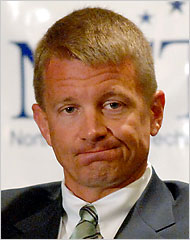
“Under federal acquisition regulations, the prosecution of the specific Blackwater individuals does not preclude the company or its successive companies and subsidiaries from bidding on contracts,” a State Department spokesperson told CBS. “On the basis of full and open competition, the department performed a full technical evaluation of all proposals and determined the US Training Center has the best ability and qualifications to meet the contract requirements.”
Representative Jan Schakowsky, who chairs the Intelligence Subcommittee on Oversight and Investigations, immediately blasted the State Department’s awarding of the contract to Blackwater. “This is a company whose cowboy-like behavior has not only resulted in civilian deaths; it has also jeopardized our mission and the safety of U.S. troops and diplomatic personnel worldwide. Instead of punishing Blackwater for its extensive history of serious abuses the State Department is rewarding the company with up to $120 million in taxpayer funds,” Schakowsky said. “I strongly believe that the former Blackwater should not be receiving further U.S. contracts, and I have repeatedly urged the U.S. government to no longer do business with this company. Though the name Blackwater has become synonymous with the worst of contractor abuses, the bigger problem is our dangerous reliance on such companies for the business of waging war.”
Earlier this year, Schakowsky and Senator Bernie Sanders reintroduced the Stop Outsourcing Security Act, which would phase out the use of private security contractors by the government. Ironically, Hillary Clinton was a co-sponsor of the legislation when she was a senator and running for president. Now, as Secretary of State, she is the US official in charge of most Blackwater contracts. Blackwater is also bidding on a contract potentially worth up to $1 billion to train the Afghan National Police.
The Grand Rapids Press and the BP Boycott
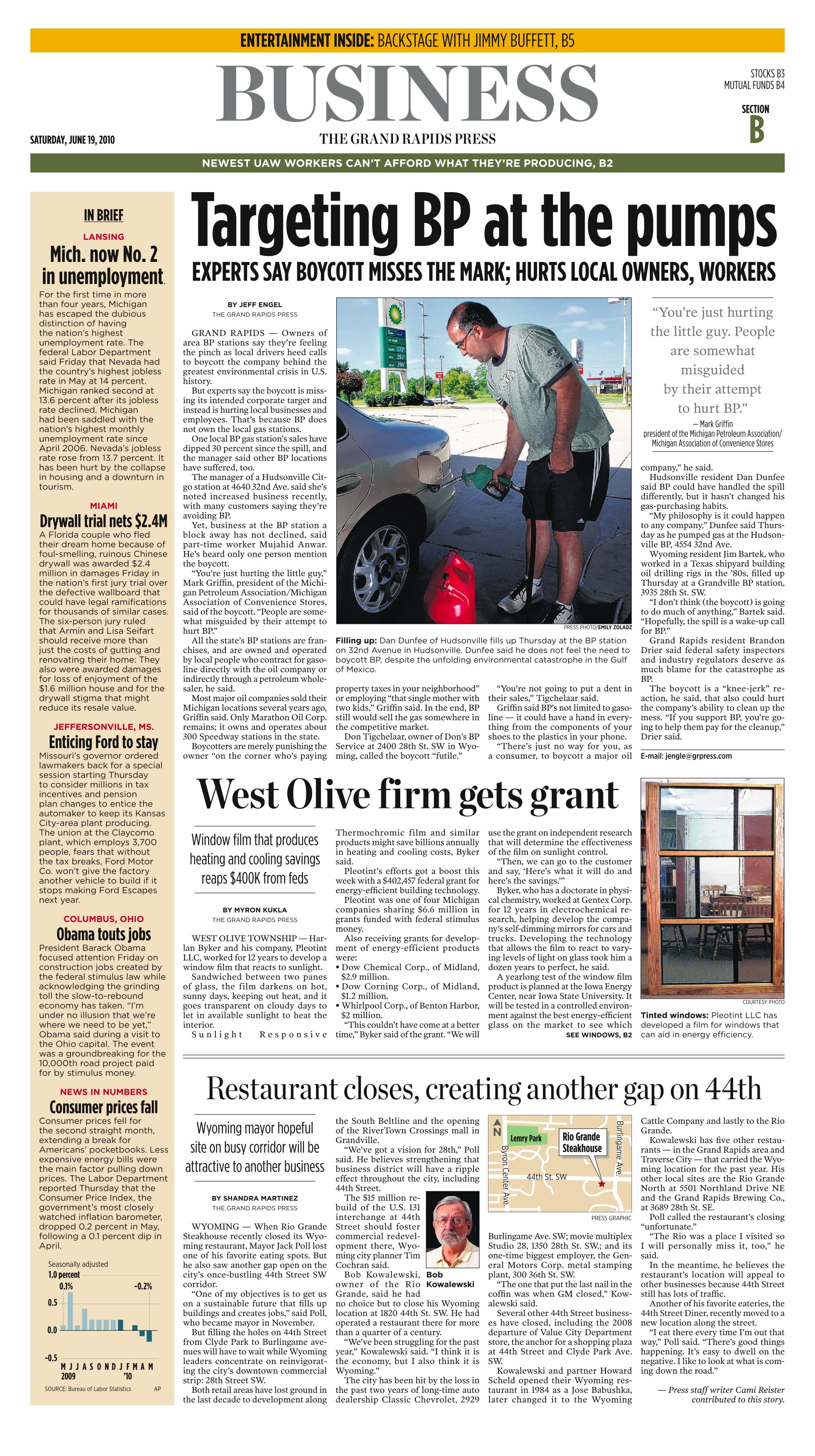
On today’s front page of the Grand Rapids Press Business section there is an article headline, “Targeting BP at the pumps: Experts say Boycott Misses the Mark; Hurts Local Owners, workers.”
With that kind of a title one might think that the Press spoke with people who have knowledge about the effectiveness of boycotts or how targeted boycott campaigns work. Instead the Press relies just one person whose credentials do not qualify them to address the effectiveness of boycotts.
The “expert” that the Press relies on is Mark Griffin, president of the Michigan Petroleum Association/Michigan Association of Convenience Stores (MPA/MACS). The MPA/MACS is essentially a business association that lobbies state legislators for the benefit of their members, which hardly qualifies Mark Griffin as an expert on this matter. He is merely defending his members, much like any business association would.
Griffin is quoted in the story as saying, “You’re just hurting the little guy. People are somewhat misguided by their attempt to hurt BP.” With such a statement one would think that the Press reporter would talk to someone who is actively involved in the boycott, at least providing readers with some balance.
However, the only other people that the Press cites in this story is a BP gas station owner and three consumers, none of which know anything about the organized boycott and therefore do not support it.

This article is another example of how the Press defends corporate and business interests, in addition to practicing poor journalism. The Press failed to report on the Grand Rapids BP boycott rally that took place yesterday in Grand Rapids and more importantly they spoke to no one who would have provided a counter perspective to Mark Griffin.
The Effectiveness of Boycotts
If the Press had bothered to practice journalism they could have found plenty of people who have participated in and organized boycotts in the past. For example in recent years the Coalition of Immokalee Workers has conducted boycotts against a variety of fast food chains in the US, like Taco Bell. Their boycott campaign was successful because it targeted locally owned restaurants.
Did these boycotts impact those individual owners and did they hurt workers? Of course they did, but that is the reality of any boycott, local business owners and workers will be impacted. However, this kind of pressure has historically forced local business owners to also pressure the corporation that is being targeted, which is the whole point of a boycott, to get consumers and other sectors of society to pressure the company that is the target of the campaign.
Other historical examples have been the grape and lettuce boycotts organized by the United Farm Workers, the Woolworth boycotts during the Civil Rights and the anti-Apartheid campaign against businesses making a profit in South Africa in the 1980s. All of these boycotts targeted local businesses that sold the products of the companies that were being targeted, which is why they were successful.
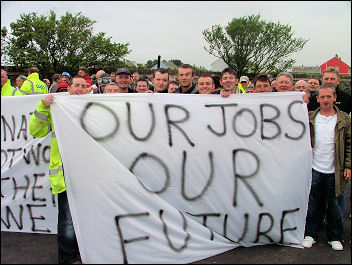
It’s official: suffering seems here to stay. For every job in America, there are six to seven workers competing for it. The unemployment rate in some Michigan cities is as high as 16 percent—and that doesn’t include all those who have exhausted their unemployment benefits months or even years ago. Michigan foreclosures on homes went up 46 percent in one year. Over one million residents here do not have any access to health insurance or affordable care.
But on the other side of the fence, take a look at the picture. Are big businesses suffering just like their workers? Quite the opposite, although they are working hard to hide that fact from the public. In February, for example, Ford announced it had $1.6 billion to retool facilities for more fuel-efficient vehicle manufacture. Its profits and “worker productivity” were up. Like many other companies, Ford is currently experiencing quarterly sales exceeding expectations. In March, its sales were up a staggering 43 percent.
But at the same time, Ford sadly announced that it wasn’t ready yet to start adding workers after having cut 47 percent of them in 2006. Blame the jobless recovery, a spokesperson said.
That term is everywhere. So what does “jobless recovery” really mean?
“Jobless Recovery” Means Exploitation of Workers
Many people who have jobs in Michigan are doing the work of two or three workers for one person’s pay. But they don’t dare complain because there’s an inexhaustible supply of fresh victims begging for a chance to take their places. Wages are stagnant, and have been for several decades. Benefits are eroding or have been cancelled completely. Pensions? A faint memory.
The creation of job scarcity—a boon to corporations—allows them to manipulate people and get them to accept working conditions that are untenable, even dangerous. And it fattens the bottom line: fewer wages are being paid out, and the work is still getting done, at a cost borne entirely by employees.
“Jobless Recovery” Means Union Busting
Earlier this year, Ford wanted its UAW workers to accept a wage freeze that would be in effect until 2015. The union rejected that demand. But GM and Chrysler workers were not so lucky. Their unions were forced last year to negotiate during the companies’ slide into supposed bankruptcy, and as a result, serious concessions were accepted.
This is only one way in which corporations are using the “jobless recovery” scenario to weaken and bust unions in this country. The scarcity of jobs in general creates an unprecedented labor pool, which is then used as a threat to unions, the traditional guardians of workers’ rights in this country. Anti-union rhetoric has notched up at the same time, making it sound like it is the unions who are responsible for the lack of jobs because of their supposedly outrageous demands for living wages and benefits.
The New York Times summed up this situation in a March 2010 article: “The declining influence of unions has made it easier for employers to shift work to part-time and temporary employees. Factory work and even white-collar jobs have moved in recent years to low-cost countries in Asia and Latin America. Automation has helped manufacturing cut 5.6 million jobs since 2000.”
“Jobless Recovery” Means Redistribution of Wealth
Representative Alan Grayson recently made the point that bank robbers can only steal as much money as a given bank holds at one time. But banks themselves have robbed the taxpayers of money they haven’t even paid into the system yet. The massive bailout that occurred under Bush and was sanctioned by Obama was the largest transfer of public money into private hands that has ever been accomplished: a crime unique in history. $12 trillion vanished right in front of our eyes.
This was the capper, at least so far, on a massive redistribution of wealth that began under Ronald Reagan. And at each point along the way, workers are promised that things will improve if they just accept the terms of the capitalists. Remember Obama’s promise that a big portion of the bailout money was going to go toward job creation? The numbers show that the Obama administration gave over 90 percent of taxpayer money to already profitable companies—with no requirement that they tell us what they did with it—and less than 10 percent for jobs programs.
Last month, 431,000 jobs were created in this country, which works out to 94 jobs per each Congressional district. All but 41,000 of those jobs were temporary census-taking positions. These are crumbs being tossed to people desperate for work and wages.
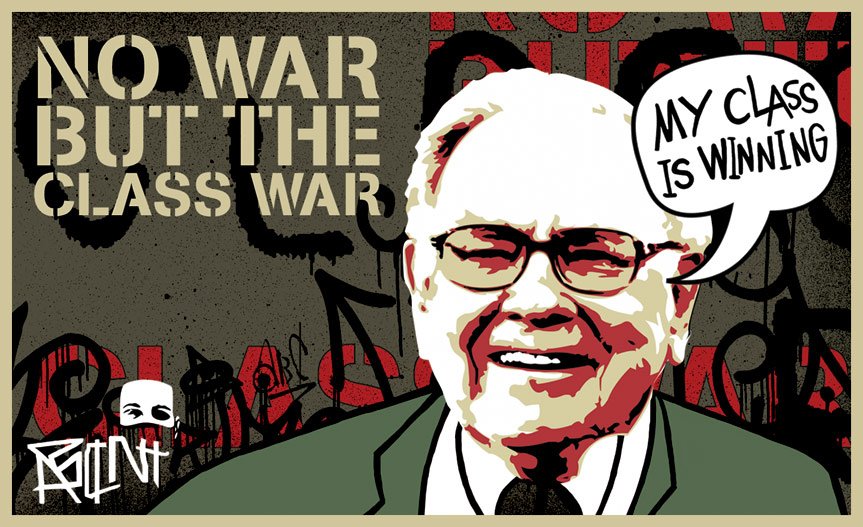
“Jobless Recovery” Means Class Warfare
Have you noticed all the economists who have started writing articles and making statements about how we’re now supposed to get used to the current poverty of jobs? Even the Obama Administration’s Department of Treasury issued a report stating that although business profits will recover by 2012, job availability will not significantly improve. In other words, we’re being told the “jobless recovery” is here to stay. Adjust your thinking. Learn to accept and scrape by.
Be sure to read these statements for what they are: declarations of victory in a war against the working class. Even Representative Dennis Kucinich admitted that, when he said in December of last year, “The class warfare is over; we lost.”
But in this battle, only one side has been fighting so far: the capitalists, as they clean out the coffers and shatter the lives of ordinary people; as they control the government with campaign contributions and lobbyists and control the message by owning the mainstream media.
It’s time for workers to get into this war and fight back together. Only by creating a new system, one that honors collective ownership and the meeting of human needs, can this battle be reversed. It’s time to stand against those who have stripped so many in this country of so much. We don’t need a so-called recovery that offers us nothing. We need an out-and-out reinvention, a revolution.
Local Rally against BP joins worldwide outcry

A small group rallied near the driveway of the Eastown BP gas station today as part of a Rally Against BP, organized by members of The Bloom Collective. The rally was staged in solidarity with hundreds of other rallies happening around the world. Goals for the rally were to promote the national boycott against BP and to challenge our social dependence on oil.
A huge number of people biking and driving by smiled, waved, honked horns and gave enthusiastic “thumbs up.” A few asked what BP was and hadn’t even realized that their local gas station was affiliated with the corporation that caused one of the most horrific man-made disasters in America’s history.
It would have been nice if some of these folks had gotten out of their cars and joined the group on the sidewalk.
While this small rally may not make any recognizable impact on the current crisis, conversations among the group and with some passersby were both informative and inspiring. Only as people come together in community can change be effected. While most of the conversation focused on the BP spill, similar catastrophes in the US, Ecuador and Nigeria and the US government’s failure to respond, we also talked about what a post-oil community could look like.
Having a vision of such a future is the first step towards arriving there.

Yesterday, the Grand Rapids Press reported that the Kentwood-based company Borisch has announced another expansion to accommodate their growth in weapons manufacturing.
The Press article focuses on the business expansion and job growth that the weapons manufacturer has announced, stating “new contracts are spurring a $7 million expansion and the addition of at least 150 jobs within two years.”
With the job market so limited in Michigan, any announcement of new jobs tends to receive news coverage. However, the Press article doesn’t acknowledge that since these are jobs based on Pentagon contracts, taxpayers are really subsidizing these new jobs.
In addition, there is nothing in the article about what Borisch makes, other than a picture of an F16 fighter jet. The company makes parts for the F16 fighter jets, combat helicopters and accuracy systems for artillery. The US sells F16s to numerous countries, including Israel, which used F16s in its bombing of Gaza last year.

Borisch doesn’t provide specific enough information on what kind of combat helicopters and artillery they make systems for, but you can bet that these weapons are also used to terrorize innocent civilians around the world.
One last piece on Borisch is there public display of an Old Testament bible verse on their company logo, Psalm 115:1. This verse reads, “Not to us, O LORD, not to us but to your name be the glory, because of your love and faithfulness.” Like other military focused businesses in the US such as Blackwater, Borisch sees no contradiction in making weapons of war and promoting biblical values.

State Representative Kim Meltzer (R-Clinton Twp.) has stated that she plans to introduce immigration legislation like that recently passed in Arizona.
Just like Arizona’s law, Rep. Meltzer’s bill would require local police to ask for the immigration papers of anyone suspected of being in the U.S. unlawfully.
Not only would such a policy invite and virtually compel racial profiling, it would force police to divert scare resources away from public safety and solving serious crimes.
Sign this petition to send a message to your state representative, state senator and Governor Granholm to urge them to reject any effort to move forward this discriminatory and unfair bill.
(This story is re-posted from the Center for Responsive Politics.)
At least seven members of Congress reported holding a minimum of $15,000 in BP stock at the end of 2009, according to a preliminary analysis of personal financial disclosure reports by the Center for Responsive Politics.

The Clerk of the House and Secretary of the Senate on Wednesday released reports covering the personal financial activities of members of Congress and their families for 2009. The Center’s preliminary investigation focused on the reports of the 20 members of Congress who reported earning income from BP holdings or owning BP stock in 2008.
Of these, the seven who reported holding more than $15,000 in BP stock were: Rep. James Sensenbrenner (R-Wis.), Rep. Rodney Frelinghuysen (R-N.J.), Sen. John Kerry (D-Mass.), Rep. Fred Upton (R-Mich.), Sen. Judd Gregg (R-N.H.), Sen. Sam Brownback (R-Kan.) and Sen. Ted Kaufman (D-Del.).
Furthermore, at least one member of Congress bought five-figures worth of BP stock in 2009, the Center’s preliminary analysis found: Rep. Vernon Buchanan (R-Fla.).
In addition to becoming politically toxic, BP stock has seen its value drop by half since April 20, when an oil rig it operated exploded in the Gulf of Mexico. The disaster has since caused millions of gallons of fossil fuels to leak into the surrounding waters.
At least one congressman who owned BP stock in 2009 said he has since sold it off.
“Senator Gregg no longer owns any BP stock,” spokeswoman Laena Fallon told OpenSecrets Blog.
Fallon did not elaborate on when or why he sold the stock.
Sensenbrenner, an heir of Kimberly-Clark, reported at least $100,000 in BP stock. (Disclosure rules only require lawmakers to reveal the value of their assets and liabilities in broad ranges, not exact amounts.) In 2008, he had a net worth of about $13 million, ranking him 30th in the House.
Spokeswoman Wendy Riemann said the congressman inherited stock in Amoco in 1978, before the company was bought by BP. He has no plans to sell it, Riemann said.
Kerry’s wife, Teresa Heinz Kerry, held a minimum of $350,000 in BP stock at the end of 2009, according to Kerry’s newly released financial report. He, himself, owns only between $1,001 and $15,000 in BP.
Kerry spokeswoman Whitney Smith said the senator has no plans to sell off his small holding in BP stock, which he inherited in a family trust.
“Senator Kerry has been the Senate’s best environmental champion for more than 25 years and has written and urged legislation to end our dependence on foreign oil,” Smith said.
Smith added Kerry’s stockholdings in BP would not impact his vote on pending legislation.
“Inherited holdings in family trusts he has no control over whatsoever clearly have no impact on his fight for a green economy and a clean environment,” she said. “Indeed, by that standard, he’s cast scores of votes against his own economic interests, and these industries have spent millions against him in political and legislative campaigns.”
The offices of Reps. Buchanan and Upton and Sens. Kaufman and Brownback did not respond to requests for comment Wednesday. Rep. Frelinghuysen’s investment in BP was discovered after business hours Wednesday, and his office could not be reached for comment.
Deconstructing Obama’s BP Speech
(This article by Anthony DiMaggio is re-posted from CounterPunch.)

Obama’s speech to the nation addressing the gulf disaster was filled with more eye candy than substance, laden with propaganda and deception. It was primarily intended to exonerate his administration for its inaction and incompetence in dealing with the worst environmental disaster in U.S. history. A close examination of Obama’s speech is in order to sort through the misinformation that’s been disseminated to the public. Below I include excerpts from Obama’s speech, interspersed with my own clarifications of his distortions and lies.
Obama: Good evening. As we speak, our nation faces a multitude of challenges. At home, our top priority is to recover and rebuild from a recession that has touched the lives of nearly every American. Abroad, our brave men and women in uniform are taking the fight to Al Qaeda wherever it exists.
AD: The “War on Terror” and attempts to combat economic troubles at home run directly contrary to each other. U.S. education and health care are in such dire straits precisely because U.S. leaders prefer to spend nearly a trillion dollars a year on militarism, while states cry poor and demand massive budget cuts that throw thousands out of work at a time when they’re at their most vulnerable. U.S. officials know that, if given the choice, the public favors cuts in military spending and a renewed focus on job creation, economic rehabilitation, and other social spending. This is why Democrats and Republicans spend so much time on fear mongering, drumming up support for indefinite war among a reluctant public.
Obama: And tonight, I’ve returned from a trip to the Gulf Coast to speak with you about the battle we’re waging against an oil spill that is assaulting our shores and our citizens.
On April 20, an explosion ripped through BP Deepwater Horizon drilling rig, about 40 miles off the coast of Louisiana. Eleven workers lost their lives. Seventeen others were injured. And soon, nearly a mile beneath the surface of the ocean, oil began spewing into the water.
Because there’s never been a leak this size at this depth, stopping it has tested the limits of human technology. That’s why, just after the rig sank, I assembled a team of our nation’s best scientists and engineers to tackle this challenge, a team led by Dr. Steven Chu, a Nobel Prize-winning physicist and our nation’s secretary of energy. Scientists at our national labs and experts from academia and other oil companies have also provided ideas and advice.
AD: It should be common knowledge that Obama has not been active in managing this crisis. The New York Times reported in April that it took until a week and a half after the onset of the spill for Obama to begin publicly criticizing BP for its negligence. The Times reported that the Department of Homeland Security took nine days to classify the incident as “a spill of national significance,” and to establish a mobile command center. The “national significance” declaration itself was absurdly conservative, considering that it was based on assessments supported by an administration that assumed the Deepwater Horizon site was spewing just 5,000 barrels a day. Realistically, the flow was probably closer to 35,000 to 60,000 barrels per day, although no one would have known this from Obama and BP’s lackadaisical response.
Obama: As a result of these efforts, we’ve directed BP to mobilize additional equipment and technology. And in the coming weeks and days, these efforts should capture up to 90 percent of the oil leaking out of the well. This is until the company finishes drilling a relief well later in the summer that’s expected to stop the leak completely.
Already, this oil spill is the worst environmental disaster America has ever faced. And unlike an earthquake or a hurricane, it’s not a single event that does its damage in a matter of minutes or days. The millions of gallons of oil that have spilled into the Gulf of Mexico are more like an epidemic, one that we will be fighting for months and even years.
But make no mistake: We will fight this spill with everything we’ve got for as long it takes. We will make BP pay for the damage their company has caused. And we will do whatever’s necessary to help the Gulf Coast and its people recover from this tragedy.
Tonight, I’d like to lay out for you what our battle plan is going forward: what we’re doing to clean up the oil, what we’re doing to help our neighbors in the Gulf, and what we’re doing to make sure that a catastrophe like this never happens again.
First, the cleanup.
From the very beginning of this crisis, the federal government has been in charge of the largest environmental cleanup effort in our nation’s history, an effort led by Adm. Thad Allen, who has almost 40 years of experience responding to disasters.
AD: This claim is not substantiated by the historical record. As mentioned above, the Obama administration preferred a “let BP handle it” response from the beginning, to the point where even liberal pundits in the corporate media attacked Obama for his unwillingness to intervene. More than a month after the onset of the crisis, White House spokesperson Robert Gibbs argued that BP had “the technical expertise to plug the hole…It is their responsibility.” When asked by a reporter if a federal government takeover of the cleanup was possible, Gibbs answered a resounding “no,” contending that the Obama administration lacked the power to play anything more than a supervisory role.
Obama: We now have nearly 30,000 personnel who are working across four states to contain and clean up the oil…As the cleanup continues, we will offer whatever additional resources and assistance our coastal states may need. Now, a mobilization of this speed and magnitude will never be perfect, and new challenges will always arise. I saw and heard evidence of that during this trip. So if something isn’t working, we want to hear about it. If there are problems in the operation, we will fix them.
But we have to recognize that, despite our best efforts, oil has already caused damage to our coastline and its wildlife. And sadly, no matter how effective our response is, there will be more oil and more damage before this siege is done.
That’s why the second thing we’re focused on is the recovery and restoration of the Gulf Coast.
You know, for generations, men and women who call this region home have made their living from the water. That living is now in jeopardy. I’ve talked to shrimpers and fishermen who don’t know how they’re going to support their families this year. I’ve seen empty docks and restaurants with fewer customers, even in areas where the beaches are not yet affected.
I’ve talked to owners of shops and hotels who wonder when the tourists might start coming back. The sadness and the anger they feel is not just about the money they’ve lost; it’s about a wrenching anxiety that their way of life may be lost.
AD: What Obama doesn’t mention when talking about his photo-op meetings with gulf coasters is that they overwhelmingly blame him for failing to control the spread of the spill when he had the chance. The American public has not been fooled by the media and Obama’s claims that they are on top of the spill. According to a USA Today poll published on June 15th, 71 percent of Americans feel that Obama “hasn’t been tough enough when dealing with BP.” According to an AP poll from June 14th, just 39 percent of the public approve “of the way Barack Obama is handling the oil spill in the Gulf of Mexico.”
Obama: I refuse to let that happen. Tomorrow, I will meet with the chairman of BP and inform him that he is to set aside whatever resources are required to compensate the workers and business owners who have been harmed as a result of his company’s recklessness.
And this fund will not be controlled by BP. In order to ensure that all legitimate claims are paid out in a fair and timely manner, the account must and will be administered by an independent third party…The third part of our response plan is the steps we’re taking to ensure that a disaster like this does not happen again.
A few months ago, I approved a proposal to consider new, limited offshore drilling under the assurance that it would be absolutely safe, that the proper technology would be in place and the necessary precautions would be taken.
AD: Obama is attempting to project a false sincerity here in terms of his alleged concern with regulating big oil. In reality, Obama came out as strongly supportive of offshore drilling by discounting the possibility of a major spill. He claimed that “it turns out that oil rigs today generally don’t cause spills…they are technologically very advanced.” When confronted with the Deepwater Horizon disaster, Obama initially plunged forward with his blind faith in BP and the “drill baby drill” mantra. Disturbingly, and as reported in the last few days, the Minerals Management Service (supervised under Obama by the Department of the Interior) approved 198 leases for oil wells following the April 20th Deepwater explosion. Americans may be appalled to know that BP was the winner for 13 of those bids.
Obama: That obviously was not the case [that drilling was safe] in the Deepwater Horizon rig, and I want to know why. The American people deserve to know why. The families I met with last week who lost their loved ones in the explosion, these families deserve to know why.
AD: For those who “want to know why” the explosion took place, the recent investigation by Rolling Stone paints a picture of an Obama administration that was blissfully ignorant of the dangers that BP was taking in pushing ahead with its production schedule at the Deepwater Horizon. As the Associated Press reports, BP documents now reveal that the company had a history of “cutting corners in the well design [at Deepwater Horizon], cementing and drilling mud efforts and the installation of key safety devices”. The company attempted to unsustainably accelerate its production schedule in an effort to save money. As the Times of London reports, “the explosion on the Deepwater Horizon…came after the well was capped with a relatively cheap type of casting…in the days before the blast, the oil giant selected a casing that provided only a single layer of protection to prevent gas from leaking into the well…the decision to use the riskier method to finish its well was taken partly on cost grounds”. Simply put, Obama should have known the dangers involved with drilling, as proper regulation of BP would have revealed the perils involved in offshore drilling. That he still wants to “know why” the oil site was dangerous is a sign more of his willful incompetence than anything else.
Obama: And so I’ve established a national commission to understand the causes of this disaster and offer recommendations on what additional safety and environmental standards we need to put in place. Already I’ve issued a six-month moratorium on deepwater drilling.
I know this creates difficulty for the people who work on these rigs, but for the sake of their safety and for the sake of the entire region, we need to know the facts before we allow deepwater drilling to continue. And while I urge the commission to complete its work as quickly as possible, I expect them to do that work thoroughly and impartially.
Now, one place we’ve already begun to take action is at the agency in charge of regulating drilling and issuing permits, known as the Minerals Management Service. Over the last decade, this agency has become emblematic of a failed philosophy that views all regulation with hostility, a philosophy that says corporations should be allowed to play by their own rules and police themselves.
At this agency, industry insiders were put in charge of industry oversight. Oil companies showered regulators with gifts and favors and were essentially allowed to conduct their own safety inspections and write their own regulations.
AD: Obama’s own blissful ignorance of the criminal recklessness of MMS employees helped set the stage for the oil spill. The sad fact is that the spill could have been avoided if MMS bureaucrats had behaved more diligently in regulating the oil companies, and if Obama would have pushed for overhauling the MMS when it mattered most – before the Deepwater Horizon disaster (for more on Obama’s complicity, see the recent piece: “How the Obama Administration Made the Oil Spill Happen”. Obama did little to rein in the MMS upon assuming office. Investigative reports find that as of late 2009, the MMS provided permission to BP and other companies to drill in the gulf without obtaining the needed permits (the Deepwater Horizon well was one of the approved sites). The MMS had a history of overruling its own scientists and engineers whenever they raised questions about the lack of safety of drilling operations in the gulf.
Obama: For decades, we have known the days of cheap and easily accessible oil were numbered. For decades, we’ve talked and talked about the need to end America’s century-long addiction to fossil fuels. And for decades, we have failed to act with the sense of urgency that this challenge requires.
Time and again, the path forward has been blocked, not only by oil industry lobbyists, but also by a lack of political courage and candor…The transition away from fossil fuels is going to take some time. But over the last year- and-a-half, we’ve already taken unprecedented action to jump-start the clean-energy industry.
As we speak, old factories are reopening to produce wind turbines, people are going back to work installing energy-efficient windows and small businesses are making solar panels. Consumers are buying more efficient cars and trucks, and families are making their homes more energy-efficient. Scientists and researchers are discovering clean-energy technologies that someday will lead to entire new industries… You know, when I was a candidate for this office, I laid out a set of principles that would move our country towards energy independence. Last year, the House of Representatives acted on these principles by passing a strong and comprehensive energy and climate bill, a bill that finally makes clean energy the profitable kind of energy for America’s businesses.
Now, there are costs associated with this transition, and there are some who believe that we can’t afford those costs right now. I say we can’t afford not to change how we produce and use energy, because the long-term costs to our economy, our national security and our environment are far greater.
AD: Obama is clearly one of the naysayers who believes the transition from a petroleum economy to a renewable one is too expensive and requires too many sacrifices. His entire foreign policy, like his predecessors, is based upon using massive military force to prop up dictators in a region that sells the U.S. cheap oil. I’ve gone through the historical record at great length regarding American officials’ admissions that foreign wars are pursued in the name of dominating global oil reserves (see my recent book, When Media Goes to War, Monthly Review Press, 2010). The U.S. spends $1 trillion a year on its military empire in order to prop up its oil economy, while spending a pittance (comparably) on renewable energies that could help wean the U.S. off of oil. Obama’s 2009 federal budget included a meager $15 billion for developing renewable energy sources. The imbalance, then, between yearly spending on the oil economy and spending on renewables is a massive 67:1. Clearly, Obama hasn’t made renewable energy the serious priority that it needs to be.
Obama: Some have suggested raising efficiency standards in our buildings, like we did in our cars and trucks. Some believe we should set standards to ensure that more of our electricity comes from wind and solar power. Others wonder why the energy industry only spends a fraction of what the high-tech industry does on research and development, and want to rapidly boost our investments in such research and development.
All of these approaches have merit and deserve a fair hearing in the months ahead. But the one approach I will not accept is inaction. The one answer I will not settle for is the idea that this challenge is somehow too big and too difficult to meet.
You know, the same thing was said about our ability to produce enough planes and tanks in World War II. The same thing was said about our ability to harness the science and technology to land a man safely on the surface of the moon.
And yet, time and again, we have refused to settle for the paltry limits of conventional wisdom.
Instead, what has defined us as a nation since our founding is the capacity to shape our destiny, our determination to fight for the America we want for our children. Even if we’re unsure exactly what that looks like, even if we don’t yet precisely know how we’re going to get there, we know we’ll get there.
AD: The glittering generalities pushed by Obama above are insulting to those who actually follow the Obama administration’s militaristic policies in the Middle East, which buttress America’s continued addiction to oil. Generic references to the greatness of the American people are the essence of propaganda, designed to satiate Americans who are susceptible to appeals to their vanity, at the expense of real discussion of America’s problems. Sadly, such appeals to American vanity are often successful in the hyper-nationalistic American political culture, which typically places arrogance above open and level-headed dialogue in times of crisis.

