(This article is re-posted from Project Censored.)

We face what appears to be a military industrial media empire so powerful and complex that truth is mostly absent or reported in disconnected segments with little historical context. A case in point: The London Times reported on June 5, 2010, that American troops are now operating in 75 countries. Has President Obama secretly sanctioned a huge increase in the number of US Special Forces carrying out search-and-destroy missions against al-Qaeda around the world? If so, this increase is far in excess of special-forces operations under the Bush administration and reflects how aggressively Obama is pursuing al-Qaeda behind his public rhetoric of global engagement and diplomacy. Somehow this information didn’t make it into the US media.
The US, in cooperation with NATO, is building global occupation forces for the control of international resources in support of Trilateralist—US, Europe, Japan— corporate profits. A New York Times report on the availability of a trillion dollars in mineral wealth in Afghanistan, on top of the need for an oil/gas pipeline from the Caspian Sea, suggests other reasons for U.S objectives in the region.
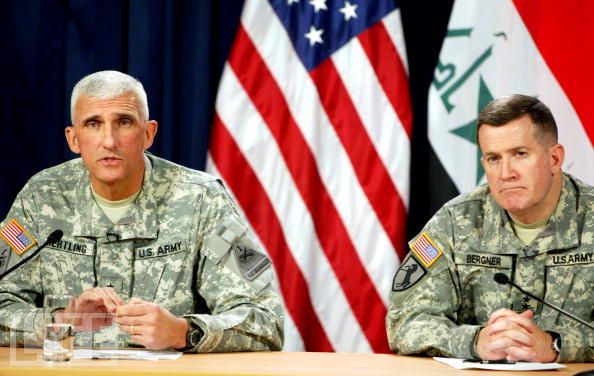
Jim Lobe of Inter Press Service writes on June 15, 2010, “The timing of the publication of a major New York Times story on the vast untapped mineral wealth that lies beneath Afghanistan’s soil is raising major questions about the intent of the Pentagon…Blake Hounshell, managing editor at Foreign Policy magazine, says that the US Geological Service (USGS) already published a comprehensive inventory of Afghanistan’s non-oil mineral resources on the Internet in 2007, as did the British Geological Survey. Much of their work was based on explorations and surveys undertaken by the Soviet Union during its occupation of Afghanistan during the 1980s.”
Given the previous reports, there is nothing new about resources in Afghanistan that the Pentagon and US multinational corporations didn’t already know. On the contrary, the public should consider whether the surfacing of this resource story is a managed-news press release being done at a time of sensitive concerns regarding NATO’s mission in Afghanistan. A deliberate news insertion such as the mineral wealth story is designed to create support for a US/NATO global empire agenda.
Managed news includes both the release of specific stories intended to build public support as well as the deliberate non-coverage of news stories that may undermine US goals. Have you been told about the continuing privatization of this global war? Independent journalist Jeremy Scahill, wrote in The Nation magazine November 23, 2009, how Blackwater (Xe) operatives in the Pakistani port city of Karachi are gathering intelligence and helping to direct a secret US military drone bombing campaign in that country.
There has not been much coverage of the report in Global Research, May 27, 2010, regarding new US capabilities for cyber warfare, announced recently by Secretary of Defense Robert Gates as the activation of the Pentagon’s first computer command and the world’s first comprehensive, multi-service military cyber operation. CYBERCOM is based at Fort Meade, Maryland, which also is home to the National Security Agency (NSA).
The US’s Israeli partner in the Middle East demonstrated a skilled manipulation of the global media’s coverage of the May 31 attack on the Gaza Freedom Flotilla. Israel controlled the news and images that emerged from the attack on the ships, asserting that the invading Israeli paratroopers were viciously attacked by crewmembers—resulting in the killing of several in “self defense.” Israel sought to divert the focus of public discussion away from the illegitimate use of excessive force against a group of humanitarians– of diverse religious and national affiliations– to the blaming of the victims for causing their own deaths.
Managed news creates a Truth Emergency for the public inside the US/NATO Military Industrial Media Empire. Deliberate news management undermines the freedom of information on the doings of the powerful military/corporate entities though overt censorship, mass distractions, and artificial news— including stories timed for release to influence public opinion (i.e., propaganda).
A Truth Emergency is the lack of purity in news brought about by this propaganda and distraction. It is the state in which people, despite potentially being awash in a sea of information, lack the power of discernment resulting in a knowinglessness about what is going on in the world. In short, we are living in a time where people do not know whom to trust for accurate information and yearn for the truth.
One antidote to the ongoing Truth Emergency is the creation of validated independent news by colleges and universities around the globe where students and professors use research skills and databases to fact check and verify information that is reported to the public. For more about this, and what we can all do to counter managed news, see Project Censored International’s new website at http://mediafreedominternational.org. Together, we can build accountability in our media and breathe life back into our withering republic.
(This article is re-posted from Environment News Service.)
 Climate change is a serious health hazard that the United States must prepare for, according to government and university scientists from across the country.
They advised Thursday that climate models show that global warming will increase air pollution and trigger more heat waves, floods and droughts, all of which will threaten human health.
“Climate change is a quintessential public health problem,” said Michael McGeehin, director of the Division of Environmental Hazards and Health Effects at the Centers for Disease Control and Prevention, an agency of the federal government.
“Heat waves are a public health disaster. They kill, and they kill the most vulnerable members of our society,” McGeehin warned. “The fact that climate change is going to increase the number and intensity of heat waves is something we need to prepare for.”
McGeehin was one of several scientists who briefed reporters on a teleconference held by the nonprofit Union of Concerned Scientists.
Climate change models show that the kind of heat waves some parts of the country have been suffering through in recent weeks will occur more often and at closer intervals, and last longer, said David Easterling, a climatologist with the National Oceanic and Atmospheric Administration’s National Climatic Data Center.
“The current spate of heat waves could be a harbinger of things to come,” he said, pointing out that from January through May, this year has been the hottest on record for global average temperatures.
Climate change could even make regions of the Earth uninhabitable, according to Matthew Huber, professor of earth and atmospheric sciences at Purdue University. His research on the effects of heat stress, reported in the Proceedings of the National Academy of Sciences, calculated the highest temperature-humidity combination that humans can withstand.
Huber’s findings show that if emissions from burning fossil fuels continue unabated, extremely high temperature and humidity levels could make much of the world essentially uninhabitable for human beings.
Over the long term, perhaps 200 or 300 years, the planet could experience an increase of average global temperatures of 10 to 15 degrees Fahrenheit.
Under that scenario, much of the world, including Australia, many Mediterranean countries, and parts of Africa, Brazil, China, India and the United States, would be so hot and humid that people would not be able to survive outside during heatwaves for more than a few hours.
“We can still decide to try to avoid that” by dramatically reducing the heat-trapping emissions that cause global warming, Huber said. “And from our calculations, it is something we should try to avoid.”
Jonathan Patz, director of global environmental health at the University of Wisconsin, Madison, said that while climate change is a health threat, tackling it is a major public health opportunity.
He pointed out that the World Health Organization reports about one million people annually die prematurely from air pollution. He says that cutting global warming emissions also would reduce certain kinds of pollution, especially ground-level ozone.
“If we can reduce air pollution,” Patz said, “we can save lives.”
Patz’s latest research found that cutting down on the number short car trips and reducing the number of miles driven by about 20 percent would save hundreds of lives, avoid hundreds of thousands of hospital admissions, and save billions of dollars in healthcare costs in the Midwest alone.
If drivers got out of their cars and either walked or rode a bicycle, Patz added, “we could probably double those health care cost savings.”
Climate scientist Brenda Ekwurzel with the Union of Concerned Scientists, who moderated the press briefing, noted that addressing climate change is not all about saving polar bears and other faraway creatures and habitats.
“More and more, studies demonstrate that the health care impact and health care costs related to climate change,” she said, “are directly related to us.”
This Tuesday, July 13 (7pm), the City of Grand Rapids will be holding a public hearing on the proposal to change the current city ordinance, which does not allow residence to have chickens. The public hearing will be held at City Hall on the 9th floor and people who are supportive of having chickens in the city should attend.
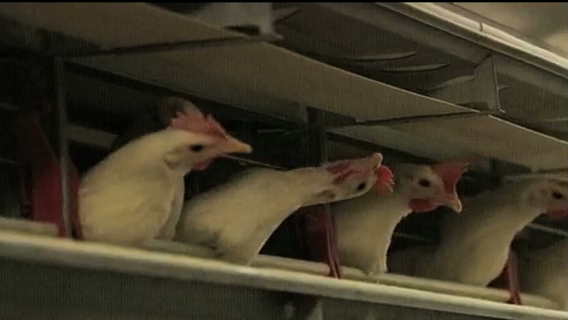
Some of those who oppose the ordinance change have already expressed their opposition and are likely to be present again on Tuesday. The main opposition so far, according to a few City Commissioners we have spoke with is from Herbrucks, a large egg producer based in Saranac, MI. (This picture shows how chickens “live” at the Herbrucks facility.)
We reported last year that Herbrucks was part of public relations campaign designed to promote Michigan agri-business, a campaign that was backed by the Center for Food Integrity (CFI). CFI is a food industry front group that was created in 2007 in order to counteract the influence that Eric Schlosser’s book Fast Food Nation had on public opinion.
It should come as no surprise that a company like Herbrucks would fight against such an effort to allow Grand Rapids residents to have chickens on their property, since they would see this as a threat to their profits.
However, City Commissioners told us that so far they have heard more from opposition than they have from those in favor. There is a well-organized campaign to change the ordinance, a campaign that held numerous meetings with some City Commissioners. Their proposal is simple:

“The City of Grand Rapids should amend the current ordinance(s) to allow for the raising and owning of laying hens. Specifically we ask that the ordinance(s) be amended such that:
1) laying hens no longer categorized as “livestock” which are currently banned from the city
2) laying hens be treated with all the same rights and restrictions as other allowed animals or pets (i.e. cats and dogs which do not require inspection by the housing department nor permission from neighbors)”.
There is a growing list of cities across the country, that allow residents to have chickens and there are numerous cities that are currently debating the topic. If Grand Rapids is to join the list of those which favor chickens in an urban setting then people will need to either contact City Hall in the next few days or show up in big numbers on Tuesday to demonstrate the idea has popular support.
Fifa Forbids Free Speech At World Cup Fan Fest
(This article is re-posted from ZNet.)
Acting against our alleged ‘ambush marketing’ and ‘incitement’ (sic), the South African Police Service, newly augmented with 40,000 additional cadre for the World Cup, detained several of us here in Durban last weekend.

We were simply exercising freedom of expression at our favorite local venue, the South Beach Fan Fest, whose half-million visitors is a record.
Wearing hidden microphones so as to tape discussions with police leadership, what we learned was chilling, for they have received orders from Durban City Manager Mike Sutcliffe that the property rights of the world soccer body, the Fédération Internationale de Football Association (Fifa), overrule our foundational Constitutional rights.
“We can charge you and detain you until the 11th of July, [when] Fifa is over!,” a top officer shouted at me during my second interrogation, on Saturday.
Sutcliffe is preparing a draft bid for Durban to host the 2020 Olympics, to present to the International Olympics Committee soon after the World Cup final in Johannesburg on Sunday night. Durban is the lead candidate from South Africa due to its warm August winter, sea-level location and recent construction of athletic facilities throughout a sports precinct stretching across from the new $390 million Moses Mabhida Stadium to the ‘Golden Mile’ beachfront..
The Durban Social Forum has come out against an Olympic Bid ‘which will create yet more debt and inequality’, given how much damage Fifa has done to the city’s poor and working people, the economy and the environment – damage not successfully offset by high national pride and profits for a few South African elites.
One barrier to a successful Olympic Bid, we hope, is the perennial, growing concern about the city’s commitment to democracy, solidarity and sovereignty.
To illustrate, my University of KwaZulu-Natal colleague Baruti Amisi, a Congolese refugee, received this email reply from Sutcliffe to a polite request for use of City Hall steps for last Saturday’s anti-xenophobia rally: “It appears you are not a South African and are clearly uninformed about the role of Fifa. In brief, we are an independent country and except for the stadium precinct, Fifa have no role in running the city.”
That’s not true, because even before the World Cup began in June, South African police were investigating an extraordinary 50,000 incidents of ambush marketing well beyond stadium areas. Fifa’s copyrighted protection of even place names (e.g., ‘Durban 2010’ on merchandise) was used to charge non-sponsors penalties in the range of $30,000 in the event that for-profit product sales mentioned Fifa’s monopolized terminology.
But this protection also extends into non-profit terrain, as we learned on Friday. Indeed, several incidents illustrated the clash of society and police authority that night. In the country’s fifth-biggest city, Port Elizabeth, hotel heiress Paris Hilton appeared in court for being in the vicinity of a friend smoking marijuana. Oops.
In Johannesburg, ten hawkers were arrested near Soccer City: “Some were trading in goods that they did not have permit to sell while others had no permit at all to sell at the stadium,” according to a police superintendent. These survivalist-entrepreneurs now will pay $200 (half their typical monthly earnings) to have confiscated goods released.
Here in Durban, the next day’s anti-xenophobia rally was considered an important way to generate consciousness, networking solidarity and concrete plans for safety in the event of a repeat of the May 2008 attacks. We thought that because Ghana was playing Uruguay later that night, the Fan Fest was an excellent place to draw upon African ubuntu spirit and welcome soccer fans into solidarity activism.
Getting Sutcliffe’s permission for the rally was, as ever, like pulling teeth. The police were informed in writing on June 19 but it was only on Friday afternoon before rally approval was granted to a coalition that included the KwaZulu-Natal Refugee Council (which Amisi heads), the Diakonia progressive church alliance, the Durban Social Forum and our Centre for Civil Society.
A group quickly brought 1000 fliers to the beach to let people know, handing out the information at half-time during the Netherlands-Brazil game. Minutes later, visiting doctoral candidate and filmmaker Giuliano Martiniello, research student Samantha Sencer-Mura and I were accused of ambush marketing and incitement, and dragged off to the nearest police station.
Indeed, I was detained for hours during both Friday’s and Saturday’s early games’ half-times, missing (thank goodness) the pain of seeing my favourite Latin American teams clobbered by Europeans. The top-heavy security force included police generals, Crime Intelligence, the Commercial Branch and even the National Intelligence Agency.
I’d gone back the next day with a pamphlet about free speech, to test whether the police really would lock me up for days simply for exercising Constitutional rights.
All of us are, of course, lovers of World Cup soccer and haters of Fifa, like most people who give this distinction a moment’s consideration.
The Zurich crew will take home $3.2 billion in profits, pay no taxes, ignore exchange controls, trickle nothing down, commercialize all aspects of the game, copyright words like ‘World Cup’, overcharge for everything, declare ‘exclusion zones’ that stretch for miles, muffle journalists with no-criticism accreditation requirements, and trample on our freedom of expression.
(If you don’t care about these issues because you’re a soccer purist, never mind, you’ll still join the many bitter players and fans who believe Fifa president Sepp Blatter’s main legacy is the quaint refusal – or, hinted Lord David Triesman of the English Football Association a few weeks ago, bribe-friendly tactic?, following which Triesman was forced to resign – to adopt ‘goal-line technology’. Photographic and communications equipment is direly needed to correct repeated and often egregious referee errors, nearly every observer agrees. Blatter instead, apparently, focuses all Fifa’s camera-power on potential ambush-marketers in the crowd.)
Illustrating how constrained our rights are, I asked one police superintendent (name withheld), “What if I say ‘Viva Argentina!’ in the fan park? No problem? What if I say ‘Phansi Fifa phansi!’?” (Down with Fifa!)
“Then you’re wrong,” the policeman answered. “You can’t say, ‘Phansi Fifa phansi’.”
Sutcliffe’s control fetish appears to be the central barrier. As a police superintendent put it, “He’s the one who has instructed us that we must enforce. He comes in our meetings.”
“And what does he say?,” I asked. “He says he doesn’t want any anti-xenophobia?”
Replied the police superintendent, “No distribution of pamphlets, especially which mention xenophobia.”
Ah, the underlying problem had emerged. The reason the pamphlet was banned was not just procedural, it was political.
The police superintendent continued: “You are reminding [people] of xenophobia. Even myself I had forgot about that thing, but now you write it down.” (He was referring to Friday’s pamphlet.)
“Do you think it is not a problem?,” I asked.
Surely Durban police know that a city councilor – Vusi Khoza of the ruling African National Congress (ANC) – is among those still being tried for the January 2009 murders of a Tanzanian and Zimbabwean, and that the streets and worksites are thick with tension and insults against immigrants and refugees. (Last November, during one of the injured victims’ testimony, Khoza reportedly laughed as the Zimbabwean described a fall of six floors from a window he was pushed from, landing on his two friends’ corpses, for they had not survived the attack.)
The senior police officer’s rebuttal: “It happened. Then government stopped it there.”
“I’m sure you know that Jacob Zuma said xenophobia’s a problem,” I rebutted. After all, when meeting his African National Congress (ANC) national executive in May, “President Zuma said the ANC branches must work against xenophobia,” I reminded the superintendent.
“There is no xenophobia”, he insisted – but nervously.
Such denialism parrots leading ANC spokesperson Jackson Mthembu’s extraordinary written statement earlier that day: “The reported xenophobic attacks by South Africans on foreign nationals, particularly from the African continent, after the conclusion of the 2010 Fifa World Cup in South Africa, is baseless and without any rational” (sic).
Added ANC National Chairperson, Baleka Mbethe, “These reports are irrational have no basis whatsoever” (sic).
And yet the army is now occupying the town of Denoon not far from Cape Town, precisely because threats could explode into 2008-type violence. A steady stream of new refugees has been pouring out of many Cape Town and Pretoria townships in search of safety over the past week, fearful of what may happen on July 11 at 10:15pm, when the last game comes to an end.
Aside from xenophobia, an overarching problem of civil and political rights for South Africans was also evident from our discussions with police. For behind Sutcliffe’s arrogance in declaring such a large Constitution-free geographical zone, was the Constitution drafters’ own ambiguity: our Bill of Rights – considered amongst the world’s most progressive – is potentially interpreted as allowing corporate property rights to trump human rights. Section 8(4) gives foundational rights to ‘juristic persons’, i.e., institutions including for-profit businesses like Fifa.
In 1996, alongside former ANC Member of Parliament Langa Zita and Darlene Miller (a sociologist at the Human Sciences Research Council), and aided by US citizens’ advocate Ralph Nader, we formally warned a Constitutional Court certification hearing that this provision could “undermine the constitutional rights of natural persons to freedom of expression, freedom of association in organs of civil society, access to information, the rights to life, security of the person, and a safe environment.”
So it seems we were right, sadly. Likewise, in the US, a similar degeneration of political rights occurred this year when the Supreme Court lifted limits on corporate spending to influence elections. In the US, the increasingly important group Nader cofounded, Public Citizen (led by Robert Weissman), is tackling the ‘Citizens United’ case and its implications, but we have not yet developed such strong anti-corporate sensibility here in South Africa.
Indeed, according to professors Chris Roederer and Darrel Moellendorf – in their 2004 book Jurisprudence – our 1996 case against corporate rights is an example “of the law serving to stabilize capitalist property relations” because “the final Constitution contains no assurance that when the rights of juristic persons conflict with those of natural persons, the rights of the latter shall prevail.”
On the other hand, the 1996 Constitutional Court ruling against us did at least concede that section 8(4) “recognises that the nature of a juristic person may be taken into account in determining whether a particular right is available to such a person or not.”
That’s why the stance of the City Manager and his police honchos is so counter-revolutionary, against the ANC’s professed democratic values. The right to inform South Africans and visitors about a municipally-approved xenophobia rally during a halftime break surely should be declared a ‘particular right’ overriding Fifa’s exclusions, given how much is at stake.
If they don’t come to their senses, will we again face police detention as we leaflet the Fan Fest and stadium crowds demanding, firstly, our Constitutional rights restored; secondly, that Fifa finance some new township soccer pitches before they leave town with all that cash; and thirdly, that they adopt goal-line technology, already!?
Patrick Bond directs the UKZN Centre for Civil Society, which has a World Cup Watch and anti-xenophobia project, at http://www.ukzn.ac.za/ccs
What We Are Reading
Below is a list of books that we have read in the past month. The comments are not a review of the books, instead sort of an endorsement of ideas and investigations that can provide solid analysis and even inspiration in the struggle for change. All these books are available at The Bloom Collective, so check them out and stimulate your mind.
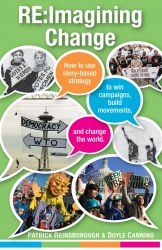
Re:Imagining Change: How to use story-based strategy to win campaigns, build movements, and change the world, by Patrick Reinsborough & Doyle Canning. An excellent resource for people working on social justice issues that discusses the importance of framing and ways to communicate what you are doing with campaigns or actions in your community. This book is based on the work of the smartMeme and has several case studies of social change campaigns that have worked because of good story-based strategies.

Self-Defense for Radicals: A-Z Guide for Subversive Struggle, by Mickey Z. This was a delightful little booklet put together by longtime activist and radical historian Mickey Z. Along with cartoon illustrations, this booklet provides not only humorous, but practical self-defense tips through the lens of radical, political activist. It may save your life, protect you from cops or just make you laugh.

No Rain in the Amazon: How South America’s Climate Change Affects the Entire Planet, by Nikolas Kozloff. If you ever thought that all you needed to do in the fight against global warming was take care of matters in your own community, then this book will smash those illusions. Kozloff provides readers with a ton of evidence and examples of how protecting the Amazon from further deforestation and contamination should be part of our struggle for survival. Another thing that makes this book so important is the fact that some of the current deforestation in the Amazon is due to corporate and government projects that promote bio-fuels. Must reading for anyone concerned about climate justice.
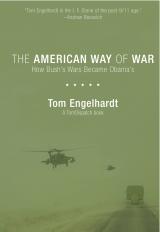
The American Way of War: How Bush’s Wars Became Obamas, by Tom Engelhardt. Tom Engelhardt, editor of Tom’s Dispatch, has done a wonderful job of providing some detailed analysis of the recent history of US intervention abroad. Engelhardt helps us all see the smooth transition from the Bush administration to the Obama administration and how there has been little difference in foreign policy, besides the rhetoric. A useful resource for anti-war activists and anyone concerned with imperialism.
Shop ‘Til You Drop The Crisis of Consumerism, by the Media Education Foundation. Are we too materialistic? Are we willfully trashing the planet in our pursuit of things? And what’s the source of all this frenetic consumer energy and desire anyway? In a fast-paced tour of the ecological and psychological terrain of American consumer culture, Shop ‘Til You Drop challenges us to confront these questions head-on. Taking aim at the high-stress, high-octane pace of fast-lane materialism, the film moves beneath the seductive surfaces of the commercial world to show how the flip side of accumulation is depletion — the slow, steady erosion of both natural resources and basic human values. In the end, Shop ‘Til You Drop helps us make sense of the economic turbulence of the moment, providing an unflinching, riveting look at the relationship between the limits of consumerism and our never-ending pursuit of happiness.
Government Bans Reporters in Gulf
(This article is re-posted from PRwatch.)

The U.S. Coast Guard put in place a new rule slapping journalists with felony charges, a $40,000 fine and one to five years in prison for coming too close to oil spill clean-up efforts without permission. Anderson Cooper of CNN says the new rule makes it “very easy to hide incompetence or failure.”
The Coast Guard rule prohibits vessels from coming within 20 meters (65 feet) of booming operations, boom or oil spill response operations “under penalty of law.” But since oil spill cleanup operations are being conducted on most of the beaches, the rule bans reporters from just about everywhere they need to be.
The new rule contradicts a statement made by Coast Guard Admiral Thad Allen in June, when he promised that “Media will have uninhibited access anywhere we’re doing operations, except for two things — if it’s a security or safety problem.” Anderson Cooper, commenting on the new rule, said ‘”Those of us down here trying to accurately show what is happening — we are not the enemy. I’ve not heard about any journalist who’s disrupted relief efforts; no journalist wants to be seen as having slowed down the cleanup or made things worse. If a Coast Guard official asked me to move, I’d move. But to create a blanket rule that everyone has to stay 65 feet away from boom and boats, that doesn’t sound like transparency.”
Author Challenges Green Capitalism
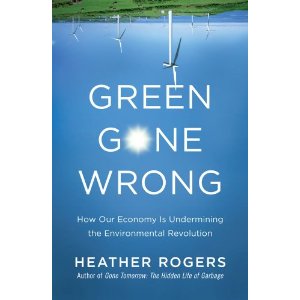
In this short video, Heather Rogers, author of Green Gone Wrong: How Our Economy is Undermining the Environmental Revolution, briefly discusses what is problematic with so-called green consumerism. Rogers book is one of the best critiques of Green Capitalism in recent years.
Cap & Trade Satire – Cheat Neutral
While most of us are enduring the current heat wave, we thought that sharing this video might help cool you down a bit. A couple of guys in England have come up with the idea of Cheat Neutral, where you can make yourself feel better about cheating in a relationship by paying them to make sure other people will remain faithful. This creative satire exposes the absurd notions behind carbon trading, what is known as Cap & Trade.
Eco-driving?
Yesterday, I was at the downtown Secretary of State office and since it is an unspoken requirement to wait, I had the opportunity to watch the wonderful programming on the TV monitor that everyone is subjected to.

It makes sense to run informational pieces about voter registration and other services that the Secretary of State offers, but the rest of the programming was nothing more than propaganda pieces.
Eco-driving
One of the spots that were running on the Secretary of State TV monitors was an ad promoting what was called eco-driving. Eco-Driving USA is a project by 11 automobile companies that is trying to win back some public confidence by promoting some “eco-friendly” driving tips.
The tips they offer are things that the industry as been promoting for years, but once you call them green or eco-friendly, then it seems more important. Some of the tips include keeping your tires inflated, gradual stops and starts, use cruise control and plan your trips ahead of time. While individual motorists might save a little on gas costs, these tips are not really designed to promote sustainability in any meaningful sense.
First, let us remember who is behind this – the auto industry. The auto industry is one of the most powerful lobby sectors in Washington and has fought the federal government for decades to limit any kind of regulation that would call for serious fuel efficiency standards. The auto industry has spent over $142 million in the past 20 years to influence federal policy.
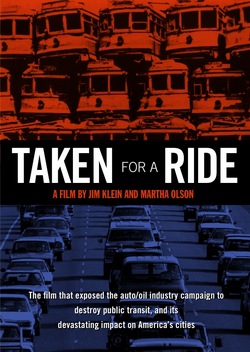
The auto industry has also was a major player in destroying much of the mass transit this country had between the 1920s & 40’s (see Taken for a Ride). This was an actual conspiracy by General Motors and the Firestone Tire Company to buy up most of the mass transit in order to force people to buy cars. The US Justice Department actually fined the companies for this criminal conspiracy, but the fines were only $5,000 per company, a mere drop in the bucket to the billions they have made.
Second, the tips the auto industry is suggesting will not reduce the amount of car manufacturing, driving, road construction, car crashes, automobile deaths, and parking lots that car ownership perpetuates. In essence, the eco-driving tips they offer are a best a band-aide to the world’s environmental problems, but more likely a distraction from more systemic changes.
Third, real eco-driving would involve riding bicycles or the use of mass transit. However, these tips are not included from the auto industry, since both bicycle use and mass transit would have a negative impact on their profits. Profits, as we all know, is the bottom line in terms of what motivates the auto industry, not safety or environmental protection.
Finally, it should be mentioned that maybe the reason that the Secretary of State’s office was running this promotional piece for the auto industry is because Governor Jennifer Granholm can be found on the Eco-driving USA website (click on the state icon).
Granholm touts the same kinds of tips for drivers as the website does and adds one of her own tips – “when you are not using the golf clubs take them out of the trunk of your car to lighten the load.” If one needed further evidence that Granholm is more interested in supporting the auto industry than working people, that statement should be added to the list.
(This Media Release is from the ACLU.)

The U.S. Department of Justice (DOJ) filed a lawsuit today challenging Arizona’s recently enacted racial profiling law known as SB 1070. In taking this extraordinary action, the federal government has sent a clear message that it will not tolerate state laws that invite racial stereotyping and profiling and interfere with federal immigration priorities and policies.
The American Civil Liberties Union, along with a coalition of leading rights groups, filed a lawsuit in May challenging the constitutionality of the law. The civil rights coalition includes the ACLU, MALDEF, National Immigration Law Center (NILC), Asian Pacific American Legal Center (APALC) – a member of the Asian American Center for Advancing Justice – ACLU of Arizona, National Day Laborer Organizing Network (NDLON) and the National Association for the Advancement of Colored People (NAACP). The law firm of Munger, Tolles & Olson LLP is serving as pro bono co-counsel in the case.
The following statements can be attributed to members of the coalition, as listed below.
Lucas Guttentag, Director of the ACLU Immigrants’ Rights Project:
“We commend the Obama administration for taking this critical step to negate Arizona’s unconstitutional usurpation of federal authority and its invitation to racial profiling. The administration’s lawsuit is a cannon shot across the bow of other states that may be tempted to follow Arizona’s misguided approach. We will continue to aggressively pursue our legal challenge and welcome the Justice Department’s participation in the battle to preserve American values of fairness and equality.”
Linton Joaquin, General Counsel of NILC:
“States planning to follow in Arizona’s misguided footsteps should take note: the United States cannot and should not allow immigrants and communities of color to be targets of hateful racial profiling legislation that puts their civil liberties on the line. We are pleased to see that the government has exercised its legal right to protect the rights of those within its borders and ensure that federal issues remain squarely in the federal domain.”
Alessandra Soler Meetze, Executive Director of the ACLU of Arizona:
“The Obama administration’s action against this ‘show me your papers’ law sends a loud and clear message against state laws that institutionalize racial profiling of Latinos and result in an erosion of trust between law enforcement and the community. There has been a long history of racial profiling of Latinos in our state, particularly in Maricopa County, causing witnesses and victims of crime to be less willing to come forward. We will fight vigorously to keep this law from going into effect, and welcome the administration’s efforts toward the same goal.”
Julie Su, Litigation Director, Asian Pacific American Legal Center, a member of Asian American Center for Advancing Justice:
“We welcome the Department of Justice’s action against Arizona’s law that invites racial profiling of anyone who might be perceived as being foreign, including Asian Americans. We hope the DOJ’s challenge to this discriminatory law signals a willingness on the part of the federal government to address the myriad ways that our country’s broken immigration system affects Americans and those who seek a better life by coming to America. We need federal action to prevent more cities and states from introducing copycat measures that violate core American values of fairness and equality.”
Chris Newman, Legal Director, NDLON:
“The Department of Justice has the legal and moral obligation to challenge SB 1070, not just to protect civil rights in Arizona but also to defend the federal government’s exclusive authority to define and implement United States immigration policy.”
Benjamin Todd Jealous, President and Chief Executive Officer of the NAACP:
“In filing this lawsuit, the Obama administration has taken a strong and principled stand against Arizona’s discriminatory law. African-Americans have the misfortune of being all too familiar with the pernicious effects of racial profiling, and we welcome the addition of the administration to the broad spectrum of organizations already challenging this unconstitutional law. Laws that encourage discrimination have no place in this country. We are confident that the courts will prevent it from ever taking effect.”
Organizations and attorneys on the case, Friendly House et al. v. Whiting et al., include:
ACLU Immigrants’ Rights Project: Guttentag, Omar Jadwat, Cecillia Wang, Tanaz Moghadam and Harini P. Raghupathi
MALDEF: Thomas A. Saenz, Nina Perales, Cynthia Valenzuela Dixon, Victor Viramontes, Gladys Limón, Nicholás Espiritu and Ivan Espinoza-Madrigal
NILC: Joaquin, Karen Tumlin, Nora A. Preciado, Melissa S. Keaney, Vivek Mittal and Ghazal Tajmiri
ACLU Foundation of Arizona: Dan Pochoda and Annie Lai
APALC: Su, Ronald Lee, Yungsuhn Park, Connie Choi and Carmina Ocampo
NDLON: Newman and Lisa Kung
NAACP: Laura Blackburne
Munger Tolles & Olson LLP: Bradley S. Phillips, Paul J. Watford, Joseph J. Ybarra, Susan T. Boyd, Yuval Miller, Elisabeth J. Neubauer and Benjamin Maro
Roush, Mccracken, Guerrero, Miller & Ortega: Daniel R. Ortega, Jr.
More information about the Arizona law, including an ACLU video and slide show, can be found at: www.aclu.org/what-happens-arizona-stops-arizona

