Media Bites – Cars and Freedom

In this week’s Media Bites we take a look at a recent commercial from the Dodge car company. The ad wants viewers to equate their vehicles with political freedom and use a re-creation of a battle from the Revolutionary War to illustrate this point.
The big difference with this battle scene is that George Washington is driving a Dodge Charger instead of a horse. The reality is that car dependency in this country has not really brought us more freedom. The social, political and ecological consequences have been devastating.
However, it is important that people understand that the shift away from mass transit systems in the 1920s was due mostly to an effort by General Motors and the Firestone Company to buy up urban trolley systems as is well documented in the film Taken for a Ride.

Today, we interviewed Stephanie Sandberg, Calvin College Professor and playwright of the important work Seven Passages: The Stories of Gay Christians.
Stephanie’s new play entitled lines: the lived experience of Race was the subject of our interview. We discussed her motives for exploring the issue of racism in Grand Rapids, what she learned from the process, how racism manifests itself in today’s Grand Rapids and her hopes for this new work to contribute to the necessary dialogue that needs to take place for racial equality to truly exist in this community.
For information on the dates & times for the public performances, check out Actors Theater.
The 3rd Congressional Race and political labels
Today the Grand Rapids Press and MLive have a story about a group of traditional GOP supporters who are backing a Democrat for the 3rd Congressional race.

The Press lists the 50 people who have decided to back Democratic candidate Patrick Miles Jr. over the Republican candidate Justin Amash. Reporter Jim Harger states, “The campaign of Miles, a Grand Rapids resident, is hoping the endorsements will position him as a centrist while labeling Amash, of Cascade Township, as a conservative ideologue who would lack influence in Washington if elected.”
The premise of the article is that the Miles campaign trying to present their candidate as a moderate and Amash as an extremist. Several people cited in the story make these claims, but there is virtually no information or verification of these claims in the article.
The only statement that provided readers with any sense of what either candidate’s politics are was a response from the Amash campaign to the announcement of the GOP endorsements of Miles. “Most 3rd District voters are not looking for a candidate like Pat Miles who is pro choice and supports higher taxes, government-run health care and out-of-control spending.”
A reasonable response from any competent journalist would have been to verify such claims, but the Press reporter doesn’t bother to look at the platform of Miles to see if he is pro choice, supports higher taxes and a government run health system.
Instead the Press reporter just provides comments from traditional GOP voters who are now endorsing Miles. Instead of just accepting the claims made by either campaign the Press reporter should have called into question the claims and provided readers with information to help the public determine what the platform and voting record of Amash actually is in order to determine if his views are “extreme.”
The fact is that neither candidate provides many details on where they stand on key issues and this is what the Press should be pursuing. What good does it do for the public to get coverage of an election that is centered around labels? While it is clear that political campaigns are always trying to paint their opponents as too liberal, too conservative or moderates, these labels are meaningless unless we can make clear determinations on where they stand on the issues.
Power Politics in West Michigan
Over the past few days some of us who write for GRIID were reporting on the West Michigan Regional Policy Forum held in Grand Rapids. The commercial media referred to this gathering as group of businessmen with “West Michigan values.”

Now, I don’t know about you, but I am never really sure what anyone means when they say West Michigan values. One could argue that they mean Christian Reformed Church values, but that surely only represents a certain sector of those who reside in West Michigan.
For this writer, those gathered at the West Michigan Regional Policy meeting represented local economic and political elites – CEOs, lawyers, people who are board of directors, politicians and investors. These people do not represent West Michigan values, they represent the values of people who have a great deal of power and want to increase that power or at a minimum maintain their current levels of power.
The goals of the group are pretty clear. They want to influence regional and state policy to benefit their interests. The goals they have laid out are to cut taxes to businesses, eliminate government regulation of business, privatize more of the public sector (such as education) and make Michigan a right-to-work state.
The West Michigan Regional Policy Forum plans to achieve these goals the old fashion way. To manipulate public opinion and to pay for politicians that will represent their interests.

To manipulate public opinion the group brought to their gathering Rick Berman, a man who has represented corporate interests for decades. Berman creates what are called Front Groups (in some circles Astroturf groups) that pose as grassroots entities in order to manipulate public opinion and often the news media into thinking they are an independent grassroots entities.
The truth is that Berman’s front groups have been financed by the tobacco industry, the alcohol industry, agribusiness, the animal cruelty industry and in general corporate America through his anti-union front groups. Berman was in West Michigan to help the local elites to figure out how to get the public to support a right-to-work policy.
Besides bring political assassins like Berman to town the group made it painfully clear that they were going to financially back candidates that embraced their agenda. Peter Seechia and Doug DeVos both made that perfectly clear in their comments to those gathered for the two-day forum.
Part of the packet that they provided to the 600 plus in attendance was a voter guide with a list of endorsed candidates throughout West Michigan. On day two the forum began with a Q&A session with gubernatorial candidates Rick Snyder and Virg Bernero, which was a pretty impressive feat considering that up to that point the candidates had not really appeared together (besides a mid September Town Hall that Snyder held where Bernero just showed up).
What the policy group was doing was vetting the two candidates to see which would be more loyal to their agenda. Both candidates argued that they were more “business friendly” than the other and neither of them really disagreed with the platform of the group except on one issue. Both candidates did not support making Michigan a right-to work state.
Now imagine for a second if candidates for the highest office in the state were to fight and argue which one was more committed to working people, racial justice, immigrants, protecting the environment, seriously reducing carbon emissions, health care as a right, mass transit and supporting reproductive rights for women. You can imagine it all you want but this reality does not exist in the US for two main reasons.
First, people who are fighting for economic justice, racial equality, mass transit, health care as a right, reproductive rights and environmental sustainability are not organized well enough to command the attention of political candidates. They clearly do not have the capital to influence these candidates and more importantly they do not have enough political power to demand change.

The second reason why we can’t imagine candidates fighting to be the best representatives for these movements is because they don’t have to. Unions, women’s groups, environmentalists and other grassroots sectors overwhelmingly will vote for Democrats and not really demand anything in return, thus leaving Democrats free to continue to support business as usual.
The Grand Rapids Press ran an AP article on September 18 that summed up this mentality quite well. The headline read: “Dems tell voters: You may hate us, but GOP is worse.” The whole article was about the Democratic Party’s main message between now and the November elections, which was essentially that they don’t represent people’s interests, but at least they aren’t as bad as the Republicans. Now that is a campaign message we can really rally around now isn’t it?
What we ought to consider and what has always made a difference in this country is creating autonomous movements that are not tied to political parties. The abolitionist movement, the women for an 8-hour work day, the civil rights movement, the feminist movement and many other movements that have actually achieved change were not beholden to political parties. Something to consider as we watch candidates jockey to win approval from the business class.
Michigan shortfalls in education a concern for business leaders
(This is one of several articles that GRIID will post over the next few days based upon our attendance at the West Michigan Regional Policy Forum.)
Dr. Shirley Robinson Pippins works as the senior vice president of programs and services for ACE, the American Council on Education. ACE lobbies for the interests of campus executives and leaders of higher education “in matters of public policy in Washington, DC, (the location of its offices) and throughout the nation.”
Pippins was a good choice for the assigned topic, “Making Michigan Globally Competitive, Cradle through Multiple Careers.” She began her career working in Headstart programs, including one here in Grand Rapids. However, this writer finds the business sector’s interest in molding infants and preschoolers, let alone elementary and high school students, into a “competitive” labor force troubling at the very least.
Despite that concern, Pippins’ rapid fire talk brought out some key problems with our educational system that the business sector may not have wanted to hear. “For global competitveness, you need a diversified, skilled workforce. The key is that the foundation of education and skills is not just for a 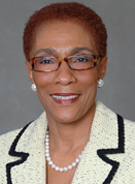 privileged few but for everyone,” she opened. “The US no longer leads the world in post secondary attainment.”
Pippins noted that among the challenges facing Michigan’s job market, 62% of new jobs will require post secondary education and only 33% of its adults have attained that. Michigan has a shrinking pool of high school graduates; 13% of our adults have neither a high school diploma or a GED–and Michigan’s current GED policies throw up barriers making it difficult for many to complete GED programs. “The best and brightest are leaving Michigan at alarming rates. If a student leaves the state for education, they probably won’t return to that state.”
Pippins went on to say that Michigan is home to many educational disparities. Poor children and black children are left behind because of insufficient funding for education at all levels. When students get to college, they lack academic preparedness. And, there is insufficient financial aid for the poor. Because the state is cutting aid to colleges and universities, tuition costs rise making higher education less attainable. “There is a lack of academic preparedness and insufficient financial support for the poor,” Pippins said. “You have substantial gaps between whites and blacks and both groups fall behind their counterparts in other states.”
Pippins didn’t mention Michigan legislation that prevents prohibits affirmative action programs. It seems this, too, is most likely widening the gap between the number of blacks and whites attending colleges and universities.
She did say t hat Michigan’s best and brightest kids are taking less math, that reading and writing skills are lacking and, their scores on advanced placement tests all raise concern. Another problem, Michigan has a low “persistence to degree completion” rate. In other words, many who begin college don’t finish. “Michigan needs to improve its post secondary education attainment levels, stop loosing students and increase academic success” if the goal is a competitive global work force.
Pippin said the state needs to “begin at the beginning” with effective early intervention, She mentioned the Michigan Early Childhood Investment Corporation and private sector/public education initiatives in other states, Again, this writer finds the intrusion of private sector business into public education troubling. She also mentioned that the state needs to develop lifelong education models that better prepare high school students for college; increase the number of students graduating from community colleges (where the state has high non-completion rates); and implement effective adult education models, including GED programs that are more accessible and better focused on readying people for college or career.
“If we’re not supporting higher education, it’s hard to have incredible expectations,” Pippin said. “That starts with K to 12 . . . so we get our best and brightest involved in the system.”
Grand Rapids People’s History Project – Interview with Michael Johnston

As part of the Grand Rapids People’s History Project we recently interviewed Michael Johnston. Michael is a retired teacher, editor of Grand Valley Labor News and local labor historian.
Michael Johnston has been involved in documenting numerous aspects of labor history in West Michigan and wrote his masters thesis on labor history in Grand Rapids.
The interview is broken up into seven parts. In Part I Johnston talks about the suppressed history of labor organizing in Grand Rapids.
In Part II Johnston talks about the working conditions for workers before the 1911 furniture workers strike and the strike itself.
In Part III Johnston addresses how the political elites responded to the 1911 furniture workers strike and how that impact local politics to this day.
In Part IV Johnston talks about the labor press history in Grand Rapids and the commercial paper’s reporting on the furniture workers strike of 1911.
In Part V Johnston talks about any efforts to organize farm workers in West Michigan.
In Part VI Johnston speaks about more recent labor run publications and labor run print shops.
In Part VII Johnston talks about why it is important to understand this history and what it can mean for anyone doing organizing work today.
Gubernatorial candidates vetted at West Michigan Policy Forum
Day two of the West Michigan Regional Policy Forum began with the editors of the GR Press and Crain’s Detroit Business acting as “moderators” for gubernatorial candidates Virg Bernero and Rick Snyder.

Choosing a business paper editor and a business friendly for-profit newspaper editor made it clear from the beginning what kind of questions would be asked of the candidates and which would not. It was also clear that the two candidates were being vetted to the members of the West Michigan regional Policy Forum, since the questions fit right into the legislative agenda of the group, particularly the 5 main directives established in 2008.
Virg Bernero
The format was to ask them questions one at a time on stage, with Bernero going first. The moderators asked the same questions to both Bernero and Snyder. When was asked what he thought about the Michigan Business Tax (MBT), Bernero said he would eliminate the surcharge and then look to reform the MBT. Bernero then went out of his way to say he was pro-business and that he has had the endorsement the Lansing Chamber of Commerce both times he ran for Mayor.
Bernero also said that he would not add any new taxes for small businesses, but made no additional commitment on issues of taxation, such as a progressive income tax policy for businesses. “I’m willing to consider anything that will help get us off the ground.”
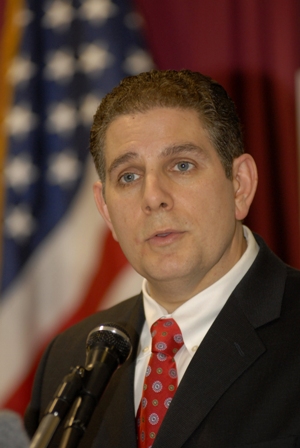
On the matter of job creation, Bernero said that the main thing to do is to figure out a way to bring investment capital into the state. Bernero is proposing the Main Street Bank initiative, based on what North Dakota does. Bernero also wants to attract foreign businesses to Michigan and set up green manufacturing zones.
The Democratic candidate was then asked what he thought about Michigan being a right-to-work state. Bernero said he is definitely against the idea and then added that Lansing just won a manufacturing contract against states that have a right-to-work policies in order to underscore his point that you don’t need it to be economically competitive.
The GR Press editor then asked if economic development should be targeted, such as the film industry and green manufacturing or should it be broader. Bernero said that you have to look at individual cases, but in order for it to be successful it needs to be more broad, with an emphasis on manufacturing.
When asked about what he thought about the Michigan Economic Development Corporation (MEDC), Bernero believes that the MEDC needs to be held more accountable and more creative. “If there are things that are not making money for the state, such as film making, then the state should not be supporting it.”
Mary Kramer (editor of Crain’s) asked Bernero about jobs again and wondered what do you do when you have jobs but unqualified people. Bernero said that what he has done as Mayor of Lansing was to partner with MSU to help facilitate students and graduates to stay and work in Michigan. The gubernatorial candidate also thought that we needed to continue the Michigan Works program and even expand what it does.
On the matter of health care Bernero said we need to figure out ways to attract and retain nurses and doctors to Michigan, particularly with primary care and not just specialized medicine. When asked what he would do to look at health care costs for Michigan he would set up more community-based health care centers so that people don’t use emergency rooms as a primary health care location.
Bernero was then asked what he would do to deal with the budget deficit for Michigan. His response was that he has balanced the budget in Lansing the past 5 years in a row. Bernero said there are no real easy answers, but he did say government needs to be more efficient. Bernero even went as far as to suggest that local governments should consolidate.
The next question addressed the issue of how to fund public education. Bernero expressed concern over the growing disparity within K-12 education across the state. He does support private education and any other form as long as it gets “positive results,” even though he did not qualify what he meant by that.
Bernero was then asked about the Democratic attack ads on outsourcing of jobs. Bernero said that people in Michigan are suffering from free trade, not fair trade. Bernero said he is a supporter of capitalism, but felt that there is a double standard on trade policy between the US and China in particular. This was an interesting comment since Bernero earlier said he wanted to get foreign companies to do business in Michigan which would potentially have the same impact on communities in other parts of the world.
The Democratic candidate for Governor was then asked about the label of being the “Angry Mayor,” a titled given to him after an interview he did on Fox news when another GM plant was being shut down in Lansing. Bernero said he gets angry as would anyone should when people lose their jobs, but he went on to reiterate that when he ran for Mayor of Lansing he ran as the pro-business candidate and received the support of most local Republicans. He also said that some of the unions in Lansing hate him and that he is not a “tool of big labor.”
Rick Snyder
Snyder said the Michigan Business Tax needs to be eliminated and replaced with a flat 6% corporate tax. “This will shift Michigan from a job killer tax state to a job creating tax state,” Snyder said.

Snyder doesn’t think Michigan needs a progressive income tax, rather the state needs to be more efficient and stop spending money on programs that do not work. Snyder believes that the goal of government is not to support itself, but to serve the public and get out of the way of business so that the economy can flourish.
On the matter of job creation Snyder says that it is less about bringing new businesses from outside of the state and instead provide opportunities and incentives for people currently in Michigan to create new jobs and businesses.
When asked what he thought about right-to-work what Snyder said was that he was opposed to it because he thinks it further divides people. He does think that Michigan businesses and labor need to come together to figure about ways to maintain and create new jobs instead of having policies that are divisive.
On the issue of targeted economic development like film industry incentives he clearly opposed it since it is a “winners and losers model.” Snyder says he used to be with the MEDC when it was winning awards, so he is in favor of creating a healthy economic development climate. Snyder again said that Michigan does not need to court companies from outside the state or country, instead we need to provide incentives and opportunities for existing businesses in Michigan to grow.
On the matter of getting qualified people to jobs that are available the Republican candidate felt there needs to be more coordination amongst groups that provide job training, such as Michigan Works and community colleges.
Snyder’s position on primary health care is to emphasize wellness and prevention as the two mechanisms to reduce costs. He believes that there needs to be more regional/community-based primary health care services.
When asked about balancing the state budget Snyder said we need to be more efficient and eliminate programming that do not have positive, measurable outcomes. Snyder also believes we need to have better government employee accountability. The Republican candidate also feels that we need to be honest with the public and share the facts about what the current debt is at the state. Once people really know what we are faced with we can better move forward to make changes.
On the matter of K-12 education Snyder said that instead of beginning the discussion with funding it should be focused on how do we better educate the state’s children. Snyder thinks that there is adequate funding that exists, but it is currently not being spent well.
When asked about what he will do if elected is that Snyder said he has a vision and a plan to turn Michigan around, even though he did not qualify what that vision and plan is.
On the matter of debating Bernero, Snyder said he would do 3 TV debates and he wanted to do them before the absentee ballots go out. He went on to talk about what happened recently with Bernero at one of his scheduled public gatherings but felt that town hall meetings are better because he would rather take questions and have a dialogue with citizens.
Snyder believes that free enterprise works. He is not anti-manufacturing, but he also thinks that Michigan needs to diversify and not be stuck in just an automotive and manufacturing jobs focus. Snyder ended by saying he wants to make a “smaller, faster, cheaper government.”
It was difficult to see much of a fundamental difference between the two candidates for governor, particularly on economic matters. There are some tactical differences, but both candidates are ardent supporters of the “free market system,” and both went out of their way to present themselves as business friendly to a crowd of mostly business professionals.
Make no mistake that the morning session with the two gubernatorial candidates was a vetting process to determine which of the candidates they will endorse in November’s election. The West Michigan Regional Policy Forum has already endorsed candidates for all other state offices in this part of the state and even though they did not list party affiliation it appears that all but one of the candidates are Republicans. The group also provided everyone in attendance with a voter guide and other election resources.
Workers’ and consumers’ rights will take swan dive if economist has his way
(This is one of several articles that GRIID will post over the next few days based upon our attendance at the West Michigan Regional Policy Forum.)
 Brian Wesbury’s lunch hour remarks at the West Michigan Regional Policy Forum reiterated the event’s goal of influencing government to free business from taxation and regulation.
Wesbury’s bio lists him as Chief Economist at First Trust Advisors L.P., a financial services firm based in Wheaton, Illinois. The Wall Street Journal ranked Wesbury the nation’s #1 U.S. economic forecaster in 2001. These credentials, no doubt, brought him great credibility among the elite business crowd in attendance.
Wesbury’s topic was, “Back to the basics for Michigan’s recovery.” He started off with an analogy based on his recent visit to the 88,000 square-foot Dodge mansion, which now stands on the campus of Oakland University in Rochester, Michigan. “The wealth that was in Michigan in the 20s, 30s, 40s and 50s, the kind of wealth that could build a mansion like that, do you know where it came from? . . . That wealth, like all wealth, came from the increased productivity of our economy.”
 Wesbury went on to tell the stories of Michigan’s farmers who were forced off the farms and into factory work that they hated because technology increased agricultural production. “That transformation created massive wealth that was built on the blood, tears and cries of farmers due to increased productivity brought about by the invention of the interbnal combustion engine.”
Don’t sympathize with those farmers of years past. Wesbury doesn’t. Instead he compares that so-called “progress” to today’s economic scene. Simply stated, technology has eliminated out-of-date manufacturing jobs but, not to worry, Americans are buying more stuff than ever before. “We produce three to four more times more stuff than we did in 1950. Thirty percent of all US workers were in manufacturing in the 50s, nine percent are now,” he said. “This is what happens when technology transforms the economy.”
Wesbury made no mention of free trade policies that have moved jobs to countries where sweatshops, slave labor and dangerous working conditions are the norm.
He also compared Michigan’s current economic woes to those experienced at the turn of the 20th century. At this juncture, an image of a black swan was projected on the overhead screens. “Today we have populists. People feel uneasy. And in the middle of this unease, we get a black swan. We have the idea that all swans are white until we see a black one. Once we see a black one, it changes all our paradigms,” he said. “Everybody thinks black swans are bad. ‘It’s going to take us down. We’re going to get pecked to death at any moment.’ It dawned on me, black swans can be positive too. ”
Wesbury identifies today’s economy as a black swan. In other words, there’s nothing to worry about. We just have to be positive. ” We suffer from economic hypochondria,” Westbury said.
Wesbury then described the economic history of humankind as a hockey stick. It was horizontal, with no change, until 1750, and then, with the writing of the U.S. Constitution, economic growth went straight up. He exclaimed, “We went straight up. That’s America. The world got freedom. The US constitution. Do you believe that’s over? That a pack of wild black swans have finished us off? Nobody in their right mind can beleve it.”
While he admitted with a chuckle that other factors might have been involved in that upward movement, he made no attempt to verify this claim, or any of the others he made, except by means of flashy charts and graphs on the overhead screens.
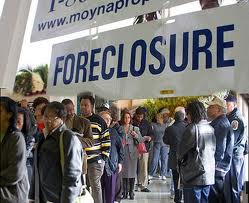 Wesbury then turned his focus to the subprime interest crisis that resulted in the massive bank bailouts and millions of families losing (and still losing) their homes to foreclosure. “Guess what, people borrowed too much. They took losses. So what. (The crisis was caused by) the government’s reaction to people who borrowed more than they should have to buy a house,” he said.
Wesbury went on to state that the 2008 finincial crisis was smaller than crises in the 70s and 80s. He credited then President Ronald Reagan with solving the earlier crisis by cutting taxes, cutting spending and raising interest rates. Wesbury fails to mention that Reagan’s deregulation policies were at the root of the predatory lending practices and mortgage lending crisis that has caused America’s families to lose their homes.
Wesbury proclaimed, “US citizens today are purchasing more than they have ever purchased in the history of America. . . We are in the midst of a strong recovery.” Tell that to your friends who can’t find a job that pays a living wage, do not have health insurance and are back living in an apartment because a bank took their home away. He presented no figures on who exactly is making all these purchases or what their income levels were.
Wesbury blames high unemployment rates on high government spending. Does he mean the more than $1,080,974,500,000 spent on the occupations of Afghanistan and Iraq? Does he mean the billions given annually to Israel’s military for their criminal occupation of Gaza? Does he mean the millions of dollars in subsidies given to corporations and big agriculture? No. It’s all the welfare crowd’s fault. He referred to 18% of Americans receiving government assistance. “82 people are pulling the wagon. 18 people are in the wagon. . . They’re living off their fellow man. They’re not doing what they were put on earth to do.”
Wesbury summed his arguments up with graphs comparing Michigan to Texas. The graphs supported his claim that eliminating taxes on and regulation of businesses, becoming a Right to Work state and reducing government spending would turn Michigan’s economy around. His last slide was a photo of a price gun, used to affix price tags to merchandise on store shelves.
“You have to label every item for sale in this state. There are two reasons for this. One, it’s a job. It’s a union thing. Two, people don’t trust you. . . We don’t trust business so the state has to regulate them. That’s a serious problem in a relationhsip between business and the government. It’s government’s way of signallung ‘these people aren’t trustworthy,” Wesbury said. “The head economist at the IMF said that technology has taken off so fast that we need more government (regulation). I look at the world totally the opposite. The more technolgy, the more entrepreneurship and the more capitalism we have, the more stable things are. We need to fight for freedom. Have faith in people . . .You have to go on a campaign to make them trust business. If you dont trust it, you don’t have an economy.”
Front Group Front Man Rick Berman: anti-union tactics for a right-to-work campaign
One of the afternoon presenters at the West Michigan Regional Policy Forum was Rick Berman. The promotional literature for the forum listed Berman as President of Berman and Company, which “specializes in strategic research, communications and creative advertising.”

To those who do real grassroots education and organizing Berman engages in political counter-insurgency by setting up front groups that both undermine the work of real grassroots groups and acts as a deceptive arm of corporate America. Berman has worked for the tobacco industry, alcohol industry, corporate agribusiness and numerous entities that oppose animal rights.
However, one of the issues that Berman has been at the forefront of and the reason for his presence at the policy forum was to talk about ways to undermine unions and promote right-to-work policies. One example of an anti-union front group is the Employee Freedom Action Committee, which was formed by Berman to defeat the Employee Free Choice Act. Berman’s talk today was entitled “Organized Labor – Rethinking Reform.”
Berman began his presentation with a look at how the country has evolved on its view of unions. He showed a Gallop chart, which shows the decline of union support. Berman makes the point that if businesses want to get people to support a right-to-work policy they need to do something bold.
Berman said that the legacy of the union movement is still strong in Michigan, which he believes is why many businesses will not take a strong stand in favor of right-to-work. So how does one get a right-to-work law passed?
Currently there are 22 states that have right-to-work policies and the last state that passed one was 10 years ago, according to Berman. Berman thinks that it is difficult to pass a right-to-work law, since most politicians don’t want to do it and ballot initiatives do not work unless there is a two-thirds public support for such a policy.
Berman says that business circles need to quietly develop public opinion on this issue. Berman also believes that tactically it is more important to begin with the problem and not present a solution too soon. In other words, don’t give unions a target to counter your efforts.
Berman then talk quite contemptuously about the public and referred to them as amazingly uniformed, thus the business community needs to make it a point to work hard to “educate” people on this issue. Berman said there are several guide posts to changing public opinion on this issue.
First, the business community needs to create common knowledge on the issue of right-to-work. You also need to engage in what he called a pre-emptive strategy and change the opposition’s position. In other words, make the opposition look more negative than they really are. Berman says that more people in the auto industry lost their jobs in Michigan in recent years than in southern states. This point was certainly true, but it omits the fact that the auto industry moved south so they could pay fewer wages to unions.
Berman believes that those who work on policy change have to embrace an advertising mentality where there is a constant campaign to convince people that a right-to-work policy is in the public’s best interest. This is especially the case with negative messaging. Berman gave the example of when the polling numbers shifted dramatically during the Kerry/Bush race in 2004. The negative message that hurt the Kerry campaign was the Swift Boat claims.
A negative message campaign that Berman shared with the audience was an anti-union commercial that wanted to push the idea that unions are corrupt and is made up of fat cats. Here is one of his anti-union ads.
To continue this idea of creating a common base of knowledge, Berman says that businesses need to create campaigns that look at the reasons why companies avoid Michigan and articulate those reasons. He emphasized that if you do this well you never have to mention right-to-work, but you lay a strong foundation for getting that policy passed in the state.
Berman also made it clear that the unions will fight hard on this issue. He claimed that the unions will use legal means, dirty tactics and lots of money, even though he never provided hard data or clear examples on this other than a ballot initiative in Colorado which would hold corporate CEOs responsible for corporate wrong doing.
Essentially, Berman’s presentation was laying the groundwork for how businesses and other anti-union sectors could work to get a right-to-work policy without even talking about right-to-work.
For anyone who cares about preserving unions and not turning Michigan in to a right-to-work state it would do them well to understand the tactics and strategy that Berman presented to the West Michigan Regional Policy Forum. If working people and unions fail to come to terms with this well financed effort will do so at their own peril.
You can find more of these tactics on Berman’s website UnionFacts.com. An additional resource on Berman’s history and work with creating front groups go to Berman Exposed.
West Michigan Elites host policy forum
(This is the first of several articles that GRIID will post over the next few days based upon our attendance at the West Michigan Regional Policy Forum.)
Today and tomorrow marks the West Michigan Regional Policy Forum in Grand Rapids. This is the second summit that seeks to build on the work of the first summit held in 2008.
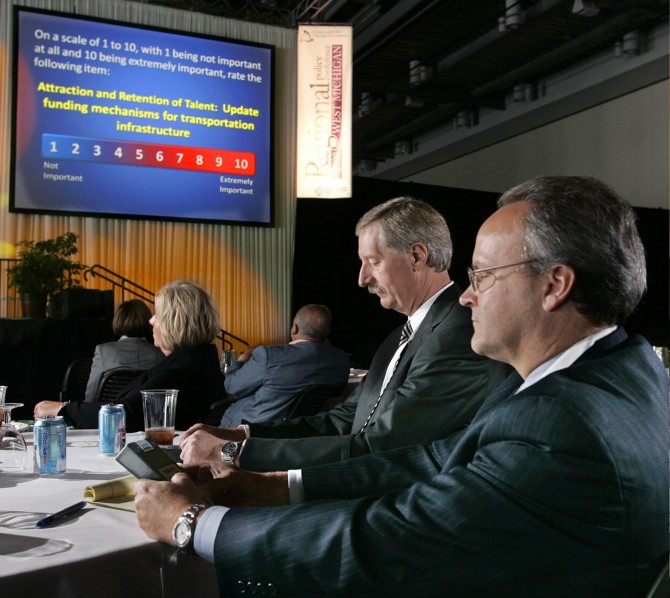
The summit brings together many of the local economic and political power players, such as the DeVos & Van Andel families, Peter Seechia, the Grand Rapids Chamber of Commerce, local CEOs, lawyers and government leaders.
Secchia gave the open comments and began by taking a swipe at the Governor Granholm and vague remarks about the political climate that he claimed supports their platform. Seechia began with a progress report on the goals that the group came up with in 2008. Those goals are:
- Governance: Eliminate the MBT with corresponding spending cuts.
- Workforce of the Future: Implement a right-to-work status for Michigan.
- Health Care and Life Sciences: Increase funding for providers with effective prevention practices.
- Manufacturing and Design for the Future: Streamline the permitting process within state government.
- Attraction and Retention of Talent: Update funding mechanisms for transportation infrastructure.
Seechia claims that candidates who support the elimination of the MBT will be elected in November. Seechia believes that the ground is now fertile for pushing for a right-to-work policy for Michigan and trashed the GR Press for editorializing against it, despite the fact that the Press articles on the subject were biased in favor of the anti-union policy.
Seechia points to the ongoing development of “medical mile” as evidence of the success of point number three, but did not provide any commentary on goal 4 and 5. Seechia concluded by saying that they have made much progress on the goal set forth in 2008.
Seechia gave the microphone over to Doug DeVos who continued to present information about the goals and objectives of the policy forum. DeVos spent quite a bit of time on the theme of “quality of life.” DeVos said that what the forum’s work is really about was “quality of life,” which is an interesting comment considering that DeVos comes from the wealthiest family in the area. His comments also ignore high-levels of poverty and growing number of unemployment and under-employment.
DeVos then made an interesting comment when he said that in a recent conversation with Bill Clinton, the former President in relation to his “relief work” in Haiti, that what “Haitians needed was economic development and not looking for a hand out.” This statement not only is clear lie, it omits the well-documented history of US military and economic intervention in Haiti.

The first invited speaker of the day was Michael Flemming, President of the American Chamber of Commerce Executives. In a strange Orwellian way, Flemming’s talk was about how to do grassroots lobbying.
Flemming began with a joke, which in many ways reflected his attitudes about the economy and workers. The joke he claimed was from Minnesota and what they felt about people in Iowa. “Iowans don’t give their workers coffee breaks because they are afraid they won’t have enough time to retrain them.”
Flemming believes that there are five fundamental points for “grassroots lobbying.” First, is that businesses have to take positions and not remain neutral on policy. Second, businesses and trade associations need to have a broad perspective on economic and policy matters. What Flemming meant by that is business needs to not just think about profits in and of themselves, rather they need to see that thinking about public education may be relevant for the future of their business.
Third, business must adopt a regional strategy, which is what this forum is all about. Flemming also said that doing regional policy is more important than branding regional economies. The fourth imperative, according to Flemming, was that it is no longer about mass movements, but developing influence and influential’s. He said the business community needs to underwrite the “grassroots” working being done on policy matters.
The fifth and final imperative is that this strategy needs to work collaboratively with local governments. As Flemming talked about this issue what he really meant was the importance of what the business people refer to as private/public partnerships. This is really code for what people in Third World countries know as structural adjustment, where public services are defunded and privatized.
Flemming then gave some points about how to move forward with these 5 grassroots lobbying principles. He said people need to lead without authority, which he said was that since people in the business community are not elected they just need to lead because it is the right thing to do. Flemming gave Gandhi as an example of a leader who led without authority, which is an accurate example, but I find it hard to believe that most people in the room were aware of Gandhi’s views on economics, which would be in clear conflict with those of the West Michigan Policy Forum.
“The rich cannot accumulate wealth without the co-operation of the poor in society. If this knowledge were to penetrate to and spread amongst the poor, they would become strong and would learn how to free themselves by means of nonviolence.” Gandhi

