What We Are Reading
Below is a list of books that we have read in recent weeks. The comments are not a review of the books, instead sort of an endorsement of ideas and investigations that can provide solid analysis and even inspiration in the struggle for change. All these books are available at The Bloom Collective, so check them out and stimulate your mind.

The Case for Withdrawal from Afghanistan, edited by Nick Turse – This is an important collection of essays by 22 different contributors on not only the possibility of a US/NATO withdrawal from Afghanistan, but the necessity of such a move. There are essays that provide historical context and some that provide important analysis about the real reasons for the 9-year US occupation of Afghanistan. However, the most important and most critical essays are from Afghans themselves, particularly Malalai Joya whose essay is entitled, “No Nation Can Liberate Another.” This book is a timely contribution that could be a useful resource for a growing anti-war movement in the US.

Uses of a Whirlwind: Movement, Movements, and Contemporary Radical Currents in the United States, edited by Team Colors Collective – This collection of essays and interviews is some of the best analysis we have come across in recent years. Not only does Uses of a Whirlwind provide excellent examples of radical organizing across the US, it provides inspiration and models for how to organizing better. The essays deal with work being done around urban rights, queer organizing, food justice, climate justice, worker movements and anti-authoritarian efforts. For anyone who does organizing work this book is a must. For anyone who needs evidence that there is important grassroots work being done across the country this book is for you.

Midnight on the Mavi Marmara: The Attack on the Gaza Freedom Flotilla and How it Changed the Course of the Israeli/Palestine Conflict, edited by Moustafa Bayoumi – The world saw earlier this year the raw brutality of the Israeli government when it boarded a boat filled with humanitarian supplies for the victims in Gaza. This collection of essays provides first hand accounts of that vicious Israeli action, along with its relevance within the larger struggle for justice for Palestine. The contributors exposed the hypocrisy of the Israeli government and the complicity of the US who supported these serious human rights abuses. This book is an excellent contribution for those wanting to make sense of the so-called Israeli/Palestine conflict.

We Are An Image From the Future: The Greek Revolt of December 2008, edited by A.G. Schwarz, Tasos Sagris, and Void Network – For most of us in the US, what was presented by the US media at the end of 2008 in Greece seemed like nothing more than street riots. What we learn from We Are An Image From the Future is that there was and is a highly organized anti-capitalist block in Greece that shook the very foundations of power there. This collection of essays provides not only a close look at what took place on the ground in Greece, it provides some inspiration for what could happen anywhere. As one observer said; “What the Zapatista uprising of 1994 was to the anti-globalization movement, the Greek uprising of 2008 could be to the demise of capitalism itself.”
Obama administration wants to increase government spying on US citizens
(This Action Alert is from the ACLU.)
Did you hear about this? The Obama administration is seeking to expand the government’s ability to conduct invasive surveillance online.1
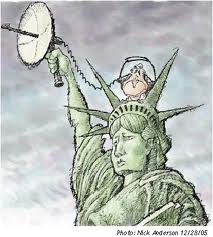
This outrageous proposal would mandate that all online communications services use technologies that would make it easier for the government to collect private communications and decode encrypted messages that Americans send. This includes communications sent using texting platforms, BlackBerries, social networking sites, and other “peer to peer” communications software such as Skype.
While the country tends to other issues, the administration and law enforcement officials are seeking greater power to invade your privacy. We must take a stand against this proposal before it even makes its way to Congress.
Sign the ACLU’s petition to Attorney General Holder: Rein in FBI surveillance power.
So, what’s wrong with this proposal?
- Instead of securing our online communications and protecting our privacy, the government wants to pave the road for more out-of-control government spying. Concern over cyber security is at an all-time high. This proposal will create even more security risks by mandating that our communications have a ‘backdoor’ for government use — making our online interactions even more vulnerable and easier to collect.
- It’s not only the government that will go through this ‘door.’ In 2004, hackers took advantage of a similar law in Greece to hack into mobile communications systems and listen to the calls of high government officials — including the Prime Minister.2
- The government has yet to make the case that encryption is actually hindering their investigations. According to the most recent Wiretap Report3, law enforcement encountered only a single encrypted call last year, and they were able to learn the contents of that call in spite of the encryption.
Take a stand against this proposal. Sign the ACLU’s petition to Attorney General Holder: Rein in FBI surveillance power.
There is no justification for this move to put our personal online communications within easy reach of the government’s prying eyes.
We must send a strong and clear message to the Obama administration today: Do not spy on me.
Heartwell Proposes Grand Rapids Privatize Water Services
It was reported today in the Grand Rapids Press that Grand Rapids Mayor George Heartwell is proposing to both consolidate and privatize some of the current services the city provides.

Press reporter Jim Harger states that there are some “low-hanging fruit” and some “big ticket” items that the Mayor is proposing for either consolidation or privatization. Among those identified for possible privatization in the story are, “city’s emergency medical services currently handled by city firefighters; merging motor fleet operations with Kent County and neighboring cities; and privatizing the city’s water and sewer systems.”
The article only sources the Mayor who said he expects resistance from within the city government since it will mean some employees will lose their jobs.
On the matter of privatizing the water and sewage services, Heartwell admitted that he has been in contact with private companies, but none have made any offers.
We should not be surprised that this is the direction that Mayor Heartwell wants to take the city, since consolidation and privatization were the main themes of his State of the City address in January. On the surface in it seems quite understandable that this is a direction the Mayor wants to go in considering the budget deficit they are facing. However, what is really happening with Grand Rapids and communities all across the country is what has been happening for decades around the world – it’s called Structural Adjustment.
Structural Adjustment (SAPs) is a policy that the IMF and the World Bank impose on countries seeking loans, a policy that the US has endorsed. These SAPs advocate for cutting government spending, privatizing public services and opening up markets to outside entities, most often corporations.
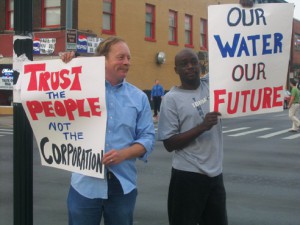
If Grand Rapids were to go the route of privatizing both the water and sewage services, what might be some possible outcomes of that decision?
The organization Food & Water Watch has been looking at this issue for years and provides us with important documentation that sheds light on what we can expect if Grand Rapids were to privatize its water and sewage services.
In one report entitled “Money Down the Drain,” the key findings state that:
- Private utilities charge higher rates than municipalities
- Privatization does not increase the efficiency of water and sewage systems
- Privatization has many hidden expenses
- Water corporations drive up costs and shoot down service quality
- The public can do it better and cheaper
- Public funding for water must go to only public utilities
Another report, “Faulty Pipes: Why Public Funding, Not Privatization – Is the Answer for US Water Systems,” provides numerous examples and case studies of when privatization has been disastrous for municipalities. One example they look at is the city of Milwaukee, which is comparable in size to Grand Rapids.
In 1998, they privatized their water services and gave the contract over to the multinational water giant Suez. Shortly after that rates went up, services diminished and polluted water was being piped into Lake Michigan. Food and Water Watch has dozens of case studies, which show that municipal water privatization does not work.
Unfortunately for readers of the Grand Rapids Press, the reporter did not explore the potential consequences of privatization and just reported that the Mayor of Grand Rapids was considering taking these steps.
We cannot let something as fundamental to our lives as access to clean water, be placed in the hands of private corporations. We all should send a message to the city that this is unacceptable and organize ourselves in order to fight this proposed privatization.
Peace Studies Conference held at GRCC
The Second Annual Peace Studies Conference is being held at Grand Rapids Community College this week and even though GRIID is not able to attend the whole conference, it will be writing about some of the presentations.
The first session we were able to attend was an afternoon session on Tuesday entitled, Dealing with the Causes and Ramifications of Violence: Peacebuilding Techniques. There were two presenters, Julie Keil from Saginaw Valley State University and Carole McKenna from Ferris State University.
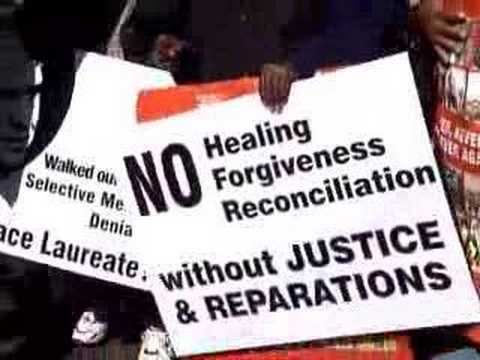
Julie Keil spoke first on the topic of Truth and Reconciliation Commissions (TRC), a process where countries that have experienced of form of civil war or serious political violence has come to terms with that dark period of their country.
Julie said she has spent time and worked on post civil war work in Sierra Leon. The question she posed to the audience and was the framework for her research is whether or not countries that went through a TRC process has lead to democracy and the growth of civil society?
She used Freedom House as a source for definition for democracy, political rights, civil liberties, civil society, although the definitions were very limited for each of these categories. It should also be noted that Freedom House while having more progressive origins, has in the past 30 years become more an arm of US policy, often reflecting State Department positions on international conflict.
Ms. Keil then gave reasons why it is important to have Truth and Reconciliation Commissions. First, a TRC can provide a record of the truth and to provide a forum to discuss the abuses that is not in a punitive nature, meaning people cannot be punished for the information disclosed. In addition, TRCs can provide some sort of justice/reparations for victims of political violence, to provide for closure, to expose the wrongdoing of previous regimes and to provide legitimacy for the new regime.
She then stated that often perpetrators are not brought to justice, There are numerous reasons why justice often does not occur, such as it is very costly to proceed through legal means. Secondly, trials to get to the truth of events, only to focus on the guilt or innocence of individuals. Another reason is that courts can provide an opportunity for acquittals. The speaker cited Nuremburg as an example where some war crimes got off.
The rest of the time she spent looking at whether or not countries that had Truth and reconciliation Commissions have an improvement in democracy. Her data showed that in 27% of the cases there was an increase of democracy, as defined by Freedom House. Countries with the biggest increases were Ghana and Panama. The same percentage of countries had increases in civil rights, with South Africa and Chile being countries with major improvements.
Her conclusions were that there is a positive outcome of Truth and Reconciliation Commissions in countries that go through that process. The greatest improvements in broad democratic terms were mostly seen in Latin America, while the worst area was sub Saharan Africa.
The Culture of US Militarism
The second speaker was Dr. Carole McKenna, who presented on what she called Canadian and American Culture of Militarism. She is also author of the book Militarism: The Power Arrangements between Soldiers, Wives, and the Military Industrial Service Complex.

Dr. McKenna wanted to look at how military families and wives coped not just with the risks that their spouses & children were taking in war, but how they negotiated the realities of war while living in America.
Dr. McKenna admitted that she had 3 sons in the US Army, but she also protested the US war in Iraq. She looked at the US military policy known as Stop Loss, which is where the military kept soldiers in active duty for longer periods of time than in previous wars.
During one interview with a woman married to a soldier she mentioned graffiti that was spray painted on cliffs near the military housing that said “Iraq made our husbands mean.”
Using the graffiti as a jumping off point, she then discussed the Thomas Theorem, which reflects the idea that people will believe whatever they want to believe in order to cope. “Military families,” she said, “had to believe in the military missions that their families were involved in. This was particularly so during military funerals where the message that was required was to stay positive.”
She then discussed the relationship between our culture of consumerism and pampering, which Dr McKenna said are both necessary in order for military wives to cope. Some of the wives would work on self-beautification through teeth whitening or physical exercise. One other technique was for people to attend church or get into therapy. Overwhelmingly, those who admitted they were depressed, while in therapy, were often prescribed drugs. So the emphasis is that instead of looking at the reality of war, military families are encouraged to remain positive and not question what is being done in our name.
She concluded her comments by discussing the need for a peace process that has an economy that serves people and protects eco-systems. Her analysis of our economic system was certainly anti-capitalist, although she never named it as such. There is a clear need to change our economic system, according to Dr. McKenna, in order to avoid perpetual war. “Not until we change our economic system can we address this country’s involvement in war.”
Historic First in Nation’s Fast Food Industry, 200 Jimmy Johns Workers to Vote in NLRB Union Election on October 22
(The Grand Rapids chapter of the IWW is working on an organizing campaign with Jimmy John’s workers locally. Anyone interested can contact the IWW. This Media Release is re-posted from ZNet.)
FOR IMMEDIATE RELEASE:

Jimmy Johns Workers Union (Industrial Workers of the World)
Contact: Mike Wilkow, 612-807-6633
September 28, 2010
MINNEAPOLIS– The National Labor Relations Board confirmed today that it will conduct a union election for 200 workers at ten Minneapolis-area Jimmy John’s on October 22, an historic first in the nation’s almost entirely non-union fast food industry. The secret ballot union election could be a turning point for labor at a time of deepening poverty for millions of Americans affected by the recession, many of whom are employed in low-wage service sector jobs.
“People who thought of themselves as middle class or upwardly-mobile two years ago are now making minimum wage at Jimmy John’s, with no real prospects for moving up. If these are the kinds of jobs that American workers will be stuck with, then we are going to make them quality jobs for working families,” said Mike Wilkow, a union member at Jimmy Johns.
If a majority of workers vote in favor of unionization, the company will be legally bound to negotiate with a bargaining team elected by its employees.
The unprecedented fast food union campaign at Jimmy John’s comes at a time of deepening economic misery for US workers. According to a recent report by the US Census Bureau, a record-breaking 43.6 million Americans– 1 in 7 people– are living in poverty. The Bureau of Labor Statistics estimates the unemployment rate at 9.6%, with 14.9 million people out of work and uncounted millions more too discouraged to look for work. Layoffs and outsourcing have decimated higher-paid jobs, particularly strongholds of unionization such as manufacturing and construction, forcing many workers to seek employment in low-wage areas of the economy once reserved for teenagers and students. For many, it feels like food service and retail are the only jobs left.
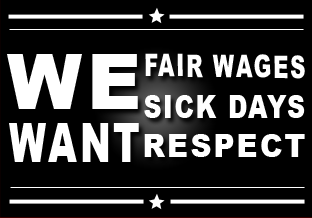
While many workers are forced to seek employment in food service, industry wages and working conditions are widely regarded as substandard; in 2009, the median wage in the fast food industry was $8.28/hr and as of July 2010, the average workweek in fast food was only 24.3 hours. The median annual income for fast food workers is $10,462, or $871 per month. This is less than half the federal poverty line of $21,954 for a family of four, and below the federal poverty line of $ 10,830 for an individual. Jimmy John’s is below industry standards, paying most workers the federal minimum wage of $7.25/hr, scheduling most workers less than 20 hours/week, and offering no benefits.
Unionization has clear allure to poverty-wage food service workers. According to figures released by the Bureau of National Affairs, union members in the food service industry earned on average $2.36 more per hour, a 32% difference, than non-union workers in the same industry in 2009.
Despite the appeal of higher wages and better benefits, union density in the fast food industry is stuck at only 1.8%, far below the national average of 12.3%. Unionization efforts have been stymied by stiff employer resistance and professional “union avoidance” firms that specialize in thwarting NLRB election campaigns. 75% of employers avail themselves of third-party anti-union consultants when their employees petition for an NLRB election, according to a recent study by noted Cornell University labor scholar Kate Bronfenbrenner. The study demonstrates that many employers embark on union-busting campaigns consisting of threats, intimidation, firings, interrogation, and even spying. Due largely to these factors, only 45% of NLRB elections conducted from 1999-2003 resulted in a union victory.
Success for the union at Jimmy John’s could be a major breakthrough for labor in an industry known for low union density and deplorable working conditions. Jimmy John’s workers say they possess the resolve to see through what they acknowledge will be a tough fight. Jaim’ee Bolte, a member of the union, says, “People say fast food is unorganizable. We say failure is not an option. Service industry jobs are the future and our future needs to have quality jobs for working families with living wages, affordable healthcare, paid time off, consistent hours, and basic respect. It’s time for change in America, we hope this will be a turning point for all workers.”
The Jimmy Johns Workers Union, open to employees at the company nationwide, is affiliated with the Industrial Workers of the World labor union. Gaining prominence in recent years for organizing Starbucks workers, the IWW is a global union founded over a century ago for all working people.
Lies in the Name of the Free Market
(This article is re-posted from PRWatch.org)
A powerful advocacy organization has made a big impact on this midterm election cycle in states across the country. Americans for Job Security (AJS) has spent millions of dollars on attack ads targeting candidates they view as anti-free market.

While this group believes in the free exchange of capital, they are vehemently opposed to the free exchange of information, at least when it comes to their sponsors. AJS has routinely denied requests for a list of donors. As a 501(c)(6), they do not have to reveal this information. But the IRS has stated that any 501(c)(6) group whose “primary purpose” is political activity, must name their donors.
The Washington Post reports that AJS spends the vast majority of its budget on television and radio ads before elections. Groups such as Public Citizen have complained to the IRS about AJS’ abuse of its tax-exempt status. But the ambiguous nature of the IRS’ “primary purpose” standard has allowed AJS to continue spewing attack ads every election cycle.
Beyond the Pale
In addition to being shadowy and secretive, AJS’ ads are often misleading, completely untrue, and even offensive. While attacking Congressman Zack Space, AJS stated that he voted for “job-killing energy taxes.” AJS is referring to Space’s vote in favor of a cap-and-trade system designed to slow global warming. While it is arguable that a cap-and-trade system will cause businesses to pass costs on to consumers, it cannot be equated to an energy tax.
AJS also accused former Colorado Lieutenant Governor and Republican Senate candidate Jane Norton of growing “the state bureaucracy by $43 million in just 3 years.” While the state budget did grow by this amount during Norton’s time in office, it was not because of her actions. Spending grew in Colorado because of an increase in federal funds, not because of any increases in taxes.
In a very disturbing case, AJS disseminated a television ad geared toward defeating Arkansas Senate candidate Bill Halter that has generated charges of racism. The TV spot depicts numerous Indians thanking Halter for outsourcing jobs to India. The ad’s detractors have argued that the ad promotes stereotypes. In addition to being racist, the ad is not true. The Securities and Exchange Commission reported that while WebMethods did open a center in India while Halter was on the board, it had no effect on the loss of jobs in America.
Americans for Job Security joins all the other front groups springing up in the wake of the U.S. Supreme Court’s ruling in Citizens United, which gave corporations the right to spend unlimited funds to influence elections. These groups allow corporations to do just that while remaining anonymous. This kind of election hanky-panky makes SourceWatch an even more important resource for voters seeking the truth about suspicious groups with “feel good” names that suddenly appear and run over-the-top attack ads against candidates.
Media Bites – National Happy Hour
In this week’s Media Bites we take a look at a new commercial from Budweiser, which is promoting its National Happy Hour Day.
This ad is essentially trying to get viewers to associate all things American – baseball, cookouts, and concerts with their product. Thus montage of scenes and build up of the music underscore this message.
However, the commercial also uses images of a woman that seeks to present her as nothing more than a sexual being woven throughout the spot.
Local concert to benefit groups doing solidarity work in Afghanistan

This Thursday there is a Beatles Tribute show at Billy’s Lounge in Eastown. The show will benefit two organizations doing solidarity work in Afghanistan.
One of those organizations is RAWA – the Revolutionary Association of Women in Afghanistan. RAWA has been fighting for the rights of women and against foreign occupation of their country ever since the 1979 occupation begun under the former Soviet Union.
RAWA has consistently opposed military occupation, whether under the Russians or the current US/NATO occupation, which is now 9 years and counting. RAWA has also been a strong critic of the Islamic fundamentalists that make part of the Karzai government, the Warlords and the Taliban.
RAWA does amazing work both inside and outside of Afghanistan to not only bring attention to the plight of women, but to provide resources and training for women to be leaders in their communities. RAWA focuses primarily on education and health care work.

The other organization which will benefit from funds raised at the show is the Grand Rapids-based group Healing Children of Conflict (HCC). HCC was formed a year ago around the idea of providing medical treatment to children who have been seriously wounded by US military attacks in Iraq or Afghanistan and Palestinian children wounded by Israeli attacks, which are funded by the US.
HCC also does work to educate people in the West Michigan area about US policy in each of those countries in order to prevent children from being killed or wounded in the future.
The show this Thursday, September 30th is at Billy’s Lounge in Eastown, 1437 Wealthy. $5 will get you in the door and music starts at 8:30pm.
The concert is just one of several events around the 9th anniversary of the US occupation of Afghanistan. For more information on other activities, go to Grand Rapids for Justice and Peace in Afghanistan.
On Saturday, 21 area folks, many from the arts community, gathered at The Bloom Collective for a potluck/discussion, ArtPrize: Open Competition? Or 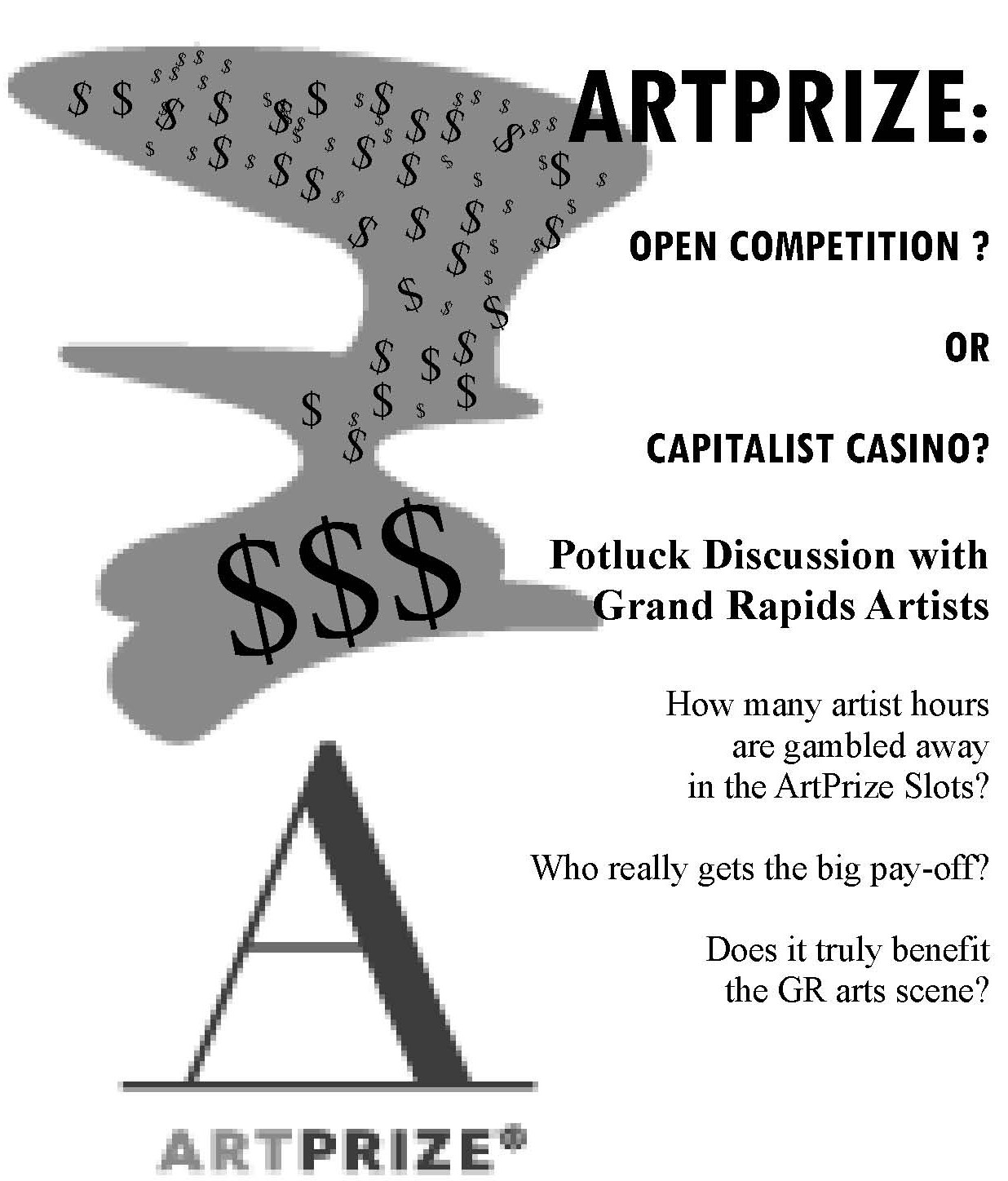 Capitalist Casino?
Of the many discussions The Bloom has hosted, this was the first where participants voiced fears over remaining anonymous. Because of these concerns, the discussion was not recorded and some comments reported are not sourced.
The discussion opened with this quote from Signal: 01, A Journal of International Political Graphics & Culture: “The production of art and culture does not happen in a vacuum. It is not a neutral process. We don’t ask the question of whether culture should be instrumentalized towards political goals, the economic and social conditions we exist under marshal all material cultural towards the maintenance of things the way they are. The question that we need to ask is whether our cultural production is used to uphold the massive levels of inequality that exist across the globe, or to challenge capitalism, statecraft, patriarchy, and all the systems used to produce and reproduce that disparity.”
ArtPrize as Empire
ArtPrize is not simply a cultural production. Its parameters are created and controlled by a self-selected elite. One artist described ArtPrize as colonizing Grand Rapids artists, venues and neighborhoods. In response, another said that ArtPrize reminded them of an old cartoon where the characters lived inside of a video game. When someone turned the game on, a giant cone descended and any characters caught within were forced to take part in the game. “The top-down aspect is the biggest problem,” he said.
 Two people shared examples from 2009’s ArtPrize. Representatives from the event visited their venues some months prior to the event. They were told not to schedule anything during the dates that ArtPrize was going to happen—but not given any details about what ArtPrize was.
Heartside’s street people and homeless persons are assigned a different role. Police stopped by agencies serving this population to tell them to warn their clients that their presence on the streets during ArtPrize would not be tolerated. Seating in the Cherry Street pocket park was partially eliminated to discourage street people from gathering there.
“It’s about property values. ArtPrize is importing capital, getting consumers interested in moving in and developing the area in a way that marginalizes the working class people in Heartside,” another participant said. “When rich white people come into Grand Rapids they don’t want to see the black people.”
Indeed, Heartside and its neighbors to the south have been targeted for gentrification as is evidenced by Grand Action’s Urban Market project and the Wealthy Jefferson Development Initiative, two projects steaming ahead without input from the people living in the neighborhood.
The ArtPrize Color Pallet
Just how white is ArtPrize? Well, no black faces were among last year’s chosen winners; the bulk of folks attending the event seem to be of the paler persuasion; and, at least one of last year’s African American venues and entries was left off the ArtPrize map not once, but every time it was printed in the Grand Rapids Press.
“ArtPrize is for white people to come to have a lot of fun and not have to deal with black people. It is part of a conservative movement that is racially motivated,” the artist said. “I opened up my venue . . . white families that came up to my loft would take three steps into my space and run out. They literally flew back down the hallway. This happened repeatedly. Those are the dynamics in this city and I am trying to reverse them. Frederick Douglas said that until America deals with the issue of race, nothing van be fixed. Race is going to have to be a part of ArtPrize. Get some black people involved.”
Art or Entertainment?
ArtPrize does make art accessible to the general public, albeit through the non-stop hype produced for the event by local media. While some entries do tackle social issues, these are few and far between—and the subject of negative comments, according to one artist present. Why the negative reactions? Perhaps because people have been cajoled into perceiving the event as pure entertainment. Casting art in this role takes away its power to challenge political and social issues.
Printmaker Alynn Guerra grew up in Mexico where the general public sees art as more than decoration. “ArtPrize perpetuates society looking at art as something that is just beautiful, that attracts. Art is more than decoration. Art has purpose. It’s evident that most artists who support themselves with their art are starving in this society. They have to work another job,” she said. “Why isn’t our community supporting us in the same way it supports other professions? How come no one is questioning why artists can’t come up with projects like these ourselves? Why does it have to come from the government and private sector, from the top not the bottom?”
Artist Brett Colley voiced similar concerns. “Much art is not suited for ArtPrize,” he said. Two of his students working on ArtPrize entries were asked to change their work by the venue. Two others who presented challenging work received hate mail. He also cited the lack of opportunity for critical discourse during the event.
Another artist said, “ArtPrize has not managed to make art more visible. The eyes of the world were on us. What the world saw was work that didn’t deserve the attention. The really amazing artists (in Grand Rapids) were not seen. . . I don’t think it’s doing a damn thing for artists.”
Who’s working? Who’s getting paid?
Many voiced concern with ArtPrize’s use of free labor—volunteer labor during the event and the countless artist hours poured into creating the works. Gallery owners and art educators are left out of the financial equation but expected to take part. While flyers for an upcoming anti-war march were torn down from public utility poles, ArtPrize flyers were welcome. This brings up the issue of public space. “Why does ArtPrize get to usurp all this public space and then give it back to us? Their logo shows up on every corner with no license or fees paid,” Colley said. “When art is used as an economic vehicle, who does it serve?”

This zine is available at The Bloom Collective, bloomcollective@gmail.com
The scheduled two-hour discussion carried on for nearly three. A last and very relevant question posed by one participant, “What do people want to do about it?”
One artist encouraged people to get involved with ArtPrize when it achieves
non-profit status. Others suggested making a publication prior to next year’s event.
“We need to form a guerilla art collective, to step outside the system,” another artist said. “to attract people to a counter-voice on the streets rather than what is coming through ArtPrize.”
GRIID has access to a zine, Against ArtPrize, anonymously created and shared at The Bloom event, which takes a critical look at ArtPrize.
Business as Usual at the Grand Rapids Press

On September 6, The Grand Rapids Press published an article, complete with “photo album,” of Dick and Betsy DeVos’s new summer home in Holland. The facts—that the DeVos family had chosen to tear down a 12,000-square-foot, multimillion dollar home in order to build a 22,000-square-foot faux-chateau, along with a multi-bedroom guest house—proves that the current Michigan Depression is only a rumor for some people.
The photos prove something that my father used to say: “Money can’t buy good taste.”
Surprisingly, in this area of DeVos worship, particularly during the current month of Art Prize (formerly known as September), this Press article rubbed many people the wrong way. Letters to the editor all month have complained bitterly about the insensitivity of an article flaunting the DeVos’s immense pyramid-scheme fortune at a time when people in West Michigan are struggling with increased poverty, loss of jobs and health care insurance, and record numbers of foreclosures.
The Press, insists bombastic editor Paul Keep, embraces criticism, but it apparently rankled under this relative onslaught of harsh letters. So on Sunday, September 26, the job fell to Business Editor Nancy Crawley to play apologist for the Press’s decision to feature the DeVos summer house story on page 1.
In doing so, she revealed a lot about the Press’s attitude about capitalism, the still-clung-to idea of a trickle-down economy, and an open contempt for the realities of life in West Michigan for the majority of us.
Crawley stated that a “handful of readers” chose to complain. This was unbelievable, Crawley said, puzzling, “Didn’t the project employ scores of people, from architects to attorneys to carpenters?” Why, there was even a local grocer who had to add “staff” (probably an out-of-work college student) to handle all the food orders from work crews.
Of course, Crawley doesn’t note that all this fabulous employment was temporary, and now has essentially come to an end.
Other readers, Crawley says, objected to the front-page placement of the story. This, she said, was “evidence of a scary mind set emerging from this long, ugly recession—a stern, puritanical insistence that we don’t deserve good things, good times.”
Of course, an objective observer might comment that the problem was that so few of us enjoy “good things, good times,” and those who do are doing so at the expense of the majority of working-class folks in the area.
After all, we’re talking about Dick and Betsy DeVos here. Proponents of a right-to-work state in Michigan, and advocates of union-busting. Supporters of private-school vouchers that weaken bring public education for those who can’t afford private schooling. Heirs to the vast Amway wealth that was brought about by drawing people into a pyramid scheme that destroyed thousands of lives and businesses. And let’s not forget Betsy “Marie Antoinette” DeVos’s statement in 2004 that the only problem with the Michigan economy was that Michigan workers were paid too much. In a press release statement in 2004, Betsy stated, “Many, if not most, of the economic problems in Michigan are a result of high wages and a tax and regulatory structure that makes this state uncompetitive.”

But according to Crawley, our supposed Puritanical insistence that we be frugal and not lavish “hurts rather than helps our economy. What makes the economy stronger and our way of life the envy of the world is that people have the right to pursue happiness, enjoy the fruits of their labor, and, if they have gotten rich on the up-and-up, let’s hope they spend their money instead of hoarding it.”
Oh, yes—the famous Reaganomics with its trickle-down effect is omnipresent in this ludicrous column. Dick and Betsy DeVos have served the economy well by spending, spending, spending. And now, Grand Rapids, Nancy Crawley says it’s your turn. Let’s make West Michigan the envy of the free world by spending to keep our economy (that is to say, the fortunes of the ùber-capitalists like the DeVos family) strong. Even if you have to cut out a few more meals in your two-room rented apartment, or lower the thermostat again, or figure out how the same income you had 10 years ago is going to stretch to meet record increases in your health insurance, or watch your house being seized by the sheriff.
And, with the kind of sensitivity that we’ve come to expect from the Press, Crawley’s column ran right next to a feature article titled “2010 on track to set another record for foreclosures across Kent County, West Michigan.” The first line of the article was, “Andrew Zukowski lost his full-time job eight years ago and has not had a steady paycheck since.”
Let’s hope Nancy never glanced over at the next column of the Business section. It might have brought a little reality into the rosy, free-market, spendy world in which she lives, and from which she edits and reports to the rest of us long-suffering Press readers.

