Gone Camping – GRIID will resume on August 12

We are fortunate enough to take a little break from cyberspace. GRIID writers are off for the next week or so. We’ll resume posting new articles, news dissection, Media Bites, and all things Indy Media when we return. In the mean time feel free to look at our archives or better yet, enjoy some of the remaining summer days.
“I went to the woods because I wished to live deliberately, to front only the essential facts of life, and see if I could not learn what it had to teach, and not, when I came to die, discover that I had not lived.”
Henry David Thoreau
The Rich Are Giving Their Money Away?
Most of the country has probably heard by now that Bill Gates, Warren Buffet and numerous other billionaires are planning to “give away their money,” as many media outlets have reported.

The Grand Rapids Press wrote, “Billionaires Bill Gates and Warren Buffett pulled off quite a coup when they announced that 40 of the richest U.S. citizens will give the bulk of their wealth to charity.”
But before we all get teary-eyed and canonize these people as saints, it would be useful to ask a few questions. Two basic questions that any reasonable journalist might ask could be 1) how did these people make their money to begin with, and 2) what does it mean to give their money to charity?
These are questions not asked by the Press reporter. Instead, she writes, “If you had a fortune, would you give it away to a favorite cause? Or would family be haranguing you for their cut of the pie? Tell us what you would do, if you had more money than you knew what to do with.”
First, this is a ridiculous question to ask people, since 99.9% of us will never be billionaires. Second, the question merely distracts us from asking more fundamental questions, thus never encouraging the public to think about wealth creation and philanthropic funding.
Wealth Creation
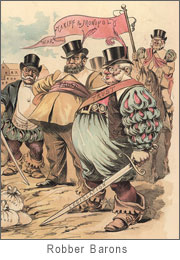
Quite often we are led to believe in the myth that wealthy men made their fortunes on hard work and ingenuity. For instance, J.P. Morgan made his first fortune selling defective rifles to the Union Army during the Civil War. He bought the rifles for $3.50 each and sold them for $22, thus making $18.50 on each rifle. Morgan also avoided military service during the Civil War because he could pay the $300 fee that allowed him to save his skin.
Modern day robber barons are no different. Bill Gates made his money off of computer software and technology that was first subsidized by taxpayers. Early research and development for computers was done through the US military at taxpayer expense. Once computers became more user friendly, people like Gates were given rights to “develop” what the public paid for.
Warren Buffet made his billions through the stock market, which is now being seen by more and more analysts as a very large ponzi-scheme. Buffet didn’t make anything or sell a product, he just figured out a way to fleece the public through speculative capital. Others on the list of those “giving away their” wealth are David Rockefeller who inherited wealth from generations of oil monopolies and political deals.
So, the idea that these billionaires are giving up “their” money is a matter of perspective. One could certainly argue, as I do, that this money really belonged to the public in the first place. Much of the wealth made by billionaires was either subsidized by the public or was made on the backs of laborers who do the real work that creates wealth.
Who Gets the Money?
The second basic question we should all be asking is where is this money going that these rich people are now “giving away?” First, it should be noted that they are not really giving it away. They will all make more money on their tax returns than any of us will make in a lifetime.
Second, many of these billionaires already have foundations through which they will channel this money. Foundations are a wonderful way for the wealthy to hide their money so that the IRS will not tax it. More importantly, foundations are a way for these elites to use their money to influence society, even engage it what some analysts refer to as social engineering.
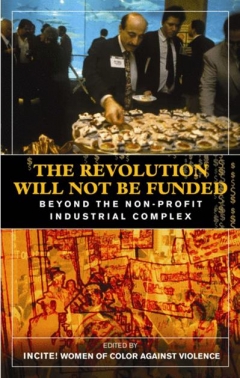
Since billionaires have made their money off of a political and economic system that benefits the minority, they are not likely to donate money to entities or causes that will undermine the systems of power they benefited from. Some excellent work has been done on this topic and I would encourage people to read Joan Roelof’s book Foundations and Public Policy. Another good source that questions the benevolence of philanthropic giving is a collection of essays by the women of color collective known as INCITE!. Their book is entitled The Revolution Will Not Be Funded and is a critique of what they refer to as the Non-Profit Industrial Complex.
Both Roelof’s and the women with INCITE! argue that much of the money that is “given” by rich people is used for either conservative causes, which blatantly support their politics or liberal causes, which do not seek to change the system, only provide some form of assistance to those who have been negatively affected by the current system.
When looking at the list of billionaires who have pledged to “give away” their money, we could mention that one of them is Thomas Monaghan, former CEO of Dominos Pizza. Monaghan is notorious for donating millions to far right religious causes, such as anti-abortion and anti-gay efforts. Monaghan also was a big supporter of the arch conservative Catholic Bishop in Nicaragua in the 1980s, Obando y Bravo, because the bishop was anti-Sandinista and anti-liberation theology. (For more on Monaghan, see The Religious Right in Michigan Politics.)
When one takes a close look at the kinds of efforts that Bill gates has given his money to, it also peels away the thin veneer of benevolence. Michael Barker, in a 3-part essay on Gate’s foundation and politics, shows us that the software baron has supported population control projects and corporate agribusiness projects throughout Africa. Black radical writer Bruce Dixon also explores Gates’ role in supporting genetically modified crops throughout Africa, in what is called the new green revolution. Both writers make it clear that Gates is using his money to both benefit his legacy and more importantly to benefit systems of power that Gates is a part of.
We could go down the list and find many other examples of how this “pledge” by wealthy billionaires is in no way designed to redistribute wealth. Instead, the recent announcement by contemporary robber barons was a slick public relations ploy to justify an economic system that these people benefited from. Unfortunately, most of the major news media as played right along with them.
Mass Demonstration Planned in Benton Harbor on 8/10

On Tuesday, there will be a mass demonstration in Benton Harbor, Michigan to confront the opening of a new golf course.
Protest organizers from BANCO, state that the land that the new golf course has been built on was public land and that this theft of land is another demonstration of the power that the Whirlpool Corporation wields in the St. Joseph/Benton Harbor area.
BANCO has been fighting the dirty and racist politics of Whirlpool for years and is inviting people from the mid-west to come to Benton Harbor on Tuesday, August 10 – at 10am – and stand with residents who demand justice. People will meet at the Benton Harbor City Hall, 200 Wall St.

The golf course is owned by the Jack Nicklaus Corporation and is one of 345 courses the former golf pro owns around the world, with another 140 under construction.
This is not the first time that golf courses have been the target of protest. In fact, there is a global movement against golf courses because of the elitist’s appropriation of land, excess use of local water resources and environmental contamination.
In 1996, the Jack Nicklaus Corporation wanted to build a golf course in Morelos, Mexico. Zapatistas and their supporters protested this proposal, since the golf course would have been built on communal lands. Public opposition and the beating of 40 people at a nearby plantation by Mexican police were enough to force the company to abandon any plans to build a golf course in that part of Mexico.
BANCO wants to send a strong message to those who attend the opening on Tuesday, that theft of public land is not acceptable. For more information contact Rev. Edward Pinkney, 269-925-0001 or go to banco.org.
Anyone from West Michigan wanting to carpool or caravan down can contact Cole Dorsey coledorsey@gmail.com.
SOA Watch Activists Block Entrance of Military Base, Demand Withdrawal of U.S. Troops from Colombia
(This article is re-posted from SOA Watch.)
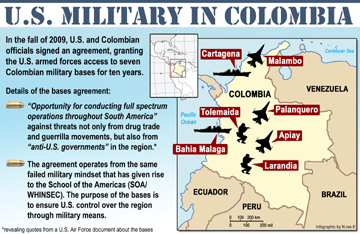
A group of nine School of the Americas Watch activists are currently in Colombia to confront the escalation of U.S. policy in the region and to express solidarity with courageous Colombians working for peace and justice. On Tuesday, the group set up a vigil at the Tolemaida military base, where U.S. soldiers are stationed.
Yesterday, two busloads of 65 activists from Justicia y Paz, the Movement of Victims of State Crimes, the Mothers of Soacha (who are seeking justice for their children who were killed as part of the “false positive” scandal), SINALTRAINAL, and others arrived to join the 9-member SOA Watch delegation, who proceeded to block the entrance to the base. Activists held banners denouncing US intervention in Colombia as well as Iraq.
Father Roy Bourgeois said of the action: “It’s a great joy to be in Colombia speaking with Colombians, with one voice, against U.S. domination and militarization. Our delegation has been deeply moved by the strength and spirit of so many Colombians struggling for a just peace in Colombia.”
The Tolemaida military base is one of seven Colombian bases to which the U.S. military has been granted access for 10 years under the U.S.-Colombia Defense Cooperation Agreement, which was signed in October 2009. The agreement has been met with opposition by Colombian and international human rights groups. It caused tensions in the region after a U.S. Air Force document became public that revealed that the United States military is planning to use the seven Colombian bases for “full spectrum operations throughout South America” against threats not only from drug trade and guerrilla movements, but also from “anti-U.S. governments” in the region.
Later today the SOA Watch delegation will leave the area and travel to Bogotá, is the capital city of Colombia. Tomorrow, the group will go to the U.S. embassy in Bogotá. Amplify the voices for justice and peace in Colombia by contacting ambassador Brownsfield now. Call the U.S. embassy in Colombia at 011-571-315-0811 and send an email by clicking on this link.
Media Alert – Stop Google/Verizon Deal
(This Media Alert is from the group Save the Internet.)
Google is about to cut a deal with Verizon that would end the Internet as we know it.

According to a front-page New York Times story, the deal allows “Verizon to speed some online content to Internet users more quickly if the content’s creators are willing to pay for the privilege.”
It would create fast Internet lanes for the largest corporations and slow lanes for the rest of us.
That’s why we’re starting a mass protest by Google users to stop these two companies from joining forces to sell out millions of people like us who use the Internet.
Google’s motto is supposed to be “Don’t Be Evil.” But this deal puts the company in bed with the devil.
From the beginning, the Internet has been a level playing field that allows everyone to connect to one another and the world of content available online — whether it’s ABC News or your cousin’s wedding video. There’s only one Internet, and it shouldn’t matter who your provider is or whether you’re logging on from home or your cell phone.
This deal will change all of that, allowing Google and Verizon to pick what websites you can see over others. The result couldn’t be bleaker for the future of the Internet and for free speech and independent voices online.
Founders Larry Page and Sergey Brin created Google to make information freely available to everyone online. But this deal is a complete reversal that abandons their core principles:
Sign this letter and tell Google’s founders: “Your Verizon deal IS evil, and it must be stopped.”
It’s up to the millions of people who use Google every day to tell the company to do the right thing.
Google must walk away from this bad deal, and make sure Internet users everywhere can enjoy the entire open Internet wherever, whenever and however they want.
Coffee and Sustainability
People are fond of saying, “let’s get together and talk politics over coffee.” In some circles they say, “let’s talk about the politics of coffee.”

During the mid-90’s, there was a campaign targeting Folgers coffee because of its support for the Salvadoran military dictatorship. Some of us were involved in that campaign locally. I remember the president of a local peace organization saying at the time, “all boycotts are off in the face of addiction.”
Coffee drinkers have felt better about their addiction in recent years with the rise of Fair Trade Coffee, coffee which is purchased through a cooperative system where workers are treated with dignity and receive a fair wage.
There are numerous places that one can buy Fair Trade Coffee in Grand Rapids, both freshly brewed and by the pound. However, there is now another business approach to coffee, one that was featured in a recent MiBiz publication focusing on what the business journal called “foodpreneurs.”
This effort is called the Direct Trade Coffee Club and it has several new business partners in Grand Rapids, specifically the MadCap Coffee Company. The MiBiz article featured MadCap Coffee and spoke with the owners and one of the employees.
One of the owners (Chad Morton) says that he travels to Central America regularly to meet with farmers and to “advise them on how to make their crops better.” He also says that this is a justice issue “when you see a 10-year old kid in flip flops carrying 10-pound bags of coffee up a hill an adult can barely walk up.” Morton also says that the goal of the company is to educate coffee drinkers in Grand Rapids and to promote sustainability.

In one sense it is encouraging to see people think about how their consumer habits impact people around the world, but lets be clear about the fact that this is a business whose goal is to expand. A spokesperson for the Direct Trade Coffee Club admits as much at the very end of the MiBiz article by saying they are looking to other products like chocolate to market locally.
The idea of expansion or growth is fundamental within a capitalist model, whether you make bombs or sell coffee. If this is the case, where does one draw the line on how many bombs or how much coffee is enough?
People in countries throughout Latin America, Africa and Asia have been suffering because of the massive consumption of coffee from the rich nations of the world. The US consumes more coffee than anyone other nation in the world, a reality, which has dictated massive levels of coffee production in poor countries.
We all like to think that people in those countries grow coffee because that is what they want to do, when in fact coffee production has historically been determined by the demand in countries like the US. Coffee companies, wanting access to cheap land and cheap labor have often collaborated with brutal dictatorships to insure hefty profits (see Coffee and Power, Paige).
When the Fair Trade Coffee effort came on the scene it was motivated by a desire to not continue the unjust working conditions that coffee workers were subjected to. This is a natural reaction by people who are opposed to human suffering. However, part of the problem with this thinking is that it does not question the very nature of coffee growing and coffee consumption.
People in Latin America don’t grow coffee because this is a career choice for them, they grow it because they might be able to make a living within the current market system. Small farmers and small farm movements like Via Campesina would rather grow food for local consumption than luxury items like coffee, but are often unable because they can’t get a decent price for their food crops.

The reasons for not being able to make a living off of growing/selling food are historical and structural. Under a capitalist model one needs high volume in order to compete in the market, something that small farmers are never able to achieve. Add to this the fact that the US often dumps cheap food stables like wheat and corn into these countries through programs such as USAID and you have another reason why small farmers can’t compete. (For an excellent investigation of how USAID money is used see The Soft War: The Uses and Abuses of U.S. Economic Aid in Central America.)
Now along comes fair trade and direct trade efforts, which seek to go around these historical and structure factors, but these efforts do not address the more fundamental problems. For instance, lets say that all of the current land in the world that was used for growing coffee was all of a sudden transformed into fair trade or direct trade production. Would that alleviate the human and ecological damaged caused by the current forms of coffee production? There is no question that some of the suffering would be reduced, but is this really a solution to ecological and human rights around the world?
Coffee production still demands that is travels thousands of miles before it gets to consumers in the US, which necessitates massive levels of fossil fuel use. But the more important issue here again is growth. If coffee sellers in the US and other industrial countries want to expand their markets, it also means there will need to be an expansion of coffee production, which means more land is used to grow coffee. Considering that millions of people around the world have no access to land to grow food, does it seem like a sustainable notion to expand coffee markets?
And lets face it, those of us in the US who buy fair trade or direct trade coffee are usually in positions of privilege. Working class people and people who are struggling to get by are not likely to buy fair trade or direct trade coffee, simply because it is often twice as expensive as commercial brand name coffees.
If you are going to drink coffee it is certainly more humane to buy fair trade or direct trade, but if you are seriously wanting to look at what is means to be sustainable then we all need to continue to investigate these issues to see whether or not consuming luxury items can be label sustainable.
Afghanistan: a War Correspondent’s Viewpoint
(This interview was done by Ron Jacobs and re-posted from CounterPunch.)
Anand Gopal is a correspondent who has been covering the war in Afghanistan for several years. His current employer is The Wall Street Journal. Prior to that, he worked for The Christian Science Monitor. I met Gopal a couple of years ago and check in with him occasionally to get his viewpoint on the Washington-led occupation and war in South Asia. Most recently, I sent him a few few questions via email. The exchange follows. –Ron Jacobs

Ron: If you were to compare the situation in Afghanistan in summer 2009 with the current situation, how would you characterize it? For example, is there more fighting or less? Has the nature of the insurgency changed? If so, how?
Anand: It is six months into the troop surge yet we haven’t seen any drop-off in violence. Rather, the summer of 2010 is proving to be far more violent than that of 2009, which in itself is remarkable given that 2009 was the bloodiest year of this war. Look at the numbers: There is a 30% increase in the number of soldiers killed in June and July compared to the same period last year. The number of security incidents in the first week of July, for instance, is 65% greater than the same week last year (see websites like icasualties.org and indiciumconsulting.net for these numbers). This is easily the most violent summer in Afghanistan since the civil war days of the mid-nineties. Hope of peace amongst ordinary Afghans has plummeted to incredible lows.
The insurgency has changed quite a bit in the last year. It is more splintered movement, partly due to Coalition Force assassinations of commanders, and partly due to the arrest of the Taliban’s leader Mullah Beradar. Hundreds of commanders have been killed, but the Taliban has no trouble finding recruits to fill their shoes. The new commanders are younger and (often) more radical than their predecessors. At the top, after Pakistan’s arrest of Beradar (who was the day-to-day leader of the movement) in February has led to a power struggle between different insurgent leaders. None of this, however, has diminished the group’s effectiveness as a fighting force on the ground, as the above numbers indicate.
Ron: Now that General McChrystal is gone, is there any sense among the people in Afghanistan that you talk with—among the occupying forces or Afghans—that the nature of the war will change? Part two to this question: is there any sense among the Afghans you talk with that the US presence will begin to diminish next summer (2011)? If not, in what ways do these people see the war ending?
Anand: Most Afghans don’t believe the nature of the war will change. In particular, many Pashtuns in the south and east view the Americans as brutal, arrogant and deadly. For them this has less to do with this or that commander, but more so with the general thrust of the war and US policy here for the last nine years.
From the point of view of the soldier, however, I believe that they do expect a change. There was a lot of anger and disgruntlement towards McChrystal from the military’s rank and file. In particular, many soldiers felt that McChrystal’s rules of engagement were too restrictive and put the lives of ordinary soldiers in danger. Whereas before soldiers were able to fire when they felt a threat, under McChrystal they had to take measures to ensure that there were no civilians the could be harmed–a difficult thing to do in the heat of battle. Moreover, while such rules existed for conventional soldiers, a different set of rules appear to have existed for the special forces, who seemed to have been free to attack whom they wanted as they pleased. This led to a lot of night raids that killed civilians, and also spawned an image that McChrystal’s special forces guys had free reign (keep in mind that McChrystal used to head the special forces) while conventional troops had their hands tied.
It may be too early to say exactly what changes will come about with the changeover of command. However, it appears that one big change is that Petreaus is pushing hard to expand the militia program in an attempt to replicate his successes with militias in Iraq. But militias in Afghanistan can be quite dangerous, especially in a country with recent history of warlordism and civil war. Another change is that Petreaus appears to be moving to ease restrictions on air strikes, which will likely lead to more civilian deaths.
Ron: The last time we communicated, I asked about the war in Pakistan? What can you tell us about that? We know that drone attacks continue at an even greater rate and that the US media has published allegations that there are some connections between Pakistan’s ISI and certain elements of the Taliban. Based on your knowledge, are those allegations true or are they merely an attempt to convince the US public that the war needs to be expanded in Pakistan?
Anand: First, it’s important to realize first that the Pakistani Taliban and Afghan Taliban are distinct organizations. The Pakistani Taliban is a broad collection of Pakistani groups and commanders, most of whom have been fighting against the Pakistani military during the last few years. These groups mostly consist of Pashtuns from the tribal areas and surrounding regions. It is also closely allied with an array of other groups, made up of Punjabis, Arabs and more. In recent times the Pakistani military has succeeded in weakening the Pakistani Taliban quite a bit in places like Swat and South Waziristan, thanks to a series of offensives.
The Afghan Taliban are, as the name suggests, mostly Afghan. Allegations that elements of Pakistani intelligence support the Afghan Taliban are undoubtedly true. The Afghan Taliban’s leadership is based in Pakistan, and the ISI supports the group in a variety of ways. There was ample evidence of this even before the wikileaks incident. Unlike most of the Pakistani Taliban, the Afghan Taliban concentrate their efforts in Afghanistan, and in particular against the Afghan government and the foreign forces.
Pakistan is playing a double game in all of this. They are closely allied with the US, and get millions in support from Washington, but at the same time secretly supporting an insurgency against the Americans in Afghanistan. There are a lot of complicated historical reasons for this, but to make a long story short we can say that Pakistan views the Afghan Taliban as one of the best ways to safeguard its interests in Afghanistan.
It should be added, by the way, the Pakistan is doing now what it has done consistently for the last thirty years–supporting Afghan Islamist groups. What is new is the change in the U.S. position. For instance, whereas in the eighties Washington, together with Islamabad, funneled millions to Afghan insurgent leaders like Jalaluddin Haqqani, the U.S. has now stopped and is fighting Haqqani, whereas Pakistan continues to support him.
Are Oil Companies Greenwashing Gulf Coast Cleanup?
(This article is re-posted from PR Watch.)

Sandra Bullock, Lenny Kravitz, Harry Shearer and a slew of other celebrities jumped on the bandwagon to star in a public service announcement called “Be the One,” to support Restore the Gulf, a campaign to encourage people to sign a petition saying, “I demand that a plan to restore America’s Gulf be fully funded and implemented for me and future generations.” But when it was reported that “Restore the Gulf” was backed by major oil companies, stars started pulling their support.
“Restore the Gulf” is promoted by the America’s Wetland Foundation, which was reported to be a front group funded by BP, Shell, Chevron, the American Petroleum Institute and a host of other oil companies. Huffington Post wrote on July 29 that the situation has created “the bizarre spectacle of the oil industry using a perfectly-named front group to solicit taxpayer assistance for BP’s cleanup bill.”
Restore the Gulf operates “RestoreTheGulf.com,” which is not to be confused with the U.S. government-run site “RestoreTheGulf.gov.” America’s Wetland Foundation maintains that their campaign does not seek to get taxpayers to pay for coastal cleanup of BP’s oil disaster. Instead, the group wants a long-term commitment from the government to restore the Gulf’s wetlands.
Here is the commercial using media and sports celebrities.
Obama Drops 2009 Pledge to Withdraw Combat Troops from Iraq
(This article is re-posted from the Inter Press Service.)

Seventeen months after President Barack Obama pledged to withdraw all combat brigades from Iraq by Sept. 1, 2010, he quietly abandoned that pledge Monday, admitting implicitly that such combat brigades would remain until the end of 2011.
Obama declared in a speech to disabled U.S. veterans in Atlanta that “America’s combat mission in Iraq” would end by the end of August, to be replaced by a mission of “supporting and training Iraqi security forces”.
That statement was in line with the pledge he had made on Feb. 27, 2009, when he said, “Let me say this as plainly as I can: by Aug. 31, 2010, our combat mission in Iraq will end.”
In the sentence preceding that pledge, however, he had said, “I have chosen a timeline that will remove our combat brigades over the next 18 months.” Obama said nothing in his speech Monday about withdrawing “combat brigades” or “combat troops” from Iraq until the end of 2011.
Even the concept of “ending the U.S. combat mission” may be highly misleading, much like the concept of “withdrawing U.S. combat brigades” was in 2009.
Under the administration’s definition of the concept, combat operations will continue after August 2010, but will be defined as the secondary role of U.S. forces in Iraq. The primary role will be to “advise and assist” Iraqi forces.
An official who spoke with IPS on condition that his statements would be attributed to a “senior administration official” acknowledged that the 50,000 U.S. troops remaining in Iraq beyond the deadline will have the same combat capabilities as the combat brigades that have been withdrawn.
The official also acknowledged that the troops will engage in some combat but suggested that the combat would be “mostly” for defensive purposes.
That language implied that there might be circumstances in which U.S. forces would carry out offensive operations as well.
IPS has learned, in fact, that the question of what kind of combat U.S. troops might become involved in depends in part on the Iraqi government, which will still be able to request offensive military actions by U.S. troops if it feels it necessary.
Obama’s jettisoning of one of his key campaign promises and of a high-profile pledge early in his administration without explicit acknowledgment highlights the way in which language on national security policy can be manipulated for political benefit with the acquiescence of the news media.
Obama’s apparent pledge of withdrawal of combat troops by the Sept. 1 deadline in his Feb. 27, 2009 speech generated headlines across the commercial news media. That allowed the administration to satisfy its anti-war Democratic Party base on a pivotal national security policy issue.
At the same time, however, it allowed Obama to back away from his campaign promise on Iraq withdrawal, and to signal to those political and bureaucratic forces backing a long- term military presence in Iraq that he had no intention of pulling out all combat troops at least until the end of 2011.
He could do so because the news media were inclined to let the apparent Obama withdrawal pledge stand as the dominant narrative line, even though the evidence indicated it was a falsehood.
Only a few days after the Obama speech, Secretary of Defense Robert Gates was more forthright about the policy. In an appearance on Meet the Press Mar. 1, 2009, Gates said the “transition force” remaining after Aug. 31, 2010 would have “a very different kind of mission”, and that the units remaining in Iraq “will be characterized differently”.
“They will be called advisory and assistance brigades,” said Gates. “They won’t be called combat brigades.”
But “advisory and assistance brigades” were configured with the same combat capabilities as the “combat brigade teams” which had been the basic U.S. military unit of combat organization for six years, as IPS reported in March 20009.
Gates was thus signaling that the military solution to the problem of Obama’s combat troop withdrawal pledge had been accepted by the White House.
That plan had been developed in late 2008 by Gen. David Petraeus, the CENTCOM chief, and Gen. Ray Odierno, the top commander in Iraq, who were determined to get Obama to abandon his pledge to withdraw all U.S. combat brigades from Iraq within 16 months of taking office.
They came up with the idea of “remissioning” – sticking a non-combat label on the combat brigade teams — as a way for Obama to appear to be delivering on his campaign pledge while actually abandoning it.
The “remissioning” scheme was then presented to Obama by Gates and the chairman of the Joint Chiefs of Staff, Adm. Mike Mullen, in Chicago on Dec. 15, 2008, according a report in the New York Times three days later.
It was hardly a secret that the Obama administration was using the “remissioning” ploy to get around the political problem created by his acceding to military demands to maintain combat troops in Iraq for nearly three more years.
Despite the fact that the disparity between Obama’s public declaration and the reality of the policy was an obvious and major political story, however, the news media – including the New York Times, which had carried multiple stories about the military’s “remissioning” scheme – failed to report on it.
The “senior administration official” told IPS that Obama is still “committed to withdrawal of all U.S. forces by the end of 2011”. That is the withdrawal deadline in the U.S.-Iraq withdrawal agreement of November 2008.
But the same military and Pentagon officials who prevailed on Obama to back down on his withdrawal pledge also have pressed in the past for continued U.S. military presence in Iraq beyond 2011, regardless of the U.S. withdrawal agreement with the Iraqi government.
In November 2008, after Obama’s election, Gen. Odierno was asked by Washington Post correspondent Tom Ricks “what the U.S. military presence would look like around 2014 or 2015”. Odierno said he “would like to see a …force probably around 30,000 or so, 35,000”, which would still be carrying out combat operations.
Last February, Odierno requested that a combat brigade be stationed in Kirkuk to avoid an outbreak of war involving Kurdish and Iraqi forces vying for the region’s oil resources – and that it be openly labeled as such – according to Ricks.
In light of the fact that Obama had already agreed to Odierno’s “remissioning” dodge, the only reason for such a request would be to lay the groundwork for keeping a brigade there beyond the 2011 withdrawal deadline.
Obama brushed off the proposal, according to Ricks, but it was unclear whether the reason was that Iraqi political negotiations over a new government were still ongoing.
In July, Odierno suggested that a U.N. peacekeeping force might be needed in Kirkuk after 2011, along with a hint that a continued U.S. presence there might be requested by the Iraqi government.
 This is the second of a three-part series . Look for Part 3 next week.
In 2005, the Keweenaw Bay Indian Community tried to lease the sacred Eagle Rock site from the State of Michigan for ceremonial use. Located in Michigan’s Upper Peninsula near Marquette, Eagle Rock and the surrounding Yellow Dog Plains are part of lands ceded to the tribe for hunting and fishing by an 1842 government treaty upheld by the courts again in 1983. The DNR declined to lease them the land because of concerns about how ceremonial use might impact this pristine wildlife habitat.
In 2007, the State of Michigan leased the land to Rio Tinto’s Kennecott Mining Company. Today, the lofty trees, endangered animal habitats and celebrated blueberry bushes surrounding Eagle Rock are just a memory. Kennecott bulldozed them, erected chain-link and razor wire fence and prepares to drill its entryway to the new mine, directly through the sacred rock. This destruction will seem miniscule when compared to the environmental devastation that will soon follow—damage that will lay waste the Yellow Dog plains, poison the Salmon Trout River, kill wildlife and impact one of the world’s most important sources of fresh drinking water, the Great Lakes.
Why would the State refuse the gentle use of the land to its indigenous peoples but allow its destruction by a corporation known for environmental destruction and human rights abuses? Well, the answer of course, is profit. Profit has always trumped the treaties our government has made with Native Americans.
Who will stand and fight? The Native American people living in the area and their few allies. From the look of the situation today, the fight is all but lost.
“Throughout the US, Native American People are fighting to protect the sacred places from development,” says Jessica Koski, Keweenaw Bay Indian Community member. “The courts have ruled that constitution isn’t strong enough to protect native people, especially when it comes in conflicts with development.”
Some environmentalists say the new Michigan mining law is to blame. Others say the law is good, but the MDNRE (formerly MDEQ) is not enforcing it. Either way, our Native peoples lose. That loss will be felt sorely by all of Michigan’s residents in the not too distant future.
Weekend gathering inspires a last stand
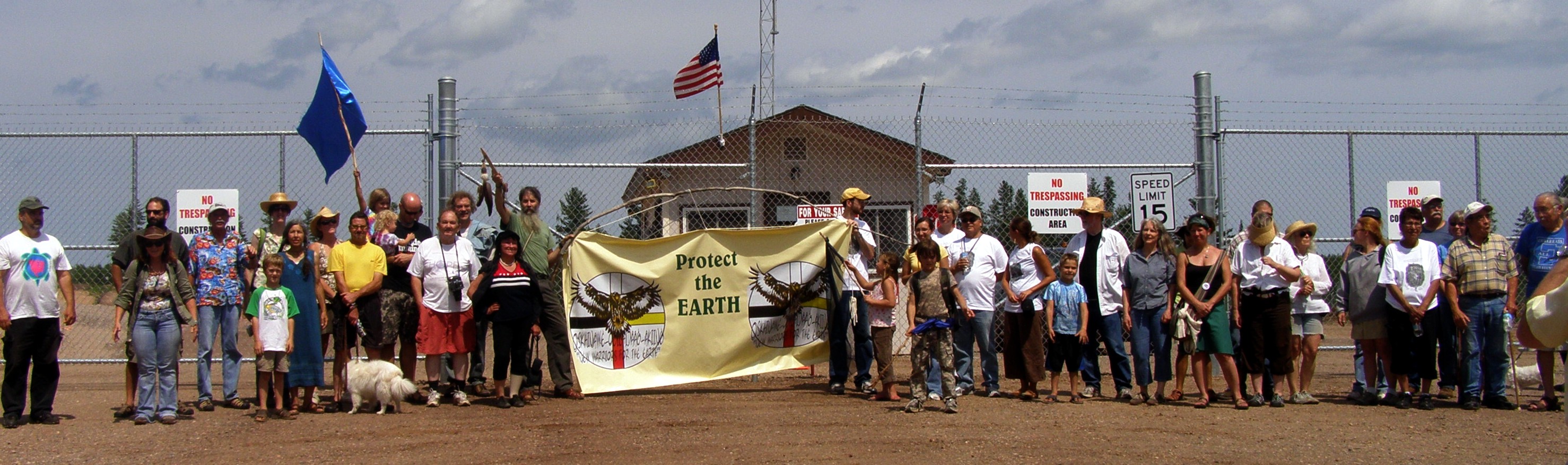
Last weekend, Native and non-Native people from the Marquette area and across the Great Lakes region joined together at the 3rd Annual Protect the Earth gathering.
Winona LaDuke’s Saturday morning Keynote speech emphasized the importance of creating greater resiliency and self-determination within Native communities. She urged Native peoples to strive for food and energy sovereignty in order to decrease their dependence on multinational corporations. This advice seems just as applicable for those of us living in non-native communities.
“As Anishinaabekwe (Anishinaabe women), it is our responsibility to care for the water,” Koski says “Protect the Earth and the annual walk to Eagle Rock re-energized our spirits and commitments to protecting the Yellow Dog Plains. As a people, it is our responsibility to not allow Rio Tinto the social license to mine near our freshwater and Great Lakes.”
A main focus of the gathering was Kennecott’s Eagle Mine and how to increase public awareness of sulfide and uranium mining interest throughout the Upper Peninsula. Protecting Migi zii wa sin, Eagle Rock, as a National Historic Site and Sacred Place to the Anishinaabe people was of special concern.
University of Michigan anthropologist, Stuart Kirsch, spoke near the Yellow Dog River about the detrimental effects of mining along the Ok Tedi and Fly Rivers for the Yonggom people of Papua New Guinea. Indeed, Rio Tinto/Kennecott has a record of abuses against indigenous peoples all over the world. Kirsch emphasized that it is not too late to stop sulfide mining from contaminating our rivers and watersheds here in the U.P.
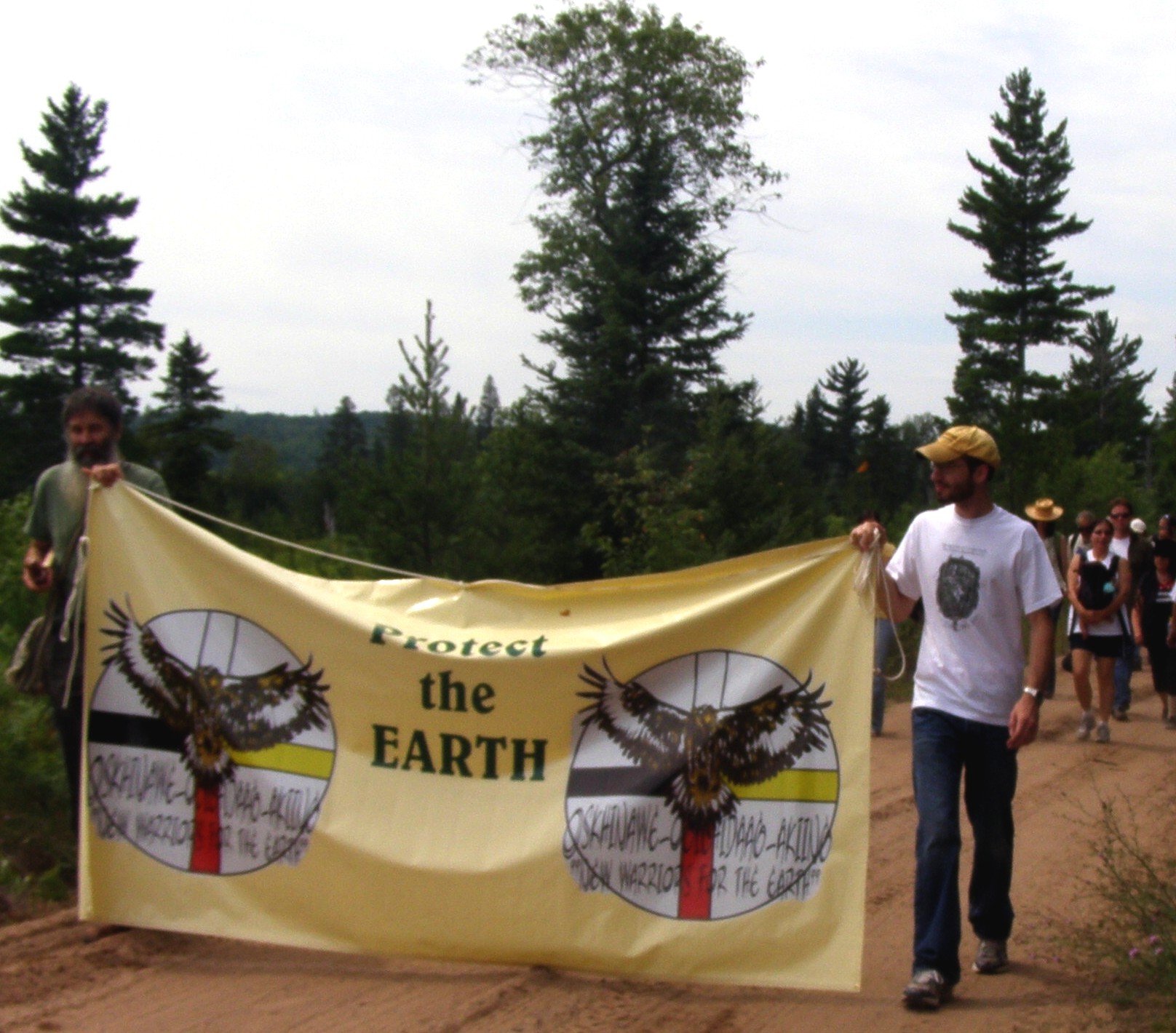 We need the whole state, the public to say ‘no.’
Indeed, the Native Americans living in the UP will feel the first and greatest impact of the Kennecott Eagle mine. Like the indigenous tribes in the film Avatar, they are watching their sacred site desecrated for profit. They will feel the loss of income and an important food source as fisheries are fouled. Their stand against bulldozers and barbed wire has already resulted in overzealous police action and illegal arrests. Non-native people and those living downstate cannot afford to let them stand alone.
“We really need supporters downstate,” Koski says. “ We need the whole state, the public to say ‘no.’ We need to look at what’s happening in the Gulf of Mexico and realize the responsibility that Michigan holds to the Great Lakes. These are the biggest fresh water lakes in the world. We need to stand up and protect our water.”
 Grand Rapids Institute for Information Democracy