Rev. Jesse Jackson Rouses GR Citizens
 The Reverend Jesse Jackson spoke to a standing room only crowd at Grand Rapids’ New Life Church of God in Christ yesterday, as part of the Rainbow Push Coalition Jobs, Peace and Justice Tour. He began his speech by inviting the audience to join him for this Saturday’s march on Detroit.
Jackson referenced Martin Luther King’s march for freedom, jobs and justice as he began his remarks. “Here we are 47 years later marching together for jobs, justice and freedom,” he said. “Today we are all free but we are not all equal. The quest is to put America back to work, to even the playing field.”
Using a biblical allegory of building a wall, Jackson explained that the city-to-city tour’s intent is to build the Rainbow Push Coalition in Michigan by connecting people from across the state. The Jobs, Peace and Justice Tour includes stops in Detroit, Kalamazoo, Battle Creek, East Lansing. Flint and Ann Arbor. “We came (here) in ’63. We were down but moving up. Today we are up but moving down.”
Jackson summarized the gains made by African Americans since the 60s as Jim Crow practices, such as denying service at restaurants and hotels, were made illegal and voting rights were extended to African Americans, 18- to 21- year-olds and college students living away from their hometowns. He said that had not reforms been made to the way delegates voted in presidential elections, Hillary Clinton would have taken the Democratic nomination in 2008 instead of Barack Obama. Referring to the 1984 presidential elections, he stated, “We found out during that season that our popular vote was much bigger than our delegate vote. We marched to ‘democracize’ democracy.”
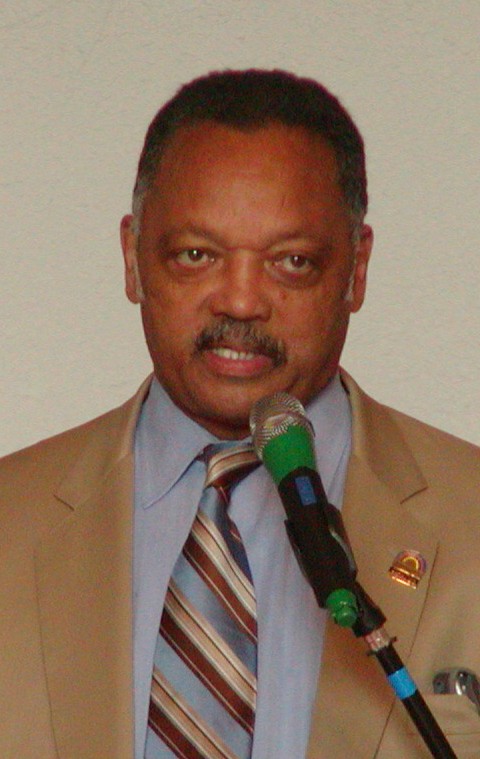 Jackson went on to say that in spite of those “fundamental shifts,” things are not right in the US. “Native Americans cannot get three meals a day because they are food insecure―but we have food stored in warehouses. Americans cannot get a house. Millions work without health insurance. Most poor people are not on welfare. They work every day. They catch the early bus. They raise other peoples’ children. They drive cabs . . . They work in fast food restaurants . . . They work . . . cleaning bed pans but when they get sick they cannot get healthcare.”
Jackson said that even though we see people of color in The White House and legislatures, he sees plants closing and jobs leaving every city he visits. “We cannot compete with China’s labor; we cannot compete with slave labor. When they close your plant and take your job and give you that pink slip, turn the lights out and lock the gates, the issue is not black and white, it is dark and light. We need to turn the lights back on for the American worker.”
Jackson referred to the 2008 Olympics in China saying that Americans won medals along with contenders from other countries because the playing field was even. In today’s globalized economy, the playing field for labor is not even. “We have globalized capital without globalizing human rights, workers’ rights, women’s rights and children’s rights.”
He went on to blast the Wall Street bankers and bailouts; predatory lending practices that charge higher interest rates to people in need; and cuts to human services, education and mass transit. “Here we are today fighting two wars. . . . we’re building roads, bridges, schools, houses and hospitals in Afghanistan. We need the same thing in America . . . use the same plan for Grand Rapids, Lansing, Detroit and put us back to work.”
 At this point, Jackson referenced the “American Dream” and shifted his emphasis from systemic issues to personal responsibility and faith. His powerful oratory energized the crowd to echo his admonishments to parents of schoolchildren. “Six things. One, you get up first. I may not be able to read or write or calculate, but I can take my child to school. Two, meet your child’s teachers. Teachers teach children differently when they know their parents . . . Three, exchange phone numbers. Then the teachers will call you, not the police. Four, turn off the TV. Five, pick up your child’s report card. Six, take your child to worship on the weekend . . . teach your child to read and write. Teach your child to pray.”
Jesse Jackson was able to lay out his excellent analysis of the US economy, continued racism and classism and the occupations of Afghanistan and Iraq with words that brought the message home to his audience. However, he failed to address the failures of a two-party neo-capitalist system that serves the interests of power and money. “Democracizing” democracy will take more than succeeding at school, working hard at our jobs, voting in elections and trusting in God. Historically, change has been seized in streets, not in the voting booth. Let’s hope Saturday’s march on Detroit takes steps in that direction.
Islamophobia and the Great “Ground Zero Mosque” Myth
(This article by Deric Shannon is re-posted from ZNet.)

Since the 9/11 terrorist attacks and following the “War on Terror”, “islamophobia” has become an increasingly familiar term in the United States—and with good reason. Crimes committed against Muslims because of their faith rose steadily from 2001 through 2005 according to studies, and they don’t seem to have dropped significantly since. Muslims in the US have reported attacks, racist slurs, police detentions and searches that were unprovoked, employment and housing discrimination, and so on. Since George W. Bush declared his “crusade” against terrorism (a particularly prescient turn of phrase) the xenophobia common in nations at war has amped up here in the United States.
The demonization of a people as if they are a monolithic mass during war time is as old as nation-states and their wars. In the US now, we are currently seeing this combined with another unsurprising and common set of events: A media and politician-generated hysteria close to campaign time. This is, after all, one of the ways that politicians swindle people into supporting them at the polls come voting time. And so, at the announcement of building an Islamic Center in Lower Manhattan, reports from political pundits started rolling in about the “Ground Zero Mosque”—continuing toward their November crescendo. Within the last few weeks, the hysteria has gotten louder and louder as a result of some high profile (and disturbing) protests and actions—some connected directly to the controversy in NYC, others apparently organized just from the sheer inertia of the rising anti-Muslim sentiment.
To name one example close to home for me personally, a group of right-wing Christians called “Operation Save America” descended on the Bridgeport Islamic Center here in Connecticut (where I live) a couple of weeks ago. One protestor there told reporters that “(t)here’s a war in America” and they “plan on taking it to the mosques around the country.” They were carrying placards reading things like “Islam is a Lie” and could be heard screaming “Jesus hates Muslims!” One protestor was even heard yelling “Murderers!” at young children leaving the center.
Given the public reaction, there are some rather serious problems with the “Ground Zero Mosque” myth that need to be stated (as often as possible)—some obvious and some not-so-obvious and perhaps even some lessons to be learned from it.
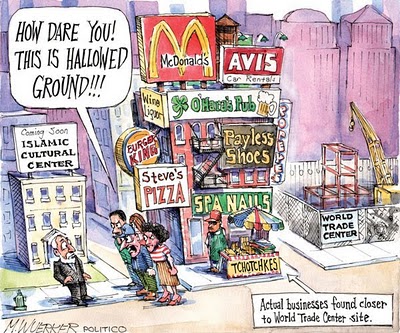
The first problem is that there isn’t really a “Ground Zero Mosque”. No, seriously. There isn’t one. There is a proposed Islamic Center a few blocks away. Plans were for there to be basketball courts, spaces for community education, a space for worship, and even a memorial for the victims of 9/11 in the building. Further, the building would not be visible from the site where the World Trade Center once stood. The discourse around the “Ground Zero Mosque” is so obviously a blatant deception that the AP has re-thought the ways it shaped the headlines and is now taking steps to stop using the phrase. Of course, that hasn’t stopped the political class and their pundit lackeys from using the term to describe their manufactured version of reality.
The second big problem with the Myth is the claim that the Islamic Center has some relationship with Jihadists who want to destroy America. Right-wing blogger, Pamela Geller, for example, refers to the Center as an “Islamic supremacist mosque at…hallowed ground” and suggests that Obama supports “Islamic Jihadists” by coming out in favor of building the center. Robert Spencer uses the even more grandiose “Islamic Supremacist Ground Zero Mega-mosque” to describe the center, bringing to mind the vast mega-churches common in the United States, but ostensibly being dedicated to a jihadist Islamicist faith that encourages killing innocents and wiping the USA off the map.
There are a couple of problems with this part of the politico-generated hysteria. First and foremost, the Imam of the proposed center, Feisal Abdul Rauf, speaks internationally on the dangers of extremism. As I write this piece, Rauf is touring the Middle East speaking out against terrorism. He was likewise seen as a State Department ally during the Bush presidency and funded for similar tours under G.W. He has condemned the 9/11 terrorist attacks as “un-Islamic” and gave a memorial speech for Daniel Pearl (the American journalist who was kidnapped and murdered by Islamic terrorists). Rauf is also a Sufi, a group of Muslims more known for their mysticism than their militancy. But “truth” is more an approximation in the media, particularly among liberal and conservative pundits when their candidates are running for office. In any case, Rauf is hardly a model for Islamic terrorism.
Further, peer-reviewed studies have shown that such Islamic Centers actually help to counter terrorism. And so in the twisted logic of political opportunism, a portion of the American public is manipulated into showing their outrage at Islamic terrorists by opposing something that would likely help prevent Islamic terrorists! One study, done by researchers for Duke and UNC, concluded by encouraging the creation of such community centers in order to help integrate Muslim youth into society and decrease feelings of isolation. Again, rather than a symbol for fundamentalism or a catalyst for extremism, these centers more often help stem Islamic terrorism (and weren’t we supposed to be at war with “terrorism”, anyway?).
Another problem with the discourse around the proposed center is the claim that it is “insensitive” to the victims of 9/11 or their families (though, as we’ve already seen, the rhetoric doesn’t always stop at “insensitive”). How could “Muslims” build this center at ground zero?—so the questions go—Don’t “they” know that “they’re” gonna offend the families of the victims of 9/11? Doesn’t it speak volumes about “these people” that “they’d” do this? And so on. In the last few weeks I’ve heard too many of these kinds of claims about “those people”, etc.
I was trained as a sociologist and, while a good part of what I learned in that training was to be suspicious of sociologists, one concept that comes from social scientists is pertinent here—the concept of “the Other.” Scholars as diverse as Sartre, Lacan, and de Beauvoir have written about how humans come to understand their “selves”, often in relation to other communities that we construct as “foreign” or “different” and, oftentimes, subordinate and “barbaric.” Through this process of creating a mythological and queer (in the sense of being strange) contrast, we come to construct (and understand) our selves. A part of this process is homogenizing groups that we have deemed “Other” and failing to see any differentiation within those groups.
This is where the discourse around “Muslims” being responsible for 9/11 and “them” knowing better than to put one of “their” social centers close to Ground Zero comes from. While we all know that it was fundamentalist Muslims who committed the terrorist attacks of 9/11—a subset of a fairly diverse Islam—it follows the homogenizing project of “Othering” to lump Muslims together as a single, monolithic group and to then hold them collectively responsible (particularly during war time and close to the political machinations so common during campaign time). For most Americans, Christianity is normal and Islam is “Other” because Christianity is common in our society. We make pledges on the Bible in our courts. Churches are a ubiquitous sight, where mosques are not. Many of us, our families, and our loved ones are Christians of one sort or another. So when we read about an abortion clinic being bombed, we know that “Christians” aren’t responsible for it, but Christian fundamentalists. When we hear about Catholics erecting a statue in honor of the victims of the Oklahoma City Federal Building, we don’t get offended because “Catholics” were responsible for the attack in the form of Timothy McVeigh. We differentiate between Christians because Christianity has become such an important part of how we see our selves. And so the entire idea of “Muslims” knowing better than to be so insensitive and build this Islamic center is problematic—it projects a collective guilt onto all Muslims who likely differentiate between themselves, while we fail to. And, again, these problems are compounded by the media circus near campaign time, the wars in Afghanistan and Iraq (two nations that never attacked the USA) and the xenophobic sentiment whipped up in order to manufacture the consent of the American people for these wars.
I might take a moment here, too, to explain that I’m not religious. I was brought up with a particularly virulent form of fundamentalist Christianity that was psychologically destructive, shaming, and often times just outright ridiculous (I remember one friend who was forbidden from watching the cartoon “The Smurfs” by his parents because they were “demonic”). I’m not a fan of religion in general, so I don’t want this to seem like advocacy for religious centers of any kind. However, I do recognize that not all forms of Christianity are the same—and neither are all forms of Islam—which is essentially what is being suggested here.
I think there are a couple of lessons in this manipulated hysteria for us too, even if they are lessons that we should already have learned. One is about the need for independent media of our own. Too often we allow for-profit news services to influence us in subtle ways. Our news sources are the media arm of politicians and the wealthy and they reflect a very narrow spectrum of political ideas. This is a very old insight, one impressively demonstrated in Herman and Chomsky’s famous book “Manufacturing Consent”. We need to be able to provide counter-narratives to their claims and support independent media that adds our voices to the media circus.
Secondly, we need to rise above the bait of our bosses and politicians. It serves the interests of our rulers for working people to be divided over superficial nonsense like the building of a community center. It is when exploited, oppressed, and ruled people come together and actively resist their rulers that change starts to happen. Throughout history, the dispossessed have found common cause in fighting the people that ruled over us. But we have only done so when we were able to wake up from the deep sleep eagerly provided to us by the people who rule us and largely own and operate the globe.
Finally, we might use this particular media-generated hysteria to think about the ways that we might best intervene in our social world. The economy is in crisis, so we’re told (for our natural environment, for disappearing species, and for billions of people throughout the world living in hunger and privation capitalism is always a crisis), and while masses of people are being laid off and evicted from their homes around us, many of us are arguing over a community center. The fact that our rulers wield this kind of ideological power over us, even in a time like this, is cause for critical reflection. How is it that liberals and conservatives have so captured the public mind? Why are we seeing this hard turn toward xenophobia and Othering at this particular historical juncture? In what ways might we substantively address the cultural divide being forced onto people from above?
I don’t think we have adequate answers to those questions. But I do think that through struggle and study we can learn together to dispel some of these illusions that are peddled to us.
The myth of the “Ground Zero Mosque” and the Islamophobia that surrounds it are media-generated products of a state at war during campaign time. The myth represents some of the worst kinds of “Othering” associated with the hyper-patriotism that followed 9/11 in the United States. At a recent protest against the proposed center in New York City, protestors could be seen jeering, yelling at, and threatening one dark-skinned worker for being “Muslim”—even after he explained to these (largely white) protestors that he was not. The problems here are obvious. We need to be countering these media-generated myths.
(This article by Bruce Dixon is re-posted from Black Agenda Report.)
It’s old news by now that the African American conversation, as heard on corporate media, throughout commercial black radio, is limited to what greedy corporations owning those stations want us to, or will allow us to talk about. When we listen to Warren Ballantine and Steve Harvey giving relationship advice, to Gale King interviewing celebrities, to gay-hating gospel entertainers like Donnie McClurkin, to Rev. Al Sharpton pitching predatory car title loans, or even Tom Joyner on the Morning Show himself, we are not hearing our conversation, or our news about our lives and concerns. We’re hearing the voice of our would-be masters.

Black communities are overwhelmingly against privatizing schools and public resources, and widely oppose the wars in Afghanistan, Iraq, Somalia and everywhere else, more so than any other constituency in the nation. But when was the last time you heard a whisper of this on black TV and radio. In black-oriented media? In the very places we ought to be able to hear our own voices, our collective political will is a political won’t, a corporate and commercial no-go zone.
On August 4, 2010 Tom Joyner had as guest on his nationally syndicated Morning Show one Julius Hollis, an African American former telecom exec who heads up the Alliance For Digital Equality (ADE), a corporate lobbying entity in blackface, widely believed to be funded largely by AT&T. We have included a link to the six minute segment in this article.
In it, Joyner strokes Hollis, first just for being “a good guy,” secondly for his supposed advocacy on extending “access to digital technology by minority communities”, and third for Hollis’s and ADE’s alleged philanthropy. Hollis asserts that he helped start an in-school and after-school program for fifty children in Atlanta which is now “accessible to” more than 2.1 million children. That’s a lot of children. BAR called ADE’s headquarters in Atlanta. We asked where those 2.1 million children were, and exactly what Hollis meant when he said his program was “accessible to” them. Despite repeated telephone inquiries over the course of a week nobody at ADE could tell us that. In fact, they took our calls politely, but never returned any.
We suspect that Hollis’s claim was misleading at least, and fraudulent at worst. If his program actually served 2.1 million children, ADE would be anxious to show the world, rather than hiding from legitimate inquiries. Besides, “accessible to” is a lawyerly weasel-word phrase calculated to sound very much like “our program actually serves 2.1 million children” while allowing whoever made the statement to say they really meant no such thing. Harvard Law School is theoretically “accessible to” everybody as well. Again, BAR gave ADE and Hollis a chance to explain what they mean, a chance they passed up. We won’t call Hollis a liar. But we wish he would explain “accessible to” and show us the 2.1 million children his program serves, if that’s the truth. Maybe Tom Joyner will invite him back to explain it all.
Is ADE really a charitable organization of high-level black and brown “entrepreneurs” all about “giving back” because they’re such good guys and girls? ADE does not disclose its budget, but to sourcewatch.org, the indispensable wiki on corporate front organizations,
“Its 2007 tax return (Form 990),” according to SourceWatch, “…had an operating budget of over $2 million, of which no money was allocated for fundraising, nor hiring of employees. In fact, the total compensation for board members exceeded the amount of all program-related expenses.”
Next time Hollis is on the Morning Show, Joyner can also ask about ADE’s supposed advocacy mission, for the expansion of broadband and technological opportunities to black and brown communities. Maybe he’ll point out that ADE is, under federal law, not a charitable outfit, but a 501c4, or lobbying nonprofit, created to advance its tax exempt purposes by influencing public officials. In the real world, Julius Hollis is a telecom lobbyist, and ADE is what’s called an “astroturf” organization, created to carry out the political will of its corporate funders while pretending to be a grassroots operation arising out of black and Latino communities.
ADE is apparently rolling in cash, and has no need of the fundraising appeals typical of do-gooder nonprofits. It has lots of money with which to buy new friends. Earlier this year ADE forked over a load of cash to assume co-sponsorship of Blogging While Brown, an annual gathering of black bloggers.
ADE has two faces. Public policy is made mostly inside the DC Beltway. In this place, safe from most public input or scrutiny, ADE and its corporate sponsors are everywhere, at every official and unofficial event, every congressional meet and greet, every hearing, every panel discussion, with well-paid black and brown ministers and spokespeople. ADE’s message is always the same. ADE, its board members, well-compensated staff and lackeys claim that black and brown communities don’t want publicly owned city or community wi-fi networks to compete with Comcast, Verizon, AT&T and the like. Black and brown people love the idea of Comcast merging with NBC, and bitterly oppose this thing called network neutrality, along with anything else that would “stifle innovation” by regulating the giant telecom monopolies and near-monopolies. The next time you want to see “entrepreneurial innovation” on the part of AT&T, look at your nearly incomprehensible phone bill. This is the face ADE would rather you didn’t see.
ADE’s other face is about corporate philanthropy, because as Joyner would have us believe, they’re “good guys, giving back”, and about its supposed “JET Agenda,” which stands for “jobs, education and technology.” Joyner makes quite a big deal, in the six minute segment, of the few dozen laptop computers ADE enables he and Roland Martin and some others to hand out to deserving minority children at public appearances. What Joyner, Martin and others don’t tell us is that these are the companies which invented, and which still profit from the digital divide.
Pressing for “jobs, education and technology” sounds nice too. Enabling net neutrality over cell phone networks, along with community-owned municipal wireless and cable networks would guarantee an exponentially greater number of jobs and entrepreneurial spaces in our communities. But these are the very things ADE brings black ministers to Washington and to its regional conferences to testify against. Their advocacy of black community access to jobs, education and technology is even less substantial than Hollis’s apparent claim to be the author of an educational program serving 2.1 million children.
ADE never really explains how preserving the rights AT&T, Verizon, Comcast and their peers to dictate our digital future will bring about its “jobs, education and technology,” any more than establishment economists explain how lower taxes on the rich will create trickle-down jobs for the rest of us. So when current AT&T execs like Cynthia Marshall use exactly the same talking points and language to describe AT&T’s “JET Agenda” of “jobs, education and technology” as Julius Hollis does, it’s hard not to believe that AT&T is speaking every time their lips move. Whether it’s posing as an agent of philanthropy, or hurling bogus accusations of racism at Free Press and other advocates of network neutrality, ADE is a black and brown sock puppet for the telecoms. As we wrote several months ago,
“…ADE’s policy positions and rhetorical poses, especially its opposition to network neutrality and specious claim to want to bridge the digital divide, fit the exact profile of a telecom-funded PR operation on the part of Comcast, AT&T, Verizon, Time-Warner, with black and brown corporate execs on its board. The Alliance For Digital Equality is clearly a corporate-funded front organization pursuing corporate welfare, bailouts and preferential laws and rules for its funders disguised as some kind of benevolent public service. “
ADE is not in the business of public service, any more than Warren Ballentine, Gail King, Rev. Al and Donnie McClurkin are about the black conversation. To station owners and media personalities we are not a people or a polity. We are just a market, to be manipulated and sold to advertisers. Maybe Tom Joyner will invite his good buddy Julius Hollis back to explain himself. Maybe Tom will find a black advocate of network neutrality, community-owned cable and wi-fi, and have that person as a guest on the Morning Show. Maybe. Should we hold our breath?
BlueGreen Alliance Bus Tour Comes to West Michigan
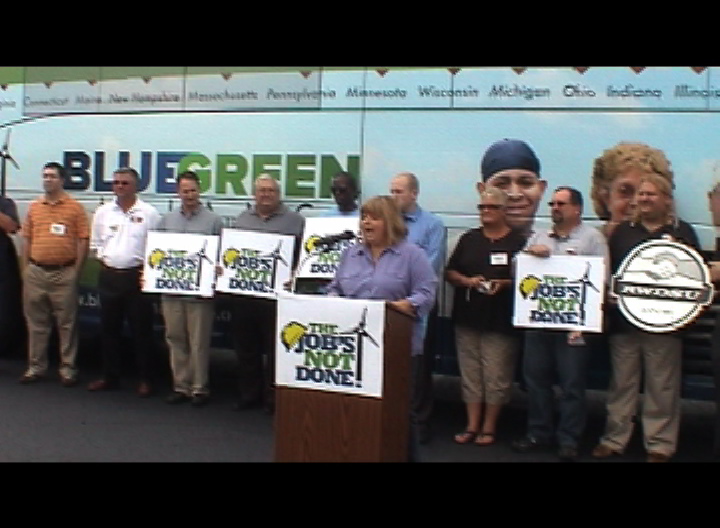
Yesterday, the BlueGreen Alliance bus Tour stopped off in West Michigan on a 17 state road trip promoting clean energy and green jobs. The Press Conference was held in the parking lot of the Teamsters Local 406, where local people heard from several labor activists from around the country who were on the tour.

The main focus of those who spoke yesterday was to get Michigan residents to pressure Senator’s Stabenow and Levin to pass the Senate version of the Clean Energy Bill. Representatives from the construction workers union, the SEIU, and the steelworkers union spoke about the importance of creating green jobs and getting the Senate to pass this bill.
Several of these workers have been laid off in the past year and they stressed that if the Senate were to pas this bill it would not only help protect the environment, it would create needed jobs. According to the Press release sent out by the BlueGreen Alliance, the passage of the Senate bill would create up to as many as 42,000 green jobs in Michigan alone.
However, there has been much criticism, particularly from some in the environmental community that the House bill that has passed and the Senate version that is still to be decided still allows for too much pollution and might even weaken existing environmental protections.
In May, Friends of the Earth released a statement that read in part, “The bill described in these summaries would scrap crucial tools for solving the climate crisis while locking in billions in polluter payouts. It would be a step backward in the fight against climate disruption-great for polluters, but bad for people and the planet.” Last month in the Guardian it was reported that the Senate bill would not cap the amount of carbon emissions and that large polluters will not be held accountable.
Mark Mullholand, a worker from Ohio felt that the legislation would at least open the door to making some improvements and that it was better than doing nothing. After the press conference I interviewed Mark who has been on the tour from the very beginning.
It is worth noting that no local environmental groups were present at this event and the only other news media that attended was the Grand Valley Labor News and Fox 17, which didn’t send a reporter.
A Critique of the Obama Administration so far

(This interview is re-posted from News Click.)
It’s going to be almost two years that Barack Obama was sworn in as President of the United States. During his presidential campaign he promised change. But may be the person who runs the best campaign does not necessarily turn out to be the best president. Prof. Vijay Prashad does detailed analysis of Obama Administration and his declined popularity.
Vijay Prashad is George and Martha Kellner Chair in South Asian History and Professor of International Studies at Trinity College in Hartford, Connecticut, USA. He is the author of eleven books, most recently The Darker Nations: A People’s History of the Third World (2007).
State Department Details Blackwater Violations of US Laws
(This article from McClatchy Newspapers is re-posted from Common Dreams.)
The company formerly known as Blackwater violated U.S. export control laws nearly 300 times, ranging from attempts to do business in Sudan while that country was under U.S. sanctions to training an Afghan border patrol official who was a native of Iran, the State Department said Monday.
 Erik Prince of Xe, formerly Blackwater. Prince recently moved to the United Arab Emirates, and has put Xe Services up for sale.(Chuck Kennedy / MCT)
The alleged violations were spelled out in documents released Monday by the State Department as part of a $42 million settlement with Blackwater that will allow the company, now known as Xe Services LLC, to continue receiving U.S. government contracts.
The agreement appears to spell the end of a three-and-a-half-year, multi-agency federal probe into Xe Services’ unauthorized exports of defense technologies and services. While elements of the case were presented to a federal grand jury, the company and its currently serving officers have avoided criminal prosecution.
The State Department said Monday that Xe Services’ alleged violations, while widespread, “did not involve sensitive technologies or cause a known harm to national security.” Additionally, it said, they took place while Xe “was providing services in support of U.S. government programs and military operations abroad.”
Under the agreement with the U.S. government, the Moyock, N.C., company was levied a $42 million fine, but Xe is allowed to use $12 million of that to strengthen the company’s export control compliance programs. Xe won’t be barred from further U.S. government contracts, and a government policy of denying most of the firm’s export control applications, in place since December 2008, will be lifted.
Mark Corallo, a spokesman for Blackwater founder Erik Prince, didn’t immediately return a phone call seeking comment. Prince recently moved to the United Arab Emirates, and has put Xe Services up for sale.
McClatchy first reported in June that Xe Services and the U.S. government were negotiating a multimillion-dollar fine to settle allegations that it violated laws regulating the export of defense equipment and know-how overseas. The article detailed Blackwater’s extensive efforts to secure business in southern Sudan at a time when the country was under U.S. sanctions for its sponsorship of terrorism.
A 41-page State Department document released Monday provides some new details about Blackwater’s Sudan plans and provides a peek into the secretive company’s training of foreign military personnel around the globe.
For example, an October 2006 Blackwater proposal to the south Sudanese government called for the company to provide military training to individuals who held citizenship in both Sudan and neighboring Uganda, but “would be deemed Ugandans for training purposes.” Blackwater obtained Ugandan passports for the prospective trainees from the south Sudanese government.
At the time, Sudan was under U.S. sanctions, but Uganda wasn’t.
Most of the 288 violations of export control laws cited in the document involve Blackwater providing unauthorized military or security training to foreign nationals or failing to vet adequately the backgrounds of those it was training. The concern is that U.S. enemies could benefit inadvertently from such training.
Persons trained by Blackwater under a U.S. government contract to train the Afghan Border Police included “one (who) was born in Pakistan and the other in Iran, a proscribed country,” the document says.
Blackwater provided military training to security forces in almost every corner of the globe, often without proper authorization from the U.S. government, the documents show. Countries that received those services included Azerbaijan, Canada, Japan, Jordan, Kuwait, Niger, the Philippines and Taiwan.
Blackwater also violated firearms regulations on numerous occasions, the documents allege. In one case, it diverted weapons intended for use in supporting U.S. military operations in Iraq to the company’s private contracts in that country.
The company “did not fully cooperate” during the first 18 months of the State Department investigation, which began in February 2007, and made several false statements to the government that it later revised, the documents said.
ON THE WEB
The State Department agreement with Xe Services
MORE FROM MCCLATCHY
Feds won’t charge Blackwater in Sudan sanctions case
Media Bites – Adidas
In this week’s Media Bites, we take a look at a hip, new commercial from the athletic shoe and apparel company Adidas. The ad presents their product in a retro diner setting, where shoes are served like food. While it may seem cool to wear Adidas, the commercial omits the conditions that workers who make the shoes are forced to work in.
2010 Fall GRIID Classes
This fall we are offering two new classes that our readers would no doubt find are about topics that we write about on a regular basis. The classes are Radical Sustainability and Confronting Racism and White Privilege.

In the Radical Sustainability class we will investigate the growing popularity of sustainability or what would more accurately be called Green Capitalism. What does it mean to be Green? Can we purchase our way out of environmental destruction? What is Greenwashing?
We will not use a book for this class, rather a collection of articles, web pages and videos to have greater understanding of the idea of sustainability. We will also collectively create a vision or set of proposals for what a truly sustainable Grand Rapids might look like. This class will be on Mondays from 7 – 9pm, staring October 4.

The second class is designed to get participants to confront the issue of White racism & White privilege. As a primary text, we will use the book by Tim Wise, Between Barack and a Hard Place: Racism and White Denial in the Age of Obama. In addition, we will look at how White Racism impacts other communities of color and issues such as immigration.
Included in this class will be a look at the racial dynamics that exist in the Greater Grand Rapids area and what is or isn’t being done to promote racial justice. This class will be on Wednesday’s from 7 – 9pm, starting October 6.
Both classes are for 6 weeks and the cost is $20. We will be hosting the classes in the Steepletown Center at 671 Davis NW in Grand Rapids. For more information or to sign up please contact Mike Saunders at outobol@gmail.com or Jeff Smith jsmith@griid.org.
If you want to promote the classes you can forward this link and print or post the flyers for both classes.
What We Are Reading
Below is a list of books that we have read in recent weeks. The comments are not a review of the books, instead sort of an endorsement of ideas and investigations that can provide solid analysis and even inspiration in the struggle for change. All these books are available at The Bloom Collective, so check them out and stimulate your mind.

The Possessive Investment in Whiteness: How White People Profit From Identity Politics, by George Lipsitz – The book by University of California Professor George Lipsitz is an excellent investigation into how White Privilege and White Supremacy is manifested in the contemporary United States. Lipsitz looks at how White Privilege and White Supremacy has evolved since the Civil Rights era into a much more subtle and sophisticated form of institutional racism. An important book for anyone committed to racial justice.

Sparking A Worldwide Energy Revolution: Social Struggles in the Transition to a Post-Petrol World, edited by Koyla Abramsky – For anyone who is concerned about the future of the planet and who is tired of the limited critique of Peak Oil, this collection of essays will both inform and inspire. The 50 essays contained within this book are presented from an anti-capitalist perspective. The contributors look at energy workers, oil production, natural gas, nuclear and bio-fuels. In addition, there are numerous examples of communal approaches to energy production and use, as well as indigenous and grassroots efforts to fight the global energy cartels.
For All The People: Uncovering the Hidden History of Cooperation, Cooperative Movements, and Communalism in America, by John Curl – In many ways this book is like a people’s history of economic cooperatives. The author excavates a rich history and shows that one thing that many unions embraced in the later part of the 19th century and early part of the 20th century were cooperatives that both competed with companies and demonstrated a model that could counter capitalism. Seeking to reclaim history that has remained largely ignored by most historians, this dramatic and stirring account examines each of the definitive American cooperative movements for social change – farmer, union, consumer, and communalist – that have all but been erased from collective memory.
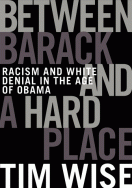
Between Barack and A Hard Place: Racism and White Denial in the Age of Obama, by Tim Wise – Written within weeks of the 2008 Electoral victory of Barack Obama, this short book by one of the best anti-racist thinkers in America cautions us to not believe that just because a Black man occupies the White House that racism no longer exits. Wise looks at both the attitudes that White people who voted for Obama have, as well as the a more sophisticated for of White Supremacy that the author refers to as Racism 2.0.
The Press and Economic Lessons
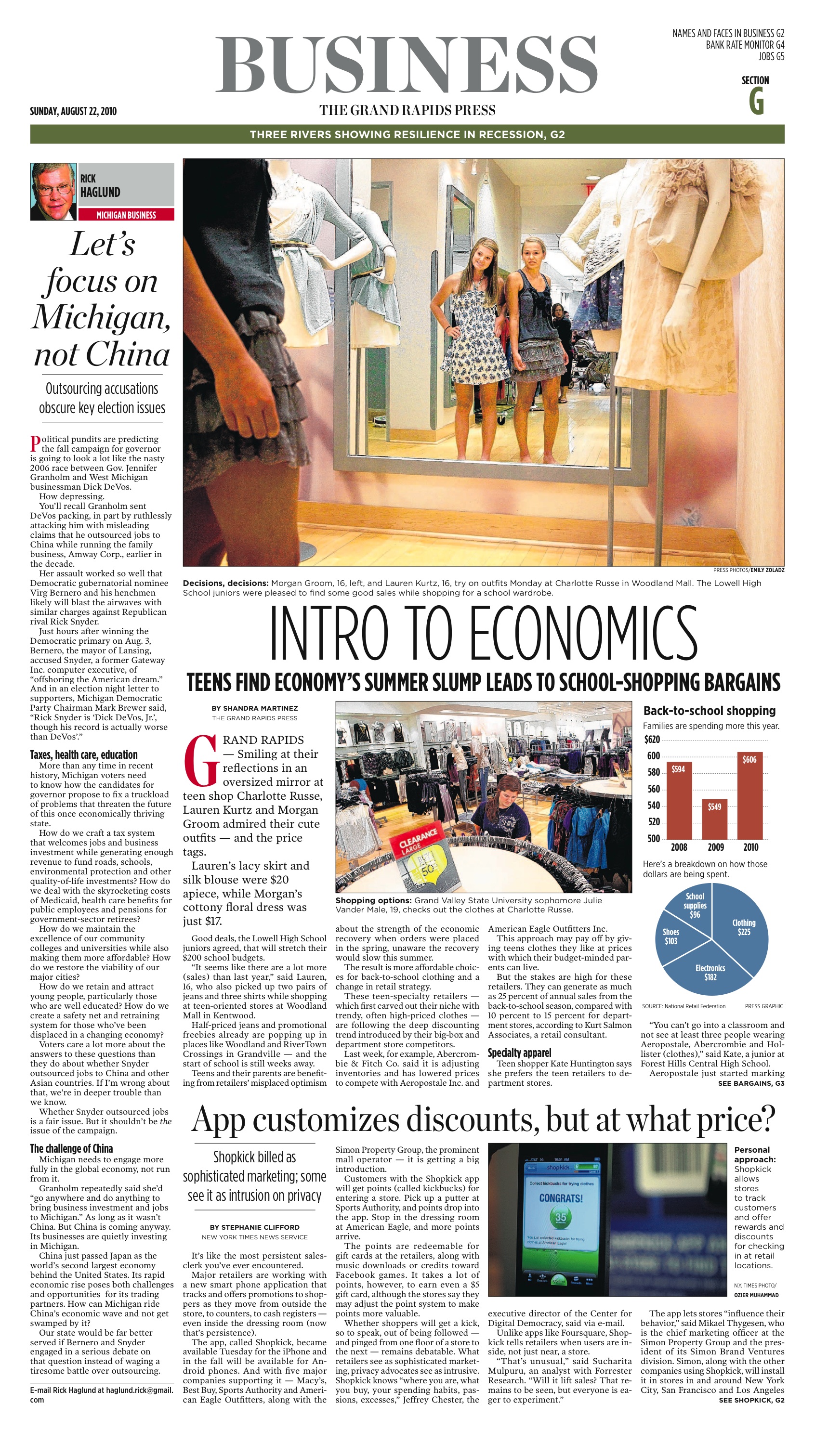
Yesterday, the Grand Rapids Press ran as a feature story in the Business section an article entitled, “Intro to Economics.” The basic premise of the article was that since retailers were too optimistic about teen clothing sales they over ordered in the Spring, so now the prices have drooped, which is supposedly good for consumers.
The article speaks to a few teens and a few parents, some which were happy that they were able to “only” spend $500 on their kids for back to school clothing. Besides the consumer input the article also sourced a retail analyst who doesn’t really add anything to the story.
Much of the story was actually a promotional piece for several national clothing retailers like Abercrombie & Fitch and Aeropostale. The Press reporter even tells readers which area malls have these teen clothing deals and what the prices are for some of the items. This is common practice with the Press as we have noted before and in another recent story on back to school shopping.
The print version of the story is accompanied by 4 pictures, all of shoppers in front of stores or teens trying on clothing. These images add to the basic economic message of the Press story, which tries to frame the article as pro-consumer. However, the pictures and the article seriously omit important economic elements of the clothing industry.
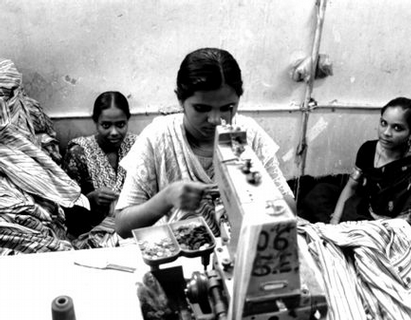
First, there is no mention of where most of the clothing sold in chains stores is made. Knowing that the bulk of clothing that Americans buy is made outside of the country’s borders would be a useful bit of information in communicating the economics of the retail industry.
Second, readers are not made aware of the realities that garment works around the world, many of whom are teenagers themselves. According to the National Labor Committee (NLC), young women in Bangladesh make as little as 11 cents an hour at beginning wages making jeans. The NLC reports that women make an estimated 2 cents for every pair of jeans they sew.
Many of these young women in Bangladesh are now organizing to get a more just wage, a campaign that was recently endorsed by both US and British unions. Adding this kind of information would surely qualify as an Intro to Economics, and would probably resonate with teenagers and their parents who might be interested in more than the price tag.
 Grand Rapids Institute for Information Democracy