We can never rely on cops to prevent ICE from taking people or holding them accountable in Grand Rapids or anywhere else
Over the past week I have seen the information in the graphic below shared on social media. Some people in the Grand Rapids area have even asked what GR Rapid Response to ICE thinks about this information. I am not speaking on behalf of GR Rapid Response to ICE, but I am a volunteer organizer with them and understand where we stand on the relationship between cops and ICE agents.

ICE and Cops go hand in hand
 The only thing in the graphic here on the right that I agree with is for people to record/document when ICE agents – masked or unmasked – take people.
Calling the GRPD or any local police department is not only a bad idea, it could make it worse for the person or persons that have been taken.
The rest of the information in this graphic is also deeply problematic, since it is operating with the assumption that there is accountability with cops involved. “Verified Law Enforcement” is a meaningless term, primarily because it suggests that those who are identifiable are somehow legitimate. Police officers work for governments, thus they are state workers, or as David Correia and Tyler Wall state in their book, Violent Order: Essays on the Nature of Police, police are violence workers. The co-authors write, “The purpose of the police is to inflict pain or to threaten pain when order is is being threatened, just as the purpose of the taser is to inflict pain in order to control another human being.”
I get that ICE agents showing up with no badge and no visible evidence that they are ICE agents is deeply troubling, but it is troubling when people apprehend immigrants, regardless if they have their faces covered or not. We have to remain rooted in our opposition to anyone working for the state that wants to do harm to people in our community.
The rest of the information within the graphic continues the same worldview that the system works and that accountability can be achieve, especially if the police become involved. The cops take a statement, which pressures the cops to identify themselves, leading to a paper trail, with the possibility of a civil lawsuit. This line of thinking ends with accountability, the graphic claims. Again, this line of thinking demonstrates that the policing and legal system work and are a legitimate avenue for obtaining justice. Such thinking is both naive and historically inaccurate.
People really need to unlearn what we have all been taught about the cops, the courts and the Prison Industrial Complex. We really need to come to terms with what the actual function of policing is, which Alex Vitale describes beautifully, stating:
“The reality is that the police exist primarily as a system for managing and even producing inequality by suppressing social movements and tightly managing the behavior of poor and nonwhite people; those on the losing end of economic and political arrangements.”
I would highly recommend that people read some of the following books to being our process of unlearning what the real function of policy is:
- Our Enemies in Blue: Police and Power in America, by Kristian Williams
- The End of Policing, by Alex Vitale
- No More Police: A Case for Abolition, by Miriam Kaba and Andrea Ritchie
- Becoming Abolitionists: Police, Protests, and the Pursuit of Freedom, by Derecka Purnell
- “Prisons Make Us Safer”: And 20 Other Myths about Mass Incarceration, by Victoria Law
- Copaganda: How Police and the Media Manipulate Our News, by Alec Karakatsanis
- Beyond Courts, by Community Justice Exchange
What is ultimately missing from this graphic I have been deconstructing is that it omits the most powerful way(s) we can create community safety. In terms of preventing ICE from taking people, I believe that what Movimiento Cosecha and GR Rapid Response to ICE are doing is already working to prevent ICE from taking people. The other major shift would be to stop funding ICE and Police departments and invest that money in meeting the basic community needs. This is why we say, Community Care, Not Cops!
GR Rapid Response to ICE action dramatizes the horror of ICE violence by exposing the Avelo Airlines contract with ICE
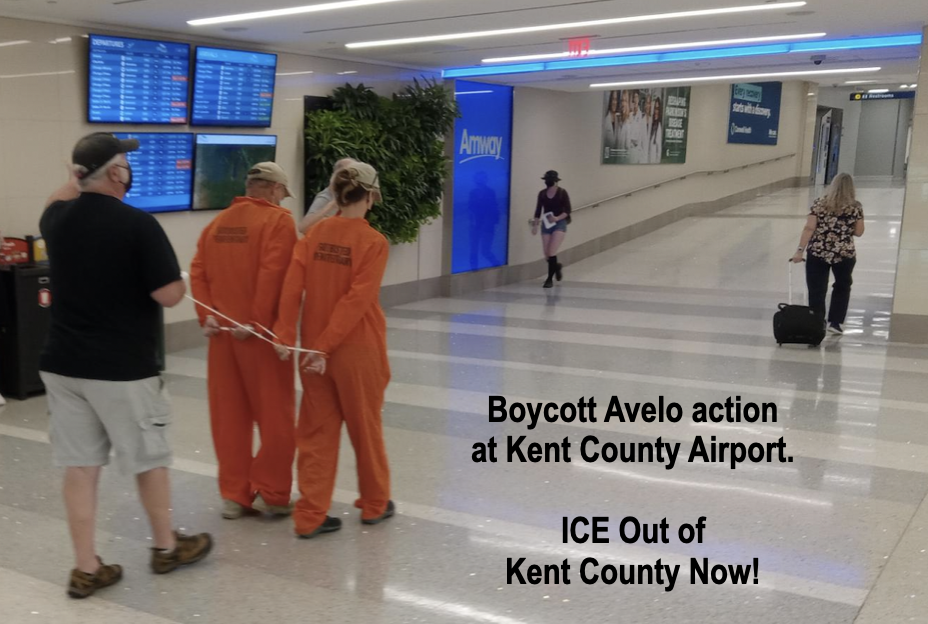
 On Saturday, a dozen activists took part in an action organized by GR Rapid Response to ICE.
The action centered around the contract that Avelo Airlines signed with Immigration and Customs Enforcement (ICE) to transport immigrants directly to El Salvador. Avelo Airlines is a small airline that launched in 2021 with a fleet of 20 aircraft. On May 12, Avelo Airlines became the first commercial airline to begin deportation flights, and running flights and hiring flight attendants in Mesa, AZ to fly people in ICE custody out of the country.
In March, it was announced that Avelo Airlines would be offering flights out of the Kent County Airport, with a few direct flights to North Carolina and Florida. GR Rapid Response to ICE began talking about organizing an action, but only if it would fit within the larger work to pressure Kent County to adopt a Sanctuary policy.
The action on Saturday was a low risk action, that involved handing out informational flyers and using street theater to dramatize the relationship between Avelo Airlines and ICE. You can watch the short video here below.
Street Theater is a creative tactic for social movement work, a tactic that was popularized by the Brazilian theater practitioner and political activist Augusto Boal. Using street theater also provides a more visual and emotive mechanism to communicate political realities, especially realities that are rooted in oppression.
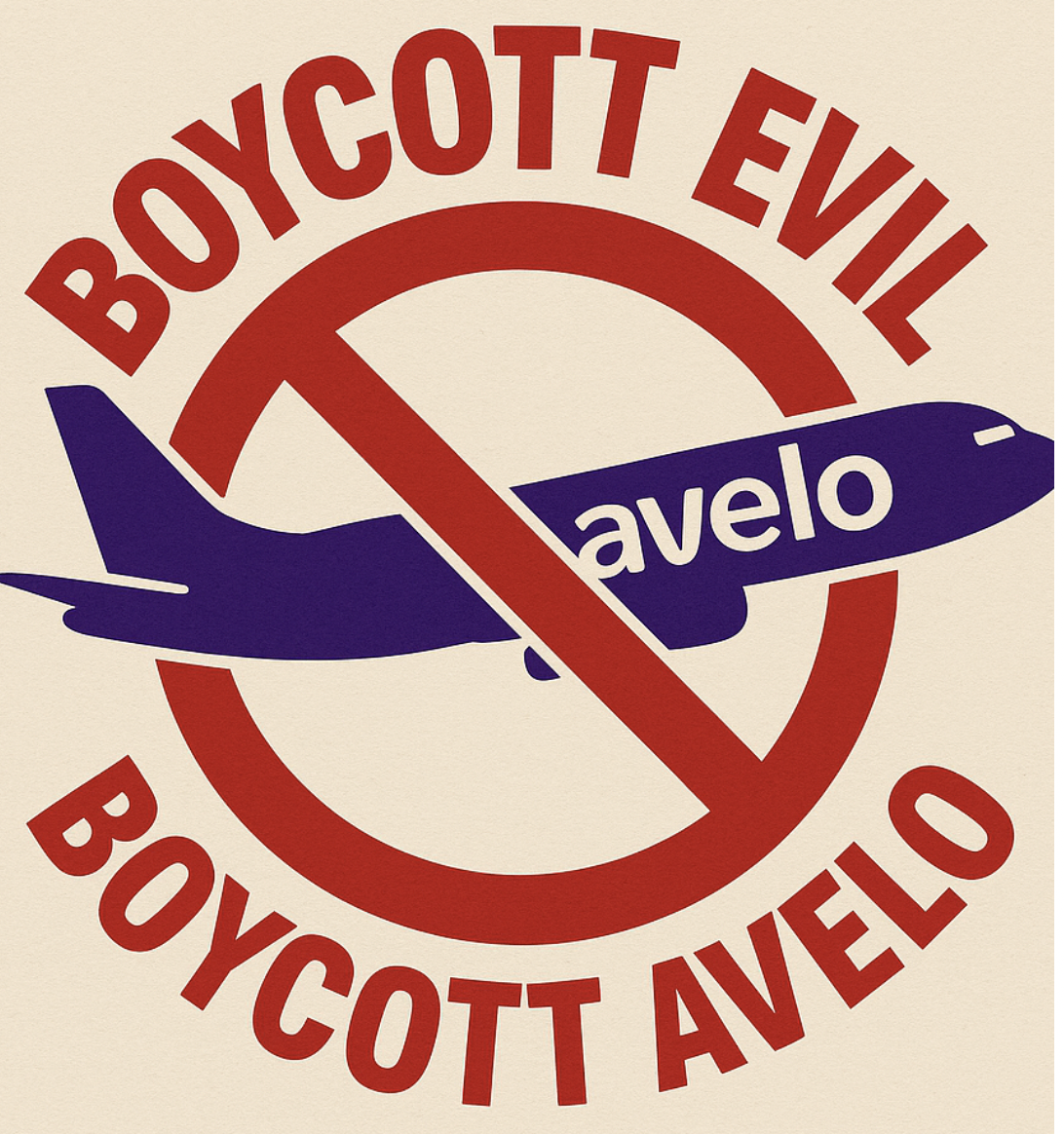
The informational handout complimented the street theater, since it provided concrete information on Avelo Airlines, along with additional actions that people could take after knowing about the contract between ICE and Avelo Airlines. The handout lists numerous actions that people can participate in, making the action at tactic that leads to other actions. What follows is a list of actions that people can take:
1. Boycott Avelo Airlines – don’t purchase tickets from them and tell others to do the same.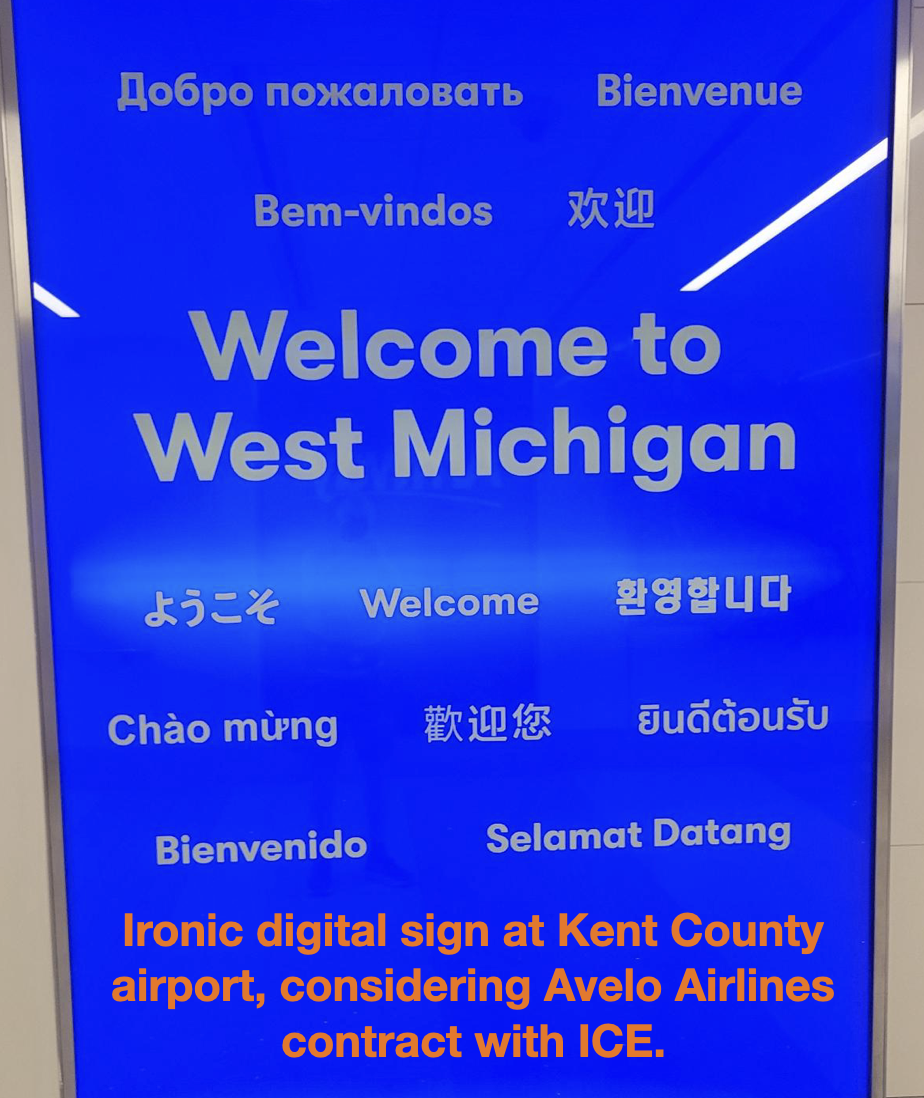
2. Send a message to the Gerald R. Ford International Airport Authority Board to end their contract with Avelo Airlines grrboard@grr.org
3. Sign the Action Alert to get the Kent County Commission to adopt a Sanctuary policy tinyurl.com/KentCountySanctuary
4. Attend the July 24th Kent County Commission meeting to demand they adopt a Sanctuary policy – 8:30am in the County Building.
5. Join the work of Movimiento Cosecha and GR Rapid Response to ICE to get ICE out of Kent County by sending an Email to info@grrapidresponsetoice.org
The US bombed Iran last night in a cruel act of aggression. Yes, the Trump Administration bombed Iran without Congressional approval, but most members of Congress have refused to condemn the bombing, like Rep. Scholten and Senator Slotkin.

Around midnight of last night, Rep. Hillary Scholten posted these comments on her Facebook page:
Iran must never be allowed to obtain nuclear weapons.
As the president takes action without congressional approval, my thoughts are with our troops. The American people deserve a voice—through Congress—before our troops are sent to serve in another endless war.
Rep. Scholten leads with an ideological comments that Iran can never obtain nuclear weapons. What arrogance! Scholten is reflecting a standard US imperialistic narrative that certain countries cannot have nuclear weapons, but the US and a few other imperialist nation can possess nuclear weapons. What is glaringly omitted from Scholten’s comments is that she fails to mention that the US is the only country that has used nuclear weapons, weapons that were dropped on civilian populations in Hiroshima and Nagasaki, Japan in 1945.
In addition, Scholten’s demand that Iran never be allowed to obtain nuclear weapons is taken from the AIPAC playbook, which you can read in the AIPAC statement in support of the Trump Administration’s bombing of Iran. This makes complete sense, since Rep. Scholten has been loyal to Israel and AIPAC, ever since she first took an AIPAC paid-for trip in the summer of 2023.
Michigan Senator Elissa Slotkin also released a statement after the Trump Administration bombed Iran, stating:
I expect a full, classified brief on the strikes in Iran, and the strategy and force protection plans, as soon as possible.
In the meantime, tonight I’m focused on the safety of the over 40,000 U.S. forces in the Middle East, and their loved ones back home, concerned about retaliation and what comes next.
While it’s too early to know the results, a successful strike by our capable military wasn’t the primary question.
The real question is: what happens the day after? A strike can have major repercussions for safety and stability across the region. As someone who served in Iraq and saw up close the loss of blood and treasure over 20 years, I don’t want to be embroiled in another drawn out conflict, and neither do the American people.
This is exactly why our founders built a role for Congress on issues of war and peace — to ensure questions of real consequence are answered before American men and women are engaged in war.
There is not one single word of condemnation in Senator Slotkin’s statement. Like Rep. Scholten, she focuses on the safety of US military personnel, to the exclusion of the Iranians who were killed in the US military bombing of Iran.
Senator Slotkin also wants us to think that just because she was in the US military in Iraq that she some how doesn’t want the US to be “embroiled in another drawn out conflict.” The US was not embroiled in a conflict in Iraq, the US bombed the shit out of Iraq and engaged in a military occupation of that country for years, resulting in over a million dead Iraqis.
Rep. Scholten and Senator Slotkin are not only cowards, they are complicit in the US bombing of Iran, just as they have both been complicity in Israel’s ongoing genocide of the Palestinians.
It has been more than 20 months since the Israeli government began their most recent assault on Gaza and the West Bank. The retaliation for the October 7, 2023 Hamas attack in Israel, has escalated to what the international community has called genocide, therefore, GRIID will be providing weekly links to information and analysis that we think can better inform us of what is happening, along with the role that the US government is playing. All of this information is to provide people with the capacity of what Noam Chomsky refers to as, intellectual self-defense.

Information
Israel Is Inflicting New Horrors on the People of Gaza
‘The Never-Ending Hunger Games of Gaza’: IDF Kills 70+ Palestinians Trying to Get Food Aid
For Families Sheltering in Nylon Tents, Gaza’s Scorching Summer Is Unbearable
Red Card for Genocide: Why FIFA Must Be Held to Account
Children Are Starving in Gaza, as Soldiers Kill People Looking for Food
Israel’s Nuclear Deception: Flagrant Lies and Brazen Hypocrisy
Analysis & History
‘This Is The FINAL SOLUTION To The Gaza Question’: Norman Finkelstein CLASHES With Israeli General
Image used in this post is from https://www.amnesty.org/en/petition/lift-the-blockade-on-gaza-and-stop-the-genocide/
Philanthropy is just reputation laundering for the oligarchy.
It is that time of the year again, when GRIID posts about the various West Michigan Foundations from families that make up the Grand Rapids Power Structure. I start with the DeVos family, which has 5 different foundations.
The Dan and Pamela DeVos Foundation
GRIID has always begun our Foundation Watch work by looking at the foundations associated with the most powerful family in West Michigan, the DeVos family. Two weeks ago I looked at the Dick and Betsy DeVos Foundation, and last week I investigated the Doug and Maria DeVos Foundation. Dan DeVos is currently the CEO of Fox Motors, a co-owner of CWD Real Estate Investments and owns numerous professional sports teams. According to GuideStar, in 2023, the Dan and Pamela DeVos Foundation contributed $13,052,000.00 leaving them with $9,947,343.00 of funds left in their foundation account.
The Dan and Pamela DeVos Foundation made contributions to dozens of entities in 2023, but there are some clear categories of groups they contributed to, such as the Religious Right, Think Tanks, Education-centered groups, and social service entities, to name a few. Below is a listing of each from these categories, with a dollar amount and a brief analysis.
I also include groups that are DeVos owned or created, along with liberal non-profits. With the liberal non-profits, we believe that funding from foundations like the DeVos family foundations ARE a form of hush money. When I say hush money, I mean that these entities will not publicly challenge the system of Capitalism, the wealth gap, structural racism and other systems of oppression, which the DeVos family benefits from and perpetuates through their own political funding.
Religious Right
- Keystone Community Church – $75,000
These religious groups practice varying degrees of conservative politics, which fit into the ideological framework that the DeVos family is committed to.
Far Right Think Tanks and Pro-Capitalism groups
- Mackinac Center for Public Policy – $75,000
Think Tanks influence public policy in individual states, like the Mackinac Center for Public Policy does in Michigan. The Mackinac Center for Public Policy is a right-wing pressure group based in Michigan. Founded in 1987, it is the largest state-level “think tank” in the nation. It was established by right-wing activists to promote “free market,” pro-business policies.
Education-centered groups
- Davenport University – $220,000
- Ferris State University – $50,000
- Grand Rapids Christian Schools – $600,000
- GVSU – $55,000
- Hope College – $25,000
- Northwood University – $4,085,000 (Dan DeVos is on the Board of Trustees)
Half of the Education groups that the Doug and Maria DeVos Foundation contribute to are conservative Christian Schools. GVSU and Northwood University received foundation money, since both of the schools departments and buildings named after the DeVos family, along with the fact that they have influenced business policies at those schools, along with social policies, like delaying GVSU from providing domestic partner benefits by more than a decade because of DeVos funding. In 1994, when faculty and staff at GVSU were meeting with then President Lubbers over the university’s willingness to offer domestic partner benefits, word got out that this was going to happen. At the time GVSU was raising money for a proposed health education building on Michigan St and Peter Cook and Rich DeVos had pledged millions. Once DeVos and Cook found out about the proposal by GVSU to offer domestic partner benefits, they threatened to withdraw their financial support if the university would support a domestic partner benefits policy. GVSU acquiesced to the wish of DeVos and Cook.
DeVos-owned, created or connected groups
- Chicago Cubs Charities – $10,000
- Corewell Health Foundation – $25,000
- Grand Rapids Art Museum – $130,000 (Pamela DeVos is an honorary Trustee)
- Grand Rapids Griffins Youth Foundation – $160,000
- Grand Rapids Symphony Society – $650,000 (Pamela Roland is a Board member)
- John F Kennedy Center for the Performing Arts – $200,000 (Pamela DeVos is a Trustee)
- West Michigan Aviation Academy Foundation – $15,000
- Whitney Museum of American Art – $475,000 (Pamela DeVos is on the Board of Trustees)
Of course all these entities that were created by DeVos family members, also promote their ideological religious and capitalist values. On top of that, it also means that DeVos family members are funding their own entities and using their foundation to fund their own pet projects, and arts and culture institutions that cater primarily to members of the Capitalist Class.
Groups receiving Hush $
- Bethany Christian Services Inc. – $150,000
- Family Outreach Center – $80,000
- Hope Network – $105,000
- Safe Haven Ministries – $10,000
- YMCA of Greater Grand Rapids – $300,000
These groups all provide some sort of social service – people fleeing domestic violence, those who are housing insecure, people with disabilities, adoption and immigration. There are root causes to all of these issues, but these groups are not likely to address root causes and larger systems of oppression. When the DeVos family foundations make contributions, this will increase the likelihood that systems of oppression will not be addressed by these groups.
Foundations rarely make contributions without strings attached. The Dan and Pamela DeVos Foundation has a long history of funding far right and religious right groups, which GRIID began documenting over a decade ago when I started this project. Lastly, it is worth noting that the Dan and Pamela DeVos Foundation, like all of the DeVos family foundations, compliments the campaign contributions they make to further impact public policy and promote their religious and capitalist ideologies.
Three days ago, the GRPD apologist group Voice for the Badge, posted on their Facebook page an article about a Sheriff in Florida who made a statement recently regarding those protesting ICE.
Brevard County Sheriff Wayne Ivey issued a harsh warning Thursday to protesters who use violence in his county: “Throw a brick, a firebomb or point a gun at one of our deputies, we will be notifying your family where to collect your remains at. Because we will kill you graveyard dead. We’re not going to play.”
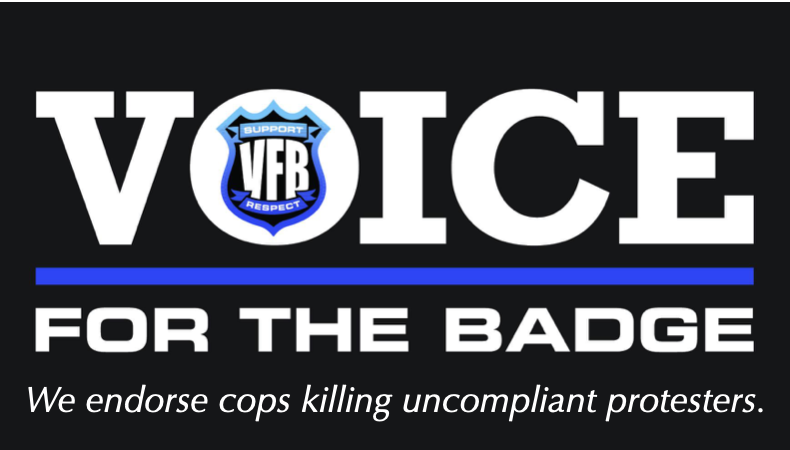
The Voice for the Badge posted the following comment that accompanied the article from the Orlando Sentinel, stating:
Tells it like it is and will be! Thank You to this amazing Sheriff for protecting his community, citizens and supporting his Deputies!
Voice for the Badge is making it clear that they support cops killing people who engage in more militant forms of protest, and people who do not comply with orders from cops during protests.
In some ways this is similar to what Chief Winstrom said a few days ago at his Press Conference, which was meant to dictate the narrative about what happened between GRPD cops and two Black men who dared to question what the GRPD was doing when they had stopped several Black youth at gunpoint. Winstrom said, Comply now, complain later.
I take what Winstrom means when he says, Comply now, complain later, tack hat his cops will not tolerate people who don’t obey the GRPD, people who are not compliant, and people who push back against policing practices in Grand Rapids.
Voice for the Badge is Johnny Brann Sr.
For anyone who has followed Voice for the Badge, you will know that the public face of the organization is Johnny Brann Sr. Johnny Brann Sr is also the only person who posts on the Facebook page of Voice for the Badge.
Johnny Brann Sr is the owner of Brann’s Steakhouse on West Leonard in Grand Rapids, which also has pro-cop stuff up throughout the restaurant. Johnny Brann Sr has also contributed to political candidates in Grand Rapids in recent years, specifically those that are pro-cop. Here are the names of candidates and how much Johnny Brann Sr and his wife have contributed since the 2020 Election:
- David LaGrand – $1000 in 2024
- Dean Pacific – $2450 in 2024
- John Krajewski – $2450 in 2024
- Andrew Robbins – $2100 in 2022
I have written about the racist and xenophobic nature of Voice for the Badge over the past 5 years, since the group formed after the nationwide George Floyd protests. Tommy Brann Sr. has a very simplistic view of cops, but it is a dangerous view, since he believes that cops are always right and that the public needs to obey them no matter what.
Last night Movimiento Cosecha and GR Rapid Response to ICE hosted a rally at Calder Plaza to denounce the violence that ICE is committing in Grand Rapids, which includes the monitoring, intimidation, arrest and detention of immigrants.

All four of the West Michigan TV stations and MLive reported on the rally, in varying degrees of accuracy. The Kalamazoo-based channel 3 did a short story, which spent as much time on President Trump’s Executive orders that criminalize immigrants as they did on what the rally organizers were calling for.
The WZZM 13 story was also fairly short, plus they did not provide sufficient context for the rally or the specific demands that Movimiento Cosecha and GR Rapid Response to ICE were making.
WOODTV8 did a better job of covering the rally, specifically because the centered the voices of immigrants and those most impacted by ICE violence. The 3 minute and 21 second story also provided information about the harm that ICE has engaged in over the past two weeks, but the channel 8 reporter failed to provide details of what the adopting a Sanctuary policy would concretely mean.
The WXMI 17 story was also longer than most local TV news stories, with a running time of 2 minutes and 50 seconds. However, what was problematic about the channel 17 coverage is that they provided more time to Mayor LaGrand and City Manager Mark Washington, using clips from a story back in January, when local organizers first demanded the city adopt Sanctuary policies. The comments from the Mayor and the City Manager were not questioned, nor were those from Movimiento Cosecha and GR Rapid Response to ICE provided an opportunity to contest the claims of GR City officials
The MLive article came the closest to providing some information on what Movimiento Cosecha and GR Rapid Response to ICE are calling for regarding the adoption of Sanctuary policies by the City, stating:
“Lowe said the pro-immigration groups are demanding that the city implement six policies. Those policies include prohibiting law enforcement from detaining individuals on civil immigration warrants, and preventing the Grand Rapids Police Department and Kent County Sheriff’s Office from collaborating with ICE officials and not establishing detention centers in the city.”
Originally, there were 5 demands in the Action Alert – an Action Alert that people can still sign – that was presented to the Grand Rapids City Commission in January. Here is the wording of those demands:
In declaring itself a Sanctuary City, Grand Rapids would implement and execute the following:
– policies restricting the ability of state and local police to make arrests for federal immigration violations, or to detain individuals on civil immigration warrants;
– policies restricting the police or other city workers from asking about immigration status;
– policies prohibiting “287(g)” agreements through which ICE deputizes local law enforcement officers to enforce federal immigration law;
– policies that prevent local governments from entering into a contract with the federal government to hold immigrants in detention;
– policies preventing immigration detention centers in Grand Rapids.
Since then, the partner organizations of Movimiento Cosecha and GR Rapid Response to ICE have included one additional demand, which is for the City of Grand Rapids to not share license plate information with ICE, information that is obtained from the Flock cameras that exist in Grand Rapids.
While there was a great deal of coverage about last nights ICE Out of GR rally and several members of the immigrant community were centered, the local news missed the mark on providing accurate information on what Movimiento Cosecha and GR Rapid Response to ICE are demanding of the City regarding the adoption of sanctuary policies.
Since last Wednesday, when Movimiento Cosecha and GR Rapid Response held a Press Conference to condemn the detention of Carlos Menjivar, there has been no evidence that Michigan Senators Gary Peters and Elissa Slotkin, along with Rep. Hillary Scholten, have shown no evidence that they have even attempted to get a father out of detention.
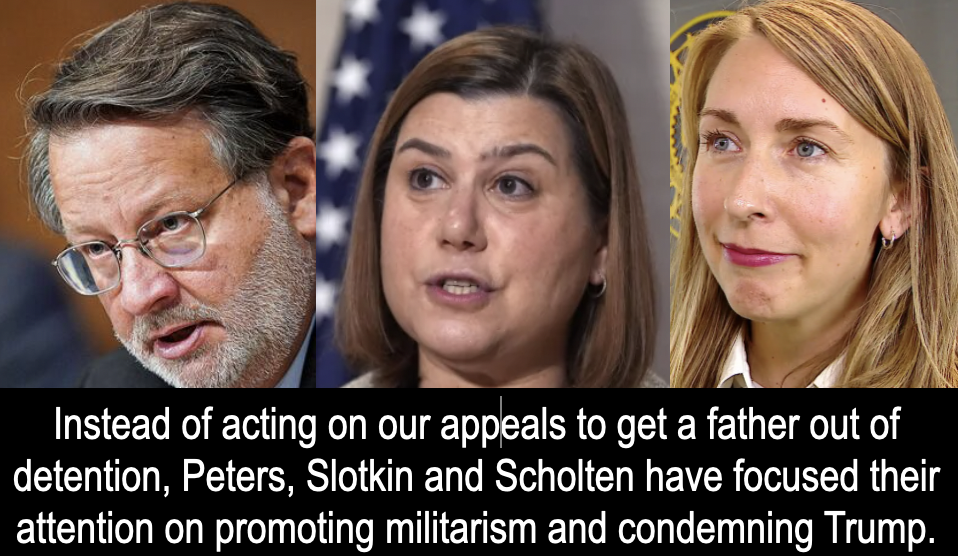
People have sent over 2,400 online Action Alerts to Peters, Slotkin and Scholten. Since June 12, when the Action Alert was created, Senator’s Peters have said nothing on the websites about the case of Carlos Menjivar, but they have talked about pushing for more investments into Selfridge Air National Guard Base in Michigan, along with making pronouncements in support of Israel’s bombing of Iran.
As for Rep. Scholten, she has not posted anything about the request to get Carlos Menjivar released from ICE detention, which would allow him to re-unite with his family in El Salvador. Rep. Scholten has not posted any Press Releases since June 6, but she has posted a video where she condemns President Trump’s decision to send the National Guard to Los Angeles to suppress the protests that have been led by members of the immigrant community.

Rep. Scholten claims that we need immigration reform, not militarization. However, this is exactly what Scholten was proposing in her awful campaign ads from last fall, her continued criminalization of immigration policy, and her failed Dignity Act, which also calls for increased funding for US Customs and Border enforcement.
The only question is, why do people keep voting for Democrats, when they do not stand up for justice or advocate for immigrants being targeted by ICE?
Last week I reported on the Salvadoran family that went into sanctuary after the father was arrested and detained by ICE after coming to his scheduled appointment at the ISAP office on June 4.

There are several updates I wish to communicate. First, the mother and her three children realized that after the campaign to get Senator’s Peter and Slotkin, along with Rep. Scholten, to call for an immediate release of Carlos Menjivar did not result in any action taken by these politicians, they decided to go back to El Salvador. The family had a voluntary departure option, so the mother took her 3 children and went back to El Salvador on Saturday.
Second, Carlos Menjivar is still locked up in detention and we are still asking for people to sign the Action Alert to apply pressure to Senator Peters, Senator Slotkin and Rep. Scholten to meet the demands listed in the Action Alert.
- For Carlos Menjivar to be released so he can voluntarily depart to his home country of El Salvador.
- Return Carlos’ passport, which the ICE agents took when they detained him.
- Change Carlos Menjivar’s status from deportation to voluntary departure, since a charge of deportation would have lifelong consequences for him.
Third, to attend the ICE Out of GR rally that takes place at 6pm on Tuesday, June 17 at Calder Plaza. People will find out a whole ranges of ways they can resist ICE in Grand Rapids, as well as become involved in the campaigns that Movimiento Cosecha and GR Rapid Response to ICE have to get the City of Grand Rapids and Kent County to adopt sanctuary policies.

Fourth, to understand that the work of resistance involves a great deal of people and the use of a variety of tactics, skills, time and talent. Here is an incomplete list of all thethings that people have been doing over the past 2 weeks:
- Accompanying people to their appointments at the ICE and ISAP offices.
- Co-ordinating all of the requests for accompaniment.
- Providing legal assistance.
- Creating Press Releases.
- Hosting a Press Conference.
- Offering Sanctuary.
- Hosting a family in Sanctuary.
- Transporting the family in Sanctuary.
- Preparing and delivering food for the family in Sanctuary.
- Driving the family in Sanctuary to Chicago to catch their flight back to El Salvador.
- Conducting media interviews.
- Doing comms work on social media.
- Creating an Action Alert.
- Organizing more GR Rapid Response to ICE trainings.
- Organizations offering space for GR Rapid Response to ICE trainings.
- Documenting ICE activity and GRPD complicity.
- Providing crowd safety for Cosecha organizers.
- Tabling at events to further the work.
- Speaking at rallies to inform the community about the work.
- Having meetings to debrief recent activities, to plan upcoming actions and talk about strategic development of the work.
- Checking in with people doing the work and providing support.
- Affirming the work and other forms of emotional labor.
If you want to be part of this work, the community care work, the resistance work, then come to the rally, attend a future GR Rapid Response to ICE training or contact Movimiento Cosecha or GR Rapid Response to ICE.


Grand Rapids School Board narrowly passes 2025-2026 Budget, with unanimous opposition during public comment
“For the first time in recent memory, executive contracts were not rubber stamped by the GRPS Board of Education! Instead we saw the board ask good questions, name gaps, and look for ways to better prioritize students.”
The above comments are from community efforts to pressure the GRPS to adopt a more just budget, one that centers teachers and students. The Grand Rapids Educators Association (GREA), supported by the Urban Core Collective, hosted a picnic prior to the GRPS Budget hearing. The event was design to building community and solidarity with teachers in the district and to push for several demands that the teacher’s union presented during the Budget Hearing.
Some of the information and demands from the GREA included:
During the Public Comment portion Budget Hearing, the GRPS Board President decided to limit people to two minutes instead of three, since there were several dozen people who had filled out cards to speak. It always amazes me how elected officials can arbitrarily reduce the length of time for public comment, just because there are lots of people who want to speak. It seems like they should be welcoming as much public input as possible.
Throughout the public comment, there were students, teachers, parents, alumni and community members who spoke out against the proposed budget. There were lots of GRPS teachers who spoke, with some of them using the talking points listed above. One recent Physical Education (PE) hire spoke about how difficult it was to get hired and how long they had to wait until a GRPS representative got back with them regarding their application. The PE teacher also talked about how understaffed they were, even though many of their friends had also applied for similar positions.
A Special Education teacher also spoke forcefully about how the GRPS was violating state law, with too many Special Education students in a class room per teacher. This GRPS teacher talked about how they were also understaffed and how moral in their department was low, because people felt overworked and under appreciated.
Another public comment came from a GRPS alumni, who had organized an online petition campaign to prioritize the GRPS budget for students and teachers. This community member stated that over 600 people had signed the petition.
However, the overriding theme of the public comment during the Budget Hearing was that no one support the existing budget proposal, since it did not prioritize teachers and students. There was unanimous opposition to the budget proposal.
When it came time for the School Board to vote on the budget, Dr. Roby read a statement suggesting that the budget outcome is the result of outside forces that were out of the control of her office. Dr. Roby also made it clear that board members who are pushing back on the budget have been “negligent” in their demands and that if the budget isn’t adopted it will impact families and scholars.
The Board President followed Dr. Roby’s comments stating that it would be a vote of no confidence of Dr. Roby to not adopt the budget. The Board President then pushed to immediately go to a vote. Several Board members stated the need to have a discussion on the proposed budget before it went to a vote. GRPS Board members all spoke up and several of them talked about how they would not be voting out of fear or that they would not be intimidated to vote a certain way.
Dr. Roby spoke again in response to the push back from some board members. I took Dr. Roby’s comments as a form of gaslighting that was directed at Board members who were challenging the proposed budget. At one point Dr. Roby also said that the community needed to do their own homework to understand the budget. There were several people in the audience were were taken back by this statement, especially since the proposed budget had only been available to the public for one week. I personally felt insulted by this comment and based on the reactions of those who spoke during the Budget Hearing, they too were somewhat disgusted.
The School Board finally voted on the General Operating Budget, a vote that was 5 in favor and 4 against. Those voting against were Melton, Moreno, Rodriguez and Kilpatrick.