GRIID Class on the Prison Industrial Complex in Kent County – Week #4
 For week #4, participants in the discussion on the Prison Industrial Complex in Kent County, we looked at two items before we talked about the main reading.
The first item we looked at came up in the Week #3 class discussion, which had to do with GRPD surveillance of activist groups, specifically the GRPD targeting those demanding justice over the GRPD murder of Patrick Lyoya and the FOIA documents that were requested.
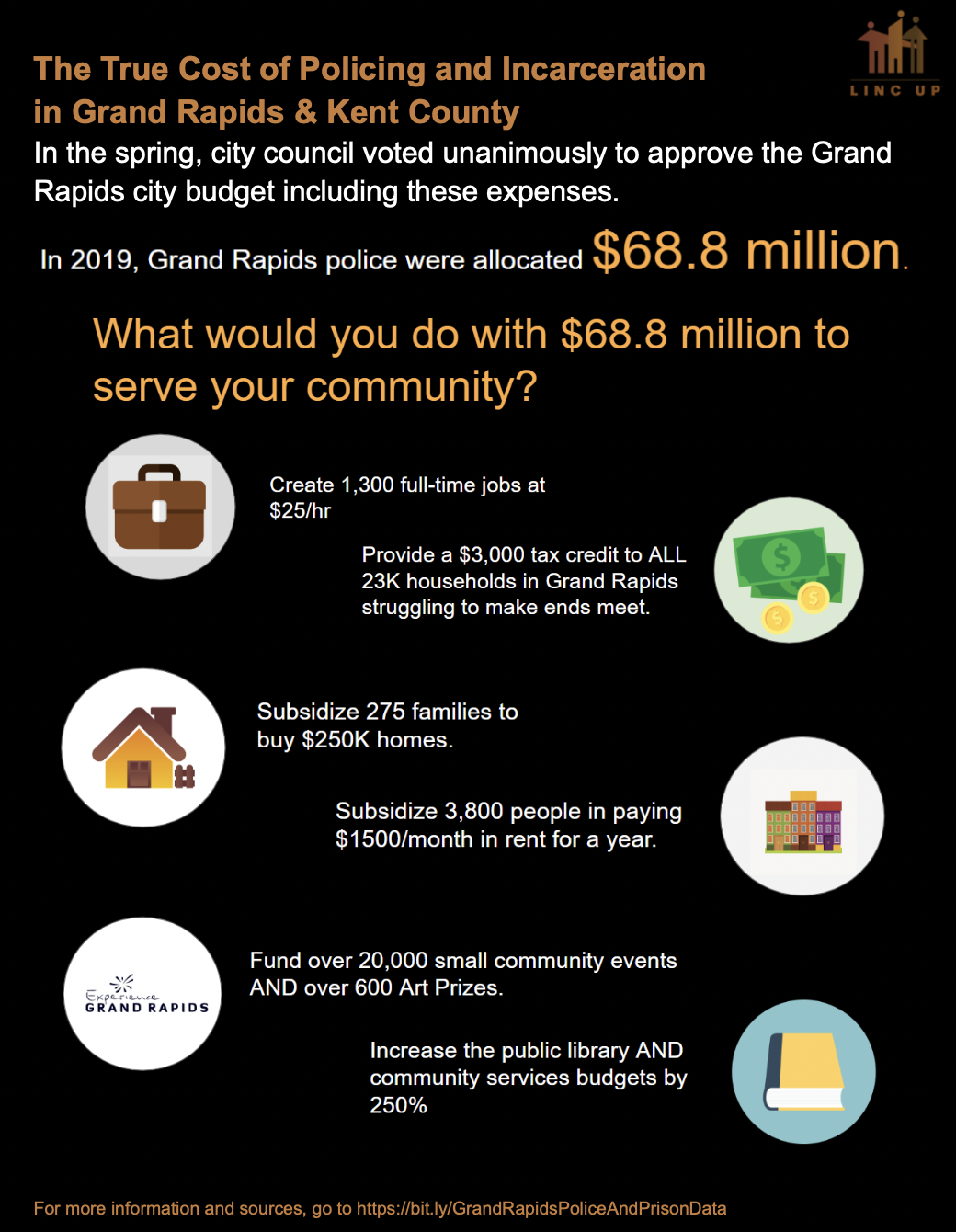
A second issue that was discussed was a look at more data on the PIC in Kent County, data that was used to create 4 community flyers that could be used as popular education tools and to engage the public in radically imagining how taxes could be diverted from policy & incarceration to meeting real community needs.
The majority of the class discussion for week #4 was spent discussing chapters 3, 4 and 5 from the book Beyond Courts. Chapter 3 provides an excellent critique of what are often called diversion programs or specialty courts. The authors of the book have this to say:
“For abolitionists, the fact that prosecutor-led diversion programs and specialty courts maintain and entrench the legitimacy of the carceral state is just one reason to oppose them. In addition, these programs: 1) extend the scope of the criminal punishment system into the community; 2) widen the net of people under carceral control; 3) increase the power, resources, and reach of prosecutors and ”judges (and the criminal punishment system more broadly); 4) further neoliberal logics of individual responsibility that uphold the criminal punishment system; and 5) are more concerned with control and submission than health and well-being. Diversion programs deprive people of self-determination through a logic of white paternalistic “care through control.”
Chapter 4 focused on a variety of community-based interventions that would shift power away from the carceral state. Some examples of community-based interventions were:
- Cop Watching
- Court Watching
- Bail Funds
- Participatory Defense Hubs
- Jury nullification

Chapter 5 centered on the abolitionist idea of Defunding Courts, just like Defunding the Police. In fact, if we are serious about abolishing the Prison Industrial Complex in Kent County, the book would call this Defunding Cops, Courts and Cages. At the beginning of Chapter 5 it states:
“For example, in 2022, there were almost 13 million misdemeanor charges that forced thousands of people into the criminal justice system each year. More than a quarter of all cases filed in criminal courts are motor vehicle, drug and broken windows offenses, so called “low-level” crimes that police and prosecutors pursued aggressively in cities particularly in the 1990s.”
The authors argue that these 13 million misdemeanor charges more often than not landed people in jail, primarily because they could not afford bail. These statistics expose the absurdity of the of the Prison Industrial Complex across the US.
There were numerous great models being used across the country, like the Seattle Solidarity Budget, which used a participatory budgeting model to redirect millions to meet community needs away from the PIC in that city.


Comments are closed.