US Military Spending in 2010 the largest since WWII
(This article is re-posted from Open Secrets.)

Did you know that the United States is spending more on its military this year than any other year since World War II? In an article in The New Republic, Gregg Easterbrook outlines how the $700 billion the United States is spending on defense this year is roughly equivalent to military spending in all other countries combined — and how when adjusted for inflation, it’s more than was spent during the Korean War, the Vietnam War or during the Reagan military buildup.
Since 2001, Easterbrook writes, “military and security expenditures have soared by 119 percent” and “even if the costs of the conflicts in Iraq and Afghanistan are subtracted, the defense budget has swelled by 68 percent since 2001.”
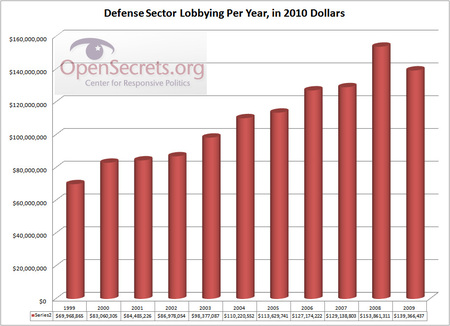
During this time, lobbying by defense contractors and other defense-related interests has also surged. According to the Center for Responsive Politics‘ analysis, in the 10-year period between 1999 and 2008, when adjusted for inflation, defense sector lobbying increased by 120 percent — going from $70 million in 1999 to $154 million in 2008 (in 2010 dollars). Calendar year 2008 represented the peak of defense lobbying in the past decade. (See graph below.)
Nevertheless, during the first three quarters of 2010, defense sector interests still invested $102 million in lobbying. These 318 clients hired nearly 1,000 lobbyists — of whom two-thirds have passed through Washington’s “revolving door” of influence between the private and public sectors, according to the Center’s research.
Don’t Let Comcast Kill the Internet
(This article by Tim Karr is re-posted from SavetheInternet.com)
In the past 24 hours Comcast has been exposed committing blatant abuses of its power over all things media.
 The New York Times reported last night that the cable giant has threatened to block access to the popular online movie service Netflix unless the company that streams its films pays new and extortionate tolls. Earlier in the day, Comcast was caught red-handed trying to smother the marketplace for competitive Internet modems designed for use on its network — a violation of fundamental Net Neutrality principles that allow you to choose what devices you want to use.
These are just the latest in a history of abuse by a company determined to become the 21st century’s media gatekeeper. If Comcast gets away with these violations, it will be the beginning of the end of the experiment in information democracy called the Internet. What more reason does the Federal Communications Commission need to step up — for once — and protect the openness that is central to a better, more participatory and diverse media.
Taken as a whole, these abuses show us what a media monopoly looks like in the Internet age — one company, consolidating its media power to squash competitors, to stifle innovation and free speech, and to gouge consumers.
Here are seven reasons we must stop an out-of-control Comcast:
1. Killing Off Competition: NetFlix
Comcast is the largest nation’s largest broadband provider and pay-TV company. It has leveraged that access to our homes to become the third-largest telephone company in the country with the tentacles of its communications networks reaching across more than a third of the country.
In most these regions, Comcast’s market power reigns uncontested, with few to no other companies vying to compete with the cable giant for this package of services. Comcast wants it to stay that way. So much so that it’s now moving to kill off competitors. On Monday, Level 3, the service that streams Netflix movies to consumers revealed that Comcast had threatened to cut off the pipe to its customers unless Level 3 pays a steep new toll for transit. The toll was non-negotiable — no payment, no access — meaning no Netflix (or any other independent content that Level3 transmits) for the 17 million broadband customers who connect via Comcast.
Not by coincidence, Comcast happens to offer its own movie streaming service: Xfinity. By erecting a tollbooth at the edge of its network, the company can price competitors out of the market and ensure that its one online video offering remains the only choice for consumers.
2. Stifling Innovation: Zoom Modems
Just hours before the Netflix story broke, Comcast was accused of violating another basic tenant of the open Internet and the free market. In a complaint filed Monday with the FCC, modem manufacturer Zoom Telephonics presented evidence that exposed Comcast restricting consumer access to modems produced by independent manufacturers. Comcast was doing this by placing unreasonable conditions on cable modems Zoom wants to sell to Comcast customers.
Comcast would prefer users rent their modems from Comcast — at a monthly fee that over time far exceeds the cost of modems bought on the open marketplace. By blocking the manufacture of independently produced modems, Comcast can lock in these exorbitant rental rates in a marketplace where it already controls about 40 percent of the national cable connections.
If Zoom’s complaint is accurate, these practices violate both the letter and the spirit of the Communications Act and the FCC’s open Internet principles. It’s the same pattern of anti-competitive behavior that the company showed when it throttled BitTorrent (see below). By erecting anti-competitive barricades and stifling innovations in the modem marketplace, Comcast is violating the open Internet principle it repeatedly promised the FCC it would respect.
3. Consolidating Media Power: NBC Takeover
Some may have thought that the Internet age marked the end of the era of a few huge companies controlling all media. But Comcast, which is hell-bent to take over NBC Universal, has given us an unwelcome glimpse at the new face of media consolidation.
For consumers, the NBC merger would give Comcast unprecedented control over what you can watch and how you can watch it. They’ll leverage this power to suffocate online TV — like Netflix, Miro and iTunes — in favor of their limited offerings. Comcast already raises its rates to the tune of 10 percent a year. With less competition, they’ll jack up prices even more. Even if you don’t have Comcast at home, you could end up paying more to get NBC shows. Comcast will also have an incentive to promote NBC shows over local or independent programming, making it even harder to find alternative voices on the cable menu.
And this will just be the first in a wave of media mega-mergers. “As the economy recovers, we will see more proposed media industry combinations,” explains FCC Commissioner Michael Copps. “While I look at each proposed transaction on its individual merits, my long-standing skepticism about the harms imposed by so few controlling so much persists.”
4. Censoring Free Speech: Vinh Pham
Comcast customer Vinh Pham got caught in the black hole that is Comcast customer service. All he wanted was to get his Internet and cable working without opting for Comcast’s “Triple Play,” which included phone services as well.
“I do not want your freaking Triple Play,” Pham says. “Who the hell still uses landlines, let alone buy landlines through their cable company? Stop trying to sell me [something] I don’t want.”
Every time he tried to make the change his account crashed. So Pham took matters into his own hands, fixing his modem so that he actually received the services he was being charged for on his monthly bill. But after Pham shared his experience via his personal blog, Comcast decided to lower the hammer.
Comcast contacted the company that hosts Pham’s blog and demanded the entire blog be censored. (This is nothing new. They had a similar reaction when one of their on-air hosts decided to protest a distinguished service award for Fox News Channel’s Bill O’Reilly.)
Reporting on the affair, blogger-activist Phil Dampier wrote: “When cable giants like Comcast trample all over free speech (and their paying customers), it’s teaches a valuable lesson why giving them a chance to grow even larger through a merger with NBC-Universal is a dangerous mistake.”
5. Lobbyists, Lawyers and Lies: Cohen’s Kumbaya
Earlier this month, Comcast’s top lobbyist, David Cohen, declared Net Neutrality an issue over which Washington needn’t concern itself any longer. “It’s time to put this [Net Neutrality] debate behind us,” he said to the strains of Kumbaya. “Check the box and move on.”
Now, don’t think this means Comcast has changed its tune on the importance of the open Internet. It’s still trying to kill Net Neutrality. It’s just making a softer sell to convince Washington to trust Comcast to protect the rights of Internet users. “Real self-regulation” by the industry itself is the answer, Cohen told a room of nodding lobbyists and lawyers.
But the only thing you can trust about Comcast is that it will seek to boost its bottom line and serve shareholders by any means possible. That’s the nature of corporations. And naturally, the public shouldn’t expect corporations like Comcast to look out for its best interests. Public policy is designed for that role. Are you listening FCC?
6. Blocking Internet Access: BitTorrent
Comcast gave us a taste of a world without Net Neutrality when an Associated Press investigation in 2007 caught the cable giant red-handed, jamming use of popular file-sharing applications.
Despite mounting evidence of Internet blocking, the company refused to come clean and disclose its “network management” practices. A coalition of Net Neutrality supporters and legal scholars filed a complaint with the FCC.
In response to the public outcry and a mountain of evidence, FCC Chair Kevin Martin sanctioned Comcast for violating Net Neutrality. Martin ruled that Comcast had “arbitrarily” blocked Internet access and failed to disclose to consumers what it was doing. But the ink was barely dry on the FCC order before Comcast sued the FCC in federal court, challenging not only the agency’s ruling but its entire authority to protect Internet users.
7. Blocking Public Access: Harvard
In 2008, The FCC called a public hearing at Harvard University to weigh whether Comcast was blocking public access to the Internet (see above). In characteristic fashion, Comcast responded by blocking public access to the hearing itself. The company deployed paid seat-fillers to bar others from entering an official FCC event.
While Comcast seat-warmers snoozed, a collection of Harvard and MIT scholars, Internet advocates, industry leaders, engineers and policymakers nearly all agreed that Internet blocking has serious consequences for each and every one of us.
That the Boston hearing was marred by Comcast’s efforts to stack the crowd in its favor — leaving concerned citizens out in the cold — demonstrates again why we can’t trust a media monopoly with an Internet that is vital to our democracy.
Those who should ultimately decide the Internet’s future are people like you and me — everyone who uses the Internet every day and in every way. That’s why every citizen needs to get involved right now.
Comcast’s most recent abuses come just days before FCC Chairman Julius Genachowski is to announce a vote on new Net Neutrality rules.
If the FCC stays on the sidelines, Comcast will turn the Internet into cable TV. Its runaway abuse of media power will impact pretty much everything we do online.
This is a moment of truth for Julius Genachowski. The FCC chairman can no longer weigh whether to take action. He must move now to restore the agency’s authority to protect consumers against a new generation of monopolists.
Cancun Climate Summit and the False Solutions of Green Capitalism

One could certainly argue that the most pressing issue of the 21st century in global warming. The International Panel of Climate Change has for years made it clear that we need to reduce the current amount of carbon emissions 80% by 2050 if we are to have a safe and stable global temperature.
However, there is not much progress being made in the attempts to reduce carbon emission by both states and private businesses as is evidenced by a new report from the National Climatic Data Center, which states that 2010 is one of the warmest years recorded in human history.
Much of the problem stems from countries like the US which are unwilling to make a commitment to reducing greenhouse gas emissions in any substantial way. This was the case over a decade ago at the Kyoto Summit and last year at the international climate summit in Copenhagen.
Cancun Summit
Yesterday, the latest round of international talks on global warming kicked off in Cancun, Mexico. Unlike Copenhagen, the Cancun Summit has received scant attention in the for profit news media. This is in part due to the Obama administration’s general lack of interest on the matter and a continued unwillingness to make any serious commitment to reduce carbon emissions.

Latin American specialist Laura Carlsen writes, “The results of the Cancun climate change talks are a foregone conclusion. Following in the footsteps of the Copenhagen non-agreement, experts, activists, and the negotiators themselves have announced that they expect no binding agreements on emissions controls to come out of the conference.”
In addition to the probability that no binding agreements will come out of the conference, Carlsen believes that the US and other powerful nations will continue to promote false solutions. Some of the major false solutions are Clean Development Mechanisms, carbon trading and geo-engineering.
However, one of the worst solutions that is being promoted is the UN REDD program (Reducing Emissions from Deforestation and Forest Degradation). The REDD program is not only a false solution, but it directly and negatively impacts indigenous communities around the world. According to the Indigenous Environmental Network (IEN), the REDD program is nothing more than a form of colonialism. The IEN provide excellent analysis of this topic and other false climate solutions in their Indigenous People’s Guide.
Independent and Autonomous actions for Climate Justice
Many groups like the Indigenous Environmental Network and Via Campesina are organizing separate assemblies during the Cancun Summit as well as protests and other actions to confront the delegates. Most of these independent and autonomous groups are anti-capitalist and believe that real climate justice is rooted in localized economies that are based upon cooperation and ecological integrity.

In addition to confronting capitalism, many groups are advocating for a more comprehensive analysis of the roots of global warming, which also means we must confront global poverty and war. This is the message that Nobel Peace Prize winner Wangari Maathai is communicating with a recent article entitled, Cancun Must Be About More than Just Climate Change.
While we shouldn’t expect that nations will make any meaningful progress at the Climate Summit in Cancun, it is important to pay attention to what civil society groups are doing to both confront the green capitalists and promote real climate justice.
For those wanting to get news and analysis from a grassroots perspective on the Climate Summit check out the Indigenous Environmental Network’s blog RedRoad Cancun and Via Campesina. For those of you who read Spanish, an excellent news resource is Mexico Indy Media.
New Report confirms fears about the possibility of Grand Rapids privatizing its water system
In late September we reported that Grand Rapids Mayor George Heartwell was considering the idea of privatizing the City’s water and sewage system because of the budget deficit that Grand Rapids is faced with.

We noted in a report by the group Food and Water Watch entitled “Money Down the Drain,” the key findings state that:
- Private utilities charge higher rates than municipalities
- Privatization does not increase the efficiency of water and sewage systems
- Privatization has many hidden expenses
- Water corporations drive up costs and shoot down service quality
- The public can do it better and cheaper, and
- Public funding for water must go to only public utilities
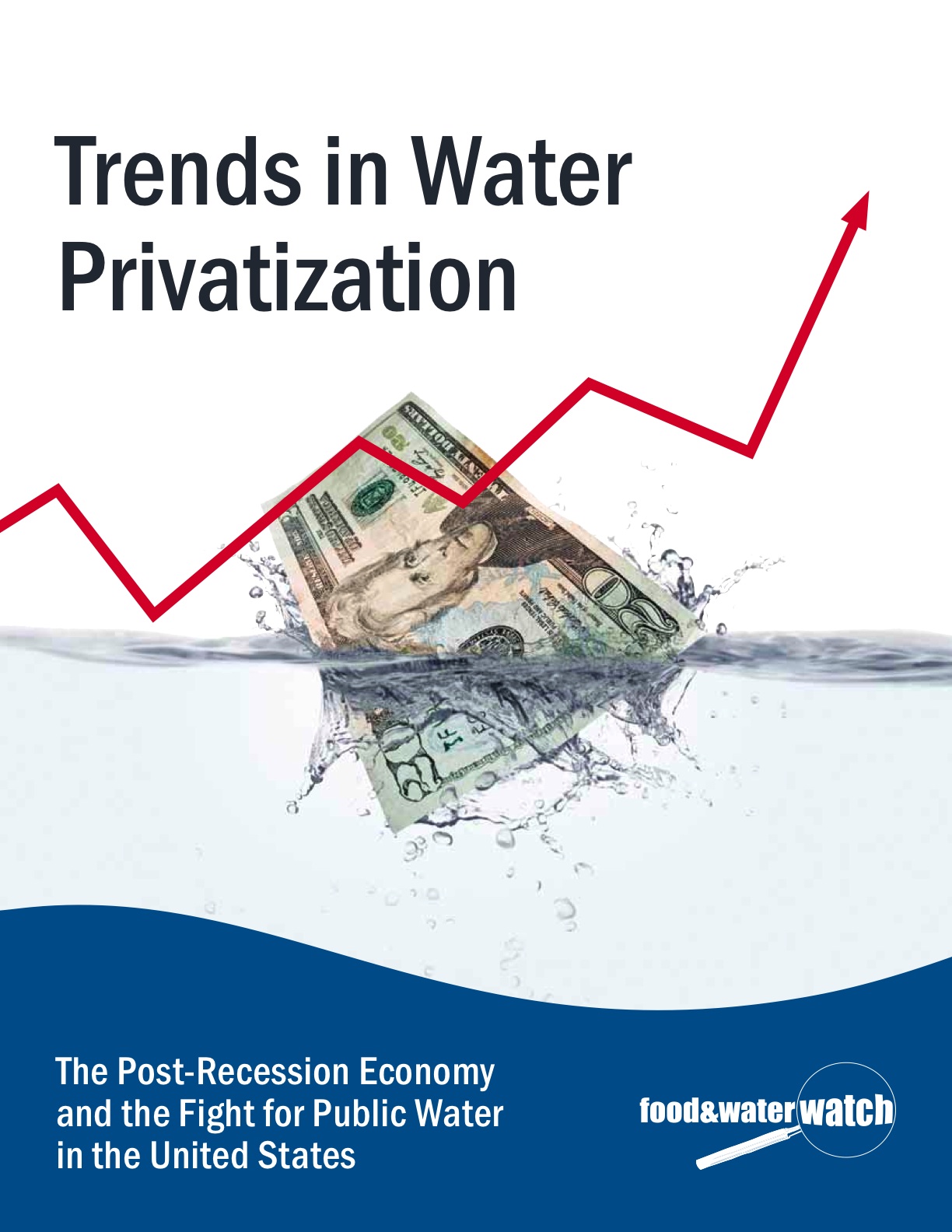
Food and Water Watch has just published a new report that is particularly relevant to the budget deficit issue that faces the City of Grand Rapids. Their new report, Trends in Water Privatization, released yesterday takes a close look at the dramatic increase in municipal water privatization.
The major findings of a report “reviewed 200 prospective and completed sales and concessions over the last two decades and uncovered five aspects of this new trend in water privatization:
- Many cities and towns explored sales and long-term concessions of their water and sewer systems since 2008. There were five times as many prospective deals in 2010 as there were completed transactions in a typical year over the previous two decades.
- Prospective privatizations, if actualized, would affect an unprecedented number of people. The typical water system put forward for privatization in 2010 served around 45 times more people than the average system sold over the last two decades.
- Budget constraints drove the surge in potential privatization deals. Previously, the need for expensive improvements to water infrastructure was the main factor in a municipality’s decision to sell or lease its water system. Since 2008, several cities have considered privatizing well-maintained water systems to shore up weak budgets.
- Possible sales and concessions were clustered around the Rust Belt. Although the surge in interest was a nationwide phenomenon, prospective deals were concentrated in the Rust Belt, where cities were hit particularly hard by the recession.
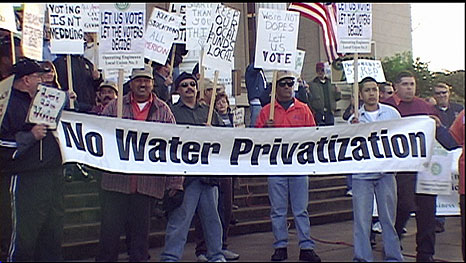
- Strong public opposition hindered privatization. Public resistance thwarted at least 17 possible sales and concessions from 2008 to 2010 and seemed likely to block many more prospective deals. In fact, despite new attention on the idea, the number of sales and concessions completed each year remained small.
The report notes that the budget crisis that many municipalities across the country face will likely continue for a few more years and that means that for profit water companies will be seeking to cash in on this economic reality.
Food and Water Watch states in Trends in Water Privatization that, In May 2010, Don Correll, then-CEO of American Water, the nation’s largest water company, told investors that the fiscal crisis coupled with the need for expensive water system improvements created golden opportunities for privatization. “So the idea of monetizing some assets,” he said, “something that was almost heresy some time ago is something that we’re seeing far more receptivity to today and we are busy with that as well.”
Another company, Aqua America, has stated that they were talking with at least 40 municipalities about water privatization in 2010 alone and are expected to close the deal on 20 of those communities by the end of the year. Clearly, these private corporations are aggressively seeking opportunities to buy water systems from municipalities that are struggling financially.
The report does not mention Grand Rapids, but that doesn’t mean that private entities haven’t already approached the city. However, one of the few encouraging facts presented in the Food and Water Watch report is that when citizens are alerted to the possibility of municipal water being privatized they were able to block the sale of these city services in at least 17 communities in the past 2 years.
Grand Rapids needs to not just be aware of this possibility, we need to be organized and demand that the water and sewage system we currently have stays within the democratic control of the city and not fall into the hands of private profiteers.
The Press’ selective eulogy of Peter Cook

Today, MLive.com posted a story about the death of local businessman and former Chairman of Mazda Great Lakes, Peter Cook.
The article frames Cook as person born who “rose from near poverty to become a visionary businessman and generous philanthropist.” The Press reporter recounts the “influential encounter” Cook had that made him a successful businessman, his relationship with his wife and a short listing of some of the recipient’s of his philanthropy.
The story ends with a comment from Mary Angelo with the Roosevelt Park Neighborhood Association who speaks highly of Cook’s donations to non-profit institutions along the Grandville Avenue corridor, where Cook grew up.
While it is clear that Cook donated to entities which have benefited working class communities (arts center, library and Hispanic Center) in the Grandville Avenue corridor, Cook has also donated significant amounts of money to the Republican Party and to some far right entities around the state and around the country. This information is unfortunately not included in the Press eulogy of Cook.
According to OpenSecrets.org Cook donated in just the 2009/2010 Election cycle thousands of dollars to the Michigan Republican Party and to individual GOP candidates in West Michigan. This information is relevant, particularly as it relates to where candidates and the GOP stands on issues like education, health care and the public funding of these basic human rights. One could argue that Cook has financed politicians who have a history of advocating for less public funding of basic social programs.
The other area of funding, which is worth looking at, are the donations he has made to groups like Campus Crusade for Christ, Michigan Family Forum, the Mackinac Center, the Acton Institute, Teach Michigan and Gospel Films in Muskegon. In addition, Cook served as a member on the board of the Council for National Policy, which serves as a mechanism for religious right and conservative individuals across the country. (see Russ Bellant’s The Religious Right in Michigan Politics)
MLive’s exclusion of Cook’s funding of far right groups and his involvement with organizations with overt political agendas is not only misleading, it does a disservice to the public by not providing comprehensive disclosure on someone who had tremendous influence on many levels locally and nationally.
IWW to host 2-day organizing training in Grand Rapids

The local chapter of the IWW (Industrial Workers of the World) is hosting a 2-day organizer training for anyone who is part of the working class.
Fire Your Boss! is the name of the training, where people will learn what their rights are on the job, US Labor laws and how to organize where you work. People from all over the Midwest will be participating in this training and the public is invited.
December 4 & 5
9:30am – 5:00pm
671 Davis NW
Steepletown Neighborhood Center
The IWW is asking for a $5 – $10 donation for the training, which will include coffee, bagels and lunch for both days. You can register by sending an E-mail to griww@iww.org or by calling 616-881-5263.
Justin Amash, Israel and AIPAC

Yesterday, the Grand Rapids Press ran a short blurb mentioning that the Arab American Institute (AAI) considers Justin Amash’s election to Congress as a victory, since Amash himself is an Arab American.
The Press coverage of the 3rd Congressional race did not make the ethnicity of Amash an issue during the election campaign and did not mention that some of his largest donors were Arab American business owners such as the owner of Martha’s Vineyard in Grand Rapids.
The AAI considers the election of Amash as a victory since it increases the number of Arab Americans in Congress. One can certainly argue that increasing the racial diversity of Congress is an improvement, but racial diversity alone does not mean that there will be an improvement with major policy decisions.
For instance, the AAI also supports a more progressive or liberal position when it comes to US foreign policy with countries such as Iraq, Lebanon and with Palestine. Amash himself did not have a well-developed position on Israel/Palestine on his website during the campaign, but what content he did have, was not terribly consistent with what the AAI advocates. More important was a position paper that Amash wrote concerning US/Israeli relations.
The position paper is written with language that emphasizes the need for Israel to have security and it condemns the use of violence and terrorism to achieve political gains for Palestinians. The position paper goes on to criticize Iran’s desire to develop any nuclear capability, but fails to mention that Israel already possesses nuclear weapons.
In many ways the position paper by Amash reads like it was written by the American Israeli Public Affairs Committee (AIPAC). In fact, AIPAC may have played a role in writing the position paper by Justin Amash, since it is mentioned as part of an announcement about an AIPAC event in Grand Rapids that will include comments from Rep. Amash.
The announcement appears on Facebook and states “Representative-elect Amash worked closely with AIPAC throughout his campaign.” The announcement also states, “In addition to regularly speaking with AIPAC’s leaders in West Michigan and meeting with AIPAC’s professional staff, Representative-elect Amash traveled to Detroit to attend both the annual AIPAC Michigan Community Event in May and the AIPAC Michigan Annual Brunch in October. We value Representative-elect Amash’s friendship and look forward to continuing to work closely with him.”
The AIPAC meeting with Rep. Justin Amash will be held at Temple Emanuel in Grand Rapids and is open to the public at 7pm on December 13. GRIID plans on being there to report on what happens during the AIPAC-sponsored public forum, but it already seems clear that despite his Arab heritage, Amash is clearly in the pro-Israeli camp.
Re-Teaching Gender and Sexuality
Reteaching Gender & Sexuality is a message about queer youth action and resilience. The video was generated to contribute additional queer/trans youth voices to the national conversations about queer/trans youth lives. Reteaching Gender & Sexuality intends to steer the conversation beyond the symptom of bullying, to consider systemic issues and deeper beliefs about gender and sexuality that impact queer youth. We invite you to share the video with your friends, family and networks; we invite you to share with us what THIS issue means to you!
Help kickstart our tour: kck.st/?dJtJqi
For more info go to putthisonthemap.org.
On the World Stage, U.S. Falls Flat on Women’s Equality
(This article by Michelle Chen is re-posted from In The Times.)
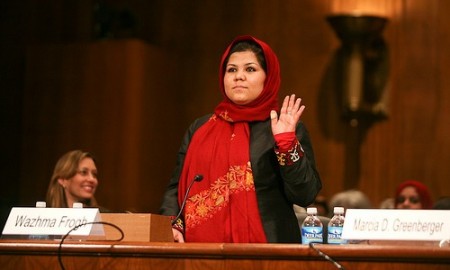
The United States speaks boldly about women’s rights in Afghanistan, about liberating Arab women in the Middle East, and about Mama Grizzlies and Supermoms on the home front. But when it comes down to codifying our commitment to women’s equality in the law… we’ll get back to you.
As the Senate bailed on the Paycheck Fairness Act, which would have strengthened critical anti-discrimination protections, lawmakers again locked horns on gender equity at the international level, in a debate on the Convention on the Elimination of All Forms of Discrimination against Women (CEDAW).
Along with Sudan, Iran and Somalia, the U.S. has yet to formally ratify the United Nations’ CEDAW since it was launched over three decades ago. (It hasn’t even been a century since the 19th Amendment, so conservatives understandably need a little more time to adjust.) The CEDAW is associated with campaigns against gross human rights violations like human trafficking or systematic violence against women. But the Convention is also a versatile framework for measuring equality in many arenas, including the global economy and the workplace.
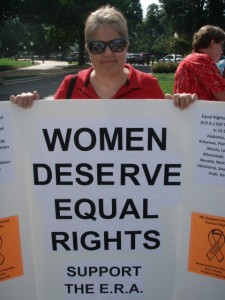
Article 3 provides for equality in the “full development and advancement of women,” especially in the “political, social, economic and cultural fields.” Such words may prompt the same red flags that conservatives waved when fighting the Equal Rights Amendment (“by ‘equality,’ they mean mass abortions and the demise of the American family!”). But the text articulates a vision of gender justice that draws upon decades of feminist discourse.
Article 11 not only sets a standard of gender non-discrimination in employment, but also bars bias on the basis of marital or maternity status, which in theory decouples a woman’s freedom to earn a living from her ties to a spouse or family planning decisions.
Article 10 ensures equal educational opportunity for women, including job training, which may undercut structural barriers that exclude women from certain sectors or higher-skill positions.
Other provisions guarantee equal access to financial resources and credit, give rural women a voice in community development planning, ensure equality before the law in terms of contracts and property holding. The Convention also enshrines equality before the law without regard to gender.
You could argue that an “advanced” society like the U.S. needn’t bother with CEDAW, a treaty that seems geared toward countries like Morrocco and Kuwait, which struggle with severe restrictions on women’s political and economic activities.
But understanding how gender equity plays out in America requires reading between the lines. For example, the Senate would have a lot to answer for if it were really bound to certain provisions of Article 11:
(d) The right to equal remuneration, including benefits, and to equal treatment in respect of work of equal value, as well as equality of treatment in the evaluation of the quality of work;
(e) The right to social security, particularly in cases of retirement, unemployment, sickness, invalidity and old age and other incapacity to work, as well as the right to paid leave
Sadly, the Senate’s failure on Paycheck Fairness appears to be entirely consistent with our global outlook. In terms of the overall safety net, core concepts like social security, unemployment benefits, and paid medical leave, have all been stifled or threatened by deficit hawks in recent months.
Research indicates that the lack of such benefits hurts workers overall, but disproportionately punishes lower-income mothers and families. But, as we’ve reported before on this blog, initiatives on the federal, state and local level to provide paid sick leave-a benefit that millions of workers lack despite widespread public support-have confronted militant resistance from the right.
Many of the controversial family-friendly policies are of course taken for granted in Western Europe, where the welfare state is not (yet) politically taboo. But even so, the European Union continues to reflect CEDAW’s guiding principles in ongoing efforts to close the gender wage gap and expand political participation.
The Convention has enjoyed only a brief flash in the Washington spotlight at a Senate hearing last week. As the Iowa Independent reports, the CEDAW has languished on the Senate’s backburner for years despite the broad support from current and previous administrations, together with a slew of other national and international human rights, legal advocacy and community organizations.
Melanne Verveer, Ambassador-at-Large with the State Department’s Office of Global Women’s Issues, testified before the Senate Judiciary Subcommittee on Human Rights and Law:
In my time at the State Department, I have visited scores of countries and met with women from all walks of life, from human rights activists in Russia, to microcredit recipients and small-business entrepreneurs in rural South Asia, to survivors of rape and conflict in the Democratic Republic of the Congo. In my travels, the number-one question I am asked time and time again is, “Why hasn’t the United States ratified CEDAW?” …
Some governments use the fact that the U.S. has not ratified the treaty as a pretext for not living up to their own obligations under it. Our failure to ratify also deprives us of a powerful tool to combat discrimination against women around the world, because as a non-party, it makes it more difficult for us to press other parties to live up to their commitments under the treaty.
While U.S. hypocrisy is exposed when addressing the most blatant human rights crises on a global scale, the everyday injustice that women face in the American workplace displays a subtler paradox: hegemony is not leadership. In fact, it might just mean you never have to explain why you lag so far behind.
Dennis Banks: “Take your truth and leave the room.”

GRIID file photo
“When we as human beings start destroying the very mother that provides for us, then we are not only destroying ourselves but the future of human beings. It’s going to be that way if change doesn’t start now. Not a political change, but some kind of uprising, some sort of anger. Something’s going to happen. I hope I see it in my lifetime because I want to hobble over there and be part of that change.” Dennis Banks, 11-22-2010
Despite his graying beard and slower pace, Dennis Banks commanded the respect of the audience assembled to hear the wisdom of this contemporary Native warrior and elder. He came to Grand Rapids Nov. 22 to speak as part of Grand Valley State University’s Intercultural Training for Native American Heritage Month.
A Native American activist and one of the founders of the American Indian Movement, AIM, Banks took part in the famous 1973 occupation of Wounded Knee, South Dakota and many other courageous actions for Native rights.
Banks, whose given name is Nowa Comig, began with an anecdote about the car accident that broke his back last year. The doctor came into his hospital room to break the bad news, “There’s going to be a problem with you walking. That’s the truth.”
Banks told him, “Take your truth and leave the room.”
On Feb. 14, 2011, Banks will lead “The Longest Walk,” a 5,000+mile walk across the United States to raise awareness about diabetes prevention among native peoples.
Bury the dead
Banks then shared how he recently joined the Ojibwa people near Mount Pleasant, Michigan for very special ceremony. Central Michigan University had returned the human remains of 130 native people so they could be laid to rest in the way that their sacred belief requires. “Ironically other universities said that this was a dangerous precedent,” Banks said.
The University of Michigan is one institution holding the remains of thousands of native people. In California, Berkley has 25,000. In all, the remains of some half a million native people are under glass or storage boxes in universities and museums. “The American Indian Movement (AIM) is going to issue a statement about policies mandated by the federal government to return those bones to the native people. Some universities are going to resist.”
He then encouraged young people to tell universities holding these remains that they would not enroll there. “This should be a major concern to the conscience of America. What are we doing storing human beings? It’s time to give these things back. Our religious belief is that those bones have to be returned to the earth so the person can continue their journey.”
Support the troops
As a Viet Nam era war veteran, Banks lived the results of US Foreign Policy first-hand. “This latest war is the longest one the US has been involved in except the longest undeclared war–against native people. It’s still going on. There is absolutely no need morally for them (US troops) to be there (Afghanistan). Bring them home and get them out of harm’s way.”
“Why would people hate us in other countries? . . . Our foreign policy is getting us in trouble the last 30, 40, 50 years. Those who stay at home never see the damage. To try to make this entire world a Christian world—it’s not going to happen. Ask the question, ‘Why do they hate us?’ When native people go overseas, we are loved. They welcome American Indians. But if you’re white, there’s warnings . . . Terrorists? If we start defining terrorists that definition is going to come pretty close to home.”
Religious freedom
During the recent national brouhaha over the so-called Ground Zero mosque, Banks stood with Muslim Americans. He shared an MSNBC/Rachel Maddowclip about a handful of fanatical right wing pundits turning the New York City mosque issue into a campaign to outlaw the practice of Islam in the United States.
“I supported Muslims so that history is not overlooked. In the late 1700s there were many burnings of sweat lodges, longhouses, holy sites. Those who did the burning were US soldiers and militia. When I first started hearing about people protesting the mosque, I began to think ‘Why are these people protesting against Americans?’ The 1890 Massacre at Wounded Knee . . . Sand Creek, Colorado, the death marches of the Cheyenne people, chapter after chapter of American history . . . America should have a memory. Why does it have to rely on Native American memory? What is sacred? The whole land is sacred . . .
We have closed up some churches on our reservations. Since then, no suicides. (It’s not that the churches caused the suicides, it’s) the conflict of who we are as native people. We are native people. Our DNA is we are native. Yes we’ve joined the different faiths but we are still native people. That’s the conflict going on inside of us.”
Love your mother
Banks then turned the talk to environmental issues. He shared how one of his enterprises on the reservation where he lives is tapping five kinds of trees for syrup, including maple syrup. Ten years ago, the tapping season lasted four weeks. The past few years, it has only lasted ten or twelve days. Power lines on the reservation prevent eagles and hawks from nesting and scare away the bears.
Army Corps of Engineers water control has killed off the reservations supply of medicinal herb and reduced the wild rice harvest. (The water is being used to irrigate urban golf courses.) “We try to stop them but they are coming with their bulldozers. Soon young people are going to rise up and say this is it. The very first lesson we should learn is ‘What is our relationship to this earth?’ It’s a breathing relationship but pretty soon there will be no more trees. When we as human beings start destroying the very mother that provides for us, then we are not only destroying ourselves but the future of human beings. It’s going to be that way if change doesn’t start now. Not a political change, but some kind of uprising, some sort of anger. Something’s going to happen. I hope I see it in my lifetime because I want to hobble over there and be part of that change.
This is our Mother Earth. She has been feeding us. What are we doing? We are killing our Mother. That’s a great, great sin. It will never be excused. Who knows? Mother Earth will destroy us all. She will have to do that to cleanse herself and get rid of us. We are shoveling our own graves. We can turn it around.”
“Take your truth and leave the room.”
How can we turn it around? We must identify the so-called truths propelling humanity towards certain destruction as lies. Sustainable capitalism. The “free” market. Corporate benevolence. Materialistic happiness. Fighting for freedom.
It’s time that people tell the powers that be to take their truth and leave the room.
###
View the trailer of A Good Day to Die, a new documentary about Dennis Banks.
 Grand Rapids Institute for Information Democracy