21st Anniversary of the 1989 US Invasion of Panama
Twenty-one years ago the US military invaded the Central American nation of Panama under the pretext of the War on Drugs. It is worth revisiting this bit of US history since it can shed light on current US foreign policy.

President George Bush Sr. told the American public that Panamanian leader Manuel Noriega was a dictator and a thug. The US military mission in Panama was to “restore democracy” and was named Operation Just Cause.
I remember that the propaganda campaign was so well received by the American people that even many “peace” groups were not opposed to the removal of Noriega. This was the case in Grand Rapids, where few people were willing to question of challenge the invasion.
Noriega was a thug and had been involved in drug trafficking for decades. However, it is important to note that the US was aware of his drug trafficking activities, since Noriega was a CIA asset since the early 1970s. In fact, when George Bush Sr. was Director of the CIA and Vice President he and Noriega had close relations. According to Bill Blum, author of Killing Hope: US Military and CIA Interventions since WWII, Noriega was on the CIA payroll for at least two decades.
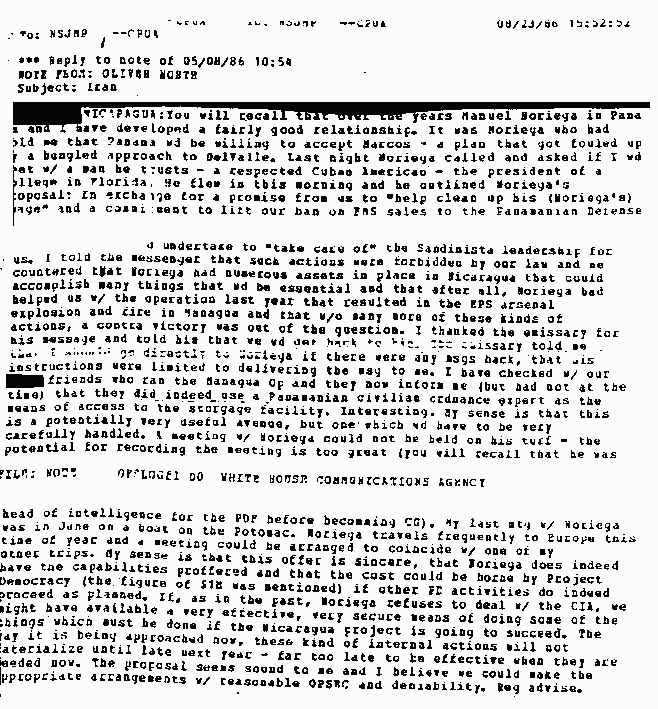
Numerous former DEA agents have noted that Noriega was involved in drug trafficking while he worked as a US government asset. Former drug trafficker Col. Oliver North acknowledged this relationship is numerous cables that are now declassified and organized by the National Security Archives. In one memo, North states, “You will recall that over the years Manuel Noriega and I have developed a fairly good relationship.”
The evidence is overwhelming that Noriega was trafficking in drugs while working directly with the US government. If that is the case, what was the real reason that Noriega was targeted in late 1989? According to Noam Chomsky, Noriega was targeted because he opposed the US Contadora Peace Process and supported the Central American initiation Esquipulas Peace Plan. The Esquipulas Peace Plan did not seek to marginalize the Sandinista government from the rest of the Central American nations and since the US had been waging a covert and economic war against Nicaragua since 1980, Noriega’s failure to support the US plan cost him dearly.

However, beyond deposing Noriega, the US also used the invasion of Panama to test new weapons systems, something that happens in almost every US intervention. One of those weapons was a stealth bomber that targeted civilians neighborhoods, particularly that of El Churro. The bombing was intense and contributed significantly to the estimated 4,000 civilian deaths at the hands of the US military, according to a United Nations report.
The level of war crimes was serious and provides a clear example of the ongoing double standard of US foreign policy. Just months after the US had killed thousands of Panamanian citizens, George Bush Sr. condemned the Iraqi invasion of Kuwait. Bush’s condemnation of Saddam Hussein would have easily been applied to the US for their invasion of Panama in 1989.
In addition to the US hypocrisy demonstrated in Panama the US media did not question the pretext of the invasion. In fact, the mainstream commercial media tended to reflect the general attitude of the White House and bought into the demonization of Noriega without providing any historical context.
The US military also used Press Pools, where they selected specific news agencies to come to Panama, but controlled their itinerary preventing them from doing any investigative reporting. This issue and many others are explored in detail in the award winning documentary, The Panama Deception. Twenty-one years later it would do us all well to think about how the 1989 US invasion of Panama is relevant today.
Democrats Push through Yet Another Anti-Palestinian Resolution
(This article by Stephen Zunes is re-posted from Common Dreams.)

Though outgoing Speaker of the House Nancy Pelosi has insisted that there just isn’t enough time for the lame duck Democratic-controlled Congress to consider much of the progressive legislation on the docket prior to the Republican takeover early next month, she and other Democratic leaders did find time last Wednesday to pass a resolution condemning efforts by Palestinian moderates to seek recognitionof a Palestinian state alongside Israel.
The Oslo accords were signed in 1993 with the vision of Israel’s eventual withdrawal from the occupied West Bank and Gaza Strip and the establishment of a Palestinian state alongside Israel. This was an enormous compromise on the Palestinian side, given that such a state would leave them with only 22% of their historic homeland, the rest of which became the state of Israel in 1948. Right-wing Israeli politician Benyamin Netanyahu, then in opposition, denounced the agreement and promised to derail it. As prime minister in the late 1990s and again since his coming to office again in last year’s election, he has been doing his best to accomplish this by colonizing large swathes of the West Bank with illegal settlements for Israeli Jews which he insists must be annexed into an expanded Israel. The moderate Palestinian Authority president Mahmoud Abbas, by contrast, has been working toward the implementation of the Oslo Accords, offering strict security guarantees for Israel in return for an end to the occupation.
Nevertheless, the Democratic leadership in the House of Representatives has insisted that it is the Palestinians, not the Israelis, who are responsible for the breakdown in the peace talks. Recognizing that talks are pointless while Israel’s colonization drive continues and noting the Obama administration’s ongoing refusal to exercise its extensive leverage to force Israel to stop building new settlements, the Palestinians have understandably refused to return to direct negotiations until Israel suspends its colonization drive, which has been condemned as illegal by the UN Security Council, the International Court of Justice, and virtually the entire international community. However, Rep. Gary Ackerman (D-NY), whom the Democrats put in charge of the House Foreign Affairs subcommittee on the Middle East , insisted during last Wednesday’s debate, that “Israel has shown time and again that it is ready” to make peace and that Palestinians’ objections to Israelis colonizing their land were “overwrought.”
To help put pressure on Israel and the United States to move the peace process forward, the Palestine Authority has been soliciting international recognition of an independent Palestinian state in the West Bank and Gaza Strip. During the past couple of weeks, Brazil, Uruguay, Argentina, and Norway have done just that. This is what prompted the House resolution, introduced by House Foreign Affairs committee chairman Howard Berman (D-CA), who serves as the House Democrats’ chief foreign policy spokesman.
The Democratic leadership in the House has long argued that Israel’s attacks on civilian population centers in Gaza Strip and elsewhere are legitimate self-defense and that it is the Palestinians, not the Israelis, who are making peace impossible. Pelosi, for example, insists that the conflict is about “the fundamental right of Israel to exist” and that it is “absolute nonsense” to claim it has anything do to with the Israeli occupation. One would think, then, that this Palestinian effort to achieve recognition for a state which explicitly defines the borders as exclusively those occupied by Israel in the June 1967 war and not any part of Israel itself would be welcomed. But, to the Democrats, Palestinians asking for even just 22% of Palestine is too much. Rising in support of last Wednesday’s resolution, Rep. Elliot Engel (D-NY) called it “preposterous” that a Palestinian state should be created based on the requirements of UN Security Council Resolution 242, which from Presidents Lyndon Johnson through George H.W. Bush had been recognized as the basis of Middle East peace, which called for Israeli withdrawal from the occupied territories in return for security guarantees. Similarly, Rep. Berman threatened the Palestine Authority by saying, “If they persist in pursuing a unilateralist path . . . there will be consequences.”
Congress has correctly condemned violence by extremist Palestinian extremist groups like Hamas, yet when the Palestine Authority tries to advance their freedom through nonviolent means, such as these diplomatic initiatives, the Democrats are just as quick to condemn them as well. Indeed, earlier in their careers, Berman, Ackerman, Engel, Pelosi and other Democratic leaders were on record opposing any kind of Palestinian statehood, changing their view reluctantly only years later. However, they insist that whatever kind of Palestinian “state” may emerge can only be on what the Israeli occupiers are willing to allow them to have, even if all that is left is a series of small non-contiguous cantons surrounded by annexed Israeli settlement blocs. Taking any initiative to advance their independence separate from what the rightist Israeli government can agree to, according to the Democratic leadership, is completely unacceptable.
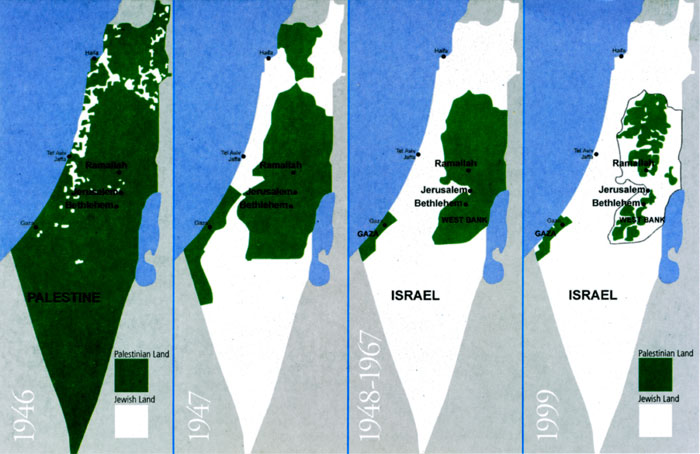
One can only think of how Dr. Martin Luther King, Jr., in his “Letter from a Birmingham Jail,” noted that the greatest obstacle to the advance the cause of justice is one who “paternalistically believes he can set the timetable for another man’s freedom.”
Recognizing that most ordinary Democrats oppose the Israeli occupation and would likely put pressure on their representatives to vote against the resolution, Berman and Pelosi put the vote on last Wednesday’s agenda before the text was even made available to other House members. This made it impossible to have any hearings, give any time for constituents to express their opposition, or even allow the Obama administration to offer an opinion. Also fearing opposition from Democratic House members who might be concerned at rousing the anger of their liberal constituents, Berman and Pelosi refused to have roll call vote and instead brought it up under a procedure known as “suspension of the rules,” a procedure normally used for non-controversial measure like honoring a recently-deceased eminent figure. Doing it this way not only limits debate and makes it impossible to attach amendments, it allows a resolution to pass by a non-recorded voice vote and to automatically be recorded as “unanimous.” Only ten representatives were on the floor when the resolution was passed by “unanimous consent.”
This kind of cynical maneuvering by the Democratic Party leadership is unfortunately quite typical of how they have handled resolutions dealing with the Israeli-Palestinian conflict during their four years in the majority. It raises the question as to whether the Republicans can do any worse.
Unfortunately, the answer is probably yes. While a growing minority of Democratic House members are finally listening to their liberal constituents’ concerns about U.S. backing for Israeli occupation, colonization and repression, the Republicans – outside of Rep. Ron Paul (R-TX) and a few others of a more libertarian orientation – are solidly aligned with the rightist Israeli government. We can only expect more such resolutions in the coming Congress.
Community Radio Act
(This article by the Prometheus Radio Project is re-posted from ZNet.)

Today a bill to expand community radio nationwide – the Local Community Radio Act – passed the U.S. Senate, thanks to the bipartisan leadership of Senators Maria Cantwell (D-WA) and John McCain (R-AZ). This follows Friday afternoon’s passage of the bill in the House of Representatives, led by Representatives Mike Doyle (D-PA) and Lee Terry (R-NE). The bill now awaits the President’s signature.
These Congressional champions for community radio joined with the thousands of grassroots advocates and dozens of public interest groups who have fought for ten years to secure this victory for local media. In response to overwhelming grassroots pressure, Congress has given the Federal Communications Commission (FCC) a mandate to license thousands, of new community stations nationwide. This bill marks the first major legislative success for the growing movement for a more democratic media system in the U.S.
“A town without a community radio station is like a town without a library,” said Pete Tridish of the Prometheus Radio Project, the group which has led the fight to expand community radio for ten years. “Many a small town dreamer – starting with a few friends and bake sale cash – has successfully launched a low power station, and built these tiny channels into vibrant town institutions that spotlight school board elections, breathe life into the local music scene, allow people to communicate in their native languages, and give youth an outlet to speak.”
The Local Community Radio Act will expand the low power FM (LPFM) service created by the FCC in 2000 – a service the FCC created to address the shrinking diversity of voices on the radio dial. Over 800 LPFM stations, all locally owned and non-commercial, are already on the air. The stations are run by non-profit organizations, local governments, churches, schools, and emergency responders.
The bill repeals earlier legislation which had been backed by big broadcasters, including the National Association of Broadcasters. This legislation, the Radio Broadcast Preservation Act of 2000, limited LPFM radio to primarily rural areas. The broadcast lobby groups claimed that the new 100 watt stations could somehow create interference with their own stations, a claim disproven by a Congressionally-mandated study in 2003.
Congressional leaders worked for years to pass this legislation. As the clock wound down on the 111th Congress, they worked with the NAB to amend the bill to enshrine even stronger protections against interference and to ensure the prioritization of full power FM radio stations over low power stations.

Though the amendments to the bill will require some further work at the FCC, low power advocates celebrated the first chance in a decade for groups in cities, towns, and other communities to take their voices to the FM dial.
“After ten years of effort, a $2.2 million taxpayer-funded study, and new provisions to address this hypothetical interference, we are finally on our way to seeing new community radio stations across the U.S. This marks a beginning, not an end, to our work,” said Brandy Doyle, Policy Director for the Prometheus Radio Project. “For the first time, LPFM community radio has a chance to grow, and we’re ready to seize that opportunity.”
“All of us at UCC OC Inc. and at Prometheus express our incredible gratitude to Congressmen Mike Doyle and Lee Terry and Senators Maria Cantwell and John McCain for the leadership and counsel during this process,” said Cheryl Leanza, a board member of the Prometheus Radio Project and a Policy Advisor to the United Church of Christ, Office of Communication, Inc.“Without their work and the work of their committed staff we would not have come this far. At long last the 160 million Americans who have been deprived of the opportunity to apply for a local low power radio station will get a chance to be a part of the American media.”
“I am a leadership organizer from the ranks of the poor working with other low-wage workers – fighting for human rights in Maryland,” said Veronica Dorsey of the United Workers, a human rights organization in Baltimore. “Low power FM radio would allow the United Workers to expand the message of our End Poverty Radio show, which is currently only available on the internet. End Poverty Radio develops leaders and gives workers a way to tell their stories and be heard – and a low power FM station would reach a lot of people who do not have access to the internet. LPFM is a way for those in the community who are struggling to survive to hear stories that they can relate to, and to know that they are not alone in this struggle for human dignity. We can’t wait to work to build low power FM in communities like ours, so we can accomplish these goals.”
“Civil rights groups and community organizations have wanted low power FM radio for years, and now the chance is here,” saidBetty Yu, coordinator of the Media Action Grassroots Network, a national media justice network with members in many cities and communities that lost their chance to get low power FM radio stations. “From Seattle, Oakland, and Albuquerque to Minneapolis, San Antonio, Kentucky and Philadelphia, thousands of communities know that having access to our own slice of the dial means a tool to build our movements for justice. We have won something huge in Congress, but the fight is not over. Now we need to work at the FCC to make sure as many licenses as possible can be available in rural communities, towns and suburbs, and America’s cities.”
LPFMs have saved lives in powerful storms when big broadcasts lose power or can’t serve local communities in the eye of the storm. WQRZ-LP in Bay St. Louis, MS received awards from President Bush and other organizations post Katrina in 2005, when one of the station operators swam across flood waters with fuel strapped to his back to keep his station on the air.The station proved so important that the Emergency Operations Center of Hancock County set up shop with the LPFM to serve the community after Hurricanes Katrina and Rita. Bipartisan Senators and House members have expressed support for the Local Community Radio Act as a vital way to expand emergency service media across our nation.
“I’m Frank Bluestein from Germantown, Tennessee, one of the several large suburban cities located just outside of Memphis. We have been fighting for the past 10 years to persuade Congress to give communities like ours the opportunity to establish a low power FM radio station. Our city wants to provide community and civic groups, students of all ages, local artists and others the power to communicate over their own LPFM channel,” said Frank Bluestein, a media teacher and Executive Producer of Germantown Community Television.
“Equally important for Germantown, we need a dedicated communication outlet that will serve the needs of our citizens in the event another tornado rips through town or if any kind of natural disaster hits,” continued Bluestein. “In this day and age, emergency management is a must for a city of our size and LPFM perfectly fits our needs. A low power FM radio station can stay on the air even if the power goes out. Low power FM saved lives during Katrina but strangely, the federal government is banning it from this part of Tennessee. That is not fair or wise. We have the right to be as safe as any other community in the US. After 10 years, now is the time! Congress has passed the Local Community Radio Act, and chances are so much greater that groups in towns like mine can apply for LPFM licenses. Germantown is ready to work here and at the FCC to make licenses for communities like ours possible.”
Grassroots leaders were key in helping Senators understand that expanding low power FM was important and urgent. “Our station provides some of the only local service to Gillette when big storms come through, and it puts great content on the air. That’s why so many in our town think it is such a vital resource,” said Pastor Joel Wright of the First Presbyterian Church of Gillette, WY, licensee of KCOV-LP 95.7 FM . “Senators Barrasso and Enzi had concerns about expanding low power FM, but they heard from many Wyoming folks who want these stations, and dropped those concerns. Communities of faith and so many others can celebrate that we’ve jumped this big hurdle to more license being available in cities, smaller towns, and rural communities nationwide. I look forward to working with many other pastors and groups to launch their own wonderful new community voices.”
“The Media Mobilizing Project works with a huge diversity of leaders across Philadelphia — from taxi drivers and immigrant communities to students and low wage workers,” said Desi Burnette of Philadelphia’s Media Mobilizing Project. “Our leaders have been lucky enough to produce multiple programs with WPEB-FM, 88.1 – bringing all of these communities together. But WPEB is a 1-watt station, only covering a few city blocks. Now with the passage of the Local Community Radio Act, Philadelphia has a much greater chance of getting at least one 100-watt station of its own. With low power FM in our community, poor and working people across this region would have an incredible tool to learn together, to understand their shared struggles and conditions, and to work to change them.”
“Our low power FM radio station has allowed Guatemalan, Haitian, and many other hard-working immigrant farmworkers to communicate in their native languages, and to build the power for dignity and respect in the fields of Southwest Florida,” said the Coalition of Immokalee Workers’ Gerardo Reyes Chavez. “Our radio station, WCIW – Radio Consciencia – has developed womens’ leadership, has allowed us to mobilize rapidly in crises, and has helped us transform not just our community but the hundreds of communities inspired by our struggle. We look forward to helping many other farmworkers learn how to build their own stations and how to expand justice on the FM dial.”
“In the rural areas we serve and all across the country, low power FMs are poised to celebrate and preserve unique local culture,” said Nick Szuberla of Appalshop, a group that uses media to preserve Appalachian culture and tradition while working to improve quality of life. “More low power FMs mean that the vibrant, beautiful, and vital voices of America’s rural areas and small towns will shine – and it will mean sustainable local resources in times of crisis. Low power FM stations can stay on the air in storms and save thousands of lives. Congress and community radio advocates should be proud of the resources they’ve won for American communities.”
“Our group of 150 volunteers here at the Chicago Independent Radio Project (CHIRP) is extremely pleased that the Local Community Radio Act has been passed by Congress, and will be signed into law by our fellow Chicagoan, President Obama,” said Shawn Campbell, a founder of CHIRP. “For three years, CHIRP volunteers and supporters have worked diligently toward the goal of being able to apply for a low power FM broadcast license, and we look forward to working with our national allies and the FCC to make sure new stations are licensed in large markets around the country, including Chicago.”
“For decades, the Esperanza Center has worked in San Antonio and beyond to bring people together across cultures, and to ensure the civil rights and economic justice of everyone,” said Graciela Sanchez of the Esperanza Center for Peace and Justice in San Antonio. “Whether we are fighting for the right to publically protest or to save the water systems of our region, we need to communicate and coordinate to effectively organize. Low power FM in San Antonio can unite people across cultures and issues to work together to make this city better for everyone. We celebrate this victory for everyone and pledge to work with allies to win as many stations as possible for communities nationwide.”
Over 10 years, hundreds of groups of all walks of life struggled to bring community radio stations to every community possible, and they cannot all be listed here. We would like to thank the coalition who worked weekly to move this mountain including: Free Press, United Church of Christ Office of Communication, Inc, U.S. Conference of Catholic Bishops, Media Access Project, the Future of Music Coalition, the Media and Democracy Coalition, the Leadership Conference on Civil and Human Rights, the National Hispanic Media Coalition, the Benton Foundation, the Prometheus National Advisory Committee and Board of Directors.
“We’ve built community radio stations from coast to coast and around the country,” said Hannah Sassaman, a longtime organizer with the Prometheus Radio Project. ‘The faith and perseverance of low power FM’s legislative champions and the thousands who pushed the Local Community Radio Act has paid off in incredible ways. After ten years of struggle, it’s stunning to know that in the next years, the FCC will work to and begin licensing LPFMs in city neighborhoods, in suburbs and towns, and in rural areas. It’s humbling to understand that new young people will gain a love of telling stories at the working end of a microphone or at home listening to their neighbors. And it’s powerful to know that these stations will launch leaders in every walk of life to change their communities, and this country. We look forward to launching the next generation of community stations with you.”
To learn more about low power FM community radio, visit http://www.prometheusradio.org.
When Commercial Radio Calls
A few days ago I received an interesting call from a representative of Citadel Radio, which owns four stations in Grand Rapids.

The reasons for his call was prompted by reading a story I wrote for Recoil magazine (also posted here) about Clear Channel’s decision to eliminate a locally produced show and fill that three-hour slot with syndicated Radio Talk Show personality Glen Beck.
The Citadel spokesperson was responding to my criticism of WOOD radio’s decision to include Beck to a line up that already included Rush Limbaugh, Michael Savage and Sean Hannity. He wanted to assure me that Citadel had a commitment to local programming and that the only program they air that I would find objectionable would be the Mark Levin show.
First, I found it interesting that he would call me at all. The Citadel spokesperson did not bother to note that besides writing for Recoil I have been doing local media watchdog work with GRIID for the past 12 years.
Second, had the Citadel spokesperson bothered to find out more about my politics he would realize that I would object to more than just the Mark Levin show. It is true that I would object to the content of Mark Levin’s show. Levin is included in Rory O’Connor’s important book Shock Jocks, as one of the more racist radio commentator’s in the country. One only has to spend a few minutes on Levin’s webpage to see that he advocates for far right politics.

However, in looking at the four stations that Citadel runs in the Grand Rapids market there isn’t much local about what is broadcast. The station owns WBBL (talk sports radio), WLAV (Classic Rock), HOTFM (pop music station) and WJRW. WJRW went through a major facelift within the past year shifting to talk radio, but with content that is reflective of much of the local radio shows.
Besides the far right ranting of Mark Levin, WJRW also has former Congressman and President candidate Fred Thompson, Jim Bohannon and Allen Hunt, all of which could be included in the right/conservative politic camp.
In addition, WJRW has a show hosted by the Grand Rapids Chamber of Commerce, local businessman Tommy Brann, Tony Gates and WZZM 13 news anchor Lee Van Ameyde. Sure these are all local programs, but the content and politics of each of these four programs are clearly in line with the same reactionary politics of Mark Levin.
For instance, Lee Van Ameyde does not hide his political conservatism. When talk show host Sean Hannity visited Grand Rapids years ago, WZZM 13 allowed him to broadcast his show from their location. Van Ameyde about fell out of his chair telling viewers that “Sean Hannity sat in this very seat.”
Van Ameyde, like most TV news-readers tends to have contempt for the general viewing population. At a GR Summit on Racism breakout session in 2002 Van Ameyde admitted that WZZM 13 dumbed down the news to a fourth grade level, since that it what they think they average level of intelligence is of their viewers. Now, I’m not sure how they can make such determinations, but having monitored channel 13’s content for 10 years I would agree that they do news at a low intelligence level.
While I am sure that the Citadel Radio spokesperson was hoping to win points with GRIID on wanting to distance themselves from the likes of Glen Beck, any reasonable person would conclude that the content of WJRW is not much different than WOOD radio, locally produced or not.
Who Is the FBI Really Trying to Entrap?
(This article by Glen Ford is re-posted from Black Agenda Report.)

Attorney General Eric Holder told hundred of Muslims near San Francisco that the FBI’s sting operations penetrating mosques across the country are an essential “tool in uncovering and preventing terror attacks.” But of course, most of the FBI’s high profile prosecutions for alleged domestic terrorism involve plots that were hatched in almost every detail by paid FBI informants who nurtured the schemes to their pre-planned conclusions.
So, in point of fact, the FBI has not been engaged in “uncovering and preventing terrorist attacks,” as Eric Holder claims, but rather, it has spent tens of millions of dollars and many thousands of man-hours concocting, financing, and providing training and equipment for crimes purely of its own invention. The FBI – first under George Bush and then even more aggressively under Barack Obama – has fabricated the illusion of a wave of terror that did not, for the most part, exist. In doing so, the U.S. government has perpetrated at least two classes of crimes: one, against those it has directly entrapped and prosecuted for crimes conceived and executed by the government, itself; and the second, larger class of crime, conspiracy to deliberately deceive and terrorize the American people, for the purpose of depriving the American people of their civil rights, and to foment a public hysteria that would facilitate the launching of military attacks on other peoples.
“Poor and powerless men were manipulated like puppets in theatrical productions directed by the FBI for purpose of frightening an audience of 300 million Americans.”

These are high crimes, as high as they come, which, in a just world, would warrant many counts of impeachment for both chief executives responsible: presidents Bush and Obama. The irony is, the very atmosphere of hysteria and war fever that the fake terror plots engender among the public, insulates the perpetrators from accountability for their crimes. No wonder the incoming Obama administration shielded the outgoing Bush gang from prosecution. Obama instructed Eric Holder to expand the phony terror racket, not to shut it down. Both presidents’ historical legacies are now inextricably tied to a domestic war on terror that is largely a fiction.
The fiction has real victims, including the poor and powerless, largely Black and brown men who were manipulated like puppets in theatrical productions directed by the FBI for purpose of frightening an audience of 300 million Americans. The families of some of these entrapped, involuntary actors in the FBI’s fake terror dramas are scheduled to gather at New York University, in Manhattan, on December 16, to devise strategies for seeking justice.
Muslim Americans have been criminalized as a community. In Irvine, California, an FBI operative was so brazen in soliciting recruits for jihad, mosque members got a court restraining order to shut him up. It turns out the informant was paid $177,000 to incite a holy war – the going rate, apparently, for inventing terror where none has previously existed.
So who is the real target of government entrapment? It could not be the individuals sucked into the FBI vortex, since Eric Holder’s men knew they were incapable of independently carrying out the crimes and, therefore, represented no danger to society. No, American society, itself, has been entrapped by the Bush and Obama manipulators. The object is to terrify the American public, so that they will surrender their civil liberties – possibly the greatest extortion scheme in U.S. history.
What We Are Reading
Below is a list of books that we have read in recent weeks. The comments are not a review of the books, instead sort of an endorsement of ideas and investigations that can provide solid analysis and even inspiration in the struggle for change. All these books are available at The Bloom Collective, so check them out and stimulate your mind.

The Black History of the White House, by Clarence Lusane – Official histories of the United States have ignored the fact that 25 percent of all U.S. presidents were slaveholders, and that black people were held in bondage in the White House itself. And while the nation was born under the banner of “freedom and justice for all,” many colonists risked rebelling against England in order to protect their lucrative slave business from the growing threat of British abolitionism. These historical facts, commonly excluded from schoolbooks and popular versions of American history, have profoundly shaped the course of race relations in the United States. Lusane deals with everything from slaves in the White House, to servants, Black entertainers and racial policies endorsed by Presidents since the founding of the nation. The Black History of the White House is an excellent text for anyone wanting to come to terms with the White Supremacist history of this country.

All That We Share: How to Save the Economy, the Environment, the Internet, Democracy, Our Communities and Everything Else that Belongs to All of Us, edited by Jay Walljasper – In an accessible field guide format—replete with illustrations, charts, and other visual materials—Things We Share offers an engaging entrée into a broad range of key topics and concepts from the commons movement, which touches everything from natural resources, art, and the environment to technological knowledge, the digital realm, economics, and politics. Veteran progressive journalist Jay Walljasper frames each chapter around a single idea, with additional contributions by other distinguished activists, politicians, and writers. All That We Share is an important contribution for those seeking to re-claim the commons from corporate capitalist control.
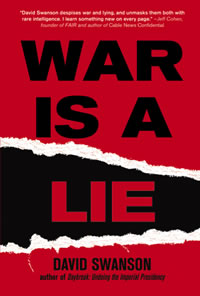 War is a Lie, by David Swanson – War is a Lie is methodical look at the justifications that people in power provide for the US going to war. Swanson walks the reader through the layers of propaganda that have accompanied US wars from the founding of the country up to the Obama administration. The author looks at the human & economic cost of war, whether or not it makes us more secure, who profits from war, how administrations have defended sending troops into war, how soldiers have been made into heroes, how the “enemy” has been demonized, the physical and technological nature of war, the legalities of war and the absurdity that wars are waged for humanitarian purposes. The book is well sourced and a useful tool for those who are opposed to war but struggle to articulate reasons for being against war beyond moral objections.

Bonhoeffer: Pastor, Pacifist and Nazi Resister (DVD) – Distributed by Icarus Films, Bonhoeffer is biographical look at German Theologian Dietrich Bonhoeffer who was part of what was known as the Confessing Church in Nazi Germany. Bonhoeffer, is known in some circles as an influential theologian, but is often not recognized for his role in resisting Nazi policy and even participating in intelligence gathering in a plot to assassinate German leader Adolf Hitler. Bonhoeffer was arrested and put in prison and was executed after the failed assassination attempt. Bonhoeffer wrote extensively while in prison where he expanded his views on faith and justice. Bonhoeffer never saw a contradiction in his religious beliefs and his participation in the plan to assassinate Hitler.
The Aftermath of the Cancun Climate Summit
Two weeks ago we posted a piece about the issues facing the international community at the beginning of the Global Climate Summit in Cancun, Mexico.

The climate summit has now wrapped up and there has been virtually no attention given to this event in US commercial media. Major news outlets in the US made the Obama tax cut policy, WikiLeaks and the death of Elizabeth Edwards the main story for the week of December 6 – 12. Thus, the Cancun Climate Summit was nowhere to be found.
Independent sources continued to report on the event, both inside the government talks and on the street where protests and people’s assemblies were held. Latin American specialist Laura Carlsen reports that there will be no major international agreements on reducing global warming coming out of the Cancun talks. Instead, polluters will continue to get away with devastating practices and the rich nations of the world continue to be held to a different standard.
Reporter and activist Patrick Bond had an even sharper critique of the Climate Summit in an article entitled, “Climate Capitalism Wins in Cancun.” Bond asserts that the market solutions to global warming dominated the summit, which essentially means that things will go on business as usual. Bond is particularly critical of the United Nation’s Reduced Emissions from Deforestation and forest Degradation (REDD) and the Clean Development Mechanism (CDM), both of which promote the false solutions of the market.
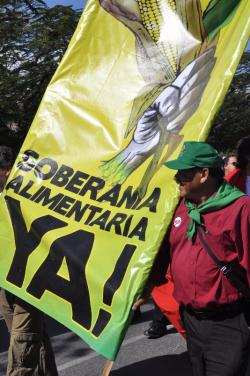
The lack of US news coverage of the Climate Summit not only reflected the complete disregard of the summit from Washington it ignored the grassroots organizing and opposition to much of what took place. The Indigenous Environmental Network released on the final day of the Climate Summit this statement, which summarizes much of what popular movements throughout the world have been saying about Global Warming and Climate Justice:
As representatives of Indigenous peoples and communities already suffering the immediate impacts of climate change, we express our outrage and disgust at the agreements that have emerged from the COP16 talks. As was exposed in the Wikileaks climate scandal, the Cancun Agreements are not the result of an informed and open consensus process, but the consequence of an ongoing US diplomatic offensive of backroom deals, arm-twisting and bribery that targeted nations in opposition to the Copenhagen Accord during the months leading up to the COP-16 talks.
We are not fooled by this diplomatic shell game. The Cancun Agreements have no substance. They are yet more hot air. Their only substance is to promote continued talks about climate mitigation strategies motivated by profit. Such strategies have already proved fruitless and have been shown to violate human and Indigenous rights. The agreements implictly promote carbon markets, offsets, unproven technologies, and land grabs—anything but a commitment to real emissions reductions.
The Voices of the People Must be Respected
Indigenous Peoples from North to South cannot afford these unjust and false ‘solutions’, because climate change is killing our peoples, cultures and ecosystems. We need real commitments to reduce emissions at the source and to keep fossil fuels in the ground. Because we are on the front lines of the impacts of climate change, we came to COP-16 with an urgent call to address the root causes of the climate crisis, to demand respect for the Rights of Mother Earth, and to fundamentally redefine industrial society’s relationship with the planet. Instead, the Climate COP has shut the doors on our participation and that of other impacted communities, while welcoming business, industry, and speculators with open arms. The U.S., Industrialized nations, big business and unethical companies like Goldman Sachs will profit handsomely from these agreements while our people die.
Women and youth in our communities are disproportionately burdened by climate impacts and rights violations. Real solutions would strengthen our collective rights and land rights while ensuring the protection of women, youth and vulnerable communities. While the Cancun Agreements do contain some language “noting” rights, it is exclusively in the context of market mechanisms, while failing to guarantee safeguards for the rights of peoples and communities.
The failures of the UN talks in Copenhagen have been compounded in Cancun. From the opening day to the closing moments of the talks, our voices were censored, dissenting opinions silenced and dozens ejected from the conference grounds. The thousands who rallied outside to reject market mechanisms and demand recognition of human and Indigenous rights were ignored.
The Market Will Not Protect Our Rights

Market-based approaches have failed to stop climate change. They are designed to commodify and profit from the last remaining elements of our Mother Earth and the air. Through its focus on market approaches like carbon trading, the UNFCCC has become the WTO of the Sky.
We are deeply concerned that the Cancun Agreements betray both our future and the rights of peoples, women, youth, and vulnerable populations. While the preamble to the Cancun Agreements note a call for “studies on human rights and climate change,” this is in effect an empty reference, with no content and no standards, that will not protect the collective rights of peoples. The market mechanisms that implicitly dominate both the spirit and the letter of the Cancun Agreements will neither avert climate change nor guarantee human rights, much less the Rights of Mother Earth. Approaches based on carbon offsetting, like REDD, will permit polluters to continue poisoning land, water, air, and our bodies, while doing nothing to stop the climate crisis. Indeed, approaches based on the commodification of biodiversity, CO2, forests, water, and other sacred elements will only encourage the buying and selling of our human and environmental rights.
The Cochabamba People’s Agreement Points the Way Forward
There is another way forward: the Cochabamba People’s Agreement represents the vision of everyday people from all corners of the globe who are creating the solutions to climate change from the ground up, and calling for a global framework that respects human rights and the Rights of Mother Earth.
If any hope emerges from Cancun, it comes from the dramatic demonstrations we saw in the streets and from the deep and powerful alliances that were built among indigenous and social movements. The Indigenous Environmental Network joined thousands of our brothers and sisters to demand real climate solutions based in the rights of Indigenous Peoples, the rights of Mother Earth, and a just transition away from fossil fuels. We will continue to stand with our allies to demand climate justice. The communities on the frontlines of the problem––those who face the daily impacts of the climate crisis––are also on the frontlines of the solutions. Community-based solutions can cool the planet!
The fight for climate justice continues. We are committed to deepening our alliances with indigenous and social movements around the world as we build in our communities and mobilize toward COP-17 in Durban, South Africa. Social movements in South Africa mobilized the world to overthrow Apartheid and create powerful, transformative change. The same mass-based movement building is our only hope to overturn the climate apartheid we now face. We look forward to working with our African brothers and sisters and tribal communities in Durban.
We only have one Mother Earth. As Indigenous Peoples, we will continue our struggle to defend all our Relations and future generations.
Graduation gowns, landfills and another greenwashing story in the Press
On Saturday, the Grand Rapids Press ran a short article on new “sustainability” effort at GVSU.

The university now offers to provide “eco-friendly” graduation gowns for students to buy. According to the article the gown “is made of wood pulp and the zippers of polyethylene terephthalate, or PET, a plastic commonly used in beverage containers.”
Interestingly, the GVSU bookstore manager states in the next paragraph that “most of the gowns may still end up in landfills, at least they’re made of material designed to disintegrate quickly.” He goes on to say that the eco-friendly gowns in the landfill are better than the old ones made with polyester.
What the bookstore manager fails to acknowledge or be aware of is how ridiculous this green consumer scam really is. First, there is no discussion about why graduates need to wear any kind of gown in order to participate in a brief ceremony upon graduation. Not wearing a gown would not detract from the ceremony itself and it would eliminate the waste of millions of gowns every year across the country.
Second, the lack of any critical assessment of this so-called sustainable initiative on the part of GVSU and the bookstore manager is that it’s primarily driven by the company that makes the gowns, Jostens. Indeed, the bookstore manager even puts in a plug for the company in the Press story by saying that Jostens will donate $1 to an environmental sustainability project when student who use their gowns contact them.
This whole effort by Jostens seems like a clear campaign to convince people that they should keep buying their products because now they have some sort of commitment to environmental responsibility. The truth is that what the company has a commitment to is making a profit and justifying what it is that they do.
Jostens is the largest “graduation” products based company, which sells gowns, yearbooks, rings and other items through high schools and colleges across the country.
Jostens has a “sustainability” section on their website, which has all kinds of lofting language about commitment to the environment, but it seems that reasonable people would be able to see through all of this greenwashing.
Would high school and college graduate feel slighted if they didn’t wear a gown on graduation day? And how many people actually wear their high school graduation ring? Jostens, however, assures us that they buy gems for their rings from companies that engages in environmentally and socially responsible mining activity. The Jostens website doesn’t post the names of companies they buy their gems from, which if course should make us all suspect as to the integrity of their claims.
However, even if the mining of gold and other gems for their products do not harm the environment (a claim I find implausible) the bottom line is do they even need to be selling and marketing products, which have no intrinsic value to improving the quality of human life? Unfortunately, the Press reporter didn’t bother to ask such questions, but instead treated the claims of sustainability as fact.
Billions Down the Drain in Useless US Afghan Aid
(This article by Patrick Cockburn is re-posted from CounterPunch.)
Beautiful but fake photographs are often the only evidence that companies have carried out expensive aid projects located in parts of Afghanistan too dangerous for donors to visit.
“I went to see a food processing plant in the east of the country which was meant to employing 250 women,” says an Afghan who used to work for an American government aid organization. “We had started the project and were paying for the equipment and the salaries. But when I visited the site all I found was a few people working on a vegetable plot the size of a small room.”

When he angrily complained about the non-existent plant he was told by a local official to keep his mouth shut. He said that “if I did not keep quiet there would be trouble on the road back to Jalalabad – in other words they would kill me.”
As President Obama prepares his review of how his Afghan strategy is working to be issued next week he is likely to focus on military progress.
But the most extraordinary failure of the US-led coalition in Afghanistan is that the expenditure of tens of billions of dollars has had so little impact on the misery in which 30 million Afghans live. Since 2001 the US alone has provided $52 billion in aid, two thirds for security and one third for economic, social and political development.
Despite this some nine million Afghans live in absolute poverty while a further five million, considered ‘not poor’, try to survive on $43 a month.“Things look alright to foreigners but in fact people are dying of starvation in Kabul,” says Abdul Qudus, a man with a deeply lined face in his forties, who sells second-hand clothes and shoes on a street corner in the capital. They are little more than rags, lying on display on the half frozen mud.
“I buy and sell clothes for between 10 and 30 Afghanis (two to six cents) and even then there are people who are too poor to buy them, “ says Mr Qudus. “I myself am very poor and sometimes I don’t eat so I can feed my children.” He says he started selling second hand clothes two years ago when he lost his job washing carpets.
US officials admit privately that the torrent of aid money that has poured into Afghanistan has stoked corruption and done ordinary Afghans little good. Aimed at improving economic and social conditions in order to reduce support for the Taliban it is having the reverse effect of destabilizing the country. Afghanistan was identified as the third most corrupt country out of 178 in the world in a report released yesterday by Transparency International.
“The aid projects are too big, carried out in too short a time, and the places they are located are too remote,” says a diplomat. He recalled that he was unable to monitor a road construction project in Kunar province in the east, because he was not allowed for security reasons to visit areas where he and his team could not be protected by indirect fire. Afghan and Americans who have overseen aid projects agree that the ‘quick fix’ approach has been disastrous. Schools that local people may not need are equipped with computers in districts where there is no electric power or fresh water.
The flood of money has had little success in reducing economic hardship. “It has all messed up into one big soup,” says Karolina Oloffson, head of advocacy and communication for the Afghan NGO Integrity Watch Afghanistan. Aid organizations are judge by the amount of money they spend rather than any productive outcome.
“The US has a highly capitalist approach and seeks to deliver aid through private companies,” she says. “It does not like to use NGOs which its officials consider too idealistic.”
Big contracts are given to large US companies that are used to a complicated bidding process, can produce appropriate paper work, and are well connected in Washington. The problem is that much of Afghanistan is far too dangerous for these companies to carry out work themselves or monitor sub-contractors.
In his office in Kabul Hedayutullah, the owner of the Noor Taq-e-Zafar Construction Company, says that there is a simple reason why the quality of work is so poor. He says: “Let us say the main US contractor has a contract worth $2.5 million donated by a foreign government. He will take a 20 per cent administrative fee and find a sub-contractor, who will sub-contract to an Afghan company, which may sub-contract again. At the end of the day only $1.4 million may be there for building the project which is too little to do it properly.”
Progress of schemes is often monitored by photographs of work in progress. In one small but typical case an Afghan company was paid to build and get running a tractor repair shop in highly dangerous Oruzgan province in the south to give employment to local youth.
The contractor rented an existing tractor repair shop in Kandahar for the day and hired local young men to look as if they were busily fixing engines in the shop. This was all photographed and the pictures emailed to the main contractor and the donor organization, both of which expressed high satisfaction at what had been achieved. “There is no intention to provide service,” says Mr Hedayatullah, “just to make money.”
There have been some successes. Kabul now has an almost continuous supply of electricity which comes from Tajikistan and Uzbekistan along wires hanging from newly built pylons that cross the Hindu Kush mountains. The US commander, Gen David Petraeus, is demanding that emergency generators supply continuous power to Kandahar.
But overall aid has done surprisingly little for most Afghans. Little of the money trickles down and much of it is monopolized by a tightly-knit group of businessmen, warlords and politicians at the top. Former Vice President Ahmed Zia Massoud is alleged to have been stopped entering the United Arab Emirates with $52 million in cash in a suitcase according US diplomatic documents leaked through Wikileaks. Police chiefs and provincial governors all want a cut of the pie.
Yama Torabi, the co-director of Integrity Watch Afghanistan, says it is not really possible to carry out development aid in areas of conflict where there is fighting, It might be better to stick to humanitarian aid.
This would be contrary to US military policy, pioneered in Iraq, whereby local US military commanders control substantial funds that can be used for local aid projects through the so-called Provincial Reconstruction Teams (PRTs). But this militarization of aid means that the Taliban target schools built on the orders of a US commander.
“People see schools built by the Americans as American property,” says an Afghan who once worked for a US government agency. “They are frightened of sending their children there.” Overall it is doubtful that aid provided by PRTs does the US or other members of the foreign coalition much good because “villagers don’t forgive the US army for killing their sons just because it has built a road or a bridge.”
The US government policy of providing aid through large American private companies, whose interest lies in making a profit rather than improving the life of Afghans, is proving a failure in Afghanistan as it did previously in Iraq.
As winter approaches half of Afghans face the prospect of ‘food insecurity’, or not getting enough to eat in the next three months, according to the US Famine Early Warning System. The best use of aid money may be to subsidize food prices and help people like Mr Qubus, the old clothes seller, and his family from starving.
 Grand Rapids Institute for Information Democracy
The Tangled Web of the Grand Rapids Press
Last week, we reported on the number of racist, homophobic, and harassing comments that readers of the Grand Rapids Press were posting on its MLive website. Several people asked if we could contact the Press directly to talk about the problem with them, see if they were aware of its extent, and find out exactly how the site was monitored.
In the meantime, Editor Paul Keep made a big, although rather vague, announcement in Sunday’s paper: that the Press was making the shift to its long-hinted-at focus on its online edition. Keep calls this “Web-first, print-important.” This seems to mean that the Press will continue to issue a printed paper, but focus on its website content first. The announcement was short on details; Keep himself noted that the change’s “dimensions are somewhat murky.” But it seems clear that the Press considers its website the lifeboat of the newspaper.
GRIID attempted to contact Paul Keep with no luck last week, but the Sunday article announced that online editor Meegan Holland was now in charge of the web edition. I called her on December 20, and she spent a significant amount of time explaining how the MLive site was monitored.
First, Holland made it clear that the Press is concerned about the vitriol and racism being posted daily about its articles. She said that in the past week, she had been engaged in “a number of intense talks” with MLive about the hate-speech posts, and added, “We’re upset about it, and our exploration of this issue has support from top to bottom here.” She added that the Press staff also had a meeting last week about the subject, stating, “Everybody felt that something must be done. We really need to be digging in and addressing this.” The new “web-first” strategy, she noted, has made the problem a priority.
Asked if having a large number of comments on each article was an editorial goal, Holland replied, “We want the website to keep rolling; our goal is to have lots of comments.” This statement agrees with a comment she made in a Press article from January 15 of this year. But Holland made it clear that no one on staff wanted that at the expense of hate speech, and that there was no encouragement by management to leave posts up just to up the number of comments per thread.
Holland verified what another Press reporter had told GRIID earlier: that each writer was encouraged to read his or her comments and attempt to monitor them; but because of the reduced size of the staff and the demands on the remaining employees, many reporters were only able give this task limited time.
One surprise was that the chief monitoring came not from the Press or MLive, but via Advance Internet. Advance hires a team of subcontracted “sweepers” to review posts and remove them. However, Holland says that the Press is also reliant on reader input. “It takes a community,” she said. Readers using the Alert button and reporting offensive messages seemed to be one of the most reliable methods the Press had currently to keep up-to-date on the removal of offensive posts. Holland said, “We really need the community’s help.”
Other problems with the monitoring of the site that Holland discussed were anonymous posting, the “Most Comments” list, and the idea of having a voting system to vote comments up or down.
Holland stated that the Press was committed to anonymous posting. She said there were legitimate reasons for this: it allowed people to avoid repercussions from employers, church members, etc. I pointed out that anonymity was also the chief feature that allowed the hate speech to thrive. No one had to accept personal responsibility for what they posted online. I also told her that there was a growing movement among some readers to change their account names to their full, real names and then demand that hate-speech authors do the same. You can find this grass-roots activity in a number of threads now.
The “Most Comments” list appears at the right side of the screen, and shows account names with the largest number of posts per week. Both Holland and I agreed that this rewarded the regulars who tended to post the most offensive comments.
Holland seemed to feel that voting individual comments up or down would be a good addition, but I told her that because this regular hate-speech gang online was so active, it seemed this would just give them the means to remove any commentary that challenged their views from the site.
While it’s encouraging to learn that the Press is addressing this problem with serious intention, one hopes that the newspaper won’t end up taking a fall-back position of giving readers the main responsibility for monitoring the site. And until the Press puts solutions in place, the hate speech continues unabated. From this week’s articles, here are a few examples:
An article about a Black woman who sued the United Way for discrimination on the job elicited many comments by people assuming that she was just attempting to “blackmail” the company and her claim was baseless, even though the EEOC found that her case had merit. The article caused one reader to make the strange and racist assumption that since most of the people who benefited from United Way programs were Black, no settlement for the discrimination suffered by the employee should be made: …$250,000 in punitive damage to a person that suffered no physical or mental harm being taken away from an organization that raises money for hundreds of local charities, many if not most, serving black clients is just plain selfish.
Other comments included:
• I think Dire Straits said it best: “You get your money for nothin and your chicks for free!” This woman sounds like she was lucky to even have a job. It is becoming way too easy to throw out the race card these days.
• I have seen this so many times, and it is alarming how often people cave in to this kind of blackmail…I’d fire her now on my first opportunity for the smallest infraction. She needs to be out of there. She will try to sue again, because she’s the type, and needs to be ousted. That’s what you get for playing your card.
• This is a perfect example of why you cannot hire a black person for any job.
Attached to a cross-posted article the GR Press featured from Muskegon about how minimum wage eliminates jobs, there was this statement that seems to argue for minimum wage, but with a disturbing, hate-speech slant:
Slaves who are starved to death don’t do much work, and letting them die and constantly having to replace them is highly inefficient, thus costly. Even fleshless machine tools require the expense of regular maintenance…In conclusion, minimum wage has the same onus today, as meeting the basic needs for slaves did in plantation days. And it must be raised periodically to adjust for the increasing costs of those needs. Very basic logic, what?
A number of posts argued that corporations should not be made to pay minimum wage because profits suffer, and included these:
• Minimum wage is a job killer. In the middle of a resesion/depression, in the midst of widespread unemployment where people can’t afford to purchase extra items, if sales are down, how can a business afford to pay more?
• Minimum wages does nothing more than increase labor costs without regard to productivity. In the early years of minimum wage it was a way for unions to keep blacks from getting their jobs.
And the vitriolic blaming of the unemployed for their own plight was on full display in comments on two stories about extending unemployment benefits. About one of the featured unemployed people in an AP wire story, one author wrote: Uh ms.smith, from the picture look’s like you haven’t miss a meal so I really don’t think you are having a bad time… So you have been collecting unemployment for 18 month’s wow! Is this the set standard for unemployment ins? Heck go on welfare after being “unable” to find work after 18 month’s. Hey kid’s can you say the word “Lazy”.
Other comments included:
• People, there are employers screaming for employees – some even offering free housing! But giving up a guaranteed $477 a week before taxes, food stamps, heating help, free this and free that, might be hard to do. In that case, unemployment is a choice.
•It is tiresome to be forced to carry the burden on our backs of all the feel-sorry-for me whiners.
• If people are losing their jobs in their 50’s and are homeless in a year then you obviously didn’t save or spend your money wisely.
• ohhhh look the free money money…Bunch of unemployed useless bums.
Let’s hope that the Press finds workable solutions to this situation soon.