Palestine Solidarity Information, Analysis, Local Actions and Events for the week of February 2nd
It has been almost 16 months since the Israeli government began their most recent assault on Gaza and the West Bank. The retaliation for the October 7, 2023 Hamas attack in Israel, has escalated to what the international community has called genocide, therefore, GRIID will be providing weekly links to information and analysis that we think can better inform us of what is happening, along with the role that the US government is playing. We will also provide information on local events and actions that people can get involved in. All of this information is to provide people with the capacity of what Noam Chomsky refers to as, intellectual self-defense.

Information
Israel Escalates West Bank Military Assault, Invading Areas Across the North
The Israeli Far Right Is Desperate to Resume the War
Gaza’s Unbreakable Resistance: A Historical Perspective on the War and Its Aftermath
Report: Israel Detaining Record Number of Palestinian Children Without Charges
Gaza Aid Survey Details Israel’s ‘Disregard of International Law’
‘CONSPIRACY THEORY’ IS NOW FACT: GREATER ISRAEL HAS ARRIVED
“A City of Ghosts” — Returning to Rafah to Find Death and Destruction
Analysis & History
New Realities of Israel/Palestine in the Trump Era: Settler Colonial Destinies in the 21st Century
Mustafa Barghouti on Israel’s “Defeat” in Gaza, Saudi Normalization, and the War on the West Bank
TRUMP’S NIGHTMARE PLAN FOR GAZA
Israel Is Still the Obstacle to a Permanent Gaza Cease-Fire
Events
Parallels in Power: Black Civil Rights and Power
Saturday, February 9 at 2pm, Fountain Street Church
Image used in this post is from the https://visualizingpalestine.org/visual/questions-children-gaza/.
Why Can’t the Michigan Catholic Church be courageous like the Confessing Church was in Nazi Germany?
No institution can e silent in the face of oppression. Well, unless the institution is designed to either benefit from or be a buffer against resistance to oppression.

The Michigan Catholic Conference recently came out with a statement, which was signed by the Bishops from the diocese across the state. Here is the body of the statement that was sent.

After reading this statement I can see the appeal, where they use a biblical quote, “you were a stranger and you welcomed me.” The Bishops also say they empathize with immigrant families over the fear of mass deportations and all the anti-immigrant rhetoric. The Catholic Bishops also say they pledge “unyielding support.”
The statement then calls on elected officials to support policies to keep immigrant families safe and together.
The statement ends by saying that immigrants should not give up faith they in the face of hardships and they ask for the intervention of Our Lady of Guadalupe.
As someone who was once studying to be a Catholic Priest, I understand the sentiment and the rhetoric. However, such sentiment and rhetoric is one of the reasons why I left the church around 1990.
No where in this statement from the Michigan Catholic Conference is there a sense of urgency or any concrete commitment to actively support immigrant families. More importantly, there is nothing in the state that would communicate to immigrant families that the Catholic Church would actively resist the threat of mass deportation by engaging in such practices as offering Sanctuary to those who are being terrorized with the threat of mass deportation.
This is not the time to be neutral or to offer nice words. Now is the time for action and resistance to the threat of mass deportation. My time in Latin America, from 1988 through 2006 certainly taught me that in communities of people and even faith leaders, took courageous action in the face of repression. When I say repression, I’m talking about brutal US financed counter-insurgency wars in Guatemala, El Salvador and Chiapas. The risks from people of faith there were greater than what the Michigan Catholic Conference is having to deal with.
What we need from so-called Christians is to adopt the same kind of commitment that the Confessing Church did in Nazi Germany, which wrote the Bareman Declaration. Why can’t the Michigan Catholic Bishop model the Liberation Theology practice in Latin America, like Archbishop Oscar Romero? Then there would be no polite dancing around the issue of mass deportation, just unequivocal resistance and courage.

Lessons on the history of US Immigration Policy #2: Anti-Immigrant Policies in the US are bi-partisan
I completely understand the sense of urgency around responding to the Trump Administration’s attempt to carry out mass deportations. This is why I do work with Movimiento Cosecha and GR Rapid Response to ICE.
However, millions of immigrants have been removed from the US over the past 25 years, by means of voluntary removal, enforced returns, Removals (deportation), Administrative Returns and Title 42. You can see in the graphic below what the numbers are like since the early 1990s.

In the 1990s, President Bill Clinton and congressional Republicans responded to fears over the free movement of capital—particularly as those fears related to the North America Free Trade Agreement (NAFTA) implemented in 1994—by joining nativists in demonizing the free movement of people. The militarization of the US border began under Jimmy Carter and continues to this day.
After 9/11, 2001, all US administrations ramped up deportations and increased the budget for US Customs and Border Protection (CBP), along with creating Immigration and Customs Enforcement (ICE). You can see in the graph above (in red) how removals/deportations increased after 9/11.
The Trump Administration has essentially made anti-immigrant xenophobia a main talking point, a talking point that has resonated with his followers. This anti-immigrant rhetoric has been effective, but it is not new. Here is President Clinton’s State of the Union speech from 1996:
“All Americans, not only in the states most heavily affected but in every place in this country, are rightly disturbed by the large numbers of illegal aliens entering our country. The jobs they hold might otherwise be held by citizens or legal immigrants. The public service they use impose burdens on our taxpayers. That’s why our administration has moved aggressively to secure borders more by hiring a record number of new border guards, by deporting twice as many criminal aliens as ever before, by cracking down on illegal hiring, by barring welfare benefits to illegal aliens. In the budget I will present to you, we will try to do more to speed the deportation of illegal aliens who are arrested for crimes, to better identify illegal aliens in the workplace. We are a nation of immigrants. But we are also a nation of laws. It is wrong and ultimately self-defeating for a nation of immigrants to permit the kind of abuse of our immigration laws we have seen in recent years, and we must do more to stop it.”
 Daniel Denvir, who wrote the book, All-American Nativism: How the Bipartisan War on Immigrants Explains Politics as We Know It, makes the following point:
“Anti-immigrant politics became defined by attacks from both right-wing nativists and the bipartisan establishment on “illegal immigration.” It was a form of security theater that functioned to safeguard not only neoliberalism but also (to nativist consternation) legal immigration. Legal immigration enabled by the 1965 reform is the largest driver of the demographic change that nativists oppose: more than three-quarters of foreign-born people in the United States are here with authorization.6 But the larger and newly diverse large-scale legal immigration since the passing of the Hart-Celler Act has always been protected by ethnic advocacy organizations, labor unions, religious groups, business interests, and powerful figures within both major parties. Anti-“illegal” politics, then, have been at the center of a public immigration debate that has blamed undocumented people for most everything.”
This is why Movimiento Cosecha was not celebrating after the Biden Electoral victory in 2020, since the affected community, the undocumented immigrant community, has first hand knowledge that both parties will deport them in larger numbers. They did banner drops that said, Democrats Deport us too!

It is incumbent that just because the Democrats do not engage in the more overtly anti-immigrant rhetoric that they aren’t carrying out the same repressive anti-immigrant policies. In 2023, I wrote an article headlined, Where is the outrage from white liberals? After 2 years, the Biden Administration’s immigration policy is very similar to the Trump Administration. In that article, I document that the Biden Administration was continuing many of the same policies that the Trump had put in place from 2017 through the end of 2020.
So, let’s fight against mass deportation now, but allies cannot abandon this movement once the Trump Administration is gone, because anti-immigrant policies in the US are fundamentally bi-partisan.
State of Michigan is giving away $2.8 million of public money to build a road for a private weapons company
On Wednesday, MLive reported that, “the Michigan Strategic Fund has allocated $2.8 million to build a road from the city of Grayling to a planned Saab Inc. munitions plant in nearby Grayling Township.”
The Michigan Strategic Fund had approved an additional $3.5 million to the Swedish weapons company Saab Inc., public that money that was provided for the construction of a munitions factory to the global corporation.
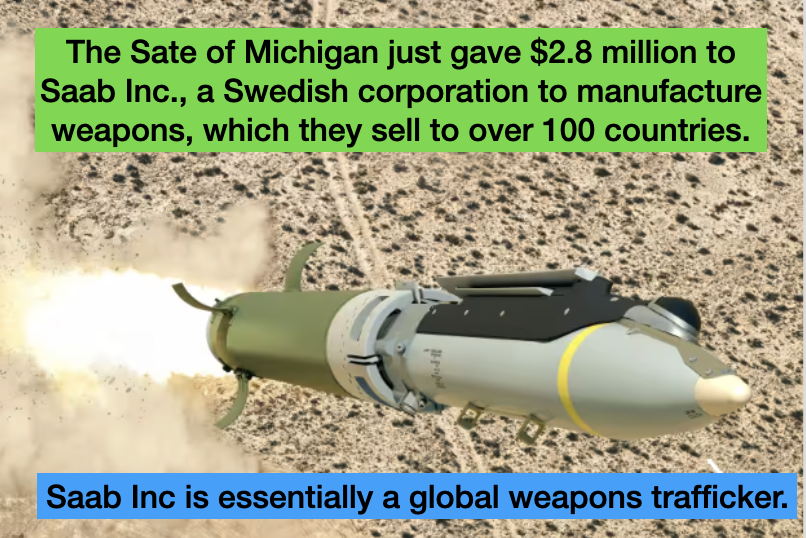
According to the MLive article, Saab Inc. will assemble ground-launched bomb systems and shoulder-launched munitions for the U.S. Department of Defense. The rest of the article talked mostly about land use and land sales to Saab Inc., but didn’t explore any other angles related to the use of public money for a privately owned weapons corporation.
One omission in the MLive article was any information about the Michigan Strategic Fund, which was created by former Michigan Governor Rick Snyder in 2012. The Michigan Strategic Fund Board is also made up of people from the corporate world, along with a few government staffers. Included among the MSF Board is Randy Thelen, the President and CEO of the Right Place Inc.
Another omission centers around the kinds of weapons that will be manufactured by Saab Inc. at the northern Michigan facility. The MLive article states they will make “ground-launched bomb systems and shoulder-launched munitions for the U.S. Department of Defense.” If you look on the Saab Inc. site you can get a more detailed description of the weapons, such as the Ground-Launched Small Diameter Bomb (GLSDB) and the AT4, which is a shoulder launching system, that has its own promotional video.
Saab Inc. also operates in 30 different countries from around the world and sells weapons to to over 100 countries. Therefore, Saab Inc. is not only a weapons manufacturer, they are a weapons trafficker.
Lastly, it is worth noting that Saab Inc. is worth $11.27 Billion, which begs the question why the State of Michigan is providing $2.8 million to build a road for the global weapons trafficker?
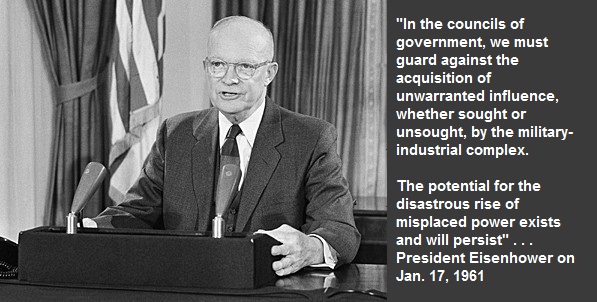
In conclusion, I leave you with the words of President Eisenhower from his farewell speech on the dangers of the military industrial complex:
Now this conjunction of an immense military establishment and a large arms industry is new in the American experience. The total influence—economic, political, even spiritual—is felt in every city, every Statehouse, every office of the Federal government. We recognize the imperative need for this development. Yet, we must not fail to comprehend its grave implications. Our toil, resources, and livelihood are all involved. So is the very structure of our society.
In the councils of government, we must guard against the acquisition of unwarranted influence, whether sought or unsought, by the military-industrial complex. The potential for the disastrous rise of misplaced power exists and will persist. We must never let the weight of this combination endanger our liberties or democratic processes. We should take nothing for granted. Only an alert and knowledgeable citizenry can compel the proper meshing of the huge industrial and military machinery of defense with our peaceful methods and goals, so that security and liberty may prosper together.
Lessons on the history of US Immigration Policy #1: Is the US a nation of immigrants?
It is quite common to hear from politicians, the news media and other centers of social and cultural influence this idea that the United States of America is a nation of immigrants. This sentiment was used by Grand Rapids City officials during last night’s City Commission meeting.
Not only is this belief that the US is a nation of immigrants historically inaccurate, it is a form of erasure and exclusion.
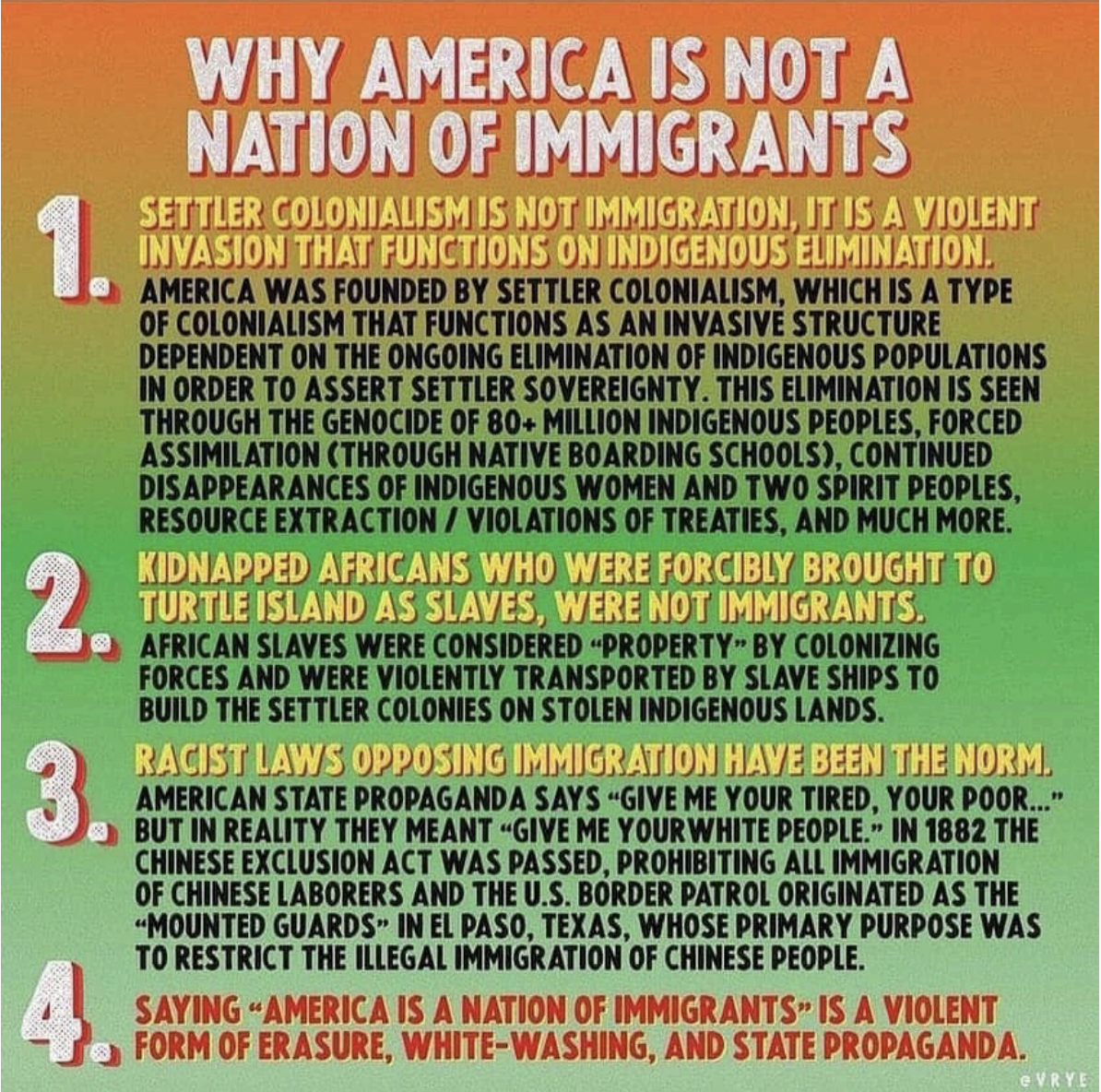
Indigenous historian and author Roxanne Dunbar-Ortiz, in her book, Not “A Nation of Immigrants”: Settler Colonialism, White Supremacy, and a History of Erasure and Exclusion, provides us with 4 overarching reasons why the idea that the US is a nation of immigrants is not only wrong, but it is harmful.
- Settler Colonialism is not immigration, it is a violent invasion that functions on Indigenous elimination. America was founded by Settler Colonialism, which is a type pf colonialism that functions as an invasive structure dependent on the ongoing elimination of Indigenous populations in order to assert settler sovereignty. This elimination is seen through the genocide of 80+ million Indigenous peoples, forced assimilation (through Native boarding schools), continued disappearances of Indigenous women and Two Spirit peoples, resource extraction/violation of treaties, and much more.
- Kidnapped Africans who were forcibly brought to Turtle Island as slaves, were not immigrants. African slaves were considered “property” by colonizing forces and were violently transported by slaves ships to build the Settler Colonies on stolen Indigenous lands.
- Racist laws opposing immigration have been the norm. American state propaganda says, “Give me your tired, your poor….” But in reality they meant “Give me your white people.” In 1882, the Chinese Exclusion Act was passed, prohibiting all immigration of Chinese laborers and the US Border Patrol originated as the “Mounted Guards” in El Paso, Texas, whose primary purpose was to restrict the illegal immigration of Chinese people.
- Saying “American is a nation of Immigrants” is a violent form of erasure, white-washing, and state propaganda.
If your organization or community group would be interested in a presentation or class on the history of US Immigration Police, please contact Jeff at sjeff987@gmail.com.
There was a tremendous outpouring of public support for Grand Rapids to declare itself a Sanctuary City
Over the past two months, GR Rapid Response to ICE and Movimiento Cosecha GR had been meeting to discuss and plan to pressure the City of Grand Rapids to declare itself a Sanctuary City.
While engaged in a hunger strike in Lansing to win Driver’s Licenses for undocumented immigrants in early December, Movimiento Cosecha organizer Gema Lowe had struck up a conversation with newly elected Mayor David LaGrand. She asked him if he would support Grand Rapids becoming a Sanctuary City. LaGrand responded by saying that “we have to do a whole lot more than that.” The immigrant justice organizer said, “But we are asking you as the new Mayor of Grand Rapids to get behind GR being a Sanctuary City.” Mayor LaGrand would not make a commitment that day nearly two months ago.
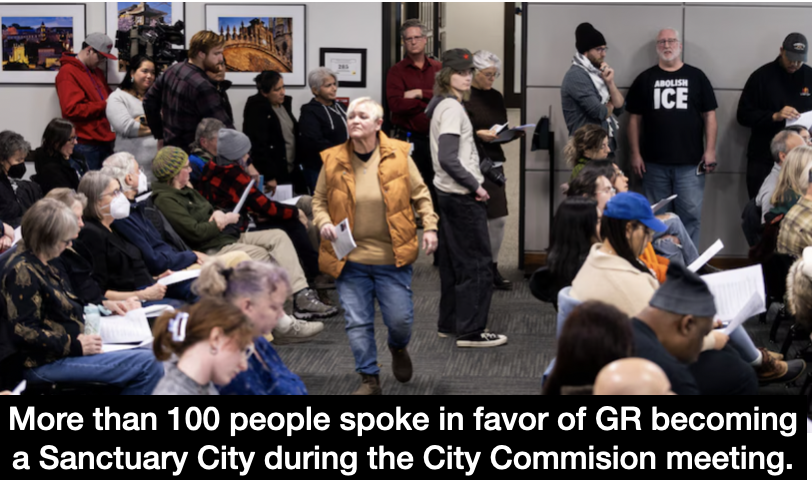
Last night there were easily over 100 people who had come to the Grand Rapids City Commission meeting to demand that they declare Grand Rapids a Sanctuary City and commits to preventing the Grand Rapids Police Department from cooperating with Immigration and Customs Enforcement officials and any law enforcement agency that seek to arrest, detain and deport undocumented immigrants. These two demands were part of an online Action Alert that was sent to the Mayor, the 6 Commissioners, the City Manager, the City Attorney and the City Clerk. These 10 Grand Rapids City officials have each received over 2,000 electronic messages to meet these two demands.
 There were so many people who came to speak about GR becoming a Sanctuary City that the meeting didn’t end until 11:30pm. Besides the City Chambers being packed, there were more than 50 people people who had to wait in the lobby to watch the commission meeting before being able to come up to the 9th floor to give public comment, and that doesn’t include the countless people who didn’t stay the entire time because people have lots of other responsibilities to attend to.
There were members of the affected community who spoke about what it is like to live in constant fear of “La Migra”, often fighting back tears as the recounted witnessing their parents or other family members being deported. One immigrant told the Commissioners that he learned how to respond be prepared if ICE came to his home even before he learned how to do simple math.Many immigrants talked about how hard they have worked to support their families, often on minimum wage jobs, while other immigrants have created their own businesses, pay taxes and do the work that no one else wants to do in West Michigan.
There were countless allies who got up to speak, with many of them talking about their own heritage and which generation they were, since most of us a from immigrant families. Rev. Doug Van Doren stated that Grand Rapids is already a Sanctuary City for him, since he doesn’t have to worry about ICE coming to take him or his family away. Many of the allies spoke about their work as teacher, counselors, social workers, and pastors, where they are confronted with the daily realities and daily reminders of the simple fact that undocumented immigrants never know when ICE will come for them and their families because they don’t have documentation.
You can watch and listen to the testimony from over 100 people who were calling for the City of Grand Rapids to declare itself a Sanctuary city at this link.
There were two people who not only spoke against the demand to make GR a Sanctuary city and both of these white men used racist, xenophobia rhetoric that was filled with the ideological talking points that have been coming out of the mouth of Donald Trump since he first began campaigning for the presidency in 2016.
City Officials respond
Before I get to how city officials responded the 3 hour long public comments, it is important to note that the City Manager spoke before public comment. Mark Washington wanted to try to convince those who sent letters and those who spoke last night that the city already had robust immigration policies in place, such as their equity policies and the fact that the Chief of Police has already come out and said that the GRPD will not enforce federal immigration policy.
As someone who has followed these matters closely for years, the policy that the City Manager was referring to, is known as the Foreign National’s Policy.
This policy clear states:
The policy allows officers to provide assistance to federal immigration authorities when there is an emergency that poses an immediate danger to public safety or federal agents.
Many of us from GR Rapid Response to ICE and Movimiento Cosecha are all too familiar that the rhetoric of the City and the GRPD is in dark contrast to what they practice. See my article entitled, the criminalization of dissent in Grand Rapids.
What follows are some of the responses by Grand Rapids City officials to the overwhelming demand for GR to declare itself a sanctuary.
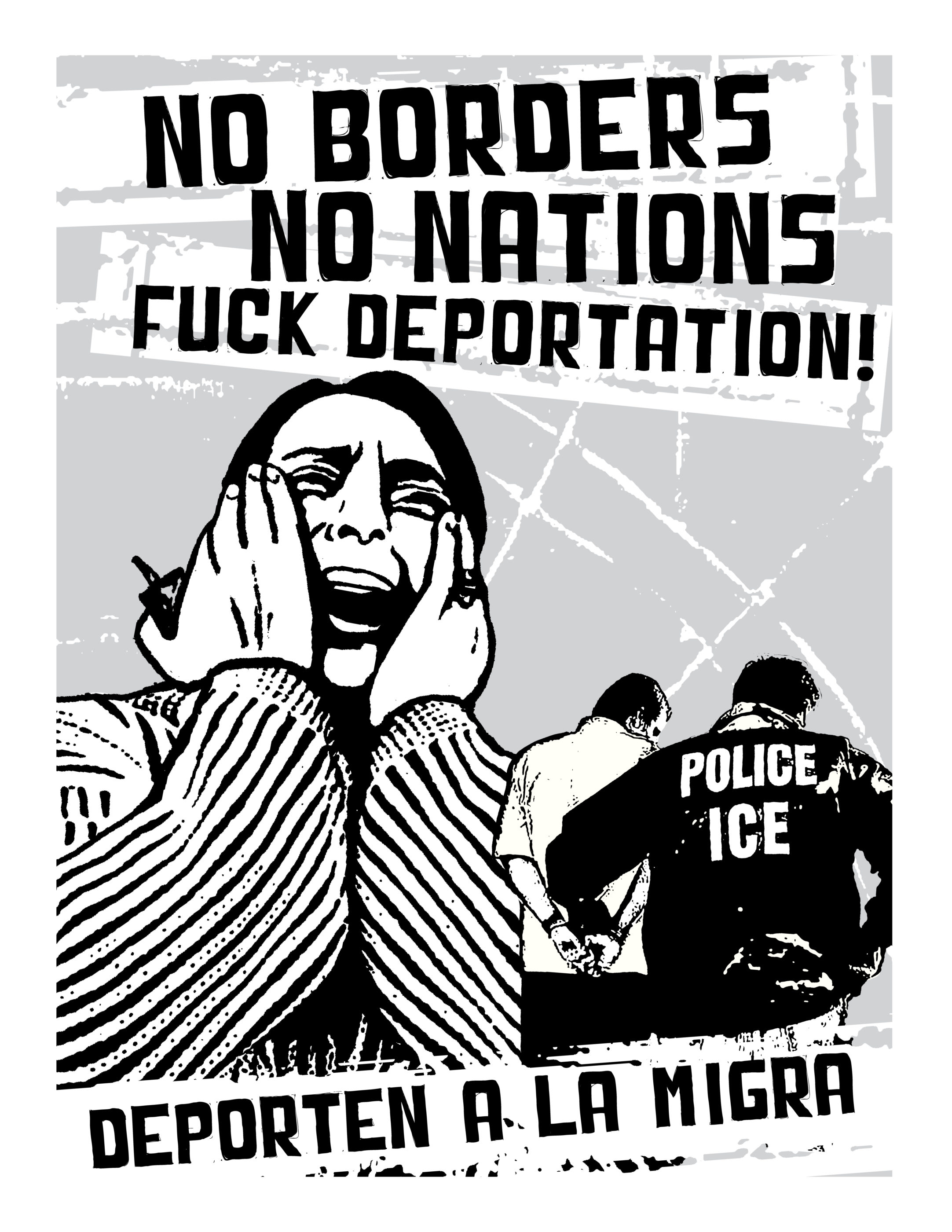 Commissioner Belchak stated that there are no easy answers and there were probably as many people who would oppose GR being a Sanctuary City, they just didn’t show up. Now, there is no way she could know this, but the fundamental difference is that what was on display last night was a demonstration of organized people getting behind a specific cause.
Commissioner Perdue stated that decisions like this are not hard, but dangerous. She thinks that being a Sanctuary could do more harm than good.
Commissioner Ysasi acknowledges all the effort that has gone into this campaign. She stated it was an emotional evening, with lots of stories and fears. She brought up the fact that we have also been pressing the GRPS to declare themselves a Sanctuary School District. Commissioner Ysasi then speaks to the CDBG grants they receive from the federal government, which could be put at risk if GR becomes a Sanctuary City.
Commissioner Kilgore said it is scary, since he is the first queer person to be a City Commissioner. “We have good policies, but we have to make them more embodied,” he said.
Commissioner Knight talks about Trump and previous administrations, then asks us to use this energy everyday to deal with the homeless, etc. She has heard from non-profits who don’t have funding and can’t give out gas card. It felt like she was talking down to us about the political reality, like we are aware of what is coming and what has been happening for decades. She kept says, “8 days,” referring to the brief time since Trump became President again. We all know that these issues are inter-related and we know how to have an intersectional lens when thinking about systems of oppression work.
Mayor LaGrand said he was glad to know people are willing to act, but he didn’t seem to acknowledge or understand that Movimiento Cosecha and GR Rapid Response to ICE have been acting since 2017 around immigration justice matters. LaGrand says the overarching concern is for care and compassion. While I don’t disagree with this sentiment, people were demanding action from the city.. LaGrand then said something that shocked people, He said that they were not really hearing from the affected community. I counted at least several dozen from the affected community. Then there is the issue that many people from the affected community don’t feel safe at City hall during these meetings because there are always cops there.
Now, I definitely felt frustrated with the responses, but after reflecting on it on the way home last night I reminded myself that we already had a victory last night. Sure, Grand Rapids City officials did not meet our demands, but they have heard from several thousand people, plus the local news media has been reporting on these issues for more than a week. Our collective efforts have forced elected officials and the public at large to think about immigration policy and the realities that undocumented immigrants face every day. This is what we call polarization, where people can’t be neutral and need to pick a side. Which side are you on?
The public wants a Sanctuary policy, School Board members debate it, along with the suppression of Action Alert emails calling for a Sanctuary policy
During the Grand Rapids Public School Board meeting last night, there were 31 people who spoke during public comment period to ask, encourage and demand that the GRPS adopt a sanctuary policy for the district.
Those that spoke raised numerous topics and issues around the matter of the threat of ICE being on this community and the threat of their ability to enter or even be on the property of all GRPS facilities.

Several people emphasized that the current GRPS policy, while being a good first step, will still allow ICE to enter GRPS buildings and if they have a warrant, the GRPS will allow ICE to interrogate students, which is most definitely a traumatic experience and it would be a form of violence. This same trauma would be experienced if students witness or find out that their parents were picked up by ICE after dropping off or coming to pick up their children who are students of GRPS.
Other speakers used the following talking points from the Urban Core Collective (UCC)
Sanctuary districts actively prevent ICE and immigration services from acting on school grounds, parking lots, and surrounding areas. They empower districts to collaborate with community partners to provide critical resources, training, and support for those encountering ICE violence. Becoming a sanctuary district would bring a significant amount of security to thousands of GRPS students whose loved ones are without documentation.
We acknowledge and commend GRPS for their proactive response to this threat. Superintendent Roby presented the district’s current policy, which recognizes schools as protected places and limits ICE enforcement on district property. She also shared the document all GRPS staff have received in the event that ICE does come to a school building.
We believe that the current GRPS plan does offer students and families some protection. However, because of the increased threat of deportation, we ask GRPS to actualize the district’s commitment to truly being a “safe and welcoming space” for students. More steps are needed to keep students and their families safe.
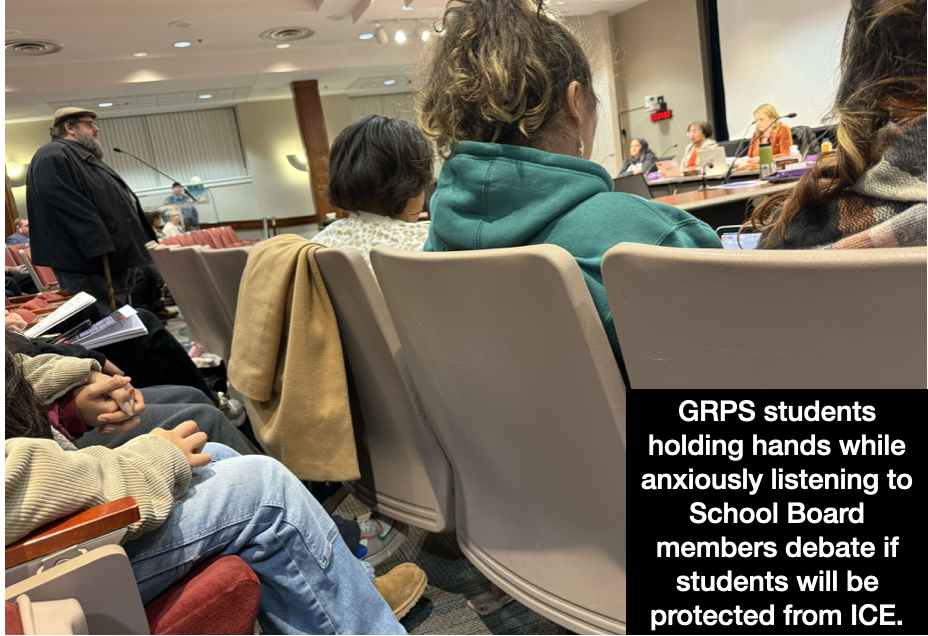 Advancing Safety and Equity
We believe GRPS must take the following actions to strengthen its commitment to sanctuary and prioritize student and family safety:
- Create a Policy Advisory Committee: GRPS should establish a policy advisory committee composed of members from the affected community. This committee would be given the power and authority to update the current GRPS response plan. This committee should include representation from Movimiento Cosecha GR and GR Rapid Response to ICE.
- End Collaboration with GRPD on ICE Matters: GRPS should immediately amend the current policy to remove any contact with the Grand Rapids Police Department (GRPD) regarding an ICE-related issue. GRPD has repeatedly demonstrated deep collusion with ICE around immigration enforcement. This should include referrals from the GRPS safety department to the GRPD.
- Prominent Signage to Protect Students: GRPS should proactively create signage that signifies schools as protected areas and warns off ICE enforcement.
- Comprehensive Immigration Education: Push out immigration enforcement information to all students and staff, including what their rights and resources are if they encounter ICE.
Dr. Roby’s response was a bit defensive regarding people’s “feelings” vs facts. The GRPS Superintendent did not address what people said during public comment. She went on to say that ICE or any other law enforcement agency must have a judicial warrant, before the district will allow them to get information and access to students, faculty and staff. This statement made it clear that GRPS would be cooperating with ICE.
The GRPS Communications person then spoke, but essentially repeated what had already been said about work that the GRPS has been doing around immigration.
At one point one of the GRPS Board of Education members said that ICE agents are “visitors”, like anyone else who comes to their facilities. Visitors don’t come with the intent of arresting and detaining people.
GRPS School Board member Jose Rodriguez then addresses the Resolution and wanted to read it, but Board member Williams opposed this, stating that she wanted to read it in her own time. President Davis then said that the Strategic Plan is how policy gets implemented, not through Resolutions.
Board members Willians doesn’t agree that with the Resolution, since it would undermine the Superintendent. “This is not how we have done this before, as one of the senior board members.”
School Board member Rodriguez brings up at the end that there has been suppression of the Action Alert Emails calling for a Sanctuary Policy. This means that the GRPS Administration has prevented messages getting to School Board Members. Board member Rodriguez also reads part of the Resolution, which is not included in the current existing policy. Board member Williams responded by saying she is concerned about GRPS funding if the Resolution is adopted. Money over the safety of the GRPS students.
Board member Rodriguez once again brought up the suppression of the Action Alert. The Board President doesn’t want to talk about it. Board member Williams doesn’t want to talk about it and thinks that Board member Rodriguez bringing up the Action Alert was a “surprise” to her. The Board President then tries to re-direct the conversation away from the Action Alert. At this point, without any apparent reason, School Board member Williams gets up and leaves the meeting.
I left minutes later and was unable to stay for the entire meeting, but there was finally some discussion about maybe putting together an Advisory Committee, which would include those from the affected community, to make recommendations about how the district should move forward on immigration and ICE matters. In addition, there was some willingness amongst the Board members to look at adopting a Resolution.
Here are some School Sanctuary Toolkits, in English and Spanish, which GR Rapid Response to ICE put together years ago.
No one really knows if the Trump Administration will be able to actually implement a mass deportation campaign in this country.
The logistics and the cost of such an endeavor will be extremely difficult. However, what will be even more difficult for any government effort to engage in mass deportation will be how much resistance there will be. Imagine if there were thousands of faith communities, schools, non-profits and other institutions that publicly declared their opposition to the threat of mass deportation and their willingness to offer Sanctuary.

I know what kind of commitment and risk it takes to declare your community as a sanctuary for those whom the government deems as “illegal.” In 1986, the community I was living in, Koinonia House, declared itself a sanctuary for Central American political refugees that were fleeing the US sponsored counter-insurgency wars.
One major aspect of becoming a Sanctuary was the need for those seeking to declare themselves a Sanctuary to obtain support from the community, especially in the form of letters. Such letters were a sign that Koinonia House would indeed be trusted with doing the work and it signaled to the federal authorities that those who signed the letters stood with the members of the Grand Rapids Sanctuary. After soliciting letters, Koinonia House received nearly two dozen endorsements from churches, community organizations, university groups, individuals and parents with whom we had developed a relationship with.
The Central American Sanctuary Movement had two main goals. First, was the commitment to offer a safe place for people to live who were fleeing political violence. The second part of the work was to try to influence public opinion and eventually change the national policy around US support for the counter-insurgency wars in Central America.
 We never fully knew how much we were under surveillance, but within the first month of offering Sanctuary to the Guatemalans that had arrived, two FBI agents showed up one day at our door. Not knowing who they were, the Guatemalans let them in. I was upstairs doing some work, when one of the Guatemalans came to get me. The FBI agents introduced themselves and then said, “So, what’s going on here?” I responded by saying, “Since you are FBI, we have to assume that you know exactly what is going on here. However, if you don’t have a warrant, then I’m going to have to ask you to leave.” Right at that moment there were several friends who had stopped by, so we invited them in and told said in a loud voice that the FBI agents were here to harass and intimidate us. Fortunately, the FBI agents left. This was a clear lesson about the importance of being public about the Sanctuary work and how being public and visible could prevent us from being arrested and the Guatemalans from being deported.
During the first Trump Administration, a church in Wyoming, Michigan, Joy Like a River, declared itself a sanctuary in 2018. This was certainly welcomed news, but it was also the only church to declare itself a sanctuary, out of roughly 800 churches that exist in the Grand Rapids area.
With the Trump Administration’s threat of mass deportation, we will need lots of churches willing to be a sanctuary, whether or not they publicly declare themselves one or not. It certainly sends a message to the immigrant community about how serious congregations and other institutions are when it comes to what they are willing to do and willing to risk to support those most vulnerable to deportation.
When churches declare themselves a sanctuary, they are making a commitment to provide safe haven for undocumented immigrants. This doesn’t mean that undocumented immigrants have to stay in the church, it just means that the church community is taking on that responsibility. Members of the congregation can house people however they are able to, but the congregation is making a commitment to providing safe haven for those seeking sanctuary. Here are some toolkits for churches that are interested in being a Sanctuary Church:
https://neumc-email.brtapp.com/files/fileshare/sanctuary+movement+toolkit+(umc).pdf
https://www.uua.org/files/pdf/s/sanctuary-toolkit-2017.pdf
In addition to churches, schools can also be sanctuaries, which means that they do not allow ICE on the school premises and will not cooperate with any law enforcement agency that is targeting undocumented immigrants or their children. The GR Rapid Response to Ice group put together this useful Sanctuary toolkit for schools during the first Trump Administration, in English and in Spanish.
Non-profits and even businesses can take a put stance against ICE, by announcing their solidarity with undocumented immigrants and posting signage in a window or near the entrance to their buildings, like the signs included here below.
Imagine what kind of message this sends the immigrant community, where churches, schools, non-profits, local businesses and other institutions take a public stance to be safe spaces for immigrants and to publicly declare that they will not cooperate with ICE or any other law enforcement agencies that is seeking to arrest, detain and deport immigrants. This is the kind of solidarity we need. This is one way we can resist the Trump Administration’s threat of mass deportation.

Rep. Scholten once again votes with the GOP to criminalize immigrants and put them at risk of deportation
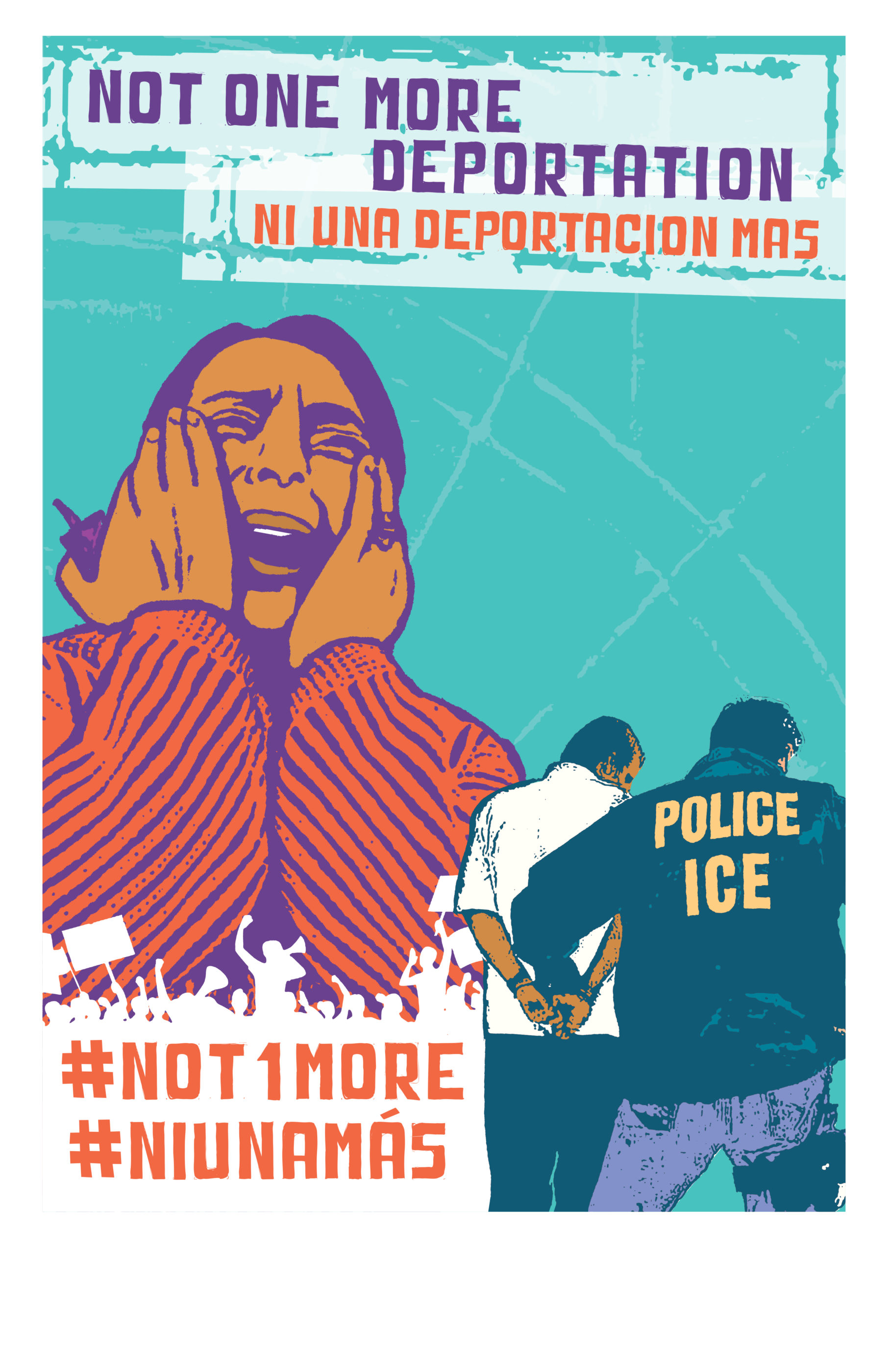 Last week, I noted that Rep. Hillary Scholten’s rhetoric on US immigration policy was different than her voting record. One clear example earlier this month is when Rep. Scholten voted with the Republicans to pass the Laken Riley Act, which is an awful policy that will further criminalize immigrants.
Rep. Scholten commented in her most recent weekly Email message with a comment about immigration:
As a nation, we have a right to enforce our borders and our immigration laws. HOW we do it matters. ICE is required to follow the law, and discrimination and racial profiling are still illegal. Here in West Michigan, we have seen the harmful and disastrous impact that reckless enforcement can have on our citizens and even our veterans. I’ve stood up to it before, and I’m prepared to do it again.
Note that Rep. Scholten leads with the emphasis on enforcement of US borders and laws, but says nothing about the Trump Administration’s threat to engage in mass deportation.
After voting for the awful Laken Riley Act, Rep. Scholten then votes for the Preventing Violence Against Women by Illegal Aliens Act, H.R. 30. Republicans were claiming that the Preventing Violence Against Women by Illegal Aliens Act would protect women and children. Republican Rep. Nancy Mace from South Carolina argued that the legislation was necessary to protect women and children from a “hoard” of undocumented immigrants sexually abusing “American” women and girls.
In response to H.R. 30, at least 200 organizations that fight against domestic violence have condemned the legislation and are saying that the Preventing Violence Against Women by Illegal Aliens Act will make it easier to deport survivors who get caught up in the criminal legal and child welfare systems as a result of the abuse they suffered.
In a recent article from the Intercepted, it states:
The bill would amend the Immigration and Nationality Act to broaden the definition of certain crimes related to sexual and domestic violence offenses, altering the standards for whether someone is “inadmissible” — ineligible for a visa or permanent status in the U.S. — or deportable. The bill imports a definition of domestic violence and other related offenses from the 2022 Reauthorization of the Violence Against Women Act that was intended to expand access to grant funding to help survivors, not to be used in the context of immigration enforcement. Survivors acting in self-defense, or who are falsely accused of one of these actions, may be deportable or inadmissible, regardless of whether they have been convicted of a crime.
Once again, Rep. Hillary Scholten has not only voted with Republicans, she has voted for legislation that will further criminalize immigrants. It is high time people come to terms with the fact that, Rep. Hillary Scholten has voted for two pieces of legislation over the past few weeks that will assist the Trump Administration in their campaign to engage in mass deportation. Rep. Scholten is NOT an ally in the fight for immigration justice.
Palestine Solidarity Information, Analysis, Local Actions and Events for the week of January 26th
 It has been more than 15 months since the Israeli government began their most recent assault on Gaza and the West Bank. The retaliation for the October 7, 2023 Hamas attack in Israel, has escalated to what the international community has called genocide, therefore, GRIID will be providing weekly links to information and analysis that we think can better inform us of what is happening, along with the role that the US government is playing. We will also provide information on local events and actions that people can get involved in. All of this information is to provide people with the capacity of what Noam Chomsky refers to as, intellectual self-defense.
Information
Israel Invades Jenin Days After Signing Gaza “Ceasefire”
Bad Deal Better Than No Deal: Ex-Israeli Negotiator Fears Netanyahu Could Resume Attacks
The Fight for Dignity: Reshaping Gaza’s Post-War Narrative
Gaza Ceasefire at Last: How Israel’s ‘First Defeat’ Will Shape the Country’s Future
Why the West is wrong about Hamas
The Israeli Military Is One of Microsoft’s Top AI Customers, Leaked Documents Reveal
Contrasting Reality: Treatment of Israeli and Palestinian Prisoners
Nearly 40,000 Palestinian Children Orphaned by War in Gaza
Analysis & History
The Systematic Destruction of Gaza’s Healthcare System: A Pattern of Genocide
EXCLUSIVE: Hamas Intends to Uphold Agreement, Senior Official Tells Drop Site in 30-Minute Interview
 Grand Rapids Institute for Information Democracy