The Grand Rapids Press Editorial Board’s Position on Haiti and Other “Unwelcome Distractions”
 It seems there is a possibility someone on the Grand Rapids Press’ Editorial Board read this writer’s recent article on the mainstream media’s terrible coverage of recent events in Haiti, and mistook the list of criticisms for a how-to manual. This writer is well aware the obvious middle-school come back to this is “Don’t flatter yourself, Joe.” The obvious response is “I guess it is asking a lot of a newspaper to research an editorial before they publish it when ads don’t sell themselves.”
If the few responses on MLive’s message board are at all indicative of the level of real information the Press is able to convey to its readers, it is clear the editorial piece published on January 26, titled “What we need to do to help Haiti recover” is just the latest in a legacy of misrepresenting the situation in Haiti; this type of misrepresentation contributes to a media chorus supporting American apathy and ambivalence to tragedies in places lake Haiti that range from desecration of democracy to economic degradation to a degree that forces terrifying habits like diets dedicated to geophagy.
Before earthquakes or hurricanes even enter the picture, Haiti and discussions concerning it all have real and potentially terrifying consequences for the Haitian people. Answering questions about Haiti’s economy can effect how many Haitians starve to death while eating cakes of dirt to not feel their insides eating themselves. Talking about who is allowed in the country’s borders and what parties are allowed to run in elections ultimately will determine whether or not the world’s first successful nation-wide slave revolution has been reversed.
With so much at stake it is disconcerting to see Mlive.com’s commenters posting things like :
“They” the Haitians need to learn to help theirselves and quit begging like dogs for a handout…that doesn’t do anything but go to a bunch of corrupt mobsters running things in that country. “
and:
“Personally, I would withhold all aid until Haiti changes its constitution to aid a resolute protection of private property rights. With a strong protection of private property, Haiti will eventually climb out of its poverty and be able to fund hospitals and culturally-specific schools all on its own.”

The Grand Rapids Press is not solely responsible for either the ignorance or the borderline to blatant racism displayed by the people that comment on MLive’s forums, but the tragedy lies in the realization that these opinions are not far from the narrative the mainstream media has been spinning since Baby Doc’s return brought Haiti back into the news cycle’s spotlight. The easy story for the media to perpetuate is all Haitian Presidents are kleptocrats, that all aid to Haiti is tossed into a furnace of corruption, and that the free market and privatization can save the country. The problem is not all Haitian Presidents are created equal, neither is all aid, and parceling up the land and selling it off only results in foreign corporations owning all of the land and expropriating all of Haiti’s goods and resources at the expense of the already poor Haitian people.
Upon Jean-Claude Duvalier’s return to Haiti less than two weeks ago, this writer analyzed some of the initial media coverage available concerning this event. While that article is linked here, the quick version is the media has made some crucial mistakes in its overall coverage of Baby Doc’s return. The Media treats Haiti like it did not exist before the Earthquake. The Grand Rapids Press demonstrates this in the most cliché way imaginable in the first line of their editorial: “A year after a massive 7.0 earthquake, pain, suffering and death remain realities for Haitian children and families.“
As a corollary to the media’s story of Haiti’s non-existence prior to last year, Baby Doc’s history as a promoter of torture, rape, murder, drug running, intimidation, thuggery, and stealing from aid marked for the poor gets glossed over as he is simply referred to as a “dictator” or “ex-president.” If his crimes are at all mentioned, they are in terms of him stealing money from aid funded by U.S. and European interests, or delivering drugs that harmed American streets. The G.R. Press calls Duvalier a “dictator” and an “unwelcome distraction.” Calling the return to Haiti of a man who ordered the Ton-ton Macoute to execute hundreds if not thousands an “unwelcome distraction” is an unwelcome moral disgrace. Glossing over the crimes he committed is an attempt to avoid uncomfortable questions concerning the support given to him and his father by the Nixon and Reagan Administrations under the guise of combating global communism.
The other corollary is former Haitian President Jean-Bertrand Aristide gets either ignored, or grouped with Jean-Claude Duvalier and rapidly dismissed. The G.R. Press does the latter and calls Aristide’s potential return an “unwelcome distraction” as well. This helps the Press ignore over a decade of U.S. meddling in Haiti that at every point championed the interest of corporations and global Capitalism at the expense of real democracy and the lives of the poorest citizens of one of the poorest countries in the world. Baby Doc is not Aristide. Aristide is widely popular among almost all Haitians, and was democratically elected in fair elections multiple times, yet the U.S. is blocking his return to Haiti, while giving the murderer, Duvalier, a wink and a nod. This writer can not determine which is worse, the fact that the G.R. Press used the phrase “unwelcome distraction” as a euphemism for “rape, murder, drug running, and torture,” or the fact that the Press grouped a democratically elected liberation theologian with that torturing, drug running, murderer.

When the editorial board declares: “The (Haitian) people deserve a legitimate, effective government to ensure a better future.” immediately after blowing off any chance at Aristide’s return, they are ignoring events that happened less then a decade ago, like the 2004 removal of Aristide from the Presidency at gunpoint by U.S. agents authorized by the Bush Administration. (See Getting Haiti Right This Time: The U.S. and the Coup) This writer can think of no reason why the Editorial Board of the Grand Rapids Press would find it necessary to comment on a situation in a foreign country like Haiti, but lack the will to follow through with a total reporting of the facts.
Yes, it goes against the mainstream media narrative to say a Haitian leader like Aristide was actually a force that promoted wonderful things like democracy, and the U.S. hasn’t always been the best help to the people of Haiti in terms of their human rights and economic well-being. But, the job of an independent press, especially in an editorial situation where more leeway is given to express an individual (and, ideally, well-informed) opinion, is not to continually go over the same knots on the counting rope. Those who get their news from independent media have no problem getting access to knowledge like the enormous differences between Baby Doc and Aristide. Why does the Press’ Editorial Board refuse to present those easily obtainable facts to its readers?
New Media We Recommend
Below is a list of new materials that we have read/watched in recent weeks. The comments are not a “review” of the material, instead sort of an endorsement of ideas and investigations that can provide solid analysis and even inspiration in the struggle for change. All these books are available at The Bloom Collective, so check them out and stimulate your mind.

All Labor Has Dignity: Martin Luther King Jr., edited by Michael Honey – This book is a collection of speeches that Dr. King gave over the years that focuses on economics and labor issues. Many of them are being made available to the public for the first time. The editor does an excellent job of providing some context to each of the speeches, many of which gave before labor groups and working class people fighting for economic justice. The speeches are divided into three themes: the importance of a labor/civil rights alliance, challenging the racism within the labor movement and the Poor People’s Campaign. The book even includes a CD with audio recordings of Dr. King’s speeches. All Labor Has Dignity is an important contribution to reclaim the radical Dr. King.

Mountain Justice: Homegrown Resistance to Mountaintop Removal for the Future of Us All, by Tricia Shapiro – Beyond the information about the ecological and human health consequences of mountaintop removal, this book provides readers with stories an solid documentation about the campaigns being wage against this environmental catastrophe. People who read this book will no doubt be inspired by the actions of people from the Appalachians and those who have come to stand with the locals to fight against one of the most insidious forms of corporate plunder in recent decades within the US. Must reading for anyone who thinks that direct action is ineffective.
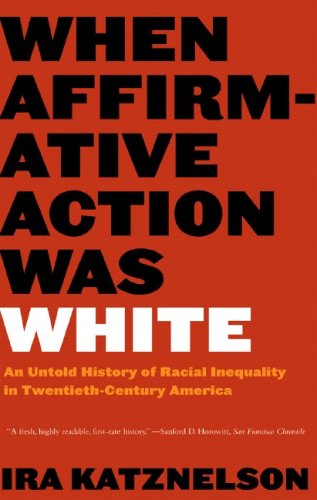
When Affirmative Action Was White: An Untold History of Racial Inequality in Twentieth-Century America, by Ira Katznelson – When people hear the phrase affirmative action they often associate it with policies put in place in the 1960’s that were designed to provide greater opportunities for women and people of color. However, as the author of When Affirmative Action Was White so eloquently documents, the federal government in the US didn’t start affirmative actions in the 60’s, they began in the 1930’s. Katznelson argues that many of the New Deal policies and particularly the GI Bill were designed to provide greater benefits to Whites, while often excluding racial minorities. An important contribution into the history of institutional racism in the US.
Scarred Justice: The Orangeburg Massacre 1968 (DVD) brings to light one of the bloodiest tragedies of the Civil Rights era after four decades of deliberate denial. The killing of four white students at Kent State University in 1970 left an indelible stain on our national consciousness. But most Americans know nothing of the three black students killed at South Carolina State College in Orangeburg two years earlier. This scrupulously researched documentary finally offers the definitive account of that tragic incident and reveals the environment that allowed it to be buried for so long. It raises disturbing questions about how our country acknowledges its tortured racial past in order to make sense of its challenging present.
Media Bites – How Children Influence Adult Spending

In this week’s Media Bites we look at a series of ads, which are part of a campaign for the Toyota Highlander. The campaign uses child actor Riley Thomas Stewart to sell the company’s new line of SUV’s.
This ad campaign uses a child to pressure parents to purchase products based on what is cool. According to the documentary Consuming Kids, children under the age of 12 influence adult spending to the tune of $700 billion a year and this campaign is just one example of how influential children can be in adult consumer spending.
Newsweek and Grand Rapids: Who get’s asked the question?
First, I want to say that I am not a fan of Newsweek Magazine. Newsweek is fundamentally an elite publication that acts as an apologist for the US government and for the economic elites in this country.

Their story about the Top 10 Dying Cities in the US is not an exercise in journalism, rather it is a statistical play on words. Using census figures to make determinations about the quality of a city can be useful, but it is most certainly incomplete.
Having said that I find it interesting how people have responded to the Newsweek story and what evidence they use to refute the idea that Grand Rapids is a dying city.
Grand Rapids Press Business reporter Julia Bauer responded on January 21st to the claims of Newsweek by listing “evidence” at the bottom of her article showing that Grand Rapids was alive and well. The list included – DeVos Children’s hospital, Laughfest, ArtPrize, ticket sales at Van Andel arena, museum ticket sales and Meijer Gardens.
On Monday, the GR Press ran a follow up story where they sought responses from people in Grand Rapids who disagree with Newsweek’s assessment. The story cited GR Community Foundation President Diana Sieger, the creation of Facebook pages challenging the magazine’s claim and a video interview from WZZM with a local hotel manager.
The Monday Press story was accompanied by a photo gallery providing more evidence that Grand Rapids is thriving. The photos were all of downtown Grand Rapids except for a picture of the Meijer Gardens and the re-developed Kent County Airport.
Yesterday, the Press ran another story based on a letter that Mayor George Heartwell send to Newsweek, which was read at the Tuesday morning City Commission meeting. In his letter Heartwell cites as evidence that the city is alive and well items such as ArtPrize, the new JW Marriot hotel, the 92 downtown bars & restaurants, Van Andel arena events and all the LEED certified buildings in the area.
While all of this response certainly speaks to new development projects, entertainment opportunities, the “medical mile” and restaurant options it is interesting that virtually all of the responses deal with downtown Grand Rapids and not GR neighborhoods.
However, a more important point that I think is worth making here is who gets asked to respond to the claims made by Newsweek? The people who are cited in the Press articles are people who are privileged, both in terms of money and status. We hear from the Mayor, the JW Marriot manager and the President of the GR Community Foundation.
In contrast, what sort of reaction would one get if the Press had sought out the voices of people who live in the Black Hills neighborhood of Grand Rapids or the Senior Citizens housing center on Division and Delaware? What would happen if working class families and individuals who work two jobs to make ends meet or people who are facing home foreclosure were asked what they thought about the Newsweek article? How about the people standing in line at the unemployment offices or those who use the services of the soup kitchen?
The question is not so much is Grand Rapids a dying or thriving city, rather who is thriving and who is being left behind?
“We need to stop this culture before it kills the planet” – A conversation with Derrick Jensen
(This interview between Mickey Z. and Derrick Jensen is re-posted from Dissident Voice.)
As you begin reading this interview, take a look at the nearest clock. Now, dig this: Since yesterday at the same exact time, 200,000 acres of rainforest have been destroyed, over 100 plant and animal species have gone extinct, 13 million tons of toxic chemicals were released across the globe, and 29,158 children under the age of five died from preventable causes.

Worst of all, there’s nothing unique about the past 24 hours. It’s business as usual, a daily reality—and no amount of CFL bulbs, recycled toilet paper, or Sierra Club donations will change it even a tiny bit.
As you do your best to convince yourself of the vast chasm between the two wings of America’s single corporate party, I suggest you listen carefully to hear if even one of the politicians mentions any of the following:
Every square mile of ocean hosts 46,000 pieces of floating plastic
Eighty-one tons of mercury is emitted into the atmosphere each year as a result of electric power generation
Every second, 10,000 gallons of gasoline are burned in the US
Each year, Americans use 2.2 billion pounds of pesticides
Ninety percent of the large fish in the ocean and 80 percent of the world’s forests are gone
Every two seconds, a human being starves to death
This is just a minute sampling, folks, and sorry, but your hybrid ain’t helping. That reusable shopping bag you bring to the market has zero impact. Your home composting kit is not gonna start a revolution.
In fact, even if every single person in the US made every single change suggested in the movie An Inconvenient Truth, carbon emissions would fall by only 21%—in contrast to the 75% emissions decrease that scientific consensus believes must happen…now.
None of this, of course, is news to Derrick Jensen. He is the author of essential works such as A Language Older Than Words and Endgame. His worldview has nothing to do with party politics, incremental reform, leftist in-fighting, corporate compromise, or anything that seeks to tweak but ultimately maintain the ongoing global crime we call civilization.
“My loyalty,” he told me, “is with the nonhuman and human victims (or targets) of this culture, and my work is toward stopping this culture’s assaults on nonhumans, on the land, on the planet itself, on women, on indigenous peoples, on the poor.”
If you’ve grown weary (and wary) of the entrenched Left and all the words left unspoken, you owe it yourself to read the rest of our conversation below. Afterwards, you just might start realizing that you also owe to the planet to get busy.
Our exchange took place during the week of January 17 and went a little something like this…
Mickey Z.: We’re starting this conversation as another MLK Day is observed. Not much of a chance that we’ll hear this Dr. King quote—”The question is not whether we will be extremists, but what kind of extremists we will be”—mentioned much by the corporate media, huh?
Derrick Jensen: Just today I read an article stating that, no surprise, industrial-induced global warming will be far worse than estimated, and if carbon emissions continue as expected, could render much of the planet uninhabitable within 100 years. Even now, 150-200 species are driven extinct every day. This culture extirpates indigenous peoples. The oceans are being murdered. And today I saw a study of rates of fire retardant in every fetus. And on and on. And yet those of us who are working to stop this planetary murder are sometimes characterized as extremists.
I think the real extremists are the people who value capitalism over life, the people who value civilization over life. I cannot think of any more extreme position than valuing this insane culture over life.
MZ: Not surprisingly, another major African-American figure from the 1960s—Malcolm X—had some positive words for extremism in the name of toppling that insane culture. Using Hamlet as a springboard, Malcolm wrote:
Hamlet) was in doubt about something—whether it was nobler in the mind of man to suffer the slings and arrows of outrageous fortune—moderation—or to take up arms against a sea of troubles and by opposing end them. And I go for that. If you take up arms, you’ll end it, but if you sit around and wait for the one who’s in power to make up his mind that he should end it, you’ll be waiting a long time. And in my opinion, the young generation of whites, blacks, browns, whatever else there is, you’re living at a time of extremism, a time of revolution, a time when there’s got to be a change. People in power have misused it and now there has to be a change and a better world has to be built and the only way it’s going to be built with—is with extreme methods. And I, for one, will join in with anyone—I don’t care what color you are—as long as you want to change this miserable condition that exists on this earth.
DJ: I think the key has to do with wanting to change this miserable condition.
I try to be fairly inclusive of the people I would work with, but I’ve realized over the past many years that I’m not working toward the same goals as many of the environmentalists who are explicitly working to save capitalism or to save civilization, rather than the real world. In talks and interviews I often ask what all of the so-called solutions to global warming or the murder of the oceans, or biodiversity crash, etc, all have in common. And what they all have in common is that they all take industrial capitalism as a given, and the natural world as that which must conform to industrial capitalism. That is literally insane, in terms of being out of touch with physical reality. I mean, look at Lester Brown’s Plan B 4.0 to Save Civilization. What does he want to save? Could he be any more explicit? He wants to save civilization. But civilization is killing the planet. It’s like writing a book about how to save a serial killer who is murdering so many people he’s running out of victims. We see this attitude all the time. When people, for example, ask how we can stop global warming, they’re not asking how we can stop global warming; they’re asking how we can stop global warming without changing the physical conditions (burning oil and gas, deforestation, industrial agriculture, and so on) that lead to global warming. And the answer to that question is that you can’t. Likewise, when they ask how we can save salmon, they aren’t really asking how we can save salmon, they’re asking how we can save salmon without removing dams, stopping industrial logging, stopping industrial agriculture, stopping industrial fishing, stopping the murder of the oceans, stopping global warming, and so on.
A question I keep asking is: with whom (or what) do you identify? Where is your loyalty? Whom, or what do you want to save? And if what you really want to save is this “miserable condition”—capitalism, civilization, what have you—at the expense of the planet, then we’re not really working toward the same goal, are we? My loyalty is with the nonhuman and human victims (or targets) of this culture, and my work is toward stopping this culture’s assaults on nonhumans, on the land, on the planet itself, on women, on indigenous peoples, on the poor.
MZ: It’s a testament to the power of propaganda how even well-meaning folks will choose the options—both public and private—that work against their own interests. Gay rights activists are currently applauding the alleged repeal of “don’t ask, don’t tell.” In the name of promoting diversity and inclusion, they are celebrating the ability to volunteer for an institution that exists to violently crush all diversity and inclusion.
The conditioning is so interwoven throughout every aspect of our culture that even respected Leftist thinkers simply cannot comprehend your comment, “civilization is killing the planet” and resort to retorts about “misanthropy.”
So, the question must be asked, Derrick: Can these people be reached with the message that we can’t have industrial capitalism as a given without all the murderous side effects?
DJ: There’s a great line by Upton Sinclair about how it’s hard to make a man [sic] understand something when his [sic] job depends on him not understanding it. I think that’s true even more for entitlement. It’s hard to make someone understand something when their entitlement, their privilege, their comforts and elegancies, their perceived ability to control and manage, depends on it.
So much nature writing, social change theory, and environmental philosophy are at best irrelevant, and more often harmful in that they do not question human supremacism (or for that matter white supremacism, or male supremacism). They often do not question imperialism, including ecological imperialism. So often I feel like so many of them still want the goodies that come from imperialism (including ecological imperialism and sexual imperialism) far more than they want for these forms of imperialism to stop. And since the violence of imperialism is structural—inherent to the process—you can’t realistically expect imperialism to stop being violent just because you call it “green” or just because you wish with all your might.
Here’s another way to say this: as I say in Endgame, any way of life that requires the importation of resources will a) never be sustainable and b) always be based on violence, because a) requiring importation of resources means you are using more of that resource than the landbase can provide, which is by definition not sustainable (and as your city grows you’ll need an ever larger area to harm); and b) trade will never be sufficiently reliable, because if you require some resource (e.g., oil) and the people who live with or control that resource won’t trade you for it, you will take it, because you need it. It’s inherent. One of the many implications of this is that if you don’t question imperialism itself, the solutions you present will be absurd, and either irrelevant or harmful.
Here’s a story. A couple of weeks ago a tree fell down in a storm and knocked down an electric wire in this neighborhood. My neighbor told me about it, and when I saw the downed tree I looked and looked and looked for the stump, to see where the tree came from. I couldn’t find it. I’ve looked again every time I’ve gone by that place. Well, today I was walking and I saw where it came from. The top of a big tree had broken off. It was really obvious when I looked up instead of down. Point being (instant aphorism): You can search as thoroughly as is possible, but you’ll never find what you’re looking for if you’re looking in the wrong place.
This applies to everything from personal happiness to solutions to global warming.
But the problem is worse than mere entitlement. RD Laing came up with the three rules of a dysfunctional family:
Rule A is don’t.
Rule A.1 is Rule A does not exist
Rule A.2 is Never discuss the existence or nonexistence of Rules A, A.1, A.2
This is as true of dysfunctional cultures as dysfunctional families. So we cannot talk, for example, about the fact that this culture is only one way of living among many, that this way of living is based on conquest and the acquisition of power, that this way of life systematically destroys landbases, other cultures, and on and on. Systematically, functionally.
But it’s worse than this. In the 1960s a researcher attached electrodes to people’s eyeballs to track where they looked, and then showed them pictures. What the researcher found is that if the photo contained something that threatened the person’s worldview, the person’s eyes would not even track to it once: they would evidently see it out of the corners of their eyes, and know where not to look. So far too often you can make the point as reasonably as you can, and the person will have no idea what you are talking about.
MZ: Considering the glacial rate by which most humans – myself very much included – recognize and address destructive or self-destructive patterns in their personal life, it’s difficult to imagine a lot more humans allowing their eyeballs to focus in on global crises and their obscured causes. High Noon is approaching and it seems most of us don’t even know how to tell time.
Speaking of High Noon, I recently watched the classic 1952 film and found myself focused on the moment when Amy (Grace Kelly), the pacifist wife of Marshal Kane (Gary Cooper), shoots and kills a man to save her husband’s life. Earlier in the film, Amy had declared: “My father and my brother were killed by guns. They were on the right side but that didn’t help them any when the shooting started. My brother was nineteen. I watched him die. That’s when I became a Quaker. I don’t care who’s right or who’s wrong. There’s got to be some better way for people to live.”
However, she not only ends up shooting a man, she also fights off the main villain, which allows Marshal Kane to finish him. Now, before some readers run and tell Gandhi on me, what I’m proposing as the lesson is that when faced with the clarity a crisis can sometimes inspire, we can recognize that those clock hands are inching towards noon and surprise ourselves (as Grace Kelly’s character did) with our ability to take things to a new level.
If not, what chance do we (the animals, the trees, the eco-system, etc.) have?
DJ: Very little chance. Even if people don’t care about nonhumans, recent estimates are that billions, literally billions, of humans will die in what is beginning to be called a climate holocaust. This is if the temperature rises 4 degree Celsius.
And the most recent estimates are revealing that global warming is far worse than previously believed (have you ever noticed how the previous estimates were always low?), and could go up 16 degrees C within 90 years, rendering much of the planet uninhabitable (“Science stunner: On our current emissions path, CO2 levels in 2100 will hit levels last seen when the Earth was 29°F (16°C) hotter—Paleoclimate data suggests CO2 ‘may have at least twice the effect on global temperatures than currently projected by computer models’”). This means that there are young people now who will die in this climate holocaust. And there are too many people who prefer this wretched, destructive way of life over life on the planet, and literally over their own children. We need to stop this culture before it kills the planet.
MZ: Although I feel there’s way too much hand-holding in the realm of activism and far too many progressives sitting idle as they wait for a leader to give them direction, I must ask you this: What types of immediate direct action might you suggest to those reading this interview, in the name of stopping this culture before it kills the planet?
DJ: I think the important thing is that they start doing some form of activism. I can’t tell people what to do, because I don’t know what is important to them and I don’t know what their gifts are. But the important thing is that they start. Now. Today.
So how do you start? The problems are so huge! Well, the way I started as an activist was the result of the smartest thing I ever did. When I was in my mid-20s I realized I wasn’t paying enough for gasoline (in terms of including any of the ecological costs, etc), so for every dollar I spent on gas I would donate a dollar to an environmental organization (never a national or international organization, but rather local grassroots organizations), but since I didn’t have any money I would instead pay myself $5/hour to do activist work, whether it is writing letters to the editor or participating in demonstrations. My first demos were anti-fur demos and anti-circus demos. And don’t let your perceived ignorance stop you: I had no idea what exactly was wrong with circuses, but I knew they were exploitative of nonhuman animals and so I showed up, and other people handed me signs. If anyone asked me, What’s wrong with circuses? I just pointed them to the person standing next to me. I went from there to other forms of activism, including filing timber sale appeals, and so on. The point is that I started. At the time it cost $10 to fill my tank with gas, and if I filled it once a week, that meant two hours per week. And I started having so much fun with the activism that I stopped keeping track of how many hours I was doing activism, and just did it. But the important thing is that I got off my butt and started doing something.
It’s also important that when people do activism, that it not simply be personal stuff: environmentalism especially has gone down the dead end of lifestylism, where people think that changing their own life is sufficient. Just today I read an article that said, about water, “First of all, turn off the water when you don’t need it. It’s that simple. I don’t want to sound too preachy, but, according to UNICEF and the World Health Organization, lack of access to clean drinking water kills about 4,500 children per day. The water won’t magically travel from our taps to someone in need, but creating a mind-set of conservation will certainly help. There is absolutely no purpose served by letting water you are not using run down the drain.” This is just absurd. Yes, lack of access to clean water kills 4500 children per day, but it’s not because of my own water usage. 90 percent of the water used by humans is used by agriculture and industry. So all these environmental pleas for simple living are tremendous misdirection: these children (and what about the salmon children, and the sturgeon children, and so on) aren’t dying because I brushed my teeth: they’re dying because agriculture and industry are stealing the water. Just yesterday I read that Turkey is sacrificing all nature reserves to put in dams. This is not so people can have showers. It’s for agriculture and industry.
I live pretty simply, but that’s because I’m a cheapskate. I turn off the water while I brush my teeth, too. Big fucking deal. That is not a political act. There are no personal solutions to social problems. None.
So when I say that people should do some activism, I mean do something good for your landbase. Stop destructive activities. Do rehabilitation. Or if your primary emergency is violence against women, then do work against domestic violence, or against pornography, or against the trafficking in women. Get started.
Like Joe Hill said, “Don’t mourn, organize.”
MZ: I like to tell people that we live in the best time ever to be an activist. We’re on the brink of economic, social, and environmental collapse. What a time to be alive. We can take part in the most important work humans have ever undertaken. How lucky are we? In this era of “hope and change,” I say action is always better than hope. Or, as Rita Mae Brown said, “Never hope more than you work.”
DJ: Yes, I get so tired of people saying they hope salmon survive, or hope this or hope that. But what is hope? Hope is a longing for a future condition over which we have no agency. That’s how we use the word in every day language. I don’t say, “Gosh, I hope I put my shoes on before I go outside.” I just do it. On the other hand, the next time I get on a plane I hope it doesn’t crash. After I get on the plane I have no agency. Think of this: if a parent says to an eight-year-old child, “Please clean your room,” and the child says, “I hope it gets done,” we all know that’s ridiculous. I asked an eight-year-old what would happen if she said that to her parents, and she said, “Someone has to clean the room!”
That kid is smarter than a lot of environmentalists. It’s ridiculous to say we hope global warming doesn’t kill the planet when we can stop the oil economy that is causing global warming. I’m not interested in hope. I’m interested in agency, and I’m interested in people no longer waiting for some miracle to solve their problems. We need to do what is necessary.
MZ: When you first began writing and speaking about civilization and the eventual collapse, did you ever truly imagine that you’d be around to see things as bad as they are right now?
DJ: No. And even though I wrote in The Culture of Make Believe about the ways in which economic collapse can lead to more and more over brownshirt-ism and fascism, I’m still kind of stunned at the way it is happening here. But more to the point, even though I’ve written something on the order of fifteen books about this culture’s insanity, I still cannot believe this isn’t all a bad dream, with this frenzied maintenance of this culture as the world is murdered. I keep wanting to wake up, but each time I awaken this culture is still killing the planet, and not many people care.
MZ: I’m sure you can’t even calculate how many times you’ve been interviewed but I’m wondering if there’s a question you always wished you’d been asked but so far, no one has done so. If so, by way of wrapping up, please feel free to ask and answer that question.
DJ: Four questions:
Q: You’ve said many times that you don’t believe that humans are particularly more sentient than other animals. Where do you draw the line?
A: I don’t draw the line at all. I don’t see any reason to believe anything other than that the universe is full of a wild symphony of wildly different voices, wildly different intelligences. Humans have human intelligence, which is no greater nor less than octopi intelligence, which is no greater nor less than redwood intelligence, which is no greater nor less than flu virus intelligence, which is no greater nor less than granite intelligence, which is no greater nor less than river intelligence, and so on.
Q: How did the world get to be such a beautiful and wonderful and fecund place in the first place?
A: By everyone making the world a more beautiful and wonderful and fecund place by living and dying. By plants and animals and fungi and viruses and bacteria and rocks and rivers and so on making the world a better place. Salmon makes forests better places because of their existence. The Mississippi River makes that region a better place because of its existence. Bison make the Great Plains a better place because of their existence.
Civilized humans do not make the world a better place because of their existence. They are collectively and individually making the world a less beautiful and wonderful and fecund place. How can you make the world a better place? What can you do to make the landbase where you live more healthy, more beautiful, more fecund? And why aren’t you doing it?
Q: What will it take for the planet to survive?
A: The eradication of industrial civilization. Industrial civilization is functionally, systematically incompatible with life.
The good news is that industrial civilization is in the process of collapsing.
The bad news is that it is taking down too much of the planet with it.
Q: So if industrial civilization is collapsing, why shouldn’t we just hunker down and make our lifeboats and protect our own, and basically take care of our own precious little asses?
A: I would contrast the narcissism and cowardice of this attitude with that expressed by Henning von Tresckow, one of the members of the German resistance to Hitler in World War II. When the Allies invaded France in 1944, anybody paying any attention at all knew that the Nazis were going to lose: it was just a matter of time. So some members of the resistance suggested that they stop working to take down the Nazis, and instead just protect themselves until the war was over, basically hunker down and make their lifeboats and protect their own. Henning von Tresckow responded that every day the Nazis were killing 16,000 innocent civilians, so basically every day sooner they could bring down the Nazis would save 16,000 innocent civilians.
There is more courage and wisdom and integrity in that statement than in all the statements of all the craven lifeboatists put together.
Between 150 and 200 species went extinct today. They were my brothers and sisters. It is not sufficient to merely hunker down and wait for the horrors to stop. Salmon won’t survive that long. Sturgeon won’t survive that long. Delta smelt won’t survive that long.
Here’s another way to say all this. I would contrast the narcissism and cowardice of the lifeboatists with the attitude expressed by my dear friend, and the person who really got me started in environmentalism, John Osborn. He has devoted his life to saving as much of the wild as he can, through organized political resistance. When asked why he does this work, he always says, “We cannot predict the future. But as things become increasingly chaotic, I want to make sure that some doors remain open.” What he means by that is that if grizzly bears are around in 30 years they may be around in fifty. If they are gone in 30 they are gone forever. If he can keep this or that valley of old growth standing, it may be standing in 50 years. If it’s gone now, it will be gone for a long, long time, maybe forever.
As you said, Mickey Z, we are living at a time when we have perhaps more leverage than at many previous times. Any destructive activity we can halt now may protect that area until the collapse: people couldn’t realistically say that in the 1920s. I believe it was David Brower who said that every environmental victory was temporary while every loss was permanent. I think we are quickly reaching the point where every victory can be permanent.
One final thing: the single most effective recruiting tool for the French Resistance in WWII was D-Day, because the French realized once and for all that the Germans weren’t invincible. Knowing that this culture is collapsing should not lead us into narcissism and cowardice, but should give us courage, and should lead us to defend the victims of this culture.
The Future of Capitalism debated at GVSU
Last night an estimated 250 people came to hear a debate on the Future of Capitalism on the downtown campus of GVSU. The Seidman Business Ethics Center hosted the event, which featured four panelists, two defending Capitalism and two critiquing Capitalism.

Each panelist was given eight minutes to present their argument and then each of the four were allowed to respond to comments from other panelists, before the audience was invited to comment.
Professor Nathan Goetting, editor of the National Lawyers Guild Review, was the first to speak. Goetting began by saying that free market Capitalism has never really been tried, at least not the theoretical version that is taught in business schools. Instead, Goetting pointed out, Capitalists want a strong state to intervene to protect their interests both at home and abroad. Such is the nature of all market economies, which always seek to get even richer.
Goetting mentions Wal-Mart as an example and the 2008/2009 Wall Street bailout as prime examples of how Capitalism needs the state in order to function. This state intervention comes in the form of subsidies, tax-breaks, taxpayer bailouts, deregulation and sometimes police/military intervention to protect capital interests. This led the first panelist to claim that what we have would more accurately be called mega-corporatism.
Goetting concluded his comments by saying that Liberty and Democracy should be virtues that are central to the workplace and our economy, but these are elements that Capitalism does not want or foster.
The next panelist was Mr. Craig Meurlin, a lawyer with Warner, Norcross & Judd, and former Amway VP and General Counsel from 1993 – 2000. Meurlin argued that the free market has brought many in China out of poverty, a country he has spent a great deal of time in both while he was with Amway and because of current business clients he represents. Meurlin never provided any evidence to support his claim about Chinese people being pulled out of poverty because of Capitalism.
Meurlin then acknowledged the shortcomings of Capitalism, but still thinks that it is a “successful system.” He then spent a great deal of time focusing on the role of the government and stating that the state is just as much to blame, if not more so, for the economic crisis we are currently facing. Meurlin suggested the government should make more laws that creates boundaries for the free market system, but he never articulated what those boundaries might look like. He also acknowledged mentions that corporate monopolies are problematic and identifies Proctor & Gamble as an example, which it should be mentioned has been a company that Amway has been fighting for years over claims that the P&G logo promotes Satanism.
Meurlin also blamed the US government for the Wall Street financial crisis. He criticized both the General Motors and Chrysler bailouts and bad government intervention. Then Meurlin made what seemed like a contradictory comment to this writer. He said, “When markets are too free they will destroy everything around them.”

The third speaker was Professor Bruce Bettinghaus, who teaches at GVSU. Bettinghaus not sure if he was for or against Capitalism and referred to Wikipedia as a source for defining what Capitalism is. He said that Pure Capitalism is narco-capitalism, where anything goes. Bettinghaus referred to the Lord of the Flies as a literary reference to make his point. The other end of the spectrum is state control, according to the GVSU professor. Here Bettinghaus cites Marx and Animal Farm to illustrate the problem of state control. “What we have is something more in the middle,” said Bettinghaus.
Bettinghaus offered up a solution for regulation by saying that what banks needed to due was to change the capital to assets ratio, particularly for the larger banks. He thinks that the bankers are “crazy” and agrees that we have a system of corporatism and the corruption exists because they (the bankers) are the biggest contributors to Congress.
The last panelist was Tony Nelson, a GVSU graduate who works in Chicago with the Mexico Solidarity Network. Nelson took the conversation in a whole different direction by looking at real scenarios as well as the human consequences of Capitalism.
Nelson said what if you had a local businessman who made Pokeman dolls, but sets up factories in Mexico. The company makes a great deal of money, but the money comes back to West Michigan and benefits this community, not the one in Mexico where the factory is. This businessman is considered a positive influence in the community. In contrast there are farm workers (some with, some without documentation) who work picking crops in the US making very little money. They send some of their earnings back to Mexico, which can help family members survive. This migrant worker is often reviled and viewed as a burden on US society.
Nelson said he came to Capitalism based on his experience in Mexico, where people are asking us in the US to think about how our policies negatively impact them. “Capitalism is inherently flawed,” said Nelson, “and is primarily driven by profit and growth.”
The panelist went on to say that development and trade policies are decided on behind closed doors, where the public has no say. He mentions NAFTA, CAFTA, and Plan Puebla Panama as example of undemocratic policies that have been devastating for the working poor and indigenous communities in Mexico and Central America. Nelson cited the Chapter 11 provisions of NAFTA, which allows corporations to sue governments if local communities object to a factory or a mine that will pollute their communities. “These are aspects of Capitalism that most of us will not see,” said Nelson. “We don’t know the trail of production that millions are workers are subjected to.”
Nelson concluded his comments by say Capitalism is not sustainable. “They (the Capitalists) need workers to exploit and consumers who don’t care.”
Craig Meurlin was the first to respond after all four made their arguments. He agreed with the idea that what we have is mega-corporatism and this corrupts government. He even suggested that Congress should where NASCAR-like suits to display the logos of companies that make contributions to them.

However, Meurlin then posed the question, “If capitalism is flawed, what do you propose we replace it with?” Bettinghausen followed by saying that you need something that will motivate people, that will get them out of bed and that is what the free market does.
Goetting said that incentives don’t need to be selfish and people don’t need to be threatened to do good. He thinks people care about justice and caring for one another. The incentive can be communal. Nelson agreed with Goetting and said that there are other economics models that can work, but capitalism doesn’t allow for other models.
Betinghausen responded by saying that natural scarcity is what motivates us to do things. He then asked the question “Who owns NFL teams?” His point was that most of the NFL teams are owned by municipalities, which just isn’t the case. All NFL teams are owned by private individuals or corporations, except the Greenbay Packers, which are owned by the community. What the owners have been doing for years is getting municipalities to pick up much of the cost of building new stadiums with the threat of relocating if they don’t comply. (See Dave Zirin’s book Bad Sports)
Tony Nelson then responded to the question “what would you replace Capitalism with?” He said that communities should be allowed to create localized economies and that no economic system should be imposed on the whole world.
There wasn’t much time for Q&A and most of the people who asked questions made statements that suggested they were also critical of Capitalism, since most of the comments questions Meurlin and Bettinghaus.
As with most debates there simply wasn’t enough time to explore the topic. Another criticism of the forum was that all four panelists were White men, which contributed to the problem of how this topic is dealt with since women and people of color are disproportionately impacted by Capitalism in negative ways.
Radical Poetry Workshop at The Bloom Collective Saturday
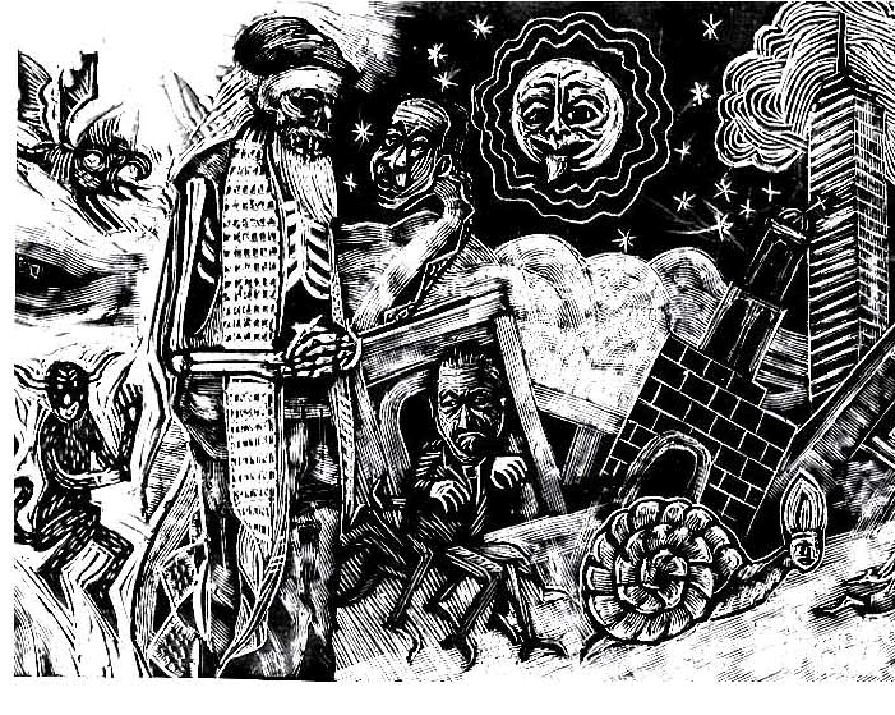 Radical Poetry Workshop
Sat. Jan 29 2-5 p.m.
T he Bloom Collective
671 Davis NW Grand Rapids
(Corner of 5th & Davis)
$3-$5 suggested donation
When members of The Bloom Collective began planning a Radical Poetry Workshop a few months ago, using a print depicting John Ross seemed like a logical choice for the event flyer. John passed away Jan. 17. Now, it seems only fitting that next Saturday’s event start off with video of him reading his works when he visited Grand Rapids in March 2010.
After the video presentation, The Bloom will share the works of other radical poets and lead a discussion about the importance of words to revolution. People who attend will be invited to share their own poems by reading them aloud, sharing copies or selling their poetry zines. The group might even do a little writing.
Folks who come are also invited to enjoy a potluck supper so bring a dish to pass. The Bloom will share vegan dishes. For information, visit thebloomcollective.org
(This article was submitted by Robby Fischer.)

The Muskegon County Jail has announced plans to implement a new policy that will limit inmates’ correspondence to standard-sized postcards. The policy, which is slated to go into effect February 7th, has already been adopted by jails in Ingham, Isabella, and Gratiot Counties, and is being considered for adoption in Oceana, Newaygo, and Allegan Counties.
The main reasons for the switch, as Muskegon Sheriff Dean Roesler explained to the Muskegon Chronicle, are to “cut down on staff time and allow them to concentrate on other duties, like supervising the inmates.” Roesler also claims that the new policy will “increase our security” by cutting down on contraband being mailed into the jail- specifically drugs and porn.
In another Chronicle article, Roesler claimed that he was “on solid ground” regarding the policy’s legality, on the grounds that other counties have already implemented the same postcard-only regulation. “There have been challenges raised, but none of them successful that I’m aware of,” Roesler said.
Sheriff Roelser, it would appear based on that statement, must be unaware of the recent class action lawsuit filed in Colorado Springs against the El Paso county jail, wherein that jail’s postcard-only policy was determined to be unconstitutional and was successfully reversed. The decision to reverse the practice came December 20th, 2010, after U.S. District Judge Wiley Daniel granted a preliminary injunction to the American Civil Liberties Union of Colorado. (View the Martinez vs. Maketa case).
It would behoove Sheriff Roesler to take this news into account, because the last I checked, a violation of the First Amendment rights in Michigan is just as unconstitutional as a violation of First Amendment rights in Colorado.
Luckily, Muskegonites are organizing against the policy. ‘Letters Are Better’ is a grass-roots effort that has planned a call-in day for this Thursday, January 27. On that day, anyone interested in objecting to the postcard-only policy should call Sheriff Roesler at 231.724.6236 and let him know… as frequently as possible. If you can’t get through to the Sheriff, call Mark Burns, the Jail Administrator, at 231.724.6289.
You may consider bringing up these talking points:

– Contrary to the Sheriff’s statement in the January 7th article in the Muskegon Chronicle, there have been successful challenges against the postcard-only policy. The Martinez vs. Maketa case in El Paso County, Colorado is the case in point.
– Denying inmates the right to enclose their messages limits freedom of expression. In the words of the ACLU in Colorado, “the postcard-only policy has forced prisoners to either abandon important correspondence or risk divulging highly confidential, sensitive information to anyone who will handle or see a postcard. As a result, gay prisoners have been chilled from expressing themselves when writing to their intimate partners. Prisoners with HIV or Hepatitis C have refrained from corresponding with family members about their medical conditions.”
– The argument has been made that eliminating the need have someone reading letters will “save the taxpayer’s dollars”… but in reality, that one small change will, at most, save taxpayer cents. If you cannot afford to run a jail responsibly, then you cannot afford to run a jail. Period. The proper course of action in that case is to shut it down… and that is an act that will save taxpayer dollars.
– Cases of contraband and witness intimidation are often cited as proof that letters must be done away with… but these instances say much more about the jail staff than they do about the mode of communication. If the staff had been doing their job correctly, those letters would have been intercepted.
– Rebecca Wallace, staff attorney with the ACLU of Colorado, put it nicely: “Beyond their clear constitutional violations, these policies are simply counter-productive. Letters clearly allow prisoners to maintain relationships with friends and family that will aid in their return to life after incarceration. If jail officials are serious about lowering recidivism and increasing public safety, they would do well to recognize that preserving prisoners’ rights to send letters actually protects us all.”
This unconstitutional postcard-only policy must be exposed and overturned now. If it is able to gain a foothold in West Michigan, it will set a terrifying precedent for the rest of the jails in the state.
If you would like to know more about this resistance effort, or other ways to get involved, email lettersarebetter@hotmail.com, or call 231-733-5370.

The local group Healing Children of Conflict has announced that they are hosting an event with Dr. Izzeldin Abuelaish, a Palestinian doctor who lost members of his family during the Israeli Assault on Gaza two years ago.
Dr. Abuelaish is on tour with his new book I Shall Not Hate, which recount’s his personal reflections and thoughts about the importance of non-violence and forgiveness in the midst of violence and hate.
Dr. Abuelaish was in Grand Rapids last March and GRIID was able to interview him about the death of his three daughters from Israeli bombing. He will be speaking and signing books on Thursday, February 3 at 7pm in the Schuler Books on 28th Street. This event is free and open to the public. For more information contact Healing Children of Conflict at info@healingchildrenofconflict.org.
John Muir: Nature’s Evangelist?
 Donald Worster presented the Jan. 19 January Series lecture entitled, John Muir and the Religion of Nature. Worster is professor of U.S. History at the University of Kansas and author of “A Passion for Nature: The Life of John Muir.”
Worster began with remarks about the photos of nature scenes he found on the walls of his room within Calvin College’s Prince Center. He used these as examples of how Muir’s Religion of Nature has crept into contemporary religion, even Calvinism. Even so, contemporary society, as a whole, fails to give Nature the attention our primordial connection to it would seem to require.
“Nature is usually avoided in polite academic society, avoided in political works, ignored in our business and economic work. It’s too old fashioned and has implications,” Worster said. “Why has nature fallen out of favor. . . To dismiss the movement to conserve and protect places like Yosemite is bad history. It misses just how subversive to hierarchy and tradition the love of natural beauty can be. The ideas of freedom, equality and brotherhood connected to a love of nature is rooted in a revolutionary vision of a non-hierarchical and egalitarian society.”
Worster then summarized John Muir’s life. Known as the “Father of American environmentalism” and founder of the Sierra Club, Muir was born in Scotland 1838 and immigrated to the Wisconsin frontier at age 11. A University of  Wisconsin dropout and conscientious objector, he set off on a solo, one thousand mile trek that took him to the Florida coast and then across the Ohio river. This walk across America set him on course as an advocate for nature and the wilderness. Muir’s advocacy is also credited as having been vital to the founding of national parks.
Worster’s brief biography did fail to mention bigoted statements about native peoples in Muir’s writings. Mark Davis Spense, in his book Dispossessing the Wilderness: Indian Removal and the Making of the National Parks, notes that “The Sierra Miwok that Muir encountered in the Yosemite high country, for instance, seemed ‘dirty,’ ‘deadly,’ and lazy.’“ Muir wrote, “They had no right place in the landscape.”
Philosophically, Muir rebelled against the Judeo-Christian human-centric view of the world, the idea that the Earth was created for man. Worster offered this quote describing the Judeo-Christian God from Muir’s book, Man’s Place in the Universe. “He is regarded as a civilized, law-abiding gentlemen in favor either of a republican form of government or of a limited monarchy; believes in the literature and language of England; is a warm supporter of the English constitution and Sunday schools and missionary societies; and is as purely a manufactured article as any puppet at a half- penny theater.”
Muir’s Religion of Nature was an inherent rebellion against class inequalities, hierarchy and empire, borne of his loathing for England’s upper classes.
“Muir found his god in nature, especially in the Sierra Nevada Mountains,” Worster said. His was a “duo-theism with God and Mother Nature as co-equal deities of the world, God and Nature, two artists working in harmony and gender equality.”
Worster offered this quote from Muir’s journals: “The whole wilderness seems to be alive and familiar, full of humanity. The very stones seem talkative, sympathetic, brotherly. No wonder when we think that we all have the same Father and Mother.”
This description of Muir’s spiritual connection with nature, which could be defined as being closer to animism than theism, brings to mind the contemporary works of Derrick Jensen, especially A Language Older than Words. Jensen shares how all of Nature, the animals, plants, rocks and trees speak a language older than words, a language that we today no longer hear or comprehend. This was no doubt the same language Muir heard on his travels through the wilderness of America, an America that had not yet seen the environmental destruction we see today.
 Jensen writes, “I looked closely, and saw one blade of wild grass, and another. I saw the sun reflecting bright off the needles of pine trees, and I heard the hum of flies. I saw ants walking single file through the dust, and a spider crawling toward the corner of the ceiling. I knew in that moment, as I’ve known ever since, that it is no longer possible to be lonely, that every creature on earth is pulling in the direction of life–every grasshopper, every struggling salmon, every unhatched chick, every cell of every blue whale–and it is only our own fear that sets us apart. All humans, too, are struggling to be sane, struggling to live in harmony with our surroundings, but it’s really hard to let go. And so we lie, destroy, rape, murder, experiment, and extirpate, all to control this wildly uncontrollable symphony, and failing that, to destroy it.”
Before closing, Worster admitted that John Muir did not remain loyal to his own ideals in later life. After coming into quite a bit of money, he settled comfortably into upper class, capitalist America. Jeffrey St. Clair confirms this in his book Been Brown So Long It Looked Like Green to Me: The Politics of Nature, “In 1899, railroad tycoon Edward Harriman put together an expedition of naturalists, scientists, painters and fellow robber barons to explore the coast of southeast Alaska. The shrewd head of the Union Pacific even rented the services of John Muir, the father of environmentalism and founder of the Sierra Club, thus striking a bond between corporate villains and mainstream greens that thrives to this day.”
Worster concluded, “When such success comes to people, they change their companions and change their views as well . . . despite changes in his bank account, he never thoroughly repudiated his views. This is the Muir we need to understand under better and remember.”
This writer disagrees. Throughout radical American history, the impact of social movements has been weakened when the ruling class co-opted them and made them a functioning part of the existing “system.” In addition to remembering Muir’s contributions to the environmental movement and the National Park system, we need to remember how easy it can be for the powers that be to co-opt, side-track and disempower the forces of justice and change. This lesson from the past could help those working for change to not repeat it in the present.
Let’s also remember to listen to Nature like Muir did in his younger years. It may be hard to hear what the animals and trees are saying, but let’s give it a try. If we are going to save this planet from human destruction, we need to learn, listen to and abide by Nature’s words.
 Grand Rapids Institute for Information Democracy