On Saturday, local activists greeted people at the Fulton St. Farmers Market with information about a new campaign focused on improving the work and living conditions of migrant workers.

The campaign is called Fair Food and it is intended to educate people about where their food comes from, what the working conditions are for migrant workers and how people can work to promote justice for migrant workers.
The people involved had read the Michigan Civil Rights Commission report on migrant worker conditions last year and were so appalled at what they discovered that they began meeting and developing the Fair Food Campaign. The campaign is based on farmworker justice standards that the group developed by looking at other national campaigns. The nine standards are as follows:
1) Farmworkers should get paid a livable wage for their work and receive at least the federal minimum wage. Currently farmworkers are excluded from the federal minimum wage laws, which includes overtime pay requirements.
2) Farmworkers should not be subjected to forced labor or debt bondage.
3) Farmworkers should have access to educational information about their rights as workers under the law in both English and Spanish. When necessary, translation should also be provided for those whose first language is indigenous.
4) Farmworkers should have access to clean water for drinking, bathroom facilities, and regularly scheduled breaks that follow federal standards.

5) Farmworkers should not be exposed to pesticide application while working in the fields, should be provided proper protection gear when coming in contact with pesticides and should be provided full disclosure (in English and Spanish) when they are working with produce that has been sprayed with pesticides.
6) Farmworkers should be provided just and adequate housing conditions when that is part of the worker contract. Farmworker housing should always be voluntary for workers and not required by employers.
7) Farmworkers should not be intimidated or harassed when attempting to organize fellow farmworkers. The right to form a union should apply to farmworkers. All agricultural employers must provide a mechanism for workers to file any grievances related to the work or working conditions.
8) Federal Child Labor Law should be observed unless the children working on the farm are family members of the farm owner.
9) Farmworkers should not be harassed, intimidated or discriminated against based on their gender, ethnicity or immigration status.
During their time at the Fulton St. Farmers Market they handed out brochures about the campaign and encouraged people to sign a pledge of support. Many people were receptive of the campaign and not only signed the pledge but talked with organizers about other ways they could get involved in the campaign.
Campaign organizers are seeking organization endorsements along with individual pledges, but more importantly they want local grocery stores, restaurants and vendors to ask questions about whether or not migrant workers were involved in the food they purchased and what the working conditions of those migrant workers are. The campaign ultimately wants to nine farmworker justice standards to be adopted, but recognizes that will take some time.
Those involved also said that there is a great deal of interest for people to buy food that was grown locally and that this is a good thing. The Fair Food Campaign just wants people to take it a step further and get people to not only think about where the food was grown, but under what conditions.
The Fair Food Campaign is looking for people to get involved. They plan to go to the farmers market on a regular basis, contact local grocery stores and restaurants to get them to sign on and to try to get other organizations to support the campaign. People can sign a pledge online, join their Facebook group and contact them at fairfood@live.com.
New Media We Recommend
Below is a list of new materials that we have read/watched in recent weeks. The comments are not a “review” of the material, instead sort of an endorsement of ideas and investigations that can provide solid analysis and even inspiration in the struggle for change. All these items are available at The Bloom Collective, so check them out and stimulate your mind.

Power and Terror: Conflict, Hegemony, and the Rule of Force, by Noam Chomsky – This is an updated book by Pluto Press that was originally published in 2003 that dealt with US policy after the terrorist attacks of 9/11/2001. The book now includes revised articles, some new interviews and several articles by Chomsky from the first two years of the Obama administration. One of those new articles is the text of a speech that Chomsky gave at a national anti-war conference, where the author provides an excellent analysis of the brutal foreign policy of Barack Obama. While some of the essays in this book might be considered out of date, Chomsky’s analysis from the early part of the Bush II presidency is still relevant, since Chomsky does not make the mistake of making the US invasion of Iraq in 2003 out to be an action uncharacteristic of US foreign policy. Power and Terror reminds of that the current US policy is consistent with over a century of US intervention and imperialistic hubris.

At The Dark End Of The Street: Black Women, Rape, and Resistance – a New History of the Civil Rights Movement from Rosa Parks to the Rise of Black Power, by Danielle McGuire – We reported on the talk given by this author in Grand Rapids in March and after reading the book this reader was even more impressed with the analysis. McGuire blazes new territory with her investigation and analysis of how the civil rights movement was born. McGuire argues that it was the experience of black women who had been the victims of rape and sexual harassment from White men and had been organizing resistance. Rosa Parks herself was part of that organizing efforts way before the Montgomery Bus Boycotts. At The Dark End Of The Street is an important contribution to understanding not only the origins of the Civil Rights it also challenges the narrative of how movements are built.

A Poetics of Resistance: The Revolutionary Public Relations of the Zapatista Insurgency, by Jeff Conant – When one thinks of the PR industry one usually thinks that some corporate entity is trying to con us into buying something or do damage control for causing harm to people or the environment. However the Zapatista application of public relations is quite different. Writer Jeff Conant weaves for us tales of how a mostly indigenous movement in Southern Mexico, with limited resources, makes the most sophisticated PR Firm from New York City look rather ordinary. Conant provides not only sharp analysis he relies on his own observations from numerous trips to Zapatista communities. Having spent time in two different Zapatistas communities I was impressed with Conant’s detailed descriptions of a whole array of Zapatista cultural and political expression. A moving account of one of the most important political movements of the 21st Century and worth reading for those who have been to Chiapas and those who haven’t.

Big Noise Dispatches 07 (DVD) – This is the most recent collection of Big Noise Films fabulous documentary work. For years the Big Noise Films team has been producing powerful political documentaries and the Dispatches series is an amazing collection of analysis and profiles in political insurgency from around the world. In Dispatches 07 there are 5 documentaries dealing with the Marjah offensive in Afghanistan, the ongoing US occupation of Iraq, The US trained army in Afghanistan, US military recruiting of Latinos/as and the FBI’s use of paid informants in the US. All of these films are informative and could be useful tools to both politicize and organize dissent here at home. Highly recommended!

Yesterday, the local organization welcomed the arrival of Hamzah Al-Daeni and his father to Grand Rapids in order to receive medical treatment because of the injuries that the now 8 year old boy received when a US bomb exploeded outside of his home in Baghdad, Iraq.
Hamzah’s father spoke passionately about what happened to his son and other members of the family in April of 2008 when the US bomb exploded near their home. The Iraqi man said that he took Hamzah to a nearby hospital where they did work on his son, but initially thought that he would not survive the loss of his legs but the damage done to other parts of his body. Even today Hamzah has bomb shapnel lodged in his body.
Healing Children of Conflict has several doctors who have agreed to providing additional diagnosis for Hamzah and will for sure fit him for a prosthetic for his right leg, which he lost due to the bombing. Hamzah and his father will be staying at the Ronald McDonald House of West Michigan and numerous activities and speaking opportunites will be lined up over the next 6 weeks. If anyone is interested in volunteering, donating or becoming involved in the work of Healing Children of Conflict contact online at www.healingchildrenofconflict.org.
At yesteday’s arrival event there were numerous local news agencies there who reported on Hamzah and his father. The Grand Rapids Press ran a story that includes several pictures, along with each of the three local TV stations – WXMI 17, WZZM 13 and WOOD TV 8.
GRIID also produced a video that includes the presentation from one Healing Children of Conflict member and an interview with an additional representative who spoke to us after the welcoming event.
To many people in this country, Cinco de Mayo has become a day to celebrate the Americanized version of Mexican culture. Supermarkets have specials on taco shells, tomatoes, and salsa. Bars have Cinco de Mayo happy hours. Some communities have fiestas on the 5th of May. But most people here don’t know what event is being remembered on this day, and many Americans believe that Cinco de Mayo is Mexico’s “Independence Day.” It’s not; in Mexico, this day is not even a national holiday.

What Cinco de Mayo is, most compellingly, a reminder of the struggles that Mexico has endured against imperialistic interests, and how often those struggles have taken place throughout Mexico’s history. The day is the anniversary of the Battle of Puebla, a key event in an invasion by France to seize control of Mexico not long after the Mexicans had managed to free themselves from Spanish rule.
The Franco-Mexican War started in 1862, when the United States and the Confederacy were battling across the American South. The Second French Empire, ruled by Napoleon III, invaded Mexico with initial support from Great Britain and Spain. France’s excuse was that it needed to call in debts that Mexico owed to the Second Empire, but it soon became clear that France’s true intent was to conquer the country.
The French were enthusiastically supported by the elitists and wealthy landowners; by the powerful Catholic clergy; and by the most conservative political elements in Mexico.
The Battle of Puebla came early in the war, and it was both the first significant battle and the first defeat of the French by the Mexicans. French General Lorencez was certain that the entire country would capitulate at the first show of French force. In this, he was seriously mistaken. The Mexican Army, bolstered in number by Mexican peasants and farm workers, managed to hold the line against the French army, even with the disparity of troops—approximately 5,000 Mexicans facing an estimated 12,000 highly trained French soldiers.
The Mexicans not only repelled the initial attacks, they dug in on the hills between Puebla’s forts to defend them. After its “shock and awe” beginning, the French army began to run out of artillery ammunition. Lorencez attempted at the beginning of the battle to hold back his reserve troops so that he would have a full force with which to attack Mexico City. But he found himself having to put all his reserves forward, unsupported by artillery fire.
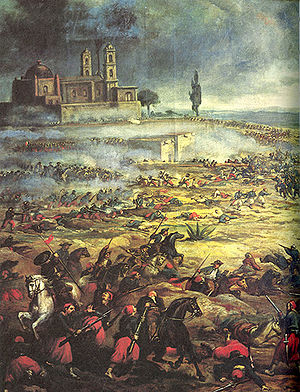
Mexican General Zaragoza attacked both flanks of the French army at the same time, while peasant troops concealed themselves along the escape route out of Puebla to do the maximum damage to French troops as they retreated. Lorencez tried a second attack on May 7th, but was unable to make even the slightest headway against the Mexicans as they fiercely defended the city.
This remarkable defeat of European imperialists forces was not to last, however, despite some support from Abraham Lincoln, who had his own agenda in aiding the Mexican cause. Historian James Cockcroft has noted that Lincoln provided armed troops to keep the French from using U.S. Southern access points to enter Mexico, and even provided arms to the Mexican Army. Lincoln did this because he knew that a French-controlled Mexico would side with the Confederacy and might given it enough clout to win the American Civil War. He continued his support in order to ensure that a government led by Benito Juárez, strongly anti-Confederate, would end up in power.
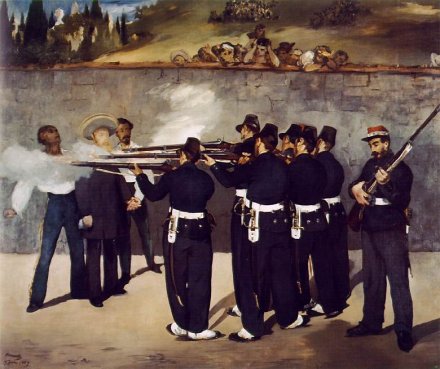
Ultimately, the French seized Mexico City and conquered the country, turning its government into a monarchy. Napoleon III installed one of his relatives, the Austrian Archduke Maximilian Ferdinand, as the monarch. He chose the title of Emperor of Mexico, and ruled with his wife, the former Princess Maria Charlotte of Belgium, called Empress Carlota.
But the Mexican people continued to battle during the five years of French monarchy. Especially remarkable was the commitment of the Mexican working class, who were treated little better than serfs during this period of history. Their determination would not permit foreign invaders to swamp their country. In May of 1867, Mexico City was re-taken by the Mexican people, and the self-styled Emperor was executed. Carlota went mad, and was sent packing to Belgium, where she spent the rest of her life in an asylum-like seclusion.
One of the ironies of the supposedly liberal Juárez government once it took control was that it added, rather than detracted, to the power base of the Mexican landowners. Having switched sides and become de facto “liberal” supporters, the landowners gained additional resources when Juárez nationalized Catholic Church property. The consequential boom in real estate speculation further impoverished the working class and led to the development of an aggressively exploitative form of agrarian capitalism. The elite, having gained this additional power, ultimately installed dictator Porfirio Diaz. The Mexican peasants and workers would again have to go to war to topple Diaz in 1910.
Mexico also continued to fight off various powers as they tried to possess, to raid, to plunder the country’s resources. This included attempts by Great Britain to seize Mexican oil production in the 1930s. And today, Mexicans are waging another battle—against U.S. agribusiness and other capitalist maneuvers made seamlessly easy by NAFTA. Since the Mexican government’s acceptance of NAFTA, the wages of industrial workers in the country have fallen 25 percent. 700,000 Mexican farmers have lost their land. And the number of immigrants leaving Mexico for the U.S. has doubled.
Today, Cinco de Mayo, a largely commercial holiday made popular in the 1940s, is used today by American advertisers “as a marketing opportunity for corporate America.” It will be marked by the sale of tacky decorations, fiestas, tequila, parades, mariachi music, and Americans’ weird interpretations of Mexican food. (Can anyone say “wet burrito”?)
What would be a better acknowledgement of the Battle of Puebla is to honor the ánimo of the Mexican people, and stand in solidarity with them as they continue to struggle against foreign invasions and the capitalist agendas that fuel them.
Blackwater’s New Ethics Chief: John Ashcroft
(This article is re-posted from WIRED.)
The consortium in charge of restructuring the world’s most infamous private security firm just added a new chief in charge of keeping the company on the straight and narrow. Yes, John Ashcroft, the former attorney general, is now an “independent director” of Xe Services, formerly known as Blackwater.

Ashcroft will head Xe’s new “subcommittee on governance,” its backers announced early Wednesday in a statement, an entity designed to “maximize governance, compliance and accountability” and “promote the highest degrees of ethics and professionalism within the private security industry.”
In other words, no more shooting civilians in Iraq and Afghanistan; no more signing for weapons its guards aren’t authorized to carry in warzones; no more impersonations of cartoon characters to acquire said weaponry; and no more ‘roids and coke on the job.
Ashcroft’s arrival at Xe is yet another clear signal it’s not giving up the quest for lucrative government security contracts now that it’s no longer owned by founder Erik Prince, even as it emphasizes the side of its business that trains law enforcement officers. In September, it won part of a $10 billion State Department contract to protect diplomats, starting with the U.S. consulate in Jerusalem. Ashcroft, a U.S. senator before becoming attorney general in the Bush administration, is a very known quantity to the federal officials that Xe will pitch. Even if he’s not lobbying for Blackwater, Ashcroft’s addition on the board is meant to inspire confidence in government officials of its newfound rectitude.

To some, Ashcroft will be forever known as the face of Bush-era counterterrorism, the official who vigorously defended the Patriot Act’s sweeping surveillance powers; told civil libertarians that their dissents “only aid terrorists“; and covered up the Spirit of Justice’s boob. At the same time, when Ashcroft was critically ill in 2005, he resisted a White House entreaty to his hospital bed seeking to reauthorize warrantless surveillance in defiance of the acting attorney general.
“This is a company with a strong history of service to its country, and a reputation of best-in-class offerings to its public and private customers,” Ashcroft said in a statement. “I look forward to helping USTC enhance its governance and oversight capabilities as the company moves forward,” referring to U.S. Training Center, another of Blackwater’s many names. Like scores of other senior security officials, he’s spent his post-government career running a Washington consulting firm.
Xe is still sorting out its permanent leadership and searching for a permanent CEO. For now, the investor team that bought the company in December assembled and empowered a board of directors to run the shop along with the existing management. That board includes former National Security Agency director Bobby Ray Inman. Its chairman is a Clear Channel co-founder, Red McCombs.
Ashcroft and his new subcommittee will report to the board. “With the formation of this subcommittee, and with Ashcroft as its chair,” the firm says in the statement, “USTC aims to set the bar for industry standards against which all other companies will be measured.”
Democracy on Hold in Benton Harbor
This story by Ryan Harvey is re-posted from TruthOut
Michigan emergency financial management law “a violation of constitution,” say residents.
While the country watched the protests in Wisconsin spill into the State Capitol Building, Michigan Gov. Rick Snyder was passing a controversial bill that many consider a direct attack on the constitutional rights of the citizens of Michigan.
Public Acts 4-9, also called The Emergency Financial Management bill, gives already existing “Emergency Financial Managers” (EFMs) sweeping new powers, allowing them to literally suspend the entire elected bodies of municipalities they deem to be failing, and suspend collective bargaining agreements with unions for up to five years.
Immediately after the bill passed, an EFM took complete control over the city of Benton Harbor as well as Detroit’s public school system. EFMs are also in power in Pontiac and Ecorse.
As many as 400 accountants, lawyers, school employees and city workers are taking classes as part of the new law, studying corporate-sector strategies for municipal application. One class, “Dealing with the Unionized Workforce,” alludes to union-busting techniques.(1)
Having studied, these teams are ready to attack the local governments of Michigan to restructure their finances. “A SWAT team is an OK way to look at this,” Michigan State University economist Eric Scorsone told Bloomberg last week of the trainees.(2)
Many Michigan residents, especially those experiencing poverty or hanging on to medium-income jobs, are outraged. Protests, lawsuits from the American Civil Liberties Union and local municipalities and calls for Governor Snyder to be recalled have unfolded with the bill’s passing.
“It’s a dictatorship,” Marian Kramer of the National Welfare Rights Union in Detroit says. “They are restructuring the government to protect the interests of corporations, that’s what this is all about. It’s not about us.”
“They have violated the constitution for the residents of Benton Harbor,” says Rev. Pinkney of Benton Harbor. “This is a constitutional issue.”
He and hundreds of others have been organizing and participating in demonstrations, lawsuits and other forms of protest against the bill.
Benton Harbor residents say that Whirlpool, the world’s leading manufacturer of major home appliances, and which once employed many in Benton Harbor in manufacturing jobs, might have a role in the EFM law as well; State Rep. Al Pscholka, who introduced the bill, formerly sat on the board of a Whirlpool-funded nonprofit in Benton Harbor now behind a controversial development on the town’s beach. And his former boss Rep. Fred Upton is a Whirlpool heir who owns property near the development.

Protesters listen to a speaker at a rally in Benton Harbor against EFM and Harbor Shores, on April 27, 2011. (Photo: Protect JKP)
Sucked Down the Whirlpool
Benton Harbor has long dealt with abject poverty, job loss from outsourcing and low-level corruption.
Earlier this month, former City Manager Richard Marsh settled a $192,000 lawsuit accusing other city officials of conducting fundraisers in the name of the city, but not turning over the money, and of burying a report on the city’s financial situation.
The city government has been profiled for government accountability lapses in the past as well. But many residents say that appointing an EFM with no legal accountability whatsoever will only makes such problems worse.
“You as a citizen have no rights,” Marian Kramer says. “The EFM only responds to the governor and his committee, not to the people.”
Benton Harbor residents point out the state government’s two-faced approach to their community. They see Whirlpool as the real criminal, overshadowing anything a city commissioner could do in a lifetime.
Whirlpool, which has its global headquarters in Benton Harbor, has long controlled the city. In 1986, at the behest of business leaders, Benton Harbor was designated as an “Enterprise Zone” to give tax exemptions to the private sector. Whirlpool quickly ate up the exemptions.(3)
At the same time, the St. Joseph-Benton Harbor area was losing over 5,000 jobs.(4) Whirlpool continued layoffs into the ’90s, until in 1996 they laid off half of the workers at their Evansville, Indiana, plant.
Today, less than one-third of Whirlpool’s workforce is inside the country.(5)
In 2003, as anti-police brutality riots broke out in Benton Harbor, Whirlpool was complaining that further tax incentives in a proposed energy bill were not enough to keep them from moving more jobs overseas. Apparently, the $17.40-an-hour jobs at Evansville were too pricey.
“A tax credit that creates a benefit for our refrigeration business is certainly welcome, but isn’t sufficient to eliminate the need for us to consider the possibility that we move some production to Mexico,” Tom Catania, Whirlpool’s vice president of government relations, threatened at the time. (6)
The threats worked and more favorable legislation passed in the 2005 Energy Policy Act. Thanks in part to the hundreds of thousands of dollars it poured into lobbying, Whirlpool has since received over $500 million dollars in tax breaks.(7)
After the new tax incentives started, Whirlpool announced it would soon be moving its Evansville and Fort Smith, Indiana, plants to Mexico, laying off another 1,200 workers(8) and leaving up to 1,500 more out of jobs through the overall “ripple effect.”(9)
This year, the job-exporting mega-manufacturer will receive multiple government handouts once again, including over $300 million in energy tax credits from the federal government – which will account for one-third of its annual profit(10) – a $19.3 million grant from the Department of Energy, $19 million in tax incentives from the Michigan Economic Growth Authority(11) and almost $1 million from the State of Ohio.(12) The company has also received over $500 million in tax credits in the last six years from the Brazilian government.(13)
And, like General Electric, Whirlpool’s effective tax rate for 2010 will be zero percent.(14)
Subsidized by these tax incentives and government handouts, Whirlpool last week announced a three-percent rise in first-quarter profits, up from $164 million to $169 million.(15)Whirlpool’s sales last year topped $17 billion.
Residents See Whirlpool Role in EFM Law
Whirlpool has often used the “job-creation” myth as a mean of getting government handouts and calming Benton Harbor residents. But, according to the Detroit Economic Club, Whirlpool’s Michigan workforce is almost 100 percent white collar. Benton Harbor is a blue-collar town. (16)
Whirlpool CEO Jeff Fettig exposed this recently, describing the new Whirlpool headquarters project for which the company has been promised $19 million in tax breaks from the state. “We have historical reasons [for staying in Benton Harbor], as well as having 4,000 good people here,” he told a crowd in March. “All that could change that equation for us is whether in the future we can continue to attract talent to the state.”(17)

A rally in Benton Harbor, Michigan is held against EFM and Harbor Shores, on April 27, 2011. (Photo: Protect JKP)
So, the “knowledge economy” jobs for which Michigan is paying are being marketed to people outside of Michigan.
To keep a clean public image, Whirlpool funds and largely controls a nonprofit in Benton Harbor called the Cornerstone Alliance, which has a revolving door with Whirlpool and the Whirlpool Foundation for its staff members and employees.
Cornerstone has long served the interests of Whirlpool in Benton Harbor, creating a façade through which the company can pass off its actions as being in the interests of “the community.”
“They’re an arm of Whirlpool,” says Carol Drake of Friends of Jean Klock Park.
Carol has been fighting for the preservation of the historic park against a consortium of developers led by Whirlpool. Her organization has tracked the evolution of developers’ plans to seize the public park, which she says have been in the works for decades.
Their current project is called Harbor Shores, a $500 million golf resort to include luxury homes, a water park, high-end condominiums and other similar upscale amenities.
Both Whirlpool and Cornerstone are partners in this development, which will span Benton Harbor’s public beach. Jean Klock Park was deeded to the people of Benton Harbor almost 100 years ago, but the central area of it was turned over to developers in 2008.
While the city government of Benton Harbor was complicit in this deal, newly elected commissioners have officially withdrawn the city’s support. “I don’t think any good government would show their support when we’ve given much more than any other entity,” Benton Harbor City Commissioner Duane L. Seats II said.(18)
But those commissioners no longer have any power due to Joe Harris’ recent suspension of all local government activity through the Emergency Management law.
This has led some to believe that the EFM bill is being used here to ensure that the Harbor Shores project continues.
“The true intent of the Emergency Management law here is so that the Whirlpool Corporation can complete what they started long ago,” Carol says, “the takeover of the park and of the City of Benton Harbor.”
Residents point out that Pscholka, who introduced the bill, was vice president of the Cornerstone Alliance’s Chamber of Commerce from 1996 to 2004.
“To say that there’s no connection between Harbor Shores and this legislation is absurd,” says Julie Weiss. “They are the ones who need to explain themselves.”
Julie has been active for many years in the fight to protect the park. Her organization, Protect Jean Klock Park, was founded in 2008 to support federal litigation against the National Park Service, The Army Corps of Engineers and the City of Benton Harbor.
“Pscholka was also a staffer for U.S. Congressman Fred Upton (R-MI),” Julie says. Representative Upton owns over $1 million in Whirlpool stock and pushed hard for the privatization of Jean Klock Park. His grandfather was a co-founder of Whirlpool.
For its part, Whirlpool has donated former factory land appraised at $20 million in anticipation of development at Harbor and has offered over $15 million in economic assistance and loans.
Meanwhile, the state of Michigan has offered up to $120 million in tax breaks for the project.(19)
The Harbor Shores plan is being run through a nonprofit called Harbor Shores Community Redevelopment, Inc., a collaboration among Whirlpool, Cornerstone and a new formation called The Consortium for Community Development.
The company in charge of developing Harbor Shores, Evergreen Development, was formed in 2005 in anticipation of the project. Evergreen’s Chief Financial Officer Jeffery Gilbertson is the former senior director of Financial Operations, International at General Growth Properties (GGP), one of the largest mall owners in the United States.
While Gilbertson was joining up with Evergreen in 2008, his former employer, after amassing $27 billion in debt, was filing what has been called the largest real estate bankruptcy in US history.(20)
Meanwhile, workers at Baltimore’s Inner Harbor were announcing a major campaign against GGP, which parallels the fight in Benton Harbor in many ways. A new report released this week shines light on these issues and perhaps puts the Harbor Shores project in Benton Harbor under a new light.
“The Inner Harbor,” the report reads, “has become a glaring example of poverty zone development, with low-quality jobs and abusive wages and conditions. As in other poverty zone developments, the private developers – General Growth Properties and Cordish Companies – and their investors insisted on secure profits through access to public subsidies and advantageous leases with the vendors who run the businesses in the development.”
That might sound all too familiar to the residents of Benton Harbor.
Development vs. Fair Development
It was recently announced that the 2012 and 2014 Senior PGA Tournament, brought to you by Whirlpool’s own KitchenAid, would be played at Harbor Shores.
“The Senior PGA, KitchenAid brand and Whirlpool Corporation’s alliance presents an opportunity to show how business and golf can help to strengthen and transform lives and communities,” said Jeff Noel, corporate vice president of Whirlpool Corporation.(21)
Instead of hiring locals whose taxes have helped fund the golf course’s development to work the tournament, the PGA is asking for 1,500 volunteers.(22)
This is a bit ironic since one of the big promises with the Harbor Shores development is that it will, according to their numbers, create 4,739 jobs. This number has been used in both the media and in the community as the great defense of the project.
The figure was first announced in an impact study conducted by students from the Kelley MBA Sports & Entertainment Academy with assistance from the W.E. Upjohn Institute for Employment Research.
But there’s a catch. When the W.E. Upjohn Institute conducted their own in-depth study afterwards, they found that the previous study’s numbers were skewed. The authors had computed the employment numbers as “job years,” which, according to the new report, “is not a reporting technique generally used by professional economists.”
“In essence, a ‘job year’ is one year of employment,” the report states. “By this measure, a solitary individual who works at the same job for 10 years would be reported as 10 ‘job years.'” The Upjohn Institute reports all employment impacts in terms of conventional jobs or employment levels, which is compatible with standard, publicly-reported employment statistics.”
It turns out the numbers were off by as much as 3,123. The second report puts the total employment count during the highest employment year (which in the report is 2012) at 1,616 jobs. That includes projected tourism employment and development construction.
These numbers also don’t account for how long those jobs will last, how much they will pay and how much skill they will involve. What we do know from the reports is that the majority of the jobs created will be in construction, meaning they will only last a few years.
Again, the Baltimore report describing working conditions at the Inner Harbor gives insight into what these kinds of developments mean when they talk about jobs: “The vendors, many but not all extremely powerful and wealthy companies themselves, maximize their profits by minimizing their unfixed costs (in particular labor), which creates a downward pressure on wages and working conditions for the vendors’ employees who work at the very bottom rung of the economic ladder.”
“In short,” it continues, “the development’s profits do not trickle down, but are instead squeezed upward from the workers.”
The promise of low-paying jobs and temporary employment will not lift Benton Harbor’s current residents out of poverty. Residents say they have been hearing similar things for years, but little has changed.
“They aren’t going to bring any jobs that are going to sustain a family,” Carol says.
Though there have been some improvements since the harsh years of the late 1970s, unemployment rates in Benton Harbor are still far above the national average (15 percent today with unofficial claims as high as 70 percent) and almost half of the city’s residents are now living at or below the poverty line. While the unemployment rate is lower than it was when the 1986 tax incentives started, almost half of the city’s residents have moved out since then, which helped bring that percentage down.
“They had to run the city down as far as they possibly could so [Whirlpool] would qualify for all the state money,” Carol suggests, “so they could create this development.”
One typical pattern with this type of development is that, after completion, property values rise and renters must move on to cheaper areas. For instance, while Fred Upton and Whirlpool CEO Jeff Fettig will see their property values rise in St. Joseph, the 60 percent of Benton Harbor residents who rent their houses will not.(23)
If poor residents are priced out and forced to other places, the result on paper will be that the overall income of Benton Harbor rose as a result of the Harbor Shores development.
“They want us to leave here as soon as possible,” says Reverend Pinkney.
As the Baltimore model has shown, developers in positions like Harbor Shores often masquerade as an economic engine for a city while leaching public money to make big profits.
“Baltimore’s Inner Harbor is a sad example of what broken promises for economic prosperity and jobs can do to a community,” says Ashley Hufnagel, a leadership organizer with the United Workers.
“It is workers and the community who end up paying the price for poverty-zone developments through poverty wages, lack of healthcare, barriers to education and more. That’s why harbor workers in Baltimore are holding the developers accountable and calling for Fair Development, an alternative model that respects human rights, maximizes public benefits and is sustainable.”
A demonstration has been called for in Benton Harbor on June 18, the anniversary of the 2003 riots. Another larger demonstration will take place during the 2012 PGA Championships at Harbor Shores.
Footnotes:
1. See here [3].
2. See here [3].
3. See here [4].
4. See here [5].
5. See here [6].
6. “Good Jobs First, Layoffs at Whirlpool: Costs to the Evansville Metro Area and Indiana Taxpayers.” Commissioned by IUE-CWA Local 808 and AFL-CIO Industrial Union Council Washington, DC. April 2010.
7. See here [7].
8. See here [8].
9. “Good Jobs First, Layoffs at Whirlpool: Costs to the Evansville Metro Area and Indiana Taxpayers.” Commissioned by IUE-CWA Local 808 and AFL-CIO Industrial Union Council Washington, DC. April 2010.
10. See here [9].
11. See here [10].
12. See here [11].
13. See here [12].
14. See here [13].
15. See here [14].
16. See here [6].
17. See here [6].
18. See here [15].
19. See here [16].
20. See here [17].
21. See here [18].
22. See here [19].
23. See here [20].
 [21]
[21]Yesterday, Senator Carl Levin issued a brief statement on the killing of Osama bin Laden.
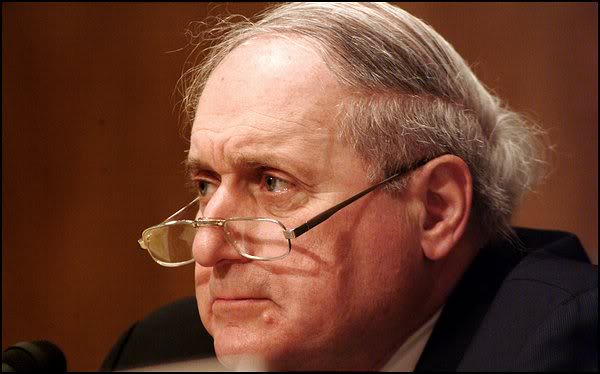
“The people of the world can feel relief and satisfaction that a monster has been brought to justice. Justice has a long memory and a long arm.
“I stand in awe and appreciation of the men and women of our military and our intelligence community, who have once again demonstrated their amazing courage and competence. Their heroism is a stark contrast to bin Laden, who while sending his underlings to die or huddle in mountain caves has been living in the comfort of a villa in Pakistan. Surely this will help puncture the myth of Osama bin Laden.
“This is a great victory in the fight against terrorism. But it is not the final victory.
“These events also bring back to us the pain of the terrible loss we suffered on Sept. 11, 2001, and of the sacrifices of the brave men and women who have been lost or wounded in the years since. It is their heroism, and not bin Laden’s hatred, that endures.”
The statement is revealing on many levels. First, Levin makes the claim that the “people of the world” feel relief that bin Laden is dead, even though the Senator never provides any evidence that the people of the world indeed feel this way. Some heads of state have made comments to that effect and some people in the US are rejoicing over the decision of the Obama administration to assassinate bin Laden, but there is hardly a sense that the people of the world feel relief.
In fact, many people around the world have reason to have a continued sense of fear, since the death of bin Laden will not end US military campaigns around the world. The people of Afghanistan, Pakistan, Iraq, Libya, Palestine, Egypt, Yemen and many other countries will not feel relief. The US military operations or US supported military repression in those countries will not end and will not even decrease in intensity because of the death of bin Laden, a point that Jeremy Scahill made yesterday in regards to Afghanistan & Pakistan while speaking on Democracy Now.
Secondly, Levin goes out of his way to make heroes out of the US military personnel who were involved in the operation that ended bin Laden’s life. Levin says that the men and women have demonstrated “amazing courage.” Interesting, so the most sophisticated army in the world, with the most deadly weaponry in the world demonstrates courage because they assassinated Osama bin Laden. How is this courageous? These men were just following orders.

Levin also said that the US military demonstrated amazing competence. If indeed, the US military did finally kill bin Laden, it took them almost 2 decades to do so, since bin Laden was on the hit list beginning with the Clinton administration. In fact, there are those who have worked in the US intelligence community who think that the US has had plenty of chances to kill or arrest bin Laden and have failed to do so over the past 20 years, a claim made by former intelligence officer Michael Scheuer in his book Imperial Hubris.
Thirdly, Levin states that the death of bin Laden is a victory in the “fight against terrorism,” but then says it is not the “final victory.” Again, Levin provides no evidence that the assassination of bin Laden is a victory in the US campaign against so-called terrorism. Indeed, the assassination of bin Laden will likely have no impact on actions of groups like al Qaeda or the Taliban insurgents in Afghanistan.
Fourth, Senator Levin uses the opportunity of the announcement of bin Laden’s death to talk about the terrorist attack against the US on 9/11/2001. This has been the case of much of the US media, where pundits make the point that those who lost family members in those attacks can now feel like justice has been served. What is problematic with such a position is that is assumes that bin Laden was responsible for 9/11. There is no hard evidence that bin Laden gave the orders for 9/11 and if he is indeed dead we will never know since there will be no trial to determine such a conclusion.
Lastly, the statement by Levin and the current news blitz omits the history relationship between Osama bin Laden and the US. Bin Laden has been presented only as an enemy of the US, but news agencies, President Obama and Senator Levin omit the fact that in the 1980s bin Laden was part of the Mujahideen insurgent forces fighting against the Soviet occupation of Afghanistan. Bin Laden, like many other Muslim extremists, was the recipient of US funding, weapons and training throughout the 1980s in that anti-Soviet campaign, a point that Bill Blum has documented well.
The US funding of bin Laden during the 1980s was also supported by Senator Levin and the majority of Congress who approved roughly $6 billion in weapons and other military aid to the Mujahideen. However, providing historical context is usually not of interest for the commercial media in the US, which means that Senator Levin will rarely be questioned on his foreign policy positions.
(This article is re-posted from OpenSecrets.)
During federal elections, contributions to moneyed political party organizations such as the Democratic National Committee or National Republican Senatorial Campaign Committee receive considerable attention. Less scrutinized are governors associations, which in recent years have attracted significantly more special interest cash than ever before.

Unlike political committees or candidates for federal office, the Democratic Governors Association and Republican Governors Association both may receive unlimited amounts of money in their bids to support gubernatorial candidates across the nation, including money directly from corporate and union treasuries. And raise cash they did.
During the 2010 election cycle, the RGA raised a total of $117.1 million. Interest groups, corporations and unions accounted for $73.1 million of these contributions to the RGA. And of this sum, $60.3 million (or 82.5 percent) came from businesses, lawyers and lobbyists.
According to a Center for Responsive Politics analysis of the top 50 donors to the RGA, 39 are corporate entities, and together, they gave $19 million to support the organization.
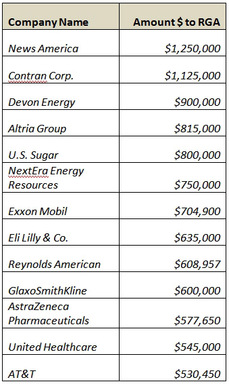
Topping the list of corporate contributors to the RGA is News America, at $1.25 million. News America is a subsidiary of News Corp., a company founded by media magnate Rupert Murdoch. News Corp. is the third largest media conglomerate in the world, and it owns Fox News Channel, the Wall Street Journal and the New York Post, among other publications.
Contran Corp. is a close second, having made $1.125 million in contributions to the RGA during the 2010 election cycle. Contran is a holding company that owns subsidiaries that specializes in chemical, metal, computer and waste management systems. In 2010 alone, the company also spent $340,000 to lobby the federal government.
The DGA, meanwhile, received $46.7 million of its overall $55.3 million in receipts during the 2010 election cycle from corporations, unions or special interest groups, and $32.7 million of that — or about 70 percent — came from corporations, lobbyists and lawyers.
Of the DGA’s top 50 donors, 32 are corporations from the health, energy or and telecommunications sectors.
Pfizer gave $590,770, and this represented the single largest corporate contribution to the DGA. Pfizer is a global pharmaceutical company that produces drugs such as Advil, Celebrex and Lipitor. During 2010, the drug company spent more than $13 million lobbying Congress on public health and tax issues.
Second on the DGA’s list is FirstEnergy Corp., which gave $550,000. FirstEnergy is an Ohio-based electric company and is a member of the Forbes 500 list. The company hired 15 lobbyists to influence lawmakers in Washington on energy, environmental and other issues last year.
Among major corporate contributors to the DGA and RGA:

A number of corporations ultimately hedged their bets in gubernatorial races by giving generously to both the DGA and RGA.
When comparing the top 50 donor lists for both associations, 15 companies sent money to both organizations, according to the Center’s research.
For instance, the U.S. subsidiary of AstraZeneca Pharmaceuticals contributed $577,000 to the RGA while also giving $520,000 to the DGA. AstraZenceca is a London-based pharmaceutical company that specializes in drugs that combats cardiovascular, respiratory and gastrointestinal diseases.
Similarly, the Correction Corporation of America gave $306,000 to RGA and $265,000 to DGA. Correction Corporation of America designs, constructs, remodels and manages prisons and jails. The organization also operates inmate transportation services through its subsidiary company, TransCor America.
Another company that donated to both associations is Wal-Mart. During this past election cycle, the massive retailer contributed $469,000 to the RGA and $411,000 to the DGA.
Click on the charts below to see how business and special interest sectors have contributed money to the DGA and RGA during the 2010 election cycle (click charts to enlarge):

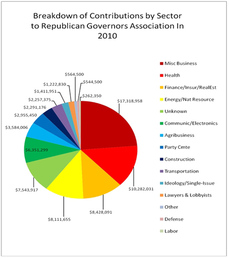
Although corporations have made sizable donations to both governors associations, individuals have also made six- and seven-figure donations, particularly to the RGA.
In all, eight people gave at least $500,000 to the RGA during the 2010 election cycle, including Perry Homes chief Bob Perry ($8 million), Elliott Management hedge fund honcho Paul Singer ($2.38 million) and Koch Industries co-owner David Koch ($1 million).
Perry is also notable for his financial support of the Swift Boat Veterans for Truth organization that criticized Democrat John Kerry during his 2004 presidential bid and American Crossroads, a conservative group established last year in part by former George W. Bush strategist Karl Rove, as OpenSecrets Blog previously reported.
Eleven people donated six-figure sums to the DGA during the 2010 election cycle, including Newsweb Corp. Chairman Fred Eychaner ($450,000), lawyer J. Steve Mostyn ($400,000) and BLS Investments Chairman Bernard L. Schwartz ($350,000).
Six-figure contributions by Eychaner were also notably used by a political committee operated by EMILY’s List called Women Vote! to fund radio ads during the special election in Massachusetts in January 2010, as OpenSecrets Blog first reported in March 2010. Women Vote! was one of the first so-called “super PACs” to operate during the 2010 election cycle.
During the 2010 election cycle, the GOP won a net of six gubernatorial seats in the 38 contested state and territorial governorships.
The 2012 election cycle will feature only 13 gubernatorial races. But corporations, labor unions and ideological groups will likely invest their resources into these contests given their competitive nature and deep partisan divides across the nation.
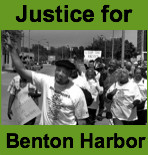
On Saturday, while attending the May Day celebration in Grand Rapids, we had a chance to speak with Benton Harbor activist/organizer Rev. Pinkney.
He talked about what the newly imposed Emergency Financial Manager means for the people of Benton Harbor and what is being done to respond to what he called a “theft of democracy.”
Rev. Pinkney also informed us that there is a demonstration in Benton Harbor this coming Saturday, May 7. Michigan Governor Rick Snyder was invited by the city of St. Joseph to be the Grand Marshall of Grand Floral Parade, which is the biggest yearly event in St. Joseph & Benton Harbor.
People are invited to come and protest the parade this coming Saturday, May 7. People will meet at 11am in front of the Benton Harbor Public Library 200 Wall Street, then march to where the parade is being held.
For more information on the protest or the struggle in Benton Harbor go to http://bhbanco.blogspot.com/.
Grand Rapids Celebrates May Day 2011

Yesterday, hundreds of people from the community came out to celebrate in the 2nd annual May Day event organized by the Grand Rapids Chapter of the IWW.
While the day started out windy and cool, the sun finally broke through and it was a beautiful day for a celebration. Some 15 bands played throughout the day, including folks music, hip hop, Latin rock, punk, blues, rap and Indie music. The IWW also had a DJ there throughout the day spinning tunes between bands keeping the energy high.
These mix of music genres was reflected in the turnout with a racial diverse audience of people, some of which came from the immediate neighborhood surrounding Martin Luther King Park.
In addition, members of Stop Targeting Our Kids (STOK) provided some activities for children such as face painting and other artistic expression projects. The Really, Really Free Market was also open for several hours allowing people to exchange goods without having to spend any money. There was also free food provided by a new chapter of Food Not Bombs and garden plants from Our Kitchen Table. The new worker-run restaurant BarterTown also brought food for people to sample and to see how a worker-run restaurant differs from a management run business.
There were also several organizations there with information and resources. The Sprout Anarchist Collective had a table with zines and other resources, along with the IWW and the Bloom Collective.
Between bands groups had an opportunity to let people know about the grassroots and anti-capitalist work being done in Grand Rapids. There was also some poetry read, a speech by Rev. Pinckney from Benton Harbor and the IWW kept reminding people about the history of May Day and their call for a general strike. GRIID had a chance to speak with IWW member Cole Dorsey about some of these issues.

