Voltairine De Cleyre: Feminist and Anarchist writer lived in Grand Rapids in the 1880s
 Emma Goldman once referred to Voltairine De Cleyre as, “The most gifted and brilliant anarchist woman America ever produced.”
Voltairine De Cleyre was born in Michigan in 1866 and was named after the French Enlightenment writer Voltaire. She grew up experiencing poverty and then was forced to live in a Catholic convent by her father, who thought it would provide a better education for her. Life at the convent did have a positive effect, but not the one that her father had hoped for. What Voltairine developed was not only a critical understanding of the world, she would also eventually identify as an atheist because of the oppressive nature of the Catholic education.
By the early 1880s she moved to the Grand Rapids area and eventually to Grand Rapids and was active in the anti-clerical, Free Thought Movement. Voltairine soon began writing for various publications and exploring other political disciplines. However, it was the Haymarket uprising in Chicago in 1886 that finally brought her to embrace anarchism. More specifically, it was the hanging of the Haymarket Martyrs in 1887, that solidified her belief and commitment in political anarchism.
There is an excellent zine produced by Sprout Distro in Grand Rapids on the history of Anarchism in Grand Rapids, with a section on De Cleyre that is worth citing:
Voltairine De Cleyre was one of the leading figures in the US anarchist space from 1890 to 1910, according to anarchist historian Paul Avrich. DeCleyre was born in the small town of Leslie, Michigan in 1886 and spent the majority of her childhood in St. Johns (both near Lansing). While she lived most of her adult life in Philadelphia, she spent a few years in Grand Rapids in the 1880s. These were important years of her life, marking the period when she became active in radical politics and eventually anarchism. De Cleyre was a prolific writer who wrote both political and literary works, contributing essays and poems to a wide range of anarchist publications. Central to her anarchism was her critique of gender which ran throughout her life’s work, making her one of the major theorists of anarcho-feminism. Her positions with regard to gender were considerable more radical than most feminists of her time (for example, she rejected gender essentialism) and is recognized by at least one of her biographers as “arguably the most radical, revolutionary feminist at the turn of the twentieth century.”
In addition to De Cleyre’s deep feminist thought, she began devoting a great deal of time to the memory and legacy of the Haymarket Martyrs. In fact, between 1895 and 1910, she began to give speeches throughout the midwest and east coast on the anniversary of Haymarket, on May 1. Paul Avrich, the anarchist historian, eventually put together a collection of these Haymarket speeches by De Cleyre, in a small book entitled, The First Mayday: the Haymarket speeches 1895 – 1910.
In the speech she delivered in 1906 in Chicago, De Cleyre shared these eloquent words:
For organizing war upon your system of slavery these men are obnoxious to you; and you seize upon an anonymous act of violence to accuse them of conspiracy! It is ever the coward’s word; and small wonder you impute it to others, in view of the miserable lies and tortures you resort to, to extort confessions of conspiracy from weaklings whom your cruelty drives mad. Well, this time you have overshot the mark. But you wiull not learn by it. So long as teachers rise up to teach the reconstruction of society without you, so long will you do them to death, imprison, persecute somehow until the working people in mass declare an end of your privilege.
However, De Cleyre did not limit herself to writing just about the Haymarket Martyrs. She was a prolific writer of poetry and essays. In her poem entitled, The Burial of My Past, the anarchist wrote:
And now, Humanity, I turn to you;
I consecrate my service to the world!
Perish the old love, welcome the new –
Broad as the space-aisles where the stars are whirled!
Voltairine De Cleyre was an astute observer of the world. She wrote about anarchism and the particularly anarchism in America. She wrote about Direct Action, Crime & Punishment and the Paris Commune. In 1911, the year before she died, she wrote about the Mexican Revolution.
De Cleyre stated, “The Mexican revolution is one of the prominent manifestations of the world-wide economic revolt. It possibly holds as important a place in the present disruption and reconstruction of economic institutions, as the great revolution of France held in the eighteenth century movement.”
Voltairine De Cleyre died in 1912, at the young age of 46. However, despite her short life, she not only impacted those who heard her speeches, she continues to inspire generations of people who will consecrate their service to the world!
For more information on Voltairine De Cleyre, see Paul Avrich’s book, An American Anarchist: The Life of Voltairine de Cleyre, and The Selected Works of Voltairine de Cleyre, edited by Alexander Berkman.
Image used here is from a print made by GVSU student Katie Los.
Why are we not focusing as much attention on the Billionaires in our own back yard as we are on Musk and Bezos?
Ever since the January 20th, when Trump reclaimed the White House, there has been a great deal of attention given to Elon Musk’s role in that administration, and rightfully so.
I would encourage people to read the following two articles, both of which provide a substantive critique of Elon Musk and the DOGE. First, is an article entitled, Elon Musk Didn’t Start Flouting The Law With DOGE, which provides solid historical analysis of Musk’s criminal practices. The second article is entitled, The DOGE Charade, which deconstructs what the Musk-led project is actually doing, instead of what he and Trump are claiming.
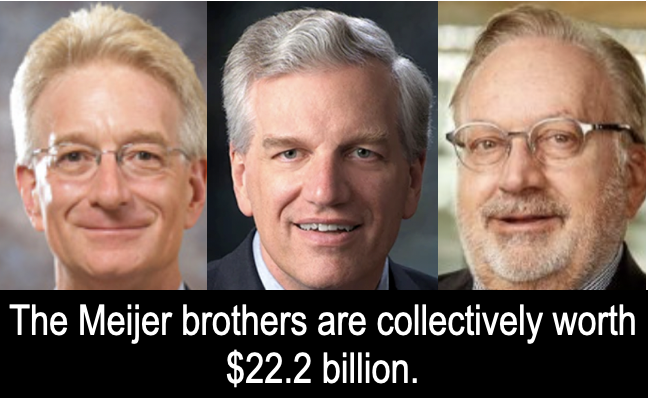
We should all have nothing but contempt for people who are part of the growing billionaire class. They extract from people and from the earth with the goal of expanding their wealth, regardless of the consequences. I get that people want to focus on Musk and Bezos, but we have Billionaires right here in our community.
There are 11 Billionaires in Michigan and two Billionaire families right here in Grand Rapids…..the Meijer and DeVos families. According to the most recent Forbes Real Time Billionaire page, the Meijer brothers – Doug, Hank and Mark, are all listed as being worth $7.4 billion each. In a recent report, the group Americans for Tax Fairness puts the DeVos family wealth at $5,4 billion collectively. Personally, I think that the DeVos family’s collective wealth is higher than that, but it is so difficult to find hard data, as they, like most members of the Capitalist Class, don’t believe in transparency.
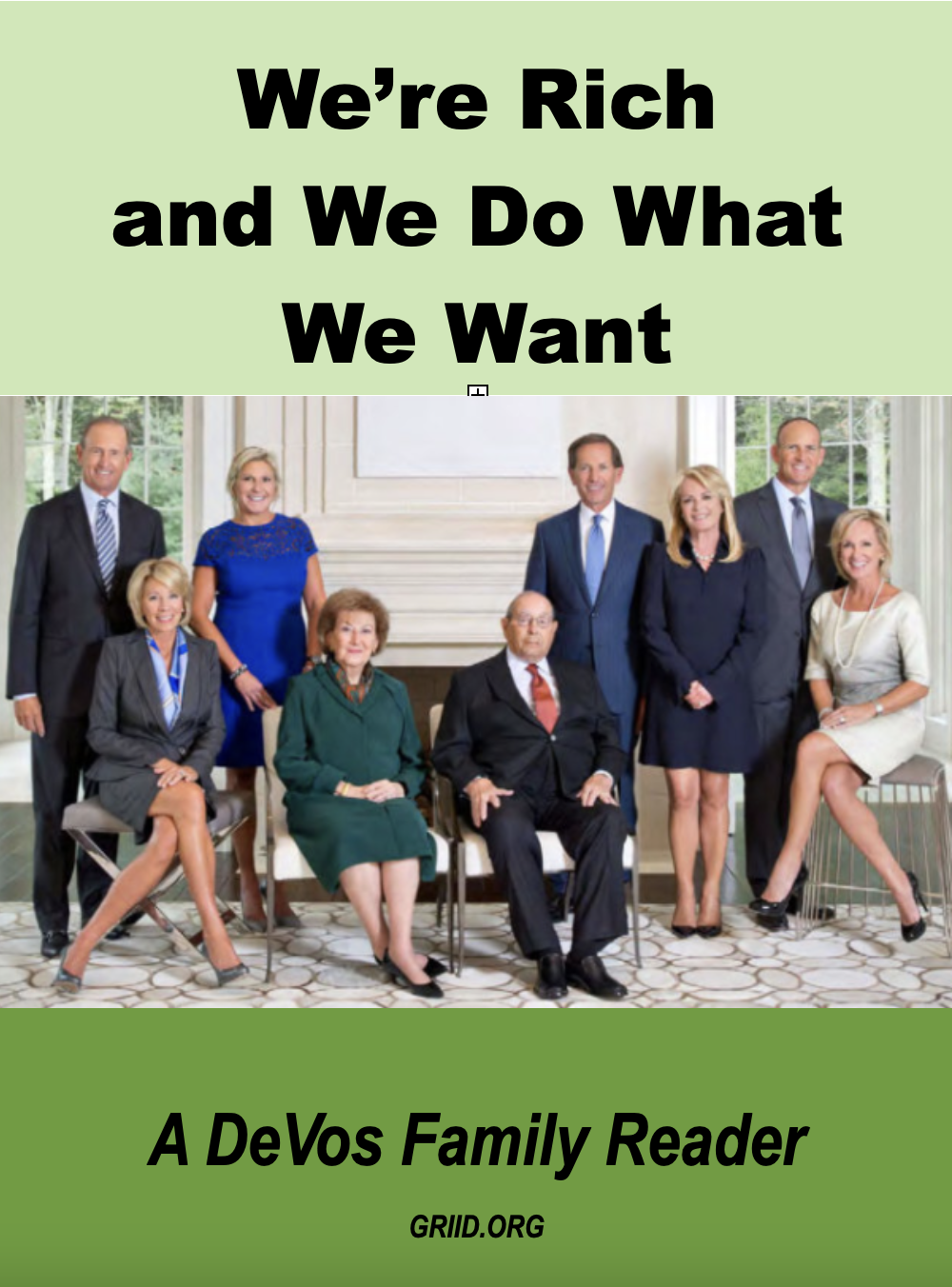 I have written extensively about the DeVos family for more than 30 years, which you can see in my A DeVos Family Reader, entitled, We’re Rich and We Do What We Want. More recently, I wrote a piece, Why are we not more pissed off with the DeVos family regarding the shit show that is the Trump Administration? In that article I provide details on how much money the DeVos family spent in the 2024 election, at the local, state and federal level.
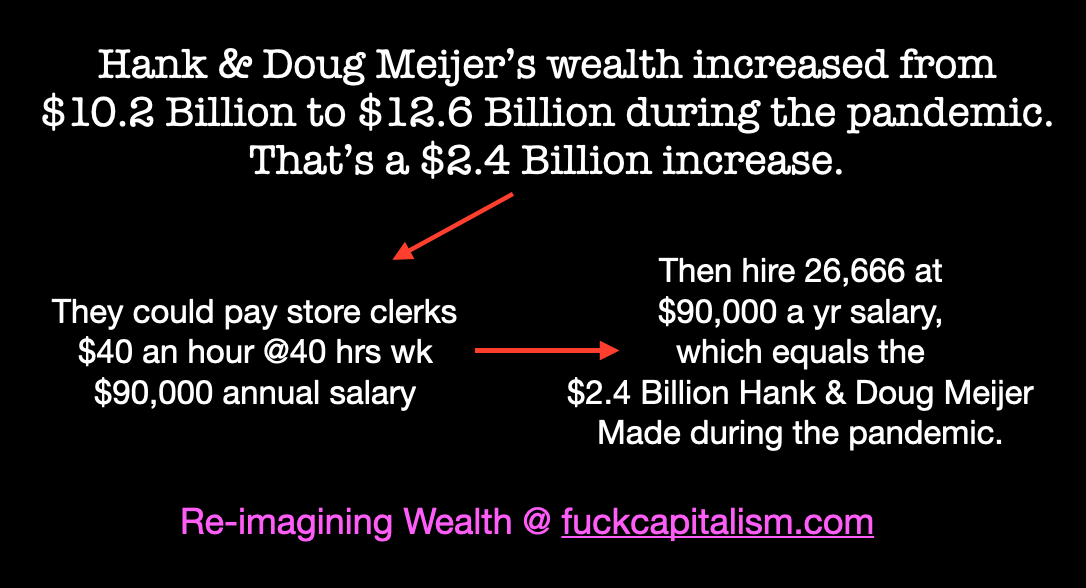
Now, over the past few years, GRIID has been tracking the wealth of the Meijer family, like when we noted that, during the first 18 months of the COVID pandemic, the wealth of Doug & Hank Meijer had grown by $6.7 Billion. We noted that this increased wealth was taking place when so many people were without work and experiencing food insecurity.
Another way that we have looked at the wealth of the Meijer family in recent years is to re-imagine how just the amount of increased wealth they made during the early part of the pandemic could benefit their employees. We noted that if Meijer paid their employees $40 an hour for a 40 hour work week, that would result in a $90,000 annual salary. If Meijer decided to pay their employees such a wage, they would still be worth BILLIONS, meaning their lives would be ridiculously comfortable. The difference is that their employees would now have a less stressful life and be able to have opportunities they didn’t have before.
In another examination of the Meijer family wealth, we wrote in August of 2021:
For the rest of us, we should be marching on the Meijer corporate headquarters at 2929 Walker Ave NW, Grand Rapids, making other demands about wealth redistribution. Imagine what $900 million could do to relieve the harm that thousands of families are currently experiencing in the Greater Grand Rapids area. $900 million would eliminate poverty, homelessness, food insecurity and provide plenty of health care funding. Demanding that the Meijer family give $900 million to be distributed to the thousands of families in this area who are experiencing poverty, systemic racism and other forms of structural violence would still leave Hank & Doug Meijer with $12.6 billion, which I’m sure they could still support their families on.
Considering the fact that the DeVos family is number 49 of the 150 families from the Capitalist Class in the US that contributed over $7 million to the GOP in the 2024 election cycle, it would be safe to say that they are the member of the Billionaire Class in Grand Rapids that is most responsible for the new Trump Administration locally.
If we acknowledge this fact, then why are there no protests and no rage being directed at the DeVos family? Why are we not organizing a campaign to expose them and to undermine their comfort? What is it going to take before we take action action the people who have imposed upon us this nightmare reality we find ourselves in?
Taxing the rich is a nice sentiment, but that is really low hanging fruit. We need to make members of the Billionaire Class, like the DeVos family, feel uncomfortable and let them know that we will not tolerate their efforts to expand their wealth while so many in this community are just trying to survive.
The DeVos family directly contributed to making sure that Donald Trump became President again. Why are we not more pissed off about this family? Like the Meijer family, the DeVos headquarters is located in this city, at the corner of Lyon and Monroe. They have business offices, their investment firm and all of their foundations are housed in one building. Why are we not organizing actions there?
A brief history of International Women’s Day and what is being planned in Grand Rapids
International Women’s Day evolved out of a growing effort amongst women’s and socialist groups to fight for more equality for women at the end of the 19th century and the beginning of the 20th century.
In 1908, 15,000 women marched in New York City demanding shorter work hours, better wages and the right to vote. In 1909, the Socialist Party of America designated February 28 as the first National Women’s Day, which was to be celebrated on the last Sunday of every February.

In 1910, at the Second International Conference for Working Women, there was a proposal to have an international women’s day, where women around the world would press for their demands on the same day. The proposal was not adopted until the following year and International Women’s Day (IWD) was celebrated in several countries around the world. However, something happened just one week later that would galvanize this new international movement.
On March 25, a fire began at the Triangle factory in New York City. It was common practice for factory owners to lock the workers inside until the work day ended and because of that practice 140 women, most Jewish and Italian immigrants, burned to death in that fire. The international women’s movement, labor and socialist movements mobilized around the world to mourn these women and to organize for worker and women’s rights.
For years after the first, the Triangle factory fire became the focus of International Women’s Day and gave birth to the Bread and Roses Campaign. The Bread and Roses Campaign was begun by workers (mostly women) who went on strike at a textile factory in Lawrence, Massachusetts. This strike was organized by the Industrial Workers of the World (IWW) with the slogan, “We want Bread, but we want Roses too!”
 For decades, International Women’s Day was rooted in the radical tradition, with a deep commitment to intersectionality. Longtime organizer Judy Rebick reflects this in the following comment:
“In the end, my conclusion is that the inter-locking systems of patriarchy, colonialism and capitalism will maintain the oppression of women. There is only so far we can go without challenging all of them. That’s why I am thrilled to see the women’s movement become more global, more diverse, more radical and more integrated into other movements for social and environmental change. Even if in the short time, we are less effective in making change, in the long term the change will be deeper and broader.”
What is happening on March 8th in Grand Rapids?
There are not a lot of details about the upcoming March 8th action in Grand Rapids, which is being billed as International Women’s Day – Unite & Resist in Grand Rapids, MI.
The event says it is a Protest/Rally. It is followed by a brief description:
On International Women’s Day, we’re taking to the streets to fight back against the fascist takeover. Join us to defend our rights, our bodies, and our future. No permission needed—just show up and bring others.
This will be a family friendly event peaceful! Please bring signs!
This protest/rally will start at noon at Rosa Parks Circle in downtown Grand Rapids and end at 3:30pm. Unfortunately, no other details are available , with no speakers listed nor are there organizations mention that have organized or sponsored this event.
 Earlier today, the Climate Justice Team with the Urban Core Collective (UCC) hosted a Press Conference regarding the increased utility costs that Consumers Energy is imposing on the public. The Press Conference was live streamed and you can watch a video of that live stream here.
Sergio Cira-Reyes, a Climate Justice organizer with UCC, kicked off the Press Conference with these comments:
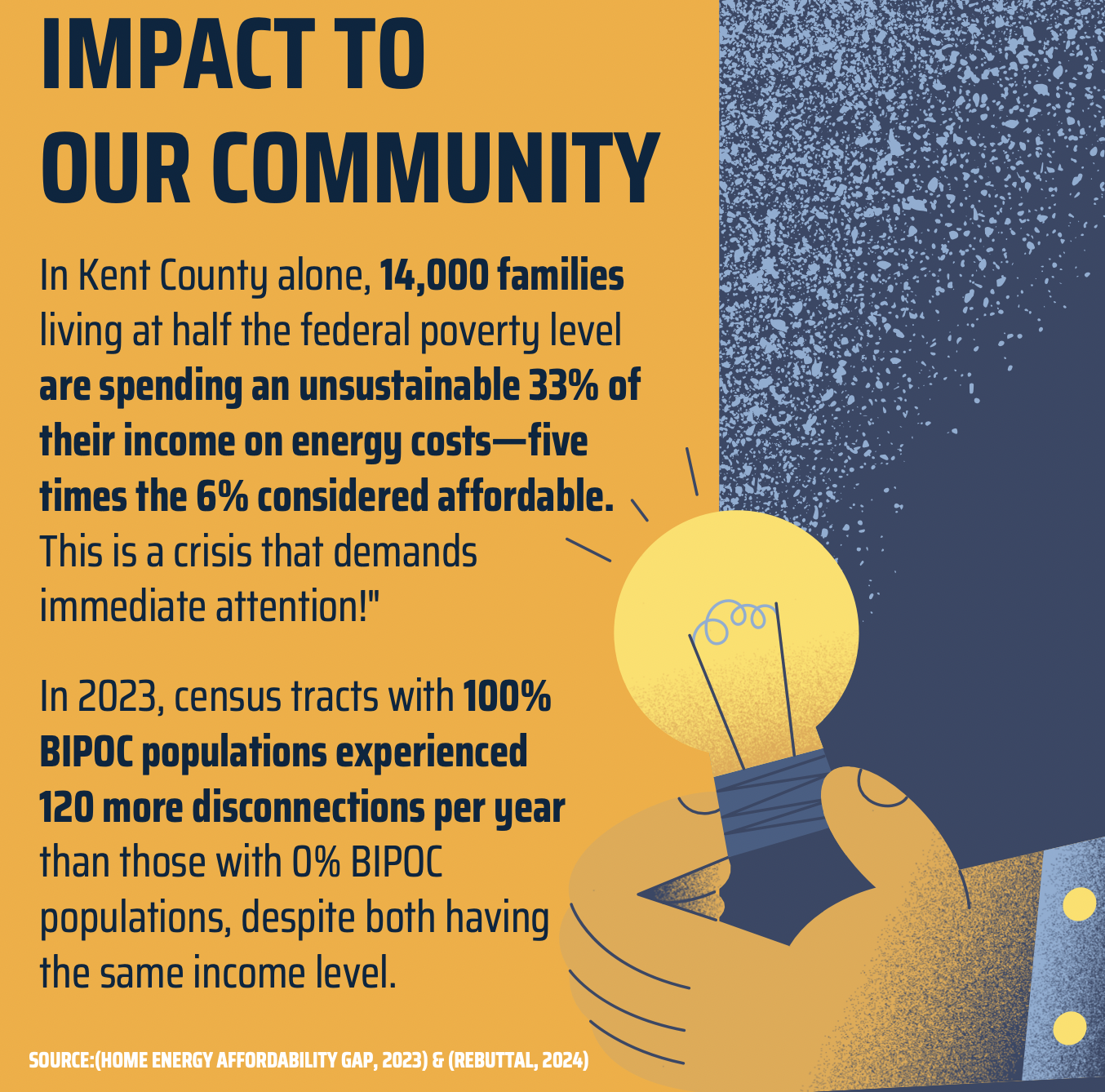
With the progress of climate change, an alarming crisis is growing as the percentage of income that families have to spend on energy surpasses the 6% allocation that is considered affordable. As recently as 2019, close to 14,000 Kent County families living at 50% of the federal poverty level, were spending 33% of their income on energy costs. Spending six percent of household income on energy costs is considered affordable, yet families are spending more than the 30% that they should be spending on housing alone. Since 2019, the Michigan Public Service Commission has approved a total of $274 million in six annual rate hike requests from Consumers Energy.
 A second major points that was raised during the Press Conference, also from Cira-Reyes, was that of all 148 sitting state lawmakers, 102 received campaign funds from DTE Energy or Consumers Energy PACs between 2017 and 2022.” That’s almost 70% of all Michigan lawmakers taking money from the utilities during that time period. The campaign contributions from the utility companies raises serious concerns about whether the policy that the commission leans on to make decisions on our behalf is made by politicians who are in the pockets of the Utilities.
Janet Zahn, who is the Co-Chair of the Grand Rapids Climate Coalition, also spoke during the Press Conference. Zahn addressed how disconcerting it is that Consumer’s Energy was continue to hike utility costs, but was not as committed to increasing the amount of energy it was providing, specifically from renewable sources. Zahn said, “the energy companies should be providing a public service to the communities they operate in, instead of prioritizing profits for their shareholders.”
Another important point that was addressed during the Press Conference had to do with how Consumer’s Energy was disproportionately shutting off electricity to BIPOC consumers. “Besides the less than transparent regulatory process, there are also concerns surrounding reliability and disproportionate disconnection rates tied to race. Consumers Energy ranks among the lowest performers nationwide when it comes to reliability, but most alarming are the systematic disconnections disproportionately targeting BIPOC communities. In his rebuttal testimony to the Michigan Public Service Commission, Boratha Tan on behalf of the Ecology Center, The Environmental Law & Policy Center, The Union of Concerned Scientists and Vote Solar, found a direct correlation between the percentage of people of color living in a census-tract and disconnections by Consumers Energy, even when the area median income was the same. In 2023 “census tracts with a 100% BIPOC population would experience about 120 more residential disconnections compared to a 0% BIPOC population census tract with the same income level.” In other words (using Consumers Energy’s own data), disconnections happen more often in BIPOC communities than in non-BIPOC communities, even when both communities have the same income level.”
 The Urban Core Collective (UCC) has decided to intervene, on behalf of residents in Grand Rapids, in order to stop Consumers Energy from increasing rates. In this and past rate cases, UCC also argued for an increase in bill assistance for customers unable to afford electricity, better community engagement and transparency, and equitable investment in energy infrastructure in low-income and BIPOC communities. In the case where the MPSC gave Consumers Energy the green light to increase rates by $92 million, the utility company had sought a $216 million increase in its original application. UCC, along with other advocacy organizations in the state, intervened in that case as well.
Call to Action
The UCC is urging residents to make public comments describing how Consumers Energy’s rate hikes are impacting them. Residents can give their public comment using any of the following three options:
- Attend the next commission meeting on March 13, 2025 which will be take place at 7109 W. Saginaw Highway, Lansing, MI 49817
- Submit a comment via the Michigan Public Service Commission website
- Send a public comment via email by contacting the Commissioners at
lara-mpsc-commissioners@michigan.gov.
If you are interested in the work of the Urban Core Collective’s Climate Justice Team, you can contact Sergio Cira-Reyes directly at sergio@uccgr.org.
The English Only Executive Order from Trump fulfilled a decades-long effort by xenophobic organizations
 On March 1st, the Trump Administration put forth an Executive Order that designates English as the official language of the United States.
The move follows the Trump administration’s termination of the Spanish-language version of the White House website and its Spanish-language account on X, formerly known as Twitter.
Both were abruptly shut down within hours of Trump’s second presidential inauguration. Visitors to whitehouse.gov/espanol were met with “page not found” and a “GO HOME” button that sent the user to the English-language page. This button was later updated to read, “GO TO HOME PAGE.”
Part of the Executive Order states:
From the founding of our Republic, English has been used as our national language. Our Nation’s historic governing documents, including the Declaration of Independence and the Constitution, have all been written in English. It is therefore long past time that English is declared as the official language of the United States. A nationally designated language is at the core of a unified and cohesive society, and the United States is strengthened by a citizenry that can freely exchange ideas in one shared language.
Historically, the U.S. has had no official language, and Spanish was spoken in the lands that now make up the U.S. well before the country’s founding.
Today, there are approximately 43 million people in the U.S. that speak Spanish as their primary language, representing roughly 14% of the entire population. If those who speak Spanish as their second language are included, then the U.S. is the second-largest Spanish-speaking country in the world after Mexico.
Another inaccuracy from the Trump Executive Order to make English the official language of the US is this comment – Our Nation’s historic governing documents, including the Declaration of Independence and the Constitution, have all been written in English.
The U.S. Constitution was translated into German and Dutch in 1787 and 1788, languages that were widely spoken at the time, especially in New York, Pennsylvania and Maryland. These translations helped inform the public of the country’s foundational values and allowed for public engagement and participation during the ratification process.
In 1964, the Civil Rights Act, which outlawed discrimination based on race, color, religion and sex, also laid the legal foundation for multilingual services in federal assistance programs. In government programs such as Medicaid, people who speak a language other than English are entitled to treatment equal to that of English speakers.
If you attend a Grand Rapids City Commission meeting, they offer a Spanish language interpreter, even for those wishing to participate in Public Comment. However, the Kent County Commission meetings DO NOT provide translation nor interpretation, despite the fact that there are 11.7 Latino/Hispanics living in Kent County, according to the 2023 US Census.
English Only
For decades there has been an organized effort to make English the official language of the US, starting as far back as the early 1930s, when the America First movement was in fully swing. (See Erika Lee’s book, America for Americans: A History of Xenophobia in the United States)
Beginning in the early 1980s groups like US English were formed and, “dedicated to making English the official language of the United States through amendments made to the US constitution,” according to SourceWatch.
US English was also connected to the John Tanton Network, a group of anti-immigration organizations like the Federation for American Immigration Reform and Center for Immigration Studies.
Over the years they spent millions of dollars lobbying the US Congress to make English the official language. Some of their largest funders were:
- Aequus Institute: $4,000.00 (2004-2008)
- Bill and Berniece Grewcock Foundation: $4,000.00 (1999-2000)
- The Lynde and Harry Bradley Foundation: $6,000.00 (2002-2007)
- Richard and Helen DeVos Foundation: $248,000.00 (1998, 2000-2001, 2003-2008)
- Donors Capital Fund: $55,000.00 (2007, 2009-2011)
- DonorsTrust: $11,350.00 (2004-2005, 2007-2010)
- Lowndes Foundation: $500.00 (2004)
- The Roe Foundation: $10,000.00 (1998-2005, 2008-2009)
- The Whitcomb Charitable Foundation: $13,000.00 (2007-2011)
Not only did the DeVos family fund this effort, Helen DeVos was part of the Advisory Board of US English up until 2013. This relationship between the DeVos family and the far right agenda, underscores the point I was making in an article last month, entitled, Why are we not more pissed off with the DeVos family regarding the shit show that is the Trump Administration? So why aren’t we protesting outside of the DeVos complex in downtown Grand Rapids?
Last week, in an event hosted by GR Rapid Response to ICE, I presented on the history of US Immigration Policy at Fountain Street Church to about 40 people. One person who attended provided this feedback:
This is an invaluable history of US immigration policy from the founding of the nation to the current Trump administration’s attack on immigrants. Jeff Smith begins with a picture of children in cages and raises the issue of whether this is unprecedented in our history. Sadly it is not, when we consider the legacy of family separation during slavery and the forced removal of Native American children to boarding schools. Jeff discusses the many reasons that people come to this country, from employers who recruit workers, encouraging them to build lives here only to get rid of them during economic downturns, to the forces of poverty, violence and climate instability that drive people from their countries. Included are many helpful book and film titles for those who want to learn more. This presentation powerfully conveys how decisions made at the highest levels of our government affect families and communities.
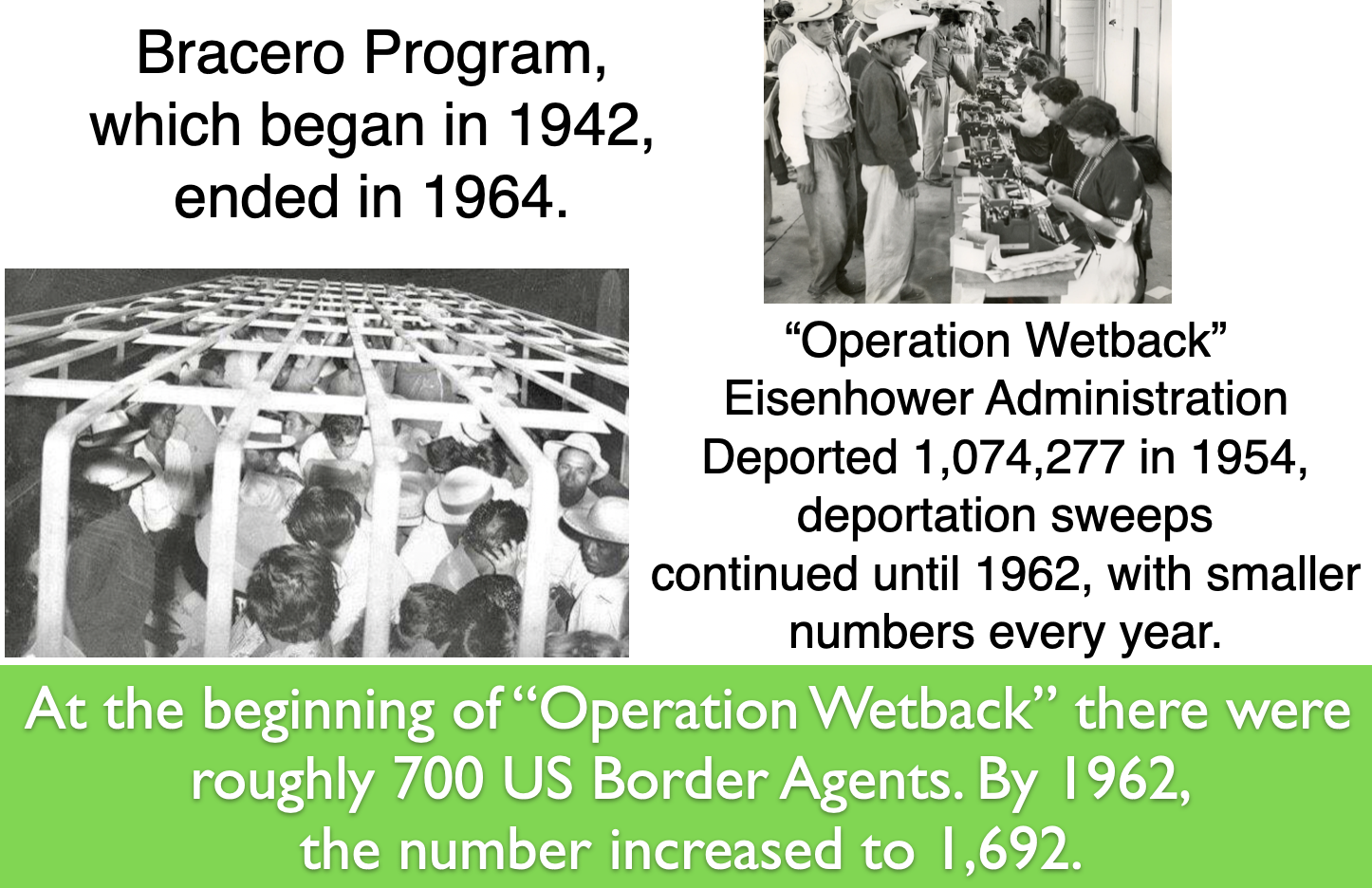
The Trump administration’s threat to engage in mass deportation is the first time a US President has threatened to deport all undocumented people. If we are going to resist the threat of mass deportation, it is important that we understand that deportation has been a long standing strategy used by numerous US administrations for more than 100 years.
The US engaged in deportation as a policy and strategy beginning with the 1875 Page Act, followed by the Chinese Exclusion Act in 1882. The Page Act prevented Chinese women from coming to the US and the Chinese Exclusion Act barred Chinese laborers for 10 years and establishing grounds for deportation of any Chinese person found unlawfully in the US. During 1885 and 1886, at least 168 communities carried out Chinese expulsion and self-deportation campaigns These campaigns resulted in the destruction of Chinese businesses, homes and several massacres.
In 1919 and 1920, the US government arrested 6000 people, mostly socialists anarchists and communists that opposed the US involvement in WWI, along with their involvement in radical labor organizing. These arrests were carried about by US Attorney General Mitchell Palmer, who also deported 556 of the leftists leaders, in what are known as the Palmer Raids.
After the Great Depression hit the US in 1929, there were between 500,000 and 2 million Mexicans that were forced to self-deport, because of all the anti-Mexican sentiment during the early 1930s.
In 1954, the Eisenhower Administration conducted what they called “Operation Wetback”, which resulted in the deportation of 1,074,277 Mexicans. This was historically one of the largest acts of deportation in US history, which President Trump referred to during his 2024 campaign.
Since the Clinton Administration, you can see how deportation, forced or voluntary removal has existed in the US, based on this graphic below.

I can offer the following educational opportunities for people, which includes these popular education slides.
- A 90 minute workshop on the history of US immigration policy
- An 8 week class on the history of US immigration policy
If you are part of a non-profit, a faith community, a grassroots group or any other organization that wants to learn more about the history of US immigration policy, then please reach out to me and we can talk about what would work best for your group. You can contact me at sjeff987@gmail.com.
Since the George W. Bush Administration, GRIID has been doing Media Literacy work in the community, which is essentially the promotion of critical thinking skills.
During the past 25 years we have been using Media Literacy Exercise #1, which we update every time a new US Administration has new cabinet members. This exercise has two parts, with Part I being the branded alphabet and Part II being a visual of White House cabinet members, and in this case cabinet members of President Trump. The answers to Part I & II can be found on page 3 of Media Literacy Exercise #1.

In both parts of this exercise, people are asking to identify the products from each letter of the alphabet, then name the members of the Trump Administration and what position they hold.
The Branded Alphabet media literacy exercise is a great way for people to:
- Understand the pervasive nature of advertising in our society and how we are all being targeted by advertising campaigns.
- Understand how the news media functions and how they decide what information to give us, when to give it to us, and how to give it to us.
- Juxtapose the Branded Alphabet with the current administration cabinet as a way to demonstrate the gap between our knowledge of products vs our knowledge of politics.
- Understand how the media system is constructed in such a way as to make consumerism a priority over an informed public
We invite you to test your knowledge, by participating in this Media Literacy Exercise. First, see if you can identify the product for each letter of the alphabet. Second, see how many people you can name in the Trump Cabinet, along with what position they hold in his administration.
Now, think about why it is easier for people to identify branded products, than to identify politicians that have a significant impact on policies that affect all of our lives. Some of the most common reasons that people give are:
- The products have been around for decades, but administration officials change regularly.
- The images of the alphabet are different, colorful and engaging, whereas the image of politicians are very similar.
- As a society we are inundated by commercial images, but the faces of administration officials are only on certain news channels or websites that focus on national politics.
- We consume products, but we don’t consume politicians.
Can you come up with more reasons why we know more of the Branded Alphabet over members of the Trump Cabinet? In addition to identifying them, can you talk about who these people are in terms of their history, their voting record (if they were elected officials), what other government positions they have held, how much money they have and what kind of political positions have they embraced over the years?
Here are a few websites that you might find helpful for answering some of these questions.
Voting Records for those in the Trump Administration have previously held federal political positions https://justfacts.votesmart.org/
Campaign Financing records for those in the Trump Administration have previously held federal political positions, or you can search what each of the Trump Cabinet members have contributed previously. https://www.opensecrets.org/
The Revolving Door Project tracks people who have been in politics and gone into the corporate world, or they came from the corporate world and are now in politics https://therevolvingdoorproject.org/personnel/
You can also compare the information you get from the above sites to what the White House has to say about these cabinet members.
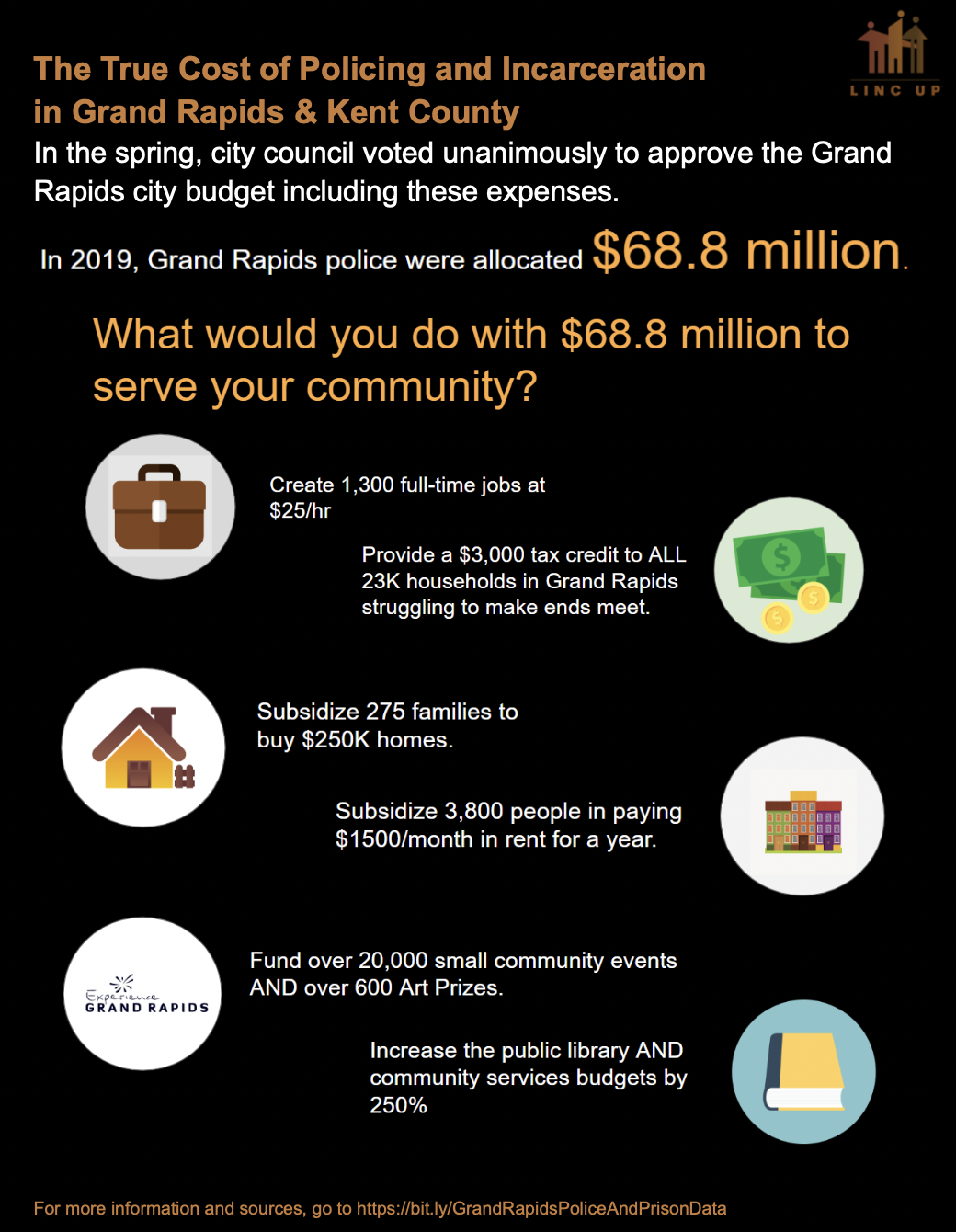 For week #4, participants in the discussion on the Prison Industrial Complex in Kent County, we looked at two items before we talked about the main reading.
The first item we looked at came up in the Week #3 class discussion, which had to do with GRPD surveillance of activist groups, specifically the GRPD targeting those demanding justice over the GRPD murder of Patrick Lyoya and the FOIA documents that were requested.
A second issue that was discussed was a look at more data on the PIC in Kent County, data that was used to create 4 community flyers that could be used as popular education tools and to engage the public in radically imagining how taxes could be diverted from policy & incarceration to meeting real community needs.
The majority of the class discussion for week #4 was spent discussing chapters 3, 4 and 5 from the book Beyond Courts. Chapter 3 provides an excellent critique of what are often called diversion programs or specialty courts. The authors of the book have this to say:
“For abolitionists, the fact that prosecutor-led diversion programs and specialty courts maintain and entrench the legitimacy of the carceral state is just one reason to oppose them. In addition, these programs: 1) extend the scope of the criminal punishment system into the community; 2) widen the net of people under carceral control; 3) increase the power, resources, and reach of prosecutors and ”judges (and the criminal punishment system more broadly); 4) further neoliberal logics of individual responsibility that uphold the criminal punishment system; and 5) are more concerned with control and submission than health and well-being. Diversion programs deprive people of self-determination through a logic of white paternalistic “care through control.”
Chapter 4 focused on a variety of community-based interventions that would shift power away from the carceral state. Some examples of community-based interventions were:
- Cop Watching
- Court Watching
- Bail Funds
- Participatory Defense Hubs
- Jury nullification

Chapter 5 centered on the abolitionist idea of Defunding Courts, just like Defunding the Police. In fact, if we are serious about abolishing the Prison Industrial Complex in Kent County, the book would call this Defunding Cops, Courts and Cages. At the beginning of Chapter 5 it states:
“For example, in 2022, there were almost 13 million misdemeanor charges that forced thousands of people into the criminal justice system each year. More than a quarter of all cases filed in criminal courts are motor vehicle, drug and broken windows offenses, so called “low-level” crimes that police and prosecutors pursued aggressively in cities particularly in the 1990s.”
The authors argue that these 13 million misdemeanor charges more often than not landed people in jail, primarily because they could not afford bail. These statistics expose the absurdity of the of the Prison Industrial Complex across the US.
There were numerous great models being used across the country, like the Seattle Solidarity Budget, which used a participatory budgeting model to redirect millions to meet community needs away from the PIC in that city.
 On Friday, MLive posted a story with following headline, “ICE is partnering with more local police agencies, but not in Michigan.”
The article strangely begins by quoting a Sheriff from Washtenaw County and Grand Rapids Police Chief Eric Winstrom, both of which claim that they are not cooperating with ICE. Just because these local law enforcement spokespersons are making a claim doesn’t mean their departments aren’t cooperating with ICE. I don’t have experience with Washtenaw County, but I have been directly involved in immigration matters in Grand Rapids and there is plenty of evidence over the years that the GRPD and the Kent County Sheriff’s Department have been cooperating with ICE. The case of Jilmar Ramos Gomez is probably the case that received the most local and national news coverage.
In fact, shortly after the Jilmar Ramos Gomez case, the City of Grand Rapids was forced to create a policy about interacting with Immigration and Customs Enforcement (ICE), known as the Foreign National’s Policy. This policy clearly states:
The policy allows officers to provide assistance to federal immigration authorities when there is an emergency that poses an immediate danger to public safety or federal agents.
Many of us from GR Rapid Response to ICE and Movimiento Cosecha are all too familiar that the rhetoric of the City and the GRPD is in dark contrast to what they practice. See my article entitled, the criminalization of dissent in Grand Rapids. The GRPD always gets to decide when public safety is being threatened, which often happens when they believe that systems of power are being challenged, like people trying to prevent ICE from arresting and detaining immigrants.
 When Movimiento Cosecha and GR Rapid Response to ICE initiated their campaign to get the City of Grand Rapids to declare the city a Sanctuary, this action came with several demands, which included: (Note: you can still sign that Action Alert)
- policies restricting the ability of state and local police to make arrests for federal immigration violations, or to detain individuals on civil immigration warrants;
- policies restricting the police or other city workers from asking about immigration status;
- policies prohibiting “287(g)” agreements through which ICE deputizes local law enforcement officers to enforce federal immigration law;
- policies that prevent local governments from entering into a contract with the federal government to hold immigrants in detention;
- policies preventing immigration detention centers in Grand Rapids.
Mayor LaGrand has gone on record that he opposes Grand Rapids becoming a Sanctuary City would give immigrants a “false sense of hope.” On the contrary, if Grand Rapids adopted the policies listed above, it would concretely mean the GRPD would not be cooperating with ICE in direct ways.
The MLive article I cited earlier in this post, specifically mentions the 287(g) program, which would allow ICE to deputizes local law enforcement officers to enforce federal immigration law. Policies such as these would give the Sanctuary declaration real teeth, not a false sense of hope, as Mayor LaGrand claims.
The MLive article also mentions Michigan law enforcement agencies and schools would cooperate with ICE if they have a judicial warrant, which the GRPD and the Grand Rapids Public Schools have said they would honor. This is cooperation, which any governing body can question and refuse to comply with.
Lastly, the MLive article mentions that, “The Michigan House passed a resolution earlier this month threatening to withhold funding from any city, county or university that has a policy to “subvert immigration enforcement in any way” or “refuses to comply with federal immigration enforcement measures.”
MLive article never cities immigrants
The response from Movimiento Cosecha to this threat of with-holding state funds for cities that declare themselves sanctuaries is powerful. Cosecha organizer Gema Lowe said:
If the State of Michigan were to withhold funds to Grand Rapids because they were a Sanctuary City, the city could first ask the people who have their names on the buildings all over this city, to donate funds to cover the cost of lost state or federal funds. Of course, it is not likely that this would happen. However, we have a saying, “Everything we need is right here in our community.” We believe that if the State or the Federal government were to withhold funds because the City of Grand Rapids decided to defy the arrest, detainment and deportation of immigrants, people in this community would step up and contribute with money, time or skills to meet the needs of people in Grand Rapids. In fact, it would galvanize the community and demonstrate that “we take care of us.”
The City of Grand Rapids has no real excuse to not declare itself a Sanctuary, it is simply a matter of political will, especially since we know that 3204 people are on record as supporting GR being a Sanctuary City, while only 16 people have gone on record as being opposed. The City better starts listening to its people.
Palestine Solidarity Information, Analysis, Local Actions and Events for the week of March 2nd
It has been nearly 17 months since the Israeli government began their most recent assault on Gaza and the West Bank. The retaliation for the October 7, 2023 Hamas attack in Israel, has escalated to what the international community has called genocide, therefore, GRIID will be providing weekly links to information and analysis that we think can better inform us of what is happening, along with the role that the US government is playing. We will also provide information on local events and actions that people can get involved in. All of this information is to provide people with the capacity of what Noam Chomsky refers to as, intellectual self-defense.

Information
Israel pounds West Bank children and infrastructure
Stop Repeating the Vast Undercount of Gazan Deaths. It Is Ten Times Greater.
Gaza Has Changed the Discourse on Popular Resistance, But Are We Truly Listening?
Israel Delays Prisoner Release, Threatening Gaza Cease-Fire
Israel Sends Tanks into West Bank Amid “De Facto Annexation” of Palestinian Lands: Mariam Barghouti
The Gaza “Ceasefire” Is at a Crucial Crossroads
Campus Police Are Using Israeli Spy Tech to Crack Down on Student Protest
ICC urged to investigate Biden’s personal role in Gaza genocide
Analysis & History
Trump Gaza Video Reflects Shared US and Israeli Histories of Ethnic Cleansing
Unlawfully Detained, Tortured and Starved: The Plight of Gaza Medical Workers in Israeli Custody
The State of the Gaza “Ceasefire” and an Interview with Hezbollah
Image used in this post is from Palestine Solidarity Grand Rapids https://www.facebook.com/PalestineSolidarityGR
 Grand Rapids Institute for Information Democracy