Western Mercenaries and Corporations Pouring Into Libya
The story by Glen Ford is re-posted from Black Agenda Report.

Western security firms – a polite term for mercenary outfits – are cramming planes into Libya to make the country safe for an invasion of western capitalists, the real beneficiaries of NATO’s war. So frenzied is the crush of war capitalists and their hired gunmen seeking to cash in on the Libyan catastrophe, the New York Times tell us a $5 cab ride from Tripoli’s airport to downtown hotels now costs $800. The head of the U.S.-Arab Chamber of Commerce calls it a “gold rush,” as officials of the government established by force of NATO airpower lay out the red carpet for the foreign hordes. Libya’s nominal new rulers in the Transitional National Council are in a rush to sell off the nation’s birthright before they’ve even got it in their hands.
The huge influx of big, burley western mercenaries is most ironic, since the so-called rebels’ principal call to arms was that Moammar Gaddafi was maintained in power by paid gunmen from sub-Saharan Africa. They used the false specter of a black mercenary presence to turn the rebellion into a race war that claimed the lives of untold thousands of black Libyans and immigrant workers – an ethnic cleansing that no doubt still unfolds and will forever mark the new regime as racist to its core. That same regime now embraces a real world invasion of Euro-American mercenaries. White and money, indeed, makes right, in the new Libya.
The bodies of the dead had not yet been buried in Sirte, the seaside city virtually leveled by months of NATO bombing – and where all of the citizens’ vehicles were stolen by riotous rebel gunmen – before trade delegations from France and Britain began descending on Tripoli. The French, who were so eager to be first in aggressive, unprovoked war, made sure they were also first in line to get a piece of the spoils. A delegation of businessmen from 80 French companies arrived a whole week before their Libyan hosts’ gunmen butchered Col. Gaddafi and scores of other prisoners. We’re sure the French raised glasses of champagne to mark the occasion.
Of course, foreigners and their money were all over Tripoli before the Europeans and Americans decided that a Shock and Awe assault on Libya would put them in a better position to deal with the uncertainties of the Arab Spring. Foreign investment in Libya increased 25-fold between 2002 and 2010. Gaddafi, by all accounts, had come to an accommodation with foreign capital. European and Asian corporations were transforming the face of Tripoli. Corporate logos on countless construction sites testified to Gaddafi’s determination to “normalize” relations with the imperial powers and the world in general. In recent years, he released from prison hundreds of Islamic fighters, as part of that “normalization.” It would be his undoing.
So, before NATO’s war, there was no question of western access to Libya – and certainly no threat of withholding oil. It is not access, but the terms of access, that makes the difference between war and peace with imperialism. For the Americans, the French and the British, the price of peace is one’s national sovereignty. Oh – and keeping out the Chinese, 30,000 of whom were forced to leave Libya when the bombs started falling. It is doubtful that they will be back in such numbers, until after the current regime is, itself, overthrown
Coverage of Campaign to Target Stabenow on Farm Bill
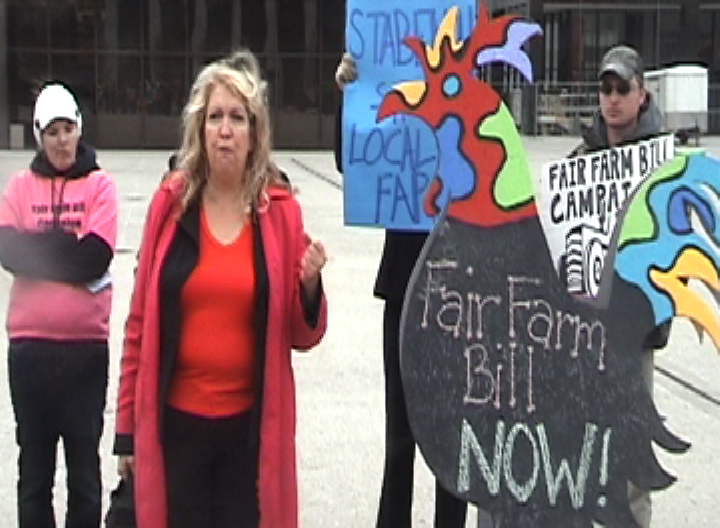
Yesterday, about 25 people gathered at Calder Plaza to stage a media event that they hope will pressure Michigan Senator Debbie Stabenow into supporting a major revision of the Farm Bill, revisions that will support small, family farms.
The event featured a spokesperson with the national advocacy group Food & Water Watch and 3 local speakers. The speakers included a mom, a local organic food market owner and a representative from the Greater Grand Rapids Food Systems Council.
The speakers addressed the need to have more local control of the food we all consume, support for small family farms, which can’t compete with agribusiness, and the need to challenge the current Farm Bill provisions which favor large farming operations.
The Grand Rapids Press cited the Food & Water Watch spokesperson and the organic market owner, but the not the other two speakers. WXMI 17 doesn’t cite any of the speakers, just a local farmer who was in attendance at the media event. This same farmer was also cited in the Grand Rapids Press story.

WXMI 17 went with some of the people who were at Calder to Plaza to deliver the postcards that people have signed to Stabenow urging her to take a stand on this issue. The group delivered nearly 3,000 postcards from West Michigan residents. The Grand Rapids Press sought out a response from one of Stabenow’s local staffers who is quoted as saying, “Family farms are critically important to Michigan’s economy. That’s why Senator Stabenow has led efforts to help small farms succeed throughout her time as a member and now as Chairwoman of the Agriculture Committee.”
Unfortunately for readers the Press never verifies such a claim that the Senator has led efforts to “help small farms succeed.” There is also no mention in any of the news coverage of the public hearing Stabenow held on the Farm Bill earlier this year, which would give readers an indication of who she has heard from on this issue.
Lastly, there was also no coverage of the Michigan farmers who are beneficiaries of the current Farm Bill structure. The Environmental Working Group documents that Michigan farmers have received $4.35 billion since 1995 from government subsidies, with the bulk of that money going to a small number of agribusiness companies/farms. You can search their database to find out which farms/businesses have been the major recipients of government subsidies.
Death of the Middle Class march this Saturday
We the People of Grand Rapids has organized a march this Saturday to protest the current economic conditions in Michigan.
Information from their Facebook event page states:
“Because of Michigan’s inability to create decent jobs,
• $1 Billion in cuts to k-12 education funding,
• cuts to college level funding,
• the new 48 month low-income assistance timeline,
• the taxing of senior’s pensions,
• reduction of the Earned Income Tax Credit,
• introduction of “Right to Work” bill,
• combined with the 86% tax-cuts to corporations
We now have an income-gap between the rich and the poor that has effectively killed the middle class. (US income equality is now 93rd in the world, below Egypt, India, China, Iran.)”
The group is going to have a funeral-style protest and is encouraging people to wear black.
Death of the Middle Class March
Saturday, November 5
11:00AM – The march starts at the corner of Ottawa and Pearl and will end at Calder Plaza with speakers.
Forum on Power, Justice and Public Memory in Central America at GVSU: Archival research on Human Experiments in Guatemala, 1946 – 1948
The second presenter at today’s Latin American Studies forum was Anna Carla Ericastilla, the current Director of the Archivo General de Centroamérica. Anna presented in Spanish, but a translator was provided.

The presenter began with a brief summary about the circumstances centering around the medical experiments conducted by US doctors on Guatemalans without their knowledge or consent.
The three archival centers in Guatemala had no knowledge of this atrocious history, but upon the discovery they began their own investigation. The objective of this investigation was to provide information to the Guatemalan government to take action on behalf of the dignity of their people.
The investigation involved the review of documents from nine different agencies and took 6 months to complete. Part of the framework for the investigation involved determining who were the people whom these experiments were conducted on – prisoners, prostitutes, the mentally ill and soldiers. There were several teams involved in the investigation, some which collected the documents and others that did the quantitative analysis of the information collected. Over 20,000 separate documents were part of this investigation.
In addition to collective the information the research team had to reconstruct the social makeup of Guatemala at the time and what mechanisms allowed for these experiments to take place. This included the role of the Ministry of Health, the military, police and legal system involved that would contribute to the medical experiments taking place. Anna also mentioned that this period was the tail end of a 4 decade dictatorship, where the state was beginning determine new social dynamics.

The researchers found that roughly 2,000 people were subjected to the medical experiments. However, since most of them were infected with STDs they most like infected members of their families or other people they came in contact with.
The group also sought to investigate who all was involved in these experiments, both from the US and within Guatemala that participated in or allowed them to happen. In addition, there was the need to determine everything from who performed the experiments, costs of resources used and other indicators to verify the claims made. One such resource discovered were the use of rabbits to incubate the STDs, which allowed the medical personnel a regular source to infect the people.
One other aspect the researchers found out women who worked as prostitutes were also used as a weapon to infect men. In some cases, the women in prostitution was forced to have sex with a dozen men in an hour in order to infect them. The men used for these experiments were those diagnosed as mentally ill, prisoners and soldiers.
They researchers also discovered that the US doctors admitted that they needed to do these kinds of experiments in Guatemala because they would not be able to conduct them in the United States.
An additional question the researchers wanted to answer was whether or not the Guatemalans used in these experiments were victims of torture. The researchers, according to the presenter, had to divorce themselves from their own personal feelings about this history and make determinations based on the research. However, the research term did conclude that these experiments did constitute a form of torture.
In conclusion, according to the presenter, the final document will include 8 chapters that will cover the social and political context of the experiments, the administrative structure in which the experiments were planned and conducted, reports on the identities of those involved, those responsible for the experiments and the subjects of those experiments.
Anna concluded her comments by stating that this was yet one more chapter of the long legacy of unjust relations between the US and Guatemala that have plague Guatemala for over a century.
Forum on Power, Justice and Public Memory in Central America at GVSU – the cultural impact of the 2009 Honduran Coup
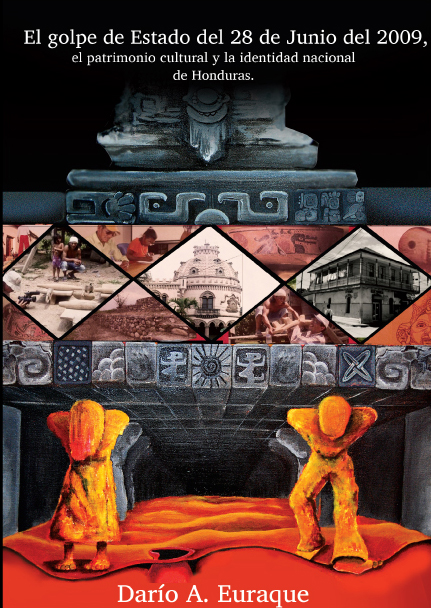
The forum hosted by the Latin American Studies department began today with a presentation by Dario Euraque, a former Director of the Instituto Hondureño de Antropología e Historia and currently Professor of History at Trinity College in Connecticut. His presentation was entitled “The Coup in Honduras in 2009: National Identity, Globalization and the Threat of History, a Personal Account.”
Dr. Euraque began by showing a clip from a documentary that accompanies a book he wrote on the 2009 Coup in Honduras. The clip includes footage, photos and interviews from people who were reflecting on the consequences of the coup. One woman was interviewed, a woman who participated in the initial mobilizations against the coup, who was raped by four soldiers.
The book Dario has written is only available in Spanish, but can be downloaded as a PDF. The 30 – minute documentary that accompanies the book is also online, which is in Spanish, with some English subtitles.
Dr. Euraque said that one of the things that he focuses on is the misinformation about the Mayan roots of Honduras. Many people identify with Mayan roots, but Dario said that this is not only true, this misinformation played a significant role in the propaganda during the 2009 coup.
Between the 1930’s and 1990’s, the government of Honduras engaged in a campaign to solidify the idea that most Hondurans have a Mayan ancestry, when in fact Dr. Euraque says that there are numerous other indigenous groups in Honduras that make up the bulk of the indigenous ancestry for Hondurans.
One of the ways that the government fostered this identity was to construct miniature replicas of Mayan ruins in central parks in communities throughout the country. Another mechanism of enculturation was to promote the nation’s Mayan heritage, particularly in the tourist industry. In the airports, the public parks and many of the hotels designed for tourism are replete with Mayan images and architecture.

In addition, much of the national identity reflects what Dr. Eurague calls the Mayanization of the country. The Honduran currency has Mayan images, the Honduran passport has a Mayan image, the national soccer team includes Mayan imagery, the phone cards and of course so much of the private sector uses Mayan imagery in their advertisements.
What all this has to do with the 2009 coup was the fact that Dr. Euraque, who was working with the Zelaya government at the time, was part of an effort to transform the national identity through de-centering Mayan heritage and promoting the other indigenous identities.

This campaign around transforming Honduran identity was done by presenting and promoting the accurate history of Honduras. Dr. Dario and others began do this by creating a vibrant national archive that was very accessible to the public. After the coup the person in charge of the archive it became under the control of pro-coup forces. Under the new control of pro-coup forces, they transformed the national archive center into a recruiting center for the military/national guard. Dr. Euraque stating that not only was this a bad decision, but it is illegal under international law to have such cultural centers turned into military facilities.
Dr. Euraque objected to this decision and in an act of solidarity, his staff at the archive held a protest in support of his decision. In fact, the national archive even became a center of resistance shortly after the coup. Because of his ongoing resistance to the coup and the misuse of the national archive building, Dr. Euraque was removed from his job in September of 2009. All throughout this presentation, Dr. Euraque showed numerous examples of this process, with photos and documents, since he felt it was extremely important to document this time and in a sense create an personal archive of the consequences of the coup in Honduras.
From Oakland to Grand Rapids: March against Police Brutality
Yesterday about 50 people marched against police brutality, in an action organized by Occupy Grand Rapids.
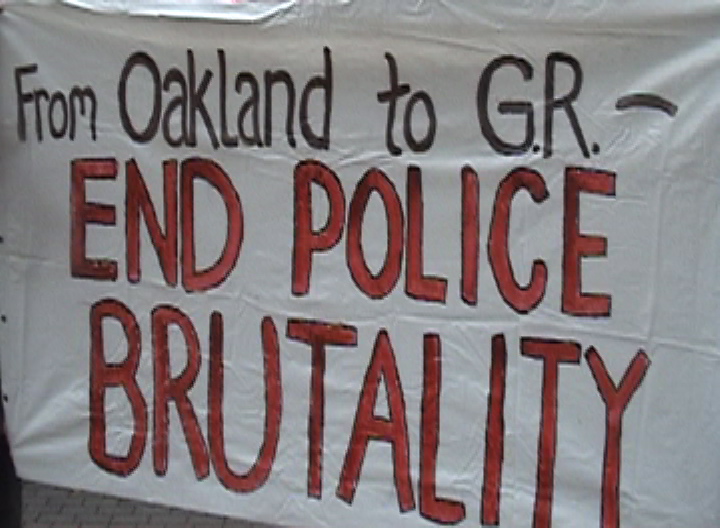
This against was taken to stand in solidarity with the community of Oakland, California, which had called for a General Strike yesterday in response to police brutality. The General Strike in Oakland shut down the ports and the downtown banks.
The Occupy Grand Rapids event was designed to make a statement by marching through downtown Grand Rapids past locations that are directly connected to the systemic violence, which is manifested through police brutality.
People marched down Division, cut through the campus of GRCC, past the courthouse, stopped briefly at Calder Plaza, past the Federal building, down Monroe, up Monroe Center past the police station and back to Monument Park where the march began.
Along the way marchers chanted and some engaged people on the street and in their cars. Most of the feedback was positive even along Division Street where marchers continued to hold signs up until the time the general assembly meeting began.
At one point while marchers were walking up Monroe Center, a few members of the IWW entered the Jimmy Johns to hand out flyers, since there has been a national campaign to organize workers at Jimmy Johns over the past year.
When people gathered back at Monument Park along Division, there was a dispute amongst some present over one sign that said, “the only good cop is a dead cop.” The reporter from the Grand Rapids Press made this the focus of his story without providing any information on the real intent of the march or people’s experiences of police brutality in this community and across the country.
Several people this reporter spoke with had not only a critical view of police, they spoke about their lived experience of suffering at the hands of police brutality, both at other demonstrations and in their daily lives. One useful document that supports this systemic violence is a toolkit put together by the group INCITE on stopping police violence, which provides detailed analysis of police brutality in this country.
While there were clearly differences of opinion about the police at yesterdays march, the Press story was in no way an accurate depiction of the broad experiences of those present at yesterday’s action.
Nov. 4/5 Seminar features noted Black Historian Tony Burroughs
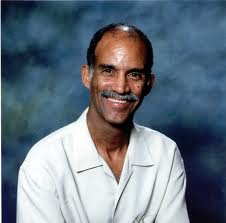
This Friday and Saturday the Western Michigan Genealogical Society will host its annual conference at Calvin College.
The focus of the two-day conference is exploring the roots of African Americans who participated in the US Civil War. Noted historian and genealogist Tony Burroughs is the keynote speaker who has done extensive research on African Americans in the Civil War.
The conference information states, “How often do we hear from Civil War soldiers themselves? Not often. It is especially rare when we hear from African American Civil War soldiers when most were prohibited from reading and writing. African American soldiers did discuss their war experiences. Hear what they said.” This is the topic for Friday.
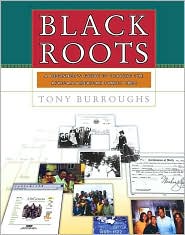
On Saturday, the conference will cover the following themes; The Nature of Genealogy, The Six Phases of African American Genealogy, Did Your Ancestor Serve in the Civil War and how to do successful genealogical research.
Friday, November 4
6:30PM – 9:30PM
Saturday, November 5
8:30AM – 5:15PM
Calvin College Prince Conference Center
1800 East Beltline
This two-day conference is co-sponsored by the Western Michigan Genealogical Society and the Kutsche Office of Local History at GVSU.
Occupy Harlem Campaign Launched
This article by Donna Lamb is re-posted from Black Agenda Report.
As Occupy Wall Street continues to galvanize America and numerous Occupy movements keep springing up in cities, towns and communities across the nation, it was only a matter of time before Harlem residents and activists took the bull by the horns and brought the initiative uptown.
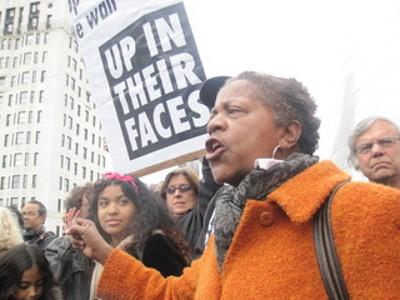
On the evening of October 28, about 150 people, many of them born and raised in Harlem, attended the first Occupy Harlem general assembly, held at St. Philip’s Church in Central Harlem. Nellie Bailey, who is with Harlem Fightback Against War at Home and Abroad as well as a member of the United National Antiwar Coalition, was a co-convener.
There were many proposals dealing with economics and jobs, including a request to endorse “Jobs for ALL,” a massive public works and public service program to create 25 million new jobs at union wages, to be paid for by new taxes on the wealth and income of the rich, on financial transactions, and on corporate profits.
Two political proposals sought endorsement of the Occupy Congress campaign to occupy the local offices of members of Congress unless they sign a pledge to vote down any proposed cuts to working people’s programs and for a congressional hearing in Washington, DC to address the second-class status of independent voters, which make up 41 percent of the electorate.
There were also important proposals regarding issues affecting Continental Africans, such as the Nuba Mountain peoples in southern Sudan, and people of African descent throughout the Diaspora, including Haiti.
“Occupy Harlem can only survive as a people’s movement with the direct involvement of the 99 percent to affect change,” Nellie Bailey said. “We need a radical transformation of the current status quo – the banks financing and controlling the political process, buying out politicians in both parties to protect the economic interest of the one percent. Poor and working class people in Harlem and throughout the country are suffering,” she continued. “We aren’t going to take it anymore. Occupy Wall Street is our blueprint.”
Joining Bailey was Black Agenda Radio commentator Glen Ford. “We can’t just wait for the people downtown in Occupy Wall Street to stand up for us. We must organize for our own economic and political defense,” he said.
Added Larry Adams of the People’s Organization for Progress, “We must take action because the recession in America is a full-blown depression for Black America.”
Focusing attention on one of Harlem’s grave concerns was guest speaker Carl Dix, national spokesperson for the Revolutionary Communist Party. He stressed the urgent need to end the NYPD’s “stop and frisk” policy that is harassing and humiliating countless innocent people.
Dix told of one Black young man who was stopped and frisked on his way to get some chicken. After the police officer found that the young man had no record, instead of just releasing him, the officer told him to do the chicken noodle soup dance and then he would let him go. “I don’t want to live in a country where our Black young men are treated like that,” declared Dix. “It is a burning injustice, and we want to tap into a supportive mood around resisting it and to link in with people who are trying to deal with it on other levels.”
The microphone was opened to all, and attendees eagerly came forward to propose a wide range of issues from the local to the international that they thought should be supported or endorsed by Occupy Harlem.
For instance, at the local level there were proposals to support the continued opposition to the planned 50-year expansion of Columbia University that threatens to take over Harlem; to endorse the struggle against the privatization of Harlem’s public housing; and to fight the closing of the Harlem post office, which will devastate many Harlemites who don’t have bank accounts and must rely on postal money orders to pay their bills. There was also a proposal to support Harlem’s community gardens that provide food, making the community less dependent on outside sources.
Along with the many issues proposed, there was robust discussion regarding procedures and a number of other items. Said Bailey: “As we feel our way in these uncharted waters, we recognize the need of the Harlem community to freely express itself. That is what we tried to do tonight instead of going by a format that others may use in their Occupy movements. As we move forward, we will work these issues out through a democratic and transparent process.”
At its next general assembly Occupy Harlem will begin considering the proposals voiced at this first meeting and organizing working committees, a crucial step forward to sustain and coalesce the movement.
Grand Rapids LGBT History – Businesses, Boycotts and Ordinances
It has been several months since the recent Holland City Commission decision to not include sexual orientation into the City’s anti-discrimination ordinance.
One of the first responses to this Holland decision from the LGBT community and their allies was to call for a boycott of Holland businesses. However, this decision quickly turned into a campaign of finding businesses that supported an LGBT inclusive ordinance and promoting them. According to the group Until Love is Equal, this tactic would send a message, “as non-supportive businesses watched customers going into other stores.”
In Grand Rapids, the campaign to get an LGBT-inclusive ordinance passed played out in a different way. The campaign to pass an ordinance began in 1991 after the Community Relations Commission recommended that the ordinance be updated to include “gender orientation” into the language.
The first time the ordinance was brought before the City Commission it was voted done 4 – 3, with lots of people at the first public hearing expressing their opposition to such an ordinance.
The LGBT community at that time did not call for a boycott of Grand Rapids businesses, nor did they seek out businesses, which supported the ordinance change. Instead, some in the local business community put together a list of those who also opposed the ordinance saying it was “contrary to the values of West Michigan.”

However, what is interesting about the businesses that actively opposed to the ordinance in Grand Rapids in 1991 was the fact that many of those in the original list actually were NOT opposed to the ordinance. The list that was provided to the Grand Rapids City Commission came from Mike Beckett, a man who worked for a local insurance agency. He submitted a list of 140 businesses he claimed were opposed to the ordinance, which members of the LGBT community at the time believed influenced the Commission’s decision.
Members of the LGBT community seemed to think that the list was not accurate and began contacting those listed to verify their stance on this issue. During this process they discovered that many of the businesses on the list did not oppose the ordinance and were never approached by Mr. Beckett about such a campaign against inclusion.
Once Mike Beckett was exposed for his deceit he made a formal apology to the Lesbian and Gay Community Network, which published his apology in their August 1991 newsletter. Once the group had verified the real list of businesses that opposed the ordinance they decided to publish that list in the September issue of the Network newsletter. It is worth noting which businesses and individuals were on that list (included here) from 1991, a list that now included just 59 entities.
After the accurate list was published there was no real push from the broader business community to oppose the ordinance, but there were some area families with significant wealth that made their opposition to equality for the LGBT community known by spending lots of money on campaigns to defeat such efforts. That is an issue we will explore in our next article on the Grand Rapids history of the LGBT community.
Included here is a 1991 archival news story on the first ordinance hearing that was defeated.
Yo Debbie! Listen to your constituents! Take a Stand!
Rally for Fair Farm Rules
Calder Plaza, Grand Rapids, MI
4:10 p.m. Thurs. Nov. 3
On Thursday, Food & Water Watch urges people from Kalamazoo and Grand Rapids to rally at Grand Rapids’ Calder Plaza to ask Senator Debbie Stabenow to support the Fair Farm Rules and Michigan’s small farmers. Stabenow, the Chair of the Senate Agriculture Committee, has so far refused to take a stand on the issue despite the fact that over the past two months, community members in Grand Rapids and Kalamazoo have gathered more than 2,500 postcards urging her to support the Fair Farm Rules.
The Fair Farm Rules prevent meatpackers from giving undue preference to large factory farms, which put small independent producers at an economic disadvantage. The new rules would:
- Stop price premiums and secret preferential contracts granted to cattle and hog factory farms.
- Prevent one buyer from representing multiple meatpackers at an auction. This practice effectively eliminates competitive bidding on livestock, which hurts small-scale producers.
- Prohibit retaliation against poultry growers who speak out about abuses.
- Protects poultry growers who make expensive upgrades and investments and prevents companies from requiring growers to make expensive upgrades to their facilities if they are in working order.
Michigan consumers and the environment lose out as small and midsize farmers are pushed out of business. We are left with fewer options for grass-fed and free range meat and poultry products as well as less access to meat, milk and eggs that are free of antibiotics and artificial hormones.
In addition, factory farming takes a terrible toll on Michigan’s environment and waterways. And, it’s only humane to  agree that animals farmed for our meat, milk and eggs should be allowed to live lives free of the constant pain, darkness and social isolation that is the norm on large factory farms. As small farms disappear, so will humane conditions for a growing majority of our fellow creatures.
The 2008 Farm Bill included new reforms to protect small and midsize livestock farmers, but those reforms are being blocked by a handful of large companies that dominate the meat and poultry industries.
Over the past five years, nearly 27,000 midsize independent family farms have been driven out of business nationally. Those remaining are squeezed by a market that favors big agribusinesses.
In June, Senator Stabenow hosted a public hearing on the Farm Bill in East Lansing that mostly involved Michigan based agri-business and agri-business associations. These entities and the clients they represent have been the recipient of billions in subsidies in the past 15 years as has been well documented by the Environmental Working Group.
 Grand Rapids Institute for Information Democracy