Palestine Solidarity Information, Analysis, Local Actions and Events for the week of March 16th
It has been more than 17 months since the Israeli government began their most recent assault on Gaza and the West Bank. The retaliation for the October 7, 2023 Hamas attack in Israel, has escalated to what the international community has called genocide, therefore, GRIID will be providing weekly links to information and analysis that we think can better inform us of what is happening, along with the role that the US government is playing. We will also provide information on local events and actions that people can get involved in. All of this information is to provide people with the capacity of what Noam Chomsky refers to as, intellectual self-defense.

Information
Death sentence for health sector as Israel closes Gaza crossings
As Israel Pulls Plug on Gaza, Smotrich Says Trump’s Ethnic Cleansing Plan ‘Taking Shape’
From Gaza to Syria: The Unyielding Reality of Israeli Settler Colonialism
Israeli Cabinet Minister: ‘Only Solution for the Gaza Strip Is to Empty It of Gazans’
Israeli soldiers vandalize and desecrate West Bank homes
EXCLUSIVE: Banned Yale Scholar Speaks Out After AI-Generated Accusations of Terror Ties
Analysis & History
The Gaza Ceasefire Stalemate and the Case of Mahmoud Khalil: A discussion with Sami Al-Arian
Gaza Doctrine: The West Bank is under fire
Image used in this post is from https://www.btselem.org/
Lessons on the history of US Immigration Policy #6: White Supremacy has always driven US Immigration Policy
 So far in this series on lessons on the history of US Immigration Policy, I have looked at the question – Is the US a Nation of Immigrants in Part I; how anti-immigration policies in the US are bipartisan in Part II; the dominant narrative around how we talk about immigrants in Part III; and an investigation into the root causes of people migrating to the US, especially those coming from Latin America, in Part IV. In Part V, I looked at false narratives about immigrants and the importance of creating counter-narrative.
In today’s post, I want to talk about how US immigration policy has historically been grounded in a white supremacy framework. Since the first immigration policies were adopted at the end of the 1700s, like the Naturalization Act of 1795. The Naturalization Law of 1802 repealed and replaced the Naturalization Act of 1798, but kept the “free white person” requirement remained.
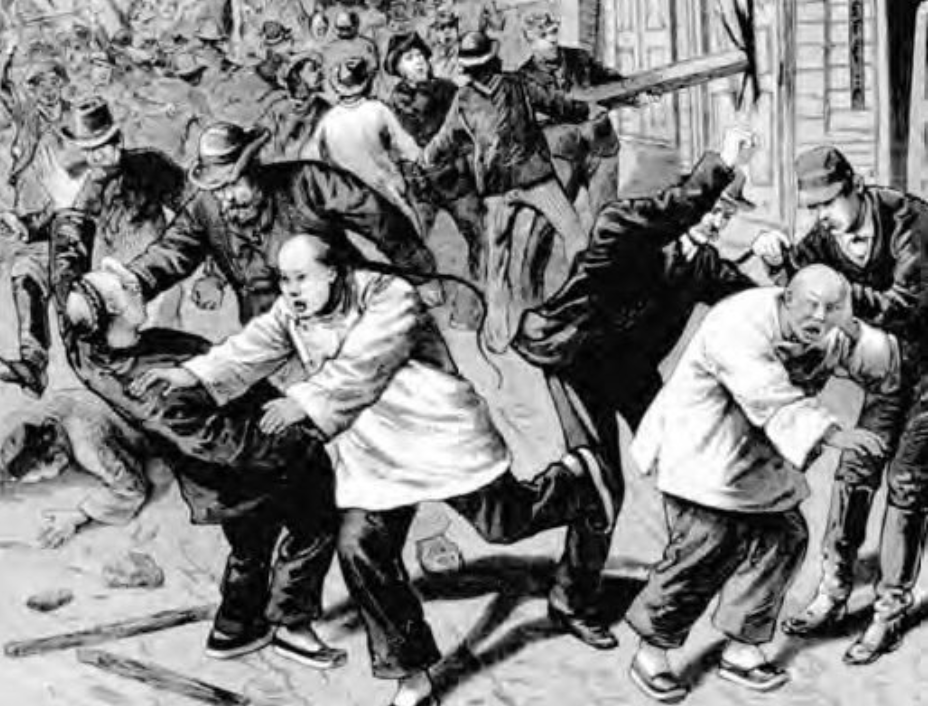 However, we first began to see the over racist nature of US Immigration policy in the later part of the 19th Century, with the passage of the Page Act in 1875. The Federal Government argument is that they didn’t want Chinese women to become prostitutes. Real reason is that they barred Chinese women so that male Chinese workers who came to work on the railroad, didn’t start families in the US.
The US government continued the anti-Chinese policy with the notorious Chinese Exclusion Act in 1882, barring Chinese laborers for 10 years and establishing grounds for deportation of any Chinese person found unlawfully in the US. Anti-Chinese immigration laws created a political climate that normalized vicious anti-Chinese sentiment. According to the book, The Deportation Machine: America’s Long History of Expelling Immigrants, between 1885 and 1886, at least 168 communities carried out Chinese expulsion and self-deportation campaigns. These campaigns resulted in the destruction of Chinese businesses, homes and several massacres.
White labor groups were even involved in the anti-Chinese campaigns, particularly on the west coast. In fact, according to an article from the Grand Rapids Evening Leader, dated December 24, 1885, a labor group was asking people to come to California to help “round up” Chinese people, which you can see in this post in that Grand Rapids newspaper in 1885.
During the Great Depression, millions of Mexican living in the US were forced to leave because of the growing anti-Mexican sentiment, coupled with the economic hardship. This is what some historians refer to as “coerced repatriation.”
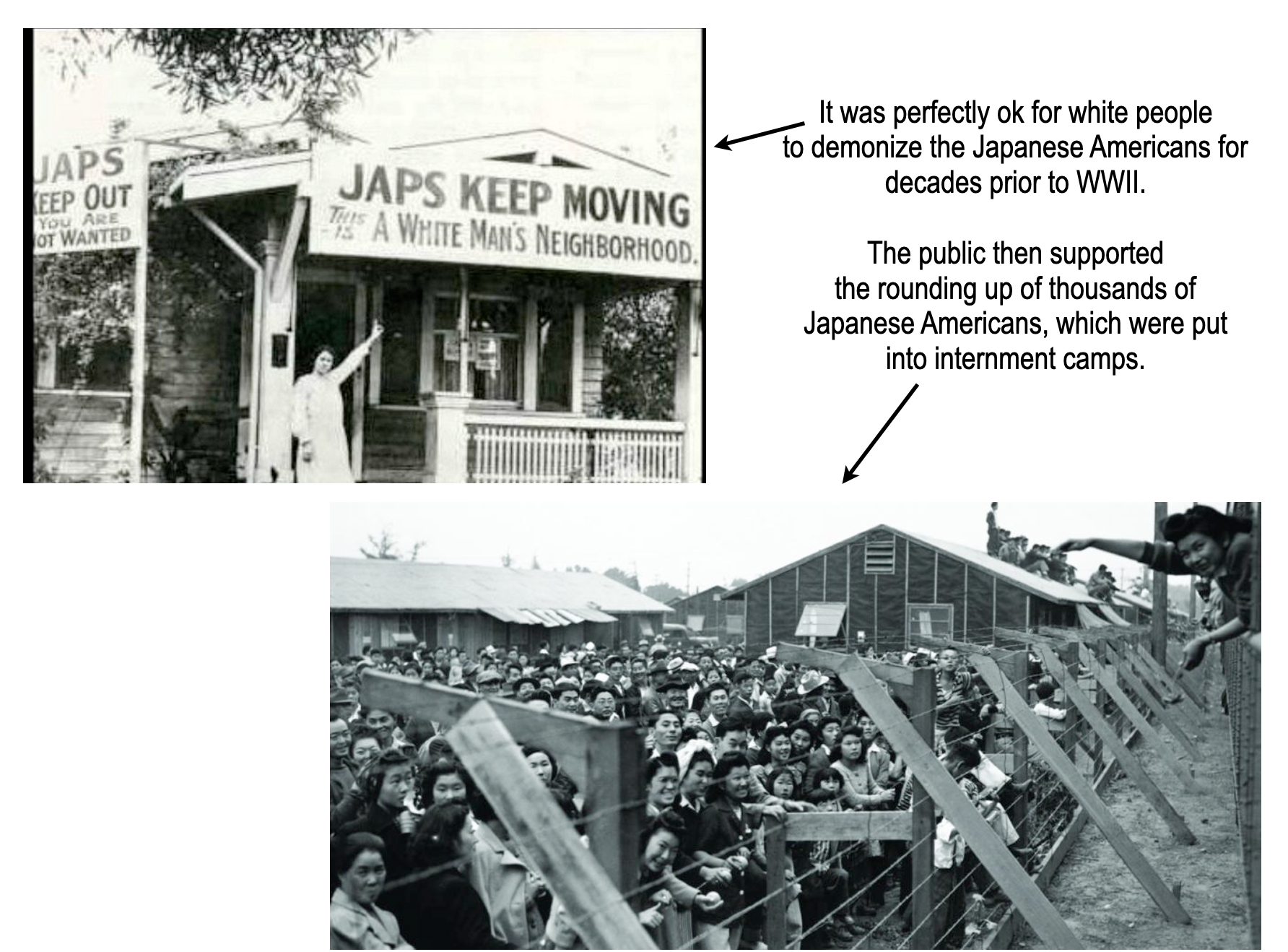
During WWII, there were thousands of Japanese Americans put into internment camps, even though many white communities were discriminating against the for years prior to the war. In fact, the US would not allow thousands of Jewish people who were fleeing Nazi Germany to come to the US, something that David Wyman documents well in his book, The Abandonment of the Jews.

In the post-Cold War era, the xenophobic nature of US immigration policy has disproportionately been reflected in the treatment of Mexican, Haitian and Central America immigrants.
I would recommend for people wanting to explore the racialized nature of US Immigration policy to read America for Americans: A History of Xenophobia in the United States, by Erika Lee and American Intolerance: Our Dark History of Demonizing Immigrants, by Robert Bartholomew & Anja Reumschussel.
One of the 10 principles of journalism is that it must serve as an independent monitor of power.
Now, I don’t claim to be a journalist, more of a media watchdog, but I do engage in movement media. Movement media is reporting and documenting what social movements are doing, which is what I have been trying to do with GRIID since 2009.

However, since I have been monitoring what I call the Grand Rapids Power Structure for nearly two decades, I thought I would start a new segment – Monitoring the Rich and Powerful in Grand Rapids.
The Monitoring the Rich and Powerful in Grand Rapids segments will offer brief commentary on those who have power over others in this community. These segments will not replace my regular reporting on the Grand Rapids Power Structure, since those stories will offer more in depth writing.
As we navigate a second Trump Administration with the likes of Elon Musk, it seems like a perfect opportunity to shed some light on rich and powerful of Grand Rapids, or to frame it the way that radical media from the 60s and 70s would do regarding the Capitalist Class, using the phrase, “up against the wall motherfucker!”
- Grand Valley State University President Philomena Mantella was appointed to the board of directors for the Detroit branch of the Federal Reserve Bank Chicago. Mantella can add this appointment to her list of other roles that demonstrates that she is more interested in being connected to centers of power than promoting critical thinking and academic freedom. Mantella is also part of the Right Place Inc., the Econ Club of Grand Rapids, and Grand Action 2.0. In 2023, the President of GVSU decided to partner with local companies to promote a talent pipeline for local business, when she stated: “We are addressing labor-shortage concerns and creating a positive impact on the business community. This program will highlight Grand Valley students’ human-centered skills and deep knowledge of their disciplines, and the companies will benefit from well-prepared employees.”
- On Tuesday, the Grand Rapids City Commission voted to authorize $128 million in capital improvement bonds that will go toward constructing the Acrisure Amphitheater and Amway Stadium, as reported in Crain’s Business. This money will eventually come out of the Hotel Tax, which was increased last year through an August ballot initiative. However, the City’s willingness to approve the $128 million bond for entertainment facilities is reflective of their priorities, since Grand Rapids City Commissioners have never agreed to take out a similar amount for affordable housing or any other social benefit for the residents of Grand Rapids. Imagine if Grand Rapids took out a bond of $128 million for housing? Imagine if people could get $50,000 towards a downpayment for a modest $250,000 home. $128 million could provide 2560 families with a downpayment. For tenants who are paying $2000 a month for rent, which is $24,000 a year, then $128 million could cover the cost of rent for 5333 families for an entire year. Now, that would be housing justice!
- The Acton Institute is a notorious think tank that calls Grand Rapids home. GRIID has been writing about the Acton Institute for decades. However, we also are always looking at who sits on their board of directors. For instance, J.C. Huizenga, the CEO of National Heritage Academies (NHA), is an Acton Institute board member. NHA is a charter school entity that has a long history of undermining public education. JC Huizenga also sits on the Grand Rapids Promise board. At one of their board meetings in someone entions BIPOC students and Huizenga responds, “what does BIPOC stand for?” Former GRPS Superintendent Teresa Weatherall Neal responds, “It’s just another name for non-sense, JC.” JC Huizenga then asks, “I’m wondering, does this discriminate against Asian people, Jews who aren’t wealthy or Syrian Refugees?” All the while Weatherall Neal is shaking her head in affirmation of Huizenga’s comment. Weatherall Neal talks about how she had to deal with the term BIPOC while she was GRPS Superintendent. “Black signifies all people from Africa. So everyone is lumped together.” You could not make this stuff up.
Last week marked the 60th anniversary of what is often referred to as Bloody Sunday, where police beat Civil Rights activists during a march through Selma across the Edmund Pettus Bridge.
The Student Non-violent Coordinating Committee (SNCC) has been engaged in a 2-year voting rights campaign in Selma, so SNCC leader John Lewis, along with Hosea Williams (SCLC) led the march. A blockade of state troopers and local cops told those marching to disperse, to which they refused.The police gave orders to attack those marching, beating them with clubs in a cloud of tear gas, while mounted police ran down marchers and continued to club them as they fled.
The march was organized not only because of the fight for Voting Rights, but to honor the death of Jimmy Lee Jackson, who was murdered by the police on February 18th, 1965. On March 3rd, Dr. King delivered the eulogy for Jackson, which included the following words:
Jimmy Lee Jackson was murdered by every white minister of the gospel who has remained silent behind the safe security of his stain-glassed windows. He was murdered by the irresponsibility of every politician…..who has fed his constituents the stale bread of hatred and the spoiled meat of racism. He was murdered by the timidity of a federal government that is willing to spend millions of dollars a day to defend freedom in Vietnam but cannot protect the rights of its citizens at home. He was murdered by every sheriff who practices lawlessness in the name of law. He was murdered by the cowardice of every Negro who passively accepts the evils of segregation and stands on the sidelines in the struggle for justice.

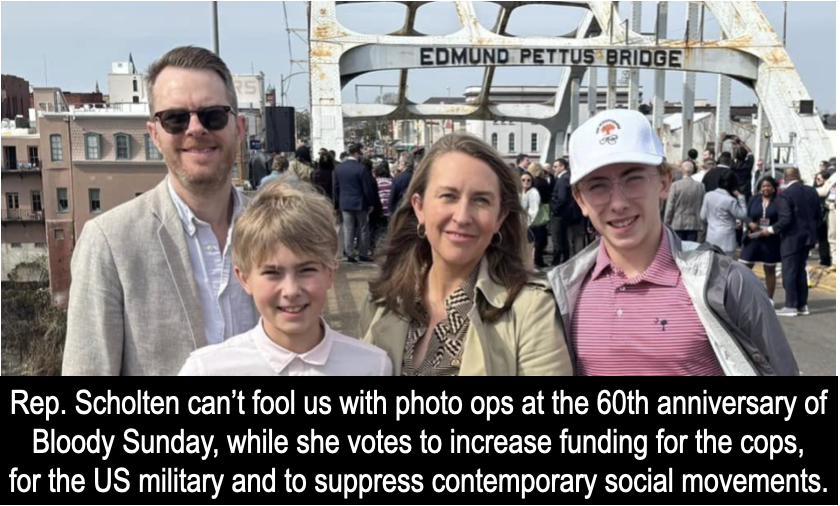
Interestingly enough, Rep. Hillary Scholten posted numerous photos of her family who went to Alabama for this historic 60th anniversary of Bloody Sunday. Here is a picture of Scholten’s family on the Edmund Pettus Bridge, where Black activists were brutalized by cops. No one should be fooled by the photo ops from Rep. Scholten, especially in light of the comments that Dr. King made in 1965 at the funeral of Jimmy Lee Jackson.
Putting sentiment aside, let’s look at the voting record of Rep. Scholten since she was first elected as the 3rd Congressional Representative for Michigan in 2022, and juxtapose her voting record with Dr. King’s words cited above.
During Police Week in 2024, Rep. Scholten made the following statement:
“Every single day, law enforcement officers put their lives on the line to protect their communities. I’ve had the honor of meeting hundreds of these heroes during my time in Congress, and I am in awe of their willingness to put others above self in a time when serving one’s community is all the more challenging. As we work to make policing stronger and safer for all in West Michigan, it’s so important to recognize our safety heroes who do this work every single day. This week, the House came together in a bipartisan way to advance several pieces of legislation that will improve the lives of officers around the country, and I was proud to be a part of this much-needed effort.”
These words from Rep. Scholten were matched by her votes in 2024, which are listed below, with some commentary from GRIID.
- H.R. 3325 – The Recruit and Retain Act to authorize law enforcement agencies to use Community Oriented Policing grants for recruitment activities, in an effort to address an unprecedented crisis in hiring and retaining qualified personnel. GRIID – she voted for more public money to be used to recruit more cops, which are state violence workers.
- H.R. 7581 – The Improving Law Enforcement Officer Safety and Wellness Through Data Act to require the U.S. Attorney General–within 270 days of enactment–to submit reports that detail acts of violence against law enforcement officers and the efficacy of programs intended to provide law enforcement with wellness resources. GRIID – Let’s find more money and created programs to assist cops with wellness, but not for the families of the 426 people that the cops have killed so far in 2024, according to https://mappingpoliceviolence.org/.
- H.R. 7343 – TheDetain and Deport Illegal Aliens Who Assault Cops Act to require that non-U.S. nationals who assault law enforcement officers must be arrested, detained, and removed from the U.S. GRIID – really, this shit. Does Rep. Scholten want us believe that there is an epidemic of undocumented immigrants assaulting cops? PLEASE!
- H.Res. 1213 – A resolution regarding violence against law enforcement officers. GRIID – This resolution begins by stating, “Whereas, beginning in 2020, and in conjunction with the “defund the police” movement, respect for the rule of law and law enforcement officials diminished;” This is very telling, since it equates the Black-led Defund the Police Movement with the lack of respect for the rule of law. How can any reasonable person respect cops who brutalize Black people, or in the case of Patrick Lyoya, shot them in the back of the head while sitting on top of them?
In addition to supporting the police and voting for more public money for cops, Rep. Scholten has voted for the massive US military budgets over the past two years, which Dr. King also condemned since it took money away from meeting the needs of every day Americans.
A third way that Rep. Scholten betrays the memory of Bloody Sunday, is by voting to suppress the pro-Palestine campus movement, which Dr. King would certainly have endorsed. I wrote about this just yesterday, but will include part of what I wrote regarding Rep. Scholten’s position on the pro-Palestine campus movement.
Rep. Scholten, the so-called liberal, once again is demonstrating her allegiance to US Imperialism, to Zionism and her commitment to the repression of free speech. Notice that the Congresswoman provides no evidence of antisemitism. You just have to invoke it to make it a fact, just like Zionists preach. On top of the unsubstantiated claim of antisemitism, Rep. Scholten takes it one step further by partnering with a Republican from Indiana to introduce legislation that in reality is meant to further silence critics of Israel and US policies that support Israel. However, this might be a good time to point out why Rep. Hillary Scholten is on the wrong side of history and the wrong side of justice.
- US students and faculty are organizing to stand in solidarity with the Palestinians and against the US-funded Israeli genocide that has already killed 35,000 Palestinians.
- Many of the campus protests against the Israeli genocide are being led by Jewish students and faculty.
- US students who are organizing encampments across the country are following in the same tradition as previous movements like the Civil Rights Movement, the anti-Vietnam and anti-Iraq War Movements, the Climate Justice Movement, and the South African anti-Apartheid Movement, just to name a few.
- US students and faculty are exposing the political and economic commitment that Higher Education has to conformity, especially when it comes to US foreign policy and Israel.
- US students and faculty are also exposing how the police state functions in the US, especially when university trustees and university donors are pressuring campuses to actively suppress this movement.
In the end, Rep. Hillary Scholten can not hide behind the 60th anniversary commemoration of what happened on the Edmund Pettus Bridge. Rep. Scholten is in no way furthering the cause of justice for Black people, for immigrants, but she is proudly voting for increased funding for the cops and for the US military. How dare she cheapen the memory of the Black Freedom Struggle, of the SNCC organizers and the murder of Jimmy Lee Jackson.
Photo credit goes to Spider Martin – 1965.
Fox News asked Betsy DeVos what she would do if she was Secretary of Education in the 2nd Trump Administration
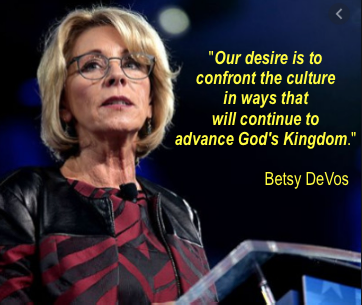 A month ago, Betsy DeVos was interviewed by Fox News, where she was asked about being the Secretary of Education in the second Trump Administration, along with what she thinks the Trump Administration should focus on regarding education policy.
Of course, Betsy DeVos was passed over, with Trump nominating Linda McMahon as the new Secretary of Education. However, this didn’t stop DeVos from speaking her mind about what the 2nd Trump Administration should do regarding the Department of Education.
Here are some highlights from what Betsy DeVos had to say:
- She hopes that Trump will complete the education agenda from the first term.
- DeVos believes that the Department of Education has been a completer failure, since its founding in 1979.
- DeVos said that one trillion has been spent on the Department of Education, with zero or near zero benefits.
- DeVos said, we are not talking about defunding or eliminating the budget, but having the money be more effectively spent – block granting back to the state and directly to families who need it the most.
- In response to “critics” of school choice programs, Betsy DeVos said that those are opposed to school choice have been around for a long time, but the achievement levels have increased with school choice programs.
- DeVos also claims that teachers will benefit under the Trump Administration’s education priorities.
- DeVos claims that the Free Application for Federal Student Aid (FAFSA) reform will be beneficial to students, since it will move “professionals” into administering student loans, which means privatizing federal loans, which DeVos believes would mean more accountability.
- DeVos would also love to see the Education Freedom Policy implemented.
So far the Trump Administration has signed two Executive Orders related to the Department of Education and education policy – Keeping Education Accessible and Ending Covid-19 Vaccine Mandates in Schools, and Ending Radical Indoctrination in K-12 Schooling.
GRIID methodically monitored the 4 years that Betsy DeVos spent in the Trump Administration, wiring about what the billionaire was doing and what her agenda was as the Secretary of Education. I put those articles under the section – Betsy DeVos Watch.
GRIID made it very clear in 2016, when Donald Trump asked Betsy DeVos to be his Education Secretary, that she has always been an enemy of public education. Betsy DeVos led a school voucher campaign in Michigan, a campaign that was defeated in 2000. Betsy didn’t let that stop her efforts to undermine public education, because the very next year she created the Great Lakes Education Project.
Betsy DeVos has always seen education as a talent pipeline for the business community, but more importantly, she has been promoting a NeoLiberal Education model for more than 3 decades.
During an American Legislative Exchange Council (ALEC) summit, DeVos used standard content from the Neo-Liberal playbook, arguing states rights, choice, the market-place of ideas and even attempting to use language such as, “We the People.” One aspect of the Neo-Liberal playbook is to convince people that whatever policy the right wants to promote is all about freedom and liberty. In addition, one other major theme is to attack the federal government. This message has been central to every administration since Ronald Reagan, even though the Neo-Liberal agenda is not always against the Federal Government. For instance, entities like ALEC or the State Policy Network a deeply in favor of government intervention and policy when it comes to the annual US military budget, tax policies that benefit the wealthy and massive subsidies for corporations. Thus, the Neo-Liberal Agenda is quite selective in their notion of choice and freedom, especially when it comes to policies that benefit the Capitalist Class.

This is why Betsy DeVos promoted what she called Education Freedom Scholarships. According to DeVos, “The policy will make a historic investment in America’s students, injecting up to $5 billion yearly into locally controlled scholarship programs that empower students to choose the learning environment and style that best meets their unique needs.” These programs allow people and corporations to donate to a designated scholarship granting organization (SGO) and be reimbursed in the form of a tax credit. With the DeVos plan, states would designate the eligible SGOs, but the federal government would fund the tax credit reimbursement, up to $5 billion total.
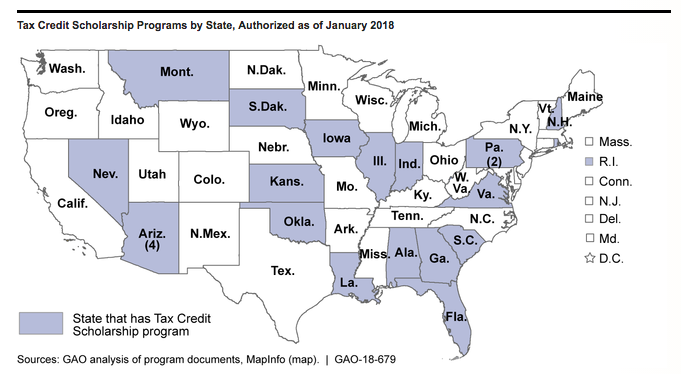
Betsy DeVos has been directly involved in getting these tax credit scholarship programs in the states in the graphic above, through a network of organizations that mirror groups in Michigan like the Great Lakes Education Project and the Mackinac Center for Public Policy. Across the country, the State Policy Network, which brings together groups that primarily push for policy changes at the state level.
The claim made by the former Secretary of Education that School Choice is better and that achievement levels have increased is in sharp contrast to the data and analysis of a 2019 report entitled, Still Asleep at the Wheel: How the Federal Charter School Programs Results in a Pileup of Fraud and Waste. There has been over $1 billion in federal funding for Charter Schools that either never opened or have since closed. The report’s Executive Summary states:
It is impossible to document total waste for the entire 25 year program because the Department never required the states to report the names of funded schools until 2006. However, we have now documented $502,468,123 (28 percent of the total database amount) that was awarded to schools from grants that were active between SY 2006-07 and SY 2013-14 that never opened or that have closed. Applying that percentage to the total expenditures ($4.1 billion) of the CSP programs designed to create new schools, approximately $1.17 billion in federal funding has likely been spent on charters that either never opened, or that opened and have since shut down.
Facts and data don’t matter to people like Betsy DeVos, not when their deep commitment to Capitalism and their ideological belief in God drives them.
When Betsy DeVos gave a speech at the far right school Hillsdale College, DeVos was more candid than usual, since she was speaker to those with the same ideological commitments. In part of her speech, DeVos didn’t mince words about what she really thinks of the American public that doesn’t embrace God and County, when she said:
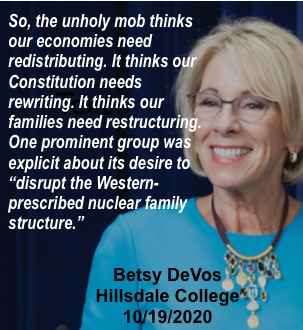 So, the unholy mob thinks our economies need redistributing. It thinks our Constitution needs rewriting. It thinks our families need restructuring. One prominent group was explicit about its desire to “disrupt the Western-prescribed nuclear family structure.”
That’s taken right from the old Marxist playbook. It admits the goal is to “[do] away with private property and [educate] children on a communal basis, and in this way [remove] the two bases of traditional marriage.”
While I miss the opportunity to critique Betsy DeVos as Secretary of Education, whatever the Trump Administration plans to do with the Department of Education and the Education budget will lean heavily on the network of charter schools and private schools across the US, along with think tanks, associations and organizations that are a part of the State Policy Network, all of which Betsy DeVos and her family have had a hand in crafting and funding. The battle for public education will be waged at the local and state level, regardless of whether or not the Department of Education will be dismantled under Donald Trump.
The Biden Administration paved the way for Trump’s policy of punishing Pro-Palestine campus organizers
 In the past few days we learned that Department of Homeland Security (DHS) agents entered a student residential building at Columbia University in uptown New York and detained Mahmoud Khalil, one of the lead negotiators on behalf of pro-Palestine protesters at 2024’s Gaza solidarity encampment.
Within just a few days, over 2 million letters have been sent to the Department of Homeland Security, to Immigration and Customs Enforcement and to Columbia University, demanding the Immediate Release of Palestinian Student Activist Mahmoud Khalil from DHS detention.
Just yesterday, we learned that a New York federal court judge ordered that recent Columbia University graduate Mahmoud Khalil cannot be deported from the United States until a further court order.
Like several of the Trump Administration’s oppressive policies, the public and the courts have pushed back, so we’ll see what happens with Mahmoud Khalil and those who have been part of the pro-Palestine campus movement.
Of course, all of this is offensive and disgusting, since it means that free speech is no longer protected. However, if we are to honestly engage in fighting this issue, we have to come to terms with the fact that the Biden Administration paved the way for Trump’s policy of punishing Pro-Palestine campus organizers.
 Do you remember President Biden’s swift and strong response when pro-Israel extremists reportedly blasted the chemical weapon “skunk spray” on students peacefully protesting at Columbia University earlier this year? Do you remember how the White House condemned the attack, demanded accountability, and called on the school to protect students from such hate?
No? You don’t remember? Of course you don’t. Because none of it happened. President Biden didn’t respond swiftly or strongly to the skunk spray attack. He didn’t respond at all.
How about President Biden’s response when a Texas man hurled racist slurs at a group of Palestinian Americans after a ceasefire protest at the University of Texas in Austin, ripped a Palestinian flagpole off their car, dragged one of them out of the backseat, and stabbed him?
The Biden administration’s silence was nothing new.
On Stanford University’s campus, a driver yelling“F—k you and your people” reportedly used his car to ram an Arab Muslim student attending a ceasefire protest, sending him to the hospital. No response from the White House.
At the University of Texas, pro-Israel extremists disrupted a Palestine Solidarity Committee meeting and hurled profanities at the attendees. No response.
In Arizona, Texas, Georgia, New York and other states, law enforcement agencies have brutalized students and even professors who attended peaceful protests against the genocide in Gaza. Again, no response.
Now contrast the White House’s lack of response to violent actions motivated by anti-Palestinian hate with the White House’s vocal response to inflammatory words that a small number of individuals have allegedly said at or near pro-ceasefire protests on college campuses.
“I condemn the antisemitic protests, that’s why I set up a program to deal with that,” the president said, broadly mischaracterizing the sit-ins led mostly by Jewish and Palestinian students.
In a statement marking Passover, Biden said, “Even in recent days, we’ve seen harassment and calls for violence against Jews. This blatant antisemitism is reprehensible and dangerous – and it has absolutely no place on college campuses or anywhere in our country.”
Last fall, the White House rushed to falsely claim that ceasefire protesters in Philadelphia were antisemitic for demonstrating outside a kosher restaurant—the protesters actually targeted the business because it held a fundraiser benefiting the IDF.
But the White House said nothing when protesters at November’s March for Israel chanted genocidal slogans. On the contrary, a prominent Biden administration official spoke at the march, sharing the stage with notoriously anti-Muslim and antisemitic pastor John Hagee.
All of what the Biden Administration did or didn’t do, helped to pave the way for the Trump Administration to further target pro-Palestine activists. If the Biden Administration would have condemned violent actions against pro-Palestine activists or spoke up to condemn the witch hunts that Rep. Elise Stefanik from New York was engaged in by going after University Presidents and other campus leaders, it would have made it harder for the Trump Administration to do what they want to do with Pro-Palestine campus organizers.
The same could be said for the role that Rep. Hillary Scholten played in demonizing pro-Palestine campus organizer.

Last April, I wrote a piece about how Rep. Scholten responded to the pro-Palestine campus movement. Scholten wrote in her weekly newsletter:
“I’m sure many of you have seen the ongoing protests happening on college and university campuses across the country right now. The right to free speech and protest is fundamental, but far too many of these protests have crossed the line into harassment, intimidation, and discriminatory anti-semitism. Colleges and universities do not have enough clear guidance on what does and does not cross the line into antisemitism– which has put Jewish students at risk and at the same time, jeopardizes legitimate free speech. Students have the right to peacefully protest, but antisemitism is never –and never will be– tolerated.
As others rushed to the cameras, I got to work on solutions. This week, my Republican colleague and fellow midwesterner Rep. Rudy Yakym from Indiana and I championed our new bill, the PROTECT Jewish Students and Faculty Act, to require colleges and universities to adopt the International Holocaust Remembrance Alliance’s official working definition of antisemitism in student and faculty codes of conduct as a condition of receiving Title IV federal funds for financial aid. This way, we’re protecting students and faculty and ensuring that institutions of higher education can be safe spaces of learning and free expression for all.”
Rep. Scholten, the so-called liberal, once again is demonstrating her allegiance to US Imperialism, to Zionism and her commitment to the repression of free speech. Notice that the Congresswoman provides no evidence of antisemitism. You just have to invoke it to make it a fact, just like Zionists preach. On top of the unsubstantiated claim of antisemitism, Rep. Scholten takes it one step further by partnering with a Republican from Indiana to introduce legislation that in reality is meant to further silence critics of Israel and US policies that support Israel. However, this might be a good time to point out why Rep. Hillary Scholten is on the wrong side of history and the wrong side of justice.
- US students and faculty are organizing to stand in solidarity with the Palestinians and against the US-funded Israeli genocide that has already killed 35,000 Palestinians.
- Many of the campus protests against the Israeli genocide are being led by Jewish students and faculty.
- US students who are organizing encampments across the country are following in the same tradition as previous movements like the Civil Rights Movement, the anti-Vietnam and anti-Iraq War Movements, the Climate Justice Movement, and the South African anti-Apartheid Movement, just to name a few.
- US students and faculty are exposing the political and economic commitment that Higher Education has to conformity, especially when it comes to US foreign policy and Israel.
- US students and faculty are also exposing how the police state functions in the US, especially when university trustees and university donors are pressuring campuses to actively suppress this movement.
Instead, what Rep. Hillary Scholten is doing is taken right from the Zionist playbook to blame the victim or anybody else, but never Israel. Scholten is one of 9 co-sponsors of H.R. 7478, which was introduced by Rep. Rudy Yakym from Indiana. Scholten is only one of two Democrats who cosponsored this shitty piece of legislation that includes the likes of Rep. Elise Stefanik from New York. Stefanik has been the person leading the charge to discredit universities who allow Palestine Solidarity actions or Middle East Studies that question Israel’s illegal occupation of Palestinian land.
It’s bad enough that Rep. Scholten has consistently voted to send billions of dollars in US military aid to unconditionally support Israel and to participate in an AIPAC funded trip to Israel last year, she now wants to use a right-wing tactic to silence college students across the US for courageously denouncing genocide. Rep. Scholten’s legacy as a member of Congress will be that she defended genocide and the suppression of those who opposed genocide. This is also the legacy of the Biden Administration and it paved the way for the Trump Administration to escalate the repression against pro-Palestine campus organizers.
Viva Flaherty – Radical Socialist who documented the furniture workers strike and resisted WWI in Grand Rapids
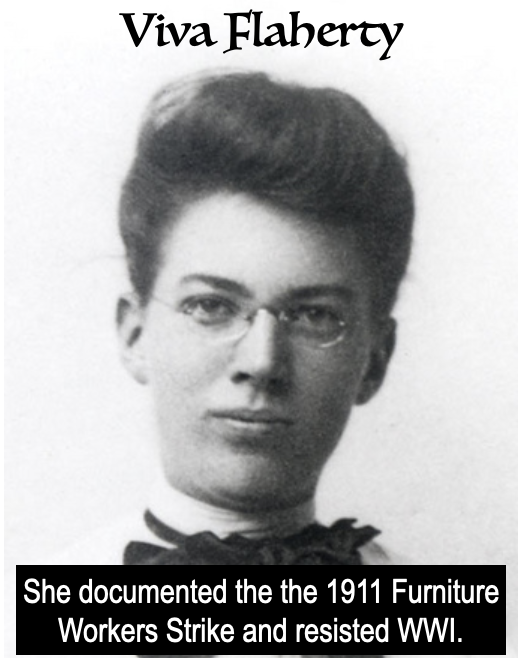 Last week I posted a story about Voltairine De Cleyre, a feminist and anarchist writer who lived in Grand Rapids in the 1880s. Today, I want to draw attention to Viva Flaherty.
At the time of the 1911 Grand Rapids Furniture Workers Strike, Viva Flaherty was working as the office secretary at Fountain Street Church, which was a Baptist Church in the early part of the 20th Century.
Viva Flaherty documented the 1911 strike because she believed that the “people of Grand Rapids are awakened and enlightened and they can be trusted with the whole truth.” Flaherty went on to say, in her introduction to the History of the Grand Rapids Furniture Strike:
“A strike is a public matter, and if the people are to know how another is to be avoided they should know all the inside facts of this one, so that they may know whom to distrust and on whose shoulders rests blame for a nineteen weeks strike.”
Flaherty makes it clear in her version of the story that the strike was able to endure as long as it did because of the seven unions that were involved, with membership of over 4,000 workers in thirty-five shops in Grand Rapids. She also made it clear in the opening observations of her historical account that the Christian Reformed Church would not grant their members the right to be part of the union, since it was not “founded on divine right.”
On page 8 of the booklet written by Flaherty, she documents the kind of wages earned by those in the furniture industry, stating that of the eight thousand furniture workers employed in Grand Rapids, most made less than $2 a day. Flaherty also mentions that as early as 1909, after furniture workers found out that the price of what they produced had increased by 10%, they demanded that their wages increase. Some of the workers who had made such demands in 1909 were fired shortly thereafter as being agitators.
A commission was established to investigate the grievances of the workers, which included a final report. However, according to Flaherty, the Brotherhood of Carpenters and Joiners had designated the commission as, “the hired servant of that powerful union, the Furniture Manufacturers Employers’ Association.”
Such suspicions were affirmed by the furniture industry’s claims that they needed to honor any of the demands from the striking workers around wages, hours, piece work, etc. Flaherty notes that the furniture barons, “repudiated any social responsibility to regulate wages to suit the cost of living.”
On page 17, Flaherty affirms the workers admiration of Bishop Schrembs when she writes:
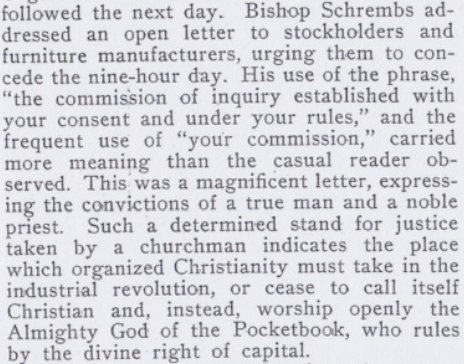
Such commentary not only reflects that Schrembs was practicing the social gospel, but it also reflects the sophistication of Flaherty and her keen theological observations. What a powerful indictment she makes of the church that endorsed the furniture barons, by stating that they worship the Almighty God of the Pocketbook.
Flaherty then goes on to talk more about the specifics of the strike, beginning on page 18, where she discusses the “riot” on May 15. The “riot” Flaherty was speaking of is when workers and their wives confronted strikebreakers & scabs who were brought in to continue with production after the walkout of 7,000 furniture workers.
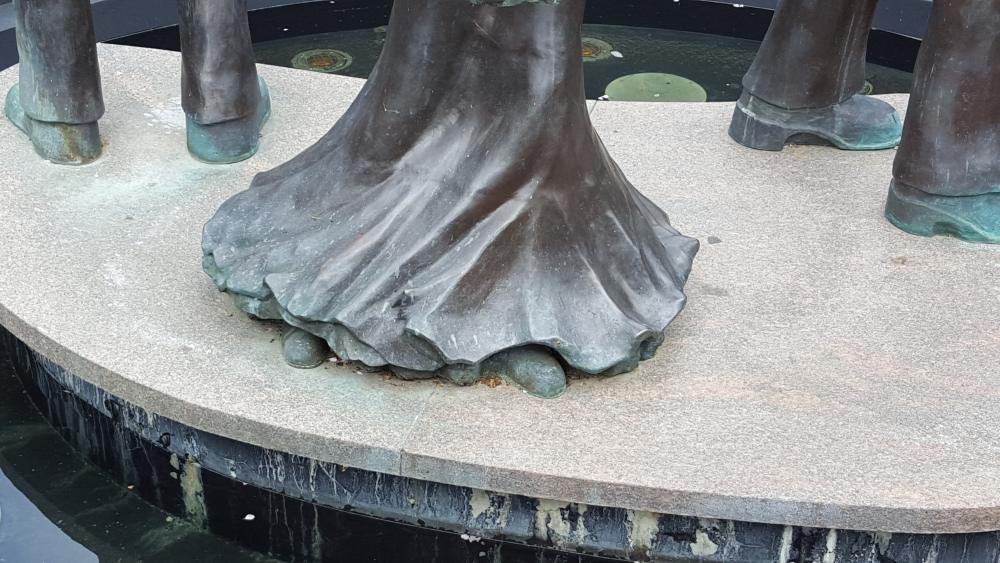
It is worth noting here that during the confrontation against the scab workers, many of the women in the crowd, who had been hiding rocks and bricks under their dresses began to throw them at the scab workers and cops who attempted to escort them into the factories. Such disgust at the attempt to break the strike by the furniture barons is captured in the statue dedicated to the 1911 furniture workers strike. At the feet of the woman depicted in the statue, you can see rocks underneath her dress.
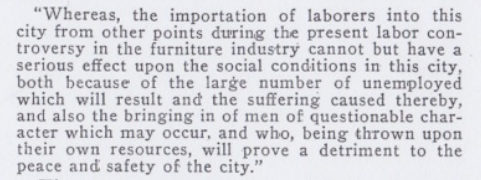
The City of Grand Rapids, for its part, not only called for arbitration during the strike, but adopted this resolution on July 24, 1911:
Towards the end of the booklet, Flaherty provides more forceful observations about the furniture industry and reflects a high level of class consciousness that workers had developed in the early part of the 20th century. Flaherty states:
“Capital knows that when the people realize that capital is organized in this country today for the conscious and deliberate purpose of crushing labor in its efforts to become free, the people will make common cause with labor and send the divine right of capital to join the divine right of kings. Industrial freedom is a state which the world as yet has not experienced.”
Flaherty then follows up with a clear indictment against the captains of industry, particularly the National Association of Manufacturers and the Furniture Manufacturers Employers’ Association. These entities were producing their own propaganda that blamed workers for being “class conscious” and for “stirring up trouble.”
Resisting World War I
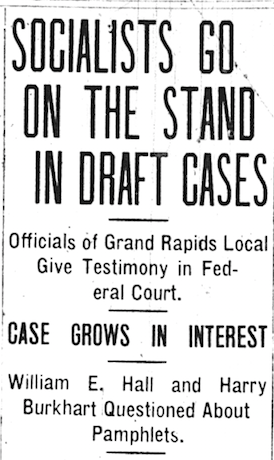
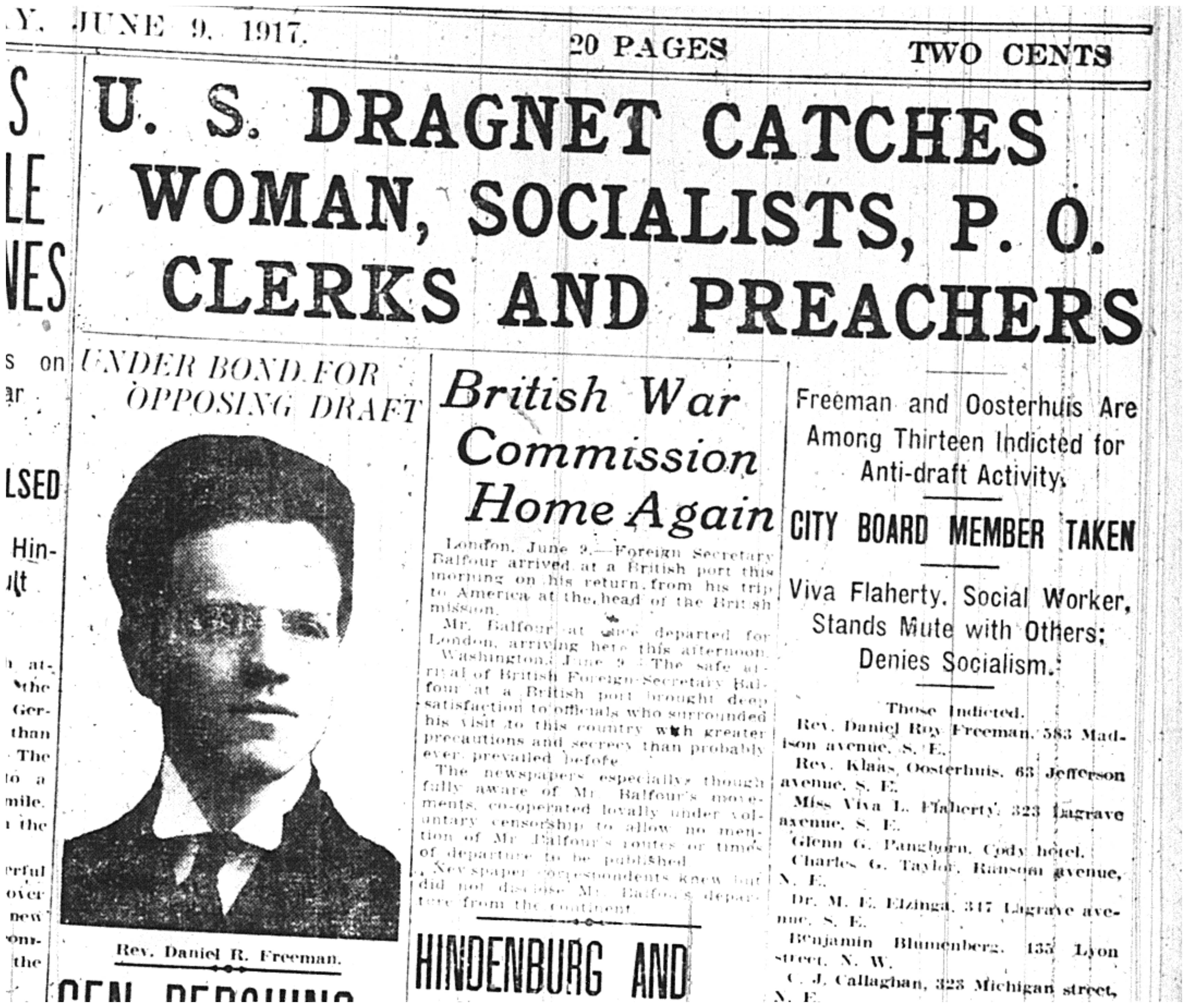 In May of 1917, several members of the Socialist Party, two clergymen and Feminist/Labor supporter Viva Flaherty were arrested in Grand Rapids for distributing anti-conscription pamphlets near downtown Grand Rapids.
This seemingly mild act of informing people about their rights and about the imperialist nature of World War I was seen as a form of treason. There had been numerous laws passed since the beginning of the United States government, such as the Alien and Sedition Acts passed in 1798, which meant to silence and punish those considered to be, those “dangerous to the peace and safety of the United States.”
The Espionage Act was passed in 1917, as a means to silence and punish those who spoke out against the US entry into World War I. However, as radical historian Howard Zinn points out, these laws were not applied equally and were meant to target dissidents during WWI, particularly radical labor organizers, socialists and anarchists. Some of those arrested for opposing the US entry into WWI were arrested and jailed, while others were arrested and deported.
The level of contempt that the US government held against radicals involved in labor organizing and anti-WWI activities eventually led to the Palmer Raids (1919-1920) as a justification for “cleansing” the US of radical leftists, socialists and anarchists.
Those arrested in May of 1917 in Grand Rapids fell under the category of dissidents and radicals. There were several who identified as Socialists and then there was Viva Flaherty. Flaherty was the only woman arrested in May of 1917, but she was possibly the most well known of the group, particularly in Grand Rapids.
Flaherty, along with those she was arrested with, were passing out anti-conscription pamphlets on Division Avenue near downtown Grand Rapids and on Bridge Street. They had 15,000 copies printed from the Furniture City Printing Company of Grand Rapids.
The International Socialist Review, published in Chicago, makes mention of the action taken by the state against Viva Flaherty and her fellow dissidents. Published in the July 17 edition of the ISR, this is what they had to say about the anti-conscription action:
 Almost all active members of the Socialist Party have been arrested and indicted by a Federal Grand Jury. Principal charge is that the accused, by the circulation of literature and “thru demonstrations, mass petitions and by other means,” conspired to “prevent, hinder and delay” the execution of the conscription law. There were six counts in the indictment.
National Secretary Adolph Germer, of the Socialist Party, was also indicted by the same jury and charged with conspiracy. On learning the “news,” Comrade Germer went to Grand Rapids, submitted to arrest, plead “not guilty” and was liberated on bonds. If necessary, these cases will be carried to the highest courts.
Grand Rapids has a population around 130,000—mostly wage slaves. Scab labor runs its factories. It is a typical American Billy Sunday burg. Therefore all the fury of the pulpit and the press was directed against the socialists.
Among the indicted comrades are Ben A. Falkner, financial secretary of the Local. For years he has been employed in the city water works department. He has been fired and blacklisted by the political patriots. Comrade G. G. Fleser, corresponding secretary of the Local, who had worked eight years for the Grand Rapids and Indiana Railroad as a stenographer, was discharged by the patriotic rail-plutes. Viva L. Flaherty, social worker and writer; Charles G. Taylor, member of Board of Education; James W. Clement, manufacturer; Charles J. Callaghan, postal clerk (discharged); Dr. Martin E. Elzinga; G. H. Pangborn; Vernon Kilpatrick; Rev. Klaas Osterhuis, and our wellknown, active old-time Comrade, Ben Blumenberg.
The Grand Rapids Press wrote about the arrests, the selection of the jury and the trial itself. Much of the their reporting reflected a bias in favor of prosecution of those arrested for distributing anti-conscription material. There were a few interesting cartoons that ran during the trial in October of 1917, one with the note below Viva Flaherty’s image which says, “Viva Flaherty has many visitors during recess.”
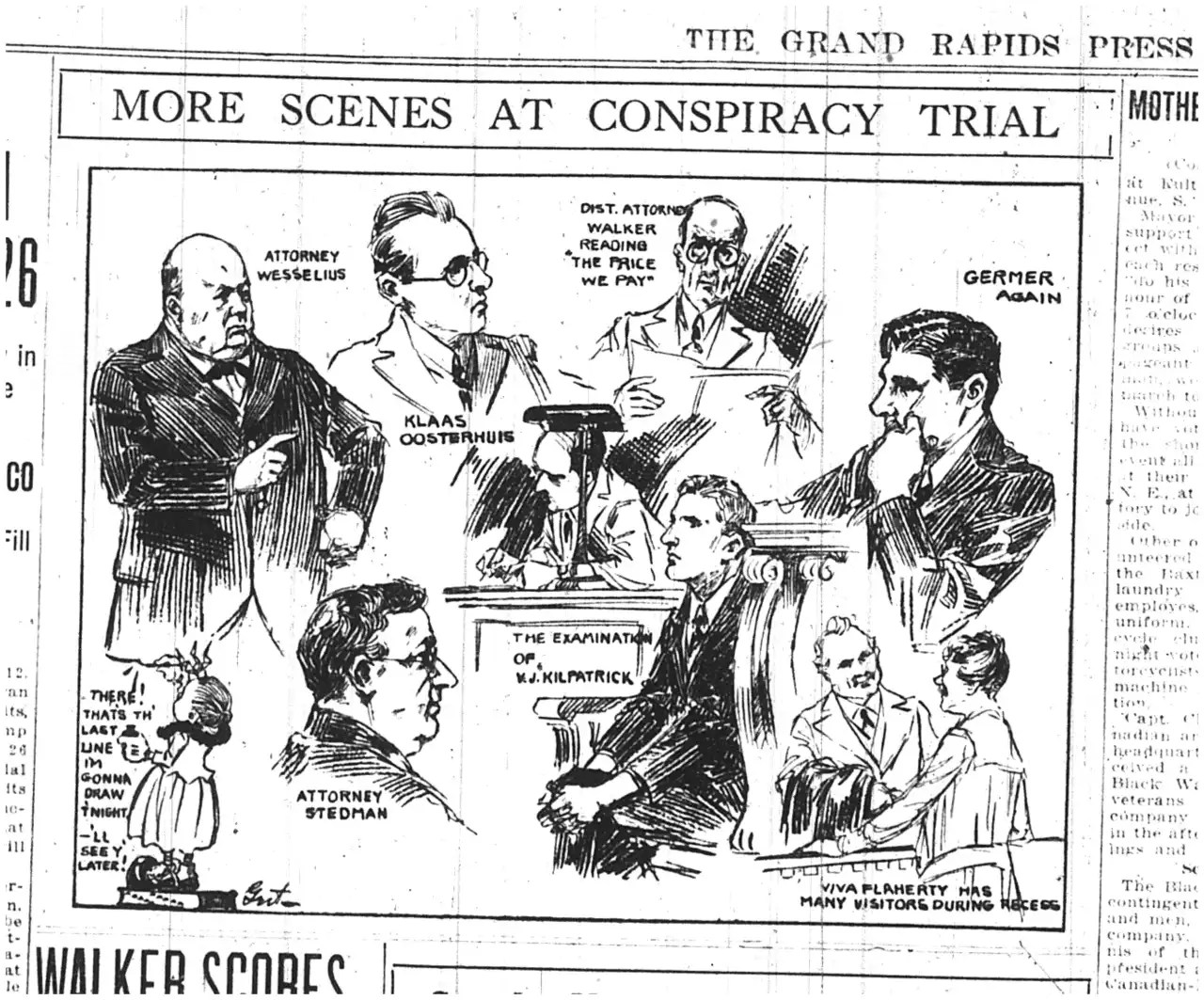
Ultimately, Viva Flaherty and her co-conspirators were not found guilty for the charges brought against them from May of 1917. The trial ended on October 18, 1917, and it well documented by the National Socialist Party in the publication entitled, “Not Guilty.”
Viva Flaherty may not be well know, especially for her opposition to the US entry to WWI and the military draft, but future generations should look to her for inspiration as someone who challenged political and economic power structures in Grand Rapids. Flaherty lived to be 84, eventually dying in 1968.
For week #5 in our collective investigation into the Prison Industrial Complex in Kent County, we continued our reading/discussion of the book, Beyond Courts. However, before that I shared two sets of links.
The first set of links here are about the so-called criminal justice reform movement, where the likes of the Koch brothers and the DeVos family have leveraged their economic resources to push for certain reforms that are motivated on accessing labor.
A second set of links came from our week #4 discussion around ways to dismantled the PIC, examples from various anti-state carceral movements around the country.
https://www.seattlesolidaritybudget.com/
https://griid.org/wp-content/uploads/2020/06/movement-for-black-lives-defund-police-toolkit.pdf
Chapter 6 focused on the theme that there are no such thing as progressive prosecutors. Here is an excerpt from chapter 6:
“Diversion programs and other reforms—whether reducing racial disparities in prosecutions, or diversifying staff of the prosecuting office, or increasing investigations of police officers in individual, sensationalized cases—all contribute to the legitimacy of the prosecuting office. They are public relations strategies aimed at softening the prosecuting office’s image, while continuing the machinery of criminal punishment under both new and old structures.”

Chapter 7 focused on abolitionist principles & campaign strategies for prosecutor organizing. This chapter provided excellent framing around how to think about the abolition of the prison industrial complex, with clear principles, tactics and strategies that have been utilized by other abolitionists, as is illustrated in the graphic above.
During the discussion on Chapter 7, there were interesting observations made, particularly around the issue of how the non-profit industrial complex makes it difficult to engage in abolitionist work. Not only did this theme filled the rest of the discussion, it influenced what I sent the group to read for week #6.
It was a beautiful sunny day on Saturday, with an estimated two thousand people who showed up to Rosa Parks Circle for International Women’s Day.

There were lots of signs and flags, and lots of speakers who addressed a number of issues from reproductive justice to labor struggles, the Palestine liberation struggle, US militarism, transphobia, mass deportation and environmental justice.
It was difficult to hear many of the speakers, since the sound system wasn’t great and the ice rink at Rosa Parks Circle prevented people from getting close to the speakers. There were a few information tables and eventually a march that began around 1:30pm.

There was upbeat energy emanating from the crowd, and lots of people embracing each other and sharing stories throughout most of the rally. No doubt people left the event feeling inspired and hopeful about moving forward.
One of the early speakers was State Rep. Kristian Grant. She talked about what is happening in Lansing and that she was fighting for us in the State Legislature. She also said that she doesn’t have any more West Michigan Nice in her, nor does she have anymore thoughts and prayers, but that she is ready to burn shit down. (You can listen for yourself) While I would welcome this reality, this is not who Rep. Grant has been in recent years as a State Representative. Rep. Grant failed the statewide coalition of tenants, known as the Rent is Too Damn High, by not fighting for the 10 pieces of legislation that tenants we demanding last fall. It should also be mentioned that Rep. Grant also took money from the Michigan Realtors Association PAC. I find it hard to believe that Rep. Grant is fighting for us and I don’t believe for a second that she is ready to burn shit down.
Then I saw a sign that read, “I can’t believe that we still have to protest.” The sign was being held by a white woman. The sign reminded me of the title of a book from the abolitionist Angela Davis, Freedom Is a Constant Struggle: Ferguson, Palestine, and the Foundations of a Movement. In that book, Davis discusses the importance of movement building and how all of the issues we are confronted with are intertwined.

The march began where Breanna Taylor Way, Pearl Street and Monroe Avenue converge. There was a GRPD cop car parked in the street at that intersection, preventing people from going east on Pearl Street. At that point it became clear that the organizers must have obtained a permit from the City to hold the protest. This dynamic became even more clear after those who were marching in the street were accompanied by a GRPD cruiser. I raise this point since the GRPD has cracked down hard on BIPOC organizers over the past year, specifically when people have taken to the streets for Patrick Lyoya, Immigrant justice or to call for the US to stop sending billions to Israel during their genocidal campaign.
The fact that the GRPD did not have a very strong presence at the rally on Saturday, also suggests that they knew that there would be no disruption of business as usual by the organizers or the fact that the rally was primarily attended by white people. For years, when BIPOC people attend actions, even 50 – 100, the GRPD presence has been overwhelming and often oppressive.
I get that people who attended to rally/march on Saturday are upset about what the Trump Administration has done since January 20th. People not only have a right to be pissed off, they ought to be pissed off. However, this shit show is a constant for Black people, Indigenous people, immigrants, the working class, queer & trans people, those with disabilities and anti-war activists who are confronting US imperialism.
- During the Biden Administration there were on average 1,200 people killed a year by the police, and Black people are 2.8 times more likely to get killed by cops than white people, according to Mapping Police Violence.
- The Biden Administration deported more people in a four year period than were deported during the first Trump Administration.
- Last summer in an article I wrote about the economy, I mentioned a recent ALICE report. ALICE stands for Asset Limited, Income Constrained, Employed. In that people it stated that 41% of Michigan households live paycheck to paycheck, but that number goes up to 47% for Grand Rapids households. This means that nearly half of the households in Grand Rapids are living paycheck to paycheck!
- People were livid when President Trump scolded Ukrainian President Zelensky, but where was the outrage when Biden embraced Netanyahu during the Israeli genocidal campaign against Palestinians, along with providing billions in weapons that were used to kill families, women and children?
What does it take to get people, particularly white people, to empathize with the struggle of BIPOC, immigrant, queer and trans people? Yes, there was a great turnout at the International Women’s Day rally on Saturday, but where were those people when we were fighting to defund the GRPD, to demand justice for Patrick Lyoya, to demand an end to missing and murdered indigenous people, when the Michigan Democrats failed to vote for driver’s licenses for undocumented immigrants or in the fight for trans rights? I say these things not to chastise, but to provide proper context for how we might build a real resistance movement for the future.
Freedom is a constant struggle and we can’t just show up when we are directly affected. As someone who is also white, I invite other white people to practice solidarity and to show up when BIPOC, queer and immigrant organizers are making demands and fighting for justice. Challenge your own comfort, be an accomplice to other people’s liberation struggles, and take risks.

Palestine Solidarity Information, Analysis, Local Actions and Events for the week of March 9th
It has been 17 months since the Israeli government began their most recent assault on Gaza and the West Bank. The retaliation for the October 7, 2023 Hamas attack in Israel, has escalated to what the international community has called genocide, therefore, GRIID will be providing weekly links to information and analysis that we think can better inform us of what is happening, along with the role that the US government is playing. We will also provide information on local events and actions that people can get involved in. All of this information is to provide people with the capacity of what Noam Chomsky refers to as, intellectual self-defense.

Information
Trump Admin Bypasses Congress to Send Israel $4B as It Blocks Aid Into Gaza
State of Siege: Israel is conducting its largest mass expulsion campaign in the West Bank since 1967
‘War-Crime Starvation Strategy’: Israel Blocks All Humanitarian Aid into Gaza
As Freed Palestinians Describe Torture, Trump OKs $3 Billion Arms Package for Israel
Slow Motion Ethnic Cleansing in Hebron
Why the Second Phase of Gaza Negotiations is Failing
Columbia University’s Secret Disciplinary Process for Students Critical of Israel
Israel’s War Decimated Gaza’s Farmlands and Killed Most of its Livestock
Holding US lawmakers accountable for backing Gaza genocide
International Law at a Crossroads: Can Gaza Spark a Global Reckoning?
Analysis & History
Archiving Gaza: The Race to Save Evidence of War Crimes and Mass Destruction
Trump and Netanyahu’s roadmap: Nakba, forcible transfer and expulsion
Image used in this post is from https://visualizingpalestine.org/visual/anti-palestinian-racism-on-campus/
 Grand Rapids Institute for Information Democracy