Grand Rapids Activist Calendar celebrates year two

Today, the local online activist calendar, the Grand Rapids Activist Calendar is celebrating its second year of providing a forum for area people to promote and participate in a variety of activist projects and campaigns.
According to a Press Release sent out today:
“Over the past year, the Grand Rapids Activist Calendar has continued to grow with a steadily increasing number of visits to its website, followers on Facebook, and subscribers to its bi-weekly email list. The Calendar launched a new website in July of 2011 and has publicized nearly 300 events – including protests, demonstrations, rallies, meetings, movie showings, lectures, and classes – in the past 8 months.
The Calendar was launched in 2010 with the goal of providing a central hub for activists to learn about upcoming events in the Grand Rapids area. Since that time, it has helped promote dozens of progressive events in the greater Grand Rapids area.
The Grand Rapids Activist Calendar promotes grassroots organizing efforts by creating new and strengthening existing ties in our community through mutual solidarity in our struggles. The Calendar relies on individuals and groups submitting their events.”

The Grand Rapids Activist Calendar is the best online source for local actions, campaigns, educational events and forums for progressive, left and radical efforts that are happening in West Michigan. It not only provides a great service, it demonstrates that there are lots of efforts to inform and organize people committed to social justice and radical social transformation.
GRIID highly recommends that people not only visit the site, but that they share this valuable resource and sign up to receive the bi-weekly e-mail on upcoming activist events.
This article by Bruce Dixon is re-posted from Black Agenda Report.
The murder of Trayvon Martin by a vigilante and son of a retired Florida judge has sparked more media heat, more column inches, and more protest marches than anything since, well, the murder of Troy Davis only a few months ago. The fact is that literally millions of people have prayed, demanded, forwarded emails, shown up at meetings, marched in the streets and searched for concrete ways to contribute to changing the system that killed Davis, Martin and will continue to kill countless others.
But it’s clear that the establishment civil rights leaders and politicians and corporate media have nothing to offer them but the same dance steps they’ve followed before. Show up at a prayer vigil or demonstration and go quietly home afterward. Wait for the civil rights lawyers to sort it out, wear a hoodie to church. Donate or sign a petition. Vote for or against somebody. And they don’t even mention Troy Davis any more, as if this month’s atrocity had nothing to do with last month’s or next month’s.
Beyond trying to repeal a certain kind of dumb law in the handful of states that have it, and opening real investigations into the individual case of Trayvon Martin, our traditional civil rights and political leaders, the black political class, have nothing to offer us. Repealing a couple of bad laws won’t do it. The police may have released Martin’s shooter because of the bad law. But “stand your ground” doesn’t stand up as an explanation of why they performed no canvass to determine other facts of the homicide, and made little or no attempt even to identify the victim. The most plausible explanation then, for the gross police and prosecutorial malpractice in this case is the fact that the shooter’s father was a retired local magistrate, and cozy collusion between cops, prosecutors and judges is the way business is done everywhere in the US. It’s something police anywhere in the country might plausibly have done, as a “professional courtesy” to the retired judge, whether they had a “stand your ground” law or not.
The black political class has nothing to offer here because they too are deeply tied to the prison state, and to the corporate interests that profit from it. While they will admit that the vigilante killing of Trayvon Martin and the state sanctioned murder of Troy Davis are distinct threads in a seamless garment, their advocacy remains limited to a handful of exemplary cases. The last thing they want to see is a movement independent of them, and of the two parties emerge on this or any issue. The last thing they want to hear are concrete demands for real change, demands they are prepared neither to make or to deal with themselves.
Kali Akuno, of the US Human Rights Network, on the other hand, offers us a glimpse of what concrete demands flowing out of the Trayvon Martin case addressing the seamless garment of vigilante murder, police malpractice and the prison state might look like…
1. Currently, there is no national database that documents the killings of Black people by police, security guards and self-appointed peacekeepers. To understand the magnitude of the epidemic, we demand it be documented. To ensure that we hold the government accountable to this mandate, we call on all the organizations defending the human dignity and rights of Black people to collaborate on producing an independent database of these summary executions.
2. We must demand that the priorities of Homeland Security be shifted. As a recent Salon.com article noted, “So much money has gone into armoring and arming local law-enforcement since 9/11 that the federal government could have rebuilt post-Katrina New Orleans five times over and had enough money left in the kitty to provide job training and housing for every one of the record 41,000-plus homeless people in New York City. It could have added in the growing population of 15,000 homeless in Philadelphia, my hometown, and still have had money to spare. Add disintegrating Detroit, Newark, and Camden to the list. Throw in some crumbling bridges and roads, too.”(March 5, 2012) The military industrial complex is no longer a sector of the state—it has become the state—a police state. We must use whatever political rights we have left to demand that the tremendous resources used to fortify this militarized stated be used for human development, such as education, health care, and the development of sustainable energy and technology, not hunt and kill people.
3. At the same time, Homeland Security grants to police departments should be conditional on institutional overhaul that deprograms racist policies, rules of engagement, training and rewards.
a. Recruitment, training of new recruits and on-going retraining must identify racist assumptions and uproot them. The concept of “suspicious behavior” must be deconstructed under the leadership of community representatives.
b. When a cop has killed or wounded an unarmed “suspect” or used excessive force to subdue a “suspect”, that cops should be suspended without pay until the investigation is complete. If the cop is not cleared, he should be fired. (A number of killer cops are repeat offenders)
c. Cultural and institutional support that allows police departments to lie, cover-up, spin, justify and remain unaccountable for killing Black people must be identified. All actions must be video recorded and made public.
d. Community representatives responsible to community forum should be consulted on all these changes and approve them before implementation. Representatives of families whose loved ones have been killed should participate in these community bodies.
e. Money from one homeland security tank could more than fund high quality training for the entire police force for decades.
4. Redirect Homeland Security Funds to establish and institutionalize local community mental health programs. Jails and prisons are flooded with people who need support for emotional problems. Treatment, not punishment is needed. And there also should be community support for families—especially those with children who have emotional problems. A tragic number of children get killed by police when desperate parents call for help. This must end. Also, police must be trained, retrained and retrained on how to deal with people exhibiting erratic behavior. The policy of tasing for compliance must be ended.
5. Overhaul policies that encourage and justify harassment, assault and murder by non-trained, non-accountable citizens, such as “stand your ground”. Eg. Security guards, self-appointed neighborhood watch coordinator and a man defending his “castle” were responsible for at least four murders in the last three months.
6. Eliminate all the policies and procedures on all levels of government and in all state agencies that sanction the racial profiling of Black and other discriminated and targeted groups.
7. Stop the War on Drugs and end the mass incarceration of Black people. Reform all of the drug enforcement, quality of life, and mandatory minimum sentencing laws that have resulted in the gross over incarceration of Black people and the largest penal system in the world.
8. Challenge the cultural and legal climate that demonizes Black people and encourages racist attacks by security guards and vigilantes by instituting a massive public education campaign that addresses the historic legacy of white supremacy and institutional racism and educates the public about their fundamental human rights.
9. Finally, the Obama administration must create and institute a “National Plan of Action for Racial Justice”1 to fulfill the governments obligations under the Convention to Eliminate all forms of Racial Discrimination (CERD)2 by creating a permanent Inter-Agency Working Group to implement all of the aforementioned demands to protect Black and other historically oppressed groups from racial discrimination, targeted violence, and summary executions. For more information on CERD visit http://www.ushrnetwork.org/content/campaignproject/elimination-all-forms-racial-discrimination-icerd.
Instead of patting the First Black President on the back for talking to us about his imaginary son, the one that “would look like Trayvon Martin,” Mr. Akuno says we ought to be directly engaging government on every level, and most especially the Obama administration on making these concrete demands happen so that we can begin to limit the number of vigilante killings, police murders and state-sanctioned executions. Our black mayors and local officials don’t deserve a pass on this, and our First Black President certainly does not either.
As evidence, as if any was needed, of the systemic nature of vigilante killings alone, Akuno offers a partial list of more than 30 vigilante killings of blacks from the beginning of this year alone.
New Media We Recommend
Below is a list of new materials that we have read/watched in recent weeks. The comments are not a “review” of the material, instead sort of an endorsement of ideas and investigations that can provide solid analysis and even inspiration in the struggle for change. All these items are available at The Bloom Collective, so check them out and stimulate your mind.
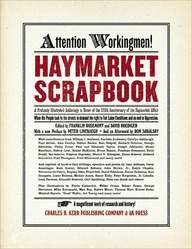
Haymarket Scrapbook, edited by Franklin Rosemont and David Roediger – If you are looking for any good resources on the history of May Day, this collection of essays, poetry, graphics and reprints of old posters and pictures, is a fabulous resource. This is a re-print of a book from 1986, but its relevance is even more profound today. The oversized book includes a wonderful collection of essays on the Haymarket Affair, the Haymarket Martyrs and other related labor focused writings and reflections from the late 19th Century. The old posters, political cartoons and graphics add so much more to ones understanding of the impact that the Haymarket Affair had on both US and International solidarity. This book is a treasure for radical historians and those wanting to learn radical history.
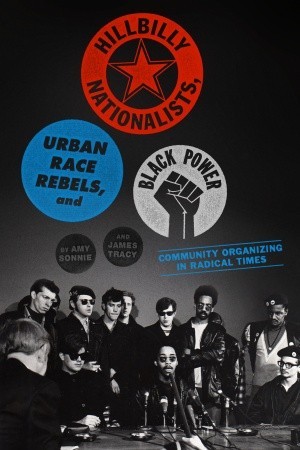
Hillbilly Nationalists: Urban Race Rebels, and Black Power, by Amy Sonnie and James Tracey – Ever wonder if there were White radicals in the 1960s and 70s who were involved in challenging the systems of power in the US that were not part of SDS or the Weather Underground? Well, there were plenty of groups doing incredible organizing work that, unfortunately, are not known by enough of the dissident community today. Hillbilly Nationalists looks at several White radical organizations that formed in response to the Black Power movement’s call for White people to go organize in their own communities. Relying heavily on interviews with those involved in various groups, this book introduces us to organizations such as JOIN, the Young Patriots, Rising Up Angry, the October 4th Organization and White Lightning. Each of these groups were an outgrowth of the radical organizing of the Black Panthers and other liberation groups in the US that did amazing things in cities like Chicago, Philadelphia and New York. An important piece of history that sheds light on what many White radicals were doing that to confront power.
Rebel Cities: From the Right to the City to the Urban Revolution, by David Harvey – This book by radical historian David Harvey is not only an interesting look at urban revolution since the industrial era began, it is also a philosophical investigation into the conditions that have contributed to numerous urban uprisings from the Paris Commune to the current Occupy movement. Harvey also provide sharp economic analysis of industrial capitalism and neoliberal policies that helps frame our understanding of urban revolutions, but in fact acts as a call to new ones. At times it is a little heavy on analysis, but it’s still a valuable contribution to the growing body of literature that is calling for a radical reordering of society.
Introducing Capitalism: A Graphic Guide, by Dan Cryan, Sharron Shatil and Piero – This short graphic guide reads like a comic book, with short excerpts and fabulous illustrations of what capitalism is and has evolved to. Introducing Capitalism provides a sharp contrast to the explanations most of us have been given in the US educational system. The books does a wonderful job of presenting capitalist ideas such as surplus value, the role of the consumer, labor, inflation and state capitalism. In addition, the graphic guide looks at historical manifestations of capitalism and various critiques of this economic model from socialists, anarchists, situationists and other radical thinkers. A wonderful popular education tool for working class people and political dissidents.
Powerful new documentary on US immigration policy
Sin País (Without Country) is an award-winning 20-minute documentary film that intimately follows one family’s journey as they are fractured by deportation after living in the U.S. for seventeen years. This dynamic short film is being used in hundreds of classrooms and communities across the country to spark transformative conversations and put a human face to the immigration debate. 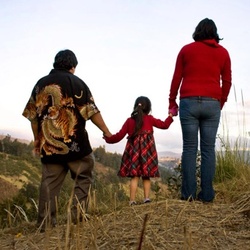
Sin País attempts to get beyond the partisan politics and mainstream media’s ‘talking point’ approach to immigration issues by exploring one family’s complex and emotional journey involving deportation.
In 1992, Sam and Elida Mejia left Guatemala during a violent civil war and brought their one-year old son, Gilbert, to California. The Mejia’s settled in the Bay Area and raised their family for the past seventeen years–until one morning immigration agents stormed the Mejia’s house, looking for someone who didn’t live there.
Sin País begins two weeks before Sam and Elida’s scheduled deportation date. After a passionate fight to keep the family together, Sam and Elida are deported back to Guatemala.
With intimate access and striking imagery, Sin País explores the complexities of the Mejia’s new reality of a separated family–parents without their children, and children trying to succeed in life without their parents.
Through April 15th, you can now watch the entire film for FREE…find out more HERE. There is also a new discussion guide that has been made available for free at: www.sinpaisfilm.com. Both the film and the discussion guide are great resources for those who want to transform the oppressive immigration policy of the US.
This Saturday, there will be another march/walk in Grand Rapids in response to the brutal murder of Trayvon Martin in Florida on February 26.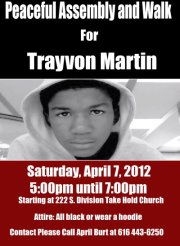
Last week, an estimated 1,000 people marched in Grand Rapids to protest the shooting and murder of Trayvon Martin. Students at GRCC are holding a silent protest today at 3:15pm and GVSU students are holding an event on Thursday at 5:30pm on the Allendale campus. All these events clearly demonstrate that people are outraged by what happen and want to demonstrate some sort of solidarity.
The event in Grand Rapids begins at 222 S. Division at 5pm. People are asked to bring signs and wear a hoodie or all black. More details of the event can be found on Facebook.
Peaceful Assembly and Walk for Trayvon Martin
Saturday, April 7
5:00 – 7:00PM
People will gather at 222 S. Division
Gay Christian Yes campaign goes public in Grand Rapids
Earlier today members of the group GIFT – Gays in Faith Together – went public with a new campaign to generate more support for those who identify as Christian and as members of the LGBT community.
The group kicked off their campaign by putting up a billboard and hosting a Press Conference at Westminster Presbyterian Church near downtown Grand Rapids.
Theresa McClellan, the Christian Yes Campaign coordinator, welcomed those in attendance and announced the online resources available to faith communities and individuals wanting to explore the possibility of becoming an open and affirming church.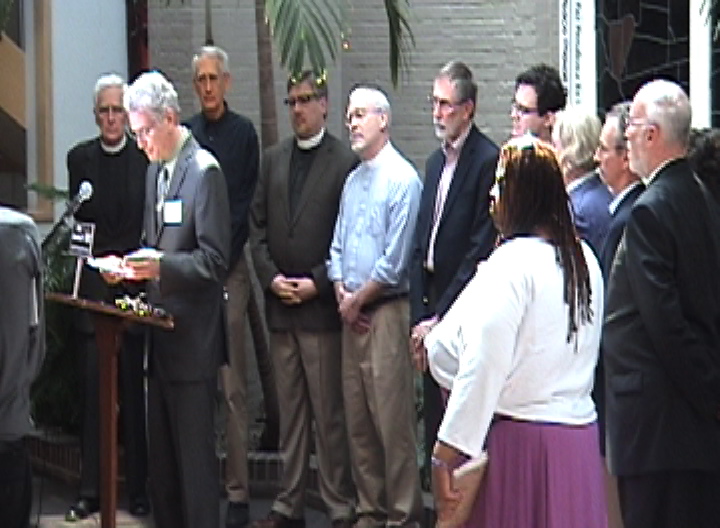
Some of the resources available include:
- listings of 30 area gay-friendly churches
- articles and affirming sermons from pastors and theologians
- books, videos, and stories from gay Christians, as well as friends, family, and allies
Rev. Jim Lucas, the founder of GIFT also spoke about the campaign and the significance of kicking off the campaign during the Christian Holy week. You can watch the brief presentation from Rev. Lucas in the video below.
After Rev. Lucas spoke, several area clergy then addressed the media and talked about their personal journeys and what the congregations they represent have done to address what some of them referred to as a justice issue.
Dump Rush Campaign/Protest continues this Friday
The Dump Rush on WOOD Radio campaign continues with another protest planned for this Friday, April 6 at 1:00 pm outside the Clear Channel office in downtown Grand Rapids at 77 Monroe Center.
People are invited to bring signs, handouts and letters to deliver to WOOD Radio demanding that they remove Limbaugh’s program from their regular lineup of syndicated shows.
For those who cannot attend we are asking them to do the following things, which are absolutely necessary for this campaign to be effective:
1. Send e‐mails to WOOD Radio Station Manager Tim Feagan at TimFeagan@clearchannel.com or write letters to: WOOD Radio 77 Monroe Center Grand Rapids, MI 49503.
2. Pressure local businesses that advertise on WOOD Radio to pull their funding until WOOD Radio removes the Limbaugh show. Here is a list of local companies and their contact information:
Grand Rapids Lighting
616-949-4931
Kyper College
kcapisciolto@kuyper.edu 616-988-3676
Kent Equipment
(616) 675-5368 http://www.kentequipment.com/contact.htm
River City Reproductions
616.464.1220 info@rivercityreproductions.com
Life EMS
1-888-543-3367 info@lifeems.com
Mercantile Bank of Michigan
616.406.3604 https://www.mercbank.com/contact.asp
Silver Bullet Firearms
(616) 249-1911 silverbulletfirearms@gmail.com
West Michigan Office Interiors
(800) 964.0201 sales@wmoi.com
Granite Transformations
(866) 400-1594
http://grandrapids-granitetransformations.aiprx.com/grandrapids/contact-us/
AMR-West Mi
(616) 459-8228
http://www.ems-education.com/page5/
AAA Turf
616-669-7715
sales@aaaturf.com
West Michigan Glass Block
616.243.3700
http://www.wmgb.com/contact.asp
Bartlett Tree Experts
616-245-9449
Spectrum Health
(616) 391-1382
http://www.spectrumhealth.org/body.cfm?id=57
Family Fare
616-878-8350
http://familyfare.spartanstores.com/contact-us
3. Share this campaign information with as many people and organizations you are affiliated with.
Second round of Farm Bill hearings in Washington continues to be dominated by Agri-business
Last month we reported on the Farm Bill hearings that had already taken place in Washington, hearings that were chaired by Michigan Senator Debbie Stabenow.
In those first two hearings we noted that those invited to address the Senate Agriculture Committee were disproportionately people from Agri-business and trade agencies, not small farmers.
Since then, an additional two hearings have been held by the Senate Agriculture Committee in DC, also hosted by Senator Stabenow.
The first of the two Farm Bill hearings held last month, was on March 7, with the theme of Healthy Food Initiatives, Local Production and Nutrition. This hearing included the least amount of invited speakers compared to the other three hearings on this topic.
Agriculture Secretary Tom Vilsack began the testimony and addressed the importance of supporting local farmers, especially with the increased interest of buying local food. However, despite Vilsack’s rhetorical support for local small farmers, there was nothing in his testimony to suggest that there would be financial assistance available or financial incentives that would make it possible for small farmers to compete in the market. When agri-business gets billions in subsidies, how can we expect small farmers to be able to make a living?
The invited guests who addressed the Senate Agriculture Committee was a mixed bag, consisting of a 1,00 acre farmer, a representative from WalMart, a CEO of a food bank, the Executive Director of the Food Trust and the head of the Eastern market in Detroit.
The farmer from Arizona talked about the CSA they have developed over the years, but spent more time talking about Food Hubs, this idea that we need centralized locations where food can be stored and distributed. Food Hubs are part of the growing trends with local food consumption and it is even the language that Dick DeVos used when describing the now in construction Urban Market in Grand Rapids. However, if this is what is meant by food hubs, then people should be very concerned about who will have access to these food hubs and who will really benefit from them.
The representative from the Food Trust not only talked about their groups work on trying to increase the access of fresh, healthy food for everyone who lives in the Philadelphia area, he talked about how they hosted meetings for people – hunger advocates, farmers, environmentalists and health workers – to discuss and design what they would want the 2012 Farm Bill to look like. The Food Trust representative also talked about their farm to school program.
The representative from WalMart talked about everything from the company’s sustainability policies to anti-obesity initiative, but the bulk of their time was spent talking about their local food program. It is no secret that WalMart has been trying to cash in on the growing interest in local food buying. The retail giant has come under serious scrutiny, but has even convinced the White House that they can be a solution to urban “food deserts.” One food justice advocate’s response to WalMart’s claim of being a solution to food deserts was, “Walmart is using the term ‘food desert’ as a Trojan horse to get into our communities and bring about more corporate control of our food system.”
The other Farm Bill hearing that took place in March was on the 15th with the theme of Risk Management and Commodities. This hearing included more invited speakers, but the list of those invited was dominated by the agri-business sector.
Those who addressed the Senate Agriculture Committee were the American Soybean Association, the National Corn Growers Association, the National Association of Wheat Growers, the Western Peanut Growers Association, the National Cotton Council, Farmers Mutual Insurance Company and the American Farm Bureau.
There were representatives from the National Farmers Union and Future Farmers of America, but their voices were small compared to the agri-business sector, which dominated the fourth Farm Bill Hearing.
There were also two farmers who addressed the committee. One farmer from Kansas, ran a 7,000 acre farm and the other farmer was from Bangor, MI. However, the farmer from Michigan didn’t speak much about their blueberry farmer. Instead, this farmer was at the Farm Bill hearing to speak on behalf of MBG Marketing, also known as the Blueberry people. MBG Marketing represents 300 blueberry farmers from several states, but its headquarters is in Michigan.
Like the previous Farm Bill hearings, these two hearings did little to challenge the power of the agri-business sector or the future of the national food system. However, considering who was invited to the table, it makes complete sense that the food system would remain under the influence of the agri-business sector, despite a growing grassroots call for a more democratic food system.
HCC concludes Middle East film series this week
The group Healing Children of Conflict is hosting the third film in its Spring series this week, with showings at both GVSU and Calvin College.
The last film in the series is the documentary film Encounter Point. Encounter Point is an 85-minute feature documentary film that follows a former Israeli settler, a Palestinian ex-prisoner, a bereaved Israeli mother and a wounded Palestinian bereaved brother who risk their lives and public standing to promote a nonviolent end to the conflict. Their journeys lead them to the unlikeliest places to confront hatred within their communities. The film explores what drives them and thousands of other like-minded civilians to overcome anger and grief to work for grassroots solutions. It is a film about the everyday leaders in our midst.
GVSU Screening of Encounter Point
Wednesday, April 4
7pm
Lake Huron Hall #142 Allendale Campus
Calvin College Screening of Encounter Point
Thursday, April 5
7pm
Bytwerk Theater, DeVos Center
Both screenings are free and opening to the public. A discussion will follow both film screenings.
Yesterday, the editor of the newly formed MLive Group, Paul Keep, wrote an editorial on what he called he legacy of Dr. Martin Luther King Jr.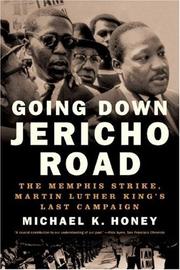
Keep was writing in anticipation of the April 4 anniversary of King’s assassination while in Memphis in 1968 to support the sanitation workers strike for racial and economic justice – a critical point that Keep omitted in his editorial.
Keep began his editorial by saying that Dr. King would not likely be surprised at the recent shooting of Trayvon Martin. He then went on to say that King, “spoke about having seen the promised land — a land in which the color of people’s skin made no difference in how they were treated.”
While it is true that Dr. King mentioned the Promised Land in his last speech on April 3, 1968, he didn’t really make statements about the color of people’s skin. King’s speech was a history of struggle and resistance that was continuing in Memphis, where he talked about the sanitation workers strike and boycotts against companies like Coca-Cola.
Keep then went on to say, “We’re the kind of nation that can rise above prejudice to break new ground in the political world, but we are so often reminded that we’re also a nation that cannot seem to put a sordid chapter of its past completely behind it in the area of race relations.”
This statement is very revealing, because what it indicates is that Paul Keep has no idea what the history of racism in the US is really about. By calling it a “sordid chapter of its past,” he minimizes the brutality of systemic racism of the past like slavery of Africans and genocide of Native Americans. This notion of putting this history behind us also ignores and denies the current systems of institutional racism that plague communities of color throughout the nation, such as the Prison Industrial Complex, major health and economic inequities that exist for communities of color, the anti-immigrant practices of racist groups and the government, which detain and deport thousands every year.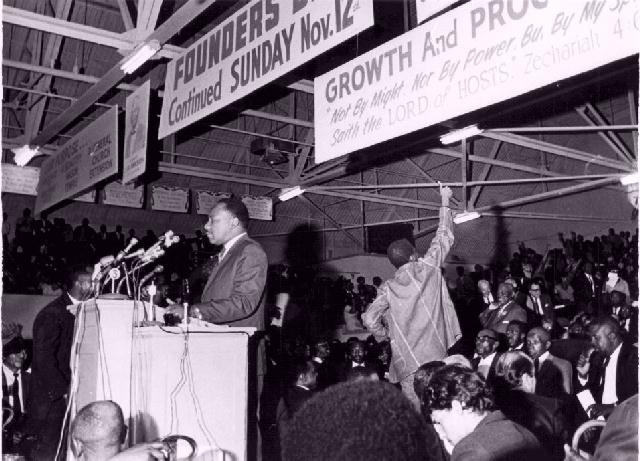
Keep further demonstrates his White privilege by recounting a conversation he had with a young Black woman in Flint about 10 years ago. Keep wanted to acknowledge how far the US has come over the years in terms of eliminating some forms legal segregation, but the young woman wasn’t, in Keep’s words, “satisfied.” Keep acknowledged that she had a right not to be satisfied, but then he doesn’t go further in terms of trying to understand why this young Black woman felt the way she did.
Instead, Keep ends his editorial with reflections on visiting the Lorraine Hotel and the National Civil Rights Museum in February with his wife and son. Keep writes, “It was haunting to look at the motel balcony and the spot where Dr. King fell. He was only 39 years old when he died. Think what he might have done had he been given more years to work on his causes. Or did it somehow take his death to wake up a nation? We’ll never know the answer to that, but we should all be able to agree that we aren’t yet in his promised land.”
These final comments again reflect the tremendous privilege he has, since he doesn’t take any personal or professional ownership for the ongoing struggle for racial justice. He could have taken the opportunity on the anniversary of Dr. King’s death to commit the MLive Media Group to doing stories on the current manifestations of institutional racism in West Michigan.
Instead, Keep chooses to write in vague language about whether or not the death of King woke up the nation. The assassination of King and the subsequent uprising that took place all across the country was a wake up call to the Black community, which understood that even someone who preached non-violence was a threat to the power structure. King and the movement had moved beyond segregation and were now demanding economic justice, because that was how racism was most often manifested, by keeping Blacks in poverty through exploitation and limited opportunities.
We will never get to the “promised land” as long as people with privilege and power like Paul Keep aren’t willing to give it up and join in the struggle for racial and economic justice.

