The Grand Rapids group Healing Children of Conflict (HCC) is hosting another film series over the next several months on both the GVSU and Calvin campuses.
The three-film series looks at the Middle East, with particular emphasis on the Israeli/Palestinian conflict. The first film is a documentary entitled, The Iron Wall, which looks at the Israeli settler expansion and the massive wall that is still under construction and is creating tremendous animosity amongst Palestinians.
The second film in the series is the 2008 animated documentary entitled, Waltz with Bashir. Waltz with Bashir looks at the horrors of the 1982 Lebanon War. The third film in the series is the 2006 film, Encounter Point. This film tells the story of an Israeli settler, a Palestinian ex-prisoner, a bereaved Israeli mother and a wounded Palestinian bereaved brother who sacrifice their safety, public standing and homes in order to press for a grassroots movement for nonviolence and peace.
The HCC film series is part of the group’s mission, which is to do education work around global conflicts that the US is involved and children are being seriously wounded. All 6 film-screening dates are free and open to the public.
Iron Wall
February 15, 7:00PM at GVSU – Manitou Hall Room 102, Allendale Campus
February 22, 7:00PM at Calvin College, Bytwerk Theater
Waltz with Bashir
March 14, 7:00PM at GVSU – Lake Huron Hall Room 142, Allendale Campus
March 15, 7:00PM at Calvin College, Bytwerk Theater
Encounter Point
April 4, 7:00PM at GVSU – Lake Huron Hall Room 142, Allendale Campus
April 5, 7:00PM at Calvin College, Bytwerk Theater
Super Bowl Ads Part II: Budweiser and brand loyalty
The only alcohol company that ran ads during the 2012 Super Bowl was Anheuser-Busch, which has been one of the top companies to feature new ads during the big game for years.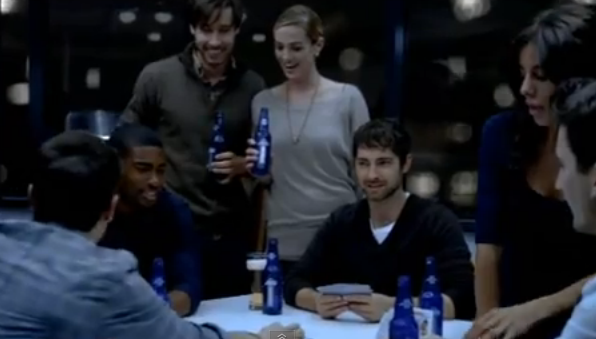
The company aired five different commercials, with three different themes. There were two commercials devoted to rolling out their new brand, Bud Light Platinum. One of those ads is in a factory setting, where the new age beer is being processed. The other Bud Light Platinum ad takes place in a high rise building featuring young urban professionals who mix work and play. As is with most advertising that targets the twenty-somethings, this ad is full of “pretty people.”
A second theme in the Budweiser ads that ran during this years Super Bowl was the theme of prohibition. The first ad featured a sad and dull society, with everyone focused on working. However, once prohibition is lifted everyone celebrates and Budweiser is delivered to a local saloon by the Clydesdale horses. The other prohibition themed ad takes viewers on a historical timeline ride from decade to decade from the 1920s all the way to the present, showing how in every era Budweiser has been enjoyed by the masses.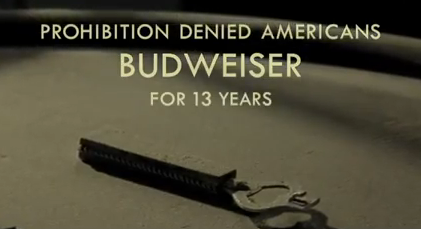
What is interesting about Anheuser-Busch’s use of the prohibition theme is that the company did better than most during that period. The company produced near-beer, a product that would rival the non-alcoholic beers on the market today. The company also received special licenses during prohibition to make beer above the near-beer level for “Medicinal purposes,” thus allowing them to stay ahead of their competitors. Lastly, the company was selling malt syrup, which they said was for making companies, but some sources acknowledge that this product was for those who wanted to make their own beer at home.

The last ad that Budweiser featured during the 2012 Super Bowl was an ad that continued a marketing trend begun by the beer company in the 1980s. Budweiser featured a dog named Wego, which when called by someone would hear, “Here We Go.” This has been a tag line of Budweiser ads in recent years and in is the command in this ad for the dog to go fetch beer for people.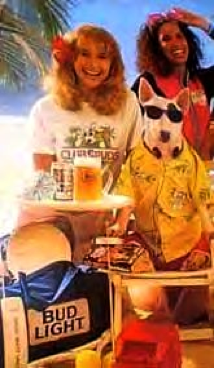
This marketing trend, using dogs or other animals, that act human began with the company’s create of the character Spuds McKenzie in the 1980s and has been repeated by their use of frogs, lizards, horses and mice. Wego is just the most recent in a long line of animals used to grab the attention of children in order to build Brand Loyalty. Developing brand loyalty works like this; if we can get children to think of our brand when they think of beer, it will increase the likelihood that they will purchase Budweiser when they are of drinking age. The use of animal characters who act human is the tool they use to plant their brand in the minds of children, a technique that advertisers have been using, which is based on their understanding of brain development in children.
Super Bowl commercials Part I: Male Fantasy and feminist bitches
Over the next several days we will offer up a few critiques and some media deconstruction of ads that were featured during the 2012 Super Bowl.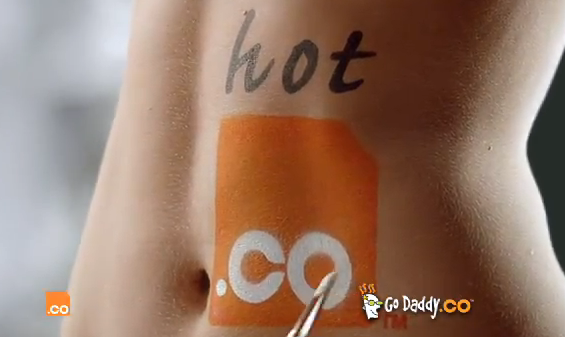
The annual game has been the most watch TV day of the year for the last three decades, with an estimated cost of each commercial being $3.5 million. In addition to the cost, marketers know that the viewership has changed with the introduction of a celebrity music half-time show and the creation of Super Bowl commercial parties – which was an idea that was thought to be grassroots, when in fact it was something that the ad industry created and is now being mimicked by the public.
In today’s installment, we’ll look at body images and hyper-sexual messages that were part of several Super Bowl spots.
One company that has made it a point to use women’s bodies to brand their image is Go Daddy. These commercials are almost becoming predictable, featuring professional race car driver Danica Patrick.
This year’s Go Daddy spot was fundamentally no different that previous ads during the Super Bowl, with at least one woman naked. In this ad, Patrick is accompanied by another woman as they paint Go Daddy phrases on the body of a third woman. The usual suggestive language is used throughout the spot and the all too familiar Go Daddy jingle at the end as we are told that even more is to be revealed at Go Daddy online.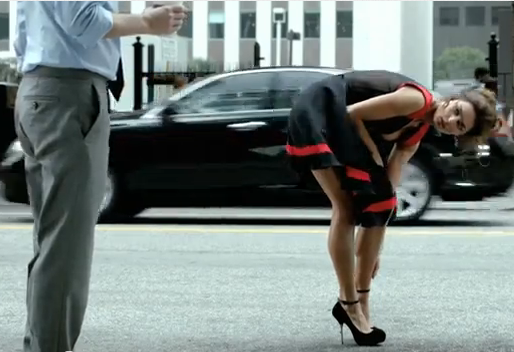
However, a commercial by Fiat robbed Go Daddy of its annual “sexist ad” status, when the car company unveiled their new ad during the Super Bowl. In this spot a nerdy looking guy is walking down the street with a latte and is stopped dead in his tracks when he sees a woman bent over in the street wearing a stunning black and red dress.
The woman sees that he is looking at her and snaps at him in Italian, saying, “What are you looking at? Were you stripping me with your eyes?” However, the woman then warms up to the man, embracing him and then dipping her finger into his latte. Some of the foam drips off her finger onto her chest. She continues to talk to him in Italian saying, “Poor thing, You could do no less. Did it make your heart skip a beat? Did it make you dizzy? You’ll be lost thinking of that sensation forever.” She then leans in as if to kiss the man and all of a sudden he wakes up and the Fiat Abarth is parked in the street where he first saw the woman. Essentially Fiat is using male fantasy as a means of selling their new car. Indeed, Fiat refers to this commercial as Seduction.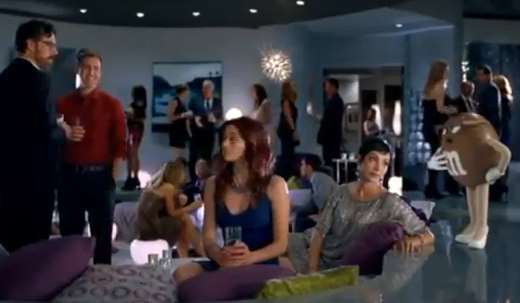
Another interesting commercial that dealt with body image and sexual content was an M&M spot. A female M&M character is talking with two woman, while two men look on. The men are laughing and the M&M character asks the women why they are laughing. One of the women says, “They think you are naked.” The female M&M character explains that her outer coating is chocolate colored and she then shames the men who walk away in embarrassment.
Up to this point the add could be viewed as empowering for women, since all the female characters in the spot seem disgusted with the behavior of men, plus the female M&M character calls out the adolescent male behavior. Unfortunately, the ad doesn’t end there. A male M&M character moves the audience back into a silly mood when he takes his outer coating off thinking the female character is nude. This is all accompanied by the male M&M character dancing and music blaring in the background. The female M&M character continues to look disgusted at the end of the spot, but the “humorous” component of the spot shifts the focus away from women’s confidence and onto the “guy acting silly.”
Of course, we can’t forget the H&M commercial featuring soccer legend David Beckham. In this spot Beckham is only wearing his underwear, while the camera moves up and down his body, while we hear the song Please Don’t Let Me Be Misunderstood, sung by the Animals.
I think the spot is problematic on two levels. First, it presents a body image of men that most men simply will never achieve. This beauty standard for men in media certainly can impact how men see themselves and it might also influence what women are attracted to, by normalizing the 6-pack ab body.
However, the more devastating aspect of the ad is that it gives some men fuel to say that men and women’s bodies are being equally exploited in media, so women should just shut up and stop complaining about it. In fact, this comment and many more explicit are all over the blogosphere and on youtube, where men are complaining about “feminists” and “bitches.”
The problem with such observations is that just because a man’s body is being used to sell a product, doesn’t mean there is parity in regards to the larger social consequences of this kind of objectification. Men are not being sexually assaulted by women every 6 seconds in this country and men are not suffering from some form of eating disorder at the astronomical rates that women are because of the gender norms that have been imposed on society. Men who want to say, “we are now even,” because of the David Beckham ad just don’t want to acknowledge the tremendous privilege they have.
iPads, iPhones, iPocrisy
This article by Scott Nova is re-posted from CounterPunch.
The New York Times’ revealing series on why Apple produces most of its iPhones and iPads in China beautifully illustrates one of the defining dynamics of contemporary capitalism: abusive labor conditions in the overseas factories of US corporations are not, contrary to industry rhetoric, a problem to be solved; they are a highly prized driver of profitability.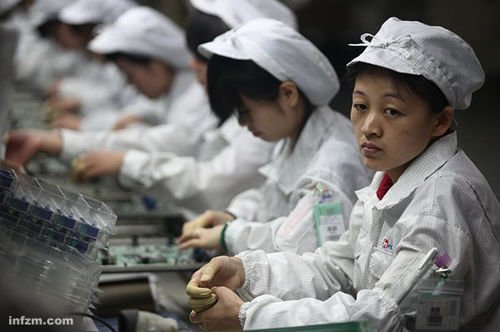
The Fantasy World of “Corporate Responsibility” vs. the Real World of Global Supply Chains
While Apple and its competitors know they must pay lip service to concern for worker rights, lest their brand’s image be tarnished, the practical reality is that if worker rights were genuinely respected in places like China, production costs would be higher, deliver times slower, and profits correspondingly lower. The last thing these brands want is for any of the countries where they exploit low-wage labor to actually enforce their own workplace laws, much less comply with international standards.
This is why there is a yawning gap between the public rhetoric of these corporations on labor rights issues and the actual manner in which they operate their supply chains. Their public statements are suffused with pious expressions of concern for workers and accounts of ostensibly strenuous efforts to promote labor rights compliance by their suppliers. In practice, these corporations maintain a production model that routinely exploits the very labor abuses they claim to abhor. The Times reporters exposed this mammoth hypocrisy, on the part of the world’s most revered and profitable company, by getting former Apple executives to speak candidly (albeit anonymously) on the subject – the kind of enterprising effort to pierce the corporate public relations veil that is seen all too rarely in mainstream journalism.
Here is new Apple CEO Tim Cook, articulating the company’s official position – that it is deeply committed to uprooting abuses in its supply chain, but that this arduous work that will take years to complete: “We care about every worker in our worldwide supply chain…Every year we inspect more factories, raising the bar for our partners… [W]e’ve made a great deal of progress and improved conditions for hundreds of thousands of workers. We know of no one in our industry doing as much as we are, in as many places, touching as many people.”
Meanwhile, here is a former Apple executive, telling the truth: “We’ve known about labor abuses in some factories for four years, and they’re still going on. Why? Because the system works for us. Suppliers would change everything tomorrow if Apple told them they didn’t have another choice. If half of iPhones were malfunctioning, do you think Apple would let it go on for four years?” The abuses in question include unconscionable safety practices that have led to numerous workplace deaths and injuries.
‘The speed and flexibility is breathtaking.’
And consider this charming tale, also told to the Times by a former Apple executive. The Times writes: “One former executive described how the company relied upon a Chinese factory to revamp iPhone manufacturing just weeks before the device was due on shelves. Apple had redesigned the iPhone’s screen at the last minute, forcing an assembly line overhaul. New screens began arriving at the plant near midnight. A foreman immediately roused 8,000 workers inside the company’s dormitories, according to the executive. Each employee was given a biscuit and a cup of tea, guided to a workstation and within half an hour started a 12-hour shift fitting glass screens into beveled frames. Within 96 hours, the plant was producing over 10,000 iPhones a day. ‘The speed and flexibility is breathtaking,’ the executive said. ‘There’s no American plant that can match that.’”
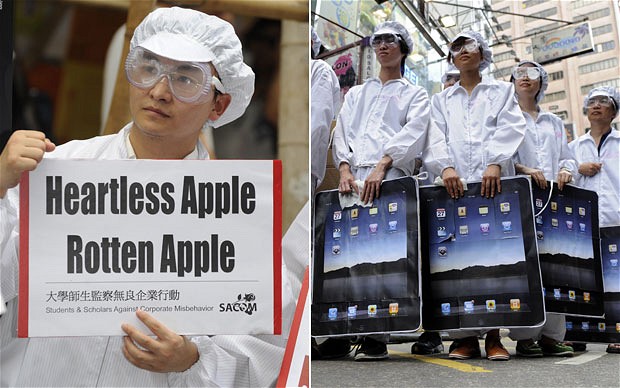
A wonderful story about the responsiveness of Chinese manufacturers to their customers’ needs, no doubt. Except that the management methods upon which this awe-struck Apple executive heaps such fulsome praise constitute massive violations of Chinese labor law. These laws strictly limit overtime hours – a mandate routinely ignored in practice, to Apple’s evident delight.
Imagine finally closing your eyes after a grueling 12-hours shift on an ultra-high-speed production line, only to be shaken from sleep moments later and forced back onto the line for another dozen hours of punishment. Imagine doing this for a cruel joke of a wage, under the thumb of managers whose idea of motivational strategy is to penalize slower workers by making them stand at attention, immobile, for hours, as a lesson to their fellow employees. This is the price workers pay for the “breathtaking speed and flexibility” that enable Apple to implement, in a few days, design changes that would take a month at any factory whose managers did not have the power to drag the entire workforce out of bed when it suits Apple’s needs. (On the plus side, the workers do get a biscuit.)
This former Apple executive’s unusually candid description of what actually goes on at Apple’s overseas plants was, of course, dutifully denied by the company that runs the facility. Like all of Apple’s suppliers, that company, Foxconn, is well-schooled as to the official line on labor rights issues. According to the Times, Foxconn claims that “a midnight shift, such as the one described, was impossible ‘because we have strict regulations regarding the working hours of our employees based on their designated shifts, and every employee has computerized timecards that would bar them from working at any facility at a time outside of their approved shift.’” The Times notes that “employees, in interviews, have challenged those assertions.”
Indeed they have; recall that this is the same production facility where the brutal regime has driven substantial numbers of workers to suicide, which they usually commit by leaping from the roof of the overcrowded dormitories. (Foxconn’s solution to this horrific development? Putting up nets outside the dorms and forcing workers to sign pledges not to kill themselves.)
Here is Cook again defending the company to Apple’s US workforce: “Any suggestion that we don’t care is patently false and offensive to us.” And: “We insist that our manufacturing partners follow Apple’s strict code of conduct, and to make sure they do, the Supplier Responsibility team led more than 200 audits at facilities throughout our supply chain last year. These audits make sure that working conditions are safe and just…”
It’s a good thing these “auditors” weren’t around the night Foxconn was dragging thousands of exhausted workers out of bed at midnight in order to make sure Apple got all those iPhones to stores on time.
If It Wanted, Apple Could Triple Workers’ Wages World-Wide and Still Make $40 Billion in Profits
Apple’s labor practices, and its public hypocrisy, are particularly appalling when one considers the resources at the company’s disposal. In the fourth quarter of 2011 alone, Apple cleared more than $17.5 billion in pre-tax profits; total profits for the last twelve months were $43 billion, on $128 billion in revenue. Apple could triple the wages of every one of the nearly 700,000 manufacturing workers in its global supply chain (to a little less than $3.00 an hour in China) at a cost of roughly $3 billion. That is about 7% of pre-tax profits. Apple could implement these increases, providing a decent income to more than two million people – workers and their families – and still maintain a profit margin over 30%. It could address the grievous safety hazards in its factories for far less.
Unfortunately, Apple (like its competitors) will do none of this until and unless it is forced to do so by some combination of public pressure in the countries where its products are mainly sold and worker protest in the countries where they are made. By the perverse moral logic to which today’s captains of industry subscribe, a corporation would never voluntarily reduce its profits, however modestly, to accomplish an irrelevant purpose like paying a decent wage to the people around the world who make its products.
The good news is that with worker protest in China growing, and with unions and labor rights activists in the US beginning to recognize Apple’s vulnerability to an energetic corporate campaign, there is at least some prospect that Apple might eventually be forced to clean up its act. In the meantime, Apple will continue to demand the “speed and flexibility” it requires, while its communications department continues to publish fairy tales about benevolent corporate leaders who “care about every worker.”
Who is influencing the 2012 Election with money from Grand Rapids?
The Center for Responsive Politics just updated their database on financial contributions for the 2012 Election cycle.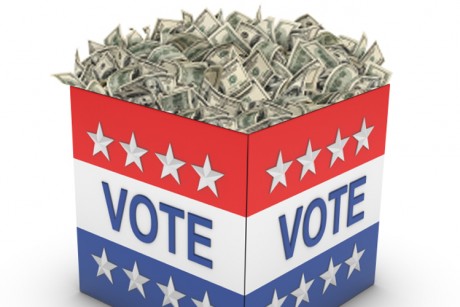
The new data shows that President Obama is way ahead of any of the GOP challengers, having raised $125 million so far. The next closest candidate in terms of money raised is Mitt Romney, who has raised $56 million.
Much has been made of the recent Supreme Court decision knows as Citizens United, which has allowed Corporations and other entities to make unlimited donations during election cycles. However, it would dishonest to not recognize that money has always influenced electoral politics in the US and that the richest 1% has always made it a point to buy influence by buying candidates or financing partisan politics.
Looking at the data recently compiled by the Center for Responsive Politics, one can see that there are a small number of people locally who are trying to influence the democratic process by giving large sums of money to candidates and political parties as the nation prepares for another Presidential Election in November.
In the 49503 zip code area we found that the largest donors in the 2012 election cycle so far are mostly members of the DeVos Family. Richard DeVos Sr. has contributed $70,900 so far, with his wife Helen giving an additional $60,400. Dick DeVos has contributed $41,300 to date and his wife Betsy has given $33,300. The other two sons of Richard DeVos, Doug and Dan have also made sizeable contributions, with Doug DeVos giving $44,300 and Dan DeVos throwing in $73,300. The wives of Doug and Dan DeVos have also contributed to influencing the election with Doug’s wife Maria contributing $31,300 and Dan’s wife Pam chipping in $5,000. Collectively, these members of the DeVos family have sought to influence the 2012 elections by contributing $359,800 so far, with 9 months of giving still ahead of us. It should be mentioned that Peter Seechia has also contributed a sizeable amount, giving $30,800.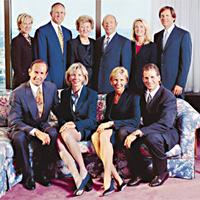
The largest recipients of this money from the 49503 zip code are: the Republican National Committee ($358,700) and Justin Amash ($61750), with other candidates receiving substantially smaller amounts.
From the 49504 zip code area the two largest donors are Susan and Michael Jandernoa, who have contributed a combined amount of $81,600. Jandernoa is the CEO of the Perrigo Company. Their money has primarily gone to the Republican National Committee and Pete Hoekstra who is running against Michigan Senator Debbie Stabenow.
In the 49506 zip code area the largest donors are Mark (Meijer CEO) and Elizabeth Murray, which have contributed a combined $40,800 to date. Other sizeable contributors have been JC Huizenga $5,000 and Crystal Flash President Thomas Fehsenfeld $5,000. The largest recipients from this zip code area are again the Republican National Committee and Pete Hoekstra.
From the 49546 zip code area (East Grand Rapids) the largest donors are: Calvin College President Gaylen Byker $65,100, Amway executive Suzanne Vanderweide giving $30,800 and Kate Pew Walters $10,000. The largest recipient from the 49546 zip code area are again the National Republican Committee.
Lastly, the largest donors from the 49512 zip code area are John Kennedy (Autocam CEO) $165,800 and Nancy Kennedy $40,800. The top recipient of money coming from the 49512 zip code area are the Republican National Committee and the Republican Party of Michigan.
Clearly the largest contributors from Grand Rapids are giving to the GOP, but as we noted earlier the Obama campaign is way ahead of all other contenders. However, it is useful to note whom the big money players are in electoral spending from this city and it speaks to their contempt for anything resembling real democracy.
The Sierra Club Took Millions From Fracking Industry
This article by Russell Mokhiber is re-posted from CounterPunch.
 Last week, I wrote an article about how Chesapeake Energy, through its fracking activity, was destroying the rural way of life in West Virginia.
After the article ran, an insider called me with a tip – Sierra Club has taken money from Chesapeake Energy.
I called Sierra Club on Monday and asked – Are you taking money from frackers – in particular Chesapeake Energy?
Waiting for a response, I called Sierra Club activists in West Virginia to see if they know anything.
Two of them – Jim Sconyers and Beth Little – e-mailed Michael Brune, the executive director of Sierra Club, and asked him whether the Club has taken money from Chesapeake Energy.
Brune writes back to Little and Sconyers:
“We do not and will not take any money from Chesapeake or any other gas company. Hope all’s well with you both.”
Simultaneously, I get an e-mail from Maggie Kao, the spokesperson for the Sierra Club.
On Tuesday, Kao writes to me: “We do not and we will not take any money from any natural gas company.”
I write back – I understand you do not and will not.
But have you taken money from Chesapeake?
That was Tuesday.
All day Wednesday goes by.
All day Thursday goes by.
And I can’t get an answer.
Then Thursday night, Kao writes says – okay, Brune can talk to you at 7:30 pm EST.
And by the way, Kao says – check out this story just posted in Time magazine.
The headline: How the Sierra Club Took Millions from the Natural Gas Industry – and Why They Stopped.
Turns out, Sierra Club didn’t want the story to break in Corporate Crime Reporter.
The millions from frackers.
And how as late as Tuesday, Sierra Club tried to mislead it’s own members about the money.
According to the Time report, between 2007 and 2010 the Sierra Club accepted over $25 million in donations from the gas industry, mostly from Aubrey McClendon, CEO of Chesapeake Energy – one of the biggest gas drilling companies in the U.S. and a firm heavily involved in fracking.
Time reported that the group ended its relationship with Chesapeake in 2010 – and the Club says it turned its back on an additional $30 million in promised donations.
Waiting to speak with Brune.
And ask him what he meant by:
“We do not and will not take any money from Chesapeake or any other gas company.”
Lisa Wright was on the executive committee of the Sierra Club’s Finger Lakes chapter in upstate New York.
But she soon got fed up with the national organization’s coziness with the natural gas industry and Chesapeake Energy.
Wright wanted Sierra Club to take a position against fracking – similar to a position the Club took on coalbed methane – it’s too dangerous to regulate – you have to prohibit it.
But Sierra Club wouldn’t budge.
Sierra Club’s position was to regulate, not prohibit.
So, on May 3, 2011, in an e-mail to Sierra Club’s executive director Michael Brune, Wright withdrew her membership.
“National Sierra Club has handled its affairs in regards to shale-gas in such an egregiously arrogant, ill-informed and out-of -touch manner that I simply cannot continue to pretend that my grassroots efforts in association with Sierra Club will in any way help the movement,” Wright wrote to Brune. “The high level associations of the gas industry with NGOs – evident in the Aspen Energy Summit – is like an infection that cannot be cured with sophisticated PR campaigns that obfuscate the underlying problem of your corporate associations.”
“It is my hope that you will reconsider your views on America’s shale-gas future, and provide the forward-thinking leadership that the Sierra Club brand once promised.”
On May 11, Brune wrote back, thanking Wright “for her thoughtful response.”
But then he added:
“Before I sign off, I do want to be clear about one thing: we do not receive any money from Aubrey McClendon, nor his company Chesapeake,” Brune wrote. “For that matter, we do not receive any contributions from the natural gas industry. Hopefully this will alleviate some concerns. Thank you for all your work.”
So, when Wright heard yesterday that in fact Sierra Club had taken $25 million from Chesapeake Energy between 2007 and 2010, she went back and dug up her e-mail correspondence with Brune.
“I took his response to mean that he had not taken any money from Chesapeake or the gas industry,” Wright toldCorporate Crime Reporter. “It was misleading.”
Brune’s position is that his “do not and will not” position was not misleading – because he didn’t address the past.
But Brune is going to be facing an angry grassroots this weekend when he holds a conference call for members to address the issue.
He might want to consider a different answer.
How Sierra Club Misled Its Members about the $25 Million from Chesapeake Energy
Lisa Wright was on the executive committee of the Sierra Club’s Finger Lakes chapter in upstate New York.
But she soon got fed up with the national organization’s coziness with the natural gas industry and Chesapeake Energy.
Wright wanted Sierra Club to take a position against fracking – similar to a position the Club took on coalbed methane – it’s too dangerous to regulate – you have to prohibit it.
But Sierra Club wouldn’t budge.
Sierra Club’s position was to regulate, not prohibit.
So, on May 3, 2011, in an e-mail to Sierra Club’s executive director Michael Brune, Wright withdrew her membership.
“National Sierra Club has handled its affairs in regards to shale-gas in such an egregiously arrogant, ill-informed and out-of -touch manner that I simply cannot continue to pretend that my grassroots efforts in association with Sierra Club will in any way help the movement,” Wright wrote to Brune. “The high level associations of the gas industry with NGOs – evident in the Aspen Energy Summit – is like an infection that cannot be cured with sophisticated PR campaigns that obfuscate the underlying problem of your corporate associations.”
“It is my hope that you will reconsider your views on America’s shale-gas future, and provide the forward-thinking leadership that the Sierra Club brand once promised.”
On May 11, Brune wrote back, thanking Wright “for her thoughtful response.”
But then he added:
“Before I sign off, I do want to be clear about one thing: we do not receive any money from Aubrey McClendon, nor his company Chesapeake,” Brune wrote. “For that matter, we do not receive any contributions from the natural gas industry. Hopefully this will alleviate some concerns. Thank you for all your work.”
So, when Wright heard yesterday that in fact Sierra Club had taken $25 million from Chesapeake Energy between 2007 and 2010, she went back and dug up her e-mail correspondence with Brune.
“I took his response to mean that he had not taken any money from Chesapeake or the gas industry,” Wright told Corporate Crime Reporter. “It was misleading.”
Brune’s position is that his “do not and will not” position was not misleading – because he didn’t address the past.
But Brune is going to be facing an angry grassroots this weekend when he holds a conference call for members to address the issue.
He might want to consider a different answer.
That Takes Ovaries to be performed in Grand Rapids this week
In the tradition of The Vagina Monologues, That Takes Ovaries: Bold Women, Brazen Acts brings a strong feminist message to West Michigan this week with two separate performances.
That Takes Ovaries!: Bold Women, Brazen Acts is a unique performance that utilizes activist theatre to tell the real-life stories of women and girls who have performed courageous actions and focuses on the bold, brazen, outrageous, and courageous things women have accomplished.
Performances will be held February 9th in the Grand River Room in Kirkhof on GVSU’s Allendale campus, and February 10th at Wealthy Theatre in Grand Rapids. Tickets are $10 for GVSU students and $15 for community members. Tickets for the February 9th performance can be purchased at the 20/20 desk in Kirkhof, while tickets for the Wealthy Theatre performance can be purchased through the Wealthy Theatre box office at www.wealthytheatre.org/ovaries or by calling 616-459-4788.
If you have any questions please contact the GVSU Women’s Center at 616-331-2748 or email ThatTakesOvariesGVSU@gmail.com.
LGBT and pro-immigration activists confront Rep. Agema
Earlier today 10 people from West Michigan went to the Rainbow Grill in Grandville, Michigan to confront State Representative Dave Agema about his recent hateful legislative proposals, some of which are now state law.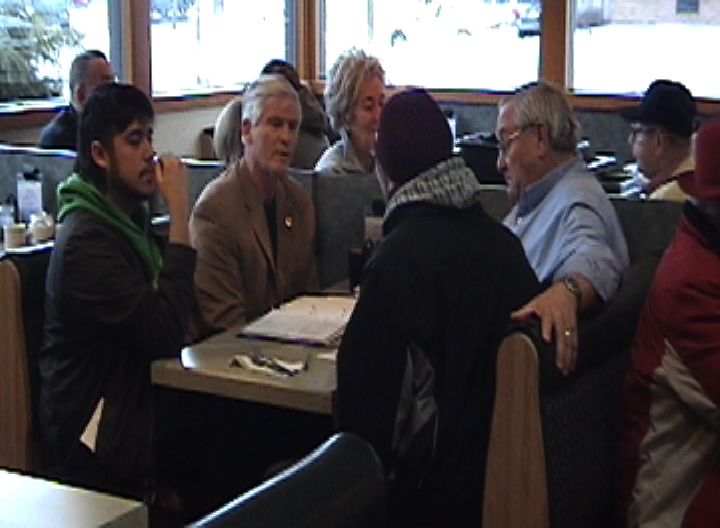
The issue that brought most people out today to confront Rep. Agema was the legislation to eliminated domestic partner benefits to some state employees, which the Representative introduced. The legislation was passed by both the House and the Senate late last year and signed into law by Gov. Snyder just before the holidays.
However, there were also people who came today to address Agema’s anti-immigration stance, anti-Muslim position and his support for the anti-union proposed Right to Work policy.
The activists who came to confront Agema found out 2 weeks ago at a rally in Lansing that the area Representative did not have a local office and only meets with constituents once a month at the Rainbow Grill.
Once Agema arrived people sat down with him at a booth and began to express their feelings and perspectives on issues of concern to the LGBT community, immigrant community and working people who all have been targets of Agema introduced and co-sponsored policies.
It appeared that the State Representative was not used to people actually showing up to talk with him on important matters. The group made it very clear that they all intended to speak to Agema who was clearly agitated by their collective confrontation.
After roughly 90 minutes of people directing their anger at the State Representative, Agema said he needed to go to another meeting. The group followed him outside and continued to confront Agema as he kept trying to leave. The group as a whole told him how much his policies were causing harm to people and that despite the Representative’s claims to follow the law, the group continued to press him on how his policies harm some of the most vulnerable members of this community.
Besides confronting Agema, members of the group passed out information sheets on how Agema’s policies impact working families.
The group found out that the Grandville Representative only meets with local constituents on the first Saturday of every month from 8:00AM to 9:30AM at the Rainbow Grill on Chicago Drive. Some of those who confronted Agema said they plan to come back next month and bring more people.
The Intersection of Sports and Politics: An afternoon with Dr. John Carlos & Dave Zirin
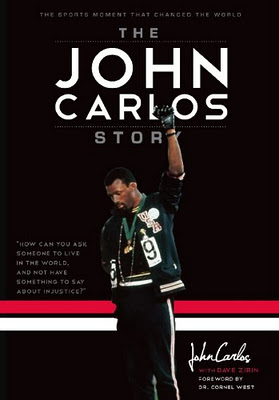
On Thursday, I had the opportunity to spend time with 1968 Olympic Athlete Dr. John Carlos and left sports writer Dave Zirin while they were in Grand Rapids to give several talks.
After speaking with a few different smaller groups, we were able to sit down and interview both of them for about 40 minutes. The interview is posted below.
For the main presentation the audience of at least 600 was shown a portion of the documentary, Not Just a Game: Power, Politics and American Sports. The section that was shown dealt with the hyper-commercialism of sports today and the contrast of present days athletes like LeBron James to former athletes like Muhammad Ali and John Carlos.
After the 15-minute clip, Carlos and Zirin took the stage. Zirin chose to just ask question of the Olympic legend, instead of having a formal presentation. Dr. Carlos talked about that moment in 1968 in Mexico City, when he and Tommy Smith made that amazing statement on the medals stand.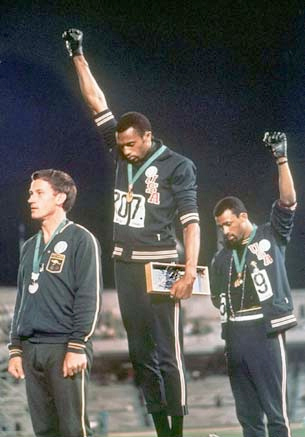
The former athlete also talked about his relationship to his father, his early acts of civil disobedience and growing up in Harlem. While Dr. Carlos talked about his relationship with Malcolm x and his meeting with Dr. Martin Luther King Jr., I could see on the faces of many of the students present a sense of awe. This sense of awe was reflected in the line of people who wanted to get their book signed by Dr. Carlos and how many students wanted a picture taken with the Olympic great.
Dave Zirin also told the audience about the day that he and John Carlos spoke to the Occupy Wall Street in New York City. The main point that Carlos made that day and repeated to the audience at GVSU, is that we all have to make critical decisions in life about whether or not we do things that benefit just ourselves or take action that benefits the greater good. It is in these moments, said Dr. Carlos, that we define who we are and what we stand for. “Don’t come to the end of your life with regrets about making a difference in the world. Even though it might be unpopular, take a stand for justice when the opportunities present themselves!”
The Deal That Saved Detroit and Banned Strikes
This article by Laura Flanders is reposted from CounterPunch.
President Obama is, as AP puts it, “wearing his decision to rescue General Motors and Chrysler three years ago as a badge of honor” on his reelection campaign. It saved jobs and working communities, brought the US auto industry back from the brink. In January, U.S. auto sales were up eleven percent over a year ago, and a proud president was cooing to the college students of Ann Arbor, Michigan:
“The American auto industry was on the verge of collapse and some politicians were willing to let it just die. We said no… We believe in the workers of this state.”
You’re going to be hearing a lot about the deal that saved Detroit in the next few months, not least because likely opponent Mitt Romney was against it. Then Governor Romney wrote in the fall of 2008 that if the big three auto companies received a bailout “we can kiss the American auto industry goodbye.” Romney bad; Obama good; Big Three back. The Deal with Detroit story is gold dust for Democrats. Reality is a bit more complicated.
For one thing, it was Republican President Bush, not the Democrats’ Barack Obama, who originally decided not to stand by as the auto makers died. The deal saved an industry – US cars are still being made in the US — but it came at such a high price that in many ways it’s a whole new industry. The American auto industry that built middle class lives as well as cars — that one we kissed good-bye, and it may be a while before we see it back again.
To review: in the fall of 2008, President George W Bush announced a $17.billion loan, split into $13.4 billion at once and another $4 billion in February. The billions for Detroit were tied tight with all the string that had not been attached to the trillions simply given away to Wall St. The Treasury never forced the financial industry to hand over majority shareholder control in exchange for access to the Troubled Asset Relief Program. No CEO of AIG or Bank of America or Well Fargo had to shrink a wage or skimp on a pension. (Far from it, the Government Accountability Office found that the “standard agreement between Treasury and the participating institutions does not require that these institutions track or report how they plan to use, or do use, their capital investments.”)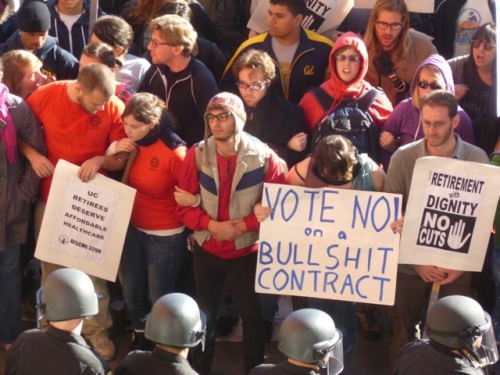
Big bucks for the Big Three, by contrast, came with all sorts of ties – mostly around the neck of the United Auto Workers and their members. When the deal was finally worked out, under Obama’s “Car Tsar” (a man with zero manufacturing experience but oodles of admiration from NY developer Steve Rattner and Lawrence Summers) the worker’s concessions amounted to a slash in all-in labor costs from around $76 per worker-hour in 2006 to just over $50. Abandoning decades of principle, the UAW approved a two-tier wage structure in which new hires start at t$14/hr — roughly half the pay and benefits of more senior line workers. To top things off, Treasury demanded — just one more teeny thing – a strike ban. The pièce de no résistance! Under the government’s agreement with the companies, any strike by workers is grounds for forfeiting the loan.
The timing couldn’t be more poignant. Seventy-five years ago, in the winter of 1936-37, it was a strike at General Motors that won the first victory for the one-year-old UAW, and won for organized labor the respect that made it possible to negotiate for those middle-class auto-makers’ lives. Late on December 30, 1936, autoworkers in Flint occupied a General Motors plant launching a strike that within less than a month, involved 135,000 workers in 35 cities across the country. When the union called for support in early January, 150,000 people showed up at Detroit’s Cadillac Square in a show of solidarity.
The Sit-Down Strike as it came to be known, ended on Feb. 11, 1937 with a defeat for GM, but for forty-four days, the company used ever tactic to end the occupation. (Take courage Occupy Wall St!) In the dead of winter, owners turned off the heat to the occupied plants. Knowing the strikers’ depended on “solidarity kitchens,” they cut off food delivery. When police moved in on one of the plants in Flint in January, workers pelted officers with engine parts and police fired back tear gas and bullets, sending 28 injured workers to the hospital. Women formed an Emergency Women’s Brigade. The next time police threatened to storm the plant gates, they found their way blocked by women locking arms — the indominatble “Rolling Pin Army.”
The battles of 75 years ago forced GM negotiators to recognize the union as the bargaining agent for the workers, and for a while at least, factory owners across the country negotiated in fear of a sit-down. Seventy-five years later Obama and the Democrats are cheerleading the deal that saved Detroit – and did away with the right to strike, at least temporarily. Now US auto sales are on the rise and with unemployment what it is, the companies say there’s a line around the block for those $14/hour entry-level jobs .
“On the plus side we still have US based auto production,” says Ed Ott, former chair of the New York Central Labor Council. What are union rights going to be like going forward? “The unions say we’ll build back up. Let’s hope they’re right.”
A more likely scenario is $14/hour auto jobs are here to stay. If the US wages low enough, they may draw jobs back from where they’ve gone to. As long as no one here is looking to increase taxes on the factory owners, offshore wages right here save employers the trouble and cost of off-shoring. What’s it mean for those workers’ families? Unless their low-wage lives are subsidized by more taxpayer-dollars in the form of free or low cost public services and help they’re in for pretty lean years. UAW President Bob King (praised for his “flexibility” ) is hopeful union strength will build back up. Heaven knows how.
Lucky us. We missed it the first time. Now, it looks as if we get to experience the Gilded age all over again – and in another half century or so, some auto worker may decide to sit down and occupy a factory.
 Grand Rapids Institute for Information Democracy