Remembering the Legacy of Salvadoran Archbishop Oscar Romero: March 24 – A Martyr for Justice!
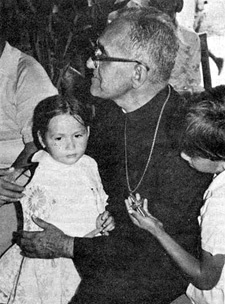 Today is the 45th anniversary of the death of Salvadoran Archbishop Oscar Romero. Romero was gunned down by Salvadoran death squads on March 24th, 1980, while saying mass in San Salvador.
In the late 1970s, Oscar Romero began to challenge the power structure in El Salvador, mostly through his Sunday sermons and his weekly radio broadcast. Romero understood all to well that the poverty and violence that people endured was because of the unjust economic power that the country’s wealthy possessed.
Romero also understood that the political violence that was terrorizing the country’s poor and working class people was a direct result of US military aid to El Salvador. Five weeks before Romero was assassinated he wrote a letter to then US President Jimmy Carter. He asked Carter that if the US really wanted to support justice in El Salvador that the US should stop sending weapons to his country and that the US should not directly intervene in any way into the political, economic, military or diplomatic affairs of El Salvador.
Noam Chomsky writes in the book Manufacturing Consent, that after Romero sent the letter to Carter, the Carter administration put pressure on the Vatican to try and curb the activities of the archbishop. The Vatican did not try to silence Romero for his critique of US imperialism, but they also did nothing to challenge the Salvadoran military to cease their threats against Romero and other religious workers in the tiny Central American country.

I have written about how Oscar Romero impacted my life in an article you can find here.
There are numerous books on Oscar Romero, such as Voice of the Voiceless: The Four Pastoral Letters and Other Statements. Other books include:
- Blood in the Fields: Oscar Romero, Catholic Social Teaching, and Land Reform, by Matthew Philipp Whelan
- Assassination of a Saint: The Plot to Murder Óscar Romero and the Quest to Bring His Killers to Justice, by Matt Eisenbrandt and Benjamín Cuéllar
There is also an excellent documentary, Monsenor: The Last Journey of Oscar Romero.
There is also the Hollywood film, where Raul Julia plays Romero, which is entitled Romero.
Lastly, here are word from Romero’s final sermon, where he pleaded with the Salvadoran soldiers to lay down their weapons.
Mayor LaGrand’s State of the City address provides us some insight into what Grand Rapids residents can expect
Last Thursday night, Mayor David LaGrand gave his first State of the City speech at an event that was invite only. Invite only events by public officials means that they want to control the narrative and prevent any dissenting voices from being heard. It’s not a good look for those who claim to be progressive.

In addition, the event featured numerous sponsors, most of which have a track record of engaging in repressive, exploitative practices, along with be part of the Capitalist Class. There are several constructions companies listed, which might provide an idea about what the Mayor had to say about the current housing crisis. SeyferthPR is listed, which is the PR firm that represents the local power structure, along with Warner Norcross Judd, the law firm that represents the local power structure. There are energy companies that notoriously perpetuate the climate crisis, and a company that has a near monopoly on paid parking.
However, the most telling event sponsors are the DeVos family companies, represented by Amway, AHC Hospitality and RDV Corp. In addition, there are numerous entities which the DeVos family has influence in, often a representative, such as Downtown Grand Rapids Inc. and Grand Valley State University, which I have written about in my analysis of the Grand Rapids Power Structure.
2025 State of the City Address
There was the expected local news coverage of Mayor LaGrand’s State of the City address, like MLive’s post that highlighted 4 take aways from the night. There was also an article posted on the Rapidian, which presents itself as a more independent voice, but too often mimic’s how the commercial media practices journalism. You can also watch the State of the City address at this link and make up your own mind. (LaGrand’s comments begin at 20:25 in the video) What follows is my analysis of what Mayor LaGrand said and didn’t say.
LaGrand spent the first 2 minutes and 35 seconds thanking the sponsors of the event, Grand Rapids City employees, the elected officials in the room and members of the Grand Rapids City Commission. LaGrand then identifies what he called, “three baskets for policy challenges.” Those identified were housing, justice & policing, and City & Neighborhood design.
Housing
LaGrand began his comments on housing by saying, “We all know that Grand Rapids is no longer a cheap housing market. And that makes sense – housing is cheap in places people don’t want to live, and more expensive when there’s demand.” The Mayor then provided some data about the growing need for housing, the increased cost of housing, while income increases are nowhere near what the housing costs are.
LaGrand even acknowledges the increase in the number of unhoused people across the country, but then praises what Grand Rapids is doing, citing the 100 in 100 days program, a program that is limited in scope and is ultimately a false solution to the bigger issue of housing insecurity. Central to the issue of the housing crisis is the fact that 47% of Grand Rapidians are one paycheck away from being on the streets or having to live with family/friends. In February, there was a new report on the housing crisis in Kent County, which stated two things that the Mayor did not acknowledge:
- Even if rents froze tomorrow, and wages increased at their current rate, it would take until 2036 for people in similarly earning professions to be able to live comfortably and affordably in Kent County, according to the report.
- If home prices remained at the rate they are now, people in those occupations still wouldn’t be able to afford a home in Kent County until 2041, the report stated.
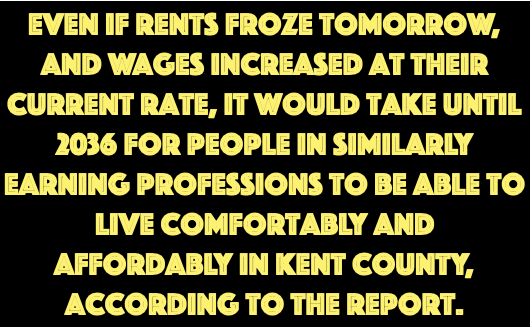
LaGrand does acknowledge in the slide above these awful housing related projects, all of which exemplify the worst of the housing as a commodity narrative. This is especially true of the DeVos/Van Andel three towers project, which will receive $565 million is tax incentives. In addition, the City of Grand Rapids and the people representing the three towers project treated the significant public opposition to this project with nothing but contempt.
LaGrand then talked about 2 housing efforts that he was excited to announce, that GR now has a land bank and ADUs – Accessory Dwelling Units. However, neither of these two items addresses the fundamental challenge of the duel economic component, which is the cost of housing and the fact that people do not make a living wage in this city.
Justice & Policing
In this portion of his speech, LaGrand by making this statement – “Public order is the bedrock of a strong city.” Public order is essentially code for business as usual. The wealth gap in this city, to priority of profits over people, the structural racism and maintaining systems of power and oppression are what public order looks like in this city.
LaGrand chose to highlight projects like Cure Violence and the new 16 bed community mental health efforts. LaGrand failed to acknowledge that the Trinity Health 16-bed crisis stabilization unit is a face saving effort after Trinity health did not assist a Black man who was struggling with mental health issues last fall and was shot to death by the GRPD because they thought he had a gun.
LaGrand also praises Winstrom, but ignores the massive budget the GRPD gets on an annual basis, which are millions more than the city charter minimum requires. LaGrand praises the increase in GRPD cops and continues the same copaganda narrative that more neighborhood cops means more community safety. The notion of community policing or neighborhood policy is a good thing is not grounded in reality, as I have written previously regarding the so-called Operation Safe Neighborhoods.
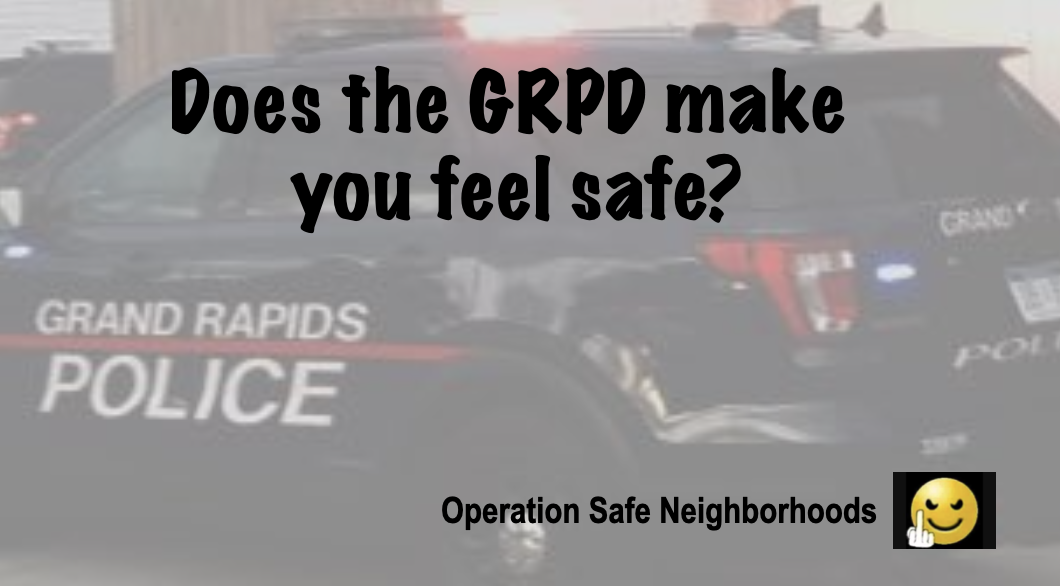
What we know is that when people’s basic needs are being met, there is a reduction in crime. However, you can’t meet the needs of people, when you spent massive amounts on policing, and provide even larger amounts of tax subsidies to developers for private gains.
At about 40 minutes into the video Mayor LaGrand started talking about the importance of cities. In fact, LaGrand said that ever since human invented cities a few thousand years ago, they have been thriving. The Mayor offers no real evidence of such a claim and having spent many years abroad doing solidarity work, my experience about cities says otherwise. But if you want good analysis about cities, I would suggest you read Mike Davis who wrote Dead Cities in 2002 and Planet of Slums in 2005.
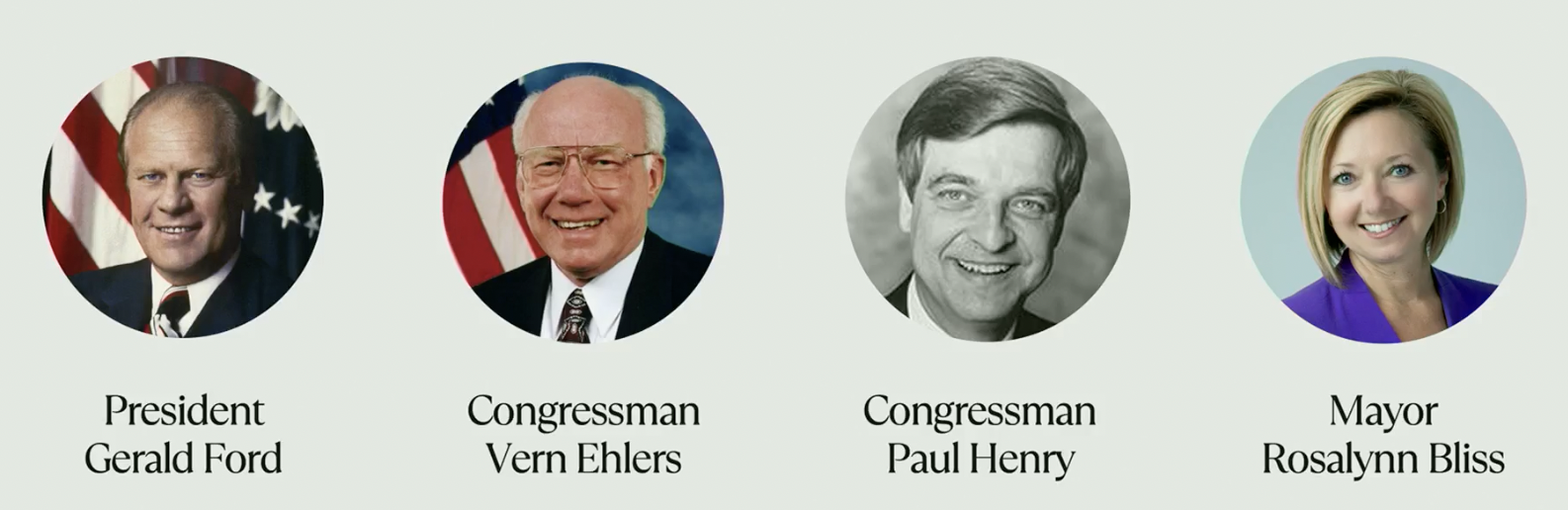
After waxing about cities and democracy, LaGrand then talked about what he really thinks is important – party politics that is non-partisan. He then shares a slide with the images of Gerald Ford, Congressman Vern Ehlers, Congressman Paul Henry and former Mayor Rosalynn Bliss. Really, these are the models for us?
- As a member of Congress, Gerald Ford voted to militarize policing in the US, suppress the social movements of the 1960s and 70s, then as President supported the continuation of US Imperialism and US involved wars abroad.
- Here is a more honest assessment of the legacy of former Congressman Vern Ehlers.
- I also have a memory about former Michigan Congressman Paul Henry.
- An alternative to the dominant narrative regarding the legacy of Mayor Bliss.
LaGrand ended his comments by promoting his Mayor’s Mondays and that he wants to flip the scrip and value everyone’s voice. However, when immigrants and other community members showed up to a late-January City Commission meeting to demand that Grand Rapids become a Sanctuary City, people were dismissed. City Commissioner Belchak said, “there were probably as many people who would oppose GR being a Sanctuary City, they just didn’t show up.” However, to date, there have been 3204 people who have formally communicated that they want GR to be a Sanctuary City, while only 16 people have formerly opposed it.
Pure Copaganda: New Trailer for GRPD TV series and local news coverage about All Access PD Grand Rapids
A new All Access PD Grand Rapids trailer has been released, a trailer about a TV series focusing on the Grand Rapids Police Department.
The TV series will stream on MAX, beginning April 8th, which will include eight episodes. Not surprising, all four local daily news outlets reported on the new trailer and the TV series. What follows is some analysis about the collective coverage from MLive, WOODTV8, WZZM13 and WXMI 17.
WXMI 17 actually had two separate stories about the show and the trailer for All Access PD Grand Rapids. In the trailer, which features Police Chief Eric Winstrom, it is important note that his comments really frame what this TV series is all about, despite whatever claims the GRPD or the TV producer might make about the “behind the scenes” feel of the 8 episode series. Early in the trailer, Chief Winstrom says, “When I moved here 2 years ago, from Chicago, trust in this police department was at an all time low. I knew that I had to break down the walls.”
The first WXMI 17 story includes the full trailer, along with a title and brief description of all eight episodes. The second channel 17 story featured the show’s producer who said he met Winstrom while he was in the Chicago Police Department, where the produced was immediately impressed with the future GRPD Chief.
The second WXMI 17 story is referred to as Behind the Curtain, with the channel 17 reporter talking about how many cameras were allowed to follow the GRPD and that there was no censorship by the GRPD of what the TV crew was filming. And the public is just supposed to believe this assessment from the channel 17 reporter?

WOODTV8 did a zoom with the TV series producer, Gary Sherman. Sherman is quoted as saying: “Chief Winstrom, when he got here, realized that there was not a great relationship between the police department and the city and the people of Grand Rapids, and he felt that transparency would be the best way to bond a relationship between the police department and the people of Grand Rapids,” Sherman said. “And he said to me, ‘If I gave you total transparency, do you think you should get a show on the air?’ And I said, ‘Total transparency, all-access, is exactly what every network is looking for and never offered. And the fact that you’re offering it, I think I could probably sell a show.’ And that’s exactly what happened.”
The notion that the GRPD practices total transparency is a cruel joke. There have been numerous FOIA requests from activist groups since Chief Winstrom has been in Grand Rapids, with the most recent being one related organizing around the GRPD’s murder of Patrick Lyoya. I wrote about these FOIA documents last September, along with Additional Incident Reports_Redacted and Combined additional documents_Redacted.
In the trailer of the All Access PD Grand Rapids TV series, Winstrom says when he came to Grand Rapids community trust was at an all time low. Actually, the GRPD murder of Lyoya happened a month after Winstrom arrived, which was when community trust was at an all time low, not when he first arrived.
The MLive article acknowledged the GRPD murder of Patrick Lyoya, which happed right after Winstrom arrived, but said nothing more about it. In fact, most of the MLive coverage focused on what TV producer Gary Sherman had to say about Winstrom. The MLive story also included a brief description of all 8 episodes.
The WZZM 13 story at least included a brief bit about one of the murders the GRPD was investigating and provided some airtime to father of the boy that was killed. However, the channel 13 story also cites TV Show producer Gary Sherman, who says, “This police department is amazing, and it’s an amazing community.”
The All Access PD Grand Rapids TV series should be seen for exactly for what it is, pure Copaganda. Regardless of what the TV show producer has to say about the GRPD, Black, Brown, immigrant and activists communities know better about how the GRPD really operates. These communities know that there is no real transparency or accountability since Winstrom arrived. The news coverage of the upcoming TV series provides no critique of the GRPD, nor do they include critical community perspectives.
Beginning in April, GRIID will watch each of the 8 shows about the GRPD, provide a critique of the series and juxtapose concrete examples and data on how the GRPD operates and functions in the service of power.
Palestine Solidarity Information, Analysis, Local Actions and Events for the week of March 23rd
It has been more than 17 months since the Israeli government began their most recent assault on Gaza and the West Bank. The retaliation for the October 7, 2023 Hamas attack in Israel, has escalated to what the international community has called genocide, therefore, GRIID will be providing weekly links to information and analysis that we think can better inform us of what is happening, along with the role that the US government is playing. We will also provide information on local events and actions that people can get involved in. All of this information is to provide people with the capacity of what Noam Chomsky refers to as, intellectual self-defense.

Information
Massacre at 2 A.M.: Israel Resumes Indiscriminate Attacks Against Gaza, Killing Over 400 People
Pro-Palestine Campus Organizers: Demilitarization & Democratization Go Together
Israel resumes genocidal attacks on Gaza, killing 400
Israel’s Assault Marks One of the Deadliest Days for Children in Gaza History
The Monkey’s Tail: How Netanyahu’s Ambitions Expose Israel’s Vulnerabilities
Israeli Blockade Leaves 1 Million Children in Gaza Without Basic Necessities ‘Yet Again’: UNICEF
ISRAEL VIOLATED THE GAZA CEASEFIRE FROM THE START. WHY WON’T THE MEDIA TELL YOU THAT?
Israel’s settlement policy is a war crime, says UN
Analysis & History
The Unraveling: Zionism, October 7, and the Ongoing Nakba w/ Ilan Pappe
“Endless Trauma”: Israeli Strikes Shatter Gaza Ceasefire as Blockade Starves Palestinian Population
Israeli Strikes Kill 174+ Children in Gaza as Netanyahu Breaks Ceasefire to Save Political Career
Image used in this post is from https://mondoweiss.net/.
One of the 10 principles of journalism is that it must serve as an independent monitor of power.
Now, I don’t claim to be a journalist, more of a media watchdog, but I do engage in movement media. Movement media is reporting and documenting what social movements are doing, which is what I have been trying to do with GRIID since 2009.
However, since I have been monitoring what I call the Grand Rapids Power Structure for nearly two decades, I thought I would start a new segment – Monitoring the Rich and Powerful in Grand Rapids.
The Monitoring the Rich and Powerful in Grand Rapids segments will offer brief commentary on those who have power over others in this community. These segments will not replace my regular reporting on the Grand Rapids Power Structure, since those stories will offer more in depth writing.
As we navigate a second Trump Administration with the likes of Elon Musk, it seems like a perfect opportunity to shed some light on rich and powerful of Grand Rapids, or to frame it the way that radical media from the 60s and 70s would do regarding the Capitalist Class, using the phrase, “up against the wall motherfucker!”
- Dick DeVos, the oldest son of Rich DeVos has a Facebook page, where he refers to himself as a Public Figure. While that is sort of a true description, I would prefer to call him – Local Oligarchy member. Dick recently posted on his FB page the following: The team working on the Acrisure Amphitheater reached a special milestone on Friday as workers raised the final steel beam and completed the amphitheater’s framework. Congratulations to the entire team and GREAT WORK!! Grand Action 2.0 and our partners could not be more excited to see how this project transforms Grand Rapids. Very grateful for all of the workers, engineers, and contractors who have been working on this project!! Dick DeVos conveniently omits the fact that the bulk of the funding for the 14,000 seat amphitheater is because of all the tax breaks and public money from the State of Michigan, Kent County and the City of Grand Rapids. DeVos does acknowledge that he is part of Grand Action 2.0, which has been the entity driving most of the downtown Grand Rapids projects since the arena in the mid-1990s. I have written about Grand Action 2.0 a great deal in recent years, which you can find here, but in one of the articles I ask the question – How is it that we allow groups like Grand Action 2.0 to get away with the shit they do?
- In a new post from the website Grand Riverfront it states: Amway Stadium, set to open in 2027, is expected to drive economic development, expand opportunities for young athletes, and attract large-scale events that benefit businesses across the region. The new venue will be more than just a soccer stadium. It’s designed to be a multi-purpose facility that serves the broader community. While it will be home to an MLS NEXT Pro team, it could also be available for high school and collegiate championship games, lacrosse, rugby, and marching band competitions, as well as an endless list of community opportunities – much of which have yet to even be imagined. Tourism officials and business leaders believe the stadium will generate millions in visitor spending, benefiting hotels, restaurants, and local businesses. Groups like this, which are essentially made up of the same people that are part of Grand Action 2.0, the DDA and the Grand Rapids Chamber of Commerce are always claiming these project will be an economic boost. These groups often cite economic impact numbers, but they rarely, if ever, say where the money is going, which in the downtown area in goes to the OWNERS of the hotels, parking structures, bars, restaurants, etc. The business class reaps the profits from these projects, not those who work in parking garages, restaurants, bars and hotels. People who work in these spaces still don’t make a living wage, while the owners of these spaces continue to expand their wealth.
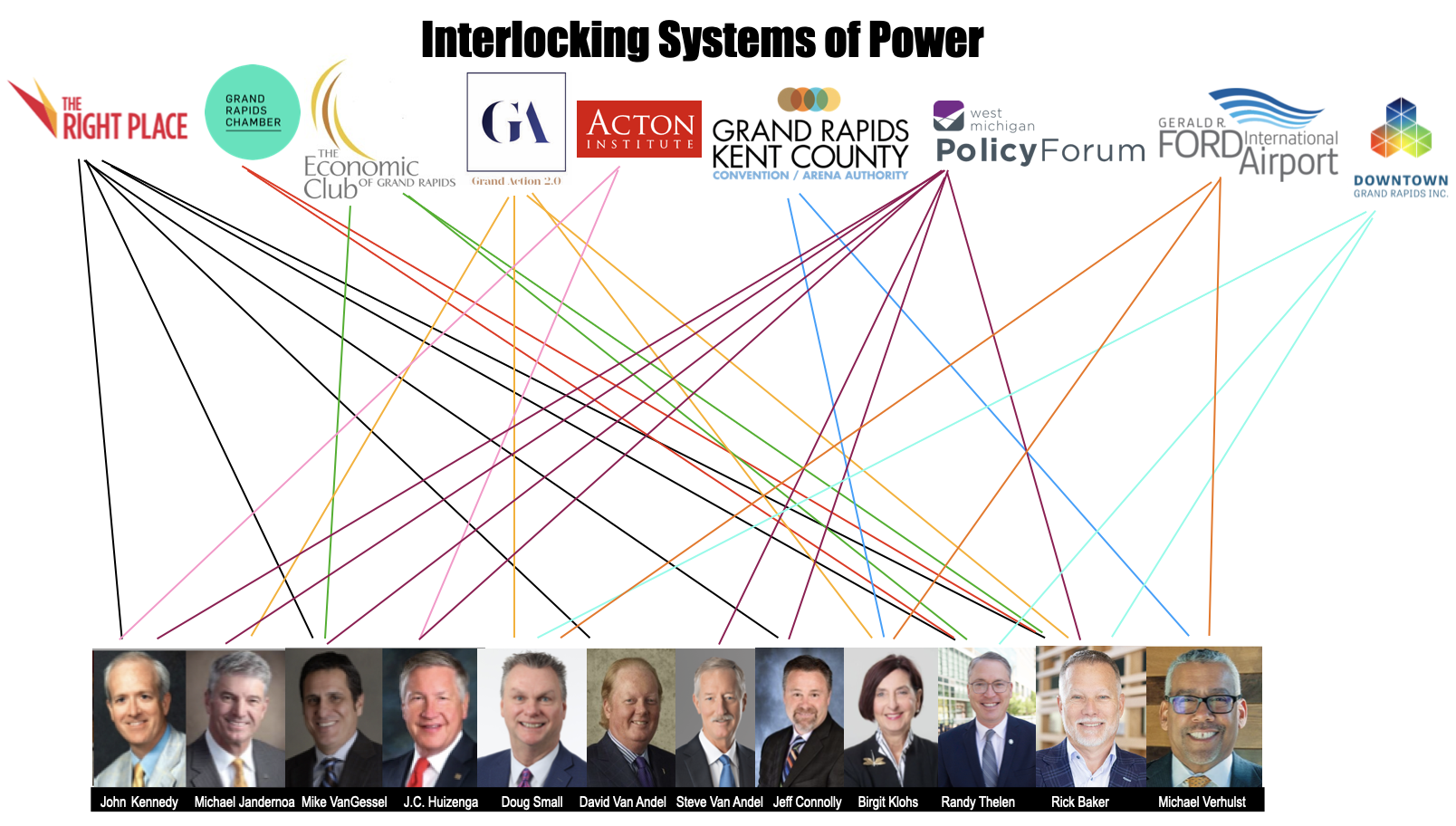
- The West Michigan Policy Forum recently posted an article by one of their members, John Kennedy, the CEO of Autocam. They write on their FB page: Michigan’s roads are in dire shape, but raising taxes on small businesses and people isn’t the solution. John Kennedy said the West Michigan Policy Forum stands against a proposed Corporate Income Tax hike because it will hurt local businesses, job growth, and Michigan’s economy. Instead, Kennedy said revenue-neutral proposals like Speaker Matt Hall’s plan is the best way to fix our roads and bridges. Let’s prioritize better budgeting over more taxes to keep Michigan open for business and drive real economic growth. John Kennedy, who is a member of the Grand Rapids Power Structure, besides sitting on the board of the West MI Policy Forum, also sits on the board of the Acton Institute and the Right Place Inc. Kennedy is on the far left of the info-graphic here below.
4 things to think about before attending Rep. Scholten’s Town Hall meetings next week

Updated version as of 5:45PM on March 20.
Next week, Rep. Hillary Scholten will be finally holding an in-person Town Hall meeting. I say finally, because Rep.Scholten has not held an in-person Town Hall meeting at least since the summer of 2023. Remember, Rep. Scholten only began her tenure as the 3rd Congressional Representative since January of 2023.
People have been raising hell over the fact that other members of Congress in Michigan have not been holding in-person Town Hall meetings, but this is likely the first one that Scholten has hosted.
However, just because Scholten is hosting in-person Town Hall meetings, doesn’t mean she is really interested in what people think. What follows are some reasons why.
First, you can see from the graphic included here, that Rep. Scholten has two Town Hall meetings, one in Grand Rapids and the other in Grand Haven. If you want to attended you have to RSVP, by going to this link. Once you RSVP they will send you the location of either Town Hall Meeting. I sent an RSVP in 2 weeks ago, and finally got a response on March 20th. Here is what the response said: For security purposes, you’ll receive the exact location details and your final confirmation ticket needed for entry next week, so stay tuned. Please note that all bags must be limited to 12” x 6” x 12” and backpacks will not be permitted. Bags can be subject to search upon entry. Weapons of any kind, including firearms, knives, and other dangerous items, are strictly prohibited. It appears that security will be heavy, which begs the question of why? What does Rep. Scholten have to fear? The notification also stated, “All attendees must be registered for the event in advance and sign in upon arrival.” This means that people who are registered can’t invite people to a Town Hall meeting with the person who is suppose to represent us. All so very controlling and cowardly.
Second, the Town Hall meetings are only one hour in length, which is ridiculous considering how many issues that Congress deals with, both domestic and foreign policy. In addition, politicians always take time to tell people during these Town Hall meetings what they are doing, often 15 – 20 minutes, which leaves 40-45 minutes for people to ask questions or make comments.
Third, the likely mechanism for people to ask questions will be through writing down your question/comment on cards. This allows the Scholten team to pick and chose which questions will get asked and refuse those that are more challenging or questioning of her voting record.
Fourth, rhetoric from candidates or politicians is meaningless, especially when it doesn’t match up with their voting record. You can search Rep. Scholten’s voting record at this link. In addition to voting records, we should also scrutinize campaign financing for elected officials. You can investigate what people, groups or Political Action Committees (PACs) that Scholten is in bed with, by going to this link.
 GRIID has been tracking Rep. Scholten’s voting record since she first took office in 2023. There are three areas that we have done lots of monitoring on, immigration policy, US Military Budget and her unconditional support for Israel, before and since the genocide began in October of 2023.
- Most of the GRIID articles on Rep. Scholten’s support for the Israeli genocide can be found at this link.
- Since Rep. Scholten was elected, she has voted both years to support a massive US military budget, in 2023 and 2024.
- Since the beginning of this year, Rep. Hillary Scholten has voted three times with the GOP on legislation that further criminalizes undocumented immigrants.
You might consider keeping this information in mind, especially if you plan on attending the Town Hall meetings next week.
GRPD creates counter narrative about incident from last weekend, while Chief Winstrom claims the cops have regained community trust
Last weekend there was an incident in downtown Grand Rapids, where 20 GRPD cops used pepper ball guns on a primarily Black group of people. In addition, the GRPD plus the GRPD made several arrests.
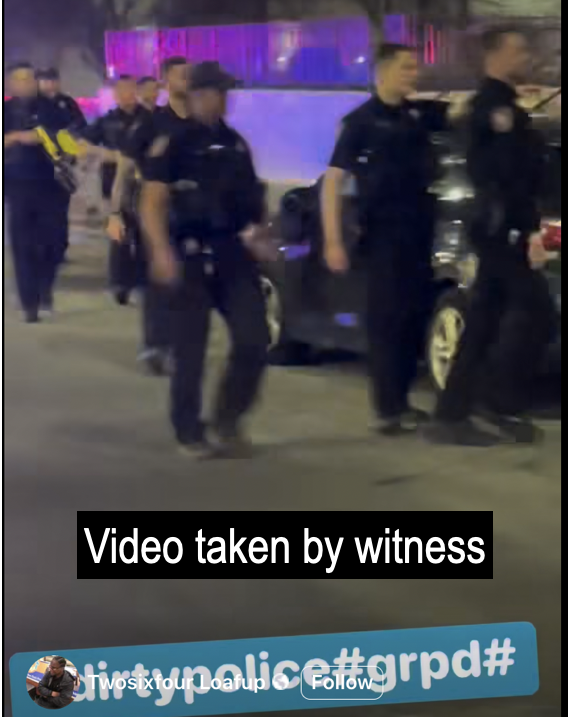
I first found out about it on Sunday, when someone who was at the scene of the incident filmed what was happening, which you can watch at this link.

In a direct response to the resident video, GRPD Chief Eric Winstrom took it upon himself to reach out to local news to provide a counter-narrative about what happened. Both MLive and WXMI 17 reported on the incident, which I want to de-construct here.
MLive’s coverage was very problematic for numerous reasons. First, the only source cited in their article was the GRPD, specifically Chief Winstrom. Second, nothing of what Winstrom was saying was questioned by the reporter, nor were his claims verified. For example, MLive states:
Winstrom said he believed the officers had shown “great restraint” in a violent situation that could’ve ended much more violently. There were about 20 officers who responded to the incident.
There is no follow up to this comment or verification as to whether or not the GRPD used “great restrain.” The MLive goes on to quote Winstrom:
“I looked into the incident and saw the officers really facing a very difficult situation where they are overwhelmingly outnumbered,” he told MLive/The Grand Rapids Press on Monday, March 17. “It’s chaotic, it’s very violent, and the officers showed great restraint, and in a matter of probably about eight minutes, brought everything to a peaceful conclusion.”
 Again, the mLive reporter demonstrates no questioning or verification of the claims made by Winstrom, particularly his comment, “in a matter of probably about eight minutes, brought everything to a peaceful conclusion.” What Winstrom means by bringing things to a peaceful resolution is to arrest people and to use weaponry that causes discomfort and significant pain, especially for those with respiratory issues.
Third, the only visuals that MLive used were still shots from GRPD bodycam footage. We know that GRPD cops have a history of turning bodycams off, plus the still images were probably provided to local media for use, images that were selected, since there is no concrete evidence of wrong doing on the part of the GRPD.
Fourth, the ending of the article underscores Winstrom’s real reason for crafting a message about the incident that took place last weekend. MLive cites Winstrom at length:
“I’m glad we’re in a place of trust, where I think the default now is that everyone knows that the police officers who respond to 911 calls in the city all have body-worn cameras on,” he said. “Everyone knows that the officers are aware of the ubiquity of surveillance video, including cell phone videos. Everyone knows that I am not afraid to hold police officers accountable when they do things wrong. And so I think the trust issue has really improved.”
Such a claim is once again unchallenged and unverified by the reporter. What I know about community attitudes about the GRPD, particularly in the circles I am in, is that people, especially BIPOC people, do not trust the GRPD.
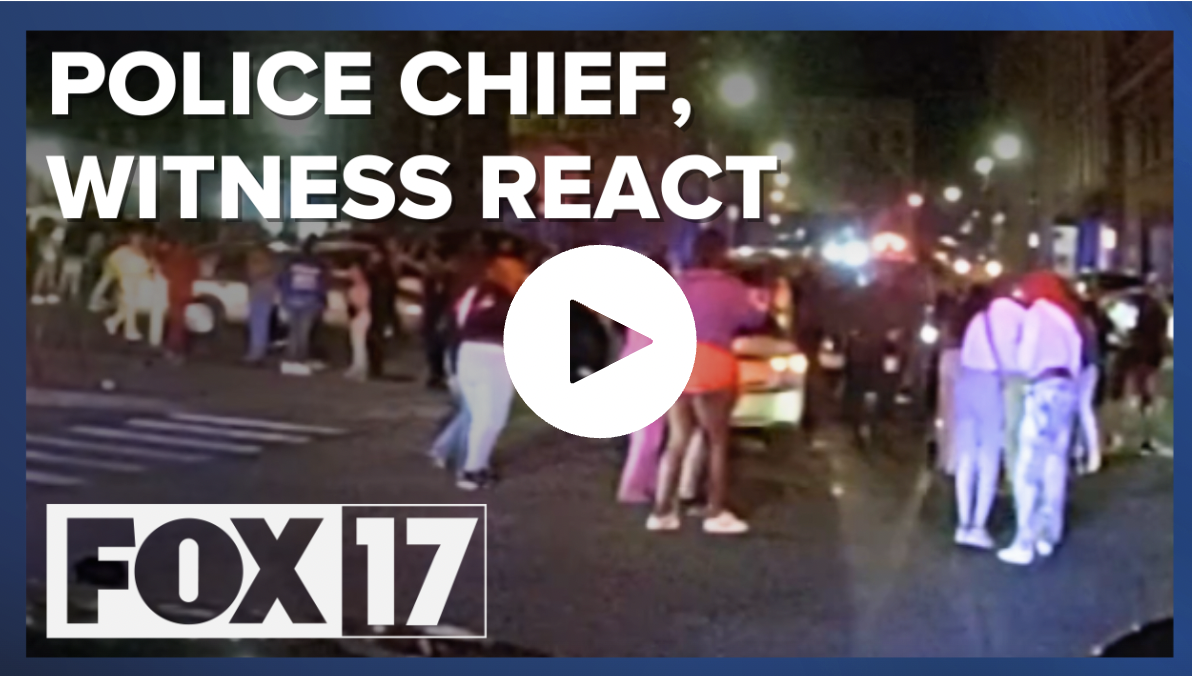
The WXMI 17 story was a little better than the MLive story, in that they actually talked to one of the people who was there when the GRPD showed up. Unfortunately, neither news outlet links to the actual footage take by a witness to the incident.
Despite providing some space for the witness to offer their version of what went down, the bulk of the WXMI 17 story provides more space for Chief Winstrom to dictate the narrative. The witness said he felt the whole incident was racially motivated, and this is where Winstrom comes in by saying: “I’ve spoken to African American leaders in the community, and the response I’ve gotten is completely different.” What African American leaders is Winstrom referring to? Does he mean the pastors who do ride-alongs with the GRPD or other leaders who consistently want to have their picture taken with the Police Chief.
WXMI 17 also include a 4 minute and 43 second video from the GRPD which does show some fighting, but mostly it shows the GRPD using pepper spray. The last minute of the video shows GRPD cops wielding pepper ball guns. The video footage is muted for “foul language”, which is unfortunate, since we can’t hear what the cops are saying either during this incident.
In the end, the GRPD used this incident as an opportunity to both control and re-direct the narrative about what happened, taking no responsibility for their use of force, all the while claiming that they have regained the community’s trust. This is yet another example of how Police Chief Eric Winstrom deliberately lies about how the GRPD functions, especially in Black and Brown communities.
Interview with Brett Colley on his letter to those protesting the Pétalos De Cambio mural at GVSU
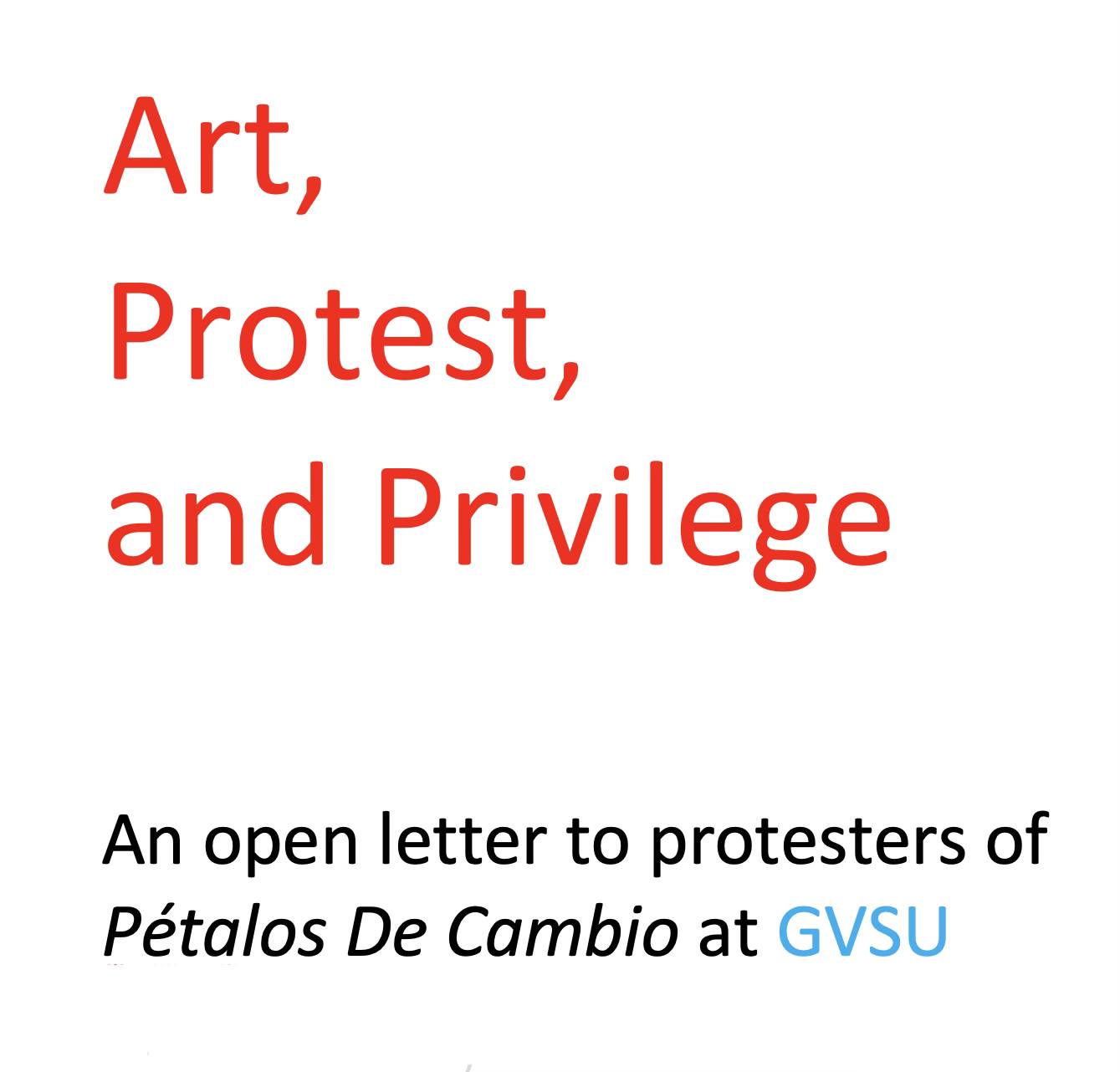
I sat down with Brett Colley, a professor at GVSU in the Department of Visual & Media Arts, after he wrote a letter to people who were protesting a mural that was on display at the GVSU campus.
Before reading the interview with Brett, I encourage you all to read his letter, which you can find at this link.
GRIID – Can you first share when people began objecting to the mural entitled Pétalos De Cambio at GVSU and why they were opposed to it?
Brett – “Pétalos De Cambio” was installed in the Kirkhof Center in the Summer of 2024, and I believe GV officials received concerns about its imagery as soon as September. My understanding is that there were at least two meetings during the Fall semester between Catholic students demanding Grand Valley remove the work from its collection, and university officials. I wasn’t part of those meetings so I can only glean the students’ motives from their statements to various news outlets and the information shared out by GV representatives.
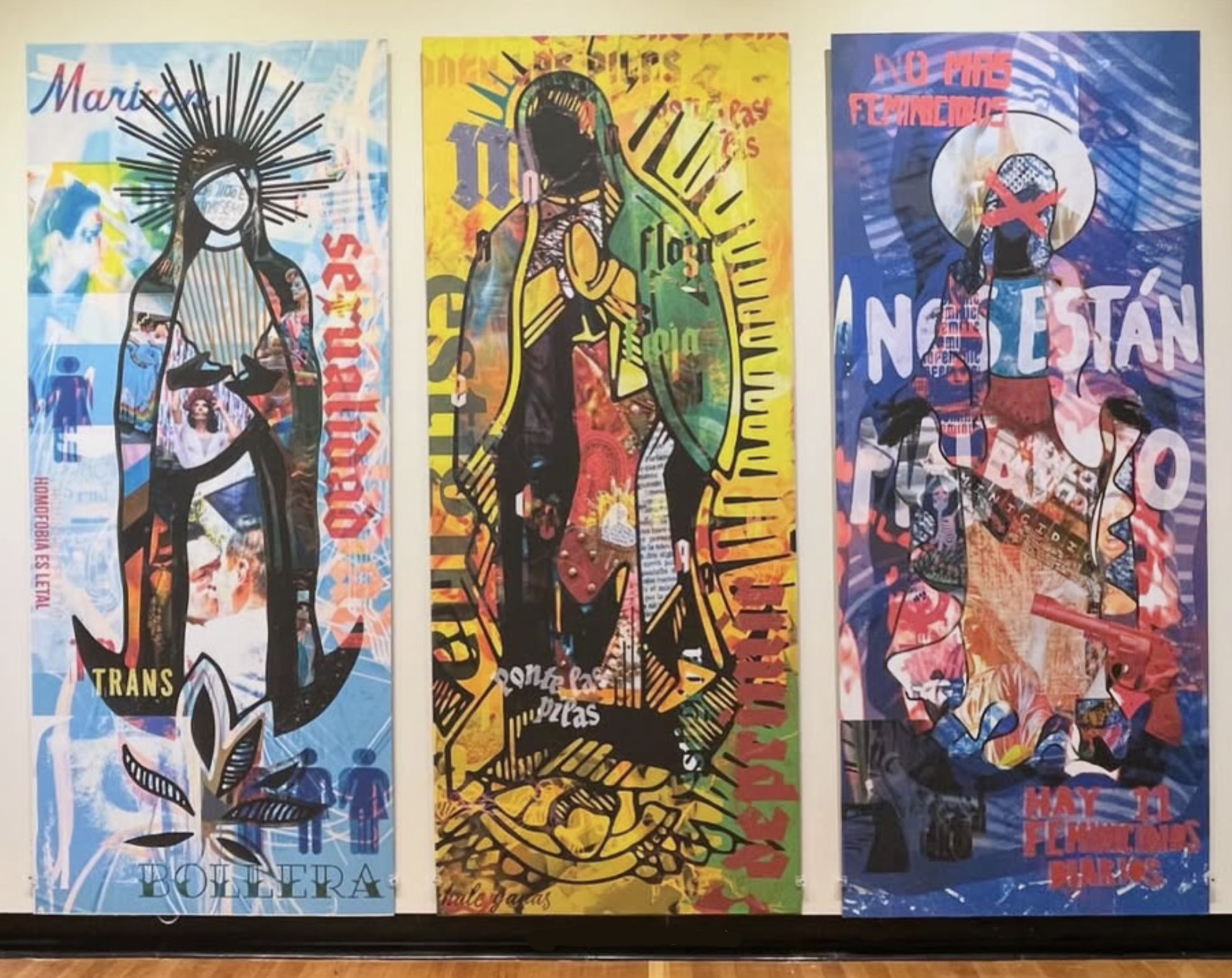
In the press, students claim the mural is offensive to them due to the fact that in one of three panels a modified depiction of Our Lady of Guadalupe (a Catholic icon originating from Mexico) has an X drawn over its head and a gun floating near its feet. They insist this is an act of violence against Mary, asserting to the Detroit Free Press, “There’s no other interpretation of an X through a person’s face and a gun pointed at them than the total death, destruction and annihilation of that person” – a statement that, as an artist, I find patently absurd. The mural also includes text, such as “homophobia is lethal”, and “my son is homosexual – I am proud of him”. While not mentioned by GV students in any news article I could find, these phrases were described in a petition supporting their protest as “blasphemous” and “offensive to God”.
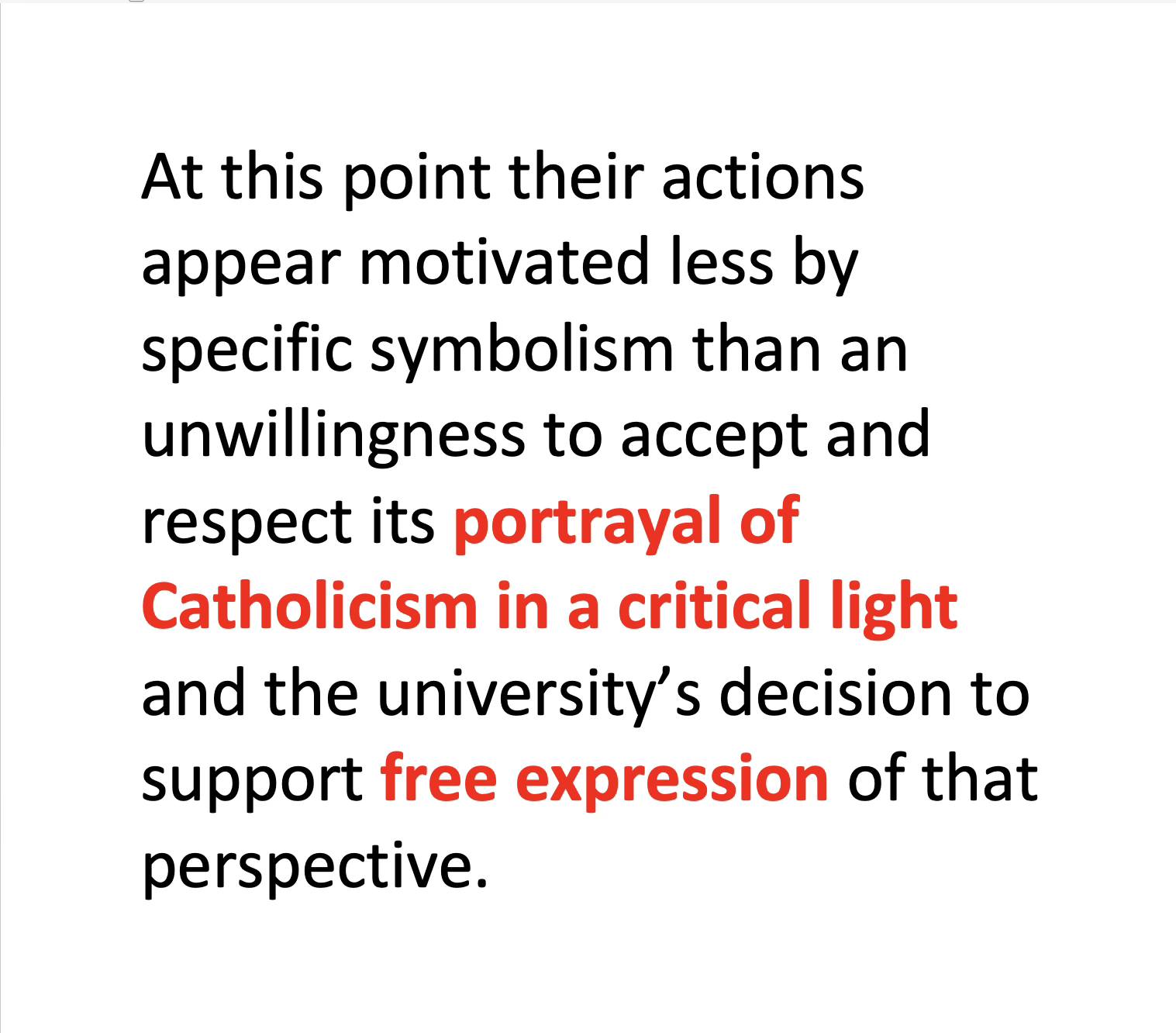
In other news coverage the protestors – again, mostly GV students – argue that Grand Valley’s purchase and display of “PDC” is a sign that they’re disrespected and unwelcome on campus.
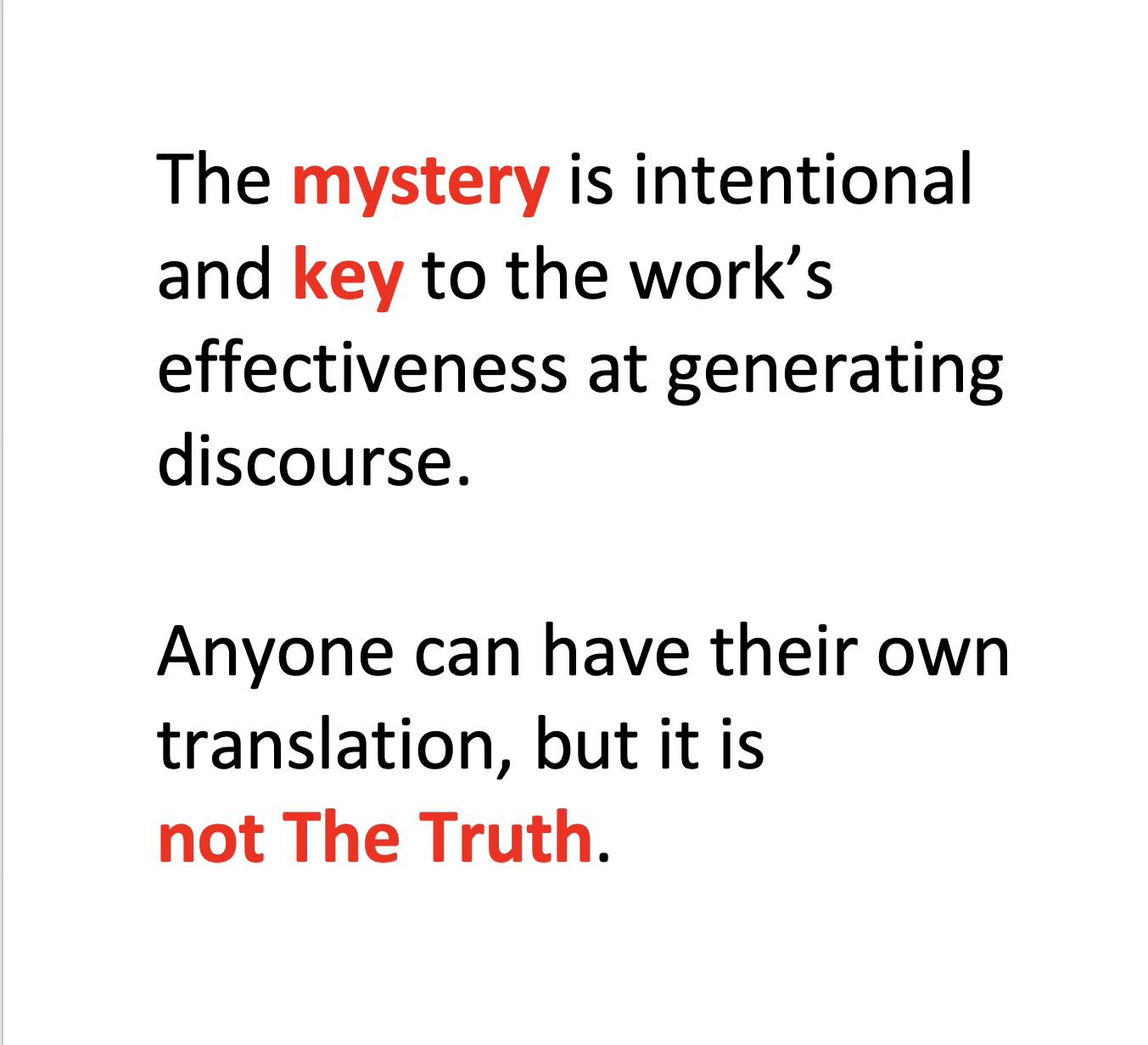
It is definitely worth noting that the artist provided an eloquent, thoughtful statement about the work which makes its intentions quite clear:
“The murals are aimed at addressing societal challenges without undermining the core tenants of the Catholic Faith. These murals seek to confront gender-based violence, homophobia, and mental health disorders advocating for a nuanced reevaluation of certain aspects of Catholic teachings to foster a more inclusive and compassionate culture. The intent is not to criticize, but to encourage thoughtful reflection on interpretations that may inadvertently contribute to societal issues.”
This is art from a student who identifies as Catholic themself, with familial connection to Mexico. Motivated by their own religious convictions and deep compassion they created a work intended to raise awareness about systemic violence (femicide) and the oppression of queer folks in that part of the world – the sort of socially-engaged scholarship we purport to celebrate at GVSU. Its installation in the Kirkhof Center near the Milton E. Ford LGBT Resource Center and Office of Multicultural Affairs owes to its thematic relationship with the work of those offices. All of this seems to have been lost (on both protestors and GV leaders who removed the work) in a cacophony of self-righteous voices.
With the involvement of conservative state lawmakers (Luke Meerman, Jamie Thompson) and a far-right national organization (TFP Student Action) this ongoing drama has evolved from a misunderstanding of specific symbolism in “PDC” into a battle from the larger culture war, as those who feel their long-held conservative dominance undermined by social progress in a more tolerant direction. Here’s an instructive quote from Meerman: “We want healthy debate to go on, but I think the real point of what we who call ourselves Christians continue to feel is, that we’re continuing to be ostracized and pushed out of the university realm and this is one more example of, ‘You’re not welcome here. You’re hateful people.’”
GRIID – How did GVSU respond to the demands to remove and destroy the mural?
 Brett – As I mentioned earlier, GV officials met with offended students on least two occasions. It is my understanding that these meetings included the Vice President of Academic Affairs, the Dean of Student Affairs, the director of the Kaufman Interfaith Institute, the director of the GV Art Museum, and a representative from our Title IX office. In short, their concerns were met with great seriousness and respect.
In response to those discussions, measures were taken to provide greater context for “PDC”. GV curators added label copy to its display, expanding upon the artist’s own statement with more background regarding the mural’s imagery, and its social significance.
Several news outlets have reported that GV officials also informed the students “PDC” would not be removed, in keeping with the university’s commitment to the First Amendment. Then, shockingly, the work was removed in the early hours of February 5th, before the Kirkhof Center had even opened to students for the day.
One of my principal frustrations since this occurred is that there’s been no widely shared explanation for the abrupt change of course. University leadership has been woefully silent in the press on the subject of “PDC”s removal, though the protest has been covered several times since.
The radio silence implies that GV leaders feel they made a mistake (in collecting and/or displaying “PDC”), or that the artist did something wrong, or that we are simply not deserving of an explanation. Additionally, the lack of information makes seeing a clear way forward very challenging. When you don’t know exactly why a decision was made, how can you address it?
What has been shared in small meetings and my individual communications with GV leaders is that several of them were receiving hate mail and threats, and that there were threats to the mural, as well. Evidently there have been offers to purchase the work for the express purpose of destroying it. I’m inclined to believe there were also threats made by conservative donors to withdraw funding.
I wish that GV leadership would simply disclose what the actual pressures were, so that we as a culture could have that learning moment, an opportunity to reflect openly on the greater meaning of this. I think that level of transparency would also be a constructive step toward healing.
GRIID – You wrote a letter to Grand Valley leadership before you wrote a letter to those protesting the mural. What were you hoping the letter to GV leadership would accomplish? And have you received a response from the Catholic group that was protesting?
Brett – My first written reaction to this issue was a message to state rep’ Jamie Thompson, addressing a melodramatic Facebook post she made on January 26, amplifying one GV student’s lamentation that the mural was “stomping on their religion” and condemning the school for displaying it. There were actually dozens of others who, like me, commented on that post immediately to correct misinterpretations, share the artist’s own words, and call Thompson out for exploiting the situation to stir up support with conservative constituents.
Naively, I mistook that single post’s comment section as an indication of where the protest stood in the greater social consciousness, but it was only a few days later (Feb. 7) that my colleagues and I from the Visual & Media Arts received official word of the mural’s removal. With that news I volunteered to compose a letter to GV leadership (on behalf of over 20 colleagues who co-signed) expressing our concerns about the dangerous precedent this move has set. I can share some of that language here:
“We are deeply troubled over the chilling effect the decision to remove “Pétalos De Cambio” will have on the expressive works of both present and future students, staff, and faculty, as well as the message it may send to Latinx students at GVSU who see this work as representative of their experience and concerns. Moreover, we believe that in removing this artwork GVSU signals that it will bow to societal pressures despite freedoms guaranteed in the constitution, and that the institution has somehow made an error in moral judgment by procuring/displaying the piece at all, and that by extension the artist – our student exemplar – has also committed an offense.”
 This letter prompted a meeting between concerned VMA faculty, the director of the GV Museum, and GV leaders where we learned there is intention to reinstall the mural, but no designated site or clear timeline. Following that meeting I had more personal exchanges with leadership, wishing to emphasize that – while their email inboxes have likely quieted a bit with “PDC”’s removal – many on campus feel betrayed and demoralized, and the work of VMA faculty, staff, and students has been made more challenging as a consequence.
The most recent letter I wrote and published to social media is directed at the students/protestors themselves, and is my good faith effort to elucidate the unique language of visual art and the power of varied interpretations, while also calling out what I perceive as the actual agenda and extraordinary audacity of folks with immense privilege declaring their persecution at the expense of the artist – a Catholic peer – and the marginalized communities reflected in the mural’s content.
I shared the letter directly with LakerCatholic (student organization), as well at the pastor and campus minister at St. Luke University Parish. I haven’t heard anything in response.
GRIID – You mentioned that the Catholic group at GVSU received support from TFP Student Action. Judging from its website, it is clearly a far-right organization. Can you say anything more about them and the petition they circulated? https://tfpstudentaction.org/
Brett – I’d not been aware of TFP Student Action prior to this protest. It’s the worrisome organization of some ugly, homophobic, misogynist values. In addition to common Catholic positions like being opposed to abortion rights, they are aggressively anti-queer. There is a “victories” page on TFP’s website that lists instances across the country where they targeted schools for organizing Pride celebrations, for listing Planned Parenthood as a potential employer, for displaying other so-called “blasphemous” artworks, etc.
It has been my assumption that the social media firestorm fueled by Luke Meerman and Jamie Thompson attracted the attention of TFP, but it’s possible there is some other affiliation with GV protestors. It is not clear to me how much their own values align with TFP, but regardless they came together for a rally on GV’s campus on February 8, and TFP created and continues to circulate an online petition, which is aimed at GV President Mantella. After being apprised that “PDC” is an attack on the Mother of God, petition signers are also encouraged to call other listed GV leaders and demand with “polite firmness” that it be removed from the collection. Recently I attended a luncheon where President Mantella disclosed that she’d been threatened with bodily harm over this issue. How very polite!
The overall rhetoric of TFP, and of the petition specifically, is alarming to say the least. They describe even the concept of being “trans” or “homosexual” as an insult to the Mother of God. I wasn’t seeing or hearing that sort of extreme language on GV’s campus until the Feb. 8 rally. This rhetoric and behavior is so divisive and wildly off target, not at all in keeping with the stated values of the university, and tragically ironic given that the sustained complaint from these Christian students is that they don’t feel respected or welcome. It seems like a pretty misguided way to earn respect, make friends, or build alliances.
GRIID – With the rightward shift of politics, even before the 2024 Election, it seems as though groups like those protesting the mural have even more space in the cultural and political landscape to impose their far-right views. What do you say to that?
Brett – That’s my perception, as well, and I don’t even think there’s a reasonable argument to the contrary. I mean, the advent of social media platforms like X, Truth Social, and Meta all but assure that – unless we’re very deliberate about countering it – each of us is continually occupying an echo chamber, with slightly distorted versions of our existing beliefs bouncing back at us from all directions. These environments – populated by increasingly isolated people and largely anonymous – are the ideal breeding ground for extreme political species.
 I’m thinking again of (state rep) Meerman’s quote from above, about Christians being “ostracized and pushed out of the university realm”. In addition to being so instructive about the protest’s agenda, it’s an unsubstantiated, statistically preposterous claim when two-thirds of U.S. identifies as Christian, and an example of the sort of Orwellian argument we’ve been hearing over the past 10+ years in national politics: the majority claims minority status. It’s laughable, but through social media (like Facebook, where I first saw Jamie Thompson sharing a similar sentiment) one has the instrument to amplify such an assertion. I think it’s more accurate to say that what’s being challenged at some universities – through the introduction of diverse voices and perspectives – is regressive dogma that impedes the ability of many people to flourish.
I’m also thinking about something that happened in 2020 under the proverbial radar, as we were (rightfully) preoccupied with the early pandemic. That year Trump signed an executive order mandating that all future federal buildings conform to Neoclassical architectural styles, and another commissioning a sculpture garden of traditional statues to honor patriots of his choosing (figures like Barry Goldwater and Douglas MacArthur). In other words, he turned his authoritarian attention to arts and culture.
And now this protest against “PDC” is happening against a national backdrop where we find Trump usurping directorship of the Kennedy Center and ordering changes to the language of NEA grant applications that cut off support to any DEI-inflected proposals, overtly fascist efforts to control culture at the level of the arts and humanities. I’m definitely not the first to acknowledge the parallels between what is happening there and Hitler’s campaign against “degenerate art”, a violent determination of what was made, exhibited, and supported in 1930s Germany.
GRIID – Would you say that what happened at GVSU is part of the growing assault on Higher Education in the US?
Brett – I certainly see it as more than a coincidence. No doubt conservative voices across the country feel emboldened by the far-right policies being pushed at our national level.
I fully appreciate that for most people reading this there are greater concerns facing higher ed, including suspension or cuts to federal funding for critical studies and experiments, the targeting of DEI programs and institutions that have enacted them, the gutting of our Department of Education, which threatens financial aid, violent suppression of pro-Palestinian campus protests and First Amendment rights.
And even these issues are overshadowed by a host of other crises like the imminent threat of deportation facing undocumented students and their families, the precarious status of non-citizen staff/faculty, the open assault on queer and trans folks, a long list of horrible things.
This one act of censorship at Grand Valley may seem insignificant in comparison, and an odd thing to direct such emotional energy toward, but to me it’s a micro sample of a macro concern – the slide toward a less informed, less tolerant, less democratic, less free society.
If you want to undermine democracy, if you want to smooth the path to authoritarian rule, start with education, start with the arts – spaces where people are actively curious and afforded diverse experiences and perspectives, growing socially conscious, critically engaged, and creative about solving problems.
GRIID – How has this whole process impacted your students and how has it impacted you?
Brett – Honestly, I feel disrespected as a scholar and as an artist. At the same time “Petalos De Cambio” was being removed from Kirkhof, the GVSU library was showcasing historically banned books about two hundred yards away. In other words, not only standing behind but celebrating controversial, creative works. Why is that? Why are university’s values being applied so differently from one discipline to the other?
The students I work with have learned and shared back to me the following lessons:
- A dominant group can cry persecution and get what it wants
- Conservative values over-ride their own
- Bullying is an effective tactic
- Donors have the real power
- Their opinions/desires don’t matter
- GVSU does not support freedom of speech
- GVSU is not a safe space for them
As painful as that list is to share, it’s truly not hard to understand why those are the thoughts/feelings of art students who use their visual language to express complex and sometimes controversial ideas, who are discovering their individual identities through these media, and who’ve now seen one of their own censured due to conservative blowback.
An art student produced scholarship that so exemplifies the university values – critical engagement, global curiosity, commitment to making the world a better place – we purchased it. A second student found it offensive. That student chose to reject any explanation or interpretation beyond their own, shared their animus with state lawmakers, and from there social media converted it into an ill-informed chorus of censors. Now a smart, significant artwork is in storage. Conservative Christians, not artists, are acting as curators of our culture. It’s an indignity we won’t soon forget.
It is my charge to encourage and support students in their creative research, and this experience has made that work more difficult. How do I counter the lessons they’ve learned? I find myself in the complex position of being both a mentor and a representative of the institution many students now view as unsupportive, at best (and oppressive, at worst).
I’m simultaneously fired up and fatigued. I have been expending a lot of time and energy toward understanding and addressing this protest and GV’s decisions. The fact that an excellent student has been so negatively impacted by both the protestors and the admin decision (double injury) is depressing and infuriating and distracts me from other work I have to do. At the same time, it feels important to challenge what’s happening on all fronts and redeem this shitty situation somehow, so I haven’t given up yet.
 For week #6 in our collective investigation into the Prison Industrial Complex in Kent County, we read two essays that I selected based on the discussion we had during week #5.
I did share an extra resource, which is a toolkit that focuses on community care around mental health.
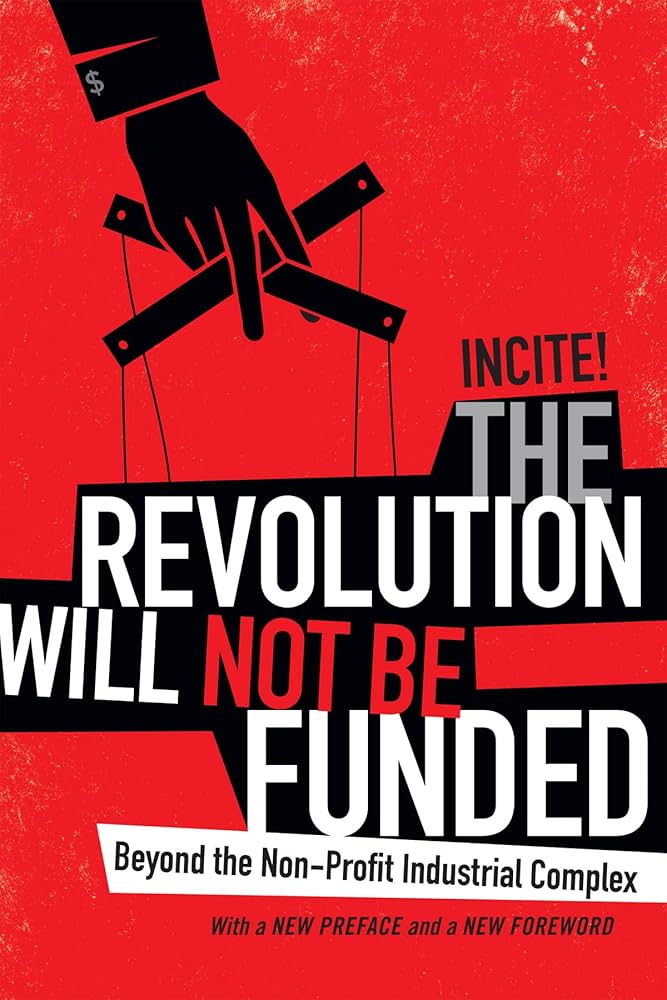
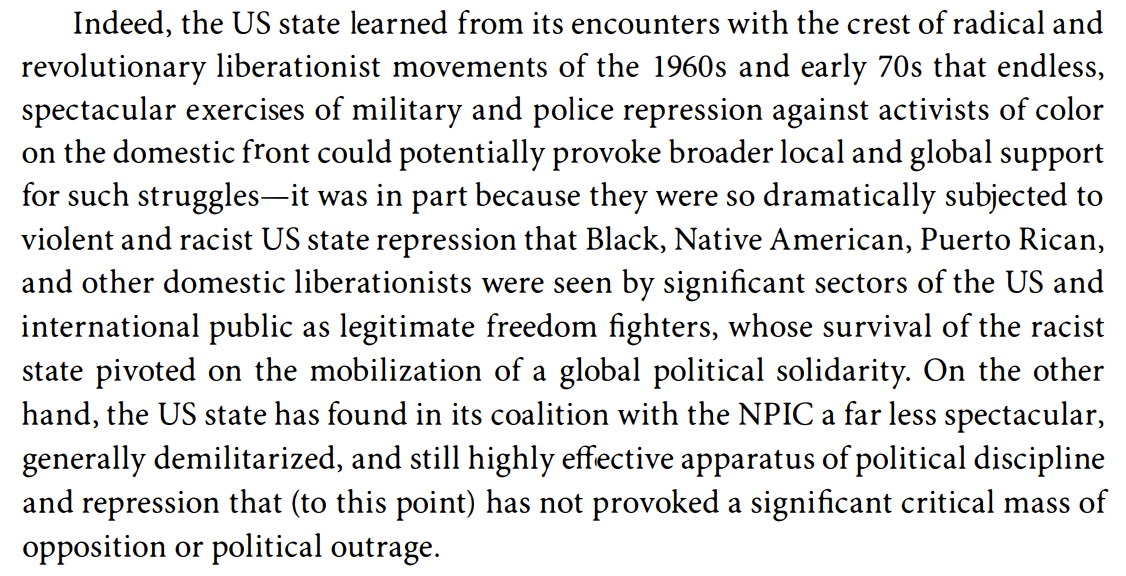
The first essay we discussed was a chapter from the book, The Revolution Will Not Be Funded, beginning on page 44, by Dylan Rodriguez. Rodriguez talks about carceral violence, using the FBI’s COINTELPRO campaign against radical groups in the 1960s and 70s. The essay then talks about what lessons the state learned during those decades and how they began to develop relationships with those in the non-profit sector and how the non-profit industrial complex came to play a larger (less violent) role in diminishing the impact or even the possibilities that people might take more radical actions to challenge systems of power and oppression.
Next, we discussed what environmental strategist Stephen D’Arcy lays out for us in his essay, Environmentalism as if Winning Mattered: A Self-Organization Strategy.
D’Arcy suggests a two-pronged strategic approach, the Resistance Phase and a Transition Phase. Keep in mind that D’Arcy is focusing on environmental outcomes, but he also makes clear that his approach is fundamentally an anti-capitalist strategy.
The Resistance Phase would include some of the following strategic objectives:
- To construct an anti-corporate alliance of Indigenous communities, workers’ organizations, and environmental protest groups, based on a serious, sustained commitment to practical solidarity at the grassroots level.
- To build cost-raising protest movements, directed against all forms of environmental destruction, framing these struggles whenever possible as struggles for environmental justice, including Indigenous self-determination, economic justice and public welfare.
- To promote prefigurative community-based alternatives to capitalist production that model sustainability, solidarity, popular autonomy, and environmental justice.
- To re-establish vital currents of ecologically oriented anti-capitalist radicalism, for instance, eco-socialism, anarcho-Indigenism; social ecology; left eco-feminism; and so on.
The Transition phase would also have four strategic objectives:
- To organize anti-capitalist environmentalists into a common front of radical community organizations (SMOs, CCOs, PAOs), capable of tactical concentration for united action;
- To establish the hegemony of the anti-capitalist common front within the mass environmental movement, so that it exercises a consensual, acknowledged leadership role in pointing the way forward for large sections of the broader movement;
- To gain for the common front and its allies a degree of community-based “social” power, resting on the capacity to deploy general strikes, mass protest, and mass civil disobedience campaigns, on such a scale that the community-based opposition constitutes a community-based counter-power that can effectively challenge the economic power of corporations and the coercive power of the state;
- To secure the transfer of ever more extensive governance functions to community-based self-organization (SMOs, CCOs, PAOs), so that “social” sector institutions ultimately displace — rapidly whenever possible, gradually whenever necessary — both “private” and “state” sector institutions from their role in running the economy, the healthcare and education systems, providing social services, etc.
Darcy emphasizes that we not only need to resist the harm that governments or the economic systems are causing, but to create a counter-power infrastructure that makes us less dependent on existing political structures, structures which primarily benefit those in the Capitalist Class.
GR Chamber of Commerce Policy Conference benefits the business class, regular people are on their own
I used to be be able to attend these conferences, but the GR Chamber of Commerce and the West MI Policy Forum gatherings are off limits to media that are critical of the Capitalist Class. I would have been able to attend, but only if I paid the $250 registration fee for a morning only policy conference.
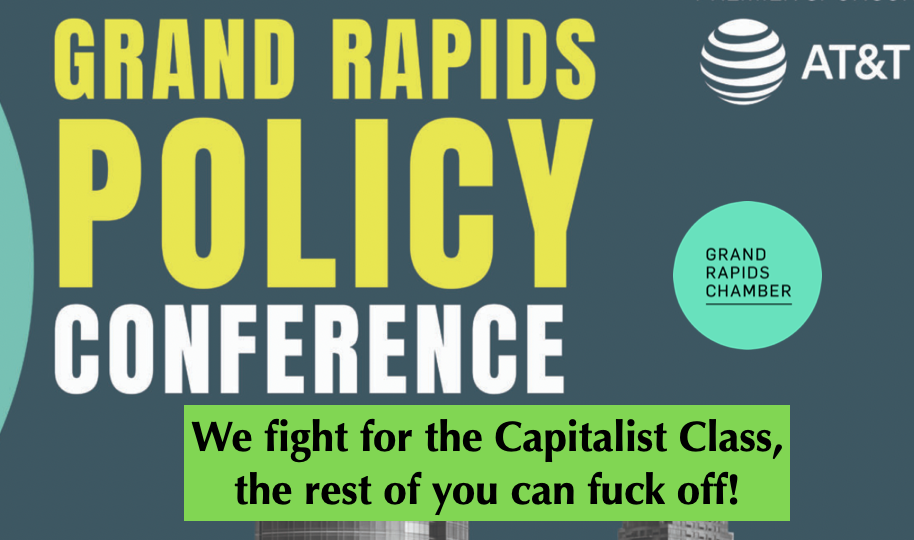
Last week, the Grand Rapids Chamber of Commerce held their annual policy conference, with the usual suspects in business, along with politicians that they have bought. What follows is the line up of people who presented:
- Hannah Naltner, Senior Vice President of Organizational Strategy and General Counsel, RDV Corp. (DeVos-owned)
- Joshua Lunger, Vice President of Government Affairs, Grand Rapids Chamber
- David LaGrand, Mayor, City of Grand Rapids
- Mark Washington, City Manager, City of Grand Rapids
- Ben Greene, Chair of Board of Commissioners, Kent County
- Speaker Matt Hall, Michigan House of Representatives
- Brooke Oosterman, Executive Director, Housing Next
- Sam Cummings, Managing Partner, CWD
- Marc Eichenbaum, Former Special Advisor to the Mayor of Houston, Texas
- Rick Baker, President & CEO, Grand Rapids Chamber
All three politicians that spoke, Mayor LaGrand, County Commissioner Greene and State Representative Hall, have all been funded by the Grand Rapids Chamber of Commerce. In the 2024 election cycle, LaGrand received $2000 from the GR Chamber, along with plenty of money from other GR Chamber members. Kent County Commissioner Ben Greene received $3500 from the GR Chamber, along with hefty amounts from members of the Grand Rapids Power Structure. State Rep. Matt Hall hasn’t received as much from the GR Chamber of Commerce, but he has received $43,550 from the MI Chamber of Commerce during his career as State Representative.
Since I was unable to attend the policy conference, I am relying on what other news reported and from what the GR Chamber of Commerce posted on their social media.
As was listed above, Grand Rapids Power Structure member Sam Cummings spoke during the Policy Conference, primarily to promote his conversion of the Fifth Third Bank building from office space to apartments. The building conversion that Cummings talked about was due to a state law change in 2023 amending the Brownfield Redevelopment Financing Act. Housing development activities are now eligible activities for brownfield capture, like the 111 Lyons building that is owned by Cummings. Essentially this means that there will public subsidies available to people like Cummings, who has a long history of benefiting from public funding, as GRIID has noted in a previous posting.
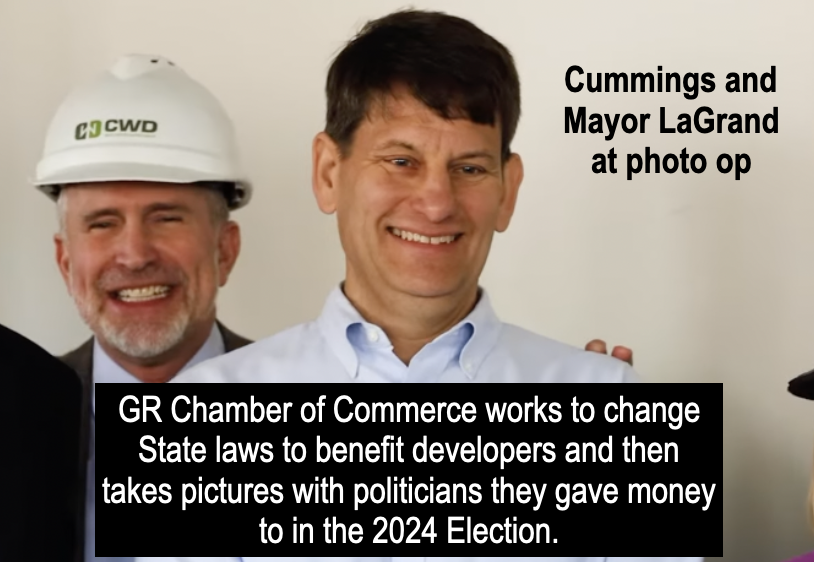 The conversion of the Fifth Third Bank building will result in 140 apartments, according to Cummings. Former Mayor Rosalynn Bliss praised this conversion and current Mayor David LaGrand said it would help make the downtown a “real, living neighborhood.” However, no where in the coverage of this building conversion did it talk about what the 140 apartments would cost. Considering where the building is and the fact that Cummings, Wierda and DeVos (CWD) owns the building, the cost will be affordable only to members of the professional and Capitalist classes.
State Rep. Matt Hall also spoke at the Chamber’s Policy Conference, but he was not cited in any of the local news stories. Rep. Hall, you might recall, recently pushed a resolution that would threaten to block funding from the state if communities adopted Sanctuary policies in opposition to the Trump Administration’s threat of mass deportation. Too bad we don’t know for certain where the GR Chamber of Commerce stands on this matter, unlike their previous push to criminalize the unhoused in downtown Grand Rapids.
In the end, despite the claims from the GR Chamber of Commerce that they want to build a “thriving, prosperous West Michigan for all,” they continue to only represent the class they are part of, the Capitalist Class.
 Grand Rapids Institute for Information Democracy