You Can Vote, but You Can’t Work
This article by Vijay Prashad is re-posted from CounterPunch.
In August 1964, Malcolm X spent several weeks in Egypt. While in Cairo, he wrote an essay in the Egypt Gazette entitled “Racism: the Cancer that is Destroying America.” Here, Malcolm X noted, “The common goal of 22 million Afro-Americans is respect and HUMAN RIGHTS….We can never get civil rights in America until our HUMAN RIGHTS are first restored.” The distinction is essential. Civil Rights are earned through the State form. They are historically specific to the modern world, and came onto the agenda of the modern State only because of the struggles of ordinary people to move the ideals of the early modern era into the realm of legality. These are Civil Rights.
Human Rights, Malcolm notes, are to be restored. They are innate, the essence of our species being, the way in which we as social actors want to see ourselves, and how our best instincts force us to see each other. These are innate, but they are not always enacted, for human history is as much a struggle of ordinary people for justice (civil rights) as it is the march of dehumanization. The dance between human rights, our rights as people in society, and civil rights, our rights as citizens in states, is a fundamental part of the grammar of modern politics. To believe that to win civil rights from the state is sufficient is what constitutes modern liberalism: legal provisions for equality are enough for it. That is why it celebrates the US Civil Rights Act of 1964 as its highest achievement. After that, modern liberalism sees that the task is to tinker with reality, not to fundamentally transform it.
Malcolm X looked through and beyond modern liberalism. Of course civil rights in the state are necessary, but these are not sufficient. More is required.
The great tragedy of the movement that fought for civil rights within the United States is that it won its liberal victory just when the United States economy and society were violently transformed. The structural process of globalization and the Reaganist anti-State policy combined to undermine the very institutions that had been tasked with upholding the civil rights of the newly enfranchised minorities. A weakened State and a national economy convulsed by the domination of finance would not be able to guarantee the civil rights of the people. This is what Malcolm saw, and this is why he was quick to seize on the distinction between civil rights and human rights.
It is also fitting that Malcolm made these comments in Egypt. It is a long-standing tradition in African American radical thought that over the course of a career its political intellectuals have begun with hope that justice would be attained within the American project, and then in the course of struggle come to the realization that absent an international perspective this dream is futile. The importance of Pan-Africanism is here, but Pan-Africanism is a concrete form of what is the more general affirmation, the importance of an internationalist politics. Since 1964, the liberal doctrine of multiculturalism has enabled the state to absorb a small percentage of minorities into the ranks of the elite, while at the same time the question of human rights for the majority of minorities languishes. Barack Obama and Susan Rice put a sophisticated face on contemporary imperialism, at the same time as the State enhances a regime to devastate the social world of the darker nations.
That mix of globalization and Reaganism which tragically undermined the goals of the Civil Rights victories is what constitutes neo-liberalism: opening up for profit areas of social life that had been communal, selling public assets at throwaway prices to private speculators, allowing finance to become dominant over social life, and enabling real estate and insurance to produce massive bubbles that burst in slow motion and then spectacularly in 2008. The social consequences of neo-liberalism have been grotesque. Global unemployment is at spectacularly high levels, with an “alarming” future for joblessness, according to the International Labour Organisation’s World of Work Report 2012. Young people are nearly three times as likely as adults to be unemployed. An estimated 6.4 million young people have given up hope of finding a job.
You can vote, but you can’t work.
High unemployment comes in a context of a collapsed state-support network, a weakened social fabric and criminally high food and fuel prices that have resulted mostly from commodity speculation in these markets. From Rome, the Food and Agriculture Agency reports that the world’s hungry will top 1.02 billion this year. Since 2008, food riots have struck Africa, Asia and Latin America, with the edges of Europe and the United States now prone to inflation protests. The Social Unrest Index shows that 57 out of 106 countries showed a risk of increased social unrest. The IMF recognized that one of the spurs for the Arab Revolt of this year was the rising bread prices as a result of the end to the “democracy of bread.”
You can vote, but you can’t eat.
It is bad enough if one is reduced to the level of bare life, but even worse if this condition is not general across the population. Rates of social inequality are at record levels for the modern era. In the US, the Occupy movement raised the issue of the 1%. We know that they control obscene amounts of social wealth. It is scandalous when you look at the wealth situation on the global level. A recent UN report shows us that the richest 1% of adults across the planet owned forty percent of global assets, and the richest 10% owned eighty-five percent of the world total.
You can vote, but you have no power.
Disparity and deprivation do not sit well with the commonplace ideas of fairness and justice. The powerful know this. The way they divide up the national budget demonstrates their values. The US national budget is given over to military and police expenditure, to prisons rather than schools, to guns rather than bread. Given the social consequences of neo-liberalism, it is far more effective and logical to build a security apparatus, to cage people into devastated cites or to hold them in congested high-security prisons. There is nothing irrational about the prison industrial complex. From a neo-liberal perspective, it is perfectly reasonable. Neo-liberalism was always purchased with the iron fist, rarely with the velvet glove (whether your example is Chile, 1973 or NYC, Guiliani time).
You could vote, but we’ve now locked you up.
But you cannot lock up Freedom.
One of the great triumphs of the past two decades has been the gradual and by now almost total demise of the legitimacy of the current phase of capitalism, in other words, neo-liberalism. The first big blow to neo-liberalism came in South America, starting with the Caracazo in 1989 and ending in the Pink Tide of elections that brought in governments that leaned Left. Over the past two years, we’ve seen massive protests in Africa and Asia, with the Arab Spring as the most dramatic, and then the southern European uprisings bookended by the Occupy experiment. These tell us that neo-liberalism is the naked Emperor. The governing ideology of the ruling class is bankrupt.
Neo-liberalism has begun to be seen as de-legitimate, but neither it nor the logic that governs beneath it, capitalism, has been dispatched for at least two reasons.
First, neo-liberalism continues to exercise institutional power through the Central Banks and the multilateral financial institutions. Inflation is their target, not jobs. There is no fiscal space, no policy space, for States or politicians to exert other dreams, other imaginations. If they do not hold their debt down and keep inflation low, they are sanctioned by a rise in the price of their borrowing. Freedom to act is constrained by the dollar-crats who hold the keys to the vaults.
Second, one of the long-term trends of the capitalist system is to the move by those who control capital to substitute machines for labor. Capitalism is a massive labor-displacing system. The problem with actual workers is that they are restive and demanding, and they are expensive. Machines are undemanding and cheaper. Machines might end up being ecologically devastating, but that’s not relevant to capitalism. Machines might also end up being socially wonderful, since they free up time for leisure, but that would only work if the fruits of mechanization were not seized by the select few who own or control the social wealth.
What we know for sure is that the time of the neoliberal security state, of the governments of the possible, is now over. Even if such states remain, its legitimacy has eroded. The time of the impossible has presented itself.
We need to fight for reforms because they are imperative to the survival of people. But the reforms themselves can never deliver more than survival. The system is simply not able to open its arms and embrace us. Love is antithetical to Profit and Property. There is nothing that we can tinker with to make this system any better. Many have already come around to the idea that they have become disposable to this system, and so they have disposed it: they have turned to the creation of alternative economies, to new collectivities, experimental forms of putting our social relations ahead of Money. Our fear, my fear, of the future holds us back from fully embracing the time of the impossible. If we want to restore our human rights, as Malcolm said, the time is now.
In Memory of GRIID contributor Kate Wheeler
Long time GRIID contributor Kate Wheeler passed away on Saturday after fighting an illness for years.
Despite an illness that limited her mobility, Kate Wheeler was a tenacious fighter for justice and someone with a solid grasp of history.
Kate had been contributing to GRIID over the past few years, with numerous stories on the consequences of Governor Snyder’s austerity measures, the battle against Michigan’s Emergency Financial Manager Law and the role that the right wing think tank, the Mackinac Center for Public Policy, played in the push to privatize more public services in Michigan and punish public workers.
In addition, Kate wrote numerous stories under the heading of “This Day is Resistance History,” a column that was intended to show that there is a rich history of public resistance to injustice in the US and around the world.
Her last column was on April 17, The Capitalist Shame of the Titanic.
We at GRIID are grateful for Kate’s contributions and we will miss her tenacious commitment to justice.
This campaign finance update is re-posted from OpenSecrets.
Pharmaceuticals, utilities and big agriculture have led the lobbying charge so far this year, according to preliminary figures from latest lobbying disclosures. The pharmaceutical industry as a whole spent $69.6 million on lobbying in the first three months alone, while electrical utilities spent $43.3 million. The agricultural services industry – which includes heavy hitters like Monsanto, the American Farm Bureau and Archer Daniels Midland – spent far less, only about $12.9 million, but that represented a 48 percent increase over its lobbying in the final three months of 2011.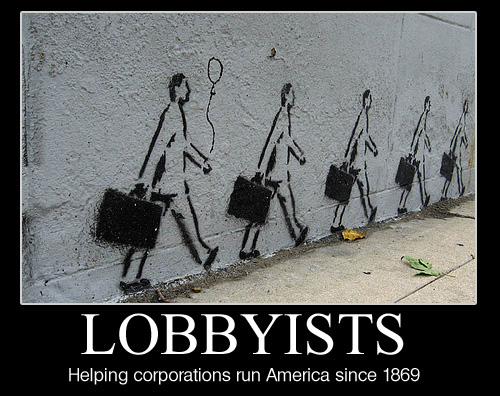
Overall, the ebb and flow of industries on our list of top lobbyists was dictated by the legislative calendar. While all these groups regularly rank highly in terms of their spending, they all had particular battles early in 2012.
The farm bill, the sprawling piece of legislation that sets the tone (and subsidies) every five years for the agriculure and food industry, is up for reauthorization this year — giving the agriculture industry a lot to talk to legislators about. The American Farm Bureau spent $6 million in the first three months of the year, a bit more than it spent in the entirety of 2011. That pushed the organization, which is the largest trade group for the industry, into fourth position on our list of top lobbying clients so far this year.
It’s difficult to tell exactly how much an industry or company spends lobbying on a particular bill — most big companies have a laundry list of interests — but the pharmaceutical industry clearly focused on protecting the existing provisions of Medicare Part D, which subsidizes the cost of drugs. Critics in Congress have targeted the program for its huge cost, and some want it to be more transparent about how reimbursements are set. Also at issue is whether the government should be able to negotiate drug prices with the companies, something that is currently prohibited.
At the forefront of the pharmaceutical firms’ lobbying push was PhRMA (Pharmaceutical Researchers and Manufacturers of America), the industry trade group, which has spent $5.2 million so far this year. If that rate is sustained, PhRMA will top its 2009 total – when it fought hard over healthcare reform and spent $26.1 million. Following right behind the trade group was Merck, which has spent $4.5 million so far this year, more than half of its total spending in all of last year.
The $43.3 million that electric utilities spent lobbying makes it the second-biggest spending industry, but the number represents only a 12 percent increase over last quarter’s lobbying. The dominant issue for most of the big utilities – like Southern Company (which accounted for nearly 10 percent of the entire industry’s lobbying expenses with $4 million spent so far this year) — is the EPA’s plan to regulate the emissions of greenhouse gases. Since the plan is on hold while details are worked out, the big utilities have all had a chance to make their voices heard with lawmakers on new bills that would kill the EPA’s power to regulate in this area.
To see a full list of the top industries and how they’ve lobbied Washington in the first three months of 2012, explore our industry lobbying page. Or, check out our top spenders page, to see a list of top organizations and how much they spent on lobbying so far in 2012 (spoiler: once again, the No. 1 organization, by far, is the Chamber of Commerce).
Michigan Senator Debbie Stabenow was in Grand Rapids today to promote her support for what MLive called the “Bring Jobs Home Act.”
First, it should be noted that Senator Stabenow is up for re-election and her visit to Grand Rapids today is most likely motivated by her desire to stay in the Senate.
Second, the public should be very skeptical of such a proposal. The language of the proposed legislation on one level seems kind of like a benefit when it says the bill is designed, “To amend the Small Business Act to establish a loan program to assist and provide incentives for manufacturers to reinvest in making products in the United States, and for other purposes.”
The public and journalists are often swayed by any language that promotes the notion of job creation, but what this proposed legislation will actually do is transfer more public money to the private sector.
Why is it that those who promote capitalism never see the contradiction of the state intervening on behalf of capital? This contradiction is even more apparent when looking at US trade policy over the past 20 years.
The Bring Jobs Home Loan Act of 2012 is designed to provide financial incentives for manufacturers to bring jobs back to the US that have gone overseas. However, over the past 20 years US trade policy has facilitated an easy transfer of US manufacturing jobs to foreign countries with legislation like NAFTA, CAFTA and the most recent trade bills with Colombia, Panama and South Korea.
These trade policies have generally been a bi-partisan affair, with the first major trade agreement being NAFTA. NAFTA was signed by the Clinton administration and has resulted in Michigan losing 287,923 manufacturing jobs (or 36 percent) during the NAFTA-WTO period (1994-2011), according to Public Citizen.
More recently, the US Congress passed legislation that would make it easier for US companies and investors to do business in Panama, Colombia and South Korea. Public Citizen was clear last fall about how these trade policies would impact US workers by stating:
“Passing the Korea deal would kill U.S. jobs. Even official government studies show it will increase the U.S. trade deficit. Passing the Colombia deal would kill any leverage Colombian union, Afro-Colombian and other community leaders and their U.S. union and civil society friends and allies have to stop the murders, forced displacements and other acts of political violence that dominate life in Colombia. And passing the Panama deal would kill our ability to fight tax havens without risking attack by corporations under new privileges established in the pact.”
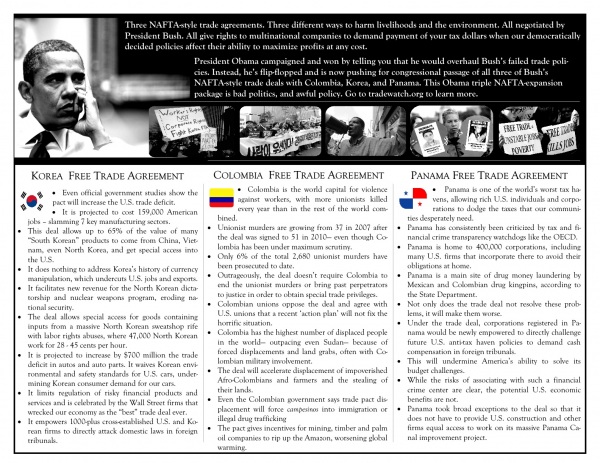
Michigan Senator Stabenow voted for the trade agreement with South Korea, which was the biggest US job killer of the three. She voted against the trade proposals with Colombia and Panama in October, but those will have less of an impact on US jobs.
Having supported some trade agreements, which export US jobs abroad, it seems a bit strange that Stabenow would now want to provide government incentives to have manufacturers bring jobs back to the US. However, as we stated earlier, in her bid to win re-election, the Senator is really pushing for legislation that will transfer taxpayer money to private businesses and then call it job creation.
This article by Tom Engelhardt is re-posted from Tom’s Dispatch.
He has few constraints (except those he’s internalized). No one can stop him or countermand his orders. He has a bevy of lawyers at his beck and call to explain the “legality” of his actions. And if he cares to, he can send a robot assassin to kill you, whoever you are, no matter where you may be on planet Earth.
He sounds like a typical villain from a James Bond novel. You know, the kind who captures Bond, tells him his fiendish plan for dominating the planet, ties him up for some no less fiendish torture, and then leaves him behind to gum up the works.
As it happens, though, he’s the president of the United State, a nice guy with a charismatic wife and two lovely kids.
How could this be?
Crash-and-Burn Dreams and One That Came to Be
Sometimes to understand where you are, you need to ransack the past. In this case, to grasp just how this country’s first African-American-constitutional-law-professor-liberal Oval Office holder became the most imperial of all recent imperial presidents, it’s necessary to look back to the early years of George W. Bush’s presidency. Who today even remembers that time, when it was common to speak of the U.S. as the globe’s “sole superpower” or even “hyperpower,” the only “sheriff” on planet Earth, and the neocons were boasting of an empire-to-come greater than the British and Roman ones rolled together?
In those first high-flying years after 9/11, President Bush, Vice President Dick Cheney, and their top officials held three dreams of power and dominance that they planned to make reality. The first was to loose the U.S. military — a force they fervently believed capable of bringing anybody or any state to heel — on the Greater Middle East. With it in the lead, they aimed to create a generations-long Pax Americana in the region.
The invasion of Iraq in 2003 was to be only the initial “cakewalk” in a series of a shock-and-awe operations in which Washington would unilaterally rearrange the oil heartlands of the planet, toppling or cowing hostile regimes like the Syrians and the Iranians. (A neocon quip caught the spirit of that moment: “Everyone wants to go to Baghdad. Real men want to go to Tehran.”) This, in turn, would position the U.S. to control the planet in a historically unique way, and so prevent the rise of any other great power or bloc of nations resistant to American desires.
Their second dream, linked at the hip to the first, was to create a generations-long Pax Republicana here at home. (“Everyone wants to go to Kansas, but real men want to go to New York and LA.”) In that dream, the Democratic Party, like the Iraqis or the Iranians, would be brought to heel, a new Republican majority funded by corporate America would rule the roost, and above it all would be perched a “unitary executive,” a president freed of domestic constraints and capable — by fiat, the signing statement, or simply expanded powers — of doing just about anything he wanted.
Though less than a decade has passed, both of those dreams already feel like ancient history. Both crashed and burned, leaving behind a Democrat in the White House, an Iraq without an American military garrison, and a still-un-regime-changed Iran. With the arrival on Bush’s watch of a global economic meltdown, those too-big-not-to-fail dreams were relabeled disasters, fed down the memory hole, and are today largely forgotten.
It’s easy, then, to forget that the Bush era wasn’t all crash-and-burn, that the third of their hubristic fantasies proved a remarkable, if barely noticed, success. Because that success never fully registered amid successive disasters and defeats, it’s been difficult for Americans to grasp the “imperial” part of the Obama presidency.
Remember that Cheney and his cohorts took power in 2001 convinced that, post-Watergate, post-Vietnam, American presidents had been placed in “chains.” As soon as 9/11 hit, they began, as they put it, to “take the gloves off.” Their deepest urge was to use “national security” to free George W. Bush and his Pax Americana successors of any constraints.
From this urge flowed the decision to launch a “Global War on Terror” — that is, a “wartime” with no possible end that would leave a commander-in-chief president in the White House till hell froze over. The construction of Guantanamo and the creation of “black sites” from Poland to Thailand, the president’s own private offshore prison system, followed naturally, as did the creation of his own privately sanctioned form of (in)justice and punishment, a torture regime.
At the same time, they began expanding the realm of presidentially ordered “covert” military operations (most of which were, in the end, well publicized) — from drone wars to the deployment of special operations forces. These were signposts indicating the power of an unchained president to act without constraint abroad. Similarly, at home, the Bush administration began expanding what would once have been illegal surveillance of citizens and other forms of presidentially inspired overreach. They began, in other words, treating the U.S. as if it were part of an alien planet, as if it were, in some sense, a foreign country and they the occupying power.
With a cowed Congress and a fearful, distracted populace, they undoubtedly were free to do far more. There were few enough checks and balances left to constrain a war president and his top officials. It turned out, in fact, that the only real checks and balances they felt were internalized ones, or ones that came from within the national security state itself, and yet those evidently did limit what they felt was possible.
The Obama Conundrum
This, then, was what Barack Obama inherited on entering the Oval Office: an expanding, but not yet fully expansive, commander-in-chief presidency, which, in retrospect, seemed to fit him like a… glove. Of course, he also inherited the Bush administration’s domestic failures and those in the Greater Middle East, and they overshadowed what he’s done with that commander-in-chief presidency.
It’s true that, with President Truman’s decision to go to war in Korea in 1950, Congress’s constitutional right to declare war (rather than rubberstamp a presidential announcement of the same) went by the boards. So there’s a distinct backstory to our present imperial presidency. Still, in our era, presidential war-making has become something like a 24/7 activity.
Once upon a time, American presidents didn’t consider micro-managing a permanent war state as a central part of their job description, nor did they focus so unrelentingly on the U.S. military and the doings of the national security state. Today, the president’s word is death just about anywhere on the planet and he exercises that power with remarkable frequency. He appears in front of “the troops” increasingly often and his wife has made their wellbeing part of her job description. He has at his command expanded “covert” powers, including his own private armies: a more militarized CIA and growing hordes of special operations forces, 60,000 of them, who essentially make up a “covert” military inside the U.S. military.
In effect, he also has his own private intelligence outfits, including most recently a newly formed Defense Clandestine Service at the Pentagon focused on non-war zone intelligence operations (especially, so the reports go, against China and Iran). Finally, he has what is essentially his own expanding private (robotic) air force: drones.
He can send his drone assassins and special ops troops just about anywhere to kill just about anyone he thinks should die, national sovereignty be damned. He firmly established his “right” to do this by going after the worst of the worst, killing Osama bin Laden in Pakistan with special operations forces and an American citizen and jihadi, Anwar al-Awlaki, in Yemen with a drone.
At the moment, the president is in the process of widening his around-the-clock “covert” air campaigns. Almost unnoted in the U.S., for instance, American drones recently carried out a strike in the Philippines killing 15 and the Air Force has since announced a plan to boost its drones there by 30%. At the same time, in Yemen, as previously in the Pakistani borderlands, the president has just given the CIA and the U.S. Joint Operations Command the authority to launch drone strikes not just against identified “high-value” al-Qaeda “targets,” but against general “patterns of suspicious behavior.” So expect an escalating drone war there not against known individuals, but against groups of suspected evildoers (and as in all such cases, innocent civilians as well).
This is another example of something that would be forbidden at home, but is now a tool of unchecked presidential power elsewhere in the world: profiling.
As with Bush junior, the only thing that constrains the president and his team, it seems, is some set of internalized checks and balances. That’s undoubtedly why, before he ordered the successful drone assassination of Awlaki, lawyers from the Pentagon, State Department, National Security Council, intelligence agencies, and the Department of Justice Office of Legal Counsel held meetings to produce a 50-page memorandum providing a “legal” basis for the president to order the assassination of a U.S. citizen, a document, mind you, that will never be released to the public.
In truth, at this point the president could clearly have ordered those deaths without such a document. Think of it as the presidential equivalent of a guilty conscience, but count on this: when those drones start taking out “behaviors” in Yemen and elsewhere, there will be no stream of 50-page memorandums generated to cover the decisions. That’s because as you proceed down such a path, as your acts become ever more the way of your world, your need to justify them (to yourself, if no one else) lessens.
That path, already widening into a road, may, someday, become the killing equivalent of an autobahn. In that case, making such decisions will be ever easier for an imperial president as American society grows yet more detached from the wars fought and operations launched in its name. In terms of the president’s power to kill by decree, whether Obama gets his second term or Mitt Romney steps into the Oval Office, the reach of the commander-in-chief presidency and the “covert” campaigns, so secret they can’t even be acknowledged in a court of law, so public they can be boasted about, will only increase.
This is a dangerous development, which leaves us in the grip — for now — of what might be called the Obama conundrum. At home, on issues of domestic importance, Obama is a hamstrung, hogtied president, strikingly checked and balanced. Since the passage of his embattled healthcare bill, he has, in a sense, been in chains, able to accomplish next to nothing of his domestic program. Even when trying to exercise the unilateral powers that have increasingly been invested in presidents, what he can do on his own has proven exceedingly limited, a series of tiny gestures aimed at the largest of problems. And were Mitt Romney to be elected, given congressional realities, this would be unlikely to change in the next four years.
On the other hand, the power of the president as commander-in-chief has never been greater. If Obama is the president of next to nothing on the domestic policy front (but fundraising for his second term), he has the powers previously associated with the gods when it comes to war-making abroad. There, he is the purveyor of life and death. At home, he is a hamstrung weakling, at war he is — to use a term that has largely disappeared since the 1970s — an imperial president.
Such contradictions call for resolution and that should worry us all.
Wrong Font Size’ Keeps Michigan’s ‘Shock Doctrine’ in Place
This article is re-posted from Common Dreams.
Opponents of Michigan’s emergency manager law who had gathered more than enough petitions to put the law on the November ballot were told yesterday that it wouldn’t happen because the petitions had used the wrong font size.
Organizers had hoped to suspend Public Act 4, the Local Government and School District Fiscal Accountability Act, also known as the “emergency financial manager law” signed by Gov. Snyder last year. The Center for Public Integrity explained that with the law, “appointed managers can nullify labor contracts, sell public utilities and dismiss elected officials.” Greatly contested was the ability of emergency managers under this law to nullify collective bargaining agreements.
Even though organizers had gathered 203,000 petition signatures, about 40,000 more than necessary to put a repeal on the ballot, the Board of State Canvassers was unable to accept the petitions due to a deadlock 2-2 vote with the two Republican members of the board ruling out the petitions, saying the size of the font on the heading was incorrect.
The Detroit Free Press reports that Canvassers board member James Waters who agreed to certify the petitions said, “I believe there was more than substantial compliance, there was total compliance,” while Republican Norm Shinkle, who voted against them said, “I think there is a legitimate question as to size.”
The Detroit News reports that opponents of the “emergency financial manager law” are furious at the results. “The Constitution was not judged on the basis of font size,” said Anthony, president of the Detroit NAACP and pastor of Detroit’s Fellowship Chapel church. Rashid Baydoun, executive director of the Arab-American Civil Rights League, said, “The will of the people was denied. All we ask is for Michigan people to be able to decide.”
If the petitions had been certified, the emergency manager law would have been immediately suspended.
Stand Up for Democracy, the group that organized the petitions, has vowed to file an appeal.
Detroit Free Press: Emergency manager ballot issue rejected, now it’s headed for the courts
LANSING — Opponents of Michigan’s beefed-up emergency manager law are headed for the state Court of Appeals after a state elections panel declined by deadlock Thursday to place a referendum on the law before voters in November.
Herbert Sanders, attorney for the group Stand Up for Democracy, which collected 203,000 petition signatures to put the issue on the ballot, said he would file an appeal of the Board of State Canvassers’ decision within a week.
The canvassers split 2-2 along party lines (Democrats supporting and Republicans opposed) after hearing exhaustive testimony on a single point of contention about the adequacy of the petitions — whether the typeface used on a heading met a statutory size requirement. […]
Certification of the petitions for the ballot would have suspended the 2011 law, forcing emergency managers appointed to seven cities and school districts around the state to operate with diminished authority under an earlier version of the law.
The Detroit News: EM referendum off November ballot, opponents vow appeal
LANSING— Angry shouts broke out Thursday at a Board of State Canvassers meeting when members failed to allow a repeal of the emergency manager law to make the ballot based on the type size on the petitions.
Supporters of the repeal effort said they’ll take their fight to court. […]
Michigan has seven emergency managers operating with the tough new powers granted under Public Act 4. Four that were appointed under a previous and weaker emergency manager law had their powers boosted when the new act was past last year. The current managers are in Pontiac, Flint, Ecorse and Benton Harbor, and in the Detroit, Highland Park and Muskegon Heights school districts.
The year-old law grants nearly unlimited power to emergency managers to overrule elected officials and toss union contracts. It replaced Public Act 72 of 1990, which Republicans who control the House and Senate, and Gov. Rick Snyder claimed did not give enough power to emergency managers.
Had the board voted to put the repeal question on the ballot, P.A. 4 would have been immediately suspended, according to the Secretary of State’s Office. It is the position of the Snyder administration, and of Attorney General Bill Schuette, that if P.A. 4 is suspended, the law it replaced, P.A. 72, would be revived.
Facebook Lobbies Washington to “Like” Spying on Users
This article by Pratap Chatterjee is re-posted from CorpWatch.
Facebook, the social network behemoth that is about to become a multi-billion dollar company, has been lobbying for a proposed new U.S. law called the Cyber Intelligence Sharing and Protection Act (CISPA) that would allow companies to share information with government agencies. Zaid Jilani at the Republic Report has been digging up details on the Washington lobbyists who are helping Facebook.

“Under CISPA, private companies may spy on user communications, whether stored or in transit, and freely pass personal information to the government as long as they claim a vague “cybersecurity” exception,” write Mark M. Jaycox and Lee Tien at the Electronic Frontier Foundation. “The bill also creates expansive legal immunity that makes companies and the government largely unaccountable to users. Companies ‘acting in good faith’ are also excused from all liability for engaging in potential countermeasures, even if they hurt innocent parties.”
This is not the first time that the U.S. Congress has tried to pass a dubious law on computer security in the name of stopping piracy. Last year, the Stop Online Piracy Act and the Protect IP Act – backed by Hollywood and opposed by Facebook, Google and Wikipedia – was defeated after a huge backlash. Opponents noted that the law – as drafted – would threaten freedom of speech and support Internet censorship.
Mike Rogers, a Republican from Michigan, and Dutch Ruppersberger, a Democrat from Maryland, are the sponsors of the new bill. Unusually for Washington, the two men work together well, according to the Washington Post. Rogers is a former Federal Bureau of Investigations agent who has been promoting the drone war, notes the Post, and the two men have the backing of people like Michael Hayden, former director of the Central Intelligence Agency and the National Security Agency. So it is small wonder that CISPA will help out the intelligence agencies by expanding their powers of surveillance.

Not surprisingly, activists like Avaaz are campaigning against CISPA and so is (surprisingly) the Obama White House, which has threatened to veto the bill if it makes it to the president’s desk. But Facebook – which opposed the cyber-security bills last year – has decided to support CISPA. The proposed law “would make it easier for Facebook and other companies to receive critical threat data from the U.S. government,” Facebook’s Washington DC office posted on its blog. It would “impose no new obligations on us to share data with anyone –- and ensures that if we do share data about specific cyber threats, we are able to continue to safeguard our users’ private information, just as we do today.”
Well, many Facebook users would testify that the company actually does a very poor job of protecting user’s private information. Zaid Jilani at the Republic Report points out that Facebook is actively paying a Washington lobby firm to lobby for CISPA. In his article titled “Dislike: Meet The Lobbyists Facebook Hired To Help The Government Spy On You” he reports on the people at Fierce, Isakowitz & Blalock that are working the halls of Congress to get the bill passed. “What’s particularly interesting about all of these individuals is that every single one previously worked somewhere in the executive or legislative branches of the Federal government. They were paid by taxpayers to get the training and connections that now allow them to have high-paid lobbying jobs representing corporations,” writes Jilani.
After all, Facebook has a lot to gain from this such as the ability to “freely pass personal information to the government” and to be “excused from all liability even if they hurt innocent parties.”
On Friday, when Congress gets to vote, we will find out which members “like” the Facebook plans.
Grand Rapids Activist takes part in GE Protest in Detroit
On Wednesday, Grand Rapids Activist and IWW member Danny went to Detroit to participate in the protest against General Electric at their annual shareholders meeting.
Yesterday, on the Common Dreams blog staff wrote:
“Hundreds of protesters affiliated with the “99 Percent” movement disrupted the start of General Electric Co’s annual shareholders’ meeting in Detroit on Wednesday, in an attack on the largest U.S. conglomerate’s low tax rate.
Outside Detroit’s Renaissance Center, thousands more demonstrators swarmed the area, chanting “This is What Democracy Looks Like.” They were surrounded by dozens of police, including three mounted units.
A 2011 report by think tank Citizens for Tax Justice reported that GE had an effective negative tax rate from 2008 through 2010. CTJ’s summary of GE’s federal income taxes over the past decade shows that:
- From 2006 to 2011, GE’s net federal income taxes were negative $3.1 billion, despite $38.2 billion in pretax U.S. profits over the six years.
- Over the past decade, GE’s effective federal income tax rate on its $81.2 billion in pretax U.S. profits has been at most 1.8 percent.
General Electric’s CEO Jeff Immelt, a Republican who is one of President Barack Obama’s key allies from corporate America and heads up Obama’s Job Council, has called for U.S. tax “reform” that would lower the 35 percent statutory corporate tax rate.”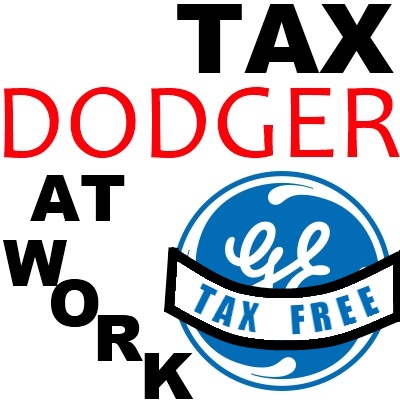
In a communiqué with the GR branch of the IWW, Danny stated the following:
“I went to the protest in Detroit against GE. It was taking place around their shareholder meeting in the tall GM building next to the river. The event was apparently organized primarily by Good Jobs Now, but both the attendance and messaging was great and very diverse. I’d say no one organization led the event. Probably as a result of this, I’d also say the event was successful in many ways.
Despite having only twelve people on the Facebook event page say they’re attending, many, many more than that showed up. It was a massive presence, possibly a thousand or more. Many of the people there were extremely energetic, both in their chants and even literally hopping around in excitement. Once we started the march from Hart Plaza, following a walk along the river, and pretty much immediately when we reached the road between the building and the river, we took to the street. We spent a while there, watching the police slowly try to clear the street, even getting a couple horses. For the most part, however, people held the line.
Eventually, I spotted some people up in the balconies inside the building, with their fists raised. I wasn’t certain what was going on in there until much later in the day.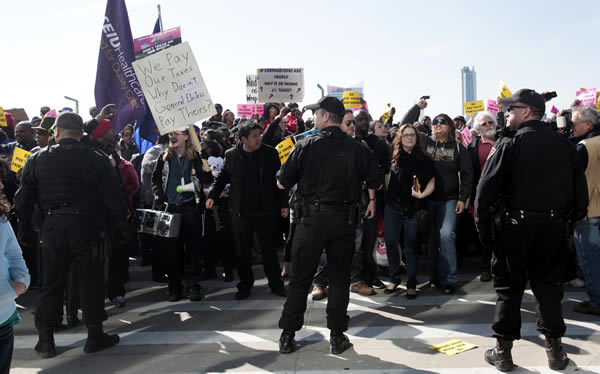
What I was told by a fellow worker who participated inside was this: During the meeting, a couple pastors stood up and started speaking or chanting. When they began to be pulled from the meeting, somewhere between a couple dozen to a hundred people stood up and chanted for GE to pay its share, etc. Despite many of the protesting shareholders being there due to having worked at the company, there were at least a few smug capitalists who retorted with the classic, “get a job.” As those people were being pulled from their meeting, employees, retirees, etc. seemed to be coming into the meeting attracted by the protests faster than people were being pulled out. After being forced out of the meeting, they chanted loudly as they made their way down the stairs of the building. When they reached the bottom, they were applauded, and possibly spoke, but I couldn’t hear anything any particular individual said (nobody bothered to use the human mic at any point in the day) and didn’t applaud because I had no idea who or what we were applauding at the time.
We then went around the building, between it and its parking complex, still holding the entire street. People were in the balconies alongside the building, and in the crosswalks, but these may well have just been onlookers. Reaching the downtown-Detroit-facing side of the building, we filled the driveway in front of the building and stayed there for a while. Once I reached the other corner, I looked back to see people still turning the last one.
Then we took the street again. This time, it wasn’t a side street. We completely blocked both sides of East Jefferson Ave, at the segment that intersects I-375 and M-10 in front of the GM building. Maps tell me this is a pretty significant part of Detroit vehicle traffic. I’m not sure, but we may also have blocked traffic through the
Detroit-Windsor tunnel. We held the streets for a long time, very slowly advancing until we reached the intersection back near Hart Plaza.
After the events, I listened to a bit of the pathetic-as-always coverage in the media. They seemed to have not the slightest idea of the message or even the scale of the protest. I heard that the police had gotten a 10% pay cut that week and so weren’t likely looking to arrest anyone for protests about the economy. I did, however, hear
that a couple people were arrested inside the building, though none outside. I also heard that the UAW pulled out at the last minute. They apparently released a statement to the effect that they don’t want to upset any employers or politicians’. I’m tempted to write an article about that, titled, “UAW Calls It Quits!”
New Media We Recommend
Below is a list of new materials that we have read/watched in recent weeks. The comments are not a “review” of the material, instead sort of an endorsement of ideas and investigations that can provide solid analysis and even inspiration in the struggle for change. All these items are available at The Bloom Collective, so check them out and stimulate your mind.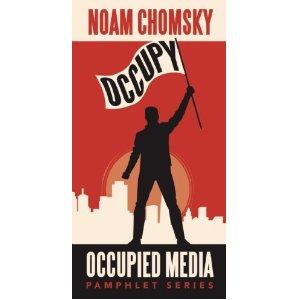
Occupy, by Noam Chomsky – Published by Zuccotti Park Press, Occupy, is a collection of interviews and speeches that Noam Chomsky given regarding the Occupy Movement. These short pieces pack a punch with Chomsky offering up his own reflections on the significance of the Occupy Movement, the history of organizing in the US and the possibilities for radical transformation of the US and the world. Chomsky speaks with optimism and consistency, particularly on the importance of having an educated and organized populace. Chomsky believes that the Occupy Movement is a demonstration of the potential power that people have in confronting power. The short book also includes a wonderful tribute from Chomsky on the legacy of radical historian Howard Zinn.
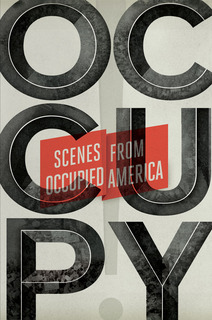
Occupy: Scenes from Occupied America, edited by Astra Taylor & Keith Cessen – This is the first published collection of essays on the US Occupy Movement, according to Verso Books. The collection of 34 essays is a mix of commentary from noted writer/activists such as Angela Davis, Judith Butler, Rebecca Solnit and Doug Henwood. The other half of the book is a collection of first hand accounts of what was happening on the ground at Occupy Wall Street, from how the horizontal meetings took place to how people dealt with repression from the police. This eclectic mix provides people with an invigorating sense that radical change is happening across this country. An inspiring collection.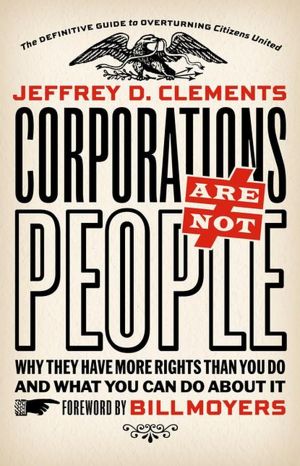
Corporations are not People: Why They Have More Rights than You Do and What You Can Do About It, by Jeffrey Clements – With all the recent attention given to the growing economic inequality in the US by the Occupy Movement, it is no surprise that more writers are starting to expose the nature of corporate power. Jeffrey Clements book, Corporations are not People, is a very readable expose on the power of corporations, both in the political arena and in public life. Clements mixes solid historical analysis with current examples of how corporations have positioned themselves to have tremendous influence throughout society. However, the book falls short at the end when the author lays out his framework for challenging corporate power, which ends up being nothing more than reforms within the current system. Besides the lack of substantive action, this book is a useful educational tool on coming to terms with the nature of corporate power.
Koch Brothers Exposed (DVD) – Koch Brothers Exposed is a hard-hitting investigation of the 1% at its very worst. This full-length documentary film on Charles and David Koch—two of the world’s richest and most powerful men—is the latest from acclaimed director Robert Greenwald (Wal-Mart: the High Cost of Low Price, Outfoxed, Rethink Afghanistan). The billionaire brothers bankroll a vast network of organizations that work to undermine the interests of the 99% on issues ranging from Social Security to the environment to civil rights. This film uncovers the Kochs’ corruption—and points the way to how Americans can reclaim their democracy.
Protestors converge in Kalamazoo to protest animal testing during World Laboratory Animal Liberation Week
This article is by Janet Vormittag, Publisher of Cats and Dogs, a Magazine Devoted to Companion Animals and author of Dog 281, wwwjanetvormittag.com.
World Laboratory Animal Liberation Week (April 21 – 29, 2012 ) is the time when activists come together to make a difference for animals. 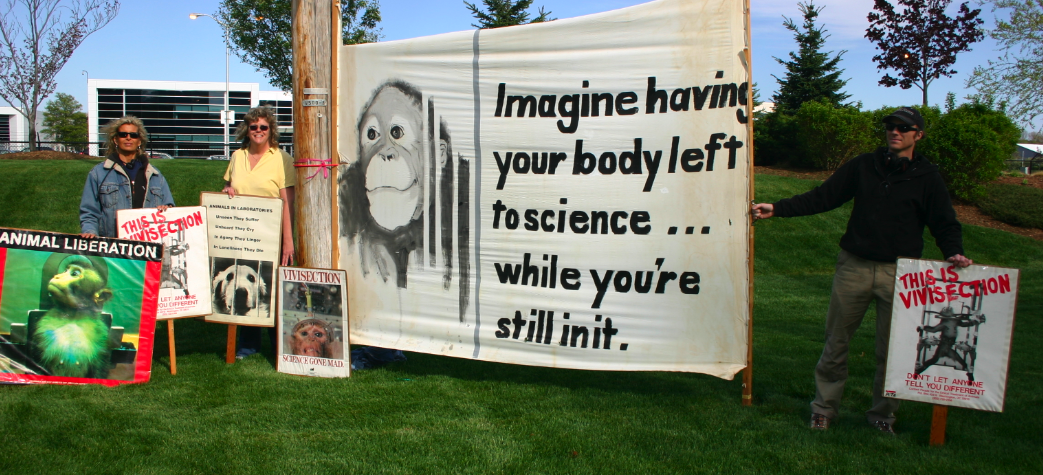
According to Stop Animal Exploitation NOW! (SAEN) over 20,000,000 million animals suffer and die in U.S. laboratories every year. “These innocent victims are subjected to addictive drugs, caustic chemicals, ionizing radiation, chemical and biological weapons, electric shock, deprivation of food and/or water, psychological torture and many other horrors.”
SAEN was founded in 1996 to force an end to the abuse of animals in laboratories.
Tuesday afternoon Grand Rapids resident Robin Karell-Brouwer drove 67 miles to protest the use of animals used at MPI Research Inc., 54943 N Main Street, Mattawan.
The picket, organized by Kalamazoo Animal Liberation League (KALL), was part of a worldwide protest held during World Laboratory Animal Liberation eek.
Karell-Brouwer said she made the trip because she feels strongly about animals used in research. “It’s ethically wrong. I love animals and I think what they do to them is disgusting. I see it as torture.”
According to the 2010 annual report filed with the United States Department of Agriculture, MPI Research used 12,982 animals that year, including:
Dogs: 3,520
Cats: 64
Guinea Pigs: 583
Hamsters: 29
Rabbits: 3,879
Primates: 3,136
Sheep: 29
Pigs: 1,648
Others: 94
Rats, mice, birds, amphibians and other animals have been excluded from coverage by the Animal Welfare Act. Therefore research facility reports do not include these animals.
According to their website, “MPI Research partners with pharmaceutical, biotech, medical device, and chemical companies, conducting research throughout the drug and device discovery and development process.”
 Grand Rapids Institute for Information Democracy