Obama’s Expansion of Af-Pak War
This interview with Tariq Ali is re-posted from Democracy Now.
Amid ongoing U.S.-Pakistani tensions and fears of a military coup in Pakistan, we are joined by British-Pakistani political commentator, historian, activist, filmmaker and novelist Tariq Ali. Ali discusses Pakistan’s internal turmoil, as well as Pakistani attitudes toward U.S. foreign policy, the GOP presidential contest, and the prospect of a military strike against Iran.
“Pakistanis are basically suffering because Obama, arrogantly, escalated the war in Afghanistan and Pakistan and thought he could get away with it. That has now blown up in his face,” Ali says.
Protests planned next week for the Auction of State Lands for Oil & Gas leasing in Michigan
Much of the following information comes from Mary Ann Lesert.
At a May 1st meeting in Barry County a DEQ geologist proclaimed there is no environmental risks with fracking for natural gas in Michigan. Plenty of people are disagreeing with that assessment.
To demonstrate their disagreement there are organized efforts to stop the sale of public lands, one step necessary for fracking to take place across the state. People with the group Ban Fracking Michigan and other local grassroots efforts are calling for the following actions to take place around the state:
- On May 8 the MI DNR will auction mineral rights for oil & gas leasing to 109,000 acres of state (public) land – including nearly all of the Yankee Springs Recreation Area (23,400 acres in Barry County) and portions of the Lake Orion Recreation Area in Oakland County. Land in 23 Counties is being offered.
- May 7: Occupy the MI DNR Call-In Day – May 7 through May 8 Event Link
- May 7: Kalamazoo – Mineral Rights Protest March – 4:00pm Event Link
- May 8: Lansing – Auction Protest & Rally for “Let’s Ban Fracking” MI Ballot Initiative. Location: Constitution Hall, 525 West Allegan, Lansing, MI
Time: Gather at 7:30am or after – Bring Ban Fracking / Save Public Land signs. Auction: Bidders Register at 8:00 am / Auction Begins at 9:00am
Parking: Garages at the building (Allegan and Pine) & Allegan and Capitol.

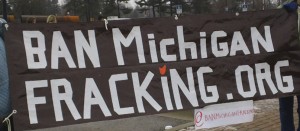
“Let’s Ban Fracking” Petitions for a Ballot Initiative to Ban Fracking in Michigan will be on site May 8th. Make sure you sign the just-launched petition.
MI DNR Bid Documents – Map and Parking Directions
MI DNR Auction Page – Check out the County Maps of Land Being Auctioned
Our Purpose: To let the DNR know that inviting oil & gas development on public land is not what we expect of a department that is supposed to protect and conserve.
New Media We Recommend
Below is a list of new materials that we have read/watched in recent weeks. The comments are not a “review” of the material, instead sort of an endorsement of ideas and investigations that can provide solid analysis and even inspiration in the struggle for change. All these items are available at The Bloom Collective, so check them out and stimulate your mind.
Appetite for Profit: How the Food Industry Undermines Our Health and How to Fight Back, by Michele Simon – Wonderfully researched, Appetite for Profit is an excellent expose of what is wrong with the food system we have in the US. Written by a public health attorney, the book systematically dissects the food system, food corporations, fast food, processed foods, food labeling, government policy and how junk food is marketed to children. Simon makes a strong case that the problem doesn’t so much stem from individual food choices as the food system that is more concerned about profit than the health and well being of the populace.

Weaponizing Anthropology: Social Science in Service of the Militarized State, by David Price – Weaponizing Anthropology is a brilliant analyses of not only how the social sciences are increasingly becoming an integral part of the warfare state but also how knowledge and culture are subject to new modes of militarization, organized in multiple new ways for the production of state violence. Price makes the argument that more and more that the military industrial complex is utilizing social sciences, often through universities, to deepen the ways in which the US imperial project can manipulate and control populations. A disturbing book that shatters any naïve and simplistic understanding of how the US military functions.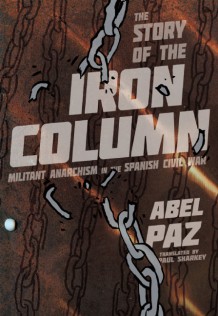
The Story of the Iron Column: Militant Anarchism in the Spanish Civil War, by Abel Paz – A first hand account of how anarchist organizing worked in revolutionary Spain during the late 1930s. Abel Paz, a teenager during the Spanish Civil War, gives us a rich account of the highly organized and militant campaigns by Spanish anarchists that controlled much of the country before Franco’s army suppressed their experiment in self-governance. The book is translated from Spanish and is at times a bit choppy, but the content and the story telling are incredible. Highly recommended.
Living Downstream (DVD) – Based on the acclaimed book by ecologist and cancer survivor Sandra Steingraber, Ph.D., Living Downstream is an eloquent and cinematic documentary film. This poetic film follows Sandra during one pivotal year as she travels across North America, working to break the silence about cancer and its environmental links. Sandra is not the only one who is on a journey—the chemicals against which she is fighting are also on the move. The film follows these invisible toxins as they migrate to some of the most beautiful places in North America. These chemicals enter our bodies and how, once inside, scientists believe they may be working to cause cancer. Steingraber calls on all of us to be carcinogen abolitionists, where instead of just treating cancer, we abolish it.
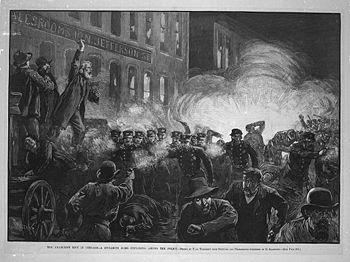
On this day in 1886, a labor rally was held at Haymarket Square in Chicago by workers as part of a campaign to win the 8-hour workday.
Chicago capitalist had been particularly brutal in their treatment of workers in the manufacturing and slaughterhouse sectors, but there was also a lively labor movement that was led by the International Working People’s Association (IWPA).
The rally was also a response to police brutality against workers who were on strike at the McCormick Harvesting Machine Company. The police not only beat several striking workers and their supporters, they fired into the crowd at one point wounding several and killing four.
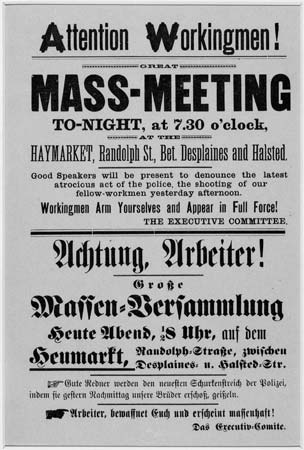
The police brutality incensed members of the IWPA, in particular Albert Parsons and August Spies. Upon hearing the news of the police brutality against striking workers on May 3rd, Spies created a printer circular in both English and German, which read:
Revenge! Workingmen, to Arms!!……You have for years endured the most abject humiliation……you have worked yourself to death……your Children you have sacrificed to the factory lord – in short, you have been miserable and obedient slaves all these years. Why? To satisfy the insatiable greed, to fill the coffers of your lazy thieving master? When you ask them now to lessen your burdens, he sends his bloodhounds out to shoot you, kill you!……..To arms we call you, to arms!!!
About 3,000 workers showed up on May 4 to protest the police brutality called for by the capitalist class and to demand an 8-hour workday. After several speeches and a call to action, many workers then retreated to their homes. A small crowd now remained and nearly 200 police officers arrived and demanded that the workers disperse. A bomb then exploded near the police wounded dozens, which resulted in the police then firing into the crowd of workers killing several and wounding 200.
With no evidence at all of who was responsible the Chicago police arrested eight anarchist leaders connected to the IWPA, including Spies and Parsons. The local press was calling for a speedy trial that would result in executions. According to radical historian Howard Zinn, the real crime of the anarchists was their ideas and their literature. In fact, only one of the eight arrested was even present at Haymarket Square (Fielden) and he was speaking on the platform when the bomb exploded.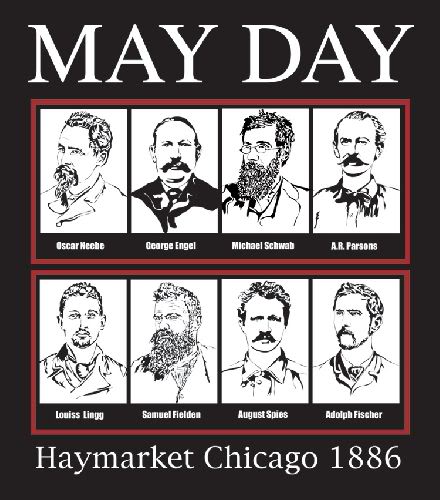
The trial was short and within days the 8 men were founded guilty of murder and sentenced to death. The execution, however, did not take place until the next year and by that time one of those arrested had killed himself in jail. Four of the men were eventually executed and the other three were pardoned.
According to Zinn, it was eventually discovered that the police had paid someone to infiltrate the anarchists who were part of the IWPA and act as an agent provacateur, who admitted to throwing the bomb. This action gave the police and the capitalists a pretext to not only arrest the Haymarket Martyrs, but it led to increased police harassment, the arrest of hundreds and the dismantling of the revolutionary labor leadership in Chicago.
The reaction to the initial arrests on May 4 was far reaching, with workers in London organizing solidarity protests and workers all across the US becoming radicalized. Hundreds of thousands of workers went on strike in 1886, in what Zinn documented as 1,400 separate strikes.
More importantly, workers around the US and around the world began to commemorate the Haymarket Uprising on May 1st, which is why most of the world celebrates May 1st as its worker holiday.
It’s ironic that this history has been suppressed in the US and most people end up celebrating Labor Day in early September, a holiday that marks the end of the summer and tourism more than it does the celebration of labor struggles in the US.
We commemorate this day in resistance history not only to draw attention to the sacrifices and courage of people gone before us, but to follow their example to organize for dignity, freedom and liberation!
This article is re-posted from iwatchnews.org.
South of the border, war is raging with guns mostly supplied by merchants in the United States.
The Government of Mexico has estimated that almost 50,000 people have been killed since 2006, a toll that has made its top officials irate about the persistent flow of weapons south. Some law enforcement officials in the U.S. government share the Mexicans’ concern, but their attempts to stanch the flow by obtaining better intelligence about it have badly singed their fingers.
The notorious “Fast and Furious” operation by the Bureau of Alcohol, Tobacco and Firearms — one in a string of attempts over a nearly decade-long period to tag and closely monitor the movement of individual arms — blew up when two of the weapons being tracked were used to kill a U.S. border patrol agent in 2010.
Republicans in Congress seized on the issue, holding multiple hearings last year. Acting ATF Director Kenneth Melson was reassigned. The Phoenix U.S. attorney who oversaw the operation also resigned, and Republicans called for the resignation of Attorney General Eric Holder. And President Obama has been largely hands off on the gun issue, treating it as the political third rail that is best to be ignored, or at least carefully walked around.
Into this politically-charged environment, the Bureau of Alcohol, Tobacco, Firearms and Explosives (ATF) released a first-of-its-kind report on Thursday that nonetheless attempts to assess the proportional distribution — if not the scope — of the arms flowing to drug cartel operatives.
It confirmed that a majority of the weapons being used by the Mexican drug cartels to kill police, criminals and civilians alike have come from inside the United States. Precisely, of the 99,691 weapons traced from Mexico between 2007 and 2011, 68,161 were manufactured or imported from the U.S. — over 68 percent. Because the data only reflect arms that are captured by Mexican law enforcement agencies, they depict only a subset of all those that flow south.
The data also showed the U.S. arms’ contribution is becoming more malignant: Criminals using U.S. weapons have been moving from handguns to rifles with detachable magazines, weapons with far greater destructive ability in conflicts with government forces. The percentage of traced guns that were rifles went from 28.2 percent in 2007 to 43.3 percent in 2011, while the percentages for pistols, revolvers and shotguns declined.
The flow of U.S. weapons to foreign countries isn’t constrained just to Mexico. Over the five years studied in the report, over 99 percent of the weapons seized for tracing in Canada, for example, were of U.S. origin. Of the five countries studied in the Caribbean for 2011 alone, the largest percentage of weapons with a U.S. origin came from The Bahamas (94 percent), followed by the Dominican Republic (81.3 percent), Jamaica (80.8 percent), Barbados (60 percent) and Trinidad and Tobago (43.3 percent); the majority of weapons seized for tracing were handguns.
But Mexico remains the more volatile situation. After all, there aren’t civilians being gunned down in the streets of Vancouver. Some of the most powerful weapons to show up in Mexico were first imported in a stripped-down condition into the United States, and then modified by domestic gun dealers before being transported across the border.
The data has been seized upon by advocates of stricter gun controls in the United States. In a press release, Sen. Diane Feinstein (D-CA) said the new data “makes it very clear that we need to increase our efforts to starve the supply of American weapons that arm Mexico’s brutal drug trafficking organizations.” ATF was required to release the gun recovery data due to a provision authored by Feinstein as part of last year’s Commerce, Justice and Science Appropriations bill.
The reports form the most comprehensive long-term data available for guns that have been traced through ATF’s National Tracing Center. A report done in 2009 by the Government Accountability Office found that 87 percent of firearms seized by Mexican authorities and traced over the previous five years were from the United States — a higher figure that suggests U.S. law enforcement efforts to root out trafficking may now be having a modest impact.
The National Rifle Association’s Institute for Legislative Action, a group funded partly by gun manufacturers, did not have an immediate comment.
Top Michigan PACs have raised $22.2M this cycle
This article is re-posted from the Michigan Campaign Finance Network.
Coming on the heels of a record year of lobbyists’ spending, there are more signs of recovery in the money-in-politics sector of Michigan’s economy. Michigan’s top 150 political action committees have raised $22.2 million so far this election cycle. That figure is up by 12.2 percent compared to the same point in the 2010 election cycle, when the top 150 PACs had raised $19.8 million.
PAC fundraising this cycle is up by 1.6 percent compared to 2008, when the top 150 raised $21.8 million. This year’s total trails the mark set in Michigan’s record-setting 2006 election, when the top 150 PACs had raised $23.2 million by this point in the cycle.
Data were compiled by the nonpartisan Michigan Campaign Finance Network from reports filed last week with the Michigan Department of State.
The House Republican Campaign Committee and the House Democratic Fund have raised the most of all PACs so far this cycle. The House Republicans have raised $1,567,831 and they have $1,004,449 on hand. The House Democrats have raised $1,199,490 and they have $674,817 on hand. Both committees are debt free from last cycle.
The Senate Republican Campaign Committee has raised third most at $1,075,419 but its fund balance is only $76,336. Senate Democrats rank 10th on the list. They have raised $450,427 and have $276,472 on hand. Both Senate caucus PACs are debt free as they prepare for the 2014 elections.
Occupying positions 4 through 8 are: The Michigan Education Association PAC: $947,386; Blue Cross / Blue Shield PAC: $751,292; Michigan Regional Council of Carpenters PAC: $574,998; Michigan Association for Justice PAC: $507,137; and the Michigan Association of Realtors PAC: $472,171.
Business Leaders for Michigan PAC II ranks 9th overall, and highest among committees taking corporate contributions, with $466,000. The next leading SuperPAC is the California-based ‘education choice’ supporter, Parents and Teachers for Putting Students First – 30th with $210,000. The Michigan Chamber of Commerce PAC III ranks 3rd among SuperPACs and 36th overall with $154,406 raised.
PACs that raise corporate contributions are allowed to make independent expenditures but they are not allowed to make contributions to candidate committees.
The Michigan Chamber PAC III was heavily involved against the recall of former Rep. Paul Scott and the subsequent election of his successor, Rep. Joseph Graves. The MEA-backed Citizens Against Government Overreach, 29th with $217,681, drove the campaign to recall Scott.
Leadership PACs are a mix of the expected and the unexpected so far this cycle. House Speaker Jase Bolger has the top leadership PAC so far, ranking 14th overall with $386,973 raised. Senate Majority Leader Randy Richardville has the second biggest fundraising total among the politicians with $322,327, good for 16th overall.
Former Rep. Michael Sak of Grand Rapids has the third biggest fundraising total among leadership PACs with $249,775, holding the 22nd spot overall. Sak amassed his total by giving up funds from his old candidate committee.
The fourth biggest leadership PAC is that of Wayne County Executive Robert Ficano. He had the largest leadership PAC last cycle. This cycle he has raised $135,296, but only $1,000 since last October’s report. His administration has been racked by criminal investigations and charges against former staffers.
Gov. Rick Snyder’s One Tough Nerd PAC ranks 148th overall, at $30,175.
Last week’s PAC reports were the first ones filed by most PACs since last October, six months ago.
“The frequency of state PAC reporting is abysmal,” said Rich Robinson of the Michigan Campaign Finance Network. “We should not have to wait six months to see who is raising money from whom. The legislature and the Governor need to get a better standard of campaign finance accountability written into law. This isn’t rocket science.”
Top 150 Michigan state PACS, 01/01/2011-04/20/2012
It has been a week since the announcement from Rick DeVos of his latest endeavor known as Start Garden.
As has been the case with other projects such as 5×5 and ArtPrize, this new project has received plenty of media coverage, all with significant fanfare.
The basic idea is that with $15 million of the DeVos Family money, people will submit proposals for business ventures that DeVos and his team will look at and decide which ones deserve to get funded. Of course, there is a mechanism where the public can vote on some of the proposals, but in the end “voting” in this format will generally mean people who are supportive of such projects and those who have an awareness of it. It would be safe to assume that most of those “voting” for projects submitted to Start Garden will be people who fall into the creative class category…..the ones who who have been involved in Rick DeVos’s other projects.
DeVos made his announcement last week at a press conference held at one of the many family owned properties in Grand Rapids, the JW Marriott Hotel. DeVos is quoted in MiBiz as saying, “It’s unlike any fund in the world. It involves hundreds of ideas, which can come from anywhere and from anyone.” But any serious observer (which should include journalists) would ask the question of how this project is different than any other in the world?
Other wealthy families have a history of investing in projects, so that couldn’t be what makes it different. In fact, what the Start Garden Project is doing is somewhat similar to what banks and other financial institutions do, they lend money to projects they think are viable. The difference here is that the DeVos family and the Start Garden Team will be making those decisions, which gives them even more leverage to determine the future of Grand Rapids. Gaining more leverage in determining the future of this community has been the goal of the DeVos family ever since Rich DeVos began acquiring billions through the Amway business.
In addition to increasing the family’s influence on the economic, social and political future of Grand Rapids, the Start Garden Project is just another mechanism for the DeVos family to make money off the ideas and hard work of others. If one reads the Start Garden rules page it is clear that those who run Start Garden get to have the right to make money off of ideas that are profitable. The investment agreement section states clearly, “Start Garden does not take ownership in intellectual property of your idea at the $5,000 level. It contains options so we remain investors if your idea becomes a successful business.”
The emphasis on Start Garden’s ability to benefit from profitable ventures is restated again on a different page. “We recognize this investment agreement is unusual. It’s our prototype of an agreement that has as few strings attached as possible, but still maintains an investor relationship if your idea becomes a huge success.”
At a recent talk Rick DeVos commented that such criticism of his projects are nothing more than conspiracy theories about his family’s business. Start Garden is not a conspiracy, but it is another way for the DeVos family to make money while having more influence in the future of Grand Rapids.
Leaving Afghanistan by Staying?
This article is re-posted from Voices for Creative Non-Violence (VCNV).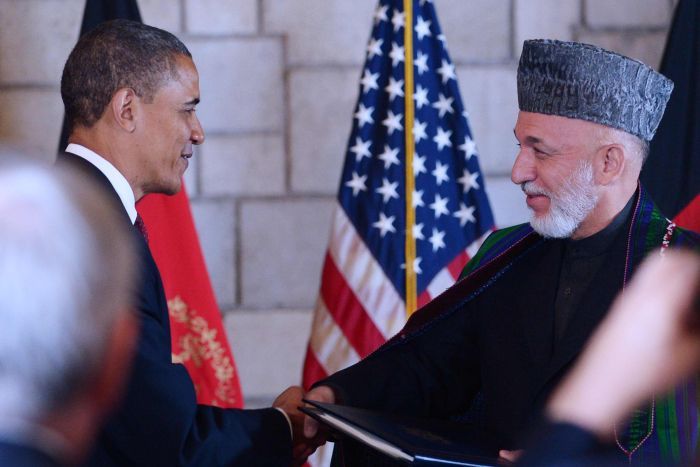
President Obama has signed an agreement with President Karzai to keep a major U.S. military presence in Afghanistan (currently about three times the size Obama began with) through the end of 2014, and to allow a significant unspecified military presence beyond that date, with no end date stipulated.
But Obama forgot to provide any reason not to withdraw from Afghanistan now. Rep. Barbara Lee has a bill for withdrawal now.

Obama spoke of a transition to Afghan control, but we’ve heard that talk for a decade. He talked of fighting al Qaeda, but the U.S. has not been fighting al Qaeda in Afghanistan, and has admitted for years that there is virtually no al Qaeda presence there.
The agreement requires that all “entities” involved in a peace process renounce violence, but the Taliban will no more do that while under foreign occupation than the United States will do so while occupying. This is not a serious plan to leave. Nor is it a plan based on Afghan sovereignty.
The agreement says it becomes effective when “the Parties notify one another, through diplomatic channels, of the completion of their respective internal legal requirements.” The U.S. Constitution requires ratification by the Senate of all treaties.
Tell Congress to insist on its right to approve or reject this plan.
A more detailed agreement will be worked out on May 20th when NATO meets in Chicago. Activists for peace and justice need to be there!
Roots Action, Veterans For Peace, Fellowship of Reconciliation, and Voices for Creative Nonviolence are working together to end the war in Afghanistan and are jointly issuing this call for peace.
This article by Vandana Shiva is re-posted from Common Dreams.
The economic crisis, the ecological crisis and the food crisis are a reflection of an outmoded and fossilized economic paradigm – a paradigm that grew out of mobilizing resources for the war by creating the category of economic “growth” and is rooted in the age of oil and fossil fuels. It is fossilized both because it is obsolete, and because it is a product of the age of fossil fuels. We need to move beyond this fossilized paradigm if we are to address the economic and ecological crisis.
Economy and ecology have the same roots “oikos” – meaning home – both our planetary home, the Earth, and our home where we live our everyday lives in family and community.
But economy strayed from ecology, forgot the home and focused on the market. An artificial “production boundary” was created to measure Gross Domestic Product (GDP). The production boundary defined work and production for sustenance as non-production and non-work – “if you produce what you consume, then you don’t produce”. In one fell swoop, nature’s work in providing goods and services disappeared. The production and work of sustenance economies disappeared, the work of hundreds of millions of women disappeared.
To the false measure of growth is added a false measure of “productivity”. Productivity is output for unit input. In agriculture this should involve all outputs of biodiverse agro-ecosystems – the compost, energy and dairy products from livestock, the fuel and fodder and fruit from agroforestry and farm trees, the diverse outputs of diverse crops. When measured honestly in terms of total output, small biodiverse farms produce more and are more productive.
Inputs should include all inputs – capital, seeds, chemicals, machinery, fossil fuels, labour, land and water. The false measure of productivity selects one output from diverse outputs – the single commodity to be produced for the market, and one input from diverse inputs – labour.
Thus low output, high input chemical, industrial monocultures, which in fact have a negative productivity, are artificially rendered more productive than small, biodiverse, ecological farms. And this is at the root of the false assumption that small farms must be destroyed and replaced by large industrial farms.
This false, fossilized measure of productivity is at the root of the multiple crises we face in food and agriculture. It is at the root of hunger and malnutrition, because, while commodities grow, food and nutrition have disappeared from the farming system. “Yield” measures the output of a single commodity, not the output of food and nutrition.
This is the root of the agrarian crisis.
When costs of input keep increasing, but are not counted in measuring productivity, small and marginal farmers are pushed into a high cost farming model, which results in debt – and in extreme cases, the epidemic of farmers’ suicides.
It is at the root of the unemployment crisis.
When people are replaced by energy slaves because of a false measure of productivity based on labour inputs alone, the destruction of livelihoods and work is an inevitable result.
It is also at the root of the ecological crisis.
When natural resource inputs, fossil fuel inputs, and chemical inputs are increased but not counted, more water and land is wasted, more toxic poisons are used, more fossil fuels are needed. In terms of resource productivity, chemical industrial agriculture is highly inefficient. It uses ten units of energy to produce one unit of food. It is responsible for 75 per cent use of water, 75 per cent disappearance of species diversity, 75 per cent land and soil degradation and 40 per cent of all Greenhouse Gas emissions, which are destabilizing the climate.
In food and agriculture, when we transcend the false productivity of a fossilised paradigm, and shift from the narrow focus on monoculture yields as the only output, and human labour as the only input, instead of destroying small farms and farmers we will protect them – because they are more productive in real terms. Instead of destroying biodiversity, we will intensify it, because it gives more food and nutrition.
Futureconomics, the economics of the future, is based on people and biodiversity – not fossil fuels, energy slaves, toxic chemicals and monocultures. The fossilized paradigm of food and agriculture gives us displacement, dispossession, disease and ecological destruction. It has given us the epidemic of farmers suicides and the epidemic of hunger and malnutrition. A paradigm that robs 250,000 farmers of their lives, and millions of their livelihoods; that robs half our future generations of their lives by denying them food and nutrition is clearly dysfunctional.
It has led to the growth of money flow and corporate profits, but it has diminished life and the wellbeing of our people. The new paradigm we are creating on the ground – and in our minds – enriches livelihoods, the health of people and eco-systems and cultures.
On April 2, 2012, the United Nations organised a High Level Meeting on Wellbeing and Happiness: Defining a new Economic Paradigm to implement resolution 65/309 [PDF], adopted unanimously by the General Assembly in July 2011 – conscious that the pursuit of happiness is a fundamental human goal and “recognising that the gross domestic product does not adequately reflect the happiness and well-being of people”.
I was invited to address the conference at the UN. The meeting was hosted by the tiny Himalayan Kingdom of Bhutan. Bhutan has given up the false categories of GNP and GDP, and replaced them with the category of “gross national happiness” which measures the wellbeing of nature and society.
Bhutanese Prime Minister Jigmi Thinley has recognised that “growing organic” and “growing happiness and wellbeing” go hand in hand. That is why he has asked Navdanya and I to help make a transition to a 100 per cent organic Bhutan.
In India, Navdanya is working with the states of Uttarakhand, Kerala, Madhya Pradesh, Jharkhand and Bihar for an organic transition. We aim for an organic India by 2050, to end the epidemic of farmer suicides and hunger and malnutrition, to stop the erosion of our soil, our biodiversity, our water; to create sustainable livelihoods and end poverty.
This is futureconomics.

Earlier today, a small group of people gathered at the corner of Fulton and Division in downtown Grand Rapids to draw attention to the US/NATO war in Afghanistan.
The group handed out flyers to people passing by and held signs that called for an end to the more than a decade-long US/NATO occupation of Afghanistan that has escalated under the Obama administration.
Thos involved in organizing the protest were also inviting people to Chicago later this month to be part of a march against NATO that is expected to have several hundred thousand participants.
We interviewed one of the organizers, Tom Burke, and asked him about the relationship between May Day and the May 20th action in Chicago, Obama’s continuation of the Bush wars and what people can expect if they go to Chicago for the NATO protest on May 20.
 Grand Rapids Institute for Information Democracy