
Bullying is a serious issue in the US today. Millions of children experience being bullied on a daily basis at school, so much so that over a million will stay home each month in order to avoid being intimidated, harassed or abuse by fellow students.
Directed by Sundance and Emmy Award-winning filmmaker Lee Hirsch, BULLY is a beautifully cinematic, character-driven documentary—at its heart are those with the most at stake and whose stories each represent a different facet of this bullying crisis.
“We hear students talk first-hand about their bullying experiences yet see how often their pain is ignored.” said Lisa Perhamus, Assistant Professor of Education at GVSU. “I’ve sat with students as they’ve talked about feeling tormented at school and have listened to parents describe feeling helpless about how to protect their children when they send them off to school. Each child’s experience with bullying is a life story that they bring into the classroom with them every day. We must learn how to ask children about these stories and really listen to what they have to say. I hope this film helps each of us become a better listener.”
BULLY tells the remarkable stories of five brave families that will challenge viewers to move from shock and resignation about bullying to action, transforming communities into places where empathy and respect are valued and bullying is unacceptable. The film confronts bullying’s most tragic outcomes, including the stories of two families who’ve lost children to suicide. BULLY brings human scale to this startling statistic, offering an intimate, unflinching look at how bullying has touched these families.
Bully
Thursday, April 19
6:30 PM
Celebration Cinema North
Corner of Knapp & East Beltline
This is a free screening, which will be followed by a discussion with local people involved in anti-bullying work.
Pentagon spending under Obama
The following information is re-posted from iwatchnews.org.
Every spring, the Government Accountability Office reports to Congress on how well the Pentagon’s major weapons programs are progressing, and its conclusions have not been flattering for a long time. This year’s report states again that while there have been some improvements, most of the programs that GAO examined in detail are not using wise procurement practices, such as ensuring that “requirements and resources” match, that the weapons designs are stable, and that the manufacturing processes are “mature.” It predicted further cost increases and schedule slippages. Here are a few key data in the 188-page report:
24 – Number of programs that have at least doubled in cost since they were started.
13 – Number of programs that have at least tripled in cost since they were started.
5 – Number of programs that have at least quadrupled in cost since they were started.
$1.58 trillion – The cost of all 96 major programs.
$74.4 billion – How much these major programs increased in cost in 2011.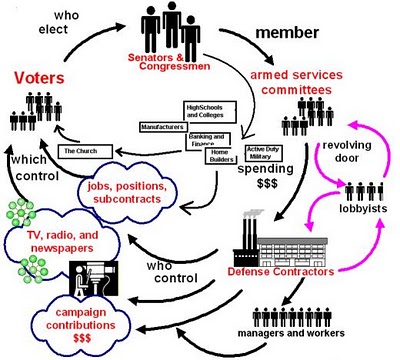
$447 billion – How much more these major weapons programs are expected to cost than initially estimated.
20% – How many major shipbuilding programs studied by the GAO had mature technologies in hand prior to the start of final design work.
43% – How many major programs have set required “affordability” targets.
52% – How much of last year’s cost increases were incurred by a single program: the Joint Strike Fighter.
60% – How many programs in which the costs of each unit — i.e. plane, tank, missile — went up last year.
$35 billion – How much the Joint Strike Fighter’s costs increased last year due to what the GAO called “manufacturing inefficiencies, parts shortages, and quality issues.”
440 million – Number of man-hours needed to complete one aircraft carrier, the CVN 78.
1,522% – The increase in the C130J air transport program’s total cost since it started.
Source: General Accountability Office, “Defense Acquisitions, Assessments of Selected Weapon Programs,” March 2012.
The Capitalist Shame of the Titanic

The weekend of April 14th and 15th marked the 100th anniversary of the sinking of the Titanic. For many years, this event was not only a tragedy but a travesty. Investigations conducted after the sinking showed that White Star Line stewards kept third-class passengers locked into the lower decks while the available lifeboats (only enough for half the people on board) were loaded with the first- and second-class patrons. The survival rates of the poor on the Titanic were there for all to see: only 25 percent survived, as opposed to 63 percent of first-class passengers.
The Titanic was advertised as the grandest vessel ever built. No luxury was spared, and people clamored for tickets for the maiden voyage. First-class tickets started at $4,300 for the six-day voyage, at a time when an American middle-class family lived comfortably on $800 a year. And the most expensive first-class suites cost approximately $120,000. Part of what the passengers paid for was security: a new design of the lower bulkheads meant that Titanic had less chance of sinking than an ordinary liner of its time, a fact touted by the White Star Line.
The sinking might have been avoided if Bruce Ismay, managing director of the White Star Line, had not ordered the ship to change to top speed on the night of April 14. He wanted to get into New York City a day early to garner more publicity—despite ice warnings on the seas reported earlier in the day. And at least one ice warning received by Titanic was ignored amid the onslaught of first-class telegrams being sent out about on-shore plans.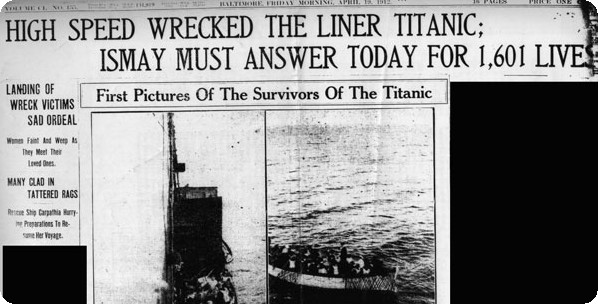
But one aspect of the Titanic disaster has only recently come to light, and that was a corporate trick monstrous in its callous disregard of its employees. Individual letters sent to crew that survived and to the families of crew members who died informed them that the employee had been fired in the early morning of April 15. The charge was “gross insubordination” for abandoning ship and “disembarking on the high seas.”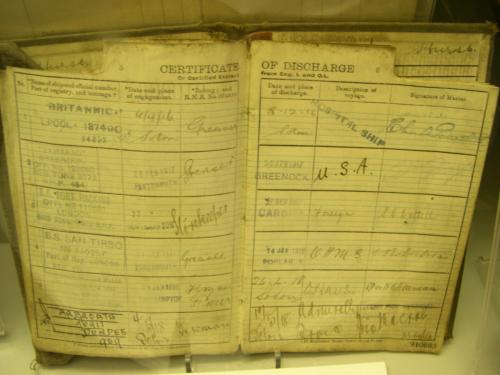
Many passenger claims were made against the RMS Titanic after her sinking: claims by individual families for wrongful death; claims by countries such as Belgium for “loss of countrymen,” and claims for jewelry, paintings, U.S. mail, and an automobile.
By firing all of its crew, the corporation did not have to pay wages for the final voyage, pension claims, or any insurance policies of its employees, saving the company thousands and thousands of dollars. It sounds like the kind of heartless strategy that might be used in a massive corporate layoff today, but this happened 100 years ago.
And who these “insubordinate” crew members? They were not saving themselves. Only 214 crew members survived out of the nearly 800 employees on board. The band famously played to the very end; less well known are the boiler-room crew who worked until they drowned in an attempt to keep electricity going so distress messages could be sent out. The ship’s chief baker immediately went to the kitchens and filled sacks with freshly baked bread and other provisions and threw a sack into each poorly equipped lifeboat. Stewardesses ran back and forth looking for the parents of children who had been separated from their families, and finding the children seats on the lifeboats. Second Officer Charles Lightoller personally saved 31 passengers and crew members after the ship sank by organizing them to stand on top of an overturned lifeboat, and then had them all shift their weight at the same time to keep the boat from tipping over. He was the last person to board the Carpathia, staying in the water until he was sure that every lifeboat passenger was saved.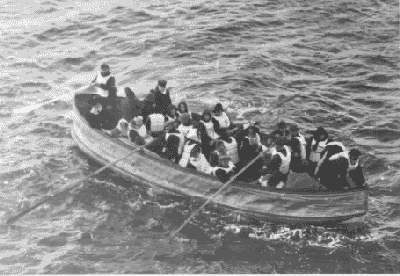
Stunned families, who saw how Ismay was vilified by the press, kept quiet about the shame of the firings, and how the crew members were treated afterward. That might account for the fact that it took so long for this story to emerge.
When the surviving crew members reached New York on the Carpathia, they were penniless because there were no pay packets waiting for them. They had no clothes but their uniforms. Usually, the White Star Line reserved hotel rooms for crew members and then handed out new assignments to return the crew home to England and Ireland. This time, there were no return passages on offer.
Fortunately, Woolworth’s, hearing of the plight of the abandoned crew members, offered them jobs, free meals, and free clothing. Meanwhile, families back home had to scrape together the money for return voyages. And many of these surviving crew members were never able to get jobs on ships again, with the black mark of being fired by White Star on their records.
Titanic’s sinking destroyed the lives of thousands of families, but the corporation’s unnecessary destruction of employee reputations and ability to earn livings in an effort to improve its bottom line is a new and shameful page in the history of the White Star Line.
This article is re-posted from the Michigan Campaign Finance Network.
Michigan candidates for the U.S. House of Representatives have filed their campaign finance reports for the first quarter of 2012. Those reports suggest a limited number of competitive primaries and even fewer competitive races in the November general election. A synopsis of races that are likely to be the most competitive follows.
1st District
Former Democratic state representative Gary McDowell has a wide financial advantage over Derek Bailey, the tribal chairman of the Grand Traverse Band of Ottawa and Chippewa Indians, in the 1st District Democratic primary. As of March 31st, McDowell had $502,674 cash on hand compared to Bailey’s total of $78,296.
Incumbent 1st District Republican Rep. Dan Benishek had $512,297 in cash on hand.
Almost $7 million was spent in the 1st District in 2010 when Benishek defeated McDowell to win the then-open seat. In 2010 Benishek raised $1.3 million and McDowell raised $836,000. Third-party groups supporting Benishek and opposing McDowell spent $3.3 million. Third-party groups supporting McDowell and opposing Benishek spent $1.5 million
3rd District
Former state representative Steve Pestka has a two-to-one advantage in cash on hand in the 3rd District Democratic primary race against Trevor Thompson: $195,000 to $90,000. A large part of the difference is due to Pestka’s self-funding of $18,800 and a loan of $50,000 he made to his campaign.
Incumbent 3rd District Republican Rep. Justin Amash had $200,000 cash on hand.
Amash had a relatively narrow fundraising advantage over Democrat Pat Miles in 2010: $1,050,000 to $960,000. However, he defeated Miles by almost 50,000 votes out of 217,000 votes cast. The 3rd District has become marginally more favorable to Democrats since redistricting with the inclusion of Calhoun County.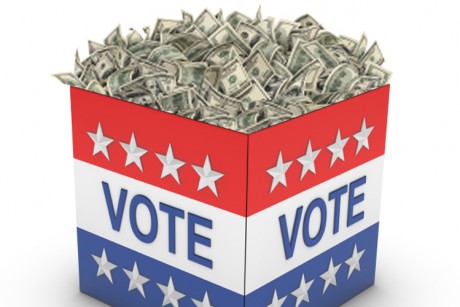
6th District
The anti-tax Club for Growth has pledged support for former state representative Jack Hoogendyk in his challenge to incumbent Rep. Fred Upton in the 6th District Republican primary. Fundraising through the first quarter suggests little competition. Upton had $2,270,000 in cash on hand. Hoogendyk had $57,000. The Club for Growth spent $6,000 for cable TV advertisements attacking Upton earlier this year, but that was matched twenty-fold by a $125,000 television ad blitz supporting Upton by the U.S. and Michigan Chambers of Commerce.
The Club for Growth provided 90 percent of the funds for now-Rep. Tim Walberg when he defeated then-freshman Rep. Joe Schwarz in the old 7th District Republican primary in 2006. The Club bundled $607,000 of earmarked individual contributions and made $514,000 in independent expenditures in that campaign. So far the Club has not generated earmarked contributions for Hoogendyk. The Club has a bigger mountain to climb in 2012 than it did in 2006, taking on the chairman of the House Energy and Commerce Committee as he seeks his 14th term in office.
13th District
Incumbent U.S. Rep. John Conyers faces at least two challengers who are raising money for the 13th District Democratic primary. State Sens. Glenn Anderson and Bert Johnson have raised $134,000 and $58,000, respectively, while Conyers has raised $576,000. Conyers had $132,000 in cash on hand, Anderson had $74,000 and Johnson had $41,000.
14th District
Incumbent Rep. Gary Peters has a wide financial advantage over fellow incumbent Rep. Hansen Clarke and Southfield Mayor Brenda Lawrence in the 14th District Democratic primary. Peters had more than $1.2 million in cash on hand, Clarke had $564,000 and Lawrence had $65,000.
Peters raised $3.4 million in 2010 in winning a $9 million race in the old 9th District that featured more than $4 million in third-party spending. Clarke raised $588,000 in winning the old 13th District. He defeated former Rep. Carolyn Cheeks Kilpatrick in the 2010 primary.
Summaries for all congressional candidates who have reported raising money are attached to this news release.
This release previously contained a fund balance for Glenn Anderson that was based on Sen. Anderson’s original filing of his April quartely report with the FEC. It has been revised to reflect Sen. Anderson’s revised April quarterly.
* MI congressional candidates’ fundraising through 3/31/2012
Goldman Sachs: buying more elections and paying more fines

Since the 2008 economic “crisis,” there are several banks and financial institutions that have been given a de facto status of being the most egregious offenders in terms of engaging fraud and insider trading that has benefited the 1% and exploited the 99%.
CorpWatch founder and writer Pratap Chatterjee recently wrote a piece about significant fines that Goldman Sachs has paid out to the state of Massachusetts and the federal government. Accroding to Chatterjee, Goldman Sachs had to pay put $10 million to state regulators in Massachusetts and $22 million in an SEC settlement.
“From 2006 to 2011, Goldman held weekly huddles sometimes attended by sales personnel in which analysts discussed their top short-term trading ideas and traders discussed their views on the markets,” said the SEC in a press release issued earlier this week. “In 2007, Goldman began a program known as the Asymmetric Service Initiative (ASI) in which analysts shared information and trading ideas from the huddles with select clients.”

Insider trading – as we have noted before – is the practice of cashing in on information that is not known to the general public. Although it is not illegal in many other countries, the U.S. takes it very seriously and will jail violators and sometimes ban them from trading. Bigger companies – like Goldman Sachs – will typically pay out large sums in order to avoid such punishment.”
Goldman Sachs is just one of the companies that CorpWatch monitors, particularly from the banking/financial sector, but they also have data and analysis on hundreds of other corporations that is a great resource.
Bi-partisan electoral theft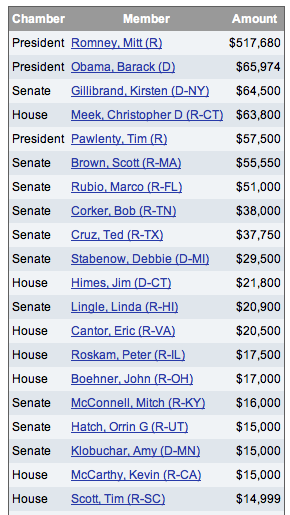
Despite the somewhat negative imagine that Goldman Sachs has in the public mind, it has not diminished the influence they have when it comes to lobbying and buying elections.
According to the Center for Responsible Politics, Goldman Sachs has contributed over $37 million to candidates since 1990, nearly $4 million in the 2012 election alone. During these two decades Goldman Sachs has contributed over $22 million to Democrats and nearly $15 million to Republicans. The bi-partisan nature of their electoral bribing is the norm with most Fortune 500 companies.
In 2008, the major recipients of electoral funding from Goldman Sachs were Mitt Romney at Barack Obama. It should be noted that in that same year the 10th largest recipient was Michigan Senator Debbie Stabenow, who received $29,500, even though it was not a re-election year for her.
Mitt Romney and Barack Obama are the top two recipients of campaign money from Goldman Sachs in 2012, which underscores how centers of power often cover their political bases so that no matter which candidates wins, they win.
Goldman Sachs is no less involved in influencing legislative decisions, by paying millions to lobbyists to get the kind of laws that will best benefit their bottom line. For example, the company lobbied heavily on the trade bills the US was negotiating to solidify investor rights in countries like South Korea, Colombia and Panama.
It should be apparent to anyone looking at this data to draw the conclusion that not only is Goldman Sachs still engaged in fraudulent behavior, they are making sure that real democracy does not exist in the electoral and legislative arena of US politics.
Mutual Aid GR announces new online barter system
The group calling themselves Mutual Aid Grand Rapids, has just announced they have gone live with a online site that promotes bartering.
The online bartering system is designed to:
- share skills/resources
- build community and
- resist the environmental destruction being brought about by global capitalism.
According to the Mutual Aid GR site:
This board was created to help build stronger community in West Michigan, stop hyper-consumption and utilize people’s talents. Our current economic system serves a small percentage of the population, causes tremendous human harm and is environmentally destructive.
Barter Board is just one attempt to create more economic freedom and autonomy for people to collective resist capitalism.
The online barter system is self-posting where one can add the skills/resources they can barter with by category. People can also search for skills resources they need and be matched with people who can barter with them. The more people who add to the site, the more opportunities there are for people to barter.
Bartering is based on exchange or trade, so we ask that people not expect goods/services for free and are willing to actually barter with their own goods/services. Posts are welcome to either offer goods/services or to find goods/services needed. We ask that this system be based on barter (exchange of goods/services) and not on money. Users are welcome to list their talents and the degree to which they are proficient in these talents, understanding that someone may offer to provide a service in which they are not necessarily professionally trained.
In addition, Mutual Aid GR is also hosting a People’s Assembly on Radical Sustainability this Saturday as an alternative Earth Day event. The People’s Assembly will be a forum to discuss tactics, strategies and actions to take that call for systemic change and resistance to ecologically devastating effects of global capitalism.
People’s Assembly for Radical Sustainability
Saturday, April 21
11:00 AM – 3:00 PM
Trinity United Methodist Church
1100 Lake Dr. SE, Grand Rapids
The event is free and open to anyone who believes we need to take bold action against the current destruction of this planet and anyone who isn’t being duped by green capitalism.
Lunch and childcare is also being offered. For more information go to http://www.facebook.com/events/214450608656865/.
Postal System Changes are coming
This article is re-posted from OpenSecrets.org.
Watching paint dry might sound more exciting to some Americans than overhauling the postal service — until they realize that post offices will be closed, Saturday delivery is on the chopping block and other things they take for granted are up for debate.
That’s the hornet’s nest that Congress will be stirring up over the next few weeks. The issue took on new urgency last year when the United States Postal Service announced it would have to close hundreds of distribution centers and thousands of small post offices to stay solvent.
Furious efforts to save local post offices have ensued, of course, but the whole topic has been red-hot in Washington, where a wide range of special interests have weighed in. They include some of the heaviest hitters OpenSecrets.org keeps track of, like postal unions and FedEx, as well as groups from more obscure corners of the lobbying world, like the Envelope Manufacturers of America (yes, envelopes have lobbyists).
Lawmakers have until May 15 to come up with a postal bill – that’s the deadline set by the USPS before it implements its own plan to close post offices (mostly rural) and tinker with rates. That ensures the matter won’t wind up in the dead letter office.
Two major versions of postal reform legislation are being considered: the 21st Century Postal Service Act, which is headed to the floor in the Senate, and the Postal Reform Act of 2011. Both would drastically change the USPS as we know it with rate increases, post office closings and changes to the postal workers’ retirement system. Potential new revenue streams could come from allowing the shipment of beer, wine and liquor (which FedEx and UPS already do) and giving the USPS the green light to offer some financial services.
Even before this last-minute push, the postal service revamping has been a source of drama on the Hill. For instance, the House version of the overhaul legislation, which includes layoffs, has been shepherded by the chairman of the Government Oversight and Reform Committee, Darrell Issa (R-Calif). Issa was once a favorite of the postal unions – but since he began pushing the reform bill this election cycle much of that money has been shut off. The Senate’s leading voice against cuts is Bernie Sanders (I-Vt), a perennial favorite favorite of public-sector union money.
Of course, lawmakers have heard from FedEx and UPS, both of whom have a lot riding on the viability of their biggest competitor. Both also qualify as heavy hitters on OpenSecrets.org for their intense Washington presence on the lobbying and campaign finance scene (both companies even own townhouses near the United States Capitol building to host fundraising events for lawmakers).
And, with tens of thousands of public employees affected, the unions and groups that represent those workers have been out in force: there’s the National Association of Letter Carriers, and the National Postal Mail Handlers Union, both of which are affiliates of union heavyweight AFL-CIO.
There’s also the National Rural Letter Carriers Association, which represents mail-carriers far from the big metropolises. The National Association of Postmasters goes to bat for managers, and the National Star Route Mail Contractor Association backs contractors the post office uses to ship mail. The National Active and Retired Federal Employees Association had to say something about this, since most suggestions involve changes to the pension fund for postal employees.
And those are just the heaviest of the heavy hitters in the fight. Check out the full spectrum of groups that have lobbied on the two pieces of legislation, including some surprising names.
21st Century Postal Service Act
Or, to help keep tabs on all the interests talking to Congress about the big business that is your mail, look up our info on lobbying in the entire “postal” issue area.
New Media We Recommend
Below is a list of new materials that we have read/watched in recent weeks. The comments are not a “review” of the material, instead sort of an endorsement of ideas and investigations that can provide solid analysis and even inspiration in the struggle for change. All these items are available at The Bloom Collective, so check them out and stimulate your mind.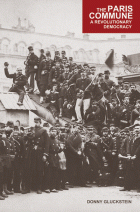
The Paris Commune: A Revolutionary Democracy, by Donny Gluckstein – For anyone looking for a book with solid analysis of the 1871 Paris Commune, Donny Gluckstein’s book does the job. Gluckstein not only provides readers with an excellent overview of the Paris Commune, he uses lots of archival material to demonstrate how much was achieved by the Commune in just 2 short months. Gluckstein also provides healthy criticism, but does not demonstrate an overt ideological bias. An important book about an important moment in revolutionary history.
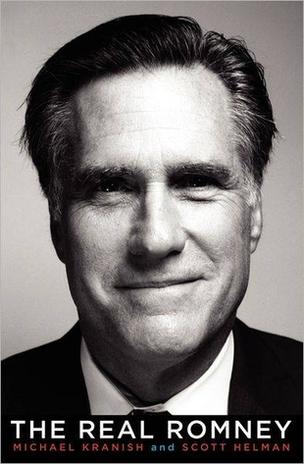
The Real Romney, by Michael Kranish & Scott Helman – It is an election year and while we don’t support candidates or real believe there is much value in participating in the electoral process, there is value in reading more substantive analysis of the major candidates. This book by two Boston Globe writers sheds light on the person who now seems like the eventual GOP candidate for President in the November elections. The Real Romney is a well written investigation into the history of politician Mitt Romney. In addition to an investigation into Romney’s background, the co-authors do an excellent job of looking at Romney’s record as Governor, the role his Mormon faith plays into his politics and the tremendous monetary wealth this Presidential candidate possesses. This book is an useful resource if you don’t have any faith that the news pundits will actually provide substantive background coverage of candidate Romney.
The Unspoken Alliance: Israel’s Secret Relationship with Apartheid South Africa, by Sasha Polakow-Suransky – For several years Palestinians and supporters of the BDS campaign against Israel have argued that Israel’s occupation of Palestine is a form of apartheid. Sasha Polakow-Suransky’s book is timely in that regard, since the book exposes the Israeli relationship to the Apartheid South African government. Based on a great deal of archival material, The Unspoken Alliance looks at the decades long relationship between Israel and South Africa. An integral part of that relationship was based on arms sales from Israel to South Africa, a relationship, which helped Israel become a major weapons manufacturing and exporting country. This historical relationship, according to the author, also damages Israel’s standing in the global civil rights community, since Israel supported the racially devastating apartheid system in South Africa. Well written and highly recommended.

The Battle of Chile (DVD) – On September 11, 1973, President Salvador Allende’s democratically-elected Chilean government was overthrown in a bloody coup by General Augusto Pinochet’s army. Patricio Guzmán and five colleagues had been filming the political developments in Chile throughout the nine months leading up to that day. The bombing of the Presidential Palace, during which Allende died, would now become the ending for Guzmán’s seminal documentary The Battle of Chile, an epic chronicle of that country’s open and peaceful socialist revolution, and of the violent counter-revolution against it. This is a powerful and important film for those wanting to truly understand US foreign policy, since the US played a major role in the coup that put in power one of the most brutal dictators in Latin American history.
Chomsky on the intersection of race & class in US history
This video is re-posted from ZNet.
Author and linguist Noam Chomsky talks about how race and class intersect in US history, with emphasis on how this intersection impacts African Americans.
Chomsky talks about US slavery, the Jim Crow era, the Civil Rights movement and contemporary treatment of Blacks in the US. He also acknowledges that King became a real threat to the US once he started combining his analysis of White Supremacy with class oppression.
Media Alert: Keep Super PACs off PBS and NPR
This Media Alert is re-posted from SavetheNews.org.
Sesame Street, brought to you by Mitt Romney. Up next, Downton Abbey, but first, a word from Obama’s Super PAC.
This is no joke! A U.S. appeals court just struck down a ban on political ads on public broadcasting. That means your local PBS or NPR station could start running nasty attack ads right away.
The court said that permitting these sorts of ads would not threaten or undermine the educational nature of public broadcast stations.
But polluting public programming with misleading and negative ads is not in keeping with the original vision of noncommercial broadcasting. And it’s certainly not the solution to funding public media.
Many Americans turn to public TV or radio to escape the offensive political ads that have flooded commercial stations. Please join us and tell the leadership of PBS and NPR stations that they must reject political ads:
Act Now: Political Attack Ads Have No Place on Public Media
An overwhelming majority of Americans say public funding for public media is money well spent. PBS and NPR and their member stations should know that accepting political ads is not the solution to public broadcasting’s funding problems.
We need to invest in public media, not open it up to dirty Super PAC money.
 Grand Rapids Institute for Information Democracy