Jerry Ford Graffiti has a new look
It appears that the original graffiti pieces depicting former President Jerry Ford have been altered to include a new message.
As you can see from the pictures, there are at least two of the images of Ford, which now include the words “War Criminal.”
Does the alteration of unsanctioned art change the “debate” about whether or not this is art or graffiti? It will be interesting to see if the local authorities will now have the images removed, since Ford is no longer seen as a local hero with the current depiction.


Next Tuesday, May 1st, there will be a protest in Grand Rapids to draw attention to the May 20th demonstration in Chicago to protest a meeting of the member nation involved with NATO.
According to the organizers of the event on May 1st in Grand Rapids:
“The U.S. government spends billions every month on the war in Afghanistan and the military alliance called NATO. At the same time, across the country people are struggling to keep their heads above water. We are feeling the effects of the economic crisis caused by the 1% – the bankers of Wall Street and their political parties. Our communities fight to stay in their homes, keep schools open, make healthcare available, and defend our jobs from cutbacks. Now NATO is coming to meet in Chicago, invited by President Obama and Mayor Rahm Emanuel. The bankers of the G8 were supposed to meet there too until they saw so many people were going to protest.
We will march against the war and poverty agenda of the NATO meeting with our message: Jobs, Housing, Healthcare, Education, Pensions, and the Environment: NOT WAR! Thousands, including Grand Rapidians, will be in Chicago for a family friendly rally and march that will be seen and heard around the world!”
May Day Protest Against NATO
Tuesday, May 1
4:30 – 6:00PM
Monument Park – corner of Division & Fulton
Grand Rapids
For more information, write to Mike at kowalskimike@comcast.net.
The Philanthropic Complex
This article by Curtis White is re-posted from the Jacobin.
In the fall of 2009 I was approached by Hal Clifford, editor of Orion Magazine, and asked to write an essay about American philanthropy, especially in relation to environmentalism. From the first I was dubious about the assignment. I said, “Not-for-profit organizations like you cannot afford to attack philanthropy because if you attack one foundation you may as well attack them all. You’ll be cutting your own throat.”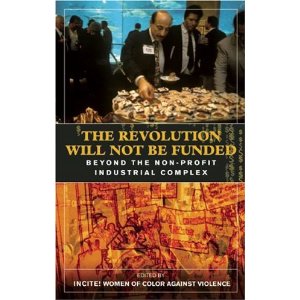
Hal assured me that while all this might be true someone had to take up the issue, and Orion was willing to do so. And I was the right person to write the essay precisely because I was not an insider but simply an honest intelligence. So, with many misgivings I said I’d try.
I interviewed about a dozen people on both sides of the field, both givers and getters, and some in the middle. The people I spoke to were eager to articulate their grievances even if they were just as eager to be anonymous. I also should acknowledge that the development of these grievances was no doubt colored by my own experiences as a board member and president of the board of two not-for-profit organizations in the arts.
After working for several months writing and revising the essay, Hal Clifford announced that he would be leaving Orion. My first thought was “uh-oh.” The managing editor, Chip Blake, took over my essay and at that point things got dicey. Ultimately he explained that he hadn’t been fully aware of my assignment, that he hadn’t known the essay would be an attack on “the oligarchy,” that it didn’t seem to be fully a part of the magazine’s usual interests, and that–fatally–from the magazine’s point of view publishing the essay would be an exercise in “self-mutilation.”
Which was exactly what I said at the beginning! They had come to their senses even if it had taken a long time and cost me a lot of work to get there.
But, secretly, I was pleased. This editorial catastrophe was the best possible confirmation of everything I argue in the essay.
Part One: What Organizations Experience
In the United States, everyone may enjoy freedom of speech so long as it doesn’t matter. For those who would like what they say to matter, freedom of speech is very expensive. It is for this reason that organizations with a strong sense of public mission but not much money are dependent on the “blonde child of capitalism,” private philanthropy. This dependence is true for both conservative and progressive causes, but there is an important difference in the philanthropic cultures that they appeal to.
The conservative foundations happily fund “big picture” work. They are eager to be the means for disseminating free market, anti-government ideology. Hence the steady growth and influence of conservative think-tanks like the Heritage Foundation, Accuracy in Media, the American Majority Institute, the Cato Institute, the Brookings Institute, the Manhattan Institute, the Hoover Institute, and on (and frighteningly) on.
On the other hand, progressive foundations may understand that the organizations they fund have visions, but it’s not the vision that they will give money to. In fact, foundations are so reluctant to fund “public advocacy” of progressive ideas that it is almost as if they were afraid to do so. If there is need for a vision the foundation itself will provide it. Unfortunately, according to one source, the foundation’s vision too often amounts to this: “If we had enough money, and access to enough markets, and enough technological expertise, we could solve all the problems.” The source concludes that such a vision “doesn’t address sociological and spiritual problems.”
Indeed.
The truth is that organizations whose missions foreground the “sociological and spiritual” go mostly without funding. Take for instance the sad tale of the Center for the New American Dream (NAD), created in 1997 by Betsy Taylor (herself a funder with the Merck Family Fund). NAD’s original mission statement gave a priority to “quality of life” issues.
We envision a society that values more of what matters—not just more…a new emphasis on non-material values like financial security, fairness, community, health, time, nature, and fun.
This is exactly the sort of “big picture” that philanthropy has been mostly unwilling to fund because, it argues, it is so difficult to provide “accountability” data for issues like “work and time” and “fun” (!). (To which one might reasonably reply, “Why do you fund only those things that are driven by data?”)
In any event, in 2007 NAD ran an enormous deficit, $500,000 in a budget of less than $2,000,000. In 2008, however, NAD staged a remarkable recovery. Suddenly, its restricted grants grew from $234,000 in 2007 to $647,000 in 2008. The cavalry, apparently, had arrived. NAD’s savior was the Richard and Rhoda Goldman Foundation which had given a restricted grant of $350,000 for 2008.
Good news except that the money did not fund NAD’s vision; it was restricted to a narrow project. NAD was now in the bottled water business, as in “don’t buy bottled water.” NAD’s 2008 Take Action! section in its newsletters was devoted to the Goldman Gospel: get local athletic teams off bottled beverages, etc. In short, a visionary organization had become a money chaser.
One source summarized the general situation in this way, “Progressive funders say all things are connected, but act as if all things are disconnected. Conservative funders never argue that all things are connected, but then they act—and spend money—as if they were.”
One of the most maddening experiences for those who seek the support of private philanthropy is the lack of transparency, that is, the difficulty of knowing why the foundation makes the decisions it makes. In fact, most foundations treat this “lack” as a kind of privilege: our reasons are our own. One of the devices employed by philanthropy for maintaining this privilege is what I call the mystique of the foundation’s Secret Wisdom.
So you want to ask, “What do you know that I don’t know? What do you know that makes your decisions wise?” The closest thing to an answer you’re likely to hear is something like this: “The staff met with some Board members last night to discuss your proposal, and we’re very interested in it. But we don’t think that you have the capacity [a useful bit of jargon that means essentially that the organization should give up on what it thought it was going to do] to achieve these goals. So what we’d suggest is that you define a smaller project that will allow you to test your abilities [read: allow you to do something that you have little interest in but that will suck up valuable staff time like a Hoover]. Meanwhile, we’d like to meet with your Board in six months and see where you are.”
And on you go one year at a time. But cheer up, you’ve made your budget for the year!
The uncertainty and opacity of this reality leave organizations frustrated and bewildered. No matter how many meetings are held, no matter how carefully the questions are posed, the fundamentals remain maddeningly elusive. It is as if grant seekers were Kafka’s K in The Trial searching absurdly for someone to tell him exactly what crime he has committed.
The foundation has money but it has no organic idea (no idea that is native to its being) what to do with it. Perhaps the foundation really would like to help someone somewhere, but it can’t quite bring itself simply to trust the organizations it funds and set them free to do their work, in part because it fears that once freed this intelligence and competence might produce results not in keeping with the interests of the foundation.
Not wanting to acknowledge that brutal fact, all that the foundation is left with is the chilling satisfaction of its own undiminished and unaccountable authority. None of this, of course, can be said, least of all by the organizations that are still hoping for support.
Like the system of patronage that served the arts and charity from the Renaissance through the 18th century, private foundations have the rarest privilege of all: they do not have to explain themselves. They do not have to justify the origins of their wealth, or how they use that wealth, or what the real benefit of their largesse is.
In the end, what the foundation can be trusted to understand is not forest health, or climate change, or the imperatives of recycling; what it can be trusted to understand is the thing that gives it its privileges: its endowment. Unfortunately, managing how the endowment is invested often leads to conflicts with the stated social purpose of the foundation.
For example, one of the emerging controversies in the world of private philanthropy is the 95-5 question. Foundations are required to give away just 5% of their endowment each year. The other 95% is invested. But invested where? Environmentalists are particularly sensitive to this question because if the money is invested in companies that continue to pollute, you have a very disturbing reality. 5% does (theoretical) good while 95% does demonstrable bad: chasing profits in the same old dirty and irresponsible way.
This issue came to a head when the Los Angeles Times concluded a long investigation into the investment practices of foundations by revealing that the Gates Foundation funded a polio vaccination clinic in Ebocha, Nigeria, in the shadow of a giant petroleum processing plant in which the Gates Foundation was invested.
The Los Angeles Times report states:
But polio is not the only threat Justice [a Nigerian child] faces. Almost since birth, he has had respiratory trouble. His neighbors call it “the cough.” People blame fumes and soot spewing from flames that tower 300 feet into the air over a nearby oil plant. It is owned by the Italian petroleum giant Eni, whose investors include the Bill & Melinda Gates Foundation.
Say what you like about the need to invest wisely for the future of the foundation, but this is prima facie evidence of a deep moral conflict not just at Gates but in all of private philanthropy. The simple fact is that most boards actually don’t know if their investments and their missions align. When pushed on the matter, most foundations respond as Gates did: investments are the foundation’s private concern and no business of ours.
But the problem remains, when organizations receive funding, what confidence do they have that this happy money is not itself the expression of a distant destruction? (Perhaps your funder owns stock in British Petroleum. Of course, for the people of Louisiana, that’s anything but distant.) When philanthropy proceeds without acknowledging this reality, it proceeds without conscience. It proceeds pathologically. It destroys the thing it claims to love. And it makes the organizations it funds complicit
Because this culture of unaccountable authority is rarely challenged, especially by the organizations that receive funding, the foundations become little more than, as one source put it, dramas of “self-aggrandizement.”—the lavish year-end celebrations in which many indulge being a particularly noxious demonstration. They like to be thanked for their generosity, and they like the warm feeling of virtue that washes over them when they receive their thanks.
It is as if they could not tell which was the more worthy: the organization for its work or the foundation itself for its generosity. You can sense this tension in the films that the big foundations underwrite for PBS. “Support is provided by the John D. and Catherine T. MacArthur Foundation,” emblazed on the screen with heraldic force, as if it had been struck with a single blow into brass.
Without an understanding of this psychology, it’s difficult to explain the most perplexing question asked of private philanthropy: why do most foundations give away only 5% of their endowment each year, the legal minimum?
Let’s say the funding is going to address the problem of global warming. If that problem must be successfully addressed within the next two decades, if it’s really the critical moral issue of our time, or any time, why spend only 5%? For a simple reason: spending 5% annually will allow the foundation to do its work into eternity. Sadly, a world without a livable climate is easier for the philanthropist to imagine than a world without the dear old family foundation.
Most of the sources that I contacted for this essay requested anonymity. The reasons for this may be obvious and hardly worth mentioning except that what’s hardly worth mentioning is a powerful emotion: fear. Fear of losing a grant or a job, fear of harming a client, or fear of becoming persona non grata in the field. Everyone has skin in the game, so “discretion is the better part of valor,” as Falstaff put it. One source spoke of being threatened with blackballing by one wealthy donor. His error? He’d supported Ralph Nader rather than Barack Obama.
Mark Dowie reports in his book Losing Ground that in the early 1990s the Pew Charitable Trust entered the fray over public land forestry. Josh Reichert, Pew’s environmental program officer, created a foundation coalition, the National Environmental Trust, to address forestry among other issues. Once the money was held out, large organizations like the Sierra Club fell in line, talked the talk, and took the money.
The downside was that this program was not allowed to consider a “zero cut” position. The organization would be about moderating policy on behalf of corporate interests. Smaller, more principled organizations like the Native Forest Council were “left out in the cold.” But Reichert was unapologetic. According to Dowie, “Reichert stipulated that no one advocating zero cut, criticizing corporations by name, or producing ads that did so would be eligible for membership in the forest coalition—or for funding.”
All of this leads to the reasonable assumption that to criticize is to invite punishment. All that’s left is a lot of smiling and bad faith.
Part Two: Why Organizations Experience What They Experience
In the end, philanthropy wants the wrong thing. It may think that it ought to want what the lovers-of-nature want, but its actions reveal that, come what may, it loves other things first: the maintenance of its privileges, the survival of its self-identity, and the stability of the social and economic systems that made it possible in the first place.
This is not an inhuman feeling. As Nietzsche put it, it is “all-too-human.” The people who live within the culture of wealth can’t do the things that grassroots environmentalists want them to do without feeling that they are dying. They can’t fund the creation of ideas that are hostile to their very existence; they can’t abandon control over the projects they do fund because they fear freedom in others; and they can’t give away all of their wealth (“spending out”) without feeling like they’ve become the Wicked Witch of the West (“I’m melting!”). Instead, philanthropy clings to the assumption of its virtues. Its very being, it tells itself, is the doing of good. It cannot respond to criticism because to do so might lead it to self-doubt, might lead it to honesty. And that would be fatal.
The great paradox of environmental philanthropy is this: How do institutions founded on property, wealth, and privilege (in short, plutocrats) seek to address the root source of environmental destruction if that source is essentially the unbridled use of property, wealth, and privilege? And yet when we ask that foundations abandon their privileges and simply provide funding so that we activists can do our work without hindrance, what the foundation hears is a request that they will their own destruction. Not unreasonably, they are bewildered by the suggestion and unwilling to do so.
There’s an old saying on the Left that goes something like this: Capitalism accepts the idea that it will have enemies, but if it must have enemies it will create them itself and in its own image. In fact, it needs them in the same way that it needs the federal government: as a limit on its own natural destructiveness.
The periodic Wall Street meltdown aside, the most dramatic problem facing capitalism for the last thirty years has been its tendency to destroy the very world in which it acts: the environmental crisis in all its manifestations. The response to this crisis has been the growth of the mainstream environmental movement, especially the Environmental Protection Agency and what we call Big Green (the Sierra Club, et. al.). But, it should go without saying, Big Green was not the pure consequence of an up-swelling of popular passion; it was also the creation of philanthropic, federal, and corporate “gift giving”.
For instance, the Natural Resources Defense Council was created by the Ford Foundation, just as Pew created the National Environmental Fund. (Pew itself was first endowed with money from the Sun Oil Company. At its inception, Pew’s political views were deeply conservative. It advocated free markets and small government, and funded the John Birch Society.) These large environmental organizations are more dependent on federal and foundation support, and accordingly tend to take a “soft” line on economic and industrial reform. As Mark Dowie reports, “They are safe havens for foundation philanthropy, for their directors are sensitive to the economic orthodoxies that lead to the formation of foundations and careful not to do anything that might diminish the benefactor’s endowment.”
As with the Environmental Protection Agency, Big Green is not so much an enemy as a self-regulator within the capitalist state itself. The Sierra Club is not run by visionary rebels, it is upper management. It really does have effects that are beneficial to the environment (many!), but in no way are those benefits part of an emerging new world that is hostile to the industries that are the most immediate origin of environmental destruction.
Consequently, a given industry may attack environmentalism when it interferes with its business, but the plutocracy as such is dependent on Big Green and will regularly replenish its coffers so that it may stay in existence, never mind the occasional annoyance for an oil company that wants to spread its rigs and pipelines across delicate tundra.
Capitalism has taught environmentalism how to protect it from itself. Federal and philanthropic funding allows Big Green to play a forceful national role, but it also provides the means for managing and limiting the ambitions of environmentalism: no fundamental change. Sadly left out of negotiations between government, industry and environmental NGOs are the communities of people who must live with whatever decision is reached. As Paula Swearengin of Beckley, West Virginia, commented after House Republicans stripped the EPA of its authority to refuse a permit for yet another project for mountain top coal mining, “The people of Appalachia are treated like we’re just disposable casualties of the coal industry. We live in the land of the lost, because nobody wants to hear us.”
Will environmental philanthropy ever convince the federal government to limit the ability of the coal industry to destroy mountaintops in West Virginia? Maybe. But will they seek to curb that industry’s constitutional freedom to deploy capital in their ruinous “pursuit of happiness”? No. Absolutely not. In the aftermath of the British Petroleum disaster in the Gulf of Mexico, no one understands the importance of environmentalism better than the stockholders of BP. They will be very happy for environmental groups to put pressure on the oil industry to provide more safety for deep sea drilling. But they are most unlikely to welcome the end of deep sea drilling itself, and putting an end to the reign of corporations is utterly beyond the pale.
Philanthropy and the organizations it funds are what they are. They are not in the revolution business. They are in risk management.
Pro-Corporate video goes viral on Earth Day
On Earth Day, a group calling themselves Free Market America released a video entitled, “If I wanted America to Fail.”
The four and a half minute video uses jingoistic language to claim that “environmentalists” are destroying America. The person narrating the video keeps interjecting what he would do if he wanted America to fail, with each tactic a jab at mostly moderate environmental regulations that exist in the US.
The narrator also engages in climate denial and makes the claim that the spotted owl population on the west was decimated by other owls and not by humans. In another unsubstantiated claim the narrator says that people want to stop farming and logging, which makes them hypocrites because they have a roof over their heads and food on the table.
Nothing in the video is ever substantiated, it is just filled with wild claims and music to make us feel sad. The video also includes a brief homage to Milton Friedman, a leader in promoting market capitalism, which played a key role in the past 60 years of what Naomi Klein refers to as an economic shock doctrine.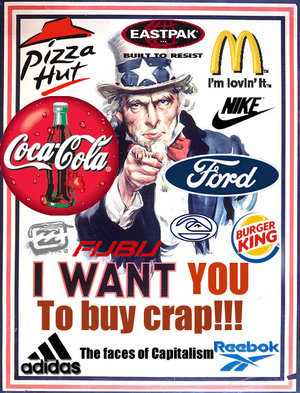
One last major distortion in the video is the use of the phrase, “If I wanted to destroy America.” The question we might ask ourselves is by America do they mean the people and the geographic boundaries or do they mean those who run the country? It seems to this writer that the video producers are equating the business community with America.
For those who care about the future of the planet, one might say that the video is a reflection of the desperation that capitalists feel because of a growing international consciousness and action around the fact that the global capitalism is the primary factor in environmental destruction in the world.
However, one should not take too much solace in this idea, since the capitalist class is dug in and will not give up the power they have just because more and more of the public wants clean water, air, soil and the protection of natural habitat.
It is worth noting that the group behind Free Market America is Americans for Limited Government, a pro-business political action committee, which has a short history of lobbying at both the state and federal level.
Public Pressure causes Kent County Sheriff’s Department to back off some aspects of their Bag a Fag policy
In December, we reported that the Kent County Sheriff’s Department was being challenged by the ACLU of Western Michigan on its policy of targeting gay men in county parks, in what is often referred to as “Bag a Fag” operations.
Then in February, we reported that several LGBT organizations and allies sent a letter to the Kent County Commissioners demanding that this practice of targeting gay men by the Sheriff’s Department cease.
Up to this point the ACLU had been trying for 9 months to get a meeting with the Sheriff’s Department and the Kent County Prosecutors Office, but it wasn’t until several County Commissioners, who upon receiving the letter, pushed for the County to meet with the ACLU.
Since then the Sheriff’s Department has met with the ACLU and as of now the Kent County Sheriff’s Department is no longer arresting gay men for having conversations with other men in public parks. There are still aspects of the Sheriff Department’s Policy on this issue that leaves those at the ACLU a bit uneasy, but clearly some progress has been made because of the pressure that individuals and organizations have put on the Kent County Sheriff’s Department.
We will continue to provide updates on this issue as new information comes to light.
Media Alert: Dow Chemical & PBS programming
This Media Alert is re-posted from Fairness & Accuracy in Reporting.
The four-part series America Revealed, airing on PBS stations this month, looks at big-picture economic issues, from agriculture to transportation to manufacturing. The series underwriter? The Dow Chemical Company, whose commercial interests closely track the subjects covered in the PBS series.
The first episode (4/11/12) focused on large-scale agriculture, which is one of the industries in which Dow is a major player. The program featured an extended look at the corn industry, including efforts to control pests. As the program explained, the food industry “needed a game changer” in that fight. And it got one: The “genetically modified organism, better known as a GMO.”
This positively portrayed “game changer” just happens to be the very type of product Dow sells. Indeed, Dow is among a handful of companies that dominate the genetic seed market (Pesticide Action Network, 8/10). The company has recently been trying to win approval for a new genetically modified corn that has been nicknamed “Agent Orange” for its resistance to a highly toxic herbicide. Dow’s application is opposed by the Natural Resources Defense Council and the Center for Food Safety because of its toxicity, and the likelihood that it will simply create even more resistant weeds (EcoWatch, 4/10/12). The problem with the Dow series is broader. On the company’s website, Dow breaks down its interests into four categories: Agricultural, Infrastructure/Transportation, Energy and Consumer/Lifestyle.
The PBS series Dow is funding addresses food and agriculture in the first episode. The second episode, which aired last week, is titled “Nation on the Move”–a look at transportation. The third episode is “Electric Nation,” and the final installment will deal with American manufacturing. In other words, Dow’s interests are all over the Dow-funded public TV series.
Under PBS‘s underwriting guidelines, this show should never have been allowed with this sponsor. Over the years, however, PBS has shown a remarkable willingness to allow certain funding arrangements–usually when the funders were large corporations (FAIR Press Release, 4/3/02). The network outlines three tests that “are applied to every proposed funding arrangement in order to determine its acceptability”:
*Editorial Control Test: Has the underwriter exercised editorial control? Could it?
*Perception Test: Might the public perceive that the underwriter has exercised editorial control?
*Commercialism Test: Might the public conclude the program is on PBS principally because it promotes the underwriter’s products, services or other business interests?
Without knowing anything about the matter of editorial control, it would seem clear that America Revealed has problems with the perception and commercialism tests. As the PBS guidelines state of the perception test:
When there exists a clear and direct connection between the interests or products or services of a proposed funder and the subject matter of the program, the proposed funding will be deemed unacceptable regardless of the funder’s actual compliance with the editorial control provisions of this policy.
On its commercialism test, PBS explains:
The policy is intended to prohibit any funding arrangement where the primary emphasis of the program is on products or services that are identical or similar to those of the underwriter.
On paper, PBS would seem to take these matters quite seriously:
Should a significant number of reasonable viewers conclude that PBS has sold its professionalism and independence to its program funders, whether or not their conclusions are justified, then the entire program service of public television will be suspect and the goal of serving the public will be unachievable.
If PBS believes that conflicts of interests are indeed that important, then why is it airing a Dow-funded series about Dow’s business interests?
ACTION:
Ask PBS to explain why Dow Chemical Company is permitted to fund a series about issues closely linked to Dow’s business.
CONTACT:
PBS Ombud, Michael Getler ombudsman@pbs.org or 703-739-5290
1% Art: Who are the patrons of contemporary art today?
This article by Andrea Fraser is re-posted from Adbusters. Editor’s Note: On the local level it is worth noting who sits on the board of directors for the two major year-round art facilities in Grand Rapids, UICA and GRAM.

Who are the patrons of contemporary art today? The ARTnews 200 Top Collectors list is an obvious place to start. Near the top of the alphabetical list is Roman Abramovich, estimated by Forbes to be worth $13.4 billion.
He has admitted to paying billions in bribes for control of Russian oil and aluminum assets. Bernard Arnault, listed by Forbes as the fourth richest man in the world with $41 billion, controls the luxury goods conglomerate LVMH, which, despite the debt crisis, reported a sales growth of 13 percent in the first half of 2011. Hedge fund manager John Arnold, who got his start at Enron–where he received an $8 million bonus just before it collapsed–recently gave $150,000 to an organization seeking to limit public pensions. MoMA, MoCA and LACMA trustee Eli Broad is worth $5.8 billion and was a board member and major shareholder of the now notorious AIG. Steven A. Cohen, estimated to be worth $8 billion, is the founder of SAC Capital Advisors, which is under investigation for insider trading. Guggenheim trustee Dimitris Daskalopoulos, who is also chairman of the Hellenic Federation of Enterprises, recently called for a “modern private initiative” to save the failing Greek economy from a “bloated and parasitic” “patronage-ridden state.” Another Guggenheim trustee, David Ganek, recently shut down his $4 billion Level Global hedge fund after an FBI raid.
Noam Gottesman and former partner Pierre Lagrange (also on the ARTnews list) earned £400 million each on the sale of their hedge fund GLG in 2007, making them “among the world’s biggest winners from the credit crunch,” according to the Sunday Times. Hedge fund manager Kenneth C. Griffin supported Obama in 2008 but recently gave $500,000 to a political action committee created by former Bush adviser Karl Rove and was also seen at a meeting of the right-wing-populist Koch Network. Andrew Hill’s $100 million in compensation in 2009 led Citigroup to sell its Philbro division, where he was the top trader, after pressures from regulators to curtail his pay on the heels of Citigroup’s receipt of $45 billion in US federal bailout funds (he subsequently moved the company offshore). Damien Hirst, estimated by the Sunday Times to be worth £215 million, is one of a handful of artists who have now made rich-lists alongside their patrons. Peter Kraus collected $25 million for just three months’ work when his exit package was triggered by Merrill Lynch’s sale to Bank of America with the help of US federal funds. Henry Kravis’s income in 2007 was reported to be $1.3 million a day. His wife, economist Marie-Josée Kravis, who is MoMA’s president and a fellow at the neoconservative Hudson Institute, recently defended “Anglo-Saxon capitalism” against “Europe’s ‘social capitalist politics’” in Forbes.com. Daniel S. Loeb, a MoCA trustee and founder of the $7.8 billion hedge fund Third Point, sent a letter to investors attacking Obama for “insisting that the only solution to the nation’s problems … lies in the redistribution of wealth.” Dimitri Mavrommatis, the “Swiss-based” Greek asset manager, paid £18 million for a Picasso at Christie’s on June 21, 2011, while Greeks were rioting against austerity measures. And of course, there is Charles Saatchi, who helped elect Margaret Thatcher. The firm of MoMA chairman Jerry Speyer defaulted on a major real estate investment in 2010, losing $500 million for the California State Pension Fund and up to $2 billion in debt secured by US federal agencies. Reinhold Würth, worth $5.7 billion, has been fined for tax evasion in Germany and compared taxation to torture. He recently acquired Virgin of Mercy by Hans Holbein the Younger, paying the highest price ever for an artwork in Germany and outbidding the Städelsche Kunstinstitut in Frankfurt/Main, where the painting had been on display since 2003.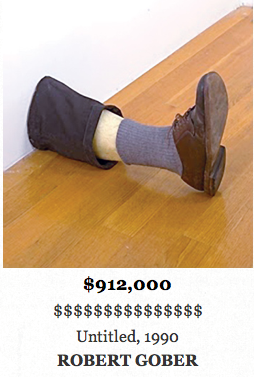
In the midst of an economic crisis, the art world is experiencing an ongoing market boom which has been widely linked to the rise of High Net Worth Individuals (HNWI) and Ultra-HNWIs (people worth over $1 million or $30 million respectively), particularly from the financial industry. A recent report by Art+Auction even celebrated indicators that these groups were rebounding from their 2008 dip to precrisis wealth. Until recently, however, there has been very little discussion of the obvious link between the art world’s global expansion and rising income disparity. A quick look the Gini index, a measure of income inequality, shows that the countries with the most significant art booms of the past two decades have also experienced the steepest rise in inequality: the United States, Britain, China and India. Further, recent economic research has established a direct connection between skyrocketing art prices and income inequality, showing that “a one percentage point increase in the share of total income earned by the top 0.1% triggers an increase in art prices of about 14 percent.” It is now painfully obvious that what has been extraordinarily good for the art world over the past decades has been disastrous for the rest of the world.
In the United States it is difficult to imagine any arts organization or practice that can escape the economic structures and policies that have produced this inequality. The private nonprofit model–which almost all US museums as well as alternative art organizations exist within–is dependent on wealthy donors and has its origins in the same ideology that led to the current global economic crisis: that private initiatives are better suited to fulfill social needs than the public sector and that wealth is best administered by the wealthy. Even outside of institutions, artists engaged in community-based and social practices that aim to provide public benefit in a time of austerity simply may be enacting what George H. W. Bush called for when he envisioned volunteers and community organizations spreading like “a thousand points of lights’ in the wake of his rollback in public spending.
Progressive artists, critics and curators face an existential crisis: how can we continue to justify our involvement in this art economy? At minimum, if our only choice is to participate or to abandon the art field entirely, we can stop rationalizing that participation in the name of critical or political art practices or–adding insult to injury–social justice. Any claim that we represent a progressive social force while our activities are directly subsidized by, and benefit from, the engines of inequality can only contribute to the justification of that inequality. The only true “alternative” today is to recognize our participation in this economy and confront it in an open, direct and immediate way in all of our institutions, including museums and galleries and publications. Despite the radical political rhetoric that abounds in the art world, censorship and self-censorship reign when it comes to confronting our economic conditions, except in marginalized (often self-marginalized) arenas where there is nothing to lose–and little to gain–in speaking truth to power.
Indeed the duplicity of progressive claims in art may contribute to the suspicion that progressive politics is just a ruse of educated elites to preserve their privilege. In our case, this may be true. Increasingly it seems that politics in the art world is largely a politics of envy and guilt, or of self-interest generalized in the name of a narrowly conceived and privileged form of autonomy, and that artistic “critique” most often serves not to reveal but to distance these economic conditions and our investment in them. As such, it is a politics that functions to defend against contradictions that might otherwise make our continued participation in the art field, and access to its considerable rewards–which have ensconced many of us comfortably among the 10 percent, if not the 1 percent or even the 0.1 percent–unbearable.
A broad-based shift in art discourse may help precipitate a long overdue splitting off of the market-dominated subfield of galleries, auction houses, and art fairs. If a turn away from the art market means that public museums contract and ultra-wealthy collectors create their own privately controlled institutions, so be it. Let these private institutions be the treasure vaults, theme-park spectacles and economic freak shows that many already are. Let the market-dominated art world become the luxury goods business it already basically is, with what circulates there having as little to do with true art as yachts, jets, and watches. It is time we began evaluating whether artworks fulfill, or fail to fulfill, political or critical claims at the level of their social and economic conditions. We must insist that what art works are economically determines what they mean socially and also artistically.
If we, as curators, critics, art historians and artists, withdraw our cultural capital from these markets, we have the potential to create a new art field where radical forms of autonomy can develop: not as secessionist “alternatives’ that exist only in the grandiose enactments and magical thinking of artists and theorists, but as fully institutionalized structures, which, with the “properly social magic of institutions,’ will be able to produce, reproduce and reward noncommercial values.
1968 saw revolution happening across the global, from France to Mexico and Prague to the US. Some of these revolutionary moments were spontaneous and some were part of ongoing opposition to global capitalism and war.
Anti-war and student organizing began as early as 1965 at Columbia University. An SDS chapter (Students for a Democratic Society) had been formed and was one of the main entities in the 1968 student uprising.
However, there were two main issues that led to the student uprising at Columbia in 1968. First, in 1961 the university had announced plans to build a gymnasium at the edge of campus, which would create a physical form of separation between Morningside Park and Harlem. Many of the Black community saw this not only as a sign of gentrification, but a form of segregation. By 1967, the Black community was now referring to the proposed gymnasium as “Gym Crow.”
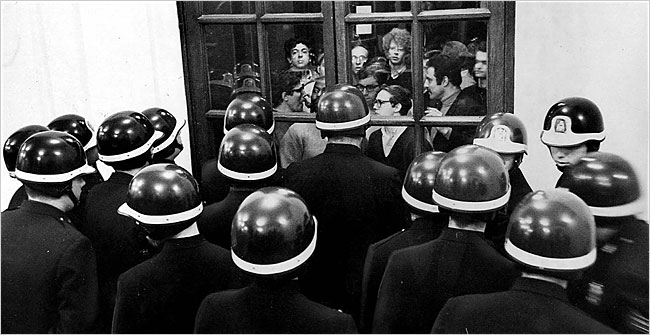
The other major catalyst for the student uprising was the 1967 discovery of a Columbia University think tank that was working with the Institute for Defense Analysis (IDA), which was part of the Department of Defense. Students at Columbia saw the IDA as a direct connection the collaboration of the US military through the IDA and the university to further weapons research that contributed to the brutal war in Vietnam.
Thus, the growing opposition to the war and the racist gentrification of the gymnasium were major factors that contributed to the growing radicalization of the students at Columbia University.
Beginning in April of 1968, students began protesting on campus drawing attention to the university’s role in the war and promoting racism against the residents of Harlem. The protests escalated to building occupations that, according to a documentary, resulted in students taking over 100 university buildings.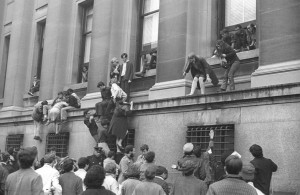
On April 23rd, some students who had occupied one of the buildings, then took the acting Dean, Henry Coleman, hostage until their demands were met. As was expected the New York Police responded with violent force resulting in hundreds of people being beaten and several dozen needed to be hospitalized.
In response to the police brutality the students called for a general strike, which included the participation of many faculty members. Classes and other university activities were shut down because of the student occupations and solidarity that emerged from the larger community.
Many of the Black students occupied Hamilton Hall and made the focus of their occupation the proposed gymnasium that would promote racist gentrification and segregation. The Black student occupation with the support of the Harlem community actually won the battle and the gymnasium was never built.

The rest of the student occupations eventually ended, but many of the students continued resisting the university policies and demanding justice for all those brutalized during the student uprising. This resistance continued through til graduation, where most of the 1968 graduation class walked out of the commencement ceremony and gathered to hold a counter-commencement action as a further protest against the university.
The Student Uprising at Columbia University in 1968 was one of the more radical student actions in the US during that period and it demonstrated the power of organized resistance that informed some of the anti-war and anti-establishment actions that took place in the ensuing years.
Much has been written about the April 1968 Student Uprising at Columbia University, but an excellent resource in this documentary that was produced in 1969 that utilizes lots of footage of the events from April of 1968.
For the third year in a row, the Grand Rapids branch of the IWW (Industrial Workers of the World) will host its May Day celebration at Martin Luther King Park.
The celebration is a commemoration of the historic event known as the Haymarket Affair, which took place in 1886 in Chicago where the state engaged a brutal labor suppression that led to the execution of several labor organizers.
The May Day Celebration is also a way that working people celebrate their power as workers, build mutual aid between each other and resist the capitalist class, which will stop at nothing to expand their profits at workers expense.
This years’ event will include numerous information tables, a Really, Really Free Market, children’s activities, a community potluck and local live music from noon until 9pm. For a listing of the bands, check out the facebook event page. There will also be several people from the community speaking on a variety of justice issues between bands and several poets.
May Day Celebration
Saturday, April 28
Noon – 9pm
Martin Luther King Jr. Park
Corner of Franklin & Fuller in Grand Rapids
Nobel Laureate Rigoberta Menchu speaks in Kalamazoo
On Friday night several hundred people came out to hear the 1992 Nobel Peace Prize winner, Rigoberta Mench Tum. The Nobel Laureate and Guatemalan Mayan spoke on the campus of Western Michigan.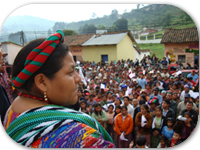
Rigoberta began by talking about the Mayan calendar and Mayan cosmology and its relation to our ability to see the present and the future.
The Nobel Laureate cautioned that we not just look into the future less we become utopic. If we are paying attention to the present we will be able to concentrate on the work we need to do. Rigoberta encouraged the audience to do both, so that we not lose sight of what we want while we do the work we need to do.
Rigoberta continued by talking about the importance of seeing ourselves as a continuation of our ancestors, those who came before us millions of years ago. We are their continuation. “In our ceremonies we celebrate this lineage by always going back seven generations. My name is the same as my grandmother and her grandmother, which in Mayan culture is a way of continually remembering those who came before us.”
Rigoberta then talked about when she won the Nobel Peace Prize 20 years ago. She was living in exile at the time, working with refugees, while the country was in the midst of a war that no one knew when it would end. The country was suffering from a genocidal policy at the hands of the Guatemalan military. Looking back she sees how much has changed, but that so much work needs to continue.
She acknowledged that today the poverty is pervasive in Guatemala, effecting millions. When she goes into the villages she tries to encourage people to do something to change that reality. “We try to encourage each other to contribute something, no matter how small.”
“The solidarity amongst ourselves, and that which we develop with our youth, is a tremendous gift for the future. We have to enthusiastically support education for our youth, we cannot put our faith in the government to fulfill that goal.”
The first question asked of Rigoberta, during the Q&A, was if she would ever consider running for president in her native country of Guatemala. She said she has always fought in two systems, the Mayan system and the Western system, which is full of rules. “Our struggle is between these two systems, where the one does not recognize our traditions and our ancestral system. Another tradition is to not take our land, our water and the other natural resources that we rely on for sustenance.”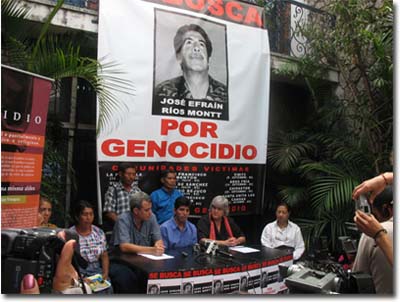
“So, if I was President these two systems would still be fighting, so until there is no conflict between these systems, then real change will come. I consider myself as a political person and was part of the first Mayan political party, which did not come about until after the civil war ended. This party is not only Mayan, but it is made up of lots of women, Mayan women who are in leadership positions. It will be a process that will not come quickly to end racism and sexism, but I believe it will happen.”
The next person asked the question about the claim that the Mayan calendar predicts that the world will come to an end in 2012. Rigoberta responded by saying she began her talk by recognizing the Mayan calendar, but she never talked about an end to this world.
She said that this fear mongering is a product of Hollywood to make money. She also said that this hype around the Mayan calendar has political motives of some in order to control the actions of others. She did acknowledge that this is “a time of no time,” where humans live in spiritual, social and material decadence. Therefore,” we need to bring about equilibrium and balance. This is how we prevent the end of the world.”
While it was delightful to hear Rigoberta Menchu speak again, especially after doing human rights work with her in Guatemala, it was somewhat disappointing that there was little information about what is happening in that Central American country today, especially the recent genocide cases.
 Grand Rapids Institute for Information Democracy