Human Oil Spill draws attention to Enbridge crimes and plans to expand tar sands pipeline through Michigan

Earlier today about 50 people converged on the Capitol in Lansing to not only shed light on the 2nd anniversary of the Enbridge oil disaster in the Kalamazoo River, but to draw attention to the corporation’s plans to expand their tar sands oil pipelines through Michigan.
A Michigan chapter of the National Wildlife Federation and other groups from across the state came to Lansing to create a human oil spill. People dressed in black laid down inside the State Capitol building, just before a press conference that addressed the true costs of the 2010 Enbridge oil spill and to talk about the company’s plans to expand the tar sands oil pipelines in Michigan.
One of the speakers during the press conference was State Rep. Kate Segal from Calhoun County. Rep. Segal address the true cost of the Enbridge oil spill, based on a recent report that exposed the companies criminal and negligent behavior.
Those who spoke at the press conference did say that they were not asking for the proposed Enbridge tar sands oil pipeline to be prevented, they wanted more research done to determine safety and environmental regulations before the company moves forward.
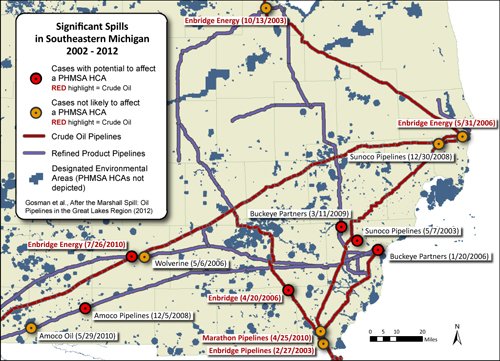
It seems that not demanding an end to the tar sands oil pipelines in Michigan or anywhere else in North America ignores the tremendous human and environmental cost the tar sands project is already having, particularly on indigenous communities in Canada near the Alberta tar sands extraction area.
People in Michigan really need to come to terms with this proposed Enbridge tar sands oil pipeline. It seems to this writer that just as people are calling for a ban on fracking in Michigan, they should also be calling for no new oil pipelines to be constructed anywhere in the state.
Before today’s event, I had a chance to interview Beth Wallace, an organizer with the National Wildlife Federation, one of the organizers of today’s event.
Tariq Ali: What is Really Happening in Syria?
This video is re-posted from ZNet.
Tariq Ali says we are witnessing in Syria “a new form of re-colonisation, which we saw in Iraq and in Libya. Many of the people who first rose against the Assad regime, says Ali, have been sidelined, leaving the Syrian people with limited choices, neither of which they want: either a Western imposed regime, “composed of sundry Syrians who work for the western intelligence agencies”, or the Assad regime.
The only way forward, in the interests of all Syrians, he says, is negotiation and discussion. But it is now obvious that the West is not going to let that happen because they are backing the opposition groups who are against any negotiation.
This Media Alert update is from the Free Press.
On July 1, we posted a Media Alert from Free Press about the Chicago Tribune’s outsourcing of news stories.
On July 17, Free Press volunteers visited Tribune Tower in Chicago, delivering over 20,000 signatures with a simple message for Tribune and other media giants:
Don’t sell out local journalism. Stop outsourcing local news and put out-of-work local journalists back on local beats.
We want news produced by local journalists and coverage of the issues our community cares about. When you outsource local reporting to underpaid overseas workers, everyone in the community loses.
Free Press launched this petition after This American Life aired a report showing that Tribune, Hearst and other media companies had dismantled local newsrooms at dozens of papers, replacing skilled local reporters with a third-party company called Journatic. Journatic pays workers in the Philippines 35–40 cents a story to manufacture “local” articles for papers in Chicago, San Francisco, Houston and Hartford, among other cities.
And Journatic has a weak grasp on journalistic ethics, to say the least. Journatic’s clients have found themselves in hot water for running stories with fake bylines and plagiarized text.
Newspaper giants need to realize what the public already knows: There’s no substitute for real local journalism. But Tribune and Hearst are paying lip service to the public outcry, applying WD-40 to the assembly line instead of dismantling it.
The Chicago Tribune indefinitely suspended the use of Journatic following a plagiarism revelation. But Tribune’s other papers, including the Hartford Courant and the Orlando Sentinel, are still using Journatic. And despite reports that over 350 fake bylines were published in the Houston Chronicle alone, Hearst has simply committed to removing those bylines — not to ending its relationship with Journatic.
It should be clear by now that good local news can’t be outsourced. We need accountable, local journalists who know their communities and uphold journalistic ethics. Today’s petition delivery won’t be our last. We’ll continue to push for changes at the companies that have sacrificed local news for what whistleblower Ryan Smith has dubbed “pink-slime journalism.” To send a message to Journatic’s clients, from the media giants on down to the editors at your local newspaper, sign our petition today.
Arizona’s Banned Book List
This list is re-posted from CounterPunch.
People involved in the Mexican American Studies struggle in Tucson, Arizona recently compiled a list of the banned books from the district, as well as released a letter signed by many organizations expressing concern over First Amendment rights, given the Tucson Unified School District’s removal of these texts. Here is the letter and here is the list, also reproduced below.
Debbie Reese has compiled this list from the May 2, 2011 Cambium Report.
High School Course Texts and Reading Lists Table 20: American Government/Social Justice Education Project 1, 2 – Texts and Reading Lists
Rethinking Columbus: The Next 500 Years (1998) by B. Bigelow and B. Peterson
The Latino Condition: A Critical Reader (1998) by R. Delgado and J. Stefancic
Critical Race Theory: An Introduction (2001) by R. Delgado and J. Stefancic
Pedagogy of the Oppressed (2000) by P. Freire
United States Government: Democracy in Action (2007) by R. C. Remy
Dictionary of Latino Civil Rights History (2006) by F. A. Rosales
Declarations of Independence: Cross-Examining American Ideology (1990) by H. Zinn
Table 21: American History/Mexican American Perspectives, 1, 2 – Texts and Reading Lists
Occupied America: A History of Chicanos (2004) by R. Acuña
The Anaya Reader (1995) by R. Anaya
The American Vision (2008) by J. Appleby et el.
Rethinking Columbus: The Next 500 Years (1998) by B. Bigelow and B. Peterson
Drink Cultura: Chicanismo (1992) by J. A. Burciaga
Message to Aztlán: Selected Writings (1997) by R. Gonzales
De Colores Means All of Us: Latina Views Multi-Colored Century (1998) by E. S. Martínez
500 Años Del Pueblo Chicano/500 Years of Chicano History in Pictures (1990) by E. S. Martínez
Codex Tamuanchan: On Becoming Human (1998) by R. Rodríguez
The X in La Raza II (1996) by R. Rodríguez
Dictionary of Latino Civil Rights History (2006) by F. A. Rosales
A People’s History of the United States: 1492 to Present (2003) by H. Zinn
Course: English/Latino Literature 7, 8
Ten Little Indians (2004) by S. Alexie
The Fire Next Time (1990) by J. Baldwin
Loverboys (2008) by A. Castillo
Women Hollering Creek (1992) by S. Cisneros
Mexican White Boy (2008) by M. de la Pena
Drown (1997) by J. Díaz
Woodcuts of Women (2000) by D. Gilb
At the Afro-Asian Conference in Algeria (1965) by E. Guevara
Color Lines: “Does Anti-War Have to Be Anti-Racist Too?” (2003) by E. Martínez
Culture Clash: Life, Death and Revolutionary Comedy (1998) by R. Montoya et al.
Let Their Spirits Dance (2003) by S. Pope Duarte
Two Badges: The Lives of Mona Ruiz (1997) by M. Ruiz
The Tempest (1994) by W. Shakespeare
A Different Mirror: A History of Multicultural America (1993) by R. Takaki
The Devil’s Highway (2004) by L. A. Urrea
Puro Teatro: A Latino Anthology (1999) by A. Sandoval-Sanchez & N. Saporta Sternbach
Twelve Impossible Things before Breakfast: Stories (1997) by J. Yolen
Voices of a People’s History of the United States (2004) by H. Zinn
Course: English/Latino Literature 5, 6
Live from Death Row (1996) by J. Abu-Jamal
The Lone Ranger and Tonto Fist Fight in Heaven (1994) by S. Alexie
Zorro (2005) by I. Allende
Borderlands La Frontera: The New Mestiza (1999) by G. Anzaldua
A Place to Stand (2002), by J. S. Baca
C-Train and Thirteen Mexicans (2002), by J. S. Baca
Healing Earthquakes: Poems (2001) by J. S. Baca
Immigrants in Our Own Land and Selected Early Poems (1990) by J. S. Baca
Black Mesa Poems (1989) by J. S. Baca
Martin & Mediations on the South Valley (1987) by J. S. Baca
The Manufactured Crisis: Myths, Fraud, and the Attack on America’s Public Schools (1995) by D.C. Berliner and B. J. Biddle
Drink Cultura: Chicanismo (1992) by J. A Burciaga
Red Hot Salsa: Bilingual Poems on Being Young and Latino in the United States (2005) by L. Carlson & O. Hijuielos
Cool Salsa: Bilingual Poems on Growing up Latino in the United States (1995) by L. Carlson & O. Hijuelos
So Far From God (1993) by A. Castillo
Address to the Commonwealth Club of California (1985) by C. E. Chávez
Women Hollering Creek (1992) by S. Cisneros
House on Mango Street (1991), by S. Cisneros
Drown (1997) by J. Díaz
Suffer Smoke (2001) by E. Diaz Bjorkquist
Zapata’s Discipline: Essays (1998) by M. Espada
Like Water for Chocolate (1995) by L. Esquievel
When Living was a Labor Camp (2000) by D. García
La Llorona: Our Lady of Deformities (2000), by R. Garcia
Cantos Al Sexto Sol: An Anthology of Aztlanahuac Writing (2003) by C. García-Camarilo et al.
The Magic of Blood (1994) by D. Gilb
Message to Aztlan: Selected Writings (2001) by Rodolfo “Corky” Gonzales
Saving Our Schools: The Case for Public Education, Saying No to “No Child Left Behind” (2004) by Goodman et al.
Feminism is for Everybody (2000) by b hooks
The Circuit: Stories from the Life of a Migrant Child (1999) by F. Jiménez
Savage Inequalities: Children in America’s Schools (1991) by J. Kozol
Zigzagger (2003) by M. Muñoz
Infinite Divisions: An Anthology of Chicana Literature (1993) by T. D. Rebolledo & E. S. Rivero
…y no se lo trago la tierra/And the Earth Did Not Devour Him (1995) by T. Rivera
Always Running – La Vida Loca: Gang Days in L.A. (2005) by L. Rodriguez
Justice: A Question of Race (1997) by R. Rodríguez
The X in La Raza II (1996) by R. Rodríguez
Crisis in American Institutions (2006) by S. H. Skolnick & E. Currie
Los Tucsonenses: The Mexican Community in Tucson, 1854-1941 (1986) by T. Sheridan
Curandera (1993) by Carmen Tafolla
Mexican American Literature (1990) by C. M. Tatum
New Chicana/Chicano Writing (1993) by C. M. Tatum
Civil Disobedience (1993) by H. D. Thoreau
By the Lake of Sleeping Children (1996) by L. A. Urrea
Nobody’s Son: Notes from an American Life (2002) by L. A. Urrea
Zoot Suit and Other Plays (1992) by L. Valdez
Ocean Power: Poems from the Desert (1995) by O. Zepeda
UPDATE, Monday, January 16, 2012
Bless Me Ultima by Rudolfo Anaya
Yo Soy Joaquin/I Am Joaquin by Rodolfo Gonzales
Into the Beautiful North by Luis Alberto Urrea
The Devil’s Highway by Luis Alberto Urrea
This video interview is re-posted from ZNet.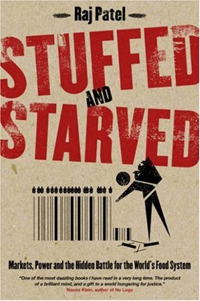
Raj Patel is a writer, activist, and academic, focusing on the global food system and food justice. He is currently a visiting scholar at UC Berkeley’s Center for African Studies, a fellow at the School of Development Studies at the University of KwaZulu-Natal, and a fellow with organization Food First. He has worked for the World Bank, the World Trade Organization, and the United Nations, and has been tear gassed on four continents protesting against them. The second edition of Patel’s first book Stuffed and Starved: The Hidden Battle for the World Food System has just been released by Melville House Books. His most recent work, The Value of Nothing (2010, Portobello Books), is a New York Times best-seller.
David Zlutnick interviewed Patel at his home in San Francisco around the topic of international food markets and their role in propagating inequities in food access and distribution, as well as ongoing popular resistance to these market forces. He argues the latter, which he sees coming to fruition both through organized transnational campaigns as well as “food rebellions,” represent significant possibility for not only the transformation of the food system but also political accountability.
Bloom Collective to host screening of Just Do It film on environmental direct action July 26
Record heat, lack of rain, new oil drilling in Alaska, fracking all across the country, species extinction, burning fossil fuels and contamination of the soil are reasons to feel a sense of urgency about the future of life on this planet.
These realities can feel overwhelming at times, but it is important to note that millions of people across the globe are fighting what is killing us. That is the theme of the powerful film, Just Do It. Just Do It takes us to England, where environmental activists are people their lives on the line through direct action to stop the machines of capital that are destroying the planet.
The Bloom will be screening the film “Just Do It: A Tale of Modern-Day Outlaws” at the DAAC with a potluck before and discussion after (and eating throughout).
Just Do It
Thursday, July 26
7:00PM
DAAC 115 S. Division, Grand Rapids
Potluck starts at 6pm
(bring something, if you please)
Film starts at 7pm
($5 suggested donation, no one is turned away due to lack of funds)
Discussion after, until around 9pm
For additional information and updates go to http://www.facebook.com/events/171409426325027/
Thousands of Mexicans Protest Alleged Elections Fraud
This video is re-posted from The Real News Network.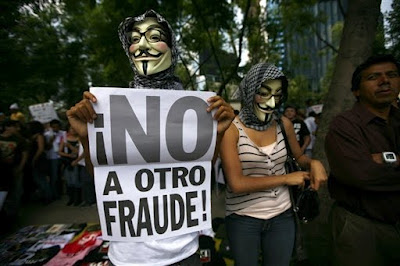
James Cockcroft, poet, lecturer, writer, including author of Mexico’s Revolution Then and Now talks to Paul Jay about why the Mexican elite will not allow Andres Lopez Obrador to be president.
The protests against election fraud have been going on for weeks. Cockroft provides some good context within this context. For additional information check out the following news sources:
http://upsidedownworld.org/main/mexico-archives-79
http://www.jornada.unam.mx/ultimas/
Insurance for corn, not for kids
This article is re-posted from the Environmental Working Group.
On the same day that the House will vote to end health insurance subsidies for low income Americans, the House Agriculture Committee will vote to increase crop insurance subsidies for the largest and most profitable mega farms – and will cut nutrition assistance programs to pay for it.
Many of the same House Agriculture Committee members who will vote tomorrow (Wednesday) on a proposal to increase crop insurance subsidies voted against the Affordable Care Act in 2009, including Chairman Frank Lucas (R-OK) and Ranking Member Collin Peterson (D-MN). Other members of the House Agriculture Committee who are expected to support unlimited insurance subsidies for corn and cotton farmers tomorrow but voted against health insurance subsidies for low income Americans in 2009 include Reps. Tim Holden (D-PA), Larry Kissell (D-NC), and Mike McIntyre (D-NC), as well as Reps. Bob Goodlatte (R-VA), Tim Johnson (R-IL), Steve King (R-IA), Randy Neugebauer (R-TX), Michael Conaway (R-TX), Jeff Fortenberry (R-NE), Jean Schmidt (R-OH), Glenn Thompson (R-PA), and Thomas J. Rooney (R-FL).
Unlike the health insurance subsidies included in the Affordable Care Act, crop insurance subsidies are not subject to any limits on who can receive subsidies or the amount they can receive. As a result, 26 policyholders each collected more than $1 million in insurance subsidies in 2011 and more than 10,000 each collected more than $100,000, according to an Environmental Working Group analysis. Roughly 30,000 policyholders collected 42 percent of all premium subsidies in 2011.
Rather than place reasonable limits on crop insurance, the Lucas-Peterson proposal that will be considered tomorrow by the House Agriculture Committee actually expands crop insurance subsidies – at a cost of more than $9 billion. To help pay for this expansion and meet deficit reduction targets, the Lucas-Peterson proposal will cut the Supplemental Nutrition Assistance Program, known as SNAP, by $16.1 billion and cut environmental programs by $6.1 billion.
In other words, the bill would give unlimited taxpayer dollars to farmers who are already making record profits and less support to hungry kids who depend on federal assistance for food, and to programs that keep drinking water clean.
Reasonable crop insurance reforms like payment limits and means testing – which already apply to SNAP and to health insurance subsidies – could save more than $20 billion when combined with cuts in subsidies to crop insurance companies. But such reforms were not considered by the committee leaders and face an uphill fight on the floor of the House.
Tell the FTC: Stop Merck from Pushing Drugs on Kids
This action alert is re-posted from the Campaign for Commercial Free Childhood.
Kids shouldn’t be targets for pharmaceutical sales pitches. That’s why we’re urging you to tell the Federal Trade Commission to investigate Merck & Co. Inc.’s Madagascar 3-themed Children’s Claritin® marketing. Packaging for Merck’s Grape-Flavored Chewable Children’s Claritin® allergy medication features characters from Dreamworks’ new Madagascar 3: Europe’s Most Wanted movie, and each box offers “5 free stickers” to purchasers. Retail outlets are promoting mail-in movie ticket vouchers and downloadable Children’s Claritin® Madagascar-themed games on shelves alongside the medication. Merck officials claim these promotions are aimed at adults, but it’s clear the company is targeting children.
Tell the FTC: Stop Merck from pushing drugs on kids.
The FTC regulates over-the-counter drug marketing and has protected children from exploitative pharmaceutical marketing in the past. That’s why CCFC joined the Public Health Advocacy Institute (PHAI) and other health and advocacy organizations to call on the FTC to investigate Merck’s Madagascar campaign. As PHAI’s executive director, Mark Gottlieb, said, “Marketing medicine directly to children at all, much less through entertainment tie-ins, is well beyond the pale and is not only inherently unfair, it is downright dangerous.”
Adding to the danger is that the same Madagascar characters used to market Children’s Claritin® are being used to promote foods aimed at children. McDonald’s Happy Meals recently included Madagascar toys. Characters from the movie are also being used to market Fruit-flavored Airheads candy and General Mills (Betty Crocker label) Fruit Snacks, creating the risk that children will confuse the medication with candy Marketing pharmaceuticals to children is unfair and deceptive.
Please tell the FTC to stop Merck from marketing Claritin® to kids.
Monsanto and Gates Foundation Push GE Crops on Africa
This article by Mike Ludwig is re-posted from Truthout.
Skimming the Agricultural Development section of the Bill and Melinda Gates Foundation web site is a feel-good experience: African farmers smile in a bright slide show of images amid descriptions of the foundation’s fight against poverty and hunger. But biosafety activists in South Africa are calling a program funded by the Gates Foundation a “Trojan horse” to open the door for private agribusiness and genetically engineered (GE) seeds, including a drought-resistant corn that Monsanto hopes to have approved in the United States and abroad.
The Water Efficient Maize for Africa (WEMA) program was launched in 2008 with a $47 million grant from mega-rich philanthropists Warrant Buffet and Bill Gates. The program is supposed to help farmers in several African countries increase their yields with drought- and heat-tolerant corn varieties, but a report released last month by the African Centre for Biosafety claims WEMA is threatening Africa’s food sovereignty and opening new markets for agribusiness giants like Monsanto.
The Gates Foundation claims that biotechnology, GE crops and Western agricultural methods are needed to feed the world’s growing population and programs like WEMA will help end poverty and hunger in the developing world. Critics say the foundation is using its billions to shape the global food agenda and the motivations behind WEMA were recently called into question when activists discovered the Gates foundation had spent $27.6 million on 500,000 shares of Monsanto stock between April and June 2010.
Water shortages in parts of Africa and beyond have created a market for “climate ready” crops worth an estimated $2.7 billion. Leading biotech companies like Monsanto, Syngenta, Bayer and Dow are currently racing to develop crops that will grow in drought conditions caused by climate change, and by participating in the WEMA program, Monsanto is gaining a leg up by establishing new markets and regulatory approvals for its patented transgenes in five Sub-Saharan African countries, according to the Centre’s report.
Monsanto teamed up with BASF, another industrial giant, to donate technology and transgenes to WEMA and its partner organizations. Seed companies and researchers will receive the GE seed for free and small-scale farmers can plant the corn without making the royalty payments that Monsanto usually demands from farmers each season.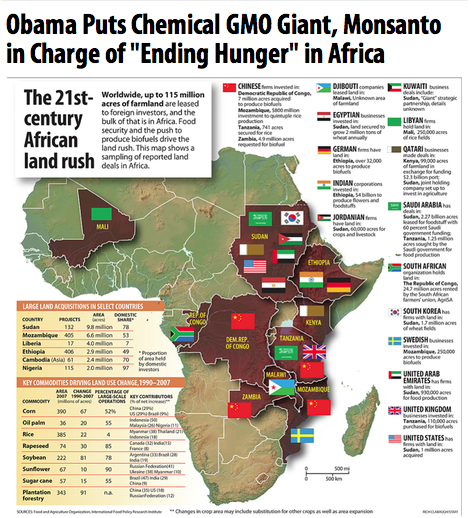
Monsanto is donating the seeds for now, but the company has a reputation for aggressively defending its patents. In the past, Monsanto has sued farmers for growing crops that cross-pollinated with Monsanto crops and became contaminated with the company’s patented genetic codes.
In 2009, Monsanto and BASF discovered a gene in a bacterium that is believed to help plants like corn survive on less water and soon the companies developed a corn seed know as MON 87460. It remains unclear if MON 87460 will out-compete conventional drought-tolerant hybrids, but the United States Department of Agriculture could approve the corn for commercial use in the US as soon as July 11. Monsanto plans to make the seed available to American farmers by next year.
GE crops like MON 87460 can only be tested and sold in countries that, like the US, are friendly toward biotech agriculture. WEMA’s target areas could add five countries to that list: South Africa, Uganda, Tanzania, Kenya and Mozambique. The Biosafety Centre reports that WEMA’s massive funding opportunities pressure politicians to pass weak biosafety laws and welcome GE crops and the agrichemical drenched growing systems that come with them. Field trials of MON 87460 and other drought-tolerant varieties are already underway in South Africa, where Monsanto already has considerable political influence. Kenya, Tanzania and Uganda are expected to begin field trials of WEMA corn varieties in 2011.
The agency that is implementing WEMA is the African Agricultural Technology Foundation (AATF), a pro-biotechnology group funded completely by the US government’s USAID program, the United Kingdom and the Buffet and Gates foundations. The AATF is a nonprofit charity that lobbies African governments and promotes partnerships between public groups and private companies to make agricultural technology available in Africa. The Biosafety Centre accuses the AATF of essentially being a front group for the US government, allowing USAID to “meddle” in African politics by promoting weak biosafety regulation that makes it easier for American corporations to export biotechnology to African countries.
WEMA and AATF swim in a myriad alphabet soup of NGOs and nonprofits propped up by Western nations and wealthy philanthropists that promote everything from fertilizer to food crops with enhanced nutritional content as solutions to world hunger. Together, these groups are promoting a Second Green Revolution and sparking a worldwide debate over the future of food production. The Gates Foundation alone has committed $1.7 billion to the effort to date.
There was nothing “green” about the first Green Revolution of the 1950s and 1960s. As population skyrocketed during the last century, multinationals pushed Western agriculture’s fertilizers, irrigation, oil-thirsty machinery and pesticides on farmers in the developing world. Historians often point out that promoting industrial agriculture to keep developing countries well fed was crucial to the US effort to stop the spread of Soviet Communism.
The Second Green Revolution, which is focused on Africa, seeks to solve hunger problems with education, biotechnology, high-tech breeding, and other industrial agricultural methods popular in countries like the US, Brazil and Mexico.
Africa has landed in the center of a global food debate over a central question: with the world’s growing population expected to reach nine billion by 2045, how will farmers feed everyone, especially those in developing countries? The lines of the debate are drawn. The Second Green Revolutionaries are now facing off with activists and researchers who doubt the West’s petroleum and technology-based agricultural systems can sustainably feed the world.
The African Centre for Biosafety and its allies often point to a report recently released by IAASTD, a research group supported by the United Nations (UN), the World Health Organization, and others. IAASTD found that industrial agriculture has been successful in its goal of increasing crop yields worldwide, but has caused environmental degradation and deforestation that disproportionately affects small farmers and poorer nations. Widespread use of pesticides and fertilizer, for instance, cause dead zones in coastal areas. Massive irrigation projects now account for 70 percent of water withdrawal globally and approximately 1.6 billion people live in water-scarce basins.
Increasing crop yields is the bottom line for groups like the Gates Foundation, but the IAASTD recommends that sustainability should be the goal. The report does not rule out biotechnology, but suggests high-tech agriculture is just one tool in the toolbox. The report promotes “agroecology,” which seeks to replace the chemical and biochemical inputs of industrial agriculture with resources found in the natural environment.
In March, a UN expert released a report showing that small-scale farmers could double their food production in a decade with the simple agroecological methods. The report flies in the face of the Second Green Revolutionaries.
“Today’s scientific evidence demonstrates that agroecological methods outperform the use of chemical fertilizers in boosting food production where the hungry live – especially in unfavorable environments,” said Olivier De Schutter, the UN Special Rapporteur on the right to food and author of the report. “Malawi, a country that launched a massive chemical fertilizer subsidy program a few years ago, is now implementing agroecology, benefiting more than 1.3 million of the poorest people, with maize yields increasing from 1 ton per hectare to 2 to 3 tons per hectare.”
De Schutter said private companies like Monsanto will not invest in agroecology because it does not open new markets for agrichemicals or GE seeds, so it’s up to governments and the public to support the switch to more sustainable agriculture. But with more than a billion dollars already spent, the Second Green Revolutionaries are determined to have a say in how the world grows its food, and agroecology is not on their agenda. To them, sustainability means bringing private innovation to the developing world. The Gates Foundation can donate billions to the fight against hunger, but when private companies like Monsanto stand to benefit, it makes feeding the world look like a for-profit scheme.

