This article is re-posted from the site KillerCoke.org.
Coca-Cola workers at Coke operations in New York State have linked up with the Campaign to Stop Killer Coke/Corporate Campaign, Inc. to help in their fight for justice. The Coke 16 is a group of black and Latino workers employed at plants in Maspeth (Queens) and Elmsford (Westchester). The New York Daily News dubbed them the Coke 16, although the group is growing much larger. We are also working with victims alleging racial discrimination at Coke’s operations in Smithtown (Long Island).
Here is an except from the opening statement in the Coke 16 lawsuit:
1. Coca-Cola may be an enjoyable refreshment for most, but its black and Hispanic workers produce Coca-Cola’s beverages in a cesspool of racial discrimination. There is an endemic culture of racism at Coca-Cola that runs through its management and supervisors at its New York bottling plants in Elmsford and Maspeth. The 16 Plaintiffs herein have suffered from the worst of its ills in terms of biased work assignments and allotment of hours, unfair discipline and retaliation, and a caustic work environment.
2. Black and Hispanic production workers at Coca-Cola are typically assigned to the most undesirable and physically dangerous positions, and to tasks that are outside of their job descriptions. Meanwhile, the managers contravene the established seniority system by giving better jobs and more overtime hours to white workers with less seniority than minority workers. As several of the Plaintiffs have found, opportunities for advancement and promotion within the company are routinely biased against minority workers. Finally, the truck drivers among the Plaintiffs have had their hours unfairly limited and prevented from working overtime, while white drivers do not have to face these problems.
3. Those among the Plaintiffs who have dared to speak up about the discrimination to managers or human resources have not only found no resolution to their concerns, but instead have faced swift retaliation from the white managers. This retaliation has come in the form of unwarranted scrutiny and unfair disciplinary actions, up to the point of suspension and termination for some of the Plaintiffs.”
On April 16, the Coca Cola Company hosted its annual shareholders meeting, but the Coke bosses did everything they could to avoid discussing the Coke 16 case.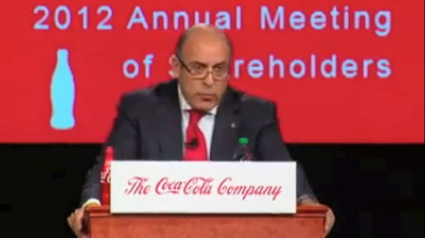
At April’s Coca-Cola annual meeting, in an orchestrated effort to avoid any tough questions about the Coke 16 racial discrimination lawsuit, Coke Chairman/CEO Muhtar Kent tried to take the offense by claiming a question on the Coke 16 had been emailed to the Company.
The question was submitted through the Shareowner Forum by a user named ELV1152. “I’ve been following the lawsuit against your company in the paper that claims some of your employees in New York are once again subject to racial discrimination at work. How do you explain this and what are you doing to make sure this kind of thing doesn’t happen?”
Kent had his answer prepared although he tried to make it seem as though he had never seen the question. During his answer, he looked around at the audience and, in a poor acting job, asked:
“…Is there anyone in the audience that are from those two locations?” pretending as though he did not know that they were present. Five Coke employees WERE present and they stood. Kent stated: “If there’s anybody who’d like to, afterwards, talk to our representatives, associates, from those two locations, please feel free to do so.” Campaign to Stop Killer Coke Director Ray Rogers went up to one of them, Pat Dixon, at the end of the meeting, but he adamantly refused to speak to Ray.
See the video of Kent addressing racial discrimination; Ray addressing racial discrimination and the Coke 16, and Kent responding to Ray. The five Coke “representatives” stood up at 1:57 of the video; Dowin Lewis is the second person on the left.
Michigan Civil Rights Commission seeks input on updating state civil rights act to include LGBTQ community
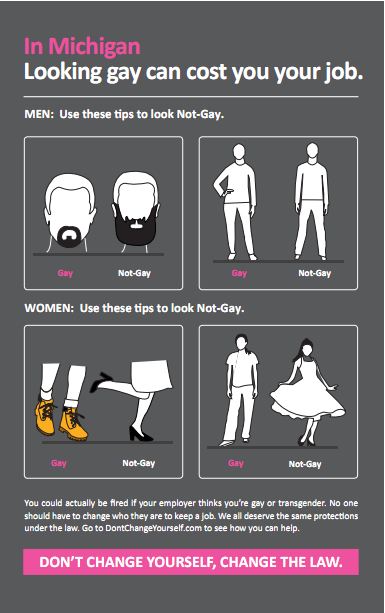
The Michigan Civil Rights Commission will be hosting a forum in Jackson (MI) on Monday, May 21st for the purposes of gathering public input on whether or not to update the Elliott-Larsen Civil Rights Act (ELCRA).
Here is part of the language of the notice the Michigan Civil Rights Commission sent out on this matter:
The Department is conducting a social research project objectively examining the impact Michigan’s laws and policies related to the lesbian, gay, bisexual, and transgender (LGBT) community have, not only on the LGBT community itself but with a particular focus on other communities, the state and its economy. The Department is specifically concerned with the Elliott-Larsen Civil Rights Act (ELCRA). The Elliott-Larsen Civil Rights Act (ELCRA) – Michigan’s Civil
Rights law – prohibits discrimination in employment, housing, and public accommodations based on religion, race, color, national origin, age, sex, height, weight, familial status, or marital status. The Act does not offer protections based on sexual orientation or gender identity.
The Department is seeking stories from Michigan residents about their experiences with discrimination. Please consider how amending ELCRA would:
- Impact your community/neighborhood/family/church/school
- Change your life or that of a family member
- Impact/change your business operations/workforce/services
- Affect your perception of others
In short, this project is not about “I support”/“I don’t support” but what you would gain/lose if ELCRA is or is not amended. Please consider sharing your thoughts on the proposed amendments to this law. We are interested in hearing from individuals in favor of and opposed to such changes to the law. 
Besides the public hearing in Jackson (MI) on Monday, the Michigan Civil Rights Commission welcomes e-mail messages telling your story about the benefit of updating the Elliot-Larson Civil Rights Act.
You can send an e-mail to the commission at calcagnor@michigan.gov or to this link, which was created by Unity Michigan and the Michigan ACLU.
It is important to note that if the Elliot-Larsen Civil Rights Act is updated to include the LGBTQ community, then there would be no need to pay anti-discrimination ordinances in each community around the state.
New Media We Recommend
Below is a list of new materials that we have read/watched in recent weeks. The comments are not a “review” of the material, instead sort of an endorsement of ideas and investigations that can provide solid analysis and even inspiration in the struggle for change. All these items are available at The Bloom Collective, so check them out and stimulate your mind.
Occupy the Economy: Challenging Capitalism, Richard Wolff in conversation with David Barsamian – This book is a collection of interviews conducted between the beginning of the Occupy Wall Street (OWS) campaign and the end of 2011. Alternative Radio talk show host David Barsamian interviews Richard Wolff, an economics professor and author of the book Capitalism Hits the Fan. Wolff and Barsamian discuss the phenomenon of the Occupy movement, particularly at a time when global capitalism is becoming more brutal. Wolff presents information and ideas in a very understandable fashion and links the current movements against capitalism and austerity from OWS to Spain and Greece. These interviews are lively, refreshing and are a good overview of the current global economic crisis within capitalism.

America’s Food: What You Don’t Know About What You Eat, by Harvey Blatt – With the growing interest in eating healthy and eating local, Harvey Blatt’s book is an important additional to the literature that seeks to explain what is wrong with our current food system. The book starts out with technical language and charts, but quickly moves into chapters that lay out how most of the food we consume is grown or raised and why we need to radically alter our food system. Blatt has chapters on the importance of protecting the integrity of soil, the growth of GMOs, how grains are grown, how chickens, pigs and cows are “manufactured,” as well as chapters on fish production and the agribusiness of fruits and vegetables. Blatt concludes the book by looking at how most of the food available in the market are highly processed foods that are the main contributor to poor diet and health in the US. The only shortcoming of the book is that it does not provide any suggestion on how to challenge the food system, but then there are plenty of source that do just that.
Viva La Historia: Mexican Comics, NAFTA and the Politics of Globalization, by Bruce Campbell – For anyone who has spent time in Mexico or reading Mexican popular media they know how prolific Mexican comics are. Not only are there hundreds and hundreds of different Mexican comics, many of them are highly political and are a great source of social commentary. Bruce Campbell does a great job of analyzing the role that comic books play in Mexico, particularly on themes of NAFTA and globalization. Viva La Historia is rich in its investigation of Mexican comics and how they have shredded the North American Free Trade Agreement and the beneficiaries of global capitalism in Mexico, a country that has seen the growth of dozens of billionaires over the past 15 years. The book could have included more visual examples from the comic book world, but the author’s analysis is sharp and often as witty as the comic books he is presenting to the reader. Campbell’s book demonstrates the power of communicating ideas outside of traditional methods of news or academia and why popular culture can be a mechanism for consciousness raising and subversion.
Monumental: David Brower’s Fight for Wild America (DVD) – From the moment David Brower first laid eyes on the beauty of the Yosemite Valley, he fought to preserve the American wilderness for future generations. The story of a true American legend, Monumental documents the life of this outdoorsman, filmmaker and environmental crusader, whose fiery dedication not only saved the Grand Canyon but also transformed the Sierra Club into a powerful national political force, giving birth to the modern environmental movement. (even though Brower would later be forced out of the Sierra Club because they abandoned its more radical roots). Seen through Brower’s own eyes – he was an accomplished filmmaker, and his stunning footage is included here – a 1956 raft trip down Glen Canyon, before its damming, evokes the awful sadness of losing public land we’ve failed to protect. And in period footage of Brower’s early rock-climbs and of his training in the 10th Mountain Division Brower emerges as an unlikely and inspiring national hero.
Banner Challenges Balle Conference Participants

Yesterday was the kickoff to the national Balle conference in Grand Rapids, a conference that focuses on what is vaguely referred to as creating local economies.
The Grand Rapids group Local First, a local version of Balle, is co-hosting the conference and promoting the regional strides that West Michigan has made in the arena of supporting local businesses.
However, not everyone is in agreement with the message of Balle. A banner was hung across the Kent County Convention Center, where the conference was being held, with the message – Capitalism Kills.
The banner hung across the street during the opening ceremonies and keynote presentations while some people handout out small flyers that said, Go beyond BALLE and Local First’s green capitalist approach. Do it yourself! Or why not do it together? The message also included the web address to mutualaidgr.org.
Last week, the West Michigan Environmental Action Council posted an article on their blog entitled, What We Need to Know About Fracking in Yankee Springs. The blog post was included in their e-newsletter that went out yesterday.
The article was no doubt a response to the growing concern by people who live in Barry County and those who are friends of Circle Pines in the Yankee Springs area over the issue of fracking that could become a reality in the not too distant future.
In fact, at last week’s anti-fracking protest in Lansing, there were several people from Barry County and a few people connected to Circle Pines who came to speak out against the DEQ auctioning of public land for possible oil & gas extraction.
The WMEAC bloggers acknowledge that the land sold in the public auction could allow hydraulic fracking, but then cites the President of Miller Energy Company as saying he doesn’t think, “Yankee Springs will be a successful area for fracking.” Besides not citing any other sources on this matter, why use the President of Miller Energy Company, which has a long history of profiting from oil & gas extraction and a history of global expansion at one point in the company’s history?
The blog posting then provides a brief overview of the history of fracking in Michigan, but only uses the DEQ as a source on this history, particularly Director of the Office of Oil, Gas and Minerals for the Department of Environmental Quality, Hal Fitch. The Michigan DEQ has stated publicly that fracking is safe and for anyone who was at the public auction on Lansing last week, they would be hard pressed to trust anything that Hal Fitch had to say.
However, the most important aspect of the WMEAC blog post was their statement, “WMEAC is not yet ready to request a permanent moratorium on horizontal hydraulic fracturing.”
Instead of supporting a permanent moratorium, WMEAC states that it is supporting some proposed legislation that would “(1) place a moratorium on fracking for two years; (2) provide funding for a study to be done on Michigan fracking and its environmental implications; and (3) require fracking companies to publicly disclose the chemicals used in order to trace chemicals found in water and soil samples to specific companies and wells.”
However, the grassroots group Ban Michigan Fracking has a much more critical view of these legislative proposals.
“The package of bills is a sleight-of-hand, pro-regulatory approach to ensure that fracking for shale gas is labeled ‘safe’ and continues in Michigan,” says LuAnne Kozma of Ban Michigan Fracking. A bill calling for a moratorium is tied to a bill that would initiate a gas industry-funded study and fracking advisory committee, but not the other way around. In other words, the proposed fracking panel and study could go forward even without a moratorium. One of the bills’ key sponsors, state Representative Mark Meadows, revealed shortly after introducing the bills that he is opposed to a ban on fracking.”
The WMEAC blog piece ends with a list of 7 questions that “still need to be answered” about fracking in the Yankee Springs area. The most important of the 7 questions asked has to do with wanting to know what the environmental track record of the companies that purchased land during the public auction. This would indeed be important information as would any and all information that would provide complete transparency if any fracking were to take place.
What was interesting about the list of question was what was omitted. None of the questions asked had to do with how fracking would impact the eco-systems in the area, the wildlife, the soil and water table of the Yankee Springs area. There was also no question posed about how fracking could impact human health. Instead, several of the questions focused on how fracking would impact recreational activities, tourism and other area businesses.
These might be legitimate questions, but they should not take priority over the well being of human and non-human life in the eco-systems that make up the Yankee Springs area.
With the recent legislative proposals that seek to take away more right of women, people have begun to organize and fight back.
One action will be a rally held in downtown Grand Rapids next week to Stop the War on Women. The rally is being organized and co-sponsored by Progressive Women’s Alliance of West Michigan, Planned Parenthood Advocates of Michigan, the National Organization For Women Greater Grand Rapids Chapter, and the American Civil Liberties Union of Michigan Western Branch.
The promotional informational states, “Join us for a rally on May 24th to tell the world that women and men in Grand Rapids will NOT stand for the attacks on women by politicians in both parties.” This would be a refreshing departure from most events and actions in recent decades, which have often ended up being a mechanism of support for the Democratic Party.
We plan to attend the event and report on what is said and what additional actions are being planned after the rally that will really guarantee justice and equality for women.
Stop the War on Women Rally
Thursday, May 24
6:00 – 8:00PM
Rosa Parks Circle
Downtown Grand Rapids
Violence Against Women Act Focus of Heavy Lobbying
This article is re-posted from OpenSecrets.org.
This week the House is debating the reauthorization of the 1994 Violence Against Women Act, and there seems to be little danger of a relapse of the relative bipartisanship that occurred at the end of April, when the Senate approved its version of the bill.
By the time of that vote, 15 Republicans joined the entire Democratic caucus in passing the legislation, which is not to say that the two sides were singing in harmony from the start. And things are worse over on the other side of the Capitol.
Even before things got tense, 44 organizations were registered to lobby on the bill as of March 31 — including, somewhat unexpectedly, eight Native American tribes or groups working on their behalf and several immigration groups.
What the native Americans want, is to close what they call a jurisdictional gap that occurs when a non-Indian man assaults an Indian woman on reservation land. Tribal police have no authority in those circumstances under current law, and statistics show in a dramatic way that the feds rarely go forward with prosecutions. The Senate bill, as it was passed, would allow tribal authorities to intervene in such cases as long as they were misdemeanors, rather than felonies. But House language could leave tribal women worse off than they are under existing law, according to lobbyists for the tribes.
Most of the immigration groups supported Senate language that would preserve certain rights of undocumented women to call police, without fear of deportation, if they are being abused.
The House bill, under a package of amendments that its sponsor was expected to introduce tonight, would make it harder for women to secure “U” visas, which were designed to encourage victims of serious crimes to come forward despite being undocumented.
“The House bill rolls back existing protections,” said Greg Chen, top lobbyist for the American Immigration Lawyers Association.
Lobbyists on the other side maintain that the current system lends itself to fraud, although there’s little statistical evidence to support that.
A vote in the House is expected on today.
On May 16, 1998 people all across the globe took to the streets, not just to protest, but to reclaim the streets.
The Reclaim the Streets (RTS) movement has been around since at least 1991, but by 1998 it had become a global forum of direct action.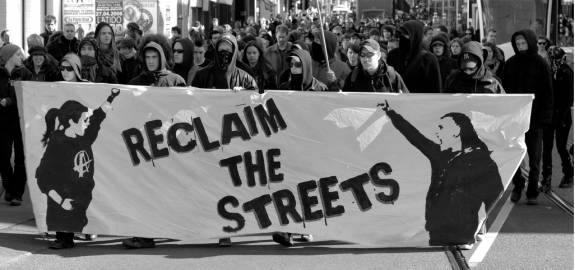
The original Reclaim the Streets action was a way for people to reclaim streets from cars and other fossil fuel-based vehicles. People were becoming more aware of how deadly car culture had become and they wanted to resist the power that cars have in our communities by taking over busy roads and intersections to say, “the streets belong to people, not cars.”
By 1998, the Reclaim the Streets actions had evolved to include more than just resistance to cars, but as a way of protesting corporate globalization and capitalism. The hyper-commercialism of public space and the privatization of public space was alienating to a growing number of people, so the reclaiming of public space, like streets, was one way for people to say that “global capital does not rule us!”
Since 1998, people have used a reclaim the streets tactic as a way to draw attention to other forms of ecological destruction, to protest war, racism, police brutality, violence against women, hate crimes against members of the LGBTQ community and discrimination directed at immigrants.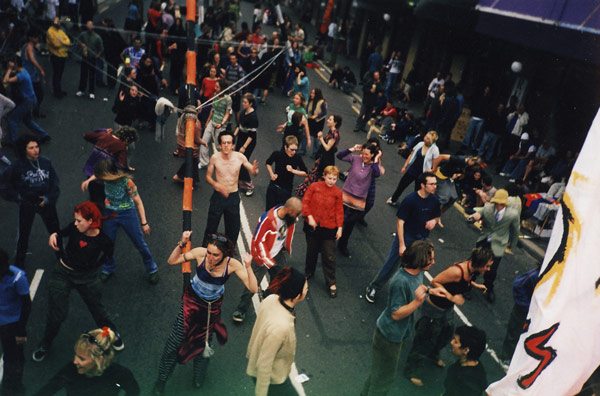
In fact, people began to use road intersections to talk about and creatively dramatize the intersectional nature of justice issues. People began to do street theater to draw attention to how ecological destruction disproportionately impacts women or to show how economic gentrification impacts communities of color and queer youth.
However, beyond using the streets as a forum to protest or dramatize an injustice, the Reclaim the Streets Movement has also been about the social and cultural importance of play and spontaneous celebration. For many people who have participated in a Reclaim the Streets action it has been exhilarating to just be able to be in the street without worrying about being hit by a car, to just dance, beat on a drum or embrace other humans who want to reclaim their humanity by reclaiming a road, a parking lot or street intersection.
How wonderful it is to see people talking in the streets, to see bicyclists, people on stilts, people in drag, people juggling, children using chalk to make images on the pavement, with music and dancing setting the tone for the action.
In 1998, over a million people took part in the Reclaim the Streets Global Day of Action. People took over streets in London, the Netherlands, Prague and Berkley, where 700 people reclaimed the streets.
On this day is resistance history, let us not only remember these kinds of actions……let’s continue to engage in them wherever we are!
The following video is from the 1998 Reclaim the Streets Action in London.

Several years ago I wrote a book about my experiences of doing solidarity work in Guatemala and Chiapas, Mexico. After I completed the book I also produced a documentary film that was first screening in Grand Rapids in 2006.
The book is now online here at GRIID for those who are curious about the 20 years of working with Guatemalans in Grand Rapids and numerous trips to Central America as a human rights worker.
The book is entitled Sembramos, Comemos, Sembramos: Learning Solidarity on Mayan Time. The main title doesn’t translate well, but basically means we plant in order to eat in order to plant.
I first encountered this phrase from a Mayan farmer one morning as we were walking to a village to interview people who were brutalized by the Guatemalan military. He told us that this phrase represented the simple, yet profound cycle of life for most Mayans who lived off the land.
I was inspired by such a simple truth and I recount those kinds of experiences in the book in three sections. The first section is entitled Q’anjobal Mayans Invade Amway Territory. I share thoughts on being bit by the Central America bug, part of the Sanctuary movement in the 80’s and how I negotiated cultural solidarity in an area permeated with Christian conservatism.
Part II is called Sembramos, Comemos, Sembramos – We Plant, in order to Eat, in order to Plant. This is a saying I learned from a Mayan farmer that reflects the simplicity and consistency in the lives of the Mayans I met in Guatemala and Chiapas. Here I gleaned sections from my journal entrees from various trips between 1988 – 2005, where I have had numerous opportunities to accompany and observe the relentless persistence of the Guatemalan popular movements and the participatory democracy of the Zapatista communities. 
Part III, The Way You Live, Determines How We Live, is a collection of articles that I have written over the years on various aspects of how US policy impacts Guatemala and Chiapas and what we might do to change those policies. As Noam Chomsky has always pointed out, the responsibility of the citizens of countries that dictate global policies are key in determining the outcome of many liberation struggles around the world.
The film takes on a slightly different title, with Reversing the Missionary Position: Learning Solidarity on Mayan Time. It is an hour-long film that primarily covers my experiences in Guatemala and Chiapas doing human rights work. You can watch the trailer here or contact me at jsmith@griid.org to get a copy of the film.
Millions in Michigan political ads unreported
This article is re-posted from the Michigan Campaign Finance Network.
A five-party, multi-million-dollar Michigan television ad campaign orchestrated by Mentzer Media Services illustrates the major role of nonprofit advocacy corporations in contemporary presidential politics.
Four nonprofits organized as 501(c)(4) corporations – Americans for Prosperity, American Future Fund, American Energy Alliance and the 60 Plus Association – have spent $3.4 million so far this year in a steady barrage of campaign-style ads criticizing the Obama administration for its energy and health care policies. Because of their timing, the ads do not have to be reported to the Federal Election Commission (FEC) and the sponsoring nonprofit corporations are not required to disclose their donors.
The SuperPAC Restore Our Future, which Mitt Romney has referred to as, “my SuperPAC,” is spending an additional $589,000 on TV in Michigan this month, extolling Romney’s virtues as a caring corporate executive. As a SuperPAC, Restore Our Future will report its donors and its spending to the FEC.
The data on the advertising were compiled by the nonpartisan Michigan Campaign Finance Network from the public political files of Michigan broadcasters and cable systems. All figures are gross sales.
Americans for Prosperity began the Mentzer advertising campaign in January, spending $670,000 and stopping its ads just before the 30-day reporting window for the Michigan presidential primary began. Advertisements that feature the name or image of a candidate and run within 30 days prior to a primary election must be reported to the FEC as electioneering communications.
The day after the Michigan presidential primary, American Future Fund began a two-week $706,000 ad blitz. That was followed by two weeks of ads sponsored by 60 Plus Association for $802,000; then two weeks of ads sponsored by American Energy Alliance for $488,000. After a two-week hiatus in April, Americans for Prosperity began a new two-week flight of ads that was overlapped first by American Future Fund, then by Restore Our Future.
As data were being collected by MCFN on May 11th, American Future Fund and Americans for Prosperity were placing new ad buys. Spending for those ads is not included in this report.
All the fore-mentioned advertising was created by Mentzer Media Services. In addition, Mentzer was the agency for Restore Our Future’s $2.2 million Michigan TV ad blitz in the weeks immediately preceding the Michigan presidential primary.
“This Mentzer-orchestrated campaign is exploiting the inadequacy of federal campaign disclosure rules,” said Rich Robinson of the Michigan Campaign Finance Network. “We are in the midst of the endless presidential campaign, but these corporations’ spending doesn’t have to be reported because year-long campaigns were not contemplated when the rules for reporting electioneering communications were developed. “An additional benefit to the corporations is that they retain their 501(c)(4) tax status, and the right to provide anonymity to their donors, because their spring and summer advertising is not acknowledged to be electioneering,” Robinson said. “Since they are allowed to deny that their advertising is electioneering, they can say that their main purpose as organizations is not electioneering.”
Organizations whose main purpose is electioneering are classified as 527 committees. 527 committees must disclose their spending and their donors.
MCFN will report periodically throughout 2012 on campaign advertising that is not disclosed to the FEC.
C4G MIA in 6th CD; Chambers, Chemistry Council support Upton
Earlier this year the anti-tax Club for Growth announced that it would challenge incumbent U.S. Rep. Fred Upton in his campaign for reelection in Michigan’s redesigned 6th Congressional District. So far that challenge hasn’t amounted to much: A modest $6,000 cable TV ad buy.
The Club’s ads were answered initially by the U.S. Chamber of Commerce and the Michigan Chamber of Commerce. The state and national Chambers spent $128,000 for television spots touting Upton’s service.
The U.S. Chamber and the American Chemistry Council are in the midst of a new three-week TV ad campaign praising Upton. The Chemistry Council is spending $240,000 and the U.S. Chamber is spending $118,000 in the Grand Rapids-Kalamazoo media market.
While Club for Growth has a demonstrated capacity to mobilize large sums of money in a hurry, the business establishment has signaled that it will not surrender the chairman of the House Energy and Commerce Committee to the radical fringe of the Republican Party for a low cost.
DIBC ad campaign totals $1.6 million in 2012
The Detroit International Bridge Company resumed its advertising against a new public-private bridge between Detroit and Windsor in March, after a pause that avoided the escalation in ad rates at the time of the February presidential primary.
From Christmas until early February, the DIBC spent $728,000 for its ads. From late March through May 7th, DIBC spent $877,000, bringing its 2012 total to $1.6 million.
DIBC spent more than $6 million for TV ads in 2011 and succeeded in killing the enabling legislation for a new bridge in the Senate Economic Development Committee.
 Grand Rapids Institute for Information Democracy