After the London Olympics: “The Gloves Come Off”
This article by Dave Zirin is re-posted from ZNet.
When I was in London last May, I met people optimistic and pessimistic about the coming Olympics. I spoke with Tories excited about the coming spectacle and union leaders concerned that the promises of jobs and development would fall short. I met right-wing economists railing against the Olympic-sized debt and Labour party leaders giddy about the tourism and “prestige” the Games would bring. I met cab drivers enraged about restrictions on their routes and bus drivers ready to strike they didn’t receive a hefty bonus for the extra demands of the Olympics (the government caved and paid transit workers to be happy during the fortnight.)
But there was one thing everyone agreed about and they used the same phrase repeatedly: “After the Olympics the gloves will come off.” They all meant that the Olympics were a vacation from political reality. After the Games were done, a political battle would commence over who would bail the UK out of a crippling economic crisis. Simon Lee, senior politics lecturer at the University of Hull, was quoted by Reuters as saying that the Olympics did little more than “paper over the fact that we are on the verge of a depression.”
The numbers are certainly dire. The economy has been shrinking for nine consecutive months, even with the added stimulus of pre-Olympic spending. Youth unemployment is well over 20%. Among all unemployed, almost a third have been out of work for a year. The plan for correcting this is even more dire, with Prime Minister David Cameron committed to an agenda of acute austerity.. That means laying off government employees, including doctors, nurses, and teachers, and raising taxes on working people, all in the name of paying down their debt.
If Cameron believes that debt is truly the economy’s greatest problem, then the Olympic hangover, as it did in Greece in 2004, could severely aggravate the existing crisis. The final price tag of the Games, including massive security costs, will reach as high as 24 billion pounds, ten times the original rosy projections when they won the bid back in 2005. Back then, London Mayor Ken Livingstone predicted a tax of £240 per citizen to pay for the games. Suffice it to say, those costs can safely be adjusted upward.
Debt is not the only hangover of these Olympics. A treasure trove of new surveillance equipment has now become a permanent part of the London landscape. Already the world’s most surveilled metropolis, the city is now, as Stephen Graham reported in the Guardian, “wired up with a new range of scanners, biometric ID cards, number-plate and facial-recognition CCTV systems, disease tracking systems, new police control centres and checkpoints. These will intensify the sense of lockdown in a city which is already a byword across the world for remarkably intensive surveillance.” As one security official told me when I was in London, “These toys aren’t going anywhere. What are we going to do? Put them back in the box?”
Then there are the displacements. In the opening ceremonies, NBC’s Meredith Viera described East London as a “wasteland” that had been “transformed” by the Olympics. I actually walked the streets of East London and I wish Ms. Viera has done the same. Another word for “wasteland” could be “working class community where people live and raise families”. In addition, if the area has been “transformed” it’s because hundreds of residents were displaced. They are on the waiting list for promised new public housing, which, once again, because of the austerity agenda may never be built. Watch the homelessness statistics in London spike in the months ahead
All of these chickens will come home to roost in the aftermath of the games when austerity explodes out of the starting blocks like a demonic Usain Bolt. The crisis is real and the only question is who is going to pay to bail out the country. If it’s the 1%, that will mean nationalization, tax hikes, deficit spending, and the state pumping money into the economy to avoid a depression. If it’s the 99%, and that’s already the plan, expect a round of vicious cuts amidst the Olympic afterglow. The National Health Service, so praised in the Olympic opening ceremonies, will see a reduction in staff of 50,000. Tax hikes on workers will be a reality alongside layoffs. Anger will rise. Then, all of that surveillance equipment will really come into use.
The gloves will come off indeed. Let’s see if the workers, immigrants, and everyday people of the UK can take the punch and return in kind. If not, we’ll always have the Spice Girls.
Impunity at Home, Rendition Abroad
This article by Al McCoy is re-posted from ZNet.
After a decade of fiery public debate and bare-knuckle partisan brawling, the United States has stumbled toward an ad hoc bipartisan compromise over the issue of torture that rests on two unsustainable policies: impunity at home and rendition abroad.
President Obama has closed the CIA’s “black sites,” its secret prisons where American agents once dirtied their hands with waterboarding and wall slamming. But via rendition — the sending of terrorist suspects to the prisons of countries that torture — and related policies, his administration has outsourced human rights abuse to Afghanistan, Somalia, and elsewhere. In this way, he has avoided the political stigma of torture, while tacitly tolerating such abuses and harvesting whatever intelligence can be gained from them.
This “resolution” of the torture issue may meet the needs of this country’s deeply divided politics. It cannot, however, long satisfy an international community determined to prosecute human rights abuses through universal jurisdiction. It also runs the long-term risk of another sordid torture scandal that will further damage U.S. standing with allies worldwide.
Perfecting a New Form of Torture
The modern American urge to use torture did not, of course, begin on September 12, 2001. It has roots that reach back to the beginning of the Cold War and a human rights policy riven with contradictions. Publicly, Washington opposed torture and led the world in drafting the United Nation’s Universal Declaration of Human Rights in 1948 and the Geneva Conventions in 1949. Simultaneously and secretly, however, the Central Intelligence Agency began developing ingenious new torture techniques in contravention of these same international conventions.
From 1950 to 1962, the CIA led a secret research effort to crack the code of human consciousness, a veritable Manhattan project of the mind with two findings foundational to a new form of psychological torture. In the early 1950s, while collaborating with the CIA, famed Canadian psychologist Dr. Donald Hebb discovered that, using goggles, gloves, and earmuffs, he could induce a state akin to psychosis among student volunteers by depriving them of sensory stimulation. Simultaneously, two eminent physicians at Cornell University Medical Center, also working with the Agency, found that the most devastating torture technique used by the KGB, the Soviet secret police, involved simply forcing victims to stand for days at a time, while legs swelled painfully and hallucinations began.
In 1963, after a decade of mind-control research, the CIA codified these findings in a succinct, secret instructional handbook, the KUBARK Counterintelligence Interrogation manual. It became the basis for a new method of psychological torture disseminated worldwide and within the U.S. intelligence community. Avoiding direct involvement in torture, the CIA instead trained allied agencies to do its dirty work in prisons throughout the Third World, like South Vietnam’s notorious “tiger cages.”
The Korean War added a defensive dimension to this mind-control research. After harsh North Korean psychological torture forced American POWs to accuse their own country of war crimes, President Dwight Eisenhower ordered that any serviceman subject to capture be given resistance training, which the Air Force soon dubbed with the acronym SERE (for survival, evasion, resistance, escape).
Once the Cold War ended in 1990, Washington resumed its advocacy of human rights, ratifying the U.N. Convention Against Torture in 1994, which banned the infliction of “severe” psychological and physical pain. The CIA ended its torture training in the Third World, and the Defense Department recalled Latin American counterinsurgency manuals that contained instructions for using harsh interrogation techniques. On the surface, then, Washington had resolved the tension between its anti-torture principles and its torture practices.
But when President Bill Clinton sent the U.N. Convention to Congress for ratification in 1994, he included language (drafted six years earlier by the Reagan administration) that contained diplomatic “reservations.” In effect, these addenda accepted the banning of physical abuse, but exempted psychological torture.
A year later, when the Clinton administration launched its covert campaign against al-Qaeda, the CIA avoided direct involvement in human rights violations by sending 70 terror suspects to allied nations notorious for physical torture. This practice, called “extraordinary rendition,” had supposedly been banned by the U.N. convention and so a new contradiction between Washington’s human rights principles and its practices was buried like a political land mine ready to detonate with phenomenal force, just 10 years later, in the Abu Ghraib scandal.
Normalizing Torture
Right after his first public address to a shaken nation on September 11, 2001, President George W. Bush gave his White House staff expansive secret orders for the use of harsh interrogation, adding, “I don’t care what the international lawyers say, we are going to kick some ass.”
Soon after, the CIA began opening “black sites” that would in the coming years stretch from Thailand to Poland. It also leased a fleet of executive jets for the rendition of detained terrorist suspects to allied nations, and revived psychological tortures abandoned since the end of the Cold War. Indeed, the agency hired former Air Force psychologists to reverse engineer SERE training techniques, flipping them from defense to offense and thereby creating the psychological tortures that would henceforth travel far under the euphemistic label “enhanced interrogation techniques.”
In a parallel move in late 2002, Secretary of Defense Donald Rumsfeld appointed General Geoffrey Miller to head the new prison at Guantanamo, Cuba, and gave him broad authority to develop a total three-phase attack on the sensory receptors, cultural identity, and individual psyches of his new prisoners. After General Miller visited Abu Ghraib prison in September 2003, the U.S. commander for Iraq issued orders for the use of psychological torture in U.S. prisons in that country, including sensory disorientation, self-inflicted pain, and a recent innovation, cultural humiliation through exposure to dogs (which American believed would be psychologically devastating for Arabs). It is no accident that Private Lynndie England, a military guard at Abu Ghraib prison, was famously photographed leading a naked Iraqi detainee leashed like a dog.
Just two months after CBS News broadcast those notorious photos from Abu Ghraib in April 2004, 35% of Americans polled still felt torture was acceptable. Why were so many tolerant of torture?
One partial explanation would be that, in the years after 9/11, the mass media filled screens large and small across America with enticing images of abuse. Amid this torrent of torture simulations, two media icons served to normalize abuse for many Americans — the fantasy of the “ticking time bomb scenario” and the fictional hero of the Fox Television show “24,” counterterror agent Jack Bauer.
In the months after 9/11, Harvard professor Alan Dershowitz launched a multimedia campaign arguing that torture would be necessary in the event U.S. intelligence agents discovered that a terrorist had planted a ticking nuclear bomb in New York’s Times Square. Although this scenario was a fantasy whose sole foundation was an obscure academic philosophy article published back in 1973, such ticking bombs soon enough became a media trope and a persuasive reality for many Americans — particularly thanks to “24,” every segment of which began with an oversized clock ticking menacingly.
In 67 torture scenes during its first five seasons, the show portrayed agent Jack Bauer’s recourse to abuse as timely, effective, and often seductive. By its last broadcast in May 2010, the simple invocation of agent Bauer’s name had become a persuasive argument for torture used by everyone from Supreme Court Justice Antonin Scalia to ex-President Bill Clinton.
While campaigning for his wife Hillary in the 2008 Democratic presidential primary, Clinton typically cited “24” as a justification for allowing CIA agents, acting outside the law, to torture in extreme emergencies. “When Bauer goes out there on his own and is prepared to live with the consequences,” Clinton told Meet the Press, “it always seems to work better.”
Impunity in America
Such a normalization of “enhanced interrogation techniques” created public support for an impunity achieved by immunizing all those culpable of crimes of torture. During President Obama’s first two years in office, former Vice President Dick Cheney and his daughter Liz made dozens of television appearances accusing his administration of weakening America’s security by investigating CIA interrogators who had used such techniques under Bush.
Ironically, Obama’s assassination of Osama bin Laden in May 2011 provided an opening for neoconservatives to move the nation toward impunity. Forming an a cappella media chorus, former Bush administration officials appeared on television to claim, without any factual basis, that torture had somehow led the Navy SEALs to Bin Laden. Within weeks, Attorney General Eric Holder announced an end to any investigation of harsh CIA interrogations and to the possibility of bringing any of the CIA torturers to court. (Consider it striking, then, that the only “torture” case brought to court by the administration involved a former CIA agent, John Kiriakou, who had leaked the names of some torturers.)
Starting on the 10th anniversary of 9/11, the country took the next step toward full impunity via a radical rewriting of the past. In a memoir published on August 30, 2011, Dick Cheney claimed the CIA’s use of “enhanced interrogation techniques” on an al-Qaeda leader named Abu Zubaydah had turned this hardened terrorist into a “fount of information” and saved “thousands of lives.”
Just two weeks later, on September 12, 2011, former FBI counterterror agent Ali Soufan released his own memoirs, stating that he was the one who started the interrogation of Abu Zubaydah back in 2002, using empathetic, non-torture techniques that quickly gained “important actionable intelligence” about “the role of KSM [Khalid Sheikh Mohammed] as the mastermind of the 9/11 attacks.”
Angered by the FBI’s success, CIA director George Tenet dispatched his own interrogators from Washington led by Dr. James Mitchell, the former SERE psychologist who had developed the agency’s harsh “enhanced techniques.” As the CIA team moved up the “force continuum” from “low-level sleep deprivation” to nudity, noise barrage, and the use of a claustrophobic confinement box, Dr. Mitchell’s harsh methods got “no information.”
By contrast, at each step in this escalating abuse, Ali Soufan was brought back for more quiet questioning in Arabic that coaxed out all the valuable intelligence Zubaydah had to offer. The results of this ad hoc scientific test were blindingly clear: FBI empathy was consistently effective, while CIA coercion proved counterproductive.
But this fundamental yet fragile truth has been obscured by CIA censorship and neoconservative casuistry. Cheney’s secondhand account completely omitted the FBI presence. Moreover, the CIA demanded 181 pages of excisions from Ali Soufan’s memoirs that reduced his chapters about this interrogation experience to a maze of blackened lines no regular reader can understand.
The agency’s attempt to rewrite the past has continued into the present. Just last April, Jose Rodriguez, former chief of CIA Clandestine Services, published his uncensored memoirs under the provocative title Hard Measures: How Aggressive C.I.A. Actions after 9/11 Saved American Lives. In a promotional television interview, he called FBI claims of success with empathetic methods “bullshit.”
With the past largely rewritten to assure Americans that the CIA’s “enhanced interrogation” had worked, the perpetrators of torture were home free and the process of impunity and immunity established for future use.
Rendition Under Obama
Apart from these Republican pressures, President Obama’s own aggressive views on national security have contributed to an undeniable continuity with many of his predecessor’s most controversial policies. Not only has he preserved the controversial military commissions at Guantanamo and fought the courts to block civil suits against torture perpetrators, he has, above all, authorized continuing CIA rendition flights.
During the 2008 presidential campaign, Obama went beyond any other candidate in offering unqualified opposition to both direct and indirect U.S. involvement in torture. “We have to be clear and unequivocal. We do not torture, period,” he said, adding, “That will be my position as president. That includes, by the way, renditions.”
Only days after his January 2009 inauguration, Obama issued a dramatic executive order ending the CIA’s coercive techniques, but it turned out to include a large loophole that preserved the agency’s role in extraordinary renditions. Amid his order’s ringing rhetoric about compliance with the Geneva conventions and assuring “humane treatment of individuals in United States custody,” the president issued a clear and unequivocal order that “the CIA shall close as expeditiously as possible any detention facilities that it currently operates and shall not operate any such detention facility in the future.” But when the CIA’s counsel objected that this blanket prohibition would also “take us out of the rendition business,” Obama added a footnote with a small but significant qualification: “The terms ‘detention facilities’ and ‘detention facility’ in… this order do not refer to facilities used only to hold people on a short-term, transitory basis.” Through the slippery legalese of this definition, Obama thus allowed the CIA continue its rendition flights of terror suspects to allied nations for possible torture.
Moreover, in February 2009, Obama’s incoming CIA director Leon Panetta announced that the agency would indeed continue the practice “in renditions where we returned an individual to the jurisdiction of another country, and they exercised their rights… to prosecute him under their laws. I think,” he added, ignoring the U.N. anti-torture convention’s strict conditions for this practice, “that is an appropriate use of rendition.”
As the CIA expanded covert operations inside Somalia under Obama, its renditions of terror suspects from neighboring East African nations continued just as they had under Bush. In July 2009, for example, Kenyan police snatched an al-Qaeda suspect, Ahmed Abdullahi Hassan, from a Nairobi slum and delivered him to that city’s airport for a CIA flight to Mogadishu. There he joined dozens of prisoners grabbed off the streets of Kenya inside “The Hole” — a filthy underground prison buried in the windowless basement of Somalia’s National Security Agency. While Somali guards (paid for with U.S. funds) ran the prison, CIA operatives, reported the Nation’s Jeremy Scahill, have open access for extended interrogation.
Obama also allowed the continuation of a policy adopted after the Abu Ghraib scandal: outsourcing incarceration to local allies in Afghanistan and Iraq while ignoring human rights abuses there. Although the U.S. military received 1,365 reports about the torture of detainees by Iraqi forces between May 2004 and December 2009, a period that included Obama’s first full year in office, American officers refused to take action, even though the abuses reported were often extreme.
Simultaneously, Washington’s Afghan allies increasingly turned to torture after the Abu Ghraib scandal prompted U.S. officials to transfer most interrogation to local authorities. After interviewing 324 detainees held by Afghanistan’s National Directorate of Security (NDS) in 2011, the U.N. found that “torture is practiced systematically in a number of NDS detention facilities throughout Afghanistan.” At the Directorate’s prison in Kandahar one interrogator told a detainee before starting to torture him, “You should confess what you have done in the past as Taliban; even stones confess here.”
Although such reports prompted both British and Canadian forces to curtail prisoner transfers, the U.S. military continues to turn over detainees to Afghan authorities — a policy that, commented the New York Times, “raises serious questions about potential complicity of American officials.”
How to Unclog the System of Justice One Drone at a Time
After a decade of intense public debate over torture, in the last two years the United States has arrived at a questionable default political compromise: impunity at home, rendition abroad.
This resolution does not bode well for future U.S. leadership of an international community determined to end the scourge of torture. Italy’s prosecution of two-dozen CIA agents for rendition in 2009, Poland’s recent indictment of its former security chief for facilitating a CIA black site, and Britain’s ongoing criminal investigation of intelligence officials who collaborated with alleged torture at Guantanamo are harbingers of continuing pressures on the U.S. to comply with international standards for human rights.
Meanwhile, unchecked by any domestic or international sanction, Washington has slid down torture’s slippery slope to find, just as the French did in Algeria during the 1950s, that at its bottom lies the moral abyss of extrajudicial execution. The systematic French torture of thousands during the Battle of Algiers in 1957 also generated over 3,000 “summary executions” to insure, as one French general put it, that “the machine of justice” not be “clogged with cases.”
In an eerie parallel, Washington has reacted to the torture scandals of the Bush era by generally forgoing arrests and opting for no-fuss aerial assassinations. From 2005 to 2012, U.S. drone killings inside Pakistan rose from zero to a total of 2,400 (and still going up) — a figure disturbingly close to those 3,000 French assassinations in Algeria. In addition, it has now been revealed that the president himself regularly orders specific assassinations by drone in Pakistan, Yemen, and Somalia off a secret “kill list.” Simultaneously, his administration has taken just one terror suspect into U.S. custody and has not added any new prisoners to Guantanamo, thereby avoiding any more clogging of the machinery of American justice.
Absent any searching inquiry or binding reforms, assassination is now the everyday American way of war while extraordinary renditions remain a tool of state. Make no mistake: some future torture scandal is sure to arise from another iconic dungeon in the dismal, ever-lengthening historical procession leading from the “tiger cages” of South Vietnam to “the salt pit” in Afghanistan and “The Hole” in Somalia. Next time, the world might not be so forgiving. Next time, with those images from Abu Ghraib prison etched in human memory, the damage to America’s moral authority as world leader could prove even more deep and lasting.
New report shows how US Religious Right is pushing anti-LGBT and Anti-reproductive rights in Africa
The US-based group, Political Research Associates, has recently published an excellent report that details how elements of the Religious Right in the US is the driving force behind the growing anti-LGBT and anti-reproductive rights laws throughout the continent of Africa.
The report, Colonizing Africa Values: How the US Christian Right is Transforming Sexual Politics in Africa, is a result of the work of Kapya Kaoma, who has been researching homophobic policies in Africa for over a decade.
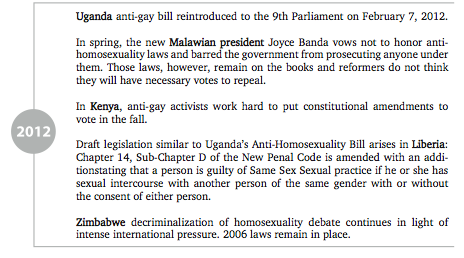
The report states that after the Uganda anti-Gay legislation was first proposed in 2009, the issue had faded from the mainstream US media. However, the Uganda Bill was just the beginning of anti-gay and anti-reproductive rights legislation.
When Uganda’s parliament ended its session in May 2011 without passing the Anti-HomosexualityBill levying the death penalty for “aggravated”homosexuality, human rights activists in Africa andaround the world thought they had defeated the legislation, first proposed in October 2009. But parliamentarians reintroduced the “Kill the Gays” Bill in February 2012 with the same inhumane penalties, similar bills showed up in other countries,and anti-gay measures passed in Burundi in 2009,Malawi in 2010 and Nigeria in 2011.
The report identifies groups like the American Center for Law & Justice, Human Life International, and Family Watch International work both separately and in tandem to renew and expand colonial-era proscriptions on sexual rights. Some of these players may be familiar to U.S. audiences. The Pat Robertson-founded American Center for Law & Justice (ACLJ) recently opened offices in Kenya and Zimbabwe and actively intervenes in those countries’ constitution-making processes.
ACLJ is run by Jay Sekulow, a prominent figure in anti-gay, -abortion, and -Muslim legal strategies, who advised the George W. Bush administration on judicial nominees and is embraced by presidential hopeful Mitt Romney. Other players in this American crusade, such as Mormon activist Sharon Slater of Family Watch International, are little known outside of international sexual health and rights circles, yet they wield influence well beyond their modest budgets.
These Right Wing Religious groups are seen by many activists in Africa as a form of neo-colonialism and they want those of us in the US to understand this and name this activity as such.
Colonizing African Values is an important and must read report for those who care about global solidarity, LGBT and reproductive justice. The research is well documented, with an excellent glossary of terms and US Christian groups involved. There is also an extremely valuable timeline of anti-LGBT bills and laws in Africa since 2006 that begins on page 27 of the report.


This video is re-posted from ZNet.
A musical primer to a visionary economic system. ParEcon is an alternative to the 1% economics of today’s coked out capitalism, and the old record of your grandpapys communism. It is something as new as revolution and as old as revolt. It is in process, and invites participation.
If you dig this vision and this video please share it, and discuss it with friends, family and co-workers. To get more involved with a worldwide movement of people creating culture and organizing towards a new vision for society check out:
For more FREE music by Lonnie Atkinson check out:
Tomorrow (August 15), people will converge on the State Capital in Lansing, as the Michigan Senate will vote on the anti-Choice/anti-reproductive health services bill that was passed in the MI House in June.
Last month, we reported on an action day in Lansing to protest the state legislature’s anti-women vote in June and tomorrow’s action will be another attempt to send a message to lawmakers that taking away reproductive rights and services is unacceptable.
Here is what Dani Vilella with Planned Parenthood Advocates of Michigan told us:
On Wednesday, August 15th, Planned Parenthood Advocates of Michigan, ACLU of Michigan, AAUW of Michigan, Michigan NOW, and Unitewomen.org are inviting women’s health supporters to join us at 11:30 am on the Capitol Lawn for a visit to the Senate Gallery. We will once again show the Michigan Senate that “Women are Watching…And We Vote!” Senate Session is scheduled to begin at 12:00 noon. Wear your bright pink! Don’t have your pink T-shirt yet? We will have FREE T-shirts available!
As you know House Bill 5711 passed the full House on June 13 by a vote of 70-39. It was then referred to the Senate Judiciary Committee where it passed on July 26 by a vote of 3-1. The bill now awaits action in the full Senate. The Senate will hold session on only one day this month, Wednesday, August 15th. If passed House Bill 5711 would make the full range of reproductive healthcare services, including abortion care, virtually inaccessible in Michigan.
There is a car pool for people coming from Grand Rapids, just go to the facebook page event to find out more information.
Levin, The Democrats and Goldman Sachs
In some ways it is quite fashionable these days for people to make claims about being anti-corporate. People will acknowledge that corporations have too much power and that US politics has been corrupted by that power.
However, making such claims is one thing, actually resisting corporate power is another thing.
One recent example of saying one thing and doing another was reflected in a statement that Michigan Senator Carl Levin made on Friday about the financial giant Goldman Sachs.
In a statement issued to the Department of Justice on Friday, Levin called Goldman Sachs role in the recent economic crash both deceptive and immoral. His statement reads in part:
Our investigation of the origins of the financial crisis revealed wrongdoing and failures among mortgage lenders, banking regulators, credit rating agencies and investment banks. One of those investment banks, Goldman Sachs, created complex securities that included “junk” from its own inventory that it wanted to get rid of. It misled investors by claiming its interests in those securities were “aligned” with theirs while at the same time it was betting heavily against those same securities, and therefore against its own clients, to its own substantial profit. Its actions did immense harm to its clients, and helped create the financial crisis that nearly plunged us into a second Great Depression.
These words from Senator Levin make him appear to be at least somewhat concerned about corporate corruption, but in reality they are hallow words, words that carry no credibility.
Senator Levin can make all the statements in the world that he wants about companies like Goldman Sachs, but the fact remains that he supported the massive taxpayer bailout of the Wall Street bankers and other financial institutions.
One of the main reasons why Levin supported this massive bailout is because his political party, the Democrats, are just as dependent on corporations as the Republicans are in order to stay in power.
According to the Center for Responsive Politics, Goldman Sachs has given over $39 million dollars to the Democrats and Republicans since 1990, with over $22 million going to Democrats and over $15 million going to Republicans. In fact, Goldman Sachs has given more money to Democrats in every Presidential Election since 1992, except the current election cycle.
In the 2008 Presidential Election, Goldman Sachs gave over $1 million dollars to Barack Obama’s campaign and another $400,000 to Hillary Clinton.
In the 2012 election, Mitt Romney is currently the highest recipient of Goldman Sachs money, receiving just over $600,000. However, there are numerous Democrats also receiving money from Goldman Sachs, including Senator Levin’s Colleague, Debbie Stabenow. Stabenow has received $29,500 so far from the corporation that Levin refers to as deceptive and immoral.
The other aspect of the political system’s relationship to corporations like Goldman Sachs is that is often results in politicians going to work for companies like Goldman Sachs in a revolving door fashion.
According to Sourcewatch, there have been former Goldman Sachs employees who worked in the Clinton, George W. Bush and Obama adminsitrations.
Its hard to take politicians seriously, when they and their political parties are under the influence of corporate power.
GRIID Fall 2012 Classes
The Grand Rapids Institute for Information Democracy will be offering two classes this fall, both of which we think are important an timely.
The first class is A History of US Social Movements, an 8 – week class that will explore the rich history of social justice movements in the US.
Using Howard Zinn’s book, A People’s History of the United States, we will explore the Abolitionist movement, the Civil Rights movement, the US labor movement and many other movements over the past century.
Howard Zinn himself, would argue that virtually all of the social progress we have made in the US has been due to these powerful movements and not elections.
A History of US Social Movements will be held on Mondays from 6 – 8pm, starting September 17.
The second class we are offering is entitled Radical Sustainability. This class is designed to look at the current environmental crisis, critique the response by Green Capitalism and explore tactical and strategic ways to resist the destruction of species, forests, oceans and the crisis of global warming.
This class will also look at what is happening in West Michigan so as to put a local framework around how we respond to mountaintop coal mining, fracking, industrial pollution, transportation and agribusiness.
The Radical Sustainability class will be using the book Deep Green Resistance and meet on Wednesday nights from 6 – 8pm, starting September 19.
Both classes are $20 (not including the cost of the books), but we will not turn people away for lack of funds.
Classes will be held in one of the community rooms at the Steepletown Center at 671 Davis NW in Grand Rapids. To sign up for the class send an e-mail to jsmith@griid.org.
“Adapting” to the Climate Crisis: That Was Easy
This article by Brian Moench is re-posted from Common Dreams.
Rex Tillerson, CEO of ExxonMobil, admitted recently that global warming is not a hoax, but that we needn’t worry: “We have spent our entire existence adapting, OK? So we will adapt to this. Changes to weather patterns that move crop production areas around — we’ll adapt to that. It’s an engineering problem, and it has engineering solutions.” 
Tillerson’s buddies at the U.S. Chamber of Commerce added, “Populations can acclimatize to warmer climates via a range of behavioral, physiological and technological adaptations.”
Worldwide, a billion people are already dangerously malnourished, with the climate crisis playing a major role. But apparently those facing starvation should stop whining and look forward to “adapting” by “engineering” their bodies to not need food.
And here’s how that “adaptation” thing is going in America. The average July temperature in the US this summer was 5.5 degrees hotter than in 1896. Record-breaking heat and drought are torching two thirds of the country. Natural disasters have been declared in 32 states, the most in our history. Much of the Midwest grain crop has “physiologically adapted” to this new climate, by dying. You and I will soon “financially adapt” by paying a lot more for food.
The wells supplying water to some MidWestern families are “adapting” by drying up. Mississippi River flow is at a 40 year low allowing, among other things, salt water from the Gulf of Mexico to creep north, threatening larger community water supplies.
Forty million acres of Western forests have “acclimatized” to the stress of heat and drought by expiring from pine beetle infestation — a direct result of climate warming. Since 2010, unprecedented wildfires have overwhelmed Western and Southern states. Oklahoma is currently enjoying its turn “adapting” to the new climate — 113-degree temperatures and explosive wildfires roaring across the state.
Warmer, more acidic oceans (from increases in heat-trapping CO2) are forcing the foundation of marine ecosystems — phytoplankton — to “acclimatize” by disappearing. These tiny organisms consume CO2 to produce half the world’s oxygen, equaling that of trees and plants on land. Ocean phytoplankton has fallen 40 percent since 1950. Most of the coral reefs are now “adapting” by bleaching (the first stage of dying). Note to Tillerson and the Chamber: Land and ocean ecosystems are interdependent (Ecology 101). In fact the fossil and climate record shows strong evidence that if marine life is obliterated, land-based ecosystems, the basis for human survival, will “adapt” by collapsing from massive, toxic climate disruptions (see Under a Green Sky by University of Washington paleontology professor, Peter Ward).
Water temperature in Midwestern streams has soared this summer, causing millions of fish to “physiologically adapt” by floating to the surface, dead, including 40,000 sturgeon and numerous endangered species. So many fish died in one Illinois lake that the carcasses clogged a power plant’s intake screen, forcing a partial shutdown.

Water hot enough to kill fish cannot adequately cool nuclear power plants, so they are also “technologically adapting” by becoming more dangerous. Last week, the temperature of the reservoir water used to cool the Illinois Braidwood nuclear power plant exceeded the safety limit of 98 degrees. The end result? Efficiency, safety and power output all drop during extreme heat. The same is true of coal-fired power plants.
The non-profit Electric Power Research Institute, scientists and engineers funded by the power-generating industries themselves, released a study that proponents of nuclear power should have to memorize like the pledge of allegiance. Their study specifically warned of the threat a warming climate posed to all thermoelectric power plants. No U.S. nuclear reactors were designed factoring in water temperatures as high as we are now seeing. All their owners have done so far is ignore the warnings and declare hotter cooling water “safe,” as was the case at Braidwood last week and at other nuclear plants as well.
New nuclear reactors approved this year for construction in Georgia, and soon in South Carolina, don’t address this problem, either. It turns out the nuclear industry is “technologically adapting” to our new, more dangerous climate — by ignoring it.
Fossil-fuel cheerleaders continue to claim that we have little to worry about. Apparently, Americans will “behaviorally adapt” to decimated agriculture, ecosystems and energy infrastructure by having our “engineers” help us invade Canada, where it’s cooler.
Whew! That was easy.
Environmental Justice, Direct Action and Global Warming

There is a tremendous sense of urgency around the world on many fronts, but maybe the ecological crisis we face is the most urgent.
Global warming and climate change are issues that could determine the future of humanity on the planet, in addition to what it is doing to all other forms of life.
The extraction and burning of fossil fuels is the main culprit in global warming and that realty must change for there to be a future.
There are a growing number of grassroots efforts around the world that is confronting the fossil fuel industry, particularly through direct action.
Rising Tide North America is not only one of these grassroots groups engaged in direct action against the fossil fuel industry, they publish a newsletter the documents lots of other forms of resistance to the fossil fuel industry.
The Summer 2012 issue is particularly inspiring, with countless stories about direction action across the US and around the world, where people are taking matters into their own hands to stop oil & gas pipelines, stop hydraulic fracking, strip mining, mountaintop mining and the companies & politicians most complicit in the current ecocide.
There are stories about tree sitters shutting down a strip mine in West Virginia, hundreds occupying the Office of the Department of the Interior, logging operations blockaded in Oregon, an indigenous groups stopping a natural gas project in Australia, Puerto Ricans resisting a natural gas pipeline on their island and Navajo activists fighting a water diversion project in Arizona.
All of these actions are individually and collectively making a difference and are contributing to a growing number of global actions of resistance against policies and practices that are destroying the planet.
If you want to do something in West Michigan, the group Mutual Aid GR is planning some upcoming actions against the fossil fuel industry, particularly around the issue of fracking. You can contact them at grpeoplesassembly@gmail.com.

We’re Gonna Scapegoat Like It’s 1995: Welfare and the Never-Ending Lies of the American Right
This article from Tim Wise is re-posted from his blog.
In the pantheon of right-wing dog whistles, none is as tried, true, and generally effective as “welfare” bashing. Ever since the days of Ronald Reagan, who fabricated tales of a “welfare queen” collecting hundreds of thousands of dollars in cash benefits by using multiple identities and Social Security numbers, conservatives have known that articulating an inchoate rage against welfare spending and recipients, who are cast as irresponsible leeches, living off the rest of us, pays real political dividends. Even though welfare reform in the mid-1990s largely eliminated no-strings-attached cash assistance from the nation’s social safety net, millions of Americans act as if nothing ever changed, as if welfare reform never happened. They are just as upset about it today as they were twenty years ago, which is why Mitt Romney and his surrogates at FOX News, along with commentators like Rush Limbaugh, continue to hammer the theme of undeserving poor people, getting handouts while they sit on the couch, don’t work, and (according to Romney’s latest campaign commercial), are poised to be let out of whatever minimal work requirements have existed for the past 16 years, thanks to the liberalism of Barack Obama.
For a moment, let’s put aside the fact that the state waivers advocated by the Obama Administration were actually sought by conservative Republican Governors, and that they would only allow states the flexibility to design better ways of actually helping recipients find jobs. So too, let’s ignore the fact that even welfare reform’s chief advocate, Newt Gingrich, and former GOP operative and architect of the reform, Ron Haskins, have acknowledged that the Romney campaign’s take on the waivers is dishonest. For now, let us simply examine the far larger problem: namely, that the characterization of welfare as some huge program, dispensing massive benefits to the poor, and the characterization of recipients as lazy slackers who sit around collecting checks at taxpayer expense is rooted entirely in fantasy. For conservatives to continue beating this tired drum is to deliberately seek to make an issue where there is none, to scapegoat the poorest and most vulnerable Americans for problems they did not create, and to engage in a kind of class warfare for which the right frankly lives. To criticize the rich is, to hear them tell it, untoward and unbecoming; but to bash the poor is a venerable pastime. To the extent such invective manages to stir up racial resentments (given how racialized the image of welfare recipients has been for the past forty-plus years), all the better, especially when your guy is running against the nation’s first black president. Anything to suggest that Barack Obama is bending over backwards for black folks plays well with the angry white men who increasingly make up the core constituency of the Republican Party.
Think that’s too harsh? OK. Well then, perhaps you’d like to explain the meaning of the not-so-thinly-veiled racial resentment embedded in recent comments made by Rush Limbaugh on his radio show, in a long diatribe about welfare, President Obama, the state waivers, and the upcoming election. While discussing the president’s response to the Romney campaign’s claims — the ones called dishonest by virtually every media outlet of record — Limbaugh insisted that the primary reason Obama is upset about the attack is because it has the potential to reinvigorate white male working class voters: a group whose vote Limbaugh claims Obama had been trying to suppress. To wit, here’s Limbaugh on August 10th:
Okay, let’s stick with the Romney welfare, gutting-welfare ad that…the regime is so upset about. No question Obama is trying to suppress the white vote. The white, working, middle class vote. Obama’s trying to suppress that…A lot of Obama’s ads and the PAC ads on television have been designed to suppress that vote by portraying Romney as anathema to them…he knows they’re not going to vote for him. But if he can get them to not vote period, then it doesn’t matter that he’s written them off. If they’re not going to vote for him, the next task is to make sure they don’t show up for Romney. How do you do that? Well, you portray Romney as some rich moneybags guy who isn’t going to help them. And, not only that, doesn’t even like them!…And so where (Obama’s) in the middle of trying to suppress the votes of the white, working class, here comes Romney with a truthful ad that’s going to whip them back up into a frenzy…Whatever success Obama has had in angering white working class voters towards Romney where they might just sit out and not vote, now he’s whipped them up into a frenzy…This is why the Romney welfare ad has got them so discombobulated, because they’ve done it to themselves. Obama has undercut his own strategy. Which again is to so depress or anger the white, working class that they don’t vote.
And why does the waiver request — again, one that was initiated by conservatives — whip the white working class into a frenzy? Returning to Limbaugh:
Because the one thing the white, working class voters don’t like is slothful welfare recipients. They don’t like slackers. They don’t like takers. They don’t like people sitting on the couch, getting a welfare check, watching television, when they know they’re paying for it.
Of course, there would be no reason to discuss this as a racial issue — as an issue for the white working and middle class — unless it was fully understood by the person discussing it in that manner that the image of welfare recipients (the “takers” in Limbaugh’s formulation) was something other than white. By discussing this matter in racial terms, it is quite apparent that Limbaugh knows what he’s doing, and what the popular imagery of welfare recipients is: it’s black and brown folks, eating bonbons and having babies out of wedlock, while salt-of-the-Earth white men break their backs and pay the taxes that help support them in their idleness. It is blatant. It is transparent. And of course, it is thoroughly dishonest on multiple levels.
To begin, there is the simple fact that contrary to popular belief, the numbers of people “receiving checks” from the government (the common imagery and that which is being played upon by Limbaugh) are at an all-time low. So although FOX very cleverly ran a segment recently during which they claimed (and with a graphic no less!) that over 100 million Americans were now receiving “welfare,” that number does not refer to the common understanding of welfare — and the understanding that Limbaugh is deliberately trying to cultivate with his image of people receiving checks — but instead, includes anyone receiving benefits from any government program, targeted to low and moderate income persons, households or communities: what are called “means tested” programs. But a quick look at the House Ways and Means Committee’s annual Green Book, which catalogs these programs in detail, indicates how different the reality of government programs and program beneficiaries is, from the common and stereotypical beliefs about both.
So, for instance, the only way you can get anywhere near “100 million” Americans receiving welfare from the federal government, is to include huge swaths of beneficiaries whom few would consider to be welfare recipients, in any traditional sense. You would have to include the millions of elderly and disabled persons who receive two-thirds of all Medicaid benefits. You’d have to include the 10 million low-income seniors who receive a prescription drug subsidy under Part D of Medicare. You’d have to include the 27 million working adults who receive the refundable portion of the Earned Income Tax Credit, because their incomes are too low to owe federal taxes, as well as 18 million working parents who receive the refundable child tax credit because their incomes are too low to qualify for the standard, non-refundable credit available to middle income families. You’d also have to include the 2 million low income elderly Americans who receive benefits under the Nutrition Program for the Elderly, which guarantees adequate meals in congregate settings or home-delivered meals to older poor folks; as well as the 2.5 million people who benefit from adult education and literacy services, funded by the federal government and operated by states and various educational agencies; and the 8 million or so low-to-moderate income students who receive Pell Grants to make college affordable; and the 1 million or so children who reap the benefits of pre-school readiness programs like Head Start, which has been proven to reduce dependence on other forms of assistance.
So, as far as the folks who “get checks” are concerned, unless Limbaugh means to bash the folks who get refund checks under the Child Tax Credit, or the EITC — which most sane people don’t consider welfare, since one has to work in order to qualify for them, and which even Ronald Reagan praised as among the most effective anti-poverty programs ever created (and which he supported because it reduced dependence on other forms of assistance) — the numbers of such Americans is not 100 million. It is not 50 million. It is not 20 million. As evidenced by the House Ways and Means Committee’s Green Book, it is approximately 12 million, of which 7.7 million are elderly, blind or disabled persons receiving checks from the SSI program, and who are not likely the folks Limbaugh and his ilk are condemning as slothful. That leaves about 4.3 million who receive benefits from TANF (what used to be Aid to Families With Dependent Children, or AFDC), roughly three-quarters of whom are children. Which means that only about 1 million adults receive cash from this most vilified of programs: less than one-half of one percent of the adult population.
And what’s more, of those who do “receive checks” so to speak, it is simply false that they are dependent on those benefits, or receive them for long periods of time, rather than work. As indicated by the Department of Health and Human Services, in any given month, about half of all TANF recipients live in a family unit with at least one person who is employed, but whose earnings are so low as to make them still eligible for a small cash welfare subsidy. Nearly 30 percent of TANF recipients live in a family with at least one person who works at a full-time job, and yet, whose income remains at or below poverty level.
That dependence is an uncommon state for welfare recipients should really come as no surprise, given how minimal are the grants offered to poor persons and families. TANF benefits, for instance, have fallen in value by 20 percent since the mid-1990s in 34 states, adjusted for inflation; and this is after the real value of benefits had already plummeted by more than 40 percent from 1970 until 1996 in 2/3 of all states. As of 2011, benefits came to less than half the poverty line in all 50 states, and left recipients below 30 percent of the poverty line in most. Indeed, in 14 states, benefits left recipient households below one-fifth of the poverty line, receiving, on average, less than $300 a month for a family of three, while in states like Alabama and Mississippi, TANF benefits have reached an almost incomprehensibly absurd low: $215 and $170 per month for a family of three; hardly sufficient to sustain a welfare dependent lifestyle. By 2010, average monthly TANF benefits stood at less than $180 per person and only $428 per household.
And since most persons who inveigh against welfare dependence do so because of a belief that beneficiaries remain on various government program rolls for long periods, it also might help to note how inaccurate are the regular claims of long-term welfare reliance. Fact is, half of all persons who enter the TANF rolls and begin to receive cash benefits from the program will exit the rolls within 4 months, three of every four TANF entrants will exit within a year, and only about 1 in 6 will receive benefits for 20 months or longer. Long-term welfare use has fallen by half since the 1990s, and even by the ‘90s had fallen considerably, relative to prior decades. So when it comes to able-bodied people who get cash assistance (or checks) from the government, both the numbers of such persons, the amount of money received by such persons, and the length of time they receive benefits are considerably different than common mythology, and the right-wing lies spread by professional prevaricators like Limbaugh.
But, just to be generous, let’s assume that the Limbaughs of the world, and the folks at FOX, don’t mean to limit their critique to cash welfare. Sure, they talk about people “getting checks,” but maybe that’s just a metaphor for the larger panoply of benefits that millions of people receive from government. Surely, when you add in those other programs, like food stamps, and housing subsidies then we’re talking big money, massive dependence, and an out-of-control welfare state!
Well, no, not really. First, let’s examine food stamps, or what are now known as SNAP benefits (which stands for the Supplemental Nutrition Assistance Program). On the one hand, it is certainly true that due to the economic crisis of the last several years, the SNAP rolls have gone up dramatically. And it is also true that most persons who receive cash benefits under TANF do in fact receive SNAP (although, it should be noted, only about 8 percent of SNAP recipients also receive cash). However, the image of these benefits as being sufficient to engender laziness and dependency is nonsensical. Even when households receive both cash and food stamp benefits, recipient households are left below the poverty line in every state, below 75 percent of the poverty line in 45 states, and below half the poverty line in several southern states. In 2011, SNAP beneficiaries received an average of only $134 per month, and according to 2009-2010 data, the average household benefit came to only $290 per month. So even the combined monthly average of food stamps and TANF — at around $315 per person, and $720 per household — is hardly sufficient to allow the poor to become dependent on these benefits for long periods. Even the maximum monthly SNAP benefit for a family of four (an amount received by very few recipient households), is only $668, which comes out to less than $2 per person, per meal.
Of those poor people who do receive means-tested cash and food assistance, only 15 percent receive both TANF and SNAP, and about three-quarters of those receiving any such benefits (TANF, SSI or SNAP) received them from only one program. And although it is often assumed that the poor receive not only cash but also free or reduced priced housing from the government, less than 14 percent of TANF recipients (or about 1 in 7) are currently benefitting from some form of public housing subsidy. Only 9 percent of TANF recipients receive child care assistance, and only 12 percent benefit from the refundable Earned Income Tax Credit (EITC). In other words, it is simply not true that so-called welfare recipients receive multiple benefits from multiple programs, sufficient to provide for an extravagant or even remotely decent lifestyle.
And as with TANF, most SNAP beneficiaries do not remain on the program for long periods of time. Half of all new SNAP participants will leave the benefit rolls within 10 months, and three in four recipients will leave within two years. Although critics of the program often point out that a large share of recipients on the rolls at any given time will indeed remain on for a long time — an average of seven years for about half of all persons receiving SNAP at any given moment — there is an explanation for this seeming long-term dependence that is far less damning than SNAP critics would like us to believe, and which explains how it can nonetheless be true that most SNAP recipients will receive benefits only for a short period.
The difference between the percentage of SNAP recipients who are short-term versus long-term beneficiaries, on the one hand, and the percentage of SNAP recipients on the rolls right now who will be long-term beneficiaries, on the other, should be obvious. By definition, if one is on the rolls right now, then one cannot be off the rolls right now at the same time, thereby eliminating automatically all persons who may have come onto the rolls at some point in the previous year but who had cycled off before now. What one will be left with is, by definition, a disproportionate number of recipients who will remain on the rolls for a longer period. But this should not be taken to mean that long-term dependence is the norm, nor should it be accepted as a critique of the program.
As an analogy, consider the population of the nation’s jails and prisons. If we look at the number of people who are incarcerated at any point in a given year, we know that the vast majority of them will be incarcerated for relatively minor offenses, and will be released in a relatively short period of time. But if you looked at the population of incarcerated persons, say, right now, or at any given moment, as a snapshot in time, a disproportionate number of them would likely be persons with long prison terms. Not because most criminals are hard-core violent offenders who receive long terms, but because anyone who is a hard-core violent offender is likely to be captured in the data at whatever time you sample it, while minor offenders will have cycled out of jail or prison and not be evident in the same way.
Likewise, imagine if we were to examine hospitals and hospital beds. If one were to look at those who are currently occupying beds at your local hospital, at this very moment, it is likely that a disproportionate number of them would be hospitalized with serious, chronic conditions, from which they may well not recover, and certainly not quickly. On the other hand, if one were to look at the entry log of all persons admitted to that same hospital over the course of the year, what would you find? Obviously it would be something very different: the overwhelming majority of persons admitted to the hospital would prove to be persons who didn’t have serious chronic conditions, and whom the hospital was able to get well and back on their feet pretty quickly. So if you were trying to assess the efficacy of the doctors at the hospital, based solely on the share of chronically and seriously unhealthy patients remaining at any given moment in a hospital bed, your assessment wouldn’t be very good. On the other hand, if you were assessing their effectiveness by looking at all patients admitted — a far more statistically and intellectually honest method — you would give them much better marks.
The same is true with SNAP and other welfare benefits. The important point is that most people who come onto the program will not stay long, and it is for this reason that we can say, definitively, that such efforts do not create a culture of dependency among those who receive benefits. If the programs did engender dependence, we would expect that large numbers, perhaps most, of all persons coming onto the program rolls would find themselves trapped on them, unable or unwilling to leave; and that is simply not the case.
In fact, the government, thanks to a bi-partisan advisory committee established in 1994, actually has a definition of welfare dependence that it uses to calculate just this issue. What is that definition? Here it is, as discussed in the most recent available report on welfare dependence, submitted by the Department of Health and Human Services:
A family is dependent on welfare if more than 50 percent of its total income in a one-year period comes from AFDC/TANF, food stamps, and/or SSI, and this welfare income is not associated with work activities.
Now if anything, even this definition may be too broad, in that it includes those who depend on SSI benefits, even though SSI is for people with bona fide disabilities or the elderly or blind, and it includes people who may only receive benefits for a short period of time, and who would not, therefore be considered dependent by most. But even using this definition, fewer than 4 percent of Americans meet the bi-partisan and accepted definition of welfare dependence. Of those receiving any means-tested cash or food stamp benefits, 58 percent rely on those for less than 25 percent of their income, and only 1 in 4 were truly dependent on the benefits for half or more of their income. In racial terms, only 1 in 10 blacks nationwide and about 1 in 17 Latinos (5.7%) meet the criteria for welfare dependence, contrary, again, to common belief.
If we use a more rational definition however, one that excludes from the dependence classification those persons whose cash income comes from SSI due to a disability that prevents them from working, or because of their age, and examine only TANF and the food stamp or SNAP program, only 2.1 percent of the population would meet the criteria for welfare dependence, with 1.1 percent of whites, 3.5 percent of Latinos, and 5.7 percent of blacks meeting the dependence criteria. In other words, and contrary to racial stereotypes, fully 94 out of 100 African Americans and between 96 and 97 out of every 100 Latinos are not dependent on government welfare programs.
But to the denizens of the right, facts don’t matter. What matters is that by playing upon the class and race prejudices of their base (and sadly, many independent minded voters as well), they hope to, using Limbaugh’s own words, “whip white working class voters into a frenzy,” and push them to vote against Barack Obama, the black president who wants to give handouts to black people. It is a racist, classist campaign rooted in blatant lies. It is unbecoming of decent people, but perfectly predictable for the indecent, which is to say, for the American right. Lies are their currency. Cultivating bigotry and resentments are literally all they have left. It is up to the rest of us to destroy them, politically, once and for all.


