This article is re-posted from iwatchnews.org.
As the U.S. military heads for the door in Afghanistan, one of its most important tasks is to train Afghan police to take control of the nation’s security. But a billion-dollar Afghan police training contract, now being administered by the Army, has encountered some troubles, according to a new report by the Defense Department’s Inspector General’s office.
In just the first four months after the contract was signed in December 2010, its cost shot up $145 million, or 14 percent. A series of late revisions has slowed the training process for Afghan police, the IG report said, and the contract has been written in a way that allows new costs to accumulate without penalty.
The IG blamed the Army for the early cost hike, asserting that those overseeing the work by the lead contractor, DynCorp International, should have anticipated that its scope would be greater than initially estimated.
The new contract replaces three previous training contracts, costing a total of $4.954 billion. Two of these were also held by DynCorp. It started adding personnel and associated expenses at the Army’s request less than a month after the contract was awarded.

In January 2011, for example, Army officials told DynCorp to provide a communications system that would ensure contact with patrols and to create a database tracking ANP personnel records. The Army also amended the contract to add 31 trainers, 15 instructors and medics and four senior mentors to lead teams of advisers. According to the IG report, these positions were essential to training the Afghan police and should have been included in the initial proposal.
According to DynCorp spokeswoman Ashley Burke, the company had to increase its support staff from 29 to 73 to oversee the added field personnel, eventually tripling the costs of its program management office from $8 million to $24 million.
In a response included with the IG report, Army contracting officials defended the $145 million cost jump as a consequence of “the vagaries of wartime environment.” Army Contracting Command spokeswoman Ann Jensis-Dale said officials at Central Command, or CENTCOM, made the changes based on new information in Afghanistan.
CENTCOM spokesman Oscar Seara, said the late contract revisions were partly a result of Afghan police having “been largely neglected” in the last 10 or 11 years, as the U.S. military worked exclusively with the Afghan National Army. Seara said, during that time, development of Afghan law enforcement fell outside the scope of DoD’s mission in Afghanistan.
Ben Freeman, an investigator for the non-profit Project on Government Oversight, who specializes in Defense personnel, called the Army’s reasoning faulty.
Adding costs within a month of the contract’s signing suggests that Army contracting officials should have foreseen those costs and included it in the original contract, Freeman said. He also faulted the Army for offering a fixed-price-plus-cost contract, an agreement that allows defense contractors to increase costs of the contract as the mission progresses.
“It creates a perverse incentive for the defense contractor,” Freeman said. “They know they’re going to get their money, and whatever comes on top of that won’t come out of their pocket.”
At the same time it faulted the Army’s handling of the police training contract, the Pentagon’s Inspector General cited 19 other contracts Army officials failed to properly award or manage out of 45 active contracts reviewed.
Army contracting officials failed to properly oversee the bidding process for six of those contracts, the IG said in two separate reports (one from May 25, and the other from May 30). In thirteen cases, the Army allowed subcontracts to go to companies before adequately vetting them. The 19 contracts were valued at approximately $45.4 million.
Stop the War on Women Protest in Lansing Today

The war on women came barreling through the halls of the Michigan legislature. Not only did the House of Representatives pass an omnibus abortion bill that could, among other things, shut down clinics that provide safe, legal abortions throughout the state – two female representatives were banned from speaking, in part for uttering the word “vagina.” Can’t say it? Don’t legislate it.
Join Eve Ensler today (Monday) in Lansing to send a message to the legislature. Women must be heard, especially when legislation impacts their bodies and their health.
Stop the War on Women Protest
Monday, June 18
6:00 to 8:00pm
Lansing State Capitol
Campaign Against Caterpillar having an impact
This campaign update is re-posted from End the Occupation.
Early this morning, US Campaign member groups demonstrated outside and raised their voices inside the Caterpillar Corporation shareholders meeting for the 9th year in a row. This was just the most recent of a series of events that occurred this Spring, showing the corporation that its support for the Israeli occupation — notably supplying D9 bulldozers which Israel uses to demolish Palestinian homes, uproot olive trees, construct Jewish-only settlements and the Apartheid Wall, and kill and maim unarmed civilians — comes at a cost.
The action came just eight days after a unanimous vote by the Arizona State University (ASU) undergraduate student government passing a bill submitted by US Campaign member group ASU Students for Justice in Palestine, demanding that ASU divest from and blacklist companies that provide the Israeli army with weapons and militarized equipment or are complicit with the genocidal regime in Darfur. The bill named ten such companies, including Caterpillar and Motorola Solutions.
The vote came on the heels of a decision by the Friends Fiduciary Corporation, which serves over 250 Quaker Friends meetings, schools, organizations, trusts and endowments and has over $200 million in assets, decided to divest from Caterpillar.
Last year, after seven years of Caterpillar’s most important corporate gathering being dominated by member groups and others protesting the company’s complicity in the occupation, Caterpillar moved its shareholder meeting from Chicago to Little Rock, Arkansas. This year, Caterpillar moved even further away to San Antonio, Texas. We said it last year and we’ll say it again now: Caterpillar, you can run but you can’t hide!
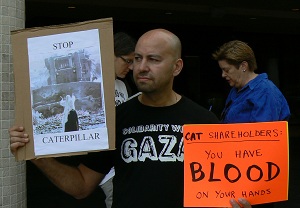
Gabriel Schivone spoke passionately inside the meeting as a shareholder on behalf of JVP and a “robust coalition of religious organizations” in favor of a proposal behind which many US Campaign member groups have rallied through the years. Entitled “Review of Global Corporate Standards,” the proposal urges Caterpillar to adopt a review and public reporting of the company’s worldwide business practices, and to extend wide-reaching policies to “conform more fully with international human rights and humanitarian standards.” An advance poll of showed that at least 21% of all shareholders voting in favor. Organizers from member groups Jewish Voice for Peace (JVP) and Palestine Online Store joined activists from No Más Muertes, the Esperanza Peace & Justice Center in San Antonio, and elsewhere outside the meeting. They made “concrete connections” between Israel’s Apartheid Wall and the wall on the U.S.-Mexico border — both of which Caterpillar is helping to build — drawing attention to the racist policies suffered as a result by Latina and Latino migrant communities and indigenous peoples in Arizona and Palestine. El Movímíento Estudíantíl Chícan@ de Aztlán (M.E.Ch.A.), the largest association of Latina and Latino youth in the U.S., drew similar connections earlier this year and endorsed Boycott, Divestment, and Sanctions (BDS) in another victory at ASU.
Sadly, retirement giant TIAA-CREF, which invests more than $1 billion in Caterpillar, was missing in action. TIAA-CREF has answered calls for divestment with claims that it prefers to engage with companies rather than divest from them. Yet TIAA-CREF was nowhere to be found during this chance to voice concerns.

TIAA-CREF cannot simultaneously claim to “finance for the greater good” and invest — including through its Social Choice Fund! — in the destruction of Palestinian homes and lives. TIAA-CREF’s Senior Vice President and Corporate Secretary William Mostyn III needs to hear from you!
Click here to write a letter to TIAA-CREF to remind them that we are watching!
Next month, shortly before the TIAA-CREF annual shareholders meeting, the Presbyterian Church (USA) will vote on divestment from Caterpillar, Motorola Solutions, and Hewlett Packard. The church’s Mission Responsibility Through Investment and the General Assembly Mission Council have already put their full support behind divestment. Successful regional overtures on boycotting settlement products and naming and condemning Israeli apartheid are also on the agenda.
The claim that BDS efforts are failing is a favorite of BDS opponents, but it’s betrayed by the stream of recent victories. With summer around the corner, thanks to the hard work of member groups around the country, Caterpillar and countless US institutions like it are feeling the heat!
New Media We Recommend
Below is a list of new materials that we have read/watched in recent weeks. The comments are not a “review” of the material, instead sort of an endorsement of ideas and investigations that can provide solid analysis and even inspiration in the struggle for change. All these items are available at The Bloom Collective, so check them out and stimulate your mind.
Ned Ludd & Queen Mab: Machine Breaking, Romanticism and the Several Commons of 1811 – 12, by Peter Linebaugh – Peter Linebaugh is not only a fabulous historian, he is a fabulous writer. This short booklet that examines the rumblings around the notion of “The Commons” at the end of the 18th Century and the early years of the 19th Century. Linebaugh not only looks at those who identified themselves as Luddites, but other insurrectionary movements around the world that embraced the Commons and rejected technology that displaced creative work and disregarded nature. Linebaugh looks at the Mexican Revolution of 1810, several Native communities in confederation, Ireland and England. The author doesn’t spend a great deal of time discussing the political philosophy of those who called themselves Luddites, but he does provide insight into how people were influenced by them, both in practical terms and in literary terms. This is why Linebaugh looks at Queen Mab, written by Percy Shelley and other poems and novels of the day that spoke passionately about the theft of the commons and the early stages of the industrial revolution. An important contribution for those who are struggling to make sense of living in a high tech and ecocidal world.

The Case for Sanctions Against Israel, edited by Audrea Lim – The International Boycott, Divestment & Sanctions (BDS) campaign against Israeli aggression has been growing for several years. This book is a great resource for those interested in expanding this campaign. The anthology of writings in this book include essays on history, interviews, personal testimony, comparisons to Israeli and South African Apartheid and statements of solidarity, such as the one from Indigenous and Women of Color Feminists. Other contributors include John Berger, Naomi Klein, Ilan Pappe, Omar Barghduti, Marc Ellis and Noura Erakat. An excellent recourse that will both inform and inspire. After reading The Case for Sanctions Against Israel one can not help but want to be part of this historic campaign for justice with the Palestinians.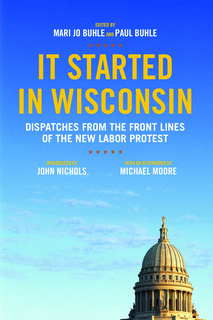
It Started in Wisconsin: Dispatches From the Front Lines of the New Labor Protest, edited by Mari Jo and Paul Buhle – In this collection of essays and political cartoons readers come face to face with the passion, courage and power of the movement that began in 2011 in Wisconsin. The authors provide for us some background on radical politics, but more importantly each chapter tells the story of how thousands of people in Wisconsin fought to brutal policies implemented by Gov. Walker, policies that targeted public employees, unions and teachers. Readers will learn about how Green Bay Packers fans brought their passion for football to the protests against privatization and the austerity measures being funded by the right. It was in Wisconsin that we first saw solidarity expressed in the US for the struggle in Egypt and around the Middle East it what was becoming the Arab Spring. It Started in Wisconsin is a fabulous re-telling of the power of popular movements and an inspiration for what is possible. It is true that the Recall campaign against Gov. Walker failed, which makes the vision of a grassroots effort to confront power all the more relevant. Highly recommended.
Windfall (DVD) – Wind power… it’s sustainable … it burns no fossil fuels…it produces no air pollution. What’s more, it cuts down dependency on foreign oil. That’s what the people of Meredith, in upstate New York first thought when a wind developer looked to supplement the rural farm town’s failing economy with a farm of their own — that of 40 industrial wind turbines. WINDFALL, a beautifully photographed feature length film, documents how this proposal divides Meredith’s residents as they fight over the future of their community. Attracted at first to the financial incentives that would seemingly boost their dying economy, a group of townspeople grow increasingly alarmed as they discover the impacts that the 400-foot high windmills slated for Meredith could bring to their community as well as the potential for financial scams. With wind development in the United States growing annually at 39 percent, WINDFALL is an eye-opener that should be required viewing for anyone concerned about the environment and the future of renewable energy.
This media advisory is re-posted from Via Campesina.
About 3000 people from around the world will mobilize to say NO to the commodification of life and nature at the Peoples Summit for Social and Environmental Justice and in Defense of the Commons.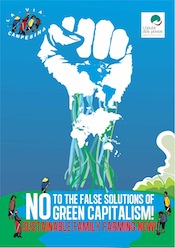
The peoples Summit is a space for discussion, debate and construction of alternative proposals by the global civil society, social movements and peoples collective organizations. La Via Campesina has been actively participating in the construction of this activity in order to denounce the false solutions of the same failed economic model that is now being dressed in green under the name “green economy”. La Via Campesina is instead promoting peasants sustainable agriculture as a true solution to the global climatic and environmental crises.
The delegation of La Via Campesina will participate in various plenaries as well as the global mobilization that will take place on the 20th of June concentrating at the junction of the roads Av. Rio Branco and Av Presidente Vargas in Rio de Janeiro. La Via Campesina has been actively participating in the planning of the Peoples Summit that will take place as a parellel activity to the UN conference on Sustainable Development or Rio + 20. This meeting marks the twentieth aniversary of the 1992 United Nations Conference on Environment and Development (Rio 92 or Eco 92).
The most important political space in the Peoples Summit will be the Peoples Permanant Assembly that will organize around three main themes: The denouncement of the structural causes of global poverty and environmental crisis as well as the new forms of the reproduction of capital; Peoples real solutions and new paradigms; and the agendas, campaigns and mobilizations of anticapitalist struggles after Rio +20.
La Via Campesina is an international movement that brings together about 200 million peasants, small and medium-sized producers, landless, rural workers and indigenous people from around the world. LVC advocates sustainable small scale peasant’s agriculture as a means of promoting social justice and dignity. The organization brings together more than 150 organizations in about 70 countries of Africa, Asia, Europe and America.
This story is re-posted from the youth immigration rights group One Michigan.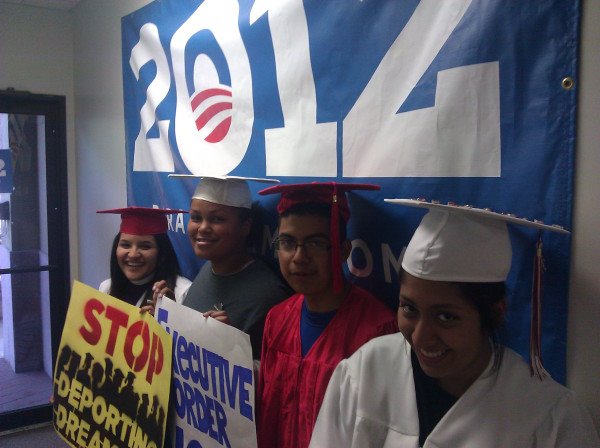
One Michigan along with National Immigrant Youth Alliance (NIYA), a network of undocumented led organizations, are calling for the President to issue an executive order to stop the deportation of DREAM Act-eligible youth. On Monday, undocumented youth in Colorado ended a 7- day occupation and hunger strike inside Obama’s headquarters making the same demand. We take action in solidarity with undocumented youth across the nation.
Four youth from metro-Detroit are no longer going to allow their lives and the lives of their friends and families to be held up by petty partisanship and congressional gridlock.
Jose Esquivel of Lincoln Park, 18, Evelin Calderon of Allen Park,17, and Nyasia Valdez of Detroit,16,Dayanna Rebolledo of Detroit,22, have been sitting-in at President Obama’s Campaign Headquarter Since yesterday June 13th, in Dearborn (13742 Michigan Ave Dearborn,MI) demanding that President Obama give relief to thousand of DREAMers. Obama campaign staffers have shut off the Internet and power to the office and are denying the protesters contact from outside supporters who want to bring them food.
For Evelin Calderon a recent graduate from Melvindale High School and undocumented student anything less than an executive order is unacceptable, “We need the strength of an executive order to stop our deportations. Prosecutorial discretion has not stopped them. I am asking President Obama to act fully within his power and give an executive order. Failing to do so will keep my life on hold.”
Nyasia Valdez an immigrant rights activist knows well the failure of this administration to do anything for immigration reform, “We know we need the DREAM Act, however while we wait we need the President to issue an executive order stopping the deportation of DREAM Act eligible youth. President Obama has the power to stop these deportations and we need him to act. I will wait as long as it takes for him to take action, even if it means risking arrest.”
Urge President Obama to use his power to issue an executive order to stop deportations of DREAM Act students http://action.dreamctivist.org/execorder
All four youth vow to remain at the office until President Obama issues an executive order or arrests are made. If arrested the undocumented youth could face deportation, a reality for any DREAM Act student arrested on any given day.
“I know the risk I am taking today. I am risking my life because I am tired of seeing my community live in fear. I am tired of President Obama speaking words, our communities need action. Stop making excuses, an executive order is within your power.” stated Jose Esquivel.
Video: https://www.facebook.com/photo.php?v=4021842505078
Live updates: http://facebook.com/onemichigan
Live video stream: http://www.ustream.tv/channel/executive-order-now—michigan
Creating a Local Food System
In recent years there has been a growing interest amongst the general population to eat healthy and eat local. This interest has sparked more individuals to grow some of their own food, join a CSA (community supported agriculture), eat at restaurants that serve locally grown food, even learn how to preserve food.
However, these types of individual or market-drive responses are both inadequate and in some ways unsustainable. Individual actions are inadequate in that they tend to ignore the power of the existing agribusiness system and it is unsustainable, because much of the focus has been put on operating within the for-profit, market economy. Until eating healthy food is seen as a right and not as a commodity, we can never have a truly sustainable and just food system.
Once we have a principled framework, we need to then think about creating a local food system. Creating such a system means we need to do a local food assessment, do a food audit and create a food charter.
Assessing Our Food System
Assessing our food system involves two main components, coming to terms with what the capitalist agribusiness system looks like and an analysis of the local food realities. Our current food system is based on making money, growing mono-crops, using pesticides, government subsidies, contaminating the soil, the production of genetically modified crops and the exploitation of labor. Food in the current system means that food can be wasted and used as a tax write-off. Food in the current capitalist system is even used as a weapon, a theme that is explored in detail in Raj Patel’s book, Stuffed and Starved.
The current for-profit food system causes environmental destruction, causes poor health, contributes to global warming and is one of the main perpetrators of hunger.
Assessing the local food system requires a very similar understanding, but it also requires an assessment of the capacity to create a truly sustainable local system. Agribusiness dominates the food system in West Michigan, with the bulk of the food consumed here coming from far away. Most of the food consumed locally is also highly processed, coming from food brokers who have nothing to do with growing real food or the fast food industry, which does tremendous ecological and human health damage.
The capacity for a sustainable and just food system on the other hand is tremendous in West Michigan. We have great climate and lots of land for growing food. We have the benefit of living in the Great Lakes Water Basin, so access to water is not an issue. We have a significant amount of family owned farms and cities that can also be integral to food production. There are some good online resources for doing local food assessments, such as the Oakland Food System as well as an interesting document written by Kami Pothukuchi. 
Auditing the local food system
A food policy audit is a tool to help assess a community’s existing local food policy infrastructure. It helps facilitate a process to assess the strengths, gaps and opportunities in community food policies and identify priorities to improve the local food system.
Several communities have already developed their own auditing tools, one from the University of Virginia, which directly addressed food production, distribution, and access, as well as community activities that might help improve the food system.
Lastly, it might be useful to create a community food charter. A food charter is a statement of values and principles to guide a community’s food policies. In a charter, community members come together to develop a common mission for their food and agriculture systems. Each community’s charter would be unique to its area, thus what works for West Michigan may not work in other areas.
Here is an example of a food charter from Detroit and another one from Toronto.
Noise Parade Blocks Traffic in Downtown GR

Monday night, about 40 people attended a benefit concert at the DAAC for Marie Mason and Eric McDavid in recognition of June 11th, the International Day of Solidarity with political prisoners. Mason and McDavid are long term political prisoners jailed for their involvement in acts of resistance against industries that exploit the environment.
After the event, which included several local and regional poets and bands, attendees took to the streets for an impromptu “noise parade”, which traveled through downtown Grand Rapids. The group walked in the street at about 10:30pm stopping traffic, banging drums and buckets, blowing whistles and noisemakers, and waving various anarchist flags. The parade traveled north on Division Ave, where it passed the Grand Rapids Police Department and continued down Monroe Center, through the shopping district. The group grew in numbers as it moved past Van Andel Arena, up Fulton, and onto Ionia, as intrigued onlookers joined the march. The parade concluded by returning to Division Ave and the DAAC, where participants dispersed.
This weekend people in West Michigan will celebrate the 43rd anniversary of the Stonewall Uprising, the insurgent action that most acknowledge as giving birth to the contemporary LGBT movement.
The Stonewall Uprising was an unplanned act of resistance by gays and lesbians who frequented the New York bar known as the Stonewall Inn. The Stonewall Inn was owned by the son of a mob boss who tolerated gay and lesbian customers, although they were relegated to an area in the back of the bar.
The Stonewall Inn was not a well-kept establishment, but its subaltern nature provided space for the gay and lesbian community to at least have a place to interact and explore their own identities.
The NYPD was not tolerant of the gay and lesbian community, both from a legal point of view (dressing outside of one’s accepted gender norm could result in an arrest) and culturally, since the cops were and are a hyper-heterosexual and masculine institution, which would not tolerate gender bending in any shape or form.
The homophobic position that the NYPD took towards the gay and lesbian community was the norm, which resulted in constant harassment, abuse and arrests of the more flamboyant gays and lesbians, particularly Drag Queens. This abuse by the police was in some ways provoked as the gay and lesbian community began to more regularly defy the established norms and engage in public displays of affection, which of course the police found unacceptable.
As I mentioned earlier this was not a planned act of resistance nor was a polite or non-violent uprising. The authors of the zine Militant Flamboyance state:
Some of the arrestees began striking poses as they were being led off by the police while others arrested or confronted were mouthing off, and some threw their coins at the police. Still the cops continued to shove some arrestees into the police wagon. Some consider the most explosive moment to be when a butch lesbian was arrested and thrown in the wagon and began to rock it. Around this point in the night, some accounts speak of several spontaneous flashes of anger, a mass opposition, and militant refusal to accept the police harassment. One queen took off her high heel, smashed a police officer and knocked him down, grabbed his handcuff keys and freed herself. She then passed along the keys to her comrades, while others started to yell “Pigs!” “Faggot Cops!” and “Gay Power!” All of this led to the crowd transforming and growing into a mob, which began throwing everything possible at the police; bricks, coins, bottles, garbage cans, even dog shit.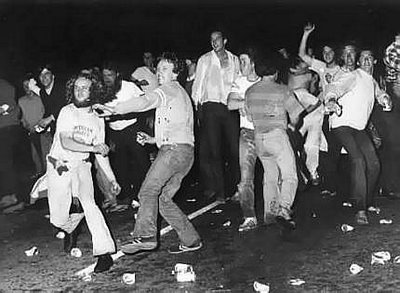
The confrontation with the police lasted three days in late June of 1969 and involved hundreds of gays, lesbians and allies from the area who came out to participate in the uprising and defend their friends and lovers.
The Stonewall Uprising not only sent a message to the heterosexist power structure, it sent a message to other people who identified as gay, lesbian, bi-sexual or people who were just coming to terms with their sexual identity.
Following the Stonewall Uprising, those who had a history in the more closeted groups such as the Mattachine Society attempted to use the energy of the uprising that erupted in Greenwich Village and control it to serve its own strategic interest. However, those involved with the uprising would have nothing with their attempts to co-opt this insurgent movement.
Those who identified as gay, lesbian and bi-sexual decided to use the Stonewall Uprising as an opportunity to create a revolutionary organization and called it the Gay Liberation Front (GLF), in many ways modeled on many of the other radical groups that had come into being in the 1960s. The Gay Liberation Front was not focused solely on identity politics and made as part of their platform revolutionary principals that called for economic justice, an end to sexism, racism and US militarism abroad.
Months later a group that wanted to be more focused on gay and lesbian issues, the Gay Activist Alliance (GAA), formed and broke with the GLF. However, despite the Gay Activist Alliance not wanting to engage in inter-sectional politics, they did maintain a liberation-based worldview, which influenced their organizing strategy.
There was also the reality that those in the early LGB community who were not White and didn’t identify as a man felt that their concerns were either ignored or marginalized.
Radicalesbians was a lesbian caucus of GLF that split off and became its own organization and similarly, female activists left GAA to found Lesbian Feminist Liberation. There was also a group named Street Transvestite Action
Revolutionaries (STAR) that was founded to provide necessary services (like clothing, food and housing) to homeless trans and gender-variant young people living on the street, many of whom were involved in sex work. STAR also pushed existing gay groups to include transvestite and drag issues in their campaigns, as the gay organizations would often exclude them to appeal to politicians and straight citizens.
These tensions continued throughout the 1970s, but beginning in the 1980s the White, male sectors of the LGB movement became dominant and formed groups like the Human Rights Campaign (HRC), which took a much more assimilationist approach to organizing. Instead of calling for liberation and justice, HRC and other mainstream LGB groups called for the inclusion of gays, lesbians and bisexuals into existing social institutions such as corporations, the church and other hierarchical power structures.
From Commemoration to Beer Tents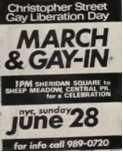
The very first Pride Celebration took place in 1970 in New York City called the Christopher Street Liberation Day. However, gay and lesbians groups did organize marches in Chicago, Los Angeles and San Francisco as well, where hundreds of people turned out. Many of these marches and parades were called Liberation or Freedom marches, which reflected the desires of those who organized these events.
However, by the 1980s, the anniversary of the Stonewall Uprising began to be run by more mainstream groups with the funding to do so. The Gay Alliance in New York reflects on this period:
In the 1980s there was a major cultural shift in the Stonewall commemorations. The previously, loosely organized, bottom-up marches and parades were taken over by more organized and less radical elements of the Gay community.
Now we have Pride events that are often held in more upscale parts of communities across the country, with more vendors than information tables and more entertainment than organizing campaigns.
Last year we interviewed Wick Thomas, an activist from Kansas City who confronted the elitist and exclusionary evolution of Pride in that community. There are also plenty of stories across the country where members of the LGBTQ community have challenged the failure of Pride events to make the spirit of Stonewall more central to the celebrations.
In Grand Rapids, like many other communities, the beer tent and photo booth are often more popular than information tables that are calling for a radical reorientation of the movement. Police Associations are welcomed, while LGBT youth and the Transgender community are targeted by cops.
In the early years of Pride in West Michigan, local campaigns were central to the celebration as is evidenced by the archival video we have about the 1988 Pride, where information tables dominated the physical space at Pride and the focus from the stage was on current campaigns and education.
I write these reflections on just before the 2012 West Michigan Pride Celebration, not because I know what is best for the LGBT community. I write these comments, like any historian, to get us all to think about where we came from and hope that it informs where we go from here.
This Saturday, West Michigan will celebrate the 24th Annual Pride Celebration at Riverside Park in Grand Rapids.
The LGBT community first organized a Pride Celebration in June of 1988 in Grand Rapids, after people made that an early priority following the creation of The Network earlier that year.
You can watch a video of the very first Pride Celebration, which took place in the old Monroe Amphitheater in downtown Grand Rapids. The first Pride Celebration in Grand Rapids featured speakers, music, lots of information booths and a proclamation read by a member of The Network that called out Mayor Helmholt for not endorsing their event.
The Pride Celebration this year will be held at the north end of Riverside Park, as it has been for several years running now. There will be music, information and vendor booths and other opportunities for the LGBT community and allies to celebrate the 43rd anniversary of the Stonewall Uprising.
West Michigan Pride
Saturday, June 16
Noon – 9:00PM
Riverside Park, Grand Rapids
 Grand Rapids Institute for Information Democracy