Holland Hosts Public Hearing on the issue of including LGBT in the State’s Civil Rights Law
An estimated 250 people showed up in Holland last night to participate in a public hearing hosted by the Michigan Department of Civil Rights on the matter of expanding the 1976 Elliot Larson Civil Rights legislation to include the LGBT community.
It was ironic that the hearing was being held in the Holland City Council Chamber, since just over a year ago, the City Council of Holland voted down a proposal to pass an ordinance that would include the LGBT community in its anti-discrimination policy.
Members of the Michigan Department of Civil Right (MDCR) began the hearing by talking about the process that led them to host a series of hearings this year, which will provide them with public input to be included in a report they will be releasing sometime in 2013.
Members from the MDCR asked people to frame their comments to reflect how amending the Elliot Larsen Civil Rights Act would “impact your community/neighborhood/family/church/school, change your life or that of a family member, impact businesses or workforce and affect people’s perception of others.”
Some of the people who gave verbal testimony directly addressed the issues laid out by the MDCR, while others came with written statements that only addressed their narrowly held religious views.
There were a total of 18 people who opposed amending Elliot-Larsen to include legal protections for the LGBT community in Michigan. Of those 18 people, 16 were White men, 2 were White women and almost all of them were older residents of Holland.
Many of those in opposition spoke with the same arguments we had heard last year during some of the Holland City Council meetings. Often those opposed would refer to the LGBT community as “homosexuals,” a term that in itself is derogatory and demeaning. Others kept referring to a “gay agenda,” which they believed would mean that it was the desire of the LGBT community to convert straight people to their “lifestyle.”
Other people who were opposed to amending Michigan’s civil rights law did so because they believe that “sodomy was a sin” and that granting civil rights to the LGBT community would “create a slippery slope that would lead to the legalization of rape, pedophilia and bestiality.”
One man, who said he was a father, objected to changing the law because it would mean that “they would have to teach homosexuality in the schools.” Another person in opposition said that granting the LGBT civil rights would lead to children being molested in bathrooms by people claiming to be Transgender. Others kept referring to statistics about how “gay people are more deviant and that gay couples have a high divorce rate.” Not surprising, none of the statistics or claims made by those who opposed amending the Elliot Larsen Civil Rights law provided a credible source. One Christian man even stated that deviancy in gays was evident in Nazi Germany, where some of the worst atrocities were committed by Hitler’s Storm Troops who were known to be “homosexuals.” Not only is this an unsubstantiated claim, it is well documented that the gay community was targeted for repression by the Nazis.
A few of those opposed to granting civil rights to the LGBT community were also claiming that changing the law would take away their freedom. One man even cited New York Mayor Bloomberg’s restriction of large sized sodas as an example of why big government is dangerous.
At one point an older White man, who acknowledged he was straight, stated that he feared that if such changes were made that his beliefs and his freedoms would be threatened. He went so far as to say that he would face retribution, punishment and even be the victim of hate if the LGBT community was granted equal protection under the law. In many ways, this statement reflected the tremendous privilege that straight, White men are generally unwilling to acknowledge they have in this society. To have such privilege – legal, economic and social – and then turn around and claim to be a victim, exposed the banality of those who opposed changes to the state civil rights law.
When it came to those who spoke in favor of amending the Elliot-Larsen Civil Rights Act to include legal protections of the LGBT community, the comments were undeniably different.
Many people spoke clearly about the actual harm that is being done to those who identify as LGBT. One man spoke about losing his job because he was gay, while other people talked about being harassed, intimidated and discriminated against in terms of housing.
One member of Holland is Ready spoke about how she was not public about her identity at work because of the anti-atmosphere. She said that one day a co-worker saw a gay couple walking down the street and said, “I wish those people would stay in Saugatuck.”
Other people who spoke in support of amending Elliot Larsen said that people have experienced a tremendous amount of homophobia and Transphobia. A woman who identified herself as a mom and in a relationship with another woman said she would have less fear about feeding her family, about where she could get a job, about where she could live, about the climate of the school that her daughter attended, if the civil rights law was changed.
A member of Holland PFLAG spoke about how ignorance is not bliss. He used to hold the same narrow ideas about gay people, until 3 close friends told him that they all had members of their family that identified as LGBT. He said that once the issue became personal, it all changed for him.
A young woman who identified herself as a Christian said she was taught not to judge and that she wants the LGBT community to have the same civil rights protections as everyone else. As a daughter of an immigrant family she said she understood that civil rights should be granted to everyone.
Heather Holt, a member of Holland is Ready, believes that people in Holland do experience discrimination because they identify as LGBT. She has been going door to door in Holland, along with other members and volunteers with Holland is Ready, and heard from most people that they support legal equality.
A woman who has a gay son says that both sides of this issue have fears. “But we are talking about human rights, not special rights.” She doesn’t attend church anymore because her son and her family were rejected by their church ever since he came out.
Another man from Holland said he was fired as a teacher for defending the rights of gay students. He taught at a Christian School, which would not stop the harassment of LGBT students by straight students.
One woman, who identified as bi-racial, criticized those who used the bible and the constitution to justify discrimination. She said she was tired of hearing from White men talking about racial discrimination. “You were probably one of those who supported discrimination against Blacks when they were fighting for civil rights.”
By the time that 9pm rolled around 42 people had provided verbal input into this issue, with 24 supporting the inclusion of the LGBT community in the state civil rights law, while 18 were opposed.
One person told this reporter that she spoke with members of the Michigan Department of Civil Rights afterwards and one of them said, “These were the most vitriolic, moralist comments we’ve heard so far on this issue.” The MDCR held a hearing in Jackson earlier this month and plans to hold others in the coming months. The MDCR also made it clear that people can submit comments electronically by going to this link.
Afterwards we spoke with one of the organizers from Holland is Ready, Lindsay TerHar, about the group’s work and her assessment of the public hearing.
Leonard Peltier Solidarity action in Grand Rapids
Yesterday, a small group of people participated in an event organized to draw attention to the plight of Native American activist Leonard Peltier who has been in a federal prison since the late 1970s.
Ian Swanson, whose family is part of the local Native community, organized the event in conjunction with actions taking place all over the US. Swanson invited people to join him for a solidarity walk from the East Hills area to the Grand River downtown. After the walk, people came to the river over the next several hours to talk about Peltier’s case, Native American struggles today and how people could be in solidarity.
Peltier was a member of the American Indian Movement (AIM) in the 1970s and joined other young warriors on the Pine Ridge Reservation to help the community fight to regain their dignity and sovereignty.
Pine Ridge had been mired in corruption from the Bureau of Indian Affairs appointed tribal leader, poverty and growing awareness of land disputes with the federal government, which wanted to take lands that were rich in uranium and other minerals.
The American Indian Movement was already being targeted by the FBI’s counterintelligence campaign (COINTELPRO) and the presence of AIM increased the level of repression against community members who wanted to reclaim land, fight corruption and improve the conditions for the tribe.
Here is an interview we did with the organizer of the action today in support of Leonard Peltier.
Wikileaks founder Julian Assange talks with Noam Chomsky and Tariq Ali about the recent global uprising.
They both speak about the Arab Spring and other revolutionary movements, particularly in Latin America.
Chomsky and Ali both address the US role in the repression against populations around the world and how this has been a catalyst for much of the resistance, along with the devastating consequences of capitalism.
Both writers talk about the growing autonomy in South America over the past ten years and the Arab uprisings of the past year and a half.
In addition, both Ali and Chomsky address the crisis of democracy that has been created by capitalism and how it has diminished the capacity of democracy.
Farmworkers plagued by pesticides, red tape
This article is re-posted from iwatchnews.org.
Laboring in the blackberry fields of central Arkansas, the 18-year-old Mexican immigrant suddenly turned ill. Her nose began to bleed, her skin developed a rash, and she vomited.
The doctor told her it was most likely flu or bacterial infection, but farmworker Tania Banda-Rodriguez suspected pesticides. Under federal law, growers must promptly report the chemicals they spray.
It took the worker, and a Tennessee legal services lawyer helping her, six months to learn precisely what chemical doused those blackberry fields. The company ignored her requests for the information. The Arkansas State Plant Board initially refused to provide records to her lawyer, saying it didn’t respond to out-of-state requests. An Arkansas inspector, dispatched after the complaint, didn’t initially discern what pesticides were used the day the worker became ill, records show.
When answers finally arrived — the fungicide was Switch 62.5WG, a chemical that can irritate the eyes and skin — Banda-Rodriguez had already left Arkansas to follow the season to Virginia and ultimately returned to Mexico. She never learned whether the pesticide sickened her.
The episode is as telling a snapshot today as it was six years ago for one of America’s most grueling and lowest-paying vocations. Pesticides can endanger farmworkers, but thin layers of government protect them and no one knows the full scope of the environmental perils in the fields.
The Environmental Protection Agency administers a Worker Protection Standard meant to regulate pesticides and protect workers and handlers. Yet the agency maintains no comprehensive database to track pesticide exposure incidents nationwide.
In 1993, the Government Accountability Office (then called the General Accounting Office) warned that the lack of data could lead to a “significant underestimation of both the frequency and the severity of pesticide illnesses.”
Nearly 20 years later, the EPA can still only guess at the scope of pesticide-related ailments in an industry where many workers, toiling in the shadows, are reluctant to speak up. The EPA often hands enforcement of pesticide regulations to states, which receive and investigate few formal complaints each year, federal records show.
“The system in place to address pesticide exposure is horrible. It’s dysfunctional,” said Caitlin Berberich, an attorney with Southern Migrant Legal Services, a Nashville nonprofit that provides free legal services to farmworkers in six southern states. “It just doesn’t work at all.”
Some top state regulators agree the full toll of pesticides on farmworkers is not documented. Yet reforms requiring more complete disclosure of pesticide use have been caught up in EPA red tape.
The EPA did not respond to repeated requests for comment and written questions, sent by the Center for Public Integrity over the last month, about its pesticide oversight. The EPA “estimates that 10,000-20,000 physician-diagnosed pesticide poisonings occur each year among the approximately 2 million U.S. agricultural workers,” federal records show.
Yet when workers do complain — as in the case in Arkansas — securing hard information can be daunting.
Sometimes, workers say, they pay a price for speaking up.
When pesticides were sprayed near them in 2010 in the tomato fields outside the city of Newport, in a patch of east Tennessee where the mountains touch the clouds and road signs warn of falling rock, the migrant farmworkers complained to state regulators. When it happened again, they say, they snapped videos with their cell phones.
The tomato farm’s response, the workers say in an ongoing federal lawsuit: to fire them on the spot, pile them on a bus and route them back to Mexico. The company denies any wrongdoing or retaliation.
In Florida in late 2009, farmworker Jovita Alfau, working in an open-air plant nursery in a rural swath of south Miami-Dade County, said she became dizzy and weak, with numbness in her mouth, and vomited.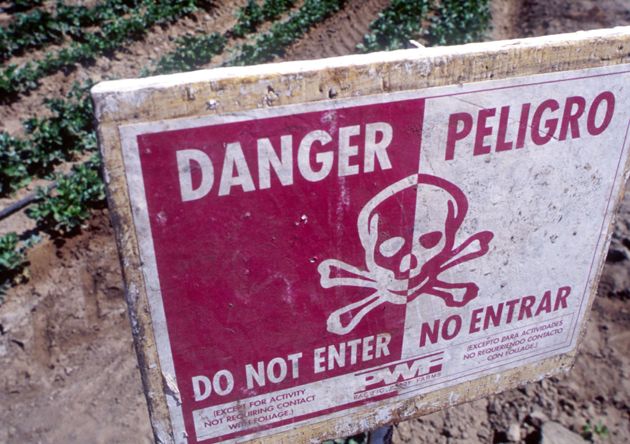
Alfau said she had been told to tend to hibiscus plants at the Homestead nursery less than 24 hours after they had been sprayed with the pesticide endosulfan. The grower sent workers out too soon after the spraying, Alfau said in a lawsuit, violating the Worker Protection Standard, and did not tell her when pesticides were applied, provide protective gear or tell her how to protect herself.
Endosulfan is so toxic that, by summer 2010, the EPA banned its use, saying the pesticide “poses unacceptable risks to agricultural workers and wildlife.”
Several days after falling ill, Alfau went to the doctor but was not asked about pesticides, said her lawyer, Karla Martinez of the Migrant Farmworker Justice Project. Alfau, a legal U.S. resident and Mexican native, said she has been unable to work regularly since.
Power Bloom Farms and Growers denies wrongdoing, but agreed this month to settle Alfau’s case for $100,000, court records show. Under terms of the settlement, the company could also pay up to $75,000 total to other affected workers in a case that also included wage abuse allegations. The company did not respond to an interview request.
Farmworkers who have spent decades in the fields say one constant remains: Workers have little voice when it comes to pesticides.
“We have to run to the cars and close the windows because the plane is putting pesticides in the fields. After that happens, people feel sick,” said Yolanda Gomez, who began picking Florida oranges when she was nine and spent more than 30 years following the harvest from Florida to Washington State. “When you go to the field you go clean, and when you come out of the field you can see your eyes are very red.”
Raised in a family of farmworkers, with a father who once carried signs for Cesar Chavez, Gomez is now a community organizer for the Farmworker Association of Florida, in Apopka near Orlando. Farmworkers frequently trek into the office complaining of pesticide-related illnesses, she said.
“When you tell them, ‘Let’s make this paper and put your name on it so we can make a difference,’ they just won’t do it,” Gomez said. “‘I don’t have any papers. I have to work. This is the only way I can feed my family.’ They don’t see another way out of the system.”
The system, she said, “should care about the human side of the worker.”
Bottom of the food chain
The battle over pesticides is a microcosm of the larger struggle for laborers at the bottom rung of the economic food chain.
“There’s this disenchantment,” said attorney Adriane Busby, who focuses on pesticide safety policy for the nonprofit Farmworker Justice in Washington, D.C. “They just don’t believe anything will happen if they go above and beyond in reporting things. They don’t believe in the system protecting them.”
For farmworkers, just getting clear answers about pesticides is a struggle. No one, the EPA included, has a full picture of the problem.
An EPA slideshow report in 2006, for instance, opened with a question: How many occupational pesticide incidents are there each year in the United States?
The slide listed multiple possibilities, from 1,300 to 300,000. Each number could be true, the report said – it just depends upon the source. One number came from the Poison Control Center, another from EPA estimates and yet another from the Council of State and Territorial Epidemiologists.
This uncertainty, even the EPA admits, can carry real consequences. As its slide noted, the lack of accurate information “inhibits clear problem identification.”
Advocates say the dearth of information triggers another problem: It’s hard to hold government and industry accountable when there is no benchmark from which to judge.
In its 2006 report, the EPA set goals of gathering more complete information and creating a more consistent means of tracking incidents. Among its recommendations: To “prepare a report on occupational incidents.”
Six years later, asked whether such a report has been prepared, the EPA did not respond.
Instead of maintaining its own database, the EPA depends on states to report complaints. But those annual reports list minuscule numbers. In 2011, for instance, North Carolina listed a total of five investigations based on complaints — for the entire state. South Carolina, another major agricultural producer, reported zero. Tennessee: 3.
Florida, the nation’s second-biggest agricultural state after California, reported 61 complaint-based investigations that year.
But Gregory Schell, managing attorney with the Migrant Farmworker Justice Project in Lake Worth, near West Palm Beach, Fla., said just a fraction of the pesticide incidents are reported.
His guess: “One-tenth of 1 percent, in Florida.”
In 2005, Schell surveyed laborers who worked for a grape tomato grower in northern Florida that season. Nearly one in four said they had been directly sprayed with pesticides or other chemicals. Just under half said they had encountered drift from nearby fields. Thirty-six percent said they had become sick or nauseous from pesticides, and more than four of 10 said they developed skin rashes or irritation.
Had those numbers been extrapolated out for a state with 200,000 farmworkers, there would have been thousands of complaints, not dozens.
“Workers view these exposures as an occupational hazard. Even when they do complain, there’s an unwillingness to come forward,” Schell said. “One [reason] is their immigration status. The other is the employer can and will fire them.
“It is like pulling teeth for us to get people to file pesticide complaints.”
The official count doesn’t reflect reality, agrees Andy Rackley, director of agricultural environmental services for Florida’s Department of Agriculture and Consumer Services. “I would say we probably don’t have a good handle on it,” Rackley said. “It’s probably not as big as some people say it is but it’s probably bigger than what our complaint investigation files would indicate.”
Rackley believes growers should be required to more fully disclose where farmworkers are when pesticides are being sprayed. “Where were the workers at the same time, were they harvesting in the same fields?” he asked. “That won’t keep anybody who’s intent on hiding something from doing something, but it certainly raises the stakes.”
Growers log their pesticide use, and many track workers’ activities — but there’s no rule requiring one report tying the two, Rackley said. “EPA has been working on a rule to do that for at least eight years, maybe longer,” he said, “but we still don’t have it.”
Language barriers add another hurdle.
Pesticide warning labels are not required to be in Spanish, though eight of every 10 farmworkers are foreign born and most of the nation’s agricultural workforce comes from Mexico.
On average, according to the U.S. Department of Labor’s National Agricultural Workers Survey, crop workers had not advanced beyond the seventh grade. Forty-four percent said they could not speak English and 53 percent could not read the language. When farmworkers can’t read safety instructions, they face higher risks of exposure, say advocates who have pushed the EPA to require bilingual labeling.
With a scarcity of hard data, advocates are sometimes left to cite decades-old reports as proof of pesticide’s perils. One report, from the U.S. Bureau of Labor Statistics, said farmworkers suffer the highest rate of chemical-related illness of any occupational group, at 5.5 per 1,000. The report date: 1987
Florida’s Rackley believes the EPA should more fully fund qualified advocacy groups to train workers on pesticide safety — empowering workers, giving growers a level of comfort, and building trust between the two. “Listen, the growers need the workers and the workers need the growers, that’s the bottom line,” he said. In recent years, records show, the EPA has provided funding from $25,000 to a nonprofit to help reduce farmworker pesticide exposures in New Jersey to up to $1.2 million over five years to help train clinicians working with farmworkers.
A conflict in Tennessee
Workers who speak up sometimes find themselves immersed in conflict.
In Newport, Tenn., tomato grower Fish Farms hired workers under the federal government’s H-2A temporary agricultural program, in which legal foreign workers can be brought in when industry lacks local laborers for the job.
At Fish Farms, 15 workers contend in an ongoing lawsuit, pesticides were sprayed in the fields while they worked and close to their trailer homes, in a secluded stretch of a city of almost 7,000 whose commercial strip includes Debbie’s Drive Inn, For Heaven’s Cake & Bakery and the Newport Plain Talk newspaper.
In July 2010, aided by Southern Migrant Legal Services, the laborers complained to the pesticides administrator of the Tennessee Department of Agriculture, “citing frequent exposure to pesticides while working at Fish Farms, physical symptoms, and the absence of medical care,” according to the lawsuit. Some laborers told the state they had lost fingernails that season, and said pesticides were sprayed 30 feet away from them.
That August, the workers turned to the Knoxville Area Office of the Wage and Hour Division of the U.S. Department of Labor, contending the company skirted federal and state pay and housing laws. The workers said they had to wash their clothes in a nearby river, and that their trailers were insect-infected and overcrowded, with holes in the walls. The company said the housing met federal standards, and any violations were caused by the workers.
On August 23, 2010, the Labor Department conducted an on-site investigation — leading to a skirmish. Two Fish Farms bosses “impeded” the inspectors’ discussions with the workers, the federal lawsuit says, and two others “arrived brandishing firearms.”
Fish Farms disputes that account in its response to the lawsuit. Instead, the company said, one worker “held a knife in a threatening manner.” The company fired him and filed an aggravated assault charge. The worker said he had been using the knife to cook with and did not threaten anyone. The state dropped the charge.
On September 5, 2010, the workers said, pesticides were again sprayed close to their trailers. This time, they took out their cell phones and began taking video of tractors passing by. Fish Farms bosses again turned out.
Workers said they retreated to their trailers, but, according to their lawsuit, a Fish Farms boss kicked in one door and two bosses yelled obscenities, including “f—ing Mexicans.” Farm bosses snatched their cell phones, loaded workers on a bus and arranged their return to Mexico, the suit said.
This May, Fish Farms referred a reporter’s inquiry to the company’s Knoxville attorney, Jay Mader. The lawyer did not respond to three interview requests, but the company challenges the workers’ account in a formal response to the lawsuit filed this month.
On the September day workers began taking video footage, Fish Farms said, the laborers were actually trying to “fabricate evidence of improper pesticide spraying.” The decision to fire them was warranted for “excessive absences,” the company wrote, and because the farmworkers “knowingly engaged in behavior that falsely portrayed Fish Farms as being out of compliance with local, state, and federal law.”
A Fish Farms boss “may have briefly removed” cell phones in his face, but returned them. The company said it paid for lodging and bus tickets for the workers to return to Mexico. There were “heated exchanges,” the company admitted, but executives said they could not recall the exact words.
After the lawsuit was filed, Fish Farms tried to get the case dismissed, saying the former H-2A workers lacked legal standing. A judge denied the farm’s request last month,calling its argument “completely unsubstantiated and devoid of merit.” The company continues to seek the case’s dismissal.
Ultimately, the Tennessee Department of Agriculture investigated the pesticide complaints. In November 2010, months after the workers had returned to Mexico, the state cited Fish Farms for using pesticides inconsistent with labeling, and for not displaying specific information about pesticides used.
The civil fine imposed: $425, which Fish Farms paid that same month. “The department considers this matter to be closed,” the state wrote.
Maze of red tape
The case in Arkansas opens a window into the maze farmworkers enter when they think they’ve been poisoned by pesticides.
Banda-Rodriguez, the 18-year-old farmworker toiling in the blackberry fields in Judsonia, Ark., said she started getting sick one day in June 2006. A short time later, she reached out to attorney Melody Fowler-Green of Southern Migrant Legal Services about another matter, involving immigration. Later, the worker mentioned her sickness.
In October 2006, Fowler-Green sent a certified letter asking the grower, Gillam Farms, to tell her what pesticides were used the day the woman became ill. She cited the EPA’s Worker Protection Standard, which mandates disclosure. Gillam Farms did not respond, the lawyer said in a letter to the EPA the following year.
Gillam Farms did not respond to two interview requests from the Center for Public Integrity.
In Arkansas, the EPA defers regulation to the state Plant Board. In November 2006, after not hearing back from the grower, Fowler-Green contacted the state and said she was told her phone call constituted a complaint.
In January 2007, a state official told her an investigator had visited the farm “but failed to gather information regarding the pesticide used on the fields when my client became ill,” Fowler-Green wrote the EPA. “I was not offered any coherent explanation for this failure.”
She followed up again in February 2007, when the Plant Board faxed to her a complaint form to fill out. Fowler-Green said it was the first time she was told she had to submit that paperwork.
Along with a complaint, the lawyer filed an open records request to obtain the Plant Board’s investigative file.
That same month, a lawyer for Gillam Farms questioned the pesticides inquiry in a letter to the state. “My client intends to cooperate with any legitimate investigation by the Plant Board,” wrote attorney Byron Freeland. “However, we are concerned that the Plant Board is being used by a former Gillam Farms employee and her attorney to harass Gillam in an attempt to gain information for a spurious claim.”
That April, Fowler-Green said, the Plant Board finally told her the pesticide that had been used: Switch 62.5WG, a fungicide made by the Swiss conglomerate Syngenta that kills diseases on crops ranging from blackberries to turnip greens.
But the agency still hadn’t turned over its investigative case file.
“It is the opinion of the Arkansas Attorney General’s Office that the state FOIA [Freedom of Information Act] does not apply to persons outside the state,” Plant Board Director Darryl Little wrote the Nashville attorney that July.
Only when she threatened to sue did the board provide the information.
All told, it took the lawyer six months to learn the name of the pesticide Banda-Rodriguez encountered — and 10 months to get a copy of the state’s investigative file. By that time, the farmworker was back in Mexico.
In an interview, Plant Board Director Little said the agency was hamstrung because the initial complaint did not arrive until months after the worker became sick. Normally, he said, the department aims to move as quickly as possible to gather evidence.
“It was frustrating figuring out what we could do to help this lady since it had been such a long time since this incident occurred,” Little said.
Yet the director acknowledged that his office, once contacted, moved slowly.
“We were extremely short-handed in that division at the time and I am sure we were slow — there’s no question about that,” he said. “We were struggling in our division at that time to keep our nose above water.” He said the Plant Board is back to full staffing.
Asked about his initial records response, Little said he was simply applying the law. “The way it’s written states that the records are open to the citizens of the state,” Little said. “But my take on it is, the only thing you’re going to do is make somebody mad and they’re going to call someone they know in Arkansas and they are going to get the records.”
His ultimate call, he said: “Give them the records. And that’s what we did.”
In the end, the Plant Board concluded it had insufficient evidence to determine whether the worker had been exposed to pesticides, or whether the Worker Protection Standard had been violated.
When Fowler-Green complained to the EPA, the federal agency replied that Arkansas’ review was proper. The EPA does not meddle in state public records disputes, an official said – and, if anything, the worker should have filed her complaint sooner.
If it took a lawyer this long to obtain basic information, Fowler-Green thought, imagine the difficulty farmworkers face.
“Yes, of course complaints should be made right away,” said Fowler-Green, who recently took a job with another law firm. “But whether it’s a month, two months or three months, the worker still should have a right to the name of the pesticide that was applied.”
Advocates wage longshot campaigns. Southern Migrant Legal Services has four lawyers handling farmworker cases in six states.
Yet the federal Worker Protection Standard meant to protect laborers has gone 20 years since a thorough revamping.
Farmworker Justice and the nonprofit environmental law firm Earthjustice are pressing for upgrades, writing to EPA Administrator Lisa Jackson last November and calling for reforms, including:
- Expanded training requirements for agricultural workers and pesticide handlers;
- Strict limits on when workers can re-enter the fields after spraying, and more complete information provided about the pesticides they encounter;
- Rules mandating special areas for workers to change into their work clothes, store clean clothing, and shower at day’s end, so they don’t carry pesticide residues home.
Asked about the suggestions, the EPA did not respond.
Obama’s Second Latin American Coup
This article by Shamus Cooke is re-posted from ZNet.
The recent coup against Paraguay’s democratically elected president is not only a blow to democracy, but an attack against the working and poor population that supported and elected President Fernando Lugo, whom they see as a bulwark against the wealthy elite who’ve dominated the country for decades.

The U.S. mainstream media and politicians are not calling the events in Paraguay a coup, since the president is being “legally impeached” by the elite-dominated Paraguayan Congress. But as economist Mark Weisbrot explains in the Guardian:
“The Congress of Paraguay is trying to oust the president, Fernando Lugo, by means of an impeachment proceeding for which he was given less than 24 hours to prepare and only two hours to present a defense. It appears that a decision to convict him has already been written…The main trigger for the impeachment is an armed clash between peasants fighting for land rights with police…But this violent confrontation is merely a pretext, as it is clear that the president had no responsibility for what happened. Nor have Lugo’s opponents presented any evidence for their charges in today’s ‘trial.’ President Lugo proposed an investigation into the incident; the opposition was not interested, preferring their rigged judicial proceedings.”
What was the real reason the right-wing Paraguay Senate wanted to expel their democratically elected president? Another article by the Guardian makes this clear:
“The president was also tried on four other charges: that he improperly allowed leftist parties to hold a political meeting in an army base in 2009; that he allowed about 3,000 squatters [landless peasants] to illegally invade a large Brazilian-owned soybean farm; that his government failed to capture members of a [leftist] guerrilla group, the Paraguayan People’s Army… and that he signed an international [leftist] protocol without properly submitting it to congress for approval.”
The article adds that the president’s former political allies were “…upset after he gave a majority of cabinet ministry posts to leftist allies, and handed a minority to the moderates…The political split had become sharply clear as Lugo publicly acknowledged recently that he would support leftist candidates in future elections.”
It’s obvious that the President’s real crimes are that he chose to ally himself more closely with Paraguay’s left, which in reality means the working and poor masses of the country, who, like other Latin American countries, choose socialism as their form of political expression.
Although Paraguay’s elite lost control of the presidency when Lugo was elected, they used their stranglehold over the Senate to reverse the gains made by Paraguay’s poor. This is similar to the situation in Egypt: when the old regime of the wealthy elite lost their president/dictator, they used their control of the judiciary in an attempt to reverse the gains of the revolution.
Is it fair to blame the Obama administration for the recent coup in Paraguay? Yes, but it takes an introductory lesson on U.S. – Latin American relations to understand why. Paraguay’s right wing – a tiny wealthy elite – has a long-standing relationship with the United States, which has backed dictatorships for decades in the country – a common pattern in most Latin American countries.
The United States promotes the interests of the wealthy of these mostly-poor countries, and in turn, these elite-run countries are obedient to the pro-corporate foreign policy of the United States (The Open Veins of Latin America is an excellent book that outlines the history). Paraguay’s elite is incapable of acting so boldly without first consulting the United States, since neighboring countries are overwhelmingly hostile to such an act because they fear a U.S.-backed coup in their own countries.
Paraguay’s elite has only the military for internal support, which for decades has been funded and trained by the United States. President Lugo did not fully sever the U.S. military’s links to his country. According to Wikipedia, “The U.S. Department of Defense (DOD) provides technical assistance and training to help modernize and professionalize the [Paraguay] military…” In short, it is not remotely possible for Paraguay’s elite to act without assurance from the United States that it would continue to receive U.S. political and financial support; the elite now needs a steady flow of guns and tanks to defend itself from the poor of Paraguay.
The Latin American countries surrounding Paraguay denounced the events as they unfolded and made an emergency trip to the country in an attempt to stop them. What was the Obama administration’s response? Business Week explains:
“As Paraguay’s Senate conducted the impeachment trial, the U.S. State Department had said that it was watching the situation closely.” “We understand that Paraguay’s Senate has voted to impeach President Lugo,” said Darla Jordan, a spokeswoman for the U.S. State Department’s Bureau of Western Hemisphere Affairs…“We urge all Paraguayans to act peacefully, with calm and responsibility, in the spirit of Paraguay’s democratic principles.”
Obama might as well have said: “We support the right-wing coup against the elected president of Paraguay.” Watching a crime against democracy happen – even if it is “watched closely” – and failing to denounce it makes one complicit in the act. The State Department’s carefully crafted words are meant to give implicit support to the new illegal regime in Paraguay.
Obama acted as he did because Lugo turned left, away from corporate interests, towards Paraguay’s poor. Lugo had also more closely aligned himself with regional governments which had worked towards economic independence from the United States. Most importantly perhaps is that, in 2009, President Lugo forbid the building of a planned U.S. military base in Paraguay.
What was the response of Paraguay’s working and poor people to their new dictatorship? They amassed outside of the Congress and were attacked by riot police and water cannons. It is unlikely that they will sit on their hands during this episode, since President Lugo had raised their hopes of having a more humane existence.
President Lugo has unfortunately given his opponents an advantage by accepting the rulings that he himself called a coup, allowing himself to be replaced by a Senate-appointed president. But Paraguay’s working and poor people will act with more boldness, in line with the social movements across Latin America that have struck heavy blows against the power of their wealthy elite.
President Obama’s devious actions towards Paraguay reaffirm which side of the wealth divide he stands on. His first coup in Honduras sparked the outrage of the entire hemisphere; this one will confirm to Latin Americans that neither Republicans nor Democrats care anything about democracy.
Shamus Cooke is a social service worker, trade unionist, and writer for Workers Action (www.workerscompass.org) He can be reached at shamuscooke@gmail.com.
http://www.guardian.co.uk/commentisfree/2012/jun/22/washington-fernando-lugo-ouster-paraguay
http://www.guardian.co.uk/world/2012/jun/22/paraguay-fernando-lugo-ousted http://en.wikipedia.org/wiki/Paraguay%E2%80%93United_States_relations
This article by Chris Williams is re-posted from CounterPunch.
“It’s impossible!” I said.
“No Johnny, we’re impossible. It’s like it always was ten million years ago. It hasn’t changed. It’s us and the land that’ve changed, become impossible, Us!
Ray Bradbury, from the short story “The Foghorn”
Sometimes, the calendar of international conferences attended by global elites serves up potent lessons for the rest of us, when they shine a spotlight on the deliberately murky affairs of the people who run the system. As the 20 most powerful world leaders deliberate on economic issues in Los Cabos, Mexico for the G20 summit, representatives of the rest will be simultaneously converging on Rio de Janeiro to consider how to follow up on the original Earth Summit, 20 years ago this year.
At these seemingly separate gatherings, we in truth observe the two sides of the capitalist coin. Namely, how can the capitalist elite continue the necessary work of exploiting both humans and the natural world in the service of profit, while cloaking their intentions in the benign language of growth, development and sustainability? Fine words to cover nefarious ends. No doubt, as people’s livelihoods and world decay around them as a direct consequence of the system the elite oversee, and in response the flame of revolt is rekindled from Cairo to Athens, political elites in the two locations will reflect on the fact that it’s not getting any easier. From the other side, critics and commentators of the two conferences are missing an important and significant lesson when they consider them in isolation.
At the original Earth Summit in Rio, it was generally accepted that environmental questions could not be separated from economic ones. This year, the two conferences, occurring concurrently at different ends of the South American continent, bring to light how this thinking has been undermined. Furthermore, they indicate with geographical and political precision where the priorities of the global elite lie. While the most important world leaders hot-foot it to Mexico to discuss global economic development, they send low-level delegates to Brazil to discuss issues they deem less vital; to be exact, planetary ecological crisis.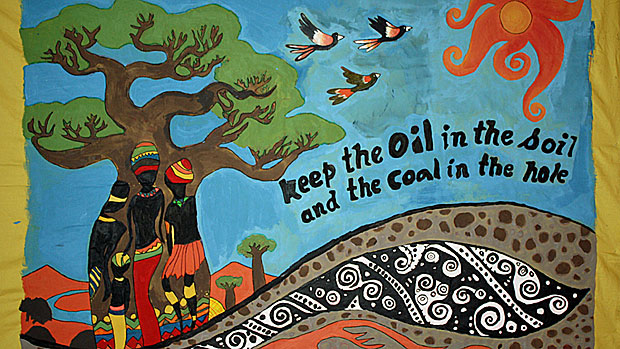
Indeed, so desperate were the Brazilian organizers of Rio+20 to cajole the British premier to attend, they changed the date of the conference so as to avoid conflicting with the much more important and worthy 60th anniversary celebrations of the Queen of England’s ascension to the throne. An attempt that proved ultimately and embarrassingly futile, as British Prime Minister, David Cameron, chose to cling to the coattails of President Obama and other G20 leaders in Los Cabos, as they calculate, connive and concoct the further dismemberment and disenfranchisement of communities of workers and peasants around the world.
In a further sad irony, to enhance attendance at Rio, Brazil is providing flights courtesy of the Brazilian air-force to those countries too poor to send delegates. It’s hard to imagine that the countries who can’t afford to send delegates to an environmental conference will have the financial capacity to take action to preserve biodiversity and a stable climate without international funding and technology transfer. But the concept or even use of the word “transfer” is exactly what the United States delegation is trying to excise from any document emerging from Rio+20.
In Los Cabos, 20 people wielding enormous economic power gather to ensure that nothing stands in the way of the international accumulation of money by their respective corporations; that capitalist growth continues, uninterrupted by paltry considerations such as democracy. Scheming and plotting in Los Cabos, the 20 leaders will huddle, concerned that their plans have been exposed by the people of Greece. As they jet to Mexico, one of the first countries to be devastated by the neoliberal prescription of privatization, deregulation and cuts to social spending, the election results in Greece ring in their ears as a collective rebuke to austerity and unemployment. In unprecedented numbers, Greeks exercised their democratic rights by voting for a previously obscure and marginal left coalition, SYRIZA and against handing the welfare of their country over to unelected technocrats governing from afar. A vote, it should be emphasized, carried out in the teeth of apocalyptic warnings of doom from central bank acolytes of the 1%, desperate to stop the people voting ‘the wrong way’.
As for the Global South, capitalist economic development, particularly since its neoliberal mutation, has been a disaster of gigantic proportions as money and natural wealth are siphoned into Western financial institutions. According to Oxfam, gross capital flows to developing countries fell from $309 billion in 2010 to $170 billion in 2011. Last year, aid donations from major donors experienced the first decrease in 14 years, dropping by $3.4 billion; overall aid was $16 billion below what the G8 committed to delivering in 2009. The drop in aid, along with legal and illicit financial transfers out of the developing world, mean that for every dollar received in aid (much of it tied to the purchase of materials from the West), 7-10 dollars go out. In 2009 alone, the developing world saw $903 billion disappear overseas thanks to a rigged system from which the majority cannot benefit. While 16 of the 20 members of the G20 have seen inequality increase over the last 20 years, as complement to that process, is it any wonder that developing countries seem to be permanently ‘developing’ even as social and ecological conditions there also worsen?
The violent dispossession that characterized the bloody dawn of capitalism captured by Marx in his writings on the enforced removal of peasants in the 1500’s amid the first acts of privatization – the land enclosures, is repeated in contemporary form through land grabs; his writing has a remarkably contemporary ring to it: “Thus were the agricultural people, first forcibly expropriated from the soil, driven from their homes, turned into vagabonds, and then whipped, branded, tortured by laws grotesquely terrible, into the discipline necessary for the wage system.”
In the 20 years since the optimism of the first Earth Summit in Rio, carbon emissions have increased by 50% and, since 1950, while the rest of the world has seen an average increase in temperature of 0.70C, the arctic, due to various positive feedback loops, has experienced double that. Absent serious action, whereas the world is now on track for 20C of warming, the arctic is on course for a truly calamitous 3-60C. The June 16th 2012 special edition of The Economist pondered an ice-free arctic with a mixture of trepidation, casual racist indifference and a general leaning toward monetary excitement: “In the long run the unfrozen north could cause devastation. But, paradoxically, in the meantime, no arctic species will profit from it as much as the one causing it: humans. Disappearing sea ice may spell the end of the last Eskimo cultures, but hardly anyone lives in an igloo these days anyway. And the great melt is going to make a lot of people rich.” Yes, to The Economist, while the change may be “devastating” to ancient and indigenous cultures, along with cold-adapted species, a certain small subset of humans will become rich while ‘making a killing’ – in all senses of the phrase.
We and the land have certainly changed and the continuation planned by the capitalists and their political representatives has unquestionably become impossible, as further capitalist development begins to contradict not just human rights or a sense of social progress, but the thermodynamic laws of the universe, which underpin a stable biosphere, upon which all life ultimately depends.
To quote British journalist George Monbiot on the reasons for the failure of so many environmental conferences, “These summits have failed for the same reason that the banks have failed. Political systems that were supposed to represent everyone now return governments of millionaires, financed by and acting on behalf of billionaires. The past 20 years have been a billionaires’ banquet. At the behest of corporations and the ultra-rich, governments have removed the constraining decencies – the laws and regulations – which prevent one person from destroying another. To expect governments funded and appointed by this class to protect the biosphere and defend the poor is like expecting a lion to live on gazpacho.”
From the other side of the political spectrum, representatives of the US environmental organization, Environmental Defense Fund, writing in a New York Times op-ed concede that “As the Arctic becomes ice-free, we can expect that it will be drilled for oil”. But, nevertheless, despite two decades of failure, hold out hope that with just a little more effort and market reforms such as cap and trade, 10 years from now we’ll be okay “with determination and the right policies, by the time Rio+30 rolls around, optimism might be the order of the day.”
Now, socialists are often decried as Utopians. We are told, our ideas may sound good in theory, but humans living equitably with one another in a democratic system based on cooperation, in a society that lives in harmony with the natural world, will simply never work in practice. Is it more realistic to believe that the same system that got us to this point will extricate us? The message from the ‘realists’ seems to be that while we may well have covered the arctic in drilling rigs by then, just give it another 10 years and things will be fine. Going beyond the wrong-headed pronouncements of the EDF, UN Secretary-General, Ban Ki-moon managed a level of fervor that would have put Dr. Pangloss himself to shame, “Increasingly, we understand that, with smart public policies, governments can grow their economies, alleviate poverty, create decent jobs and accelerate social progress in a way that respects the earth’s finite natural resources.”
One has to ask, who are the real Utopians? To many people around the world, leftwing and explicitly socialist ideas, along with class-based revolt, are re-emerging as real alternatives precisely because our rulers quite clearly have no answer other than an extension of the market into whole new areas. Meena Raman of the Malaysia-based Third World Network, was unequivocal in her denunciation of the US’s role in derailing climate negotiations in Durban in 2002 and in Rio+20: “Given the US stance, we do not want President Obama or any US leader to come to Rio to bury what was agreed in 1992 in Rio. We cannot expect the US to show any leadership in truly wanting to save the planet and the poor. So it is better for President Obama to stay at home.”
Meanwhile, 105 scientific institutions are urging action at Rio on population and consumption “For too long population and consumption have been left off the table due to political and ethical sensitivities. These are issues that affect developed and developing nations alike, and we must take responsibility for them together,” said Charles Godfray, a fellow of the Royal Society. Except that population growth is a function of poverty and it is in fact the countries with the largest levels of consumption, such as the United States and Europe, that not only are the historical cause of the ecological crisis, but are helping to drive it to its logical conclusion – a cascading collapse of ecosystems – by advocating continual economic expansion and the generation of poverty through the promotion of financial and trade agreements that accentuate inequality. Capitalism is like a shark; just as these animals can never stop moving forward for fear of drowning, so capitalism must grow or die.
It’s important to understand why negotiators see the primary way to save the environment is through putting a price on it. This is the main thrust of the talks and accepted by all negotiating parties inside the conference, representing a major schism with the tens of thousands of protesters attending the Rio+20 People’s Summit who are being forcibly kept out of the deliberations by armed riot police.
The argument goes that only by giving natural resources “value” in monetary terms can the environment be protected. On the one hand, it’s easy to see the further privatization of every molecule of water, every tree and every piece of land as dovetailing beautifully with the desires of the corporations. Extending the “free” market to new areas for exploitation is a tried and true method to enhance profits. Those who run the corporations are not slow to catch on and self-advocate: “For companies this is enlightened self interest…Those who can afford water should pay. Water is essentially over exploited because we are not valuing it as an economic good. Introducing methodologies such as escalating tariffs, which some countries have already done, will help in terms of using water intelligently, often for the first time.” So said, Gavin Power, deputy director of the UN Global Compact, which is acting as an umbrella group for 45 of the most powerful CEO’s, from such well-known environmentally conscious concerns as Coca Cola, Glaxo-SmithKline, Nestle, Merck and Bayer, to ensure their voice is heard at Rio+20.
But advocacy for the “valuation” of natural resources occurs not just or even primarily because it coincides with what corporations want. Many of the people arguing for such quantization of nature genuinely believe it will help preserve biodiversity, slow climate change and reduce the pressure on natural resources.
More fundamentally, the need to place “fair value” on everything is part of the ideological foundation of capitalism. Within the philosophy of capitalism, if something does not have a price, it cannot have value. Hence, putting the correct price, otherwise known as internalizing the cost, of a natural good, is to make possible its rational exploitation and simultaneous conservation. To those mired deep within the labyrinth of a capitalistic value system, there is no contradiction between these two aims: the commodification of nature can be seen both as a way of making money from it, and as a way of saving it, as perfectly expressed by Ban Ki-moon.
The quantification of nature is the rational end-point of capitalism’s philosophical approach to nature and hence a practical approach to ‘saving nature’. The non-quantifiable, qualitative side of nature, the purely spiritual and awe-inducing beauty of watching a sunrise for example, is not only entirely absent, or under-appreciated, it is essentially unknowable. Hence, assuming you’re not prepared to advocate regulatory reforms to place limits on the operation of corporations and boundaries beyond which they cannot cross, or you’re not advocating revolution, then extending the market becomes the only option left, consequently the focus at Rio+20 on doing exactly that.
However, for those of us who truly want to see a better world, the extension of its commodification to every single particle of nature cannot be an answer. Taking our inspiration from the rising struggles of 2011 around the globe, it is imperative that we link up the movements of social resistance, and forge new alliances with organized labor and the disenfranchised of the planet to force regulatory changes onto those who would foist false solutions on us. Only by linking social and ecological change and fighting on both fronts, autonomous of mainstream political parties, while creating our own independent battle organizations, can we hope to make progress.
Ultimately, however, it is just as vital that fighters for social emancipation, human freedom and ecological sanity, recognize that capitalism represents the annihilation of nature and, thus, humanity. A system based on cooperation, real democracy, long-term planning, and production for need not profit, i.e., socialism, represents the reconciliation of humanity with nature. And its achievement will, as Marx pointed out, of necessity be much less violent than the process by which capitalism was born in the first place:
“The transformation of scattered private property, arising from individual labor, into capitalist private property is, naturally, a process, incomparably more protracted, violent, and difficult, than the transformation of capitalistic private property, already practically resting on socialized production, into socialized [common] property. In the former case, we had the expropriation of the mass of the people by a few usurpers; in the latter, we have the expropriation of a few usurpers by the mass of the people.”
We currently live in an age that has been characterized as the Anthropocene, the Age of Man, by some scientists to take into account how drastically human civilization has altered the biosphere on a geological time scale. Only by overthrowing capitalism and moving toward a cooperative, planned economy based on democracy and sustainability can we move toward an age characterized, after Epicurus, as the Oikeiotocene – The Age of Conformity to Nature.
New Media but Familiar Lack of Diversity: Women, people of color still marginalized online
This article by Janine Jackson is re-posted from Fairness & Accuracy in Reporting.
Recent years have seen much rallying around “traditional” journalism in the face of its supposedly imminent demise, including the mythologizing of pre-Internet news media as a force of social cohesion. Lamenting the “culture of observing events from ‘inside’ a community,” Washington Post columnist and associate editor David Ignatius (5/2/10) contended:
When the information landscape was dominated by three networks and a few major newspapers, journalists were trained to report for everyone. Now, niche audiences want more intimacy and connection—even if that means less old-school independence and objectivity.
Traditional outlets, of course, did not and do not report “for everyone,” but demonstrably exclude and marginalize many people and perspectives, particularly the less politically and economically powerful (Extra!, 5–6/02, 5–6/05). Progressive critics and activists, seeing corporate journalism’s “crisis” as an opportunity, hoped that newly emerging outlets would avoid repeating those myopic patterns, forging not just new pay structures, but a new definition of news as something more than what powerful people say and do.
To what extent have digital media lived up to these hopes? There are a number of ways one could assess this dimension of “new-school” media, but the question of how they’re doing at incorporating values of gender and racial/ethnic diversity seems a key one.
Anecdotal impressions about online diversity abound, but attempts to measure representation face methodological difficulties, starting with how to define the arena being mapped. The Gender Report’s nascent Gender Check project (genderreport.com) monitors “the lead articles from two websites—one associated with a newspaper and one considered online-only—in each of the four geographic regions as defined by the U.S. Census.” Just a snapshot, to be sure, but after examining some 354 articles in 2011, the picture for women was pretty dim.
Women bylined just 31 percent of articles in online-only outlets, slightly less than the 34 percent they wrote for newspaper sites. Web outlets did a little better than their counterparts when it came to sources, but both did poorly: Women were 29 percent of sources in online-only news stories, compared to 23 percent at newspaper sites.
An ongoing byline survey by the Op-Ed Project includes Salon and Huffington Post along with a handful of other outlets. The most recent snapshot (3/21–27/12) found 20 percent female writers at Salon, 31 percent at Huffington Post. (This compares with 35 percent female bylines at the L.A. Times, 15 percent at the Washington Post.) The Op-Ed Project plans research on what women write about, to see if their contribution is sought on a range of issues, or overwhelmingly on the smaller number of women-associated issues, like childcare, that the group calls “Pink Topics.”
The pattern isn’t new, or confined to the U.S. The Global Media Monitoring Project included online news (though not online-only) in its worldwide, volunteer-based research for the first time in 2010 (WhoMakesTheNews.org), studying a day’s news on 76 national news websites in 16 countries and eight international news websites (a total of 1,061 news items). Women reported just 36 percent of the news stories in their sample, and were 23 percent of the stories’ subjects.
When it comes to race, the first thing you notice is how few outlets want to talk about it. The American Society of Newspaper Editors (ASNE) got 75 online-only news organizations to respond to their 2011 census—up from 27 in 2010, but still too few to say much about. Those who did respond included ProPublica, which reported 19 percent of newsroom staff were black, Hispanic, Asian American, American Indian or multi-racial, Factcheck.org (17 percent), Texas Tribune (35 percent), Sacramento Press (20 percent) and Connecticut Mirror (29 percent). Online outlets reporting no people of color in their newsrooms include the Madison, Wisc., Capital Times, State-line.org, MinnPost.com and the New England Center for Investigative Reporting.
Some outlets refuse to participate on principle. Yahoo! News, the most visited news site on the Web, claims divulging staff diversity data would threaten “trade secrets”; the website (along with Google and Apple) had earlier persuaded the Labor Department to endorse its argument that any public disclosure of such information would cause “significant competitive harm” (San Jose Mercury News,) 2/14/10. Talking Points Memo’s Josh Marshall (Journal-isms, 4/15/12) objected to the survey’s focus on editorial employees, leaving out the “tech and publishing parts of the company.” The Daily Beast didn’t remember being contacted; Huffington Post and Slate say they plan to take part next time around.
Though diversity in staffing is critical, news outlets have other ways to incorporate underrepresented perspectives. As with gender, there’s little by way of in-depth research on issues of story choice, but one yearlong look at the home pages of popular sites Huffington Post, the Daily Beast, Slate and Salon (Nieman Reports, Fall/11) described a dispiritingly familiar world in which African-Americans are usually celebrities or athletes, Latinos appear primarily in sporadic immigration stories, and Native Americans and Asian-Americans go missing.
“Mainstream online media,” concluded Jean Marie Brown, “are caught in the same loop that ensnared legacy outlets. Their view of minorities is limited and that in turn hinders their ability to broaden their coverage,” to “reflect people of color in all walks of life.”
Things as they are, one might be heartened by an outlet like Huffington Post’s announcement of a news section dedicated specifically to the voices and stories of African-Americans. “Our goal is to cover more stories of importance to the black community,” site founder Arianna Huffington stated (AP, 1/20/11), even if, as the site’s 27th section (somewhere between HuffPost Travel and HuffPost High School), HuffPost GlobalBlack might’ve sounded like something of an afterthought.
Rebecca Carroll ran GlobalBlack and oversaw its relaunch as “Black Voices” after Huffington Post’s merger with AOL. She had hopes of fomenting “a nuanced narrative about race” (New York Observer, 6/29/11) that would be “authentic” (“It’s not black voices if it’s not black”) and also of interest to a broad audience; “it’s really hard to accomplish that.”
It doesn’t sound like she got much chance. Asking a (white) supervisor how to respond to inquiries about GlobalBlack after the relaunch, Carroll reported (Daily Beast, 3/30/12): “She said: ‘Ignore them! No one cares!’”
It came to sum up my experience to a large extent. Although we did assemble a great team of black writers and editors, the more I tried to guide the mission forward—proposing thought-provoking stories and headlines that countered stereotypes and truly represented black voices—the more clear it became that this was bad for business. An in-depth multimedia profile of Anita Hill to mark the 20th anniversary of the landmark case was deemed not buzzy enough. A provocative black media figure I suggested as a regular contributor was dismissed as “gross.” My idea of ignoring Black History Month, which many black Americans feel has become nothing more than a diluted and packaged ritual, was deemed unacceptable, given the advertising dollars it generates.
I’m not saying this is racist—a business needs to stay in business. As Erica Kennedy points out, “A corporation exists to make money, not to solve societal ills.” But still.
In the days leading up to the relaunch of Black Voices, an executive decision was made to have white journalists at the Huffington Post write most of the stories featured on the first day.
It’s doubtful that Carroll’s is the only experience that suggests that without explicit recognition of how sponsors and owners narrow the range of acceptable content (in ways and for reasons that can, in fact, be racist), and without honest reckoning with the differing definitions we all carry about what news matters, covering “stories of importance” to underrepresented communities will remain an “on paper” priority.
Even done well, the “special section” model invites questions. Are they places for those generally marginalized to speak authentically, without filter? Or do they unnaturally barricade perspectives, like the Women’s Pages of old, with their implication that the rest of the paper, the “real” news, concerns only men? Writ larger, the question applies to what Ignatius derides as “niche” outlets: What some denounce as “blogger apartheid” is celebrated with equal vigor by others as an advance over deferential (and fruitless) appeals for inclusion.
The answer might be that spaces created by and for people of color, or women, or any community can be a vital part of a healthy, varied media landscape, but are not a substitute for forums where these perspectives intersect and interact, as they do in life. Contrary to Ignatius’ suggestion, most people don’t want to talk only to themselves, or to never be challenged. They do want to participate in arenas where they, and the issues they care about, are respected, not devalued or erased.
It should be uncontroversial that media outlets should not be allowed to discriminate, any more than insurance companies or realtors. But media diversity has never been only an end in itself; it has been a way to expand public debate as a means toward social change.
And if influencing the public conversation is the aim, we can perhaps be encouraged by the success emerging media have had pushing stories affecting communities of color (and illuminating race and class inequities) out to a wider world, as when ProPublica (with local New Orleans media) brought a spotlight to police violence in the wake of Hurricane Katrina, or when the loose network of bloggers some call the Afrosphere brought the Jena Six story to national attention. The story of Georgia’s Scott sisters, black women serving life sentences for the (disputed) theft of $11, found its way to the New York Times et al. through minority-focused sites like Richard Prince’s Journal-isms.
Journal-isms was itself a response to online media’s limited vision. The Maynard Institute for Journalism Education’s Dori Maynard took veteran journalist Prince’s column online in 2002 out of frustration, she says (Journal-isms, 11/11/11), with the lack of attention to people of color in Jim Romenesko’s widely read industry website. She cited the resignation letter of L.A. Times reporter Alisa Valdes-Rodriguez, which blasted that paper’s diversity efforts.
Valdes-Rodriguez’s letter “went all around” the Latino and black online communities, Maynard said, while “it took Romenesko a month to six weeks to catch up.” She thought the story “showed how many people are being left out of the coverage. Then it turns out that the person who was critiquing the coverage was leaving out the same people.”
To include those who have been left out is a baseline requirement for media producers who want to work not just in new formats, but in a new way.
Obama Memo Deferring Some Deportations Not a Victory For Latinos, Immigrants or Human Rights
This article by Bruce Dixon is re-posted from Black Agenda Report.
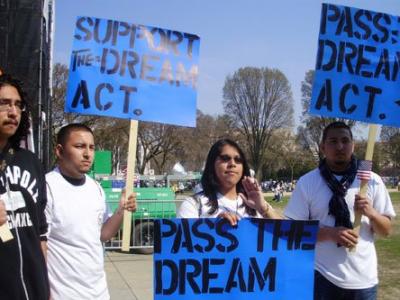
Last week’s presidential announcement that “prosecutorial discretion” would be exercised to halt deportation proceedings against young undocumented persons with spotless police records and honorably discharged veterans was neither a sign of growing presidential enlightenment, nor was it any kind of major victory for the human rights, Latino or immigrant rights movements.
First of all, it was not an executive order, a thing that federal agencies are bound by law to carry out. It was a presidential announcement accompanied by a low-level memo. Two similar memos have been issued by this administration before, with similar hype from the White House and identical celebrations by immigrant rights activists. Both were disregarded by ICE, the Bureau of Immigration, Customs and Enforcement, which just kept on deporting everyone it could lay hands on.
Secondly, to get your deportation proceedings deferred under the memo you have to come out of the shadows, register as an out-of-status person and wait to see if “prosecutorial discretion” will be applied to your case. It might or might not. There’s no appeal, and once you register they know who and where you are. Good luck with that.
Third, the memo says that to qualify for deferral of your deportation, you can’t have felonies or even “significant misdemeanors” on your record. That’s not just a high standard, it’s a brand new one that lawyers and judges have not yet defined. Many Latino immigrants live in communities where racially selective saturation policing bestows police records upon disproportionate numbers of young males.
Fourth, most of the million-plus already deported by the Obama Administration were never college grads, college students, college-bound or vets. They were ordinary working people and their families. The memo being celebrated by immigrant reform activists does nothing to slow down their deportations. College graduation, in the US has become a kind of class distinction, and the immigration reform movement and Democratic Latino leaders seem to be acting in the interest of one class of immigrants while abandoning the needs of the rest.
Fifth, immigration reform activists and their allies rarely mention that as the DREAM Act as presently written makes joining the military as a road to citizenship a much easier path than college. Page 12 of the Pentagon’s FY 2012 Strategic Plan states that to achieve its manpower goals it needs access to immigrant populations. This may be the real point of the DREAM Act.
Sixth, since the Obama administration itself initiated the most massive wave of deportations in US history, it also could have stopped them six months, a year, two years ago. So calling press conferences, as Chicago Congressman Luis Gutierrez did, to thank the Obama Administration for maybe stopping deportations just of vets and college-bound youth with spotless records is like expressing sincere gratitude to a brutal assailant who’s beat every square inch of your body the last three years, when he announces he might start going easy on the head and groin shots from now on. If you ask him nicely.
This is not a victory for the human dignity of immigrants. It’s a no-cost cynical ploy by the Obama Administration a few months before the election to shore up his sagging support in the Latino community. In 2008 Obama received more than two thirds of an abnormally large Latino vote, which made the difference in several states.
The White House knows what it needs and is going for that. The Latino and immigrants rights communities ought to do the same. For Black Agenda Radio I’m Bruce Dixon. Find us on the web at www.blackagendareport.com.
New Media We Recommend
Below is a list of new materials that we have read/watched in recent weeks. The comments are not a “review” of the material, instead sort of an endorsement of ideas and investigations that can provide solid analysis and even inspiration in the struggle for change. All these items are available at The Bloom Collective, so check them out and stimulate your mind.
Crusade 2.0: The West’s Resurgent War on Islam, by John Feffer – This is the most recent book by the co-director of the Institute for Policy Studies, John Feffer. Crusade 2.0 provides invaluable analysis of US policy towards the Muslim world, both abroad and in the US. However, the author also gives readers a solid foundation on the history of the European Christian Crusades and the justifications for slaughtering Muslims during those crusades. Feffer says that the myths about this history are still used to justify policies towards Muslims, that they are violent and that they want to rule the world. Feffer then covers the period from the fall of the Ottoman Empire through the Cold War and the post-Soviet era. The book also spends some time looking at Europe’s growing Islamaphobia and how it moved from the margins to core aspects of state policy. This point is the most important of the book, in that it is not just the far right that promotes Islamaphobia, but liberals, both in government and in academia who justify a war on Islam.
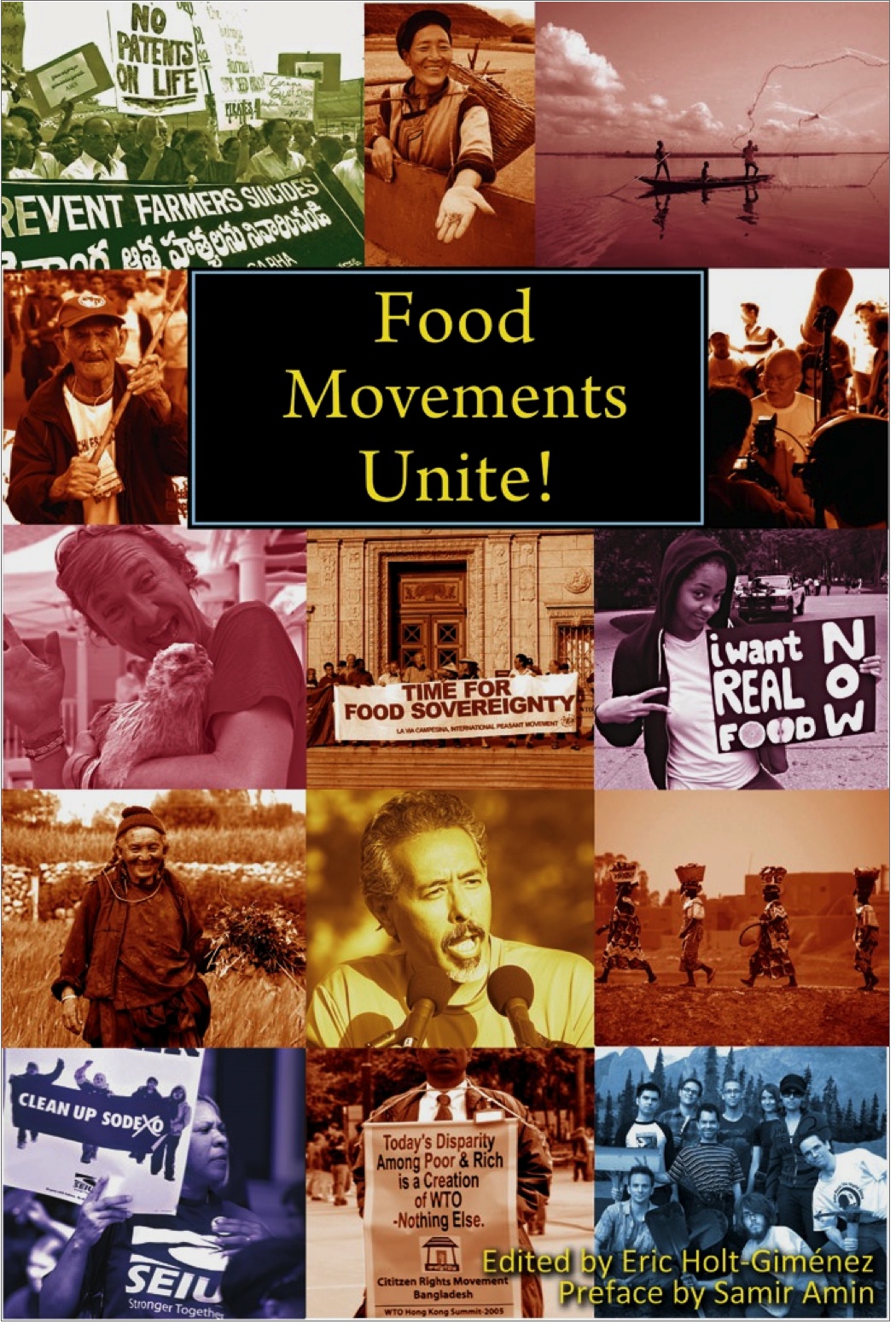
Food Movements Unite!, edited by Eric Holt-Gimenez – With more and more attention given to eating local and organic, this volume of essays is an important contribution to the issues faced by organizations working with the current food movement. The authors of these 20 essays agree that the neoliberal and reformist approaches to food justice are not only inadequate, they perpetuate the current inequities in food access and lack of food justice. The book makes it clear that a more radical approach is necessary to both dismantle the current corporate food system and create a new democratic food system where humans and the land are not exploited. There are contributions from individuals and organizations around the world providing both a critique and best practices on the growing and distribution of food. The contributors also agree that the various entities – women’s groups, urban agriculturalists, small farmers, youth, farm workers and minority movements need to unite or at least find more common ground in responding to the current food crisis.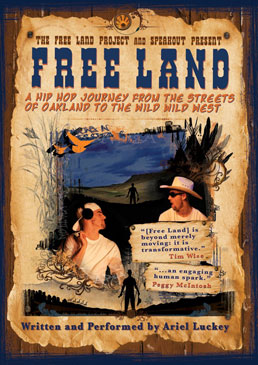
Free Land: A Hip Hop Journey from the Streets of Oakland to the Wild Wild West, (curriculum & DVD) by Ariel Luckey – How does one deal with racial privilege? This is a question that Ariel Luckey not only asks, but one he answers with passion and clarity, he answers that question by sharing with us his own journey in coming to terms with privilege and working for racial justice. Free Land is part performance art, part spoken word, part testimonial and part history lesson. Luckey uses Hip Hop as it was meant to be used, as a tool for speaking truth and for challenging business as usual politics. The DVD is informative and entertaining, but add to it the curriculum guide and you have both creative and constructive means to engage people into looking at how they benefit from racial privilege, how we need to learn from people’s history and enter into solidarity with communities of color that continue to be confronted by institutional racism. A great resource and a model of how we can do popular education.

There have already been several major blockbuster films this year, with the most recent being The Avengers and Prometheus.
Before each of these films there is tremendous hype, with TV ads, online promotions and the use of all kinds of social media. Much of the hype and marketing is connected to products and cross-promotional campaigns connected to the films.
We have looked at product placement in films for the past ten years, with a report and documentary film produced in 2002. We have since looked at product placement in films with another report in 2010 and an article just this past December.
Product Placement in films is so normal that many of us don’t even notice it anymore. The contractual use of products in films has also evolved from just making any appearance in the film to sometimes being an integral part of the plot. In addition, many films also come with licensing agreements, which means the use of the film or film characters to sell products that do not even appear in the movie.
During the first half of 2012, this trend in Product Placement in films has not diminished. Take for example last weekend’s opening of the film Madagascar 3. The featured brands in this animated film are Airbus, Central Park Zoo, Cirque du Soleil, Duane Reade, Ducati, Ferrari, HP and the New York Knicks. Licensed products (products using film characters as marketing tools) are also numerous, with brand names such as Citi, General Mills, Kraft (JELL-O), L’Oreal, Lowe’s, McDonald’s, Sun-Maid and Hallmark are all using the film to market their brands. Indeed, it is expected that there will even be video games based on Madagascar 3, with game development in the works by Nintendo DS, Nintendo Wii and Xbox 360.
Men in Black 3, which opened in late May features 23 different branded products, such as: Aqua Velva, Cadillac, Coca-Cola, Cracker Jack, Dunkin’ Donuts, Ford, Ford Taurus, Glamour, Hamilton, Louis Vuitton, Mack, NBC, New York Examiner, New York Jets, New York Mets, New York Post, Rolaids, Roosevelt Hotel, Spalding, STP, Tsingtao, Viagra and Weekly World News.
Other movies with a significant number of product placement in the last six months are Contraband with 14 branded items in the film, Chronicle with 18 brands, The Vow with 16 brands, Safe House with 11 brands, 21 Jump Street with 28 brands, Think Like a Man with 24 brands and The Avengers with 19 branded items in the film.
Most of the branded items in these films have limited roles, such as CNN in Safe House or Budweiser in Contraband. Films that target younger audiences tend to have more branded items or at least branded items that take on a more important role in those films.
On example is 21 Jump Street, which featured 28 branded products with the backdrop of the film taking place in a high school. Another example is Chronicle, which features three high school boys. The movie is shot mostly through a handheld Sony camera, through the eyes of one of the main characters, with most of the settings taking place in spaces where high school students hang out – parties, restaurants, mall parking lots, school and each other’s home. In one scene, all three main characters are hanging out on school bleachers, where they are eating Pringles, drinking Pepsi and using digital handhelds. This is not an unusual dynamic for high schools, but by using branded items it normalizes their role in youth culture, even youth who are anything but normal.

Whatever one may think about the existence of branded products in movies, it is clear that they will remain one of the main forms of marketing in a hypermedia world.
 Grand Rapids Institute for Information Democracy