Michigan Hate Crimes Conference: Vincent Chin – A 30 Year Retrospective on Lessons Learned
The presenter of this session was Tom Hayashi, with the Organization of Chinese Americans. Hayashi began by showing a clip from the film, Who Killed Vincent Chin?
Vincent Chin was beaten to death by two White men in Detroit, with the clear motivation of racial hatred. The backdrop to the story, as it has often been presented, was that one of the killers was an out of work autoworker who beat Chin because he thought he was Japanese and the Japanese were responsible for the US auto industry’s decline.
Initially the two White men charged with the murder did not jail time and only got 3 years of probation. Hayashi stated that this was a wake up to the Asian-American community that it was finally time for their community to stop being nice.
Hayashi then talked about a case against Danny Chen, an Asian American who had joined the US military. Chen was deployed in Afghanistan and upon arrival he was harassed and intimidated by fellow soldiers because of his racial heritage. Chen was also physically abused on numerous occasions and on one day, after being hit with rocks being thrown by other soldiers, was later found dead from a gun shot wound. The military said that Chen had shot himself, but there is no conclusive evidence that Chen took his own life.
Hayashi then provided a much larger historical context around the treatment of Chinese and other Asians in US history in this country. He mentioned that treatment of the Chinese during the construction of the railroads and the racist immigration policies that were adopted in the late nineteenth century that resulted in the deportation of thousands of Chinese.
Hayashi then talked about how Chinese and other Asian Americans are the target of racist stereotypes in political campaigns. Here is a video by Citizens Against Government Waste that demonstrates deeply entrenched racism.
Hayashi then shifted the conversation around the importance of an intersectional analysis, so that deeper relationships can be developed to create more effective strategies for justice. Hayashi said that African Americans must develop relationships with the LGBT community and that the LBGT community needs to development stronger relations with feminist groups and that feminist groups need to collaborate with Asian American organizations.
The presenter stated that we need to figure out ways to find common cause with groups that have a different focus, but where there might be intersecting interests.
Michigan Hate Crimes Conference: Housing and Hate Crimes
This is the first of several articles based on presentations taking place at the Michigan Response to Hate Conference in East Lansing.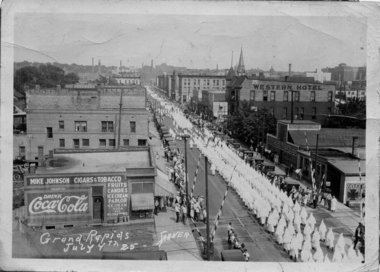
The first presenter at today’s Michigan Hate Crimes Conference was Brian Greene, with the US Department of Housing and Urban Development. Greene provided an overview of hate crimes and racism and its lasting impact on housing in America.
Greene began by talking about the history of the KKK in the US and Michigan. The Klan had numerous large rallies in Michigan prior to WWII, with a major rally taking place in Grand Rapids in 1925, as can be seen in this photo.
Greene then discussed the case of Dr. Henry Sweet, who challenged the norms of White Supremacy in Detroit by buying a house in an all White neighborhood. Sweet and his family were the target of violence, which led to a famous legal case involving Clarence Darrow.
These historical examples were used by Greene to provide a framework for ongoing hate crimes against minorities who dared to move into all White neighborhoods or communities. One recent example that Greene provide was of a hate crime committed in 2010, where an undocumented Mexican immigrant was murdered because he was Mexican, a case that is the subject of a new film, Shenandoah.
Greene provided a few other examples, in particular a case in New York involving John White. White was a Black homeowner in a predominantly White neighborhood in Long Island. Smith’s son was one of a few Black students at the local high school. His son was at a party one night and was asked to leave based on a fake social media posting that claimed White’s son was a rapist.
White’s son left and went home, but was followed by a group of White students who made threats against White. When the boy arrived at home he told his father he was being threatened by this group of White students. The White students arrived, they made racial threats against the father and son. Mr. White was holding a pistol when it was knocked out of his hand, by one of the White students. The gun went off and one of the White boys was shot. During the trial White argued that he was defending his family. White went to jail, but was later released based on a new ruling after the courts acknowledged the role that racial hatred played in this case.
By way of conclusion, Greene made the point again that the current housing disparity and discrimination in the US is rooted in this history of racial hatred that is manifested today.
One issue that Greene did not address was how gentrification fits into the institutional discrimination against racial minorities and the working class poor in urban centers across the country.
Striking Neoliberalism in Chicago
This article by Paul Street is re-posted from ZNet. Go to this link to read all the sources for the article.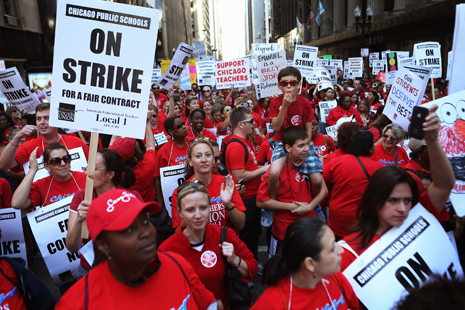
The strike currently being waged by the teachers’ union in Rahm Emmanuel’s Chicago is quite remarkable. A critical underlying issue is how teachers’ performance is appraised. Under a new assessment system that strongly ties teacher evaluations to student test scores, the city is threatening to put “as many as one-third of Chicago’s teachers on track for termination.”[1]
In Chicago as in school districts across the country, the educational authorities have made students’ scores on standardized tests the sacred gauge of whether a teacher deserves to keep her job.
A big problem with this method of measurement is that teachers have no control over what serious researchers have long shown to be the primary determinant of students’ performance on such tests – those students’ home and neighborhood environments and socioeconomic (class) status.[2] As Gary Orfield of the Harvard Civil Rights Project noted eleven years ago, “When students come to class hungry, exhausted, or afraid, when they bounce from school to school as their families face eviction, where they have no one at home to wake them up for the bus, much less look over their homework, not even the best-equipped facilities, the strongest curriculum, and the best-paid teacher can ensure success.” [3]
“Attempting to fix inner city schools without fixing the city,” education professor Jean Anyon noted in her 1997 book Ghetto Schooling, “is like trying to clean the air on one side of a screen door….Educational change in the inner city, to be successful, has to be part and parcel of more fundamental social change. An all-out attack on poverty and racial isolation that by necessity will affect not only the poor but the more affluent as well will be necessary…” [4]
Teachers also do not control the wildly divergent levels of per-student spending that different schools receive under local and state funding formulas that provide more for kids situated in property-rich school districts and less for those stuck in districts with a weak tax base.
Blaming teachers for low test scores in under-funded urban schools with high proportions of poor and deeply disadvantaged students from broken neighborhoods and fragile families is like blaming a farmer for not having a bumper crop after a drought. It’s like blaming a bus-driver for being behind schedule when much of her route is closed by a flood. It is an especially noxious practice in the weak recovery wake of the Great Recession, which pushed U.S. poverty to its highest recorded levels while squeezing school budgets like no time in recent memory – a double whammy for student/teacher “performance” that can hardly be blamed on teachers (Wall Street and “the 1%” are more appropriately to blame, to say the least).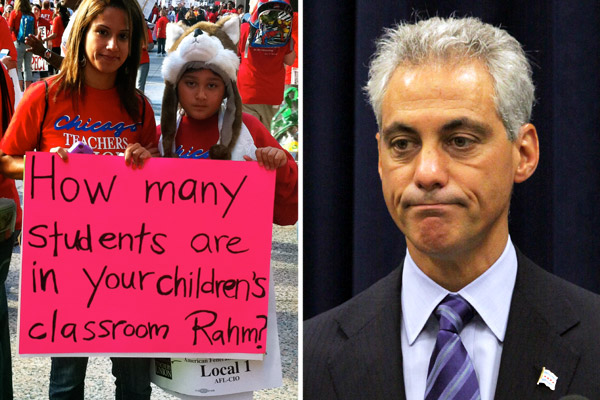
Another problem with the dominant teacher-assessment paradigm is that it incentivizes schools and teachers to gear instruction around the test. This turns the educational experience of many poor and minority children into little more than an authoritarian “drill and grill” exercise focused on repetitive answer-giving mechanics and repetition. That is a surefire way to turn kids off and squelch schools’ capacity to cultivate the many-sided and question-asking critical thinking that democracy requires. As the legendarily eloquent schools author and poor children’s advocate Jonathan Kozol has noted, test-targeted curriculum subordinates “critical consciousness” to “the goal of turning minority children into examination soldiers – unquestioning and docile followers of proto-military regulations.” Under its reign, the prolific left social critic and education expert Henry A. Giroux notes, “Teachers are prevented from taking risks and designing their own lessons as the pressure to achieve passing test scores produces highly scripted and regimented forms of teaching…worksheets become a substitute for critical teaching and rote memorization takes the place of in-depth thinking…Learning facts…becomes more important than genuine understanding.”[5]
This might seem to be a strictly “Republican” paradigm. In fact, however, the neo-Dickensian testing mania is richly bipartisan, like the vicious 2001 No Child Left Behind Act, which mandated funding and other federal penalties for schools that do not miraculously raise poor and minority children’s test scores and thereby contribute to the overcoming of the racial and ethnic “achievement gap.” The mania is enshrined in the Obama Education Department’s “Race to the Top” policy, which uses federal cash grants to encourage school districts to link teacher evaluations to student test performance and to increase their number of non-union charter schools. Obama’s former chief of staff and current leading Obama fundraiser and Chicago Mayor Rahm Emmanuel is a firm proponent of the use of standardized tests without reference to socioeconomic context to assess the merit and performance of students, teachers, and public schools.
Why this preposterous and educationally counter-productive method of teacher and schools assessment in Chicago and indeed across the country? Partly it may reflect policy makers’ fatalistic sense that “social class differences are immutable and that only schools can improve the destinies of lower class children.” This, the liberal educational researcher and author and author Richard Rothstein noted eight years ago, “is a particularly American belief – that schools can be virtually the only instrument of social reform.” [6]
Another factor is racism. Behind the testing frenzy lurks the nasty assumption that predominantly black and Latino poor students do not merit anything more than Giroux’s “highly scripted and regimented” curriculum, which would produce major student and parent rebellions if introduced in affluent white suburban school districts.
At the same time, the test-based policy is a convenient level for the neoliberal rollback and elimination of public teachers’ unions and for the related movement to turn public schools over to private corporations. Along with Republicans and many top Democrats, Mayor Emmanuel and Obama Education Secretary Arne Duncan are determined to advance the privatization/corporatization of American K-12 education. If they share the belief that “only schools can improve the destinies of lower-class children,” they also want to make sure that those schools are as private and authoritarian of possible, free from (among other things) pesky teachers unions, which hinder authorities’ cherished “flexibility” by insisting on irritating things like decent pay, resources and downtime for workers on the rugged instructional front lines. The sadistic game of blaming and shaming teachers for poor kids’ test scores is very useful for the politics and public relations of de-unionization and privatization, masquerading as “school reform.” Teachers unions and indeed public schools themselves become perfect foils for the corporate agenda of misdirecting legitimate popular anger over the failings of the educational system. The misdirection naturally ignores the deeper determinant role of the nation’s steep and savage class and related racial inequalities to advance the false undemocratic solution of corporatization, sold as “choice” and “the free market.”
It is fitting that the right wing Romney-Ryan campaign has gone out of its way to express bourgeois class solidarity with Rahm Emmanuel,[7] who received $12 million from ant-union charter school advocacy groups in his 2011 mayoral election.[8] The Obama campaign has predictably kept its distance from the Chicago conflict even as it advances the neoliberal testing agenda that lay very much of the heart of the strike.
National quadrennial electoral extravaganzas notwithstanding, the progressive Chicago Teachers Union has courageously drawn a line in the sand against the teacher-, student-, neighborhood- and public education-bashing schools agenda of the bipartisan and neoliberal elite. According to the progressive, Chicago-based historian Rick Perlstein on Salon, the fight the teachers have undertaken is a very big deal.“ If Chapter 1 of the American people’s modern grass-roots fight against the plutocracy was the demonstrations at the Wisconsin State Capitol in the spring of 2011, and Chapter 2 was the Occupy encampments of that summer,” Perlstein writes, “the Chicago Teachers Union’s stand against Emanuel should go down as Chapter 3. It’s been inspiration to anyone frustrated that people have forgotten how good it feels to stand up to bullies — and how effective it can be.” That’s no small praise. Whether Perlstein is right or not about that (I hope so), the Chicago teachers richly deserve our support and assistance. [9]
Anti-fracking march in Grand Rapids next Friday, September 21

Next Friday, September 21, the Grand Rapids group Mutual Aid GR invites everyone to participate in an action for the International Day Against Fracking.
The actual international day of protest is September 22, but Mutual Aid GR is doing on the 21st for reasons they will share before the march starts at noon.
There is a growing global resistance to the practice of hydraulic fracturing, also known as fracking. Some states in the US are looking to pass laws banning the practice, but more importantly communities are organizing and engaging in direct action against the oil & gas industry’s desire to extract more oil and gas domestically.
In Michigan, there is a petition campaign being organized by Ban Fracking Michigan and there are at least 11 other communities in Michigan that are hosting an event or action on International Day Against Fracking.
People have also been resisting the sale or leasing of public land by the State of Michigan for the purpose of oil & gas exploration. In May, there was a significant protest in Lansing at a DNR land auction and many people are already preparing for the next DNR land auction, which is scheduled for October 24.
The Facebook event created by Mutual Aid GR states:
In solidarity with communities surviving and resisting the destructive oil and gas extraction method known as “fracking”, we will march through Grand Rapids for Global Anti-Fracking Day, starting at Veteran’s Park on Fulton & Sheldon.
People are encouraged to bring signs and be ready to march in downtown Grand Rapids to make a statement against fracking in Michigan.
Grand Rapids Global Anti-Fracking Day March
Friday, September 21
Noon
Meet at Veterans Park on the corner of Fulton & Sheldon
Dow Chemical wants to expand fracking in Michigan

Yesterday, MLive posted a story about a Press Conference held in Lansing where Michigan chemical companies, such as Dow, were advocating for an increase in exploration of natural gas in this state.
This is not a surprise coming from Dow Chemical, which announced the construction of a new multibillion-dollar natural gas facility in Texas. Dow uses natural gas for production and application of many of the chemical products they manufacture.
What was interesting about the MLive story was that chemical companies were joined by two State Representatives who echoed the desire to increase the amount of natural gas exploration and extraction in Michigan.
The two representatives were State Reps. Charles Brunner, D-Bay City and Aric Nesbitt, R-Lawton. The MLive reporter notes, “Brunner acknowledged environmental concerns about the chemicals injected into the ground during fracking, but said he’s sure it can be done safely in Michigan given the state’s environmental regulations.”
What the MLive article leaves out is that Rep. Aric Nesbitt sits on a House committee that has looked at and made recommendations to increase natural gas exploration in Michigan.
Another issue the MLive story omits is the amount of money spent by corporations and business associations to lobby Michigan legislators and money given to candidates for office in Michigan in order to buy influence on gas exploration and fracking. According to Common Cause nearly $3 million has been spent in Michigan to influence fracking policy over the past decade.

The MLive article does state that there is a mild effort by some state legislators that would require more research on the environmental impact of fracking and that there is a petition campaign to put on the ballot in 2014 a moratorium on natural gas fracking.
What the MLive story does not acknowledge is the growing public resistance to fracking as was demonstrated at the DNR land auction in May or the fact that there are several anti-fracking actions being organized across the state for the international anti-fracking day on Sept. 22.
West Michigan Policy Forum Day II: Three Wealthy CEOs talk “downtown development”
The second day of the West Michigan Policy Forum began with comments from the Chairman of Haworth, Matt Haworth. He talked about how his company doesn’t refer to their workers as employees, rather they are “members.” This reflected another linguistic slight of hand that makes workers feel as if they are valued, without having any power, especially since they are not unionized.
Haworth also provided a summary of the first day themes and what day two will entail. He also facilitated some online voting by attendees around the issue of what would be on Michigan’s November ballot. This very public voting, once again demonstrated that this forum is highly political and even reactionary, since the online voting overwhelmingly showed opposition to the Protect Our Jobs ballot, the Home Health Care ballot and the Renewable Energy initiative.
Morning Session – Day 2
The first session of day two maintained a similar pattern, by having another journalist facilitate this session. Carol Cain, with a Detroit CBS affiliate, was joined by Dan Gilbert, Chairman, Rock Ventures and Quicken Loans, Dan Loepp, President and CEO, Blue Cross Blue Shield of Michigan and Dick DeVos, President, Windquest Group. The theme of this discussion was Branding Michigan: Why Strong Cities Matter.
Dick DeVos started by emphasizing the importance of developing the downtown of any city in order for them to thrive. Loepp and Gilbert affirmed this notion and Loepp talked about the decision of Blue Cross/Blue Shield to move their office to the old Steketees building in Grand Rapids.
Carol Cain lobbed another softball at Dick DeVos by asking how easy it was to rebuild downtown Grand Rapids. Dick said that in West Michigan people agree publicly and disagree privately. DeVos said it was a matter of scale, but failed to acknowledge that his family has been one of the largest beneficiaries of downtown development, with hotel expansion, offices, Grand Action projects and the money maker that is ArtPrize.
Dan Gilbert talked about purchasing buildings in downtown Detroit, because of “this commitment” to reviving the core of Detroit. Gilbert couldn’t even remember how many buildings he owned and of course was not asked if his buy of property would lead to accelerated gentrification.
DeVos also talked about the phases of development in Grand Rapids, which began with major investment in large buildings, followed by retail, followed by entertainment, then housing and finally education. He emphasized the importance of improving education in core city areas, which was interesting, since everyone in the room certainly knows that what Dick and Betsy mean by education is private education.
Ultimately, this session was a love fest amongst three wealthy CEOs who are reaping the benefits of using public policy to redirect public money to help re-develop downtown areas of major cities across the state. The all stated that the market should have barriers put before it, but they welcomed government handouts in the form of corporate welfare.
Neoliberal Democrats Attack: Chicago Teachers Strike
This article by Ben Schreiner is re-posted from Dissident Voice.
The unionized teachers in the nation’s third-largest school district went on strike Monday. The call to strike from the Chicago Teachers Union (CTU) came after receiving the authorization of 98 percent of its members.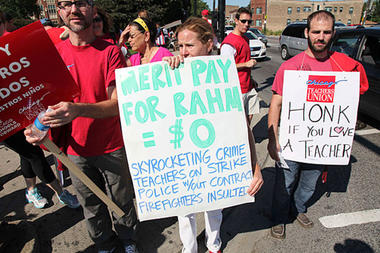
The dynamics of the struggle in Chicago are ones well known to teachers the nation over. In the name of school “reform,” the administrators and board members of the Chicago Public School (CPS) system have sought to impose a merit-based pay scheme for teachers based on standardized testing. Simultaneously, CPS has dangled the promise of “school choice” in front of parents and students in an effort to expand publically funded, privately run charter schools staffed by non-union teachers. The self-proclaimed reformers have all the while tirelessly maintained the now stale mantra that the fault for failing schools lies with sub-par teachers.
Of course, Chicago teachers—like workers across the nation—also face the threat of pay cuts and increased health care premiums. Chicago teachers have already forgone a contractual four percent pay increase.
The national significance of the Chicago struggle is that the Obama administration’s neo-liberal inspired Race to the Top education initiative (favoring so-called merit pay and charter schools) was born in Chicago. In fact, President Obama’s Secretary of Education, Arne Duncan, was the former head of the CPS and chief architect of Race to the Top. In other words, what happens in the Chicago school system is a harbinger of what is to come nationally.
Quite tellingly, the man leading the fight against the CTU in Chicago today is none other than the city’s Democratic mayor, and former Obama chief of staff, Rahm Emanuel. Yet despite leaving the White House, Emanuel (who sends his own kids to private school) retains close ties to President Obama. Until a week ago, Emanuel served as the co-chair of the president’s national campaign, having since seamlessly transitioned to preside over the president’s faltering super PAC, Priorities USA Action.
There is little question, then, that if Obama were to choose to intervene on behalf of the union in Chicago, the conflict could be swiftly settled. Emanuel would quickly bow to any pressure from the White House. And it would also appear at first glance that such an intervention would be politically advantageous for the president who once promised labor to “walk on that picket line with you” while campaigning four years ago. After all, a confrontation in his hometown between a closely allied Democrat and organized labor would appear to present a danger to Obama’s re-election hopes. As In These Times’ David Morberg wrote of the potential threat to Obama, “By provoking a strike, the mayor risks public disapproval, and—as a key fundraiser now for a pro-Obama super-PAC—hurting the Obama campaign.”
But such an analysis fails to account for where the Democrats actually raise their funds. According to the Center for Responsive Politics, the financial sector is the top contributor to the Democrats—with Wall Street lining Democratic pockets to the tune of $40 million so far in the 2012 election cycle. This compares to the $3 million contributed by labor. Thus, it is Wall Street that Obama and his chief fundraiser Emanuel must appease, not labor. And Emanuel’s neo-liberal styled school reform in Chicago is a long-favored Wall Street project.
As a 2010 New York Times story noted, Wall Street has become the main driver behind the charter school movement. As the paper reported:
The money managers are drawn to the businesslike way in which many charter schools are run; their focus on results, primarily measured by test scores; and, not least, their union-free work environments, which give administrators flexibility to require longer days and a longer academic year.
Improving education, we see, is of little true concern for Wall Street school “reformers.” Instead, the primary incentive behind the interest in public education by financial elites is in the expansion of the insidious neo-liberal doctrine. After all, charter schools are an indispensable means through which to privatize public education as a whole. And the privatization of all remaining public assets is, of course, a fundamental tenet of neo-liberalism.
And it’s easy to see why the privatization of public schooling is so prized. To begin with, there is the monetary factor. A privatized educational system would allow Wall Street to commodity education, paving the way for the transfer of yet further public wealth into the private coffers of the financial class. Much the same as has already been done to a large extent to national defense and public prisons, to take but two examples. And there is indeed much wealth to siphon from public education, as a 2012 Census report placed the value of the U.S. public educational system at just under $600 billion.
The other reason behind elite interest in school reform pertains to access to education. The elite driven attack on public education is an attack meant to roll back equal access to education won through working class struggle. We can already see the fruits of such a nefarious campaign in the skyrocketing cost of a university education, which is quickly pricing all but the elite out of an opportunity to pursue a college degree. In short then, the ascendant elite of the neo-liberal era, after waging a staggeringly successful three decade long assault on the working class, now seek to cement their gains and privileged class status by targeting the institution of public education. They seek to deprive the working class of one of the last remaining vestiges of class mobility.
“Class consciousness is not equally characteristic of all levels of American society,” as C. Wright Mills observed, “it is most apparent in the upper class.”
Teacher unions, though, are the last remaining obstacle standing in the way of a complete privatization of public education. Something those on Wall Street are all too aware of, and have tirelessly sought to counter. As the Times article noted, “Hedge fund executives are thus emerging as perhaps the first significant political counterweight to the powerful teachers unions.” And with both parties completely beholden to the hedge fund managers on Wall Street, we see the current bipartisan push for radical school reform—now coming to a head in Chicago, where a neo-liberal Democrat leads the attack.
The very fate of the U.S. public education system promises to be decided in the outcome of struggles like that now transpiring in Chicago, along with countless similar struggles in communities of all sizes across the nation. All those valuing public education, then, must stand in solidarity with the striking teachers of Chicago. For only through such an organized fightback and the use of the greatest working class weapon—the strike—can the elite attack on public education be repelled. It’s a fight that must be engaged; a fight that must be won.
West Michigan Policy Forum Part III: Freedom to Work means Right to Work
One of the major themes of the afternoon at the West Michigan Policy Forum was the issue of making Michigan a Right to Work state. Vedder and the West Michigan Policy Forum both framed Right to Work as Freedom to Work, which fits into their philosophical belief that freedom is equated with free market capitalism. In addition to teaching at Ohio University, Vedder is on the Board of Scholars at the Mackinac Center for Public Policy. Vedder also co-authored a report on the benefits of Right to Work for the state of Indiana, just months before that state adopted such a policy.
The first presenter on this theme was Richard Vedder, an economics professor at Ohio University. Vedder began by saying that his father was the head of the Michigan Democratic Party and that he grew up with great sympathy for labor unions. However, Vedder said that the data suggests that unions are no longer good for the economy and he believes that particularly “forced unionization” is bad for the economy and globalization.
Vedder then spent time talking about the growing number of Right to Work states and the reasons for that increase. Vedder states that Michigan has been suffering because of a lack of a Right to Work policy, with major flight by people due to lack of employment. However, Vedder failed to mention the amount of job loss that was due to trade policies such as NAFTA (MI lost 287,923 manufacturing jobs alone) and trends in globalization, where numerous corporations in Michigan found it more profitable to set up manufacturing operations in countries like China.
Vedder then talked about Indiana’s decision to become a Right to Work state and how there has been an increase of companies now moving to Indiana. This is in part because of the decrease in labor costs, since the lack of union jobs prevents workers from the ability to bargain collectively for things like wages.
Vedder was followed by Joseph Lehman, President and CEO, the Mackinac Center for Public Policy. Lehmen was introduced by John Kennedy, the CEO of Autocam. Kennedy derided unions in his introductory comments and referred to what unions do as larceny.
Lehmen talked about his own background and his first experiences with organized labor. Lehmen admitted that he was actually given a scholarship from the teachers union in order to go to college.
Lehmen then attempted to differentiate between what businesses are and what unions are. His main claim is the main difference is that the government intervenes on behalf of unions, whereas they don’t in business. This seems to dismiss the whole history of US government intervention in the economy to benefit businesses, with tax break and subsidies.
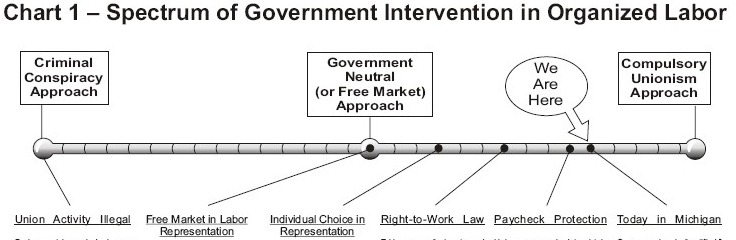
Lehmen then put up a graph that he believes represents the spectrum of government intervention in organized labor. The Mackinac Center CEO then said that the worst manifestation of government intervention into organized labor, was allowing government workers to unionize.
Lehmen showed a second graphic and referred to unions as a monopoly, which in turn makes governments a monopoly. There is some truth to this second graph, especially when it comes to labor influencing electoral politics, but Lehmen never acknowledged the vastly larger amounts of money that corporations spend to influence elections.
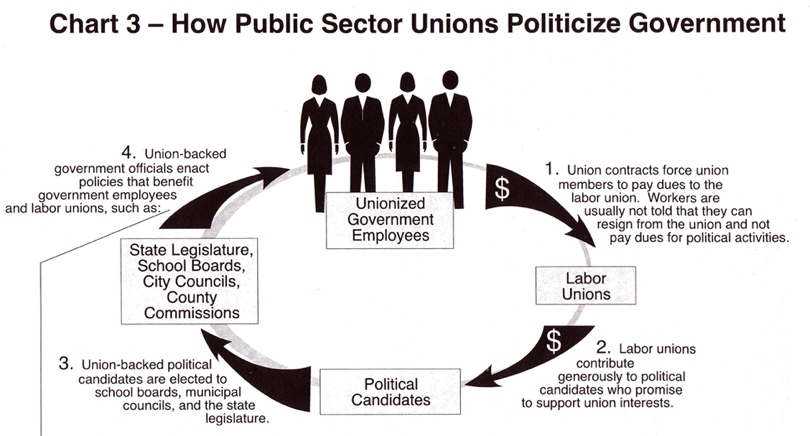
Lehmen tells the audience that the real challenge around organized labor is at the state level and unionized state employees. None of what Lehmen shared was new in terms of the political analysis that the Mackinac Center promotes, but it is useful information in terms of what battles working class people will be fighting in the months and years to come.
West Michigan Policy Forum Part II: Business plans and manufacturing talent
Second Morning Session
The second morning session was introduced by the editor of the editorial page of the Detroit Free Press, Stephen Henderson. He introduced a shot video produced by Business Leaders for Michigan, entitled the Michigan Turn Around Plan.
The video promoted the idea that Michigan is a transportation center, has abundant natural resources, is a hub of life sciences – pharmaceutical industry, higher education marketplace. The hip video with upbeat music makes claims about the possibility of new job creation, investment and creating a new Michigan and is narrated by Ford CEO Bill Ford.
Following the video, Henderson was joined by Michael Jandernoa and Alan Schultz, to discuss the Michigan Turnaround Plan. The plan is based on 6 principles:
- responsible management of finances
- effectively and efficiently provide public services
- create a competitive business climate
- strategically invest for future growth
- accelerate the growth of cities and metropolitan areas
- leverage assets to grow the New Michigan
The Michigan Turnaround Plan is essentially supported by all the local chapters of the Chamber of Commerce, the State Chamber of Commerce, various business associations, and leaders of large businesses and corporations throughout the state.
Jandernoa emphasized that some of the was to implement this business plan, besides what Robert Genetski addressed earlier in the day, was the need to invest in higher education. Jandernoa meant that there need to be ways to both create and keep “talent” in Michigan. The translation of this means to prepare students with the skills that are needed by Michigan based businesses, which is no surprise since Jandernoa sits on the GVSU Foundation Board, along with the likes of Scott Weirda with CWD, JC Huzienga (National Heritage Academies), Sam Cummings (CWD), Kate Pew Walters and John Kennedy (Autocam).
The discussion then led to more condemnation of the Protect Our Jobs ballot initiative and the other two ballot proposals that will be on the November 6 ballot.
The forum then shifted to focus talent retention and creation. This section was facilitated by another journalist, Micki Maynard, with Michigan Radio. She introduced the topic by emphasizing that talent creation/retention was more important than trade. Maynard cited talent creation guru Richard Florida and made it clear that this issue if paramount for the Michigan Turnaround Plan.
Maynard then introduced two speakers who will address talent creation/talent retention, Cascade Engineering CEO Fred Keller and Brian Harris, CEO of H & H Metal Source. Keller spoke first and basically presented the platform put forward by the group Talent 2025. Talent 2025 is made up of 70 local CEOs, names that appear on the boards of the local GR Chamber, Right Place Inc. and other business associations. Keller postulated that an increase in college graduates would translate into economic growth. Forget about developing students with critical thinking skills or providing students with greater capacity for self-discovery or pursuing humanitarian principles………this is all about manufacturing students to make money for the business class.
Brian Harris then continued to present on the work of Talent 2025, by providing details of how this effort works. Harris also read from a teleprompter and basically provided an overview of the information on the Talent 2025 website. Harris made it clear that this group of CEOs is interested in manufacturing talent that even begins with influences early childhood development, all the way up to the university level, including adult workforce development programs.
It was clear that the business class is interested in influencing education policy and investing in education in such a way that it will translate into greater profits through a future workforce that has been developed in an education system that is primarily geared towards talent creation.
West MI Policy Forum Day 2012 – An Exercise in Class Warfare
This will be the first in several postings about the 2012 West Michigan Policy Forum in Grand Rapids.
First Morning Session
The West MI Policy Forum (WMPF) kicked off today at St. Cecelia in downtown Grand Rapids, where the area business class has once again come together to set an agenda of where they want the State of Michigan to go.
Like we reported in 2010, today’s forum is made up mostly of the elite sector of West Michigan society, people in their power suits listening to Chamber music as they gather to hear the comments of today’s speakers. Chair of the WMPF, Jared Rodriguez, welcomed those in attendance, although he was really reading a script on a teleprompter. Rodriguez walked the participants through the use of an ipad, which all of the conference attendees received. Rodriguez also noted that the MLive Media Group helped to creat the ipad app for the WMPF conference.
WMPF member Doug DeVos followed Rodriguez and provided the audience with a framework for the two – day event. DeVos stated that since 2008 the group has made progress, but wanted to make it clear that he wants everyone to re-commit to continue making progress. “This isn’t about business, this isn’t about money, this is about people,” DeVos said. “When we make progress everyone benefits. This is about people realizing who they are and improving their quality of life.” Such comments reflected from the get go that the leadership of the WMPF were going to use clear talking points to downplay their own personal and corporate interests and make everyone think that this is all about the public good.
DeVos said that there were really three themes that the two – day event would deal with. The first was that personal freedom is linked to economic freedom. DeVos went on to say, “we are the enabler of personal freedom.” The second theme was that they were interested in policy solutions and not politics. The Amway President noted that there were several ballot proposals that, “were put forth by powerful groups that have slick marketing campaigns.” While DeVos wanted to frame this about policy and not politics, any discussion about the ballot initiatives is clearly about politics. The last theme he wanted people to think about was to implore those in attendance to “be courageous.” This writer has no idea what the hell that meant.
The first guest speaker to address the audience was Robert Genetski. Genetski promotes what he refers to as classical economic principles and is an expert with the conservative think tank and leading climate denier, the Heartland Institute. Genetski began by talking about where Michigan has been. Genetski believes that 4 years ago Michigan was at the bottom of the list in terms of where states rank economically. Genetski believes there have been some improvements since 2009, but that “living standards have gone down and the situation is bad.”
Genetski did state that the state budget is now solid and that the Michigan Business tax was replaced by a more “reasonable tax.”
Genettski then spoke to where Michigan is going. He focused on the upcoming National Election and emphasized that we need to embrace classical economic principles. The speaker said “prosperity depends on giving each individual maximum freedom over their lives.” This notion was supported with four fundamental principles. Genetski believes that if there are low tax rates, a free market, protection of property rights and a stable value for currency, then freedom can truly exist. He juxtaposed such ideas with current government spending, regulations and mandates, which Genetski believes are destroying the country.
For Michigan’s economy to thrive, Genetski believes that the state needs to lower the tax rate, reduce government spending and give workers the “freedom” to decide to join unions or not, which means he support Michigan being a Right to Work state. He spent most of the time addressing Right to Work and said it is key for Michigan to truly thrive.
Genetski ended his comments by focusing on 3 ballot initiative that will be voted on in November in Michigan. Genetski says the Protect Our Jobs ballot initiative, should be renamed the give unions more power initiative. He said that the Home Health Care initiative should be renamed the Unionize Home Health Care and the Renewable Energy initiative should be labeled the, “Lets make our electric rates the highest in the country” initiative.
Genetski clear set the tone and made it clear that the West Michigan Policy Forum was committed to policies that will benefit the capitalist class and that electoral politics were central to their mission, despite Doug DeVos’ claim of policy, not politics.

