Bloom Collective to host screening of Just Do It film on environmental direct action July 26
Record heat, lack of rain, new oil drilling in Alaska, fracking all across the country, species extinction, burning fossil fuels and contamination of the soil are reasons to feel a sense of urgency about the future of life on this planet.
These realities can feel overwhelming at times, but it is important to note that millions of people across the globe are fighting what is killing us. That is the theme of the powerful film, Just Do It. Just Do It takes us to England, where environmental activists are people their lives on the line through direct action to stop the machines of capital that are destroying the planet.
The Bloom will be screening the film “Just Do It: A Tale of Modern-Day Outlaws” at the DAAC with a potluck before and discussion after (and eating throughout).
Just Do It
Thursday, July 26
7:00PM
DAAC 115 S. Division, Grand Rapids
Potluck starts at 6pm
(bring something, if you please)
Film starts at 7pm
($5 suggested donation, no one is turned away due to lack of funds)
Discussion after, until around 9pm
For additional information and updates go to http://www.facebook.com/events/171409426325027/
Thousands of Mexicans Protest Alleged Elections Fraud
This video is re-posted from The Real News Network.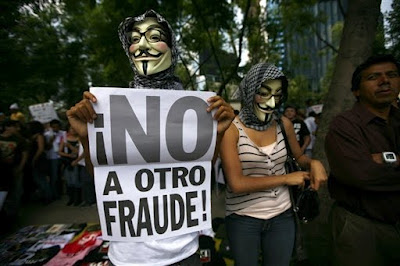
James Cockcroft, poet, lecturer, writer, including author of Mexico’s Revolution Then and Now talks to Paul Jay about why the Mexican elite will not allow Andres Lopez Obrador to be president.
The protests against election fraud have been going on for weeks. Cockroft provides some good context within this context. For additional information check out the following news sources:
http://upsidedownworld.org/main/mexico-archives-79
http://www.jornada.unam.mx/ultimas/
Insurance for corn, not for kids
This article is re-posted from the Environmental Working Group.
On the same day that the House will vote to end health insurance subsidies for low income Americans, the House Agriculture Committee will vote to increase crop insurance subsidies for the largest and most profitable mega farms – and will cut nutrition assistance programs to pay for it.
Many of the same House Agriculture Committee members who will vote tomorrow (Wednesday) on a proposal to increase crop insurance subsidies voted against the Affordable Care Act in 2009, including Chairman Frank Lucas (R-OK) and Ranking Member Collin Peterson (D-MN). Other members of the House Agriculture Committee who are expected to support unlimited insurance subsidies for corn and cotton farmers tomorrow but voted against health insurance subsidies for low income Americans in 2009 include Reps. Tim Holden (D-PA), Larry Kissell (D-NC), and Mike McIntyre (D-NC), as well as Reps. Bob Goodlatte (R-VA), Tim Johnson (R-IL), Steve King (R-IA), Randy Neugebauer (R-TX), Michael Conaway (R-TX), Jeff Fortenberry (R-NE), Jean Schmidt (R-OH), Glenn Thompson (R-PA), and Thomas J. Rooney (R-FL).
Unlike the health insurance subsidies included in the Affordable Care Act, crop insurance subsidies are not subject to any limits on who can receive subsidies or the amount they can receive. As a result, 26 policyholders each collected more than $1 million in insurance subsidies in 2011 and more than 10,000 each collected more than $100,000, according to an Environmental Working Group analysis. Roughly 30,000 policyholders collected 42 percent of all premium subsidies in 2011.
Rather than place reasonable limits on crop insurance, the Lucas-Peterson proposal that will be considered tomorrow by the House Agriculture Committee actually expands crop insurance subsidies – at a cost of more than $9 billion. To help pay for this expansion and meet deficit reduction targets, the Lucas-Peterson proposal will cut the Supplemental Nutrition Assistance Program, known as SNAP, by $16.1 billion and cut environmental programs by $6.1 billion.
In other words, the bill would give unlimited taxpayer dollars to farmers who are already making record profits and less support to hungry kids who depend on federal assistance for food, and to programs that keep drinking water clean.
Reasonable crop insurance reforms like payment limits and means testing – which already apply to SNAP and to health insurance subsidies – could save more than $20 billion when combined with cuts in subsidies to crop insurance companies. But such reforms were not considered by the committee leaders and face an uphill fight on the floor of the House.
Tell the FTC: Stop Merck from Pushing Drugs on Kids
This action alert is re-posted from the Campaign for Commercial Free Childhood.
Kids shouldn’t be targets for pharmaceutical sales pitches. That’s why we’re urging you to tell the Federal Trade Commission to investigate Merck & Co. Inc.’s Madagascar 3-themed Children’s Claritin® marketing. Packaging for Merck’s Grape-Flavored Chewable Children’s Claritin® allergy medication features characters from Dreamworks’ new Madagascar 3: Europe’s Most Wanted movie, and each box offers “5 free stickers” to purchasers. Retail outlets are promoting mail-in movie ticket vouchers and downloadable Children’s Claritin® Madagascar-themed games on shelves alongside the medication. Merck officials claim these promotions are aimed at adults, but it’s clear the company is targeting children.
Tell the FTC: Stop Merck from pushing drugs on kids.
The FTC regulates over-the-counter drug marketing and has protected children from exploitative pharmaceutical marketing in the past. That’s why CCFC joined the Public Health Advocacy Institute (PHAI) and other health and advocacy organizations to call on the FTC to investigate Merck’s Madagascar campaign. As PHAI’s executive director, Mark Gottlieb, said, “Marketing medicine directly to children at all, much less through entertainment tie-ins, is well beyond the pale and is not only inherently unfair, it is downright dangerous.”
Adding to the danger is that the same Madagascar characters used to market Children’s Claritin® are being used to promote foods aimed at children. McDonald’s Happy Meals recently included Madagascar toys. Characters from the movie are also being used to market Fruit-flavored Airheads candy and General Mills (Betty Crocker label) Fruit Snacks, creating the risk that children will confuse the medication with candy Marketing pharmaceuticals to children is unfair and deceptive.
Please tell the FTC to stop Merck from marketing Claritin® to kids.
Monsanto and Gates Foundation Push GE Crops on Africa
This article by Mike Ludwig is re-posted from Truthout.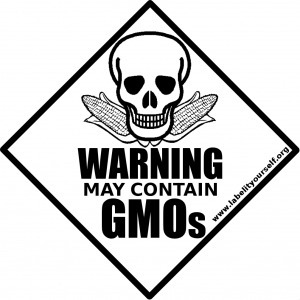
Skimming the Agricultural Development section of the Bill and Melinda Gates Foundation web site is a feel-good experience: African farmers smile in a bright slide show of images amid descriptions of the foundation’s fight against poverty and hunger. But biosafety activists in South Africa are calling a program funded by the Gates Foundation a “Trojan horse” to open the door for private agribusiness and genetically engineered (GE) seeds, including a drought-resistant corn that Monsanto hopes to have approved in the United States and abroad.
The Water Efficient Maize for Africa (WEMA) program was launched in 2008 with a $47 million grant from mega-rich philanthropists Warrant Buffet and Bill Gates. The program is supposed to help farmers in several African countries increase their yields with drought- and heat-tolerant corn varieties, but a report released last month by the African Centre for Biosafety claims WEMA is threatening Africa’s food sovereignty and opening new markets for agribusiness giants like Monsanto.
The Gates Foundation claims that biotechnology, GE crops and Western agricultural methods are needed to feed the world’s growing population and programs like WEMA will help end poverty and hunger in the developing world. Critics say the foundation is using its billions to shape the global food agenda and the motivations behind WEMA were recently called into question when activists discovered the Gates foundation had spent $27.6 million on 500,000 shares of Monsanto stock between April and June 2010.
Water shortages in parts of Africa and beyond have created a market for “climate ready” crops worth an estimated $2.7 billion. Leading biotech companies like Monsanto, Syngenta, Bayer and Dow are currently racing to develop crops that will grow in drought conditions caused by climate change, and by participating in the WEMA program, Monsanto is gaining a leg up by establishing new markets and regulatory approvals for its patented transgenes in five Sub-Saharan African countries, according to the Centre’s report.
Monsanto teamed up with BASF, another industrial giant, to donate technology and transgenes to WEMA and its partner organizations. Seed companies and researchers will receive the GE seed for free and small-scale farmers can plant the corn without making the royalty payments that Monsanto usually demands from farmers each season.
Monsanto is donating the seeds for now, but the company has a reputation for aggressively defending its patents. In the past, Monsanto has sued farmers for growing crops that cross-pollinated with Monsanto crops and became contaminated with the company’s patented genetic codes.
In 2009, Monsanto and BASF discovered a gene in a bacterium that is believed to help plants like corn survive on less water and soon the companies developed a corn seed know as MON 87460. It remains unclear if MON 87460 will out-compete conventional drought-tolerant hybrids, but the United States Department of Agriculture could approve the corn for commercial use in the US as soon as July 11. Monsanto plans to make the seed available to American farmers by next year.
GE crops like MON 87460 can only be tested and sold in countries that, like the US, are friendly toward biotech agriculture. WEMA’s target areas could add five countries to that list: South Africa, Uganda, Tanzania, Kenya and Mozambique. The Biosafety Centre reports that WEMA’s massive funding opportunities pressure politicians to pass weak biosafety laws and welcome GE crops and the agrichemical drenched growing systems that come with them. Field trials of MON 87460 and other drought-tolerant varieties are already underway in South Africa, where Monsanto already has considerable political influence. Kenya, Tanzania and Uganda are expected to begin field trials of WEMA corn varieties in 2011.
The agency that is implementing WEMA is the African Agricultural Technology Foundation (AATF), a pro-biotechnology group funded completely by the US government’s USAID program, the United Kingdom and the Buffet and Gates foundations. The AATF is a nonprofit charity that lobbies African governments and promotes partnerships between public groups and private companies to make agricultural technology available in Africa. The Biosafety Centre accuses the AATF of essentially being a front group for the US government, allowing USAID to “meddle” in African politics by promoting weak biosafety regulation that makes it easier for American corporations to export biotechnology to African countries.
WEMA and AATF swim in a myriad alphabet soup of NGOs and nonprofits propped up by Western nations and wealthy philanthropists that promote everything from fertilizer to food crops with enhanced nutritional content as solutions to world hunger. Together, these groups are promoting a Second Green Revolution and sparking a worldwide debate over the future of food production. The Gates Foundation alone has committed $1.7 billion to the effort to date.
There was nothing “green” about the first Green Revolution of the 1950s and 1960s. As population skyrocketed during the last century, multinationals pushed Western agriculture’s fertilizers, irrigation, oil-thirsty machinery and pesticides on farmers in the developing world. Historians often point out that promoting industrial agriculture to keep developing countries well fed was crucial to the US effort to stop the spread of Soviet Communism.
The Second Green Revolution, which is focused on Africa, seeks to solve hunger problems with education, biotechnology, high-tech breeding, and other industrial agricultural methods popular in countries like the US, Brazil and Mexico.
Africa has landed in the center of a global food debate over a central question: with the world’s growing population expected to reach nine billion by 2045, how will farmers feed everyone, especially those in developing countries? The lines of the debate are drawn. The Second Green Revolutionaries are now facing off with activists and researchers who doubt the West’s petroleum and technology-based agricultural systems can sustainably feed the world.
The African Centre for Biosafety and its allies often point to a report recently released by IAASTD, a research group supported by the United Nations (UN), the World Health Organization, and others. IAASTD found that industrial agriculture has been successful in its goal of increasing crop yields worldwide, but has caused environmental degradation and deforestation that disproportionately affects small farmers and poorer nations. Widespread use of pesticides and fertilizer, for instance, cause dead zones in coastal areas. Massive irrigation projects now account for 70 percent of water withdrawal globally and approximately 1.6 billion people live in water-scarce basins.
Increasing crop yields is the bottom line for groups like the Gates Foundation, but the IAASTD recommends that sustainability should be the goal. The report does not rule out biotechnology, but suggests high-tech agriculture is just one tool in the toolbox. The report promotes “agroecology,” which seeks to replace the chemical and biochemical inputs of industrial agriculture with resources found in the natural environment.
In March, a UN expert released a report showing that small-scale farmers could double their food production in a decade with the simple agroecological methods. The report flies in the face of the Second Green Revolutionaries.
“Today’s scientific evidence demonstrates that agroecological methods outperform the use of chemical fertilizers in boosting food production where the hungry live – especially in unfavorable environments,” said Olivier De Schutter, the UN Special Rapporteur on the right to food and author of the report. “Malawi, a country that launched a massive chemical fertilizer subsidy program a few years ago, is now implementing agroecology, benefiting more than 1.3 million of the poorest people, with maize yields increasing from 1 ton per hectare to 2 to 3 tons per hectare.”
De Schutter said private companies like Monsanto will not invest in agroecology because it does not open new markets for agrichemicals or GE seeds, so it’s up to governments and the public to support the switch to more sustainable agriculture. But with more than a billion dollars already spent, the Second Green Revolutionaries are determined to have a say in how the world grows its food, and agroecology is not on their agenda. To them, sustainability means bringing private innovation to the developing world. The Gates Foundation can donate billions to the fight against hunger, but when private companies like Monsanto stand to benefit, it makes feeding the world look like a for-profit scheme.
The LGBTQ Movement’s Radical Vision
This video is re-posted from The Nation.
Amber Hollibaugh of Queers for Economic Justice argues that though there’s plenty to be proud of after this year’s Pride weekend, there’s still a long way to go for the LGBTQ movement.
For more on Amber and her work, visit QEJ’s website at q4ej.org or read Amber’s book, My Dangerous Desires – A Queer Girl Dreaming Her Way Home.
Food Justice discussion generates local campaign idea
Yesterday, a group a people gathered at Garfield Park, near the South East Farmers Market, to discussion the idea of Food Justice.
The discussion was divided into two sections, with the first being a look at the current food system and what is wrong with it. The Bloom Collective provided a handout, which promoted looks of ideas and questions about agribusiness, food policy and environmental destruction.
The second part centered around how to create a food justice system. People talked about some local efforts with food justice, the work of Our Kitchen Table, the treatment of migrant workers, CSA’s, food co-ops and ways to target or dismantle the local agribusiness system.
There was also acknowledgement that food justice is inter-related to other justice work and systemic change – immigration policy, trade policies, the health care system and abolishing capitalism.
One local idea that was discussed would be a campaign to investigate the existing food contract that the Grand Rapids Public Schools (GRPS) have and then develop a campaign to have the food served in the schools be local and organic. People also suggested that students could learn more about local food production, how to prepare food and the nutritional benefits of eating healthy.
If anyone is interested in being part of such an effort, send a message to The Bloom Collective, bloomcollective@gmail.org.
Understanding the Current Food System
The current food system we have in the US is both the result of a century of policies and food functioning as a commodity within the capitalist economy. This food system is extremely unsustainable, relies on massive government subsidies, fossil fuels, pesticides and migrant labor. Many Americans are unaware of where their food comes from and what entities are involved along the way.
- Agribusiness – While there has been a resurgence of small farmers in recent years, most of the food grown/raised in the US s done so on a large scale by operators within Agribusiness. These growers and factory farm owners rely on huge taxpayer subsidies. For instance, in Michigan the amount of subsidies for growers between 1995 – 2011 was $4.61 Billion. Agribusiness also operates in such a way that makes it dependent on the use of fossil fuels, chemical fertilizers and pesticides. Agribusiness usually engages in mono-cropping and often relies on migrant labor, which is highly exploitative.
- Food Brokers – another player in the current food system are companies that buy and see food. They have nothing to do with growing or raising food, but they often determine what price farmers will receive and see food as a commodity that is trading on Wall Street. Food Brokers determine the value of crops based on speculative capital, not on the amount of labor that went into it or the nutritional value of individual food items.
- Food Processors – These companies turn the bulk of food available in grocery stores into processed foods that are often food-like products with artificial flavoring, preservatives and other additives, which allow them to have a significant shelf life. Sometimes these companies have their own brand names such as Green Giant or operate purely in the processing realm and have nothing to do with the marketing or branding of food.
- Food Distributors – Food distributors sometimes are just involved in transporting foods. The average food item travels over 1,000 from where it is grown/raised to where it is consumed, since it relies on relatively cheap fossil fuels and the public road system. However, food distributors can also be companies like Gordon Foods, which distribute food to institutions such as schools. Companies like Gordon Foods do not generally have anything to do with growing food, but they often determine the kind of food that is provided in schools, hospitals, jails, nursing homes and other institutional settings.
- Food Policy – Food is highly regulated in the US and has been determined by the agribusiness sector. One example of this was the introduction of high fructose corn syrup into the US food system in the 1970s by Archer Daniels Midland. Since then the corn by product has infested a great deal of processed foods and contributed to a tremendous amount of poor health in the US. This was a decision made by the Agriculture Secretary Earl Butz, who was part of the Nixon administration. Butz, like most Ag secretaries came from agribusiness or went to work for them after working for the government. However, most food policy is determined by what is referred to as the Farm Bill. For a solid analysis of the US Farm Bill go to Food & Water Watch.
- Grocers – Most people buy their food from grocery stores, which are dominated by large chain companies like Wal-Mart, Kroger and Meijer. These grocer chains deal in high volume, which allows them to offer lower prices. However, their operations rely heavily on government subsidies, access to lots of land and tax breaks, which is why they are in suburban areas near highways or main roads. These grocery chains spend a tremendous amount on advertising and have resulted in small, family owned food stores going out of business.
- Fast Food – The fast food industry has also been a beneficiary of food policy, food subsidies, public roads and massive amounts of advertising. The fast food industry has radically altered how Americans eat, contributing to poor health and environmental destruction as is well documented in the film McLibel. The fast food industry also relies heavily on advertising. According to the Campaign for Commercial Free Childhood, the fast food industry spends $3 billion a year on advertising that targets children.
- Animal Cruelty – The factory farm system in the US is based on massive cruelty done to animals. Animals are essentially seen as nothing more than a commodity and are tortured, injected with growth hormones & anti-biotics to keep them alive long enough before they are slaughtered. The factory farm system is also environmentally destructive.
- Advertising, branding and Product Placement – The fast food and the thousands of processed food items consumed daily rely heavily on advertising, which costs billions of dollars annually. Fast food and processed food ads are highly deceptive and tends to target younger audiences in order to develop brand loyalty. These companies also engage in product placement in films and video games and use viral advertising as a technique. In addition, these companies engage in a great deal of sponsorship of community and sporting events that not only normalizes their products, it gives them leverage in public policy.
- Global Warming – It is also important to note that the way food is grown and distributed contributes significantly to global warming. The agribusiness system, along with the burning of fossil fuels, heavy industry, cars and the military, is one of the main causes of climate change in the last 100 years.
- GMO’s and genetic diversity – The agribusiness model isn’t interested in food diversity and would rather produce fewer types of food than the generically rich diversity that nature has given us. Agribusiness genetically modifies foods without having to label foods that are GMO and they create seeds called terminator seeds, which means that the seeds in more and more fruits and vegetables can’t be used for growing.
Additional analysis can be found at: Food First http://www.foodfirst.org/ Food & Water Watch http://www.foodandwaterwatch.org/ Organic Consumers Association http://www.organicconsumers.org/.
The Radical Dissent of Helen Keller
This article by Peter Dreier is re-posted from ZNet.
Here’s what they don’t teach: When the blind-deaf visionary learned that poor people were more likely to be blind than others, she set off down a pacifist, socialist path that broke the boundaries of her time—and continues to challenge ours today.
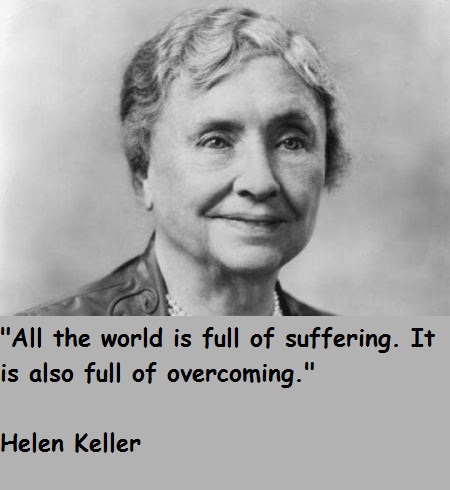
“So long as I confine my activities to social service and the blind, they compliment me extravagantly, calling me ‘arch priestess of the sightless,’ ‘wonder woman,’ and a ‘modern miracle.’ But when it comes to a discussion of poverty, and I maintain that it is the result of wrong economics—that the industrial system under which we live is at the root of much of the physical deafness and blindness in the world—that is a different matter! It is laudable to give aid to the handicapped. Superficial charities make smooth the way of the prosperous; but to advocate that all human beings should have leisure and comfort, the decencies and refinements of life, is a Utopian dream, and one who seriously contemplates its realization indeed must be deaf, dumb, and blind.”
—Helen Keller (letter to Senator Robert La Follette, 1924)
The bronze statue of Helen Keller that sits in the U.S. Capitol shows the blind girl standing at a water pump. It depicts the moment in 1887 when her teacher, Anne Sullivan, spelled “W-A-T-E-R” into one of her 7-year-old pupil’s hands while water streamed into the other. This was Keller’s awakening, when she made the connection between the word Sullivan spelled and the tangible substance splashing from the pump, whispering “wah-wah,”—her way of saying “water.” This scene, made famous in the play and film “The Miracle Worker,” has long defined Keller in the public mind as a symbol of courage in the face of overwhelming odds.
Less well known (but no less inspiring) is the fact that Keller, who was born in 1880 and died in 1968, was a lifelong radical who participated in the great movements for social justice of her time. In her investigations into the causes of blindness, she discovered that poor people were more likely than the rich to be blind, and soon connected the mistreatment of the blind to the oppression of workers, women, and other groups, leading her to embrace socialism, feminism, and pacifism.
Early Life
Keller was born on a plantation in Tuscumbia, Alabama, to Arthur Keller, a former Confederate officer and a conservative newspaper publisher, and Kate Keller, a descendant of John Adams. At nineteen months old, she lost her sight and hearing as a result of a fever. She became uncontrollable, prone to tantrums—kicking, biting, and smashing anything within reach. In that era, many blind and deaf people were consigned to an asylum. Some family members suggested that this was where Helen belonged.
Instead, her mother contacted the Perkins School for the Blind in Boston, which recommended that a former student, the 20-year-old Sullivan, become Helen’s private tutor. In 1887 Sullivan—the daughter of poor Irish immigrants and nearly blind herself—moved to the Kellers’ home. She helped calm Helen’s rages and channel her insatiable curiosity and exceptional intelligence. She patiently spelled out letters and words in Keller’s hand. With Sullivan’s support, her student soon learned to read and write Braille, and by the age of ten she had begun to speak.
Her story became well known and she, a celebrity. Newspapers and magazines in Europe and America wrote glowing stories about the young Keller. Her family connections and fame opened up many opportunities, including private schools and an elite college education. Mark Twain, who admired Keller’s courage and youthful writings, introduced her to Standard Oil tycoon Henry Huttleston Rogers, who paid for her education. She later acknowledged, “I owed my success partly to the advantages of my birth and environment. I have learned that the power to rise is not within the reach of everyone.”
In 1894, at 14, Keller began formal schooling—initially at the Wright-Humason School for the Deaf in New York and then at the Cambridge School for Young Ladies. Sullivan accompanied her, spelling into her hand letter-by-letter so she could read the books assigned in her classes. In 1900, at age 20, Keller entered Radcliffe College with Sullivan still at her side. At Radcliffe (from which she graduated magna cum laude in 1904), Keller was first exposed to the radical ideas that helped her draw connections among different forms of injustice. She began to write about herself and her growing understanding of the world.
“I Must Speak”
In a 1901 article entitled “I Must Speak” in the Ladies Home Journal, Keller wrote, “Once I believed that blindness, deafness, tuberculosis, and other causes of suffering were necessary, unpreventable. But gradually my reading extended, and I found that those evils are to be laid not at the door of Providence, but at the door of mankind; that they are, in large measure, due to ignorance, stupidity and sin.”
She visited slums and learned about the struggles of workers and immigrants to improve their working and living conditions. “I have visited sweatshops, factories, crowded slums,” she wrote, “If I could not see it, I could smell it.”
In 1908 Sullivan’s socialist husband, John Macy, encouraged Keller to read H. G. Wells’s New Worlds for Old, which influenced her views about radical change. She soon began to devour Macy’s extensive collection of political books, reading socialist publications (often in German Braille) and Marxist economists. In addition to giving inspirational lectures about blindness, Keller also talked, wrote, and agitated about radical social and political causes, making her class analysis explicit in such books as Social Causes of Blindness (1911), The Unemployed (1911), and The Underprivileged (1931). In 1915, after learning about the Ludlow Massacre—in which John D. Rockefeller’s private army killed coal miners and their wives and children in a labor confrontation in Colorado—Keller denounced him as a “monster of capitalism.”
In 1909 Keller joined the Socialist Party, wrote articles in support of its ideas, campaigned for its candidates, and lent her name to help striking workers. Although she was universally praised for her courage in the face of her physical disabilities, she now found herself criticized for her political views. The editor of the Brooklyn Eagle attacked her radical ideas, attributing them to “mistakes sprung out of the manifest limitations of her development.” In her 1912 essay “How I Became a Socialist,” published in the Call, a socialist newspaper, Keller wrote, “At that time, the compliments he paid me were so generous that I blush to remember them. But now that I have come out for socialism he reminds me and the public that I am blind and deaf and especially liable to error.”
Women’s Suffrage, Civil Rights, and War
Keller was part of wide circle of reformers and radicals who participated in a variety of overlapping causes. She was a strong advocate for women’s rights and women’s suffrage, writing in 1916: “Women have discovered that they cannot rely on men’s chivalry to give them justice.” She supported birth control and praised its leading advocate, Margaret Sanger, with whom she had many mutual friends. Keller argued that capitalists wanted workers to have large families to supply cheap labor to factories but forced poor children to live in miserable conditions. “Only by taking the responsibility of birth control into their own hands,” Keller said, “can [women] roll back the awful tide of misery that is sweeping over them and their children.”
She donated money to the National Association for the Advancement of Colored People (NAACP)—then a young and controversial civil rights organization that focused on opposition to lynching and job and housing discrimination against African Americans—and wrote for its magazine. At an antiwar rally in January 1916, sponsored by the Women’s Peace Party at New York’s Carnegie Hall, Keller said, “Congress is not preparing to defend the people of the United States. It is planning to protect the capital of American speculators and investors. Incidentally this preparation will benefit the manufacturers of munitions and war machines. Strike against war, for without you no battles can be fought! Strike against manufacturing shrapnel and gas bombs and all other tools of murder! Strike against preparedness that means death and misery to millions of human beings! Be not dumb, obedient slaves in an army of destruction! Be heroes in an army of construction!”
In 1918 she helped found the American Civil Liberties Union, which was initially organized to challenge the U.S. government’s attempts to suppress the ideas of and jail or deport radicals who opposed World War I, including Socialists and members of the Industrial Workers of the World.
The following year she wrote a letter, addressed to “Dear Comrade” Eugene Debs, the Socialist labor leader and presidential candidate, in jail for advocating draft resistance during World War I. She wrote, “I want you to know that I should be proud if the Supreme Court convicted me of abhorring war, and doing all in my power to oppose it.”
In 1924, while campaigning for Senator Robert La Follette, the Wisconsin radical and anti-war stalwart who was running for president on the Progressive Party ticket, Keller wrote him a note: “I am for you because you stand for liberal and progressive government. I am for you because you believe the people should rule. I am for you because you believe that labor should participate in public life.”
After 1924, Keller devoted most of her time and energy to speaking and fundraising for the American Foundation for the Blind, but still supported radical causes. Even as feminism began to ebb, she continued to agitate for women’s rights. In 1932, she wrote an article for Home magazine, “Great American Women,” praising the early suffragists Susan B. Anthony, Lucy Stone, and Elizabeth Cady Stanton. She also penned a humorous article for the Atlantic Monthly, “Put Your Husband in the Kitchen.”
Between 1946 and 1957 she visited 35 countries on five continents. In 1948, Keller visited Hiroshima and Nagasaki, cities destroyed by American atomic bombs at the end of World War II, and spoke out against nuclear war.
In 1955, at the height of the Cold War, she wrote a public birthday greeting and letter of support to Elizabeth Gurley Flynn, a leading Communist activist, then in jail on charges of violating the Smith Act. In response, some supporters of the American Foundation for the Blind (AFB), for which Keller was the national face, threatened to withdraw their support. The AFB’s executive director wrote to one of his trustees, “Helen Keller’s habit of playing around with communists and near communists has long been a source of embarrassment to her conservative friends.”
The FBI kept Keller under surveillance for most of her adult life for her radical views. But Keller, who died in 1968, never saw a contradiction between her crusade to address the causes of blindness and her efforts to promote economic and social justice.
Keller is well known for being blind, but she also deserves to be heralded for her progressive social vision.
This is re-posted from Common Dreams.

Hundreds of Los Angeles police in riot gear, shooting rubber bullets, clashed with Occupy L.A. protesters and street artists attending a sidewalk chalk-drawing event dubbed “Free Chalk for Free Speech” as part of the monthly L.A. ArtWalk. Several injuries and 19 arrests, mostly for “vandalism.” For drawing in chalk, in the rain? Overreact much?

This article by Rocky Kistner is re-posted from Common Dreams.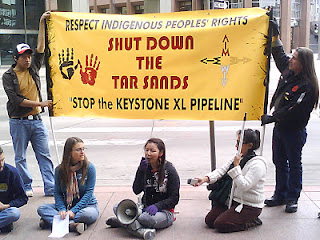
In Canada’s western province of Alberta, Melina Laboucan-Massimo’s community—the Lubicon Lake Nation—has endured a withering toxic tar sands oil assault, an Armageddon against nature few Americans are fully aware of. Here in the once pristine sub-Arctic, tar sands mining operations level vast swaths of boreal forests near native lands, as pipelines burst and spew corrosive chemical-laced tar sands oil into rivers and lakes.
The Lubicon are used to living in harmony with nature. But tar sands mining has brought a deadly discordance to their environment. Melina has watched family and friends battle unheard of cancers and respiratory ailments; she’s listened to local fishermen and hunters complain about unusual lesions and tumors festering in their catches and prey. She’s reacted in disbelief as her government has sponsored airborne sharpshooters to gun down mighty Canadian wolf packs—a zero sum game that is killing one species to try to save another—as dwindling herds of caribou flee their disappearing forest homes and may be gone forever in the not so distant future.
For members of the Lubicon Lake Nation, it is a nightmare of Kafkaesque proportions. Their verdant land of abundant wildlife is metastasizing into pock-marketed battlefields of a thousand Verduns. Melina and other community leaders have not sat idly by as the environmental carnage unfolds around them. She has testified before Congress, spearheaded Greenpeace protest actions, and worked tirelessly to get the word out about the devastation in her community.
Watch Melina Laboucan-Massimo’s story about the destruction of her native land in this short video, soon to be posted along with other updates to the Voices Against Tar Sands webpage.
According to one report, at least seven million gallons of oil has been spilled in Alberta since 2006—much of it tar sands oil—and there have been thousands of pipeline accidents since the 1990s.
Just in the past few months there have been several major pipeline spills in the province, including one spilled millions of gallons of crude near Melina’s community a little over a year ago. This is how Melina describes it when she along with others impacted by one of the largest tar sands spills in history during a rare opportunity to testify before Congress last March:
Last spring I returned home to where I was born to witness the aftermath of one of the largest oil spills in Alberta’s history. What I saw was a landscape forever changed by oil that had consumed a vast stretch of the traditional territory where my family had once hunted, trapped and picked berries and medicines for generations. Days before the federal or provincial government admitted that this had happened my family was sending me text messages telling me of headaches, burning eyes, nausea and dizziness asking me if I could find out more information as to if it was an oil spill and how big it might be…. It wasn’t until the day after the federal election that the information was released of the magnitude of the spill – 28, 000 barrels or 4.5 million litres of oil had soaked the land – this is 50 per cent larger than the tar sands oil spill in the Kalamazoo River in Michigan the year before. Soon afterward the story was swept under the carpet away from the eyes of the public yet it took until the end of the year for the official clean up to be done, but just like in Michigan we know that the land and water in that area will never be the same.
The poisons that infest these tar sands mining operations are some of the nastiest in the petrochemical world, including highly dangerous compounds like mercury, arsenic and lead. As they are dumped into rivers that flow toward the Arctic and are spewed into the cold north winds that deposit them far and wide across the remote region—thanks to powerful wind and water currents that already make it a natural sink for global toxic emissions.
A seminal study published in the National Academy of Sciences in 2010, led by renowned Alberta biologist David Schindler, found toxic pollutants from tar sands oil operations leaching into the Athabasca River, which flows north and feeds into the vast MacKenzie River Basin system that empties into the Arctic Ocean. The study poked holes in the Canadian government’s environmental monitoring system—long decried as inadequate and industry-biased by environmentalists and health activists—forcing the government to implement a new environmental monitoring plan this year.
But it’s not just the river of poisons being unleashed into the environment that concerns scientists. Huge areas of boreal forests are being transformed into open-pit mining operations, decimating critical carbon-storing forests and habitat and adding massive amounts of greenhouse gas emissions to the world’s increasingly polluted skies. Those losses are not being recovered and factored into the overall environmental impacts of tar sands mining, according to a paper Schindler and others published last year:
Claims by industry that they will “return the land we use – including reclaiming tailings ponds – to a sustainable landscape that is equal to or better than how we found it” (33) and that it “will be replanted with the same trees and plants and formed into habitat for the same species” (34) are clearly greenwashing.
The postmining landscape will support >65% less peatland. One consequence of this transformation is a dramatic loss of carbon storage and sequestration potential, the cost of which has not been factored into land-use decisions. To fairly evaluate the costs and benefits of oil sands mining in Alberta, impacts on natural capital and ecosystem services must be rigorously assessed.
For people like the Lubicon, it’s been a frustrating exercise, a battle against Big Oil and powerful political interests bent on maximizing profits . Already, the province of Alberta has the highest per capita green house emissions compared to any country in the world, and emissions from tar sands are estimated to be four times as energy-intensive as conventional oil production in the U.S. and Canada. That has permanently altered not only the landscape but the livelihoods of a people who for centuries lived in harmony with the land, a land that now is being altered from a bountiful paradise into Dante’s Hell. This is how Melina described it to Congress:
As we see the landscape change, my father who is a Cree hunter has more and more difficulty in finding moose to feed our family and community. A couple of years ago, he found 3 tumours in the carcass of a moose while hunting in our traditional territory. Pristine forest, wetlands, bogs and fens are torn up and destroyed which will be replaced by acidic soil, end cap lakes and tree farms – a mere shadow of what once was. Currently we have toxic tailing ponds sitting on the land in northern Alberta that span over 170 square kilometers which is equivalent to 42,000 acres – this is not including the toxic waste that is produced by In Situ projects which are either injected back into the earth or taken away to sit in landfills. These tailing ponds contain a whole slew of toxic chemicals from arsenic, cyanide, mercury, lead, benzene, ammonia, polycyclic aromatic hydrocarbon and naphthenic acids some of which are known carcinogens. These tailing ponds are leeching into the Athabasca watershed. It has been estimated that every day over 11 million litres or almost 3 million gallons leeched into the watershed.
Stories like Melina’s are heart-breaking, but they remain a hard sell to politicians who benefit from the profit-driven largess of Big Oil’s billions—profits that may doom the people and wildlife inhabiting an area the size of Florida to a poisonous demise. Already Alberta has the highest per capita green house emissions compared to emissions in any country in the world, and tar sands mining operations are estimated to be about four times as energy intensive as conventional oil production in the U.S. and Canada.
James Hansen, the director of the NASA Goddard Institute for Space Studies, has famously said, it’s “game over” for the planet if the 170 billion barrels of tar sands oil estimated to be stored in Canada is developed and processed. His op-ed this year of the potential impacts reads like something out of a Stephen King novel:
Canada’s tar sands, deposits of sand saturated with bitumen, contain twice the amount of carbon dioxide emitted by global oil use in our entire history. If we were to fully exploit this new oil source, and continue to burn our conventional oil, gas and coal supplies, concentrations of carbon dioxide in the atmosphere eventually would reach levels higher than in the Pliocene era, more than 2.5 million years ago, when sea level was at least 50 feet higher than it is now. That level of heat-trapping gases would assure that the disintegration of the ice sheets would accelerate out of control. Sea levels would rise and destroy coastal cities. Global temperatures would become intolerable. Twenty to 50 percent of the planet’s species would be driven to extinction. Civilization would be at risk.
The bottom line is we are all at risk if tar sands mining operations poisoning First Nation lands in Canada continue to be developed unabated. As Melina has testified before Congress, it’s more than a matter of life and death. “What kind of air, what kind of water will we be left with, so it’s a scary scenario to think about how much worse it could get,” she pleaded with members of the most powerful government on earth.
Unfortunately it likely will get worse, much worse. The Keystone pipeline—and a host of other tar sands pipelines on the drawing boards—are poised to bring rivers of poisonous bitumen crude to the U.S., where it’s likely most of it will be refined and shipped to international consumers. The heat and violent storms plaguing the U.S. and the world will only get more deadly as mammoth deposits of dirty tar sands oil are processed, refined and burned to support the world’s ever-growing oil addiction.
Meanwhile, if nothing is done to rapidly transform our energy needs to more sustainable, renewable energy sources, the caribou, wolves and birds of the Alberta boreal forests will disappear into the Arctic night, never to return. It will be a sad ending to the environment and traditions the Lubicon people are fighting to protect, traditions that in the end will protect us all.
 Grand Rapids Institute for Information Democracy