This article by Glen Ford is re-posted from Black Agenda Report.
Earlier this month, on a Friday evening after most of the White House press corps had gone home, President Obama gave himself the power to take over, or shut down, all of the nation’s communications systems – including the Internet. The executive order is supposedly designed to preserve “survivable, resilient, enduring” and effective communications so that the government can speak to the people in the event of some emergency. But what he has authorized is the imposition of total silence except for the sound of his own voice.
Clearly, in a legitimate emergency, the government needs ways to communicate – but that does not require a monopoly. So, why is Obama giving himself – and any president that follows him into the Oval Office – a total communications on-and-off switch?
The administration claims it is authorized to bring all communications under its control by the 1934 Communications Act, which allows the takeover of broadcast stations and other wireless media if there exists a state of war, or the threat of war. Back then, of course, the public was fairly sure that they knew what “war” was: Congresses declared it. The “threat” of war was pretty self-evident, too: it was when other nations were threatening to attack the United States, or vice-versa.
However, we are now in what both Presidents Bush and Obama have made clear is a perpetual war, a war that is not defined by any legal norms or foundational statutes, a war against whoever the president decides is the enemy – which can include American citizens. Both of these War Presidents have told us in multitudinous ways that we are on a war footing – and have not been off it since 9/11, and will not be on any other kind of footing until some future president gives the “all clear” sign.
Obama’s executive order has nothing to do with getting out an effective distress call to the nation during a crisis. The “emergency” he has in mind is a State of Emergency – martial law. He is methodically preparing the infrastructure for a police state. Obama already has in place his preventive detention legislation, which he signed into law in the news-less hours of last New Year’s Eve. It empowers the president to lock up whomever he chooses, without charges or trial, and to keep them for as long as the executive sees fit. Based on the near-limitless powers Obama already claims to possess, he can also kill such enemies of the state if that is in the interests of national security in this time of war. There is nothing that he recognizes as law that says he can’t take such drastic executive action against thousands, or tens of thousands of Americans in one sweep.
And now, with his new executive order, if the president finds it convenient, he can take over the national communications network – down to the last, feeble Internet voice – to explain why it was necessary for all those people to disappear.
Or maybe he’ll say nothing at all. And nobody else will dare to say anything, either.
There is a new report from the group Political Research Associates (PRA) that looks at recent reactions and campaigns from the right wing against LGBT organizing entitled, Resisting The Rainbow: Right-Wing Responses to LGBT Gains.
Since the 1980s there have been many gains made by the LGBT community across the country, but anti-gay organizations and individuals have not remained silence or complacent in the face of these gains, according to the new report from PRA.
The new report identifies these key aspects of the right wing response to LGBT gains:
- Conservative religious interests are alive and well, and they continue to transmit homophobic messages.
- Although the Christian Right is still influential, the political landscape has changed.
- The use of homophobia as a political tool is still a successful strategy for mobilizing and increasing right-wing political power.
- The Right has developed a limited, but repeatedly-used, set of homophobic arguments. Many homo-phobic frames get recycled, especially if they were successful in the past.
- The Right’s anti-LGBT strategies are complex and sophisticated.
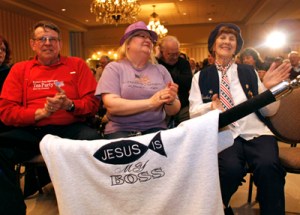
- The current broad coalition on the Right, including the Tea Party, must be taken seriously, especially in the 2012 elections. Not only could the presidency be held by a conservative, but any number of state or local fights could be swayed towards conservative results.
- Some anti-LGBT organizations have surprising levels of influence.
- Despite clear indications they are losing the war on LGBT rights, the Christian Right core of the anti-LGBT movement will not soon abandon its opposition.
- Funding streams for anti-LGBT campaigns continue to come from many of the traditional foundation and individual sources that fund other Religious Right causes, but there are new developments.

The report also includes case studies and profiles of prominent anti-LGBT individuals and organizations.
Of particular importance are the list of recommendations by PRA that current LGBT organizing and campaigns should take to heart. Too often progressive or left groups tend to dismiss the right wing, particularly the religious right wing, as just crazy, but this is a mistake. These recommendations provide a useful framework for long-term strategizing.
- Keep the long view. It is tempting to focus only on the LGBT issue of the moment, whether it be legislative, judicial, or cultural. Such threats necessarily require immediate resources and creative tactics. But it is also necessary to look beyond today’s right-wing campaigns and the next election cycle, to consider the overall context of the LGBT movement, including key trends and future possibilities.
- Interpret data about the Right to create a solid analysis that fuels strategic opportunities. So much information is readily available now from a wide array of sources that it is sometimes difficult to separate reliable facts from conclusions based on assumptions. It is vital to screen available information for its dependability, and analyze the data to identify salient issues and frames. Only careful consideration of the Right’s use of frames, both within and outside the anti-LGBT arena, will help activists determine their direction and strength. Funders should support LGBT organizations and their allies to undertake this type of research.
- Reevaluate the progressive LGBT movement’ s goals and focus.
- Cultivate broader coalitions across issue areas to develop allies, increase support, and contribute to a broader social justice agenda.
- Prepare for the inevitable backlash.
This useful and timely report should come as an important asset in the continuing struggle for LGBT and Queer justice no matter where you live.
This Day in Resistance History: Declaration of Sentiments at Women’s Rights Convention, Seneca Falls 1848
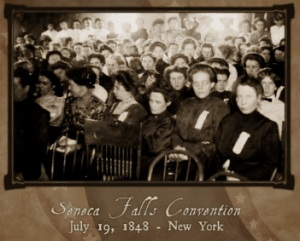
On July 19, 1848, hundreds of women gathered in Seneca Falls, New York to kickoff the Women’s Rights Convention, which gave birth to the Suffrage Movement.
The convention began with Elizabeth Cady Stanton reading what was called the Declaration of Sentiments. After reading the Declaration the first time, Stanton read it again, section by section, so those in attendance could deliberate on each part. The Declaration was revised and then voted on for approval by the women.
This Declaration was a set of resolutions and list of sentiments that clearly set the tone for greater women’s equality. The Declaration of Sentiments begins with a re-writing of the Declaration of Independence to include the rights and freedoms of women, which was then followed by this list of facts about how men have treated women:
- He has never permitted her to exercise her inalienable right to the elective franchise.
- He has compelled her to submit to laws, in the formation of which she had no voice.
- He has withheld from her rights which are given to the most ignorant and degraded men—both natives and foreigners.
- Having deprived her of this first right of a citizen, the elective franchise, thereby leaving her without representation in the halls of legislation, he has oppressed her on all sides.
- He has made her, if married, in the eye of the law, civilly dead.4
- He has taken from her all right in property, even to the wages she earns.5
- He has made her, morally, an irresponsible being, as she can commit many crimes with impunity, provided they be done in the presence of her husband. In the covenant of marriage, she is compelled to promise obedience to her husband, he becoming, to all intents and purposes, her master—the law giving him power to deprive her of her liberty, and to administer chastisement.
- He has so framed the laws of divorce, as to what shall be the proper causes of divorce; in case of separation, to whom the guardianship of the children shall be given; as to be wholly regardless of the happiness of women—the law, in all cases, going upon the false supposition of the supremacy of man, and giving all power into his hands.
- After depriving her of all rights as a married woman, if single and the owner of property, he has taxed her to support a government, which recognizes her only when her property can be made profitable to it.
- He has monopolized nearly all the profitable employments, and from those she is permitted to follow, she receives but a scanty remuneration.
- He closes against her all the avenues to wealth and distinction, which he considers most honorable to himself. As a teacher of theology, medicine, or law, she is not known.
- He has denied her the facilities for obtaining a thorough education—all colleges being closed against her.6
- He allows her in Church as well as State, but a subordinate position, claiming Apostolic authority for her exclusion from the ministry, and, with some exceptions, from any public participation in the affairs of the Church.
- He has created a false public sentiment, by giving to the world a different code of morals for men and women, by which moral delinquencies which exclude women from society, are not only tolerated but deemed of little account in man.
- He has usurped the prerogative of Jehovah himself, claiming it as his right to assign for her a sphere of action, when that belongs to her conscience and her God.
- He has endeavored, in every way that he could to destroy her confidence in her own powers, to lessen her self-respect, and to make her willing to lead a dependent and abject life.
This list of facts is a powerful indictment against Patriarchy and those who have benefited from it.
Considering the ongoing war against women, it would serve us well to not only become familiar with the ground-breaking work of the women at Seneca Falls in 1848, but to take a cue from them on the need to be clear about what is being done to women today and what direction the current women’s movement must take.
For those of us who identify as men, this date in resistance history should be a clarion call to not only be in solidarity with women, but to fight against male privilege and patriarchy in all its manifestations.
This article by Glen Ford is re-posted from Black Agenda Report.
The Obama Justice Department is in theater mode, again, pretending to threaten the bankster class with criminal penalties – prison time! – for their manipulation of the global economy’s benchmark interest rates.
The Justice Department claims to be building criminal and civil cases in the LIBOR scandal, which in sheer scope is the biggest fraud by international capital in history. But that’s all a front, a farce. Barack Obama has spent his entire presidency protecting Wall Street, starting with his rescue of George Bush’s bank bailout bill after it’s initial defeat in Congress, in the last days of Obama’s candidacy. He packed his administration with banksters, passed his own bailout and, in collaboration with the Federal Reserve, channeled at least $16 trillion dollars into the accounts of U.S. and even European banks – by far the greatest transfer of capital in the history of the world. Obama has reminded the banksters that it was he who saved them from the “pitchforks” of an outraged public. He pushed through Congress so-called financial reform legislation that left derivatives – the deadly instruments of mass financial destruction that were at the heart of the meltdown – untouched.
Wall Street may or may not remain loyal to Obama, but Obama has been loyal to Wall Street, the guys who gave him the campaign cash to become a viable candidate. His Attorney General, Eric Holder, a corporate lawyer to the core, is busily staging a pre-emptive LIBOR prosecution of bankers in order to shield them from legal action by a host of other government agencies and, ultimately, from the global universe of parties that have been harmed by the bankster’s schemes– a list that stretches to infinity. Holder’s job is to monopolize the LIBOR case, to the extent legally and humanly possible, grabbing jurisdiction and consolidating the cases against the banks with the aim of reaching a settlement that does not further destabilize the financial system.
Holder and his boss already pulled that trick earlier this year with settlement of the bank “robo-signing” scandal – a scheme that would have ranked as the “crime of the century” until LIBOR came along. A small group of state attorney generals were holding up an administration-brokered settlement that effectively gave the banksters immunity from prosecution, in return for a measly $25 billion payout. Obama used every power of his office to pressure the state law officers into line. The last one capitulated with a promise from Obama that a “special unit of prosecutors” would expand the investigation into abusive mortgages practices. You haven’t heard a peep about it, since.
Now Obama and Holder are playing the same diversionary game, making tough noises about criminal investigations of the LIBOR conspirators. But the Justice Department has already given immunity to Barclay’s Bank, of Britain, and to the Swiss banking giant UBS. More immunities will follow. The reason Eric Holder is staging criminal investigations is because that’s the only way he can protect the bankers, through immunities and by gradually narrowing the scope of the case. In the end, there will be settlements all around, and the banksters will move on to even more fantastic heights of criminality – thanks to the loyal, protective hands of President Obama.
Earlier today about 250 activists from across the state came to Lansing to continue the fight against legislation that would deny women reproductive rights.
Today’s rally and lobbying effort was a follow up to the June 12th rally that initially brought women and men out to protest those in the Michigan Legislature who attempted to silence female colleagues who dared to use the word vagina when talking about reproductive justice.
Beginning at 10am, some women gathered on the capitol steps to help take copies of a petition signed by over 115,000 people demanding an end to the anti-women legislation passed or proposed in the Michigan Legislature in recent months.
Starting at 11am, the formal rally began that included numerous female speakers from around the state. There were women from the National Organization of Women, the Michigan Nurses Association, Planned Parenthood, Breastfeeding Mothers Unite and Mothering Justice.
An organizer with Mothering Justice was the first to speak and made it clear that this rally and this movement was not just about reproductive justice, but many justice issues. They laid out their plan to fight for what they referred to as Our Mama’s Agenda:
- Paid Sick Days
- Access to Affordable Child Care
- The Elimination of Wage Theft
- A Higher Minimum Wage
- Paid Medical Leave Insurance for Every Worker
The speaker from Mothering Justice stressed that these issues are inseparable and that we need to fight for all of them together. Other women stressed the need to organize and educate about this issue from now until Election day, while others shared person stories about being discriminated and excluded from the political process.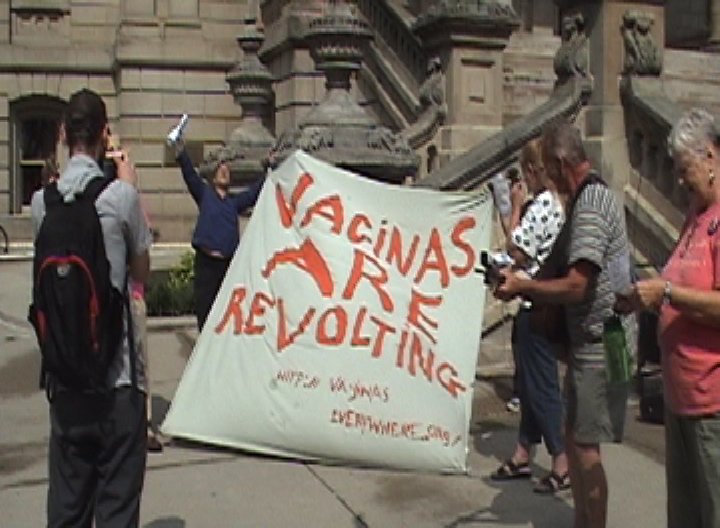
There were several organizations that also had information tables and before the formal rally began there was a spoken word artist who had written two poems in response to the absurdity that a state legislator could not use the word vagina during political debate. There was also a fabulous sing along, where people used traditional songs, changed the lyrics and inserted the word vagina whenever possible. One example was the Beatles song, She Loves You Yeah, Yeah, Yeah, which was song with the words, Vagina, Yeah, Yeah, Yeah.
After the hour-long rally people then went to their State Representative or State Senators office to demand that they vote against any of the proposed legislation that has been detrimental to women’s rights.
We also took time to interview Dani Vilella, an organizer with NOW in Grand Rapids, who also works for Planned Parenthood about the day’s event.
Human Oil Spill draws attention to Enbridge crimes and plans to expand tar sands pipeline through Michigan

Earlier today about 50 people converged on the Capitol in Lansing to not only shed light on the 2nd anniversary of the Enbridge oil disaster in the Kalamazoo River, but to draw attention to the corporation’s plans to expand their tar sands oil pipelines through Michigan.
A Michigan chapter of the National Wildlife Federation and other groups from across the state came to Lansing to create a human oil spill. People dressed in black laid down inside the State Capitol building, just before a press conference that addressed the true costs of the 2010 Enbridge oil spill and to talk about the company’s plans to expand the tar sands oil pipelines in Michigan.
One of the speakers during the press conference was State Rep. Kate Segal from Calhoun County. Rep. Segal address the true cost of the Enbridge oil spill, based on a recent report that exposed the companies criminal and negligent behavior.
Those who spoke at the press conference did say that they were not asking for the proposed Enbridge tar sands oil pipeline to be prevented, they wanted more research done to determine safety and environmental regulations before the company moves forward.

It seems that not demanding an end to the tar sands oil pipelines in Michigan or anywhere else in North America ignores the tremendous human and environmental cost the tar sands project is already having, particularly on indigenous communities in Canada near the Alberta tar sands extraction area.
People in Michigan really need to come to terms with this proposed Enbridge tar sands oil pipeline. It seems to this writer that just as people are calling for a ban on fracking in Michigan, they should also be calling for no new oil pipelines to be constructed anywhere in the state.
Before today’s event, I had a chance to interview Beth Wallace, an organizer with the National Wildlife Federation, one of the organizers of today’s event.
Tariq Ali: What is Really Happening in Syria?
This video is re-posted from ZNet.
Tariq Ali says we are witnessing in Syria “a new form of re-colonisation, which we saw in Iraq and in Libya. Many of the people who first rose against the Assad regime, says Ali, have been sidelined, leaving the Syrian people with limited choices, neither of which they want: either a Western imposed regime, “composed of sundry Syrians who work for the western intelligence agencies”, or the Assad regime.
The only way forward, in the interests of all Syrians, he says, is negotiation and discussion. But it is now obvious that the West is not going to let that happen because they are backing the opposition groups who are against any negotiation.
This Media Alert update is from the Free Press.
On July 1, we posted a Media Alert from Free Press about the Chicago Tribune’s outsourcing of news stories.
On July 17, Free Press volunteers visited Tribune Tower in Chicago, delivering over 20,000 signatures with a simple message for Tribune and other media giants:
Don’t sell out local journalism. Stop outsourcing local news and put out-of-work local journalists back on local beats.
We want news produced by local journalists and coverage of the issues our community cares about. When you outsource local reporting to underpaid overseas workers, everyone in the community loses.
Free Press launched this petition after This American Life aired a report showing that Tribune, Hearst and other media companies had dismantled local newsrooms at dozens of papers, replacing skilled local reporters with a third-party company called Journatic. Journatic pays workers in the Philippines 35–40 cents a story to manufacture “local” articles for papers in Chicago, San Francisco, Houston and Hartford, among other cities.
And Journatic has a weak grasp on journalistic ethics, to say the least. Journatic’s clients have found themselves in hot water for running stories with fake bylines and plagiarized text.
Newspaper giants need to realize what the public already knows: There’s no substitute for real local journalism. But Tribune and Hearst are paying lip service to the public outcry, applying WD-40 to the assembly line instead of dismantling it.
The Chicago Tribune indefinitely suspended the use of Journatic following a plagiarism revelation. But Tribune’s other papers, including the Hartford Courant and the Orlando Sentinel, are still using Journatic. And despite reports that over 350 fake bylines were published in the Houston Chronicle alone, Hearst has simply committed to removing those bylines — not to ending its relationship with Journatic.
It should be clear by now that good local news can’t be outsourced. We need accountable, local journalists who know their communities and uphold journalistic ethics. Today’s petition delivery won’t be our last. We’ll continue to push for changes at the companies that have sacrificed local news for what whistleblower Ryan Smith has dubbed “pink-slime journalism.” To send a message to Journatic’s clients, from the media giants on down to the editors at your local newspaper, sign our petition today.
Arizona’s Banned Book List
This list is re-posted from CounterPunch.
People involved in the Mexican American Studies struggle in Tucson, Arizona recently compiled a list of the banned books from the district, as well as released a letter signed by many organizations expressing concern over First Amendment rights, given the Tucson Unified School District’s removal of these texts. Here is the letter and here is the list, also reproduced below.
Debbie Reese has compiled this list from the May 2, 2011 Cambium Report.
High School Course Texts and Reading Lists Table 20: American Government/Social Justice Education Project 1, 2 – Texts and Reading Lists
Rethinking Columbus: The Next 500 Years (1998) by B. Bigelow and B. Peterson
The Latino Condition: A Critical Reader (1998) by R. Delgado and J. Stefancic
Critical Race Theory: An Introduction (2001) by R. Delgado and J. Stefancic
Pedagogy of the Oppressed (2000) by P. Freire
United States Government: Democracy in Action (2007) by R. C. Remy
Dictionary of Latino Civil Rights History (2006) by F. A. Rosales
Declarations of Independence: Cross-Examining American Ideology (1990) by H. Zinn
Table 21: American History/Mexican American Perspectives, 1, 2 – Texts and Reading Lists
Occupied America: A History of Chicanos (2004) by R. Acuña
The Anaya Reader (1995) by R. Anaya
The American Vision (2008) by J. Appleby et el.
Rethinking Columbus: The Next 500 Years (1998) by B. Bigelow and B. Peterson
Drink Cultura: Chicanismo (1992) by J. A. Burciaga
Message to Aztlán: Selected Writings (1997) by R. Gonzales
De Colores Means All of Us: Latina Views Multi-Colored Century (1998) by E. S. Martínez
500 Años Del Pueblo Chicano/500 Years of Chicano History in Pictures (1990) by E. S. Martínez
Codex Tamuanchan: On Becoming Human (1998) by R. Rodríguez
The X in La Raza II (1996) by R. Rodríguez
Dictionary of Latino Civil Rights History (2006) by F. A. Rosales
A People’s History of the United States: 1492 to Present (2003) by H. Zinn
Course: English/Latino Literature 7, 8
Ten Little Indians (2004) by S. Alexie
The Fire Next Time (1990) by J. Baldwin
Loverboys (2008) by A. Castillo
Women Hollering Creek (1992) by S. Cisneros
Mexican White Boy (2008) by M. de la Pena
Drown (1997) by J. Díaz
Woodcuts of Women (2000) by D. Gilb
At the Afro-Asian Conference in Algeria (1965) by E. Guevara
Color Lines: “Does Anti-War Have to Be Anti-Racist Too?” (2003) by E. Martínez
Culture Clash: Life, Death and Revolutionary Comedy (1998) by R. Montoya et al.
Let Their Spirits Dance (2003) by S. Pope Duarte
Two Badges: The Lives of Mona Ruiz (1997) by M. Ruiz
The Tempest (1994) by W. Shakespeare
A Different Mirror: A History of Multicultural America (1993) by R. Takaki
The Devil’s Highway (2004) by L. A. Urrea
Puro Teatro: A Latino Anthology (1999) by A. Sandoval-Sanchez & N. Saporta Sternbach
Twelve Impossible Things before Breakfast: Stories (1997) by J. Yolen
Voices of a People’s History of the United States (2004) by H. Zinn
Course: English/Latino Literature 5, 6
Live from Death Row (1996) by J. Abu-Jamal
The Lone Ranger and Tonto Fist Fight in Heaven (1994) by S. Alexie
Zorro (2005) by I. Allende
Borderlands La Frontera: The New Mestiza (1999) by G. Anzaldua
A Place to Stand (2002), by J. S. Baca
C-Train and Thirteen Mexicans (2002), by J. S. Baca
Healing Earthquakes: Poems (2001) by J. S. Baca
Immigrants in Our Own Land and Selected Early Poems (1990) by J. S. Baca
Black Mesa Poems (1989) by J. S. Baca
Martin & Mediations on the South Valley (1987) by J. S. Baca
The Manufactured Crisis: Myths, Fraud, and the Attack on America’s Public Schools (1995) by D.C. Berliner and B. J. Biddle
Drink Cultura: Chicanismo (1992) by J. A Burciaga
Red Hot Salsa: Bilingual Poems on Being Young and Latino in the United States (2005) by L. Carlson & O. Hijuielos
Cool Salsa: Bilingual Poems on Growing up Latino in the United States (1995) by L. Carlson & O. Hijuelos
So Far From God (1993) by A. Castillo
Address to the Commonwealth Club of California (1985) by C. E. Chávez
Women Hollering Creek (1992) by S. Cisneros
House on Mango Street (1991), by S. Cisneros
Drown (1997) by J. Díaz
Suffer Smoke (2001) by E. Diaz Bjorkquist
Zapata’s Discipline: Essays (1998) by M. Espada
Like Water for Chocolate (1995) by L. Esquievel
When Living was a Labor Camp (2000) by D. García
La Llorona: Our Lady of Deformities (2000), by R. Garcia
Cantos Al Sexto Sol: An Anthology of Aztlanahuac Writing (2003) by C. García-Camarilo et al.
The Magic of Blood (1994) by D. Gilb
Message to Aztlan: Selected Writings (2001) by Rodolfo “Corky” Gonzales
Saving Our Schools: The Case for Public Education, Saying No to “No Child Left Behind” (2004) by Goodman et al.
Feminism is for Everybody (2000) by b hooks
The Circuit: Stories from the Life of a Migrant Child (1999) by F. Jiménez
Savage Inequalities: Children in America’s Schools (1991) by J. Kozol
Zigzagger (2003) by M. Muñoz
Infinite Divisions: An Anthology of Chicana Literature (1993) by T. D. Rebolledo & E. S. Rivero
…y no se lo trago la tierra/And the Earth Did Not Devour Him (1995) by T. Rivera
Always Running – La Vida Loca: Gang Days in L.A. (2005) by L. Rodriguez
Justice: A Question of Race (1997) by R. Rodríguez
The X in La Raza II (1996) by R. Rodríguez
Crisis in American Institutions (2006) by S. H. Skolnick & E. Currie
Los Tucsonenses: The Mexican Community in Tucson, 1854-1941 (1986) by T. Sheridan
Curandera (1993) by Carmen Tafolla
Mexican American Literature (1990) by C. M. Tatum
New Chicana/Chicano Writing (1993) by C. M. Tatum
Civil Disobedience (1993) by H. D. Thoreau
By the Lake of Sleeping Children (1996) by L. A. Urrea
Nobody’s Son: Notes from an American Life (2002) by L. A. Urrea
Zoot Suit and Other Plays (1992) by L. Valdez
Ocean Power: Poems from the Desert (1995) by O. Zepeda
UPDATE, Monday, January 16, 2012
Bless Me Ultima by Rudolfo Anaya
Yo Soy Joaquin/I Am Joaquin by Rodolfo Gonzales
Into the Beautiful North by Luis Alberto Urrea
The Devil’s Highway by Luis Alberto Urrea
This video interview is re-posted from ZNet.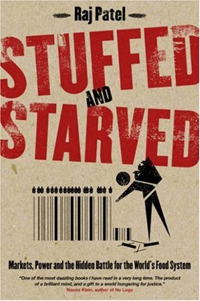
Raj Patel is a writer, activist, and academic, focusing on the global food system and food justice. He is currently a visiting scholar at UC Berkeley’s Center for African Studies, a fellow at the School of Development Studies at the University of KwaZulu-Natal, and a fellow with organization Food First. He has worked for the World Bank, the World Trade Organization, and the United Nations, and has been tear gassed on four continents protesting against them. The second edition of Patel’s first book Stuffed and Starved: The Hidden Battle for the World Food System has just been released by Melville House Books. His most recent work, The Value of Nothing (2010, Portobello Books), is a New York Times best-seller.
David Zlutnick interviewed Patel at his home in San Francisco around the topic of international food markets and their role in propagating inequities in food access and distribution, as well as ongoing popular resistance to these market forces. He argues the latter, which he sees coming to fruition both through organized transnational campaigns as well as “food rebellions,” represent significant possibility for not only the transformation of the food system but also political accountability.
 Grand Rapids Institute for Information Democracy