Rethinking Columbus: Towards a True People’s History
This article by Bill Bigelow is re-posted from Common Dreams.
This past January, almost exactly 20 years after its publication, Tucson schools banned the book I co-edited with Bob Peterson, Rethinking Columbus. It was one of a number of books adopted by Tucson’s celebrated Mexican American Studies program—a program long targeted by conservative Arizona politicians.
The school district sought to crush the Mexican American Studies program; our book itself was not the target, it just got caught in the crushing. Nonetheless, Tucson’s—and Arizona’s—attack on Mexican American Studies and Rethinking Columbus shares a common root: the attempt to silence stories that unsettle today’s unequal power arrangements.
For years, I opened my 11th-grade U.S. history classes by asking students, “What’s the name of that guy they say discovered America?” A few students might object to the word “discover,” but they all knew the fellow I was talking about. “Christopher Columbus!” several called out in unison.
“Right. So who did he find when he came here?” I asked. Usually, a few students would say, “Indians,” but I asked them to be specific: “Which nationality? What are their names?”
Silence.
In more than 30 years of teaching U.S. history and guest-teaching in others’ classes, I’ve never had a single student say, “Taínos.” So I ask them to think about that fact. “How do we explain that? We all know the name of the man who came here from Europe, but none of us knows the name of the people who were here first—and there were hundreds of thousands, if not millions, of them. Why haven’t you heard of them?”
This ignorance is an artifact of historical silencing—rendering invisible the lives and stories of entire peoples. It’s what educators began addressing in earnest 20 years ago, during plans for the 500th anniversary of Columbus’s arrival in the Americas, which at the time the Chicago Tribune boasted would be “the most stupendous international celebration in the history of notable celebrations.” Native American and social justice activists, along with educators of conscience, pledged to interrupt the festivities.
In an interview with Barbara Miner, included in Rethinking Columbus, Suzan Shown Harjo of the Morning Star Institute, who is Creek and Cheyenne, said: “As Native American peoples in this red quarter of Mother Earth, we have no reason to celebrate an invasion that caused the demise of so many of our people, and is still causing destruction today.” After all, Columbus did not merely “discover,” he took over. He kidnapped Taínos, enslaved them—“Let us in the name of the Holy Trinity go on sending all the slaves that can be sold,” Columbus wrote—and “punished” them by ordering that their hands be cut off or that they be chased down by vicious attack dogs, if they failed to deliver the quota of gold that Columbus demanded. One eyewitness accompanying Columbus wrote that it “did them great damage, for a dog is the equal of 10 men against the Indians.”
Corporate textbooks and children’s biographies of Columbus included none of this and were filled with misinformation and distortion. But the deeper problem was the subtext of the Columbus story: it’s OK for big nations to bully small nations, for white people to dominate people of color, to celebrate the colonialists with no attention paid to the perspectives of the colonized, to view history solely from the standpoint of the winners.
Rethinking Columbus was never just about Columbus. It was part of a broader movement to surface other stories that have been silenced or distorted in the mainstream curriculum: grassroots activism against slavery and racism, struggles of workers against owners, peace movements, the long road toward women’s liberation—everything that Howard Zinn dubbed “a people’s history of the United States.”
Which brings us back to Tucson: One of the most silent of the silenced stories in the curriculum is the history of Mexican Americans. Despite the fact that the U.S. war against Mexico led to Mexico “ceding”—at bayonet point—about half its country to the United States, this momentous event merits almost no mention in our textbooks. At best, it is taught merely as prologue to the Civil War.
Mexican Americans were central to building this country, but you wouldn’t know it from our textbooks. They worked in the Arizona copper mines, albeit in an apartheid system where they were paid a “Mexican wage.” In the 1880s, the majority of workers building the Texas and Mexican Railroad were Mexicans, and by 1900, the Southern Pacific Railroad had 4,500 Mexican workers in California alone.
They worked the railroad and they worked for their rights. In 1903, Mexican and Japanese farm workers united in Oxnard, California to form the Japanese-Mexican Labor Association. As Ronald Takaki notes in A Different Mirror, “For the first time in the history of California, two minority groups, feeling a solidarity based on class, had come together to form a union.” They struck for higher pay, writing in a statement that, “if the machines stop, the wealth of the valley stops, and likewise if the laborers are not given a decent wage, they too, must stop work and the whole people of this country suffer with them.”
Nowhere was this rich history of exploitation and resistance being explored with more nuance, rigor, and sensitivity than in Tucson’s Mexican American Studies program. Like Rethinking Columbus, Mexican American Studies teachers aimed to break the classroom silence about things that matter—about oppression and race and class and solidarity and organizing for a better world. Watch Precious Knowledge, the excellent film that offers an intimate look at this program—and chronicles the fearful, even ludicrous, attacks against it—and you’ll get a sense of the enormous impact this “rethinking” curriculum had on students’ lives.
Let’s continue to use this and every so-called Columbus Day to tell a fuller story of what Columbus’s voyage meant for the world, and especially for the lives of the people who’d been living here for generations. And let’s push beyond “Columbus” to nurture a “people’s history” curriculum—searching out those stories that help explain how this has become such a profoundly unequal world, but also how people have constantly sought greater justice. This is the work on which educators, parents, and students need to collaborate.
Note: There is a national call for a day of solidarity on October 12 with the Raza Defense Fund and the campaign to Save Ethnic Studies. You can join by hosting a house party to view the documentary film Precious Knowledge about the Mexican American Studies program in Tucson, Ariz. Learn more here.
This article by Rainforest Action Network is re-posted from Ecowatch.
As we write, our friends with the Tar Sands Blockade are blocking construction of TransCanada’s Keystone XL pipeline in the woods of Texas. For the past six months they have built a movement of climate activists, rural landowners, Texans, Oklahomans and people from all over the country to fiercely resist it. For two weeks, they have captured the imagination of the world with a daring tree-sit and bold ground actions near Winnsboro, TX that have delayed TransCanada’s operations.
TransCanada has responded by allowing its employees to operate their heavy machines with reckless disregard for the safety of protestors and tree-sitters. Police have responded with brutal means such as pepper-spray and Tasers against peaceful protestors. Prosecutors have responded with elevated charges.
It is clear what is at stake. NASA’s leading climate scientist Dr. James Hansen has called the Keystone XL pipeline, “a fuse to the largest carbon bomb on the planet.” If all the carbon stored in the Canadian tar sands is released into the earth’s atmosphere it will mean “game over” for the planet.
In 2011, we saw the Tar Sands Action galvanize environmental and social justice communities in an unprecedented show of unity during the sit-ins in front of the White House. Every day members of Indigenous communities, faith communities, labor communities, anti-mountaintop removal movements, anti-fracking movements and many more stepped forward and put their bodies on the line in solidarity. In the year since, we have witnessed people from the Lakota nation in South Dakota and from Moscow, Idaho putting their bodies in roads and highways blocking large transport trucks carrying oil refining equipment to develop further tar sands extraction. Now, the Tar Sands Blockade has taken the next logical step confronting climate change.
If we are determined to prevent the pursuit of extreme energy from destroying our communities, natural systems and climate, then peaceful, yet confrontational, protests like the Tar Sands Blockade are necessary actions for change.
Let us be clear: there is not an inch of daylight in between us and those blocking construction of the Keystone XL pipeline in Texas. We stand with them as we’ve stood with those fighting mountaintop removal coal mining in Appalachia, those defending old growth forests in Cascadia and those challenging nuclear power across this country.
We stand in solidarity with those who stand up for us all.
Alliance of Community Trainers (ACT)
Center for Biological Diversity
Communities for a Better Environment
Global Alliance for Incinerator Alternatives
Global Justice Ecology Project
Grassroots Global Justice Alliance
Indigenous Environmental Network
Missourians Organizing for Reform and Empowerment (MORE)
Platform
Radical Action for Mountain Peoples’ Survival (RAMPS)
smartMeme Strategy & Training Project
Neo-Liberalism and the Defanging of Feminism
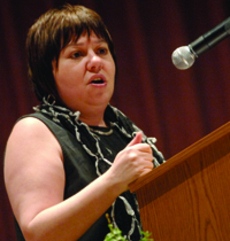
Gail Dines is a feminist, activist and the author of numerous books, most recently PornLand: How Porn Has Hijacked Our Sexuality.
In this lecture entitled Neo-Liberalism and the Defanging of Feminism, Dines provides an important and sharp critique of the state of feminism, a critique of capitalism through a feminist lens and a look at the pornography industry as one manifestation of the wedding between capitalism and patriarchy.
Dines is also one of the founders of the group, Stop Porn Culture, which provides resources and training material for people who want to both understand the pornography industry and confront it.
How Mass Incarceration Affects Everything Else
This article by Margaret Kimberley is re-posted from Black Agenda Report.
The United States is the imprisonment capital of the world. Just one state, Louisiana, has an incarceration rate 5 times higher than Iran and 13 times higher than China, nations which Americans are supposed to feel superior to. More than 2 million Americans are behind bars in jails and prisons, which is the highest on earth in total number and by percentage of population.
The phenomenon we now know as mass incarceration began in the early 1970s and has steadily increased since. In this country minor infractions result in prison terms and an ever increasing number of offenses are added to the list. Black people are a minority of Americans but make up fully half of the imprisoned population, and most of those were convicted of non-violent crimes.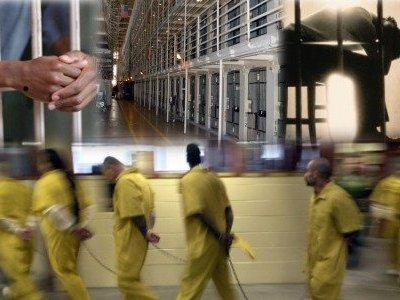
Imprisonment was and is seen as a tool to keep black people from fully realizing their gains made in the 1960s. It was no longer legal to keep black people from living where they wanted, getting jobs they were qualified to get or preventing them from going to the polls. It was possible to put people in jail for any and every offense, however. People can’t compete for good jobs or agitate for their rights if they are in jail. Problem solved.
The toll that mass incarceration has taken on black people is enormous. A newly published book entitled Invisible Men: Mass Incarceration and the Myth of Black Progress gives the facts and figures behind the crime committed against black people. Prisoners are disappeared persons who are removed from census figures, who lose their voting rights, and who upon gaining their freedom are banned from entire categories of employment. According to author Becky Pettit, statistics about black people cannot be trusted because incarcerated men aren’t included in them.
Every negative statistic that bedevils the black community is tied to the awful effects of imprisonment. It is not mysterious that a group with large numbers of its members locked away would have higher rates of HIV or lower rates of marriage or a median net worth of only $4,955.As Invisible Men so clearly points out, the large numbers of black men who are behind bars and who therefore disappear from productive life means that these dismal statistics would be even worse if the incarcerated were not also disappeared from the numbers.
Invisible Men is just the latest in a series of books such as The New Jim Crow and A Plague of Prisons which reveal the terrible toll that incarceration is taking on the black community. These works are seriously needed, documenting with hard data the depth of the attack on black people. Unfortunately, this plethora of books doesn’t seem to be lowering rates of incarceration. The great recession and its resultant budget constraints around the country have been the only thing forcing some states and municipalities to open up some of the prison doors.
It all may have started slowly, but the code words and race baiting were evident from the beginning. Terms like “law and order,” “war on drugs,” “dead beat dads” all meant that more and more black people would end up behind bars for infractions big and small. Yet it must be pointed out that code words exist for a reason. They speak with a nudge and a wink to the intended audience in a language that others may not understand.
There is a nagging question about these statistics, an elephant in the room as it were. America could not have become the world’s prison capital if a majority of the population didn‘t want it to happen. A recent poll regarding New Yorkers’ attitudes toward the NYPD stop and frisk policies shows a clear racial divide. Most whites polled, 55%, think that stop and frisk is acceptable while only 35% of blacks are supportive.
It isn’t surprising that the victims of police abuse are more likely to oppose it, but that shouldn’t stop the non-victims from opposing it too. Stop and frisk, like imprisonment, assures many white people that black people will be locked up far away from them, or at the very least will be sufficiently inconvenienced that they will not be able to compete for any benefits which society might offer. In the case of stop and frisk the victimized population may just decide to leave town for good and take themselves out of sight and out of mind.
This is the challenge of discussing not only mass incarceration but many other issues too. Black people suffer as a direct result of conscious and unconscious thinking on the part of white people. Some of those New Yorkers who will tell a pollster that stop and frisk is acceptable would not admit to harboring racist thoughts, but their reticence in owning up to those feelings doesn’t change the fact that their desires hold sway in public policy making. Stop and frisk would end immediately if enough white people wanted it to.
The wave of scholarship on incarceration is all to the good but it isn’t enough if it doesn’t address the why behind the numbers. Black people have a history of seeing political victories turn pyrrhic. The backlash against black progress is an old story that keeps repeating itself and mass incarceration is just the latest manifestation. The next steps must include ways of honestly addressing the fact that racism is at the root of almost every crisis facing black people. If this simple fact isn’t addressed, all of these excellent books and studies will in fact be irrelevant.
GVSU to host screening of A People’s History of the LGBTQ Community in Grand Rapids on October 11 for National Coming Out Day
Almost a year after the premier screen of this film, GVSU will host a screening on the Allendale campus about the struggle for justice by the LGBTQ community in West Michigan.
The LGBT Resource Center is proud to be a co-sponsor along with GVSU’s Kutsche Office of Local History, the College of Education and the Liberal Studies Department.
After the screening there will be a discussion, facilitated by GVSU faculty and staff who were part of the LGBT struggle in Grand Rapids and on the campus of GVSU.
The screening is free and open to the general community and the GVSU campus. For those who cannot make the screening, you can watch the film online and view on the archival materials.
A People’s History of the LGBTQ Community in Grand Rapids
Thursday, October 11
6:00PM
GVSU Allendale Campus – Kirkhof Center 2204 Pere Marquette

Yesterday, we sat down with Kate from the Heritage Clinic for Women to talk about their 40 Days of Choice Campaign.
The 40 Days of Choice Campaign began several years ago in response to the anti-abortion campaign known as 40 Days for Life. People can make monetary and other pledges online to provide needed support for women as they make difficult decisions. You can support the work of the Heritage Clinic for Women and join the 40 Days of Choice Campaign by going to their Facebook page.
During the interview with Kate, we also talked about the current political climate and the legislative attacks against reproductive rights, the larger socio-economic factors surrounding women’s reproductive rights and the changes she has seen in recent years because of the economic crisis.
New Evidence Confirms That Fracking Endangers Groundwater
This article by Sue Sturgis is re-posted from Znet.
The U.S. Geological Survey released two reports this week confirming that fracking for natural gas has led to groundwater contamination — a fact that has been contested by the industry.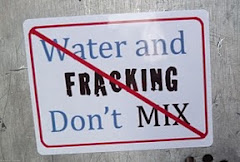
The USGS results are consistent with earlier findings by the Environmental Protection Agency that contamination from fracking had seeped into monitoring wells near gas drilling operations in Pavillion, Wyo., a rural community within the Wind River Indian Reservation. The contaminants detected include methane, ethane, diesel compounds and phenol, a known neurotoxin.
The driller involved in the operations being monitoring is Encana, a Canadian company that is one of North America’s largest natural gas producers. Its U.S. subsidiary operates in Colorado, Louisiana and Texas as well as Wyoming.
Released last December, the EPA’s draft report on the Pavillion wells was the first time the U.S. government linked fracking to groundwater contamination.
Encana has argued that the contaminants are naturally occurring. However, Rob Jackson, an environmental scientist at Duke University in Durham, N.C., told Bloomberg News that the stray gas concentrations are very high, which “suggests a fossil-fuel source for the gases.”
The findings have important implications for North Carolina, where regulators are just beginning to write rules governing the controversial drilling practice. Today the state’s Mining and Energy Commission meets to choose a chair, and Lee County Commissioner Jim Womack, the frontrunner for the job, recently dismissed concerns that fracking endangers the state’s water supplies, WRAL reports:
“You’re more likely to have a meteorite fall from the sky and hit you on the head than you are to contaminate groundwater with fracking fluid percolating up from under the ground. It hasn’t happened.”
The EPA has advised residents in the Pavillion area against using their well water for cooking or drinking.
Earlier today I sat down with poet/activist Staceyann Chin, who is the featured speaker at the GVSU Take Back the Night event on the Allendale campus. I interviewed Chin at her hotel room, where she was resting with her 8-month old daughter Zuri-Siale.
I had been listening to her spoken word on YouTube videos in recent days and was amazed at her skill with words, her passion and her insights into the human condition. I was even more impressed with her in person, since she was able to respond to my questions, while giving full attention to her daughter during the interview.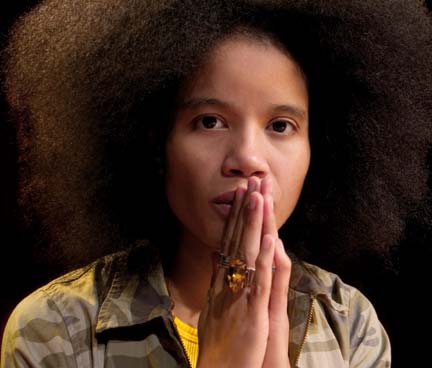
GRIID – I was reading your Facebook page earlier today and noticed that you stated that you yourself are a victim of rape. You also said that the only shame that should be felt, “belongs to the fucking coward who attacked you!” How has your own experience as a survivor informed your work as an artist and as a human being in general?
Staceyann – When you have experienced sexual assault or rape or some form of violation, you understand the problem differently. When I speak about my own experience, it is easier for other women to feel solidarity. This lived experience resonates with survivors.
People can perceive you as a survivor. Your body becomes an example of someone who has kept breathing. Every time I speak out about it, I become less afraid and I take back power from my attacker. My speaking re-affirms the fact that you can keep breathing, living, loving and laughing. The trauma brought about by the assault need not cripple you, in ways that makes you feel alone, like when you are not part of a community of survivors. When I speak out against rape, I feel a kind of uplifting.
We live in an age when the first person narrative is both powerful and provocative. It means a great deal to women to hear or read that kind of personal narrative. It is important because so much of media, particularly TV, will not say things like rape and when they do it is always very clinical or in very legalistic terms. We don’t get from media a more honest sense of rape, the way it feels, the way I felt, the sounds and the smells that come with it. So for me, I have to speak out about it all the time.
GRIID – The Take Back the Night event will be an indoor event tonight, which is different from its origin as a more confrontational action that took place outdoors, often in the streets where women were assaulted. Those Take Back the Night actions were meant to demonstrate women’s collective power, but also to send a message to rapists that their actions would not be tolerated. It seems that the Take Back the Night events have become less political and radical. What is your sense of this?
Staceyann – The change in Take Back the Night might also be a larger reflection of what has happened to feminism as well over the years. Feminism has to some degree been driven indoors. Women were reclaiming their bodies in the 1960s and 70s, but since female identities are so prescribed there is less emphasis on taking control of our bodies. As a feminist who loves bacon, who shaves her arm pits and doesn’t wear heels, I always get people questioning how can I be a feminist and……
The change with Take Back the Night also has something to do with feminism being under attack, where people are saying we don’t need to study gender anymore. Hell, even women’s centers are closing or are near to closing because of a lack of funds. What has happened to Take Back the Night is a reflection of what has happened to feminism in general. The confrontational edge has somehow been lost. Feminism used to be about smashing open doors and now it seems more “diplomatic.”
This is really important, especially since we have politicians talking about “legitimate rape,” which invites the notion that there is illegitimate rape. We have lost that “take no prisoners” edge. We lose some of the power that made us warriors. The current climate may open a whole new wave of action, but we need to take feminism back to the streets. We need to be more visible and demand that society look more closely at the safety of women’s bodies, even little girls’ bodies. Being a new mother has only underscored the need to fight in this struggle. I am in it for the long haul, but having a child means that there is no way I will let anyone harm her, even if I have to use force. The way I see it is if every woman in every part of the world said that rape will end tomorrow or else, you might see a serious change.
GRIID – I saw in one of the YouTube videos you talking about how when White men were involved in Act Up, it was because it affected them, but when people of color are dying of AIDS at a much higher level all of a sudden these White men are not to be found. As someone who identifies as a Lesbian, feminist from Jamaica, how important is it for those involved in struggles to see the intersectionality of justice issues?
Staceyann – If I am only concerned with my body, then that struggle is selfish. If I am only interested in my own rights, people will see how selfish that is. If I am only concerned about Black rights, even at the expense of others, then that is a major problem.
We have to be concerned about the community as a whole. There are poor White, Black, immigrants, women, all kinds of people who are being dispossessed of freedom. Until I am concerned about the global community, then what we are rallying for is to ask permission from the current gate keepers. We should be knocking down the wall instead of asking for permission to the same rights that everyone should have. If we knock down the walls then everyone will have access to the same big, beautiful garden. This is the kind of world I want to fight for and this is the kind of struggle we should be in.
Editor’s note: Since Staceyann Chin is a spoken word artist, it is important that you hear her, so we included a YouTube video of her talking and then reading some of her work.
Notes from OKT’s 2011 Bicycle Tour of Fruit and Nut Trees
 This week’s tour and more:
Thursday Oct. 5:
OKT Tree-mapping Workshop with Lee Mueller, 6-8 p.m. , Kroc Center, 2500 Division Ave. SouthSaturday Oct. 6:
OKT 2012 Bicycle Tour of Fruit and Nut Trees
with Forager & Cyclist, Laura Casaletto
2-4 p.m.
Meet at Garfield Park’s Madison Avenue parking lot,
south of Burton Street SE
Last fall, a dozen or so folks met in Eastown for Our Kitchen Tables’s Bicycle Tour of Fruit and Nut Trees. Sunny skies, comfortable temperatures and a brisk breeze made for a lively, enjoyable ride.
Seasoned cyclist, Josh McBryde, planned the route and led the tour across Wealthy Street and over to Cherry Park. On the way there, tree expert, Laura Cassaletto, pointed out various trees and their edible uses, bringing the group to its first stop alongside an old apple tree, full of ripe fruit, outside of a two-flat apartment house.
After assuring us that she had gotten permission from the property’s owner, Laura invited everyone in the group to pick and enjoy an apple. She mentioned that the tree’s owner had told her that the apples were not good for eating as they had not been sprayed with pesticides. The group broke into laughter. And, with a close eye for worms,we took bites of the “imperfect” fruit. All were amazed at the incredible flavor these small, old fashioned, untended apples offered.
Laura recommended foraging such untended apple trees around the city. She likes to use them for applesauce. When the apples are put through the food mill, it’s easy to pick out any critters that might have eaten their way inside the fruit.
In Cherry Park, the group identified different varieties of nut trees, scavenged nuts from off the ground and even cracked and ate a few. Heading back across the neighborhood, a stop near Diamond and Cherry yielded a look at mulberry trees (already done fruiting) as well as locust trees. Seasoned urban forager, Richa, shared that the spring flowers from the locust tree are delicious. (At the conclusion of the tour, he shared a loaf of his homemade acorn bread).
Crab apples, yes.
Along the route, Laura pointed out that ornamental crab apple trees have edible fruit. She explained that crab apple trees are related to the rose, and like the rose, are edible. High in vitamin C, their edible fruit can be identified by the “crown” at the bottom of the fruit. While fruit with a crown is edible, she warned not to forage white fruit and berries, “White is the color of death.”
She also advised us to try new foraged fruits and nuts in small quantities to see how our own body reacts to it. Because trees, like people, are individuals, the fruits and berries eaten from them have differences in flavor and in how they align with each individual person’s digestive system.
 Bittersweet, no.
In Wilcox Park, the group snacked on plump wild grapes and tried edible, though bitter, viburnum berries. We also learned that the colorful bittersweet nearby was just for decoration and not an edible. The group ended its tour at Aquinas College, where Josh handed out tree identification maps the college provides to visitors. We stopped to gather, crack and snack on beech nuts beneath an elephantine beech tree.
A 16-year-old on the tour remarked, “It was so cool to learn that if I had to, I could get enough to eat from nature.” Cool indeed. Food is growing all around us. Let’s learn to appreciate it!

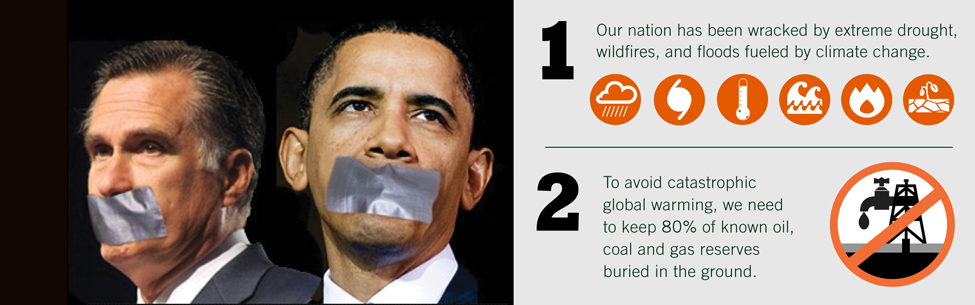
A national organization that has been trying to hold broadcaster accountable on how they report on global warming is now trying to get the two main Presidential candidates to make climate change a campaign issue.
Their campaign called Climate Silence, states:
Although Barack Obama and Mitt Romney sprinkle their speeches with mentions of energy and climate, they have remained stubbornly silent on the immediate and profound task of phasing out a carbon-based economy. Their failure to connect the dots and do the math imperils our nation and prevents the development of a national and global plan to respond to the most urgent challenge of our era. It’s time for their climate silence to end.
We don’t think that either candidate will make climate change an issue until they are forced to do so by grassroots pressure in the form of direct action. This campaign to get people to sign a petition, while commendable, is not enough.
It is important that we recognize that the candidates are not paying attention to climate change and climate justice, but the strategy should be focused on getting more and more people to confront and dismantle the main perpetrators of carbon emissions, the fossil fuel industry.