Should We Really Re-Elect This Fracking President?
This article by Bruce Dixon is re-posted from Black Agenda Report.
Any time someone mentions corporate American technological innovation, you should think of hydraulic fracturing, or fracking.
Fracking is how enormous amounts of oil and gas that used to be beyond the reach of energy companies is now being extracted across much of the United States. Barack Obama is the Fracking President. In his 2012 State of the Union he repeated the oil industry’s absurd and irresponsible claim that fracking would create 600,000 jobs.
“…the U.S. president made clear in his State of the Union address that when it came to the other big eco-controversy in America—hydraulic fracturing, or “fracking,” to access natural gas reserves—he was siding with the oil and gas industry.
“’We have a supply of natural gas that can last America nearly 100 years, and my administration will take every possible action to safely develop this energy,’ Obama proclaimed. His remarks were a clear indication that, while environmental groups, celebrity protesters and a handful of jurisdictions including Quebec and New York state continue to resist, the mainstream is prepared to ramp up gas production—and abide with the environmental risks involved.”
But the risks are beyond rational calculation.
Fracking is the explosive injection of huge volumes of water combined with secret mixes of toxic chemicals, heated hundreds of degrees past the boiling point of water and at hundreds of atmospheric pressures into deep underground rock formations where the amounts of gas or oil used to be too small to be worth going after. Some of that poisoned water seeps off to pollute finite underground water reserves. The rest is pulled back to the surface mixed with the oil, gas or whatever is being sought. When those things are removed, vast amounts of what used to be water, now irretrievably poisoned, are pumped deep into the earth.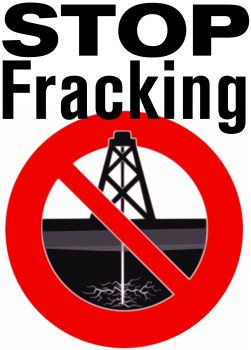
That “water” eventually returns to us. It comes back in springs which are the sources of streams and rivers, and in wells used for irrigation and drinking water. People in areas where fracking has gone on for some time can often set afire whatever issues from their household plumbing. Fracking and disposal of large quantities of waste water may even be implicated in some seismic activity; earthquakes.
Fracking is the energy industry’s answer to peak oil. It keeps oil companies profitable by catastrophically offloading the cost of oil and gas extraction onto farmers, ranchers, humans who drink water, and the environment itself. And it’s national energy policy under the Obama administration.
Let’s be clear. Fracking is about as ethical and responsible as the brain deciding to mine the liver and sell its contents.
But the US is run by capitalists, and for them fracking makes good sense. Capitalism after all, is based upon externalizing, offloading your cost onto someone less powerful, or onto nature itself. Thus capitalists make workers pay their costs by keeping wages and safety standards low. They make the public at large pay their costs by getting public subsidies and tax breaks, also by keeping safety standards lax or nonexistent, or sometimes through privatization, the handing over of public assets to private operators.
Nobody offloads costs onto the public and the environment like energy companies. Think about the BP disaster in the Gulf of Mexico, which everybody is paying for except BP. Fracking allows energy companies to use million-year old underground water reserves (that’s why they are called “fossil waters”) their private toxic sewers.
In 2008 Obama supporters projected their environmentalist beliefs on him, pretending that he stood for “green jobs” and conservation. Since Obama announced himself, at the 2008 Democratic convention as the candidate of “clean coal and safe nuclear power” this was quite a stretch. They will have to stretch even further in 2012. The Obama administration is bullish on fracking.
There’s an enormous amount of local organizing across the country, from Ohio and New York to Colorado and California, opposing hydraulic fracking. But such efforts get little news coverage locally, and are invisible in national corporate media news. Thus environmentalists who want to support Obama can, if they try really hard, console themselves with administration fairy tales of “safe fracking,” or be content with regulations that might require companies to tell us what toxic chemicals are used in the process.
Fracking is reckless, irresponsible and downright evil. But the unwillingness of environmentalists to oppose energy policies from the Obama White House that they would never have tolerated from Republicans makes Barack Obama, as Glen Ford frequently puts it, “the more effective” not the “lesser” evil. Of course Mitt Romney is evil as well, and one of them will be president until the end of 2016.
What with choices limited to greater and lesser evils, or more and less effective evils, it might be time to ask ourselves, how is this politics of choosing evil working out for us? Can we, and why should we hold our tongues and noses to re-elect this fracking president?
It has been just over two years since the Enbridge Tar Sands oil pipeline near Marshall, MI erupted sending thousands of gallons of oil into the Kalamazoo River.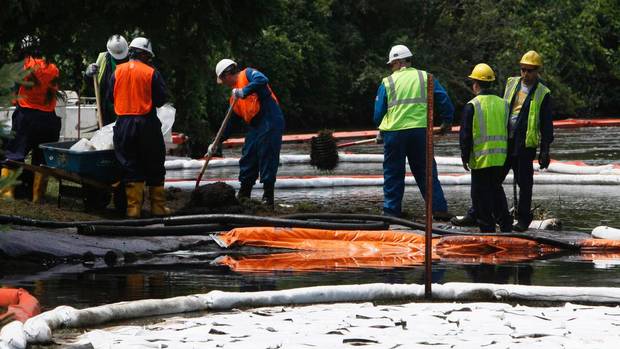
Yesterday, it has been reported that another Enbridge oil pipeline in Wisconsin was shut down after an estimated 1,200 barrels of oil were leaked.
Reuters reported, “The U.S. Transportation Department’s Pipeline and Hazardous Materials Safety Administration is investigating the cause of the Enbridge crude oil pipeline failure in Wisconsin,” spokesman Damon Hill said in an email on Saturday, adding that an inspector had been sent to the location of the pipeline failure.
Reuters also reported, Just weeks ago, the U.S. National Transportation Safety Board delivered a scathing report of Enbridge’s handling of the July 2010 rupture of its Line 6B near Marshall, Michigan, which led to more than 20,000 barrels of crude leaking into the Kalamazoo River.
First, this should be another clear indication that Enbridge cannot be trusted with human or environmental well being, since this is just one of over 800 oil spills and leaks from their pipeline system in recent years, according to a report from the Polaris Institute.
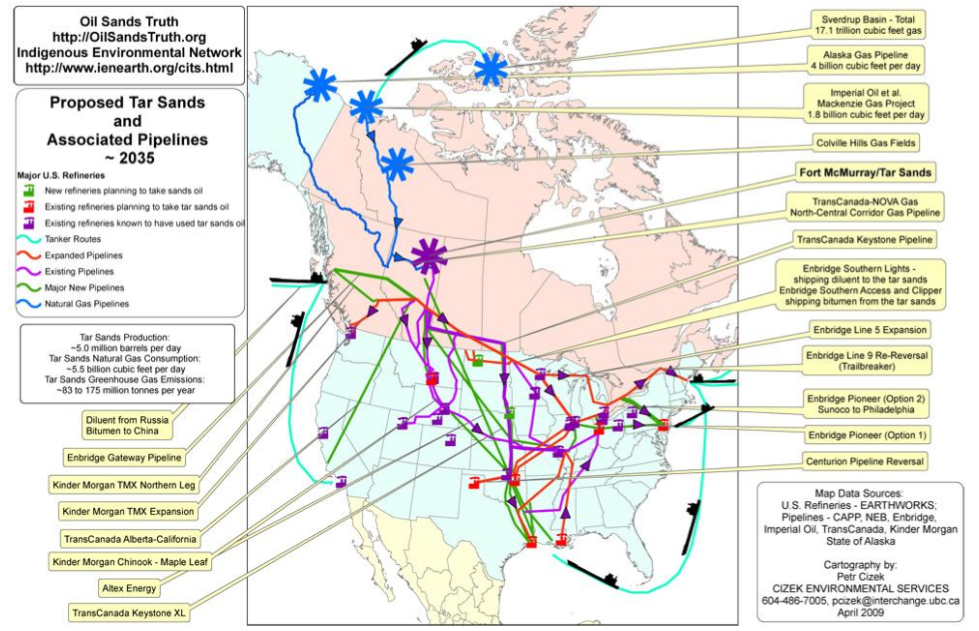
Secondly, even if the pipelines were “safe,” the extraction and burning of oil, particularly the Canadian Tar Sands Oil is devastating to indigenous communities, wildlife, eco-systems and it contributes significantly to global warming, according to the group Tar Sands Watch.
Lastly, the fact that Enbridge is proposing new Tar Sands pipelines to go through Michigan should motivate and mobilize people to prevent that from happening. This was the message of activists who came to Lansing on July 18 to form a human oil spill, drawing attention to the criminal track record of Enbridge.
Building Solidarity with workers on strike at GR Gravel
One thing we were all reminded of with the onset of the Occupy Movement was the glaring disparity between the rich and the rest of us.
This writer was reminded of that disparity yesterday, while attending Day 10 of a strike being held by the workers at Grand Rapids Gravel.
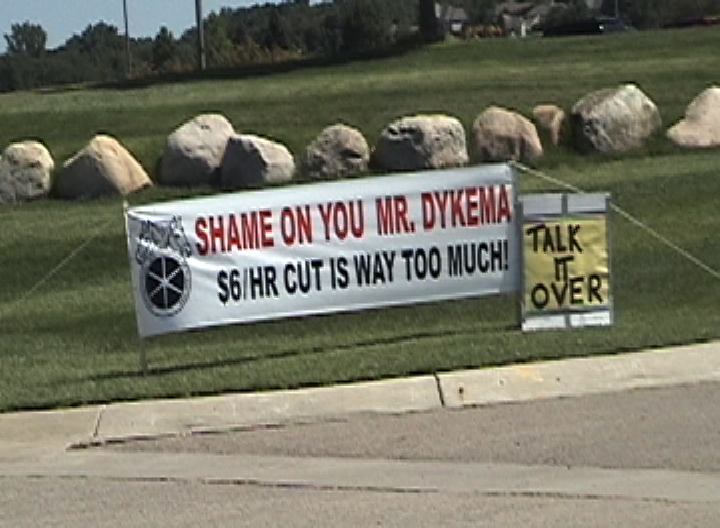
Members of the Teamsters Local 406 are on strike because the company owner was demanding a $6.00 an hour pay cut from his workforce. In talking to a 17-year employee and Teamster member, we discovered that the last time the workers received a raise was in 2000, and the raise was just 50 cents. This means that it has been 12 years since the workers have received any kind of raise and yet they are being asked to take a $6.00 an hour pay cut.
The strike rally was being held yesterday across the street from a golf course, one that the owner of Grand Rapids Gravel Andy Dykema owns. The plush golf course is not all that he owns in addition to the gravel company. According to Teamster member Bill Steckling, Dykema also owns this large condo project near the golf course.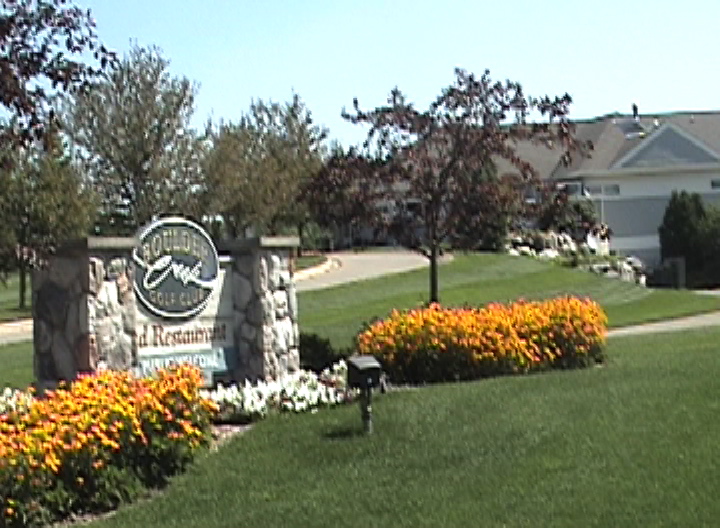
To illustrate the absurd level of wealth that Dykema possesses, another member of the Teamsters told a story while those on strike gathered to share information. The Teamster members said that one day Dykema was out near his property and he and one of his constituents were looking around. Dykema then says to the man, “that sure is a nice piece of property. We should own it.” The constituent responded by saying, “You already own it.”
When Dykema demanded that the workers take a $6.00 an hour pay cut, the union met and they did agree to take a $3.26 per hour pay cut, but the boss responded that it was $6.00 and nothing less. Disgusted with the owner’s unwillingness to compromise, the workers called for a strike.
Bill Steckling then told us that the company hired a strike breaking lawyer, who has brought in Pinkerton Guards to protect the company’s property and is working with what they believe is an Illinois firm that is hiring scab workers from out of state to replace the workers on strike. No one at this point has been able to identify the Illinois firm nor where the workers are coming from.
About 80 people made up of striking workers, family members and people from the community, came out yesterday to show solidarity for the workers on strike. The group was picketing across the street from the Dykema-owned golf course with signs, banners and a Teamster semi-trailer.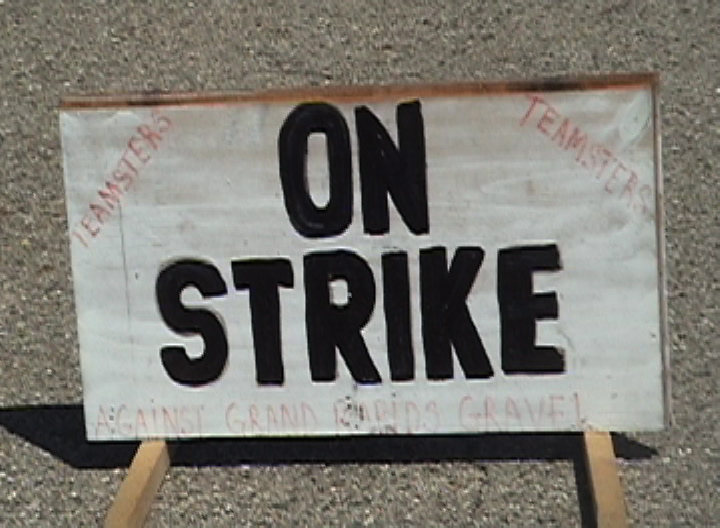
After hours of picketing, the group then gathered to hear a few speakers discuss the campaign. One Teamster member said that there was already support from other unions, like the UAW, SEIU, the local labor council and the IWW. After the speakers, everyone was invited to share some food that had been prepared, which allowed people more time to talk informally and build solidarity.
IWW members Deirdre Cunningham said of the strike, “It was important for me to come out today and stand with the striking workers in strength & solidarity. It takes a lot of courage to sign up for such uncertainty as a strike, and people need to see the support of friends, the network of shared resources available to them, to continue to stand strong for what we know is right.”
Cole Dorsey, also a member of the IWW and a labor organizer added, “The Grand Rapids IWW has a good relationship with the Teamsters local 406. Regardless of this we would have joined them in solidarity because we feel workers in struggle anywhere is an issue for workers everywhere. We joined them on the picket line today and will continue to do so until they win. One of our mottos is “the longer the picket line the shorter the strike.”
The Teamsters welcome any kind of support that people can offer, particularly the kind of solidarity by showing up and standing with them in their strike against greed. Go to this link to find the various locations where the workers are on strike and have a presence.
We also spoke with Teamster organizer Craig Salzwedel yesterday on camera. Here is the brief interview we did with Craig where he talks about the strike and the issues the union has with the company.
This article is re-posted from Common Dreams.
A recent University of Texas study, which claims to prove that the natural gas extraction process known as fracking does not cause environmental damage or water contamination, was led by a gas industry insider who currently holds up to $1.6 million in stock at a large fracking company. The information was revealed in a new exposé released by the Public Accountability Initiative (PAI).
The 400-page pro-fracking review in question was led by author Charles Groat of the University of Texas. Neither Groat nor the University openly reported that Groat himself is on the board of a fracking company, Plains Exploration and Production Company.
As a board member, Groat receives 10,000 shares of restricted stock a year. His holdings as of July 19th were worth $1.6 million. He also receives an annual fee, which was $58,500 in 2011, according to filings.
Groat did not reveal his position with the company when the report was released and told reporters that the university had turned down all industry funds for the study.
Groat’s report, Fact-based Regulation for Environmental Protection in Shale Gas Development, said that it separated “fact from fiction” and gave policy makers a way forward in a major natural gas boom. The study was reported widely by major news outlets.
On the contrary, the PAI maintains that Goat’s study contains unfounded facts and misinformation, misleading selective language, and includes inaccurate claims of peer review.
Groat’s research covered fracking operations in Texas, Louisiana, and the Marcellus Shale area. His company, Plains Exploration, is currently fracking in shale formations in Texas.
Following the PAI exposé, titled Contaminated Inquiry: How a University of Texas Fracking Study Led by a Gas Industry Insider Spun the Facts and Misled the Public, the university says it will assemble a group of independent experts to review the integrity of Goat’s study.
PAI’s exposé is the second in a series of studies revealing rampant and widespread industry ties to pro-fracking reports.
This article by Dave Zirin is re-posted from Edge of Sports.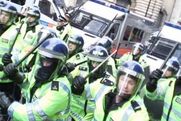
As many as 48,000 security forces. 13,500 troops. Surface to air missiles stationed on top of residential apartment buildings. A sonic weapon that disperses crowds by creating “head splitting pain.” Unmanned drones peering down from the skies. A safe-zone, cordoned off by an 11 mile, electrified fence, ringed with trained agents and 55 teams of attack dogs.
One would be forgiven for thinking that these were the counter-insurgency tactics used by U.S. army bases in Iraq and Afghanistan, or perhaps the military methods taught to third world despots at the School of the Americas in Ft. Benning Georgia. But instead of being used in a war zone or the theater of occupation, they in fact make up the very visible security apparatus in London for the 2012 Summer Olympics.
London, which has the most street cameras per capita of any city on earth, has for the last seven years since the terror attacks of 7/7/05, been a city whose political leaders would spare no expense to monitor its own citizens. But the Olympic operation goes above and beyond anything we’ve ever seen when a Western democracy hosts the games. Not even China in 2008 used drone planes or ringed the proceedings with a massive, high-voltage fence. But here is London, preparing a counter insurgency, and parking an aircraft carrier right in the Thames. Here is London adding “scanners, biometric ID cards, number-plate and facial-recognition CCTV systems, disease tracking systems, new police control centres and checkpoints.”
Stephen Graham at the Guardian refers to the entire state of affairs as “Lockdown London” as well as “the UK’s biggest mobilisation of military and security forces since the second world war.” He is not exaggerating in the slightest. The number of troops will exceed the forces the UK has had in Afghanistan.
It’s not just the costs or the incredible invasion into people’s privacy. It’s the powers being given to police under the 2006 “London Olympic Games Act” which empowers not only the army and police, but also private security forces to deal with “security issues” using physical force. These “security issues” have been broadly defined to include everything from “terrorism” to peaceful protesters, to labor unions, to people selling boot-leg Olympic products on the streets, to taking down any corporate presence that doesn’t have the Olympic seal of approval. To help them with the last part, there will be “brand protection teams” set loose around the city. These “teams” will also operate inside Olympic venues to make sure no one “wears clothes or accessories with commercial messages other than the manufacturers’ who are official sponsors.
The security operation also means the kind of street harassment of working class youth that will sound familiar here in the United States. As the Guardian reported, “Officers have powers to move on anyone considered to be engaged in antisocial behaviour, whether they are hanging around the train station, begging, soliciting, loitering in hoodies or deemed in any way to be causing a nuisance.”
There is no reason that the Olympics have to be this way. There is no reason that an international celebration of sports – particularly sports more diverse than our typical high-carb diet of football, baseball, basketball, and more football – can’t take place without drones and aircraft carriers. There is no reason athletes from across the globe can’t join together and showcase their physical potential.
But the Olympics aren’t about sport any more than the Iraq War was about democracy. The Olympics are not about athletes. And they’re definitely not about bringing together “the community of Nations.” They are a neoliberal Trojan Horse aimed at bringing in business and rolling back the most basic civil liberties.
In many ways, this is what the games have always been. From Hitler’s Berlin Olympics in 1936, to the slaughter of students in 1968 in Mexico City, to the Gang Sweeps in Los Angeles in 1984, to Beijing’s mass displacement of citizens in 2008, the “crackdown” has always been a part of the Olympic games. But in the post 9/11 world, the stakes are even higher to expose this for what it is. The Olympics have become the spoonful of sugar to help the medicine to down, and the medicine is that our elected leaders have seen the enemy, and it is all of us.
Not to shock anyone, but there are no signs that any of the security apparatus will be dismantled once the Olympics are over. Local police forces have just been given an inordinate number of new toys and the boxes have been opened, the receipts tossed away.
In many ways, this is what the games have always been. From Hitler’s Berlin Olympics in 1936, to the slaughter of students in 1968 in Mexico City, to the Gang Sweeps in Los Angeles in 1984, to Beijing’s mass displacement of citizens in 2008, the “crackdown” has always been a part of the Olympic games. But in the post 9/11 world, the stakes are even higher to expose this for what it is. The Olympics have become the spoonful of sugar to help the medicine to down, and the medicine is that our elected leaders have seen the enemy, and it is all of us.
Occupy the Dam: Brazil’s Indigenous Uprising
This article is re-posted from Yes Magazine.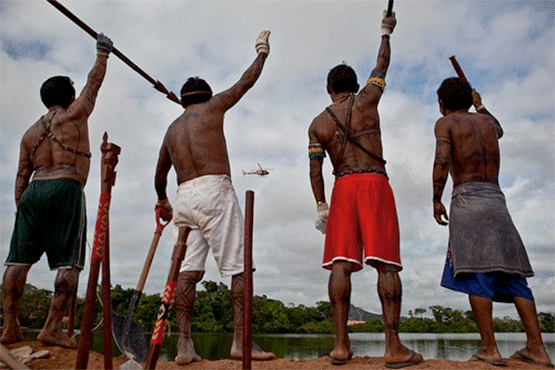
Last month, hundreds of indigenous demonstrators began dismantling a dam in the heart of Brazil’s rainforest to protest the destruction it will bring to lands they have loved and honored for centuries. The Brazilian government is determined to promote construction of the massive, $14 billion Belo Monte Dam, which will be the world’s third largest when it is completed in 2019. It is being developed by Norte Energia, a consortium of ten of the world’s largest construction, engineering, and mining firms set up specifically for the project.
The Belo Monte Dam is the most controversial of dozens of dams planned in the Amazon region and threatens the lives and livelihoods of thousands of Amazonian people, plants, and animals. Situated on the Xingu River, the dam is set to flood roughly 150 square miles of already-stressed rainforest and deprive an estimated 20,000 people of their homes, their incomes, and—for those who succumb to malaria, bilharzia, and other diseases carried by insects and snails that are predicted to breed in the new reservoir—their lives. Moreover, the influx of immigrants will bring massive disruption to the socioeconomic balance of the region. People whose livelihoods have primarily depended on hunting and gathering or farming may suddenly find themselves forced to take jobs as manual laborers, servants, and prostitutes.
History has shown again and again that dams in general wreak havoc in areas where they are built, despite promises to the contrary by developers and governments. Hydroelectric energy is anything but “clean” when measured in terms of the excruciating pain it causes individuals, social institutions, and local ecology. The costs—often hidden—include those associated with the privatization of water; the extinction of plants that might provide cures for cancer, HIV, and other diseases; the silting up of rivers and lakes; and the disruption of migratory patterns for many species of birds.
The indigenous cultures threatened by the Belo Monte Dam, including those of the Xikrin, Juruna, Arara, Parakanã, Kuruaya and Kayapó tribes, are tied to the land: generations have hunted and gathered and cultivated the same areas for centuries. They—as well as local flora and fauna—have suffered disproportionately from the effects of other hydroelectric dams, while rarely gaining any of the potential benefits. Now they are fighting back.
Indigenous leaders from these groups have asked the Brazilian government to immediately withdraw the installation license for Belo Monte. They demand a halt to work until the government puts into place “effective programs and measures to address the impacts of the dam on local people.” They point out that a promised monetary program to compensate for the negative impacts of the mega-dam has not yet been presented in local villages; also, that a system to ensure small boat navigation in the vicinity of the cofferdams, temporary enclosures built to facilitate the construction process, has not been implemented. Without such a system, many will be isolated from markets, health care facilities, and other services. The cofferdams have already rendered much of the region’s water undrinkable and unsuitable for bathing. Wells promised by the government and Norte Energia have not yet been drilled. The list of grievances goes on and on and is only the latest in a very old story of exploitation of nature and people in the name of “progress.” Far too often, this has meant benefiting only the wealthiest in society and business.
Yet here in the backcountry of Brazil, there is a difference: the makings of a new story. The indigenous people’s occupation of the dam garnered international attention, connecting their situation to other events across the globe—the Arab Spring, democratic revolutions in Latin America, the Occupy Movement, and austerity strikes in Spain and other European nations. Brazil’s indigenous protesters have essentially joined protesters on every continent who are demanding that rights be restored to the people.
Stories take time to evolve. This one—the story of people awakening on a global level to the need to oppose and replace exploitative dreams—is still in its beginning phase. And the first chapter has been powerful, elegant, and bold.
A few years ago I was invited, with a group, to Ladakh, a protectorate of India, to meet with the Dalai Lama. Among a great deal of sage advice he offered was the following: “It is important to pray and meditate for peace, for a more compassionate and better world. But if that is all you do, it is a waste of time. You also must take actions to make that happen. Every single day.”
It is time for each and every one us to follow that advice.
Opposing the Belo Monte Dam project provides an opportunity for you and me to honor those words, and those leading resistance to it can help us understand the importance of looking around—in our neighborhoods as well as globally—to determine what else we can do to change the story.
This article by James Petras and Robin Eastman-Abaya is re-posted from Dissident Voice.
One of the most significant political developments in recent US history has been the virtually unchallenged rise of the police state. Despite the vast expansion of the police powers of the Executive Branch of government, the extraordinary growth of an entire panoply of repressive agencies, with hundreds of thousands of personnel, and enormous public and secret budgets and the vast scope of police state surveillance, including the acknowledged monitoring of over 40 million US citizens and residents, no mass pro-democracy movement has emerged to confront the powers and prerogatives or even protest the investigations of the police state.
In the early fifties, when the McCarthyite purges were accompanied by restrictions on free speech, compulsory loyalty oaths and congressional ‘witch hunt’ investigations of public officials, cultural figures, intellectuals, academics and trade unionists, such police state measures provoked widespread public debate and protests and even institutional resistance. By the end of the 1950’s, mass demonstrations were held at the sites of the public hearings of the House Un-American Activities Committee (HUAC) in San Francisco (1960) and elsewhere, and major civil rights movements arose to challenge the racially segregated South, the compliant Federal government, and the terrorist racist death squads of the Ku Klux Klan (KKK). The Free Speech Movement in Berkeley (1964) ignited nationwide mass demonstrations against the authoritarian-style university governance.
The police state incubated during the first years of the Cold War was challenged by mass movements pledged to retain or regain democratic freedoms and civil rights.
Key to understanding the rise of mass movements for democratic freedoms was their fusion with broader social and cultural movements: democratic freedoms were linked to the struggle for racial equality; free speech was necessary in order to organize a mass movement against the imperialist US Indo-China wars and widespread racial segregation; the shutting down of Congressional ‘witch hunts’ and purges opened up the cultural sphere to new and critical voices and revitalized the trade unions and professional associations. All were seen as critical to protecting hard-won workers’ rights and social advances.
In the face of mass opposition, many of the overt police state tactics of the 1950’s went ‘underground’ and were replaced by covert operations; selective state violence against individuals replaced mass purges. The popular pro-democracy movements strengthened civil society and public hearings exposed and weakened the police state apparatus, but it did not go away. However, from the early 1980’s to the present, especially over the past 20 years, the police state has expanded dramatically, penetrating all aspects of civil society while arousing no sustained or even sporadic mass opposition.
The question is why has the police state grown and even exceeded the boundaries of previous periods of repression and yet not provoked any sustained mass opposition? This is in contrast to the broad-based pro-democracy movements of the mid to late 20th century. That a massive and growing police state apparatus exists is beyond doubt: one simply has to look up the published records of personnel (both public agents and private contractors), the huge budgets and scores of agencies involved in internal spying on tens of millions of American citizens and residents. The scope and depth of arbitrary police state measures taken include arbitrary detention and interrogations, entrapment, and the blacklisting of hundreds of thousands of US citizens. Presidential fiats have established the framework for the assassination of US citizens and residents, military tribunals, detention camps, and the seizure of private property.
Yet as these gross violations of the constitutional order have taken place and as each police state agency has further eroded our democratic freedoms, there have been no massive “anti-Homeland Security” movements, no campus Free Speech movements. There are only the isolated and courageous voices of specialized ‘civil liberties’ and constitutional freedoms activists and organizations, which speak out and raise legal challenges to the abuse, but have virtually no mass base and no objective coverage in the mass media.
To address this issue of mass inactivity before the rise of the police state, we will approach the topic from two angles.
We will describe how the organizers and operatives have structured the police state and how that has neutralized mass responses.
We will then discuss the ‘meaning’ of non-activity, setting out several hypotheses about the underlying motives and behavior of the ‘passive mass’ of citizens.
The Concentric Circles of the Police State
While the potential reach of the police state agencies covers the entire US population, in fact, it operates on the basis of ‘concentric circles’. The police state is perceived and experienced by the US population according to the degree of their involvement in critical opposition to state policies. While the police state theoretically affects ‘everyone’, in practice it operates through a series of concentric circles. The ‘inner core’, of approximately several million citizens, is the sector of the population experiencing the brunt of the police state persecution. They include the most critical, active citizens, especially those identified by the police state as sharing religious and ethnic identities with declared foreign enemies, critics or alleged ‘terrorists’. These include immigrants and citizens of Arab, Persian, Pakistani, Afghan and Somali descent, as well as American converts to Islam.
Ethnic and religious “profiling” is rife in all transport centers (airports, bus and train stations, and on the highways). Mosques, Islamic charities and foundations are under constant surveillance and subject to raids, entrapment, arrests, and even Israeli-style ‘targeted’ assassinations.
The second core group, targeted by the police state, includes African Americans, Hispanics, and immigration rights activists (numbering in the millions). They are subject to massive arbitrary sweeps, round-ups and unlimited detention without trial as well as mass indiscriminate deportations.
After the ‘core groups’ is the ‘inner circle’ which includes millions of US citizens and residents, who have written or spoken critically of US and Israeli policy in the Middle East, expressed solidarity with the suffering of the Palestinian people, opposed US invasions of Iraq and Afghanistan, or have visited countries or regions opposed to US empire building (Venezuela, Iran, South Lebanon, Syria, the West Bank and Gaza, etc.). Hundreds of thousands of these citizens have their telephone, e-mail, and internet communications under surveillance; they have been targeted in airports, denied passports, subject to ‘visits’ and to covert and overt blacklisting at their schools and workplaces.
Activists engaged in civil liberties groups, lawyers, and professionals, leftists engaged in anti-imperialist, pro-democracy and anti-police state activities and their publications are on ‘file’ in the massive police state labyrinth of data collecting on ‘political terrorists’. Environmental movements and their activists have been treated as potential terrorists – with their own family members subjected to police harassment and ominous ‘visits’.
The ‘outer circle’ includes, community, civic, religious, and trade union leaders and activists who in the course of their activity interact with or even express support for core and inner circle critics and victims of police state violations of due process. The ‘outer circle’ numbering a few million citizens are ‘on file’ as ‘persons of interest’, which may involve monitoring their e-mail and periodic ‘checks’ on their petition signing and defense appeals.
These ‘three circles’ are the central targets of the police state, numbering upward of 40 million US citizens and immigrants who have not committed any crime. For having exercised their constitutional rights, they have been subjected to various degrees of police state repression and harassment.
The police state, however, has ‘fluid boundaries’ about whom to spy on, whom to arrest and when — depending on whatever arouses the apparatchiks ‘suspicion’ or desire to exercise power or please their superiors at any given moment.
The key to the police state operations of the US in the 21st century is to repress pro-democracy citizens and pre-empt any mass movement without undermining the electoral system, which provides political theater and legitimacy. A police state ‘boundary’ is constructed to ensure that citizens will have little option but to vote for the two pro-police state parties, legislatures and executives without reference to the conduct, conditions and demands of the core, inner and outer circle of victims, critics and activists. Frequent raids, harsh public ‘exemplary’ punishment and mass media stigmatization transmit a message to the passive mass of voters and non-voters that the victims of repression ‘must have been doing something wrong’ or else they would not be under police state repression.
The key to the police state strategy is to not allow its critics to gain a mass base, popular legitimacy, or public acceptance. The state and the media constantly drum the message that the activists’ ‘causes’ are not our (American, patriotic) ‘causes’; that ‘their’ pro-democracy activities impede ‘our’ electoral activities; their lives, wisdom and experiences do not touch our workplaces, neighborhoods, sports, religious and civic associations. To the degree that the police-state has ‘fenced in’ the inner circles of the pro-democracy activists, they have attained a free hand and uncontested reach in deepening and extending the boundaries of the authoritarian state. To the degree that the police state rationale or presence has penetrated the consciousness of the mass of the US population, it has created a mighty barrier to the linking of private discontent with public action.
Hypothesis on Mass Complicity and Acquiescence with the Police State
If the police-state is now the dominant reality of US political life, why isn’t it at the center of citizen concern? Why are there no pro-democracy popular movements? How has the police state been so successful in ‘fencing off’ the activists from the vast majority of US citizens? After all, other countries at other times have faced even more repressive regimes and yet the citizens rebelled. In the past, despite the so-called ‘Soviet threat’, pro-democracy movements emerged in the US and even rolled back a burgeoning police state. Why does the evocation of an outside ‘Islamic terrorist threat’ seem to incapacitate our citizens today? Or does it?
There is no simple, single explanation for the passivity of the US citizens faced with a rising omnipotent police state. Their motives are complex and changing and it is best to examine them in some detail.
One explanation for passivity is that precisely the power and pervasiveness of the police state has created deep fear, especially among people with family obligations, vulnerable employment and with moderate commitments to democratic freedoms. This group of citizens is aware of cases where police powers have affected other citizens who were involved in critical activities, causing job loss and broad suffering and are not willing to sacrifice their security and the welfare of their families for what they believe is a ‘losing cause’ – a movement lacking a strong popular base and with little institutional support. Only when the protest against the Wall Street bailout and the ‘Occupy Wall Street’ movements against the ‘1%’ gained momentum, did this sector express transitory support. But as the Office of the President consummated the bailout and the police-state crushed the ‘Occupy’ encampments, fear and caution led many sympathizers to withdraw timidly back into passivity.
The second motive for ‘acquiescence’ among a substantial public is because they tend to support the police state, based on their acceptance of the anti-terror ideology and its virulent anti-Muslim-anti-Arab racism, driven in large part by influential sectors of pro-Israel opinion makers. The fear and loathing of Muslims, cultivated by the police state and mass media, was central to the post-9/11 build-up of Homeland Security and the serial wars against Israel’s adversaries, including Iraq, Lebanon, Libya, and now Syria with plans for Iran. Active support for the police state peaked during the first 5 years post-9/11 and subsequently ebbed as the Wall Street-induced economic crisis, loss of employment, and the failures of government policy propelled concerns about the economy far ahead of support for the police state. Nevertheless, at least one-third of the electorate still supports the police state, ‘right or wrong’. They firmly believe that the police state protects their ‘security’; that suspects, arrestees, and others under watch ‘must have been doing something illegal’. The most ardent backers of the police state are found among the rabid anti-immigrant groups who support arbitrary round-ups, mass deportations, and the expansion of police powers at the expense of constitutional guarantees.
The third possible motive for acquiescence in the police state is ignorance: those millions of US citizens who are not aware of the size, scope, and activities of the police state. Their practical behavior speaks to the notion that ‘since I am not directly affected it must not exist’. Embedded in everyday life, making a living, enjoying leisure time, entertainment, sports, family, neighborhoods and concerned only about household budgets … This mass is so embedded in their personal ‘micro-world’ that it considers the macro-economic and political issues raised by the police state as ‘distant’, outside of their experience or interest: ‘I don’t have time’, ‘I don’t know enough’, ‘It’s all ‘politics’ … The widespread apoliticism of the US public plays into its ignoring the monster that has grown in its midst.
Paradoxically as some peoples’ concerns and passive discontent over the economy has grown, it has lessened support for the police state as well as having lessened opposition to it. In other words the police state flourishes while public discontent is focused more on the economic institutions of the state and society. Few, if any, contemporary political leaders educate their constituency by connecting the rise of the police state, imperial wars and Wall Street to the everyday economic issues concerning most US citizens. The fragmentation of issues, the separation of the economic from the political and the divorce of political concerns from individual ones, allow the police state to stand ‘above and outside’ of the popular consciousness , concerns and activities.
State-sponsored fear mongering on behalf of the police state is amplified and popularized by the mass media on a daily basis via propagandistic-‘news’, ‘anti-terrorist’ detective programs, Hollywood’s decades of crass anti-Arab, Islamophobic films. The mass media portrayal of the police state’s naked violations of democratic rights as normal and necessary in a milieu infiltrated by ‘Muslim terrorists’, where feckless ‘liberals’(defenders of due process and the Bill of Rights) threaten national security, has been effective.
Ideologically, the police state depends on identifying the expansion of police powers with ‘national security’ of the passive ‘silent’ majority, even as it creates profound insecurity for an active, critical minority. The self-serving identification of the ‘nation’ and the ‘flag’ with the police state apparatus is especially prominent during ‘mass spectacles’ where ‘rock’, schlock and ‘sports’ infuse mass entertainment with solemn Pledges of Allegiance to uphold and respect the police state and busty be-wigged young women wail nasally versions of the national anthem to thunderous applause. Wounded ‘warriors’ are trotted out and soldiers rigid in their dress uniforms salute enormous flags, while the message transmitted is that police state at home works hand in hand with our ‘men and women in uniform’ abroad. The police state is presented as a patriotic extension of the wars abroad and as such both impose ‘necessary’ constraints on citizen opposition, public criticism, and any real forthright defense of freedom.
Conclusion: What is to be done?
The ascendancy of the police state has benefited enormously from the phony bi-partisan de-politicization of repressive legislation, and the fragmentation of socio-economic struggles from democratic dissent. The mass anti-war movements of the early 1990’s and 2001-2003 were undermined (sold-out) by the defection of its leaders to the Democratic Party machine and its electoral agenda. The massive popular immigration movement was taken over by Mexican-American political opportunists from the Democratic Party and decimated while the same Democratic Party, under President Barack Obama, has escalated police state repression against immigrants, expelling millions of Latino immigrant workers and their families.
Historical experience teaches us that a successful struggle against an emerging police state depends on the linking of the socio-economic struggles that engage the attention of the masses of citizens with the pro-democracy, pro-civil liberty, ‘free speech’ movements of the middle classes. The deepening economic crisis, the savage cuts in living standards and working conditions and the fight to save ‘sacred’ social programs (like Social Security and Medicare) have to be tied in with the expansion of the police state. A mass social justice movement, which brings together thousands of anti-Wall Streeters, millions of pro-Medicare, Social Security and Medicaid recipients with hundreds of thousands of immigrant workers will inevitably clash with the bloated police-state apparatus. Freedom is essential to the struggle for social justice and the mass struggle for social justice is the only basis for rolling back the police state. The hope is that mass economic pain will ignite mass activity, which, in turn, will make people aware of the dangerous growth of the police state. A mass understanding of this link will be essential to any advance in the movement for democracy and people’s welfare at home and peace abroad.
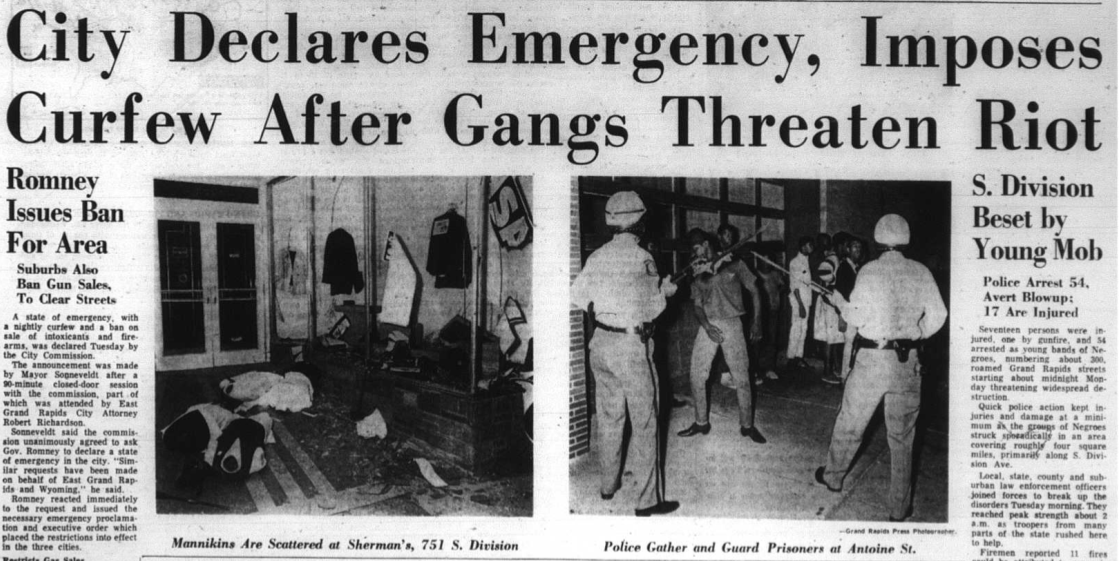
Forty-Five years ago hundreds of people participated in what the news media referred to as a race riot in Grand Rapids.
On July 25th, 1967, Grand Rapids police officers arrested several Black youth, when they pulled them over believing they were in a stolen vehicle. One source says that the officers may have used excessive force in dealing with the Black youth, according to an eyewitness account.
News reports on the first day of the uprising never mention the police abuse. Instead the headlines read that, “gangs threaten a riot” and “S. Division beset by young mob.” In fact, most of the Grand Rapids Press coverage focused on the property damage and police arrests, but never on the motives of those who took action.
The first editorial on July 26 at least acknowledges that people in Grand Rapids may have acted in part due to the riot that began on July 25th in Detroit. However, the Press editorial then uses harsh words to condemn those who participated in the Grand Rapids uprising.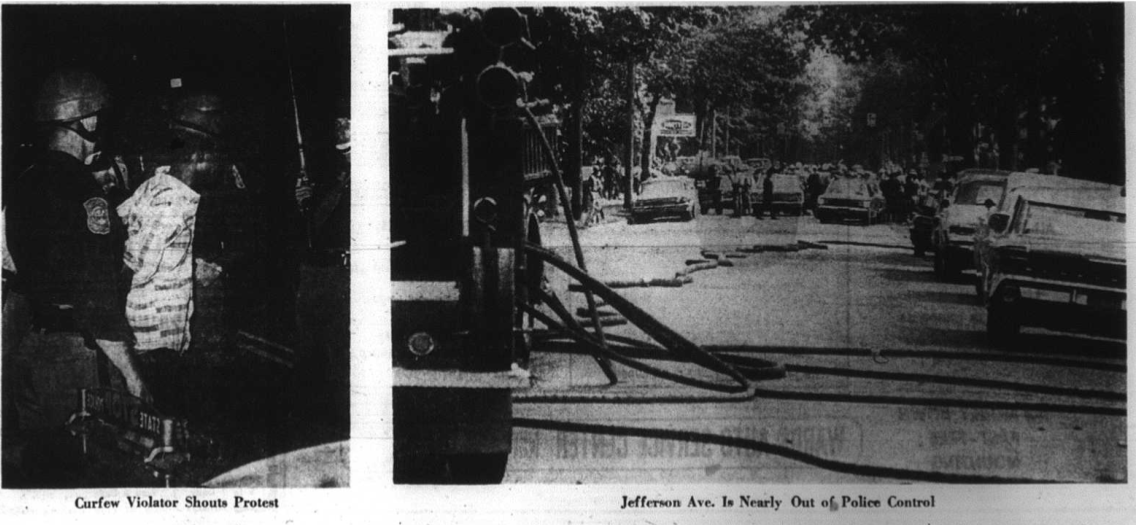
The editorial says that, “The great majority in the Negro Community is law-abiding.” This statement alone reflects contempt for anyone who acts outside officially sanctioned behavior.
The editorial goes on to say that, “the lawless behavior of a few Negro citizens has made a mockery of civil rights and that everything that has been done up to this point to improve the Negro’s social and economic standing has been a waste of time, money and effort.” It is as if the civil rights movement consisted of what the White government did for Black people, as if the Freedom Struggle didn’t really exist.
Lastly, the editorial says, “there must be no compromising with the forces of disorder.” The Press editorial writer makes his bias known by saying that anyone arrested should be treated as a criminal and nothing else.
The Grand Rapids Police, along with other area cops and the Michigan State Police made it a point to arrest anyone they could get their hands on who was either engaged in actions they deemed unlawful, even those who violated the curfew that was put in effect on the evening of the 25th.
According to a report put out by the Grand Rapids City Planning Department, there were a total of 320 arrests made over a two-day period. The report, Anatomy of a Riot, stated that 49% of those who were arrested had a prior arrest record, thus the implication that those involved were prone to “criminal behavior.”
The area where the uprising occurred was 131 to the west, Hall street to the south, Wealthy to the north and Lafayette to the east.
Besides the data contained within the report, Anatomy of a Riot spent a great deal of time making pronouncements about living conditions of the Black community, but in a contemptuous way. The report acknowledges high unemployment rates and that many of the households are led by females. “These are families without an adult male to give support, love and guidance to the children.”
What the report does not really address, nor the news coverage, was the legitimate grievances of many of those who took action between July 25 and July 27.
It is important to note that this uprising in Grand Rapids was not an isolated incident. In 1967, there were 40 “riots” across the US and numerous since 1965, including Watts and the uprisings in 1968 after the assassination of Dr. King. However, because the bulk of the uprisings took place in 1967, the federal government did commission a study to investigate the cause(s) of the “riots.”
The report, known as the Kerner Report, does acknowledge the grievances of those who rose up. The report identifies three levels of intensity, each with their own list of grievances:
First Level of Intensity:
1. Police practices
2. Unemployment and underemployment
3. Inadequate housing
Second Level of Intensity:
1. Inadequate education
2. Poor recreational facilities and programs
3. Ineffectiveness of the political structure and grievance mechanisms
Third Level of Intensity: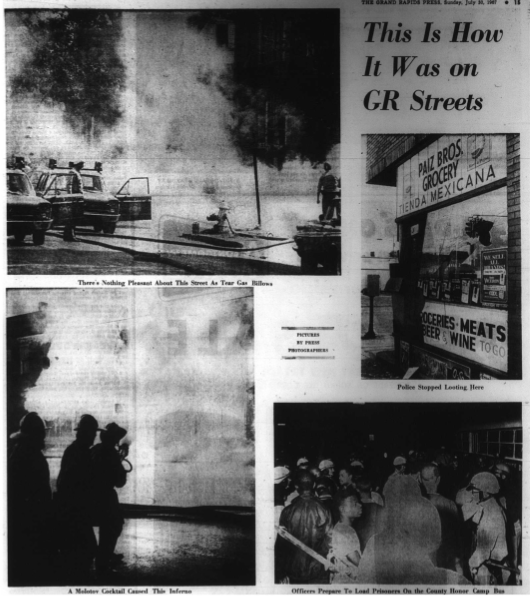
1. Disrespectful white attitudes
2. Discriminatory administration of justice
3. Inadequacy of federal programs
4. Inadequacy of municipal services
5. Discriminatory consumer and credit practices
6. Inadequate welfare programs
As was mentioned before, most of the news coverage focused on what the GR Press often referred to as lawless behavior, such as property destruction and looting as is evidenced by the photos they printed.
However, it should be noted that most of the fires that were set were of vacant or deteriorated buildings that were owned by White people. One could certainly argue that these buildings were targeted as a means of protesting against the constant exploitation of the Black community by White landlords. A former pastor in the neighborhood where the uprising took place told this writer that there were several houses and an old barn near his church on Buckley street that were set on fire and that these were buildings clearly targeted because of how the landlord treated the Black tenants.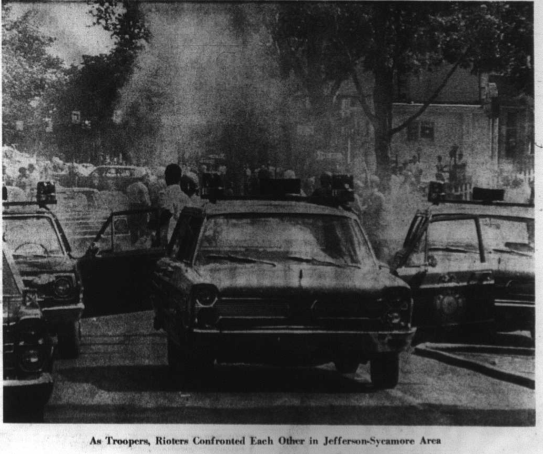
Another interesting aspect of the 1967 uprising in Grand Rapids, was the role played by a group of Black Youth who were part of what was called Operation Task Force. This was a program operating out of the old Sheldon Complex, made up of mostly Black high school student athletes who were tasked with walking the neighborhoods and talking to people to get a sense of what people’s needs were.
When the uprising began, these students in the Task Force were asked to help “calm down” the Black youth who were enraged. Ironically, some of these students were physically assaulted by police officers who did not known that the students were actually cooperating with them. Several GR Press articles were printed over the two-day period about the task force, with one headline reading. “Negro Youths calm crowd.”
On July 27, the Grand Rapids Press ran an interesting story, one that reflected the dominant culture’s fear about urban Blacks. The July 27 story was based on calls the Press writer made to people in communities near Grand Rapids, communities that were almost exclusively White.
A woman from Ionia said, “We heard they were coming here on Tuesday. We all had our guns ready if we had to.” Another White woman in Lowell was quoted as saying, “I think it is terrible. They are destroying their own property – hurting their own cause.” A resident of Saranac stated, “It is a terrible thing to say, too, but authorities should open fire on them, do something drastic to wake them up.” A man from Holland agreed with serious force being used against those rioting. He stated, “The troops should have orders to stop them anyway necessary.”
These statements clearly demonstrate the entrenched White Supremacist attitudes of the day. According to the Anatomy of a Riot report, there were calls from people on the west side of Grand Rapids who wanted to “volunteer as vigilantes” during the uprising. In fact, the report notes that some White people were arrested during the uprising, because they were in violation of the firearms ban that was put in place.
In the aftermath of the 1967 uprising in Grand Rapids there were calls for increased funding for urban youth programs and some concerns about housing conditions, especially of the properties owned by White absentee landlords. Years later there was a new condo project built in the heart of where the uprising took place, between Jefferson and Lafayette, but within a year they built a brick wall around that development to keep out undesirables.
Today, the Sheldon Complex is gone, replace by a government social services facility and a new development project is underway in the Wealthy/Division area. This new development project is forcing people of color out of the neighborhood, which is one tactic in minimizing the possibility of any future uprisings.
New Media We Recommend
Below is a list of new materials that we have read/watched in recent weeks. The comments are not a “review” of the material, instead sort of an endorsement of ideas and investigations that can provide solid analysis and even inspiration in the struggle for change. All these items are available at The Bloom Collective, so check them out and stimulate your mind.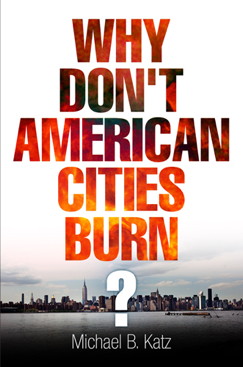
Why Don’t American Cities Burn?, by Michael Katz – An interesting look at how Americans have dealt with urban poverty over the past 50 years. The author uses his own experience in Philadelphia as a springboard for assessing the rest of the country around how policy makers have dealt with poverty, particularly in poor Black neighborhoods. Katz looks at the institutional racism and class warfare waged against Black Americans since WWII and how urban planners have responded to the race rebellions of the 1960s and 70s. The author argues that since the mid 1970s there have only been 2 “race riots” in the US, once in Miami and the 1992 LA riots. Katz observes that in many countries around the world, even in European countries, people who are faced with harsh economic conditions have no problem rising up against the system. The US political and business community have been able to redirect or co-opt urban rage in recent decades, so much so that the very idea of a riot has been eliminated as a legitimate tactical response to the debilitating effects of urban poverty. Katz argues that urban Blacks have either been forced into the Criminal Justice system or cycled into the market-driven and social service programs that put the focus on individual uplift. A valuable resource for those who want a radically different perspective on urban planning outside officially sanctioned models.
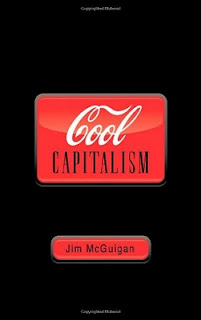
Cool Capitalism, by Jim McGuigan – Marx always said that Capitalism will find ways to be resilient and avoid greater public scrutiny. One way that the dominant economic system has done this has been to use culture as a mechanism for marketing. The author argues that Capitalism has been selling “cool” since the 1950s, but that it really took off with the counter-cultural movements in the 1960s. While there were plenty of people challenging the system, capitalism figured out a way to use the anti-establishment sentiment and make money off of it, a trend that continues til today. Cool Capitalism is an interesting mix of economic and social theory that presents solid historical analysis about the ways in which capitalism has morphed in recent decades. The section that takes a look at the role of art in cool capitalism was valuable, as was the critique of Richard Florida’s creative class slight of hand. Cool Capitalism is an important contribution to understanding how the dominant economic system continues to assimilate and undermine counter-cultural trends in order to survive.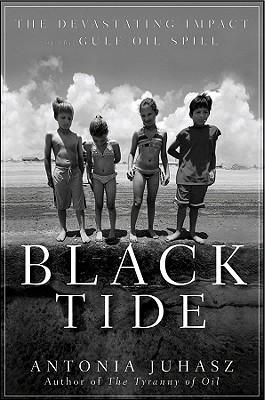
Black Tide: The Devastating Impact of the Gulf Oil Spill, by Antonia Juhasz – Black Tide is a strong indictment of BP, the oil industry and the US government complicity in one of the worst single environmental disasters in US history. Antonia Juhasz, author of The Tyranny of Oil and contributor to the blog Oil Change International, has provided us with a scathing account of what the media dubbed Deepwater Horizon. Juhasz looks at how and why the pipeline broke, the human and wildlife body count, the impact the oil spill has had on the fishing community, the spineless response by BP, the oil industry and the Obama administration. Juhasz meticulously documents these environmental crimes and the inherent criminal nature of how oil companies influence policy that will not only maintain massive oil extraction in the US, but the likely future oil disasters that the oil industry factors into its ongoing disregard for ecosystems. Unpleasant, but necessary reading for anyone who truly cares about the future of life on this planet.
The Pipe (DVD) – The Pipe is a powerful film about a community’s fight along the coast of Ireland against the multinational company Shell. Nearly a decade ago Shell discovered natural gas off the coast of Ireland, which led to plans to build a pipeline from the sea to the land, where a refining station would be placed. The people of one small community in Ireland said no to this proposal and are still fighting those plans. The film covers years of legal struggle, civil disobedience and direct action against Shell. The film deals with the internal struggles of the villagers and how it can divide or galvanize people to stand up for what is right. The film shows ordinary people putting their lives on the line to protect their homes, their land and their families.
Yesterday, the Diocese of Grand Rapids unveiled a statue of Bishop Frederic Baraga, a nineteenth century catholic clergyman that some are now pushing for sainthood.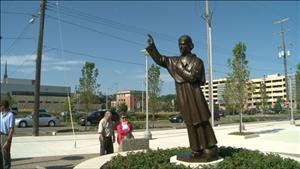
Baraga, according to some sources, founded a mission in what would become Grand Rapids, but his real legacy is the work he did in the northern part of Michigan and the UP.
Much of the news coverage of the statue ceremony states that Baraga did a great deal of missionary work amongst the Ojibway. The statue of Baraga has several bronze tablets around its perimeter, with one of them stating that Baraga created an Ojibway-English dictionary, “that is still in use today.”
While Baraga comes across in the media and church accounts as a saintly man, there is something that is glaringly missing from what function the bishop played in the colonization of the Great Lakes region.
What has come to be the acceptable norm in the US is that those who do missionary work are highly respectable individuals. However, the fundamental nature of missionary work is to not only convert people to your beliefs, but to automatically denounce the existing spiritual traditions of those you mean to convert.
More importantly, Baraga’s interaction with the Ojibway people also paved the way for genocidal policies that Europeans have implemented over the past 150 years in this area.
Those policies include the outright killing of Native people, stealing Native lands, forced relocation and taking Native children from their communities to put them in boarding schools, something the Catholic Church did in Michigan. The history of these boarding schools included denying Native children to speak their language, dress in traditional clothing, subjected to Christian teaching and also physical and sexual abuse, as is well documented in Kill the Indian, Save the Man: The Genocidal Impact of American Indian Residential Schools.
This is the legacy of Bishop Baraga, however well intentioned he was, since his committed to converting the Ojibway paved the way for the harsh policies that followed.
Native American scholar George Tinker, author of the book Missionary Conquest: The Gospels and Native American Genocide, refers to Christian missionaries to Native Nations as “partners in genocide.”
Tinker goes on to describe the significance of White missionaries this way:
Told from an Indian perspective, the story is far less entertaining and much less endearing. Pain and devastation become dominant elements as Indian anger erupts to the surface. Indeed, today the white missionary, both in the historical memory of Indian people and in the contemporary experience, has become a frequent target of scorn in most segments of the Indian world. Many implicitly recognize some connection between Indian suffering and the missionary presence, even as they struggle to make sense not only of past wrongs, but also of the pain of contemporary Indian experience. The pain experienced by Indians today is readily apparent in too many statistics that put Indians on the top or bottom of lists. For instance, Indian people suffer the lowest per capita income of any ethnic group in the US, the highest teenage suicide rate, a 60% unemployment rate, and a scandalously low longevity that remains below sixty years for both men and women.
Not surprising, such commentary did not accompany the unveiling of the Baraga statue yesterday. The lack of this kind of critical voice or perspective reflects how deeply ingrained the dominant culture, a culture of conquest, is in this country and this community.
The celebration of the unveiling of the statue of Bishop Baraga not only legitimizes what was been done to Native communities, it normalizes and sanitizes the history of genocide in the Americas.
 Grand Rapids Institute for Information Democracy