Nuclear Cover-Up Threatens Great Lakes Region
This article by Michael Leonardi is re-posted from CounterPunch.
According to recent reports from the nuclear watchdog Beyond Nuclear and several Great Lakes environmental organizations, the NRC is up to its usual practices as an industry captured agency. Collusion and flagrant cover-ups at the Davis Besse nuclear power plant on the shores of Lake Erie and at the Palisades nuclear plant on the shores of Lake Michigan have drawn the ire of Congressmen Dennis Kucinich of Ohio and Ed Markey of Massachusetts who have called on the NRC’s investigator general to investigate NRC region 3 practices and motivations of the NRC in allowing these plants to operate with grave safety concerns.
With respect to Davis Besse it seems like a flashback to the 2002 hole in the reactor head incident documented here, as part of the history of this Nuclear Nightmare between Toledo and Cleveland on the western Lake Erie basin. In 2003 the NRC’s commissioner resigned after the General Accounting Office found the agency guilty of collusion with plant operator First Energy in their attempts to cover-up the seriousness of corrosion issues that brought Davis Besse within 3/16ths of an inch of a core containment breach and catastrophic release of radioactivity. Then congressman Dennis Kucinich led the call of the Inspector General’s office as he is once again after First Energy and the NRC have colluded to downplay the seriousness of widespread cracking that has been discovered over the past year throughout the concrete shield building that houses the Davis Besse reactor.
According to some alarming revelations found in NRC documents revealed through a Freedom of Information Act filing by Kevin Kamps at Beyond Nuclear found here, NRC investigators have serious reservations as to whether the Davis Besse shield building could withstand even minor seismic activity and admit that even before the widespread cracking was discovered that the shield building was never designed “for containment accident pressure and temperature.”
This means that, even when brand new and un-cracked, Davis Besse’s shield building was not capable of preventing catastrophic radioactivity releases during a reactor core meltdown. An inner steel containment vessel, a mere 1.5 inches thick when brand new, would thus be the last line of defense. However, the environmental intervenors have un-earthed NRC and First Energy documents showing that the steel containment vessel has suffered significant corrosion over the past several decades due to infiltrating and standing chemically “aggressive” groundwater in the “sand bed” region surrounding the bottom of the containment vessel (which has also degraded the shield building’s underground “moisture barrier”), as well as due to an acidic borated water leak from the refueling channel near the top of the containment vessel.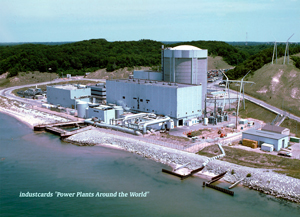
The coalition of environmental and citizens groups fighting the relicensing of Davis Besse has pointed to a 1982 study, “Calculation of Reactor Accident Consequences” (CRAC-2), commissioned by NRC, to show how bad the casualties and property damage would be downwind and downstream of a catastrophic radioactivity release which escapes Davis Besse’s corroded inner steel containment vessel and cracked outer shield building. CRAC-2 lists the following consequences at Davis-Besse: 1,400 Peak Early Fatalities; 73,000 Peak Early Injuries; 10,000 Peak Cancer Deaths; $84 billion in property damage. However, CRAC-2 was based on 1970 U.S. Census data. As reported by Jeff Donn at the Associated Press in summer 2011, populations around U.S. nuclear power plants have “soared” in the past 42 years, meaning those casualty figures near Davis Besse would likely now be much worse. And, when adjusted for inflation from 1982-dollar figures, property damage would today surmount $187 billion in 2010-dollar figures.
According to the environmental coalition’s attorney Terry Lodge, “What we have established from NRC’s own documents is that there are two Nuclear Regulatory Commissions: some hard-working, intelligent people who set out to find out the truth of these very dangerous technical problems and their causes, and a political class in the agency that is dedicated to pulling the plug on any investigation that threatens utility profits, above all else. The search for truth about the shield building had to be cut off because it went too close to the cash cow.”
Michael Keegan of Don’t Waste Michigan in Monroe stated: “These multiple crackings, complete with concrete degradation of the shield containment building, are but a metaphor for the entire dilapidated Davis Besse atomic reactor. This reactor is running on borrowed time, propped up on stilts by a captured regulator that is now under investigation for doing so.”
Kevin Kamps, of national watchdog Beyond Nuclear in Takoma Park, Maryland stated: “NRC staff and management, both at its national headquarters in Rockville, Maryland, as well as its Region 3 office outside Chicago, worked long hours, during evenings, on weekends, and even through the Thanksgiving holiday, in order to rubber stamp reactor restart approval at Davis Besse in a great big hurry, despite countless unanswered questions and unresolved concerns about the shield building cracking.”
As regards to the chronically leaking Palisade’s nuclear reactor located on the shores of Lake Michigan in southwest Michigan, the NRC’s investigator general is conducting an investigation into why recently resigned NRC chairman Gregory Jaczko was kept in the dark, along with the public, about a leak of Safety Injection Refueling Water from a storage tank into buckets in the control room when he was on a visit to the facility before meeting with nuclear watchdogs and environmentalists back in May of this year. This investigation was called for by congressman Ed Markey of Massachusetts after it was revealed that ongoing safety issues were covered-up by the Entergy owned Palisades even while a tour of the plant was in act. Palisades has a terrible record of leaks, mishaps and accidents, some of which were outlined in this 2010 report “Headaches at Palisades: Broken Seals & Failed Heals,” by the Union of Concerned Scientist’s David Lochbaum. Most recently on the 12th of August Palisades was shut down for a leak of radioactive and acidic primary coolant, escaping from safety-critical control rod drive mechanisms attached to its degraded lid, atop what is considered by the NRC itself to be most embrittled reactor pressure vessel in the U.S..
Palisades’ operator Entergy is also in the habit of periodically releasing radioactive steam into the area due to reoccurring electrical accidents most recently in September of 2011. This steam may be a contributing factor to the fact that the area around South Haven is considered a cancer cluster by medical researchers from the state of Michigan Health department.
Jaczko was the subject of what Senator Reid of Nevada called a witch hunt by politically motivated commissioners angered at the fact that Jaczko had helped to mothball the Yucca Mountain nuclear waste repository and resigned in June. A December 2011 article by Andrew Cockburn, provides an overview of the politically motivated actions at an NRC that has clearly distinguished itself to be nothing more than a regulatory agency under complete control by an industry always willing to put profit margins above any considerations of health, public safety of property values. As Kevin Kamps was quoted as saying in this article in regards to Jaczko “He’s not ‘our guy’ by any means, he has voted to re-license plants that should probably be shut down, but he does care about safety, in ways that the others do not.” It was also well put by CounterPunch contributor Karl Grossman, when he said “Jaczko was insufficiently pro nuclear.”
One of the NRC commissioners responsible forcing out Jaczko was Commissioner William Ostendorff. Ostendorff reportedly threw a temper tantrum at the NRC calling on the NRC’s Investigator General to halt her investigation into the cover-up at Palisades calling it a waste of taxpayer dollars. Now Ostebdorff finds himself under investigation for impeding an investigation. Ostendorff is an explicit representation of how the NRC operates as a captured agency through orchestrated industry deception.
The story of the NRC and nuclear regulation in the United States is one of corruption and collusion at the whim of industry dictates. Congressmen Dennis Kucinich, along with congressman Markey of Massachusetts, Senators Barbara Boxer, Bernie Sanders and Ron Wyden are some of the few voices of credibility in the wilderness of congressional complacency and acquiescence to the profit driven desires of an industry driven by the vast mythology of the “peaceful atom” that has been perpetrated by decades of propaganda from the likes of the industry front group the Nuclear Energy Institute. The corporations like Exelon, GE, First Energy, Entergy and their political escorts that prop them up from the white house and throughout the halls of congress continue to allow the operation of 104 reactors across the United States.
Obama has surrounded himself with nuclear industry advisors and cabinet members as part of his nuclear powered white house. Meanwhile congress people like republican representative Fred Upton, who’s district includes Palisades and democratic representative Marcy Kaptur who resides over the district that includes Davis Besse give carte blanche to the NRC, Entergy and First Energy putting what they define as “good jobs” and “economic partnership” over any concerns of health and safety for their constituents or for the entire Great Lakes ecosystem.
In regards to the cases of Palisade’s and Davis Besse, Dennis Kucinich stated “I can’t say the cases are related, but the similarities between these two investigations are troubling. In Michigan, an effort to determine why a radioactive leak was kept from the Chairman of NRC may have been undermined. In Ohio, we witnessed agency officials give public statements that varied dramatically from what engineers had told my staff. I cannot determine what caused this change in the answers of these Region III engineers, but I am concerned that it was in response to political pressure. I hope that the Inspector General is able to restore confidence in the NRC’s ability to provide effective oversight of our nation’s nuclear power plants.” This is a confidence that for many citizens that have been following culture of collusion and corruption at the NRC since its inception has never existed.
Jaczko has now been hunted out and replaced by Allison Macfarlane who has so far decided to keep her head in the sand when it comes to the political motivations of the NRC and its cosiness with the nuclear industry that it purports to regulate. The commissioners responsible for Jaczko’s demise remain. When asked about the perception of the NRC being a captured agency at a recent press conference Macfarlane feigned ignorance, or maybe it is that she is truly ignorant that this perception exists. If she wants to “restore confidence” as Kucinich puts it or “build public confidence in the agency by improving communication and increasing transparency” as she put it, she better get on top of the ongoing investigations of her own Inspector General very quickly. The reality that the NRC is now regulating based on deception and lies does not bode well for her attempts to build public confidence.
Senator Harry Reid recently referred to NRC commissioner Bill Magwood as a “treacherous, miserable liar,” referring to questions regarding Magwood’s support for a nuclear repository at Yucca Mountain. This repository was considered to be geologically inadequate by former chairman Jaczko and the new chair Allison Macfarlane until she jumped into the political playing field and said she would keep an open mind about the Yucca Mountain repository during her senate confirmation hearing.
Macfarlane is a geologist and expert on radioactive waste chosen at a time when the unsolvable problem of high level radioactive waste has come to the forefront once again and threatens to block any future relicensing of nuclear plants. As another in the long line of myth perpetrators Macfarlane wants to assure the American people that a safe geological storage site to keep high level radioactive waste safe and sound for over 100,000 years is surely possible if congress has the
Executive Excess 2012: The CEO Hands in Uncle Sam’s Pocket
This article is re-posted from the Institute for Policy Studies. Editor’s note: The following information is shared here so as to provide readers with yet another example of how the system screws us over. We are not advocating for a reform in the system or simply more equity in pay between workers and CEOs. Our readers have to make up their own minds on what to do with this information.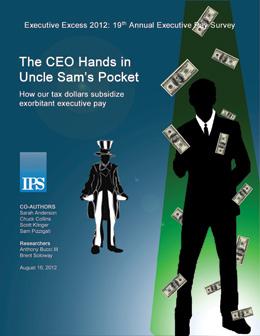
Nationwide, budget cuts have axed 627,000 public service jobs just since June 2009. Schools, health clinics, fire stations, parks, and recreation facilities—virtually no public service has gone unsqueezed. Tax dollars haven’t seemed this scarce in generations.
Yet tens of billions of these scarce tax dollars are getting diverted. These tax dollars are flowing from average Americans who depend on public services to the kingpins of America’s private sector. They’re subsidizing, directly and indirectly, the mega-million paychecks that go to the top executives at our nation’s biggest banks and corporations.
Exorbitant CEO pay packages have, of course, been outraging Americans for quite some time now. Every new annual CEO pay report seems to bring a rash of predictably angry editorials and calls for reform. But little overall has changed. Wages for average Americans continue to stagnate. Pay for top executives continues to soar.
One key reason why: Our nation’s tax code has become a powerful enabler of bloated CEO pay. Some tax rules on the books today essentially encourage corporations to compensate their executives at unconscionably higher multiples of what their average workers are paid.
Other rules let executives who run major corporations routinely reduce their corporate tax bills. The fewer dollars these corporations pay in taxes, the more robust their eventual earnings and the higher the “performance-based” pay for the CEOs who produce them.
In effect, we’re rewarding corporate executives for gaming the tax system. Our tax code is helping the CEOs of our nation’s most prosperous corporations pick Uncle Sam’s pocket.
In this latest Institute for Policy Studies Executive Excess annual report, our 19th consecutive, we take a close look at the most lucrative tax incentives and subsidies behind bloated CEO pay and highlight those executives who have reaped the highest rewards from tax code provisions that actively encourage outrageously disproportionate executive pay.
We also identify the top executives who have benefited the most from what have become known as “the Bush tax cuts”—the reductions in federal income tax rates on top-bracket, capital gains, and dividend income enacted in 2001 and 2003.
Among our findings:
- Of last year’s 100 highest-paid U.S. corporate chief executives, 26 took home more in CEO pay than their companies paid in federal income taxes, up from the 25 we noted in last year’s analysis. Seven firms made the list in both 2011 and 2010.
- The CEOs of these 26 firms received $20.4 million in average total compensation last year. That’s a 23 percent increase over the average for last year’s list of 2010’s tax dodging executives.
- The four most direct tax subsidies for excessive executive pay cost taxpayers an estimated $14.4 billion per year—$46 for every American man, woman, and child. That amount could also cover the annual cost of hiring 211,732 elementary-school teachers or creating 241,593 clean-energy jobs.
- CEOs have benefited enormously from the Bush tax cuts for upper-income taxpayers. Last year, 57 CEOs saved more than $1 million on their personal income tax bills, thanks to these Bush-era cuts.
What can be done to end today’s incredibly gross pay divide between top executives and average workers? In this year’s Executive Excess, we once again survey a wide range of reform notions with a “scorecard” that notes those reforms that have already been enacted, those still pending before Congress, and those proposals not yet before Congress that we believe hold the most CEO pay-deflating promise.
Read the full report: Executive Excess 2012: The CEO Hands in Uncle Sam’s Pocket (PDF)
Go to the campaign page: Executive Excess 2012 Campaign
Challenging Channel One’s commercial influence in our schools
This action alert is re-posted from Campaign for a Commercial Free Childhood.
For nearly 25 years, Channel One News has been the nation’s most pernicious in-school advertiser, wasting taxpayer-funded class time by showing student-targeted commercials to a captive audience of schoolchildren. But there are signs that Channel One’s days may be numbered. Many schools have dumped the network and its student audience has shrunk from 8.1 million in 2000 to 5.5 million today. But that’s 5.5 million too many.
And now, in a desperate attempt to make up for lost revenue, Channel One is escalating its daily commercial assault by advertising inappropriate and disreputable websites to students and turning entire broadcasts into ads. That’s why CCFC is calling on state departments of education to conduct a thorough review of the costs and benefits of showing Channel One News in school and to encourage local districts to suspend its use until such a review is complete.
Will you join us in urging your state’s department of education to investigate Channel One?
This week, CCFC sent a letter to state school superintendents detailing the reasons why Channel One should not be shown in schools, including:
It’s waste of students’ time and taxpayers’ money. In exchange for the loan of outdated video equipment, schools agree to show a 12-minute newscast – including 2 minutes of commercials – every day. Schools with Channel One lose more than a week of instructional time each year, including a full day just to the commercials!
Channel One violates its contract with schools by exceeding the agreed-upon limit on commercial content. In addition to regular commercials, Channel One integrates advertising into its actual newscast. For instance, on May 23, 2012, Channel One’s entire 12-minute broadcast was devoted to promoting four television shows on the ABC Family network.
Channel One promotes websites that are inappropriate for children and teens, including the highly sexualized gURL.com; Live Psychic Readings, which charges $7.49/minute; and the controversial website Spokeo.com, which was fined $800,000 by the Federal Trade Commission in June for the misuse and sale of personal data.
If state education departments investigate and publicize what Channel One is doing in classrooms and on its student-targeted website, it’s likely that educators will pull the plug. But they will only act if there is significant pressure to do so. Will you urge your state to investigate Channel One and help us put an end to the worst-of-the-worst in in-school advertising? Click here.
OKT offers Tomato canning workshop this Saturday

The Grand Rapids-based group Our Kitchen Table (OKT), is offer the 3rd in a series of canning and food preservation workshops this Saturday, August 25.
The workshop will include a how to on canning tomatoes and oven roasting tomatoes with herbs for freezing.
This workshop is for anyone, no matter what your skill level is. OKT will provide tomatoes and canning supplies, so just bring your desire to learn or share your knowledge.
The workshop is free and open to anyone. For more information contact OKT at 616-570-0218 or OKTable1@gmail.com. They also have a facebook event page for the workshop.
Tomato Canning Workshop
Saturday, August 25
2 – 4 PM
Sherman Street Church
1000 Sherman St. SE, Grand Rapids
GQ’s take on ArtPrize and the DeVos Family
Within the past 24 hours, I have had friends message me to see if I had seen the recent GQ article on ArtPrize and Rick DeVos.
Comments have been exchanged and conversation have ensued which led me to believe that a response was relevant considering Grand Rapids is about to embark on year four of ArtPrize.
My first reaction to the Matthew Power piece in GQ, which was written based on his visit last year, was that it was nice to see such a mainstream publication willing to talk about the political dynamics of ArtPrize.
Early on in the article, Power lets his readers know that he wants to know the motives behind ArtPrize, a question many of us have been asking since it was first announced.
It was also refreshing to see the article include information on the politics of the DeVos family. The GQ article does not give enough details on their political and economic influence, but that the writer even dared to go down that path is important since none of the commercial media in Grand Rapids has been willing to utter a sound about the influence of the DeVos family and ArtPrize. In fact, the local media as we have noted on numerous occasions has been nothing short of a PR engine for the event. We have also noted that local news outlets have demonstrated that reporting on ArtPrize is more important than reporting on electoral politics.
It was equally refreshing to see Matthew Power include critical comments from two local artists, Paul Amenta and Michael Pfleghaar. Amenta and Pfleghaar both do not mince words when talking about what they find objectionable about ArtPrize, which is important considering that the event itself has not been very interested in providing a forum for critical discourse. Last year this writer attended a panel discussion on AtPrize at GVSU where not one of the panel members was willing to provide any critical comments about the annual event; and, when one audience member did, the panelists danced around his question.
Pfleghaar should also be saluted for saying that the “DeVoses were oligarchs who treated Grand Rapids like a playtown, and he also suspected ArtPrize was somehow part of their shadowy conservative cultural agenda.” Pfelghaar also stated, “Rick’s money is their money to me. He was born into this fortune.”
This last comment cuts to the core of the issue in many ways, despite Rick DeVos’ attempts to distance himself from his family’s political legacy. According to the 990s we have looked at for ArtPrize, Dick and Betsy DeVos gave their son $1.7 million in 2009 to help him make his dream become a reality. His parents have continued this trend, along with other DeVos family members and the Prince family, providing hundreds of thousands each year to underwrite some of the larger venues.
Rick DeVos’ desire to distance himself from the family politics was reflected in this comment in the GQ story where he says, “I don’t even want to weigh in on any of the political stuff. I just prefer to stay away from that.” Sorry Rick, but you do not get to stay away from that since the political stuff is woven into the very fabric of ArtPrize as we have noted in a previous posting entitled The Political Economy of ArtPrize.
Does Rick really believe that he can separate his activities, such as ArtPrize or Start Garden, when they can only happen because of the family money? He can no more distance himself from his family’s politics than any other child of a billionaire family unless they reject the wealth, which ultimately means rejecting how that wealth was acquired and what kind of influence and power that wealth buys. Rick cannot distance himself from the anti-LGBT, anti-Union, anti-public education and pro-privatization policies that the DeVos family has financed and lent their name to for decades.
This influence was reflected in the GQ story when the writer pointed out that some people he spoke with said that many artists are hesitant to submit critical pieces or voice criticism of ArtPrize. Powers states that this form of “self-censorship” was due to “all the funding the DeVoses provide for cultural institutions.” Indeed, it is extremely difficult for the cash-strapped nonprofit world to slap one of the biggest hands that feeds them.
Lastly, the GQ article was instructive in its observations about Rick DeVos and his family, with references to a bodyguard-protected family car waiting for them in the alley to the bodyguard hovering near Rick during the ArtPrize awards ceremony last year at the convention center. If Rick is afraid of being assaulted or kidnapped for ransom, he might consider that animosity towards his family is not just because of their politics, but because there are millions of people living in utter poverty while his family owns their own island and Grandpa is consistently one of the top 100 wealthiest people on the planet.
Applauding Whistleblowers targeted by the Obama Administration
This interview is re-posted from ZNet.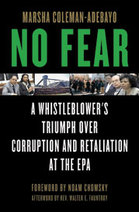
Dr. Marsha Coleman-Adebayo, author of No FEAR: A Whistleblower’s Triumph over Corruption and Retaliation at the Environmental Protection Agency (EPA) interviews Professor Noam Chomsky. Dr. Coleman-Adebayo was a student of Noam Chomsky at MIT.
While at the EPA, Dr. Coleman-Adebayo reported that a US multinational corporation was endangering the lives of South African vanadium mine workers and was ordered to “shut-up” by supervisors. She was called racial and sexual names and received death and rape threats while at the Agency.
Veolia, the Israeli Occupation and Grand Rapids contracts
Last year we reported on the potential water privatization campaign in Grand Rapids with the French multinational corporation Veolia. The City of Grand Rapids decided not to go the privatization route, but it is important to note that the City of Grand Rapids does currently contract with Veolia, which runs the steam-heating system for much of the downtown area.

Veolia Energy serves the business district with centrally-produced steam. Customers include: hospitals; college campuses; sports arena and exhibition center; prestigious office buildings and retail store fronts; city, state and county government facilities; private apartment buildings and arts and culture centers. The contracts for Grand Rapids (Grand Valley State University), Michigan is set to end in 2013. In 2010, Veolia Energy renewed its agreement with Grand Valley State University (GVSU) to continue to provide thermal heating services to its Pew Grand Rapids Campus.
Veolia is currently being targeted by numerous solidarity groups because of a contract they have with the State of Israel for a light rail system. The following information on this national campaign is re-posted from the End the Occupation Campaign.
Last month, our newest coalition member group North Coast Coalition for Palestine caught the attention of corporate America, multinationals, and official representatives of the State of Israel when they challenged renewal of a local bus operating contract with Veolia, a French conglomerate heavily implicated in the Israeli occupation.
In a stirring 5-hour session of testimonies, Sonoma County, CA residents put the Israeli occupation and its corporate enablers on trial.
It was historic. The diverse, unpaid group of Palestinians, Jews, artists, teachers, students, veterans, and activists were simply asking for the local Commission on Human Rights to recommend that the Board of Supervisors investigate Veolia prior to renewing contracts in 2014. Their request prompted the multinational to fly in two Vice Presidents and the Israeli Consulate in San Francisco to send their Deputy Consul General to monitor and testify at the hearings.
This is what the future of our movement could look like — local communities putting the occupation and its US institutional supporters on trial in courthouses, town halls, and municipal departments across the nation, in truly grassroots and democratic campaigns with global reach.
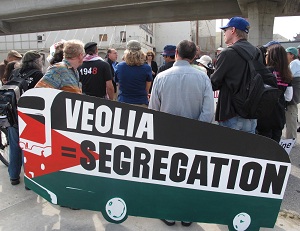
Veolia has been a major target of international Boycott, Divestment, Sanctions (BDS) campaigns due to its deep involvement in the segregated transit system serving primarily the Jewish settlements of West Bank and Jerusalem, and operation of the Tovian waste dump in the Jordan Valley — all in violation of international law.
Does your city have Veolia contracts? Click here to find out!
Next week, organizers of the DumpVeolia.LA Campaign will be waging a similar effort to challenge renewal of Los Angeles city bus contracts with Veolia at a local Transportation Committee public hearing. They are asking for your help!
Member groups in Boston, Baltimore, Sacramento, and beyond have launched exciting Veolia campaigns. The national We Divest Campaign, with more than a dozen active campaigns around the U.S., is calling on financial giant TIAA-CREF to divest from Veolia, among other companies.
Veolia is no stranger to such efforts. Over the past six years, across Europe and the world, major banks, municipalities, and other significant bodies have divested, boycotted, or otherwise severed relations with the corporation following pressure from trade unions, Ministers of Parliament, students, pension fund boards, church task forces, and others. Through dozens of BDS victories, the company has lost an estimated $12.6 billion in lost contracts. Imagine its concern seeing Veolia campaigns on the rise today in the United States!
Click here to see how you can join the new wave of campaigns putting U.S. Veolia BDS activism on the map. Don’t have local Veolia contracts? Great! Start a campaign to declare your community “Veolia-free”!
And remember, Veolia is just one possibility. Consider organizing to pass a City Council resolution against military aid to Israel, freeing funds for unmet needs in your community. Click here to check out our “Fund Community Needs, Not Israel’s Misdeeds” website and How-To Guide.
MLive, fracking and “balanced” coverage
Yesterday, MLive posted a story about the Traverse City-based Jordan Exploration Company’s intention to purchase land for oil & gas extraction at the DNR land auction on October 24 in Lansing.
The article not only gives the Jordan Exploration Co. more of a voice in this story, the reporter never challenges the comments from partial owner of the company Robert Boeve.
Boeve presents the company’s interests purely as exploratory, but admits that if the company discovers oil or gas they could be drilling as early as next summer on potentially 39,000 acres of land the Jordan Exploration Co. is looking at purchasing in Kent, Ottawa, Allegan and Ionia County.
There is not much online information about the company, but there certainly has been resistance to previous projects that Jordan Exploration has been involved in.
In January, the Oakland Press reported that the company was looking to drilling for oil and gas on the east side of the state, but that some residents were opposed to the plans.
In 2010, the Jordan Exploration Co. got approval from the DNR to open a Biomass plant in Mancelona, according to the independent media source Michigan Messenger. There was significant opposition to this project from people in the area and the original proposal was set for Kalkaska, where residents said no to such plans.
The MLive article does provide a “counter” perspective near the end of the article. A representative from the West Michigan Environmental Action Council (WMEAC) said the organization “has not taken a formal position on drilling beneath the state lands, but Occhipinti said they oppose hydraulic fracturing.”
The claim by WMEAC that they informally oppose fracking seems odd to this writer. In May we reported that WMEAC would not support a permanent moratorium against fracking in Michigan, based on comments from the organization’s own blog. If WMEAC is indeed taking a clear anti-fracking position that would be welcomed news, but we could find no evidence on their website that this is a public position.
Lastly, the MLive story does not mention that at the last DNR land auction, which took place in May in Lansing, there was a sizeable protest against auctioning off public land for oil and gas extraction. There were numerous people from Grand Rapids, Muskegon and Barry County who were part of that protest, yet their voices and their perspectives were not sought out, despite their active role in formally opposing any new oil and gas extraction in Michigan. In addition, there is the statewide group Ban Fracking Michigan, which would also provide a significant oppositional voice on this issue.
After the London Olympics: “The Gloves Come Off”
This article by Dave Zirin is re-posted from ZNet.
When I was in London last May, I met people optimistic and pessimistic about the coming Olympics. I spoke with Tories excited about the coming spectacle and union leaders concerned that the promises of jobs and development would fall short. I met right-wing economists railing against the Olympic-sized debt and Labour party leaders giddy about the tourism and “prestige” the Games would bring. I met cab drivers enraged about restrictions on their routes and bus drivers ready to strike they didn’t receive a hefty bonus for the extra demands of the Olympics (the government caved and paid transit workers to be happy during the fortnight.)
But there was one thing everyone agreed about and they used the same phrase repeatedly: “After the Olympics the gloves will come off.” They all meant that the Olympics were a vacation from political reality. After the Games were done, a political battle would commence over who would bail the UK out of a crippling economic crisis. Simon Lee, senior politics lecturer at the University of Hull, was quoted by Reuters as saying that the Olympics did little more than “paper over the fact that we are on the verge of a depression.”
The numbers are certainly dire. The economy has been shrinking for nine consecutive months, even with the added stimulus of pre-Olympic spending. Youth unemployment is well over 20%. Among all unemployed, almost a third have been out of work for a year. The plan for correcting this is even more dire, with Prime Minister David Cameron committed to an agenda of acute austerity.. That means laying off government employees, including doctors, nurses, and teachers, and raising taxes on working people, all in the name of paying down their debt.
If Cameron believes that debt is truly the economy’s greatest problem, then the Olympic hangover, as it did in Greece in 2004, could severely aggravate the existing crisis. The final price tag of the Games, including massive security costs, will reach as high as 24 billion pounds, ten times the original rosy projections when they won the bid back in 2005. Back then, London Mayor Ken Livingstone predicted a tax of £240 per citizen to pay for the games. Suffice it to say, those costs can safely be adjusted upward.
Debt is not the only hangover of these Olympics. A treasure trove of new surveillance equipment has now become a permanent part of the London landscape. Already the world’s most surveilled metropolis, the city is now, as Stephen Graham reported in the Guardian, “wired up with a new range of scanners, biometric ID cards, number-plate and facial-recognition CCTV systems, disease tracking systems, new police control centres and checkpoints. These will intensify the sense of lockdown in a city which is already a byword across the world for remarkably intensive surveillance.” As one security official told me when I was in London, “These toys aren’t going anywhere. What are we going to do? Put them back in the box?”
Then there are the displacements. In the opening ceremonies, NBC’s Meredith Viera described East London as a “wasteland” that had been “transformed” by the Olympics. I actually walked the streets of East London and I wish Ms. Viera has done the same. Another word for “wasteland” could be “working class community where people live and raise families”. In addition, if the area has been “transformed” it’s because hundreds of residents were displaced. They are on the waiting list for promised new public housing, which, once again, because of the austerity agenda may never be built. Watch the homelessness statistics in London spike in the months ahead
All of these chickens will come home to roost in the aftermath of the games when austerity explodes out of the starting blocks like a demonic Usain Bolt. The crisis is real and the only question is who is going to pay to bail out the country. If it’s the 1%, that will mean nationalization, tax hikes, deficit spending, and the state pumping money into the economy to avoid a depression. If it’s the 99%, and that’s already the plan, expect a round of vicious cuts amidst the Olympic afterglow. The National Health Service, so praised in the Olympic opening ceremonies, will see a reduction in staff of 50,000. Tax hikes on workers will be a reality alongside layoffs. Anger will rise. Then, all of that surveillance equipment will really come into use.
The gloves will come off indeed. Let’s see if the workers, immigrants, and everyday people of the UK can take the punch and return in kind. If not, we’ll always have the Spice Girls.
Impunity at Home, Rendition Abroad
This article by Al McCoy is re-posted from ZNet.
After a decade of fiery public debate and bare-knuckle partisan brawling, the United States has stumbled toward an ad hoc bipartisan compromise over the issue of torture that rests on two unsustainable policies: impunity at home and rendition abroad.
President Obama has closed the CIA’s “black sites,” its secret prisons where American agents once dirtied their hands with waterboarding and wall slamming. But via rendition — the sending of terrorist suspects to the prisons of countries that torture — and related policies, his administration has outsourced human rights abuse to Afghanistan, Somalia, and elsewhere. In this way, he has avoided the political stigma of torture, while tacitly tolerating such abuses and harvesting whatever intelligence can be gained from them.
This “resolution” of the torture issue may meet the needs of this country’s deeply divided politics. It cannot, however, long satisfy an international community determined to prosecute human rights abuses through universal jurisdiction. It also runs the long-term risk of another sordid torture scandal that will further damage U.S. standing with allies worldwide.
Perfecting a New Form of Torture
The modern American urge to use torture did not, of course, begin on September 12, 2001. It has roots that reach back to the beginning of the Cold War and a human rights policy riven with contradictions. Publicly, Washington opposed torture and led the world in drafting the United Nation’s Universal Declaration of Human Rights in 1948 and the Geneva Conventions in 1949. Simultaneously and secretly, however, the Central Intelligence Agency began developing ingenious new torture techniques in contravention of these same international conventions.
From 1950 to 1962, the CIA led a secret research effort to crack the code of human consciousness, a veritable Manhattan project of the mind with two findings foundational to a new form of psychological torture. In the early 1950s, while collaborating with the CIA, famed Canadian psychologist Dr. Donald Hebb discovered that, using goggles, gloves, and earmuffs, he could induce a state akin to psychosis among student volunteers by depriving them of sensory stimulation. Simultaneously, two eminent physicians at Cornell University Medical Center, also working with the Agency, found that the most devastating torture technique used by the KGB, the Soviet secret police, involved simply forcing victims to stand for days at a time, while legs swelled painfully and hallucinations began.
In 1963, after a decade of mind-control research, the CIA codified these findings in a succinct, secret instructional handbook, the KUBARK Counterintelligence Interrogation manual. It became the basis for a new method of psychological torture disseminated worldwide and within the U.S. intelligence community. Avoiding direct involvement in torture, the CIA instead trained allied agencies to do its dirty work in prisons throughout the Third World, like South Vietnam’s notorious “tiger cages.”
The Korean War added a defensive dimension to this mind-control research. After harsh North Korean psychological torture forced American POWs to accuse their own country of war crimes, President Dwight Eisenhower ordered that any serviceman subject to capture be given resistance training, which the Air Force soon dubbed with the acronym SERE (for survival, evasion, resistance, escape).
Once the Cold War ended in 1990, Washington resumed its advocacy of human rights, ratifying the U.N. Convention Against Torture in 1994, which banned the infliction of “severe” psychological and physical pain. The CIA ended its torture training in the Third World, and the Defense Department recalled Latin American counterinsurgency manuals that contained instructions for using harsh interrogation techniques. On the surface, then, Washington had resolved the tension between its anti-torture principles and its torture practices.
But when President Bill Clinton sent the U.N. Convention to Congress for ratification in 1994, he included language (drafted six years earlier by the Reagan administration) that contained diplomatic “reservations.” In effect, these addenda accepted the banning of physical abuse, but exempted psychological torture.
A year later, when the Clinton administration launched its covert campaign against al-Qaeda, the CIA avoided direct involvement in human rights violations by sending 70 terror suspects to allied nations notorious for physical torture. This practice, called “extraordinary rendition,” had supposedly been banned by the U.N. convention and so a new contradiction between Washington’s human rights principles and its practices was buried like a political land mine ready to detonate with phenomenal force, just 10 years later, in the Abu Ghraib scandal.
Normalizing Torture
Right after his first public address to a shaken nation on September 11, 2001, President George W. Bush gave his White House staff expansive secret orders for the use of harsh interrogation, adding, “I don’t care what the international lawyers say, we are going to kick some ass.”
Soon after, the CIA began opening “black sites” that would in the coming years stretch from Thailand to Poland. It also leased a fleet of executive jets for the rendition of detained terrorist suspects to allied nations, and revived psychological tortures abandoned since the end of the Cold War. Indeed, the agency hired former Air Force psychologists to reverse engineer SERE training techniques, flipping them from defense to offense and thereby creating the psychological tortures that would henceforth travel far under the euphemistic label “enhanced interrogation techniques.”
In a parallel move in late 2002, Secretary of Defense Donald Rumsfeld appointed General Geoffrey Miller to head the new prison at Guantanamo, Cuba, and gave him broad authority to develop a total three-phase attack on the sensory receptors, cultural identity, and individual psyches of his new prisoners. After General Miller visited Abu Ghraib prison in September 2003, the U.S. commander for Iraq issued orders for the use of psychological torture in U.S. prisons in that country, including sensory disorientation, self-inflicted pain, and a recent innovation, cultural humiliation through exposure to dogs (which American believed would be psychologically devastating for Arabs). It is no accident that Private Lynndie England, a military guard at Abu Ghraib prison, was famously photographed leading a naked Iraqi detainee leashed like a dog.
Just two months after CBS News broadcast those notorious photos from Abu Ghraib in April 2004, 35% of Americans polled still felt torture was acceptable. Why were so many tolerant of torture?
One partial explanation would be that, in the years after 9/11, the mass media filled screens large and small across America with enticing images of abuse. Amid this torrent of torture simulations, two media icons served to normalize abuse for many Americans — the fantasy of the “ticking time bomb scenario” and the fictional hero of the Fox Television show “24,” counterterror agent Jack Bauer.
In the months after 9/11, Harvard professor Alan Dershowitz launched a multimedia campaign arguing that torture would be necessary in the event U.S. intelligence agents discovered that a terrorist had planted a ticking nuclear bomb in New York’s Times Square. Although this scenario was a fantasy whose sole foundation was an obscure academic philosophy article published back in 1973, such ticking bombs soon enough became a media trope and a persuasive reality for many Americans — particularly thanks to “24,” every segment of which began with an oversized clock ticking menacingly.
In 67 torture scenes during its first five seasons, the show portrayed agent Jack Bauer’s recourse to abuse as timely, effective, and often seductive. By its last broadcast in May 2010, the simple invocation of agent Bauer’s name had become a persuasive argument for torture used by everyone from Supreme Court Justice Antonin Scalia to ex-President Bill Clinton.
While campaigning for his wife Hillary in the 2008 Democratic presidential primary, Clinton typically cited “24” as a justification for allowing CIA agents, acting outside the law, to torture in extreme emergencies. “When Bauer goes out there on his own and is prepared to live with the consequences,” Clinton told Meet the Press, “it always seems to work better.”
Impunity in America
Such a normalization of “enhanced interrogation techniques” created public support for an impunity achieved by immunizing all those culpable of crimes of torture. During President Obama’s first two years in office, former Vice President Dick Cheney and his daughter Liz made dozens of television appearances accusing his administration of weakening America’s security by investigating CIA interrogators who had used such techniques under Bush.
Ironically, Obama’s assassination of Osama bin Laden in May 2011 provided an opening for neoconservatives to move the nation toward impunity. Forming an a cappella media chorus, former Bush administration officials appeared on television to claim, without any factual basis, that torture had somehow led the Navy SEALs to Bin Laden. Within weeks, Attorney General Eric Holder announced an end to any investigation of harsh CIA interrogations and to the possibility of bringing any of the CIA torturers to court. (Consider it striking, then, that the only “torture” case brought to court by the administration involved a former CIA agent, John Kiriakou, who had leaked the names of some torturers.)
Starting on the 10th anniversary of 9/11, the country took the next step toward full impunity via a radical rewriting of the past. In a memoir published on August 30, 2011, Dick Cheney claimed the CIA’s use of “enhanced interrogation techniques” on an al-Qaeda leader named Abu Zubaydah had turned this hardened terrorist into a “fount of information” and saved “thousands of lives.”
Just two weeks later, on September 12, 2011, former FBI counterterror agent Ali Soufan released his own memoirs, stating that he was the one who started the interrogation of Abu Zubaydah back in 2002, using empathetic, non-torture techniques that quickly gained “important actionable intelligence” about “the role of KSM [Khalid Sheikh Mohammed] as the mastermind of the 9/11 attacks.”
Angered by the FBI’s success, CIA director George Tenet dispatched his own interrogators from Washington led by Dr. James Mitchell, the former SERE psychologist who had developed the agency’s harsh “enhanced techniques.” As the CIA team moved up the “force continuum” from “low-level sleep deprivation” to nudity, noise barrage, and the use of a claustrophobic confinement box, Dr. Mitchell’s harsh methods got “no information.”
By contrast, at each step in this escalating abuse, Ali Soufan was brought back for more quiet questioning in Arabic that coaxed out all the valuable intelligence Zubaydah had to offer. The results of this ad hoc scientific test were blindingly clear: FBI empathy was consistently effective, while CIA coercion proved counterproductive.
But this fundamental yet fragile truth has been obscured by CIA censorship and neoconservative casuistry. Cheney’s secondhand account completely omitted the FBI presence. Moreover, the CIA demanded 181 pages of excisions from Ali Soufan’s memoirs that reduced his chapters about this interrogation experience to a maze of blackened lines no regular reader can understand.
The agency’s attempt to rewrite the past has continued into the present. Just last April, Jose Rodriguez, former chief of CIA Clandestine Services, published his uncensored memoirs under the provocative title Hard Measures: How Aggressive C.I.A. Actions after 9/11 Saved American Lives. In a promotional television interview, he called FBI claims of success with empathetic methods “bullshit.”
With the past largely rewritten to assure Americans that the CIA’s “enhanced interrogation” had worked, the perpetrators of torture were home free and the process of impunity and immunity established for future use.
Rendition Under Obama
Apart from these Republican pressures, President Obama’s own aggressive views on national security have contributed to an undeniable continuity with many of his predecessor’s most controversial policies. Not only has he preserved the controversial military commissions at Guantanamo and fought the courts to block civil suits against torture perpetrators, he has, above all, authorized continuing CIA rendition flights.
During the 2008 presidential campaign, Obama went beyond any other candidate in offering unqualified opposition to both direct and indirect U.S. involvement in torture. “We have to be clear and unequivocal. We do not torture, period,” he said, adding, “That will be my position as president. That includes, by the way, renditions.”
Only days after his January 2009 inauguration, Obama issued a dramatic executive order ending the CIA’s coercive techniques, but it turned out to include a large loophole that preserved the agency’s role in extraordinary renditions. Amid his order’s ringing rhetoric about compliance with the Geneva conventions and assuring “humane treatment of individuals in United States custody,” the president issued a clear and unequivocal order that “the CIA shall close as expeditiously as possible any detention facilities that it currently operates and shall not operate any such detention facility in the future.” But when the CIA’s counsel objected that this blanket prohibition would also “take us out of the rendition business,” Obama added a footnote with a small but significant qualification: “The terms ‘detention facilities’ and ‘detention facility’ in… this order do not refer to facilities used only to hold people on a short-term, transitory basis.” Through the slippery legalese of this definition, Obama thus allowed the CIA continue its rendition flights of terror suspects to allied nations for possible torture.
Moreover, in February 2009, Obama’s incoming CIA director Leon Panetta announced that the agency would indeed continue the practice “in renditions where we returned an individual to the jurisdiction of another country, and they exercised their rights… to prosecute him under their laws. I think,” he added, ignoring the U.N. anti-torture convention’s strict conditions for this practice, “that is an appropriate use of rendition.”
As the CIA expanded covert operations inside Somalia under Obama, its renditions of terror suspects from neighboring East African nations continued just as they had under Bush. In July 2009, for example, Kenyan police snatched an al-Qaeda suspect, Ahmed Abdullahi Hassan, from a Nairobi slum and delivered him to that city’s airport for a CIA flight to Mogadishu. There he joined dozens of prisoners grabbed off the streets of Kenya inside “The Hole” — a filthy underground prison buried in the windowless basement of Somalia’s National Security Agency. While Somali guards (paid for with U.S. funds) ran the prison, CIA operatives, reported the Nation’s Jeremy Scahill, have open access for extended interrogation.
Obama also allowed the continuation of a policy adopted after the Abu Ghraib scandal: outsourcing incarceration to local allies in Afghanistan and Iraq while ignoring human rights abuses there. Although the U.S. military received 1,365 reports about the torture of detainees by Iraqi forces between May 2004 and December 2009, a period that included Obama’s first full year in office, American officers refused to take action, even though the abuses reported were often extreme.
Simultaneously, Washington’s Afghan allies increasingly turned to torture after the Abu Ghraib scandal prompted U.S. officials to transfer most interrogation to local authorities. After interviewing 324 detainees held by Afghanistan’s National Directorate of Security (NDS) in 2011, the U.N. found that “torture is practiced systematically in a number of NDS detention facilities throughout Afghanistan.” At the Directorate’s prison in Kandahar one interrogator told a detainee before starting to torture him, “You should confess what you have done in the past as Taliban; even stones confess here.”
Although such reports prompted both British and Canadian forces to curtail prisoner transfers, the U.S. military continues to turn over detainees to Afghan authorities — a policy that, commented the New York Times, “raises serious questions about potential complicity of American officials.”
How to Unclog the System of Justice One Drone at a Time
After a decade of intense public debate over torture, in the last two years the United States has arrived at a questionable default political compromise: impunity at home, rendition abroad.
This resolution does not bode well for future U.S. leadership of an international community determined to end the scourge of torture. Italy’s prosecution of two-dozen CIA agents for rendition in 2009, Poland’s recent indictment of its former security chief for facilitating a CIA black site, and Britain’s ongoing criminal investigation of intelligence officials who collaborated with alleged torture at Guantanamo are harbingers of continuing pressures on the U.S. to comply with international standards for human rights.
Meanwhile, unchecked by any domestic or international sanction, Washington has slid down torture’s slippery slope to find, just as the French did in Algeria during the 1950s, that at its bottom lies the moral abyss of extrajudicial execution. The systematic French torture of thousands during the Battle of Algiers in 1957 also generated over 3,000 “summary executions” to insure, as one French general put it, that “the machine of justice” not be “clogged with cases.”
In an eerie parallel, Washington has reacted to the torture scandals of the Bush era by generally forgoing arrests and opting for no-fuss aerial assassinations. From 2005 to 2012, U.S. drone killings inside Pakistan rose from zero to a total of 2,400 (and still going up) — a figure disturbingly close to those 3,000 French assassinations in Algeria. In addition, it has now been revealed that the president himself regularly orders specific assassinations by drone in Pakistan, Yemen, and Somalia off a secret “kill list.” Simultaneously, his administration has taken just one terror suspect into U.S. custody and has not added any new prisoners to Guantanamo, thereby avoiding any more clogging of the machinery of American justice.
Absent any searching inquiry or binding reforms, assassination is now the everyday American way of war while extraordinary renditions remain a tool of state. Make no mistake: some future torture scandal is sure to arise from another iconic dungeon in the dismal, ever-lengthening historical procession leading from the “tiger cages” of South Vietnam to “the salt pit” in Afghanistan and “The Hole” in Somalia. Next time, the world might not be so forgiving. Next time, with those images from Abu Ghraib prison etched in human memory, the damage to America’s moral authority as world leader could prove even more deep and lasting.
 Grand Rapids Institute for Information Democracy
