“Be Honest About the History of Our Country”: Remembering the People’s Historian Howard Zinn at 90
This video is re-posted from Democracy Now!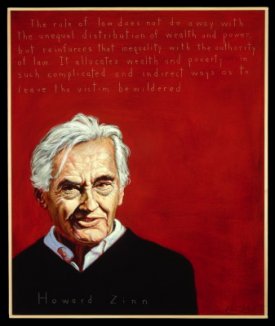
Editor’s note: For anyone interested in being part of a group discussion using Zinn’s A People’s History of the United States, you can sign up for the GRIID class A History of US Social Movements.
The late historian, writer and activist Howard Zinn would have turned 90 years old today. Zinn died of a heart attack at the age of 87 on January 27, 2010. After serving as a bombardier in World War II, Zinn went on to become a lifelong dissident and peace activist. He was active in the civil rights movement and many of the struggles for social justice over the past 50 years.
In 1980, Howard Zinn published his classic book, “A People’s History of the United States,” which would go on to sell more than a million copies and change the way we look at history in America. We air an excerpt of a Zinn interview on Democracy Now! from May 2009, and another from one of his last speeches later that year, just two months before his death.
[image: Robert Shetterly]
The Katrina Pain Index, 2012
This article by Bill Quigley and Davida Finger is re-posted from CounterPunch.
1 Rank of New Orleans in fastest growing US cities between 2010 and 2011. Source: Census Bureau.
1 Rank of New Orleans, Louisiana in world prison rate. Louisiana imprisons more of its people, per head, than any of the other 50 states. Louisiana rate is five times higher than Iran, 13 times higher than China and 20 times Germany. In Louisiana, one in 86 adults is in prison. In New Orleans, one in 14 black men is behind bars. In New Orleans, one of every seven black men is in prison, on parole or on probation. Source: Times-Picayune.
2 Rank of New Orleans in rate of homelessness among US cities. Source: 2012 Report of National Alliance to End Homelessness.
2 Rank of New Orleans in highest income inequality for cities of over 10,000 Source: Census.
3 Days a week the New Orleans daily paper, the Times-Picayune, will start publishing and delivering the paper this fall and switch to internet only on other days. (See 44 below). Source: The Times-Picayune.
10 Rate that New Orleans murders occur compared to US average. According to FBI reports, the national average is 5 murders per 100,000. The Louisiana average is 12 per 100,000. The New Orleans reported 175 murders last year or 50 murders per 100,000 residents. Source: WWL TV.
13 Rank of New Orleans in FBI overall crime rate rankings. Source: Congressional Quarterly.
15 Number of police officer-involved shootings in New Orleans so far in 2012. In all of 2011 there were 16. Source: Independent Police Monitor.
21 Percent of all residential addresses in New Orleans that are abandoned or blighted. There were 35,700 abandoned or blighted homes and empty lots in New Orleans (21% of all residential addresses), a reduction from 43,755 in 2010 (when it was 34% of all addresses). Compare to Detroit (24%), Cleveland (19%), and Baltimore (14%). Source: Greater New Orleans Community Data Center (GNOCDC).
27 Percent of people in New Orleans live in poverty. The national rate is 15%. Among African American families the rate is 30% and for white families it is 8%. Source: Corporation for Enterprise Development (CEFD) and Greater New Orleans Community Data Center (GNOCDC) Assets & Opportunity Profile: New Orleans (August 2012).
33 Percent of low income mothers in New Orleans study who were still suffering Post Traumatic Stress symptoms five years after Katrina. Source: Princeton University Study.
34 Bus routes in New Orleans now. There were 89 before Katrina. Source: RTA data.
37 Percent of New Orleans families that are “asset poor” or lack enough assets to survive for three months without income. The rate is 50% for black households, 40% for Latino household, 24% for Asian household and 22% for white households. Source: Corporation for Enterprise Development (CEFD) and Greater New Orleans Community Data Center (GNOCDC) Assets & Opportunity Profile: New Orleans (August 2012)
40 Percent of poor adults in New Orleans region that work. One quarter of these people work full-time and still remain poor. Source: GNOCDC.
42 Percent of the children in New Orleans who live in poverty. The rate for black children is 65 percent compared to less than 1 percent for whites. Source: Census.
44 Rank of Louisiana among the 50 states in broadband internet access. New Orleans has 40 to 60 percent access. Source: The Lens.
60 Percent of New Orleans which is African American. Before Katrina the number was 67. Source: GNOCDC.
60 Percent of renters in New Orleans are paying more than 30 percent of their income on rent and utilities, up from 51 percent in 2004. Source: GNOCDC.
68 Percent of public school children in New Orleans who attend schools that pass state standards. In 2003-2004 it was 28 percent. Source: GNOCDC.
75 Percent of public school students in New Orleans who are enrolled in charter schools. Source: Wall Street Journal. This is the highest percentage in the US by far, with District of Columbia coming in second at 39 percent. Sources: Wall Street Journal and National Alliance for Public Charter Schools.
76 Number of homes rebuilt by Make It Right Foundation. Source: New York Times.
123,934 Fewer people in New Orleans now than in 2000. The Census reported the 2011 population of New Orleans source as 360,740. The 2000 population was 484,674. Source: Census.
Greepeace Activists Occupy Arctic Oil Drilling Platform
This story is re-posted from Common Dreams.
 “Melting Arctic ice is a warning, not a business opportunity.”
Six Greenpeace activists have occupied the Russian oil drilling platform Prirazlomnaya in the Arctic to protest the risky plans for drilling in the pristine ecosystem.
The group includes Greenpeace International Executive Director Kumi Naidoo, who tweeted during the action, “Melting Arctic ice is a warning, not a business opportunity.”
From Greepeace’s ship Arctic Sunrise, Greenpeace Campaigner Dima Litvinov, says, “This is the face of Arctic destruction. Prirazlomnaya is the first ice-capable permanent oil platform in the Arctic. It is a perfect example — it is a personification of the slowly creeping industrialization of this pristine area. And especially, given the information that is coming in all the time about the rapidly decreasing ice cover in the Arctic, it is an obscenity. It is an insult that the same companies that are responsible for this crisis are now seeking to profit from it.”
MLive article misses the point of the GQ article on ArtPrize
Nearly a week after the GQ story on ArtPrize has been circulating in Grand Rapids, MLive finally decided to join the conversation.
The MLive article, by entertainment writer Jeffrey Karczmarcxyk, frames the narrative around the GQ story on ArtPrize (So you think you can paint) as a glass half-full/half-empty story. Karczmarcxyk presents the argument that the Matthew Powers article in GQ pointed out the very best and the very worst of the annual art event in Grand Rapids.
While the GQ article did do what the MLive writer stated, the GQ article was much more than that. Matthew Power seemed to be asking both critical questions about ArtPrize the event, but equally important was its relationship to the political and economic power of the DeVos family.
The only real reference that the MLive writer made to the politics of the DeVos family was this line, “Power’s observations on the “ultra conservative” DeVos family and its support of “hot-button, conservative issues” is searing.” While I think that Powers made important statements about the DeVos family, in terms of their involvement in issues like anti-gay marriage, I would hardly call what he wrote as “searing.”
However, maybe to Karczmarcxyk, the GQ article was a searing indictment of the DeVos family, which might explain why he did not honestly deal with that aspect of the GQ article.
The MLive story does mention Paul Armenta and SITE: LAB, but fails to acknowledge the critical comments from Armenta or GR artist Michael Pfleghaar that were prominent in the GQ article. In fact, the only source that Karczmarcxyk uses in the MLive article, other than Power, was the PR guy for ArtPrize, Brian Burch. Burch applies his trade and puts his own spin on the GQ article with this innocuous comment, “The piece offers a number of interesting perspectives that add to the conversation and showcases how much complexity can come out of something so simple.”
The MLive story was in no way a surprise, it just demonstrated once again its unwillingness to provide a larger critique of ArtPrize, the DeVos family and their politics, which is what the GQ article was a least willing to do.
Let them Die: GM ignores workers on Hunger Strike in Colombia
This article is re-posted from Foreign Policy in Focus.
Minutes before he started to sew his mouth shut, Jorge Alberto Parra Andrade explained his rationale to me: “Essentially GM gave us a choice: to die of hunger or to die waiting for them to solve this problem.”
Mr. Parra is one of 68 injured workers fired by General Motors Colombia who started a protest in front of the U.S. Embassy in Bogotá one year ago, on August 1st, 2011. The Association of Injured Workers and Ex-Workers of General Motors Colombia (ASOTRECOL) had two simple demands: fair compensation for injuries incurred in the workplace and reintegration into GM’s workforce. In commemoration of their protest’s anniversary — and without any movement on their case — four leaders of ASOTRECOL decided to sew their mouths closed and initiate a hunger strike. Another three joined on August 8th, and a small group will join each week until their cases are resolved.
ASOTRECOL workers claim that they were among 200 employees injured on the job in GM’s plant in Colombia’s capital city. The majority of ASOTRECOL’s members have undergone multiple surgeries, most commonly to treat spinal injuries, tendinitis, carpal tunnel, rotator cuff syndrome, and lumbar damage. After working their bodies until they were disabled and unable to perform manual labor any longer, GM fired them and refused to pay medical benefits or a severance package. ASOTRECOL also alleges that GM lost, altered, erased, or fabricated their medical histories to exclude their injuries from the company’s official records, and that the Ministry of Labor approved the documents.
Consequently, GM does not accept the injuries as work-related, instead claiming that they were incurred outside the plant. Luis Alvarado Vásquez, the Inspector at the Ministry of Labor who reviewed ASOTRECOL members’ records, was convicted for falsifying their records and approving their illegal firings. He was suspended from work for 12 months and has a warrant out for his arrest. However, since his cases were not automatically voided, ASOTRECOL must reverse them by entering Colombia’s lengthy legal process.
The injured workers and their families do not have time to wait years navigating the legal system. The dramatic move by ASOTRECOL activists to start a hunger strike reflects their growing desperation. Before receiving six stitches in his lips, Carlos Ernesto Trujillo explained that the workers are running out of money to pay for their homes or support their spouses and children. “They fired us without just cause, endangering us and our families,” he said. “We are taking this decision because our health has worsened each day, we’re losing our houses, we practically live in the street, and we’ve been forgotten by the government.”
Inaction by the United States
ASOTRECOL’s case is especially alarming considering the U.S. government’s stake in General Motors. Two years before ASOTRECOL began its strike, GM filed for bankruptcy protection and reorganization with the United States government. It was the fourth-largest Chapter 11 filing in U.S. history, and the U.S. government became the company’s largest shareholder with 60-percent ownership. When GM failed to stay afloat after the Bush administration pumped $20 billion into the company in 2008, the Obama administration shelled out another $30 billion in taxpayer dollars in 2009. At the start of 2012, the United States still had $25 billion invested in GM.
GM seems to have recovered from its financial turmoil and this year reclaimed its position as the largest automobile manufacturer in the United States. However, even the billion-dollar quarterly profit margins for GM did not translate into a willingness to settle the small claims of ASOTRECOL members. The first week of the hunger strike, GM attended a mediation session with representatives from the International Labor Organization, the Office of Inspector General, and the Ministry of Labor, but walked out on the first day. GM did not even stay at the negotiating table long enough to initiate a dialogue with ASOTRECOL.
The U.S. government has remained silent on GM’s situation as well, despite its pledges to support labor rights in the Colombia. The United States walked a tight rope this past year as the Obama administration tried to convince Congress to pass a free trade agreement (FTA) with the South American country. Signed by the Bush administration, the FTA stalled for years in Congress due to concerns over the country’s abysmal labor rights record. According to journalist Garry Leech, almost 75 percent of the world’s union leaders killed in the last 20 years were Colombian, and less than 5 percent of these killings have resulted in a conviction for the perpetrators. In 2011, out of 76 union leaders killed globally, 29 were Colombian.
Despite Colombia’s record as the “most dangerous country in the world to be a unionist,” the U.S. government passed the FTA, which went into effect in May 2012. The countries implemented an “Action Plan for Labor Rights” to provide enhanced protection for Colombia’s most at-risk industries. Still, seven unionists have been killed in Colombia this year, and many more have received death threats.
ASOTRECOL is a case in point for labor rights violations in Colombia. The situation of these workers is all the more deplorable given the U.S. government’s promises to protect labor leaders while at the same time remaining one of GM’s largest shareholders. Although ASOTRECOL’s case is little-known in the United States, U.S. taxpayers are de facto GM shareholders. The U.S. government should recognize its two-sided stance on this case and pressure GM to stop ignoring these workers before they die of starvation. Mr. Parra and other fired workers’ resolve in their hunger strike is evident. “We must reclaim our rights and demand an end to the human rights violations committed by General Motors. GM must answer for its actions and what they have done to us,” concluded Parra. “If necessary, we are willing to die fighting for justice.”
5 Ways Privatization Is Ruining Our Communities
This article is re-posted from Black Agenda Report.
A grand delusion has been planted in the minds of Americans, that privately run systems are more efficient and less costly than those in the public sector. Most of the evidence [3] points the other way. Private initiatives generally produce mediocre or substandard results while experiencing the usual travails of unregulated capitalism — higher prices, limited services, and lower wages for all but a few ‘entrepreneurs.’
With perverse irony, the corruption and incompetence of private industry has actually furthered the cause of privatization, as the collapse of the financial markets has deprived state and local governments of necessary public funding, leading to an even greater call for private development.
As aptly expressed by a finance company chairman [4] in 2008, “Desperate government is our best customer.”
The following are a few consequences of this pro-privatization desperation: We spend lifetimes developing community assets, then give them away to a corporation for lifetimes to come.
1. The infrastructure in our cities has been built up over many years with the sweat and planning of farsighted citizens. Yet the dropoff in tax revenues has prompted careless decisions to balance budgets with big giveaways of public assets that should belong to our children and grandchildren.
In Chicago, the Skyway tollroad [5] was leased to a private company for 99 years, and, in a deal growing in infamy, the management of parking meters was sold to a Morgan Stanley group for 75 years. The proceeds have largely been spent.
The parking meter selloff led to a massive rate increase, while hurting small businesses whose potential customers are unwilling to pay the parking fees. Meanwhile, it has beenestimated [6] that the business partnership will make a profit of 80 cents per dollar of revenue, a profit margin [7] larger than that of any of the top 100 companies in the nation.
Indiana has also succumbed to the shiny lure of money up front, selling control of a toll road [5]for 75 years. Tolls have doubled over the first five years of the contract. Indianapolis [8] sold off its parking meters for 50 years, for the bargain up-front price of $32 million. Atlanta’s [9] 20-year contract with United Water Resources Inc. was canceled because of tainted water and poor service.
2.Insanity is repeating the same mistake over and over and expecting different results. Numerous examples of failed or ineffective privatization schemes show us that hasty, unregulated initiatives simply don’t work.
A Stanford University study [10] “reveals in unmistakable terms that, in the aggregate, charter students are not faring as well as their traditional public school counterparts.” A Department of Education study [11] found that “On average, charter middle schools that hold lotteries are neither more nor less successful than traditional public schools in improving student achievement, behavior, and school progress.”
Our private health care system has failed us. We have by far the most expensive system in the developed world. The cost of common surgeries [12] is anywhere from three to ten times higher in the U.S. than in Great Britain, Canada, France, or Germany. Studies show that private prisons perform poorly [13] in numerous ways: prevention of intra-prison violence, jail conditions, rehabilitation efforts. The U.S. Department of Justice [14] offered this appraisal: “There is no evidence showing that private prisons will have a dramatic impact on how prisons operate. The promises of 20-percent savings in operational costs have simply not materialized.”
A 2009 analysis of water and sewer utilities by Food and Water Watch found [15] that private companies charge up to 80 percent more for water and 100 percent more for sewer services. Various privatization abuses or failures [16] occurred in California, Georgia, Illinois, Indiana, New Jersey, and Rhode Island.
California’s experiments [17] with roadway privatization resulted in cost overruns, public outrage, and a bankruptcy; equally disastrous was the state’s foray into electric power privatization [18]. Across industries and occupations, according to the Project on Government Oversight [19], the federal government paid billions more on private contractors than the amounts needed to pay public employees for the same services.
3.Facts about privatization are hidden from the public. Experience shows that under certain conditions, with sufficient monitoring and competition [20] and regulation [21], privatization can be effective. But too often vital information is kept from the public. The Illinois Public Interest Research Group [22] noted that Chicago’s parking meter debacle might have been avoided if the city had followed common-sense principles rather than rushing a no-bid contract through the city council.
Studies by both the Congressional Research Service [23] and the Pepperdine Law Review [24] came to the same conclusion: any attempt at privatization must ensure a means of public accountability. Too often this need is ignored.
The Arizona prison system [25] is a prime example. For over 20 years the Department of Corrections avoided cost and quality reviews for its private prisons, then got around the problem by proposing a bill to eliminate the requirement for cost and quality reviews.
In Florida, abuses [26] by the South Florida Preparatory Christian Academy went on for years without regulation or oversight, with hundreds of learning-disabled schoolchildren crammed into strip mall spaces where 20-something ‘teachers’ showed movies to pass the time. In Philadelphia [27], an announcement of a $38 million charter school plan in May turned into a $139 million plan by July.
In Michigan, the low-income [28] community of Muskegon Heights became the first American city [27] to surrender its entire school district to a charter school company. Details of the contract with Mosaica were not available [29] to the public for some time after the deal was made. Butdata [30] from the Michigan Department of Education revealed that Mosaica performed better than only 13% of the schools in the state of Michigan.
Also in Michigan, an investigation [31] of administrative salaries elicited this response from charter contractor National Heritage Academies: “As a private company, NHA does not provide information on salaries for its employees.” Education writer Danny Weil [32] summarizes the charter school secrecy: “The fact is that most discussions of charters and vouchers are not done through legally mandated public hearings under law, but in back rooms or over expensive dinners, where business elites and Wall Street interests are the shot-callers in a secret parliament of moneyed interests.”
Beyond prisons and schools, how many Americans know about the proposal [5] for the privatization of Amtrak, which would, according to West Virginia Representative Nick Rahall, “cripple Main Street by auctioning off Amtrak’s assets to Wall Street.” Or the proposal to sell off the nation’s air traffic control system? Or the sale of federal land in the west? Or the sale of the nation’s gold reserves, an idea that an Obama administration official referred to as “one level of crazy away from selling Mount Rushmore.
4.Privatizers have suggested that teachers and union members are communists. Part of the grand delusion inflicted on American citizens is that public employees and union workers are greedy good-for-nothings, enjoying benefits that average private sector workers are denied. The implication, of course, is that low-wage jobs with meager benefits should be the standard for all wage-earners.
The myth is propagated through right-wing organizations with roots in the John Birch Society [33], one of whose founding members was Fred Koch, also the founder of Koch Industries. To them, public schools are socialist or communist. Explained Heartland Institute President Joseph Bast with regard to private school vouchers in 1997, “we have come to the conclusion that they are the only way to dismantle the current socialist regime.”
But the facts show, first of all, that government and union workers are not overpaid. According to the Census Bureau [34], state and local government employees make up 14.5% of the U.S. workforce and receive 14.3% of the total compensation. Union members make up about 12% of the workforce, but their total pay [35] amounts to just 9.5% of adjusted gross income [36] as reported to the IRS.
The facts also strongly suggest that wage stability is fostered by the lower turnover rate and higher incidence of union membership in government. The supportive environment that right-wingers call ‘socialism’ helps to sustain living wages for millions of families. The private sector, on the other hand, is characterized by severe wage inequality. Whereas the average private sector salary is similar to that of a state or local government worker, the MEDIAN [37]U.S. worker salary is almost $14,000 less, at $26,363. While corporate executives and financial workers (about one-half of 1% [38] of the workforce) make multi-million dollar salaries, millions of private company workers toil as food servers, clerks, medical workers, and domestic help at below-average pay.
5. Privatization often creates an “incentive to fail.” Privatized services are structured for profit rather than for the general good. A by-product of the profit motive is that some people will lose out along the way, and parts of the societal structure will fail in order to benefit investors.
This is evident in the privatized prison system, which relies on a decreasing adherence to the law to ensure its own success. Corrections Corporation of America [39] has offered to run the prison system in any state willing to guarantee that jails stay 90% full. “This is where it gets creepy,” says Business Insider’s [40] Joe Weisenthal, “because as an investor you’re pulling for scenarios where more people are put in jail.”
The incentive to fail was also apparent in road privatization deals [41] in California and Virginia, where ‘non-compete’ clauses prevented local municipalities from repairing any roads that might compete with a privatized tollroad. In Virginia, the tollway manager even demanded reimbursement from the state for excessive carpooling, which would cut into its profits.
The list goes on. The Chicago parking meter [42] deal requires compensation if the city wishes to close a street for a parade. The Indiana tollroad deal [5] demanded reimbursement when the state waived tolls for safety reasons during a flood. Plans to privatize the Post Office have created a massive incentive to fail [43] through the Postal Accountability and Enhancement Act, which requires the USPS to pre-pay the health care benefits of all employees for the next 75 years, even those who aren’t born yet. This outlandish requirement is causing a well-run public service to default [44] on its loans for the first time.
Also set up to fail are students enrolled in for-profit colleges [45], which get up to 90 percent [46] of their revenue from U.S. taxpayers. Less incentive remains for the schools after tuition is received, as evidenced by the fact that more than half [47] of the students enrolled in these colleges in 2008-9 left without a degree or diploma. And then we have our littler students, set up to fail [32] by private school advocates in Wisconsin who argue that a requirement for playgrounds in new elementary schools “significantly limit[s] parent’s educational choice in Milwaukee.”
In too many cases, privatization means success for a few and failure for the community being served. Unless success can be defined as a corporate logo carved into the side of Mount Rushmore.
Dick & Betsy DeVos fund Broadway play written by a sweatshop profiteer about the founder of an ultra conservative church
Yesterday, MLive posted an article about Dick & Betsy DeVos deciding to provide financial support for the Broadway play Scandalous, written by Kathie Lee Gifford.
The article calls the move by Dick and Betsy their “entry” into Broadway, as if this was a new venture for them.
The play they are funding is about a woman who was an evangelical and the founder of Foursquare Church, which has grown significantly since 1930s, but has maintained its hyper-conservative roots.
The MLive story mentions that this is not the first time that Dick and Betsy DeVos have decided to fund the arts and culture, with increasing amounts of money going to the John F. Kennedy Center for the Performing Arts in Washington, D.C. and their financing of son Rick’s annual event, ArtPrize.
However, the article doesn’t explore why Dick and Betsy have decided to fund arts and culture. Instead, the MLive story refers to other articles in the New York Times and the Huffington Post, neither of which explores their motivations.
Nearly two years ago, we posted an article by artist Richard Kooyman, entitled What is ArtPrize, where Kooyman explores why he thinks the DeVos family has shifted to art & culture. Kooyman believes that the DeVos’ interest in art and culture is connected to the rest of the family philosophy of promoting capitalism and conservative religious values.
There are also aspects of the DeVos/Gifford/Foursquare partnership that are completely ignored by the MLive article.
First, there is no mention of Kathie Lee Gifford’s history of profiting from sweatshops in Central America. In 1996, Charles Kernaghan, with the National Labor Committee (MLC), investigated where Gifford’s brand name clothing was being manufactured and discovered that a factory in Honduras was using teenage girls to sew her clothes for little pay and under horrendous working conditions.
Gifford went on TV, cried and then said she would make sure such practices never happened again. Three years later it was discovered that Gifford continued to profit off of sweatshop labor, when the NLC found her clothing line being made in sweatshops in El Salvador.
This is relevant information as Gifford’s play is about a woman who promoted a certain kind of religious values, yet she herself has a history of exploited women workers abroad. It is also relevant in that the DeVos family has been a proponent of trade policies that have both benefited their company and created exploitative practices, such as the one that Gifford and Amway have profited from.
Second, there is no exploration about what the Foursquare Church has become and its relationship to the politics of DeVos and Gifford. Foursquare Church continues to promote hyper-conservative religious values such as anti-abortion, anti-gay marriage and the dominance of Christian values in public life. Former Foursquare pastor Jack Hayford, now the head of Kings College and Seminary, embraces Dominion theology, a theology that believes that religious doctrines should govern civic life. Essentially, those who embrace Dominion theology in the US would like to replace the US system of laws with the 10 Commandments. Hayford and other Foursquare leaders have also been involved with the patriarchal Christian movement known as the Promise Keepers.
It’s no surprise then that Dick and Betsy DeVos would finance a Broadway play written by a Sweatshop profiteer that promotes the story of the founder of an ultra-conservative Christian Church.
New website exposing Coca Cola’s racist practices
We have reported in the past about the international campaign to boycott Coca Cola because of their role in the murder of union organizers in Colombia and the company’s theft of water from communities in Indian.
Closer to home there is a major lawsuit against Coca Cola because of the blatant racial discrimination against its employees in several bottling plants in the US.
The lawsuit exposing Coke’s racial injustice has produced a new website, http://www.stopcokediscrimination.com/. The site provides details on the legal case against the company and this summary of the racial discrimination that Black and Latino employees face:
1. Coca-Cola may be an enjoyable refreshment for most, but its black and Hispanic workers produce Coca-Cola’s beverages in a cesspool of racial discrimination. There is an endemic culture of racism at Coca-Cola that runs through its management and supervisors at its New York bottling plants in Elmsford and Maspeth. The 16 Plaintiffs herein have suffered from the worst of its ills in terms of biased work assignments and allotment of hours, unfair discipline and retaliation, and the caustic work environment.
2. Black and Hispanic production workers at Coca-Cola are typically assigned to the most undesirable and physically dangerous positions, and to tests that are outside of their job descriptions. Meanwhile, the managers contravene the established seniority system by giving better jobs and more overtime hours to white workers with less seniority than minority workers. As several of the Plaintiffs have found, opportunities for advancement and promotion within the company are routinely biased against minority workers. Finally, the truck drivers among the Plaintiffs have had their hours unfairly limited and prevented from working overtime, while white drivers do not have to face these problems.
3. Those among the Plaintiffs who have dared to speak up about the discrimination to managers or human resources have not only found no resolution to their concerns, but instead have faced swift retaliation from the white managers. This retaliation has come in the form of unwanted scrutiny and unfair disciplinary actions, up to the point of suspension and termination for some of the Plaintiffs.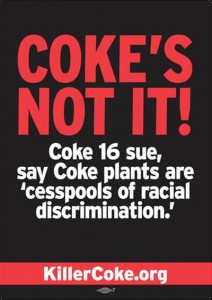
4. The minority workers of Coca-Cola face an atmosphere of casual racism from co-workers, which not only goes unpunished, but is often perpetrated by white supervisors and managers. The Plaintiffs frequently witness overt displays of racism in the plant in the form of offensive remarks and ridicule, while suffering from racially charged harassment from supervisors. This hostile work environment has caused many of the Plaintiffs significant emotional harm, to the point where they must seek therapy to deal with the stress from work.
The website also provides significant documents that related to the lawsuit, a news section, bios on the plaintiffs, protest information and a section that looks at the history of racial discrimination at Coca Cola.
The history section is instructive, with several good articles and a short video done by UK Channel 4, which includes an excerpt from Dr. Martin Luther King Jr.’s last speech in Memphis, where he called for a boycott of Coca Cola.

New Media We Recommend
Below is a list of new materials that we have read/watched in recent weeks. The comments are not a “review” of the material, instead sort of an endorsement of ideas and investigations that can provide solid analysis and even inspiration in the struggle for change. All these items are available at The Bloom Collective, so check them out and stimulate your mind.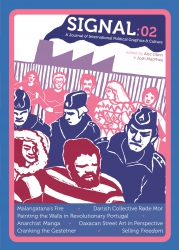
Signal: 02, a Journal of International Political Graphics & Culture, edited by Alec Dunn and Josh MacPhee – In the follow up to Signal 01, this collection of articles, posters and prints is an inspiring and fabulous tribute to visually driven political art. Included in this volume are stories about the political art of famous Mozambican artist Malangatana, political street murals in Portugal in the 1970s, early 20th Century anarchist broadsides that were distributed in northern California, political Gestetner art in the US in the 1960s, Oaxacan street art during the political uprising in 2006 in Mexico, Japanese anarchist sketches and the political printmaking work of the Danish collective Red Mother (1969 – 1978). The visuals that accompany the stories are incredible and truly speaks to the power of visual art for resistance and revolutionary change. A delightful book that should be shared widely.
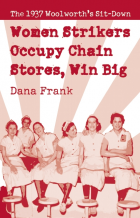 The 1937 Woolworth’s Sit-Down: Women Strikers Occupy Chain Store, Win Big, by Dana Frank – This 55-page booklet by labor historian Dana Frank is a fabulous read about the courage of 105 women that participated in a seven day strike at a Woolworth’s store in Detroit. Inspired by the Flint UAW strike, the young women who worked long hours for little pay, decided that if it could work for the GM workers, it could work for them. Frank’s recounting of the historic event is lively and insightful. The author notes that the strike not only gained tremendous support from other workers in Detroit, but workers all across the country. Other unions provided supplies and money, but it was the creativity and solidarity of these women at Woolworth’s that won their demands. Frank also notes that the strike inspired workers at other Woolworth’s across the country and service industry workers in general. The 1937 Woolworth’s Sit-Down is a fabulously inspiring read and lesson about the importance of direct action for today.
Social Movements: 1768 – 2008, by Charles Tilly and Lesley Wood – This is an expanded second edition of Tilly’s 2004 book, which brings this analytical history of social movements fully up to date. Tilly and Wood cover such recent topics as immigrants’ rights, new media technologies, anti-Olympic organizing in China, new mobilizations against the Iraq War, and the role of bloggers and Facebook in social movement activities. The co-author’s case studies, reflections and insights into global social movements today provides readers with a useful framework to both understand the power of social movements and the strategic importance of such movements. The book even comes with discussion questions that could be useful for group discussion.
Mic Check: Documentary Shorts from the Occupy Movement (DVD) – Mic Check is a collection of 19 short documentaries that deal with aspects and perspectives on the US Occupy Movement. The shorts deal with topics such as people’s motivations for participating in the Occupy Movement, police abuse, people of color and the Occupy Movement, occupying homes, Occupy Oakland, actions against foreclosures, Occupy the DOE, Food Democracy Now, student organizing and an interview with Naomi Klein. What is most refreshing about this collection of videos is the prominence of voices of color and working class people talking about their involvement, their issues and their aspirations for the future of the world. An inspiring collection of videos that demonstrate that people all across the country are pissed off at the system and want to create something different than what we have all been subjected to our whole lives.
This Day in Resistance History: Nat Turner’s Slave Revolt
On this day in 1831, a slave in Virginia named Nat Turner, led an armed rebellion against slave owners and their families.
Turner, who had been a slave nearly all his life, claimed to have had religious visions. In one of those visions, Turner was told to, “slay my enemies with their own weapons.”
Whatever one thinks about the religious visions that Turner claimed to have, the reality is that he was a slave and his lived experience of slavery certainly taught him that living under a repressive system often leads people to acts of resistance and liberation.
People who object to religion justifying his acts of violence against slave owners and their families should come to terms with the fact that most slave owners justified owning and brutalizing slaves based on religion, particularly Christianity.
Beginning on the night of August 21, 1831, Turner, along with other slaves, used axes to kill his slave owner and family. Turner and his followers then went to other slave plantations to free other slaves and attack slave owners who tries to stop them. By the next day there were some 70 slaves and free Blacks that were part of the insurrection.
Virginia authorities responded quickly by calling up the local militia and members of the US military to help put down the rebellion. On August 22nd, Turner and the rest of the rebellion were confronted by a militia. Some were killed immediately, while others escaped. Turner himself went into hiding until he was captured on October 30. The slave rebellion leader was then put on trial and sentenced to be executed on November 11, where he was hung.
It would be easy to quickly dismiss Turner’s actions as an utter failure. However, it is important that we look at these kinds of acts of resistance as part of larger movement, which led to the abolition of slavery.
Nat Turner’s rebellion was not the first by slaves in the US, nor was it the last. Some historians will note that the Haitian slave rebellion at the end of the 18th century gave birth to slave rebellions in the US. Herbert Aptheker in American Negro Slave Revolts (1943) chronicles 250 slave actions between 1526 and 1860.
The fact that slave revolts were so numerous should tell us something about the level of resistance that slaves were willing to engage in to obtain their freedom. Slaves also used other tactics to rebel against the legal system of chattel slavery, such as stealing slave owner property, sabotage, work slow downs, burning down buildings and running away. An excellent book that documents the diversity of tactics used by slaves can be found in Eugene Genovese’s book Roll, Jordan, Roll.
It is important to also note that the slave owners in Virginia and the south did not let Nat Turner’s rebellion pass without making some changes. Clearly, this action put fear into the hearts and minds of slave owners everywhere. Some states passed laws which forbid anyone to teach slaves to read and write, demonstrating the system’s fear in knowing that knowledge is power. Slave owners also began to figure out ways to tighten their control over their slaves, but the increased repression only led to more opposition.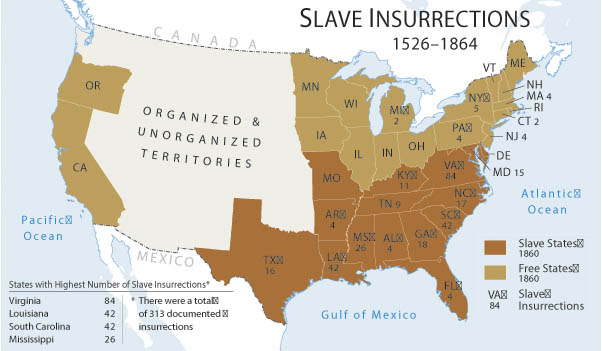
Turner’s rebellion forced anti-slave sectors to question their own tactics and complacency and more people became more vocal and willing to take bigger risks. Just as the Haitian uprising gave birth to Nat Turner’s rebellion, Turner’s rebellion gave birth to an increase in slave revolts and the armed insurrection led by John Brown in 1859. None of these actions alone ended slavery in the US, but the collective resistance against slavery over decades is what eventually led to the abolition of slavery.
Such a view of history is not how it is often presented to us in grade school where a specific date or some great man is what brought about change in this country. It is the acts of the unknown thousands that bring about change, the men and women who joined Turner to rebel against slavery in 1831 or the thousands who were arrested during the Civil Rights era that brought about change. We might not ever know their names, but we must honor their courage by taking the same kinds of risks today and revolting against systems of oppression.
Editor’s note: For those interested in exploring the history of the abolition movement and other social justice movements in the US, GRIID is offer a class entitled, A History of US Social Movements, which begins on September 17.
 Grand Rapids Institute for Information Democracy