Environmental Justice, Direct Action and Global Warming
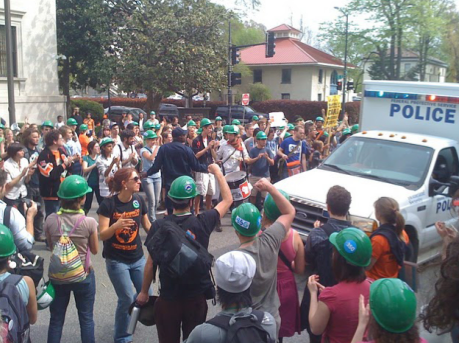
There is a tremendous sense of urgency around the world on many fronts, but maybe the ecological crisis we face is the most urgent.
Global warming and climate change are issues that could determine the future of humanity on the planet, in addition to what it is doing to all other forms of life.
The extraction and burning of fossil fuels is the main culprit in global warming and that realty must change for there to be a future.
There are a growing number of grassroots efforts around the world that is confronting the fossil fuel industry, particularly through direct action.
Rising Tide North America is not only one of these grassroots groups engaged in direct action against the fossil fuel industry, they publish a newsletter the documents lots of other forms of resistance to the fossil fuel industry.
The Summer 2012 issue is particularly inspiring, with countless stories about direction action across the US and around the world, where people are taking matters into their own hands to stop oil & gas pipelines, stop hydraulic fracking, strip mining, mountaintop mining and the companies & politicians most complicit in the current ecocide.
There are stories about tree sitters shutting down a strip mine in West Virginia, hundreds occupying the Office of the Department of the Interior, logging operations blockaded in Oregon, an indigenous groups stopping a natural gas project in Australia, Puerto Ricans resisting a natural gas pipeline on their island and Navajo activists fighting a water diversion project in Arizona.
All of these actions are individually and collectively making a difference and are contributing to a growing number of global actions of resistance against policies and practices that are destroying the planet.
If you want to do something in West Michigan, the group Mutual Aid GR is planning some upcoming actions against the fossil fuel industry, particularly around the issue of fracking. You can contact them at grpeoplesassembly@gmail.com.

We’re Gonna Scapegoat Like It’s 1995: Welfare and the Never-Ending Lies of the American Right
This article from Tim Wise is re-posted from his blog.
In the pantheon of right-wing dog whistles, none is as tried, true, and generally effective as “welfare” bashing. Ever since the days of Ronald Reagan, who fabricated tales of a “welfare queen” collecting hundreds of thousands of dollars in cash benefits by using multiple identities and Social Security numbers, conservatives have known that articulating an inchoate rage against welfare spending and recipients, who are cast as irresponsible leeches, living off the rest of us, pays real political dividends. Even though welfare reform in the mid-1990s largely eliminated no-strings-attached cash assistance from the nation’s social safety net, millions of Americans act as if nothing ever changed, as if welfare reform never happened. They are just as upset about it today as they were twenty years ago, which is why Mitt Romney and his surrogates at FOX News, along with commentators like Rush Limbaugh, continue to hammer the theme of undeserving poor people, getting handouts while they sit on the couch, don’t work, and (according to Romney’s latest campaign commercial), are poised to be let out of whatever minimal work requirements have existed for the past 16 years, thanks to the liberalism of Barack Obama.
For a moment, let’s put aside the fact that the state waivers advocated by the Obama Administration were actually sought by conservative Republican Governors, and that they would only allow states the flexibility to design better ways of actually helping recipients find jobs. So too, let’s ignore the fact that even welfare reform’s chief advocate, Newt Gingrich, and former GOP operative and architect of the reform, Ron Haskins, have acknowledged that the Romney campaign’s take on the waivers is dishonest. For now, let us simply examine the far larger problem: namely, that the characterization of welfare as some huge program, dispensing massive benefits to the poor, and the characterization of recipients as lazy slackers who sit around collecting checks at taxpayer expense is rooted entirely in fantasy. For conservatives to continue beating this tired drum is to deliberately seek to make an issue where there is none, to scapegoat the poorest and most vulnerable Americans for problems they did not create, and to engage in a kind of class warfare for which the right frankly lives. To criticize the rich is, to hear them tell it, untoward and unbecoming; but to bash the poor is a venerable pastime. To the extent such invective manages to stir up racial resentments (given how racialized the image of welfare recipients has been for the past forty-plus years), all the better, especially when your guy is running against the nation’s first black president. Anything to suggest that Barack Obama is bending over backwards for black folks plays well with the angry white men who increasingly make up the core constituency of the Republican Party.
Think that’s too harsh? OK. Well then, perhaps you’d like to explain the meaning of the not-so-thinly-veiled racial resentment embedded in recent comments made by Rush Limbaugh on his radio show, in a long diatribe about welfare, President Obama, the state waivers, and the upcoming election. While discussing the president’s response to the Romney campaign’s claims — the ones called dishonest by virtually every media outlet of record — Limbaugh insisted that the primary reason Obama is upset about the attack is because it has the potential to reinvigorate white male working class voters: a group whose vote Limbaugh claims Obama had been trying to suppress. To wit, here’s Limbaugh on August 10th:
Okay, let’s stick with the Romney welfare, gutting-welfare ad that…the regime is so upset about. No question Obama is trying to suppress the white vote. The white, working, middle class vote. Obama’s trying to suppress that…A lot of Obama’s ads and the PAC ads on television have been designed to suppress that vote by portraying Romney as anathema to them…he knows they’re not going to vote for him. But if he can get them to not vote period, then it doesn’t matter that he’s written them off. If they’re not going to vote for him, the next task is to make sure they don’t show up for Romney. How do you do that? Well, you portray Romney as some rich moneybags guy who isn’t going to help them. And, not only that, doesn’t even like them!…And so where (Obama’s) in the middle of trying to suppress the votes of the white, working class, here comes Romney with a truthful ad that’s going to whip them back up into a frenzy…Whatever success Obama has had in angering white working class voters towards Romney where they might just sit out and not vote, now he’s whipped them up into a frenzy…This is why the Romney welfare ad has got them so discombobulated, because they’ve done it to themselves. Obama has undercut his own strategy. Which again is to so depress or anger the white, working class that they don’t vote.
And why does the waiver request — again, one that was initiated by conservatives — whip the white working class into a frenzy? Returning to Limbaugh:
Because the one thing the white, working class voters don’t like is slothful welfare recipients. They don’t like slackers. They don’t like takers. They don’t like people sitting on the couch, getting a welfare check, watching television, when they know they’re paying for it.
Of course, there would be no reason to discuss this as a racial issue — as an issue for the white working and middle class — unless it was fully understood by the person discussing it in that manner that the image of welfare recipients (the “takers” in Limbaugh’s formulation) was something other than white. By discussing this matter in racial terms, it is quite apparent that Limbaugh knows what he’s doing, and what the popular imagery of welfare recipients is: it’s black and brown folks, eating bonbons and having babies out of wedlock, while salt-of-the-Earth white men break their backs and pay the taxes that help support them in their idleness. It is blatant. It is transparent. And of course, it is thoroughly dishonest on multiple levels.
To begin, there is the simple fact that contrary to popular belief, the numbers of people “receiving checks” from the government (the common imagery and that which is being played upon by Limbaugh) are at an all-time low. So although FOX very cleverly ran a segment recently during which they claimed (and with a graphic no less!) that over 100 million Americans were now receiving “welfare,” that number does not refer to the common understanding of welfare — and the understanding that Limbaugh is deliberately trying to cultivate with his image of people receiving checks — but instead, includes anyone receiving benefits from any government program, targeted to low and moderate income persons, households or communities: what are called “means tested” programs. But a quick look at the House Ways and Means Committee’s annual Green Book, which catalogs these programs in detail, indicates how different the reality of government programs and program beneficiaries is, from the common and stereotypical beliefs about both.
So, for instance, the only way you can get anywhere near “100 million” Americans receiving welfare from the federal government, is to include huge swaths of beneficiaries whom few would consider to be welfare recipients, in any traditional sense. You would have to include the millions of elderly and disabled persons who receive two-thirds of all Medicaid benefits. You’d have to include the 10 million low-income seniors who receive a prescription drug subsidy under Part D of Medicare. You’d have to include the 27 million working adults who receive the refundable portion of the Earned Income Tax Credit, because their incomes are too low to owe federal taxes, as well as 18 million working parents who receive the refundable child tax credit because their incomes are too low to qualify for the standard, non-refundable credit available to middle income families. You’d also have to include the 2 million low income elderly Americans who receive benefits under the Nutrition Program for the Elderly, which guarantees adequate meals in congregate settings or home-delivered meals to older poor folks; as well as the 2.5 million people who benefit from adult education and literacy services, funded by the federal government and operated by states and various educational agencies; and the 8 million or so low-to-moderate income students who receive Pell Grants to make college affordable; and the 1 million or so children who reap the benefits of pre-school readiness programs like Head Start, which has been proven to reduce dependence on other forms of assistance.
So, as far as the folks who “get checks” are concerned, unless Limbaugh means to bash the folks who get refund checks under the Child Tax Credit, or the EITC — which most sane people don’t consider welfare, since one has to work in order to qualify for them, and which even Ronald Reagan praised as among the most effective anti-poverty programs ever created (and which he supported because it reduced dependence on other forms of assistance) — the numbers of such Americans is not 100 million. It is not 50 million. It is not 20 million. As evidenced by the House Ways and Means Committee’s Green Book, it is approximately 12 million, of which 7.7 million are elderly, blind or disabled persons receiving checks from the SSI program, and who are not likely the folks Limbaugh and his ilk are condemning as slothful. That leaves about 4.3 million who receive benefits from TANF (what used to be Aid to Families With Dependent Children, or AFDC), roughly three-quarters of whom are children. Which means that only about 1 million adults receive cash from this most vilified of programs: less than one-half of one percent of the adult population.
And what’s more, of those who do “receive checks” so to speak, it is simply false that they are dependent on those benefits, or receive them for long periods of time, rather than work. As indicated by the Department of Health and Human Services, in any given month, about half of all TANF recipients live in a family unit with at least one person who is employed, but whose earnings are so low as to make them still eligible for a small cash welfare subsidy. Nearly 30 percent of TANF recipients live in a family with at least one person who works at a full-time job, and yet, whose income remains at or below poverty level.
That dependence is an uncommon state for welfare recipients should really come as no surprise, given how minimal are the grants offered to poor persons and families. TANF benefits, for instance, have fallen in value by 20 percent since the mid-1990s in 34 states, adjusted for inflation; and this is after the real value of benefits had already plummeted by more than 40 percent from 1970 until 1996 in 2/3 of all states. As of 2011, benefits came to less than half the poverty line in all 50 states, and left recipients below 30 percent of the poverty line in most. Indeed, in 14 states, benefits left recipient households below one-fifth of the poverty line, receiving, on average, less than $300 a month for a family of three, while in states like Alabama and Mississippi, TANF benefits have reached an almost incomprehensibly absurd low: $215 and $170 per month for a family of three; hardly sufficient to sustain a welfare dependent lifestyle. By 2010, average monthly TANF benefits stood at less than $180 per person and only $428 per household.
And since most persons who inveigh against welfare dependence do so because of a belief that beneficiaries remain on various government program rolls for long periods, it also might help to note how inaccurate are the regular claims of long-term welfare reliance. Fact is, half of all persons who enter the TANF rolls and begin to receive cash benefits from the program will exit the rolls within 4 months, three of every four TANF entrants will exit within a year, and only about 1 in 6 will receive benefits for 20 months or longer. Long-term welfare use has fallen by half since the 1990s, and even by the ‘90s had fallen considerably, relative to prior decades. So when it comes to able-bodied people who get cash assistance (or checks) from the government, both the numbers of such persons, the amount of money received by such persons, and the length of time they receive benefits are considerably different than common mythology, and the right-wing lies spread by professional prevaricators like Limbaugh.
But, just to be generous, let’s assume that the Limbaughs of the world, and the folks at FOX, don’t mean to limit their critique to cash welfare. Sure, they talk about people “getting checks,” but maybe that’s just a metaphor for the larger panoply of benefits that millions of people receive from government. Surely, when you add in those other programs, like food stamps, and housing subsidies then we’re talking big money, massive dependence, and an out-of-control welfare state!
Well, no, not really. First, let’s examine food stamps, or what are now known as SNAP benefits (which stands for the Supplemental Nutrition Assistance Program). On the one hand, it is certainly true that due to the economic crisis of the last several years, the SNAP rolls have gone up dramatically. And it is also true that most persons who receive cash benefits under TANF do in fact receive SNAP (although, it should be noted, only about 8 percent of SNAP recipients also receive cash). However, the image of these benefits as being sufficient to engender laziness and dependency is nonsensical. Even when households receive both cash and food stamp benefits, recipient households are left below the poverty line in every state, below 75 percent of the poverty line in 45 states, and below half the poverty line in several southern states. In 2011, SNAP beneficiaries received an average of only $134 per month, and according to 2009-2010 data, the average household benefit came to only $290 per month. So even the combined monthly average of food stamps and TANF — at around $315 per person, and $720 per household — is hardly sufficient to allow the poor to become dependent on these benefits for long periods. Even the maximum monthly SNAP benefit for a family of four (an amount received by very few recipient households), is only $668, which comes out to less than $2 per person, per meal.
Of those poor people who do receive means-tested cash and food assistance, only 15 percent receive both TANF and SNAP, and about three-quarters of those receiving any such benefits (TANF, SSI or SNAP) received them from only one program. And although it is often assumed that the poor receive not only cash but also free or reduced priced housing from the government, less than 14 percent of TANF recipients (or about 1 in 7) are currently benefitting from some form of public housing subsidy. Only 9 percent of TANF recipients receive child care assistance, and only 12 percent benefit from the refundable Earned Income Tax Credit (EITC). In other words, it is simply not true that so-called welfare recipients receive multiple benefits from multiple programs, sufficient to provide for an extravagant or even remotely decent lifestyle.
And as with TANF, most SNAP beneficiaries do not remain on the program for long periods of time. Half of all new SNAP participants will leave the benefit rolls within 10 months, and three in four recipients will leave within two years. Although critics of the program often point out that a large share of recipients on the rolls at any given time will indeed remain on for a long time — an average of seven years for about half of all persons receiving SNAP at any given moment — there is an explanation for this seeming long-term dependence that is far less damning than SNAP critics would like us to believe, and which explains how it can nonetheless be true that most SNAP recipients will receive benefits only for a short period.
The difference between the percentage of SNAP recipients who are short-term versus long-term beneficiaries, on the one hand, and the percentage of SNAP recipients on the rolls right now who will be long-term beneficiaries, on the other, should be obvious. By definition, if one is on the rolls right now, then one cannot be off the rolls right now at the same time, thereby eliminating automatically all persons who may have come onto the rolls at some point in the previous year but who had cycled off before now. What one will be left with is, by definition, a disproportionate number of recipients who will remain on the rolls for a longer period. But this should not be taken to mean that long-term dependence is the norm, nor should it be accepted as a critique of the program.
As an analogy, consider the population of the nation’s jails and prisons. If we look at the number of people who are incarcerated at any point in a given year, we know that the vast majority of them will be incarcerated for relatively minor offenses, and will be released in a relatively short period of time. But if you looked at the population of incarcerated persons, say, right now, or at any given moment, as a snapshot in time, a disproportionate number of them would likely be persons with long prison terms. Not because most criminals are hard-core violent offenders who receive long terms, but because anyone who is a hard-core violent offender is likely to be captured in the data at whatever time you sample it, while minor offenders will have cycled out of jail or prison and not be evident in the same way.
Likewise, imagine if we were to examine hospitals and hospital beds. If one were to look at those who are currently occupying beds at your local hospital, at this very moment, it is likely that a disproportionate number of them would be hospitalized with serious, chronic conditions, from which they may well not recover, and certainly not quickly. On the other hand, if one were to look at the entry log of all persons admitted to that same hospital over the course of the year, what would you find? Obviously it would be something very different: the overwhelming majority of persons admitted to the hospital would prove to be persons who didn’t have serious chronic conditions, and whom the hospital was able to get well and back on their feet pretty quickly. So if you were trying to assess the efficacy of the doctors at the hospital, based solely on the share of chronically and seriously unhealthy patients remaining at any given moment in a hospital bed, your assessment wouldn’t be very good. On the other hand, if you were assessing their effectiveness by looking at all patients admitted — a far more statistically and intellectually honest method — you would give them much better marks.
The same is true with SNAP and other welfare benefits. The important point is that most people who come onto the program will not stay long, and it is for this reason that we can say, definitively, that such efforts do not create a culture of dependency among those who receive benefits. If the programs did engender dependence, we would expect that large numbers, perhaps most, of all persons coming onto the program rolls would find themselves trapped on them, unable or unwilling to leave; and that is simply not the case.
In fact, the government, thanks to a bi-partisan advisory committee established in 1994, actually has a definition of welfare dependence that it uses to calculate just this issue. What is that definition? Here it is, as discussed in the most recent available report on welfare dependence, submitted by the Department of Health and Human Services:
A family is dependent on welfare if more than 50 percent of its total income in a one-year period comes from AFDC/TANF, food stamps, and/or SSI, and this welfare income is not associated with work activities.
Now if anything, even this definition may be too broad, in that it includes those who depend on SSI benefits, even though SSI is for people with bona fide disabilities or the elderly or blind, and it includes people who may only receive benefits for a short period of time, and who would not, therefore be considered dependent by most. But even using this definition, fewer than 4 percent of Americans meet the bi-partisan and accepted definition of welfare dependence. Of those receiving any means-tested cash or food stamp benefits, 58 percent rely on those for less than 25 percent of their income, and only 1 in 4 were truly dependent on the benefits for half or more of their income. In racial terms, only 1 in 10 blacks nationwide and about 1 in 17 Latinos (5.7%) meet the criteria for welfare dependence, contrary, again, to common belief.
If we use a more rational definition however, one that excludes from the dependence classification those persons whose cash income comes from SSI due to a disability that prevents them from working, or because of their age, and examine only TANF and the food stamp or SNAP program, only 2.1 percent of the population would meet the criteria for welfare dependence, with 1.1 percent of whites, 3.5 percent of Latinos, and 5.7 percent of blacks meeting the dependence criteria. In other words, and contrary to racial stereotypes, fully 94 out of 100 African Americans and between 96 and 97 out of every 100 Latinos are not dependent on government welfare programs.
But to the denizens of the right, facts don’t matter. What matters is that by playing upon the class and race prejudices of their base (and sadly, many independent minded voters as well), they hope to, using Limbaugh’s own words, “whip white working class voters into a frenzy,” and push them to vote against Barack Obama, the black president who wants to give handouts to black people. It is a racist, classist campaign rooted in blatant lies. It is unbecoming of decent people, but perfectly predictable for the indecent, which is to say, for the American right. Lies are their currency. Cultivating bigotry and resentments are literally all they have left. It is up to the rest of us to destroy them, politically, once and for all.
Blackwater Pays Millions To Settle Arms Smuggling Charges
This article is re-posted from Corpwatch.
When Blackwater offered Salva Kiir, the president of South Sudan, a package of military aid, they arranged a delivery of ten special encrypted satellite phones. In a similar bid to befriend the King Abdullah of Jordan they presented him with the “mercenary version of a fruit basket: an assortment of Glocks, along with a Remington shotgun and a Bushmaster M4 rifle.”
Blackwater, a 15 year old North Carolina private security company, is best known for an incident when its employees gunned down 17 civilians in Nissour Square, Baghdad in September 2007.

The company – which is now known as Academi – has agreed to pay the U.S. government $7.5 million to settle federal charges of arms smuggling and related crimes based on investigations into several incidents including the South Sudan and Jordanian cases. The ““Deferred Prosecution Agreement” allows the company to avoid going to court on the 17 charges if it can prove that it has changed its ways over the next 36 months.
“This company clearly violated U.S. laws by exporting sensitive technical data and unauthorized defense services to a host of countries around the world,” says Brock Nicholson, the special agent in charge of U.S. Homeland Security Investigations Atlanta. “In doing so, company employees were frequently in possession of illegal firearms and aided other foreign nationals in the acquisition of illegal firearms.”
Most of the incidents date to 2005 and 2006 when the company was at the height of its fame, earned mostly from its work in Iraq. On March 31, 2004, four Blackwater contractors were killed in the city of Falluja while accompanying a supply convoy delivering food to a U.S. military base. The company shot into the news and the U.S. military launched two major attacks on the city.
Almost exactly a year later, in March 2005, Blackwater made the gift of undeclared guns to the king of Jordan.
In late 2005, Blackwater employees traveled to Sudan to offer Kiir a variety of services: training for the Sudanese People’s Liberation Army, training for a 30 person bodyguard team, a human intelligence collection team and data monitoring technology, together with secure email and phone systems for the president and his cabinet. South Sudan was still a state of Sudan at the time, it would another five years before it became independent.
An internal Blackwater email instructed staff on how to make sure that the deal remained a secret: “Remember, the money has to come from a Ugandan government account, and we have to have a Ugandan security forces contact info [sic] to get this finished.” A set of ten “Cryptophones” worth $18,000 were also shipped to Nairobi in November 2005. A Blackwater employee in Africa emailed back: “Toys were delivered and are now functioning.”
The South Sudan deal was inspired by an initial U.S. government proposal to Blackwater that was abandoned by Washington. But even after the U.S. government canceled the project, Blackwater continued to pursue it. And the South Sudanese played along, in fact they were interested in an even bigger deal – protection for a major oil pipeline but eventually they too scrapped the idea.
Blackwater, however, in its eagerness to do business had not obtained the necessary State Department license. The company is also in hot water for a variety of similar charges, from sending secret plans for armored personnel carriers to Sweden and Denmark to providing military training to Canadian government security personnel without the proper U.S. license. (You can find the detailed legal documents at Corporate Crime Reporter)
The company issued a short statement to acknowledge the agreement with the federal government. “The agreement, which does not involve any guilty plea or admit to any violations, reflects the significant and tangible efforts that Academi’s new ownership and leadership team have made,” a statement from the company read.
Some note that the company may have a hard time proving that it has changed its ways. “The Justice Department may not be done with Academi/Blackwater yet,” writes Spencer Ackermann in Wired magazine. “Two employees who worked for Academi under its current management are suing the company for wrongful termination after they blew the whistle on a third employee’s attempts to fake the results of a gun test for Afghan security forces.”
This interview is re-posted from ZNet.
In this interview with German freelance writer Sebastian Meyer, Chomsky talks about his understanding of the political system, Occupy, the Tea Party, the so-called Euro-crisis and President Obama’s first term.
Prof. Chomsky, you’ve been a public intellectual, criticizing US domestic and foreign policy for more than 50 years. Have you ever thought about becoming a politician yourself?
Noam Chomsky: No. First of all, I’d be terrible at it (laughs). I´ll just give you one simple example. My department internally runs very democratically, so there has to be a department administrator of some sort and one member of the faculty has to take that position and it circulates. But the one person that was never allowed to take it is me, because I ruin everything so quickly. So it wouldn’t be worth it. But also I wouldn’t want to be.
Why?
Chomsky: Because whatever I can do about the issues that concern me I can do better outside the political realm.
Does it also have something to do with your beliefs about how the political system actually works?
Chomsky: I don’t criticize people who are inside the political system. But I think I can do more elsewhere. Usually, the system responds to popular activism. So, take New Deal legislation. It was implemented because the president in office, Roosevelt, was more or less sympathetic. But also because there was at that time a large array of popular movements which were pressing for responses to the crisis of the Great Depression. Same in the 1960s, Lyndon B. Johnson’s reforms were again the reaction to large scale popular mobilization.
The social movement of the day camps at public spaces and calls itself Occupy. You’ve called it the first major popular response to 30 years of class war in the US. What do you think has Occupy achieved so far?
Chomsky: It achieved a lot, in two aspects. It very significantly affected public sensibility and public discourse. The imagery of the one percent versus the 99 percent, that’s spread over right through the mainstream, that’s now standard discourse. And that’s not insignificant. It brings to public attention the massive inequality and the striking maldistribution of power. There are also specific policy proposals that make a lot of sense. Efforts to try to return the electoral system to some sort of something approximating the democratic process and not just being bought by major corporations and the super rich, proposals about a financial transaction tax, ending foreclosures of kicking people out of their homes, concern for the environment and so on.
And the second aspect?
Chomsky: The occupy movement spontaneously created communities of mutual support, mutual aid. The common kitchen, the libraries. That´s maybe even more important. The US is a very atomized society. People feel helpless and alone. Your worth as a human being depends on the number of commodity you can amass, one of the reasons for the debt crisis, and its jut driven into people’s heads from infancy through massive propaganda and public relations. So people don’t have much social interactions.
If you compare it to the Tea Party movement…
Chomsky: The Tea Party isn’t a movement. It’s massively funded by private capital. It’s a movement which demographically is not unlike what the Nazis succeeded in organizing. It’s petty bourgeois, almost entirely white, nativist tradition, with the fear that within a generation or two the white population will be a minority and those others are taking our country away from us.
The Tea Party succeeded in sending dozens of their supporters to the Senate and to the Congress. In this way they were kind of effective.
Chomsky: As long as they can be the storm troopers for the cooperate sector they will succeed. The Republicans mobilize them, like the religious right, they have to. The Republican Party, decades ago, stopped being traditional parliamentary party. It’s in lockstep obedience to the very rich and the corporate sector. But they can’t get votes that way. So they’ve got to mobilize these sectors of the population, also the religious right. But the republican establishment is a little bit afraid of them. It was quite striking to watch the primaries. Romney was the candidate of the republican establishment, but he wasn’t the popular candidate. So one candidate after another came up, Santorum, Gingrich, and they had to be shut down by massive funding, propaganda, negative advertising and so on. You could tell very easily that the establishment, the rich bankers and businessmen, they were worried about it.
Because of their irrationality…
Chomsky: Yes, take a look at German history. In the early days of the Nazis, the business community, the industrialists, they supported them. They were the ones who did smash up the unions and go to the left and so on. They thought they could control them. It turned out they couldn’t.
One of the main goals of the Occupy movement is fighting inequality in the US, but also worldwide. What is your assessment of the US and European answer to the financial and the so-called Euro-crisis?
Chomsky: The US reaction has been somewhat better than the European reaction. The European reaction is a suicide, class based suicide. It’s pretty hard to interpret the Troika Policies, mostly German backed, as something else than class warfare. In fact ECB president Mario Draghi pretty much said we are going to get rid of the social contract.
But he also said that the fiscal pact has to be backed by a growth pact.
Chomsky: Finally they are talking about what should have been done in the first place. There is plenty of resources in Europe to carry out stimulation of demand and so on. But the idea of imposing austerity under recession is a recipe for suicide. Even the IMF has come out with studies showing that that’s the case. The effect, and presumably the intention, is to dismantle the welfare state and the social contract.
Why do you think that this is the intention?
Chomsky: Just look at the people who are designing the policies. They never liked the welfare state, they never liked the power of labor. Europe was a relatively civilized place by comparative standards. But that helps the population, that doesn’t help the corporate sectors, the super rich and so on. So sure, if they can dismantle that, fine. It’s hard to think of any other rationale for the policy that’s been pursued. But as you said now it is the cracking off slightly.
The rationale that German chancellor Angela Merkel puts forward is that we have a debt crisis, and in times of debt, you’ve got to cut spending.
Chomsky: In times of debt, what you do is get the economies to grow so that they can overcome the debts. If you impose austerity, it gets worse. It was obvious in the beginning and that’s exactly what happened.
Do you think that countries like Greece should have defaulted?
Chomsky: Greece has some serious internal problems. They just didn’t collect tax, the rich were undisciplined, and there’s too much bureaucracy. But the debt is a dual responsibility. If you believed in capitalism the problem would be a problem of the lenders. I lend you money, I make some profit, you can’t pay, tough for me.
But there always has to be some enforcement or guarantee that the debts are paid back….
Chomsky: Not in capitalism. But in real life it’s your neighbor’s problem. They have to subject themselves to austerity. These are just systems for supporting the wealth and power. So should Greece have defaulted? Well, it should have had a way to extract itself from debts that they weren’t incurred by the population. It’s true that they used the fake money, fake wealth to overconsume. But that’s pretty much the faults of the banks. They were smart enough o figure out that there is gong to be unplayable debt. But the question is, could Greece restructure so that the debt would not be imposed on the population. There are countries that have done it, like Iceland or Argentina.
People in the richer European countries fear that by increasing spending this will lead to higher debts…
Chomsky: Not, if the money is used the way it was used in East Asia. They used it for capital investment and industrial policy programs. So, Taiwan and South Korea, Japan earlier, they moved from quite poor peasant societies to richer and developed societies. In fact the entire history of state capitalist development has been like that. That’s the way the United States developed. In the 1770’s, the newly liberated colonies did get economic advice from respectable figures like Adam Smith. He advised the colonies to do what are called the Principles of Sound Economics; the ones that the IMF and the World Bank were instructing the poor countries to do today. So, concentrate on your comparative advantage, export primary products, import superior manufacturers from Britain. Well, the colonies were free. So they did the exact opposite. They raised tariff barriers, developed industry, tried to monopolize cotton. That’s how the US developed.
Would protectionism make sense in the industrialized countries today? Because if you walk around in a supermarket, you´ll see products that have been produced under conditions that the societies in the industrialized countries wouldn´t tolerate. The T-Shirt from Bangladesh, the TV from China, the toy from Taiwan: all produced without interference from the welfare-state, labor unions or environmental protections. ‘There is nothing more neoliberal than the consumer“, Swiss author Adolf Muschg once noted. But shouldn´t we protect the consumer?
Chomsky: There’s two approaches. One approach is protectionism, but notice that in the case that I’ve mentioned the protectionism was against the richer societies. You are talking about something different; tariffs against poor countries. And there is another approach, namely the approach that the European Union in fact took. Help them raise their levels so they don’t undermine the living standards of northern workers.
But what happens if it´s impossible to raise standards in China?
Chomsky: Sure you can. In fact it’s being done. When there were massive protests against Foxconn (a Taiwanese corporation that produces electronic devices for Apple in China) this year, China reacted by making some changes, allowing some degree of independent unions that have been permitted to slightly reduce the owners’ conditions that sort of forced workers into this slave labor. If we impose tariffs against exports from China we are imposing costs on western corporations. It’s basically an assembly plant for parts and components that come from the more advanced industrial countries and it’s periphery.
So why not tax them for exploiting workers and the environment in those countries?
Chomsky: Yes, make them pay to raise the standards. I mean corporate profits have gone through the roof. Now, there’s study by the University of Massachusetts, that just unused corporate banking and corporation profits, it’s about a trillion and a half dollars that’s just sitting there because they see no advantage for them to spend it. Well, there are all kind of ways to spent that, as the study points to specific measures which would virtually eliminate unemployment, lead to economic growth and so on.
The presidential campaign starts to heat up. What is your assessment of the first term of president Obama?
Chomsky: Frankly, I didn’t expect much from Obama, so I wasn’t actually disillusioned. When he came into office at the height of the financial crisis, the first thing he needed to do, was put together an economic team. Who did he pick? He picked the people who created the crisis. There are Nobel laureates in economics who had different approaches. But he picked what they called the Rubin Boys, people like Tim Geithner, Larry Summers, bankers and so on. The people who essentially created the crisis. There was an article in the business press, Bloomberg News, which reviewed that. They concluded that these people shouldn´t be on the economic team, half of them should be getting subpoenas. So he was paying off the people who put him into office.
Because they majorly contributed to his campaign?
Chomsky: Most of his campaign funding concentrated in the financial institutions, which preferred him to McCain. And there were people who understood it. So shirtly after he was elected, the advertising industry awarded him the prize for the best marketing campaign of the year.
Still, Obama tried to improve things like introducing healthcare reform…
Chomsky: It´s a mixed story. The United States healthcare systems is a total disaster. If the United States had a healthcare system like any other industrial society, there wouldn’t be any deficit. In fact, it would end up being a surplus. And the reason is not obscure. A largely privatized, mostly unregulated healthcare system which is extremely inefficient and very costly. Well, the Obama reforms are slightly better than what existed, but nothing like would should exist. In fact, even the idea of allowing a public option, to make a choice to pick a public healthcare, even that he refused to pursue.
Obama had to compromise with the Republican opposition.
Chomsky: Some of his supporters argue that it was the best that could be done, given the political circumstances. But that’s by no means obvious. The president has a lot of power, for example, he can appeal to the population. The population was very strong in favor, almost two to one. So okay, appeal to the population. That’s the way Roosevelt got the New Deal legislation through.
You once said that applying the Nuremberg principles every US president actually would have been hanged. Does that apply to Obama as well?
Chomsky: Look at the global assassination campaign, it violates principles going back to Magna Charta.
You’re referring to the drones in Pakistan, Somalia and Yemen.
Chomsky: Yes. If the president decides to kill somebody, you kill him and whoever else happens to be standing around. The foundations of Anglo-American law and by now pretty much of the rest of the world, what´s called the presumption of innocence, that you can punish someone if you demonstrate that they are guilty in a court of law, it´s even in the American constitution. In fact the Obama administration has made it very clear that they basically can kill anyone they want, including American citizens.
Would you prefer a police action if you think that there are terrorists around planning attacks against the US?
Chomsky: Suppose you think that there is a group of people here who are going to rob the store. You cannot arrest them. At least under law. I mean, you can do it if you have a police state, you can do whatever you like. In fact when they murdered an American citizen, Anwar al-Awlaki, Obama said that was an “easy case” and the government explained that he did have due process. Due process means a trial by one´s peers, but he said he had due process because we talked it over within the executive branch, so that’s due process now. What about presumption of innocence? Well they answered that too. They said anyone who we kill is guilty unless later they can be shown to have been innocent. That’s all come out publicly. So it´s just an international assassination campaign. Kill who you feel like. It’s cheaper than invading a country, which did cost us too much and didn´t work anyway.
You call yourself an anarchist. Is there actually any political leader on the global scene who is doing a good job in your opinion?
Chomsky: Leaders technically don’t do a good job (laughs). If you are in a position of power you usually do something to extend it.
So do you think that political leaders are generally immune from your advice?
Chomsky: Of course. Mine or anyone else’s. There are intellectuals who like to pretend that they’re influential. Bernard-Henri Lévy or others try to puff themselves up. But in fact political leaders don’t pay any attention to them. If there is a popular movement carrying out substantial actions, then maybe they may respond.
And that´s the reason you’re trying to address the general population?
Chomsky: Yes. And I’m not telling political leaders anything they don’t know. If I were to tell Angela Merkel, austerity under recession is harmful to the economy, she don´t have to hear it from me. She can figure that out herself, probably did long time ago.
Palestine, Art & Liberation: An interview with Alynn Guerra

We had the chance to sit down with local printmaker Alynn Guerra and talk with her about the 2-week trip she took to Israel/Palestine recently.
The trip was organized by Hope Equals and was intended to not only educate people about the Israeli/Palestinian conflict, but to create a dialogue and exchange between artists there and here.
During the interview we talked about the reason for the trip, Alynn’s impression of what was taking place, stories about some of the people she met, what she learned about the impact of the US support for Israel, the culture of resistance amongst Palestinians and how this trip got her to think about the role of art in liberation struggles. The interview is in 4 parts and is about 30 minutes total.
You can also read some of Alynn’s blog entries from the trip and contact her online at http://alynn-guerra.blogspot.com/.
The following statement is re-posted from Food & Water Watch.
“Nothing shows the dangerous connection between drought and fracking more than the study released by the journal Nature this week, which shows groundwater demand is exceeding supply, particularly in agricultural zones. Not only is the oil and gas industry turning our rural areas into sacrifice zones, it is also diverting water that is needed to grow food.
“Drilling and fracking is not only a threat to water quality — it also uses massive amounts of water, removing much of the water used from the water cycle altogether.
“Unbelievably, even during horrendous drought conditions, oil and gas companies are able to continue using our freshwater resources while communities pay for pricy technologies like water reclamation plants, as we see in Big Spring, Texas. And in Colorado, farmers are competing with the oil and gas industry, who are driving up prices at water auctions.
“Fracking is not only a problem for consumers and farmers in the United States. France and Bulgaria have banned fracking thanks to the risks to water and agricultural areas. More communities, from South Africa to Australia, are fighting it as well. On September 22, these communities will join together for a global day of action to tell decision makers around the world that fracking should be banned. We can’t sacrifice our public health, our environment and communities, and there is no replacement for our diminishing water resources.”
A New Dust Bowl?
This article by Chris Williams is re-posted from ZNet.
MORE THAN 50 percent of counties in the United States are now officially designated “disaster” zones. The reason given in 90 percent of cases is the continent-wide drought that has been devastating crop production. Forty-eight percent of the U.S. corn crop is rated as “poor to very poor,” along with 37 percent of soy; 73 percent of cattle acreage is suffering drought conditions, along with 66 percent of land given to the production of hay.
The ramifications of the drought go far beyond what happens to food prices in the United States. The U.S. producing half of all world corn exports. As corn and soy crops wilt from the heat, without coordinated governmental action, we can expect a replay of the disastrous rise in food prices of 2008, which caused desperate, hungry people to riot in 28 countries.
In that instance, food was available, but hundreds of millions of people couldn’t afford to buy it. Should food prices increase to anywhere near the levels of four years ago, it will be a catastrophe for the 2 billion people who are forced to scrape by on less than $2 per day.
The poor in developing countries spend 80 percent of their income on food, much of it directly as grain, rather than as manufactured products like bread or cereal, and so any increase in the price of basic necessities immediately puts them in dire food distress.
In the U.S., prices for a loaf of bread or a corn muffin are unlikely to see major increases because, in a nod to capitalist priorities, the cost of those products is largely determined by packaging, advertising, transportation and storage costs–and ultimately the labor that is embodied in those activities, not the cost of growing the corn or other natural base material.
However, because about one-third of corn in the U.S. goes to feed animals, the U.S. Department of Agriculture (USDA) predicts that the price of animal products such as beef, dairy products, chicken, eggs and turkey will increase by 4.5 percent or more, depending on just how bad the harvest turns out to be. There will be a similar impact on vegetable oil due to the dire predictions about soy production, though these effects will likely not be felt until early 2013.
The UN’s Food and Agriculture Organization (FAO) publishes its monthly Food Price Index figures on August 9. Abdolreza Abbassian, a senior economist at the FAO, commented, “It will be up…How much up is anyone’s guess.” Ominously, he adds; “It would really surprise me if we didn’t see a significant increase.”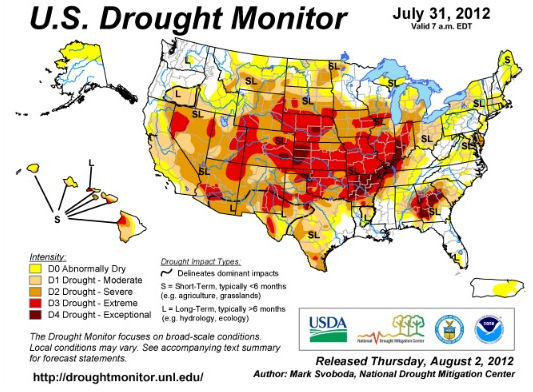
FOR THE one in five children in the United States living in food insecure households and the millions of Americans living from hand to mouth, still trying to recover homes, jobs and a stable livelihood after the crash of 2008, let alone tens of millions of other poor people around the world, any rise in food costs will be a crushing–and for many, life-threatening–calamity.
With the possibility of food shortages, the vultures of finance, otherwise known as commodity speculators, will once again begin to circle the food markets, looking to make a killing. As the financial markets were not re-regulated after the economic crisis of 2008, hedge funds and short-sellers will inevitably be on the lookout for additional profits by gambling on the price of food, exactly as they did four years ago.
Rather than any lack of actual food, most analysis indicates that the primary cause of the dramatic escalation in food prices that caused the 2008 crisis was financial speculation in the food commodity sector. That is to say, it was a human tragedy manufactured by the laws of motion of capitalism, rather than the laws of nature.
The USDA could and should be taking pro-active steps to ensure that there is no replay of 2008 as the number of people who became “food insecure”–which is to say starving–topped 1 billion worldwide.
In the short term, any crop failures need to be compensated by changing the allocation of U.S. corn and preventing commodity speculation on food. In the longer term, measures to raise grain storage volumes; address infrastructure deficiencies through appropriate investment; re-evaluate inhumane, environmentally destructive and dangerously unhealthy industrialized livestock feeding practices; and examine the location, sustainability and type of crops and monoculture farming are all issues that need attention.
Up to now, however, Agriculture Secretary Tom Vilsack has resisted calls to reduce or eliminate the federal mandate that sees more than one-third of the U.S. corn crop diverted to ethanol refineries to make “bio-fuel” to burn in car engines. The federal government has mandated that over 13 billion gallons of ethanol is made from corn this year, which would equate to 40 percent of this year’s crop.
Supposedly adopted to reduce demand for “overseas oil” and associated geopolitical concerns after oil almost topped $150 per barrel in 2008, the Obama administration raised the federal requirement to 36 billion gallons by 2022, with at least 15 billion coming directly from corn.
Even on the best of days, turning corn into ethanol is an idiotic thing to do. Many studies have shown that it takes more energy to turn the corn into ethanol than is recovered when the ethanol is burnt in a car engine. Not only that, but ethanol doesn’t have the energy density of gasoline, so cars running on a mixture of ethanol and gasoline have to burn more fuel to go the same distance and the blended mix costs more to transport.
In any year, this is bad policy. In a year of extreme drought, it should be a criminal offense to waste food resources in this manner.
Additionally, in one of the more ridiculous circular irrationalities to emerge from the anarchy of capitalist decision-making, the cost of ethanol-blended gasoline in the U.S. is also on the rise. Growing crops in the West is heavily dependent on oil for fertilizer production and mechanization–to the extent that it takes 10 calories of oil to produce one calorie of food.
Immediate elimination of the biofuel mandate is a concrete step that Vilsack could be promoting, particularly after he predicted at a White House press briefing that the drought would cause “significant increases in prices” by the end of the year.
Oil companies, which are required to blend ethanol into gasoline as part of the inappropriately named “renewable fuel standard” (RFS), are allowed to carry RFS credits over year to year. They thus have 2.4 billion credits available to allow the continued acquisition of corn for ethanol refineries.
But it’s hard to imagine suddenly freeing up 40 percent of whatever remains of the U.S. corn crop for livestock and human use not having an impact on corn prices, even accounting for the activities of the oil companies. As Gawain Kripke, director of policy and research for Oxfam America has argued, “The federal government can…put an end to the biofuel mandates, which are diverting food into fuel, and work to cut greenhouse gas emissions, which are leading to ever more erratic and extreme weather.”
Vilsack should be arguing for such a policy shift. Significantly, Lisa Jackson, head of the Environmental Protection Agency, has the power to make it happen without waiting on legislation.
This is especially necessary as some experts are beginning to worry about next year’s crop. For much of the U.S. corn belt, the main precipitation period has already passed. So without some unseasonal weather events releasing massive amounts of rain, Mark Svoboda, a climatologist at the National Drought Mitigation Center, based at the University of Nebraska, has said that what matters is getting enough rain for the beginning of next year’s crop: “This drought isn’t going anywhere…The damage is already done. What you are looking for is enough moisture to avert a second year of drought.”
Vilsack could also offer to annul small farmers’ debts to the banks. The only step he’s taken in this direction is to allow farmers an extra 30 days to pay insurance premiums–as if an extra month is going to make any difference if you’ve got no crops to sell.
He could campaign for greater agricultural aid for farmers in the Global South, specifically to build food storage facilities. Investment in this kind of food infrastructure to smooth out the ups and downs of harvests was drastically cut in developing countries throughout the 1980s and ’90s as international lenders demanded reductions in government spending in exchange for loans. In addition, such insurance was seen as unnecessary when “the market” would automatically adjust for any shortfall; similarly, in the United States, grain reserves are low and unable to make up any deficit because of a reduction in grain storage.
Perhaps more importantly still, if Vilsack and the Obama administration in general had any concern for humanity and the world’s poor, they could begin an aggressive campaign to re-regulate financial speculation on food prices in international commodity markets. Such an attack on the bankers, stockbrokers and speculators would no doubt prove wildly popular.
IN PRACTICE, the myopic priorities of capitalism dictate the solutions on offer. Vilsack has enacted short-term palliatives which are highly likely to make the long-term situation far worse.
The $383 million in emergency drought payments to farmers that just passed Congress is appropriating the money directly from cuts to conservation programs designed to promote more sustainable farming practices. Indeed, cuts to those programs are three times what is allocated for emergency drought relief, leading a coalition of environmental groups to write a letter to all members of Congress stating their opposition:
Using disproportionate cuts to conservation to fund disaster assistance undermines the successful conservation programs that are currently being utilized…Disproportionately cutting conservation dollars to pay for disaster aid is short-sighted, and the long-term investment in conservation should not be usurped by the short-term thinking to address severe drought.
Rather than downsize the powerful corn-to-ethanol industry–much of it situated in Obama’s home state of Illinois which has the third-largest production capacity, while Iowa, a campaign-defining state for Obama in 2008 and a swing state this time around, produces the most–Vilsack has instead sacrificed 3.8 million acres of conservation land for grazing and the production of hay in order to circumvent livestock owner’s anger directed at ethanol producers.
Most absurdly, considering this is, after all, the 21st century, at the same press conference where Vilsack predicted food price increases, he offered his own personal solution to the drought crisis: “I get on my knees every day, and I’m saying an extra prayer now. If I had a rain prayer or a rain dance I could do, I would do it.”
So while there is a clear and easily achievable solution at hand–reallocation of corn from ethanol distillation to food production, the agriculture secretary of the world’s biggest corn exporter believes a more useful way of spending his time is in genuflecting to an all-powerful, invisible deity in the sky.
In the medium term, the industry practice of feeding corn to cattle in huge, enclosed feeding lots to speed the fattening process needs urgent re-examination–for the good of animal and human welfare. To enhance profit margins, successively larger animals have been selected so that over time, the animals themselves have changed. The larger a single animal is, the larger the profit ratio you obtain from chopping it up.
Cows in giant feed lots are typically around 1,200 to 1,300 pounds rather than the more usual 900 to 1,000 pounds. A feed-lot cow in the open field would have to eat a simply enormous amount of grass or hay to fatten since its overall body mass is almost 30 percent larger. Hence corporations have created a cow that can’t survive except through being force-fed high-energy corn meal.
Apart from the misallocation of corn, the knock-on effects of that decision for animal and human welfare–including the incubation and mutation of pathogens, and the disposal of huge volumes of toxic animal waste laden with antibiotics and growth hormones concentrated in small areas–all feed in to the incredibly wasteful, dangerous and unsustainable nature of capitalist agriculture.
AT A time when the reality of anthropogenic climate change has become so hard to ignore that even some famous climate skeptics have given up protesting, drought is going to be an increasing factor that agricultural planners need to take into account. Therefore, cutting money from programs designed to manage the land more sustainably is a suicidal policy.
As climate blogger Joseph Romm pointed out in an article in Nature, assuming business as usual–which is exactly what is going to happen without a mobilization of the people that dwarfs the revolts of 2011–there will be a cascading series of destabilizing changes which will all negatively impact our ability to grow food:
Precipitation patterns are expected to shift, expanding the dry subtropics. What precipitation there is will probably come in extreme deluges, resulting in runoff rather than drought alleviation. Warming causes greater evaporation, and once the ground is dry, the Sun’s energy goes into baking the soil, leading to a further increase in air temperature. That is why, for instance, so many temperature records were set for the United States in the 1930s Dust Bowl; and why, in 2011, drought-stricken Texas saw the hottest summer ever recorded for a U.S. state. Finally, many regions are expected to see earlier snowmelt, so less water will be stored on mountaintops for the summer dry season.
Even worse, the recent results of 19 different climate models predict that drought will become a permanent feature of large areas of the North American continent:
If climate change pushes the global average temperature to 2.5 degrees Celsius above pre-industrial era levels, as many experts now expect, [almost all of Mexico, the mid-Western United States and most of Central America] will be under severe and permanent drought conditions.
Future conditions are projected to be worse than Mexico’s current drought or the U.S. Dust Bowl era of the 1930s that forced hundreds of thousands of people to migrate.
In other words, we are only beginning to glimpse the outlines of a situation that will become far worse without drastic ameliorative action in the near-term future. Climate change, caused primarily by the burning of fossil fuels, is creating extended droughts that threaten to undermine agriculture and, thereby, our ability to feed ourselves. Rather than a swift redirection of societal priorities–toward energy conservation, renewable technologies and sustainable farming practices, instead there’s a continuation and extension of the policies that got us here in the first place.
NOTHING CAN explain this paradox between, on the one hand, the prolongation of unsustainable food production practices that don’t even feed people successfully, and on the other, the way in which the natural world functions as an inter-connected whole, other than to examine the factors that drive a society artificially divided into antagonistic classes with opposing priorities.
We live under a system that is inexorably leading to greater and greater climatic dislocations, due to its inherently anti-ecological dynamic that is predicated on exponential growth and the prioritization of short-term measures in the interest of profit.
We see the same irrational process played out in India, which is suffering from a 20 percent shortfall in precipitation, with some states recording 70 percent reductions from historic averages. Sixty percent of India’s 1.2 billion people work in agriculture, which accounts for 20 percent of Indian gross domestic product.
But less rain doesn’t just affect farmers directly. Less rain leads to less hydroelectric power, which means farmers have to use their own pumps to obtain water from underground aquifers for crop irrigation to save their harvest. Those pumps run on electricity. So at a time when there was less electricity available because of drought, there was an increased demand for electricity to overcome the drought, a factor contributing to the massive blackout in India.
Additionally, pumping groundwater has led to aquifers dropping in some areas by between 60 and 200 meters, requiring bigger, more powerful pumps for deeper wells to continue the unsustainable practice of tapping groundwater supplies at such volumes.
This is despite the fact that while 90 percent of water use in India is for agriculture, only about 10-15 percent ends up reaching the crops, as most of it evaporates on the ground before it gets to them. Rather than investing in sustainable agricultural practices to combat the problem, the Indian government bought heavily into the Western-backed Green Revolution of the 1960’s, and promoted the planting of water-intensive crops such as rice.
According to Upmanu Lall, director of the Columbia Water Center at Columbia University’s Earth Institute, “the whole water and energy problem [in India] is dire, and it’s caused by government policy.” He gives the example of the Punjab, which has an annual rainfall of 0.4 to 0.8 meters, but now grows rice, which requires 1.8 meters of annual rainfall.
The intersection of energy, water and food with capitalist development is illustrated in India in stark form. But the solution, abstracting the limitations imposed by class society, is once again quite simple, in that crops should be grown where the climate makes most sense, not where they will make the most money or merely to add to foreign cash reserves or national status.
However, rather than taking those kind of measures or addressing climate change, India is building more coal and nuclear plants and is one of the country’s most resistant to taking effective action on climate change.
Around the world, the evidence is mounting that there are apparently no circumstances, even ones as cataclysmic as drastic changes to planetary climate, that take precedence over the need to accumulate capital by the tiny segment of society that actively benefits from the process.
Given all of the above, it seems impossible to avoid the conclusion that to survive at all on a planet that looks remotely like the one we were born on, we must confront the system that produces a society at odds both with itself and the natural world for the same reason–class stratification.
That means the building of an organized resistance in every workplace, community, school and farm all across the world. The exploitation and oppression that is meted out to the vast majority of the world’s population as a consequence of the way system works is the mirror image of the exploitation of the biosphere that, ultimately, forms the basis for life–a scientific fact the capitalists seem capable of ignoring.
We can’t afford to let them get away with it. That’s why we have to organize, in order to say: For the good of humanity and the rest of the biosphere upon which we depend, you need to go.
Chris Williams is the author of Ecology and Socialism: Solutions to Capitalist Ecological Crisis.
This month the Left Forum will be showing the film “BETTER THIS WORLD.” The film is a documentary telling the story of Bradley Crowder and David McKay, who were accused of intending to firebomb the 2008 Republican National Convention, is a dramatic tale of idealism, loyalty, crime and betrayal.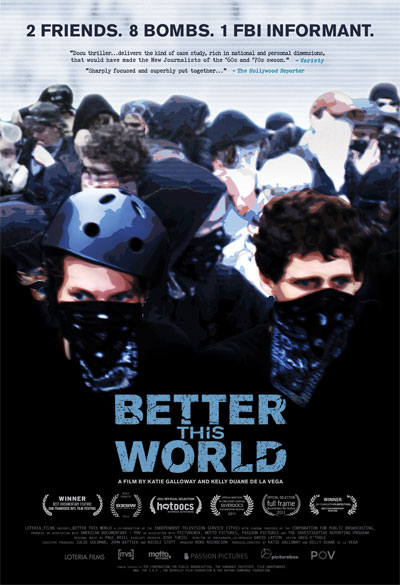
“Better This World” follows the radicalization of these boyhood friends from Midland, Texas, under the tutelage of revolutionary activist Brandon Darby. The results: eight homemade bombs, multiple domestic terrorism charges and a high-stakes entrapment defense hinging on the actions of a controversial FBI informant. “Better This World” goes on to the heart of the war on terror and its impact on civil liberties and political dissent in post 9/11 America. Winner, 2012 Writers Guild Award for Best Documentary.
After the film we will be discussing the widespread anger at Wall Street and frustrations with politician’s. Tom Burke will give an update on the Coalition to March on the RNC (www.MarchontheRNC.com). Thousands will march against the Republicans on Monday, August 27, 2012, in Tampa, Florida. The Democratic convention follows that and will face protests too. The film is free and open to the public. It will be shown on a TV set. Hope to see you there!
Better This World
Thursday, August 16
7:00PM
IGE (Institute for Global Education).
1118 Wealthy SE.
Grand Rapids, MI. 49506
Critiquing Obama’s track record: Cornel West & Paul Street
This video is re-posted from Al Jazeera.
Al Jazeera TV recently invited radical scholar’s Paul Street and Cornel West to provide an honest critique of the Obama administration.
Cornel West was a supporter when Barack Obama ran for President in 2008, but now feels that Obama’s policies have been brutal for many Americans. His most recent book, co-authored with Tavis Smiley is The Rich And The Rest Of Us: A Poverty Manifesto.
Paul Street is the author of numerous books, two of which are about Barack Obama. The first one, written during the 2008 Election, is entitled Barack Obama and the Future of American Politics, and the most recent book is entitled, The Empire’s New Clothes: Barack Obama in the Real World of Power.
We received notice that there is a meeting being held Friday at 6PM at The Network (345 Atlas Avenue in Eastown), in response to the threats of rape that were directed at people gathered in Cherry St. Park for Gay Day this past Saturday.
Someone who attended the event filmed an interaction with people who were protesting Gay Day. During this interaction, one of the men said that it was be justified to rape women and specifically the woman filming because of the “sinful nature” of the LGBT celebration taking place at Cherry St. Park.
The Grand Rapids Police Department was called during this confrontation, but the police told those who called that the group of men had the right to assemble and engage in “free speech.”
Several local groups have responded to this by claiming that what the men were doing had gone beyond free speech and was actually hate speech, since they threatened to rape some of those who were present at the Cherry St Park.
The Tolerance, Equality and Awareness Movement (TEAM) sent a letter to the Grand Rapids Police Department that called the incident hate speech, that the GRPD should formally charge these men and that, “they should be prosecuted to the fullest extended of the federal law, namely the Matthew Shepard and James Byrd Hate Crimes Prevention Act.”
In addition, the local chapter of the National Organization of Women (NOW) also posted a letter sent by a NOW member to the Mayor of Grand Rapids and the Police Chief. This letter states in part:
I expect the elected officials of Grand Rapids to work to make my community as safe as possible for all citizens. In this situation the GRPD’s failure to take action to protect our community from such horrendous threats of violence is alarming and unacceptable. I believe the GRPD’s failure to act condones threats of violence and inadvertently encourages this type of behavior in our community.
Police, Violence and the LGBT Community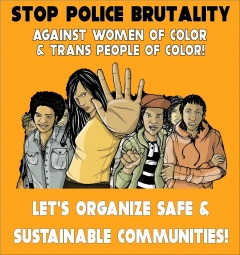
While it is certainly understandable that people are outraged over the threats of rape directed at people who were part of the Gay Day event on Saturday, it is a bit disconcerting that people believe that the police are really committed to preventing violence in this community, particularly violence against the LGBT community.
A recent report by the National Gay and Lesbian Task Force and the National Center for Transgender Equality entitled “Injustice at Every Turn” made it clear that nearly half of all the Trans people surveyed felt uncomfortable in talking to the police and that 22%, about 1/5 of all respondents, felt harassment by the police, with that percentage even higher amongst people of color.
The work of the national women of color organization, INCITE! also speaks to police abuse of women of color and Trans people of color. In their toolkit on Police Violence Against Women of Color and Trans People of Color also makes it clear that police violence directed at women of color and Trans people of color is extremely high and that continued collaboration with law enforcement agencies not only gives legitimacy to police departments, it prevents communities from finding real alternatives to relying on cops.
The marginalization of a gendered political analysis of state violence also de-prioritizes the work of developing community alternatives for safety, support, healing, and accountability from domestic violence, sexual violence, homophobic/transphobic violence, and other kinds of gender-based violence within our communities.
Dean Spade, in the amazing book Normal Life: Administrative Violence, Critical Trans Politics and the Limits of Law, argues passionately that hate crimes legislation has no deterrent effect on people and only “strengthen and legitimize the criminal punishment system, a system that targets the very people these laws are supposedly passed to protect.”
Spade goes on to say, “Could the veterans of the Stonewall and Compton’s Cafeteria uprisings against police violence have guessed that a few decades later LGBT law reformers would be supporting passage of the Matthew Shepard and James Byrd Hate Crimes Prevention Act, a law that provides millions of dollars to enhance police and prosecutorial resources?“
Locally, we have seen how the Kent County Sheriff’s Department has engaged in sting operations that target gay men in parks, just for having conversations with people. The question for all of us to ask is do we want the police to prevent violence or do we find other models that are not based on punishment and violence?
 Grand Rapids Institute for Information Democracy