In their Email for October 29, Indivisible GGR sent out information with the following headline: What is ICE? Or What Is It Supposed to Be?
The post begins by providing a very weak and limited commentary of how ICE came to be, using as their only source an NPR story. There is so much good information on the history of ICE, such as the book Abolish ICE: A Passionate Plea for a More Humane Immigration System, by Natascha Elena Uhlman. More importantly, why would IGGR not rely on the two groups doing the most around ICE since 2017 in Grand Rapids, Movimiento Cosecha and GR Rapid Response to ICE? Very troubling.
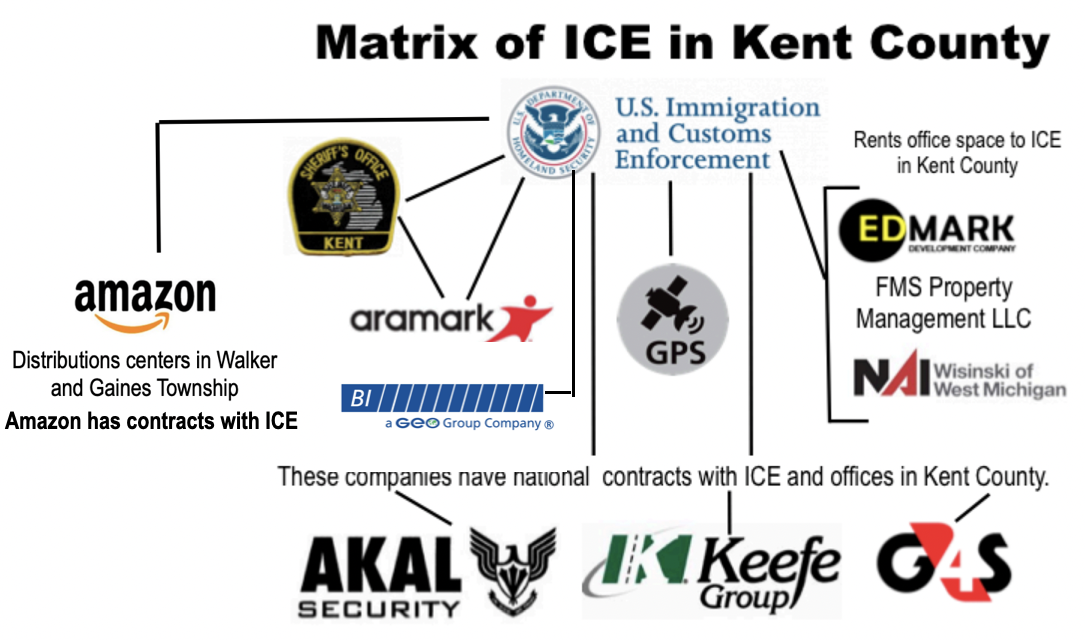
The IGGR post goes on to write:
ICE’s stated purpose is to “protect America through criminal investigations and enforcing immigration laws to preserve national security and public safety.” Unfortunately, the ICE of today is a masked police force acting at the behest of the President and his syncophantic Secretary of Homeland Security, Kristi Noem.
This is not only an inaccurate assessment, but it puts the blame solely on one administration, when in fact since ICE was created during the George W. Bush Administration, every administration has used ICE to terrorize undocumented immigrants. The Obama Administration deported roughly 3.5 million and the Biden Administration deported roughly 4 million. IGGR is showing it’s partisan bias here by wanting to only lay the blame at the feet of Donald Trump and Republicans. In addition, Democrats have been voting for anti-immigrant legislation and voting with Republicans to fund ICE and US Customs and Border Patrol. What ICE has been doing since it was created is a result of bipartisan policies.
Next, the IGGR post has a heading that reads ICE During the First Trump Administration. In this section they use as ICE data as a source without providing any independent or immigrant-led data or analysis. The section then includes what ICE looked like in Kent County during the first Trump Administration and only uses the case of Jilmar Ramos Gomez, a former US Marine who was suffering from PTSD and ended up in ICE detention because a GRPD cop called ICE in a clear case of racial profiling. The Kent County Sheriff’s office then announced that they would require a judicial warrant for ICE to detain anyone who was in the Kent County Jail. The IGGR post states, “This prompted Kent County to change its mode of cooperation with ICE to ensure constitutional protections.” What this section of the post omits are two things. First, the Kent County Sheriff’s department continued to cooperate with ICE when people who were booked into the Kent County Jail were discovered to be undocumented immigrants, plus the Kent County Jail was still profiting from holding undocumented immigrants in the Jail County Jail for ICE, which was based on a 2012 contact that ICE had with Kent County, a contract directly related to Obama era ICE policies. The IGGR post also omits the fact that Movimiento Cosecha and GR Rapid Response to ICE engaged in a 14 month campaign to end the ICE contract with Kent County.
The IGGR post then skips what ICE was doing to arrest, detain and deport immigrants during the Biden Administration and just moved on to the next heading which read, ICE During the Second Trump Administration. In this section they write:
As we’ve seen across the country, ICE has also been apprehending immigrants in Kent County as they arrive for hearings on their immigration status. In other words, those who are trying to work through the system legally are having their rights trampled on. For example, on June 4, ICE apprehended a refugee who had intended to return to El Salvador in a matter of days. The return was delayed because ICE took away the passports that the man needed in order to return. The rest of the family sought sanctuary at Fountain Street Church. The man, after being detained in unsanitary conditions, was ultimately reunited with his family in El Salvador. One may wonder the point of putting a man through all of this when he already intended to return home to El Salvador. As they say, the cruelty is the point.
The incident the IGGR post is referring to happened at the ISAP office, which you can read about in detail here from a first hand account of what happened on June 4. I also wrote an update in the case of the family that was offered sanctuary at Fountain Street Church, which talked about the efforts by Cosecha and GR Rapid Response to ICE to get Senators Slotkin and Peters, along with Rep. Scholten to assist in getting the Salvadoran father of this family released, even though none of these members of Congress did anything to fight for this family.
Lastly, the IGGR post mentions something about the GEO Group owned ICE Detention facility in Baldwin, Michigan, but says nothing about the group that has been organizing around that facility since 2018, No Detention Centers Michigan.
In the final section of the post they offer, “some ways to make your voices heard about the mistreatment of Americans at the hands of ICE.” Unfortunately, IGGR omits the most affective ways to resist ICE violence right here in Grand Rapids, by not encouraging their members to support Movimineto Cosecha and take one of the regularly scheduled trainings from GR Rapid Response to ICE. These two groups are doing actual resistance work against ICE in this city and they have been doing it since 2017. Excluding them from a call to action is not only absurd, it does harm to this movement to resist ICE. Let IGGR know that they need to do better by centering the work of those who are actually resisting ICE. Send them a message please https://www.facebook.com/groups/IndivisibleGR.
Kentwood Mayoral race is a perfect example of how problematic electoral politics are for making substantive change in people’s lives
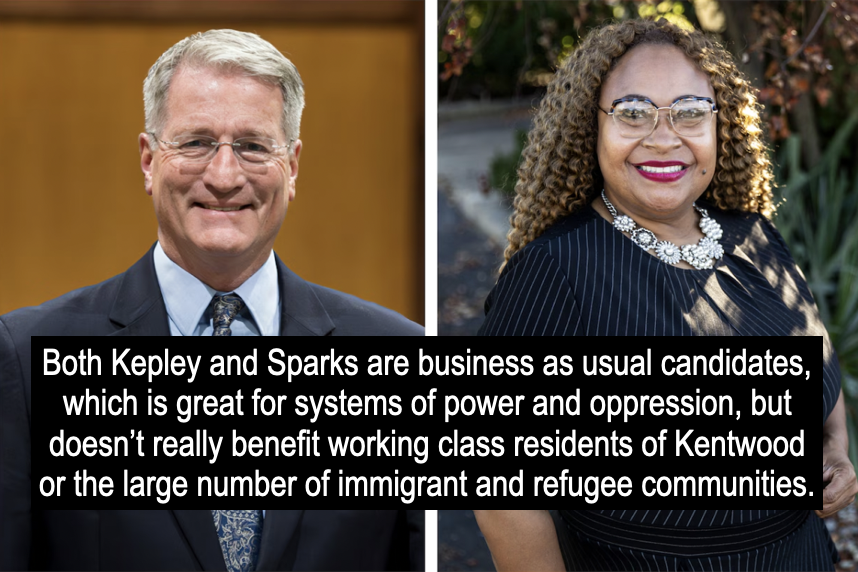
Next week people who live in Kentwood will have an opportunity to vote for a new Mayor. The two candidates who are running are incumbent Stephen Kepley and Monica Sparks, who is currently a Kent County Commissioner.
If you look at the campaign finance data for Stephen Kepley you see that he has raised $46,926.12 and spent $32,022.23. Kepley had 101 separate donors, with the following being some of the largest:
- Maintain Our Majority PAC – $10,000
- Friends of West Michigan Business – $5,000
- Realtors Political Action Committee of Michigan – $2,000
- Dan DeVos/DP Fox – $1,225
- Mike Jandernoa/42 North Partners – $1,225
- Dan Hibma/Land & Company – $1,225
- JC Huizenga/Huizenga Group – $1,225
- John Kennedy/Autocam Medical – $1,225
This short list represents some of the wealthiest families in Kent County, many of who are part of the Grand Rapids Power Structure. There are also PACs representing Realtors – those who have an interest in profiting from the housing market; the Friends of West MI Business, which is the PAC of the Grand Rapids Chamber of Commerce; and Maintain Our Majority, which is a Republican run PAC that has it’s campaign donation address the office of 220 LYONS ST NW SUITE 510, Grand Rapids, Michigan 49503. When you look up that address, it is listed as SIBSCO, the real estate firm that was started by the Secchia family, which is now run by Charlie Secchia.
The campaign finance data for Monica Sparks shows that she has raised a total of $30,015.00 and has spent $18,570.14. There were 153 separate contribution entries on the most recent campaign finance document from Monica Sparks. Here are some of the larger contributors:
- Monica Sparks – $2,540
- Michigan Laborers Political League PAC – $2,500
- Teamsters 406 Political Action Committee – $2,500
- Michigan Regional Council of Carpenters Political Action Committee – $2,000
- Kent County Democratic Party – $1,600
- Kentwood Professional Firefighters Union – $1,225
- Joshua Ferguson/270 Strategies – $1,225
- Brandon Dillion/The Winmatt Group – $1,225
- PHILPAC – $1,000
Monica Sparks is not only the largest contributor to her own campaign, she also contributed an additional $24,068.29 under the In-Kind Contributions section of her campaign finance data.
You can see that the larger contributors to Sparks’ campaign are the Kent County Democratic Party, PHILPAC (which is Phil Skaggs’ PAC), Winmatt Group (a Democratic Party consulting group), plus several labor unions, all of which have a history of funding Democratic Party candidates.
Now, some people might say that it seems clear who Kentwood voters should support. You have the incumbent Kepley, who clearly gets a large amount from wealthier families in Kent County, along with organizations like the Grand Rapids Chamber of Commerce. Kepley is a business as usual politician that does not want to disrupt development efforts or question funding for cops or the Kent County Jail. Kentwood is also a deeply diverse community, both culturally and ethnically, yet Mayor Kepley rarely does anything that challenges the white supremacy framework of Kentwood politics.
Then there is Monica Sparks, a current Kent County Commissioner. Besides relying heavily on Democratic Party and Democratic Party support groups, of the 153 separate contributions listed only 21 of those entires are from people who actually live in Kentwood. This means that the majority of campaign contributors to Monica Sparks comes from people who do not live in Kentwood.
In addition, as a Kent County Commssioner Monica Sparks has also not disrupted business as usual when it comes to issues like voting for all the massive Grand Action 2.0 projects in downtown Grand Rapids like the Amphitheater and the Soccer Stadium. Sparks has always voted to maintain hundreds of millions in funding for the Kent County Sheriff’s Department and the Kent County Jail, which has a disproportionate number of Black and Brown inmates.
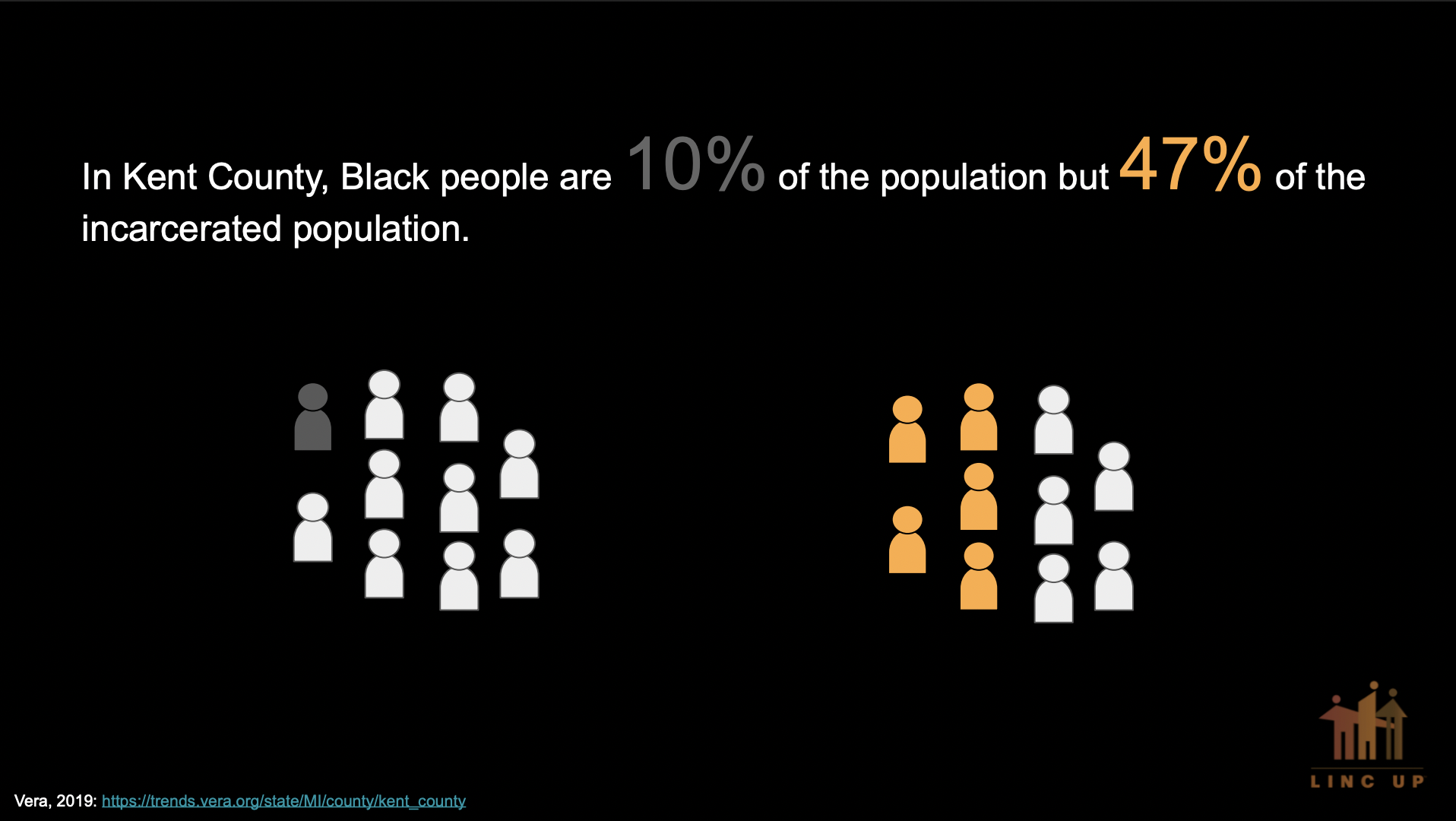
Lastly, Monica Sparks was elected to the Kent County Commission in 2018, which means that she did not support Movimiento Cosecha’s push to end Kent County’s contract with ICE and she currently doesn’t support the Cosecha and GR Rapid Response to ICE campaign to get Kent County to adopt several sanctuary policies that would concretely reduce ICE violence in this county.
Neither Mayoral candidate for Kentwood has a platform for disrupting business as usual politics, which means that systems of power and oppression will continue to thrive in Kentwood. What we have in Kentwood is clearly a partisan battle for power, but neither party wants to center the most affected people in Kentwood, working class residents and the vast immigrant and refugees communities that make Kentwood so unique. Here is a clear example of why electoral politics doesn’t serve the majority of the people, which means we need to take matters into our own hands if we want substantive and long lasting change.
On Sunday, I posted an article about a Cosecha and GR Rapid Response to ICE action where activists confronted state lawmakers for their co-sponsorship of bills that would criminalize and acts of compassion or solidarity with immigrants and attempt to limit local municipalities to adopt ordinances that would impede ICE from terrorizing undocumented immigrants.
One of the State Representatives that the group visited was Rep. Angela Rigas, who lives in Alton, MI. She would not come out to talk with people and the only time people went on her property was to knock on the door to give her a document demanding she retract her support these anti-immigrant bills. Movimiento Cosecha has as one of its core principles to practice non-violence in their organizing and resistance work.
Despite there being no real threats against Rep. Rigas, other than to challenge her co-sponsorship of bills that will punish even allies who act in solidarity with the undocumented community, here is how she responded on social media:
Today, far left extremist protestors unlawfully trespassed on my property in an attempt to intimidate and harass me for co-sponsoring a package of bills aimed at cracking down on illegal immigration. When extremists don’t get their way, this is the kind of abhorrent behavior they resort to, and I will NOT cave to their insane demands. I will ALWAYS prioritize the safety of American citizens over dangerous illegal criminals! A police report has been filed and all Ring recordings have been turned in to the Kent County Sheriff’s Department.

This is how those who are part of systems of power and oppression respond, which is to say in petty ways on social media. However, the more problematic issue is that Rep. Rigas sent pictures to the Kent County Sheriff’s office, which has a long track record of working with ICE. Equally problematic is that Rep. Rigas shared her information with a far right news outlet know as the Midwesterner, which posted a story on Sunday entitled, VIDEO: Masked leftist agitators vandalize Rep. Angela Rigas’ home over anti-illegal immigration bills.
Before talking about how awful this story is I think it is important to note that the founder of The Midwesterner is Kyle Olson. Before he founded this awful far right echo-chamber, Oslon used to do a radio show and before that he a reporter for Brietbart News. In addition, Kyle Olson was a campaign advisor for Tudor Dixon’s failed gubernatorial campaign in 2022, plus Olson is a regular on Tudor Dixon’s podcast.
The article on The Midwesterner is problematic in the following ways. First, the article is essentially a form of stenography, where Kyle Olson essentially just reports on what Rep. Rigas shared with him. Second, there was no vandalism, nothing was broken and nothing was destroyed.
Third, most of the people who had a mask on were wearing COVID masks, since long COVID is a reality that those who believe in science acknowledge. Therefore, calling people masked leftists agitators is just a way to over-simplify and distort who came to the home of Rep. Rigas. Labeling people who oppose oppression is part of the far right playbook, since it appeals to supporters of the far right and allows them to easily demonize anyone who opposes what politicians like Rep. Rigas are advocating for.
Fourth, in The Midwesterner article it states, “Video obtained exclusively by The Midwesterner shows a large group of pro-illegal alien agitators, including several masked, chanting outside the home of state Rep. Angela Rigas on Saturday.” The video that Kyle Olson is referring to was from a person who showed up and sat on the from porch of the home of Rep. Rigas. This was a guy who was called by Rep. Rigas, who not only tried to hit people standing along the road with his truck, but had this decal on the rear window of his truck.

Fifth, in the subheading from The Midwesterner, it reads, Rigas unintimidated: ‘I will ALWAYS prioritize the safety of American citizens over dangerous illegal criminals!’” Again, this is standard far right playbook tactics, which does two things. The subheading merely wants to demonize immigrants by calling them “dangerous illegal immigrants.” However, actual facts can dismantle the mantra of “undocumented immigrants are criminals.” The National Institute of Justice wrote in September of 2024, “An NIJ-funded study examining data from the Texas Department of Public Safety estimated the rate at which undocumented immigrants are arrested for committing crimes. The study found that undocumented immigrants are arrested at less than half the rate of native-born U.S. citizens for violent and drug crimes and a quarter the rate of native-born citizens for property crimes.”
The other issues with using this quote from Rep. Rigas is that there is no effort to verify that Rep. Rigas actually does anything to keep American citizens safe. In fact, Rep. Rigas has always supported the funding of cops, which doesn’t keep people safe, and is well documented in this report by Interrupting Criminalization. Rep. Rigas also has voted to take away Trans rights and workers rights, which also do not keep residents of Michigan safe.
Sixth, as I wrote in my article from Sunday, Cosecha and GR Rapid Response to ICE attached a document to the front door of the home of Rep. Rigas, demanding that she retract her support for these anti-immigrant bills, which also included signatures from several of the people who participated. Kyle Olson wrote in his article, “Remarkably, several of the agitators signed their names to the sign.” People signed the document because they are committed to being in solidarity with undocumented immigrants, even if these anti-immigrants bills are adopted. For Kyle Olsen to say this was :remarkable” demonstrates his ignorance of history where people signed similar documents as a public show of solidarity. One example from history would be from the Confessing Church in Germany, where they made it publicly know through the Barmen Declaration that they would resist the Nazi Party and harbor Jews and other communities being targeted by Hitler’s regime.
Lastly, what is important for people to understand apart from what State Rep. Rigas did by using state carceral violence as a response, is the fact that people on her Facebook page and those that are likely consumers of The Midwesterner are not shy about saying that those who showed up to confront Rep. Rigas should be met with violence and repression. What Rep. Rigas did, along with The Midwesterner, was to dox those who were non-violently resisting those who have an anti-immigration agenda. Doxxing by the far right is always dangerous, but especially now since the White House overtly supports the doxxing of activists who are resisting state violence and groups on the far right that are engaged in their own forms of violence in the streets.
For those who want to learn more about doxxing and how to better protect yourself from being doxxed, check out this zine from Sprout Distro.
Further evidence of how much the DeVos family has their tentacles in all things Grand Rapids
Last Thursday MLive posted an article with the headline, Grand Rapids board to gain an estimated $224,600 from DeVos-owned parking lot.
The article stated that a “DeVos family affiliated company” currently owns the parking lot on Ionia right across from the Van Andel Arena. 45 Ionia Associates, which is a subsidiary of RDV Corporation (Doug DeVos), bought the property in 2009, which was approved by the Downtown Development Authority (DDA).

The DDA has now approved a new 10-year agreement between the DDA and the DeVos-owned 45 Ionia Associates. According to the minutes from the DAA meeting from October 8th:
While the Owner is still interested in developing the property, the timeline to do so is undefined and the conditions today are different than they were in 2009. In acknowledgement of that, and with a desire for Area 3 to remain available for public parking as interim use, the Owner has proposed terminating the 2009 Development Agreement and entering a lease with the DDA for the continued operation of the parking lot. As proposed the DDA will pay $4,200 per month to the Owner until such time that it is ready for development. The monthly lease fee would be covered using revenue generated from the lot which will continue to be managed by MobileGR as outlined in the City and DDA Parking Agreement. Any remaining funds after maintenance and operation fees would become non-tax revenue available to the DDA for budgeted projects and programs. The initial lease term is 10 years following which it will automatically be extended for consecutive one-year terms.
The MLive article omitted this information regarding the details of the agreement between the DDA and the DeVos-owned 45 Ionia Associates. More importantly, the MLive reported did not talk about the Downtown Development Authority and it’s relationship to the DeVos family.
The DDA was founded in 1980 to allow the non-elected entity to use tax dollars from the area that makes up downtown Grand Rapids and funnel it to what they like to call public/private projects. However, these projects are ultimately designed to benefit the private sector. The public part of the relationship is to use public tax dollars, plus the public gets to act as consumers.
The other major factor that the MLive reporter failed to discuss or explore is the fact that there are several DeVos-connected people who make up the Grand Rapids DDA. There are 9 members who sit on the DDA Board:
- Richard Winn – AHC Hospitality, which is owned by the DeVos family
- David LaGrand – Mayor of Grand Rapids
- Rosalynn Bliss – Michigan State University
- Luis Avila – Varnum
- Kayem Dunn – Organizational Development Consultant
- Greg McNeilly – The Windquest Group, which is owned by the DeVos family
- Al Vandenberg – Kent County Administrator
- Jen Schottke – West Michigan Construction Institute
- Ryan Foley – Acrisure
At this point you might be saying that the DeVos family only has two people sitting on the DDA board that work for them. While this is true, you have to understand how the DeVos family has their fingers in nearly every facet of Grand Rapids and Kent County.
Since the DeVos family has so much money in Grand Rapids and Kent County, it means their interests always come first. Thus Mayor LaGrand and County Administrator Al Vandenberg would be de-facto DeVos underlings. Varnum is essentially the law firm for the rich and powerful in Grand Rapids, so Luis Avila would always be looking out for the interests of the DeVos family. Former GR Mayor Rosalynn Bliss demonstrated her allegiance to the DeVos family with numerous policy decisions that they would benefit from.
Anyone working for Acrisure has the same interests as the DeVos family and the person with the West Michigan Construction Institute is committed to development projects that will serve the long-term interests of the DeVos family as well. Lastly, Kayem Dunn, who does consulting work and also sit on the board of Experience Grand Rapids, has a history of supporting and serving the interests of those who run this city.
Besides not providing more details on the DeVos-owned parking garage and their relationship with the DDA, the real storythat MLive missed is how the DDA is fundamentally another non-elected tool of the DeVos family and other members of the Grand Rapids Power Structure.
Early Saturday morning, members of Movimiento Cosecha and GR Rapid Response to ICE gathered to take part in what they were calling a Tour of Shame. A caravan of cars visited State Representatives Bryan Posthumus and Angela Rigas, since both of the were co-sponsors of several bills that would punish solidarity with immigrants.
In April I wrote about these bills when they were first introduced, stating:
House Bills 4336 & 4337 create criminal penalties for individuals and organizations who knowingly assist or encourage immigrants without legal status in entering, residing, or being transported within the United States.
House Bills 4338, 4339, and 4342 prohibit a local municipality from enacting or enforcing any policy that limits communication or cooperation with federal officials concerning immigration. Any existing policy that governs how a municipality cooperates with federal immigration enforcement would be voided. Any municipality that violates these laws would have their state funding withheld.
When the group arrived in Rockford at the address for Rep. Posthumus they discovered that this was not his home, but an address he used during his last campaign for State Representative, a tactic that politicians often use to get elected in districts they don’t even live in.
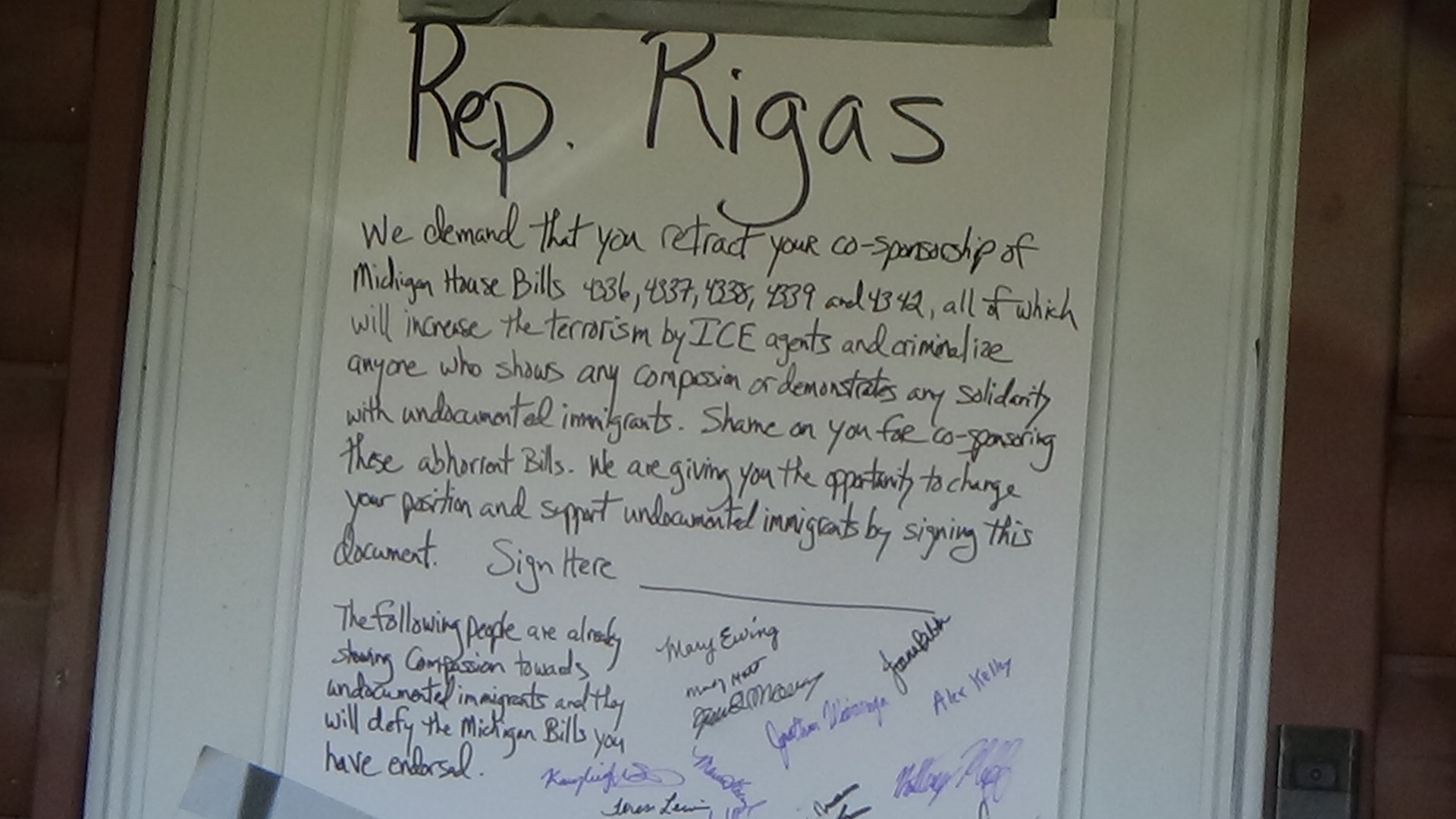
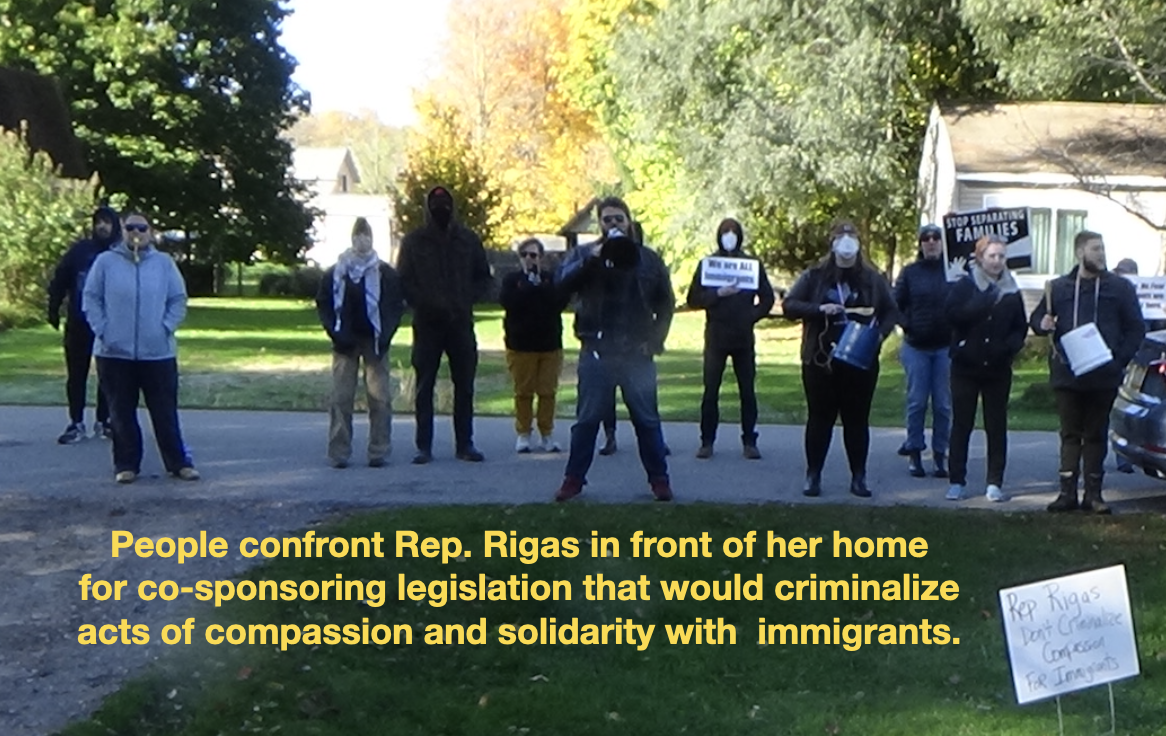
Undeterred, the group then went to the home of Rep. Angela Rigas in Alto, Michigan. The address was the correct one for Rep. Rigas who was home with members of her family. The group attempted to get Rigas to come out and have a discussion with them, along with attempting to get a commitment from her to retract her co-sponsorship of the bills mentioned above.
Rep. Rigas would not come out, so the group attached the document to her front door – shown here above), a document which read:
Rep. Rigas, we demand that you retract your co-sponsorship of Michigan House Bills 4336, 4337, 4338, 4339 and 4342, all of which will increase the terrorism being perpetrated by Immigration Customs and Enforcement (ICE) agents and criminalize anyone who shows any compassion or demonstrates any solidarity with undocumented immigrants. Shame on you for co-sponsoring these abhorrent bills. We are giving you the opportunity to change your position and support undocumented immigrants by signing this document.
Sign here _________________
 It document ended with this sentence: The following people are already showing compassion towards undocumented immigrants and they will defy the Michigan bills that you have endorsed. There were numerous people who signed the document.
The group also place some homemade yard signs, seen here on the right. After continued chanting and calls to have her come out to talk and sign the document, Re. Rigas eventually opened the inner door, but slide the top window of her storm door down to tell everyone to leave. One activist made the point that this display of protesting was nothing compared to what immigrant families go through when ICE shows up to take a family member, regularly with force and often at gunpoint. When ICE shows up it is always violent, where immigrant families are traumatized for the rest of their lives.
About 5 minutes after Rep. Rigas refused to talk with those confronting her on co-sponsorship of terrible pieces of legislation a guy in a truck came down the road – a narrow road – and tried to hit people with his sideview mirrors. This same guy parked his truck and walked towards the home of Rep. Rigas and told everyone to leave. The guy went in the house briefly and then came outside and sat on the porch filming everyone there. This white dude had a decal (shown here on the left) attached to the window of his truck that was right behind the driver’s seat.
The action at the home of Rep. Rigas lasted about an hour, when Cosecha organizers decided it was time to go as the action accomplished what it set out to do.

The last stop on the tour brought the caravan to the home State Senator Winnie Brinks. Now, Brinks had nothing to do with the proposed bills that would criminalize acts of compassion and solidarity with immigrants, but as Michigan Senate Majority Leader she said nothing to condemn these bills. What Cosecha decided to do was to offer Sen. Brinks a gift by sharing pro-immigrant legislation that was introduced in New Jersey, the Immigrant Trust Act shown here below. In all, the Tour of Shame was a success and demonstrated that the public can confront politicians outside of the stale and anti-democratic spaces that local and state governments are made up of.

It has been 2 years since the Israeli government began their most recent assault on Gaza and the West Bank. The retaliation for the October 7, 2023 Hamas attack in Israel, has escalated to what the international community has called genocide, therefore, GRIID will be providing weekly links to information and analysis that we think can better inform us of what is happening, along with the role that the US government is playing. All of this information is to provide people with the capacity of what Noam Chomsky refers to as, intellectual self-defense.

Information
Gaza Officials Say Israel Has Violated Ceasefire 80 Times in First 10 Days
The Genocide Will Not End Unless Palestinian Political Leaders are Free
Congress’s Military Budget Carries Perks for Israel
“We Estimate That Nearly One Million of Gaza’s 1.1 Million Olive Trees Have Been Destroyed”
To Media, Gaza Ceasefire Holds Despite Repeated Israeli Strikes
Israeli Knesset Advances Bill to Annex West Bank as JD Vance Visits Israel
The Unvanquished Will: Gaza’s Triumph of Spirit Against the Architecture of Genocide
Analysis & History
Gaza Two Weeks into the “Ceasefire”: Continued Killings, Aid Restrictions, Famine
The Forgotten Captives: Israel Still Imprisoning 9,000 Palestinians Even After Hostage Deal
Censorship and Military Support: How Big Tech Supports Israel
The Gaza Peoples’ Tribunal: Exploring Palestinian Erasure
Image used in this post is from https://visualizingpalestine.org/visual/break-the-bonds/
Author and education activist Jonathan Kozol gave a lecture at Fountain Street Church in 2007
Editor’s note: I have been working with Fountain Street Church and looking at a substantial amount of archival materials they have. Today’s post is only possible because Fountain Street Church has provided me access to their archives and they want this information to be public and available to the community. I will be hosting the archival material on the Grand Rapids People’s History Project site, but also posting here on GRIID. This is the second in a series of postings from the archival material at Fountain Street Church.

So far I have posted talks by Kwame Ture/Stokely Carmichael, James Meredith, Dick Gregory, Amy Goodman, bell hooks and Jane Fonda, all of whom spoke at Fountain Street Church.
Today, I want to share a lecture that author and education activist Jonathan Kozol gave a talk at Fountain Street Church in 2007. Kozol is the author of such books as Savage Inequalities: Children in America’s Schools, An End to Inequality: Breaking Down the Walls of Apartheid Education in America, On Being a Teacher, The Shame of the Nation: The Restoration of Apartheid Schooling in America, and Amazing Grace: The Lives of Children and the Conscience of a Nation.
Here is the lecture by Kozol in Part I, followed by the Q & A portion in Part II in audio form, plus a video version below.
What are the Sanctuary policies that Cosecha and GR Rapid Response to ICE are demanding from Grand Rapids and Kent County? Part I
This is the first in a series that will further examine the various sanctuary policies that Movimiento Cosecha and GR Rapid Response to ICE are demanding that the City of Grand Rapids and the Kent County Commission adopt. Today I will look at policies prohibiting “287(g)” agreements through which ICE deputizes local law enforcement officers to enforce federal immigration law.

In a recent post from Political Research Associates, they provide important historical context about 287(g).
Historically, ICE’s 287(g) agreements have relied on two frameworks to advance an “attrition through enforcement” strategy that expands the deportation machine. The “Jail Enforcement Model” deputizes law enforcement to act as immigration agents who assess immigration status and cooperate with ICE to send people from the jail to ICE detention. The “Warrant Service Officer” program, added in May 2019, allows state and local officers to serve administrative warrants, thereby arresting people for ICE and turning them over. Both approaches streamlined the process of deporting people who land in county jails, most of which are run by county sheriffs. The logic relied on an assumption that people in county jails were likely guilty of criminal activity. As then-president Barack Obama said in 2014, “If you’re a criminal, you’ll be deported.”
The article goes on to say:
But this year has been a departure from the past two decades—even from the draconian immigration policies of Trump’s first term. DHS has reinstated the so-called 287(g) “task force” agreements, a third, more expansive model that empowers any police officer to detain and arrest people on the street for being potentially deportable immigrants.
Part of the reason why Cosecha and GR Rapid Response to ICE are pushing the City and the County to adopted policies prohibiting “287(g)” agreements is because they both already have a history of cooperating with ICE.
Grand Rapids City officials like to say that their Foreign National’s Policy already prohibits them from cooperating with ICE, but even this policy states:
The policy allows officers to provide assistance to federal immigration authorities when there is an emergency that poses an immediate danger to public safety or federal agents.
This vague language allows the GRPD to determine what is an emergency or a threat to public safety. As we have seen in the past in Grand Rapids, these policies can justify all sorts of police repression and cooperation with ICE.
The Kent County Sheriff’s Department had a contract with ICE from 2012 through 2019. It was discovered several years ago that the Kent County Sheriff, Larry Stelma, signed onto a letter from the National Sheriff’s Association (NSA), a letter dated March of 2018, which said in part:
Congress must act to pass legislation to secure our borders through enforcing immigration laws, tightening border security, support the replacement and upgrades to current barriers and fencing and construction of barriers along the U.S. and Mexico international boundary as requested by those areas where it is needed, suspending and/or monitoring the issuance of visas to any place where adequate vetting cannot occur, end criminal cooperation and shelter in cities, counties, and states, and have zero tolerance and increased repercussions for criminal aliens.
Sadly, today some state and local officials have been enacting policies and giving lawbreakers shelter from being rightfully prosecuted and removed from our communities. In fact, these same laws forbid law enforcement agencies from cooperating with one another, and go as far as forcing the release of dangerous criminals into our communities exposing our citizens and legal residents to be victimized once again.
 After a 14 month campaign by Cosecha and GR Rapid Response to ICE, a campaign that got national attention, ICE ended their contract with Kent County in 2019. However, since then it is well documented that the Kent County Sheriff’s Office collaborates with ICE agents by notifying them of undocumented immigrants that were in the Kent County Jail for minor offenses, thus allowing ICE to apprehend them and take them to a detention facility in either Calhoun County or the GEO Group run ICE Detention facility in Baldwin, MI.
Recently the Trump Administration has provided some financial incentives to local police departments around the country to entice them to adopt what is called the 287(g) program, where ICE deputizes local cops to enforcement immigration laws.
The Trump Administration announced:
“Starting October 1, 2025, participating law enforcement will have these reimbursement opportunities,” DHS said in a press release posted today. “ICE will fully reimburse participating agencies for the annual salary and benefits of each eligible trained 287(g) officer, including overtime coverage up to 25% of the officer’s annual salary.”
This offer could certainly be enticing to police departments that are wanting to generate more money for their people, like the Grand Rapids Police Department that is always lobbying for adding more cops.
The Trump Administration announcement also stated:
“Law enforcement agencies will be eligible for quarterly monetary performance awards based on the successful location of illegal aliens provided by ICE and overall assistance to further ICE’s mission to Defend the Homeland:
- 90% – 100% – $1,000 per eligible task force officer
- 80% – 89% – $750 per eligible task force officer
- 70% – 79% – $500 per eligible task force officer.”
A question to ask ourselves is would the Grand Rapids Police Department and/or the Kent County Sheriff’s Department consider taking these incentives?
To date, both Grand Rapids and Kent County have rejected the demands from Cosecha and GR Rapid Response to ICE regarding sanctuary policies, so it stands to reason that they might consider the financial incentives being offered by the Trump Administration. When Cosecha and GR Rapid Response to ICE disrupted a City Commission meeting in late July, the City’s response to was to threaten people with arrest if they did not stop chanting “ ICE and Cops go hand in hand.”
This is exactly why Cosecha and GR Rapids Response to ICE has been pressuring the City of Grand Rapids and the County of Kent to adopt formal sanctuary policies, like prohibiting the 287(g) program, because it would put an end to the GRPD and the Kent County Sheriff’s Department cooperation with ICE in terrorizing immigrants.
In Part II, I will look at policies that would prevent local governments from entering into a contract with the federal government to hold immigrants in detention.
Profits over people: The GR Chamber of Commerce meets in secret to discuss immigration policies
According to a Crain’s Grand Rapids Business article earlier this month, “The Grand Rapids Area Chamber of Commerce recently held a closed-door meeting for businesses to voice concerns about the Trump administration’s immigration crackdown.”

Has the GR Chamber of Commerce decided to stand with Movimiento Cosecha and make demands about ICE not kidnapping immigrants from Kent County? Are the businesses that are part of the GR Chamber of Commerce going to declare their business spaces sanctuaries for undocumented immigrants and share the GR Rapid Response to ICE hotline number with their employees?
Not so fast.
Again, the Crain’s article stated:
The Chamber co-hosted the ninth annual Global Talent Chamber Network Convening in late September with Global Detroit in downtown Grand Rapids. The event was closed to the media, giving business owners a “safe place” for companies to say how they’re at risk of losing workers and customers, chamber leaders say.
GR Chamber spokesperson Omar Cuevas commented that, “We can not have policy that impacts growth. That is anti-business.” I see, so it’s about money, specifically money that will impact businesses who are members of the Grand Rapids Chamber of Commerce.
The Grand Rapids Chamber of Commerce has partnered with the American Immigration Council, a pro-business immigration entity to publish reports on the economic benefit of immigrants in Kent County. GRIID wrote an article about this report and how the GR Chamber is only interested in immigrant workers making money for the businesses that make up the membership of the GR Chamber of Commerce.
GR Chamber spokesperson Omar Cuevas emphasizing the point about economic impact of immigrants by saying: “We want to figure out how to maximize this talent where individuals are coming to our community with foreign degrees and certifications and work experience for jobs that we have open today.”
The Crain’s article does cite someone from the American Immigration Council who is the only person who mentions ICE, but no one from the GR Chamber of Commerce mentions the level of ICE terrorism in Kent County, which has been documented.
What the GR Chamber of Commerce is concerned about is the bottom line of the businesses that make up the GR Chamber of Commerce, not the level of fear that immigrants are experiencing because of ICE terrorism. In fact, the GR Chamber of Commerce is only concerned with immigrants who come with degrees or those who come through the H-1B program.
I get that Crain’s Grand Rapids Business reports on business issues, but that doesn’t mean they ignore groups like Movimiento Cosecha or GR Rapid Response to ICE, which are on the front lines of the fight against the federal government’s targeting of undocumented immigrants. After all, undocumented immigrants pick the food that businesses rely on, work in the kitchens and hotels for low wages and do an increasing amount of construction work that make roads and buildings possible, all of which businesses depend on. Maybe they ought to give a shit about undocumented immigrant workers and not just about expanding their profits.
No Kings messaging before Saturday and a few reflections about No Kings in GR and the possibility of mass Direct Action
The No Kings events are now in the past, but there is plenty to think about and reflect on regarding some of the messaging leading up to the event, the event itself and some possibilities for moving forward.
There was one meme that was floating around prior to October 18th, which said: Resist like its 1776 or live like its 1984. It’s an interesting framing for our current predicament, but there are several issues I take with the wording.
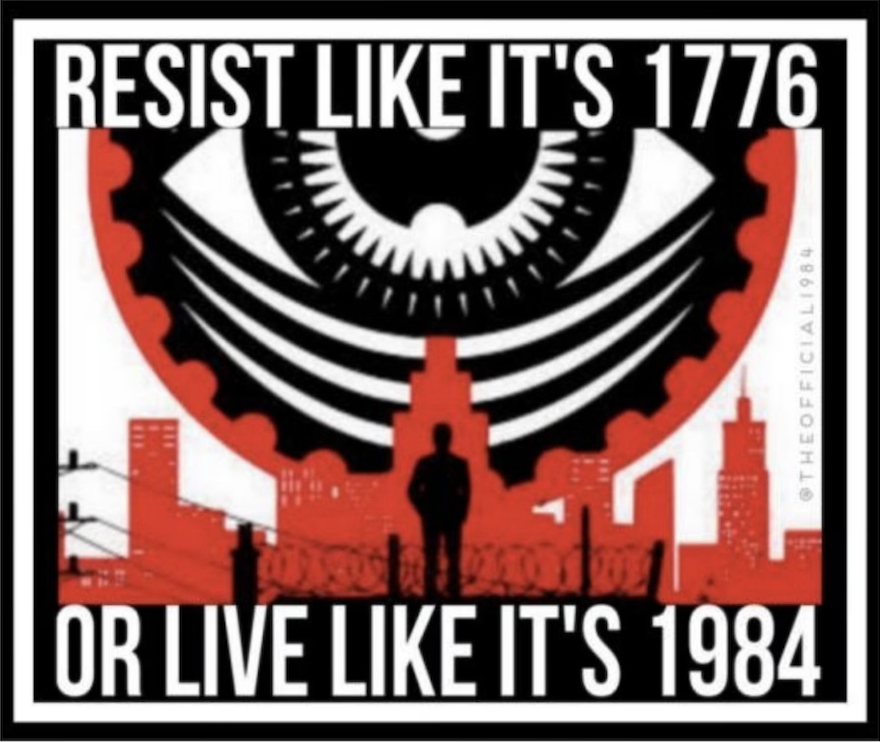 First, while the colonies in 1776 were fighting against the British army to win independence from England, to say that we should resist like its 1776 would mean that we engaged in armed conflict, since the primary strategy of those in control of the 13 colonies was to wage a war against the British. This contradicts the messaging from the dominant groups across the US that the No Kings events should be “peaceful.”
Notice that I don’t use the word non-violent, because people who have been practitioners of non-violent resistance don’t use violence, they do take actions that result in the state using violence against them. The Vietnam War resistance in  the US or the Civil Rights movement both engaged in a great deal of direct action, most often civil disobedience to challenge systemic oppression. When the dominant national groups calling for everyone to be peaceful, they mean be nice and don’t break the law. This was certainly the sentiment shared in the Top 10 Rally Reminders here on the left, with most of the reminders reflecting values held by people with tremendous privilege and those unwilling to take risks.
Then there were politicians like Michigan Senator Elissa Slotkin telling us that we had a right to protest peacefully or non-violent protest. See her video comments, beginning at 6:06 into the video. Slotkin makes the point that it is important that these No Kings protests need to remain peaceful, that the state is looking for a pretext to be violent and that we shouldn’t give them a reason to engage in repression. Slotkin says, “it’s on all of us to maintain rigorous commitments to non-violence.” It is clear that Sen. Slotkin is unaware of the history of non-violent direct action, which most movements have engaged in, where people collectively challenge unjust and repressive policies or engage in civil disobedience that illuminates how the political and economic system oppresses us. The state never needs a pretext to repress public dissent, since state repression is a constant, even if it isn’t evident to those who disproportionately benefit from the system. Lastly, Senator Slotkin, who recently voted for a $914 billion US military budget, telling us to be peaceful during the No Kings protest is the height of hypocrisy.
No Kings event at Rosa Parks Circle
Just so people are clear, I was there to table with Movimiento Cosecha GR and GR Rapid Response to ICE. Gema Lowe from Cosecha and I both spoke from the stage, with Gema talking about the terrorism that ICE is inflicting on the immigrant community, while I talked about the ways in which we are concretely resisting the ICE terrorism. I also made the point in saying that we have to move from protesting oppression to actually resisting it. Holding signs somewhere is protesting, but it is not resistance.
I was grateful that the event organizers did not invite political parties or candidates to speak because voting will not get us out of the mess we are currently in. Unfortunately, the Kent County Democrats had a booth there, which is a joke, since they do nothing meaningful for the community, especially the most marginalized in this community. They want power, they don’t want collective liberation.
It was encouraging to see the march after the rally go into the street. When there are numbers we should always disrupt business as usual, whether it is state carceral violence or the violence of Capitalism.
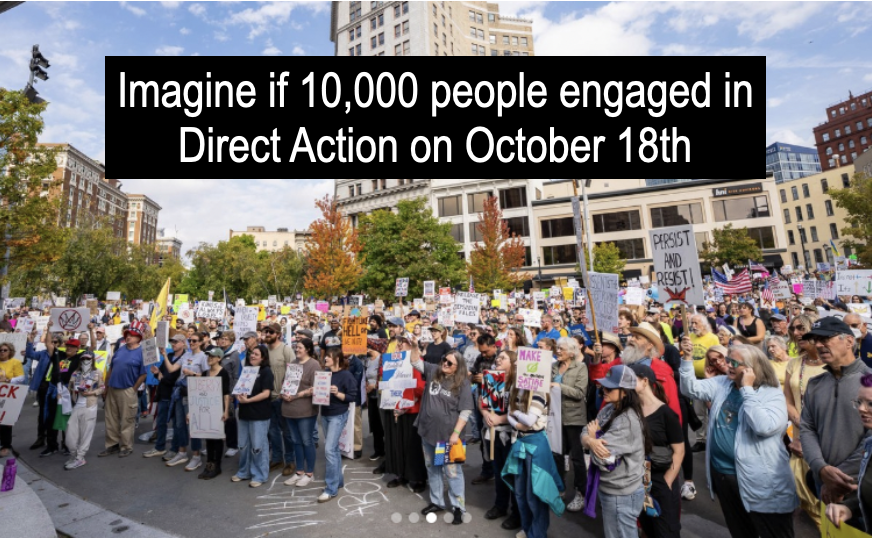
It was reported that at least 10,000 people showed up at the No Kings rally at Rosa Parks Circle. It is always great to see people show up in large numbers, especially in a system that promotes consumerism and politics as a spectator sport. However, imagine what could be done if 10,000 people in Grand Rapids showed up in other ways.
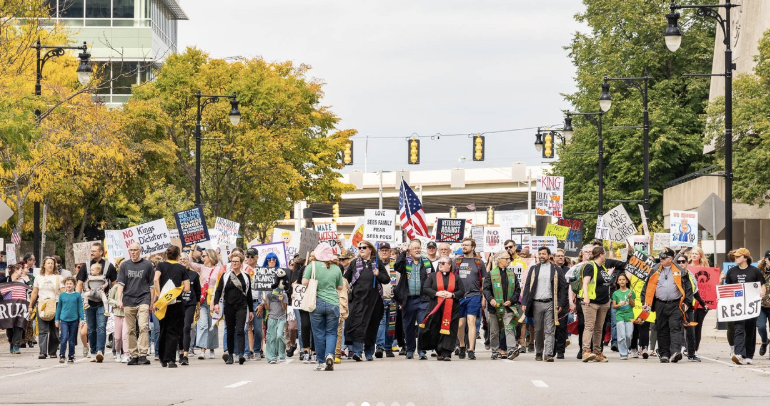
It was lovely to see local clergy lead the march after the rally, but it would be even more amazing if the congregations that they are part of would declare themselves sanctuary spaces for undocumented immigrants and commit to providing material and financial support to families that have been separated by ICE. It would also be great if local clergy/congregations would commit to never collaborating with the GRPD or any cops, condemn the economic system of Capitalism, denounce systemic racism in Grand Rapids, practice trans justice and climate justice and commit to actively opposing US Imperialism and the US role in funding genocide in Gaza.
- Imagine if the 10,000 people that came would all have donate $5. That would translate into $50,000 for Mutual Aid support to immigrant families affected by ICE terrorism, or people who need rent assistance or to post bond for people in the Kent County jail so they didn’t have to be locked up until their court dates, or to fund places like SECOM allowing them to provide a shit ton of food assistance right now.
- Imagine if 10,000 showed up to demand that the City and County adopt the sanctuary policies that Cosecha was been demanding since January.
- Imagine if 10,000 people took over the DeVos family headquarters on the corner of Monroe and Lyon and demand they pay reparations for the all the heinous shit they have done over the decades – all the anti-trans, anti-union, anti-public education, shit they have done. We could make them give back the $565 million they got in public subsidies for the Three Towers project they are getting ready to build, how they fleeced the public for millions more with the Amphitheater and the Soccer stadium. Imagine the wealthiest family crapping in their pants as we took over their space and made them pay reparations.
- Imagine if 10,000 people showed up to take over the federal building and demand that Senators Slotkin and Peters, along with Rep. Scholten end their votes for funding Israel and their genocide, stop voting for nearly a trillion dollars annually to fund the US military and make them redirect our money towards housing, healthcare and mass transit.
This is what radical imagination looks like. The possibilities are endless, if we would just realize the collective power we have. This is what scares the shit out of those in power, way more than voting, rallies or people holding signs. Direct Action is what they fear.

