Action Alert: Contact Gov. Snyder’s office in solidarity with immigrants
Nearly, two weeks ago, we were in Lansing for a pro-immigration rally, where people confronted the state government on its policy of not offering drivers licenses some immigrants.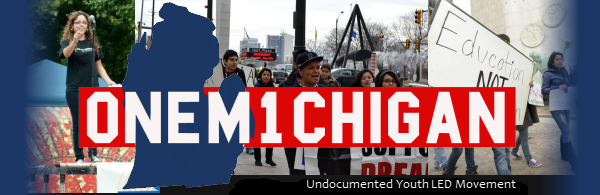
Someone from Governor Snyder’s office agreed to meet with a delegation this Wednesday to hear their stories and talk about the anti-immigration policy.
In Today’s Detroit Free Press Governor Snyder’s office is quoted in a article stating the following:
Snyder agrees with Johnson’s decision, spokeswoman Sara Wurfel said.”Both U.S. Customs and  Immigration Services and Homeland Security have made it clear that ‘deferred action’ is not legal status,” Wurfel said. And, she said, decisions on licenses are “under the purview and jurisdiction of the SOS” since the secretary is a “separate statewide elected constitutional officer.”
Tomorrow a coalition of organizations will be meeting with Gov. Snyder’s Chief of Staff and there is at least one busload from Grand Rapids to support that delegation.
Groups like One Michigan are asking people to call Snyder’s office and let him know now that Ruth Johnson’s policy is not how you welcome immigrants!
CALL 1-877-677-2122
Justice for Immigrants!
“Flatten” Gaza like Hiroshima and “mow” the population, Israeli public figures urge
This article by Ali Abunimah is re-posted from Electronic Intifada.

Among the latest horrifying examples of incitement to mass murder by Israeli public figures, Gilad Sharon, the son of former prime minister and notorious war criminal Ariel Sharon, has called for the Israeli army to “flatten” Gaza as the US flattened the Japanese city of Hiroshima in 1945 with an atomic bomb.
“The residents of Gaza are not innocent, they elected Hamas. The Gazans aren’t hostages; they chose this freely, and must live with the consequences,” wrote Sharon in the extremist publication The Jerusalem Post. Sharon elaborated:
We need to flatten entire neighborhoods in Gaza. Flatten all of Gaza. The Americans didn’t stop with Hiroshima – the Japanese weren’t surrendering fast enough, so they hit Nagasaki, too.
There should be no electricity in Gaza, no gasoline or moving vehicles, nothing. Then they’d really call for a ceasefire.
Were this to happen, the images from Gaza might be unpleasant – but victory would be swift, and the lives of our soldiers and civilians spared.
Sharon added that “There is no middle path here – either the Gazans and their infrastructure are made to pay the price, or we reoccupy the entire Gaza Strip.”
As of Sunday night, the end of the fifth day of Israel’s air assault on Gaza, more than 70 Palestinians, half of them civilians, had been killed in hundreds of Israeli airstrikes.
“Don’t give a hoot about Goldstone”
Meanwhile in a message to soldiers, Knesset member Michael Ben-Ari of the National Union party exhorted soldiers to kill without thought or mercy.
“Brothers! Beloved soldiers and commanders – preserve your lives! Don’t give a hoot about Goldstone! There are no innocents in Gaza, don’t let any diplomats who want to look good in the world endanger your lives[;] at any tiniest concern for your lives – Mow them!,” Ben-Ari was quoted as saying by the website HaKol HaYehudi.
Ben-Ari was referring to the UN-commissioned Goldstone report that documented war crimes and crimes against humanity during Israel’s 2008-2009 invasion of Gaza which left more than 1,400 Palestinians, mostly civilians, dead.
“We love you alive and smiling, not, heaven forefend, ‘just’ and dead in Gaza – Sodom [-] there are no righteous men, turn it into rubble. Paint it red! We are worried about you and rely on you. We all do, all of the Nation of Israel,” Ben-Ari added.
The phrase “the Nation of Israel” refers to all members of the Jewish religion, not to citizens of the State Israel, notes Dena Shunra who translated Ben-Ari’s comments.
On 15 November, the second day of an Israeli assault, Ben-Ari addressed a hate rally in Tel Aviv, calling for more bloodshed in Gaza. New video of that rally, which this blog reported on previously, shows Ben-Ari in action.
Ben-Ari is also notorious for his incitement against Africans and for his hatred of Christians. In July he tore up a New Testament, calling it “abominable” and threw it in the trash.
Read more examples of incitement to violence by Israeli public figures, for example the prominent rabbi who says the Israeli army “must learn from the Syrians how to slaughter the enemy.”
All of these inciters will no doubt be pleased that in the bloodiest attack of Israel’s assault so far, 11 Palestinians from a single family, including four young children and an 81-year-old woman, were killed on Sunday when an Israeli bomb flattened their home.
subMedia: Anarchy in the USA
This video by subMedia is re-posted from Dissident Voice.
1. 4 year hopium dose

2. I have a drone!
3. Foreclosure defense in Colorado
4. U.N. out of Haiti
5. Netanyahu: The butcher of Jerusalem
6. Bob Ross to the rescue.
7. Anarchy in Europe
8. P.O.S. fuck your stuff
9. Mutual Aid
Walton Family Greenwashing
This article by Dan Bacher is re-posted from CounterPunch.
Much recent media attention has focused on Walmart’s announcement that it is canceling Thanksgiving plans for many of its employees. These workers will now have to work on the holiday as the retail giant kicks off its holiday sale at 8 p.m. on Thanksgiving Day, rather than waiting until midnight on “Black Friday.”
“The result is troubling for advocates for workers’ rights, as Walmart has encroached repeatedly on a holiday that traditionally involves plenty of time spent with family and away from work,” according to a statement from the Corporate Action Network. “The decision to move up the start of Black Friday sales to Thursday could be an attempt to thwart the workers’ organization efforts scheduled for Black Friday.
Labor, social justice and human rights groups are supporting a nationwide boycott of Walmart on Black Friday to back the strike of Walmart workers that day.
However, less well known to the public is Walmart’s ambitious campaign of corporate greenwashing in recent years.
The Walton Family Foundation proudly reported “investments” totaling more than $71.4 million in “environmental initiatives” in 2011, including contributions to corporate “environmental” NGOs pushing ocean privatization through the “catch shares” programs and so-called “marine protected areas” like those created under Arnold Schwarzenegger’s Marine Life Protection Act (MLPA) Initiative.
According to a press release from the Walmart Headquarters in Bentonville Arkansas, the foundation made grants to more than 160 organizations in the U.S. and other countries “that work to protect natural resources while strengthening the local economies that depend on them.”
The foundation directed an overwhelming majority of the grants toward its two core environmental initiatives – “Freshwater Conservation and Marine Conservation.”
“Our work is rooted in our belief that the conservation solutions that last are the ones that make economic sense,” claimed Scott Burns, director of the foundation’s Environment Focus Area. “The foundation and our grantees embrace ‘conservationomics’ – the idea that conservation efforts can and should bring economic prosperity to local communities.”
The foundation donated $30.5 million to Marine Conservation, $26,842,289 to Freshwater Conservation and $14,022,907 for “Other Environment Grants”
The Top Five Grantees were Conservation International, $16,208,278; Environmental Defense Fund, $13,683,709; the Marine Stewardship Council $3,122,500; Nature Conservancy $3,024,539, and the National Audubon Society, $2,739,859.
Conservation International features Walton and Stewart Resnick on Board
Conservation International, the top recipient with $16,208,278, is an organization noted for its top-down approach to conservation and involvement with corporate greenwashing.
The Walton Foundation press release claimed that, “Conservation International continued to implement a three-year program to empower local communities to manage and conserve fishing resources on Costa Rica’s Pacific Coast.”
However, the group’s board features some of the most controversial corporate leaders on the planet, including Rob Walton and Stewart Resnick.
Rob Walton, Walmart Chairman, serves as the Chairman of the Executive Committee of Conservation International. Serving with him on Conservation International’s Board of Directors is Stewart Resnick, the owner of Paramount Farms.
Resnick has been instrumental in campaigns to build the peripheral canal to increase water exports to agribusiness and Southern California, to eviscerate Endangered Species Act protections for Central Valley Chinook salmon and Delta smelt and to eradicate striped bass in California. The Center for Investigative Reporting describes Resnick as a “Corporate Farming Billionaire and One-Man Environmental Wrecking Crew.”
Resnick is notorious for buying subsidized Delta water and then selling it back to the public for a big profit, as revealed in an article by Mike Taugher in the Contra Costa Times on May 23, 2009.
“As the West Coast’s largest estuary plunged to the brink of collapse from 2000 to 2007, state water officials pumped unprecedented amounts of water out of the Delta only to effectively buy some of it back at taxpayer expense for a failed environmental protection plan, a MediaNews investigation has found,” said Taugher.
Taugher said the “environmental water account” set up in 2000 to “improve” the Delta ecosystem spent nearly $200 million mostly to benefit water users while also creating a “cash stream for private landowners and water agencies in the Bakersfield area.”
“No one appears to have benefitted more than companies owned or controlled by Stewart Resnick, a Beverly Hills billionaire, philanthropist and major political donor whose companies, including Paramount Farms, own more than 115,000 acres in Kern County,” Taugher stated. “Resnick’s water and farm companies collected about 20 cents of every dollar spent by the program.”
Likewise, the Nature Conservancy, a group that received $3,024,539 from the Walton Family Foundation, in 2011, is also known for its strong support of the Bay Delta Conservation Plan to build the peripheral tunnels that Resnick and other corporate agribusiness interests so avidly support. A broad coalition of fishermen, Indian Tribes, environmentalists, family farmers and elected officials opposes the construction of the tunnels because they would hasten the extinction of Central Valley salmon, Delta smelt, longfin smelt and other species.
Environmental Defense Fund’s drive to privatize fisheries
Environmental Defense Fund, with the second highest donation at $13,683,709, is known for its market-based approach to conservation and its push for “catch shares” that essentially privatize the oceans. The relationship between the group and the retail giant is so close that it operates an office in Bentonville, Arkansas, where Walmart is headquartered.
“Environmental Defense Fund released its ‘Catch Shares Design Manual: A Guide for Fishermen and Managers’ to provide a roadmap to catch share design, which is a focus of our Marine Conservation initiative,” according to the Walton Family Foundation.
A catch share, also known as an individual fishing quota, is a transferable voucher that gives individuals or businesses the ability to access a fixed percentage of the total authorized catch of a particular species.
“Fishery management systems based on catch shares turn a public resource into private property and have lead to socioeconomic and environmental problems. Contrary to arguments by catch share proponents – namely large commercial fishing interests – this management system has exacerbated unsustainable fishing practices,” according to the consumer advocacy group Food & Water Watch.
True to form, Sam Rawlings Walton, the grandson of Wal-Mart founder Sam Walton, serves on the Board of Trustees of EDF.
Times articles put spotlight on Walmart
Two New York Times articles in April 2012 put Walmart and the Walton family’s “dirty laundry” in the international spotlight, leading to a renewed call by the Recreational Fishing Alliance (RFA) for the public to support their boycott of Walmart.
The Times articles covered Walton family support for anti-fishing, pro-privatization efforts in North America, followed by the publication’s exposure of alleged $24 million worth of bribes in Central America to speed up the chain’s expansion into Mexico.
“The headlines prove that Walmart and the Walton Family Foundation are no friends of local communities anywhere, and their ongoing efforts to destroy coastal fishing businesses through support of arbitrary marine reserves and privatization of fish stocks nationwide should not be supported by anglers,” said RFA executive director Jim Donofrio. “We’re asking coastal fishermen who support open access, under the law, to healthy and sustainable fish stocks to send a clear message to this arrogant corporation that we’ve had enough of their greenwashing and grafting efforts.
Donofrio noted that Walmart made world headlines following a New York Times story that charges the Bentonville, Arkansas company and its leaders of squashing an internal investigation into suspected payments of over $24 million in bribes to obtain permits to build in Mexico.
Reporter’s lapse shows complicity of corporate media
The bribery scandal was exposed on the same day that the Gloucester Times of Massachusetts exposed a reporting lapse in another recent New York Times article about the relationship between Environmental Defense Fund (EDF) and Walmart partnering together for “more enlightened and sustainable operations.”
The New York Times had earlier reported that EDF “does not accept contributions from Wal-Mart or other corporations it works for.”
However, when confronted on the fact that the $1.3 billion Walton Family Foundation (started in 1987 by Wal-Mart’s founders, Sam and Helen Walton, and directed presently by the Walton family) has been underwriting EDF’s successful effort to replace the nation’s mostly small-business, owner-operated fishing industry with “a catch shares model designed to cap the number of active fishermen by trading away ownership of the resource to those with the deepest pockets,” the author of the New York Times report conceded by email that in her rush to meet deadlines, she had not considered the relationship between the Walton family and Wal-Mart, according to Donofrio.
“I didn’t think to check the EDF board for Walton family members, or Walton Family Foundation donations,” said reporter Stephanie Clifford, adding “None of the third parties I’d spoken to had mentioned that connection, which isn’t an excuse – I should have thought of it myself, but didn’t.
RFA is hoping that saltwater anglers and fishing business owners help send Walmart stocks tumbling by refusing to shop at the corporate giant any longer.
“The Walton family uses their fortune to buy off friends who’ll cover for their despicable business practices, whether it’s corporate greenwashing with EDF, rebranding efforts through national trade association campaigns, or apparently by way of directed bribes to local officials in other countries,” Donofrio said. “Don’t just stop buying fishing tackle at Wal-Mart – stop supporting this company altogether and let’s quit supporting complete buyouts and takeovers of local communities.”
In August 2011, RFA asked fishermen to publicly boycott Walmart stores following issuance of a news release from Wal-Mart corporate headquarters in Bentonville, Arkansas where the Walton family announced investments totaling more than $71.8 million awarded to various environmental initiatives.
Over $36 million alone was handed over to “Marine Conservation” grantees including the Ocean Conservancy, Conservation International Foundation, Marine Stewardship Council, World Wildlife Fund and EDF. All of these organizations are notorious for their role in corporate greenwashing efforts across the globe.
The RFA pointed out that by contributing over $36 million to NGOs promoting alleged “marine protected areas” like those created under Arnold Schwarzenegger’s Marine Life Protection Act (MLPA) Initiative and catch share programs in 2010, the Waltons were contributing to the demise of sustainable recreational and commercial fisheries and the privatization of the oceans.
Commercial fishermen back boycott
Zeke Grader, executive director of the Pacific Coast Federation of Fishermen’s Associations, supports RFA’s boycott of Walmart.
“People who are concerned about our environment or labor rights should all be boycotting Walmart,” said Grader. “Their polices are clearly intended to commodify our natural resources and put them under the control of large corporations.”
“The Walton Family Foundation is funding the Environmental Defense Fund, which wants to commodify water through water marketing and privatize our fish through catch shares program,” said Grader. “These are tools used by corporations to further the growing disparity between 1 percent and rest of us.”
Frack Fight: A Secret War of Activists — With the World in the Balance
By Ellen Cantarow is re-posted from Tom’s Dispatch.
There’s a war going on that you know nothing about between a coalition of great powers and a small insurgent movement. It’s a secret war being waged in the shadows while you go about your everyday life.
In the end, this conflict may matter more than those in Iraq and Afghanistan ever did. And yet it’s taking place far from newspaper front pages and with hardly a notice on the nightly news. Nor is it being fought in Yemen or Pakistan or Somalia, but in small hamlets in upstate New York. There, a loose network of activists is waging a guerrilla campaign not with improvised explosive devices or rocket-propelled grenades, but with zoning ordinances and petitions.
The weaponry may be humdrum, but the stakes couldn’t be higher. Ultimately, the fate of the planet may hang in the balance.
All summer long, the climate-change nightmares came on fast and furious. Once-fertile swathes of American heartland baked into an aridity reminiscent of sub-Saharan Africa. Hundreds of thousands of fish dead in overheated streams. Six million acres in the West consumed by wildfires. In September, a report commissioned by 20 governments predictedthat as many as 100 million people across the world could die by 2030 if fossil-fuel consumption isn’t reduced. And all of this was before superstorm Sandy wreaked havoc on the New York metropolitan area and the Jersey shore.
Washington’s leadership, when it comes to climate change, is already mired in failure. President Obama permitted oil giant BP to resume drilling in the Gulf of Mexico, while Shell was allowed to begin drilling tests in the Chukchi Sea off Alaska. At the moment, the best hope for placing restraints on climate change lies with grassroots movements.
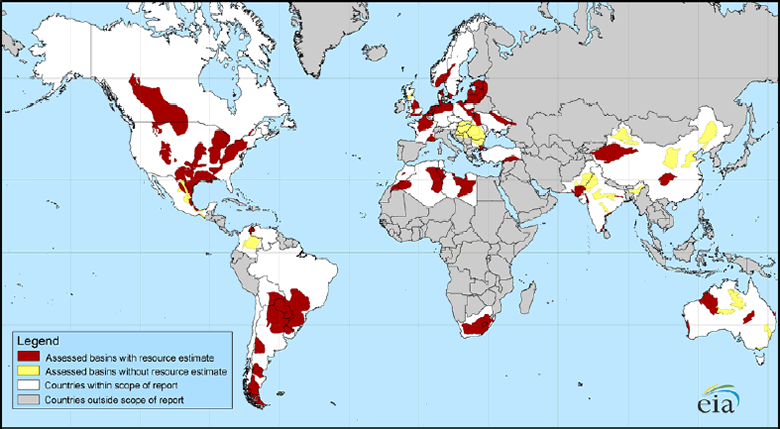
In January, I chronicled upstate New York’s homegrown resistance to high-volume horizontal hydraulic fracturing, an extreme-energy technology that extracts methane (“natural gas”) from the Earth’s deepest regions. Since then, local opposition has continued to face off against the energy industry and state government in a way that may set the tone for the rest of the country in the decades ahead. In small hamlets and tiny towns you’ve never heard of, grassroots activists are making a stand in what could be the beginning of a final showdown for Earth’s future.
Frack Fight 2012
New York isn’t just another state. Its largest city isthe world’s financial capital. Six of its former governors have gone on to the presidency and Governor Andrew Cuomo seems to have his sights set on a run for the White House, possibly in 2016. It also has a history of movements, from abolition and women’s suffrage in the nineteenth century to Occupy in the twenty-first. Its environmental campaigns have included the watershed Storm King Mountain case, in which activists defeated Con Edison’s plan to carve a giant facility into the face of that Hudson River landmark. The decision established the right of anyone to litigate on behalf of the environment.
Today, that activist legacy is evident in a grassroots insurgency in upstate New York, a struggle by ordinary Americans to protect what remains of their democracy and the Earth’s fragile environment from giant corporations intent on wrecking both. On one side stands New York’s anti-fracking community; on the other, the natural gas industry, the state’s Department of Environmental Conservation, and New York’s industry-allied Joint Landowners Coalition.
As for Governor Cuomo, he has managed to anger both sides. He seemed to bow to industry this past June by hinting that he would end a 2010 moratorium on fracking introduced by his predecessor David Paterson and open the state to the process; then, in October, he appeared to retreat after furious protests staged in Washington D.C., as well as Albany, Binghamton, and other upstate towns.
“I have never seen [an environmental movement] spread with such wildfire as this,” says Robert Boyle, a legendary environmental activist and journalist who was central in the Storm King case and founded Riverkeeper, the prototype for all later river-guardian organizations. “It took me 13 or 14 years to get the first Riverkeeper going. Fracking isn’t like that. It’s like lighting a train of powder.”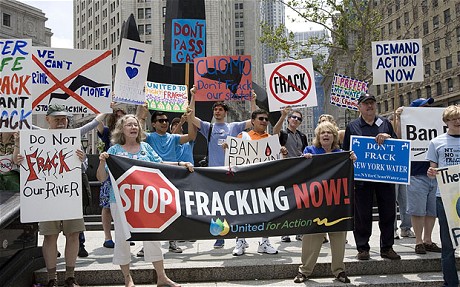
Developed in 2008 and vastly more expansive in its infrastructure than the purely vertical form of fracking invented by Halliburton Corporation in the 1940s, high-volume horizontal hydraulic fracturing is a land-devouring, water-squandering technology with a greenhouse gas footprint greater than that of coal. The process begins by propelling one to nine million gallons of sand-and-chemical-laced water at hyperbaric bomb-like pressures a mile or more beneath Earth’s surface. Most of that fluid stays underground. Of the remainder, next to nothing is ever again available for irrigation or drinking. A recent report by the independent, nonpartisan U.S. Government Accountability Office concluded that fracking poses serious risks to health and the environment.
New York State’s grassroots resistance to fracking began about four years ago around kitchen tables and in living rooms as neighbors started talking about this frightening technology. Shallow drilling for easily obtainable gas had been done for decades in the state, but this gargantuan industrial effort represented something else again.
Anthony Ingraffea of Cornell University’s Department of Engineering, co-author of a study that established the global warming footprint of the industry, calls this new form of fracking an unparalleled danger to the environment and human health. “There’s much more land clearing, much more devastation of forests and fields. . . thousands of miles of pipelines. . . many compressor stations [that] require burning enormous quantities of diesel. . . [emitting] hydrocarbons into the atmosphere.” He adds that it’s a case of “the health of many versus the wealth of a few.”
Against that wealth stands a movement of the 99% — farmers, physicists, journalists, teachers, librarians, innkeepers, brewery owners, and engineers. “In Middlefield we’re nothing special,” says Kelly Branigan, a realtor who last year founded a group called Middlefield Neighbors. “We’re just regular people who got together and learned, and reached in our pockets to go to work on this. It’s inspiring, it’s awesome, and it’s America — its own little revolution.”
Last year, Middlefield became one of New York’s first towns to use the humblest of tools, zoning ordinances, to beat back fracking. Previously, that had seemed like an impossible task for ordinary people. In 1981, the state had exempted gas corporations from New York’s constitutionally guaranteed home rule under which town ordinances trump state law. In 2011, however, Ithaca-based lawyers Helen and David Slottje overturned that gas-cozy law by establishing that, while the state regulates industry, towns can use their zoning powers to keep it out. Since then, a cascade of bans and moratoria — more than 140 in all — have protected towns all over New York from high-volume frack drilling.
This Is What Democracy Looks Like
Caroline, a small hamlet in Tompkins County (population 3,282), is the second town in the state to get 100% of its electricity through wind power and one of the most recent to pass a fracking ban. Its residents typify the grassroots resistance of upstate New York.
“I’m very skeptical that multinational corporations have the best interests of communities at heart,” Don Barber, Caroline’s Supervisor, told me recently. “The federal government sold [Americans] out when they exempted fracking from the Clean Water and Air Acts,” he added. “Federal and state governments are not advocating for the civil society. There’s only one level left. That’s the local government, and it puts a tremendous load on our shoulders.”
Caroline’s Deputy Supervisor, Dominic Frongillo, sees local resistance in global terms. “We’re unexpectedly finding ourselves in the ground zero for climate change,” he says. “It used to be somewhere else, mountaintop removal in West Virginia, deep-sea drilling in the Gulf of Mexico, tar sands in Alberta, Canada. But now…it’s right here under our feet in upstate New York. The line is drawn here. We can’t keep escaping the fossil fuel industry. You can’t move other places, you just have to dig in where you are.”
Two years of pre-ban work in Caroline included an election that replaced pro-drilling members of the town board with fracking opponents, public education forums, and a six-month petition drive. “We knocked on every single door two or three times,” recalls Bill Podulka, a retired physicist who co-founded the town’s resistance organization, ROUSE (Residents Opposed to Unsafe Shale Gas Extraction). “Many people were opposed to gas-drilling but were afraid to speak out, not realizing that the folks concerned were a silent majority.” In the end, 71% of those approached signed the petition, which requested a ban.
On September 11th, a final debate between drilling opponents and proponents took place, after which Barber called for the vote. A ban was overwhelmingly endorsed. “For the first time,” he told the crowd gathered in Caroline’s white clapboard town hall, “I will be voting to change the balance of rights between individuals and civil society. This is because of the impacts of fracking on health and the environment. And the majority of our citizens have voted to pass the ban.” The board then ruled 4 to 1 in favor.
Stealth Invasion
About a year and a half ago, as Caroline and other towns were moving to protect their land from the industry, XTO, a subsidiary of Exxon-Mobil Corporation, began preparing for a possible fracking future in the state. It eyed tree-shaded, Oquaga Creek, a trout-laden Delaware tributary in upper New York State’s Sanford County, leased the land, and applied to the Delaware River Basin Commission (DRBC) for a water-withdrawal permit. XTO required, it said, a quarter of a million gallons of water from the creek every day for its hydraulic fracturing operations.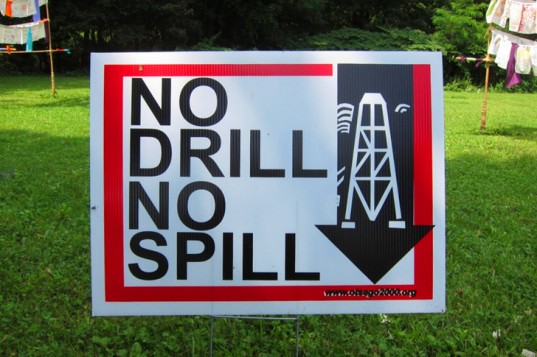
Delaware Riverkeeper, an environmental organization, found out about the XTO application and spread the word. Within days, the DRBC received 7,900 letters of outrage. On June 1, 2011, hundreds of citizens, organized by grassroots anti-frackers, packed a hearing in Deposit, a village in Sanford Township that lies at the confluence of the creek and the western branch of the Delaware River. Only two people spoke at the meeting in favor of XTO. One was the Supervisor (mayor) of Sanford, Dewey Decker. He applauded the XTO application and denounced protestors as “outsiders.” He is among a group of landowners who have leased land to XTO for hundreds of millions of dollars. (Decker refused to be interviewed for this article.) The rest of the crowd spoke up for the creek, its fish, and its wildlife. The Delaware River Basin Commission indefinitely tabled the XTO application.
While a grassroots victory, the episode also served as a warning about how determined the industry is to move forward with fracking plans despite the state-enforced moratorium still in place. As a result, Caroline and other towns are continuing to develop local anti-fracking measures, since they know that the 2010 ban on the process will end whenever Governor Cuomo okays rules currently being written by the Department of Environmental Conservation (DEC).
When it comes to those rules and fracking more generally, the DEC has a conflict of interest. While it is supposed to protect the environment, it is also tasked with regulating the very industries that exploit it through the agency’s Mineral Resources Division. Last year, the DEC received over 80,000 written comments on the latest draft of its guidelines for the industry, the 1,500-page “SGEIS” (which stands for “Supplemental Generic Environmental Impact Statement”). Drilling opponents outnumbered proponents 10 to 1. The deluge was a record in the agency’s history.
Activists weren’t the only ones with a keen interest in the SGEIS, however. Documents obtained through New York’s Freedom of Information Law indicate that, in mid-August 2011, six weeks before the DEC made its statement public, the agency shared detailed summaries of it with gas corporation representatives, giving the industry a chance to influence the final document before it went public.
Two days before the SGEIS was opened to public scrutiny, an attorney for the Oklahoma-based Chesapeake Energy Corporation and other companies asked regulators to “reduce or eliminate” a requirement for the sophisticated testing of fracking fluids. Such fluids are laden with toxins, including carcinogens, which storms could wash away from drilling sites — an especially grim prospect given the catastrophic flooding experienced in the state over the last three years.
At the same time, two upstate New York journalists revealed that Bradley Field, the head of the DEC’s Mineral Resources Division, had signed a petition that denied the existence of climate change. Formerly of Getty Oil and Marathon Oil, Field also serves as the state’s representative to the Interstate Oil and Gas Compact Commission and the Ground Water Protection Council, both industry fronts which maintain that fracking is benign. As this was coming to light, state officialsanonymously leaked word of a plan to open five counties on New York’s border with Pennsylvania to fracking as long as communities there supported the technology.
This is What Autocracy Looks Like
In May 2012, Dewey Decker and his board passed a resolution pledging thatthe town of Sanford would take no action against fracking, while awaiting the decision of the DEC. There was no prior notice. Citizens were left to read about it in their local papers. “You wake up the next morning and say, ‘What happened?’” commented Doug Vitarious, a retired Sanford elementary school teacher.
In June, a headline in the Deposit Courier, a Sanford paper, read “Local Officials in Eligible Communities Approve Pro-Drilling Resolutions.” Accompanying the piece was a map of towns that had passed such resolutions. The subscript under the map read: “Joint Landowners Coalition of N.Y.” The JLCNY is the state’s grassroots gas industry ally, whose stated mission is to “foster… the common interest… as it pertains to natural gas development.” Decker represents the organization in Sanford.
During the summer, Vitarious and other citizens asked their town board where the resolution had originated, but were met with silence. They requested that the board rescind the resolution and conduct a referendum. Decker refused.
By the end of August, 43 towns in the region had passed resolutions modeled on one appearing at the JLCNY website. It stipulates that at the local level “no moratorium on hydraulic fracturing will be put in place before the state of New York has made it’s [sic] decision.” Under New York’s Freedom of Information Law, Catskill Citizens for Safe Energy and the National Resources Defense Council obtained records from Sanford and two other towns about howthey achieved their objectives. The records, says Bruce Ferguson of Catskill Citizens for Safe Energy, “detail contacts between gas industry operatives and officials.”
Two months before superstorm Sandy swamped parts of the state, Sue Rapp, a psychotherapist fromthetown of Vestal, told me that flooding worries her as much as anything else about fracking. Upper New York State suffered flooding in 2010 and 2011. And then came Sandy. Floods turn millions of gallons of fracking waste-water for which there is no safe storage into streams of poisons that wash into waterways.
Unlike Sanford’s board, Vestal’s has not formally blocked debate. It has heard arguments for a moratorium by Rapp and an organization she co-founded, Vestal Residents for Safe Energy (VERSE), as well as pleas for a moratorium by physicians and academics. Its reaction, however, has simply been to sit on its hands, waiting for the DEC and Cuomo to make a final decision. This amounts to adopting the JLCNY position in all but formal vote. “What is happening?” asked Rapp rhetorically at a demonstration in Binghamton this past September. “They are trying to shut us down. But we do vote and we will vote. We do not constitute [what pro-drillers call] the tyranny of the majority, but simply the majority. That is called democracy.”
Demonstrations against Cuomo’s frack plan, which drew thousands to Washington D.C., Albany, and elsewhere in New York, included pledges to commit sustained acts of civil disobedience should the governor carry out plans to open the Pennsylvania border area of the state to fracking. At the end of September, the New York Times announced that Cuomo had retreated from his June stance. The report credited the state’s grassroots movement for his change of mind. Legendary for his toughness and political smarts, the governor will confront a political challenge in the coming months. Either he will please gas-industry supporters or his Democratic base. Whichever way he goes, it could affect his chances for the White House.
The stakes, however, are far larger than Cuomo’s presidential aspirations. Opening any part of the state to fracking will certainly damage the local environment. More importantly, a grassroots win in New York State could open the door to a nationwide anti-fracking surge. A loss might, in the long run, result ina cascade of environmental degradation beyond the planet’s ability to cope. As unlikely as it sounds, the fate of the Earth may rest with the residents of Middlefield, Caroline, Vestal, and scores of tiny villages and small towns you’ve never heard of.
“All eyes are on New York,” says Chris Burger, a former Broome County legislator and one of a small group who persuaded New York’s last governor, David Paterson, to pass the state’s moratorium on fracking. “This is the biggest environmental issue New York has ever faced [and not just] New York, the nation, and the world. If it’s going to be stopped, it will be stopped here.”
A Palestinian BDS Campaign for Grand Rapids
Yesterday, we posted a piece on the importance of showing solidarity with the people of Gaza, by participating in the Palestinian Boycott, Divestment (BDS) and Sanctions Campaign against Israel.
We have also posted in the past stories about the multinational company Veolia as being one of the major companies being targeted by the BDS Campaign and that Veolia operates in Grand Rapids.
Veolia is currently being targeted by numerous solidarity groups because of a contract they have with the State of Israel for a light rail system. This light rail system supports Israeli Apartheid, mostly because it only provides transportation for Israelis and is designed to compliment the Israeli Separation Wall, which has been condemned by human rights groups around the world.
There are two campaigns that could be conducted in Grand Rapids
First, the City of Grand Rapids contracts with Veolia, which runs the steam-heating system for much of the downtown area. Veolia Energy serves the business district with centrally-produced steam. Customers include: hospitals; college campuses; sports arena and exhibition center; prestigious office buildings and retail store fronts; city, state and county government facilities; private apartment buildings and arts and culture centers.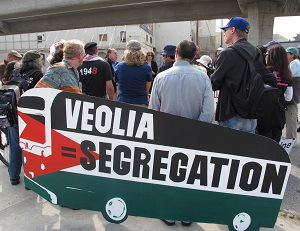
People could organize a campaign to get the City of Grand Rapids to discontinue that contract with Veolia, since Veolia profits from the Israeli occupation of Palestinian land. One could also argue that this would not be an unprecedented move, since the City of Grand Rapids participated in a Divestment Campaign in the 1980s and removed its money from Old Kent Bank, which was doing business in Apartheid South Africa.
Second, Veolia’s downtown heating system also has a contract with GVSU to heat their downtown campus. In this case, a student, faculty or staff association could begin a campaign to get the University to end that contract and join dozens of other campuses across the country who are participating in the Palestinian BDS Campaign against Israel.
Anyone interested in either campaign, please let us know as we will help publicize such a campaign and take part in it as a demonstration of solidarity with the people of Gaza.
Palestinian campaign: show solidarity with Gaza by boycotting Israel
This article is re-posted from Electronic Intifada.
Today, the Palestinian Boycott Divestment and Sanctions National Committee (BNC) released this statement, emphasizing the importance of the BDS campaign now, more than ever.
The BNC says of Israel’s latest murderous attack on Gaza that “Israel will continue its belligerence and state terrorism unless it is made to pay a heavy price for its crimes against the Palestinian, Lebanese and other Arab peoples.” The statement gives five major ways you can contribute to increasing the global popular pressure on Israel to desist from its war crimes, aggression and apartheid, citing many specific examples.
Full statement
Five ways to effectively support Gaza through Boycotts, Divestment and Sanctions
As this new aggression on the people of Gaza shows, Israel will continue its belligerence and state terrorism unless it is made to pay a heavy price for its crimes against the Palestinian, Lebanese and other Arab peoples.
Palestinian civil society has called for a campaign of boycott, divestment and sanctions (BDS) as the most effective way for international civil society and people of conscience around the world to show solidarity with the Palestinian struggle and hold Israel – and all complicit institutions — accountable for its occupation, colonization and apartheid. The global, Palestinian-led BDS movement has achieved inspiring and spectacular success, causing economic damage to companies that support Israel’s crimes, persuading artists not to perform in Israel, winning support from major churches, trade unions and social movements, as well as pressuring governments to take action.
Here are five BDS ways to effectively express solidarity with the Palestinian people in Gaza and elsewhere:
1. Boycott Israel! Don’t buy Israeli goods!
Profits from exports from Israel help to fund the Israeli government and its crimes against the Palestinian people. Refuse to buy Israeli goods and tell retailers that you are doing it. Persuade friends and family to stop buying any Israeli products too!
Brands to avoid include Ahava, Jaffa oranges, Sabra and Tribe hummus and SodaStream.
2. Join an active BDS campaign or start a new one
Initiate action in your institution, union, group, etc., against the companies and organisations that support and profit from Israel’s system of oppression over the Palestinian people.
For example, in the US, campaigners have pressured major pension funds to divest from Caterpillar, a company that provides bulldozers used to destroy Palestinian homes.
Public bodies across the world have been successfully pressured to stop awarding contracts for public services to Veolia, a company that provides infrastructure to illegal Israeli settlements. Veolia has lost contracts worth more than $14bn following BDS campaigns.
Campaigners recently persuaded a major bank to divest from G4S, a private security firm involved in Israel’s crimes against Palestinian prisoners, including children.
You can find out more about campaigns taking place in your area by contacting your local Palestine solidarity organisation. There’s a great online database of Palestine solidarity groups here or contact us for advice on whom to contact or on how to start a new BDS campaign.
3. Organise a BDS protest action
Demonstrations, banner drops and flashmobs are great ways to raise awareness of the boycott of Israel. Some actions target particular products, like the actions against Israeli cosmetics company Ahava, while others take place in supermarkets and remind shoppers not to buy Israeli goods or to target complicit companies.
There’s a useful guide to planning a BDS action here. The guide is written specifically for the Ahava campaign, but it’s full of useful ideas for similar campaigns too.
4. Urge organisations that you are a member of to divest from Israel
Trade unions, student unions, faith groups and other organisations all over the world have passed BDS-related resolutions calling for divesting from companies profiting from Israel’s occupation.
The US Quakers’ investment entity recently sold its shares in Hewlett Packard and Veolia, two companies supporting and profiting from Israeli violations of international law, after having divested from Caterpillar a few months ago for the same reasons.
Student unions around the world have voted to support divestment and have successfully campaigned to have companies like Sabra Hummus and Eden Springs removed from their campuses.
Trade unions can participate in BDS campaigns and sell any investments they may hold in Israeli companies or raise rank-and-file awareness about Israeli products to boycott.
Ask organisations that you’re a member of to hold a meeting to discuss education about and support for the BDS campaign, and find out if it’s possible to pass a resolution to support BDS when the time is right.
5. Pressure your elected officials to impose a military embargo on Israel
Military ties with Israel feed and encourage further Israeli violence. Israel wouldn’t be able to maintain its occupation and apartheid system over the Palestinian people if it wasn’t for the military aid it receives from the US or the military trade it conducts with countries around the world. Urge your government and elected representatives to support a military embargo on Israel.
This article by Kathleen Miles is re-posted from ZNet.
Black Friday, the day after Thanksgiving regarded as one of the biggest shopping days of the year, may be dramatically different this year.
Organizers are planning a nationwide strike against Walmart, the largest retailer in the world, and are banking on a new strategy: online organizing.
Labor organizers are working with social action nonprofit Engage Network as well as corporate watchdog nonprofit Corporate Action Network to pull off what they are calling a “viral” — meaning national and spreading online — strike.
Walmart workers interested in joining the day of action are directed to this website, either to find a store near them with an organized strike or to “adopt an event” at a store near them.
Brian Young, cofounder of the Corporate Action Network, said on a conference call coordinated by the United Food and Commercial Workers (UFCW) union Thursday, that organizers cannot cover the roughly 4,000 Walmarts across the country, but enabling self-appointed leaders online has widened and decentralized the campaign.
Supporters can also sponsor a striking worker, who may be losing wages in order to strike, by donating grocery gift cards. The campaign has raised more than $13,500worth of donations toward grocery gift cards since Oct. 15 — a figure that doesn’t include significant funds raised through mailed-in checks, Jamie Way, of the UFCW, told HuffPost.
The campaign is also mobilizing strikers and supporters through a Facebook app,multiple Facebook pages, a Tumblr and Twitter with the hashtag #walmartstrikers.
“This online mobilization, in addition to traditional on-the-ground organizing, has allowed the campaign to reach into the rural corners of the country that might have otherwise been overlooked,” Marianne Manilov, cofounder of the Engage Network, said on the conference call.
She pointed to a group of renegade workers in Oklahoma who mobilized in October. “A completely unorganized set of workers in Oklahomaspontaneously went out on strike and held their own type of action without any organizer or … connection with the broader organization,” she said. “This is what organizing looks like in the age of Occupy.”
The outreach leading up to Black Friday follows a series of unprecedented actions taken by Walmart workers against their employer and working conditions. In October, for the first time in the company’s 50-year history, more than 70 workers at multiple Los Angeles-area Walmart stores walked off the job, even though their jobs are not protected by an official union. The strike had a ripple effect, causing strikes in 12 other cities, in large part through online organizing.
The success of these strikes, as well as one over the summer touted as the largest ever protest against the company, and a six-day pilgrimmage of warehouse workers in September, would not have been possible without Facebook, Twitter and other web sites, Young said.
“Making Change at Walmart,” which organized the demonstrations and is a campaign affiliated with the UFCW union, has over 25,000 supporters on Facebook.
Although it does not officially represent Walmart workers, OUR Walmart, organized by the Making Change campaign, acts like a union to fight for the rights of Walmart workers. OUR Walmart, which was founded last year with 100 members, now hasover 14,000 supporters on Facebook.
Corey Parker, a Walmart worker from Mississippi, said on the conference call that he became active with OUR Walmart after finding out about it through a HuffPost article on Facebook. Now, he has mobilized workers at his store to strike on Black Friday because, he said, he realized that “not being able to make a living was not just an issue at my store.”
Adding fuel to movement, Walmart announced Thursday that it will kick off its Black Friday sale at 8 p.m. on Thanksgiving, its earliest start ever.
“Lots and lots of Walmart workers are going to be forced to not have Thanksgiving because they’re going to be preparing all day for the busiest shopping day of the year,” Dan Schlademan, director of Making Change at Walmart, said on the conference call. “This essentially cancels Thanksgiving for hundreds of thousands of workers.”
“It’s not like Walmart is financially hurting. It’s not like they’re not making unbelievable sums of money. The price of this is really decimating an important family day in our country.”
But Walmart spokesman Steven Restivo said of the sale, “Last year, our highest customer traffic was during the 10 p.m. hour and, according to the National Retail Federation, Thanksgiving night shopping has surged over the past three years.”
“Most of our stores are open 24 hours and, historically, much of our Black Friday preparations have been done on Thanksgiving, which is not unusual in the retail industry,” he said, adding that the strikes planned for Black Friday, will not “have any impact on our business.”
Regarding the action over the last few months, Restivo said, “While the opinions expressed by this group don’t represent the views of the vast majority of more than 1.3 million Walmart associates in the U.S., when our associates bring forward concerns, we listen.”
In September, dozens of Walmart-contracted warehouse workers in Southern California’s Inland Empire walked off the job and went on a six-day, 50-mile pilgrimage to protest working conditions and retaliation for speaking up.
More than a month later, the warehouse company NFI responded to some of the strikers’ working condition requests. “Just in the last week, we’ve seen the warehouse operators scrambling to replace broken and unsafe equipment, they’ve rented fans to increase ventilation, and they’ve added more water coolers,” Elizabeth Brennan, communications director for Warehouse Workers United, said on the conference call.
However, the strikers who returned to work have continued to face retaliation, many times getting their hours cut from 35 down to eight, she said. Some of these warehouse workers will join striking Walmart workers on Black Friday, Brennan said.
Excluding the retaliation, organizers hope to see that type of positive response after Black Friday. And with an online system open to anyone who wants to start a strike in his or her local Walmart, Manilov hopes both the demonstration and response will be broad-reaching.
“This is one of the first labor campaigns to really fully embrace the potential of online-to-offline labor organizing,” she said. “As this captures fire, its potential is limitless.”
The Obama administration’s unstinting financial, military and diplomatic support for Israel is a key enabling force in the conflict
This article by Glen Greenwald is re-posted from Common Dreams.
A central premise of US media coverage of the Israeli attack on Gaza – beyond the fact that Israel is justifiably “defending itself” – is that this is some endless conflict between two foreign entitles, and Americans can simply sit by helplessly and lament the tragedy of it all. The reality is precisely the opposite: Israeli aggression is possible only because of direct, affirmative, unstinting US diplomatic, financial and military support for Israel and everything it does. This self-flattering depiction of the US as uninvolved, neutral party is the worst media fiction since TV news personalities covered the Arab Spring by pretending that the US is and long has been on the side of the heroic democratic protesters, rather than the key force that spent decades propping up the tyrannies they were fighting.
Literally each day since the latest attacks began, the Obama administration has expressed its unqualified support for Israel’s behavior. Just two days before the latest Israeli air attacks began, Obama told Palestinian Prime Minister Mahmud Abbas “that his administration opposes a Palestinian bid for non-state membership of the UN”. Both the US Senate and House have already passed resolutions unequivocally supporting Israel, thus earning the ultimate DC reward: the head-pat from AIPAC, which “praised the extraordinary show of support by the Senate for Israel’s struggle against terrorist attacks on its citizens”. More bipartisan Congressional cheerleading is certain to come as the attacks continue, no matter how much more brutal they become.
In reflexive defense of Israel, the US government thus once against put itself squarely at odds with key nations such as Turkey (whose prime minister accused Israel of being motivated by elections and demanded that Israel be “held to account” for mounting civilians deaths), Egypt (which denounced Israeli attacks as “aggression against humanity”), and Tunisia (which called on the world to “stop the blatant aggression” of Israel).
By rather stark contrast, Obama continues to defend Israel’s free hand in Gaza, causing commentators like Jeffrey Goldberg to gloat, not inaccurately: “Barack Obama hasn’t turned against Israel. This is a big surprise to everyone who has not paid attention for the last four years” (indeed, there are few more compelling signs of how dumb and misleading US elections are than the fact that the only criticism of Obama on Israel heard over the last year in the two-party debate was the grievance that Obama evinces insufficient fealty – rather than excessive fealty – to the Israeli government). That the Netanyahu government knows that any attempt to condemn Israel at the UN would be instantly blocked by the US is a major factor enabling them to continue however they wish. And, of course, the bombs, planes and tanks they are using are subsidized, in substantial part, by the US taxpayer.
If one wants to defend US support for Israel on the merits – on the ground that this escalating Israeli aggression against a helpless population is just and warranted – then one should do so. As I wrote on Thursday, it’s very difficult to see how those who have cheered for Obama’s foreign policy could do anything but cheer for Israeli militarism, as they are grounded in the same premises.
But pretending that the US – and the Obama administration – bear no responsibility for what is taking place is sheer self-delusion, total fiction. It has long been the case that the central enabling fact in Israeli lawlessness and aggression is blind US support, and that continues, more than ever, to be the case under the presidency of the 2009 Nobel Peace Prize winner.
The US is not some neutral, uninvolved party. Whatever side of this conflict you want to defend – or if you’re one of those people who love to announce that you just wish the whole thing would go away – it’s still necessary to take responsibility for the key role played by the American government and this administration in enabling everything that is taking place.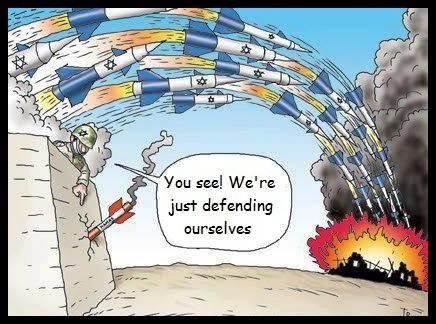
Media coverage
Due to extensive travel the past few days, I’ve been subjected to far more television news coverage than is probably healthy, and it’s just been staggering to see how tilted US media discourse is: Israeli officials and pro-Israel “experts” are endlessly paraded across the screen while Palestinian voices are exceedingly rare; the fact of the 45-year-old brutal occupation and ongoing Israeli dominion over Gaza is barely mentioned; meanwhile, every primitive rocket that falls harmlessly near Israeli soil is trumpeted with screaming headlines while the carnage and terror in Gaza is mentioned, if at all, as an afterthought. Two cartoons perfectly summarize this coverage: here and here.
Israeli officials use fake graphic to justify bombing Gaza hospitals
This article by Ali Abunimah is re-posted from Electronic Intifada.

As Israel steps up its targeting of civilian infrastructure in the Gaza Strip on the fourth day of an assault that began when it violated a truce on 14 November, Israeli officials are distributing a graphic that appears intended to justify in advance the bombing of Gaza hospitals and health facilities.
The graphic published by the Israeli army is a fake hospital sign that purports to show that Hamas leaders hide under hospitals and stockpile weapons there.
Ofir Gendelman, an official spokesman for the Israeli prime minister tweeted the same image in Arabic.

Israeli attacks on hospitals during “Cast Lead”
During “Operation Cast Lead,” its savage 2008-2009 assault on Gaza, Israel carried out widespread attacks on hospitals and health facilities. As a 2009 report by European develoment and rights organizations noted:
A World Health Organization (WHO) assessment of 122 health facilities in Gaza revealed that 48% were damaged or destroyed during the offensive: 15 hospitals and 41 primary health care centres were partially damaged; two primary health care centres were destroyed; and 29 ambulances were partially damaged or destroyed.
And during the 2008-2009 invasion, as The Electronic Intifada reported, Israeli forces killed 16 medical rescuers, four in one day alone. Another 57 were injured.
UN investigators find no evidence to back Israeli claims
The UN-commissioned Goldstone report examined the Israeli claims. On page 142, the report says that Israel alleged that:
Hamas systematically used medical facilities, vehicles and uniforms as cover for terrorist operations, in clear violation of the Law of Armed Conflict. This included the extensive use of ambulances bearing the protective emblems of the Red Cross and Crescent … and the use of hospitals and medical infrastructure as headquarters, situation rooms, command centres and hiding places.”
The commission of inquiry investigated the Israeli claims with regard to several hospitals that Israel had bombed, for example the al-Quds hospital in Tal el-Hawa, which had been hit by Israeli white phosphorus shells and high explosives.
It also looked at the flimsy nature of the “evidence” cited by Israel. In the case of al-Shifa hospital in Gaza City, this was “an interview with a ‘Hamas activist’ captured by Israel and an Italian newspaper article which in turn bases this assertion on a single anonymous source.”
“On the basis of the investigations it has conducted,” the Goldstone report said, “the Mission did not find any evidence to support the allegations made by the Israeli Government.”
Similarly, the report found no evidence to support frequent Israeli claims that ambulances were misused, and much evidence to contradict that claim. Israel’s Magen David Adom, its affiliate with the ICRC, even told the UN investigators that “there was no use of PRCS [Palestinian Red Crescent Society] ambulances for the transport of weapons or ammunition … [and] there was no misuse of the emblem by PRCS” (page 144).
In short, Israel has never presented any credible evidence to back up its claims, and yet it continues to produce propaganda like the “hospital sign” above to justify its very real crimes against Gaza’s already fragile health system.
Just how low can you go?

