Why is Obama Silent Over the New Congo War?
This article by Shamus Cooke is re-posted from Counter Punch.
The last Congo war that ended in 2003 killed 5.4 million people, the worst humanitarian disaster since World War II. The killing was directly enabled by international silence over the issue; the war was ignored and the causes obscured because governments were backing groups involved in the fighting. Now a new Congo war has begun and the silence is, again, deafening.
President Obama seems not to have noticed a new war has broken out in the war-scarred Congo; he appears blind to the refugee crisis and the war crimes committed by the invading M23 militia against the democratically elected government of the Democratic Republic of the Congo (DRC).
But appearances can be deceiving. The U.S. government has their bloody hands all over this conflict, just as they did during the last Congo war when Bill Clinton was President. President Obama’s inaction is a conscious act of encouragement for the invaders, just as Clinton’s was. Instead of Obama denouncing the invasion and the approaching overthrow of a democratically elected government, silence becomes a very powerful action of intentional complicity on the side of the invaders.
Why would Obama do this? The invaders are armed and financed by Rwanda, a “strong ally” and puppet of the United States. The United Nations released a report conclusively proving that the Rwandan government is backing the rebels, but the U.S. government and U.S. media cartoonishly pretend that the issue is debatable.
The last Congo War that killed 5.4 million people was also the result of the U.S.-backed invading armies of Rwanda and Uganda, as explained in the excellently researched book “Africa’s World War,” by French journalist Gerard Prunier.
In fact, many of the same Rwandan war criminals involved in the last Congo War, such as Bosco Ntaganda, are in charge of the M23 militia and wanted for war crimes by the U.N. international criminal court. The current Rwandan president, Paul Kagame, is a “good friend” of the U.S. government and one of the most notorious war criminals on the planet, due to his leading roles in the Rwandan genocide and consequent Congo War.
A group of Congolese and Rwandan activists have been demanding that Kagame be tried for his key role in the Rwandan genocide.
As Prunier’s book explains, the Rwandan genocide was sparked by Kagame’s invasion of Rwanda — from U.S. ally Uganda. After Kagame took power in post-genocide Rwanda, he then informed the U.S. — during a trip to Washington D.C. — that he would be invading the Congo. Prunier quotes Kagame in Africa’s World War:
“I delivered a veiled warning [to the U.S.]: the failure of the international community to take action [against the Congo] would mean that Rwanda would take action… But their [the Clinton Administration’s] response was really no response at all” (pg 68).
In international diplomacy speak, such a lack of response — to a threat of military invasion — acts as a glaring diplomatic green light.
The same blinding green light is now being offered by Obama to the exact same war criminals as they again invade the Congo.
But why again? The Democratic Republic of the Congo’s current President, Joseph Kabila, helped lead the military invasion during the last Congo war. As a good stooge, he delivered Congo’s immense mining and oil wealth to multi-national corporations. But then his puppet strings started to fray.
Kabila later distanced himself from U.S. puppets Rwanda and Uganda, not to mention the U.S. dominated International Monetary Fund (IMF) and World Bank. The IMF, for example, warned Kabila against a strategic infrastructural and development aid package with China, but Kabila shrugged them off. The Economist explains:
“…[The Congo] appears to have gained the upper hand in a row with foreign donors over a mining and infrastructure package worth $9 billion that was agreed a year ago with China. The IMF objected to it, on the ground that it would saddle Congo with a massive new debt, so [the IMF] is delaying forgiveness of most of the $10 billion-plus that Congo already owes.”
This act instantly transformed Kabila from an unreliable friend to an enemy. The U.S. and China have been madly scrambling for Africa’s immense wealth of raw materials, and Kabila’s new alliance with China was too much for the U.S. to bear.
Kabila further inflamed his former allies by demanding that the international corporations exploiting the Congo’s precious metals have their super-profit contracts re-negotiated, so that the country might actually receive some benefit from its riches.
The Democratic Republic of the Congo is home to 80 percent of the world’s cobalt, an extremely precious mineral needed to construct many modern technologies, including weaponry, cell phones, and computers. The DRC is possibly the most mineral/resource rich country in the world — overflowing with everything from diamonds to oil — though its people are among the world’s poorest, due to generations of corporate plunder of its wealth.
Now, a new war is underway and the U.N. is literally sitting on their hands. There are 17,500 U.N. peacekeepers in the DRC, not to mention U.S. Special Forces. The invading M23 militia has 3,000 fighters. What was the U.N.’s response to the invasion? The New York Times reports:
“United Nations officials have said that they did not have the numbers to beat back the rebels and that they were worried about collateral damage, but many Congolese have rendered their own verdict. On Wednesday, rioters in Bunia, north of Goma, ransacked the houses of United Nations’ personnel.”
If Obama and/or the U.N. made one public statement about militarily defending the elected Congolese government against invasion, the M23 militia would have never acted.
Human Rights Watch and other groups have correctly labeled the M23’s commanders as responsible for “ethnic massacres, recruitment of children, mass rape, killings, abductions and torture.”
But at the U.N. the Obama administration has been actively protecting this group. The New York Times continues:
“Some human rights groups say that Susan E. Rice, the American ambassador to the United Nations and a leading contender to be President Obama’s next secretary of state, has been far too soft on Rwanda, which is a close American ally and whose president, Paul Kagame, has known Ms. Rice for years. The activists have accused her of watering down language in a Security Council resolution that would have mentioned Rwanda’s links to the [M23] rebels and say she also tried to block the publication of part of a [U.N.] report that detailed Rwanda’s covert support for the M23.”
It’s likely that the Obama administration will jump into action as soon as his M23 allies complete their military objective of regime change, and re-open the Congo’s military wealth to U.S. corporations to profit from. There are currently talks occurring in U.S.-puppet Uganda between the M23 and the Congo government. It is unlikely that these talks will produce much of a result unless Kabila stands down and allows the M23 and its Rwandan backers to take over the country. The M23 knows it’s in an excellent bargaining position, given the silence of the U.N. and the United States government.
If the war drags on, expect more international silence. Expect more massacres and ethnic cleansing too, and expect the still-recovering people of the Congo to be re-tossed into massive refugee camps where they can again expect militia-sponsored killings, rape, starvation, and the various barbarisms that have accompanied this especially brutal war, a brutality that grows most viciously in environments of silence.
The local group, Mutual Aid GR is hosting a meeting to discuss next steps in the local efforts to stop horizontal hydraulic fracking in West Michigan, which is one the rise, based on recent oil & mineral rights leasing data.

According to the Facebook event page, Mutual Aid GR states:
By now we know the devastating impact fracking has on water, air, health, and communities. We need to act fast to keep our state from becoming a clear-cut, polluted wasteland at the hands of the fracking industry.
In addition to fracking, we are also planning action around the tar sands pipeline that will soon cut through the state from two locations. Here is an article, including a map, with more details:
http://ecowatch.org/wp-content/uploads/2012/10/map.jpg
Joining us at this meeting will be members of Kent County Water Conservation. We will be discussing how to fight fracking in Kent County and across the state. In addition to this, we will discuss organizing actions around the proposed tar sands pipeline, setting up a teach-in for resisting fossil fuels, creating more of our own material, and other related topics.
Next Steps in resisting Fracking and Tars Sands in Michigan Meeting
Saturday, December 1
3:00 – 5:00PM
671 Davis, NW – lower level of the Steepletown Neighborhood Center
AIDS and Activism – Part I
This is the first in a series of postings that deal with the theme of AIDS and Activism. The first posting is the chapter – AIDS in the Gay Community in Grand Rapids – from the film, A People’s History of the LGBTQ Community in Grand Rapids.

In this segment of the film we discover that AIDS activism began in the early 80s and was primarily taken on by the gay community. Larry Abbott talks about how the first organizing took place, how much of their funding came from the gay community and its allies and how groups like the United Way would not fund AIDS work at that time.
In addition, the video has Rev. Bruce Roller talking about ministering to the people dying of AIDS and the difficulty in finding a funeral home that would take the bodies of those who died from AIDS.
Jan Koopman, former director of the AIDS Resource Center, talks about the work in the 90s and Jeanne Marshall talks about the first AIDS Walk in Grand Rapids. The video ends with Drew Stoppels talking about more recent organizing efforts around HIV/AIDS in Grand Rapids.
There is also footage of TV news stories on the AIDS Quilt in Grand Rapids and stories of some of those who had a quilt made in their honor.
10 Facts Retailers Don’t Want You to Know About Online Shopping
This article is re-posted from ZNet.
When the news covers Cyber Monday every year, the focus is on sales and consumer spending – not the real cost to the workers who deliver all of those orders. The whole system is built on unsafe, low-paying, temporary jobs. Workers in U.S. shipping centers and warehouses that fulfill online orders for major retailers like Amazon.com and Walmart are subject to dangerous, sweatshop-like working conditions. These workers are consistently asked to work at unreasonable and backbreaking speeds, but they endure the pain because they’re afraid of losing their jobs. Get the real deal on online shipping:
1. Backbreaking pace of work: Workers in shipping centers who fulfill online orders are asked to grab items for boxes at unsustainably high speeds. In many cases, workers are required to collect 1,200 items in a 10-hour shift, or one item every 30 seconds.i If employees can’t keep up, they are disciplined or fired.
2. Marathon walking: Workers have to continuously cross great distances inside the massive warehouses. “Pickers,” who locate and collect items for shipping, reportedly walk on average between 12ii and 15iii miles every shift. Despite some items being football fields apart iv, workers are expected to maintain the same frenzied pace.
3. Extreme temperatures: Temperatures in warehouses are often extreme – either way too hot (120 degrees!v) or too cold. The warehouses can become literal sweatshops. Rather than slow the pace of work or provide air conditioning, last year Amazon executives arranged for paramedics to wait in ambulances outside its warehouse in Allentown, Pennsylvania, to treat all of the workers suffering from dehydration or heat stress.vi
4. Physical injuries: With a frenzied work pace, repetitive heavy lifting, constant walking, and extreme temperatures, many workers report being injured on the job.viiviii ix Many workers last less than six months at the job because of the grueling physical demands.x
5. Contractor curtain: Sweatshop shipping is such a secret now because many online retailers have grown adept at distancing themselves from the problem by hiding behind a “contractor curtain.” Retailers use a dizzying number of contract and temporary firms to hire employees to fulfill their orders – removing themselves from the responsibility of maintaining safe conditions on the job.xi
6. Expendable employment: Temporary employees at online warehouses lack job security because they are employed in an industry that thrives on disposable labor. New workers cost less than long-time employees, and often warehouses fire staff after only a few months. The high firing rate ensures no one knows how long his or her job will last.xii
7. Low wages: Temporary workers in warehouses on average make $3 less an hour than the permanent employees doing the same work.xiii Less than four percent of online warehouse workers in Illinois have health insurance. Sixty-two percent of these workers earn below the federal poverty line. More than one-third of them have to work a second job to pay the bills.xiv
8. Taxpayers forced to foot the bill: Without adequate wages and benefits, one in four workers requires government assistance, such as food stamps or welfare.xv As a result of online retailers not paying warehouse workers enough to make basic ends meet, taxpayers are forced to cover the difference.
9. No voice on the job: Today, workers face sizable obstacles and intimidation from their employer if they try to organize a union to improve working conditions on the job. Due to outdated labor law, temporary warehouse workers face the unrealistic challenge of organizing and overcoming resistance from both the retailer and the temp agency. Given the odds, temporary workers have little to no voice on the job and are extremely vulnerable to retaliation when they speak out.xvi
10. Wage theft: Many warehouse employees are paid on a “piece rate,” or paid per item rather than per hour. While the piece rate results in inconsistent paychecks for workers, it also leads to illegal wage theft as employers exploit workers, taxpayers, and competitors who play by the rules by paying less than minimum wage requirements, failing to pay workers proper overtime, and failing to pay adequate employment taxes. At a warehouse in Riverside, California, one employer racked up nearly half a million dollars in fines for failing to provide itemized wage statements to its employees.xvii
We can stop sweatshop shipping. Online retail is driven by customer demand for discount goods delivered within a day or two. We have to tell these retailers what we do want and will pay for: products from companies that deliver on good jobs by…
- Hiring enough workers to meet production demands and paying them fair wages and benefits.
- Ensuring working conditions are safe and reasonable.
- Taking responsibility as an employer by creating permanent jobs and hiring workers directly, so their employees have more rights, benefits, and security on the job.
This system won’t change until consumers stand up together and let online retailers know that we care more about how they treat their workers than the cheap discounts they’re offering.
This Cyber Monday, Say No to Sweatshop Shipping. Sign the pledge now > >
World AIDS Day 2012 events in Grand Rapids

There are several opportunities to learn about the issue of HIV/AIDS and what work is being done, both locally and nationally, at events in Grand Rapids beginning on December 1st.
World AIDS Day 2012 – The community to Reflect, React and Rejoices
Saturday, December 1
6:30PM
Fountain St. Church – 24 Fountain St., Grand Rapids
An evening of music and dance, along with information tables with resources available in West Michigan for HIV/AIDS. For more information go to http://www.facebook.com/events/546511018696839/.
World AIDS Day – featuring Jake Mossop
Saturday, December 1
8:00pm
Wealthy Theater 1130 Wealthy St. SE
The Grand Rapids Red Project is pleased to be welcoming Jake Mossop, from television’s “1 girl 5 gays,” to join us for an interactive discussion on the state of HIV/AIDS in the world today. For more information go to http://www.facebook.com/events/296663460443655/.
World AIDS Day at GVSU
Monday, December 3
Pew Campus:
noon: Todd Heywood — Criminalization of HIV/AIDS – 136E DeVos
2pm: Pam Lynch — Harm Reduction – 136E DeVos
6:00pm — How to Survive a Plague (film) – Loosemore Auditorium
Allendale campus:
noon: How to Survive a Plague (film) – Grand River Room – Kirkhof Center
All events are free and open to the public. For more information call 331-2530.
United in Anger – film
Wednesday, December 5
7:00PM
UICA – 2 West Fulton, Grand Rapids
Members free, non-members $5
GMOs in Mexico: A Crime Against Peasant And Indigenous Maize; A Crime Against Humanity
This article is based on a Media Release from Via Campesina.
In the next few days, the multinationals Monsanto, DuPont and Dow are expecting a positive response from the Mexican Government to sow 2.4 million hectares of GM maize in Mexico, a surface area equivalent to that of El Salvador. The situation is extremely alarming since Mexico is the world’s centre of maize diversity, with thousands of varieties in the fields of peasant and indigenous communities. Maize is currently one of the world’s three main food staples, so the contamination of Mexican maize by dangerous GMOs is a threat to the entire planet.
There are thousands of local varieties of maize in Mexico’s peasant communities, each one the product of different climates, soils, ecosystems and cultures. From Mexico, maize spread across the world, becoming one of the most important foodstuffs for many other peoples, especially in Southern Africa, Asia and all of Latin America. In recent decades, however, industry and the multinationals have also shown considerable interest in maize. They have developed hybrid varieties, dependent on pesticides and other inputs, which peasants must purchase. They have also developed GM maize varieties which today cover 51 million hectares across the globe.
“The situation is a matter of grave concern, since the Mexican Government is favouring the multinationals at the cost of peasant wellbeing and our health”, said Alberto Gomez, of Via Campesina Mexico. “For the past twenty years, the Mexican Government has been jeopardizing our food sovereignty by opening agriculture to free trade, flooding us with cheap, low quality maize and leaving thousands of peasants in poverty. Now they want to poison us with GM maize. We won’t allow it.”
Studies published recently in France show that GM maize could seriously damage health. These risks have not been properly assessed. In the French studies, rats which ate this maize suffered high incidences of cancer, with damage to their vital organs. In Mexico they want to sow, among others, the same variety of GM maize as that in the French studies, known as “NK 603”.
GM crops are, moreover, a violation of peasant rights. “All GM plants contaminate peasant crops, through genes patented by multinationals, and thus prevent peasants from using their own seeds. That is why in Europe we applied pressure to obtain laws which today ban GM plants from our fields and our food. In Europe and throughout the world we need to support the people of Mexico in their resistance to the multinationals. The wellbeing of everyone on the planet is at stake”, said Guy Kastler of Via Campesina France.
Via Campesina organizations throughout the world are united with Mexican civil society and men and women peasants, who oppose Monsanto’s demands and insist they be rejected. Organizations and citizens are encouraged to take action in their own countries to draw attention to the extremely irresponsible attitude of the Mexican Government. “We need to take action everywhere and denounce the fact that the attack on Mexican maize is an attack on all of humanity”, said Francisca Rodriguez of Via Campesina in Chile. “Native seeds are a treasure held by peasant and indigenous peoples. They are the only seeds which can feed the world in a healthy way, without the need for pesticides. They are the only ones whose diversity enables them to adapt to climate change. We cannot tolerate the loss of these seeds if they are contaminated by GM plants.”
Via Campesina calls upon its organizations to organize a major offensive and to remain alert. in the face of this offensive, we must mobilize in all countries: filing complaints at headquarters of the multinationals Monsanto, DuPont and Dow and with the governments that support them; filing complaints with bodies such as the FAO and the United Nations Convention on Biodiversity (CBD); pressuring Mexican embassies throughout the world; organizing demonstrations and other actions; disseminating the information through all possible media. The people and peasant communities of Mexico resist the multinationals. Reject this attack on life across the planet!
NO TO GM MAIZE! KEEP MONSANTO OUT!
GLOBALIZE STRUGGLE, GLOBALIZE HOPE!
Fracking the Great Lakes
This article by Lois Gibbs is re-posted from the Center for Health, Environment & Justice.
The Great Lakes hold 20 percent of the world’s fresh surface water. The good news is that legacy contaminants are decreasing more quickly than previously reported in three of the Great Lakes, but have stayed virtually the same in two other lakes, according to new research. Polychlorinated biphenyls (PCBs), the pesticide DDT and other banned compounds dropped about 50 percent in fish in Lakes Michigan, Ontario and Huron from 1999 through 2009, although there were no significant changes in Lakes Superior and Erie fish, according to the study to be published this month in Science of the Total Environment.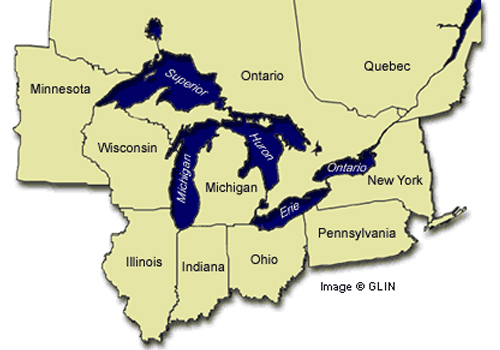
“These are very positive results. The lakes are improving and slowly cleaning themselves up,” said Thomas Holsen, co-director of Clarkston University’s Center for the Environment and co-author of the study. “Even with the decreases, it will be 20 to 30 years until the decades-old contaminants in Great Lakes fish decline to the point that consumption advisories can be eliminated,” Holsen said.
All good news, except as we clean up the old chemicals like Polychlorinated biphenyls (PCBs), the pesticide DDT and other banned compounds they are being replaced by newer ones, such as flame retardants that are building up in fish and wildlife and chemicals we are not yet even looking for from oil and gas development.
Today, the natural gas industry is beginning horizontal hydraulic fracturing all around the Great Lakes to extract gas. It is against the law to frack under the lakes but there are no laws about fracking near streams, creeks, rivers that empty into the lakes. This is insane. Hundreds of toxic chemicals are injected under pressure into the ground to fracture the shale formation. Not all of these chemicals are retrieved after the fracking is done. In fact the common gas well leaves behind about 30 percent of the chemicals, radioactive materials and brine. It’s unbelievable, hundreds of chemicals injected all around our fresh water lakes that both the U.S. and Canada have worked for decades to clean up.
This destructive activity is a prime example of governments’ tunnel vision. Oil and gas development moves forward, cleanup of the lakes moves forward, air deposited of chemicals from many sources continues. It’s like shoveling the sidewalk in a blizzard, it won’t be cleaned until the snow stops falling. There is no sign of the chemical blizzards retreat.
I grew up near the lakes in Buffalo and understand their beauty and value. My sister and brother-in-law were active in advocating the cleanup of the lakes in the 1970’s. Our family vacationed on the lakes. It was exciting back then to hear that a serious effort from both sides of the boarder would advance to make the lakes swimmable, the fish safe enough to eat and so many other promises. Now more than 35 years later reports are praising the cleanup of historical chemical deposits while at the same time new chemicals are allowed to enter the lakes without protest.
Fracking is not yet widespread around the great lakes. Yes there are some wells in Pennsylvania, Ohio and Michigan, but we can stop widespread fracking that would further contribute chemicals to our beautiful lakes by taking a stand and insisting that regulations are put in place and bans where necessary to protect this amazing gift of nature. It is up you and me to make it happen.
New Emergency Manager Bill introduced in the Michigan Senate
Less than a month after the Emergency Management legislation implemented by the Snyder Administration was defeated on Election Day, a new version of a similar policy has been introduced into the Michigan Senate.
According to Michigan Forward, one of the groups that was instrumental in defeating Proposal 1:
Michigan’s lame duck legislators in the Senate are working day and night to resurrect the dictatorship over 2.3 million voters rejected November 6. Senate Bill 865, introduced by Senator Phil Pavlov of St. Clair Township reintroduces policy that gives Governor Rick Snyder and private companies total control over school districts, cities and towns. Here’s more on the new dictator bill, SB 865:
· Reenacts PA 4 almost word for word
· Defines “consideration for local government input” by allowing them to propose an alternative to the recommendation of the Emergency Manager on only 3 issues (CBA abrogations or revisions , asset sales and borrowing) provided they have the same financial impact and provided the local government objects within 7 days and providedthey propose the alternative within 10 days of that only to have them likely ignored by the Local Emergency Financial Assistance Board: a 3 member board consisting of 3 cabinet members including the State Treasurer)
· An appropriation to avoid another referendum
To jump start a campaign to defeat this new legislative proposal, Michigan Forward has organized a lobbying day in Lansing on Wednesday, November 28. Michigan Forward is calling people to Lansing to meet with their state officals and demand that they not support SB 865. The event will kick off at 11:00 A.M. at Central United Methodist Church in Lansing (located 215 North Capitol Avenue — corner of Allegan and Capitol).
Media Alert: No More Media for Murdoch
This media alert is re-posted from Free Press.
Rupert Murdoch — the guy who’s under investigation in England for phone hacking, influence peddling and bribery — wants to get his mitts on the Los Angeles Times and the Chicago Tribune1,2. These are the major papers in the nation’s second- and third-largest cities (where, incidentally, Murdoch already owns TV stations).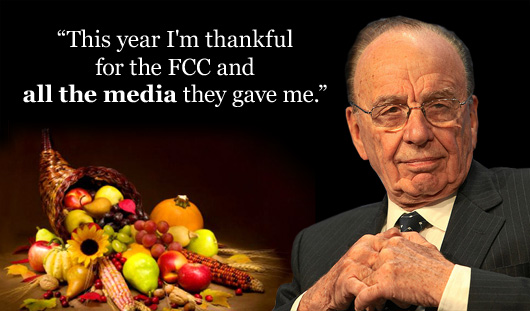
Federal Communications Commission Chairman Julius Genachowski is trying to change the agency’s ownership rules to pave the way for Murdoch to get exactly what he wants. Worse, Genachowski and Murdoch are keeping this all very hush-hush, hoping you won’t notice.3
These changes wouldn’t just benefit Murdoch. If the FCC proposal passes, one company could own the major daily newspaper, two TV stations and up to eight radio stations in your town. And that one company could be your Internet provider, too. What is the FCC thinking?!?
We can still stop the agency from taking this perilous step — but we have less than a month to do it.
By taking action, you’re joining a movement of millions who are working to stop big media from getting even bigger. Please take action today.
1. “Murdoch Eyes L.A. Times, Chicago Tribune,” Chicago Tribune, Oct. 20, 2012: http://articles.chicagotribune.com/2012-10-20/business/sns-rt-us-newscorp-tribune-labre89j0fm-20121020_1_murdoch-controls-news-corp-chairman-ceo-rupert-murdoch
2. “News Corp.’s Rupert Murdoch Is Said to Be in Early Talks to Buy the L.A. Times and the Chicago Tribune from Tribune Co,” Los Angeles Times, Oct. 19, 2012: http://articles.latimes.com/2012/oct/19/business/la-fi-ct-murdoch-newspapers-20121020
3. “FCC Proposes Loosening TV/Newspaper Cross-Ownership Ban … Again,” Nov. 14, 2012: http://www.broadcastingcable.com/article/490405-FCC_Proposes_Loosening_TV_Newspaper_Cross_Ownership_Ban_Again.php
Third Report Warns that Leaders’ Lack of Action Is Locking In Worst Consequences of Climate Change
This article is re-posted from the Union of Concerned Scientists.
A string of recent reports paints a clear picture that the world is not on track to fulfill leaders’ stated goal of limiting global warming to 2 degrees C (3.6 F) above pre-industrial levels, according to the Union of Concerned Scientists (UCS).
“The alarm bells scientists have been ringing for years are turning into a chorus,” said Alden Meyer, Director of Strategy and Policy at UCS. “World leaders set a goal of avoiding 2 degrees of warming, but the commitments they’ve made to meet that goal are inadequate. Without much more aggressive action, we will lose the fight to avert the worst consequences of climate change.”
A United Nations Environment Program (UNEP) report released today says that countries aren’t doing enough to keep the world from warming 2 degrees C above pre-industrial levels. Even if they met the most ambitious versions of current pledges, the report concludes, emissions of carbon dioxide and other greenhouse gases in 2020 will be about 52 gigatons (Gt) — some 8 Gt more than is needed to have a “likely” chance of keeping temperature increases below 2 degrees C. The gap could be as high as 13 Gt if more lenient assumptions about current pledges are used. For comparison, current emissions are about 50 Gt per year. This projected gap for 2020 is 2 Gt higher than in last year’s UNEP report.
“Not only are nations failing to close the gap between their actions and the 2 degrees goal,” Meyer said, “but the gap is actually widening.”
The UNEP report echoes two others: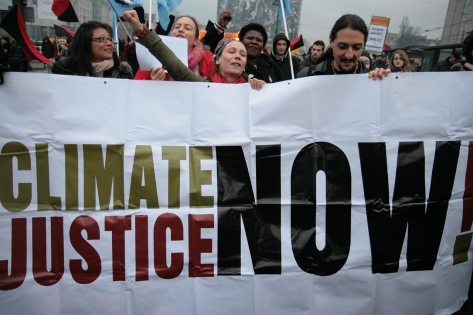
— Last week, the International Energy Agency’s World Energy Outlook 2012 concluded, “if action to reduce CO2 emissions is not taken before 2017, all the allowable CO2 emissions would be locked-in by energy infrastructure existing at that time.” The agency found that two-thirds of known fossil fuel reserves would have to stay in the ground to retain the possibility of limiting warming to no more than 2 degrees.
— Earlier this week, the World Bank issued a climate report that said without further action, “the world is likely to warm by more than 3 degrees C [5.4 F] above the preindustrial climate.” It further found, “Even with the current mitigation commitments and pledges fully implemented, there is roughly a 20 percent likelihood of exceeding 4 degrees C by 2100. If they are not met, a warming of 4 degrees C could occur as early as the 2060s.”
Exceeding a 2 degree C increase in global temperatures would exacerbate already evident effects of climate change, including ocean acidification, rising sea levels and coastal inundation, droughts, and more frequent and severe heat waves. The World Bank report, in particular, warns of the severe consequences for developing countries, including damage to coastal cities, water shortages and crop failure.
World leaders will again convene for a United Nations climate summit in Doha, Qatar later this month.


