GVSU to host 2012 Great Lakes History Conference October 12 – 13
The Women’s and Gender Historians of the Midwest (WGHOM) and Grand Valley State University’s History Department will host the Great Lakes History Conference, which began in 1975.
The focus for much of the conference this year is on women and women’s struggles. The description of the conference theme and information on both Friday and Saturday night’s keynote speakers is as follows:
“Born in Revolution”: History, Gender and the Power of Conflict
Where else can you see previews of a new documentary about the 97-year old Detroit-based activist/philosopher Grace Lee Boggs by its award-winning filmmaker and a keynote on the history of healthcare reform in the US by its leading historian all in one weekend? Join us for this year’s Great Lakes History Conference, October 12th and 13th, Eberhard Center, Pew Campus, Grand Valley State University.
Friday, October 12th, 7:30 p.m.. Eberhard Center, 2nd Floor, Pew Campus. This event is free and open to the public.
Director Grace Lee will present highlights from “American Revolutionary: The Evolution of Grace Lee Boggs.” The biographical work-in-process film explores the life and work of centenarian Grace Lee Boggs, Detroit activist and feminist.
Saturday, October 13th, 12:30-1:45, Eberhard Center, 2nd Floor, Pew Campus
Dr. Beatrix Hoffman (Northern Illinois University) will speak about her forthcoming book, Health Care for Some, that investigates the history of health care in the United States in a talk entitled “Health Care for All! Women, Activism, and the Human Right to Health“.
If you would like to attend this keynote and/or panels, please contact Gretchen Galbraith at galbraig@gvsu.edu so that we may put you on our special guest list. For details on all the panel discussions go to this link.
2012 Great Lakes History Conference
October 12 – 13
GVSU – downtown campus – Eberhard Center
For details http://www.gvsu.edu/history/module-spotlight-view.htm?entryId=9BD8F75D-D47C-9B41-9673D3766E56E44B
Photo bomb challenges the politics of ArtPrize , with online campaign
Last year we posted a two-part piece on the political economy of ArtPrize. In part II, we identified ArtPrize sponsors, based on the 990 records they submitted to the federal government, which lists the ArtPrize budget, expenses and sponsors and how much they gave.
The article from last year talked about some of the sponsors and the hateful campaigns they have funded, particularly anti-LGBT campaigns.
Some of this funding has gone to support efforts to defeat marriage equality and domestic partner benefits or to religious groups, which preach that, “homosexuality is a sin.” Despite this kind of homophobic policy funding, I have seen nothing in writing or heard anyone discussing these issues while ArtPrize has been going on. Look at it this way, what if neo-Nazi groups or the KKK were sponsors of ArtPrize? Do you think there would be some discussion of this, maybe even rage? Do you think that the African American community and its allies would be avoiding or even calling for a boycott of ArtPrize? Sure seems likely. So why is it that when institutions that make it a priority to deny people who identify as LGBTQ their basic rights, why are people not outraged? Just because the foundations that fund anti-gay policies don’t wear white hoods, doesn’t mean they don’t do harm to vulnerable population.
Starting today, a group of local activists are now trying to shed light on the anti-LGBT funding from some of the ArtPrize sponsors. Using public information, the activists have found a few examples of anti-LGBT funding and are posting photos and information at a Facebook page called ArtLies.
For example, the Edgar & Elsa Prince Foundation gave $75,000 to the 2004 Anti-Gay Marriage Amendment in Michigan. Edgar and Elsa Prince are the parents of Erik Prince and Betsy DeVos. The Edgar & Elsa Prince Foundation gave $450,000 to California’s Prop 8 to ban Gay Marriage, in 2008.
The Richard and Helen DeVos Foundation donated $100,000 to the Florida4Marriage campaign in 2008, to defeat a campaign to get marriage equality in Florida.
More recently, the Doug & Maria DeVos Foundation donated $500,000 to the National Organization on Marriage for its efforts across the country to defeat Marriage Equality. This large amount of money to defeat Marriage Equality across the country has led to a campaign to Boycott Amway, since Doug DeVos is the current President.
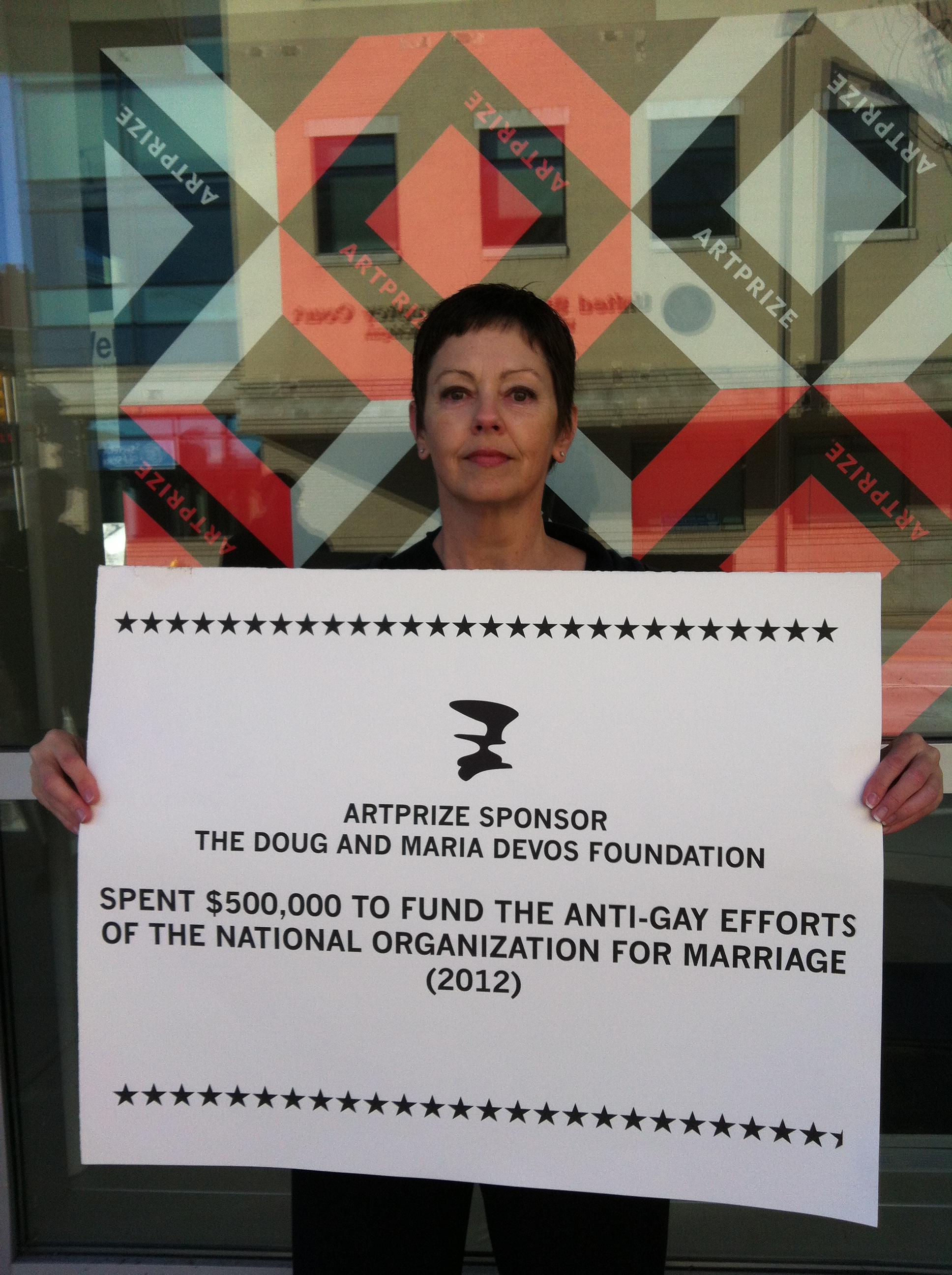
In addition, the local activists pointed out with some signs in their visual campaign other funding issues with some of the ArtPrize sponsors. For example, Richard DeVos contributed $250,000 to Wisconsin Governor Scott Walker to defeat the recall campaign earlier this year, since Walked has been attacking working people and labor policies in that state.
Another issue one of the signs points to is the funding that the Dick and Betsy DeVos Foundation and the Edgar & Elsa Prince Foundation have given the Mackinac Center for Public Policy. The Mackinac Center is a far right think tank that supports Right to Work laws, privatizing public services, privatizing public education and deregulation of any restrictions put on the private sector by the state. The Dick & Betsy DeVos has given $80,000 between 2002 – 2009 to the Mackinac Center for Public Policy and the Edgar & Elsa Prince has provided $195,000 during the same time period.
Lastly, the activists point out in one sign that the Dick and Betsy DeVos foundation has contributed millions of dollars to promote the privatization of education, which undermines public education funding across the country. One researcher even refers to Betsy DeVos as the 4 – star general of the pro-school privatization movement.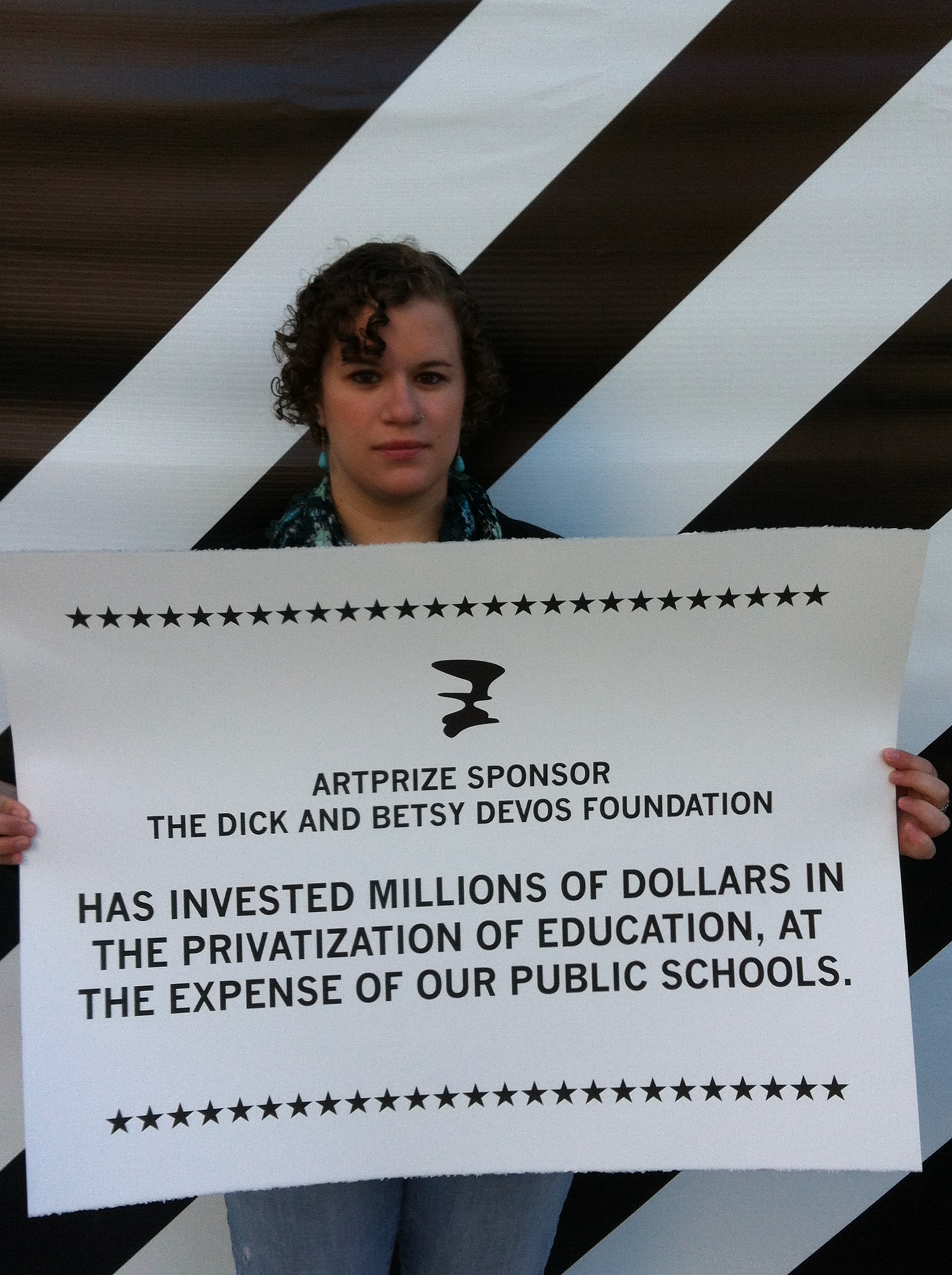
In their photo bomb action today, some of the activists even stood next to one of the WOOD TV 8 signs by the Grand Rapids Art Museum, where the channel 8 station has been broadcasting live since ArtPrize began this year. They stood their with these illuminating signs about ArtPrize sponsors to make the point that commercial media in this community has ignored the politics of the ArtPrize sponsors.

The Forgotten Palestinians
This video is re-posted from ZNet.
Celebrated Israeli historian, Ilan Pappe who wrote “The Ethnic Cleansing of Palestine” that documented the 1948 removal of 700,000 Palestinians from their lands, has now written about “The Forgotten Palestinians”.
In the book, and at this September 16 community meeting at Sydney University, Pappe reveals the situation for the Palestinians who still live within Israel’s borders.
This was the first event of Professor Pappe’s 2012 Australian lecture tour. It was hosted by the Sydney Peace Foundation at the University of Sydney with the Coalition for Justice and Peace in Palestine and Leichhardt Friends of Hebron. Professor Pappe is in Australia as the guest of AFOPA to deliver the annual Edward Said Memorial Lecture at the University of Adelaide.
Climate Justice advocate Bill McKibben to be part of forum at GVSU – September 25
Author, activist and co-founder of 350.org, Bill McKibben will be part of a forum at the downtown campus of GVSU on Tuesday, September 25.
McKibben, who’s most recent book is Eaarth: Making Life on a Tough New Planet, will speak to an audience gathered at GVSU via Skype. The title of the forum is Building a Movement to Save the Climate.
McKibben will speak first, followed by brief comments from several local groups, including Food & Water Watch, GVSU Student Environmental Coalition and Mutual Aid GR. Each organization will also have an information table with educational resources and information on local campaigns related to Climate Justice.
Bill McKibben – Building a Movement to Save the Climate
Tuesday, September 25
7:00 – 9:00 PM
Downtown GVSU Campus – Eberhard Center Room 215
Campus Sustainability Spotlight Event
This event is free and open to the public.
For more information contact Andrea Marz at marzan@gvsu.edu.
Video of anti-fracking action at Wolverine Oil & Gas

Here is a more detailed video of yesterday’s action at Wolverine Oil & Gas, which includes footage of the march, the statement by those being arrested, interaction with a representative from Wolverine Oil & Gas, protestors in the lobby and the eventual arrest.
Those of us who occupied the office went in representing the People’s Environmental Protection Agency and we charged Wolverine Oil & Gas with crimes against the environment and sought to shut them down.
Thanks to several people who documented the action and put together this video!
Local International Day Against Fracking protesters issue statements, three arrested
The Grand Rapids group Mutual Aid GR organized a downtown Grand Rapids march as part of the International Day Against Fracking. This statement was released to media prior to the action:

A participant in the action related the following about the event:
We know that hydraulic fracturing is bad for Michigan because it:
• Contaminates ground water and soil with toxic chemicals
• Contributes to the pollution and contamination of fresh water, which is one of the things that make Michigan such a magical place to live.
• Fracking poisons plants, animals and humans.
• Fracking is accelerating around the country and in Michigan and is contributing to the most urgent crisis of our time, global warming.
• Lastly, fracking for natural gas reduces the need to seek truly sustainable and renewable forms of energy.
Therefore, we occupy Wolverine Oil & Gas to say no to contaminating Michigan water; no to practices that significantly contribute to global warming; and no to companies that profit from environmental destruction.
We are occupying Wolverine Oil & Gas to demand that they release all information about the type and amount of chemicals they have used in fracking to date and the amount of water used; to release information on the location of all oil and gas wells they own and operate in Michigan, and to stop the practice of fracking where ever they engage in this practice.
Advanced Placement: The Chicago Teachers Union is poised to lead in the next school-reform fights
This article by Micah Uetricht is re-posted from the American Prospect.
Chicago Public School teachers and students were back in classrooms Wednesday morning after union delegates voted Tuesday to end their seven-day strike. The union won a number of significant victories—including a provision that student test scores will count for no more than 30 percent of a teacher’s evaluation and another that will give teachers more pay for longer school days and years. The proposed contract should be finalized and approved in the coming weeks. By almost all accounts, though, in its fight with Mayor Rahm Emanuel, the union is emerging as the clear winner.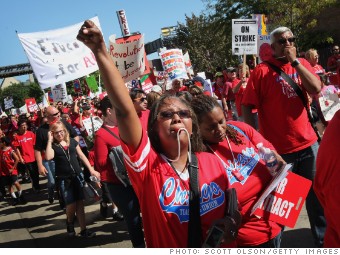
One of the sticking points in negotiations was over teacher evaluations and the role students’ test scores play in them. Emanuel is one of a number of national reformers who see unions as a roadblock to improving student performance and who subscribe to the philosophy that what poor, underperforming school districts need most are better teachers. Chicago teachers have emphasized throughout this fight that they want to weigh in on the education-reform debate and that their mission to do so extends far beyond an individual contract.
With a newly mobilized membership, widespread relationships with community groups, and much of the public’s trust, the Chicago Teachers Union has positioned itself to play a leading role in the debate in their city, which has an education system highly stratified between well-funded public magnet and private schools and crumbling, neighborhood-based schools—where more than 91 percent of public-school students are children of color, more than 90 percent attend hyper-segregated schools, and 82 percent are poor enough to qualify for free or reduced-cost lunch. Their efforts could lead the way for teachers in other cities to organize in the same way.
As union delegates streamed out of their meeting Tuesday evening, many said they were elated to return to work. Teachers embraced one another in the parking lot, and supporters chanted while holding signs reading “We’re Proud of You, CTU.” Teachers also immediately began talking about how to translate the momentum from the contract victory into a broader movement. These teachers want to refocus an education-reform debate that has centered on teacher performance to one that addresses structural barriers to student achievement, including the vastly unequal resources allocated to poor students and students of color in public schools throughout the country. Education reformers have cast teachers’ unions as a problem for urban public-school students; the Chicago union wants to present itself as a solution.
Parents had been on the teachers’ side in large numbers during the fight. They formed a support organization, Parents 4 Teachers, in early 2012 to back the teachers’ contract goals and show that they did not view teachers and their union as enemies. An active Chicago Teachers Solidarity Campaign mobilized community members who weren’t parents to support the union. Community groups like the Kenwood-Oakland Community Organization and the Grassroots Collaborative took key roles in organizing marches and town-hall meetings.
These relationships were not hastily thrown together to give a veneer of neighborhood-based union support. They were based on long-term relationships developed since the Congress of Rank and File Educators (CORE) took control of the union’s leadership in 2010 and emphasized in their platform opposition to school closures and encroaching privatization through the opening of new charter schools—reforms pushed for years under Mayor Richard M. Daley and former Chicago Public Schools CEO (now Secretary of Education) Arne Duncan—and strong relationships with community and parent organizations. While the teachers are legally limited to striking over economic issues, Karen Lewis and the rest of the union’s leaders insisted from the beginning of the contract negotiations that their fight extended past what could be won in a contract.
“That contract only governs a portion of what we’re fighting for. We’re fighting for public education itself,” says Eric Skalinder, a delegate and music teacher at Kelly High School in Brighton Park, a poor, mostly Mexican neighborhood on Chicago’s Southwest Side. Skalinder is looking to the union’s allies for direction in the union’s next fights. “These community partners and parent alliances are new,” he says. “We’ve never been more mobilized or unified. We have to focus that energy on fighting privatization, advocating for neighborhood schools, all of it.”
It’s school closures, in particular, that union delegates and community organizations are concerned about. Mayor Emanuel has proposed closing 80 to 120 public schools and opening 60 charter schools in their stead, seen by many as a not-so-subtle scheme to weaken teachers unions and push privatization. Outside the union hall in an industrial district of Chinatown where delegates met, Kirstie Shanley, an occupational therapist at Walt Disney Magnet School, says the end of contract negotiations should lead to a quick shift in the mobilization to fight those closures.
“The community, clinicians, parents, teachers—they all need to be there when there’s a closing,” Shanley says. “Rahm and [Chicago Public Schools CEO Jean-Claude] Brizard have to be aware that every time they announce a school closing to turn it into a charter, we’re ready to mobilize and fight back.” She says there is also significant movement on a referendum calling for an end to what she calls the “abuses” of the city’s unelected school board.
Whatever their next battle, the 26,000 teachers seem ready, as a text alert circulating among them late Tuesday night suggested: “CTU ALERT: Wear red Wednesday. Meet in your parking lot before swiping in. Everyone walks in TOGETHER. This is the beginning.”
MLive Media Group property Bay City Times is a cheerleader for the pro-fracking companies
Yesterday, the editorial board of Bay City Times (part of the MLive Media Group conglomerate), posted an editorial opinion piece in favor of the expansion of hydraulic fracturing for natural gas in Michigan.
The opinion piece starts off by stating that hydraulic fracturing is growing in the Great Lakes Region and “we would be foolish to stop it before it even starts.”
The Bay City Times opinion piece says that proponents of fracking claim it,“will extend the domestic natural gas supply by more than 100 years and help keep energy prices relatively stable.” By proponents, they mean the oil & gas and energy industry, which has been making a major push to justify the use of fracking for natural gas as a response to the growing public opposition to it.
The Bay City Times opinion piece also states that opponents, “point to the very few regulations of the chemicals injected into the ground.” While this is an important issue of concern it is not the only one. In addition to chemicals used in fracking there is also the amount of water used in the process, what happens to the contaminated water used in the drilling process, contamination of ground water, long-term impact on human health and ecosystems and that advocating for expansion of natural gas will making a serious push towards the use of renewable energy a fading reality.
The editorial board piece goes on to say:
Banning fracking completely would be a knee-jerk response. While restrictions are low, the Department of Environmental Quality frequently tests areas where fracking occurs and has not uncovered any issues. House Democrats are pushing for stricter rules for hydraulic fracturing, something we think needs to be explored without imposing unnecessary red tape that would make it impossible for energy companies to move in this direction.
The key statement here is their calling a ban on fracking a “knee-jerk response.” The editorial board at the Bay City Times should know better to use such language, without backing it up with some data and research. None of this can be found in the opinion piece, just an appeal for expanding fracking because Michigan faces the issue of energy costs.
The Bay City Times editorial board does say upfront that their opinion is based upon an 8-part series of stories they ran on the issue of hydraulic fracturing for natural gas. Of those eight articles only one has a source that is critical of the expansion of natural gas exploration through the use of fracking. However, in all eight articles the Bay City Times uses industry sources such as Midland Cogeneration venture, DTE, Consumers Energy, Dow Chemical, the American Natural Gas Alliance and Friends of Natural Gas Michigan.
Of course companies like Consumers Energy, DTE and Dow would be in favor of fracking and their support seems pretty obvious. The 8-part series in the Bay City Times does not give any background information on the American Natural Gas Alliance or Friends of Natural Gas Michigan.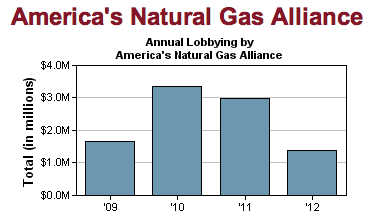
The American Natural Gas Alliance is a fairly recent creation, but has already spent nearly $10 million dollars lobbying the federal government since 2009. This alliance represents dozens of companies seeking to expand profits from hydraulic fracturing. The Vice President of Strategic Communications at the American Natural Gas Alliance is Dan Whitten, who also happens to be the spokesperson for Friends of Natural Gas Michigan.
The Bay City Times 8-part series on this critical issue is so biased towards the industry side that it begs the question of how much advertising money these companies spend with the news agency. The 8-part series and the editorial board opinion piece is a clear indication that the Bay City Times engages in a brand of journalism that not only avoids challenging power, it actually colludes with it.
Hollywood Film Pushes Flawed Corporate Education Agenda
This article by Mary Bottari and Sara Jerving is re-posted from PRWatch.
Well-funded advocates of privatizing the nation’s education system are employing a new strategy this fall to enlist support for the cause. The emotionally engaging Hollywood film “Won’t Back Down” — set for release September 28 — portrays so-called “Parent Trigger” laws as an effective mechanism for transforming underperforming public schools. But the film’s distortion of the facts prompts a closer examination of its funders and backers and a closer look at those promoting Parent Trigger as a cure for what ails the American education system.
While Parent Trigger was first promoted by a small charter school operator in California, it was taken up and launched into hyperdrive by two controversial right-wing organizations: the American Legislative Exchange Council (ALEC) and the Heartland Institute.
ALEC brings together major American corporations and right-wing legislators to craft and vote on “model” bills behind closed doors. These bills include extreme gun laws, like Florida’s “Stand Your Ground” law implicated in the Trayvon Martin shooting, union-busting legislation, Arizona style anti-immigrant legislation and voter suppression laws that have sparked lawsuits across the nation. The organization’s agenda is so extreme that in the last few months 40 major U.S. companies, including Wal-Mart, Coca-Cola, Kraft, and General Motors, have severed ties with ALEC.
Similarly, the Heartland Institute recently suffered an exodus of corporate sponsors after it launched a billboard comparing those who believe in the science behind global warming to the Unabomber, Ted Kaczynski.
As the movie’s stars take to the airwaves this week to promote the film, it is unlikely they will discuss the agenda of the film’s billionaire backers or the right-wing politicians and for-profit firms who are promoting the Parent Trigger idea, the purpose of which is to promote the transformation of the American public school system into a for-profit enterprise. We provide a primer below.
Hollywood Fiction vs. the Facts on Parent Trigger
What is a Parent Trigger law? The proposals have varied from state to state, but they generally allow parents at any failing school, defined by standardized testing, to sign a petition to radically transform the school using any of four “triggers.” Parents can petition to: 1) fire the principal, 2) fire half of the teachers, 3) close the school and let parents find another option, or 4) convert the school into a charter school. While the details of how the school can be “restructured” vary from state to state, the charter school option is always present. Charter schools are privately managed, taxpayer-funded public schools which are granted greater autonomy from regulations applicable to other public schools, ostensibly in exchange for greater accountability for results, but they have been criticized for uneven and mediocre track records.
The film, starring Oscar nominee Viola Davis and Maggie Gyllenhaal, reportedly portrays the struggle of a teacher and a parent who work to transform a low-performing Pennsylvania school, despite resistance from the local union — cast as the enemy of reform. Together, the African American teacher and the white, single mom unite to overcome hurdles and go door-to-door convincing parents to sign a petition to trigger a transformation.
While in reality most teachers do not sign the petitions and teachers are likely to get fired under Parent Trigger laws, “Won’t Back Down” has teachers uniting with parents to sign the petition and transform the school. Eventually, 50 percent of teachers sign as well as parents and the intrepid duo finally turns the school into a charter school run by the Viola Davis character.
The film portrays Parent Trigger laws as a successful way of inspiring and uniting teachers and parents and the community. The real life history of Parent Trigger is quite different. Only two school districts, both in California, have used the petition mechanism: Compton Unified School District and Adelanto School District. In Compton, a new group called “Parent Revolution” founded by a charter school operator paid individuals to collect signatures to hand the school over to a charter school operator, but the courts threw out the petitions.
In Adelanto, parents first signed petitions, then had second thoughts. The school board rejected the petition after parents withdrew their support, resulting in a lawsuit. The courts ruled that parents could not rescind their signatures. The parents had advocated for a turning the school into a charter school, a plan which was rejected by the school board. Instead, an advisory panel was created and headed by the superintendent. The legal battles are continuing.
Instead of prompting reform-minded unity, both petition drives have been criticized for creating “chaos and division” in the community. Charges of fraud and intimidation abound. “This is destroying friendships and all relationships,” one Adelanto parent, Chrissy Guzman-Alvarado, told The New York Times. “With our school divided, parents are scared to speak out or sign anything, and our community is falling apart. All for what?” she asks.
ALEC Spreads Parent Trigger Nationwide
The first Parent Trigger law was enacted in 2010 in California and, with an assist from Heartland and ALEC, the idea is rapidly spreading.
The California law was based on a proposal from Ben Austin, a policy consultant for a small non-profit education organization called Green Dot Public Schools, which manages charter schools for the city of Los Angeles. Austin subsequently formed Parent Revolution, which promotes these laws across the country. But this is not your local PTA. Parent Revolution is backed by big money, including receiving funding from the conservative Walton Family Foundation (think Wal-Mart), which has spent over a billion to promote school privatization.
The rabid pro-privatization Heartland Institute quickly took up the Parent Trigger idea in 2010. The Heartland version of the bill (PDF) went a step further and gave parents the authority to trigger a school’s restructuring regardless of whether it is “failing” or not. Heartland’s version of the bill also calls for a “school voucher” option, which allows students to receive a monetary voucher to attend another private or public school. Voucher or “choice” schools have been criticized for diverting funds from public schools to unaccountable private schools, including for-profit religious and virtual schools.
 When a new wave of school choice supporters were swept into power at the state level in November 2010, Heartland saw an opportunity to put the Parent Trigger idea on steroids by bringing it to ALEC, the controversial corporate “bill mill.”
While ALEC has a governing board of state legislators it also has a governing board of corporations, packed with tobacco firms, giant pharmaceutical firms, and energy companies like Exxon Mobil. The ultra-conservative, billionaire Koch Brothers, have had a representative on the board for years and Koch-controlled money has funded ALEC to the tune of at least $1 million, according to estimates calculated by the Center for Media and Democracy (CMD).
The ALEC Education Task Force voted to approve the “Parent Trigger Act” (PDF) at their critical December 2010 strategy meeting in Washington, D.C., and the idea quickly spread. According to CMD’s analysis, ALEC members introduced or cosponsored various versions of the bill in 17 states.
At the time, ALEC’s education task force was chaired by the for-profit education firm Connections Academy, which specializes in K-12 online education. Others on the task force include tech companies, testing companies and higher-education diploma mills like Bridgepoint Education and Corinthian Education, both of which are under investigation by state Attorneys General for aggressive recruiting policies that leave too many students in debt with no degree.
We have seen this pattern before. When the NRA finally succeeded in getting its first “Stand Your Ground” gun law passed into law in Florida, a law implicated in the tragic Trayvon Martin killing, its next step was to bring the bill to ALEC which helped it spread to two dozen other states in short order.
Parent Trigger and ALEC were a match made in heaven. ALEC’s education bills encompass more than 30 years of effort to privatize public education through an ever-expanding network of school vouchers, an idea first advocated by economist Milton Friedman in the 1950s. ALEC bills also allow schools to loosen standards for teachers and administrators, exclude students with physical disabilities and special educational needs, eschew collective bargaining, and experiment with other pet causes like merit pay, single-sex education, school uniforms, and political and religious indoctrination of students.
Parent Trigger “A Clever Way to Trick Parents”?
But does it work? The support for Parent Trigger, according to University of Illinois Professor Christopher Lubienski, is based more on ideology than empirical data. Lubienski is an Associate Professor in the Department of Educational Organization.
“There is not good evidence that the options given [after the trigger is pulled] improve student achievement. The goal has more to do with changing school governance and giving opportunities for some of these organizations to get control of the public dollar,” Lubienski said. “Policymakers need to look at the factors that actually influence student achievement.
“Unfortunately, that points to a lot more difficult issues than simply changing the structure of a school. It’s relatively simple to fire the staff and bring in a charter operator. It’s more important that kids are getting proper medical attention before they are born, that their mothers are getting the right nutrition at that time, that kids are read to at home, and that they are raised in an environment that values education. This is much more difficult to influence through policy.”
The data shows that the conversion to charter schools, which Lubienski said is the constant theme running throughout the “Parent Trigger” legislation passed in states, has not shown to be effective in improving student outcomes. A study conducted at Stanford University’s Hoover Institution presents evidence that students in only 17 percent of charter school show greater improvement in math and reading than students in similar traditional public schools, whereas 37 percent, deliver learning results that are significantly worse than the student would have realized had they remained in public schools. However, the conversion to charter schools has proven profitable to many U.S. firms such as ALEC member National Heritage Academies, a for-profit charter school management organization operating in eight states, and K-12, Inc., which promotes “virtual” charter schools as well as “virtual” voucher schools. K-12, Inc. is under investigation in Florida for improperly certifying teachers and asking them to cover it up.
In short, Parent Trigger laws are a “clever way to trick parents into seizing control of their schools and handing it over to private corporations,” according to Diane Ravitch, an education historian and former U.S. Assistant Secretary of Education in the first Bush Administration.
Philip Anschutz, Right-Wing Billionaire, Owns Production Company
“Won’t Back Down,” is a production of Walden Media, owned by billionaire investor and right-wing extremist Philip Anschutz. Anschutz participates in the Koch brothers’ secretive political strategy summits and funds David Koch’s Americans for Prosperity group, which backed Wisconsin Governor Scott Walker‘s union busting proposal and is working to defeat Barack Obama and other Democratic candidates across the country.
Anschutz bankrolls ALEC and ALEC member groups. In 2010, The Anschutz Foundation, gave ALEC $10,000 and his Union Pacific firm was an ALEC sponsor the following year. The Foundation funded three ALEC members who sat on the ALEC Education Task Force which approved the Parent Trigger Proposal: The Independence Institute, Center for Education Reform, and Pacific Research Institute.
Anschutz has also supported the National Right to Work Legal Defense Foundation, which backs legislation designed to cripple unions; the Discovery Institute, which seeks to get creation “science” accepted in public schools; and the Mission America Foundation, whose president considers homosexuality to be a “deviance.” He also owns the conservative magazine, the Weekly Standard.
Walden Media was one of the producers of the pro-charter documentary film “Waiting for ‘Superman’.” This film was criticized by Diane Ravitch as propaganda and as “a powerful weapon on behalf of those championing the ‘free market’ and privatization.”
Rupert Murdoch, Media Mogul and Owner of Education Testing Company, Distributes Film
 The film is being distributed by 20th Century Fox, owned by News Corp. and media mogul Rupert Murdock. News Corp. owns Fox News, the Wall Street Journal and the New York Post. Murdoch formerly owned the British newspaper News of the World, which imploded once it was revealed that reporters hacked into the cell phones of the family of a murdered child, as well as the cell phones of the royal family, politicians and celebrities. The paper’s top editors and reporters were arrested although Murdoch himself has not been charged.
As CMD previously reported, News Corp. has been a member of both ALEC’s Education Task Force and Communications and Technology Task Force. Wall Street Journal editorial board member Stephen Moore, is an ALEC “scholar” and both the Wall Street Journal and Fox News have gone to bat for ALEC as member corporations began to flee earlier this year. What is less well known is that News Corp. owns Wireless Generation, a for-profit online education, software, and testing corporation, acquiring it in 2010 for $360 million. Wireless Generation is also an ALEC member. Apparently, Murdoch was anxious to get a piece of the nation’s education system, which he describes as a “500 billion sector in the U.S. alone that is waiting desperately to be transformed.” News Corp’s senior Vice President in charge of its education division is none other than former Chancellor of New York City Schools, Joel Klein, who promoted a corporatist model of education reform.
Lubienski, for one is skeptical of “self-proclaimed experts on the topic of education” like Murdoch who “aren’t accountable to the public” and who have a profit motive coupled with a political agenda of widespread privatization.
Michelle Rhee, Former D.C. Chancellor of Schools, Pushes Parent Trigger
The film is being promoted by former Washington, D.C., public schools Chancellor Michelle Rhee. Rhee spoke at both the RNC and DNC screenings of “Won’t Back Down,” and her involvement underscores what is often the bipartisan nature of the modern “school reform” movement.
Her tenure as the head of the D.C. school system was so controversial, she is widely credited with losing D.C. Mayor Adrian Fenty’s reelection campaign. She was credited with greatly improving test scores in Washington, D.C. schools, but this accomplishment was cast into doubt by a USA Todayinvestigation that suggested that test score gains during her term may have been the result of cheating on the part of school officials. The report found extremely high erasure rates that were statistically anomalous.
After resigning from her position in 2010, Rhee went on to start StudentsFirst, a 501(c)4 non-profit organization planning to engage in “direct and grassroots lobbying” on education issues including Parent Trigger. Derrell Bradford, a state director for StudentsFirst, spoke on “Enacting a Comprehensive K-12 Education Reform Agenda” at the 2011 ALEC annual meeting.
Rhee’s group receives funding fromMurdoch, who “has pledged to spend more than $1 billion to bring for-profit schools, including virtual education, to the entire country by electing reform-friendly candidates and hiring top-notch state lobbyists.” New Corp’s Joel Klein serves on her organization’s board. Other supporters include New Jersey hedge funder manager David Tepper, and Alan Fournier (reportedly big backers of Romney).
Rhee was also featured in Anschutz’s film “Waiting for ‘Superman’.”
Reform or Russian Roulette?
The movie ends when the hard work of turning around a struggling school begins. The Hoover Institution study discussed above shows that only 17 percent of charter schools do a better job educating students.
With no data backing the benefits of the Parent Trigger proposal, many doubt that throwing a school system into chaos is the best way to improve troubled schools. Chaos does however give the privatizers and the profiteers starring roles in the ongoing debate over the future of the American educational system.
Rahm Emanuel: Point Man For Obama’s Bipartisan Pork Barrel Pedagogy
This article by Bruce A. Dixon is re-posted from Black Agenda Report.
By early this week, the truth was hard to avoid and impossible to deny. The Chicago Teachers strike threatened to expose the vast gulf between some of the president’s rhetoric about preserving public education and protecting teachers, and the savagery of the Obama administration’s Race To The Top initiative, which ties federal education funding to how many public schools are closed and privatized, how many public school teachers fired, and how many of those remaining are evaluated according to business-friendly norms like test scores.
“I want you to understand, the president has weighed in,” Emanuel said. “Every issue we’re talking about regarding accountability of our schools, quality in our schools to the education of our children, is the core thrust of Race to the Top.”
Emanuel added that the “notion” of the teacher evaluations he proposed came from Race to the Top.
“In that sense there couldn’t be a bigger push for the president,” Emanuel insisted.
Emanuel also thanked Mitt Romney for his statement of support.
Besides the president, Rahm Emanuel had every newspaper and radio station in town, the Commerce Club and all the billionaires, scores of well-funded charter school operators and their contractors and hedge fund backers. He even had fake citizen groups like Democrats for Education Reform, which used money donated by its billionaire backers to run deceptive radio and TV ads (still running as of Tuesday night) aimed at inciting parents against the people who teach their children. Illinois is also one of twenty or so states that have passed corporate inspired “school reform” testing and curriculum measures into law, and drastically limited the issues over which teachers can negotiate along with the their right to strike.
But one of the signs carried by striking teachers told it all. It said “our working conditions are your child’s learning conditions.” The Chicago Teachers Union had prepared months in advance for the strike by reaching out to and working with organized parents around the city and enlisting them behind its basic demands to keep schools open and well-funded, and keeping them informed on and involved in activities that fought the creeping privatization of public education in Chicago. While Rahm had the media the billionaires, armies of hired stooges and the president, the teachers enjoyed broad support among parents and the public.
Even with Chicago’s corporate working hard to blur connections between the bipartisan agenda of dismantling public education, the president who calls the shots and the mayor who enforces them, the act was getting thin. With the presidential election less than two months away, the White House couldn’t afford to have its own policies exposed to its base voters. It’s likely therefore, that the White House privately needed Emanuel to settle the strike while doing nothing to back down from the presidential policies that caused it.
With last year’s “Waiting For Superman” and this year’s “Won’t Back Down”, the elite bipartisan campaign to privatize inner city public education is bound to continue. Romney and Obama, Democrats and Republicans agree on that much, so on this issue as so many others there is no question of greater and lesser evils. But Romney or Jeb Bush or some other Republican were in the White House, Democrats of many stripes wouldn’t hesitate to connect a sitting president with presidential policies aimed at privatizing education. With a Democrat, especially a black Democrat in the White House, black political opportunists see their careers threatened by any criticism of the president, his party, his policies or what he had for breakfast, and can draw soft-headed or lazy thinkers with them in the name of racial solidarity to protect the black president. So when it comes to school privatization, a black corporate Democrat, whether in City Hall or the White House is the more effective evil.
In the months leading up to the strike, Chicago’s Public School officials fired thousands of teachers and closed dozens of schools, often with little or no notice. Some of the school closings appeared to coincide with efforts to gentrify Chicago neighborhoods, and most of them were met with outrage from local communities. They avoided many public meetings and walked out of many private meetings, refusing to bargain with teachers. According to Substance News, the Chicago Public Schools “…tried to gut the entire contract throughout most of the ten months of negotiations, retreating from many of their most serious demands only after the strike threat became credible…”
The fight isn’t over. The Chicago Tribune is already calling for teacher strikes to simply be made illegal, and the functionaries at places like the Chicago Public Schools headquarters are beneath contempt and beyond shame. CPS head honcho Jean Brizzard gets paid $250K per year, more than any other school “CEO” in the nation. But, Substance News tells us, he has not been present at a single one of the last 70 negotiating meetings. He may be on the way out with the standard golden parachute, to be replaced by a functionary from Detroit, where the takedown of public education has been largely completed already.
For those paying attention, there are lessons here. Teacher unions till now have adopted a mostly passive and defeatist attitude toward fighting privatization, and uncritically supported Democrats with their members dues money, regardless of their positions on charters and privatizaion. But unions are pretty useless without the possibility of strikes. Strikes with public support make a big difference. The picket lines were in Chicago, but the impact of Chicago’s parents and communities who stood behind their teachers is being felt nationwide. The fight against pork barrel pedagogues who prescribe corporate school reform as the cure for inner city schools is entering a new phase.
 Grand Rapids Institute for Information Democracy