This brief article is re-posted from Common Dreams.


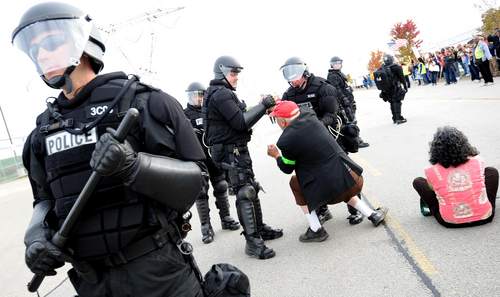
When about 650 members of community, labor and faith organizations rallied today in Elwood, Illinois in support of workers at a key Walmart warehouse striking to protest “poverty wages,” sexual harassment, racial discrimination and extreme work conditions, they were met with riot-gear-clad police and the private security Illinois Law Enforcement Alarm System Mobile Field Force who surrounded them, arrested all 47 who committed civil disobedience by sitting in the road, and told the other peaceful protesters to disperse or risk “chemical or less lethal munitions being deployed.”
“They call us bodies and that’s what we feel like.” – Mike Compton, one of the striking warehouse workers.
BP Wants To Blame Workers For Deepwater Horizon Spill, Says U.S.
This article by Puck Lo is re-posted from Corpwatch.
BP, the British oil company, has been accused of attempting to blame “blue collar workers” in order to divert attention from management failures of “gross negligence” over the Deepwater Horizon spill in 2010. The allegations were made by the federal government in a recent legal filing by the U.S. Department of Justice that was initially kept partly secret.
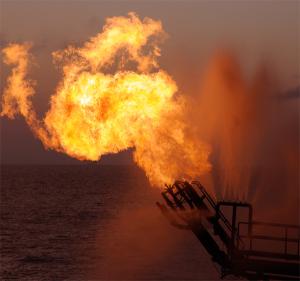
Deepwater Horizon – jointly owned by BP and Andarko Petroleum at the time – was deployed to work on Macondo, a mile-deep underwater well in the Gulf of Mexico. In April 2010 the rig caught fire, exploded, and sank. Over the following 87 days the oil well spewed nearly five million barrels into the ocean 40 miles off the Louisiana coast until the well was successfully capped with cement. Almost 70,000 square miles of water and over 1,000 miles of coastline were polluted by oil slicks, scientists say. Coral reefs and dolphins in the area continue to show signs of ill health to this day.
In mid-August BP asked U.S. district judge Carl Barbier to to dismiss a pending lawsuit by the federal government that is currently scheduled to be heard in January 2013. Instead, the company asked the judge to approve a $7.8 billion settlement, reached with 125,000 victims of the gulf disaster that includes tourist businesses and fish workers.
The federal government acted swiftly to submit a new federal legal brief to the court in New Orleans on August 31, according to legal experts, in order to convince Barbier to deny the company petition and allow the lawsuit to proceed. In their filing the government lawyers made a forceful case against the oil giant.
“BP’s management in London purposefully limited the investigation by excluding any of the systemic management failures that led to the disaster,” the lawyers wrote of an internal inquiry conducted by Mark Bly, a BP executive.
“This was a decision designed to ensure that the public and legal lines of accountability would be focused exclusively on blue collar rig workers and other contractor/defendants – but at all cost, not upon BP management and the inexplicable behaviors that coursed through the pages” of the internal BP emails. “The behavior, words, and actions of these BP executives would not be tolerated in a middling size company manufacturing dry goods for sale in a suburban mall,” the government lawyers added.
These sentences were blacked out by the government in deference to a “confidentiality claim” by the company but Barbier ordered them made public.
Cartainly individual BP workers are already being prosecuted. In April, federal prosecutors filed the first criminal charges against an individual involved in the accident. Former BP engineer, Kurt Mix, was charged with obstruction of justice for allegedly deleting hundreds of text messages sent between himself and a BP supervisor during the crisis. Mix pleaded not guilty and awaits trial in February 2013. BP has claimed that management actions in the Deepwater Horizon spill “did not constitute gross negligence or willful misconduct” on part of the company itself.
However, a presidential panel that investigated the accident has found otherwise, calling the catastrophe preventable. The panel determined that the companies involved had taken hazardous and time-saving risks. In December 2010 the Justice Department filed a lawsuit against BP and eight other companies, including Andarko Petroleum and Transocean. Halliburton, a contractor for the well that blew out, was not named in the lawsuit.

Experts say that the new filing shows that the government has become increasingly frustrated with BP’s attempts to evade responsibility. Justice Department lawyers took special issue with BP’s internal investigation noting that the company omitted from its report several revealing and embarassing emails between BP top officials that “sounded a clarion cry of impending disaster.”
“Just as BP attempted to have the public, Congress, and others focus only on what happened on the rig or in the shoreside offices of its contractors, the BP engineers and executives who drafted these and other documents were the people who actually exercised the direct authority and control over nearly every aspect of what ultimately went wrong on the rig on April 20th,” the filing’s authors wrote.
David Uhlmann, a University of Michigan professor and former environmental crimes prosecutor told Reuters that the new filing “contains sharper rhetoric and a more indignant tone than the government has used in the past.”
The government lawyers also accused BP management of refusing to learn from a 2005 Texas City refinery explosion that killed fifteen people. ”What is most striking,” the brief said, “is the utter lack of any semblance of investigation of the systemic management causes deeply implicating the corporate managers and leadership who caused and allowed the rig-based mechanical causes to fester and ultimately explode in a fireball of death, personal injury, economic catastrophe, and environmental devastation.”
The Justice Department filing reminded Barbier to rule only on whether the settlement agreement meets legal standards during an upcoming November 8 hearing and cautions against allowing BP to admit evidence or present testimony before the January trial.
The stakes are high. Under the Clean Water Act, violators are fined $1,100 for every barrel of oil spilled. In cases of gross negligence, that fine is increased to $4,300 per barrel. If a federal judge agrees that BP is indeed liable for gross misconduct, the company would have to pay $21 billion more than the $5.5 billion they planned for, according to Reuters.
BP responded to the news agency with a statement noting that it “believes it was not grossly negligent and looks forward to presenting evidence on this issue at trial in January.”
“In its filing, the U.S. Government made clear that it does not oppose the settlement reached by BP resolving economic loss and property damage claims stemming from the Deepwater Horizon oil spill. Other issues raised by the Government simply illustrate that disputes about the underlying facts remain,” the company said.
The August 31 legal brief also concluded that “BP did not act alone” and blames Transocean for its role in the disaster as well. Both the Justice Department and BP are appealing a ruling made by Barbier that let Transocean off the hook for oil that spilled underwater.
Meanwhile BP told Forbes that it has largely completed clean up from the spill, and the area has mostly recovered. Environmental experts disagree – Robert Haddad, head of the National Oceanic and Atmospheric Administration’s assessment and restoration effort, and Doug Inkley, a senior scientist with the National Wildlife Federation, told the Wall Street Journal that the region is still suffering from the spill.
The one business that has fully recovered is the oil industry. Following a six-month federal moratorium on drilling and a two-year lull after the BP explosion, the Wall Street Journal reports that over 4,000 platforms are now pumping oil and gas from 35,000 wells via nearly 30,000 miles of pipelines in the region. BP alone currently has six rigs drilling and is still the largest player operating in the area. Transocean is reportedly negotiating a partnership that would lead to a contract for four ultra-deepwater drillships similar to Deepwater Horizon.
“The only thing Macondo did was delay the entry or delivery of some ultra-deepwater rigs,” Leslie Cook, senior research consultant at Quest Offshore, told AOL Energy. The federal lawsuit is not the only one against BP for managament negligence. Six investment groups that bought shares in BP before and immediately after the catastrophe sued the company in Texas earlier this month stating that they would not have bought shares “had they known the truth,” the Daily Telegraph reported.
Pomerantz Haudek Grossman & Gross filed the lawsuit on behalf of investment firms like GAM Fund Management, Skandia Global Funds and the South Yorkshire Pensions Authority.
“BP paid only lip service to … (safety) reforms, lacked any tools for dealing with oil disasters such as deep-water spills and continued to operate by sacrificing safety for savings,” the groups filing suit stated. “BP’s reform failures led directly to the April 2010 disaster.”
Obama’s Double Game on Outsourcing
This article by Roger Bybee is re-posted from ZNet.
A wickedly barbed Barack Obama TV ad features Mitt Romney croaking “America the Beautiful” while the camera pans over scenes of Bain Capital sending jobs to Mexico and China and Romney’s use of tropical tax havens.
The ad, designed to define Mitt Romney as a job destroyer in the eyes of working-class voters in industrial states, has reportedly been effective. With 86% of Americans convinced that the offshoring of jobs contributes significantly to the nation’s economic problems, the 2012 election’s outcome may very well hinge on the perception of Obama as the defender of the public interest versus Romney the “vulture capitalist” and offshorer.
But is Obama’s record much better? Obama has aggressively promoted a set of new “free-trade” agreements that foster the shift of production from the United States to low-wage offshore sites—often in authoritarian nations denying basic labor rights. At the same time, these agreements directly and severely constrain democratically elected governments under an emerging doctrine of global corporate supremacy privileging maximum investor profits over protections for workers, consumers, and the environment. Instead of challenging the corporate prerogative to relocate family- and community-sustaining U.S. jobs to low-wage dictatorships, Obama has resorted to high-profile but hollow gestures.
About-Face on Trade Agreements
Since Obama took office, he has expressed ardent support for “free trade” agreements that provide the ground rules under which companies like Bain can generate such massive profits. Obama’s backing for these agreements, modeled on the investor rights-centered North American Free Trade Agreement (NAFTA), directly contradicts his hard-hitting message in the 2008 presidential campaign. “Decades of trade deals like NAFTA and China have been signed with plenty of protections for corporations and their profits,” he declared before GM workers in Janesville, Wisconsin, “but none for our environment or our workers who’ve seen factories shut their doors and millions of jobs disappear.”
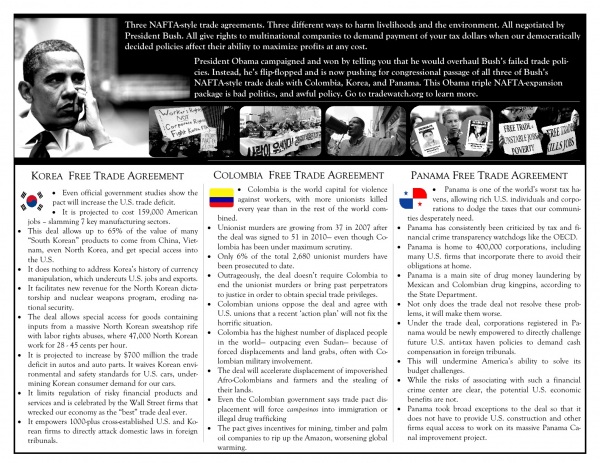
Despite his campaign rhetoric, Obama has championed George W. Bush-negotiated “free-trade” deals with labor-rights pariah Colombia, tax-haven Panama, and South Korea. Trade economist Robert Scott of the Economic Policy Institute (EPI) estimated that the South Korea deal alone will cost 159,000 U.S. workers their jobs. Union leaders also worry that the agreement will serve as a “funnel” for component parts produced under near-slavery conditions in North Korea and China under a South Korean label, says Matt McKinnon, political director for the International Association fo Machinists and Aerospace Workers (IAMAW).
Meanwhile, the Obama administration is hammering out the biggest, farthest-reaching, and most secretive “free trade” deal ever, the Trans-Pacific Partnership (TPP). The TPP would include numerous nations on the Pacific Rim, including Australia, Brunei, Canada, Chile, Malaysia, Mexico, New Zealand, Peru, Singapore and Vietnam. U.S. Trade representatives have negotiated its terms under such an unusual level of secrecy, with only 600 corporate executives apprised of the content, that even pro-”free trade” members of Congress have complained about being excluded from the talks.
An analysis of leaked TPP documents led Public Citizen’s Global Trade Watch to conclude in June that the deal would “extend the incentives for U.S. firms to offshore investment and jobs to lower-wage countries.” The TPP would also create expanded powers for corporations to challenge—before secretive dispute resolution tribunals—protective regulations on finance, the environment, workplace safety, and other vital measures enacted by democratically elected governments.
Phantom “Insourcing”
Obama is promoting the notion of tax incentives for firms to “insource”—i.e., bring jobs back to the United States. Since last fall, he has been busy declaring that U.S.-based manufacturers are suddenly returning to America’s shores. Obama has suggested that rising labor costs in China are a central factor in these decisions by U.S. firms.
The purported insourcing trend would be reinforced by substantial tax credits equalling 20% of the costs of relocating jobs back to America. There are fundamental problems with this model, under which “good firms” would be rewarded with taxpayer money, “bad” firms engaged in offshoring would be punished with the loss of tax credits, and U.S. workers would, presumably, benefit from a greater supply of family-supporting jobs.
For one thing, there is almost no evidence of a meaningful trend toward insourcing. EPI’s Robert Scott told Dollars & Sense, “I have seen no evidence of this [insourcing] in our trade performance. The U.S. trade deficit [in goods] has risen much faster than the GDP the past three years,” reaching $738.4 billion in goods for 2011. (The total deficit including services was $599.9 billion.)
Labor costs are rising in China, but not sharply enough to drive away U.S. companies, both EPI’s Scott and University of Wisconsin labor economist Frank Emspak told Dollars & Sense. Chinese labor costs—starting from a base as low as 30 cents an hour—are climbing in the range of 5% to 30% per year, hardly enough to make a significant difference to the U.S. firms that have invested so heavily in China. For example, Milwaukee-based Johnson Controls has continued to expand rapidly in China, and now has no fewer than 60 plants there. General Electric recently shifted the headquarters of its medical equipment division from Wisconsin to Beijing.
Moreover, U.S.-based firms like Apple have developed intricate and effective supply chains in China. As global justice advocate Walden Bello has pointed out, “Chinese suppliers, with subsidies from the state, have established an unbeatable supply chain of contiguous factories, radically bringing down transport cost, enabling rapid assembly of an iPod or phone, and thus satisfying customers in a highly competitive market in record time.”
In any case, since so many U.S.-based firms can legally avoid paying corporate income taxes, it is hard to imagine how sufficient incentives can be constructed, at least through tax credits alone, to influence their conduct. David Cay Johnston, tax expert and writer for Reuters, sees little hope that Obama’s tax plans will yield more jobs in the United States, though they will likely produce a further windfall of tax benefits for the corporations. Scott of EPI agrees. “The corporations will use their ability to set up subsidiaries overseas, manipulate their prices and profits, and shift revenues,” predicted Scott.
Labor’s Response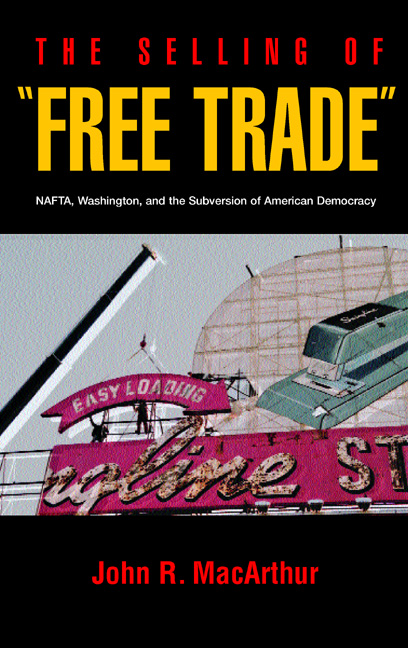
AFL-CIO President Richard Trumka, frustrated with Democrats selling out labor, fumed last year that he’d had “a snootful of this shit.” While he seems to be aware of the emptiness of Obama’s pledges against the offshoring of jobs, Trumka is holding off on public criticism of the administration on volatile trade issues as we draw closer to the November election. Asked about the TPP, Trumka told Mike Elk of In These Times, “This president has been better on trade than the last several presidents. He has enforced the trade laws better than I think anybody else and done a good job at that. Do we disagree on some things? Absolutely we do…. We will continue to work with them.”
But others in and around the labor movement view the current moment as our last chance to pressure Obama to step back from promoting the TPP and instead start taking effective action against offshoring. That is the stance adopted by the 5,000-member Association of Western Paper and Pulp Workers (AWPPW), which recently held a demonstration of several hundred outside an Obama fundraiser in Portland, Ore.
For many in labor, it’s now-or-never. “Where is the sense of urgency that the TPP must be stopped?” demands Chris Townsend, political director of the United Electrical, Radio, and Machine Workers (UE). “It’s an absurd moment when people in the Administration are saying that ‘free trade’ and the TPP will do anything but create more destruction.”
John R. MacArthur, who detailed the Clinton administration’s machinations for NAFTA in his 2001 book The Selling of Free Trade, sees close parallels between the manipulative strategies of Obama and Clinton on trade. While adopting a populist tone of concern about the fate of workers and the U.S. manufacturing base, they both remained committed to the “free trade” policies enriching their large donors. MacArthur points to the contributions pouring into Obama’s campaign “from hedge-fund partners and law firms structuring deals based on ‘free trade’.”
While Obama has drawn criticism from Democrats close to Wall Street—Newark Mayor Cory Booker, former Pennsylvania Gov. Ed Rendell, and Massachusetts Gov. Deval Patrick—over his attacks on Bain Capital and the private equity industry as a whole, MacArthur regards this conflict as a mere “pantomime” to confer illusory populist credentials on Obama. “It helps to keep people ignorant,” argues MacArthur, “about the push for free trade going on behind the scenes.”
Not all of labor has been diverted by the pantomime. The critical “action behind the scenes” has riveted the attention of some unions like the UE and the APPW, whose leadership sees passivity on the TPP and offshoring as ultimately suicidal for workers. “These trade agreements have been the number one job killer for our members,” the APPW’s vice president, Greg Pallesen, told Dollars & Sense. “Our members have made it clear they are sick and tired of the trade agreements. If we don’t take this moment to act and put pressure on the president, when will he listen?”
Unworthy Victims: Afghan Civilians Deaths still go under reported in US media as the US begins year 12 of war in Afghanistan
Editors Note: As we approach the beginning of the 12th year that the US military has been occupying Afghanistan, we do a series of articles highlighting the often overlooked aspects of the human and material cost of that occupation.
Eleven years ago the US began what was then called Operation Enduring Freedom, against the Afghani people, unjustly blaming the Taliban for their role in harboring al Qaeda.
In the first months, several thousand Afghan civilians were killed from US areal bombing, the use of cluster munitions and from US soldier raids on Afghan homes and communities. The death of Afghan civilians went under-reported on most US media and particularly in local news media.
GRIID did a study from October 7 – December 21 in 2001 of the three Grand Rapids-based TV stations and found that during that 75 day period, there were only 5 stories about wounded or dead Afghan civilians and in just three of those stories did viewers actually see images of wounded Afghanis.
Independent researchers, like Professor Marc Herold, found that there were several thousands dead or wounded Afghan civilians during the first months of the US onslaught in Afghanistan.
Since the early months of the US war in Afghanistan, the trend to under report civilian deaths has continued. In 2005, GRIID conducted another study on local TV news coverage of Iraq and Afghanistan. Not only was there no coverage of civilian deaths, there were only a total of 3 news stories about the US war in Afghanistan from the three TV stations combined over a 100 day period.
A third study was conducted in 2009, with the focus being on the Grand Rapids Press. In this 100 day study, not once were Afghan civilian deaths mentioned, even though a great deal of attention was devoted to US soldier deaths.
This disparity of which deaths get coverage in US media is what Professor Edward Herman names as “worthy and unworthy victims.” US soldiers are worthy victims, while Afghan civilians are unworthy.
Yesterday, it was reported on Common Dreams that the 2,000th US soldier has died in Afghanistan, but the lack of coverage of Afghan civilians is still disproportionately low.
This tragic milestone highlights the ongoing dangerous conditions for US and NATO soldiers in the war-torn country, but also serves as a reminder that though accurate and timely reports follow each death of a western soldier killed in Afghanistan, the death of ordinary civilians caught in the middle of a war that has dragged on for nearly eleven years are hardly mentioned at all.
Part of this story is that for most of the war statistics of Afghan civilians killed were not kept at all. From the end of August, 2012 to when the United Nations began keeping track in 2007 (six years after the US/NATO invasion), the UN estimates that 13,431 Afghan civilians had been killed.
Looking at the entirety of the war, most (conservative) estimates put the number of civilian Afghan dead at over 20,000.
To put it plainly: for every US soldier killed in a war that fewer and fewer seem willing to defend or explain, ten innocent Afghan civilians—doing their best to go about their lives under constant violent threat—are killed in war that eleven years later shows no sign of ending.
Local Anti-Fracking Activists Sentenced, Prison Industrial Complex Alive and Well in Grand Rapids
This article is by Rachael Hamilton.
Friday morning at 8:30, the three local activists who were arrested last week during a protest in observance of International Anti-Fracking Day, were arraigned and sentenced at the Grand Rapids 61st District Court, in front of Judge Benjamin Logan.
All three activists plead guilty to the charge of trespassing, and received substantial fines in response to their action of occupying Wolverine Oil and Gas, a local company that has spent money lobbying in favor of fracking, and has purchased gas and mineral rights to frack land in Barry County.
Despite the action being executed as a group, and in contradiction with usual courtroom custom, Logan arraigned each activist separately and did not provide time for any of them to further explain their actions. This was in stark contrast to the other folks in the courtroom also being arraigned at that time, who were asked questions regarding their actions, albeit in a condescending tone, and at least given time to explain themselves. All those who stood in front of Logan that morning faced both his deadpan drone of bureaucratic law and procedure, and his condescending attitude of paternal lecturing and disrespect. It appeared that Logan’s intention was to patronize all those in his courtroom, and deny any further platform to the activists.
This writer and the three activists noted aspects of the prison industrial complex inherent in the courtroom. All others present for arraignment were young Black and Latino women and men, charged with petty crimes such as minor drug possession and driving on a suspended license. While some plead guilt and others not guilty, it is safe to say they too will be charged hefty fines to the court. They were also subjected to Logan’s humiliating and morally superior commentary with statements such as one declaring that the only people who are out early in the morning are police officers and criminals, wondering which of those groups this gentleman fell into, in response to the individual explaining why he was driving his car at 2:30 in the morning. This statement not only ignores the multitude of valid reasons someone may be out at that time, but forgets that in our country we enjoy the freedom of not having a state imposed curfew. It reflected a moralistic sense of what underprivileged folks should be doing with their time. Such a display not only affirmed the concept of the prison industrial complex, but also spoke to the criminal justice system as what author Michelle Alexander calls the new Jim Crow—the biased treatment of disproportionately young black and brown members of society.
Jeff Smith, one of the activists charged with trespassing, stated after the court appearance that he was “not surprised by the court’s indifference to what we did, but their treatment of people of color was yet another reminder of the white supremacist criminal society we live in”.
Deirdre Cunningham, another of the activists, acknowledged that her experience in the courtroom mirrored that of her experience in the holding cell a week prior while they waited to be bonded out by fellow activists. There she encountered only women of color, one of whom was pregnant with children at home and faced a bond of $3,000. Cunningham stated “never could I have imagined, or will I ever forget the look of her, as she tried to decide whether to stay a few days or owe such a fee as to guarantee she’ll be back when they catch up with her again”.
Yet companies and corporations such as Wolverine, guilty of acts that are poisoning our drinking water, will not face this ridicule and contemptuous language from a judge. They will not be held financially responsible for their actions. But they will be permitted to continue committing their crimes and be celebrated in our community.
For those of you for whom this does not sit well, please consider participant in an action against the next gas and mineral rights land auction on Wednesday, October 24th in Lansing. For more information, you can contact the local Mutual Aid group at grpeoplesassembly@gmail.com.
Natural Gas Industry claim that fracking will make the US more energy independent is simply not true
This article is re-posted from Ecowatch.
Post Carbon Institute‘s Fossil Fuels Fellow David Hughes is currently researching and writing Drill, Baby, Drill: Can Unconventional Fossil Fuels Usher in an Era of Energy Independence? Slated for a January 2013 release, the report findings refute fossil fuel industry claims that unconventional supplies of oil and gas in North America will provide vast quantities of useful energy, be environmentally benign, create jobs and provide a robust economic boost.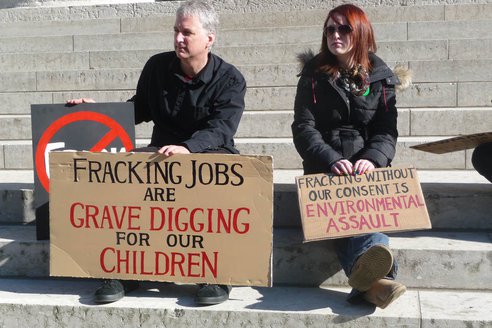
While impacted communities and environmental activists are raising the alarm over the environmental and health impacts of fracking and production of bitumen in the Alberta tar sands, the key argument used by oil and gas proponents—that these resources can usher in a whole new golden era of energy independence and security—hasn’t really been challenged. That’s where our report comes in. Hughes’ previous report, Will Natural Gas Fuel the 21st Century?, has been downloaded more than 17,000 times by citizens, advocates and government officials. The report states:
Natural gas has increasingly been touted as a “bridge fuel” from high-carbon sources of energy like coal and oil to a renewable energy future. This is based on renewed optimism on the ability of horizontal drilling and hydraulic fracturing to access natural gas from previously inaccessible shale gas deposits. A review of the latest outlook (2011) of the U.S. Energy Information Administration(EIA) reveals that all eggs have been placed in the shale gas basket in terms of future growth in U.S. gas production. Without shale gas, U.S. domestic gas production is projected to fall by 20% through 2035. Shale gas is characterized by high-cost, rapidly depleting wells that require high energy and water inputs. There is considerable controversy about the impacts of hydraulic fracturing on the contamination of surface water and groundwater, as well as the disposal of toxic drilling fluids produced from the wells. A moratorium has been placed on shale gas drilling in New York State. Other analyses place the marginal cost of shale gas production well above current gas prices, and above the EIA’s price assumptions for most of the next quarter century. An analysis of the EIA’s gas production forecast reveals that record levels of drilling will be required to achieve it, along with incumbent environmental impacts. Full-cycle greenhouse gas (GHG) emissions from shale gas may also be worse than previously understood, and possibly worse than coal.
Even assuming the EIA forecast for growth in shale gas production can be achieved, there is little scope for wholesale replacement of coal for electricity generation or oil for transportation in its outlook. Replacing coal would require a 64% increase of lower-48 gas production over and above 2009 levels, heavy vehicles a further 24% and light vehicles yet another 76%. This would also require a massive build out of new infrastructure, including pipelines, gas storage and refueling facilities, and so forth. This is a logistical, geological, environmental, and financial pipe dream. Although a shift to natural gas is not a silver bullet, there are many other avenues that can yield lower GHG emissions and fuel requirements and thus improve energy security. More than half of the coal-fired electricity generation fleet is more than 42 years old. Many of these plants are inefficient and have few if any pollution controls. As much as 21% of coal-fired capacity will be retired under new U.S. Environmental Protection Agency regulations set to take effect in 2015. Best-in-class technologies for both natural-gas- and coal-fired generation can reduce CO2 emissions by 17% and 24%, respectively, and reduce other pollutants. Capturing waste heat from these plants for district and process heating can provide further increases in overall efficiency. The important role of natural gas for uses other than electricity generation in the industrial, commercial, and residential sectors, which constitute 70% of current natural gas consumption and for which there is no substitute at this time, must also be kept in mind. Natural gas vehicles are likely to increase in a niche role for high-mileage, short-haul applications.
Strategies for energy sustainability must focus on reducing energy demand and optimizing the use of the fuels that must be burnt. At the end of the day, hydrocarbons that aren’t burnt produce no emissions. Capital- and energy-intensive “solutions” such as carbon capture and storage are questionable at best and inconsistent with the whole notion of energy sustainability at worst.
Climate Crisis and Climate Policy
This video is re-posted from ZNet.
Robin Hahnel speaking at Aalto University, Helsinki on climate change and climate policy. The talk was organized by Parecon Finland and Aalto University as part of Aalto University Master’s program on Creative Sustainability.
Hahnel is the author of numerous books on economic theory, with one of his most recent books being Green Economics: Confronting the Ecological Crisis. Hahnel is also a regular contributor to Znet.
Poet/Activist who was censored from Aquinas College last year, is featured speaker at GVSU Take Back the Night event – October 3
Last year we reported that poet/activist Stacey Ann Chin, who was scheduled to speak at Aquinas College, had her event cancelled because she is an out Lesbian.
Chin, who is a passionate speaker and gifted spoken word artist will share her work at this year’s Take Back the Night event at GVSU on Wednesday, October 3.
According to GVSU calendar event:
Starting at 7pm Staceyann Chin, survivor, author, advocate and artist, will be the featured speaker for the annual GVSU’s Take Back The Night march. Chin will offer an interactive, provoking, and challenging presentation around ending sexual assault. Survivors, activists, and all who care about their campus community are welcome to attend. The march around campus will follow her program.
GVSU Take Back the Night
Wednesday, October 3
7 – 9PM
GVSU Allendale Campus – Kirkhof Center, Grand River Room
For more information contact Theresa Rowland rowlanth@gvsu.edu
ALEC’s (Corporate) Love Affair with Fracking
This article by Sara Jerving is re-posted PRWatch.
Sometimes you can judge a book by its cover. Just one look at the cover of the brochure for this year’s annual meeting of the American Legislative Exchange Council (ALEC) reveals where some of the corporate bill mill’s loyalties lie: with the “natural” gas industry. The full-page ad on the brochure’s cover — paid for by the American Gas Association, a trade group for gas utilities companies — identifies just one of the corporate underwriters that litter the pages of the conference booklet shared with all of the elected representatives and unelected corporate lobbyists who attended the convention at the luxurious Grand America resort. (To see a pdf of the ad, which appeared in a key spot on the inside cover check downloads below.)
The conference brochure listed some 15 corporations that stand to benefit from the expansion of fracking, including Chevron, Exxon Mobil and Koch Industries.
Through ALEC, corporate lobbyists have an equal vote with state legislators on ALEC “model” bills, that are pushed in states across the nation. Often the bills were drafted by the corporate lobbyists before being approved by ALEC “task forces.” ALEC’s legislative agenda includes efforts to bar taxes on windfall profits of energy companies and numerous bills that would make it harder to regulate carbon or address global climate changes, as well as bills that would make it harder to hold these and other companies accountable when Americans are killed or injured as a result of a corporation’s product or practices in regulated industries.
ALEC’s corporate wish list also includes legislation that creates loopholes specifically for companies engaged in the extraction of oil and gas through the controversial process of hydraulic fracturing or “fracking.”
As companies have dramatically expanded fracking operations over the past few years, the industry has found an eager companion in ALEC to help facilitate the rush to industrialize land in many rural communities but with few rules to address the problems endemic to fracking. Last December, a “model” bill was approved through ALEC and then pushed in some states that would ensure that a loophole from rules of the Clean Water Act that was created for the industry at the federal level is effectively in place at the state level, along with other initiatives that benefit the oil and gas industry in the states.
Fracking has come under heightened scrutiny over the past year as the public has learned more about the toxic chemicals in fracking fluid, the vast quantities of drinkable water that fracking uses and leaves behind as waste, as well as links between fracking and the contamination of wells and other health and environmental ills.
ALEC’s Model “Disclosure” Bill Allows Companies to Skirt Disclosure

During the process of fracking, large quantities of water, along with sand and chemicals, are pumped into shale to crack the rock and allow oil and gas in the seams between layers of the shale to be released. Recent technologies have made accessing these deposits cheaper, leading to a rapid-fire expansion of fracking across the country. A key part of the controversy with fracking is that the chemicals are not disclosed by all of the companies involved in fracking, which have labeled them “trade secrets,” making it harder for people to know what chemicals and carcinogens are in the fracking fluid and waste water. During the George W. Bush Administration, Congress created an exception to the safety rules of the Clean Water Act to help companies keep the fracking chemicals secret, companies like Halliburton — which had been led by Dick Cheney, Bush’s Vice President. It’s called the “Halliburton loophole,” but it benefits many other companies.
In December 2011, as reported by The New York Times earlier this year, disclosure language for a bill on fracking was approved by ALEC at its “States and Nation Policy Summit” in Scottsdale, Arizona. As Common Cause discovered, that model bill was proposed by Randy Smith of ExxonMobil, and the vote to approve the loophole was unanimous among the legislators and there was only one dissenting vote among the corporate members (although the dissenter is not known). A detailed list of the corporations and politicians that have recently been members of that ALEC task force is available here.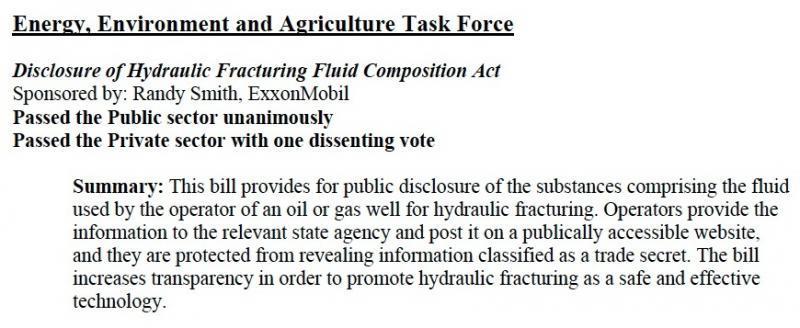
What the “Disclosure of Hydraulic Fracturing Fluid Composition Act” has done is pave the way to further the spotty disclosure that the industry has grown accustomed to, where companies can still guard the names and quantities of toxic chemicals as “trade secrets.” Exxon Mobil, the largest producer of shale gas in the country, gave a pittance — an estimated $12,500 donation out of revenue of nearly half a trillion dollars in 2011 — to help sponsor that ALEC meeting. According to the publicly traded company’s 2011 report on donations, ALEC received a total of $86,500 for the entire year from Exxon, which is the largest company in the world in terms of revenue.
In March, ALEC’s Energy, Environment and Agriculture Task Force staff Director Todd Wynn touted that states including Pennsylvania, Ohio, New York, Illinois and Indiana had taken up the “model” disclosure bill. In the same blog post Wynn bragged that, “ALEC has been at the forefront of the effort to retain state sovereignty over hydraulic fracturing, and our recently adopted model bill, the Hydraulic Fracturing Fluid Disclosure Composition Act, aims to preempt the promulgation of duplicative, burdensome federal regulations from U.S. Environmental Protection Agency (EPA).” (Documents from Common Cause showing ALEC tracking that bill are available upon request.)
Wynn is not just a cheerleader for ALEC’s oil and gas company agenda, he’s also expressed some unusual views on climate change. According to ExxonSecrets.org, Wynn has previously said:
I think that global warming could be a net benefit for the planet in fact.
Before joining ALEC, Wynn worked for one of its sister organizations, the “Cascade Policy Institute,” one of the so-called “think tanks” that are part of the “State Policy Network,” which has received Koch money and given donations to ALEC. Wynn says he studied climate impacts while getting a degree in economics. His views on climate change are most definitely not shared by most of the leading scientists in the world. Bill McKibben, for example, recently reiterated that devastating consequences of the current rate of climate change in an interview with the Center for Media and Democracy’s PRWatch, which included his views on fracking and climate change.
Utah Meeting Gathers Frack-Friendly Crowd

The romance between ALEC and fracking continued at this year’s ALEC meeting in Utah — an appropriate location for the frack-friendly ALEC crew. In May, the U.S. Secretary of the Interior Ken Salazar approved a major shale gas project by Texas-based Anadarko Petroleum Corp. in Utah’s Uinta Basin — expected to develop more than 3,600 new wells over the next decade.
In another industry-friendly move, Utah’s Governor Gary Herbert, who spoke the ALEC conference’s opening luncheon, signed a bill into law in March demanding that Congress hand over 30 million acres of federal land to the state by 2015 or the state will sue. According to the Associated Press, Lawmakers in Utah and Arizona have said the legislation is endorsed by ALEC. As documented by the Center for Media and Democracy’s ALEC Exposed Project, ALEC drafted the “Sagebrush Rebellion Act,” which was “designed to establish a mechanism for the transfer of ownership of unappropriated lands from the federal government to the states.” According to the Southern Utah Wilderness Alliance, the governor’s initiative would open up millions of acres of the “Wilderness Study Areas and proposed wilderness areas to oil and gas development” but in the process would cost Utah taxpayers enormously.
At the meeting, the CEO of the Institute for Energy Research (IER) Dr. Robert Bradley was one of the featured speakers. Bradley, formerly a director of policy analysis at Enron, also spoke at the 2011 ALEC conference in New Orleans. He is also an “adjunct scholar” at the right-wing think tank the Cato Institute and specializes in “global warming alarmism.” IER is a non-profit group focused on global energy markets that pushes for deregulation, advances climate change denial, and attempts to discredit renewable energy sources. The group’s 2010 IRS 990 form said that its focus was narrowed in on “impediments to domestic energy production, including government restrictions on access, burdensome regulations, and the favoritism of energy sources that are unsustainable in the marketplace.”
IER received some $307,000 from Exxon Mobil between 2003 and 2007, according to the publicly traded company’s “Corporate Giving Reports.” IER also received a total of $235,000 from Koch Family foundations between 1997-2010, according to a Greenpeace report. Koch Industries, an ALEC member, also profits from the expansion of fracking. Unlike Exxon, because Koch is not a publicly-traded company, any corporate donations to groups like IER, AEA, or AFP are not publicly disclosed.
IER is a “partner” organization of the American Energy Alliance, a 501(c)4 organization which calls itself the “grassroots arm” of IER. Thomas Pyle is president of both organizations, and is a former lobbyist for Koch Industries and former energy policy aide for former House Majority Leader Thomas D. DeLay, who resigned from the leadership following his indictment on conspiracy charges. Wayne Gable, also a former lobbyist for Koch Industries and former president for two of the Koch Family foundations, is on the board of both IER and AEA.
In 2011 IER and AEA launched “Energy for America” as a joint initiative with a laser point in on fracking, with an aim to “educate” the public on the practice. In October 2011, AEA and IER, in partnership with Koch Industries’ astroturf group Americans for Prosperity, started a “Energy for America” bus tour to encourage the expansion of domestic exploration of oil, gas and coal, targeting U.S. Senate battleground states for the upcoming 2012 elections.
Additionally, Brownstein Hyatt Farber Schreck is one of the three chairs of the ALEC Energy, Environment, and Agriculture Task Force. One of its clients is Freeport LNG, which owns and operates one of the first liquefied natural gas import terminals built in the United States. According to the law firm’s website, “For the last nine years, Brownstein has been the lead counsel in the structuring, strategy and development of the $1.2 billion receiving and regasification facility with commercial output capacity of more than 2.0 billion cubic feet of natural gas per day.”
ALEC’s History of Promoting Fracking
ALEC’s courtship with fracking goes back much further than last December. Prior to the approval of the chemical disclosure bill, there have been at least two ALEC resolutions passed to push for the expansion of fracking. The first was passed in December 2004, which was six months before the federal “Energy Policy Act of 2005” was passed, which included the “Halliburton Loophole” which exempted corporations from having to disclose the chemical make-up of fracking fluid in accordance with the Clean Water Act of 1972. Titled the “Resolution Encouraging Development of Liquefied Natural Gas,” the resolution stated, “ALEC encourages coordination among state agencies that oversee permitting for regasification, and between local, state and Federal government agencies, in order to facilitate and streamline regasification terminal permitting.” (“Regasification” relates to the way that gas which is converted to a liquid of a smaller volume than in its gas form is turned back into gas.)
The other resolution, titled the “Resolution to Retain State Authority over Hydraulic Fracturing,” states that the “American Legislative Exchange Council supports continued jurisdiction of the States to conserve and properly regulate oil and gas production in their unique geological and geographical circumstances.” This resolution pushes for regulation at the state-level rather than the federal level — under the assumption that the majority of states may impose weaker environmental standards than would be implemented under the U.S. Environmental Protections Agency (EPA) or Congress.
Corporate Pressure Heavy in Lead-Up to Approval of “Disclosure” Bill
In the lead-up to the approval of the chemical disclosure bill’s approval, the oil and gas industry had a strong presence at ALEC annual meeting in August 2011 in New Orleans. The Louisiana Host Committee for this conference had at least 13 corporate lobbyists, two of them representing two of the most profitable fossil fuel corporations in the world: Neil Buckingham of Shell and Jeff Copesky of Exxon Mobil. Buckingham is Shell’s Louisiana lobbyist, while Copesky is Exxon Mobil’s Southern Region lobbyist. Both of the massive global corporations they lobby for have joined in on the fracking agenda and earned a combined $49+billion dollars in 2010. Nearly one-eighth of the highlighted sponsors of the 2011 ALEC conference were players with a stake in domestic shale gas expansion. These included BP, Exxon Mobil, Chevron, Shell, ConocoPhillips, Chesapeake Energy, EnCana Corporation, CN (Canadian National Railroad), among others. If the 2011 sponsorship name levels were the same as for 2010, this amounted to over a quarter of a million dollars in contributions to underwrite the convention expenses.
At this conference, one of the workshops “Why Wait? Start Energy Independence Today” featured industry talking points such as shale gas is “clean, abundant, cheap, and it’s ours.” The ALEC 2011 Annual Meeting brochure, previewing the workshop, read “. . . [W]e as elected officials, policy makers and industry representatives must come together to create a 21st century energy policy that reduces our dependence on foreign oil and promotes the use of our most abundant, clean burning and American produced fuel, Natural Gas.”
 Since 2010, the Center for Media and Democracy has been documenting that even though the fracking industry is engaged in PR campaigns pushing fracking for our “national security,” the rate of export of natural gas by for-profit corporations to other countries has increased dramatically, as shown in the chart at the side. In addition, an August 2011 report titled “Pipe Dreams: What the Gas Industry Doesn’t Want You to Know about Fracking and U.S. Energy Independence,” written by Food and Water Watch, shows that contrary to the industry’s talking points, a significant amount of shale gas drilled in the U.S. is exported to foreign countries such as Japan, Australia, India, and China.
A second ALEC workshop “Unconventional Revolution: How Technological Advancements Have Transformed Energy Production in the United States,” included, among other panelists, Robert Bryce from the Koch-funded Manhattan Institute. The workshop “highlight[ed] the tremendous opportunities cleaner-burning natural gas offers for job creation and economic development. . . .”
In April 2011, researchers at Cornell University published research indicating that, despite long-standing assumptions and PR about “cleaner-burning” gas, the burning process for shale gas may be dirtier than that of coal in some respects. Also, in June 2011, The New York Times‘ Ian Urbina wrote a piece which called into question the profitability of shale gas.
Two weeks before ALEC’s summer 2011 meeting, Louisiana Governor Bobby Jindal announced that the state would be paying Cheniere Energy $6.5 billion to build a shale gas liquefacxtion facility at Cheniere’s Sabine Pass terminal in Cameron Parish, located in southwest Louisiana, right on the Gulf Coast shoreline. (Liquefying is a process through which methane gas is changed so it can be transported more easily by truck or train and also used to run vehicles.)
During the annual meeting, Jindal was awarded ALEC’s 2011 Thomas Jefferson Freedom Award. (Jindal is not only pushing the ALEC corporate gas agenda but has also been instrumental in attempting to implement ALEC’s public education privatization agenda in New Orleans in the aftermath of the Katrina disaster.)
Crippling Local Zoning Laws and Pushing for a Weak EPA
Beyond the effort to thwart real disclosure of fracking fluid, other “model” ALEC bills have been crafted to push forward the expansion of fracking. An ALEC bill titled “An Act Granting the Authority of Rural Counties to Transition to Decentralized Land Use Regulation,” was passed by ALEC’s Energy, Environment, and Agriculture Task Force at its Annual Meeting in August 2010 in San Diego. This model legislation would repeal all land use planning and zoning for “rural” counties by both county and state governments, taking away the local democratic process for communities to set local zoning rules. Legislation similar to this bill has been pushed in states including Pennsylvania, Ohio, Idaho, Colorado, and Texas. On July 26, the Pennsylvania Commonwealth Court struck down Pennsylvania’s version of this law stating that it “. . .violates substantive due process because it does not protect the interests of neighboring property owners from harm, alters the character of neighborhoods and makes irrational classifications.”

ALEC has also taken up the promotion of fracking in its April 2012 document called “The Economy Derailed: State-By-State Impacts of the EPA Regulatory Train Wreck.” In it, ALEC attempts to discredit Josh Fox’s Academy award-nominated film “Gasland,” which documents effects of fracking on communities across the country and the report claims that citizens do not need to worry about air or water contamination. It calls EPA efforts towards heightening federal regulations “duplicative and unnecessary” and that “the states themselves are best poised to ensure environmental protection from hydraulic fracturing processes.”
No Signs of a Break-Up
The relationship between ALEC and the oil and gas industry has proven to be mutually beneficial, advancing the corporate agenda on fracking at the expense of protections for ordinary Americans. Although 40 corporations, four non-profits, and 70 legislators have left ALEC, there is no indication that the big oil and gas companies that have helped bankroll ALEC are planning to leave any time soon.
New Media We Recommend
Below is a list of new materials that we have read/watched in recent weeks. The comments are not a “review” of the material, instead sort of an endorsement of ideas and investigations that can provide solid analysis and even inspiration in the struggle for change. All these items are available at The Bloom Collective, so check them out and stimulate your mind.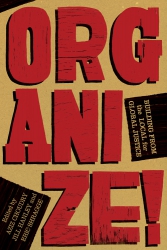
Organize: Building from the Local for Global Justice, edited by Aziz Choudry, Jill Hanley and Eric Shragge – This new collection of essays and reflections comes from activist/organizers from New Zealand, Canada and the US. The topics that are dealt with range from immigration, gentrification, Palestinian solidarity, food justice, feminism, queer politics to class-based organizing. Besides the powerful stories of organizing around numerous justice issues, there are also numerous essays that deal with group dynamics, consensus, collaborating, the role of music & art, privilege and fundraising. This collection of essays and reflections provides the reader with lots of concrete tools for organizing, but more importantly, it provides us with lessons learned and best practices to do both the internal and external work when organizing for social justice.

Anti-Racism in US History: The First Two Hundred Years, by Herbert Aptheker – Many books, both popular and scholarly, have examined racism in the United States, but this unique volume is the first to examine the existence of anti-racism in the first two hundred years of U.S. history. Herbert Aptheker challenges the view that racism was universally accepted by whites. His book thoroughly debunks the myth that white people never cared about the plight of African-Americans until just before the outbreak of the Civil War. It is always refreshing to come across a book that not only provides new insight into issues, but one that demonstrates that there is a long history of anti-racist and anti-White Supremacy organizing and resistance in the US. An important book for those wanting to understand this history and those wanting to continue to make history doing anti-racist work.

Teaching What Really Happened: How to Avoid the Tyranny of Textbooks & Get Students Excited About Doing History, by James W. Loewen – From the author of Lies My Teacher Told Me and Lies Across America, this latest book by James Loewen is essential for those who teach US history and care about how it is taught. Loewen’s book is a treasure of examples and techniques that educators can use to both motivate and engage students about learning history. History is often the worst subject for students in K-12 grades, but Loewen provides a fabulous framework with which to see history as relevant, interesting and a tool for actually making history. The examples Loewen provides hit on key historical moments in US history that provide a perfect springboard to look at a variety of ways educators can approach teaching history that makes it come alive. Like the rest of his books, Teaching What Really Happened is a must read.
Pink Ribbons Inc. – All of us know a woman who has been diagnosed with or has died from breast cancer. We have seen or may have attended one of the thousands of breasts cancer awareness events or even worn the pink ribbon, but how much do we know about the breast cancer awareness industry. Pink Ribbons Inc is an amazing investigation into both the co-opting of breasts cancer awareness by corporations/capitalism and how we have failed to seriously question where the money that is raised from pink ribbon events/sales actually goes. Highly recommended.
 Grand Rapids Institute for Information Democracy