Tar Sands resistance continues in Texas
This article by William Boardman is re-posted from Ecowatch.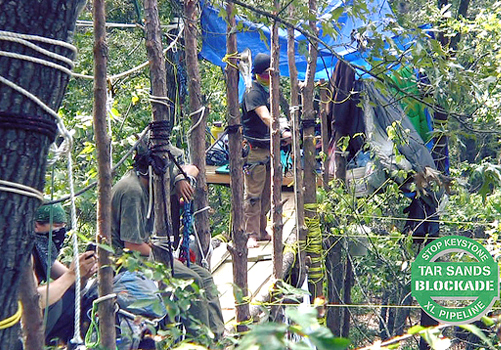
In a remote corner of northeast Texas, there are people living in trees because, they say, they’re trying to protect the planet from increased carbon emissions over the next century to help slow climate change. Challenging this treehouse blockade (see video below) is the advancing Keystone XL pipeline whose owners, the Canadian power company TransCanada, say they’re trying to save the oil industry from worsening economic conditions over the next decade.
TransCanada started building the Texas section of the XL pipeline in early August. Since then, efforts to slow construction by a coalition of landowners, environmentalists and others, calling themselves the Tar Sands Blockade, have gone from protest demonstrations and lawsuits to non-violent civil disobedience actions including an elaborate blockade of treehouses on Sept. 24 in the path of pipeline construction in Winnsboro, Texas.
Because the pipeline is intended to bring toxic tar sands crude oil, heated and under pressure, from the tar sands of Alberta, Canada to the Texas refineries of the Gulf Coast for export to foreign markets, resistance along the route through the American heartland has grown more intense over the years. And the company and the state have responded with violence, jailing, extreme bail amounts and over-charging on arrest.
“Game Over for the Climate?”
“If Canada proceeds, and we do nothing, it will be game over for the climate,” wrote James Hansen, director of the NASA Goddard Institute for Space Studies, last May in the New York Times. Hansen has been calling for measures to ward off or at least mitigate the effects of climate change since he first testified about the dangers before Congress in 1988.
He concluded his piece in the Times saying: “The science of the situation is clear—it’s time for the politics to follow. This is a plan that can unify conservatives and liberals, environmentalists and business. Every major national science academy in the world has reported that global warming is real, caused mostly by humans, and requires urgent action. The cost of acting goes far higher the longer we wait—we can’t wait any longer to avoid the worst and be judged immoral by coming generations.”
Tar sands oil is toxic from the moment it leaves the ground, leaving a devastated environment behind, wasting water in processing, destroying forests, threatening vast water tables with pipeline failures, spreading carcinogens, and finally doing far more damage than regular oil to the atmosphere and the global climate.
The oil industry, having announced plans to invest $379 billion in tar sands development, argues that it’s all benign.
Does It Take a Movie Star to Get Attention?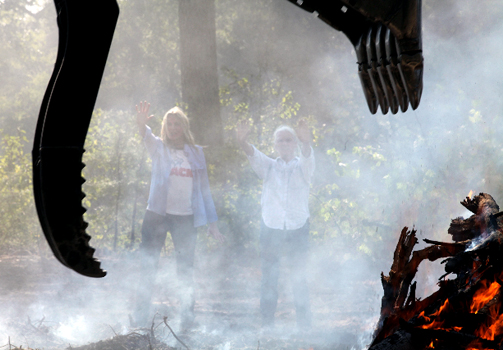
As the Tar Sands Blockade tree village enters its third week, mainstream media have ignored it almost entirely outside the region. Even on the internet there is limited coverage, with such exceptions as firedoglake.com and several environmental websites.
CBS News, USA Today and People showed some interest in the story when Darryl Hannah was arrested on Oct. 4, but CBS did no original coverage, only running an Associated Press story. All three reports ran Hannah’s unattractive mugshot, but none of them mentioned the treehouse blockade or the protestors’ underlying motivation, the dangers of tar sands oil.
Hannah was arrested for criminal trespass and resisting arrest for standing passively in front of TransCanada construction equipment, holding up her hands for it to stop. Hannah said a TransCanada private security guard hurt her wrist. Arrested with her was 78 year old great-grandmother Eleanor Fairchild. Fairchild, who also stood passively with her hands up, was charged with criminal trespass even though she was on her own land.
TransCanada had taken an easement across her land by eminent domain, so in the eyes of Texas law, that part of her land was no longer hers.
TansCanada’s use of eminent domain is under court challenge, but construction continues. The challenge is based in part on the facts that the law intends for eminent domain takings to be for the public good, whereas TransCanada is a multi-billion dollar, private, foreign corporation.
TransCanada also a faces a court challenge to its permits from the U.S. Army Corps of Engineers for this leg of the pipeline. A Sierra Club suit argues at length that TransCanada did not comply with the terms of federal environmental law, in part by failing to file a proper environmental impact statement. A federal judge denied the Sierra Club’s request for an injunction, and the construction continues.
In Winnboro, TransCanada has now encircled the treehouse blockade and shines floodlights at the protestors all night. Police and private security have been taking cameras away from people on the ground. When an important story is happening out of sight of the media, it’s hard for it to make an impression.
Resident concerns over fracking are downplayed in Fox 17 story
Yesterday, WXMI Fox 17 posted a story about exploratory drilling in Ionia at a site where a Texas-based company might engage in hydraulic fracturing.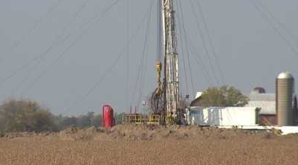
The local Fox affiliate talked to neighbors who live across the street from where the test drilling and potential fracking could take place. One response from the neighbor was:
“It’s not in our backyard, but it’s right across the stinkin’ street. So yea, close enough to really make us think about it. Ya know, start asking questions that we really didn’t ask before,” he explained.
This kind of sentiment has been shared across the country as more and more people find out about the environmental and health effects of hydraulic fracking.
The Fox 17 story then states, “Many environmentalists are against hydraulic fracturing, or fracking, because it involves injecting wells with chemically treated water.” The WXMI story provides no evidence of this claim, nor do they seek out one of the many anti-fracking groups that exist in Michigan, some even in Grand Rapids.
Instead of seeking out details on fracking from an environmentalist, Fox 17 then sites a spokesperson from the Michigan Department of Environmental Quality (DEQ) who states, “So you’d have at least three strengths of casing that would be cemented and sealed. So that would prevent any migration of any kind of fluid up and down the well and prevent anything from getting into the groundwater.”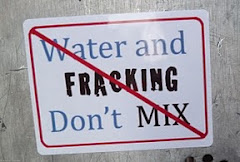
Ending with such a statement from a government official leaves one with the impression that fracking is safe and without health or environmental consequences. This flies in the face of research on the issue, such as recent studies done by the US Geological Survey, which confirm that fracking for natural gas does contaminate groundwater. Many known toxic chemicals are being used in fracking, chemical that are harmful to both humans and animals.
This information is widely available and is one of the reasons there are citizen movements all across the country that opposing hydraulic fracturing.
WXMI 17 could have easily found another voice, such as groups like Ban Fracking Michigan or Mutual Aid GR, which organized an anti-fracking protest two weeks ago in Grand Rapids, which Fox 17 reported on. There is also a big demonstration being organized for October 24 in Lansing, since the Michigan DNR will be hosting another land auction, which will allow oil & gas companies to buy mineral rights to drill on public land. There was a previous DNR land auction in May that also saw over 100 people come out to protest.
The fact that Fox 17 did not seek out other voices in this story or provide any larger contextual information about the growing statewide opposition demonstrates lazy reporting.
The Fracking of Rachel Carson, by Sandra Steingraber
This video is re-posted from Orion Magazine.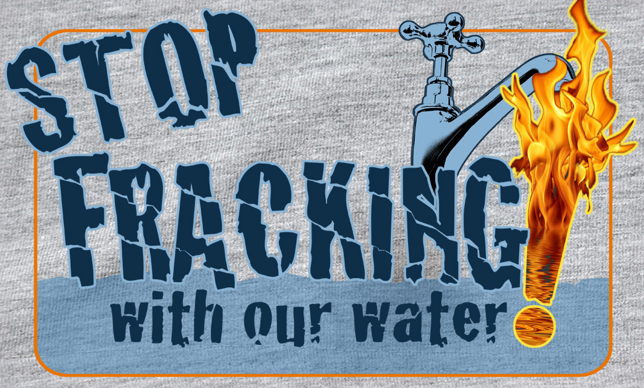
Author Sandra Steingraber, who is at the forefront of efforts to halt fracking across the Marcellus Shale deposits, reads excerpts from her essay about the fiftieth anniversary of Rachel Carson’s Silent Spring, accompanied by a full portfolio of fracking photos by Nina Berman.
Making lots money and feeling good about it: Reflections from the Corporate Social Responsibility Conference at Amway
For about 5 hours today, I sat through a conference held at the Amway headquarters in Ada on Corporate Social Responsibility.
About 125 people, mostly from the corporate world, participated in a conference entitled, Creating Impact: West Michigan Corporate Social Responsibility. The day-long conference featured two keynote speakers and several breakout sessions, all dedicated to the idea of corporate social responsibility or what some referred to as corporate sustainability.
This is a theme we have been writing about for the past two years and posting on our blog under Dissecting Green Capitalism.
The day began with an executive from Amway welcoming people and taking the opportunity to tell the audience about their practice of corporate social responsibility. The company founded by DeVos and Van Andel promotes volunteerism and financial giving amongst its employees as well as major charitable donations to numerous causes, according to the Amway spokesperson. The company spokesperson also said they were, “leveraging our Nutrilite products to children around the globe, in places like Mexico and Africa. These vitamins can be added to their native food to reduce anemia.”
One could argue that this is a nice charitable act, but what it also states about Amway and the whole corporate social responsibility trend is an unwillingness amongst global capitalists to address the root causes of problems, like malnutrition. Indeed, the comments from the Amway spokesperson set the tone for much of the rest of the day that this writer was present.
Before the first keynote speaker came to the podium, Grand Rapids Mayor George Heartwell addressed crowd. Heartwell talked about his personal and the City’s own journey in sustainability, or what Heartwell referred to as the Total Quality Management Movement.
The first keynote speaker was Jim Musial with Wolverine Worldwide. Musial gave a brief company overview and stated that the company, with recent acquisitions, is the largest non-athletic shoe company in the world.
Musial then talked about what he referred to as the rise of the Citizen Consumer, which he defined as people who wanted to make purchases that were good for the environment or supported some cause. The Wolverine executive said this is what should drive our companies, what he called a socially conscious market.
However, when Musial talked about the company’s facilities abroad and the work they do with independent suppliers he was a little more vague about how they operate. Musial said they want good corporate practices on how workers were treated, but they don’t have a great deal of pull to make suppliers adopt standards that many consumers want. He also said that it was hard to find monitoring agencies that were reliable, but he did refer to a new resource called the EcoIndex, which apparently was started by industry people and significant involvement from Nike.
Musial ended his presentation by talking about the giving practices of Wolverine Worldwide, both locally and around the globe. He showed pictures of Wolverine employees giving clean water systems and free shoes to poor people in the Dominican Republic. The pictures of smiling Dominicans feed into this notion of social responsibility as charity, without addressing the reasons for structural poverty in countries like the Dominican Republic.
Musial was then joined by a few additional presenters, but little new information was provided, except by an ethics professor from MSU. Kyle Whyte talked about global capitalism and how it creates what he called, “wicked problems.” His comments left an impression on the crowd who kept referring to this phrae, “wicked problems,” throughout the day.
This mini-panel discussion was followed by the first breakout sessions and I attended the one on “Corporate Citizenship.” The panel included Eric Foster (Seeds of Change), Jeff Padnos (Padnos) and Pat Longeran (Fifth Third Bank). This session was moderated by Norman Christopher (GVSU), who kept gushing over local corporate practices, particularly ones that the panelists were involved in.
Longeran used good doublespeak in his comments by say that Fifth Third wasn’t just involved in finances, they changed people’s lives. He also talked about how Fifth third has banks in poor neighborhoods and how the company has hundreds of people who serve on local non-profit boards. Getting company members to sit on boards of non-profits is a growing trend in the corporate world.
Jeff Padnos spoke next and said that doing business right is like “applied religion.” He equated giving people a job with the idea of teaching them to fish, which was an interesting Orwellian twist of to the statement from Bishop Dom Helder Camara who said, “When I give food to the poor, they call me a saint. When I ask why the poor have no food, they call me a communist.”
The third speaker on this panel was Eric Foster, with Seeds of Promise. Foster talked about getting people to be masters of their own destiny and local groups to partner with to make the necessary changes. Foster’s task is to get 40 people involved in place-based, resident led leadership that will benefit a particular neighborhood, to solve their own problems and create their own capital. Again, this is a nice sentiment, but it does not address any root causes, particularly structural injustices, which created poverty in the communities in Grand Rapids his organization is working with.
After lunch, participants then heard from Neil Hawkins, the sustainability person from Dow Chemical. Hawkins said that Dow has been involved with environmental sustainability for a long time and proves this by showing the audience a picture of a patent from 1906 for waste cogeneration.
Hawkins also talked about the company’s involvement with the 2012 Olympics and said that their involved was “not a form of greenwashing, but a chance to show case sustainable products. Numerous human rights groups disagreed and called out companies like Dow at the 2012 Olympics in London for engaging in greenwashing.
Howkins also talked about his company’s partnership with the Nature Conservancy to further brand their identity as having a commitment to environmental protection. We addressed this partnership in a previous posting, but would say that big beltway conservation groups like The Nature Conservancy are more committed to lobbying in DC than actually doing environmental justice work around the country.
During the Q&A someone did ask the Dow representative about the companies track record and that they have a history of making “bad decision” on environmental policy. Hawkins did say these were “old, old problems” and that “I am not going to “apologize or flog myself for past problems.” So, the people of India who have never really received justice over the Union Carbide (a subsidiary of Dow) catastrophe are just the victims of an old, old problem? What about Vietnam veterans who were exposed to the Dow created Agent Orange and the millions of Vietnamese who are still suffering from exposure? Just a problem of the past?
I left at this point, since it seemed pretty clear what was meant by “Corporate Social responsibility.” To be clear, I was not expecting the content to be much different than what I heard, but I went because I think it is always important to not only monitor what sectors of power are up to, but to hear directly from those in power about how they see the world.
This morning, MLive once again demonstrated their inability to report on the DeVos Family in a critical manner.
The article, posted online today, is headlined, ArtPrize founder Rick DeVos shares qualities with his grandfather, Amway co-founder Rich DeVos. The article does as is suggested in the headline, makes the argument that Rick DeVos is following in the footsteps of Amway co-founder Richard DeVos Sr.
The glowing review of the third generation DeVos states in part:
The entrepreneurial spirit of Rich DeVos, which has had a stamp on West Michigan for decades, seems to be renewed with his grandson Rick DeVos, who launched the international art competition and the innovative seed fund.
While his grandfather revitalized downtown Grand Rapids by investing in buildings, Rick is doing it with people.
To provide further evidence of Rick DeVos’ leadership and entrepreneurial spirit, the MLive reporter uses Doug and Dick DeVos as sourced. And what do you think that Rick’s uncle and father had to say about what the ArtPrize guru is doing for Grand Rapids? Of course it was glowing and affirming.
In addition, the MLive reporter addressed Rick DeVos’ other project, Start Garden. Not surprising, this project that Rick DeVos kicked off earlier this year was also presented as nothing but a major benefit to the community.
How is it that the most widely read daily news source in West Michigan acts as a stenographer to power? What kinds of conversations do reporters have with editors about how to present such a story? Now, I don’t think for a second that MLive editors had to say to the reporter of this article that they need to paint Rick DeVos as a local hero. It is our observation over the years of monitoring media in this market that local news agencies have internalized the same values as the corporate world, not just because they are thinking about ad sales, but because MLive is a corporation.
This internalizing of the values of the system means that the reporting on powerful families like the DeVos family is positive, but there are no balancing or dissident voices. The fact that there were no critical voices about either ArtPrize or Start Garden is a clear indicator that MLive is either unwilling to be critical of local power or is blind to the negative and even destructive aspects of what the DeVos family has done.
The recent GQ article on ArtPrize was able to both look at the cultural aspect of Artprize, but provide some contextual critique of the annual event. The author of that article was also able to find critical voices of the art extravaganza, even though that author is not from this community.
There is no mention of the fact that Rick’s uncle Doug DeVos recently gave $500,000 to the National Organization of Marriage (NOM), which is the largest anti-Gay marriage group in the US. The MLive article also does not mention the kind of negative impacts that other DeVos family funding has caused all around the world. Lastly, there is nothing in the MLive story that looks at the political economy of ArtPrize, which would expose the real financial winners of ArtPrize.
MLive should not call these kinds of articles news reporting. Stories that coddle power are nothing more than stenography and free publicity for companies like Amway and families like the DeVoses.
The Bloom Collective will be hosting a discussion this Saturday at its Westside location on the urgent issue of hydraulic fracturing, also known as fracking, in Michigan.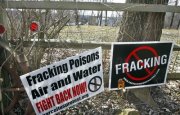
Communities around the country are resisting the push to extract more natural gas by fracking. More and more research is showing the devastating effects of fracking for natural gas, both environmental and health effects.
According to the Bloom Collective’s Facebook event page:
We will present information the ecological consequences of fracking, watch the short film entitled The Sky is Pink, talk about some specifics on fracking in Michigan, the DNR land auction planned for October 24 and what groups are currently doing and not doing in Michigan to challenge fracking.
This event will be a potluck discussion. The Bloom Collective will provide some food and beverages, but anyone is invited to bring food to share.
We are asking a donation of $3 for this event, which goes a long way towards our expenses.
What the Frack is going on in Michigan?
Saturday, October 13
4:00PM
671 Davis NW, Grand Rapids, lower level
bloomcollective@gmail.com or http://www.facebook.com/events/323486421082525/?fref=ts for more information.
The US Presidential Debates’ Illusion of Political Choice
This article by Glenn Greenwald is re-posted from Common Dreams.
Wednesday night’s debate between Barack Obama and Mitt Romney underscored a core truth about America’s presidential election season: the vast majority of the most consequential policy questions are completely excluded from the process. This fact is squarely at odds with a primary claim made about the two parties – that they represent radically different political philosophies – and illustrates how narrow the range of acceptable mainstream political debate is in the country.
In part this is because presidential elections are now conducted almost entirely like a tawdry TV reality show. Personality quirks and trivialities about the candidates dominate coverage, and voter choices, leaving little room for substantive debates.
But in larger part, this exclusion is due to the fact that, despite frequent complaints that America is plagued by a lack of bipartisanship, the two major party candidates are in full-scale agreement on many of the nation’s most pressing political issues. As a result these are virtually ignored, drowned out by a handful of disputes that the parties relentlessly exploit to galvanise their support base and heighten fear of the other side.
Most of what matters in American political life is nowhere to be found in its national election debates. Penal policies vividly illustrate this point. America imprisons more of its citizens than any other nation on earth by far, including countries with far greater populations. As the New York Times reported in April 2008: “The United States has less than 5% of the world’s population. But it has almost a quarter of the world’s prisoners.”
Professor Glenn Loury of Brown University has observed that these policies have turned the US into “a nation of jailers” whose “prison system has grown into a leviathan unmatched in human history”. The New Yorker’s Adam Gopnik called this mass incarceration “perhaps the fundamental fact [of American society], as slavery was the fundamental fact of 1850″.
Even worse, these policies are applied, and arguably designed, with mass racial disparities. One in every four African-American men is likely to be imprisoned. Black and Latino drug users are arrested, prosecuted and imprisoned at far higher rates than whites, even though usage among all groups is relatively equal.
The human cost of this sprawling penal state is obviously horrific: families are broken up, communities are decimated, and those jailed are rendered all but unemployable upon release. But the financial costs are just as devastating. California now spends more on its prison system than it does on higher education, a warped trend repeated around the country.
Yet none of these issues will even be mentioned, let alone debated, by Mitt Romney and Barack Obama. That is because they have no discernible differences when it comes to any of the underlying policies, including America’s relentless fixation on treating drug usage as a criminal, rather than health, problem. The oppressive system that now imprisons 1.8 million Americans, and that will imprison millions more over their lifetime, is therefore completely ignored during the only process when most Americans are politically engaged.
This same dynamic repeats itself in other crucial realms. President Obama’s dramatically escalated drone attacks in numerous countries have generated massive anger in the Muslim world, continuously kill civilians, and are of dubious legality at best. His claimed right to target even American citizens for extrajudicial assassinations, without a whiff of transparency or oversight, is as radical a power as any seized by George Bush and Dick Cheney.
Yet Americans whose political perceptions are shaped by attentiveness to the presidential campaign would hardly know that such radical and consequential policies even exist. That is because here too there is absolute consensus between the two parties.
A long list of highly debatable and profoundly significant policies will be similarly excluded due to bipartisan agreement. The list includes a rapidly growing domestic surveillance state that now monitors and records even the most innocuous activities of all Americans; job-killing free trade agreements; climate change policies; and the Obama justice department’s refusal to prosecute the Wall Street criminals who precipitated the 2008 financial crisis.
On still other vital issues, such as America’s steadfastly loyal support for Israel and its belligerence towards Iran, the two candidates will do little other than compete over who is most aggressively embracing the same absolutist position. And this is all independent of the fact that even on the issues that are the subject of debate attention, such as healthcare policy and entitlement “reform”, all but the most centrist positions are off limits.
The harm from this process is not merely the loss of what could be a valuable opportunity to engage in a real national debate. Worse, it is propagandistic: by emphasising the few issues on which there is real disagreement between the parties, the election process ends up sustaining the appearance that there is far more difference between the two parties, and far more choice for citizens, than is really offered by America’s political system.
One way to solve this problem would be to allow credible third-party candidates into the presidential debates and to give them more media coverage. Doing so would highlight just how similar Democrats and Republicans have become, and what little choice American voters actually have on many of the most consequential policies. That is exactly why the two major parties work so feverishly to ensure the exclusion of those candidates: it is precisely the deceitful perception of real choice that they are most eager to maintain.
Pestka vs Amash: An example of the election distraction strategy
We are one month away from the 2012 election and it is always instructive to look at how political races are framed in the local news media or in some cases mostly ignored.
In the race for Michigan’s 3rd Congressional district, most of the news coverage since the August 8 Primary has been about polling, which tells voters virtually nothing about the political platform of each candidate or their voting record.
If one wanted to find out where the candidates stood on the issues they could find some information on their respective websites. Incumbent candidate Justin Amash has 15 separate categories on his Issues page, but none of the positions he provides are more than 100 words.
All of the issues are complex and carry a sense of urgency, but Amash does seem to provide much substance on the issues he has identified. For example, here is his statement on Energy:
Our country is blessed with many options for producing energy. All forms of energy production should be allowed, and none should be given special benefits. Energy subsidies—whether for oil, wind, electric, or otherwise—make no sense. Subsidizing inefficient energy production in the hope that it will become efficient in the future is wasteful and ineffective. It requires higher taxes, locks in old technologies, and unfairly punishes entrepreneurs and inventors who do not have friends in government. Energy sources that truly meet the demands of consumers will thrive in the marketplace over time and do not need government handouts to be viable.
Such a statement is purposely vague and gives no indication on where the Congressman stands on issues such as subsidies to Big Oil, regulating the coal industry, environmental protections or the viability of renewable energy.
The same vague statements can be found on Candidate Steve Pestka’s website as well. In fact, Pestka’s Issues page only has 7 statements and his are even shorter than those provided by Amash. Here is one example from Pestka:
Creating good jobs – Getting a good job is crucial to strengthening our families and the middle class. Steve Pestka recognizes that we need to continue building a diverse economy with good-paying jobs in West Michigan. We need leaders in Washington who will embrace policies that support Michigan’s employers and which lead to higher wages, better jobs, and a more educated and stronger workforce.
What exactly does such a statement mean? It provides no context of the current economy, any clarity on what “higher wages” means, nor does it take into account current corporate tax policies or foreign trade policies, both of which determine a great deal in terms of jobs.
Pestka has nothing about his position on the US wars in Afghanistan, Libya or any number of US foreign policies. He says nothing about the US military budget, the states of Guantanamo, the use of torture or foreign aid to countries like Israel and Saudi Arabia. The Democratic challenger takes no public positions on major civil rights issues such as racial discrimination, LGBT issues, immigration or government spying. Pestka also has no information on Wall Street and the financial sector’s pillaging of the national treasury, housing foreclosures, corporate subsidies or social security. The former State Representative also says nothing about the rush by oil and gas companies in Michigan to use hydraulic fracking or the crisis of global warming.
Pestka does provide some critique of Amash’s voting record, but just on 5 legislative pieces and leaves out any number of major policy decisions that Amash has made in the last two years, such as his vote for US trade agreements with South Korea, Panama and Colombia. (All three of these trade policies were passed in the fall of 2011.) One would think with all the union backing Pestka has received he would make foreign trade an issue.
On the matter of campaign contributions, Pestka and Amash are nearly equal on amounts raised, with Amash raising $902,418 and Pestka raising $798,522, according to the last filling deadline of October 1, 2012. Major donors to Amash are Michigan Industrial Tools, Amway, Windquest Group, Autocam, Wolverine Oil & Gas and Bank of America. Major donors to Pestka are H&H Management & Development, International Association of Fire Fighters, UAW, United Food & Commercial Workers, Yesterdog and the NEA.
In the contributions area it seems there are some clear differences in where their money is coming from, but that is not overtly reflected in their platforms. Many people think that there are substantial differences between the Republicans and Democrats, but those differences tend to be around social and cultural issues, what are often called wedge issues, but not on structural issues. Both candidates operate within the framework of their respective political parties and that means that neither of them are going to challenge the business as usual policies of militarism, capitalism, environmental destruction, White Supremacy, imperialism, violence against women or the push to privatize public services. Until these issues are addressed or even debated, such elections will continue to be a staged showed to distract the public from real participatory democratic change.
Rethinking Columbus: Towards a True People’s History
This article by Bill Bigelow is re-posted from Common Dreams.
This past January, almost exactly 20 years after its publication, Tucson schools banned the book I co-edited with Bob Peterson, Rethinking Columbus. It was one of a number of books adopted by Tucson’s celebrated Mexican American Studies program—a program long targeted by conservative Arizona politicians.
The school district sought to crush the Mexican American Studies program; our book itself was not the target, it just got caught in the crushing. Nonetheless, Tucson’s—and Arizona’s—attack on Mexican American Studies and Rethinking Columbus shares a common root: the attempt to silence stories that unsettle today’s unequal power arrangements.
For years, I opened my 11th-grade U.S. history classes by asking students, “What’s the name of that guy they say discovered America?” A few students might object to the word “discover,” but they all knew the fellow I was talking about. “Christopher Columbus!” several called out in unison.
“Right. So who did he find when he came here?” I asked. Usually, a few students would say, “Indians,” but I asked them to be specific: “Which nationality? What are their names?”
Silence.
In more than 30 years of teaching U.S. history and guest-teaching in others’ classes, I’ve never had a single student say, “Taínos.” So I ask them to think about that fact. “How do we explain that? We all know the name of the man who came here from Europe, but none of us knows the name of the people who were here first—and there were hundreds of thousands, if not millions, of them. Why haven’t you heard of them?”
This ignorance is an artifact of historical silencing—rendering invisible the lives and stories of entire peoples. It’s what educators began addressing in earnest 20 years ago, during plans for the 500th anniversary of Columbus’s arrival in the Americas, which at the time the Chicago Tribune boasted would be “the most stupendous international celebration in the history of notable celebrations.” Native American and social justice activists, along with educators of conscience, pledged to interrupt the festivities.
In an interview with Barbara Miner, included in Rethinking Columbus, Suzan Shown Harjo of the Morning Star Institute, who is Creek and Cheyenne, said: “As Native American peoples in this red quarter of Mother Earth, we have no reason to celebrate an invasion that caused the demise of so many of our people, and is still causing destruction today.” After all, Columbus did not merely “discover,” he took over. He kidnapped Taínos, enslaved them—“Let us in the name of the Holy Trinity go on sending all the slaves that can be sold,” Columbus wrote—and “punished” them by ordering that their hands be cut off or that they be chased down by vicious attack dogs, if they failed to deliver the quota of gold that Columbus demanded. One eyewitness accompanying Columbus wrote that it “did them great damage, for a dog is the equal of 10 men against the Indians.”
Corporate textbooks and children’s biographies of Columbus included none of this and were filled with misinformation and distortion. But the deeper problem was the subtext of the Columbus story: it’s OK for big nations to bully small nations, for white people to dominate people of color, to celebrate the colonialists with no attention paid to the perspectives of the colonized, to view history solely from the standpoint of the winners.
Rethinking Columbus was never just about Columbus. It was part of a broader movement to surface other stories that have been silenced or distorted in the mainstream curriculum: grassroots activism against slavery and racism, struggles of workers against owners, peace movements, the long road toward women’s liberation—everything that Howard Zinn dubbed “a people’s history of the United States.”
Which brings us back to Tucson: One of the most silent of the silenced stories in the curriculum is the history of Mexican Americans. Despite the fact that the U.S. war against Mexico led to Mexico “ceding”—at bayonet point—about half its country to the United States, this momentous event merits almost no mention in our textbooks. At best, it is taught merely as prologue to the Civil War.
Mexican Americans were central to building this country, but you wouldn’t know it from our textbooks. They worked in the Arizona copper mines, albeit in an apartheid system where they were paid a “Mexican wage.” In the 1880s, the majority of workers building the Texas and Mexican Railroad were Mexicans, and by 1900, the Southern Pacific Railroad had 4,500 Mexican workers in California alone.
They worked the railroad and they worked for their rights. In 1903, Mexican and Japanese farm workers united in Oxnard, California to form the Japanese-Mexican Labor Association. As Ronald Takaki notes in A Different Mirror, “For the first time in the history of California, two minority groups, feeling a solidarity based on class, had come together to form a union.” They struck for higher pay, writing in a statement that, “if the machines stop, the wealth of the valley stops, and likewise if the laborers are not given a decent wage, they too, must stop work and the whole people of this country suffer with them.”
Nowhere was this rich history of exploitation and resistance being explored with more nuance, rigor, and sensitivity than in Tucson’s Mexican American Studies program. Like Rethinking Columbus, Mexican American Studies teachers aimed to break the classroom silence about things that matter—about oppression and race and class and solidarity and organizing for a better world. Watch Precious Knowledge, the excellent film that offers an intimate look at this program—and chronicles the fearful, even ludicrous, attacks against it—and you’ll get a sense of the enormous impact this “rethinking” curriculum had on students’ lives.
Let’s continue to use this and every so-called Columbus Day to tell a fuller story of what Columbus’s voyage meant for the world, and especially for the lives of the people who’d been living here for generations. And let’s push beyond “Columbus” to nurture a “people’s history” curriculum—searching out those stories that help explain how this has become such a profoundly unequal world, but also how people have constantly sought greater justice. This is the work on which educators, parents, and students need to collaborate.
Note: There is a national call for a day of solidarity on October 12 with the Raza Defense Fund and the campaign to Save Ethnic Studies. You can join by hosting a house party to view the documentary film Precious Knowledge about the Mexican American Studies program in Tucson, Ariz. Learn more here.
This article by Rainforest Action Network is re-posted from Ecowatch.
As we write, our friends with the Tar Sands Blockade are blocking construction of TransCanada’s Keystone XL pipeline in the woods of Texas. For the past six months they have built a movement of climate activists, rural landowners, Texans, Oklahomans and people from all over the country to fiercely resist it. For two weeks, they have captured the imagination of the world with a daring tree-sit and bold ground actions near Winnsboro, TX that have delayed TransCanada’s operations.
TransCanada has responded by allowing its employees to operate their heavy machines with reckless disregard for the safety of protestors and tree-sitters. Police have responded with brutal means such as pepper-spray and Tasers against peaceful protestors. Prosecutors have responded with elevated charges.
It is clear what is at stake. NASA’s leading climate scientist Dr. James Hansen has called the Keystone XL pipeline, “a fuse to the largest carbon bomb on the planet.” If all the carbon stored in the Canadian tar sands is released into the earth’s atmosphere it will mean “game over” for the planet.
In 2011, we saw the Tar Sands Action galvanize environmental and social justice communities in an unprecedented show of unity during the sit-ins in front of the White House. Every day members of Indigenous communities, faith communities, labor communities, anti-mountaintop removal movements, anti-fracking movements and many more stepped forward and put their bodies on the line in solidarity. In the year since, we have witnessed people from the Lakota nation in South Dakota and from Moscow, Idaho putting their bodies in roads and highways blocking large transport trucks carrying oil refining equipment to develop further tar sands extraction. Now, the Tar Sands Blockade has taken the next logical step confronting climate change.
If we are determined to prevent the pursuit of extreme energy from destroying our communities, natural systems and climate, then peaceful, yet confrontational, protests like the Tar Sands Blockade are necessary actions for change.
Let us be clear: there is not an inch of daylight in between us and those blocking construction of the Keystone XL pipeline in Texas. We stand with them as we’ve stood with those fighting mountaintop removal coal mining in Appalachia, those defending old growth forests in Cascadia and those challenging nuclear power across this country.
We stand in solidarity with those who stand up for us all.
Alliance of Community Trainers (ACT)
Center for Biological Diversity
Communities for a Better Environment
Global Alliance for Incinerator Alternatives
Global Justice Ecology Project
Grassroots Global Justice Alliance
Indigenous Environmental Network
Missourians Organizing for Reform and Empowerment (MORE)
Platform
Radical Action for Mountain Peoples’ Survival (RAMPS)
smartMeme Strategy & Training Project
 Grand Rapids Institute for Information Democracy