This article by Winona LaDuke is re-posted from Yes Magazine.
Attawapiskat Chief Theresa Spence enters her fourth week of a hunger strike outside the Canadian parliament building, thousands of protesters voice their support in Los Angeles, London, Minneapolis, and New York City. Spence and the protesters of the Idle No More movement are drawing attention to deplorable conditions in native communities and the recent passage of Bill C-45, which sidesteps most Canadian environmental laws.
Put it this way: Before the passage of Bill C-45, 2.6 million rivers, lakes, and a good portion of Canada’s three ocean shorelines were protected under the Navigable Waters Act. Now, only eighty-seven are protected. That’s just the beginning of the problem, which seems not to have drawn much attention from the general public.
“Flash mob” protests with traditional dancing and drumming have erupted in dozens of shopping malls across North America, marches and highway blockades by aboriginal groups and supporters have emerged across Canada and as far away as New Zealand and the Middle East. This weekend, hundreds of native people and their supporters held a flash mob round dance, with hand drums and singing, at the Mall of America in Minneapolis, again as a part of the Idle No More protest movement. This quickly emerging wave of native activism on environmental and human rights issues has spread like a wildfire across the continent.
Prime Minister Harper’s push for tar sands and mining
A group of natives from Aamjiwnaang First Nation in Sarnia, Ontario, pitched a pickup truck across the tracks of a Canadian National Railway spur and blocked train traffic Friday in support of the Idle No More protest in Ottawa. The blockade began just after Boxing Day, that famed Canadian holiday, and has continued.
The Aamjiwnaang blockade is one of hundreds. A center of controversy is the proposed Northern Gateway pipeline, which would cost $6 billion and bring tar sands from Alberta to the Pacific. The pipeline will cross over 40 native nations, all of whom have expressed opposition. The legislative changes could expedite approval of this and many other projects—all of which are in aboriginal territories.
“Idle No More” is Canadian for “That’s enough BS, we’re coming out to stop you,” or something like that. Canada often touts a sort of “better than thou” human rights position in the international arena and has, for instance, a rather small military, so it’s not likely to launch any pre-emptive strikes against known or unknown adversaries, and has often sought to appear as a good guy, more so than its southern neighbor. More than a few American expatriates moved to Canada during the Vietnam war, and stayed there, thinking it was a pretty good deal.
That is sort of passé, particularly if you are a native person. And particularly if you are Chief Theresa Spence. Spence is the leader of Attawapiskat First Nation—a very remote Cree community from James Bay, Ontario, which is at the bottom of Hudson Bay. The community’s 1,549 on-reserve residents (a third of whom are under the age of 19) have weathered quite a bit, including the fur trade, residential schools, a status as non-treaty Indians, and limited access to modern conveniences such as toilets and electricity. This is a bit commonplace in the far north, but it has become exacerbated in the past five years.
Enter DeBeers, the largest diamond mining enterprise in the world. The company moved into northern Ontario in 2006. The Victor Mine reached commercial production in 2008 and was voted “Mine of the Year” by the readers of the international trade publication, Mining Magazine. The company states that it is “committed to sustainable development in local communities.” But this is where the first world meets the third world in the north, as Canadian MP Bob Rae discovered last year on his tour of the destitute conditions in the village. Infrastructure in the subarctic is in short supply. There is no road into the village eight months of the year; during the other four months, during freeze up, there’s an ice road. A diamond mine needs a lot of infrastructure. And that has to be shipped in, so the trucks launch out of Moosonee, Ontario. Then, they build a better road. The problem is that the road won’t work when the climate changes, and already stretched infrastructure gets tapped out.
There is some money flowing in, that’s for sure. A 2010 report from DeBeers states that payments to the eight communities associated with its two mines in Canada totalled $5,231,000 that year. Forbes magazine reports that diamond sales by the world’s largest diamond company “increased 33 percent, year-over-year, to $3.5 billion” and that DeBeers “reported record EBITDA of almost $1.2 billion, a 55 percent increase over the first the first half of 2010.”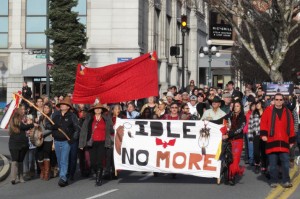
As the Canadian Mining Watch group notes, “Whatever Attawapiskat’s share of that $5 million is, given the chronic underfunding of the community, the need for expensive responses to deal with recurring crises, including one that DeBeers themselves may have precipitated by overloading the community’s sewage system , it’s not surprising that the community hasn’t been able to translate its … income into improvements in physical infrastructure.” Last year, Attawapiskat drew international attention when many families in the Cree community were living in tents.
The neighboring village of Kashechewan is in similar disarray. They have been boiling and importing water. The village almost had a complete evacuation due to health conditions, and as Alvin Fiddler, Deputy Grand Chief of the Nishnawbe Aski Nation, a regional advocacy network, told a reporter, “fuel shortages are becoming more common among remote northern Ontario communities right now.” That’s because the ice road used to truck in a year’s supply of diesel last winter did not last as long as usual. “Everybody is running out now. We’re looking at a two-month gap” until the ice road is solid enough to truck in fresh supplies, Mr. Fiddler said.
Kashechewan’s chief and council are poised to shut down the band office, two schools, the power generation center, the health clinic, and the fire hall because the buildings were not heated and could no longer operate safely. “In addition, some 21 homes had become uninhabitable,” according to Chief Derek Stephen. Those basements had been flooded last spring, as the weather patterns changed. (Just as a side note, in 2007, some 21 Cree youth from Kashechewan attempted to commit suicide, and the Canadian aboriginal youth suicide rate is five times the national average.)
Both communities are beneficiaries of an agreement with DeBeers.
The lost boys of Aamjiwnaang
Back at Aamjiwnaang, the Ojibwe have blockaded the tracks. Those are tracks that are full of chemical trains, lots of them. There are some 62 industrial plants in what the Canadian government calls Industrial Valley. The Aamjiwnaang people would like to call it home, but they’ve a few challenges in their house.
There’s a recent Men’s Health magazine article called, “The Lost Boys of Aamjiwnaang.” That’s because the Ojibwe Reserve of Aamjiwnaang has few boys. Put it this way: In a normal society, there are about l05 boys to l00 girls born. That’s the odds for a thousand years or so. However, at Aamjiwnaang, things are different.
Between 1993 and 2003, there had been two girls born for every boy in the tribal community, one of the steepest declines ever recorded in birth gender ratio. As the reporter for Men’s Health notes, “These tribal lands have become a kind of petri dish for industrial pollutants.”
This trend is international, particularly in more industrialized countries , and the odd statistics at Aamjiwnaang are indicative of larger trends. The rail line known as the St. Clair spur, carries Canadian National and CSX trains to several large industries in Sarnia’s Chemical Valley. Usually four or five trains move through each day, all full of chemicals. The Ojibwe have faced a chronic dosage of chemicals for twenty-five years, and are concerned about the health impacts. They are also concerned about proposals to move tar sands oil through their community in a pre-existing pipeline known as Line Nine.
The Idle No More movement is further spurred by what Clayton Thomas Muller, a representative of the movement, calls “the extremist right wing government of Steven Harper,” a government that seems intent on selling the natural wealth of the Canadian (aboriginal) north to the highest bidders in a multinational market. The recent passing of the omnibus budget Bill C-45, which gutted thirty years of environmental legislation, was approved by the Senate in a 50-27 vote.
Aboriginal leaders charge the Conservative government with pushing the bill through without consulting them. They note the bill infringes on their treaty rights, compromises ownership of their land, and takes away protection for Canada’s waterways and most of the environment. Since Canada’s economy is largely based on exploiting natural resources at an alarming rate, moving into a leading position in the world in terms of greenhouse gas emissions, fracking and lacing pristine water with cyanide for new mines, it’s convenient to gut the environmental laws. It’s also convenient to violate the international laws which are treaties.
Start seeing Indians
In the United States, the native community has been coming out in numbers and regalia to support the Canadian native struggle to protect the environment—drawing attention at the same time to similar concerns and issues here in the U.S. For instance, Ojibwe from the Keewenaw Bay Community in Michigan rallied against a Rio Tinto Zinc mine project, while Navajo protesters in Flagstaff, Ariz., continued opposing a ski project with manufactured snow at a sacred mountain.
Pamela Paimeta, a spokesperson for the Idle No More movement in Canada, urges the larger community to see what is occuring across the country as a reality check.
“The first Nations are the last best hope that Canadians have for protecting land for food and clean water for the future,” she said. “Not just for our people but for Canadians as well. So this country falls or survives on whether they acknowledge or recognize and implement those aboriginal and treaty rights. So they need to stand with us and protect what is essential.”
Meanwhile , Chief Theresa Spence is still hoping to meet with Prime Minister Stephen Harper, urging him to “open his heart” and meet with native leaders angered by his policies.
“He’s a person with a heart but he needs to open his heart,” she said. “I’m sure he has faith in the Creator himself and for him to delay this, it’s very disrespectful, I feel, to not even meet with us.”
The reality is that Attawapiskat, Aamjiwnaang, and Kashechewan are remote native communities that receive little or no attention until a human rights crisis of great proportion causes national shame.
Facebook and social media equalize access for those who never see the spotlight. (Just think of the Arab Spring). With the help of social media, the Idle No More movement has taken on a life of its own in much the same way the first “Occupy Wall Street” camp gave birth to a multitude of “occupy” protests with no clear leadership.
“This has spread in ways that we wouldn’t even have imagined,” said Sheelah McLean, an instructor at the University of Saskatchewan and one of the four women who originally coined the “Idle No More” slogan.
“What this movement is supposed to do is build consciousness about the inequalities so that everyone is outraged about what is happening here in Canada. Every Canadian should be outraged.”
Actually, we all should be outraged, and Idle no More.
Last night Representative Justin Amash hosted a Town Hall Meeting at the Ford Museum in Grand Rapids. The auditorium was about half-full, which would make the turnout around 200.
Amash talked briefly before the question and answer period and addressed only one major political issue, the “fiscal cliff.” The West Michigan Representative has received a fair amount of attention recently because of his stance on this issue, which has resulted in him being removed from the Budget Committee.
Amash stated that the country needs to spend less than what it does now, in order to balance the budget, a comment that elicited a strong applause. However, Amash made numerous comments that had a populist tone to them all night, but there was never much substance to back it up. This is a theme we will return to later.
Representative Amash stated that the agreement to avoid going over the “fiscal cliff” is temporary and will only prolong the problem. The country, he believes, is in really bad shape financially and it will continue to be a problem, especially for the poor.
Amash said that both Democrats and Republicans have both not done a good job on spending and that both parties are responsible for the nation’s economic woes. However, his answer to how the problem is solved was “if the public understands the problem, which is different than trying to get the politicians to understand.” This is either a naïve statement on his part or just a diversion, since the public needs to do more than understand the problem for real change to take place.
The last thing the Representative addressed before opening the night up to questions from the audience, was to talk about his commitment to transparency. It is not secret that he regularly posts on Facebook how he votes, so that constituents can see where he stands on issues. This is certainly better than what most federal politicians are willing to do, but just posting a brief explanation of how he voted is not enough for real transparency. Amash rarely puts a hyper-link to the actual legislation, so people can read the language for the themselves and he rarely provides much context for the vote as it relates to the larger picture of whatever issue he is voting for. A better site for transparency is VoteSmart.org, where you can check the voting records of all politicians. You can also view them by most recent votes or by topics, which provides the public with a more comprehensive view of how any politician votes on particular issues like Trade, Health Care or Military Spending.
Questions, but not many answers
This writer counted 17 different questions that were presented to the Congressman during the Q & A period. Most of the questions came from people who clearly supported Amash and made no bones about their affiliation with the Tea Party or Libertarian wing of the Republican Party.
This was evident to anyone present, since people either said they were members of the Tea Party or they use language in their questions to reflect a specific way they saw politics in the US.
Virtually everyone who asked a question expressed nothing short of contempt for the government, with statements about corruption, theft, lack of transparency, no regard for the public and no regard for real democracy.
Some people who asked questions discussed the Federalist Papers, some the Federal Reserve and silver and others asked Amash why he hasn’t left the Republican Party.
The Congressman addressed many of these questions with kind of an answer. Despite Amash’s statements about how the government is broken, he believes in working within the system, even if it means personally talking to each member of Congress. Amash is not interested in leaving the Republican Party, but he acknowledged on numerous occasions that both parties are to blame for the state of the country.
Some one asked him about the Tea Party Movement and its ability to affect change? He said that the Tea Party and Occupy both have had an impact on politics as usual, but he offered no concrete example to substantiate his claims.
Another person asked him about term limits, which he said he supported. Amash said that some members of Congress have been their too long and have lost touch with their communities. They live just outside of DC in the wealthiest part of the country, in Virginia. Amash even stated that many in Congress were wealthy before they got there, which is how they can get elected. This analysis also brought a loud applause from the audience. However, Amash’s solution to the financial corruption of government was that both parties needed to change. Again, populist rhetoric, but only mild reformist tactics were suggested for action.
There were some question from people who had a different perspective or at least different concerns from those who were in the majority in the room. One person said that the immigration system is broken, and asked how do we fix it? Amash thinks we need to have a system where people can come and work freely in the US and have access to becoming citizens. “There needs to be a better system in place. A big reason why so many who come illegally is because it is too difficult to come in.” Amash also said that the government shouldn’t just be able to grab people and deport them, even though that is the policy of the current administration. In fact, deportations have increased dramatically under the Obama administration.
Another person with the Micah Center in Grand Rapids said they were holding a large meeting on immigration reform in March and wanted him to commit to being there. Amash responded by saying that they should talk to his staff afterwards to work out a date.
Another person asked about concrete examples of funding cuts that Amash would support in order for the budget to be balanced. Amash said that there needs to be changes to the current Social Security and Medicare systems and that military spending does need to be reduced. On military spending Amash said there is a “great deal of waste and there are missions we shouldn’t be on.” When asked which mission the US shouldn’t be involved in, Amash stated that Libya took place without Congressional approval and that the Afghanistan war cost is outrageous. It is not that he was against the war, since he stated, “We should fight a war to win it and go home.”
One last question that was asked had to do with how the Congress thinks environmental conservation should take place. Here Amash showed his true colors and his commitment to neo-liberal capitalism, by saying, “the best way to conserve the environment is to have a vibrant economy. Poor people around the world don’t care about the environment, because the people aren’t wealthy enough to care about it.”
In the end it seems to this writer that while the rhetoric of Amash seemed anti-establishment, when confronted with what calls to action, the Congressman made sure that people should still put their faith in reforming the government from within. He did advocate that the public needs to be better informed so it could pressure the government to change. While this is a popular notion it is naïve to think that the systems of power in this country will give up that power based on public pressure, at least not the kind of pressure that Amash was suggesting.
Report Back from Fracking Meeting in Allegan
This article was written by Nicole Berens-Capizzi.
A meeting took place in Allegan County on January 9 to “educate” local residents about oil and gas leases and horizontal hydraulic fracturing. This meeting was sponsored by Allegan Farm Bureau and the Michigan State University (MSU) extension office. The speakers included Bill Mitchell of the Department of Environmental Quality (DEQ), Curtis Talley, the MSU Extension Area Farm Management Educator, Luke Miller of Miller Energy (who is also a representative of the Michigan Oil and Gas Association), and a lawyer specializing in oil and gas leases. Later in the meeting this writer discovered that there were individuals from numerous environmental groups, including Michigan Land Air Water Defense (MLAWD) and a group from Fennville whose philosophy is to look for alternatives to fossil fuels. There were many farmers in the audience, some of whom were also involved with environmental groups.
Before introducing the speakers, the individual who began the meeting briefly discussed Michigan’s role in oil and gas production, saying that Michigan has over a trillion cubic feet of capacity for oil and gas. She said that because of landmen and individuals willing to lease their land for oil and gas exploration, Michigan ranks high in oil and gas production. In relation to landowners leasing their property for this purpose, she stated that “regulations can seem overwhelming to a person not used to dealing with them”. After this brief discussion, she introduced the speakers.
Bill Mitchell of the DEQ was the first presenter. Before beginning his presentation, he reiterated to the audience that the DEQ does not work for the oil or gas industry, and they are not paid by them. He stated that the DEQ’s job is simply to enforce the laws regarding oil and gas exploration. Mr. Mitchell showed a map of Michigan that highlighted where oil and natural gas wells are located throughout the state. Much of the activity was located on or near the Antrim Shale, where many vertical wells have been installed. Mr. Mitchell repeated on at least two occasions at the beginning of his presentation that what is happening in Michigan (in terms of oil and gas exploration) is not unlike what’s happening in other areas of the country. While this statement was likely meant to make the audience feel at ease with the whole process, this would be more appropriately seen as a warning given what is happening in other states such as Pennsylvania and Ohio.
Mr. Mitchell briefly discussed oil and gas wells in Allegan County, though he did not discuss specific locations. In his presentation he stated that Allegan County has 196 oil wells, 16 brine disposal wells, 10 natural gas wells, and 217 gas storage wells. In reference to “brine”, Mr. Mitchell repeatedly stated throughout his presentation that brine is nothing more than salt water and is not the same as the “flowback water” that contains all of the chemicals used in the fracking process. This confused many members of the audience, as was evidenced by the fact that throughout his presentation and others, people continued to ask for clarification of the term. For those of us who have studied fracking, “brine” is the term used by the industry to describe the flowback water, which includes not only salt but the chemicals used in the fracking process. While Mr. Mitchell claimed brine and flowback water are two separate things, later in the day he used the terms “brine disposal wells” and “flowback disposal wells” in reference to the same thing.
Included in Mr. Mitchell’s presentation was a brief discussion of the DEQ’s role in the oil and gas leasing process. He said that the first step for oil and gas companies is to obtain leases, and the DEQ plays no role in this. The DEQ gets involved when oil and gas companies seek a permit for “exploration” purposes, at which point the DEQ verifies that they have acquired mineral and surface rights.
Mr. Mitchell also made a distinction between hydraulic fracturing and horizontal and vertical drilling. In a nutshell, he said drilling is the first step and hydraulic fracturing is “a completion process”. He noted that there have been concerns about fracking because of “media attention” on the issue, and attempted to reassure the audience that fracking is safe because there are over 12,000 wells in Michigan and it has been done safely for years. After an audience member asked for more information on those 12,000 wells, Mr. Mitchell admitted that the majority of those wells have been vertically drilled, as opposed to the newer, horizontally drilled wells that people are even more concerned about. One individual said she thought it would be prudent for water quality tests to be done prior to this exploration, at which point Mr. Mitchell said that “it isn’t the DEQ’s job to keep track of the chemicals used, just to enforce the laws”. More questions from the audience followed. At the end of his presentation, Mr. Mitchell took a seat at the back of the room next to Mr. Miller.
Between presentations this writer observed a volunteer with MLAWD asking one of the individuals hosting the meeting if he could hand out information on MLAWD or put some of his flyers on the table with the other literature handed out for the presentation. The first person he spoke with referred him to one person, who suggested he talk to another person, and the third person he spoke with pointed him back to the first person he spoke with, at which point he explained that person referred him to them. In the end, they said he couldn’t distribute his flyers. The meeting already seemed pro-industry before, but this refusal to officially allow literature from another perspective made it seem even more so. To be fair, this writer also brought information to hand out at the meeting and did so between presentations and on lunch break without anyone stopping her.
The second presenter was Curtis Talley from the MSU extension. He stated that he has experience negotiating with oil and gas companies in Colorado. His presentation focused more on how a landowner can get the most out of their money, making a comparison between crop farming and being a mineral rights owner. Mr. Talley encouraged audience members to “treat underground resources the way you’d treat your above ground resources”, meaning that mineral rights owners should not be willing to accept the first offer.
Economics was a big focus of this presentation, but audience members continued to ask questions and raise concerns about fracking and the leasing process. One audience asked, “How public are lease rates?” Mr Talley responded, “Not very public.” Another person asked “Who’s our advocate?” “The person in the mirror,” was Mr. Talley’s response. The person replied, “No wonder they’re making so much money,” which made some people laugh. “That’s business,” responded Mr. Talley. Then someone asked “How much does it cost to ship it to China?” This question made people laugh even more, including the presenters. Mr. Talley didn’t seem to know how to answer this question, saying that the natural gas might have to be liquified, and also stating that “markets overseas for natural gas are higher than they are here”. Some individuals raised concerns about compulsory pooling should they refuse drilling on their property. Mr. Talley touted the “benefits” of compulsory pooling, saying that an individual will still get paid, albeit a lower percentage of royalties. Based on the research this writer has done, this statement conflicts with the stories of some individuals who have been forced into compulsory pooling. When asked about the involvement of banks when there’s a mortgage on the home, Mr. Talley said that banks typically love properties that are being explored for oil and gas because if a homeowner defaults on a loan, the oil and gas companies will pay for it.
The last two presentations occurred after a short lunch break. These two were also the shortest. Luke Miller of Miller Energy gave a brief presentation on the process of hydraulic fracturing, again making a distinction between vertical/horizontal drilling and hydraulic fracturing. Throughout this presentation he stated that drilling for oil and gas is safe and has been done in Michigan for many years without incident. One audience member brought up the hydrogen sulfide gas leak that occurred in northern Michigan a couple of winters ago. This presenter and the others diminished this event, stating that the levels of hydrogen sulfide in the leak weren’t enough to be toxic to humans.
The last presentation was done by a lawyer specializing in oil and gas leases. He made a disclaimer that he is not an expert on the topic (it is assumed he meant the topic of fracking), and also talked about his background growing up on a farm. Like Mr. Talley, he continuously stated that people need to know what they’re signing up for, and they need to do their research first. He admitted that landmen will sometimes use tactics that make the landowner feel like they are required to sign a lease, and they will even pit neighbors against eachother. An individual asked if there was a way for a landowner to look up specific landmen in order to know their tactics, but the presenter said there wasn’t. While this presenter talked a bit about environmental concerns, the majority of the focus was on the economics of leasing and how to get the most out of a lease.
There was a question and answer period after all of the presentations were done. Members of the audience continued asking questions about environmental concerns related to fracking, and this seemed to bother Mr. Mitchell. When one audience member raised concerns about gas companies not cleaning up toxic spills, Mr. Mitchell snapped at this person, saying that gas companies are required to clean up any spills. It is worth noting here that most fracking sites are exempt from superfund laws, meaning they are not legally obligated to clean up any spills resulting from their operation. This same audience member mentioned that gas companies are exempt from the Clean Water Act, and Mr. Mitchell snapped back that they are not exempt. For the record, gas companies are exempt from certain key provisions of the Clean Water Act. Another person made reference to all the chemicals used and how some of them are “trade secret”. Mr. Mitchell denied that any of the chemicals are trade secret and said a list of chemicals used are available on their website.
Overall, this meeting was a disappointment for those hoping to learn the facts about fracking and how landowners are impacted. As someone who has studied the impact of fracking on farmers and communities, this meeting was particularly disappointing because these concerns were not addressed, yet the audience was full of individuals for whom these issues are very relevant. The meeting was clearly biased toward the oil and gas industry, as evidenced by the lack of useful information on fracking, nondisclosure agreements, and health issues, to name a few concerns, not to mention the dismissal and/or denial of concerns brought up by audience members. That being said, it was very encouraging that there were more than a handful of individuals that continued to ask questions about some of the issues the speakers were avoiding discussing.
Damocracy the Movie
This information is re-posted from EcoWatch.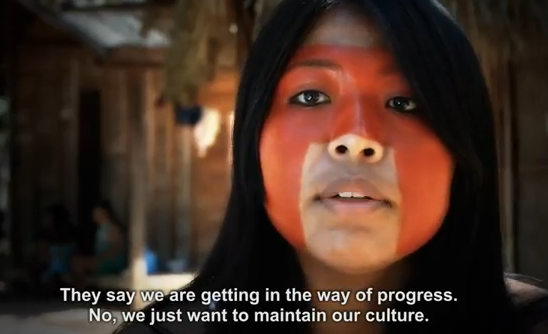
Damocracy is a short documentary that exposes the myth of dams as ‘green’ energy through two examples from Amazonia and Mesopotamia. Filmmaker Todd Southgate travels from the deepest corners of the vast Amazon rainforest in Brazil to the mountains and plains of fertile upper Mesopotamia in south east Turkey. He meets academics, lawyers, campaigners and local communities whose livelihood is threatened by two monster dam projects—Belo Monte in Brazil and Ilisu in Turkey.
The documentary shows the potential disasters these dams would cause on cultural heritage, wildlife and local communities who rely on the rich natural resources provided by the Tigris and Xingu rivers. The film also questions the sanity of climate change solutions that depend on the destruction of “the lungs of the Earth” and “the cradle of civilization.” It is a call to action to save this priceless natural and cultural heritage being gambled for the interests of a few.
The documentary will be released in February 2013.
Arrogance and the Creative Class in West Michigan
Ever since the 2007-2008 global economic crash, one mantra that has been repeated over and over about ways to both solve the economic crisis locally, is the mantra of retaining and attracting the “creative class.”
People in business, government and even the non-profit world invoke Richard Florida’s claim that what brings back cities is a group of people he refers to as the creative class. This usually translates as young, urban, white professionals who are somewhat forward thinking on social issues and entrepreneurial in spirit.

I discovered an invocation of the creative class in an article posted on Stellafly Social Media, entitled Steve Frazee and Bill Holsinger-Robinson: Your guides to tending the local economic rainforest.
The focus of the article is on the new HUB Grand Rapids, which, according to the group’s website, is a new kind of membership club dedicated to the individuals and teams building the local, sustainable economy in Grand Rapids and beyond.
However, it was the comments in the Stellafly article that were particularly instructive.
It’s all about developing a community of creative people, knowledge workers. It’s the core of the super-creative class – the 3 percent of the community who do most of the creative work,” Frazee said. “We’re bringing those people together and giving them things to start to make their lives more interesting and effective.
And what exactly will these people be doing……..ending poverty, figuring out ways to drastically reduce global warming, make health care affordable to everyone or stop rape and other hate crimes. Not even close. The HUB will be all about thinking of new ways to assist existing businesses and start new for profit ventures that will primarily serve those who already have tremendous privilege in this society.
In addition, what the hell do they mean by the “super-creative class – the 3 percent of the community who do most of the creative work?” Nowhere do they really define creative work, but it seems quite arrogant of them to make such a claim when all kinds of people, in all walks of life engage in creativity in this community.
Think of all the working class people who don’t make enough money to really make ends meet, but many of them do because they creatively can make every dollar count. What about all the artists in this community who aren’t primarily motivated by money, but provide venues of all kinds of artistic expression – places like Mexicains Sans Frontieres or the regular activities hosted by Avenue for the Arts.
Then there are all of the passionate and creative people at the grassroots level who are addressing violence in the community, making it safer for women, immigrants and other sectors of society who are the targets of violence and hate. Most of these people do amazingly creative work, for little or no money, with an outcome that is unquantifiable. Are these people not “super-creative.”
The HUB has already received $300,000 from the Michigan Economic Development Corporation, which means some of that money is taxpayer money. Shit, if these people are so creative, why do they need to be subsidized by the public?
The Stellafly article also lists entities that have offered the group support, such as Adtegrity; Atomic Object; Cascade Engineering; Huntington Bank; Grand Rapids Community Foundation; Grand Valley State University; Huron River Ventures; Spectrum Innovations; StartGarden; and the City of Grand Rapids. In many ways the usual suspects in promoting business projects that will primarily benefit those who already have easy access to capital.
Lastly, it is worth noting how they keep using the metaphor of the rainforest for what they are doing. This is also instructive, since a rainforest is extremely bio-diverse ecosystem, which does not exactly fit with the 3 percent super creative class notion. A rainforest would be an apt metaphor for including all people and all species as necessary components to make any system thrive, from the smallest insect to the largest tree.
But hey, maybe the HUB of Grand Rapids will figure out a way to stop the capitalist class from destroying what remains of the real rainforest around the world.
Guatemalans Resist Invasion of North American Mines
This article by Helen Jaccard and Gerry Condon is re-posted from ZNet. Editor’s Note: We are reposting this story as a follow up to an article we posted on January 7 about a West Michigan mining company’s expansion. This re-posting is also relevant, since there are hundreds of Guatemalans from the Huehuetenango region, which is cited in the story.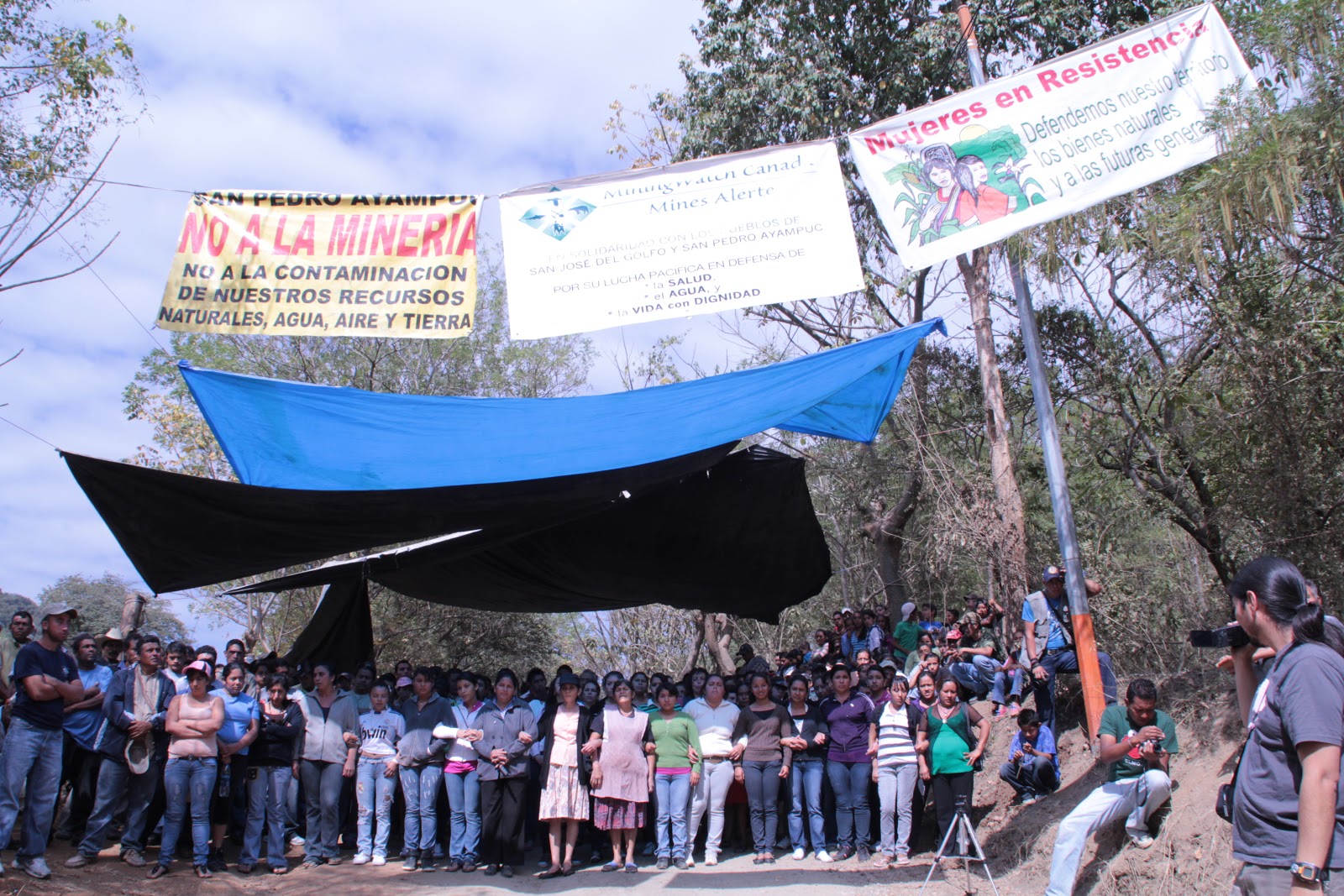
In November we traveled to Guatemala to study Spanish and learn about the lives of the indigenous Maya people. Guatemala is an amazingly beautiful country, with countless mountains and valleys, and 22 volcanoes, the most in Central America. The people are very friendly and good humored. Traditional Mayan culture, mostly observed in the colorful dress of the Mayan women, lives side by side with modernity. Picture a traditionally dressed indigenous peasant woman tending her cattle and sheep on a hillside pasture. Now watch her pull a cell phone out of her skirt to call her children.
We are not just Spanish students and certainly not “tourists” in the usual sense. We are active members of Veterans For Peace, and we are very concerned about the U.S. role in Central America. The legacy of the 36-year war waged by the Guatemalan military against its indigenous people is everywhere. A peace agreement was signed in 1996, but many people we met, especially in the mountainous Mayan communities, told us the war continues – through discrimination, poverty, lack of voice in government, and now the systematic destruction of their communities in favor of gold and silver mining, hydroelectric dams, cement plants and oil exploration.
We learned again about the CIA engineered coup that overthrew the progressive, democratically elected government of Jacobo Arbenz in 1954. Sponsored by the Eisenhower administration at the behest of the United Fruit Company (now Chiquita), the coup led to a 36-year long war of “scorched earth” genocide. More than 440 Mayan villages were destroyed and over 200,000 people died in massacres by the Guatemalan military, with aid and encouragement from the United States government.
An unjust order prevails to this day. Most of the land and wealth is in the hands of only eight families. To make matters worse, between 2000 and 2004 the Guatemalan government granted over 400 mining and extraction licenses to U.S. and Canadian mining companies who seek gold, silver and other precious metals that are right under the feet of the poor Mayan communities in the mountains. With massive profits to take away from Guatemala, the mining operations are carrying out a “scorched earth” policy of their own.
Huehuetenango
After studying Spanish for two weeks at San Pedro Laguna on Lake Atitlan (highly recommended), we stayed with a family in Huehuetenango, close to Chiapas, Mexico, which used to be part of Guatemala. We visited the small mountain town of Jacaltenango, where we met Bernardo Masariegos, a community leader who told us of the struggles in the department (state) of Huehuetenango against mines, hydroelectric dams, and petroleum extraction. The people of Huehuetenango, the most indigenous and rural department of Guatemala, adamantly oppose such exploitation. 
In successful opposition to a hydroelectric dam on the Mesté River, a grassroots movement of 9,000 to 14,000 people maintained a three year long nonviolent occupation (rotating about 100 people at a time) at the main square of Jacaltenango, swelling to more than 6,000 for every protest event. “All of the people who protest have no education,” Bernardo told us, “Only ten to twelve people in the movement were teachers and two to three were university teachers. They were the real people, the poor people.”
Indigenous peoples have an international and national constitutional right not to have their natural resources used without their knowledge and informed consent. This is called the consulta comunitaria de buena fe, or good faith community referendum. Twenty six of the 32 municipios (counties) in Huehuetenango voted against the mines in local referendums.
Our visit to the Marlin mine and affected communities
The huge Marlin Gold Mine is near the town of San Miguel Ixtahuacán, high in the rugged mountains of the department of San Marcos. It is operated by Montana Exploradora, a wholly owned subsidiary of the Canadian company Goldcorp. It is both an open pit and tunneling mine. This region is already damaged by decades of war.
On December 6, 2012, accompanied by community organizer Aniseto López, we visited people affected by the Marlin Mine, adjacent to several indigenous communities in the department of San Marcos. According to Amnesty International, in February 2011, protesters in north-western Guatemala’s San Marcos region were attacked after speaking out against the Marlin Mine. Aniseto López was taken to the local mayor’s office, where officials beat him and threatened to kill him if he continued to speak out against the mine.
In San Marcos, we visited:
The community of Ágel and a group called FREDEMI “Frente de Defensa Miguelense, San Miguel Ixtahuacán” (Front for the Defense of San Miguel Ixtahuacán). They have been resisting the mining activities since 2007. In February 2010, FREDEMI organized a protest in which 700 people blocked the entrance to the mine for 13 days.
Diodora Hernandez, who was shot in the eye for refusing to sell her land to Goldcorp.
Solomon, who worked for Goldcorp for two years. He said, “They arrived in 1996 to explore and in 2003 started to settle in with machines – now people are starting to realize how serious the situation is. There are four problems – water (contamination, dead animals, skin rashes and hair loss), cracks in the houses, explosives rocking the land, and the earth.”
On December 10 – 12 we visited a proposed mining project, El Tambor, about an hour’s bus ride from Guatemala City. Kappes, Cassiday & Associates of Reno, Nevada owns the license. Between the towns of San Jose del Golfo and San PedroAyampuc is an area called La Puya, and the entrance to the mining area. Hundreds of residents of local communities have maintained a successful nonviolent occupation here since March 2, 2012.
We arrived late and spent the first night sleeping on a wooden platform in the middle of the occupation. This and having Spanish language flyers handy to explain who we are helped us to be welcome here.
Company and police violence meets nonviolent resistance
Only days before we arrived at La Puya, on Friday, December 7, 2012, the police violently attacked the La Puya occupiers with tear gas and batons. Nearly 2,000 members of the National Police from all over Guatemala descended on the encampment. In the morning, there were only 20 people from the community – they lay down in front of the police and discreetly made phone calls – soon the church bells in the nearby town rang the alarm. By the afternoon 1,500 community members had come to support the occupiers. 
Paola Aquino Gutierrez’ 12 year old daughter was severely beaten by the police. “My 12 year old daughter was beaten Friday – she is still sore physically but more so psychologically,” Aquino told us five days later. “I have never beaten my daughter and now a police woman did. Many people still have sore throats from the tear gas that was used against us. We were on the ground when the tear gas was thrown right over our heads. My daughter and I are even more determined than ever to continue this struggle.”
Two women and a girl required medical attention after being sprayed with tear gas and four resistance leaders were arrested.
”The police captured four of us in order to scare the others, but they weren’t scared, they were even more brave, so they started calling people for help”, said Jorge López. “We are here to defend our water, our life and our territory.” In police custody, after two hours of lying in the hot sun with no food, water, or even a chance to pee, the captives were taken to two courts that refused to hear the case because of lack of charges or evidence, and released.
This is a completely nonviolent resistance, which, according to organizers, was key to preventing deaths when the police attacked with tear gas and batons.
Water shortage and being forced off of the land
The climate has become drier here. The rainy season used to start in May, but now it is dry. Lack of rain is causing crop failure in many areas of Guatemala this year. On top of that, communities that had barely enough water to survive are seeing the mining companies steal their water for processing ore. Wells, springs, and streams near mines are drying up.
The Marlin mine had a mechanical well, but it’s already dry. They are building another well closer to the spring. The people are afraid that they will soon have no water. Cristana Pérez said, “We tried to talk to the manager where they are building the mechanical well, but security people come instead and said that if we continue to fight them, they will prosecute us. The manager is saying that the well is built in consultation with the local community – it is not.”
Solomon told us, “In 1987 the community bought the spring, which gave water until last year – now it is dry. The human rights commission told the company to provide water, but we got none.”
The Marlin mine has also displaced communities. For example, there were at least 60 homes on the hillside that is now a hole in the ground.
At the El Tambor site, people are also concerned about lack of water and being forced off of their land.
“For me, the motivation is life – life itself. I’ve been here for 71 years and managed to live a tranquil life. I’ve been able to live my life being happy, so I want my children also to be able to live a happy life. If we don’t have water, if we don’t have trees, and all of that, it’s just going to be a desert,” said one man, “We struggle for life, water, and peace. If we don’t have this gold, we’ll still be able to live. But if we don’t have water, we’ll die.”
Milton Carrera explained about the water shortage, “We are fighting because if they come here, we won’t have water. We are very, very short on water. Some communities only have water maybe one hour a week. Other communities, like the big town, we only have water for one hour a day. The company is located where all of the wells are – right here. The water for the town, the wells are close to here. So what’s going to happen for us, if in 5 or 10 years we don’t have water?
Water contamination, health problems, dead animals
Mines also contaminate the water. The Marlin mine has a tailing pond containing the acidic mixture of cyanide, arsenic, heavy and radioactive metals, explosives, and other chemicals – normal for a mine using cyanide to extract gold. On September 23, 2010 at night, this contaminated water was discharged into the Quivichil River, which runs into Mexico.
Crisanta Pérez told us, “On Nov 29, 2012 we went to look at the spring and found pipes from the mine discharging into the river that goes through the community – it is now a contaminated river.”
Both FREDEMI and Solomon told us about a lot of skin problems and hair loss. According to Solomon, “In 2008-09 various people have had skin problems – two of them died. Their bodies were covered with painful rashes, and then they died.”
Cattle have been dying from drinking the water from the river. Diodora Hernandez told us, “The mother of a calf was poisoned. The water was pure white, like milk.” Her horse also died from the poisoned water. There are many other reports from shepherds whose cattle have died after drinking water downstream from the mine.
Division and Conflict
When mining companies start their propaganda campaign near a mining site, they cause divisions – in families and in communities. Aniseto López told us, “In the community, they are always in conflict – the environment is so thick with conflict that you can breathe it – conflict between those that support and those that are against the mine.”
“We were peaceful communities before all of this”, said one 71 year old man at La Puya, referring to the mining license.
Among 75 local men who work at the Marlin mine, many have left their wives and children for other women, without paying anything to help support their original family – something they would not do had they not had more money in their pockets, said Crisanta of FREDEMI. “We are really sorry about this, because a long time ago it was better – we went to the farms – men and women worked together to pick the coffee – there was no division between families.”
Many of the miners and affected community members turn to heavy drinking and drug use, Solomon told us. “There had been only 4 bars/liquor stores – now there are 100.”
At a Health Tribunal held at San Miguel Ixtahuacán on July 14-15 2012,one man testified: “There is prostitution, crime, pollution of Mother Earth. The workers, the Cocodes (local authorities), have beaten me up. When they are under the influence of alcohol, they come to my home and threaten me”
Intimidation, violence and corruption
The Marlin mine bosses will stop at nothing and have an arrogant attitude toward the Mayan people whose land they are destroying. They force entire villages to leave their land and pay very little for the land they buy, according to FREDEMI. When met with resistance, they falsely accuse people of crimes, and even shoot and kill them. They intentionally poison animals – dogs, horses, cows, and chickens.
The mining explosions rock the area. Together with tunneling and the constant traffic of heavy trucks, over 100 homes have been severely damaged with big cracks. The big trucks drive fast and run over the chickens and dogs. People are pressured to sell their land, and to stop talking about the effects of the mine. The police are bought off by the mine, so do not prosecute these crimes. The Minister of the Environment, in charge of making a report about the contamination, was being hosted by Goldcorp.
On March 12, 2007 Alvaro Sánchez, a Mayan villager living near the Marlin mine was murdered by mine workers during a heated discussion.
Diodora Hernandez refused to sell her land to the company and in 2010 two mine employees came and shot her in the eye. “I won’t sell my land – never. If I sold, where would I put my animals?” In another incident, she went to a meeting and a man threatened to kill her with a machete.
Solomon worked for the company for two years, and then started speaking out against it when he saw the problems. He said that the company comes to his home – sometimes at night – to intimidate him. He has been falsely accused of five crimes, a common tactic against mine resisters.
Crisanta Pérez of FREDEMI was also falsely charged her with a crime. “Because of the arrest warrant, I left my family and moved from place to place, hiding out for six months. When I returned home, they captured me – but by that time, people were more aware, and they blocked the police car and freed me after two hours.” Another man in the community was beaten to death.
Milton Carrera at La Puya said, “We used to have a little goat farm. They killed all my animals – about two months ago. Another of my family has a fish farm and a few months ago they put poison into the fish pond and they killed about 2,000 fish. Another lady had chickens at her house and they threw in poisoned corn.
“They shot one lady June 13…she still has the bullet, only two inches from her spine… Only God knows how she’s still walking. She has nerve problems, but she’s a very strong lady. She stopped the confrontation last Friday – if it wasn’t for her, there would have been a bunch of people killed here.”
We spoke with Yolanda “Yoli” Oquely Veliz, 33 years old, the community leader who survived the assassination attempt of June 13, 2012 after receiving death threats. She was shot three times while leaving the La Puya resistance occupation.
Communities are fighting for their survival
There are seven communities within 700 meters of the proposed mine. The Environmental Impact Study proposes removing these communities. The people have been living here for 300 or 400 years. “How can they expect us to move, when we don’t even know where we would go?”
Deodora Oliva lives about 700 meters from the mine. “See that hill there?” She points to a hill about 100 yards from the camp. “I live on the other side of that hill and they’re going to disappear that hill. I’m afraid that my village is going to disappear eventually, because the hill is right in front of my village.” In just two of the closest villages there are about 150 houses, about 1,000 people.
Milton Carrera told us, “We told the government they have to kill us. The government has to kill us in order to go inside. A lot of people decided, if they have to die, they will, to save the land for the next generation. Please tell your government that we’re humans, not animals and should have our rights respected.”
Being killed for this struggle is no idle concern. On October 4, 2012 at least seven people were killed and more than 30 injured by soldiers of the Guatemalan army near Totonicapán, about 90 miles west of Guatemala City. Unarmed indigenous people there were blockading the Inter-American highway to protest against changes in the constitution, changes to education laws that make teaching careers impossible for poor people, increasing energy prices, inadequate services, and being forced to pay for street lighting that doesn’t even reach them. According to Al Jazeera, “The indigenous community in Totonicapán is well organized, widely respected, and has historically pursued a strategy of engagement and negotiation with the government to resolve disputes. That the state would respond with violence on such a scale sparked fears about its willingness to brutally suppress protest and flout human rights.” Fortunately, a colonel and eight soldiers have been arrested and President Otto Perez Molino, former general, who was trained at the School of the Americas, has said that he will no longer deploy the army to protests. It was the National Police, not the Army, who recently attacked the people at La Puya.
Neoliberal trade agreements: intervention by other means
According to “Open Doors to Resource Extraction” by Guatemala’s Pastoral Commission for Peace and Ecology (COPAE), translated by Network in Solidarity with the People of Guatemala (NISGUA):
“In 1524, the pillaging of the natural wealth of Guatemala and Central American began with the arrival of the imperial interests of Spain. Today, the United States is intervening in a similar fashion, although more discretely, by way of imbalanced neoliberal trade agreements such as the Central and North American Free Trade Agreements (CAFTA, NAFTA).
Throughout the long history of the exploitation of Central America, among the only challenges to this system were the ones implemented during the 10-year period in Guatemala known as the “October Revolution” (1944-1954). At that time, two social-democrat presidents enacted laws in favor of the nation and the people of Guatemala. During that period, resource extraction by foreign-owned companies was banned. Part of the “development” strategy designed by the United States and implemented as part of the counterrevolution throughout Guatemala’s 36-year internal conflict (1960-1996), involved strengthening the private business sector and promoting foreign investment, which served to lay the groundwork for the all-out exploitation that we are facing today.
With CAFTA, Central American countries are essentially concessioned off for 50 years, rendering governments effectively powerless, without the right to supervise or regulate foreign companies. Chapter 10 of CAFTA, the chapter related to foreign investment, sets an unequal legal playing field– it is very difficult for a state to take legal action against a multinational company, while investor companies can sue the state as they please for loss or potential loss of profit caused by any change in regulation, law, or policy.
The Mining Law in Guatemala, implemented by the neoliberal government of President Alvaro Arzu (1995-1999), dictates that 99% of revenues be repatriated by multinational companies, leaving royalties in Guatemala of only 1%, a reform based on the neoliberal ideology that aims to attract foreign investment by creating favorable conditions for investors at the expense of the benefit to the population.”
La Lucha Continua
Clearly, imperialism’s war against Guatemala and its indigenous people has not ended. U.S. and Canadian mining corporations, aided by unfair trade agreements and collaborators in the Guatemalan government, are systematically destroying Mayan communities, while taking 99% of the enormous profits back to North America.
The resistance of Mayan and other Guatemalan communities also continues. It is no longer an armed resistance, but it is strong, deep and broad. Rural communities, such as at La Puya, are employing nonviolent strategies, while the government prefers to portray their resistance as violent and to meet it with violence.
The government is frantically attempting to isolate community leaders, accusing them of being manipulated by NGOs and funded by foreigners. Apparently, the government and the communities in resistance agree on one thing. International solidarity strengthens the resistance movement.
Toronto based Rights Action and Oakland-based NISGUA, which maintains an office in Guatemala City, provide regular updates, action alerts, organize solidarity delegations and even provide nonviolent “accompaniment” for community organizers whose lives are at risk. Solidarity actions are also aimed at culpable corporate executives and shareholders in Canada and the U.S. Another organization, Guatemala Human Rights Commission (GHRC-USA) based in Washington, D.C. has been working since 1982 to support asylum seekers and to defend the rights of women and indigenous people in Guatemala.
For the last four decades, many members of Veterans For Peace have taken bold actions in solidarity with the peoples of Central America, and we will continue to do so. We look forward to returning to Guatemala. In the meantime, there are many mining companies to visit in North America.
The 1954 coup against Guatemala’s fledgling democracy was organized in order to halt land reform and to guarantee that a U.S. company would be the primary beneficiary of Guatemala’s fertile earth and ideal growing climate. The CIA coup was also meant as a warning to governments in the region who might be so reckless as to put the needs of their own people first. Apparently however, the people of Nicaragua and El Salvador did not heed the message, and neither have the people of Guatemala.
Thirty-six years of genocide has not put an end to deep-rooted resistance in Mayan communities who wish to live free and healthy lives. Riding through the beautiful countryside, we often saw signs along reading “No a la mineria. Guatemala no se vende.” No to the mines. Guatemala is not for sale. Perhaps that was our best Spanish lesson of all.
This article by Glenn Greenwald is re-posted from the Guardian.
Prior to President Obama’s first inauguration in 2009, a controversy erupted over reports that he intended to appoint John Brennan as CIA director. That controversy, in which I participated, centered around the fact that Brennan, as a Bush-era CIA official, had expressly endorsed Bush’s programs of torture (other than waterboarding) and rendition and also was a vocal advocate of immunizing lawbreaking telecoms for their role in the illegal Bush NSA eavesdropping program. As a result, Brennan withdrew his name from consideration, issuing a bitter letter blaming “strong criticism in some quarters prompted by [his] previous service with the” CIA.
This “victory” of forcing Brennan’s withdrawal proved somewhat Pyrrhic, as Obama then appointed him as his top counter-terrorism adviser, where he exerted at least as much influence as he would have had as CIA Director, if not more. In that position, Brennan last year got caught outright lying when he claimed Obama’s drone program caused no civilian deaths in Pakistan over the prior year. He also spouted complete though highly influential falsehoods to the world in the immediate aftermath of the Osama bin Laden killing, including claiming that bin Laden “engaged in a firefight” with Navy SEALS and had “used his wife as a human shield”. Brennan has also been in charge of many of Obama’s most controversial and radical policies, including “signature strikes” in Yemen – targeting people without even knowing who they are – and generally seizing the power to determine who will be marked for execution without any due process, oversight or transparency.
As it typically does in the US National Security State, all of that deceit and radicalism is resulting not in recrimination or loss of credibility for Brennan, but in reward and promotion. At 1 pm EST today, Obama will announce that he has selected Brennan to replace Gen. David Petraeus as CIA chief: the same position for which, four short years ago, Brennan’s pro-torture-and-rendition past rendered him unfit and unconfirmable.
Although I actively opposed Brennan’s CIA nomination in 2008, I can’t quite muster the energy or commitment to do so now. Indeed, the very idea that someone should be disqualified from service in the Obama administration because of involvement in and support for extremist Bush terrorism polices seems quaint and obsolete, given the great continuity between Bush and Obama on these issues. Whereas in 2008 it seemed uncertain in which direction Obama would go, making it important who wielded influence, that issue is now settled: Brennan is merely a symptom of Obama’s own extremism in these areas, not a cause. This continuity will continue with or without Brennan because they are, rather obviously, Obama’s preferred policies.
Still, this is worth commenting on because the drastic change between the reaction to Brennan in 2008 and now is revealing. The New York Times article this morning on the appointment claims that “it is uncertain whether the torture issue will now cause any problems for Mr. Brennan.” Of course, there is nothing at all uncertain about that: “the torture issue” won’t cause any problems for Brennan, as it did in 2008, because Obama has buried that issue with his “Look Forward, not Backward” decrees; because most people who claimed concern over such issues back in 2008 have resigned themselves to Obama’s posture in this area; and because, with very rare exception, there are no more serious campaigns mounted against Obama’s decisions except from the American Right.
It is a perfect illustration of the Obama legacy that a person who was untouchable as CIA chief in 2008 because of his support for Bush’s most radical policies is not only Obama’s choice for the same position now, but will encounter very little resistance. Within this change one finds one of the most significant aspects of the Obama presidency: his conversion of what were once highly contentious right-wing policies into harmonious dogma of the DC bipartisan consensus. Then again, given how the CIA operates, one could fairly argue that Brennan’s eagerness to deceive and his long record of supporting radical and unaccountable powers make him the perfect person to run that agency. It seems clear that this is Obama’s calculus.
UPDATE
There’s one more point worth noting: the reason Obama needs a new CIA chief is because David Petraeus was forced to resign. Here we see the ethos and morality of imperial Washington: past support for torture and rendition does not disqualify one for a top national security position; only an extramarital affair can do that.
UPDATE II
The ACLU today said that the Senate should not proceed with Brennan’s nomination “until it assesses the legality of his actions in past leadership positions in the CIA during the early years of the George W. Bush administration and in his current role in the ongoing targeted killing program”.
Speaker appeals to faith in dealing with immigration issue, but leaves out policy analysis
Earlier today I went to Calvin College to hear Jenny Yang, Director of Advocacy and Policy of the Refugee and Immigration Program at World Relief, as part of the January Series.
Her work on the immigration issue came to the forefront about six years ago, when World Relief began to get numerous requests from pastors across the country who were looking for insight on how to respond to the growing number of undocumented immigrants in their congregations.
Yang realized during this time that every conversation she had or heard about immigration, especially with Christians, was not based in Christian scriptures. Immigration is a biblical issue, a church issue and a missional issue, according to Yang and spent most of her talk discussing immigration through a biblical/theological lens.
It was understandable that Yang would focus on this issue from a Christian perspective, considering it is a lecture series at Calvin. Yang provided biblical examples of how immigrants are portrayed and what messages are communicated about them. She stated that immigrants are one of the core vulnerable populations that, along with widows and orphans, must be embraced and advocated for.
Then there is the question of following the “rule of law.” Since many people come to the US without documentation, how do people of faith respond in this context? Yang made the point that following the laws of the land are a biblical mandate, but that depends on whether or not the laws actually serve the greater good.
Yang then shared some survey statistics and said that about 88% of Americans who are likely to oppose new immigrants, particularly undocumented immigrants, are White Evangelical Christians. Unfortunately, the speaker did not address why the greatest resistance is from the Christian community.
Yang did not address the fact that one of the main topics addressed on talk radio is immigration, especially from the reactionary right perspective, with radio personalities like Michael Savage, Glen Beck and Rush Limbaugh regularly attacking immigrants on their shows, as is well documented in the book by Rory O’Connor, Shock Jocks.
Yang also did not mention or identify the numerous anti-immigration groups in the US, which are well funded and politically powerful.
The speaker did look at some US immigration history, by talking about the Chinese Exclusion Act as the first immigration policy. It was followed by the National Origins Act, which limited where immigrants could come from, making European immigrants the favor group. However, she never really provided much information on current immigration policy other than to say that there seem to be two broad policy approaches. Some people want all undocumented immigrants rounded up and deported, while other groups want to give amnesty to those who are here without documentation. Yang says she didn’t agree with either approach.
Yang believes that the US should: 1) make it harder for undocumented people to enter the country illegally; 2) Make it easier for people to come through legal means; and 3) allow those who have come unlawfully to make it right with the law, pay a penalty and then go through the proper channels.
In some ways this seems like a humane and practical approach to the current policy, but it also ignores the more complex issues that drive why people come to the US to begin with.
Much of what drives immigration to the US is either political repression or poverty, which are often intertwined reasons for flight. US foreign policy in Latin America, both support of political repression and trade policies are at the root of why so many people chose to leave their own country and make their way to the US. Until these policies are addressed, the immigration debate will be incomplete and inadequate.
Yang did address some common myths about immigrants, particularly undocumented immigrants, with taxes being one of those myths. For a more comprehensive look at myths about immigration, read Aviva Chomsky’s book They Take Our Jobs!: And 20 Other Myths about Immigration.
One other important area of omission in this lecture was the growing immigrant-led movement for justice. Ever since the massive marches in 2006, immigrants themselves have been taking the lead on what they want, whether that is challenging the broad immigration policies, those fighting for The Dream Act, those speaking out against government repression and those who challenge the racist nature of much of the anti-immigration backlash in the country.
Yang ended with some discussion about how people of faith can get involved and said people can get more information at the site http://welcomingthestranger.com/ and a more recent campus immigration movement called G92.
Local Media Directory Updated

With the wonderful help from Josh Leng, the new Citizen Journalist coordinator at WKTV, we have updated the local media directory for the beginning of 2013.
Having the contact information is important for local organizers, community groups and grassroots activists, but having the information is just the first step.
It is important to be strategic in how you interact with the local news media. Check out our Media Activist ToolKit to get tips and ideas about how to important it is to develop a media strategy for your work.
Also, if your organization or community-based group is look to develop a media strategy or need training on how to deal with the media, GRIID offers workshops on those topics. Contact Jeff Smith jsmith@griid.org if you are interested.
This Day in Resistance History: French Farmers Destroy GMO Crops
On this day in 1998, an estimated one hundred farmers in France destroyed genetically modified crops, resulting in roughly $1 million of damage.
The farmer’s movement in France had done acts of resistance before the January 8, 1998 action and numerous since, including the dismantling of a McDonalds restaurant that was being built in a rural community. The farmers showed up one day and took the building apart and then used the materials for barn construction.
The 1998 action was targeting the GMO seed stock from the multinational company Novartis, one of the largest GMO corporations in the world.
Several French farmers were arrested for this action and some spent up to four months in jail. Actions like these are well documented in the book, The World is Not For Sale: Farmers Against Junk Food.
Numerous farmer groups around the world have been resisting the introduction of GMO seeds into their country and communities for nearly 20 years now. The struggle has been a difficult one, since the WTO (World Trade Organization) has decided in favor of GMO use and the right of GMO corporations to go after farmers for monetary compensation, because their crops have been infected by neighboring GMO crops. In North America, this practice of extortion has been defended by NAFTA regulations.
While the January 8, 1998 action by French farmers has not diminished the amount of GMO crops being cultivated in their country, it did demonstrate a clear tactical victory. Instead of just protesting the use of GMO crops, the farmers took matters into their own hands and destroyed the GMO seeds, with the intent of making it clear that they did not want this in their communities.
This type of action, where people physically remove or destroy something they find destructive to their freedom and autonomy is an old tactic and one that activist around the world should utilize when necessary. We must abandon the notion that “private property” is sacred, especially when private property is used to destroy the environment, make us sick and make money for the very few.
Let us celebrate the action of those that take matters into their own hands and remove harm from their lives and their communities.