When Dick DeVos says he wants to do something about public education it should scare the shit out of us
Yesterday, WOOD TV8 ran a story that began with the display of drawings of what the new entertainment facility at the BOB in downtown Grand Rapids will look like.
The story quickly turned into cheerleading for the group that worked on getting public funding for the BOB’s expansion, Grand Action. Grand Action was formed in 1991 and has made it their stated goal to develop the downtown of Grand Rapids.
This development has included the arena, the convention center, the civic theater, medical mile and more recently the downtown “market.” What the channel 8 story does not mention, and what local news people generally fail to report on, are the tactics in which Grand Action has used over the years and who are the primary beneficiaries of their projects.
One tactic that Grand Action has used over the years is to use public funding on these projects, without public input. We reported on the millions of public dollars that has been obtained by Grand Action in the course of the acquisition of the property and the construction of the new downtown market.
When it comes to beneficiaries of these downtown projects, all one has to do is look at who owns the hotels, bars, parking areas and other venues that have made a great deal of money due to the Grand Action projects. The DeVos family has certainly expanded their empire, especially with their near monopoly of the hotel business, but others businesses have also benefited tremendously. Not surprising, some of these other business owners are also involved with Grand Action, which is just another reflection of the interlocking systems of power in Grand Rapids.
DeVos and Public Education
The other aspect of the WOOD TV8 story, which was very instructive, was the commentary by Dick DeVos about public education in Grand Rapids. DeVos is quoted as saying, “They have been failing miserably, frankly, and it has got to change. I’m encouraged by new leadership, but we need action.”
Anyone hearing or reading such a statement who hasn’t bought the propaganda of the DeVos family, would either be rolling on the ground in laughter or fuming with rage. The fact that the channel 8 reporter doesn’t ask a follow up question to such a statement is also telling.
It is no secret that Dick and Betsy DeVos have not only given millions of dollars to fund private schools, but they have provided an equal amount of dollars to undermine public education by funding school voucher schemes and charter schools.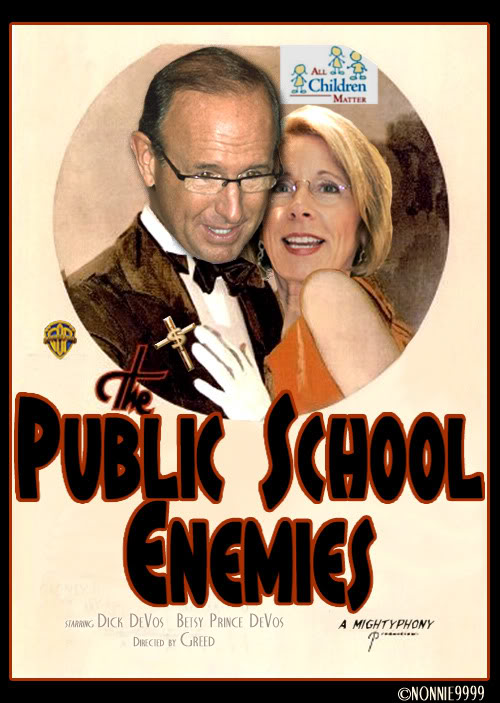
In 2002, Dick DeVos gave a speech to the conservative think tank, the Heritage Foundation. In that speech DeVos lays out a strategy for attacking and undermining public education. Here is the text of that speech:
“Where’s the battle going to be fought, for the future? In my view it will be, and at this point it needs to be, fought at the state level–utilizing vehicles such as GLEP and others nationally but ideally these organizations must be constructed locally. They need to be constructed with individuals such as the staff we had in Michigan, who were intelligent and connected with the local grassroots politics of what was going on, that had the relationships, the insights, and the political sensitivity to know what was happening.
And so while those of us on the national level can give support, we need to encourage the development of these organizations on a state-by-state basis, in order to be able to offer a political consequence, for opposition, and political reward, for support of, education reform issues.
That has got to be the battle. It will not be as visible. And, in fact, to the extent that we on the right, those of us on the conservative side of the aisle, appropriate education choice as our idea, we need to be a little bit cautious about doing that, because we have here an issue that cuts in a very interesting way across our community and can cut, properly communicated, properly constructed, can cut across a lot of historic boundaries, be they partisan, ethnic, or otherwise.
And so we’ve got a wonderful issue that can work for Americans. But to the extent that it is appropriated or viewed as only a conservative idea it will risk not getting a clear and a fair hearing in the court of public opinion. So we do need to be cautious about that.
We need to be cautious about talking too much about these activities. Many of the activities and the political work that needs to go on will go on at the grass roots. It will go on quietly and it will go on in the form that often politics is done – one person at a time, speaking to another person in privacy. And so these issues will not be, maybe, as visible or as noteworthy, but they will set a framework within states for the possibility of action on education reform issues.”
Lastly, it is important to note that in the channel 8 story DeVos says he is “encouraged” by the new leadership at the GRPS. Indeed, there have been several superintendents that have been willing to push a neoliberal agenda for the Grand Rapids Public Schools for over a decade.
This neoliberal agenda has resulted in several rounds of school consolidation, the elimination of some important programs, privatizing the busing system, attacking the teachers union and drastically downsizing staff. It is no wonder that DeVos would be “encouraged” by such actions, since it fits in well with his own plans.
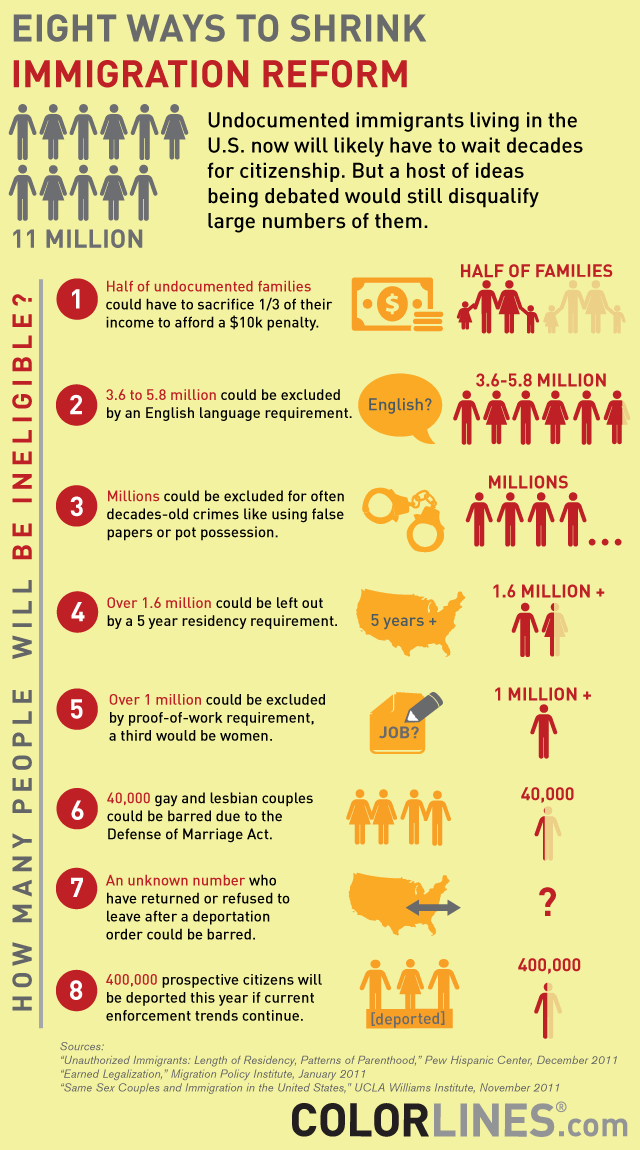
Immigration “Reform” might exclude millions
The following info-graphic is re-posted from Color Lines. Editor’s Note: As the US government debates the current immigration policy, we think it is important that whatever policy is adopted it will not be adequate, since it does not take into account US foreign policy, which is the cause of much displacement and migration of people, particularly from Latin America.
This article by Andrea Germanos is re-posted from Common Dreams.
A “profoundly disturbing” Justice Department document obtained by NBC News outlines when the U.S. can put its own citizens on a “kill list” to be targeted in drone strikes.
“This is a profoundly disturbing document, and it’s hard to believe that it was produced in a democracy built on a system of checks and balances. It summarizes in cold legal terms a stunning overreach of executive authority – the claimed power to declare Americans a threat and kill them far from a recognized battlefield and without any judicial involvement before or after the fact,” Hina Shamsi, director of the ACLU’s National Security Project, said in a statement.
From the white paper:

Describing problematic rationale of the document, Jameel Jaffer, ACLU’s Deputy Legal Director, writes:
The paper’s basic contention is that the government has the authority to carry out the extrajudicial killing of an American citizen if “an informed, high-level official” deems him to present a “continuing” threat to the country. This sweeping authority is said to exist even if the threat presented isn’t imminent in any ordinary sense of that word, even if the target has never been charged with a crime or informed of the allegations against him, and even if the target is not located anywhere near an actual battlefield. […]
Even more problematic, the paper contends that the limits on the government’s claimed authority are not enforceable in any court. […] Without saying so explicitly, the government claims the authority to kill American terrorism suspects in secret.
Speaking on Democracy Now! on Tuesday morning, Jaffer added that this is not real transparency from the administration; this is a briefing paper, not a legal memo.
“This briefing paper is not a substitute for the 50-page legal memo on which it’s based. When the executive branch seeks to give itself the unilateral authority to kill its own citizens, a summary of its argument is no substitute for the argument itself. Among other things, we need to know if the limits the executive purports to impose on its killing authority are as loosely defined as in this summary, because if they are, they ultimately mean little. President Obama rightly released the Bush-era OLC torture memos and he should now hold his own administration to the same standard by releasing its killing memo,” Shamsi added in the statement.
Read the 16-page document here (pdf).
Editor’s Note: There has been a great deal of media attention given to gun violence and the debate about gun control, but as this article makes clear, the debate is narrow and limited.
In the wake of the massacre at Sandy Hook elementary the political dialog has been dominated by the issue of gun control for nearly two months. Extreme solutions have been proposed on “both sides of isle”, and the public is expected to endorse one side or the other on this admittedly complex and contentious issue.
Since the uproar began I’ve spoken with educators, gun enthusiasts, right wing ideologs, anarchists, moderates, and youth. These conversations have taken place during record breaking consumer purchases of guns and ammo (apparently even the warehouses are sold out). Our conversations focused primarily on two questions: How does the mass murder at Sandy Hook relate to gun control, and what is an effective response given our current circumstances? The answers I received have not been articulated in any of the media outlets, with the exception of the right wing ideologs, who seemed to be parroting the right wing media almost verbatim. I will present the noteworthy and exceptional examples I encountered.
To begin, most folks I spoke with did not make the connection between Sandy Hook and gun control nearly as quickly or clearly as the capitalist media or politicians had been telling them to. Indeed, a majority felt that if the issues were related at all, the connection was loose. No one felt that gun control laws would alone solve the issue of spontaneous shootings and massacres, but that reforms surrounding arms would have to come alongside social and cultural changes as well. This reaction gave credence to the Republican assertion that Democrats have been exploiting the tragedy to forward their own agenda. However, implying such begs the question: what agenda, exactly? The right wing has been quick to accuse Obama of attempting to disarm them for his own nefarious (and inevitably, socialist) ends. Second Amendment quotes and “Don’t Tread on Me” flags have been simultaneously brandished with the moral fortitude of a population one would think has been long oppressed by a regime quick to annihilate any dissent.
The “Second Amendment Defense” falls short, however, with the fact that activists (right or left) do not arm themselves against the authorities in the United States. The argument is nullified by its lack of manifestation in the real world. So while Tea Partiers thought it was bold to protest with rifles in tow for a while, the fact the protestors rarely got up from their plastic lawn chairs left those in power feeling decisively calm and unthreatened. While examples of armed struggles against the state certainly exist around the world, this level of resistance rarely occurs in the U.S., and those fighting for “gun rights” don’t seem very eager to begin that dialog, either. After all, activists don’t even need to be armed to be charged with terrorism any longer, “economic disruption” is violent enough for the establishment nowadays.
One gun and hunting enthusiastic provided a perspective on the nature of the reforms being proposed that highlights our representatives’ general ineptitude in handling this issue.
They’ve got the thing all wrong, especially this assault rifle ban they’re talking about. It’s not going to do anything… I have a 7mm BAR downstairs (a hunting rifle). Now, it’s the same as any of those assault rifles on the inside, the guts of the gun are the same. Same amount of power, rate of fire, all that, it just doesn’t look like an assault rifle on the outside. But this type of gun is not going to be affected by the (proposed) ban. Tell me how that makes sense.
I couldn’t. I thought maybe the difference was in the intention of the weapon when it was produced, that hunting rifles aren’t intended to kill people, so that somehow makes them less dangerous. Then I remembered that nearly all the most popular hunting calibers used today were created for snipers in World War II.
The hunter I spoke with (who keeps multiple guns in his vehicle year round) did reject the NRA’s suggestion to arm all teachers for the protection of students, citing it as “unnecessary”. In fact no one I spoke to thought this was a viable or constructive solution.
The most poignant of all my conversations was with the youth, teens ranging from 13-17 in small groups discussing violence in their communities. While none of them or their relatives have been the subject of national headlines recently, nearly all of them have experienced gun violence in their lives, at least peripherally.
The kids felt like conflict resolution and coping skills were the problem, that people lack the skills or resources to resolve their issues in a healthy way or without violence. Some of the youth told stories of friends who had either perpetrated or been the victim of an impulsive act of violence over some seemingly insignificant “beef”. They’re suggestions ranged from tighter security in schools to more parent and community involvement.
When asked whether or not more guns in their communities would make them more or less safe, their answers were unanimous: less. While some believed that they personally needed a gun for protection, it was never argued that this was a solution to violence. Additionally, they all felt like arming teachers would affect their education in a negative way, not positive. None of the youth were compelled by arguments putting economic growth in front of “common sense” gun control reforms, such as closing existing loopholes in the background check system.
My conversations exposed what most Americans already know, that the elite policy makers and their mouth piece (the capitalist press) are vastly out of touch with not only the needs of the people, but also the relationship between the society and social policy. This absurdity is even more exposed when one takes the time to compare the “mainstream” response to the death of 20 children at Sandy Hook to the response to the approximately 176 children killed by US drone strikes in Pakistan alone, (nearly 9 times more). Ironically, Washington politicians have complete control over the latter example, which is funded entirely by US tax dollars, while spontaneous shootings are not only far less deadly, but also random in nature.
The tragedy at Sandy Hook has been used by the power elite as another distraction from issues which truly effect US residents, while the corporate media and lobbying groups have handled the issue equally poorly, creating a false dichotomy between “banning all guns” and “arming every citizen”, as if either of these are appropriate responses to what occurred on December 14th. Americans are well advised to see these pseudo debates for the charades they really are and keep focused on issues that actually contribute to their own freedom.
Corpocrisy: The Systematic Betrayal of American Workers
This article by Paul Buchheit is re-posted from Common Dreams.
Free market idealists argue that capitalism works for anyone with a little initiative and a willingness to work hard. That might be true if job opportunities were available to everyone. But the facts reveal a lack of opportunity, largely because the very system of capitalism that’s supposed to work for everyone is betraying its most productive members.
It’s a step-by-step process of hypocrisy disguised as free enterprise:

1. Let the public pay for the research.
Since World War 2 our federal government has played the dominant role in the research of new technologies, with an emphasis on the long-term basic research that painstakingly perfects design while not yet producing revenue. Corporate R&D, on the other hand, is heavy on the profit-making late stages of development.
Government has contributed significantly to the development of today’s most modern technologies. Business has taken full advantage. Even during the frenetic growth of the 1990s, industry funding for computer research declined dramatically while government research funding continued to climb. As of 2009 universities were still receiving ten times more science & engineering funding from government than from industry.
2. Use the publicly-funded technologies to double profits in 8 years.
From 2003 to 2011 total corporate profits more than doubled from $900 billion to almost $2 trillion.
A big part of that is the financial industry, which has adapted the (nationally built) Internet to fashion trillion-dollar trading schemes. Up until 1985 financial firms never earned more than 16 percent of domestic corporate profits. Their share recently reached 41 percent.
3. Use the recession as an excuse to cut taxes in half.
For the twenty years prior to the 2008 recession, corporations paid an average annual rate of 22.5% in federal taxes. Since then the average has been 10%.
4. Quietly hoard all the excess money.
Anywhere from $2.2 trillion to $3.4 trillion in cash is being held by non-financial corporations, who have chosen to fatten stockholders rather than invest in new production facilities and the employees needed to make them profitable.
Once again, the financial industry leads the way. Just 12 large banks hold 69 percent of industry assets, close to $8 trillion. But they’re not making their money available to consumers or small businesses. According to the Federal Reserve Bank of Dallas, community banks, which hold less than one-fifth of industry assets, provide over half of all small business loans.
5. Pay existing workers what they earned in 1970.
Less, actually. Average real wages were $17.42 in 2007, down from $19.34 in 1972 (based on 2007 dollars). Wages as a percentage of the economy, at 44% of GDP, are at an all-time low.
Jobs that remain are increasingly low-wage positions. Apple is a good example of the race to the bottom for wages, with an estimated $420,000 profit per employee and a $12 per hour pay rate for its store workers.
6. Eliminate all the other people who helped increase productivity.
Not only are “job creators” failing to create jobs with their cash hoards, but they’re also cutting jobs in order to ‘streamline’ their operations. Evidence comes from The Nation, Market Watch, and Business Insider. – Verizon, which made $38 billion in 2008-11 and paid no tax, cut 41,100 jobs. – AT&T, which made $9 billion in 20011 and paid no tax, cut 54,000 jobs. – Merck, which made $34 billion in 2008-11 and paid a 7% tax, cut 13,000 jobs.
Other leading job-cutters: – Citigroup, which made a $28 billion profit in 2010-11 and paid no tax. – Boeing, which made $15 billion in profits in 2008-11 and paid no tax. – IBM, which made $75 billion in profits in 2008-11 and paid less than 2% in taxes. – HP, which $40 billion in profits in 2008-11 and paid an 11% tax. – Pepsico, which made a $10 billion profit in 2011 and paid a 6.3% tax. – Proctor & Gamble, which made almost $60 billion in profits in 2008-11 and paid 11% in taxes. – Google, which avoided about $2 billion in 2011 taxes by shifting revenue to a Bermuda tax haven.
7. Ignore the facts.
And do nothing to address the mistreatment of American workers. CEOs, Congress, and the media are all skilled at this final step of betrayal.
GRIID Interview with Tim Wise

Last week, anti-racist educator and activist Tim Wise spoke at GVSU and participated in several programs on campus.
GRIID was able to sit down with Wise and talk about a variety of issues, particularly as it relates to West Michigan.
The following interview includes questions about the difference between White Supremacy and racism, the failure or limitations of diversity training, gentrification, the creative class, the BDS campaign against Israeli Apartheid, the importance of doing intersectional analysis and movement building and the topic of his next book.
The interview with Tim Wise is 36:49.
Don’t Say Gay in Tennessee Schools
This article by Jack McCarthy is re-posted from Political Research Associates.
This week, Tennessee State Senator Stacey Campfield (R) reintroduced the so-called “Don’t Say Gay” bill, which bans any discussion of homosexuality by elementary and middle school teachers in the state.
The bill’s actual name is the “Classroom Protection Act”–protection against “safety issues involving human sexuality,” insinuating that classrooms need protection against LGBTQ people. If a teacher or other school official–including counselors and nurses–knows or suspect that a child might not be heterosexual, the bill makes parental notification mandatory. This means that a student coming out to a trusted adult at school for advice about their sexuality would lose any expectation of privacy.
Within the vague and open-ended piece of legislation, the senator attempts to touch on the density of human sexuality. “Because of its complex societal, scientific, psychological, and historical implications, human sexuality,” according to Campfield (and others on the Right who share his stance), should be considered an acceptable topic of conversation only at home. The bill states: “course materials or other informational resources that are inconsistent with natural human reproduction shall be classified as inappropriate for the intended student audience and, therefore, shall be prohibited.”
Most would agree that human sexuality is complex and requires some level of maturity to fully grasp. However, blocking informational resources (i.e. teachers) from educating students on their own sexual orientation can only harm youth–especially in treating homosexuality as negative and dangerous, a religious influence on public education.
Meanwhile, Campfield’s own deeply inaccurate beliefs demonstrate he could use a dose of comprehensive sex education. “My understanding is that it is virtually—not completely, but virtually—impossible to contract AIDS through heterosexual sex,” he stated in an interview. “Most people realize that AIDS came from the homosexual community—it was one guy screwing a monkey, if I recall correctly, and then having sex with men. It was an airline pilot, I believe.”
This interview is re-posted from ZNet.
[This piece is adapted from “Uprisings,” a chapter in Power Systems: Conversations on Global Democratic Uprisings and the New Challenges to U.S. Empire, Noam Chomsky’s new interview book with David Barsamian (with thanks to the publisher, Metropolitan Books). The questions are Barsamian’s, the answers Chomsky’s.]
Does the United States still have the same level of control over the energy resources of the Middle East as it once had?
The major energy-producing countries are still firmly under the control of the Western-backed dictatorships. So, actually, the progress made by the Arab Spring is limited, but it’s not insignificant. The Western-controlled dictatorial system is eroding. In fact, it’s been eroding for some time. So, for example, if you go back 50 years, the energy resources — the main concern of U.S. planners — have been mostly nationalized. There are constantly attempts to reverse that, but they have not succeeded.
Take the U.S. invasion of Iraq, for example. To everyone except a dedicated ideologue, it was pretty obvious that we invaded Iraq not because of our love of democracy but because it’s maybe the second- or third-largest source of oil in the world, and is right in the middle of the major energy-producing region. You’re not supposed to say this. It’s considered a conspiracy theory.
The United States was seriously defeated in Iraq by Iraqi nationalism — mostly by nonviolent resistance. The United States could kill the insurgents, but they couldn’t deal with half a million people demonstrating in the streets. Step by step, Iraq was able to dismantle the controls put in place by the occupying forces. By November 2007, it was becoming pretty clear that it was going to be very hard to reach U.S. goals. And at that point, interestingly, those goals were explicitly stated. So in November 2007 the Bush II administration came out with an official declaration about what any future arrangement with Iraq would have to be. It had two major requirements: one, that the United States must be free to carry out combat operations from its military bases, which it will retain; and two, “encouraging the flow of foreign investments to Iraq, especially American investments.” In January 2008, Bush made this clear in one of his signing statements. A couple of months later, in the face of Iraqi resistance, the United States had to give that up. Control of Iraq is now disappearing before their eyes.
Iraq was an attempt to reinstitute by force something like the old system of control, but it was beaten back. In general, I think, U.S. policies remain constant, going back to the Second World War. But the capacity to implement them is declining.
Declining because of economic weakness?
Partly because the world is just becoming more diverse. It has more diverse power centers. At the end of the Second World War, the United States was absolutely at the peak of its power. It had half the world’s wealth and every one of its competitors was seriously damaged or destroyed. It had a position of unimaginable security and developed plans to essentially run the world — not unrealistically at the time.
This was called “Grand Area” planning?
Yes. Right after the Second World War, George Kennan, head of the U.S. State Department policy planning staff, and others sketched out the details, and then they were implemented. What’s happening now in the Middle East and North Africa, to an extent, and in South America substantially goes all the way back to the late 1940s. The first major successful resistance to U.S. hegemony was in 1949. That’s when an event took place, which, interestingly, is called “the loss of China.” It’s a very interesting phrase, never challenged. There was a lot of discussion about who is responsible for the loss of China. It became a huge domestic issue. But it’s a very interesting phrase. You can only lose something if you own it. It was just taken for granted: we possess China — and if they move toward independence, we’ve lost China. Later came concerns about “the loss of Latin America,” “the loss of the Middle East,” “the loss of” certain countries, all based on the premise that we own the world and anything that weakens our control is a loss to us and we wonder how to recover it.
Today, if you read, say, foreign policy journals or, in a farcical form, listen to the Republican debates, they’re asking, “How do we prevent further losses?”
On the other hand, the capacity to preserve control has sharply declined. By 1970, the world was already what was called tripolar economically, with a U.S.-based North American industrial center, a German-based European center, roughly comparable in size, and a Japan-based East Asian center, which was then the most dynamic growth region in the world. Since then, the global economic order has become much more diverse. So it’s harder to carry out our policies, but the underlying principles have not changed much.
Take the Clinton doctrine. The Clinton doctrine was that the United States is entitled to resort to unilateral force to ensure “uninhibited access to key markets, energy supplies, and strategic resources.” That goes beyond anything that George W. Bush said. But it was quiet and it wasn’t arrogant and abrasive, so it didn’t cause much of an uproar. The belief in that entitlement continues right to the present. It’s also part of the intellectual culture.
Right after the assassination of Osama bin Laden, amid all the cheers and applause, there were a few critical comments questioning the legality of the act. Centuries ago, there used to be something called presumption of innocence. If you apprehend a suspect, he’s a suspect until proven guilty. He should be brought to trial. It’s a core part of American law. You can trace it back to Magna Carta. So there were a couple of voices saying maybe we shouldn’t throw out the whole basis of Anglo-American law. That led to a lot of very angry and infuriated reactions, but the most interesting ones were, as usual, on the left liberal end of the spectrum. Matthew Yglesias, a well-known and highly respected left liberal commentator, wrote an article in which he ridiculed these views. He said they’re “amazingly naive,” silly. Then he expressed the reason. He said that “one of the main functions of the international institutional order is precisely to legitimate the use of deadly military force by western powers.” Of course, he didn’t mean Norway. He meant the United States. So the principle on which the international system is based is that the United States is entitled to use force at will. To talk about the United States violating international law or something like that is amazingly naive, completely silly. Incidentally, I was the target of those remarks, and I’m happy to confess my guilt. I do think that Magna Carta and international law are worth paying some attention to.
I merely mention that to illustrate that in the intellectual culture, even at what’s called the left liberal end of the political spectrum, the core principles haven’t changed very much. But the capacity to implement them has been sharply reduced. That’s why you get all this talk about American decline. Take a look at the year-end issue of Foreign Affairs, the main establishment journal. Its big front-page cover asks, in bold face, “Is America Over?” It’s a standard complaint of those who believe they should have everything. If you believe you should have everything and anything gets away from you, it’s a tragedy, the world is collapsing. So is America over? A long time ago we “lost” China, we’ve lost Southeast Asia, we’ve lost South America. Maybe we’ll lose the Middle East and North African countries. Is America over? It’s a kind of paranoia, but it’s the paranoia of the superrich and the superpowerful. If you don’t have everything, it’s a disaster.
The New York Times describes the “defining policy quandary of the Arab Spring: how to square contradictory American impulses that include support for democratic change, a desire for stability, and wariness of Islamists who have become a potent political force.” The Times identifies three U.S. goals. What do you make of them?
Two of them are accurate. The United States is in favor of stability. But you have to remember what stability means. Stability means conformity to U.S. orders. So, for example, one of the charges against Iran, the big foreign policy threat, is that it is destabilizing Iraq and Afghanistan. How? By trying to expand its influence into neighboring countries. On the other hand, we “stabilize” countries when we invade them and destroy them.
I’ve occasionally quoted one of my favorite illustrations of this, which is from a well-known, very good liberal foreign policy analyst, James Chace, a former editor of Foreign Affairs. Writing about the overthrow of the Salvador Allende regime and the imposition of the dictatorship of Augusto Pinochet in 1973, he said that we had to “destabilize” Chile in the interests of “stability.” That’s not perceived to be a contradiction — and it isn’t. We had to destroy the parliamentary system in order to gain stability, meaning that they do what we say. So yes, we are in favor of stability in this technical sense.
Concern about political Islam is just like concern about any independent development. Anything that’s independent you have to have concern about because it might undermine you. In fact, it’s a little ironic, because traditionally the United States and Britain have by and large strongly supported radical Islamic fundamentalism, not political Islam, as a force to block secular nationalism, the real concern. So, for example, Saudi Arabia is the most extreme fundamentalist state in the world, a radical Islamic state. It has a missionary zeal, is spreading radical Islam to Pakistan, funding terror. But it’s the bastion of U.S. and British policy. They’ve consistently supported it against the threat of secular nationalism from Gamal Abdel Nasser’s Egypt and Abd al-Karim Qasim’s Iraq, among many others. But they don’t like political Islam because it might become independent.
The first of the three points, our yearning for democracy, that’s about on the level of Joseph Stalin talking about the Russian commitment to freedom, democracy, and liberty for the world. It’s the kind of statement you laugh about when you hear it from commissars or Iranian clerics, but you nod politely and maybe even with awe when you hear it from their Western counterparts.
If you look at the record, the yearning for democracy is a bad joke. That’s even recognized by leading scholars, though they don’t put it this way. One of the major scholars on so-called democracy promotion is Thomas Carothers, who is pretty conservative and highly regarded — a neo-Reaganite, not a flaming liberal. He worked in Reagan’s State Department and has several books reviewing the course of democracy promotion, which he takes very seriously. He says, yes, this is a deep-seated American ideal, but it has a funny history. The history is that every U.S. administration is “schizophrenic.” They support democracy only if it conforms to certain strategic and economic interests. He describes this as a strange pathology, as if the United States needed psychiatric treatment or something. Of course, there’s another interpretation, but one that can’t come to mind if you’re a well-educated, properly behaved intellectual.
Within several months of the toppling of [President Hosni] Mubarak in Egypt, he was in the dock facing criminal charges and prosecution. It’s inconceivable that U.S. leaders will ever be held to account for their crimes in Iraq or beyond. Is that going to change anytime soon?
That’s basically the Yglesias principle: the very foundation of the international order is that the United States has the right to use violence at will. So how can you charge anybody?
And no one else has that right.
Of course not. Well, maybe our clients do. If Israel invades Lebanon and kills a thousand people and destroys half the country, okay, that’s all right. It’s interesting. Barack Obama was a senator before he was president. He didn’t do much as a senator, but he did a couple of things, including one he was particularly proud of. In fact, if you looked at his website before the primaries, he highlighted the fact that, during the Israeli invasion of Lebanon in 2006, he cosponsored a Senate resolution demanding that the United States do nothing to impede Israel’s military actions until they had achieved their objectives and censuring Iran and Syria because they were supporting resistance to Israel’s destruction of southern Lebanon, incidentally, for the fifth time in 25 years. So they inherit the right. Other clients do, too.
But the rights really reside in Washington. That’s what it means to own the world. It’s like the air you breathe. You can’t question it. The main founder of contemporary IR [international relations] theory, Hans Morgenthau, was really quite a decent person, one of the very few political scientists and international affairs specialists to criticize the Vietnam War on moral, not tactical, grounds. Very rare. He wrote a book called The Purpose of American Politics. You already know what’s coming. Other countries don’t have purposes. The purpose of America, on the other hand, is “transcendent”: to bring freedom and justice to the rest of the world. But he’s a good scholar, like Carothers. So he went through the record. He said, when you study the record, it looks as if the United States hasn’t lived up to its transcendent purpose. But then he says, to criticize our transcendent purpose “is to fall into the error of atheism, which denies the validity of religion on similar grounds” — which is a good comparison. It’s a deeply entrenched religious belief. It’s so deep that it’s going to be hard to disentangle it. And if anyone questions that, it leads to near hysteria and often to charges of anti-Americanism or “hating America” — interesting concepts that don’t exist in democratic societies, only in totalitarian societies and here, where they’re just taken for granted.
White Supremacy And Mass Incarceration
This article by Wende Marshall is re-posted from ZNet.
In a 2011 opinion piece in the Washington Post, Newt Gingrich said, “There is an urgent need to address the astronomical growth in the prison population, with its huge costs in dollars and lost human potential…The criminal justice system is broken, and conservatives must lead the way in fixing it.” An advocacy group called Right on Crime is spearheading Republican efforts to “demand more cost effective approaches that enhance public safety.” Signatories to its statement of principles include, in addition to Gingrich, other notable Republicans like Jeb Bush and Grover Norquist. A recent Washington Monthly article celebrated the right’s new focus on crime claiming it would “put the nation on a path to a more rational and humane correctional system.”
But by focusing on achieving “a cost effective middle ground,” Republican reform strategies end up eschewing the relevance of social justice and largely ignoring racial disparities and the disruptive social costs created by mass incarceration.
Justice and white supremacy
The travesty of mass incarceration and its devastating social effects and of the malfeasance of American jurisprudence cannot be measured purely in terms of economic rationality. It is an issue deeply entwined with long histories of racial oppression and white supremacy. True reform will require grappling with this larger problem.
A 1987 Supreme Court case illustrates what I mean when I say that the justice system is saturated with racism. In McCleskey v. Kemp, the Court declined to define the death penalty as racially discriminatory. The case involved the appeal of the death sentence for Warren McCleskey, a Georgia man convicted of armed robbery and the murder of a white policeman. In his appeal McCleskey cited research analysing 2000 Georgia homicides over an eight year period beginning in 1972 that found black defendants were nearly twice as likely to be sentenced to death as white defendants.
The research, described as the “most sophisticated study of the criminal justice system in the 20th century,” also found that the death sentence was applied 4.3 times more often when the murder victim was white. McCleskey’s appeal (based upon the 14th Amendment guarantee of equal protection and the 8th Amendment prohibition against cruel and unusual punishment), argued that the death sentence was racially biased. Justice Powell, in the majority opinion, accepted the general validity of the data and the likelihood that race was a factor in death penalty cases, but wrote that in the specific case of Warren McCleskey there was no proof of “the existence of purposeful discrimination.”
In the analysis of Bryan Stevenson, Executive Director of the Equal Justice Initiative (EJI), the Supreme Court’s decision in McCleskey upholds the constitutionality of the Georgia death penalty, even while it validates the data showing clear racial bias. Stevenson summed up the case by arguing that in McCleskey v. Kemp the Supreme Court viewed the problem of racial bias as “too big” to confront.
Indeed, in the majority opinion Justice Powell wrote that “if we accepted McCleskey’s claim that racial bias has impermissibly tainted the capital sentencing decision, we could soon be faced with similar claims as to other types of penalty… [S]ince McCleskey’s claim relates to the race of his victim, other claims could apply with equally logical force to statistical disparities that correlate with the race or sex of other actors in the criminal justice system, such as defence attorneys or judges.”
In effect, the Court declined to recognise that racism and white supremacy were factors in the administration of justice. “The Court,” Stevenson argued, “said if we recognise disparities based on race in the administration of the death penalty it’s going to be just a matter of time before lawyers begin complaining about race disparities for other kinds of criminal offences…”
McCleskey v. Kemp powerfully reinforced white supremacy in the administration of justice by obscuring a long American history of systematic racial violence and oppression, and normalising racial bias and racial disparities in sentencing. Although the decision was a specific deliberation on racial bias and the death penalty, its logic clearly ramifies throughout the entire criminal justice system.
Race, class and incarceration
The US incarceration rate began increasing in the mid-1970s, but exploded dramatically after passage of the 1986 Anti-Drug Abuse Act. Between 1970 and 2005 the prison population rose 700 per cent. The US comprises only 5per cent of the world’s population, but contains 25per cent of the world’s incarcerated people. Over seven million Americans are entangled with the criminal justice system through parole, probation or other forms of correctional supervision, while 2.3 million are behind bars. At 730 per 100,000 the US prison rate is 4-7 times higher than other western nations and up to 32 times higher than countries with the lowest rates like Nepal, Nigeria and India.
Racial disparities among the incarcerated are glaring: one in every 36 Latino man and one in every 15 black man is a prisoner compared with one in every 106 white man. Four percent of Native American adults are under correctional control. Data comparing apartheid era black incarceration rates in South African with current black male incarceration rates in the US provides a jarring perspective. According to the Prison Policy Institute, in 1993, during the apartheid era in South Africa, black men were incarcerated at a rate of 853 per 100,000 total black male population. In 2010, under the Obama administration, US black men were incarcerated at a rate of 3,074 per 100,000. As the law of the land, McCleskey v. Kemp became an alibi for the racialised logic of mass incarceration, obstructing recognition and elimination of blatant racism in the criminal justice system.
Featured in the December issue of the Smithsonian Magazine, Stevenson was described as “the most important advocate for death row inmates in the US,” having successfully argued cases before the Supreme Court that banned mandatory life sentences without parole for minors. Stevenson is an eloquent, soulful man who sees the world through the eyes of imprisoned children and equates the incarceration of African Americans in the post-Civil Rights era with the enslavement of Africans in the US.
Mass incarceration, he argues, has radically changed society. He speaks of urban communities, like Philadelphia, Los Angeles and Washington, where 50 percent of young black men are in prison, on parole or probation and where the disenfranchisement of convicted felons “has horrific implications for the political aspirations of people of colour.” In Alabama, Stevenson said, 34 per cent of black men have permanently lost the right to vote and within the next 10 years the level of disenfranchisement will be higher than it has been since passage of the Voting Rights Act in 1965.
Stevenson points to the consequences of the 1996 Welfare Reform Law which denied drug offenders eligibility for public housing, food stamps and other benefits, and that has had a disastrous impact on black women and children. Black women comprise half of the female prison population, although they are only 12 percent of the total population. Between 1986 and 1991the number of black women incarcerated for drug offences soared by 828 percent.
It’s not just racism in Stevenson’s analysis that drives the shame of mass incarceration. A class system defined by gross wealth and income inequality and entrenched poverty also subverts the achievement of justice. “We have a system of justice in this country,” he said, “that treats you much better if you’re rich and guilty than if you’re poor and innocent.” A racially biased war on drugs, poverty and political disenfranchisement combine, Stevenson argues, to create “a new class of untouchables, 1 million strong,” who cannot be reached by the public health or welfare systems and are “marginalised in ways from which there is no recovery.”
Using the institution of slavery as a lens through which to analyse the hugely disproportionate incarceration of African Americans men, women and children, Stevenson challenges us to question the logic of a justice system based on the rule of McCleskey v. Kemp. Why are blacks more likely to receive mandatory minimum sentences than whites? Why are two-thirds of those sentenced to life African Americans? Why, according to the US Bureau of Justice Statistics, does a black boy have a 32 per cent chance of going to gaol, compared with a 6 per cent chance for a white boy?
Mass incarceration is a legacy of slavery
Stevenson and the EJI are prompting a discussion on justice, on American racial history, and on slavery and the racism as foundational to the criminal justice system. “America,” Stevenson argued, “… became a society where slavery was a proxy for caste, and value, and worth. So when you ended slavery, you didn’t end the presumptions about black inferiority. All those things carried on… Until we have a conversation about that, we are going to continue to replicate those dynamics.” For Stevenson, it is clear that the justice system is based upon both the myth of black inferiority and on the delusion of white supremacy.
In a recent interview Stevenson described white supremacy as a tragedy because “… generations of people … were raised and taught … that they were better than other people because of the colour of their skin… There is nothing more abusive that you can do to a child or to a community than to persuade them that their worldview should be shaped by a lie, and that they should … interpret everything through that lie. And because we haven’t talked about that lie, a lot of what we say and what we do reflects an identity that is complicated and compromised by this history.”
It is crucial for us to reflect on Stevenson’s analysis that slavery and mass incarceration are part of a continuum, part of a history of racial oppression and white supremacy that remain entrenched in the legal system. This analysis is especially critical at a time when Republicans are attempting to redefine our carceral state without considering the role of race and racism in criminal justice and American history. This nation’s inability to face a past that includes slavery and the lie of white supremacy severely constricts the possibility of justice in the present and the future.
This Day in Resistance History: Hope College graduate A.J. Muste and the 1919 Lawrence textile workers strike
On February 3, 1919, an estimated 32,000 workers went on strike in Lawrence, Massachusetts to protest labor conditions and fight for the 8-hour work day.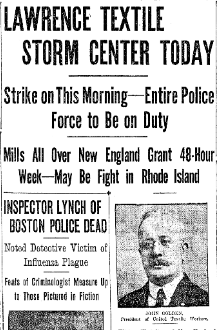
Several labor unions were involved in the 1919 strike, including the IWW, but the primary union involved with this strike was the Amalgamated Textile Workers Union, also known as the ATWU.
Despite the battle to win an 8-hour work day for several decades, not all workers enjoyed this right, which resulted in ongoing labor resistance across the country. The ATWU was fighting for shorter days, but they were also fighting for better working conditions.
The textile workers were making a measly 20 cents an hour and were often not paid for time that they worked. The workers were made up of people from at least 20 different countries, which always made it harder to organize such a diverse workforce. That the union could unify people across so many linguistic and cultural lines is a testament to their creativity.
The strike lasted 16 weeks and it was met with a tremendous amount of force by the company, which not only utilized the local police force, but the national guard, which at one point was guarding the textile mill with machine guns.
It was in this context that Hope College graduate and radical A.J. Muste came to Lawrence to stand in solidarity with the striking workers.
Muste was an ordained minister and harsh critic of the US involvement in WWI. Muste came to Lawrence just days after the strike began and joined the men and women on the picket line. Since many of the strikers had no or limited English speaking skills, Muste became a spokesperson for many of the workers, especially after he won their confidence when he was pulled off the picket line, beaten and hauled away by the local police.
Upon release from jail Muste came back and joined the picket line again and continued to be a spokesperson for the striking workers.
When the National Guard had been brought in, they set up machine guns to protect the textile mill. It is believed that the company sent in agent provocateurs to convince the workers to engage in violence, thus justifying the use of machine guns. However, Muste, who was a pacifist, counseled the workers to not use violence. Muste is believed to have said to the workers, “Let the mill owners try to weave cloth with machine guns.”
Whatever one thinks about the use of violence, in this instance the decision to not engage in violence worked and the strikers eventually won shorter work weeks, a 12% increase in pay and recognition of shop grievance committees in all departments.
We celebrate this day in solidarity with workers today who face unjust and brutal working conditions and are willing to fight back. We also remember and honor the person of A.J. Muste, not just because he is from West Michigan, but because he used his abilities to stand in solidarity with those who fought oppression.


