Democracy & Detroit 2012
This article by Elena Herrada is re-posted from Counter Punch.
Detroit is the largest of the internal colonies of Michigan. It is followed by Benton Harbor, Flint, Muskegon Heights, Pontiac and Highland Park. The aforementioned cities have been occupied by “Emergency Managers” for the past several years.
In 2009 Democratic governor Jennifer Granholm, the first woman governor of Michigan, appointed Robert Bobb over Detroit Public Schools. Two years later, after Snyder was elected (Republican) governor of Michigan, he appointed former GM executive and MGM casino magnate Roy Roberts to the position of Emergency Manager.
Each of these two have caused Detroit Public Schools to go into exponentially greater debt than before the “emergency” was created by the governor and his mouthpiece corporate media. The people of Michigan (82% in Detroit) repealed the Emergency Manager law 52% to 48% when it became clear that the law was nothing more than a license to loot and terminate collective bargaining agreements and sell off public goods to private interests, who do not have to bid or say who they are or where they got their money.
We passed a bond to rebuild our schools in Detroit, only to have them seized by a new separate and unequal school district called “Educational Achievement Authority.” It is a Jim Crow district with no transparency and no public accountability except to shareholders and “non profits” and foundations.
The role of the philanthropic interests is one that requires a deeper investigation than this simple review of 2012 in Detroit can achieve, but one worth pursuing in depth. It is an example of what happens when government is replaced by corporations.
Detroit is the epicenter of the racialized privatization battle going on in Michigan, but it is only one part of the story. The Emergency Manager remains in charge of Detroit Public Schools despite the repeal of the law. Everything the State could do to subvert the vote was done, and when the vote came in at against the Emergency Manager law, the governor ignored the vote and kept the EMs in charge.
There is utter contempt for the people in this lawless corrupt state.
It does not matter if we vote because the results are ignored. It does not matter if we go to court; the judges simply postpone the proceedings.
There is no voice of moral authority in Michigan; there are looters from top to bottom stealing the public treasury and the future of our youth. Schools are so severely underfunded that Teach for America teachers are in front of classrooms of 40 and more students all by themselves.
Millions of dollars have gone missing from the Detroit Public Schools’ classrooms, to the joy of charter operators and new shadow governments in the form of “self-governing schools” and “review boards.”
The Emergency Manager is surrounded by security guards at all times because he and his minions are so despised by the people they rob. It is a good time for a few, but not a sustainable plan.
When the colleges and universities catch on that their future students cannot score high enough on ACT or SATs, they will have to let in only the white students from the suburbs. Then there will be a movement for equity and access and we can start all over again.
Elena Herrada is a Detroit community activist leader, longtime organizer, and member of the Detroit Public Schools board. She can be reached at elenamherrada2@gmail.com.
Restoring Democracy in the Fight Against Fracking
This article by Thomas Linzey is re-posted from EcoWatch.
Same story. Different day.
People are threatened by an activity that will injure them, and they work overtime to pass a law that bans the activity.
An affected corporation—or industry association—then sues the municipality, contending that the community can’t prohibit what the state allows, and that the ban violates the “rights” of the corporation.
The upshot of these machinations is that the municipality then either repeals the ban or is bankrupted trying to defend it. Most likely, the insurance corporation for the municipality brokers a deal in which the municipality agrees not to enforce the ordinance in exchange for the corporation dropping its lawsuit.
Day after day, issue after issue, community after community, this machine has been humming along happily (for some) ever since the late 1800’s. All under a structure of law so perfectly constructed that very few understand how it actually works in practice.
Under a structure of law that lawyers, law professors, elected officials, judges and established activist organizations call “democracy.”
Why the Corporations are Right
The law as it stands is pretty straightforward—communities are prohibited from banning what state government allows. That’s because our local municipal governments (the places where we live) have the status of “children” to the state “parent” under a legal theory called “Dillon’s Rule”—which means that state law, on issues deemed to be of statewide concern—legally overrides local laws. It means that communities can only do what the state legislature explicitly allows them to do.
All of which is privately enforceable by the corporations in any given industry—who can use these doctrines to haul our communities into court. It also means that by investing in the state legislature (a “right” protected under the 1st Amendment to the U.S. Constitution), corporations can curb the actions of all communities within the State in one swoop simply by using State legislature to preempt all communities at one time.
It, of course, gets worse—federal and state civil rights laws treat “discrimination” against a corporation exactly the same way that the laws treat “discrimination” against racial minorities. Consequently, a community attempting to stop a corporation from engaging in a harmful activity that the state has permitted is treated as odiously by the law as a community attempting to ban African-Americans. It works this way because the law treats both corporations and minority members as “persons” for purposes of civil rights laws.
Sometimes, you just can’t make this stuff up. Unfortunately for us, those doctrines have been the law of the land for well over a century.
How did we get to this place? Simple. Corporations—and the people who own and run them—have been very busy manufacturing a structure of law that insulates them from community control. They had a lot of help, of course—mostly in the form of our early constitution-drafters who made critical decisions that elevated property rights above democratic ones. That structure created fertile ground for the trading, energy, agribusiness and waste corporations who then wrapped themselves in constitutional law, while the rest of us struggled for long years trying to secure constitutional protections for ourselves—for women, African-Americans, native peoples, immigrants and gays.
Now we’re faced with a situation in which a corporate few possess greater legal and constitutional rights than community majorities.
Why do we almost never win against corporations targeting our communities? It’s because we focus solely on trying to convince other people how bad an activity is, and the need to ban it. Meanwhile, over at corporate headquarters, they’re laughing at us because they’ve patented the structure of law that is routinely used to preempt and nullify what we do.
In short, they know that they can always play the final card.
How do we get our heads out of our asses?
So how do we change the rules? Well, first we need to understand our own history, and that we’re not the first ones to be faced with a gameboard that has no places for our piece. We need to understand how prior movements—when faced with a system of law that didn’t recognize women or African-Americans as “people”—successfully changed the rules of the game. We can then appreciate why traditional liberal, progressive “pressure” politics have failed so miserably, and why the natural environment is in worse shape today than it was prior to the passage of the “seminal” regulatory laws that environmental groups trumpet.
Second, we need to figure out which doctrines—what parts of the structure of law itself—allow the corporation to do what it does; and what parts authorize our own State government to enable the corporations to do what they do. And then, we must use what we know to build a movement that dismantles that platform of law by collectively refusing to obey it.
Indeed, widespread disobedience is the only thing that’s ever been powerful enough to change unjust laws. While we tend to think of civil disobedience solely in terms of laying down in front of a bulldozer, we must create a higher form—one that collectively harnesses the power of our municipal governments to turn them against the corporations (and our own State governments) and the doctrines that empower them.
Simply put, we must occupy the law.
Ten thousand communities joining together to use their lawmaking powers to frontally and directly challenge the existence of those doctrines could ultimately liberate communities from the state-sanctioned rape that we’ve endured for over a century. That grassroots disobedience to the functioning of the law must then stitch itself together to drive state and federal constitutional change that unrings the bell.
If we don’t, we better get accustomed to living on our knees.
The Longmont saga—opportunities lost
What’s happened in Longmont, Colorado is a perfect example of what activism looks like which fails to understand the tactical situation, and consequently, fails to directly challenge that platform of law.
While the original draft of Longmont’s “fracking” law contained everything necessary to mount a direct attack on preemption and corporate “rights,” the proposed amendment was then unceremoniously stripped of those provisions. They were deemed to be simply “too radical” by the drafters of the measure to be adopted by popular vote.
What could have the Longmont law looked like, if a different strategy had been pursued? Like the one created by the Pittsburgh City Council and now adopted by over a dozen other municipalities—which codified a community bill of rights recognizing peoples’ rights to clean air, pure water and a renewable energy future—and then banned gas drilling as a violation of those rights. The ordinance then stripped gas corporations in the City of the legal rights and powers that would otherwise be used to override the ordinance. The law also nullifies any State-issued permits that would allow fracking to proceed within the City.
Why? Because the overriding issue isn’t “fracking,” it is the denial of local self-government. By failing to address the latter, the focus on the former all but guarantees an organizing dead-end—the same dead-end that has been pursued by environmental and other groups for the past forty years.
Will they be overturned? Perhaps. But in many important ways, it doesn’t matter. While using our municipal governments to adopt local bills of rights is a novel approach, challenges to those laws inherently require the challenging corporation to validate each of the legal doctrines that allow them to override community lawmaking, and for a court to specifically uphold the application of each of those doctrines. In doing so, the process itself begins to reveal the otherwise-invisible apparatus which controls most aspects of our daily lives. The litigation thus becomes part of the organizing, rather than something best left just to the lawyers.
And it’s the very fact that the current machinery is invisible to so many people that allows it to function. Making it work in front of communities intimately affected by the corporate activity—with the eyes of the community on the legal system itself which then requires the injury to occur—will inevitably lead to a movement demanding structural change. It is that focus on structural change that will then take aim at driving changes to the state constitution that embed a right to community self-government at the highest levels. Communities in Pennsylvania, Washington, New Mexico and New Hampshire are now moving in that direction—building statewide organizations which grow stronger with each confrontation between resource corporations and municipalities.
Predictably, the Colorado Oil and Gas Association has sued Longmont using the same platform of law that corporations have been using against other communities for the last hundred years. Included in the lawsuit filed by the Association, on behalf of its member corporations, are claims of state preemption and violation of corporate “rights” that have been driven into both the state constitution and state law.
An opportunity has been lost to question (and openly challenge) the structure that provides the very basis of claimed corporate supremacy over Colorado communities. An opportunity has been lost to draw the parallels between fracking and the hundreds of other issues that communities face across the State—from water privatization and land development to the corporatization of agriculture.
An opportunity has been lost to make visible what has been so carefully camouflaged.
Movements build when opportunities are seized, not lost—when that which is hazy suddenly becomes clear. By framing the problem as “fracking,” and not as the corporate and governmental powers that force “fracking” on unwilling communities, it becomes easy for the gas corporations to divide, conquer, and then dissuade other communities from following.
It’s a revolt that never materializes.
It’s not too late for Longmont, of course. Both the State of Colorado and the corporate frackers, who will pile it on over the course of the next year, have drawn a bullseye around the people and natural environment of Longmont. As it all plays out, as it has a thousand times before in a thousand different places, let’s hope that a frontal challenge to the gas corporations—and the State government which has enabled and empowered them—isn’t far behind.
Why is Snyder not worried about retribution from Right to Work Law?
Recently, the West Michigan business publication, MiBiz, conducted an interview with Michigan Governor Rick Snyder.
In the preface to the interview, the co-authors write, “While many Michiganders may be fuming at the governor as we head into 2013, the business community loves him more than ever.” Such a statement, while not surprising, should make it clear to the majority working class population, that the Governor and the business community don’t give a damn about them.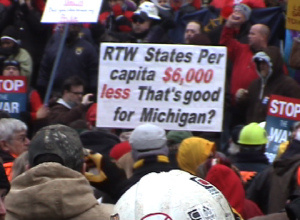
The interview begins with a fairly substantive question where Snyder is asked about making Right to Work a law and how divisive it is in this state. Snyder replies by mostly avoiding the question and falling back on what he says are his two main issues of focus, jobs and kids.
If kids are a focus for the Governor, how does implementing Right to Work legislation helping children of working class families, since we know that wages on average are lower in Right to Work states? Such a follow up question is not asked, instead MiBiz writer move on to the next question, which was the tired Richard Florida mantra of, “attracting more talent” to the state.
Much of the rest of the interview is what one would expect from the business press, corporate wellness and federal health care policy, but the bulk of the interview is really about Snyder’s business plan for the state. When I say business plan, what I really mean is Snyder implementing what the business community wants him to do, which has been his stated agenda all along.
This business plan includes an end to the personal property tax, which Snyder refers to as a, “really obnoxious tax.” What it translates into is less money for municipal governments and more money directed to the private sector. It is the next logical step in the neo-liberal austerity plan, which is nothing more than austerity for the working class and greater wealth for the rich.
MiBiz does come back to the Right to Work question in the interview by asking, Do you fear there could be any retribution from the right to work vote? Snyder’s response is worth posting in its entirely.
I hope not. You’re going to find some in the shorter term. (The personal property tax) is still a couple of years out. But we’ve already seen some positive steps even while right to work was going on, in the sense that Detroit lighting got approved and the arena got approved with some bipartisan support. One of the questions is: If you’re a public servant, particularly if you’re an elected official, to say you’re not going to work with someone because they have a difference of opinion is not a good answer. I don’t think that’s appropriate because we should all be focused not on our relationships, but on the customers, who are the citizens.
At this point Snyder should be concerned about potential “retribution” for Right to Work and other laws that were rammed through in the legislation just prior to the end of the 2012 political cycle. There is potential amongst the working class populace and various other sectors – women’s groups, racial justice groups, environmental groups, immigrant community, etc – to make life very uncomfortable for the Governor in the upcoming year. However, if the response from union leaders at the December 11 protest is any indication, Snyder might not have much to worry about until the 2014 election, since it seems that Michigan unions will not follow the example of their fellow workers in Wisconsin by occupying the state capitol and shutting down business as usual. What union leaders made clear on December 11, was that they would focus on an electoral strategy, which seems rather ineffective and a waste of funds that could be better spent on organizing.
The interview ends with MiBiz asking the Governor what keeps him up at night. His response is revealing, since he says, “Generally, I do fine.”
Such an admission should be a clarion call to those in Michigan who feel that Snyder is giving the state away to the private sector. The insurgent forces who are and will continue to be negatively impacted by these state policies should make it a goal to make it so that Snyder does not sleep well, nor the capitalist class which put him in the Governor’s seat.
Turning Michigan into Colombia: The Global Assault on Workers and the Prospects for Solidarity
This article by Kevin Young is re-posted from ZNet.
December 11 marked a major defeat for working people in the United States, as a lame-duck legislature made Michigan the twenty-fourth state to pass so-called “right-to-work” legislation. The Orwellian term “right to work” was popularized by employers starting in the 1940s as they sought to roll back the historic gains of labor during the prior decade. Right-to-work (RTW) laws prohibit contracts that require all workers to contribute to the costs of union representation, encouraging “free-riding” and making it much more difficult for unions to survive (unions remain legally bound to represent all workers within a bargaining unit, whether or not they pay their fair share of dues). Michigan’s RTW legislation sends an ominous signal for workers everywhere given the state’s historic reputation as a union stronghold and the fact that a mass protest of at least 10,000 workers at the state capitol in Lansing on December 11 did not succeed in preventing passage.
One of those 10,000 workers was visiting from Colombia, which has long been a poster child for the sort of neoliberal sweatshop economy desired by corporations and international financial institutions. Jorge Parra came to Detroit in September to confront his former employer, General Motors, for firing him and over 200 other autoworkers from its plant in Bogotá after they suffered workplace injuries and illnesses. Parra had sewn his mouth shut and begun a hunger strike on November 20 to publicize the workers’ demand for direct negotiations with GM. Reacting to the news about Michigan’s RTW legislation, Parra says that “I see a clear connection between what’s happening here and what has happened in Colombia.” He notes that the RTW laws in this country “are the same ones that have weakened union activity” in Colombia.
Parra’s comment highlights the transnational nature of the attack on working people and points to the imperative of cross-border solidarity. Parra understands on a profound level what most unions in this country have only started to learn: that “it’s all one fight.” In an era of declining labor rights, precarious employment, and inequality—and soaring corporate profits—international solidarity is more crucial than ever.
Starving for Justice: The Colombian GM Workers
Jorge Parra’s hunger strike hits the five-week mark on Christmas Day, December 25. After five weeks of not eating, the human body begins to risk permanent tissue and brain damage; a week or two after that, organ failure, blindness, and death become more likely with each passing day. 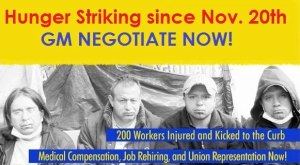
Parra was driven to this desperate measure by General Motors’ refusal to negotiate with the workers unjustly fired from its Colmotores factory in Bogotá. After Colombia’s institutional mechanisms for redress failed—no surprise given the Colombian government’s corruption and subordination to corporate interest—Parra and his fellow workers formed the Association of Injured and Ex-Workers of General Motors Colombia (ASOTRECOL) and in August 2011 began a tent occupation outside the U.S. embassy in Bogotá, choosing that site because of the U.S. government’s part ownership in GM following the U.S. auto bailout of 2008-09 and the close ties between Colombia and the United States. On December 25 the tent occupation enters its 512th day, with many of the workers there also engaging in hunger strikes in recent months. They are demanding that GM provide compensation for the wrongful firings, comprehensive medical care, and new job placements for those who are still able to work.
The workers’ families have suffered even more than the workers themselves. Some have already been evicted from their homes, by some of the same banks and mortgage companies throwing U.S. families out on the street. Many of the workers have small children. Earlier this month five of the workers’ wives wrote personal letters to GM Vice President of Labor Relations Catherine Clegg, which supporters hand-delivered to Clegg’s mansion in the Detroit suburbs on December 6. The wife of one injured worker told of how her 8-year-old daughter constantly asks why her father “is not happy like he was before, why he has his mouth sewn shut, why she has seen him so sick, and other questions that I do not know how to respond to.” The couple’s other child is a 12-year-old boy named Angel, who has cerebral palsy and is about 98-percent incapacitated. Since his father’s firing Angel no longer receives the medicine and therapy he needs. Such scenes are repeated for many of the workers’ families, who live in a world that GM executives will never see or experience. In 2011 GM recorded a record profit of $7.6 billion, thanks in part to its subsidy from taxpayers.
The struggle of ASOTRECOL is just one piece of a larger and ongoing tragedy in Colombia. The country has long been the most dangerous place in the world for trade unionists, with 29 killed and hundreds receiving death threats in 2011. Peasants, Afro-Colombians, and indigenous people are routinely murdered and displaced by business elites who covet their land and resources. Sexual violence is frequently used as part of this effort. Dozens of priests and human rights defenders are killed each year. And underlying these acts of overt criminality is the structural violence of daily life for the country’s majority: 1.15 percent of landowners control 52 percent of the land, three-quarters of rural residents live in poverty, and about 121,000 Colombians die each year from undernourishment.
But the Colombian government does very well in one respect. In 2010 the World Bank and International Finance Corporation applauded Colombia’s strides toward maintaining a “business friendly environment.” The report ranked Colombia third in Latin America with regard to the “ease of doing business.” Not coincidentally, Colombia has been the United States’ most reliable ally in South America over the past two decades, receiving hundreds of millions of dollars in annual military aid that is used in large part to kill and control Colombia’s hungry majority.
During these same two decades the Colombian government has adhered to the familiar recipe of neoliberal economic policies: reducing spending on social programs, privatizing public resources, lowering corporate tax rates, and deregulating business activity and financial transfers. Colombia’s recent “free-trade” agreements with the United States and the European Union are additional steps in this direction, designed to further liberate big business at the expense of ordinary people in all countries involved. Despite promises to respect workers’ rights—embodied in the “Labor Action Plan” that accompanied the 2011 U.S.-Colombia agreement—the idea of protecting working people runs directly counter to the logic of such trade deals.
Anti-union legislation has played an important role in this neoliberal agenda. The American Center for International Labor Solidarity notes that prior to 1990, “Colombian workers were among the most organized in Latin America.” But since the government passed anti-union legislation similar to RTW in 1990, “Anti-union discrimination by employers” has increased and “employer practices such as the dismissal and blacklisting of union leaders are widespread.” In 2005 the International Confederation of Free Trade Unions gave an overview of labor conditions in Colombia:
The state ministries and bodies responsible for social policy have been weakened, reformed or dismantled…Workers have been sacked or given less secure terms of employment in both the private and public sectors. Both sectors are being restructured using laws that promote labour flexibility and enable employers to evade clear obligations…It is a complex and sometimes impossible task to form trade unions, sign collective agreements or organise strikes…People wanting to set up a union are dismissed, harassed or even threatened with death…Impunity is the norm for those who violate labour rights (including murdering of unions leaders and members), whilst the full force of the law is brought to bear on workers, even where they are acting in full compliance with it.
The report noted that as a result, just five percent of the economically active population belonged to trade unions, and only one percent of Colombian workers were covered by a collective bargaining agreement—even worse than in the United States. But not much worse.
Moving Michigan Closer to Colombia
Twenty-three other U.S. states preceded Michigan in passing right-to-work laws, but most were in the low-wage economies of the South where unions were traditionally rare. Michigan, on the other hand, has the fifth-highest union density in the country. For this reason it was a particular target of right-wing billionaire donors like the Koch brothers, who poured millions of dollars into the state to promote RTW. These forces viewed Michigan as a litmus test for their effort to smash unions, wages, and corporate taxes in other northern states. Their dream is quite clear: an economy and society resembling Colombia’s, where atomized workers are paid starvation wages and work in dangerous conditions while the chosen few gorge themselves on the profits.
The rich have good reason to look favorably on RTW. According to a comprehensive 2011 study by the Economic Policy Institute, annual wages in RTW states are around $1,500 less than in non-RTW states, and the portion of employers who sponsor employee pension programs is 4.8 percent lower. Right-wing demagogues claim that RTW laws “create jobs,” but in fact they are just as likely to do the opposite, by lowering wages and thereby reducing consumer demand. Many workers simply enter the ranks of the permanently-unemployed and expendable population, while whatever jobs are created are typically of the low-wage, highly-precarious sort.
Michigan’s RTW laws are the culmination of a host of anti-union measures imposed in the state in the past two years. The most notorious is the “emergency manager” law that allows the governor to hand over cities and school districts to unelected dictators, who are empowered to dissolve union contracts, lay off workers en masse, and privatize public land and services. After Michigan voters rejected the law in a November referendum, the lame-duck legislature passed a slightly-modified version of the law around the same time it was pushing through RTW. In recent months Michigan’s politicians have also prohibited dues check-off for teachers, eliminated benefits for the domestic partners of state employees, and decreed that research assistants at universities are not workers and therefore cannot unionize. Governor Rick Snyder and his fellowRepublicans have led the onslaught, though sometimes with the cooperation or only tepid opposition of state Democrats.
In Detroit Jorge Parra views these developments with a sad but knowing expression on his face. “The same story is being repeated here,” he says with regard to RTW. “They put this same law into effect in the early 1990s in Colombia, and now it’s practically a death sentence to be a unionist.” Michigan workers do not face the same level of violence and hardship that Colombian workers face, but RTW and other attacks have inched Michigan ever closer to that reality.
Cross-Border Solidarity: Prospects and Obstacles
In this context, cross-border solidarity has become more urgent than ever. Solidarity has a pragmatic as well as moral logic, according to Ron Lare, a retired Detroit autoworker. Lare has been active in both the GM-Colombia solidarity campaign and the fight against RTW in Michigan. He comments that “if conditions in Colombia and other nations do not rise toward the best of U.S. union conditions via international solidarity, U.S. pay and conditions will continue to sink toward those in Colombia and other oppressed nations.” Lare notes that while GM fires injured workers in Colombia, “something approaching this situation is already the case” in many U.S. workplaces that employ temporary and non-union workers. In Michigan auto plants, for instance, “GM-Colombia conditions are already foreshadowed” in the use of temporary workers and the two-tier wage system, sending an ominous signal for the future. For Lare, “the new ‘right to work’ (for less) laws in Michigan show why workers here should care about what is happening to General Motors-Colombia workers.”
Other Michigan autoworkers echo these sentiments. Melvin Thompson was so moved upon meeting Jorge Parra that he staged a 23-day hunger strike of his own to help call attention to General Motors’ crimes. Thompson has witnessed the impact of wage cuts, speed-ups, and dangerous factories on his fellow workers, and says that in GM’s Colombia operation “you can see the parallels to how we do business here. Everything that they endure, we endure to a much lesser extent.” He felt compelled to take such dramatic action “because our struggles are tied together.” Chrysler worker Martha Grevatt says that the “unsafe practices” at her own plant and her experience dealing with company abuses for the past 25 years “tells me that the companies don’t care about workers.” That experience makes it “impossible” for her “not to be interested in and sympathetic with the workers in Colombia.” Given the global nature of the capitalist assault on workers, “the only way we can win is by uniting in common cause and refusing to be divided by borders or language.”
The solidarity campaign waged by these workers and others around the United States is an encouraging sign. Thompson’s hunger strike and the other components of that campaign represent U.S. labor at its best: self-sacrificing, compassionate, angry, and conscious of how global capitalism functions. But any effort to recruit large numbers of U.S. workers into this sort of campaign will have to confront a host of obstacles. Many of these obstacles are reflections of U.S. corporate capitalism and the racism and nationalism within U.S. society, and thus beyond the direct control of labor, while some derive from the structure and ideology of U.S. unions themselves.
Perhaps the greatest barriers to cross-border solidarity are ideological. In this country we are taught from a young age that the lives of U.S. citizens (especially the white middle-class ones) are inherently more valuable than the lives of foreigners. This implicit assumption pervades our school textbooks, newspapers, and television shows, and has a profound impact on us all. And the borders are not just national: the U.S. workforce itself has always been divided along lines of race, gender, sexuality, age, skill, wage levels, immigration and unionization status, and other categories. In this context the old IWW slogan that “an injury to one is an injury to all” is a truly revolutionary statement. “The biggest barrier to solidarity is the ability of the bosses to pit workers here against workers in other countries in competition for fewer and fewer jobs,” says Martha Grevatt. “We have to see that we have more in common with workers in other countries than with the capitalists of our own countries.”
The structural position of U.S. workers also presents certain obstacles to solidarity. As consumers, workers in the United States derive some material benefit from the exploitation of labor and resources in underdeveloped countries (though far less than capitalists do). In the case of the U.S. auto industry, employee stock ownership and profit-sharing arrangements give workers a concrete stake in the prosperity of the companies and, at least potentially, a disincentive to support the demands of other workers like ASOTRECOL in Colombia. The UAW leadership has certainly bought into this idea of shared interest between executives and workers. “Management’s not the enemy,” says one union official in Ohio. “The enemy is the competition.”
As such comments suggest, unions themselves often present institutional obstacles to solidarity. Most U.S. union leaders have done little to foster cross-border ties among workers. Even when denouncing neoliberalism, their posters and campaign literature tend to be filled with nationalistic assertions about “American” jobs. They speak not of the working class but of the “middle class,” a term that reinforces the sense that there is some other class of lazy, undeserving, often-dark-skinned parasites hovering below. This perception leads most union leaders to dismiss foreign workers as well as U.S. service workers, immigrants, domestic laborers, and the unemployed (and also provides much of the basis for right-wing populism in this country). Union leaders even sell out their own constituents by agreeing to “two-tier” wage schemes and other concessions. Their approach tends to rely much more on backroom discussions with bosses and on the concept of “partnership” with employers than on the mobilization of rank-and-file workers to confront the employers. Their political strategy consists of playing lapdogs to the Democrats.
Most Michigan unions exemplify these problems. When several solidarity activists visited a recent meeting of union executives in one Michigan town to request a donation for the families of the Colombian GM workers, most of the union leaders on the council questioned the very idea of aiding anyone but “our workers.” In thinly-veiled racist language, the council’s president worried that if they donated anything they would be “inundated” with hordes of outsiders soliciting assistance in the future. The phrase “working class” was never uttered.
Other examples abound. Many progressive critics point out that union leaders’ constant concessions and failed political strategy helped pave the way for the recent passage of RTW. Ron Lare notes that when they first heard rumors about RTW in late November, those leaders’ first instinct was to “talk to the boss” rather than mobilizing their bases for strikes and civil disobedience; even after RTW’s passage in Michigan, many national labor leaders remain committed to the same failed strategy. The injured GM workers in Colombia have yet to receive any public support from the leadership of the United Auto Workers (UAW) despite countless appeals by Jorge Parra and his fellow workers. Michigan unions’ disinterest in the recent campaign to repeal the “emergency manager” law—which would primarily affect black population centers like Detroit—is yet another telling indication of these same sorts of prejudices. Most labor leaders remain wedded to the traditional model: trying to elect Democrats, “talking to the boss” rather than engaging the rank-and-file, and remaining narrowly focused on the concerns of one’s “own” workers.
Yet if the year 2012 offers one definitive lesson for U.S. labor, it is that a militant, aggressive unionism that emphasizes rank-and-file mobilization and community alliances is the most promising strategy for defending working people. The most compelling evidence comes from the Chicago Teachers Union (CTU) strike in September, which confronted a Democratic mayor and successfully prevented his plans to cut wages and destroy job security and the union. Though public school teachers are commonly vilified by politicians of both parties, the CTU had the strong support of Chicagoans—thanks in part to union outreach to city residents and a “social unionist” perspective emphasizing the need to fight not just for dues-paying members but also for students and the community at large (for instance, by opposing school closures and demanding smaller classes). Soon after, non-unionized manual laborers in Wal-Mart’s supply chain went on strike in Illinois and California and successfully won back pay and improvements in working conditions.
Rekindling this spirit of militant unionism is crucial if U.S. workers are to achieve a decent future for themselves and their posterity. Labor must not only become more aggressive and more member-driven, but, as Martha Grevatt says, must also “build solidarity with the global community of workers who are under attack.” Time is short for a person on hunger strike, necessitating immediate action in solidarity with the GM-Colombia workers. But in this great global race-to-the-bottom, “our time is short as well,” says Ron Lare. “Time is short for us all.”
WAYS TO SUPPORT THE GM WORKERS IN COLOMBIA:
DONATE to the workers’ families by writing a check to Wellspring UCC with “Colombia relief” on memo line, and send to Wellspring UCC, Box 508, Centreville, VA 20122. Or donate at www.wellspringucc.org and write “Colombia relief” on the message subject line.
CALL/EMAIL and TELL THESE PEOPLE TO PUSH GM TO NEGOTIATE (Dial 888-720-3180 to be directed to any of them):US Embassy in Colombia: aquillaal@state.gov (Andrea Aquilla, Labor Officer), Colombian Embassy in DC: vturk@colombiaemb.org (Veronica Turk, assistant to the Ambassador), US Bureau of Int’l Labor Affairs (Jason Kuruvilla): kuruvilla.jason@dol.gov
POST ON TWITTER: @GM @USEmbassyBogota; @BarackObama; @JuanManSantos
POST ON FACEBOOK: GM: www.facebook.com/generalmotors
US Embassy: www.facebook.com/usdos.colombia
For more info visit the workers’ website at www.ASOTRECOL.com and the solidarity campaign’s Facebook page: www.facebook.com/SolidarityWithGMHungerStrikers
U.S. Energy Independence is a Sham
This article by Joshua Frank is re-posted from Counter Punch.Whether it is the hucksters pushing for the Keystone XL pipeline to cut across the Heartland, or the coal barons who are ramping up their exploits in Powder River Basin, a familiar refrain can be heard echoing throughout their propaganda: America must produce its own energy and stop relying on “terrorist” countries to keep our homes heated, cars running and economy kicking.
“The United States consumes 15 million barrels of oil per day and imports 11 million,” Russell K. Girling of the TransCanada Corporation, which is to build the Keystone pipeline, wrote in The Hill. “Keystone XL offers Americans the choice of receiving their oil from a friendly, secure supplier in Canada, instead of importing crude from unstable, volatile foreign nations such as Venezuela, Libya and other areas of the Middle East.”
Despite popular belief, Keystone XL, which is to transport tar sands from Alberta, Canada to Port Arthur, Texas, will be used domestically. Refiners based in Port Arthur, where the oil will end up, are focused on exporting oil to Europe and Latin America. The majority of the heavy tar sands oil extracted in Alberta will never end up being burned in the United States.
“To issue a presidential permit for the Keystone XL, the administration must find that the pipeline serves the national interest,” says Stephen Kretzmann, executive director of Oil Change International. “An honest assessment shows that rather than serving U.S. interests, Keystone XL serves only the interests of tar sands producers and shippers, and a few Gulf Coast refiners aiming to export the oil.”
Additionally, Valero, which is to be one of Keystone XL’s main customers, purchasing 76 percent of initial production, has detailed to its investors that the crude it is to buy is mainly set for export. To top it off, Port Arthur, where the dirty oil is to be refined, is in a Foreign Trade Zone, where the company can operate without paying any U.S. taxes. Valero’s contract is to last until 2030 and the company is to take around 100,000 barrels of tars sands per day.
Despite an outpouring of opposition to the proposed pipeline, which culminated in over 1,200 arrests in late August and early September 2011 outside the White House and ongoing protests in Texas, the Obama administration is slowly moving forward with the deal. President Obama’s jobs advisers are lending support for the pipeline and he is also likely getting pressure from within his own party to give the project a green light.
In 2008 Paul Elliot, who now serves as TransCanada’s chief Washington lobbyist for Keystone XL, served as a national campaign manager for Hillary Clinton’s presidential race. Additionally, as was discovered by anti-Tar Sands activists from Nebraska as they prepared for hearings on the matter at the State Department, the hearings were being held by a company called Cardno Entrix. It turns out that Cardno Entrix is contracted to run the environmental-review for the Keystone XL pipeline, but lists TransCanada as one of its major clients on its website.
“The pipeline company recommended the firm they wanted to review them, a firm that listed the pipeline company as one of their major clients,” writes Bill McKibben and Naomi Klein. “Perhaps–just perhaps–that explains why the review found that Keystone XL would have ‘limited adverse environmental impacts,’ a finding somewhat at odds with the conclusion of 20 of the nation’s top scientists who wrote the president this summer to say it would be an environmental disaster.”
It appears that TransCanada is doing all it can to impact the Obama administration’s decision on the matter by hiring a former Democratic campaign manager, and has certainly pushed Obama’s State Department to hire a company with close ties to the very company it is supposed to independently review. Additionally, some have criticized the job numbers for the project. In 2010, TransCanada said that, “During construction, Keystone XL would create 13,000 jobs and further produce 118,000 spin-off jobs.” But a report from Cornell University says these numbers are inflated, writing that the project will create no more than 2,500-4,650 temporary construction jobs for two years based on the data TransCanada has given the State Department.
Not only will hundreds of thousands of jobs not be created, and not only will tax revenue not help the country get back on track, the majority of the oil from the tar sands will end up not even being used in the United States. Debunking these myths are just one part of the fight for a clean energy future.
And it is not just the tar sands and the Keystone XL pipeline facts that need to be straightened out; the coal industry is currently on a major PR push to pressure the public into believing that locally produced coal is a crucial part of the U.S.’s energy independence. The U.S. is the fourth largest coal exporter in the world and companies are working hard to increase production and shipments.
“America’s abundant coal reserves — and our continued use of coal to generate electricity — also promote greater U.S. energy security,” said American Coalition for Clean Coal Electricity, a front group that is made up of over 40 coal industry companies. “The reason is simple: The coal we rely upon is found right here at home, and we have a more than 200-year supply based upon today’s rate of usage.”
While it may be true that the U.S. has some of the world’s largest reserves, along with Canada a total of 29 percent of the globe’s recoverable coal, major companies like Peabody and Arch Coal are looking more and more at oversees markets and mines to turn a profit. They know the jig is up here at home, where dozens of new coal plant proposals are being tossed in the trash. As such, Asian countries are increasingly coming into play, as China continues to build two mid-size power plants a week. In 2007 the Energy Watch Group reported that China could reach maximum production by 2015, which means they will have to get much of their coal from elsewhere.
This is why companies operating in the coal-rich Powder River Basin are increasingly eyeing potential coal export facilities up and down the West Coast. There are only two coal terminals that ship coal to Asia; one in Seward, Alaska and another major terminal in Vancouver, B.C. Coal exports from the U.S. to Asian markets during the first six months of 2010 increased almost 400 percent compared to the entire year of 2009. It’s one of the only shimmering lights on the horizon for the struggling coal industry, which is facing increased opposition in the U.S. as old power plants are shuttered and new proposals are being met with stiff resistance.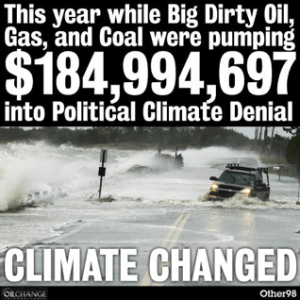
This hasn’t stopped the Obama administration from pumping hundreds of millions into “clean coal” projects or from allowing the Bureau of Land Management from opening up public lands in the Powder River Basin for coal mining. Nonetheless, as awareness of coal’s contribution to global warming and human health impacts grows, American coal companies are going to fight to keep the mines operating and the coal burning. Even it if means helping to fuel one of our country’s main economic rivals, China.
This brings us to the curious case of natural gas, the one fossil fuel that continues to be deemed a clean energy source by many despite the fact that its extraction through fracking could have catastrophic impacts, not to mention global warming causing emissions from leaks and carbon from its burning. There is no doubt there is a natural gas boom taking place across the country, with proposals for new fracking operations spreading from California to New York. But how much of this proposed natural gas will actually be used in the United States in the future is a question that has yet to be answered.
The first natural gas export from the United States was approved for Cheniere Energy in March 2011 by the Department of Energy. It will be the first large natural gas export out of the Gulf of Mexico, with other proposals in the pipeline by companies wanting to sell American natural gas to the global market. Their loyalty isn’t to America, but to their bottom line.
The Keystone XL pipeline saga and the recent misinformation about coal development illuminate how these resource profiteers market their destructive endeavors to normal Americans — as a means of energy independence and national security. Nonetheless, as the U.S. public looks to wean the country off of dirty fossil fuels, it’s a safe bet that the extraction industry will have little problem selling their dirty products to anyone who’s ready to buy.
People Watching is not the same as being a Watchdog: MLive’s 13 Michiganders for 2013
Beginning on Sunday, MLive let its readers know which “Michiganders” we should be watching in 2013.
The MLive posting provides a list of 13 people who are most likely to “make headlines.” The posting does acknowledge that the method they used to pick the 13 was not scientific, but MLive feels their “list covers a pretty wide range of movers and shakers.”
Nowhere in the article does the MLive reporter define what a mover and a shaker is, but it is safe to say that what MLive defines as a mover and a shaker is someone primarily from the business community and is a proponent of “development.”
Indeed, looking at the list of 13, it is disproportionately made up of business people, with a couple of politicians.
Watching or Watchdog?
The idea that news agencies should be watching people is certainly an old notion, but there is a major difference between watching, in a shallow celebrity sense, and being a watchdog, where people with power are monitored and scrutinized.
MLive, and its print sister The Grand Rapids Press, have never really been a watchdog of power, as we have noted in our news analysis section and in the many news reports over the years.
What MLive has demonstrated is a commitment to celebrity news and acting as an apologist for those in power, whether that has been the local 1% or development projects that continue to primarily benefit those who are already obscenely well off.
As an indication, look at the first two profiles already posted in the series of thirteen. On Sunday, MLive posted a profile of Grand Rapids bar owner Mark Sellers and today it posted a profile for billionaire Dan Gilbert.
In both profile, the MLive reporter presents nothing but gushingly positive information about both Sellers and Gilbert, with five fun facts about each of these two businessmen. Again, no information that would question the wealth both of these men have amassed or investigation into their financial practices. MLive readers are instead presented with a perspective, which says that both of these men are making the downtown of Grand Rapids and Detroit exciting places.
When MLive gets to Wednesday and posts a profile of Donald Weatherspoon, emergency manager for Muskegon Heights and Highland Park public schools don’t expect an investigation into Weatherspoon’s background or the very nature of the emergency manager policy that was voted down by the public in November, only to have the State Legislature overturn the public will and pass a new state law that can not be overturned by any ballot initiative.
Such a series focusing on those with power only reinforces and normalizes that these are the only people who really matter and can accomplish anything worth acknowledging. Such a series conversely says working class people and grassroots organizers and organizations don’t count and are not really relevant when it comes to making a difference in the world.
Just one more reason why we need as much independent and grassroots media as possible to counteract the celebrity and power-drunk commercial media in this community.
The 12 Days of a Capitalist Christmas
This article by Paul Buchheit is re-posted from Common Dreams.
On the first day of Christmas my employer gave to me ONE penny for every $3 the richest 130,000 Americans make. It’s been a national tradition since 1980.
On the second day my doctor showed me TWO Americans needing mental health care, but only one of the two could afford treatment. The doctor informed me that the fifty states have cut $1.8 billion from their mental health budgets during the recession, and that the 2013 Republican budget proposes further cuts. “It’s crazy,” I protested. “Some states are allowing guns in schools and daycare centers and churches and bars and hospitals, but they’re cutting mental health care?” The doctor just nodded in frustration.
On the third day The Economist told me that it costs just THREE cents in administrative expenses for every $100 raised through a Financial Transaction Tax (FTT) in the United Kingdom, versus $1.42 for the personal income tax and $1.25 for the corporate income tax. With up to THREE quadrillion dollars in total U.S. financial transactions, we could replace federal income taxes with a tiny FTT.
On the fourth day a food pantry gave me FOUR dollars worth of food. That’s about what food stamp recipients get each day through the Supplemental Nutrition Assistance Program (SNAP). To pay for rent and utilities, a family of three gets $400 per month from Temporary Assistance for Needy Families (TANF), which comes to about FOUR dollars a day per person.
On the fifth day a financial advisor introduced me to his FIVE richest investors, who were the only ones out of 100 Americans to increase their wealth over the past 25 years, by the impressive rate of almost 20%. It’s like that throughout the entire country, the advisor said: only 5% took almost all the gains. Five golden rings, indeed.
On the sixth day, as the traditional 12-day song started to get annoying, Santa appeared to take me by the hand to the U.S. corporate offices, where the tax lawyers gave to me SIX cents for the national treasury. “Hey,” I said, “this used to be twenty-five cents. You’ve doubled your profits in the last ten years, but individual and payroll taxes have to pay 94 cents out of every dollar!” The lawyers just smiled. Santa shook his head in frustration.
On the seventh day a guidance counselor informed me that one out of SEVEN Americans between the ages of 16 and 24 is neither working nor in school.
On the eighth day an IRS agent gave me these matching facts: Over EIGHT percent of the GDP (8.4%) goes for tax expenditures (subsidies provided through the tax code, mostly to the very rich). That’s almost exactly the same amount (8.4% of the GDP) that goes to Social Security and Medicare.
On the ninth day an unemployed dietitian told me that the average male has increased his weight by NINE percent over the past 20 years (180 to 196), and the average female by TWELVE percent (142 to 160). As a NINE dollar per hour food-service worker gave me and Santa our burgers and fries and shakes, my jolly old partner chortled, “Ho Ho Ho, soon you’ll all look like me!”
On the 10th day a Forbes article confirmed that the TEN richest Americans made more than our entire national housing budget in just one year. That’s over $50 billion. The twenty richest Americans made more than our entire education budget. Santa assured me that the transfer of wealth from society’s needs to a few individuals was not the norm around the world.
On the eleventh day a creditor gave me a bill for ELEVEN trillion dollars of debt incurred by the American consumer, including mortgages, student loans, and credit card liabilities.
And on the twelfth day Santa gave me an IOU for TWELVE trillion dollars, the U.S. share of up to $32 trillion held overseas, untaxed. “One problem,” cautioned Santa, “my reindeer haven’t been able to find any of it yet.”
After all this I stood perplexed. “What does it all mean?” I asked Santa.
“Well, that’s capitalism,” I heard him exclaim as he drove out of sight. “It’s all about the individual getting all he can, because that will benefit everyone. And let me tell you,” he added with a twinkle, “those benefits are just as real as I am!”
And with that he was gone.
We Can’t Fix Our Economy Without Confronting White Supremacy
This article by Imara Jones is re-posted from Colorlines.
Regardless of when the president and Congress decide to end their current budget standoff, it is increasingly clear that the emerging deal will do very little to reverse the fiscal wrongs at the heart of the tax code. These wrongs have transformed America’s economy into the least equitable and most racially unfair it’s been in almost a half century.
Our collective denial over the fundamental injustice at the heart of our economic system is a result of white supremacy. The words “white supremacy” are radioactive to be sure. It pains me to write them. However, as a trained economist I go where the facts lead me. Since I have written potentially inflammatory words, let me be clear about what I mean.
White supremacy is a low-level assumption about characteristics that white people allegedly have which transforms inequality between them and everyone else into something natural. It often masks itself as fairness and goes unquestioned as a result. Using this definition, our current tax code is a work of white supremacy.
The fact that we’ve arrived at this point on the watch of the country’s first black president is an irony too large to ignore. Mostly victim, partly complicit, Obama is not fully to blame. Yet, economically speaking, the stubborn fact remains that the country is at a moment of racial injustice not seen in more than a generation. In the last four years, that injustice has only expanded and calcified.
White wealth is double what it was 30 years ago. Black and Latino wealth is at its lowest point ever recorded. These inequitable consequences flow directly from political choices embedded in our tax code. But since 1980 when these choices began to be implemented, we’ve talked ourselves out of race and into a mess when it comes to taxes. In fact the frame for our current fiscal debate has clear white supremacist roots.
Recent Origins
As I’ve written previously, it began in 1980 when Ronald Reagan announced that he wanted to reduce taxes and return money to the states. This was long a demand of southern White Citizens Councils. He did so in a Mississippi county were one of the most brutal murders of the civil rights era took place.
White Citizens Councils, the political wing of the Klu Klux Klan, detested federal taxes because they were used to promote economic fairness for blacks in the South. Government spending on economic opportunity had upset the pre-existing racialized economic order. So in speech after speech, Reagan promised to “turn back the clock” and won in a landslide.
Once in office, Reagan did as promised. He re-constructed a system which took money from the employed poor and working class—who are disproportionately black and brown—and gave it to a mostly white minority who were already wealthy.
The result of Reagan’s policies—which were turbocharged under George W. Bush—is that the top 1 percent have a greater share of national income than at any point in American history. And 97 percent of the top 1 percent are white. Yet poverty is stuck at decades-high levels. One out of three blacks and one out of four Latinos is poor.
Reagan’s policies, largely followed by his predecessors in both parties, have left us a country where a child born in poverty in any other advanced economy on the planet has a better chance of becoming rich than one born in the United States.
This is blatantly wrong to the vast majority of Americans, regardless of race. They would not allow this injustice to stand, if spoken to plainly about it.
But since Reagan’s success in winning office off of white supremacist notions, the U.S. has struggled to be honest with itself about the racial impact of its economic choices. The trouble is that you can’t solve a problem that you don’t admit exists.
A Longterm Legacy
The stubborn truth is that economic white supremacy hangs like poison in the national air. It’s been the default position of the United States since the country came into existence as a slave republic. The only way to neutralize white supremacy is to admit that it still animates many of our basic economic assumptions.
The fact that Oprah and Jay-Z are points of interests because they are people of color with vast wealth makes the point. We’re conditioned to be astounded by the economic success of blacks and more unassuming about the wealth of whites. Our stereotypes about who’s deserving and who’s not are grounded in an ongoing white supremacist paradigm.
You would think that having a black president would help us work through some of this. But President Obama has yet to give one speech dedicated exclusively to the Depression-like economic distress in communities of color nor the three-decades-long government policies which caused it. In his silence Obama extends his party’s complicity in our economic system’s destructive racial aspects.
Democrats argue that they fight for race-blind, middle-class economic policies.
The only problem is that Americans aren’t attune to issues of economic injustice. In our national subconscious, economic inequality is just assumed as a natural result of capitalism. It is not. However, through hundreds of years of struggle, Americans, are actually sensitive to racial injustice.
By not confronting the racial aspects of economic inequality, we’ve actually hardened our former racial caste system, which had economic implications, into an economic caste system that has racial implications. From the perspective of economic rights and wrongs, both approaches appear eerily similar.
Instead of a debate over tax increases or spending cuts, what we need to have is an argument about what kind of country we want to have. We need to ask ourselves whether the past was both right and good enough, and how we can build a better, stronger, and fairer future.
Until we have a real stand-off over our fundamental values, we’ll continue to be stuck in a national economic cul-de-sac shaped by white supremacy. Without real change, we’ll circle there in a fruitless, schizophrenic argument with ourselves.
Democrats, Social Security and the Fiscal Cliff
This article by Rob Urie is re-posted from Counter Punch.
With democrats ecstatic that political dysfunction has postponed their cutting the social insurance programs that Americans have paid for and count on for a few weeks, discussion of the intricacies of ‘chained CPI’ (Consumer Price Index) versus other measures of inflation used to adjust Social Security can now apparently wait for the New Year. Still, this probably isn’t a bad time to ask: why? Why cut Social Security? The program is currently solvent, is expected to remain solvent for decades to come, and projected shortfalls in the future could be better addressed by raising the incomes of the people who pay into the program, not by cutting payments to those who depend on them. What is to be gained by ‘solving’ a problem that isn’t?
If cutting Social Security isn’t necessary, why then is it being proposed? Barack Obama provided copious evidence in prior proposals, television interviews and speeches that doing so is his intent. Congressional democrats and labor leaders quickly acceded to his proposal to do so, with House Speaker Nancy Pelosi going so far as to actively lie that proposed cuts will ‘strengthen’ the program. And given the cuts will eventually put tens of millions of Americans into dire poverty from a program they paid into for all of their working lives, what rationale could possibly justify doing so?
The reason I ask is a coalition of democrats, labor, liberals and progressives just re-elected Mr. Obama and democrats in Congress to what—cut Social Security? Mr. Obama created the ‘fiscal cliff’ to first push his stacked (in favor of cutting social insurance programs) ‘deficit commission’ to develop a plan to cut government spending and second, to force the issue to be revisited immediately after the election if no plan was agreed to. And Republican threats to refuse to raise the debt ceiling for leverage to ‘force’ spending cuts are idiotic—George W. Bush and congressional Republicans just led the largest increase in government spending in modern history. And that is not a difficult point to make. (And had it been on beneficial programs, it would have been laudable).
Ultimately the entire ‘debate’ is nonsense—the U.S. doesn’t fund spending directly from taxes. As the Federal Reserve is in the process of demonstrating with its QE (Quantitative Easing) programs, it can buy an unlimited quantity of government debt with money it ‘creates’ –the ‘debt limit’ is an arbitrary misdirection. This isn’t to argue that there is no relationship between economic production and money creation, but it is to point out that the ‘Federal budget’ is a convenient fiction. So, given his repeated analogy of the Federal budget to a family budget, is Mr. Obama ignorant of government finances or does he understand them and is purposely using the misleading analogy to further unstated goals?
The ‘Fix the Debt’ committee of politicians, corporate executives and connected financiers claiming to be concerned about the Federal deficit isn’t discussing eliminating the ‘carried interest’ deduction that benefits billionaire hedge fund managers, raising effective corporate tax rates that are currently the lowest in modern history, materially cutting end-of-empire levels of military spending and raising personal income tax rates on the titans of finance who would be begging for change in the street were it not for Federal government largesse in the (ongoing) bank bailouts. But they are deeply concerned about the Federal deficit, as are Mr. Obama and congressional democrats.
But again, why? The web of convenient fictions currently in play amongst both democrats and republicans in Washington—corporate tax cuts promote economic growth and job creation, government spending ‘crowds out’ more productive private sector spending, ‘excessive’ government debt will cause a financial market rebellion (bond vigilantes) and handing social insurance programs to private market profiteers is beneficial to the insured, are all demonstrably nonsense with only a cursory look at ‘the evidence.’
Effective corporate tax rates are the lowest in modern history and job creation, even before the economic calamity began in 2008, is the weakest since the 1930s. As global warming caused by largely private production and the predatory, dysfunctional private sector demonstrate on a daily basis, the ‘efficiencies’ of private production come from cost shifting, not by levels of human motivation intrinsic to capitalism. As QE is demonstrating, the Federal Reserve can control both short and long term interests rates—the ‘bond vigilantes’ are only in control when they provide cover for private interests. And Barack Obama didn’t choose the ‘least bad’ option with his healthcare ‘reform,’ he chose the private option to which he is ideologically committed.
Without apparent irony, these convenient fictions are straight from the IMF (International Monetary Fund) and World Bank playbooks circa 1980. While couched in the language of ‘economic development,’ IMF policies were / are extractive, designed to exert control over political economies and were / are tools of economic imperialism. The ‘austerity’ of IMF policies, cutting social spending to divert funds to service external debt, was rarely accompanied by even the pretense it benefited those whose social insurance programs were being looted. Cut to Mr. Obama and Democratic Speaker Nancy Pelosi mirroring the Vietnam Warism that to strengthen Social Security we must weaken it. Welcome to neo-Colonial America.
Also without apparent irony, the neo-Keynesian wing of the Democratic Party claims to have correctly analyzed current economic travails and prescribed the necessary and sufficient solutions if only Mr. Obama and the DC democrats would listen. In the first, this leaves the great mystery of why they haven’t listened and have actively articulated the policies of the radical right instead? In the second, Keynesian solutions imply that ‘we are all in this together,’ economically speaking, decades after official Washington and America’s plutocracy made it abundantly clear they believe they are responsible for their lot and we for ours, except when they need a few trillion dollars for a bailout. Finally, the ‘we’re all in this together’ monetary policies of the neo-Keynesians have benefited America’s richest 10% who own financial assets alone. (For explanations see Minsky’s essays on inflation and Marx’s Capital, Volume II).
With no respect whatsoever, this leads to the observation that Mr. Obama and his co-conspirators in the Democratic Party haven’t ‘caved,’ ‘capitulated,’ ‘relented,’ ‘given in,’ ‘submitted’ or ‘yielded’ by agreeing to cut social insurance programs. Mr. Obama’s far-right-of-center policies of his first term were just affirmed by the coalition that re-elected him. He will propose cutting Social Security again in just a few weeks. And democrats, labor, liberals and progressives will again be sincerely debating the merits of chained CPI versus other measures of inflation by which to cut Social Security. But while the effects of cuts will be real, the ‘debate’ won’t be. Put another way, the goal is to cut Social Security, not to ‘strengthen’ it.
In his speech at the Hamilton Project launch (link above) in 2006 Mr. Obama articulated the ‘slippery slope’ argument he believed was the ‘left’ position against ‘modernizing’ America’s social insurance programs. He argued supporters of these programs feared minor ‘adjustments’ were a pretext for the wholesale cuts desired by the radical right. But what this explanation leaves out is context. Were the ‘discussion’ taking place as the economic prospects of the poor and working classes were dramatically rising– rapid income gains, increasing income security, rising food security and income and wealth distribution resembling economic democracy, interpreted intent might be benign. But with Mr. Obama and congressional democrats several decades into giving voice to the desires and policies of the radical right, it would require a fool to believe benign intent today.
Hopefully I am underestimating the political pushback proposed cuts will engender. But given the propensity of democrats, labor, liberals and progressives to sincerely debate irrelevancies while giving unwavering support to the increasingly debased policies of their leaders, I doubt it. The bourgeois of these constituencies will likely break with the poor and working class and accede to the bogus rationale that the programs must be weakened so they may be strengthened, calculating that they’ll be all right in any case. And the pundit class will do the narrow calculus of cutting this program to save that without noticing the unwavering trajectory toward neo-liberal hell of the last forty years. To the folks who support the Democratic Party without apparently knowing what their policies are, good luck with that Social Security thing and all. To everyone else, we didn’t ask for this, but it’s coming our way anyhow.
Leonard Peltier Speaks Out from Prison on Denial of Medical Care, Bid for Clemency
This video is re-posted from ZNet.
Leonard Peltier, one of the nation’s most well-known and longest-incarcerated prisoners, speaks out from the U.S. Penitentiary at Coleman, Florida, where he is currently held. Peltier is the Native American activist and former member of the American Indian Movement who was convicted of aiding in the killing of two FBI agents during a shootout on South Dakota’s Pine Ridge Indian Reservation in 1975. Sentenced to prison in 1977, Peltier is now 68 years old. Democracy Now! host Amy Goodman spoke with Peltier on Saturday when he called into a press conference organized by his supporters.
 Grand Rapids Institute for Information Democracy