Oxfam: World’s Largest Food Companies Creating Legacy of Destruction
This article by Jon Queally is re-posted from Common Dreams.
The world’s largest food and beverage companies may be profitable, but according to Oxfam International their practices are helping to destroy not only the natural resources that support a global food system but the lives of the people they depend on most: their employees and their customers.
In a new effort called Behind the Brand, part of their ongoing GROW campaign to fix the broken food system, Oxfam has singled out the ten largest food processing companies—Associated British Foods (ABF), Coca Cola, Danone, General Mills, Kellogg’s, Mars, Mondelez, Nestlé, Pepsico and Unilever—to make a singular statement about the failure of these behemoths to fulfill their social and environmental responsibilities.
According to Oxfam, these “Big 10”—that together generate $1 billion-a-day in profit—are failing millions of people in developing countries who supply land, labor, water and commodities needed to make their products.
“It’s time these companies take more responsibility for their immense influence on poor people’s lives,” said Jeremy Hobbs, Executive Director for Oxfam International. “Eighty percent of the world’s hungry people work in food production and these companies employ millions of people in developing countries to grow their ingredients. They control hundreds of the world’s most popular brands and have the economic, social and political clout to make a real and lasting difference to the world’s poor and hungry.”
As The Guardian reports:
The charity’s Behind the Brands report compiled a scorecard, rating the “big 10” food companies in seven categories: the transparency of their supply chains and operations, how they ensure the rights of workers, how they protect women’s rights, the management of water and land use, their policies to reduce the impacts of climate change and how they ensure the rights of the farmers who grow their ingredients.
The company with the lowest score – just 13 out of 70 – was ABF. It scored just one mark out of 10 in its treatment of land, women and climate change, while the highest scores it managed to achieve was three out of 10, in relation to workers and transparency.
In joint second-lowest place were Kellogg’s and General Mills, which owns Old El Paso, Häagen-Dazs and Nature Valley, with both scoring 16 out of 70.
In the campaign’s first targeted action, Oxfam will target Nestle, Mondelez and Mars for their failure to address inequality faced by women who grow cocoa for their chocolate products. As part of that effort, the group released a series with first-hand accounts which explore the inequality that women cocoa growers face. And the campaign is urging people to use their own voices and social networks to speak out against the food giants.
“No brand is too big to listen to its customers,” said Hobbs. “If enough people urge the big food companies to do what is right, they have no choice but to listen. By contacting companies on Twitter and Facebook, or signing a petition to their CEO, consumers can do their part to help bring lasting change in our broken food system by showing companies their customers expect them to operate responsibly.”
The ‘Behind the Brands’ campaign also released this list of ways that the “Big 10” fail to meet their commitments:
- While some of the “Big 10” have publicly committed to women’s rights, none have committed to eliminating discrimination against women throughout their supply chains.
- None of the companies have adequate policies to protect local communities from land and water grabs, despite all of them sourcing commodities plagued by land rights violations, such as palm oil, soy and sugar. Not one company has declared ‘zero tolerance’ against land grabs in their supply chains.
- All ten companies are overly secretive about their agricultural supply chains, making their claims of ‘sustainability’ and ‘social responsibility’ difficult to verify. Nestle and Unilever are most open about the countries they source from, but no company is providing enough information about their suppliers.
- Companies are generally increasing their overall water efficiency but most have failed to put policies in place to limit their impact on local water sources. Only Pepsi has publicly recognized water as a human right and committed to consult local communities. Nestle has developed guidelines for its suppliers to manage water and was ranked top for policies on water.
- All of the companies have taken steps to reduce direct emissions, but only five – Mondelez, Danone, Unilever, Coca-Cola and Mars – publicly report on agricultural emissions associated with their products. Unilever alone has committed to halve its greenhouse gas footprint by 2020. None have yet developed policies to help farmers in their supply chains to build resilience to climate change.
- None have publicly committed to pay a fair price to farmers or fair business arrangements with them across all agricultural operations. Only Unilever – which is top-ranked for its dealings with small-scale farmers – has specific supplier guidelines to address some key issues faced by farmers.
The Bloom Collective Moves Downtown: Grand Re-Opening March 9
 The Bloom Collective, Grand Rapids’ only infoshop, is scheduled to reopen from a winter hiatus March 9th in a new location downtown. The collective will now be operating out of 8 Jefferson SE, immediately adjacent to the hyper-local, worker-run Bartertown Diner, and it’s soon-to-be sisters, Cult Pizza and Bread Square.
During their grand opening, the infoshop will host an open house and fundraiser to celebrate the move, featuring readings of radical poetry and literature, food, activities, and music. This marks the second move for the Bloom since they originally opened on Wealthy Street in mid 2007. For the past few years the collective has been struggling to get and keep community attention in the basement of Steepletown Neighborhood Services, a building owned by the Catholic church on the west side of the city. Indeed, many community members lost track of The Bloom after the gentrification on Wealthy made impossible financial demands on the anti-commercial enterprise. The current move is made possible by a partnership between the infoshop and the worker-run restaurants surrounding it.
The Bloom recently announced on their Facebook page a successful fundraising effort to get a year’s worth of rent in the bank prior to reopening. This suggest strong support for this rare institution, as the infoshop remains an “unofficial” non-profit organization, relying completely on donations to stay afloat.

a sneak peak into the new space
Still many in the community are unfamiliar with what an infoshop actually is and what role they play in modern society. The Bloom states on their website that their lending library has over 3000 materials and they “believe sharing [their] collection of resources locally is one of the many ways to inspire change and promote equality globally.” Further, the website explains that the collective operates on consensus, meaning there are no leaders or bosses, and they focus their work around four Points of Unity, which include “a very clear rejection of capitalism, imperialism, institutions and governments that promote oppression (and) all forms and systems of domination and discrimination.” Additionally, the infoshop gives “a call to direct action and civil disobedience,” and utilizes “an organizational philosophy based on decentralization and autonomy.”
The Bloom Collective, and infoshops in general, seek to be both a resource for activists in the community as well as an entry point for folks to become more politically aware and involved. This includes the books and DVDs, but they will also carry radical stickers, posters and are one of the few places to stock a zine library. The Bloom has partnered with other community organizations in a variety of fashions. Food justice group Our Kitchen Table has shared the space with the Bloom for years, and other labor, environmental, and educational groups have used the space for meetings and classes. The Bloom does not support any political parties, but they have offered critiques of local politicians and initiatives, mostly through events organized in the space. Regular movie screenings have also been a mainstay in the infoshop’s history, typically featuring provocative political documentaries.
Infoshops have a history of being targeted by right-wing and racist organizations, and well as police and governments for their radical activities and
community influence, causing a need for a certain amount of security around membership and the physical space itself. The Freedom bookshop in England was recently firebombed, while the Long Haul infoshop in Berkley CA (publisher of Slingshot!) was illegally raided by police a few years back; even the Bloom faced break-ins and threats while on Wealthy St.
The Bloom is completely volunteer run and has had spotty hours in the past as a result. The collective is counting on the more accessible location mobilizing

the Bloom’s new sign, in progress
volunteers to help keep the shop open for more regular hours. Until the gathering on March 9th, potential patrons can get in touch with the infoshop through their Facebook page, (www.facebook.com/bloomcollectivegr), by email (bloomcollective@gmail.com) or on their website, www.thebloomcollective.org, where users can sign up to volunteer or donate.
Foundation Profile: Doug & Maria DeVos Foundation
This is our third foundation profile for our Grand Rapids Non-Profit Industrial Complex Project. So far we have looked at the Richard & Helen DeVos Foundation and the Dick & Betsy DeVos Foundation.
Doug DeVos is the current President of Amway, the company that his father founded, along with Jay Van Andel.
The foundation that Doug and his wife Maria run is not as large as the elder DeVos or his brother Dick, but sizeable nonetheless.
We were able to access the 990 documents for this foundation for 2009 through 2011, from the online source Guidestar.
Like the other DeVos family foundations we have looked at, the Doug & Maria DeVos Foundation has contributed significantly to conservative Christian organizations and organizations that promote the supremacy of free market capitalism.
Some of the groups that the Doug & Maria DeVos Foundation have contributed to between 2009 and 2011 are the Willow Creek Association ($100,000), the Acton Institute ($159,350), the Mackinac Center for Public Policy ($65,000), Grand Action ($200,000) and the Heritage Foundation ($50,000).
This DeVos Family Foundation has also contributed significantly to the Grand Rapids Christian School Association ($7,106,000), the Helen DeVos Children’s Hospital Foundation ($4,545,000) and the National Constitution Center ($3,175,000).
Doug DeVos is the Chairman of the Executive Committee of the National Constitution Center, which includes a whole host of conservative members, including Richard DeVos Sr. Despite the rather benign sounding name, the National Constitution Center promotes a rather narrow notion of civic engagement, with its current Chairman being Jeb Bush.
Another large recipient of funding from the Doug & Maria DeVos Foundation is the American Enterprise Institute – AEI ($1,750,000). The American Enterprise Institute has a along history of lobbying the federal government on issues ranging from Iraq, tobacco regulation and water policies. The American Enterprise Institute has had a strong relationship with the American Legislative Exchange Council (ALEC), which has been at the forefront of much scrutiny for its lobbying practices. It also should be noted that the American Enterprise Institute is part of the network of organizations that deny climate change and has even offered money to scientists to publicly state their opposition to global warming.

One last group that has been the recipient of Doug & Maria DeVos Foundation money is the National Organization for Marriage (NOM). NOM has received $500,000 from the foundation, which has resulted in a national boycott against Amway.
The National Organization for Marriage aggressively opposed marriage equality and is a leading group that both lobbies and funnels money to state campaigns where marriage equality is on the ballot.
The California-based group Rights Equal Rights Cause initiated the boycott campaign last summer and is targeting Amway, since Doug DeVos is the current President of the family company.
New Video Campaign seeks to reframe the immigration debate

The folks at Cuentame and Brave New Films have teamed up again to create several new videos that both expose the hate language of anti-immigration forces, but also to encourage the pro-immigration rights movement to not let the anti-immigration voices frame the debate.
Nativist, racist and fear-mongering hate groups are working hard to drive their narrative on immigration. For years now, anti-immigrant groups have successfully infused their message into the national immigration debate. Influencing local politicians and national figures – with the same talking points: “More punishment”, “Militarize the border”, “Massive deportations”, “More Enforcement.” This has resulted in dangerous policies that have led to flagrant violation of human rights.
It is time we put basic immigrant, human rights back in the forefront of our national values and priorities! Let Congress and the President know that to reform immigration they must prioritize “Immigrant rights before enforcement.”
Add your name and message – make sure your voice is heard! Here is one of the four videos that Cuentame and Brave New Films have created.
A City Within A City: The Black Freedom Struggle in Grand Rapids, MI – Book Review
Todd Robinson’s, A City Within A City: The Black Freedom Struggle in Grand Rapids, MI, is important for two major reasons.
First, the book illuminates some very important history of race relations in Grand Rapids that is likely not well known, unless of course you lived through it.
Secondly, the book is extremely valuable in that is provides information that can illuminate what the possibilities are for the future. Indeed, this is the real purpose of history, to provide an honest framework so that people can learn from the past and put a proper context on the present, with the hope of what can become of the future.
Robinson begins his book through the powerful stories of individuals like Karen Parker, an African American woman who moved to Grand Rapids from North Carolina. Parker, like so many other well educated Black people who came north after WWII.
Parker said that she was amazed at how the White community in Grand Rapids held deeply racists and discriminatory attitudes towards her and her Black friends and colleagues. Robinson used first person interviews and other sources to provide substantive commentary from African Americans living in Grand Rapids before and during the Height of the Civil Rights movement. The stories vary from Blacks being victims of redlining, refused access to more skills jobs and excluded from much of the political and economic decision making in Grand Rapids.
Robinson identifies what was practiced in Grand Rapids as a form of “managerial racism,” a kind of racism that wasn’t as in your face as in the Jim Crow south, but ultimately had the same consequences.
The author identifies the businessmen and business entities, such as the Grand Rapids Chamber of Commerce, as the primary proponents of the “managerial racism.” At one point in the book, Robinson even headlines a section entitled, The Center City Plantation, which referred to the efforts by the business community to inject millions of dollars into the downtown at the expense of many neighborhoods.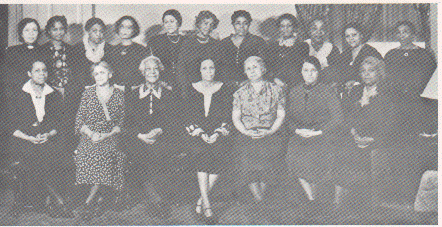
Robinson also identifies the organizing efforts and groups that were behind either reformist efforts or more systemic change around racial politics in Grand Rapids. He identifies groups such as the Grand Rapids Study Club, which was made up of Black women who studied independently on issues related to their community. Robinson also investigates the Grand Rapids chapters of the Urban League and the NAACP and what roles they played in issues like housing, education and employment.
In addition to the author’s investigation of the Black community at this time in Grand Rapids, he spends an ample amount of time on the political class in Grand Rapids that wielded power in those days. Names like Frank McKay and George Welsh are two that Robinson explores, names which sit atop some of the buildings in downtown Grand Rapids today.
Frank McKay was a robber baron in his own right and one of the 1% in that period. He owned a tremendous amount of property and had an excessive amount of influence on the politics within Grand Rapids. Welsh, was a long time Mayor of Grand Rapids and was unseated from power, not by a popular movement, but by “moderate” Republicans who wanted to manage the city in ways that would not be as blatantly dictatorial as was the case under Welsh.
The chapters I found most engaging where the chapters around educational reform and civil rights in Grand Rapids in the 1960s. Robinson does an outstanding job of presenting what was happening with education in Grand Rapids as the Black population was growing. The author presents compelling information on how the desegregation efforts locally were one way, where Blacks were bused to predominantly White schools, but White were not bused at all.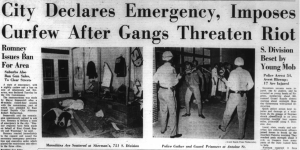
This one-sided dynamic led to lots of conflict and sent a strong message to the Black community that there was a double standard in the local school district. Robinson demonstrates how this double standard played out, with long-term effects that provide some clarity on the state of the Grand Rapids Public Schools today.
Robinson also looks at how the predominantly White schools treated Black students and how the school administration did not prepare the faculty nor the students for the integration of Blacks into schools like Union High. In fact, White students often engaged in acts of discrimination and violence against Black students, often resulting in the schools being shut down for days at a time.
The opposition to the arrival of Black students to schools like Union High led to a coalition of White Westside candidates running for the GR School Board on a platform of segregation and anti-busing. Parents and voters turned out in numbers to support these candidates and pushed racial justice back years.
The other area that Robinson explores is the growing impatience from the Black community around housing, education and employment opportunities. Like much of the country, there was a shift from the more moderate Civil Rights reformers to the Black Power Movement. People were tired of being second-class citizens and told that their status in life was because of their lack of commitment to doing for themselves.
The Black community had had enough and began participating in actions and organizing efforts that were often led by students. The Grand Rapids Public Schools began implementing harsh dress codes, which many in the Black community felt was a lack of understanding or acknowledgement of Black culture.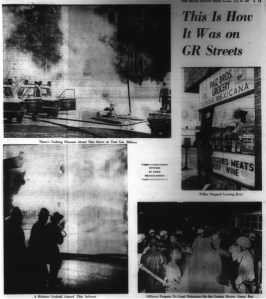
The famous Mustache affair, where a Black student refused to shave his mustache led to his suspension from school. The community responded with thousands showing up at school board meetings and pressuring the GRPS to stop imposing culturally insensitive policies on Black students.
This growing tension and frustration in the Black community, especially with Black youth, was the context for the 1967 race riot that broke out in Grand Rapids. Robinson does an excellent job of sifting through the significance of that uprising, which was just one of 47 race riots to occur in the US that year.
Robinson notes that the politicians and business leaders in Grand Rapids didn’t want to deal with the real concerns of the Black community at this time, but also recognized that it was not good business when people rose up in anger the way they did in July of 67.
The sophistication of Managerial Racism in Grand Rapids allowed those in power to take action that was presented as racial reconciliation, but was just another way on maintaining the White Supremacist power structure. Grand Rapids elected Lyman Parks as its first City Commissioner in 1968. Parks eventually became President of the City Commission and then Mayor of Grand Rapids, when then Mayor Robert Boelens resigned.
Lyman Parks was vetted by the establishment and played an important role for the White Power structure, since Parks himself identified as conservative and as a Republican. This allowed Grand Rapids to continue to be a City Within a City, where Blacks were never allowed to advance collectively.
A City Within a City should be read by anyone who cares about an honest history of Grand Rapids. It should also be required reading for anyone who identifies with wanting to fight for racial justice and dismantled the White Supremacist power structure that still rules this city.
A Week’s Worth of Troubling Immigration Revelations
This article by Seth Freed Wessler is re-posted from ColorLines.
Immigration reform lurched awkwardly forward, and then backward, and then forward in Washington this week after the White House accidentally leaked a version of its immigration plan on Saturday and Sen. Marco Rubio hollered in true partisan form that the proposal, though remarkably similar to his own, would be “dead on arrival.” Then, yesterday, Rep. Bob Goodlatte, the Republican who runs the all-important House Judiciary Committee, said he won’t support a reform bill if it includes eventual citizenship for undocumented immigrants. Democrats have drawn the line in the sand on the need for a path to citizenship, and Goodlatte’s decision to position himself on the other side of that line could spell the death of reform.
This sort of back and forth is likely to continue until one side budges or reform deliberations fall flat. But while Washington plays politics with people’s lives, the federal immigration enforcement apparatus appears to have declared war. This week saw a rush of news about the improprieties of federal immigration authorities, the true nature of immigration enforcement and what those who profit from deportation are thinking and doing. Here’s a rundown of the five most ridiculous, enraging, hypocritical things we learned about immigration enforcement in the last week.
1. ICE Officials Tell Agents to Use DMV Records and Traffic Safety Stops to Deport Immigrants
Since President Obama took office in 2008, his administration has bragged about its targeted immigration enforcement policy. Supposedly, Immigration and Customs Enforcement prioritizes what it considers to be the worst of the worst, such as rapists, drug dealers and “repeat immigration offenders” who just won’t respect the law. But last week, ICE’s claims took a serious blow when USA Today revealed that precisely the opposite is true. Emails obtained by the ACLU revealed ICE officials instructed field agents to target immigrants with low-level criminal charges by trolling state DMV records and more.
From USA Today:
Among those new tactics — detailed in interviews and internal e-mails — were trolling state driver’s license records for information about foreign-born applicants, dispatching U.S. Immigration and Customs Enforcement (ICE) agents to traffic safety checkpoints conducted by police departments, and processing more illegal immigrants who had been booked into jails for low-level offenses. Records show ICE officials in Washington approved some of those steps.
2. The Immigration Detention Industry a) Expects to Profit Despite Immigration Reform, b) Is Hiring for Success, c) and Is Buying Football Stadiums
As I reported late last week, the CEO of the country’s largest private prison company reassured investors that immigration reform wouldn’t interrupt their cash flow.
“There’s always going to be a demand for beds,” said Corrections Corporation of America’s Damon Hininger during an investor call. “[ICE’s] profile of detainees in those beds may change over time to where they focus more on what they call ‘criminal aliens’ versus ‘non-criminal aliens.’”
Another way private prison companies ensure they keep getting detainees is by hiring people once responsible for facilitating that flow. David Venturella, an ICE official who crafted some of the emails urging agents to troll DMV records for immigrants with petty offenses (see #1) left the agency in July for a new job at GEO Group, the second largest private prison company in the United States. Well timed, GEO, well timed.
And just in case policy and patronage isn’t enough, Venturella’s new employer is giving away cash in exchange for some shine. On Tuesday news broke that Florida Atlantic University’s football team will soon throw the old pig skin in the newly christened GEO Group Stadium. The 30,000-seater will be renamed in exchange for a $6 million donation from the GOE’s charitable foundation.
3. ICE Targets People Without Criminal Convictions for Detention:
A batch of data released on Wednesday by the Transactional Records Access Clearinghouse (TRAC) once again confirmed that the feds go after undocumented immigrants with no criminal convictions. Between 2008 and the beginning of 2012, only 22 percent of people the federal government detained were convicted of any crime at all. And just 8.6 percent were found guilty of a so-called “level 1” crime.
The report goes on to note that because of how ICE classifies offenses, “it appears likely that far fewer than even this small proportion of 8.6 percent actually would meet the more objective standards of having been convicted of crimes that pose a serious threat to national security or public safety.”
4. ICE Also Detains Hundreds of US Citizens and Thousands of Green-Card Holders Without Convictions
ICE asked local, state and federal jails to hold over 800 United States citizens, according to the TRAC data. Obviously it’s not legal for ICE to detain US citizens, but it happens anyway. Sometimes these people get deported. Four years ago Jaqueline Stevens reported that in its rush to meet deportation quotas, ICE swept up citizens.
The TRAC data also reveal that ICE placed immigration holds on 20,000 legal permanent residents, or green card holders, who had never been convicted of a crime. Permanent residents can be detained and deported if they break the law, and tens of thousands are cast out each year. But green cards are supposed to protect people from facing immigration penalties if they stay out of trouble. ICE got confused about this rule about 20,000 times.
5. ICE Trained County Prosecutors to Help Deport People
Prospecutors with the Maricopa County Attorney’s Office—the same place where Joe Arpaio’s still running his own immigration raid brigade—received ICE training last year on how to prosecute to ensure deportation. The Phoenix New Times reportedthat ICE’s assistant chief legal counsel delivered a slide show at a brown bag lunch that essentially outlined for prosecutors how to charge a defendant so their conviction will be a fast track to deportation.
Federal laws include a long list of convictions that lead directly to deportation for non-citizens. If you’re convicted of one of these crimes there’s no defense; you just get deported. But in many cases, prosecutors pick and choose from a laundry list of charges when considering a single crime and only some of those charges lead to mandatory deportation. The ICE presentation enumerates the difference and even provides the attorneys with tips on “Defense Counsel Strategies.” How’s that for efficiency?
Immigration Rights Advocates Host Organizing Event in Fight for Comprehensive Immigration Reform
Earlier today about 50 people gathered to discuss strategies and tactics in the national campaign to change immigration policy that would allow the estimate 11 million undocumented people to apply for citizenship.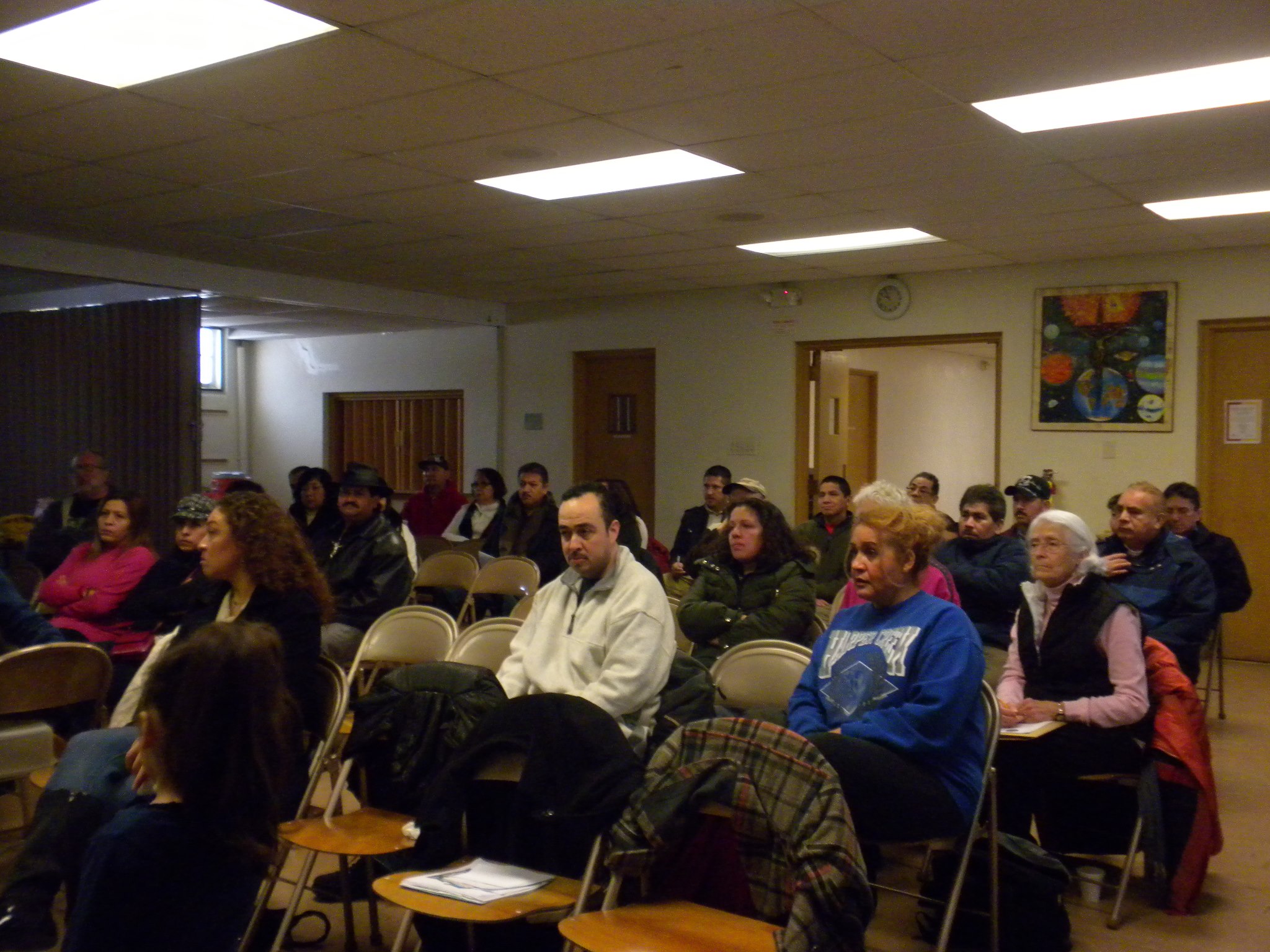
The movement for comprehensive immigration reform also includes to changes in the current immigration law that would prioritize family reunification, demilitarize borders, protest labor rights, stop ICE quotas and eliminate immigration detention.
Members of the Michigan Chapter of the Alliance for Immigration Reform (AIR) and the Michigan Organizing Project (MOP) hosted the organizing event. A team of facilitators broke down the 3 hour organizing session into several areas.
First, people discussed recent history of immigration reform, which began with organizing in opposition to the reactionary legislation proposed by Rep. Sensenbrenner in 2005. There were several large gatherings in Grand Rapids, which culminated in a demonstration with roughly 10,000 participants in late March of 2006.
The facilitator talked about the hope many in the Latino community had in 2008 after Barack Obama was elected. However, there was no follow through from the new administration to fulfill its commitment to comprehensive immigration reform. The issue was ignored, so people began organizing again around this issue with major marches in 2010.
People discussed how the government is not going to make the necessary changes in immigration legislation unless the people pressure them to do so. It was encouraging to hear people acknowledge this fact and to see people organizing from the premise that it is social movements that make changes, not the government.
After, recent immigration organizing history was covered, the group discussed a larger strategy for passing comprehensive immigration reform. People talked about the need to pressure legislators to adopt policies that the community wants. This kind of political pressure will involved getting all kinds of sectors to support comprehensive immigration reform, such as labor, faith communities and other civil rights sectors.
AIR and MOP are planning meetings with Michigan members of the federal government, educate them and get a commitment from them by whatever means necessary. People are organizing meetings in Michigan, community forums and a major march in Washington on April 10.
One other aspect of the strategy discussed was the need to both educate and mobilize larger numbers of the general public. People stated that we needed to counteract the misinformation from most media outlets and anti-immigration groups all across the country. This campaign will involved numerous ways of communication and education, but the tactic that this morning’s group spent most of their time on was the importance of having immigrants tell their stories.
In order to find effective ways to tell these stories, people broke into small groups and everyone in attendance told their own stories. Most of the people there were immigrants and many were undocumented. All of their stories were powerful and many of them were quite emotional, sharing stories of violence and constantly living in fear. The group agreed to share these stories on social media, in writing and at community forums in order to highlight what people have endured and why it is important that we see the human element of comprehensive immigration reform.
At the end of the organizing session, it was clear that people were motivated and passionate about this issue. People demonstrated their clear desire to be part of a movement that is urgent and will not be won without sacrifices.
For anyone interested in getting involved in this issue in West Michigan, you can contact AIR-MOP on Facebook.
The Power of Direct Action: Documentary on the Tar Sands Blockade
Blockadia Rising: Voices of the Tar Sands Blockade is an hour-long documentary film written and directed by Garrett Graham in collaboration with the Tar Sands Blockade and features exclusive video footage shot by the blockaders themselves during the course of over six months of sustained resistance.
In 2012, Texas landowners and environmental activists came together to organize resistance against a dangerous pipeline being built by a Canadian corporation to bring tar sands oil from Alberta Canada to refineries near the Gulf of Mexico. This hazardous project continues despite unprecedented opposition from indigenous communities, local farmers and even global environmental movements. From this struggle, a community of resistance was born that has attracted volunteers from around the continent who have successfully defied this multi-million dollar corporation with the power of non-violent direct action.
The film is meant to be both a celebration of the blockades’ achievements and a primer for those interested in joining the campaign. It explains the dangers of tar sands extraction and the risks to public health posed by the pipeline as well as the strategy of non-violent direct action that has been delaying the pipeline so far.
The story takes place in the backwoods of East Texas where the pipeline crosses farmlands and homesteads as well as aquifers and old growth forests. You will hear the voices of the blockaders who are risking their lives to stop this pipeline. In the Texas heat, they have locked themselves to heavy machinery, and braved the elements by living in trees. Hear these courageous folks in their own words.
Blockadia Rising is just the opening chapter in this ongoing movement to stop this pipeline and halt the extraction of the Canadian tar sands, but the blockaders see themselves as a part of a larger struggle against the consequences of run-away climate-change caused by unchecked extraction of natural resources by industry at the expense of both human and non-human communities. This film speaks to all movements for environmental and social justice and showcases direct action techniques that have never been attempted before.
Blockadia Rising: Voices from the tar Sands Blockade (2013) was written, edited and narrated by Garrett Graham, an active participant of the Tar Sands Blockade who continues to support their efforts. This film is dedicated to them, and everyone fighting for environmental and social justice.
The Campaign: tarsandsblockade.org The Filmmaker: garrettgrahamonline.wordpress.com
This article by Jon Queally is re-posted from Common Dreams.
Reports that President Obama is poised to nominate MIT professor Ernest Moniz to be the next head of the Department of Energy is raising serious concerns for those worried that the administration will betray its promise to take on the threat of the climate crisis by making a major domestic push for natural gas drilling using the controversial practice known as fracking.
The choice of Moniz, known for his adamant support for fracking—which he’s called “paradigm-shifting”—seems to confirm reporting last week that a major part of Obama’s plans for energy creation in his second term will be to “initiate widespread gas fracking in the US.”
“Mr. Moniz is affiliated with the industry-backed MIT Energy Initiative, so we shouldn’t be surprised about his favorable position on fracking,” said Mitch Jones from Food & Water Watch. “But President Obama could do a lot better.”
“Appointing Mr. Moniz,” Jones continued, “would be a nail in the coffin for one of his most lauded inaugural speech promises: a commitment to focus on climate solutions.”
And speaking with The Hill newspaper, Public Citizen’s Ty Slocum said: “Moniz is a status quo pick at a time when we can’t afford the status quo.”
Obama is expected to nominate new heads for both the Dept. of Energy and the Environmental Protection Agency as early as next week. Topping the expected list as the EPA’s next head is Gina McCarthy, who currently heads the agency’s Office of Air and Radiation under the outgoing Lisa Jackson.
McCarthy, whose focus on air quality and pollution from traditional coal and gas-fired plants will make her a target of the fossil fuel industry and its allies in Congress, appears cautiously agreeable to environmental groups though most have to weigh in strongly for or against the longtime Massachusetts energy regulator.
But for Moniz, coupled with the growing controversy over the dangers of groundwater pollution and climate impacts of the methane released by fracking, the most serious opposition will likely come from those who challenge the idea the natural gas is a “clean energy” or that a investing in a so-called “bridge fuel” is a better alternative than the swift transition to a truly renewable energy system.
“Mr. Moniz’s appointment to the DOE could set renewable energy development back years,” concluded Jones. “If we pursue our fossil fuel addiction by expanding fracking, which Mr. Moniz will likely advocate, the oil and gas industry will thrive while true energy efficiency and renewable solutions languish. Our water, public health and climate would suffer.”
And The Hill adds:
A major 2011 study the MIT energy program released said that environmental risks of developing gas from shale formations, which is achieved through fracking, are “challenging but manageable.”
Bill Snape, the senior counsel with the Center for Biological Diversity, said he’s concerned that Moniz’s support for natural gas could bring a shift in focus away from the development of renewable electricity and smart-grid technologies.
“The concern I have with him is, he has the veneer of this MIT PhD scientist, that somehow he is going to be objective, and in reality he could very well be a political hack for the natural gas industry,” Snape said.
Unmaking Equality
This article by Agnieszka Karoluk is re-posted from Counter Punch.
On Thursday, January 24th Defense Secretary Leon Panetta announced that the US military will lift the ban on women serving in combat. Many women’s groups and feminist activists saw this announcement as an unqualified victory. According to Kiki Cardenas writing in the popular blog feministing.com, “People asked me: “Well, do you know what you would be fighting for? DO you believe in the war?” Yes and No. I would have been fighting for women’s equality in the world and here in the U.S. and that was reason enough for me.”
Lurking in the background of sentiments such as these is the common perception that the United States military invasions into Iraq and Afghanistan were motivated by a desire to liberate burqa-clad women in these countries. Cardenas isn’t fighting for women’s equality, she’s fighting for the exploitation of her gender’s struggle to further the ends of imperialism via the military industrial complex. One way we may examine this idea is by way of post-colonialist philosopher Gayatri Spivak’s observation that, “White men will not save brown women from brown men.” This is not a racially reductionist formula—”white men are the root of all evil”—but rather a provocative entreaty to wake us from our imperialist dreams. The need for such reminders is exemplified by former First Lady Laura Bush, who on November 17, 2001 shortly after the invasion of Afghanistan addressed the American people on a radio show, “Civilized people throughout the world are speaking out in horror — not only because our hearts break for the women and children in Afghanistan, but also because in Afghanistan we see the world the terrorists would like to impose on the rest of us.”
Rather than “saving brown women”, allowing women to serve in combat roles is simply a false win for feminism and women’s rights in the US. It is nothing more than the advancement of normalization of the military industrial complex. When US military men and women are killing children in Yemen and Pakistan with Drone strikes, feminists and women’s rights activists should be actively organizing against these unjust and immoral actions rather than rallying around promoting the military and its death squads. The drone strike program is ever expanding, according to journalist Jeremy Scahill on his recent appearance on Democracy Now!, Obama had now sanctioned “signature strikes,”
“If an individual had contact with certain other individuals, if they were traveling in a certain area at certain times, if they were gathering with a certain number of people, that there was a presumption that they must be up to no good, that they are suspected militants or suspected terrorists and that the U.S. could take preemptive action against those people—and by “preemptive action,” I mean killing them with a missile”
The fight for women’s rights is far from over, and we certainly do not live in a post-feminist society, regardless of all the all too common view of the kind Carla Bruni-Sarkozy expressed when she remarked, “My generation doesn’t need feminism.” This might be easy to say for the former French first lady, but such lazy dismissals do little for the vast majority of women who still struggle for their basic rights.
In 2013, the fight for birth control and reproductive rights are under fire and workplace wage gaps are still the norm in many cases. There are bigger fish to fry than focuses on “opportunities” for women to fight in the military. The frontlines of the fight for women’s liberation should lie on labor opportunities, child care, housing and health- fundamental rights which all humans deserve, which unfortunately women and LGBTQ individuals are constantly denied due to various legal, social and economic barriers. According to the Center for American Progress, while women overall make 77 cents for every dollar the average white male makes, black women and Hispanic women only make 70 cents and 61 cents, respectively.
Lastly, another major issue regarding women in the military which is overlooked is Sexual assault. Studies suggest that as many as one in three female soldiers are raped during their US military service. Because of machismo and patriarchy which plagues American military culture and higher-ranked officers unwillingness to investigate allegations or rape and sexual assault, many times the victim who reports abuse is punished.
Military is culturally and functionally abhorrent to the interests of the women’s movement. Imperialist expansion under the guise of women’s liberation is degrading to all. As a feminist, I will say that allowing women into combat rolls does nothing for the advancement of women’s rights globally and refuse to allow this to go on in the name of women’s liberation.
Most Afghan and Iraqi women do not see it as a “win” that they or a loved one will now have the chance to be killed by a female American soldier.
-Zillah Eisenstein

