MLive eulogizes another War Criminal: Norman Schwarzkopf
On Friday, MLive wrote a short article about the passing of Gen. Norman Schwarzkopf.
The brief eulogy was mostly about a 1995 visit to Grand Rapids by Schwarzkopf, where he criticized then President Clinton on his Bosnian policy.
The MLive story then states, “But those misgivings did not stop “Stormin Norman” from calling for “100 percent” support for the American troops in harm’s way.” Such a statement is meant to elicit the belief that Schwarzkopf always had the best interests of US troops in mind. This is a nice sentiment, but it has nothing to do with reality.
Norman Schwarzkopf was born into a military family. His father was in the military and involved in the first CIA coup in Iran in 1953 (see Stephen Kinzer’s All the Shah’s Men).
Schwarzkopf had a military career, but was not know to the American public until the US war in the Persian Gulf, known by its military designation as Desert Storm.
Schwarzkopf was in charge of major military operations during the US invasion of Kuwait and then Iraq. This war was supposed to be about defending the sovereign nation of Kuwait, even though Kuwait is a monarchy, but it was primarily about oil and US hegemony in the Middle East. The timing of such an invasion is important to note, since it took place right around the time that the Soviet Union was collapsing, making it the first real post Cold War intervention.
Like in most wars, the US was using a new generation of weapons, weapons that we all learned a great deal about from the US news media particularly the new 24 news network, CNN.
One outcome of the use of such weapons was a very low US troop casualty rate, which we were told about repeatedly during the 6 weeks the war lasted. What we didn’t hear a great deal about in US news coverage, was the brutality done to Iraqi soldiers and civilians.
Iraqi troops were no match for the US military arsenal, especially since the US used a massive aerial assault early on that pretty much devastated the Iraqi Defense Forces.
Knowing they were outmatch, the Iraqi military began to retreat and surrender, but this did not deter the US military’s intent to send a strong message to the rest of the world about what happens when you defy the US.
On February 13 a US bomb killed 1,500 civilians in a Baghdad bomb shelter, and two days later President Bush urged the Iraqi people to overthrow Saddam Hussein. On February 21 Soviet diplomats announced that Iraq had agreed to withdraw unconditionally from Kuwait. The US gave them two days to do so before starting the ground attack. On February 26 as Iraqi troops tried to retreat or surrender along the Basra road, thousands were slaughtered during the “turkey shoot” on the “highway of death.” Two days later Iraq and the US agreed on a cease-fire; but two days after that, thousands of Iraqi soldiers were killed in another battle that did not kill a single American.
Some of those Iraqi soldiers were killed, not by bullets, but because they were buried alive in the sand. The US military put snowplows on tanks and push thousands of pounds of sand on top of Iraqi soldiers who were in ditches. This was reported in the US, but months later, like this New York Times article.
At the time some of us in Grand Rapids had been reading independent news and found out about the death of Iraqi soldiers from being buried alive in the sand. When then President George Bush came to Grand Rapids to celebrate July 4, 1991, we laid down in front of the very tanks that were used to bury Iraqi soldiers alive in the sand, since those tanks were part of a July 4 parade in downtown Grand Rapids.
Iraqi civilians were also targeted by the US military. Besides some of the largest bunker buster bombs that hit bomb shelters, the US also targeted the following:
Hospitals, health clinics, schools and kindergartens were bombed, education eradicated so totally that the stores for educational materials, in buildings separate from the schools (usually in a central distribution point some miles away) were also bombed. Agriculture in all forms was deliberately targeted. Chicken farms bombed, flocks of sheep and goats, broadly half of all buffalo were killed, dairy farms obliterated. Crops, food processing factories reduced to rubble.
The US military also bombed the countries water filtration plants, as has been well documented by Thomas Nagy. In addition, the US used depleted uranium in the weapons, which continues to irradiate Iraq and the region, the people, flora and fauna -and will continue to do so for four and a half billion years.
All of these actions described here by the US military are violations of international law and constitute war crimes. Such war crimes were well documented by a team of legal experts, led by Ramsey Clark.
Thus thousands of innocent Iraqi civilians were killed during Operation Desert Storm, most of it led by Gen. Norman Schwarzkopf. Such crimes were omitted from the MLive eulogy of Schwarzkopf, readers were instead told about his visit as a motivational speaker at a 1995 business conference in Grand Rapids. Now that is truth in journalism.
Labor and Reproductive Rights should be fought for together
This article by Linda Gordon is re-posted from ZNet.
On December 11 Michigan passed two right-to-work laws, one for public and one for private employees. As even our president said, they mean right to work for lower wages. These laws do not make workers free to reject joining a union; they already have that right. They abolish the requirement that those who don’t join a union pay the equivalent of union dues, a requirement designed to prevent “free riders” – workers who benefit from union contracts without paying their fair share. Three days later the same lame-duck legislature passed the most extreme anti-abortion laws in the nation. These laws define as abortion even the removal of a “fetus that has died as a result of natural causes, accidental trauma, or a criminal assault on the pregnant woman.” The laws prohibit any private or public insurance from covering abortion; charge physicians performing abortion with the responsibility of seeing that any piece of human tissue receive the burial due to a deceased person; put the burden on the physician to prove that the abortion patient was not coerced. Perhaps worst, the laws place many arbitrary requirements on clinics, none of them health related, and would force most of the state’s women’s clinics to close.
This coincidence of anti-labor and anti-abortion legislation is not a coincidence. They are part of the same right-wing agenda. If progressives are to build successful resistance to that agenda, our own agenda needs to include both labor and reproductive rights.
But unions and other supporters of labor have ignored reproductive rights. Some of this hands-off position came from deference to Catholics, but if that was once reasonable, it no longer is. Over 95 percent of Catholics use contraception in defiance of the church’s teaching and plenty of Catholics have abortions. Another reason for ignoring reproductive rights was the traditional maleness of unions, also no longer the case.
But the worst problem has been defining reproductive rights as a “women’s issue” and a feminist demand, which evokes the old labor and Left view that feminism is a movement of elites. That’s wrong too: if you ask women not about the label “feminism,” but about the issues that make up a feminist program – such as equal pay, equal job opportunity, affordable day care, shared housework, an end to violence against women, and reproductive rights – it turns out that working-class and poor women are the most feminist.
In fact, the Republican “war on women” is not just targeting women, any more than the war on labor is targeting only men. All middle- and working-class people, and especially the poor, benefit from a strong labor movement -it’s our best bulwark against a race to the wage bottom. In parallel, being able to control how many children to have and when to have them is something men as well as women need. Access to birth control has become a necessity of modern life, and this is the opinion of the majority of Americans of all groups, including African Americans, Latino Americans, and Muslim Americans.
The great majority of abortion decisions are made jointly by the men and women responsible for the pregnancy. The great majority of abortion decisions rest on economic considerations: we can’t afford a child, or another child; we can’t survive on one income; child care is too expensive for us; it would be better to finish high school, or college, or graduate school first; it’s too soon after the previous birth; I can no longer rely on my mother or sister or grandmother for help.
In other words, anti-abortion laws amount to class legislation, even if not all their proponents realize that. As in the past, during the century when abortion was made illegal, the well-to-do always found ways to obtain abortions through paying private physicians or traveling to countries more realistic about sex and the economy. It’s working-class and middle-class people and the young who depend on the clinics that the Michigan law will close. One-quarter of all poor women who get birth control get it at one of these family planning clinics and for many, they are the first entry point into any adult health care. At most clinics, initial visits are free and fees for further services depend on income – for the poor, typically $20. The majority of clinics provide women with postpartum and prenatal care, well-baby care, immunizations, and physical exams. More than 40 percent provide primary health care and many also provide genetic screening, mammograms, infertility counseling and mental health care. These clinics are usually the only source of reproductive health care for the most marginalized groups: drug abusers, prison inmates, the disabled and the homeless. And they often serve men as well as women, providing HIV testing and referrals, safe sex instruction, and prostate and testicular cancer screening.
Other abortion decisions are made by teenagers who don’t have access to contraception, or whose partners pressure them into sex and won’t use condoms, or who think that using contraception makes them “sluts.” These are the women who are least well prepared to be parents at the time.
The best way to reduce abortions is of course to make contraception easily accessible and free. (Although most anti-abortion advocates also oppose these measures.) But accidents happen; contraception is not flawless. And neither are people. Sex is an unruly force. That’s why, as all teenagers know, abstinence education doesn’t work.
But there’s an immediate political consideration too: however misnamed, the “war on women” angered and mobilized women across class lines. The Republican attacks elicited an outpouring of money and support for Planned Parenthood; when the Komen breast-cancer foundation tried to cut off support for Planned Parenthood, it was forced to take back its threat within days. This resistance represents a growing awareness of the dangers of the right-wing agenda. Pro-choice people tend to be progressive on many other issues too, including domestic spending and foreign policy. But not all understand fully how destroying labor unions pushes everyone’s standard of living downward.
Here in Wisconsin the massive uprising against the Scott Walker/ALEC agenda in 2011 was probably majority female. Then in his victorious election campaign, Walker appealed explicitly to his base of white men, talking up hunting, guns, and projecting a combative, aggressive image, while the anti-Walker campaign noticeably neglected raising any of the “women’s issues.” Instead, the anti-Walker forces should have prioritized the connections between his anti-union and anti-women’s rights agenda. Union forces simply can’t afford to write off “women’s issues” as outside their concern. Building an alliance between feminist groups and the labor movement should be a high priority.
New Media We Recommend
Below is a list of new materials that we have read/watched in recent weeks. The comments are not a “review” of the material, instead sort of an endorsement of ideas and investigations that can provide solid analysis and even inspiration in the struggle for change. All these items are available at The Bloom Collective, so check them out and stimulate your mind.
Accompanying: Pathways to Social Change, by Staughton and Alice Lynd – Long time activists and insurgent historians, Staughton and Alice Lynd give us another gem. Building on their own experiences of doing anti-racist work, union organizing, prison solidarity and anti-war activism, the authors present to us the idea of accompanying. Accompanying is another way of describing solidarity, but it is more relational in nature and operates on the premise of being present with others in the struggle. This is a term that we used when I worked in Latin America, where we would accompany people who were receiving death threats from government or paramilitary groups. The authors talk about their experiences of accompaniment in the 60s civil rights years and while doing prison solidarity. However, the longest chapter, and the one that best describes accompaniment, is the chapter on slain Salvadoran bishop Oscar Romero. A powerful and inspiring book about how we are present with each other in the struggle for justice.
 We are Many: Reflections on Movement Strategies, From Occupation to Liberation, edited by Kate Khatib, Margaret Killjoy and Mike McGuire – Of all the anthologies on since the Occupy Movement rose up in the fall of 2011, this collection of essays are by far the most dynamic and comprehensive. There are numerous personal testimonies from those who have been part of occupy experiments across the country, but what makes this collection of writings so powerful is both the critical assessment it provides of Occupy and lessons learned from the insurgent movement(s) in the US over the past year. Some authors provide brilliant analysis of what went wrong and what grassroots groups/movements still need to come to terms with when these kinds of revolutionary manifestations occur. Other contributors provide fabulous toolkits on everything from how to deal with cops, the importance of research and the value of autonomy. A wonderful collection that should be read widely and shared enthusiastically.
Colonialism, by Mia Ramnath – This is the fifth in a series of zines we have looked at from the Institute for Anarchist Studies. Mia Ramnath, author of the book Decolonizing Anarchism, provides us with a wonderful essay that articulates the essence of what colonialism is a historical context and looks at how traditional colonialism has evolved since WWII. Ramnath makes it clear that the US engages in colonialism through direct military occupation, the use of proxy forces and global economic institutions like the IMF and World Bank. In addition, this intelligently delicious zine talks about resistance movements abroad and in the US as essentially decolonizing movements that reclaim space that has been taken over by colonizing forces. This is what makes the zine so powerful, in that it expands our notion of colonialism as something beyond history. Highly recommended.
8: The Mormon Proposition (DVD) – This documentary exposes the Mormon Church’s historic involvement in the promotion and passage of California’s Proposition 8 and the religion’s ongoing campaign against gay rights. The film takes place in California and Utah as Mormons, following their prophet’s call to action, wage spiritual warfare with money and misinformation against gay citizens, doing everything they can to deny them of marriage and the rights that come with it. An important contribution for understanding the some of the anti-LGBTQ forces in the US.
Dangerous Rush to Legislate on Surveillance and Mental Health? An Interview with Dean Spade
This interview is re-posted from ZNet.
With cliffs, abysses and deadlines on every front, the New Year’s shaping up to be a dangerous place for justice. Consider the pressure to do “something” on gun violence. Spurred by the horrific slaughter in Newtown, President Barack Obama has tasked his administration to get serious about legislation before the end of next month. “This time, the words need to lead to action,” he said.
But what action? On gun control, a battle royal is shaping up. On mental illness, action may come more easily, but it may be just the wrong sort.
We still don’t know if the gunman in Connecticut suffered from mental illness but the killer of four firefighters in Webster New York was clearly disturbed. (In the note he left, he pledged to burn down the neighborhood and “do what I like doing best, killing people.”) The moment invites politicians and pundits who are jockeying for limelight (and scared of the NRA) to call for increased mental health screening and treatment, even of the mandatory sort.
PBS broadcast a piece this week about California’s “Laura’s Law” which provides court-ordered outpatient treatment for the seriously mentally ill. It was passed in 2002 but generally shunned since for civil liberties reasons. Nationwide, forty-three other states have laws permitting some form of involuntary outpatient commitment and as PBS reported, the recent killings “have raised once again the issue of forcing the mentally ill into treatment.”
Author activist Dean Spade, a professor of law at the University of Seattle, says that incidents like the Virginia Tech and Newtown shootings are often followed by calls for increased surveillance and involuntary treatment of people with mental illness.
“This is not surprising—for decades we have been told that locking more people up and building more walls and metal detectors and installing more cops and cameras will make us safer, so we are used to that response,” said Spade this week.
The problem is, it does not work, and instead the people who are targeted are not those who are actually most dangerous, but those who are already considered “suspicious” in culture that’s racist, xenophobic and anti-immigrant.
“We have a long history in the US of giving people involuntary medical treatment and using mental institutions to lock up people who are “different” or threatening to social norms,” says Spade. What will actually make us all safer is more accessible, voluntary mental health care. About one in four adults suffers from a diagnosable mental illness, according to the National Institute of Mental Health, but millions of those who report needing mental health services don’t receive care because of its cost or its negative stigma.
“So many people who could use mental health care do not reach out for it because they are afraid that they will be locked up involuntarily if they reach out to a provider,” says Spade.
At his press conference announcing the task force to reduce gun violence, President Obama said “We’re gonna need to work on making access to mental health care at least as easy as access to a gun.”
Yet, exactly as the shootings debate is playing out, funding for mental health services are teetering on the fiscal brink. Obama and Speaker John Boehner are considering long-term cuts to Medicaid, which underwrites services for more than 60 percent of people in the public mental health system, according to the Department of Health and Human Services. And that’s on top of state cuts amounting to some $5 billion from public mental health spending in the past four years, even as ten percent more people have sought services.
It takes us back to the same old story: we’d all be healthier under a free national health care system not subject to the Congressional football match. Meanwhile, we’re likely to see action for action’s sake, and that’s served us—especially some of us—very poorly.
I had a chance to talk recently with Spade, about “trickle up, rather than “trickle-down” justice. Trans activist and founder of the Sylvia Rivera Law Project, Spade is the author of “Normal Life: Administrative Violence, Critical Trans Politics and the Limits of Law.” An edited transcript is below. The video is posted in two parts, here and here.
PART ONE: The Most Imprisoning Society in the World:
Laura Flanders: Let’s start with Sylvia Rivera, The Sylvia Rivera Law Project which you founded ten years ago was named after a very special person, but not someone who is well known. Can you tell us a little bit about Sylvia?
Dean Spade: Yes, Sylvia Rivera was a trans women of color activist who was extremely active in the 60s and 70s. She was one of the people at the Stonewall rebellion. Some people credit her with being the first person to throw something at the cops. So she’s kind of a historical figure of great import for that reason. But for the Sylvia Rivera Law Project, the reason she is so important to us is throughout the course of the mainstreaming of the gay and lesbians rights movement in the 70s, 80s, 90s and today, she was a voice saying that we cannot keep marginalizing people of color and poor people.
She stood up against the way that trans people were kind of kicked out of the movement and the way that the “gay and lesbians rights” frame came to center white people, people with wealth, people who met traditional norms; gay and lesbian identities that look as much as possible just like straight couple identities, and she died in 2002 the year that I started the project. We do our work with her as one of our key inspirations for what it means to build racial and economic justice and our struggle for trans resistance.
And what is a poverty law center? What does that mean?
[A poverty law center] means that one of the main things we do is we provide free legal help to poor people who are facing a bunch of different issues. In the context of our work, trans and gender nonconforming people experience really specific, difficult conditions inside the systems where poor people are concentrated.
Homeless shelters, juvenile facilities (like foster care group homes), jails and prisons: all these places are gender segregated: men’s, women’s, girls and boys. They are places of extreme violence for gender outsiders and also for a lot of trans people there’s a lot of exclusion.
Our clients can’t get placed in drug treatment, can’t get placed into a shelter because they are going to be placed incorrectly and they’re going to face a lot of violence. So, we’re looking at the specific, really intense conditions of violence and poverty that trans communities are facing and we are providing free legal assistance, from things like deportation proceedings to welfare hearings.
How has the economic crisis of the last few years affected the people you work with?
The economic crisis has had huge impacts on our clients. Already the people we work with are criminalized, highly poor and homeless, but cuts to existing programs and benefit systems (really going back to the 90s) have made a major impact on people’s abilities to get basic needs met; to get housing… And of course the drastic growth in criminalization and immigration enforcement means that more and more of our clients are locked up in various prisons.
[For a trans person] what is the trajectory from maybe having a low-wage job to finding themselves criminalized or locked up?
Most trans people can’t even get low-wage jobs because there is just really widespread discrimination. People are like “We don’t want to hire someone like that to work in our store…”
Most people are pushed into criminalized economies. A lot of trans people are in the sex worker economy because that’s one of the only places where trans people are allowed to work. That, of course, leads to high levels of criminalization. [Also] there’s a stereotype…that trans women of color are all sex workers.
Tons of our clients are people who whether or not they are engaged in anything illegal are being profiled and policed. There are several sort of routes to criminalization. Also, it’s a crime to be a poor person in the United States. In New York City you can see this every day: sleeping outside is a crime that can get you locked up; sitting on the sidewalk if the cops think you’re poor or homeless can be a crime. Just getting by and being poor can mean going to jail.
Are trans people more likely to be homeless?
Yes. Trans people are more likely to end up homeless. One of the reasons is, it is so unsafe in the existing shelter systems. One of the pieces of work of the Sylvia Rivera Law Project over the last ten years is focused on the treatment of trans women in the department of homeless services here in New York City and this work has kind of ricocheted around the country with a lot of groups concerned with similar issues. In general, in homeless shelters, trans woman are denied access to women’s shelters. So the option is go into the men’s shelter and be the only woman there and face enormous likelihood of sexual assault. Or, stay street homeless because you are trying to figure out what’s the safest thing. If you don’t go into the shelter system in most cities you can’t qualify for other forms of low-income housing.
The problems around job discrimination produce the likelihood of homelessness and poverty, and then there’s the fact that the minimal services we have don’t accommodate trans people.
What about family care? We hear about a lot of people staying much longer than normal with their families, their birth families or going home when they can’t find a job in this economy.
Unfortunately most trans people experience a lot of family alienation because of our identities. There are always counter stories (there’s a lot of hope in that area and I think that there are some changes happening), but it’s a pretty typical experience not having family support if you’re trans, which can contribute to poverty having a deeper impact because there’s not a safety net there.
So we’ve established that you’re dealing with people who are some of the most vulnerable, the most vilified, the most criminalized in our society. You come out with an analysis that isn’t just about them or even about them, it’s about our society. What have you learned, in broad strokes, from this work that has surprised you?
I think the biggest take-away from the work I have done from the Sylvia Rivera Law Project for the last ten years is the significance of different forms of criminalization in the lives of poor people, and the way that that criminalization is highly racialized and highly gendered.
[It’s racialized and gendered] in terms of who gets arrested and what the police think looks unusual [and in terms of] which neighborhoods [police] spend time patrolling …[also] who’s doing the work, or surviving in ways that are going to give them too much contact with the police. And what actually happens in America’s prisons.
We are the most imprisoning nation in the world. We have five percent of the world’s population and twenty-five percent of the world’s prisoners. And the people in our prisons are primarily people of color and poor people imprisoned for crimes related to poverty.
Inside those prisons there is outrageous racial and gender violence, in all of them: the women’s prisons and men’s prisons… All of that picture, plus the additional picture of how much our immigration system has grown and (especially within the last ten years). We are deporting more people than we’ve ever deported, our immigration prisons have also grown by about four-fold; [they] are privatized and run at a profit. When you look at all of that, [the prison system itself turns out to be] one of the biggest sources of violence in the lives of Americans in my opinion.
What does it have to do with our model of change? Often our stories of change in this country have been, well, if you could just criminalize certain kinds of behavior—things like discrimination or violence against women or hate crimes—that will improve society. Will it? What do you think about hate crimes and the legislation that has tried to criminalize discrimination?
One of the really interesting contests inside trans communities and more broadly in queer and trans politics is whether or not hate crime laws actually work. Whether or not they are a good way to try to deal with violence against queer and trans people. And a lot of us are saying that this strategy doesn’t really work. It definitely doesn’t prevent violence against us.
Nobody has ever argued that when people are thinking who to beat up or kill tonight they look through some book and say, “oh, there’s a higher penalty if I do it for this than that.” That’s not how violence works. There is no argument that it prevents our deaths or beatings, but what it does do is it enhances the punishing power of the system that is actually the main perpetrator of violence against us.
In the lives of SRLP clients the most common perpetrator of violence is the police, corrections officers or immigrations officers. What does it mean to add power to that system?
Part of the way we see it is that the system has been desiring growth very intensely for at least the last 40 years and that growth has been motivated by profit (prisons are privatized, etc.) So, the real reason that the system wants to pass hate crimes laws is not because it is going to save our lives, but because the system wants to grow in any direction. We’ve really been looking carefully at whether or not that strategy has any benefit for preventing violence.
When you look over the ten years of the Sylvia Rivera Law Project—and congratulations on your ten years—what do you see? There is certainly more visibility, there’s more inclusion, there’s more “tolerance” [of trans people.] What else?
I guess I would say that in the last ten years you see more gay and lesbian organizations put “T” in their mission statements. There’s some more visibility in the media of certain kinds of stories about trans people, yet the actual conditions on the ground for trans people are worsening with the growing criminalization and immigration and the growing wealth divide in the United States, which the Occupy Movement has made very visible.
That’s one of the questions I am asking in the book: how come certain kinds of visible inclusion practices don’t result in material gains? I think you could ask that more broadly looking at the last 40 or 50 years in the United States. There has been so much work to declare us more equal in law, to say that racism and ablism and sexism are illegal, and yet you see the actual conditions of racialized violence and of the growing apparatus of criminalization worsen. You’ve seen the wealth gap worsen, you’ve seen women still experiencing an enormous wage gap; you’ve seen the attacks on reproductive health worsen. You’ve got to ask what is it about legal inclusion or legal equality frameworks that don’t deliver the goods on the ground?
So what is it?
I think part of what I think I’m learning from my own experience in trans resistance and other movements is that those promises of legal equality that allow state apparatuses of violence to grow in our names don’t actually deliver what we need. To actually get what we need [we need to understand] that grassroots struggle has been whatever has won anything material in terms of material change in the U.S.
I think the question is how can we turn our attention away from just getting our names on hate crimes law or our names on antidiscrimination laws that aren’t going to deliver the goods, and towards actually building meaningful strategies for dismantling criminal and imprisonment regimes, for getting rid of these violent border regimes that we have and for actually addressing poverty.
PART TWO: “TRICKLE UP SOCIAL JUSTICE”
How did you get involved in all of this? How did you grow up?
I grew up in central Virginia with a single mom and then later with some foster parents. I grew up as a poor person. I think that that had a lot of impact on my understanding of the world, and also with a single parent and seeing the sexism my mom experienced as a low-wage worker trying to get by in the welfare system. I think I was heavily politicized by the mid-90s welfare reform, which really helped me understand the stakes of some important policies that I really cared about. I was also really politicized by feminist and queer movements in that same time period. I think that led me to sort of formulate the politics that said, how can we have racial and economic justice be the center of queer-trans resistance, instead of an afterthought or something that is entirely left behind.
Do you have success stories you want to share? I know you are involved heavily with fights to stop the building of a new youth prison in Seattle and similarly involved with the Stop and Frisk campaigns in New York…
I think some of the most exciting strategies I see around the country are strategies to stop the expansion of criminalization and immigration enforcement. That looks like a lot of different things on the ground. It looks like people in local places like what we are doing in Seattle, trying to stop to stop the building of new prisons and jails –that’s huge. The system keeps expanding, it keeps sucking more people into it and hurting them while they’re there and not solving any of our problems.
Also, there’s a major national movement to stop what Obama has called “secure communities,” the framework increasing the participation between immigration enforcement and criminalization.
It’s also seen, obviously, in SB 1070, the famous controversial “show me your papers” law in Arizona. That whole trend towards criminalizing immigration and forcing more and more immigrants to live under worsening conditions is being fought back at so many levels. Also, the campaigns against stop and frisk here in New York City that have been very publicized. All of these are efforts to look at what is making this system keep devouring our communities; how do we dismantle brick by brick these really harmful machines that are leading these communities into these prisons, and how do we actually build what we need to be safe?
There are two things that I want to quickly lift up from your book, related to the way you use language. You don’t talk about discrimination; you talk about “life-shortening.” I’d like to ask you about that choice and you talk about an “imprisoning” society and people being “criminalized.” In most texts you read about people engaging in criminal behavior or “criminality” existing in certain communities. Talk about those choices and the thinking behind them.
The reason that I talk about harm and violence facing communities in terms of “life-shortening” (or sometimes I talk about the “distribution of life chances”) is because I am trying to get us to think in a material way on the ground about why some people’s lives are affected by lack of healthcare, lack of adequate nutrition, being exposed to more pollutants… The kind of material, harmful conditions that face us, which our communities are trying to resist.
I’m trying to talk about that because I want to move away from a conversation that’s solely about whether we can get the law to say good things about us. The government has declared that it’s not okay to beat up trans people; we have the federal Matthew Shepard/James Byrd Hate Crimes Law and people see it as a big stance against violence. [But it won’t prevent the violence that we’re talking about.
[Instead, I’d like us to be talking about] all the actual, material conditions that are shortening our lives, that are happening all the time and are being exploited and increased by austerity measures—and other moves from that same government that declares that our deaths are a problem.
I think part of what the book is trying to do is shift us away from asking what does the law say about us to what are legal structures doing to us and how do we actually resolve those material conditions?
In other words, emphasize the active verbs around criminalizing and imprisoning??
Yes. We live in a country where 24 hours a day you can watch Law and Order on T.V. There’s a lot of propaganda around criminality that tells us that there are these dangerous bad people, serial killers, serial rapists, who’ve got this criminal behavior problem.
In reality or criminal justice system works very differently. The reality is that all of us break laws all of the time, but that only certain people and certain communities are heavily policed and pushed into prisons (usually for very low-level crimes related to poverty.)
When we move away from thinking about individual criminals and bad people (which is the fiction that justifies the system) and look instead at these giant nets that are cast over (primarily) people of color and poor people in communities so as to bring more and more people into these private prison systems, where prison guard unions and prison corporations are seeking to influence politicians to pass more criminalizing laws (that will fill the beds and make more money…)
It’s a very different way of thinking about what criminality is, what crime is and what we would actually do to try and have a safer country.
Does it change your perspective on change making? And how social justice increases in society? We are often led to believe that if you let some people forward the rest will follow, but you suggest that it’s the other way around.
One of the ideas that I care a lot about is an idea that I call “trickle up social justice” as opposed to “trickle down.” One of the ways of thinking about social change is, let’s get one of the few most charismatic people, the people that look the most like what society already thinks are good people, and have a few really spectacular cases and maybe some New York Times articles about them and people will think that we are good and like us and perhaps we’ll make an advance for everyone.
It turns out that doesn’t really work…
It turns out if you solve the problem for the people who are the least vulnerable of the vulnerable, usually you end up mobilizing ideas that actually further the stigma of those who are considered outside or not good enough.
The idea of trickle-up social justice is that we should ethically start with those who are facing the worst conditions, those who are most losing their lives, those people in prison and immigration facilities and experiencing poverty and homelessness. We should start by figuring out how to solve the problems for them and inevitably that will solve the problems for everyone. It doesn’t work in reverse. That’s part of the idea. It’s a critique of the gay and lesbian rights strategy of choosing a few really charismatic, white couples and having that be the image of what an anti-homophobic framework is. That hasn’t really worked out for people on the bottom.
Dean Spade, Thank you.
Thank you!
Dean Spade is the co founder of the Sylvia Rivera Law Project and the author of “Normal Life: Administrative Violence, Critical Trans Politics and the Limits of Law.”
Where’s the outrage when Democrats vote to continue government spying?
The US Senate on Friday voted to reauthorize the FISA Amendments Act of 2008, a spying bill that critics say violates the Fourth Amendment and gives vast, unchecked surveillance authority to the government.
The move extends powers of the National Security Agency to conduct surveillance of Americans’ international emails and phone calls.
The FISA Amendments Act Reauthorization Act (H.R. 5949), passed on a 73-23 vote with 73% (30) of Democratic Senators voting in favor of greater government monitoring of and spying on US citizens.
Amongst the 30 Democratic Senators that voted for extending and expanding the Bush government spying policy were Michigan Senators Carl Levin and Debbie Stabenow.
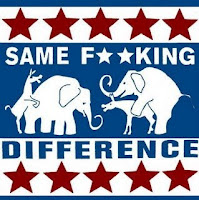
Once again we have “liberal” Democrats voting for something that is anti-democratic and repressive. What seems to be different about these laws passing now under the Obama administration, than under the Bush years, is the lack of outrage against our collective rights being under attack.
During the Bush years people were up in arms about government spying, the Patriot Act, war and silencing free speech. The same things continue under Obama, but show me organized opposition.
All these liberals have been saying for the past two presidential elections that we need to vote for Democrats because it would be so bad if Republicans controlled the White House and the Congress. Well, the Democrats control both and it isn’t pretty. What is worse is that instead of taking responsibility for voting for Democrats that are just as repressive as Republicans and represent the interests of the 1%, liberals will just respond to their candidates voting for government spying with the comment, “well, it would be worse under a Republican administration.”
Action Alert: Pressure Snyder to Veto anti-reproductive rights bills
We have received information from several groups in West Michigan and across the state that are working to pressure Governor Snyder to veto the various bills that are now before him that, if signed into law, would be a serious blow to reproductive rights in Michigan.
Governor Snyder received HB 5711 yesterday and SB 1293 and SB 1294 will be on his desk soon. Snyder has 14 days to either sign or veto HB 5711 (deadline is January 10th). He can also take no action, in which case the bill is dead, which is what is referred to as a pocket veto.
While some groups tried to work with the Governor’s office on this legislation to address some of the worst aspects of the bill, groups such as the Progressive Women’s Alliance believe that HB 5711 (S-3), “remains a terrible bill that shames women and their doctors.”
We asked the President of NOW GR, Dani Vilella, to respond to the bills that are now waiting for Snyder to either sign or veto. Vilella said:
“While there have been changes to HB5711 since its introduction in June, those changes do not go far enough. HB5711 along with SB 1293 & 1294, which ban abortion coverage in public and private insurance plans without a separate rider, do not protect women. They do not help to end the need for abortion, or reduce the unintended pregnancy rates in Michigan. They are punitive, plain and simple. They seek to restrict women’s right to make choices for their own bodies, health and lives.”
“NOW GR urges the Governor to veto these bills and asks the people of Michigan to reiterate this message by calling or emailing the Governor’s office as soon as possible.”
Along with NOW GR, Planned Parenthood, the Progressive Women’s Alliance and the ACLU of Michigan are all calling on people to contact the Governor’s office as soon as possible and demand that he veto these anti-choice and anti-reproductive rights bills.
Action Alert
Contact Governor Snyder and demand he veto HB 5711, SB 1293 & SB 1294
Call: 517.373.3400
E-mail: rick.snyder@michigan.gov
Or go online to https://somgovweb.state.mi.us/GovRelations/ShareOpinion.aspx
GOP and Feinstein Join to Fulfill Obama’s Demand for Renewed Warrantless Eavesdropping
This article by Glen Greenwald is re-posted from Common Dreams.
To this day, many people identify mid-2008 as the time they realized what type of politician Barack Obama actually is. Six months before, when seeking the Democratic nomination, then-Sen. Obama unambiguously vowed that he would filibuster “any bill” that retroactively immunized the telecom industry for having participated in the illegal Bush NSA warrantless eavesdropping program.
But in July 2008, once he had secured the nomination, a bill came before the Senate that did exactly that – the FISA Amendments Act of 2008 – and Obama not only failed to filibuster as promised, but far worse, he voted against the filibuster brought by other Senators, and then voted in favor of enacting the bill itself. That blatant, unblinking violation of his own clear promise – actively supporting a bill he had sworn months earlier he would block from a vote – caused a serious rift even in the middle of an election year between Obama and his own supporters.
Critically, the FISA Amendments Act of 2008 did much more than shield lawbreaking telecoms from all forms of legal accountability. Jointly written by Dick Cheney and then-Senate Intelligence Committee Chair Jay Rockefeller, it also legalized vast new, sweeping and almost certainly unconstitutional forms of warrantless government eavesdropping.
In doing so, the new 2008 law gutted the 30-year-old FISA statute that had been enacted to prevent the decades of severe spying abuses discovered by the mid-1970s Church Committee: by simply barring the government from eavesdropping on the communications of Americans without first obtaining a warrant from a court. Worst of all, the 2008 law legalized most of what Democrats had spent years pretending was such a scandal: the NSA warrantless eavesdropping program secretly implemented by George Bush after the 9/11 attack. In other words, the warrantless eavesdropping “scandal” that led to a Pulitzer Prize for the New York Times reporters who revealed it ended not with investigations or prosecutions for those who illegally spied on Americans, but with the Congressional GOP joining with key Democrats (including Obama) to legalize most of what Bush and Cheney had done. Ever since, the Obama DOJ has invoked secrecy and standing doctrines to prevent any courts from ruling on whether the warrantless eavesdropping powers granted by the 2008 law violate the Constitution.
The 2008 FISA law provided that it would expire in four years unless renewed. Yesterday, the Senate debated its renewal. Several Senators – Democrats Jeff Merkley and Ron Wyden of Oregon along with Kentucky GOP Senator Rand Paul – each attempted to attach amendments to the law simply to provide some modest amounts of transparency and oversight to ensure that the government’s warrantless eavesdropping powers were constrained and checked from abuse.
Just consider how modest these amendments were. Along with Democratic Sen. Mark Udall of Colorado, Sen. Wyden has spent two years warning Americans that the government’s eavesdropping powers are being interpreted (by secret court decisions and the Executive Branch) far more broadly than they would ever suspect, and that, as a result, these eavesdropping powers are being applied far more invasively and extensively than is commonly understood.
As a result, Wyden yesterday had two amendments: one that would simply require the NSA to give a general estimate of how many Americans are having their communications intercepted under this law (information the NSA has steadfastly refused to provide), and another which would state that the NSA is barred from eavesdropping on Americans on US soil without a warrant. Merkley’s amendment would compel the public release of secret judicial rulings from the FISA court which purport to interpret the scope of the eavesdropping law on the ground that “secret law is inconsistent with democratic governance”; the Obama administration has refused to release a single such opinion even though the court, “on at least one occasion”, found that the government was violating the Fourth Amendment in how it was using the law to eavesdrop on Americans.
But the Obama White House opposed all amendments, demanding a “clean” renewal of the law without any oversight or transparency reforms. Earlier this month, the GOP-led House complied by passing a reform-free version of the law’s renewal, and sent the bill Obama wanted to the Senate, where it was debated yesterday afternoon.
The Democratic Chair of the Senate Intelligence Committee, Dianne Feinstein, took the lead in attacking Wyden, Merkley, Udall and Paul with the most foul Cheneyite accusations, and demanded renewal of the FISA law without any reforms. And then predictably, in virtually identical 37-54 votes, Feinstein and her conservative-Democratic comrades joined with virtually the entire GOP caucus (except for three Senators: Paul, Mike Lee and Dean Heller) to reject each one of the proposed amendments and thus give Obama exactly what he demanded: reform-free renewal of the law (while a few Democratic Senators have displayed genuine, sustained commitment to these issues, most Democrats who voted against FISA renewal yesterday did so symbolically and half-heartedly, knowing and not caring that they would lose as evidenced by the lack of an attempted filibuster).
In other words, Obama successfully relied on Senate Republicans (the ones his supporters depict as the Root of All Evil) along with a dozen of the most militaristic Democrats to ensure that he can continue to eavesdrop on Americans without any warrants, transparency or real oversight. That’s the standard coalition that has spent the last four years extending Bush/Cheney theories, eroding core liberties and entrenching endless militarism: Obama + the GOP caucus + Feinstein-type Democrats. As Michelle Richardson, the ACLU’s legislative counsel, put it to the Huffington Post: “I bet [Bush] is laughing his ass off.”
But what’s most remarkable here is not so much what happened but how it happened. When Obama voted in 2008 to massively increase the government’s warrantless eavesdropping powers, I so vividly recall his supporters insisting that he was only doing this because he wanted to win the election, and then would get into power and fix these abuses by reversing them. Yes, there were actually large numbers of people who believed this. And they were encouraged to believe this by Obama himself, who, in explaining his 2008 vote, said things like this:
“I know that the FISA bill that passed the House is far from perfect. I wouldn’t have drafted the legislation like this, and it does not resolve all of the concerns that we have about President Bush’s abuse of executive power. . . .
I do so [vote for the FISA bill] with the firm intention – once I’m sworn in as president – to have my Attorney General conduct a comprehensive review of all our surveillance programs, and to make further recommendations on any steps needed to preserve civil liberties and to prevent executive branch abuse in the future.”
Needless to say, none of that ever happened. Now, the warrantless eavesdropping bill that Obama insisted was plagued by numerous imperfections is one that he is demanding be renewed without a single change. Last week, Marcy Wheeler documented the huge gap between (a) what Obama vowed he would do when he voted for this law in 2008 versus (b) what he has actually done in power (they’re opposites).
Indeed, when it came time last year to vote on renewal of the Patriot Act – remember how Democrats used to pretend during the Bush years to find the Patriot Act so alarming? – the Obama administration also demanded its renewal without a single reform. When a handful of Senators led by Rand Paul nonetheless proposed modest amendments to eliminate some of the documented abuses of the Patriot Act, Democratic majority leader Harry Reid did his best Dick Cheney impression by accusing these disobedient lawmakers of risking a Terrorist attack by delaying renewal:
“When the clock strikes midnight tomorrow, we will be giving terrorists the opportunity to plot against our country undetected. The senator from Kentucky is threatening to take away the best tools we have for stopping them.
“We all remember the tragic Fort Hood shootings less than two years ago. Radicalized American terrorists bought guns and used them to kill 13 civilians [by “civilians”, Reid means: members of the US military]. It is hard to imagine why the senator would want to hold up the Patriot Act for a misguided amendment that would make American less safe.”
In other words: if you even try to debate the Patriot Act or add any amendments to it, then you are helping the Terrorists: classic Dick Cheney. (Democratic Sen. Udall defended Paul from Reid’s disgusting attack: “This is not a Patriot Act. Patriots stand up for the Constitution. Patriots stand up for freedom and liberty that’s embodied in the Constitution. And I think true patriots, when they’re public servants, public servants stand up and do what’s right, even if it’s unpopular”).
Yesterday, I watched as Dianne Feinstein went well beyond Harry Reid’s disgusting Cheneyite display. Feinstein is one of the Senate’s richest plutocrats, whose husband, Richard Blum, has coincidentally been quite enriched by military and other government contracts during her Senate career. During this time, Feinstein has acted as the most faithful servant in the Senate of the National Security State’s unchecked, authoritarian power.
Yesterday, Feinstein stood up on the Senate floor and began by heaping praise on her GOP comrade, Sen. Saxby Chambliss of Georgia, for leading his caucus to join her in renewing the FISA act without any reforms. She then unleashed a vile attack on her Democratic colleagues – Wyden, Merkley, and Udall, along with Paul – in which she repeatedly accused them of trying to make the nation vulnerable to a Terrorist attack.
Feinstein insisted that one could support their amendments only if “you believe that no one is going to attack us”. She warned that their amendments would cause “another 9/11”. She rambled about Najibullah Zazi and his attempt to detonate a bomb on the New York City subway: as though a warrant requirement, let alone disclosure requirements for the eavesdropping program, would have prevented his detection. Having learned so well from Rudy Giuliani (and Harry Reid), she basically just screamed “Terrorist!” and “9/11” over and over until her time ran out, and then proudly sat down as though she had mounted rational arguments against the transparency and oversight amendments advocated by Wyden, Merkley, Udall and Paul.
Even more notably, Feinstein repeatedly argued that requiring even basic disclosure about the eavesdropping program – such as telling Americans how many of them are targeted by it – would, as she put it, “destroy the program”. But if “the program” is being conducted properly and lawfully, why would that kind of transparency kill the program? As the ACLU’s Richardson noted: “That Sen. Feinstein says public oversight will lead to the end of the program says a lot about the info that’s being hidden.” In response to her warnings that basic oversight and transparency would destroy the program, Mother Jones’ Adam Serwer similarly asked: “Why, if it’s all on the up and up?”
All of this was accomplished with the core Bush/Cheney tactic used over and over: they purposely waited until days before the law is set to expire to vote on its renewal, then told anyone who wants reforms that there is no time to consider them, and that anyone who attempted debate would cause the law to expire and risk a Terrorist attack. Over and over yesterday, Feinstein stressed that only “four days remained” before the law expires and that any attempts even to debate the law, let alone amend it, would leave the nation vulnerable.
It’s hard to put into words just how extreme was Feinstein’s day-long fear-mongering tirade. “I’ve never seen a Congressional member argue so strongly against Executive Branch oversight as Sen. Feinstein did today re the FISA law,” said Micah Zenko of the Council on Foreign Relations. Referring to Feinstein’s alternating denials and justifications for warrantless eavesdropping on Americans, the ACLU’s Jameel Jaffer observed: “This FISA debate reminds of the torture debate circa 2004: We don’t torture! And anyway, we have to torture, we don’t have any choice.”
Jaffer added that Feinstein’s strident denials that secret warrantless eavesdropping poses any dangers “almost makes you nostalgic for Ashcroft’s ‘phantoms of lost liberty’ speech” – referring to the infamous 2001 decree from Bush’s Attorney General:
“To those who scare peace-loving people with phantoms of lost liberty, my message is this: Your tactics only aid terrorists for they erode our unity and diminish our resolve. They give ammunition to America’s enemies and pause to America’s friends.”
That is exactly the foul message which Dianne Feinstein, doing the bidding of the Obama White House, spewed at her liberal Senate colleagues (and a tiny handful of Republicans) for the crime of wanting to bring some marginal transparency and oversight to the warrantless eavesdropping powers with which Obama vested himself when voting in 2008 for that FISA law. As it turns out, Yale Law Professor Jack Balkin had it exactly right in mid-2008 when explaining – in the face of lots of progressive confusion and even anger – why Obama decided to support a FISA bill that vested the executive with massive unchecked eavesdroppoing power: namely, Obama “plans to be the executive”, so “from Obama’s perspective, what’s not to like?”
Just four or five years ago, objections to warrantless eavesdropping were a prime grievance of Democrats against Bush. The controversies that arose from it were protracted, intense, and often ugly. Progressives loved to depict themselves as stalwartly opposing right-wing radicalism in defense of Our Values and the Constitution.
Fast forward to 2012 and all of that, literally, has changed. Now it’s a Democratic President demanding reform-free renewal of his warrantless eavesdropping powers. He joins with the Republican Party to codify them. A beloved Democratic Senator from a solidly blue state leads the fear-mongering campaign and Terrorist-enabling slurs against anyone who opposes it. And it now all happens with virtually no media attention or controversy because the two parties collaborate so harmoniously to make it happen. And thus does a core guarantee of the founding – the search warrant requirement of the Fourth Amendment – blissfully disappear into nothingness.
Here we find yet again a defining attribute of the Obama legacy: the transformation of what was until recently a symbol of right-wing radicalism – warrantless eavesdropping – into meekly accepted bipartisan consensus. But it’s not just the policies that are so transformed but the mentality and rhetoric that accompanies them: anyone who stands in the way of the US Government’s demands for unaccountable, secret power is helping the Terrorists. “The administration has decided the program should be classified”, decreed Feinstein, and that is that.
In 2005, the Bush White House invoked the “very bad guy” defense to assure us that we need not worry about the administration’s secret warrantless eavesdropping program; as a Bush White House spokesman put it:
“This is a limited program. This is not about monitoring phone calls designed to arrange Little League practice or what to bring to a potluck dinner. These are designed to monitor calls from very bad people to very bad people who have a history of blowing up commuter trains, weddings and churches.”
In 1968, Nixon Attorney General John Mitchell similarly told the public in the face of rising concerns over government eavesdropping powers that “any citizen of this United States who is not involved in some illegal activity has nothing to fear whatsoever.” That is the noble tradition, which the Obama White House, Dianne Feinstein and their GOP partners are continuing now.
Politics as Usual Doesn’t Work
This article by Kevin Zeese is re-posted from Dissident Voice.
The fiscal cliff is a self-created bi-partisan drama that demonstrates the failure of traditional politics and the need for mobilized resistance and a new independent political movement. The mass media and operatives from the Democratic and Republican parties have raised all sorts of imagined fears to provide cover to unnecessary cuts to health, retirement and social programs, while marginally increasing taxes on the wealthiest. But watch out! This is really only the set-up for the payback to big business interests that bankrolled the 2012 elections.
President Obama is on track to be the first Democratic president to cut Social Security benefits at a time when pensions are disappearing and it is the primary source of income for elderly Americans. Social Security does not add to the deficit as it has a $2.7 trillion surplus, expected to rise to $3.7 trillion according to the Social Security Trustees. Cuts to Medicare and Medicaid are also on the table; no doubt other safety net programs will also be cut.
While Democrats like to blame Speaker Boehner, and he and the Republicans deserve their share of bi-partisan blame, Democratic leader Nancy Pelosi is cheering on the retirement cuts saying they would “strengthen” the program. Pelosi, who keeps her leadership by raising millions from the wealthy, has raised $328 million since becoming leader including $85 million in the 2012, seems out of touch with how retired Americans teeter on the verge of poverty. In fact, while Social Security keeps 21 million out of poverty, the Census Bureau reports that in the last decade there has been a 78% increase in Americans over 60 facing the threat of hunger and one in six seniors live in poverty. The Social Security Administration reports projected poverty rates are quite sensitive to the assumption that benefits are not further reduced. The proposal made by Obama and endorsed by Pelosi (and other leading ‘progressive’ Democrats) as strengthening would noticeably reduce benefits of retirees – a person who retired at 65 in 2000, if they live to 92 will have one month cut annually as a result.
The bi-partisanship of Washington, DC has also taken military cuts off the table. In fact, while the Congress, president and media elite were fretting over the deficit both Houses passed the $633 billon NDAA with super bi-partisan majorities, a vote of 315 to 107 in the House; 81 to 14 in the Senate. The reality is the Pentagon is so over-budgeted that many retired generals and admirals are calling for military cuts. There is a lot of waste in the Pentagon, much of it quite embarrassing in a time of economic collapse and austerity. The reality is when 6 out of 10 discretionary federal dollars are spent on the military and national security, the U.S. will not be able to provide the resources for a new economy or meet the necessities of the people.
When it comes to taxing the wealthy bi-partisanship in DC prevents progressive taxation. President Obama said shortly after his election that he will not compromise on increasing taxes on the top 2%. But, now he has compromised and the tax increase on the wealthy will be only on the top 1%. The increase will at most be to a top rate of 39%, when in the 1940s and 50s the wealthiest paid as much as 92% and in the 60s and 70s paid at a 70% rate. Recent research shows a top tax rate of 83% on the wealthiest would be the optimum for the economy.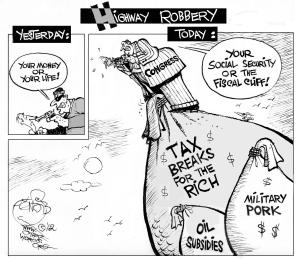
But it is not only a progressive income tax that has bi-partisan opposition; it is bi-partisan support for a reduction in corporate tax rates. Along with his offer to cut Social Security payments President Obama proposed fast-track procedures to help Congressional tax writers overhaul the individual and corporate tax code. Fast-track is a way to push controversial and unpopular measures through Congress with no hearings, amendments or lengthy debate.
The goal of cutting corporate taxes and protecting money hidden away overseas has been evident in the work of the Fix the Debt campaign made up of more than 80 CEO’s of America’s most powerful corporations and biggest campaign donors which has raised $60 million to lobby for a debt deal that would reduce corporate taxes and shift costs onto the poor and elderly.
As economist Jack Rasmus writes the fiscal cliff deficit reduction is “a prerequisite for what they really want—a cut in the corporate tax rate, understandings on non-enforcement of the foreign profits tax, and further incentives—all of which Obama (and Romney) promised in the recent elections. Obama is on record during the elections, and well before, in favor of cutting the top corporate tax rate from 35% to 28%–i.e. where it was during the Reagan period.”
In fact, everything being talked about in the choreographed negotiations is items President Obama has shown repeated support for. His deficit commission, Simpson-Bowles called for cuts to Social Security, Medicare, Medicaid and social programs. The grand bargain Obama offered to Speaker Boehner before the elections included all of these cuts and more, including to veteran health care and retirement, college financial support and food assistance. And, during the campaign Obama said that he agreed with Romney on Social Security.
The bi-partisan deficit cutters are so focused on reducing corporate taxes and helping their donors that they will do great damage to the economy. As 350 economists wrote:
As Great Britain, Ireland, Spain and Greece have shown, inflicting austerity on a weak economy leads to deeper recession, rising unemployment and increasing misery. In a deep recession, deficit reduction is a moving target. If you cut spending and consumer purchasing power in an already depressed economy, unemployment rises and revenues fall — and the goal of a smaller deficit keeps receding like a mirage in a desert. When private purchasing power is depressed by the aftermath of a financial collapse, only public investment can make up the gap.
Not all business leaders put their personal gain ahead of what is best for the country. The American Sustainable Business Council, Business for Shared Prosperity and the Main Street Alliance have called on Congress and the President to close corporate tax haven loopholes costing the U.S. Treasury $100 billion a year and raise corporate tax revenues above today’s historically low levels. They note corporate taxes accounted for less than 8% of federal tax revenues – way down from 32% in 1952.
“With corporate profits at a 50-year high and corporate taxes as a share of the economy at a 50-year low, now is not the time to lock in low corporate taxes,” said Joseph Magid, president of Gryphon Systems, a management consulting company in Wynnewood, PA. “Our country cannot afford to keep giving tax breaks and loopholes to giant corporations at the expense of smaller businesses. Highly profitable U.S. multinationals should pay their fair share.”
Most Americans know how to fix the economy; it is just elected leaders who are blinded by campaign donation corruption who cannot see the obvious. By a super majority of 62% to 30% Americans believe that growing the economy, not reducing the deficit should be the priority. By huge majorities they support taxes on the wealthy, 70% support a plan that raises taxes on the top 2%; 63% oppose taxing investor income at lower rates than worker’s wages; 75% support a plan to create a higher tax bracket for millionaires and 67% find lower taxes on corporations or the rich unacceptable. And, 62% do not want Social Security benefits cut and 79% do not want seniors paying more for health care. But the views of Americans are off the table in our representative democracy.
During the Occupation of Washington, DC at Freedom Plaza we held hearings on the deficit and found that we could create jobs, reduce the wealth divide and control spending by putting in place a progressive tax system with a proven history of working, cutting military spending and investing to getting the economy going. All of this was based on evidence-based solutions supported by majorities of Americans, economists and others. But, empirical evidence is off the table in bi-partisan Washington, DC.
Ours is not the only plan. There are many ways to reduce the deficit, create jobs and get the economy moving. See, e.g. 8 Deficit Reducers That Are More Ethical — And More Effective — Than the “Chained CPI”; Rein in the Rich: How Higher Taxes Could Lift the Economy, Republican and Democratic “Remedies” Ensure More Crises, but Alternatives That Work Are Taboo, Green presidential candidate, Jill Stein, has put forward a Green New Deal and the Economic Policy Institute has put forward Navigating the fiscal obstacle course: Supporting job creation with savings from ending the upper-income Bush-era tax cuts. All of these approaches are more consistent with what the American people want than what Obama, Boehner and Pelosi, are discussing.
The fiscal cliff shows how out of step elected officials in Washington, DC are; how they ignore what the people want and what the evidence says is needed. Their focus on providing their campaign donors with even more wealth at the expense of the economy and the people is evident. The only way we will tax the wealthy and corporations; stop cuts to Social Security, health care and social programs is for Americans to mobilize in revolt. Traditional politics does not work; the people must find a new path – the creation of an independent political movement – to create the transformations needed in the United States.
Local Capitalist Predictions for 2013: More Growth, More Profits
With the New Year just around the corner, lots of people are making predictions for 2013.
Lots of people I know are hoping to find work, make enough to take care of their families or to get medical treatment, even though most of the people I know don’t have health care insurance.
I also know people who are hoping that the New Year brings justice to their lives, whether that is justice for the immigrant community, the LGBTQ community or women who continue to fight for reproductive rights and safe communities.
The business community is also joining in on the 2013 predictions, although their predictions and aspirations are much different than the majority of the population.
MiBiz just published their 2013 Crystal Ball edition. In it they ask local CEOs and other managers within the economically privileged sectors of West Michigan to weigh in on what 2013 will bring for them and their interests.
Let’s start with comments from the Chairman and President of Amway Steve Van Andel and Doug DeVos. Amway set a record with more than $10.9 billion in sales last year, the company’s sixth consecutive year of sales growth and its second in a row in which U.S. sales increased. In other words, the DeVos and Van Andel familes continue to add to their already obscene amounts of wealth. Here are perils of wisdom from DeVos and Van Andel.
We tend to be optimists. The economy is going through some tough times, but we really have a lot of faith in it. For us, it’s not only the people here in the States, but it’s the entrepreneurs around the globe. We tend to be optimistic in them and what they do and how well they do. We think that makes a huge difference in the future and in the future of our business. Our business looks good, but we think the economy, on a global basis, has a lot of optimism to it. I think there’s potential everywhere.
Wow. Here is an example of talking, but not saying anything. Of course they are optimistic. The world is ripe for exploiting and they continue to find new markets for their products. Along the way, the DeVos and Van Andel families continue to influence economic policies based on their financial contributions to federal and state lawmakers and political parties.
Other members of the upper crust in West Michigan talked a great deal about the potential for growth. CEO of Wolverine Worldwide Blake Krueger says, “while the footwear industry is not recession-proof, there is always a good deal of consumer ‘need’ as well as ‘want,’ allowing our industry to do relatively well in more challenging times because the purchase of a new pair of shoes can be an easy way for a person to feel good when times are tough.” Apparently, Krueger has no idea what most people do when they are having tough times, but buying a pair of shoes is not even an affordable option for most people in the world who are struggling financially.
Mark Bissell (Bissell CEO) also touts the growth mantra when saying, “International … for us is a growth market. Bissell, which has eliminated hundreds of jobs locally over the past decade is now manufacturing outside the US for increase global sales, brining vacuum cleaners to the world.
Another theme that is repeated by area business people is the idea of creating and retaining talent. People are now seen as talent, instead of unique individuals that have value and worth just for being human.
Birgit Klohs with The Right Place Inc. says, “We’re amping up our marketing both locally in terms of retention and expansion, domestically with site consultants and trade shows and internationally in collaboration with the MEDC.”
The President of GVSU Thomas Haas makes it clear that his university is primarily about creating workers for local and state industry, when he says:
To be in the business of talent development, you have to look ahead and see what types of skills sets and business are out there currently and into the future. We are continually looking at what type of curriculum is broad enough to provide the skill sets that the business community wants.
The new head of the Grand Rapids Downtown Development Authority (DDA), Kristopher Larsen, makes it clear that the DDA’s function is to facilitate profit making for those businesses that operate in the downtown area. He states, “The DDA is interested in furthering its investment and those types of projects that have the ability to catalyze additional investment. Our primary focus is leveraging and how can we spend a dollar and (have) that dollar leverage four. First and foremost, it’s going to be a continued investment in the river, and (projects that don’t) equate to large dollar signs.
These are just some of the comments made by the economic elite and social managers in West Michigan. Nothing they have to say reflects an interest in the well-being of all people in the area, particularly those who don’t have much of a role in growing markets that will bring greater profits for the 1%.
There was nothing terribly revealing in these comments, but it is always good to know what the priorities of the powerful are, especially for those at the grassroots level who are organizing to dismantle such centers of power and create a world that is not dictated by growth and talent.
Presenting America’s Ten Greediest of 2012
This article by Sam Pizzigati is re-posted from Too Much. Editor’s Note: The following article is important, in that it presents some concrete information on CEOs and their treatment of workers. However, we believe that the issue is not so much greed as it is the system of capitalism.
Year in and year out, our greediest grab ungodly rewards for their own labor — and deny their employees anything close to decent compensation for theirs.
The essence of greed? Simple. Greed amounts to taking more than you need when you already have enough — and others don’t. Who among us, by this yardstick, rate as our greediest? Those greediest would be those who have the wherewithal to take whatever they want — and deny others the basics they need.
We abound in these greedy. Most of them wear power suits and dart in and out of the executive suites that sit high atop America’s most elegant corporate towers. Year in and year out, these greedy grab ungodly rewards for their own labor — and deny their employees anything close to decent compensation for theirs.
Without further ado, our fifth annual Too Much list of the greediest of our greedy, those ten deep-pocketed personages who’ve done the most in 2012 to subvert the decency we all like to call, at this time of year, the “holiday spirit.”
10/ Jack Welch: Comforting Comfortables
An oversized ego can be a terrible thing to waste. Jack Welch, the retired General Electric CEO, is doing his best not to waste a bit of his — and pick up a few extras pennies in the process.
Welch, the super CEO of the 1990s, has become a regular on the corporate chattering circuit since he retired in 2001. He collects a sweet $150,000 per appearance.
Not that Welch needs any more money. He left GE with a retirement package worth over $400 million and now divides his time between très chic abodes in Manhattan, Nantucket, and Florida’s North Palm Beach, lapping up luxury while he plots his next moves to protect plutocracy.
Welch particularly enjoys going after Warren Buffett, the billionaire who publicly acknowledges that he and his fellow rich don’t pay nearly enough in taxes. Countered Welch earlier this year: “I don’t feel undertaxed in any way at all.”
Some had hoped that Welch’s retirement would end the actual social damage he could wreak. A reasonable hope. At General Electric, Welch had the power to do everything from nuke 100,000 GE worker jobs to foul the Hudson River with toxic waste. Without that power, what damage could he do? Plenty, turns out.
Much of that damage comes from the wealth of tax-dodging expertise Welch bequeathed his successors at General Electric. In the decade since 2001, one report released this year revealed, GE paid only 1.8 percent of its $80.2 billion overall profits in federal income taxes.
9/ Jamie Dimon: Pounding Reformers
The European Union has just taken a fairly significant step toward limiting excessive banker compensation. Under proposed new rules up for a vote early in 2013, European bankers won’t be able to pocket bonuses greater than twice their straight salary.
Better not try that in the United States, Jamie Dimon — America’s highest-paid bank CEO in 2011 — warned last week. Any limits on Wall Street pay, JPMorgan Chase CEO Dimon intoned, will end freedom as we know it.
“If you don’t want a free society,” Dimon pronounced, “then start dictating what compensation can be.”
And besides, the JPMorgan chief added, any attempt to limit pay would chase talent out of America’s financial system. The banking business, he explained, simply “cannot run” on “second-rate talent.”
For his own presumably “first-rate” talent, Dimon pulled in $23.1 million in 2011, up 11 percent over 2010. The highlight of his first-rate stewardship: JPMorgan suffered a $2 billion trading loss after a bank management blunder that Dimon admitted this past spring he could not “publicly defend.”
That admission left some observers wondering how much the bank would have lost with a second-rate talent in charge.
Dimon hasn’t let JPMorgan’s debacle with risky trades slow his charge against the Dodd-Frank Act, the legislation enacted in 2010 to rein in risky trading after the 2008 Wall Street meltdown. Wall Street’s intense opposition to Dodd-Frank, with Dimon a key ringleader, has so far kept the bulk of the legislation unenforced.
8/ Wilbur Ross: Exploiting the Bankrupt
Remember the bank bailout? Private equity kingpin Wilbur Ross surely does. He spent a chunk of the past year trolling for windfalls on the busted-bank landscape — and found a hot prospect in Ohio. In October, he cut a dealto pick up the troubled First Place Financial at just $45 million.
U.S. Treasury officials balked at the deal. The bank, they complained to the courts, had borrowed $72.9 million from the federal bailout program three years earlier and not yet repaid any of the money.
The deal with Ross would likely “chill bidding” for the bank, federal officials pointed out, and cost taxpayers millions.
Not my problem, retorted Ross. So things might not “work out well” for taxpayers? “Unfortunate,” said Ross. Two months later, the Treasury prediction came true. No other bidders for the bank stepped up, and Ross had another notch in his “vulture investing” belt.
Ross has specialized for decades on buying up companies in or near bankruptcy, then “flipping” them for big profits. The secret to his success: Bankrupt companies can dump their liabilities — like mandates to fund pension plans. Ross has followed this flipping formula to fortune in steel, textiles, and coal. His latest estimated personal net worth: $2.3 billion.
In October, Ross celebrated his fabulous stash with a fundraising dinner at his Florida mansion for GOP Presidential candidate Mitt Romney. The fee to join him: $50,000 a plate. About 150 people, reports the Palm Beach Post, attended.
7/ Samuel Palmisano: Busting Nest Eggs
IBM, the world’s first computer giant, now has just 92,000employees stateside, down from 160,000 back in 2002, the year Sam Palmisano took up the IBM CEO reins.
Palmisano stepped down as chief exec last year and retired as the chairman of IBM’s board at the start of this month, but not before green-lighting a change in the IBM 401(k) plan that sets a damaging precedent for millions of Americans outside the IBM ranks.
Up until now, IBM has been matching employee contributions to 401(k)s on a semi-monthly basis. Starting in 2013, IBM will make only one match a year, on December 31. Workers who leave IBM’s employ next December 15 will get no IBM match to their 401(k) for the entire year, even if they were laid off or had to leave because of a disability.
No major U.S. corporation currently short-changes workers through this sort of maneuver. A good many other large corporations “will be looking very closely” at the IBM move, says Brooks Herman of Brightscope, a financial info firm. If they follow IBM’s lead, notes Reuters, working families throughout America will find it “very difficult to build significant nest eggs through the 401(k) system.”
Sam Palmisano doesn’t have to worry about his nest egg. He’s walking out the door with a package of retirement, bonus, and assorted other benefits one analysis values at $224.7 million.
Palmisano isn’t actually walking out the door. He’ll be consulting for IBM. His rate: $20,000 for any day he puts in four hours. In 2013, observes the Wall Street Journal, Palmisano “could pocket $400,000” for a mere “20 half-days of work.”
6/ Larry Page: Dodging Corporate Taxes
The co-founder — and current chief exec — of Google on a top ten greedy list? How can that be? Hasn’t Google CEO Larry Page’s personal foundation just announced plansto fund free flu shots for every kid in metro San Francisco?
True enough. But no local philanthropic gesture can offset a global greed grab. The same Larry Page who’s fighting flu in San Francisco is running a giant corporation that’s sidestepping billions of dollars in taxes all over the world.
In 2011, Bloomberg reports, Google “avoided about $2 billion” worldwide via just one Bermuda tax dodge alone. On paper, Google is supposed to be paying 39 percent of its profits in combined U.S. federal and state corporate taxes. Last year. Google actually paid federal and state taxes at just a combined 22 percent rate.
If profit-rich corporations like Google don’t pay their tax fair share, notes international tax expert Richard Murphy, “somebody else has to pay or services get cut.” And if services get cut, only a fortunate few — like kids in San Francisco — end up getting served.
Larry Page, by the way, can afford a bit of local beneficence. Forbes estimates his total personal fortune at $18.7 billion.
5/ Steven Cohen: Modeling Lance
At poker, you can’t win a hand unless someone else at the table loses. Same on Wall Street, as billionaire Steven Cohen knows as well as anyone.
The 56-year-old prepped for the financial world at the Wharton business school and spent his spare collegiate hours beating his buddies at the card tables.
Cohen has upped the ante somewhat since then. In the late 1990s, his “super-secretive” hedge fund returned investors an astounding 70 percent a year. For his investing magic, Cohen would eventually be demanding 50 percent of any profits he generated for his deep-pocketed investors.
That hefty profit share would bankroll an anything-goes lifestyle for Cohen. On top of $14 million for a personal manse, he shelled out $300 million on fine art.
By 2006, stock trades by Cohen’s hedge fund were accounting for $2 of every $100 all Wall Street stock traders combined were betting. Admirers began calling basketball fan Cohen the “Michael Jordan” of the financial industry.
The better sports analogy, says ProPublica’s Jesse Eisinger, might be the drug-cheating cyclist Lance Armstrong. Federal regulators and prosecutors have so far snared six of Cohen’s hedge fund operatives for insider trading. All these years, Eisinger suggests, Cohen may have been “cutting corners and pushing employees to the point where they break the law.”
The biggest losers in the Cohen story? American taxpayers. Cohen pays federal income tax on much of his ample annual earnings — $600 million last year alone — at just a 15 percent rate, not the 35 percent rate that faces ordinary income over $388,000, thanks to a special loophole that benefits the movers and shakers who run hedge and private equity funds.
4/ Brian Driscoll: Tanking Twinkies
Should captains go down with their ship? In contemporary Corporate America, captains of industry don’t go down with their ship. They sink it, then jet ski to the nearest yacht.
Hostess Foods, the corporate baker most famous for Twinkies, was already foundering when Brian Driscoll came in as CEO in 2010. Private equity wiseguys had gobbled up Hostess in 2004, loaded the company up with debt, and squeezed $110 million in worker wage concessions.
Driscoll came in with a plan: squeeze workers some more — and raise his own pay to reward the brilliance of his planning. Alas for Driscoll, the plan went awry when Hostess workers refused to cooperate.
Hostess then declared bankruptcy this past January — a move designed to void the company’s union contracts — and went to court to argue that Driscoll still merited a $3.5 million pay deal, with additional annual bonuses.
This CEO pay bid outraged Hostess workers and cost Driscoll whatever corporate credibility he still had left. Amid the resulting furor, Driscoll suddenly resigned. Two months later, in May, he resurfaced as the CEO of Diamond Foods, the Pop Secret popcorn maker, with a three-year pay deal worth over $10 million.
Hostess, meanwhile, is careening toward liquidation. Thousands of Hostess workers have already lost jobs. All Hostess workers have lost wage income and pension savings.
Driscoll, to be sure, hardly deserves all the blame. A half-dozen CEOs have come and gone over the last decade, notes one Hostess worker whose annual take-home has dropped $14,000 since 2005, “and all of them left the company worse than when they took over.”
3/ Jim Skinner: Milking the Minimum Wage
As CEO at fast-food colossus McDonald’s, Jim Skinner didn’t just worry about burgers. He worried about the minimum wage — getting higher. Under Skinner, McDonald’s helped bankroll industry lobbying campaigns against attempts to raise state and federal minimum hourly pay rates.
That lobbying has paid off — for Mickey D’s. In Chicago, not far from McDonald’s corporate global headquarters, a McDonald’s worker with 20 years of experience can still only be earning $8.25 an hour, as economics reporter Leslie Patton devastatingly detailed earlier this month.
McDonald’s CEO Jim Skinner took home $8.75 million last year, a generous sum that equals about 580 times the annual pay of a full-time minimum-wage worker. Just 20 years ago, in 1992, the then-McDonald CEO pulled in 230 times the minimum wage annual take-home.
Skinner retired his CEO perch this past June 30. Unlike many other senior citizens today, he won’t have to take a fast-food job to make any ends meet. He walked off into the sunset with a retirement package worth an estimated $82.3 million.
2/ Larry Ellison: Collecting Oceanfront
Oracle software CEO Larry Ellison has earned, over the years, almost a permanent spot on our top-ten greediest list. His basic corporate m.o.— buy out his rivals, grab their customers, fire their workers — has never changed.
But Ellison, the sixth-richest man in the world, has turned over a new leaf of sorts. He’s actually sharing the wealth. The catch? He’s only sharing with his sidekicks. In the fiscal year that ended this past May 31, Oracle presidents Safra Catz and Mark Hurd each took home $51.7 million.
And Ellison? His 2012 pay: $96.2 million. His total fortune? Forbes tabs that at $41 billion.
With a pile of billions that high, couldn’t Ellison “share” a bit more? Maybe. But Ellison does have some ongoing expenses for annual maintenance. This past fall, for instance, Ellison picked up — for $36.9 million — his ninth luxury property on the stretch of Malibu oceanfront that local wags like to call “Billionaires’ Beach.”
Some of those locals are speculating that Ellison is planning to turn his Malibu beachfront into a private, super-exclusive resort hideaway for the world’s uber rich. But Ellison would be far more likely, other Ellison-watchers posit, to plop that resort on Lanai, the Hawaiian island Ellison also picked up this past year.
So why does Ellison need all that Malibu beachfront? Most likely, the scuttlebutt goes, he just wants to keep the riffraff out of his ocean-view sight-lines.
1/ Sheldon Adelson: Distorting Democracy
Few Americans hold a fortune larger than Sheldon Adelson. In fact, only eleven do. Forbes puts Adelson’s net worthat $20.5 billion. What can you do with over $20 billion? For starters, you can spend $150 million on an election.
Adelson did just that in 2012. No American invested more in politicking this year than he did. The 79-year-old became, as Time magazine notes, “the public face of what critics cast as a plutocrat class trying to buy U.S. elections.”
Get used to that face. Adelson told the Wall Street Journal earlier this month that he plans to spend over twice as much on his favorite candidates the next time around.
How does anyone get rich enough to plop that much money on pols? The bulk of Adelson’s wealth comes from the Las Vegas Sands, the world’s largest casino company. Adelson, the Sands chief exec and top shareholder, essentially treats the company as his own personal ATM. He even outsources to himself.
In 2009, for instance, Adelson had his Sands empire rent corporate jets from two outside companies. The controlling owner of the outside companies: Sheldon Adelson. The transactions netted Adelson $7.45 million.
Just last month Adelson had Sands declare a special dividend. He’ll personally collect $1.2 billion from this distribution — and pay only a 15 percent federal income tax on it. On January 1, with the likely expiration of the Bush-era tax cuts, the dividend tax rate will jump from that 15 to 35 percent. The Sands dividend quickie will save Adelson nearly a quarter-billion in taxes.
But the real key to Adelson’s billions has to be his manic hostility to unions. His flagship casino, the Venetian, currently operates as the only nonunion major casino in Las Vegas. Of the 40,000 Sands workers worldwide, not one is working under a union contract. And Adelson is aiming to keep things that way.
Last year, 130 security guards at Adelson’s new casino in Bethlehem, Pennsylvania, had a different idea. They voted to organize a union. Adelson’s Sands management predictably refused to recognize the union.
The National Labor Relations Board subsequently found Sands guilty of an unfair labor practice and ordered the company to start bargaining. Sands chose instead to start tying up the case in the federal courts.
The security guards make $13 an hour. They think Adelson and Sands can afford to share some wealth. Adelson will share nothing. Who could possibly expect anything else — from 2012’s greediest American of them all?
 Grand Rapids Institute for Information Democracy