
Supporters gather to hear Victoria speak
On Tuesday morning about 25 people gathered outside the federal building in downtown Grand Rapids to rally in support of Victoria Lorenzo-Calmo. Victoria is facing deportation to her native Guatemala as soon as Wednesday after unknowingly signing a voluntary deportation document, which will leave her three children either without a mother or without much needed medical care. All of Victoria’s children are U.S. citizens.
Victoria fled to the United States from an abusive husband in her homeland, wherein she was once beaten to the point of miscarriage four months into her pregnancy. Victoria, threatened with death and few options, fled to the States in 2001, where she has since found a loving partner who is the father of her three children. Two of Victoria’s children, Jaqueline, 7, and Jason, 2, have cochlear implants and will inevitably go deaf if forced to go to Guatemala with their mother, where proper medical care is not available.
At the ralley, one of Victories children held a sign reading “Don’t deport my mom”.
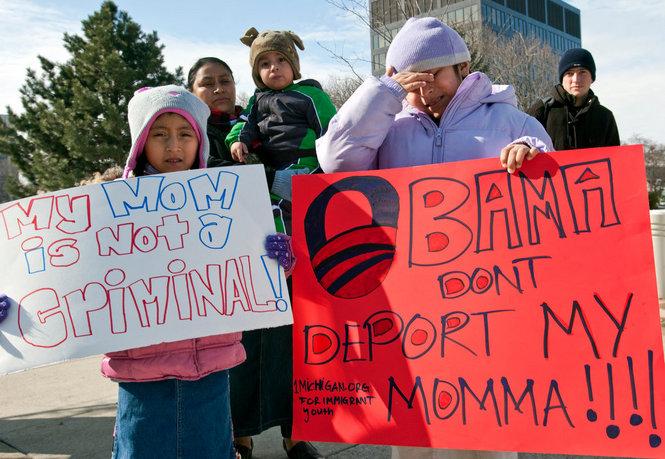
Victoria and her children, Mlive
As the community members gathered around Victoria and her children in the cold morning air, their mother pleaded to the crowd, passersby, and the press. “We will have no medicine, no means to meet our basic needs. We need each other and will fight for each other”. Victoria’s children are not being forced to leave the country, leaving their mother with the impossible choice of bringing them with her to a place where life will be a continual struggle and they will go deaf, or leave them here where she will never see them again. This rally could be some of the last time they will spend together as a family.
Left with few other options, protesters turned to prayer and the support from a higher power multiple times during the demonstration. One supporter said, “I know God will fill his purpose [and prevent deportation] of these innocent kids, who would get no medical attention.”
Victoria herself said she felt “very emotional that so many people came out in support [of her]” because of how difficult deportation will be on her family. Given the circumstances she fled from, Victoria believes her life will be at risk in Guatemala.
Immigration and Customs Enforcement (ICE) had initially given Victoria a “differed action”, effected prolonging her stay in the United States, however this action has been suddenly been denied and Victoria is expected to arrive at the ICE office on Wednesday, March 6th, prepared to leave the country.
Supporters are urged to call Khaalid Walls in Detroit at 313-226-0726 and John Morton at ICE @ 202-732-3000. The following script and talking points have been provided, as they have been effective in the past:
“I am calling to ask that you please use discretion in deporting Victoria Lorenzo-Calmo (A# 096-166-869). Her children need her and they cannot leave the country. Please do not deport Victoria.”
<> Victoria was once beaten so badly by her ex-husband that she lost the baby she had been carrying for four months.
<> If she returns to Guatemala with her children, all of their lives are in danger with the threats against her.
<> If she returns to Guatemala without her children, she will never see them again.
Obama’s Department of Fracking and Nukes
This article by Karl Grossman is re-posted from Counter Punch.
With the nomination of Ernest Moniz to be the next U.S. secretary of Energy, President Barack Obama has selected a man who is not only a booster of nuclear power but a big proponent of fracking, too. What happened to Obama’s call for “clean” energy in his 2013 State of the Union address?
Moniz, a physicist and director of the MIT Energy Initiative, heavily financed by energy industry giants including BP and Chevron, has long advocated nuclear power. He has continued arguing for it despite the multiple meltdowns at the Fukushima Daiichi nuclear plant complex, maintaining that the disaster in Japan should not cause a stop in nuclear power development.
In a 2011 essay in Foreign Affairs magazine titled “Why We Still Need Nuclear Power,” Moniz wrote: “In the years following the major accidents at Three Mile Island in 1979 and Chernobyl in 1986, nuclear power fell out of favor, and some countries applied the brakes to their nuclear programs. In the last decade, however, it began experiencing something of a renaissance….But the movement lost momentum in March, when a 9.0 magnitude earthquake and the massive tsunami it triggered devastated Japan’s Fukushima nuclear power plant…The event caused widespread public doubts about the safety of nuclear power to resurface. Germany announced an accelerated shutdown of its nuclear reactors, with broad public support.” But, insisted Moniz, “It would be a mistake…to let Fukushima cause governments to abandon nuclear power and its benefits.”
Moniz went on: “Nuclear power’s track record of providing clean and reliable electricity compares favorably with other energy sources.” Foreign Affairs is the publication of the Council on Foreign Relations, which regards itself an elite grouping of government officials, industry executives, scientists and media figures. Moniz is a member.
He also said in the essay that “the public needs to be convinced that nuclear power is safe.” As U.S. energy secretary, this will likely be a main thrust of Moniz. He would endeavor to lead the 16,000-employee Department of Energy with a budget of $27 billion for 2013 in trying to get the American public to believe in what decades ago the U.S. government promoted as “Citizen Atom.”
Likewise, when it comes to hydraulic fracturing or fracking—the process that uses hundreds of toxic chemicals and massive amounts of waste under high pressure to fracture shale formations to release gas captured in them—Moniz told the Senate Energy Committee in 2011 that the water and air pollution risks associated with fracking were “challenging but manageable” with appropriate regulation and oversight.
Fracking also can also lead to radioactive contamination. Many shale formations contain Radium-226 and other radioactive poisons unleashed in the fracking process.
Erich Pica, president of Friends of the Earth, declared after Obama’s nomination of Moniz on Monday, that the group “has grave concerns about Mr. Moniz’s history of support for both nuclear power and fracking.” Pica described Moniz’s support of nuclear power despite “the unfolding catastrophe” of Fukushima as “frightening.” On Moniz being “a big booster of fracking,” Pica said this has been “seemingly without due regard for the environmental and public health risks and impacts.”
Nevertheless, in Washington Monday, Obama, describing Moniz as a “brilliant scientist,” said: “Most importantly, Ernie knows that we can produce more energy and grow our economy while still taking care of our air, our water and our climate. And so I could not be more pleased to have Ernie join us.”
It’s not as if Obama wasn’t warned about Moniz.
For weeks, as reports spread that Moniz would be replacing Obama’s first energy secretary, the also staunchly pro-nuclear power Steven Chu, former director of Lawrence Berkeley National Laboratory, the organization Food & Water Watch circulated an online petition for people to send to Obama. It stated: “This is not the person we need as our country’s Energy Secretary at this critical moment. We need a visionary leader who can enact policies that move us away from intensive fossil fuel extraction, such as fracking, and toward a renewable energy future.” Other groups circulated similar petitions.
And it’s not as if Moniz was unfamiliar to Obama, or Washington. He has been a member of both Obama’s Council of Advisors on Science and Technology and Obama’s Blue Ribbon Commission on America’s Nuclear Future. And he was an undersecretary in the Department of Energy in the Clinton administration.
Obama’s stance as president on nuclear power has been a change from his position as candidate Obama. “I start off with the premise that nuclear energy is not optimal and so I am not a nuclear energy proponent,” Obama said campaigning in Iowa on 2007. He went on that unless the “nuclear industry can show that they can produce clean, safe energy without enormous subsidies from the U.S. government, I don’t think that’s the best option. I am much more interested in solar and wind and bio-diesel and strategies [for] alternative fuels.” As he told the editorial board of the Keene Sentinel in New Hampshire that year: “I don’t think there’s anything that we inevitably dislike about nuclear power. We just dislike the fact that it might blow up and irradiate us and kill us. That’s the problem.”
Nevertheless, in his first State of the Union speech he spoke about “building a new generation of safe, clean nuclear power plants in this country” and kept repeating that pitch. But in recent times, in the wake of the Fukushima disaster, Obama has increasingly avoided using the words nuclear power—he didn’t refer to it at all in his State of the Union address this January. Instead he has let Chu, and will let, if he is confirmed, Moniz, do the talking about nuclear power and pushing it as an energy source for the United States.
As to fracking, in his 2013 State of the Union address, Obama said “the natural gas boom has led to cleaner power and greater energy independence. That’s why my administration will keep cutting red tape and speeding up new oil and gas permits.”
This article by Dave Zirin is re-posted from ZNet.
A sit-in at the university president’s office; calls for their resignation; a packed, campus-wide meeting that resolves nothing and opens the door to further conflict. Such actions are notable enough on their own, but we’ve never seen a protest movement quite like what’s happening at Florida Atlantic University. For the first time on record, hundreds of students are raising their voices against the renaming of their school’s football stadium. FAU decided to sell the stadium’s naming rights to Geo Group, a notorious private prison corporation, and students are saying, “Hell no.” Their efforts signal something even more significant than pushing back against the inviolate prerogatives of a school’s football program. It’s a high-profile sign of the growing movement against our system of mass incarceration otherwise known as “the New Jim Crow.”
Geo Group will pay $6 million over twelve years to rebrand the football stadium, home of the FAU Owls. Protesters have now also rebranded the stadium, calling it “Owlcatraz.”
Students marched and occupied President Mary Jane Saunders’ office last week, submitting a letter that read, “We are protesting because we believe that institutions of higher learning like FAU have the responsibility to stand up to the systemic racism, corruption and human rights violations that define the prison-for-profit system, and advocate instead for the equality and human rights.”
The students are, of course, correct. Private prisons are immoral, Orwellian institutions. To combat any trend against growing levels of incarceration, they spend millions on political lobbying to make sure that provably racist institutions like “the War on Drugs”, “three strikes” laws and, their latest ripe plum, the incarceration of undocumented immigrants, remain the rule of the land. But if private prisons are diseases, then Geo Group is the Ebola virus. Describing one of their juvenile jails in Mississippi, a judge called Geo Group’s facilities “a cesspool of unconstitutional and inhuman acts and conditions.”
Throwing more gasoline on the fire, President Saunders’s initial response to Geo Group’s offer was pure, uncritical glee, calling it “delightful” and saying without a sprig of irony, “This gift is a true representation of The GEO Group’s incredible generosity to FAU and the community it serves.”
When people at a packed meeting of 250 students raised concerns about the way Geo Group “serves the community”, she pointed out that GEO Group’s chairman, George Zoley has a “love” of the school because he is a proud alumnus. This led philosophy professor Simon Glynn to say tartly, “We don’t seem to be doing our jobs adequately because it appears we may be graduating people from the university who are ethically challenged.”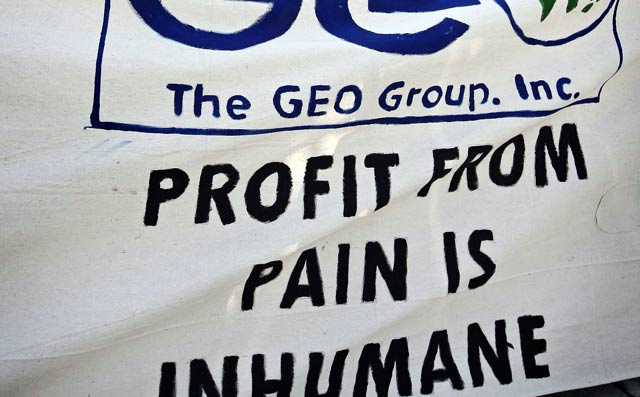
It also raises the question, in these cash strapped times, where President Saunders would draw the line if not at Geo Group. Would she have considered an offer to rename the field “Jerry Sandusky Stadium” if offered $7 million? If Larry Flynt had pledged $8 million to call it “Hustler Arena” does she take a meeting? For many students, the deeply personal disrespect embodied in the taking of Geo Group’s money is no less intense.
A number of FAU students are the children of immigrants. Geo Group, as I’ve written elsewhere, is currently bidding to be the state’s private prison of choice aiming to warehouse the state’s 3 million undocumented immigrants. Incipient immigration reform, it is believed in the industry, will create a massive demand for private detention facilities. It’s viewed that GEO Group’s effort to be the shiny name on the side of the stadium is form of corporate “sin-washing” that smoothes the transition to Geo Group’s taking on this incredibly expansive role in jailing the undocumented.
As students packed the rafters and demanded answers, Saunders didn’t backtrack from her earlier praise of GEO Group but also actually said that she was simply unfamiliar with their record and history. She also described the $6 million payoff as a “closed book,” saying that the papers have been signed and it’s a done deal. Student protest leader Gonzalo Vizcardo said, “The board of trustees should have done due diligence on GEO before they signed that agreement. What (Saunders) said about GEO being a wonderful company was outrageous.”
This movement isn’t stopping despite President Saunders’s most fervent wishes. By, at best, not doing her due diligence or, at worst, valuing the money over any attendant moral or ethical concerns, Saunders has turned the school into a national punch line. By standing up to this synthesis of football and prison, and Geo Group’s uniquely American horror story, the students are trying to map a different way forward for the university. If it’s remembered as a place where a campus movement was finally launched against the private prison industry and the New Jim Crow, that will be a far prouder legacy than the place that sold their soul for the dirty money of a for-profit gulag.

Michigan Unity reports that last night the Royal Oak, Michigan, City Commission ensured that all residents will be treated fairly and equally by passing a human rights ordinance. The ordinance includes crucial protections for gay and transgender people.
“Unity Michigan applauds the Royal Oak City Commission for standing up for fairness,” said Jon Hoadley, Director of the Unity Michigan Coalition. “Royal Oak is the 22nd city in Michigan to pass an ordinance like this. We’re thrilled to see momentum growing across the state, and look ahead to a day where everyone in our state is treated fairly.”
Royal Oak is one of over 20 cities in Michigan, and more than 100 across the country who have successfully implemented similar ordinances.
Unity Michigan, is encouraging people to send a thank you note to the Royal Oak City Commissioners who voted in favor of the anti-discrimination ordinance. You can send a message to them by clicking here.
The Lansing-based group, the Michigan Campaign Finance Network, sent out a new statement today, which documents how much was spent by lobbyist in Michigan for 2012.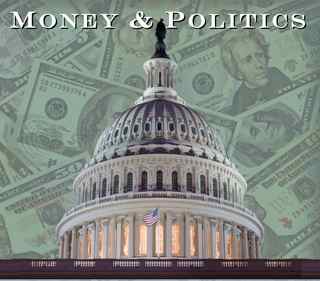
According to the Media Release:
The top spenders among lobbying entities are multi-client firms who disclose overall spending and their client lists, but they are not required to report their lobbying contracts or how much they spend representing each of their clients.
The Michigan Campaign Finance Network annually compiles a list of the top 200 spenders on lobbying in Michigan. Thirteen of the top 20 are multi-client shops who accounted for more than $7 million in lobbying expenditures. There are no data available to discern how that $7 million was deployed, or whose interests it advocated.
A list of the top 200 Michigan lobbyists in 2012 is attached to this news release.
Dearth of information on perks for public officials
Lobbyists reported spending $649,000 to provide food, drink, travel and accommodations for public officials in 2012. Less than one-third of that amount – $193,796 – is connected to a named beneficiary. That is because lobbying expenditures that provide hospitality for public officials don’t have to be itemized unless they exceed reporting thresholds. Here are the reporting thresholds that were in effect for 2012:
• Lobbyists didn’t have to name beneficiaries of their wining and dining unless their spending for an individual lobbyable official exceeded $57 in a month, or $350 for the calendar year. • Travel and accommodations didn’t have to be reported unless they exceeded $750 per instance of travel. • Gifts are banned, but tickets for entertainment valued at less than $57 aren’t considered to be gifts and, therefore, are allowed, though not reported. • Financial transactions between lobbyists and lobbyable officials, such as personal loans or sales of personal property, didn’t have to be reported unless they were valued at more than $1,150.
Since expenditures to provide food and drink to groups of lobbyable officials, mainly legislators, amounted to $125,816 of the itemized expenditures, the failure to identify beneficiaries is much greater than gross figures suggest. Subtracting the $126,000 for group food from reported overall spending of $649,000, means that $523,000 was spent to entertain individuals. Just $68,000 of the $523,000 spent on individuals is tied to individual beneficiaries. That means 87 percent of all that was spent to entertain individual lobbyable officials apparently didn’t reach the reporting thresholds.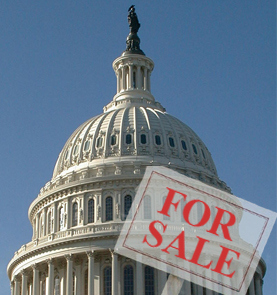
Despite the very limited reporting of beneficiaries, 14 legislators managed to consume more than $1,000 worth of reported lobbyists’ hospitality. They are listed as members of the 2012 Silver Spoons Supper Club, attached to this news release.
Getting serious about lobbying disclosure
Michigan’s inadequate lobbying disclosure needs to be modernized. Here are a few essential reforms:
• Multi-client firms should report all contracts, naming the client and the amount of each contract.
• All food and beverage hospitality provided by a lobbyist to a lobbyable official should be reported from the first dollar spent.
• All travel and accommodations provided by a lobbyist to a lobbyable official should be reported from the first dollar spent.
• All entertainment gifts for lobbyable officials should be prohibited. Gifts should be limited to plaques, or the like, given in recognition of service.
• Any financial transactions between a lobbyist and a lobbyable official, or a lobbyable official’s family member, should be reported from the first dollar.
For a complete listing of the top 200 lobbyists in Michigan for 2012, click here.
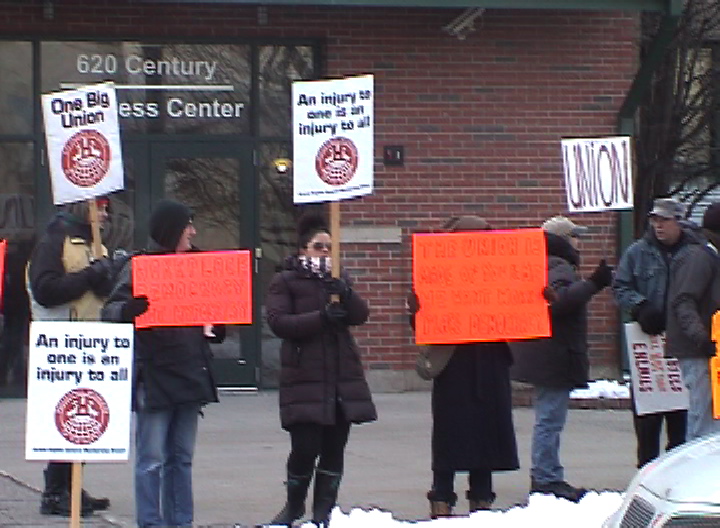
Earlier today, about 20 people showed up in the cold to stand in solidarity with the Star Ticket Workers Union.
The Star Tickets Workers Union went public over a month ago with their campaign to democratize their workplace and management has responded by hiring an outside firm to create and distribute propaganda to undermine the union efforts.
Members of the Grand Rapids branch of the IWW, along with other allies, showed up this morning with signs to show the workers there that they support their efforts to democratize the workplace and to send a message to management that these workers do not stand alone in their struggle.
We had an opportunity while at the solidarity rally to speak with a member of the Star Tickets Workers Union and a member of the IWW.
This article is re-posted from Common Dreams.
Hundreds of Florida farmworkers and their allies on Sunday are embarking on a two-week, 200-mile “March for Rights, Respect and Fair Food” calling on one of the state’s corporate giants to “do the right thing” and join the campaign that assures humane working standards for tomato harvesters.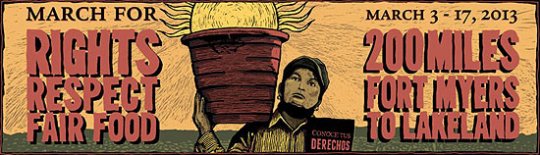
Organized by the Coalition of Immokalee Workers (CIW), the march’s goal is to highlight successes of their Fair Food Program (FFP) as well as call out Publix, one of the largest purchasers of Florida tomatoes, for failing to join the program, and whose workers, CIW explains, “are denied access to the FFP’s higher standards, complaint mechanism, and ‘penny-per-pound’ bonus.”
The march begins in Fort Meyers and ends at Publix’s headquarters in Lakeland, Florida.
“After decades of what Edward R. Murrow called the ‘Harvest of Shame,’ the Fair Food Program is something the Florida tomato industry, something all of us can all be proud of — labor rights advances that are setting the bar for social responsibility in the US produce industry today,” said Gerardo Reyes of the CIW.
Educator and community organizer Kandace Vallejo adds in Waging Nonviolence “Why I’m walking 200 miles with the Immokalee Workers”:
To date, [Campaign for Fair Food] has signed Fair Food Agreements with 11 major corporations — McDonalds and Whole Foods among them — but Publix has been reticent to join the historic program. The agreements include a penny-per-pound premium sent down the supply chain to workers, stipulations on working conditions, and the establishment of a third-party monitoring system to ensure these changes last. Indeed, the Fair Food Program could prove to be a model for how to re-shape the rest of American agriculture.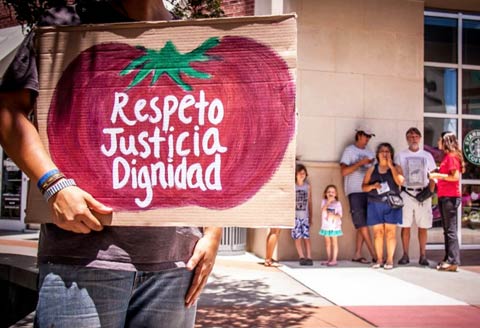
The changes won thus far have been monumental. Workers now receive a “Fair Food Premium” in their pay. Sexual harassment is no longer tolerated, and growers provide bathrooms, water and shade structures under which workers can rest. Tomato pickers are educated on-site about their new rights under the program, and there is a hotline that workers can call to report violations. These changes are a direct result of people organizing in solidarity with the Coalition of Immokalee Workers, and it is all held in place by one crucial force — consumer power.
Agreements are backed by market consequences, but as long as a low-bar market for tomatoes still exists, growers and retailers who don’t want to participate don’t have to. Coalition member Leonel Perez recently told me, “We are far from system-wide transformation. We need more corporate buyers to come on board, and we need consumer support to make that possible.”
“But while the changes we are seeing in farmworkers’ lives today are indeed unprecedented, there is still much to be done,” stated Reyes. “With each new corporation that joins, the wage increases and labor reforms grow and deepen, which is why Publix’s decision to turn its back on the FFP is so unconscionable. Its support, which would cost Publix little or nothing, could significantly change the lives of some of the state’s hardest workers, yet the $28 billion company won’t even show farmworkers the respect of granting us a meeting to discuss the Fair Food Program face-to-face.”
From CIW:
We will march to celebrate the changes underway today in Florida’s tomato industry. We will march so that Publix does, finally, support the Fair Food Program. We will march so that those growers who refuse to meet the new standards no longer get solace, and sales, from retailers like Publix who remain willing to purchase tomatoes produced the old way, “no questions asked.” And we will march so that, one day, farmworkers across this country might enjoy the unprecedented new rights and working relationships being born today in the fields of Florida.
AFL-CIO’s Own Oil Disaster
This article by Ann Robertson and Bill Leumer is re-posted from ZNet.
With less than transparency, the AFL-CIO just issued a statement endorsing “expanding the nation’s pipeline system.” Although it did not explicitly endorse the Keystone XL pipeline, the labor federation nevertheless managed to extend its blessing to the project while hiding behind vague generalities. However, the logic of its position is unambiguous: the federation is in favor of extending pipelines in general and without qualification; the Keystone XL is a pipeline. Therefore logic compels us to infer that the federation supports the extension of the Keystone XL pipeline.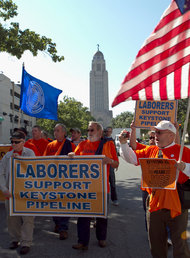
The duplicity of the gesture is entirely intentional. The building trades unions have embraced the pipeline and have lobbied the AFL-CIO to do the same. However, the AFL-CIO would prefer not to alienate its environmental allies, who strongly oppose the pipeline. For this reason the federation refrains from mentioning the Keystone XL by name. But its vague generality is just enough cover to provide President Obama with an excuse to support the pipeline, which his administration’s State Department has already secretly embraced. Obama can now point to disunity among his liberal supporters as a justification for ignoring them. He can do exactly what the corporations want while pretending to be unable to satisfy the conflicting and inconsistent demands of the liberal left. The AFL-CIO hides behind language, and Obama hides behind the AFL-CIO.
Obama has been in desperate need of this cover. Thanks to the Freedom of Information Act, we know that in 2011 his State Department was engaged in its own duplicity by sending encouraging emails to a representative of TransCanada, the company seeking to build the pipeline, while at the same time supposedly conducting a neutral investigation into the pipeline’s environmental impact.
Then in 2012 James Hansen, a NASA scientist, in a New York Times op-ed article forcefully argued that Canada’s development of its tar sands oil supply, because it contains twice the amount of carbon dioxide as other oil reserves, will tip global warming trends past the point of no return. He concluded: “…it will be game over for the climate.”
We seem to be caught in an irreversible downward spiral. Money translates into power, thanks to lobbying and campaign contributions. When wealth becomes concentrated in the hands of corporations, power becomes equally concentrated. For this reason, corporations have been particularly successful at imposing their agenda on the rest of society.
They have successfully attacked unions and thereby lowered wages, eliminated safety regulations and reduced benefits; they have undermined public education by defunding it and by promoting charter schools that have a dubious record of success; they have undermined health care by insisting that profits be prioritized over the welfare of patients; they have torn the safety net by campaigning for a reduction in government spending; and they have placed the survival of the planet as we know it in jeopardy by refusing to curtail the consumption of fossil fuels. The 1% surges forward at the expense of the 99%.
The 99% will have no chance of halting this corporate onslaught by playing the corporate game of money and power. Although labor unions have money, their resources are miniscule compared to corporate reserves, so labor’s attempts to beat corporations at lobbying and campaign contributions have yielded paltry results. In fact, the standard of living of working people has been steadily eroding and has been both the cause and effect of a declining union membership.
However, organized labor has far more powerful resources at its disposal, if it will only take advantage of them. By embracing the philosophy that served as the foundation of their origin — “an injury to one is an injury to all” — unions could begin to organize and mobilize the 99% in order to create a powerful movement capable of sweeping the country. Such a movement would draw its power and inspiration by occupying the moral high ground: unions would not only fight for their members’ interests, they would fight most tenaciously for working people in general, especially those most in need. They would demand that the government institute a public works program like those in the 1930s that would create good paying jobs for all. They would fight for the protection and extension of Social Security and Medicare, protection of the environment, amnesty for undocumented workers, fully funded public education and social services, all to be paid for by taxing the rich. In this way the unions could begin to create a movement of millions. They could transform the current culture of corruption, where it is all about special interests, backroom deals, money and power. Only such an independent massive movement has the chance to shift the balance of power in favor of the 99%.
But in order to spark such a movement, organized labor will have to abandon its current, doomed trajectory where it responds to its continually declining membership by redoubling its efforts to mimic the backroom cynical deals of corporations. It will have to trade in manipulation for inspiration and money for morality, including reducing the inflated salaries of many of the top officials. And it will have to give up its pretense of putting up a fight, where lip service is given to some good cause and a small, ineffectual rally of a few hundred is organized to supposedly promote it. Instead, it will have to put up a real fight by bringing millions of people into the streets to place their demands on the government. Above all it must never try to advance the interests of its own members at the expense of other working people and of the survival of the planet. By offering support for the Keystone XL pipeline, the AFL-CIO wins a few construction jobs and a little money; but it sacrifices everything of value.
This Day in Resistance History: 1968 Chicano students walk out in protest of racist policies
It was 45 years ago today that Chicano students in Los Angeles began a week long walk out protest against the school districts deeply entrenched racist policies.
According to one source, ”two thousand students walked out of Garfield High. They were met by policemen and an angry administration. The next day 2700 students walked out carrying leaflets on education reform.” They continued to walk out for several days after that.
Institutional discrimination was being displayed by the school system against the Chicano students and several incidents finally pushed them to take action in the form of a walk out or what the students called “Blowouts.”
After the first walk out, 10-15 thousand students from the main five East LA schools, adding Lincoln and Jefferson, held a 9 AM rally one day at Hazard Park. They carried signs reading “Chicano Power” and “Viva la Raza.”
1,200 people attended a community meeting held at Lincoln High on March 28. The Educational Issues Coordinating Committee, made up of parents, presented the original 36 demands. Although the Board claimed to agree with the needed changes, they cited a lack of funds to follow through. This prompted the students to walk out of the meeting.
Some of the demands that the students were pushing for were Bilingual bicultural education; more Latino teachers and administrators; smaller class sizes; better facilities; and the revision of text books to include Mexican American history.
On March 31, thirteen of the walkout organizers were arrested for conspiracy to disturb schools and the peace, a felony charge. Included in the LA 13 were Sal Castro and Moctezuma Esparza. Sympathizers began demonstrations to release the LA 13 immediately. Students and community members held picket lines in front of the Hall of Justice downtown. They were supported by Black nationalists, Students for a Democratic Society (SDS), Senator Robert Kennedy, and Cesar Chavez. Legal defense was provided by the Chicano Legal Defense Committee and the American Civil Liberties Union. During this time, focus shifted to the LA 13 and direct action in the schools ceased.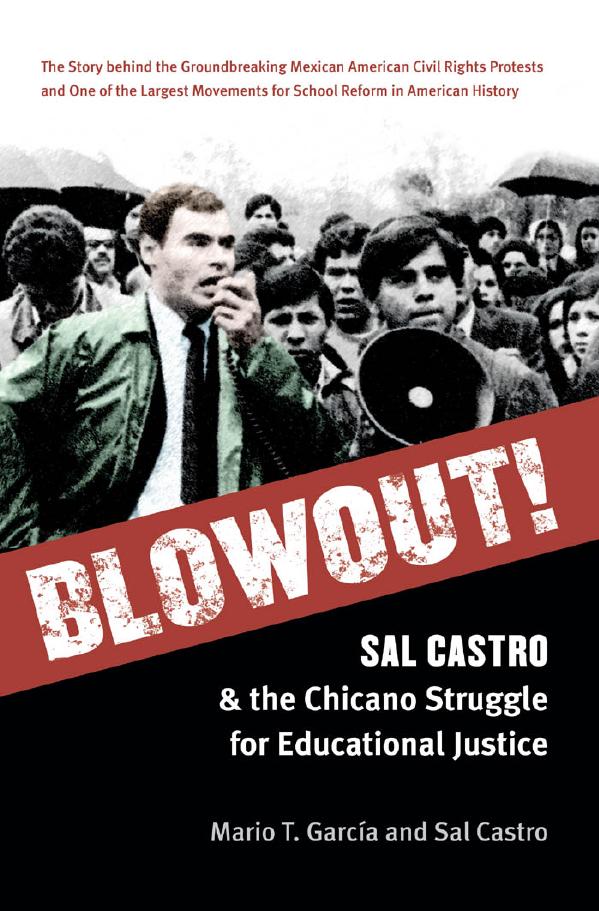
On June 2, over 2,000 supporters rallied at the Central Police station as Sal Castro was released on bail. However, he could not resume teaching until cleared of the charges. Activists demanded that the Board reinstate him. They began sit-ins at the Board office. 35 supporters sat there for eight days until they were arrested on October 2. On October 3, Castro was reinstated.
The Chicano student walkouts did not just happen in Los Angeles, but all across the country. These student walkouts were part of a larger student movement based on revolutionary principles that was reflected in all the insurgent movements of the day, both in the US and across the globe.
The Chicano student movement is powerfully documented in the book Blowout!, by Mario T. Garcia and Sal Castro, published just 2 years ago. In addition, PBS produced a solid documentary on the Chicano Movement, which includes a section on the student walkout movement.
Today, we honor the courage of these students, to stand up and fight for justice and liberation. Let us learn from this history and utilize the same passion and tactics to fight for justice today. It is our duty to share this information with young people, so they know what possibilities there are in the struggle for liberation.
This article is re-posted from Oil Change International.
Talk of U.S. crude exports apparently reached new heights this week at the Platts North American Crude Oil Marketing Conference, which ends today in Houston.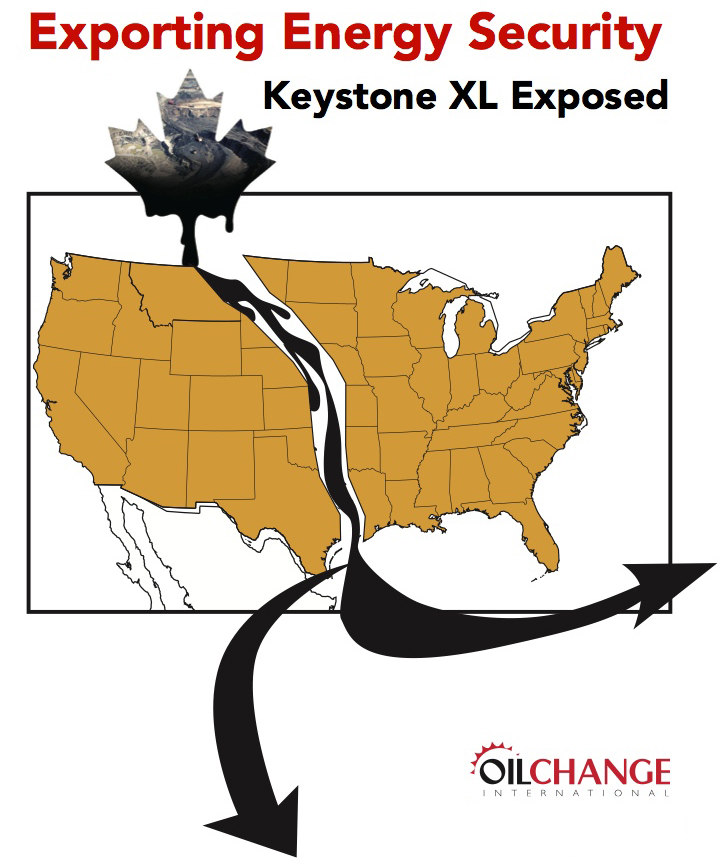
It has been a familiar cry at such shindigs for the past year or so, with the industry increasingly confident to come out in public with the controversial message that crude exports, which are currently only allowed under special license, are necessary to keep the current oil boom going.
It has also become common knowledge—since we published our report on Keystone XL (KXL) exports in September 2011—that the Gulf Coast refineries set to process KXL oil export a large proportion of the petroleum products they produce. Therefore the pipeline will effectively enable Canadian tar sands exports beyond the U.S. via these Gulf Coast refineries.
But Ed Morse, former Deputy Assistant Secretary of State for Energy Policy under Jimmy Carter and currently Global Head of Commodities Research at Citigroup, has raised the temperature on the KXL exports debate significantly this week with statements he made in a speech at the Platts conference.
According to Platts’ “The Barrel Blog” Morse declared that, “Canadian crudes will be exported from the U.S. Gulf Coast before the end of 2014.” He apparently went on to suggest that a Canada-South Korea free trade agreement could result in Canadian crudes being exported via the Gulf Coast through a soon-to-be-widened Panama Canal.
Morse’s timing may be a little bit out as the Panama Canal widening project was recently reported to be behind schedule, with the latest estimate for opening to the large tankers that crude exporters favor set at June 2015.
However, the prospect of Canadian tar sands crude exports from the Gulf Coast is very real. The U.S. crude oil export ban would arguably not affect Canadian crudes if the Canadian crude is not blended with any U.S. crudes. The Bureau of Industry and Security’s Export Administration Regulations for crude oil state that the BIS will approve license applications for:
“Exports of foreign origin crude oil where, based on written documentation satisfactory to BIS, the exporter can demonstrate that the oil is not of U.S. origin and has not been commingled with oil of U.S. origin.”
U.S. crude exports, which Morse and the industry more generally are now pushing hard for will be trickier, but the pressure is now on.
Morse said that, “Washington needs to come to grips with what to do with this surplus (…) the current restrictions will be the focus of a major debate.”
The surplus he’s referring to is currently speculative but relates to the abundance of light sweet oil primarily coming out of the fracked oil fields of North Dakota and Texas.
U.S. refining capacity, particularly on the Gulf Coast, is configured to process large quantities of heavy oil, a result of speculation that Canadian tar sands oil would abundantly flow to the Gulf Coast by now. The refineries have a limited capacity to process this light sweet oil. Therefore producers are taking a hit on price and starting to worry about where they will sell the increasing quantities of this oil that they expect to produce should the oil boom continue at its current pace over the next decade.
The call to lift the US crude export ban has been going on within industry circles and likely at lobby events in Washington for some time. It recently burst more overtly into the public realm with an op-ed in the Financial Times by the head of the IEA, Maria van der Hoeven.
That Keystone XL will become an export pipeline is getting clearer every day. The refineries in the Gulf Coast refining region known as PADD 3 exported 37 percent of their production in 2012, up from under 30 percent in 2011. (Figures calculated from EIA data here)
The State Department must make a National Interest Determination in deciding whether to approve the Keystone XL pipeline. What is now abundantly clear is that the pipeline is only in the interest of tar sands oil producers, who desperately need to access new markets beyond America, to raise the price they fetch for their dirty product and support the currently threatened growth of the tar sands industry.

