In late May, the US Army Corps of Engineers released a report about the Enbridge Line 5 oil pipeline and their proposed tunnel that would run under the Great Lakes.
Locally, channel’s 13 and 17 ran stories about the report. The headlines for the online versions of those stories are instructive, since they present how headlines can be misleading. It’s also interesting, because both WZZM 13 and WXMI 17 used the same Associated Press (AP) article.

The AP article emphasizes that the construction of a pipeline tunnel by the Enbridge Corporation would do lots of environmental damage to ecosystems where the construction would take place. Some of the environmental impacts would be the loss of an estimated 300 trees, a serious impact on aquatic life, cause significant soil erosion, the vibrations from the drilling would have geological consequences, loss of wetlands, vegetation, the harm of construction equipment, the trucks hauling soil and the possible destruction of archaeological sites.
The AP story does quote the Sierra Club and a spokesperson for the group Earthjustice, which stated: “My key takeaways are the Army corps has put blinders are in service to Enbridge and President Trump’s fossil fuel agenda.”
The Michigan-based environmental group Oil & Water Don’t Mix, are a bit more to the point on what the Enbridge Line 5 tunnel would mean, stating:
The construction of a new pipeline tunnel would massively disrupt the ecosystem, destroy wetlands, and contaminate the Great Lakes. Moreover, under a backroom deal struck by Enbridge and former Gov. Rick Snyder, Michigan taxpayers would be stuck for 100 years with owning a risky underwater tunnel and the financial costs of any failure. The oil tunnel would also extend the life of dangerous polluting fossil fuel infrastructure at a time when urgent climate action is needed.
Unfortunately, the AP article does not link to the US Army Corps of Engineer’s report, which you can find here. The AP story also omits a response from the Enbridge Corporation, which has the usual propaganda message from a company that makes massive profits from moving fossil fuels from point A to point B, without any real concern for the consequences of such activities.
Lastly, it is worth noting that in 2018, Gov. Whitmer campaigned on the promise that the Enbridge Line 5 would be shut down. This has yet to happen and it is unlikely to happen, especially if we put our trust in the political process. What I want to know, is why don’t we have a Standing Rock for Line 5?
For several years, the Kent County Sheriff’s Department has been using 25 cameras that are spread around Kent County, cameras that relay information about vehicles and license plate numbers.
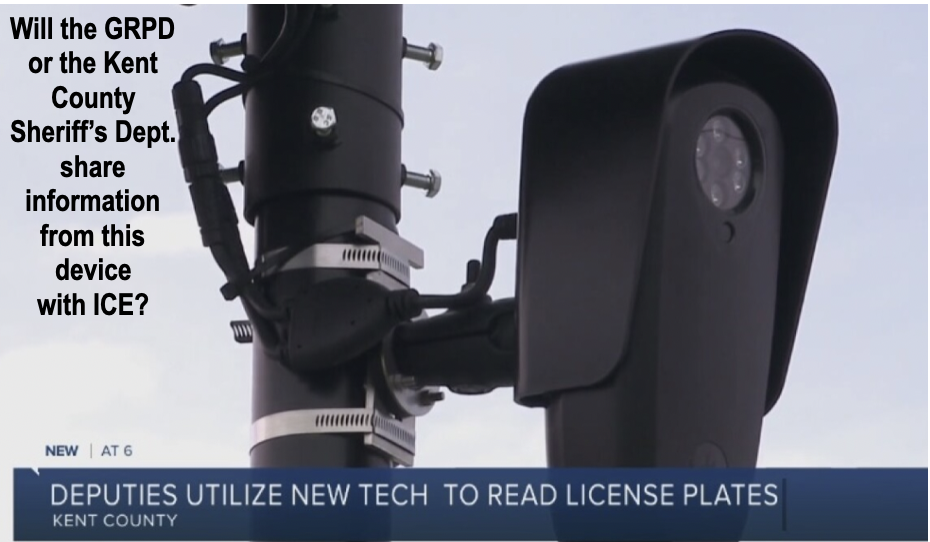
According to a recent article on 404 Media, Immigration and Customs Enforcement (ICE) is now using what are called Flock cameras to obtain license plate numbers to track down undocumented immigrants. The 404 Media article states:
Data from a license plate-scanning tool that is primarily marketed as a surveillance solution for small towns to combat crimes like car jackings or finding missing people is being used by ICE, according to data reviewed by 404 Media. Local police around the country are performing lookups in Flock’s AI-powered automatic license plate reader (ALPR) system for “immigration” related searches and as part of other ICE investigations, giving federal law enforcement side-door access to a tool that it currently does not have a formal contract for.
The massive trove of lookup data was obtained by researchers who asked to remain anonymous to avoid potential retaliation and shared with 404 Media. It shows more than 4,000 nation and statewide lookups by local and state police done either at the behest of the federal government or as an “informal” favor to federal law enforcement, or with a potential immigration focus, according to statements from police departments and sheriff offices collected by 404 Media. It shows that, while Flock does not have a contract with ICE, the agency sources data from Flock’s cameras by making requests to local law enforcement.
While state and local law enforcement agencies normally lack the authority to enforce federal immigration laws, the Trump administration has encouraged them to participate in a program called 287(g), a provision of the the Immigration and Nationality Act that authorizes DHS agencies including ICE to delegate certain immigration enforcement actions to state and municipal police.
Using the Flock technology provides an additional tool to be used by the Kent County Sheriff’s Department, the GRPD and other local law enforcement agencies to assist ICE in hunting down those who are undocumented and those that the administration are targeting, regardless of immigration status.
In addition, if the GOP-introduced legislation from April, House Bills 4336 & 4337, would create criminal penalties for individuals and organizations who knowingly assist or encourage immigrants without legal status in entering, residing, or being transported within the United States. This kind of information could also be obtained through the Flock camera systems being used right here in Kent County. The Michigan House Bills are currently in committee.

One other important point about the use of Flock cameras to obtain information for ICE and local law enforcement was made in a recent article on Common Dreams, stating:
Responding to the 404 Media report, journalist Krishna Sai Andavolu asked, “If ICE can use a nationwide network of license place readers for its purposes, what’s stopping the government from using it for whatever purposes they want?”
Movimiento Cosecha and GR Rapid Response to ICE has been pushing the City of Grand Rapids and Kent County to both adopt Sanctuary policies, which involve numerous points such as:
– policies restricting the ability of state and local police to make arrests for federal immigration violations, or to detain individuals on civil immigration warrants;
– policies restricting the police or other city workers from asking about immigration status;
– policies prohibiting “287(g)” agreements through which ICE deputizes local law enforcement officers to enforce federal immigration law;
– policies that prevent local governments from entering into a contract with the federal government to hold immigrants in detention;
– policies preventing immigration detention centers in Grand Rapids.
It could be that these campaigns to pressure both local governing bodies to adopt Sanctuary policies might consider adding that to Flock technology currently being used in Grand Rapids and Kent County could be used to share license plate information with ICE. Regardless, people who live in Kent County should be concerned with the increased surveillance technology being used, technology that will no doubt be used to suppress popular movements, and target vulnerable communities.
It has been nearly 20 months since the Israeli government began their most recent assault on Gaza and the West Bank. The retaliation for the October 7, 2023 Hamas attack in Israel, has escalated to what the international community has called genocide, therefore, GRIID will be providing weekly links to information and analysis that we think can better inform us of what is happening, along with the role that the US government is playing. All of this information is to provide people with the capacity of what Noam Chomsky refers to as, intellectual self-defense.

Information
Students achieve Israeli divestment victories on US college campuses
Israeli Officer Says ‘Nearly Every’ IDF Platoon Has Used Palestinians as Human Shields in Gaza
IN GAZA, FAMINE IS THE WEAPON — AND SO IS AID
Intensifying Israeli Onslaught Has Displaced 180,000 Palestinians in Just 10 Days
International Law and Israel’s Reign of Terror in Gaza
Devastation, bombing and starvation: Israel is destroying life in Gaza
THE RISING DEATH TOLL OF THE U.S.–ISRAEL AID DISTRIBUTION PLAN IN GAZA
New Israeli Law Allows Palestinians as Young as 12 to Be Imprisoned for Life
Analysis & History
EXCLUSIVE: Inside Trump’s New Gaza “Ceasefire” Proposal
Israeli forces open fire at new Gaza “aid” site, as Netanyahu rejects ceasefire deal
Philanthropy is just reputation laundering for the oligarchy.
It is that time of the year again, when GRIID posts about the various West Michigan Foundations from families that make up the Grand Rapids Power Structure. I start with the DeVos family, which has 5 different foundations.

The Dick and Betsy DeVos Foundation
GRIID has always begun our Foundation Watch work by looking at the foundations associated with the most powerful family in West Michigan, the DeVos family. The Dick and Betsy DeVos Foundation has been one of the largest in West Michigan, which was founded in 1989, the same time that Dick DeVos was the CEO of Amway. According to GuideStar, in 2023, the Dick and Betsy DeVos Foundation contributed $9,729,300.00 leaving them with $52,282,355.00 of funds left in their foundation account.
The Dick and Betsy DeVos Foundation made contributions to dozens of entities in 2023, but there are some clear categories of groups they contributed to, such as the Religious Right, Think Tanks, Education-centered groups, and social service entities, to name a few. Below is a listing of each from these categories, with a dollar amount and a brief analysis.
We also include groups that are DeVos owned or created, along with liberal non-profits. With the liberal non-profits, we believe that funding from foundations like the DeVos family foundations is a form of hush money. When we say hush money, we mean that these entities will not publicly challenge the system of Capitalism, the wealth gap, structural racism and other systems of oppression, which the DeVos family benefits from and perpetuates through their own political funding.
Religious Right
- Alpha USA – $100,000
- Global Leadership Network – $600,000
- Help Pregnancy Crisis AID Inc. – $25,000
- Mars Hill Bible Church – $200,000
- Partners Worldwide – $25,000
- Pregnancy Resource Center – $20,000
- Embracing the Journey Inc. – $50,000
These religious groups practice varying degrees of conservative politics, which fit into the ideological framework that the DeVos family is committed to. For instance, Global Leadership Network merges Christianity and Capitalism, plus the partner with far right groups like Prison Fellowship.
Far Right Think Tanks
- Acton Institute for the Study of Religion and Liberty – $20,000
- American Enterprise Institute – $375,000
- Center for Law and Policy Studies – $125,000
- Defense of Freedom Institute for Policy Studies – $250,000
- First Liberty Institute – $50,000
- Foundation for Individual Rights and Expression – $25,000
- Institute for Cultural Evolution – $66,000
- Mackinac Center for Public Policy – $125,000
- Manhattan Institute for Policy Research – $100,000
- Philanthropy Roundtable – $50,000
- The Claremont Institute – $120,000
These Think Tanks influence public policy in individual states, like the Acton Institute and the Mackinac Center for Public Policy does in Michigan. The American Enterprise Institute and the Philanthropy Roundtable do the same thing, but at the federal level, which is why they are based in DC. They also fund regional think tanks like the Manhattan Institute for Policy Research and the Claremont Institute, both of which work with the State Policy Network and the Heritage Foundation.
Education-centered groups
- American Federation for Children’s Growth Fund – $500,000
- Hillsdale College – $75,000
- Holland Christian Schools. – $155,000
- Northwood University – $250,000
- Potters House – $201,000
- University of Maryland – $1,020,000
The American Federation for Children’s Growth Fund promotes School Voucher programs, corporate tax credit, and other school choice programs. Hillsdale College was founded on Far Right principles. Hillsdale College has developed their own curriculum to counter the 1619 Project. The Hillsdale project is called The Hillsdale 1776 Curriculum, which is a very sanitized and whitewashed version of US history. Hillsdale College also played a major role in Project 2025.
DeVos-owned, created or connected groups
- Chicago Cubs Charities – $10,000
- Grand Action Foundation 2.0 – $1,000,000
- West Michigan Aviation Academy Foundation – $515,050
Of course all these entities that were created by DeVos family members, also promote their ideological religious and capitalist values. On top of that, it also means that DeVos family members are funding their own entities and using their foundation to fund their own pet projects, like Grand Action Foundation 2,0 – which promotes development projects in Grand Rapids that use public funds and expands their wealth – or the West Michigan Aviation Academy – because it promotes the privatization of education.
Groups receiving Hush $
- Blandford Nature Center – $100,000
- Exalta Health – $10,000
- Degage Ministries – $5,000
- ICCF Community Homes – $25,000
- John Ball Zoo – $100,000
- Kent County Habitat for Humanity – $5,000
- Safe Haven Ministries – $10,000
- Women’s Resource Center – $10,000
These groups all provide some sort of social service – nature preserve, those who are housing insecure, people with disabilities, and those fleeing domestic violence. There are root causes to all of these issues, but these groups are not likely to address root causes and larger systems of oppression. When the DeVos family foundations make contributions, this will increase the likelihood that systems of oppression will not be addressed by these groups.
Foundations rarely make contributions without strings attached. The Dick and Betsy DeVos has a long history of funding far right and religious right groups, which GRIID documented 10 years ago when we started this project. Lastly, it is worth noting that the Dick and Betsy DeVos Foundation, like all of the DeVos family foundations, compliments the campaign contributions they make to further impact public policy and promote their religious and capitalist ideologies.
Where are we 5 years after the uprising in Grand Rapids in terms of defunding and abolishing the GRPD?
It has been five years since Grand Rapids had thousands of people in the streets as a response to the police murder of George Floyd, Breanna Taylor and other Black people over the past decade. All of that came to a head on late May of 2020, with some of the largest actions in US history that were demanding something beyond police reforms.
The uprising that took place on May 30th in 2020 was not planned, even though there were several marches planned that converged on Rosa Parks Circle that day. The convergence of people on that day resulted in a major confrontation between those in the streets and the GRPD and other local cops who came to their aid.

Most of the rage was directed at the cops, who sustained a great deal of damage, even the loss of a few cruisers. Unfortunately, most of the commercial news media focused on the smashing of windows and downtown and a small amount of looting, rather than give attention to how people took out their rage against the police that day.
From the very beginning, Grand Rapids City officials attempted to control the narrative about what happened on May 30th of 2020, but some of us have presented counter-narrative, like what I wrote.
The City of Grand Rapids responded with repressive actions, like a curfew for the downtown of Grand Rapids, plus they called in the Michigan National Guard, which turned downtown GR into an occupied military action. Plus, for the first week after the May 30th uprising, the local commercial news media also hijacked the narrative centered around cops killing Black people.
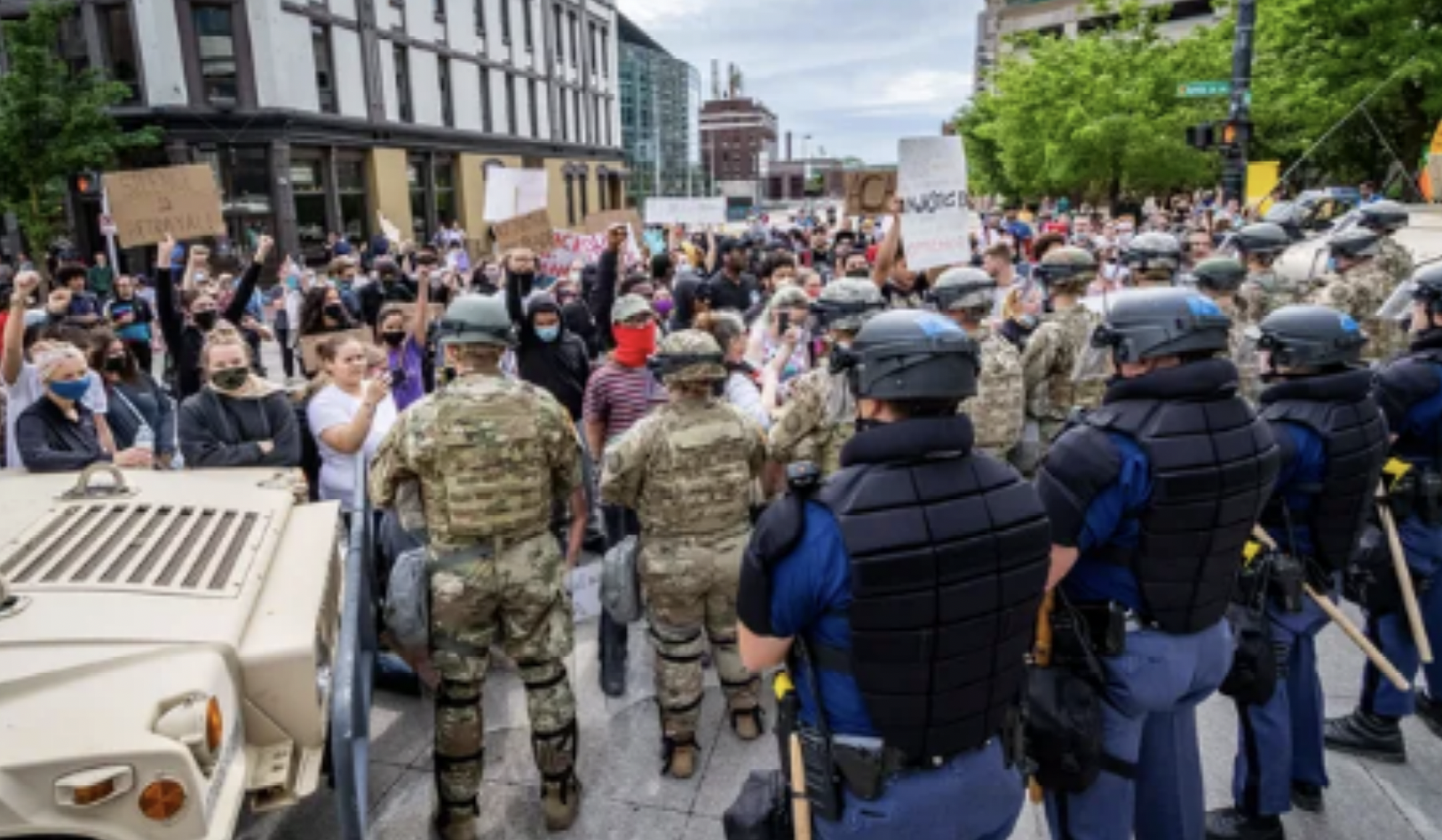
On the one year anniversary of the May 30th, 2020 uprising, I wrote that there were three main narratives that emerged in Grand Rapids, narratives that continue to be used. Those narratives are:
- Narrative #1 is the narrative of systems of power
- Narrative #2 is the narrative of liberalism and normalcy
- Narrative #3 is organized resistance and a call to Defund the GRPD
I also put together a visual depiction of how the GRPD has tried to control the narrative about public safety since the May 30th rebellion in Grand Rapids through November of 2020, which you can find here.
What else happened after the May 30th, 2020 uprising?
One of the frameworks of the national uprising after George Floyd was murdered by a cop came out of the Movement for Black Lives and Critical Resistance to call for the Defunding of the police and the eventual abolition of policing. These ideas had been around for decades, but after the uprisings of 2020, they became part of the national dialogue, as more and more people, were tired of the usual police reform promises that came from politicians and more mainstream civil rights groups.
The Movement for Black Lives created a Defund the Police Toolkit, which provided excellent resources for local communities to adopt this strategy. On June 26, 2020, Defund the GRPD held its first Press Conference, where they announced clear demands for defunding the Grand Rapids Police Department.

On July 8, 2020, after weeks of pressure from community groups to Defund the GRPD, 3 City Commissioners were set to propose defunding the GRPD to the 32% City Charter mandated minimum. However, the City Manager and the City Attorney stepped in and prevent such a vote, making the claim that the City Commission did not have the legal authority to do so. City Manager Mark Washington did say that they would revisit possible reduction in GRPD funding later that year.
July 29. 2020 – The City of Grand Rapids announced that there would be a new Strategic Plan for the GRPD in August, but the announcement made it clear that there is no way for the GRPD to reduce their funding, using recent gun violence as the main justification.
August 10, 2020 – New GRPD Strategic Plan placates those unaffected by police violence and ignores those calling for defunding.
September 24, 2020 – GRPD planned for another riot during a protest to honor Breonna Taylor in Grand Rapids.
November 17, 2020 – Defund the GRPD and other community groups stopped the efforts of the City of Grand Rapids to use Cares Act funding from Kent County to purchase ShotSpotter technology that the GRPD wanted.
December 2, 2020 – A member of the Grand Rapids Power Structure sends the City Commission a letter to oppose any defunding of the GRPD.
December 27 & 30, 2020 – The GRPD police union and supporters increased their efforts to oppose any sort of defunding of the GRPD, making it clear that the efforts of Defund the GRPD were a threat to their institutionalized power.

February 24, 2021 – GRPD Strategic Plan revisions claim that Grand Rapids, “will become the safest mid-sized city and most trusted police department in the United States.”
March 9, 2021 – Justice for Black Lives activists were targeted and arrested by the GRPD during a protest, showing how the GRPD engages in selective enforcement of local ordinances.
March 31, 2021 – GRPD rolls out their Operation Safe Neighborhood plan, which involved the use of helicopters terrorizing people in mostly Black and Brown neighborhoods. This so-called community policing approach, is nothing more than a re-packaging of what the GRPD has done for decades.
April 6, 2021 – Local news media talk to GR City Commissioners about the police budget, where they all pretty much oppose any defunding of the GRPD.
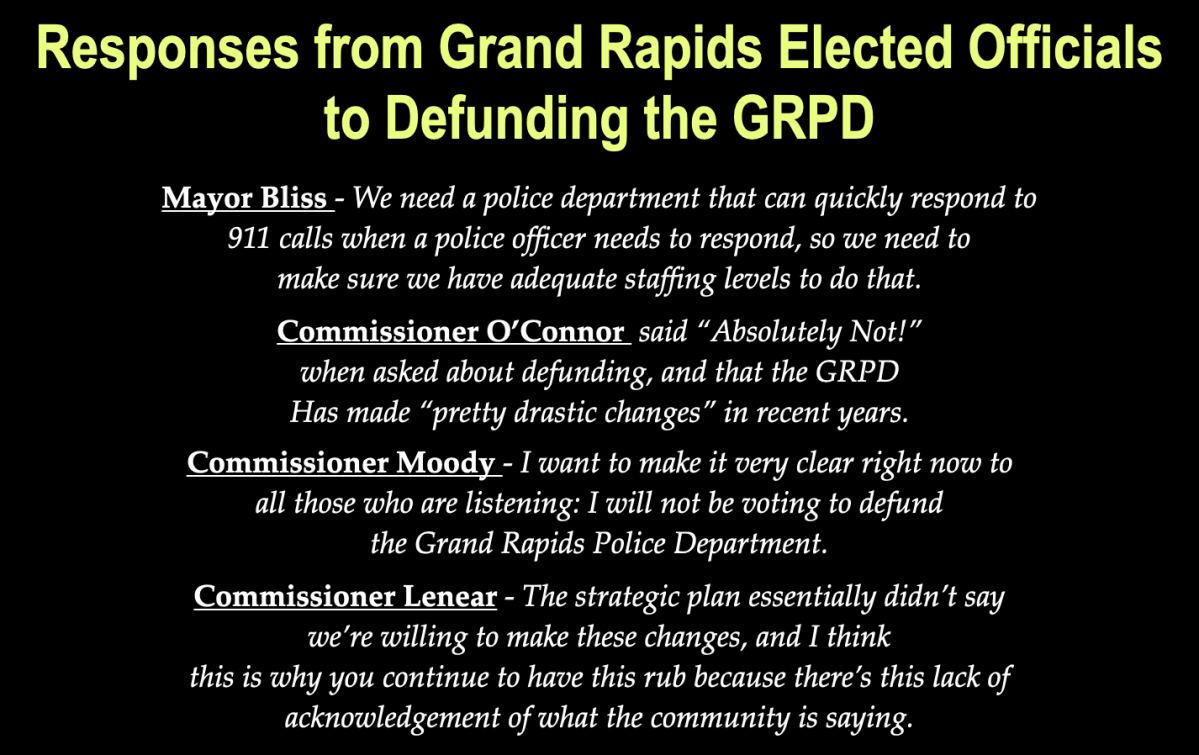
April 20, 2021 – Grand Rapids City Officials and the GRPD release a memo, which essentially threatens people who protest the upcoming Derrick Chauvin trial.
April 27, 2021 – Grand Rapids Police Officer’s Association says that the recent viral video of GRPD cops repeatedly punching a black motorists, is simply “fanning the flames of national outrage.
May 3, 2021 – Grand Rapids City Officials hold a 1 hour visual town hall to talk about the 2022 City Budget, which included the budget for the GRPD.
May 9, 2021 – GRPD arrests the wrong Black man who was on the way to a family funeral, but was charged with resisting arrest.
May 19, 2021 – City Commission hearing on 2022 Budget once again demonstrated how much contempt they have for public input, especially input that challenges their power.
Defund the GRPD did a lot of organizing around the 2022 City Budget proposal, which involved education on the budget, mobilizing people to come to the public hearing on the budget, sending electronic messages to Grand Rapids City Officials, organizing a demonstration with Justice for Black Lives to draw attention to continued police repression in Grand Rapids, and putting out their own list of demands for the 2022 Grand Rapids City Budget.
After Patrick Lyoya was murdered by the GRPD
Defund the GRPD and Justice for Blacks did the bulk of the organizing for 2 years around challenging the GRPD and building capacity for defunding the Grand Rapids Police Department.
Justice for Black Lives dissolved, but many people involved in that group created what became known as the Comrades Collective. DeFund the GRPD was still around, and engage in actions and other resistance work, but then Patrick Lyoya was murdered on April 4th of 2022, by a GRPD cop.
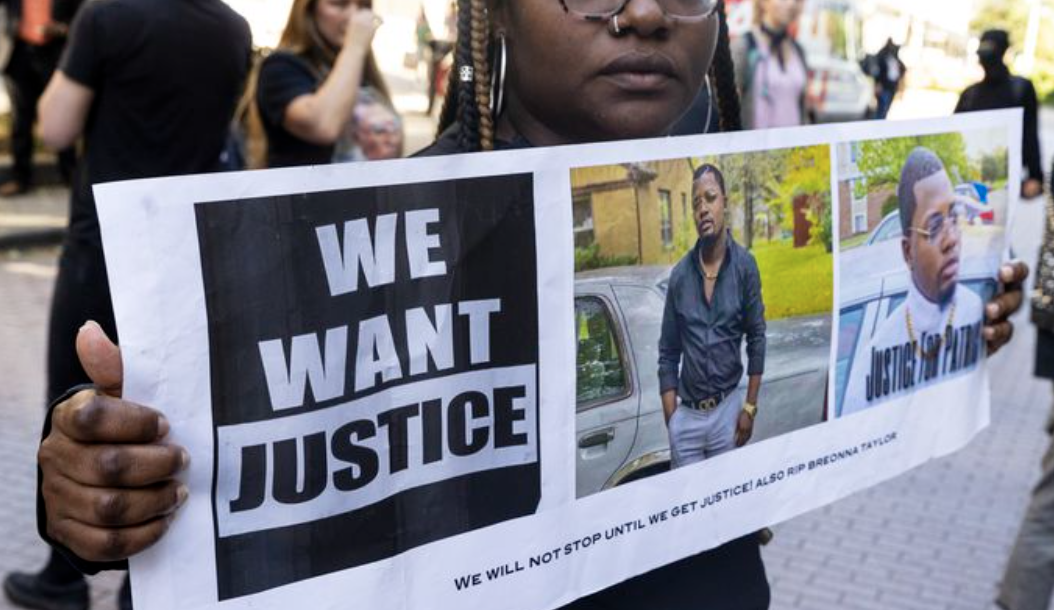
Within a couple of days after Patrick’s murder, the Grand Rapids Alliance Against Racist and Political Repression was formed. GRAARPR was formed out of the Freedom Road Socialist Organization, which is predominantly an ally group, which did not check in with the BIPOC-led groups Defund the GRPD and the Comrades Collective. This dynamic has created some tension and frustration within the organizing community and needs to be addressed.
People involved in Defund the GRPD, Justice for Black Lives and the Comrades Collective have faced significant repression at the hands of the GRPD over the past 5 years, and some of their members are still being targeted.
The number of people involved in working to defund and abolish policing in Grand Rapids has diminished for a variety of reasons, even after Patrick Lyoya was murdered by the GRPD. Some of those reasons are:
- BIPOC organizers that have been targeted have not be sufficiently supported, especially by those who identify as allies.
- There has been too much Respectability Politics injected into the larger movement, especially by politicians and mainstream civil rights groups that are more interested in police reforms and building so-called community trust with the GRPD than they are about defunding and abolishing the GRPD.
- When Chief Winstrom was hired in March of 2022, he made it a point to not only try to control the narrative about the GRPD, he adopted a no tolerance strategy that has seen the criminalization of dissent in Grand Rapids in the last three years.
- People put too much faith in the legal system, especially after Chris Schurr was charged with the killing Patrick Lyoya, Too many of us put hope in the outcome of the legal proceedings and the Schurr trial, when we should have at least been more suspicious of the outcome or never should have put any faith in a system that was never designed to actually bring about justice.

We have seen in recent months in Grand Rapids a clear pattern from the GRPD, with significant repression and no tolerance for any kind of protest. We need to move beyond simply protesting and start engaging in resistance work that doesn’t make it so easy for the GRPD to intimidate, harass, surveil and arrest people. We need to stop engaging in performative demonstrations that involve too many god damn speakers and no real revolutionary vision. If we want shit to change we are going to have to be strategic and willing to take risks.
The eighth and final episode in the All Access PD: Grand Rapids TV series on HBO/Max has now concluded. So what can we learn from this high-scripted TV show that featured the GRPD?
First, I want to provide a brief summary of each of the 8 episodes, followed by several points about why I think it is important for communities in Grand Rapids to look beyond simply the entertainment aspect of the All Access PD: Grand Rapids TV show.

Episode #1 sure reminded me of the show COPS, where Black bodies are criminalized and that Black people in urban settings are represented as thugs. This first episode affirms that stereotype, thus perpetuating structural racism and justifying state carceral violence.
Episode #2 ends with the mother of the shooting victim coming in to the GRPD headquarters and talking to Winstrom on camera, praising them for all they have done on this case. The mother states, “You give off a vibe that you really care.” The mother then praises the female homicide investigator, with Winstrom and another cop smiling as the episode credits are rolling.
Episode #3 follows the case of a Black person charged with a shooting, which further normalizes the white supremacist belief that Black people are inherently deviant and violent. This HBO/MAX TV series with the GRPD is presenting Grand Rapids as a city with a bunch of violent Black people who prey on other Black people.
Episode #4 was essentially about drug dealers and drug users in the Heartside area of Grand Rapids. Every one of the dealers and users were Black people, so this episode continues to perpetuate racial stereotypes and present the GRPD as compassionate saviors of the unhoused.
In Episode #5 Chief Winstrom gets the final word while the credits are rolling to say that the end result was justice. Simple as that. Winstrom gets to decide when justice happens, because it’s his show. However, after 5 episodes, the only thing that changed is that there were Latinos included as part of those committing crimes in Grand Rapids.
Episode #6 communicates that the only shooters and victims are BIPOC,, plus some of the video footage used communicates the message that there are Black gangs roaming the streets of Grand Rapids. This show will definitely contribute to fostering and maintaining stereotypes about Black people, since the audience will no doubt be predominantly white.
Episode #7 continued with representing Black people as suspects in gun violence, as drug traffickers, then added a new stereotype, by associating guns and drugs with rap music.
Episode #8 demonstrated how highly scripted this TV series about the GRPD has been. This was the last episode in the series and the GRPD clearly wanted to craft a narrative that shows how much they care about the community and how dangerous their jobs are.
What can we learn from the All Access PD: Grand Rapids TV show?
Here are several things that I think we need to talk about in regards to what the GRPD TV show was really about and what it means for this community.
- The GRPD TV show demonstrates that you can craft messages which say – most of the crime that is happening in Grand Rapids is being committed by Black and Brown people without being worried about any pushback from the community.
- The highly-scripted TV series is also about what the community wasn’t shown, which is the over-policing in BIPOC and poor neighborhoods, how much the GRPD works to protect property and maintain order, especially in the downtown, since Grand Rapids doesn’t want to alienate tourists, which means they don’t want to take money away from those who own this city.
- The All Access PD: Grand Rapids series was essentially both a recruiting plan for the GRPD and a Public Relations tool to boost their image locally and across the country. The GRPD TV show is also being used to leverage unconditional funding for the GRPD, since the Grand Rapids City Commission once again unanimously approved all of the money they have been requesting, along with how the Mayor and City Manager continued to praise the GRPD even after the Kent County Prosecutor decided to not re-charge the cop that killed Patrick Lyoya.
- The GRPD TV series attempted to present the cops as human being trying to do good and to continue to build back some form of community trust. There is no evidence in the TV show that the city is deeply divided over the GRPD and that their actions continue to alienate people throughout Grand Rapids, which was intentional.
Lastly, it should be stated that the All Access PD: Grand Rapids TV series is ultimately about controlling the narrative about policing. Ever since the 2020 uprising in Grand Rapids, there has been an all out war to control the narrative about the GRPD, because more than anything those in power do not want to succumb to the will of popular social movements, and they will not allow any conversation about defunding/abolishing the Grand Rapids Police Department. Grand Rapids is in a narrative war about the GRPD, and this was ultimately why Grand Rapids politicians and members of the Capitalist class have endorsed it.
Editors Note: Last week, the Grand Rapids City Commission unanimously approved the FY2026 budget, which not only provides $69.1 million to the GRPD as listed in the budget narrative, it provides millions more for new technology and other resources for the GRPD and entities that work directly with the GRPD. The total budget for what the system calls community safety – it would be more accurate to call it the Punishment Industry – comes to $247.3 million of public money.

Episode eight begins with a Lieutenant in the GRPD talking about “all the different hats that cops have to wear.” The GRPD responds to an accident involving a motorcycle and a car. A young white woman is injured and a young white male is sitting with her, attempting to stop the bleeding.
The cop asks the guy what happened and thinks he smells alcohol. The cop then grabs what he believes to be a suspect, and in response another white male become agitated and starts yelling at the cop to let the possible suspect go. Another cop steps in, puts his hands on another white male and then picks him up and slams him to the ground. The white male then asks the cop for his badge number and name, several times, but the cop never provides the information, and instead tells the guy he is under arrest as cuffs are put on him.
While taking the two white males to their squad cars, the GRPD informs one of the young men that they are being charged with obstruction and failure to obey a cop. The GRPD cop then tells him that if this young man does any damage to the police vehicle, they will be charged with a felony.
The episode then cuts to the Deputy Chief of Police, who is talking about how he has always done patrol work and then begins to talk about how dangerous patrol work is. The Deputy Chief of Police – speaking directly to the camera – talks about how a fellow officer and patrol partner, was killed responding to a domestic violence call. A picture of the cop who was killed – Robert Kozminski – was shot by someone in July of 2007.
The next scene takes viewers into the daily roll call room, which has a table with a plaque on it commemorating Kozminski. The Deputy Chief of Police says the plague is there “as a reminder of how dangerous this job is.” Interesting that they spent more time talking about a GRPD officer who was killed in 2007, but only mention in passing that Patrick Lyoya was killed by a GRPD cop in 2022.
The GRPD responds to another call about someone who has barricaded themselves into a home that they don’t live in. The Deputy Chief of Police says that while some cops are trying to reason with the suspect, other cops are entering the house through windows. The Mental Health Team becomes involved and tries to talked the suspect down. At the same time, SWAT cops show up all geared up to try to take the person with a mental health crisis into custody.
Then we see the GRPD responding to a call about a bank robbery, where the suspect is a white male. The GRPD sees a man who fit the description, stopped him and put him in a police cruiser until the bank employee tells the cops this was not the man who robbed the bank.
Another patrol cop, who is patrolling in the Burton Heights area, says that there is a lot of drug dealing happening in the parking lots along South Division. This cops sees a low-level dealer, who runs and the cops tries to catch him on foot. The episode then jumps back to the person who barricaded himself inside a home.
The GRPD has more than a dozen cops there when the man finally comes downstairs and gives himself up. A GRPD cop, who is speaking to the camera, then says that normally someone like this would be taken to the Kent County Jail. However, with the new Mental Health Response Team, they work to provide other resources to address some short term needs. No sooner does the cop tell viewers this, he then admits that the man who was having a mental health crisis is going to the jail. The GRPD cop (Officer Howard) who is saying all of this, is the same cop that many activists have ID’d as a cop who often instigates harassment of people involved in social justice work, which I wrote about recently.
The episode cuts back to the bank robbery, where they now suspect a “homeless guy.” The cops find the guy, who was staying at a local hotel, and they arrested him immediately at gun point.
Now we are back to the drug dealer suspect. The cops have now brought in police dogs and are using their recently purchased drones to find the suspect. Using live drone footage, they found the suspect who is a Black male. The cops talk with him briefly, tell him he is going to jail, then tells the camera that they try to convince these people that they need to, “change their lifestyles.”
Back at GRPD headquarters, the Deputy Chief of Police informs the patrol squad that his son and daughter are going to do a ride-along with the patrol officers. For the next several minutes, the TV show producers try to humanize the cops, where the children of the Deputy Chief of Police are making light of their father also on patrol.
The cops then chase a suspect with a drug warrant, someone who is in a car and trying to get away from the GRPD. The cops throw a tire spike tool on the road, which will deflate car tires, thus enabling them to capture the suspect.
The episode switches to another call, where a late night party is in progress in Grand Rapids. Someone was shot near the Agave bar and the cops show up on the scene. The episode cuts back to the high speed chase. The tire finally deflates and the driver pulls over and is apprehended. This scene comes to a close with both of the Deputy Chief of Police’s kids arriving on the scene and talking about how much they enjoyed the ride-along.
Back to the Agave bar shooting and the Deputy Chief of Police says that some communities feel marginalized by the cops, but that they try to build relationships with them. The crowd outside the bar grows and people begin taunting the cops, when Chief Winstrom shows up. Several GRPD cops then praise Winstrom, with one cop saying, “everybody loves him.”
The episode ends with the daughter of the Deputy Chief of Police showing up in uniform as an intern, where Winstrom arrives to welcome the new recruit.
From a production perspective, this episode was all over the place, with no real story line coherence. However, it seems like they were attempting to get viewers to see cops as regular people and to show how “risky” it is to be a GRPD cop. However, in every instance in this episode, the GRPD was always heavily armed, with lots of cops showing up in each scene, and often using physical force when dealing with suspects.In each case the GRPD approached people at gun point, despite the fact that none of them had a weapon on them.
Episode eight demonstrated how highly scripted this TV series about the GRPD has been. This was the last episode in the series and the GRPD clearly wanted to craft a narrative that shows how much they care about the community and how dangerous their jobs are.
Having watched and deconstructed all eight of the scripted episodes, the GRPD rarely prevents violence from happening, often escalates violent situations, doesn’t demonstrate any accountability and disproportionately targets Black and Brown residents in neighborhoods that have been disinvested.
For all the hype that this show received from local news media, the All Access PD Grand Rapids show did nothing to improve their image or their standing in communities of color. The show also completely avoided addressing how the GRPD engages in a variety of repressive tactics when dealing with organizations and community groups that are demanding justice.
Shortly after the Kent County Prosecutor decided he would not re-charge the ex-GRPD cop who shot Patrick Lyoya in the back of the head, the City of Grand Rapids released a statement.
Part of what Mayor LaGrand said was:
“While the criminal case has concluded, our city’s journey has not. The work of healing, of building a more equitable and just Grand Rapids, and of strengthening the bonds of trust between our community and all who serve it, including our police department, must continue with even greater resolve. We are committed to the ongoing reforms and dialogues necessary for this progress. We also recognize and support the dedicated GRPD officers who serve our city honorably and professionally every day.”
“The legacy of Patrick Lyoya’s tragic death must be one of enduring commitment to positive change. I implore every resident to channel their emotions into peaceful, constructive action. Let us come together to support one another and continue the hard work of building a city where everyone is safe, valued and respected.”
City Manager Mark Washington echoed some very similar sentiment:
“The City of Grand Rapids’ commitment to accountability, constitutional policing and our comprehensive police reform agenda remains unwavering. During my tenure, we’ve made great strides in improving policing in our community – many of which have occurred over the last three years – and were just recently highlighted by our Police Chief to our Public Safety Committee on May 20, 2025. We recognize that today’s announcement may intensify the need for trust-building with some segments of our community, and we are fully dedicated to that ongoing work. We also deeply value our GRPD officers who perform their challenging, and often dangerous, duties with integrity, professionalism and commitment to our community every day.”
“I know for some in this is very difficult day and for others a great relief. Regardless, I expect for any and all community expressions to be lawful and civil as we navigate the path forward together.”
Here are some of my immediate responses to these comments from members of the Grand Rapids political class:
First, you can toss around words like equity, justice and healing all you want, but the actions of the City of Grand Rapids do not put into practice meaningful actions/policies to promote equity, justice and healing.
Second, both Mayor LaGrand and City Manager Washington go out of their way to praise the GRPD, using words like commitment, trust-building, comprehensive police reform, dedicated, honor and professionalism. Even on the heals of a three year fight to win justice for Patrick Lyoya, the treatment of community organizers in this fight, or any other struggle for justice that has occurred in the past decade – primarily led by BIPOC organizer – LaGrand and Washington have the audacity to still praise a police department that continues to surveil, intimidate, harass, arrest and abuse members of the community.
Third, both LaGrand and Washington make comments with the intent of both trying to control public responses to Becker’s decision to not re-charge Schurr and to demonize anyone who doesn’t operate within the parameters of state-dictated responses. LaGrand wants everyone to be “peaceful” and use “constructive action.” Washington wants everyone to be “lawful and civil.” These are merely code words designed to control and to demonize anyone who doesn’t follow the state-sanctioned script for proper behavior. In other words, nothing that disrupts business as usual, nothing to challenges systems of power and oppression, which ultimately means performative actions and respectability politics.
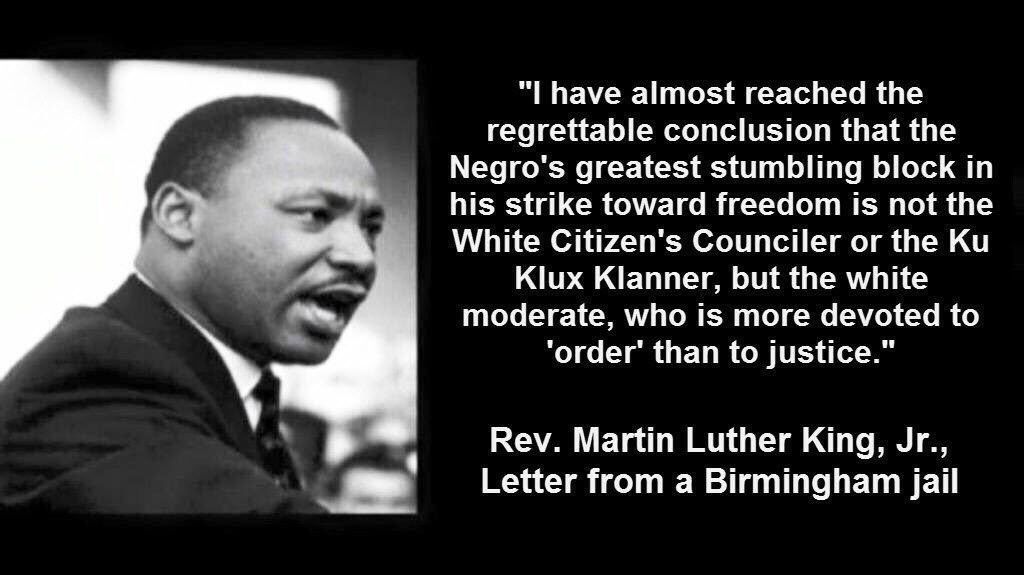
Getting back to Mayor LaGrand’s point about building a more equitable and just Grand Rapids, it is interesting (but not surprising) that he offers no concrete examples of how this city can be more equitable or just.
We know that City Manager Mark Washington has demonstrated his commitment to order, and we have already witnessed the Mayor’s response to critical issues in his first 5 months in office – not listening to the undocumented immigrant’s demand to adopt Sanctuary policies, being dismissive of those who have been abused by the GRPD, his bizarre response to the housing crisis and his commitment to policing, which was reflected in his State of the City address – “Public order is the bedrock of a strong city.”
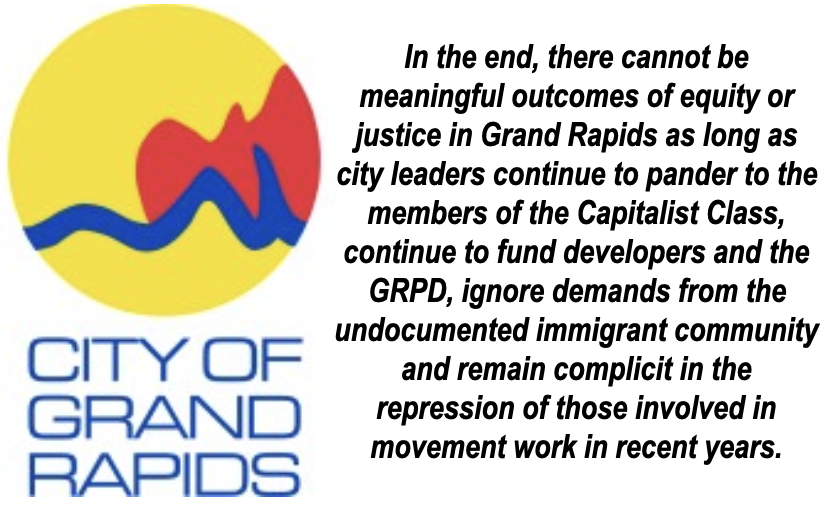
In the end, there cannot be meaningful outcomes of equity or justice in Grand Rapids as long as city leaders continue to pander to the members of the Capitalist Class, continue to fund developers and the GRPD, ignore demands from the undocumented immigrant community and remain complicit in the repression of those involved in movement work in recent years. The statement from the City of Grand Rapids should just be one more reminder that we cannot work towards collective liberation when the political system is commitment to state repression, what they like to call law and order.
Palestine Solidarity Information, Analysis, Local Actions and Events for the week of May 25th
It has been more than 19 months since the Israeli government began their most recent assault on Gaza and the West Bank. The retaliation for the October 7, 2023 Hamas attack in Israel, has escalated to what the international community has called genocide, therefore, GRIID will be providing weekly links to information and analysis that we think can better inform us of what is happening, along with the role that the US government is playing. We will also provide information on local events and actions that people can get involved in. All of this information is to provide people with the capacity of what Noam Chomsky refers to as, intellectual self-defense.
Information
International Solidarity Movement Volunteers Speak On Building Solidarity In The West Bank
Netanyahu’s Endgame: Isolation and the Shattered Illusion of Power
Genocide is the Currency of Western Domination
Gaza’s Graveyard of Illusions: How Israel’s Narrative Collides with Military Failure
Israel kills 100 Palestinians on Nakba Day
STUDENTS AND TEACHERS IN GAZA: “EDUCATION ITSELF IS A FORM OF DEFIANCE”
Netanyahu: Gaza Aid Scheme Offers Israel Symbolic Cover to Finish the Genocide
How NYT Reports on Weaponized Famine So You Don’t Have to Give a Damn
Gaza First Amendment Alert (May 16, 2025)
Analysis & History
Why Didn’t The Democrats Strike a Ceasefire in Israel | Norman Finkelstein
Making Gaza Unlivable: Israel Intensifies Attacks as Netanyahu Vows to Seize All of Gaza
Israel Is Attempting to Execute a Final Solution in Gaza
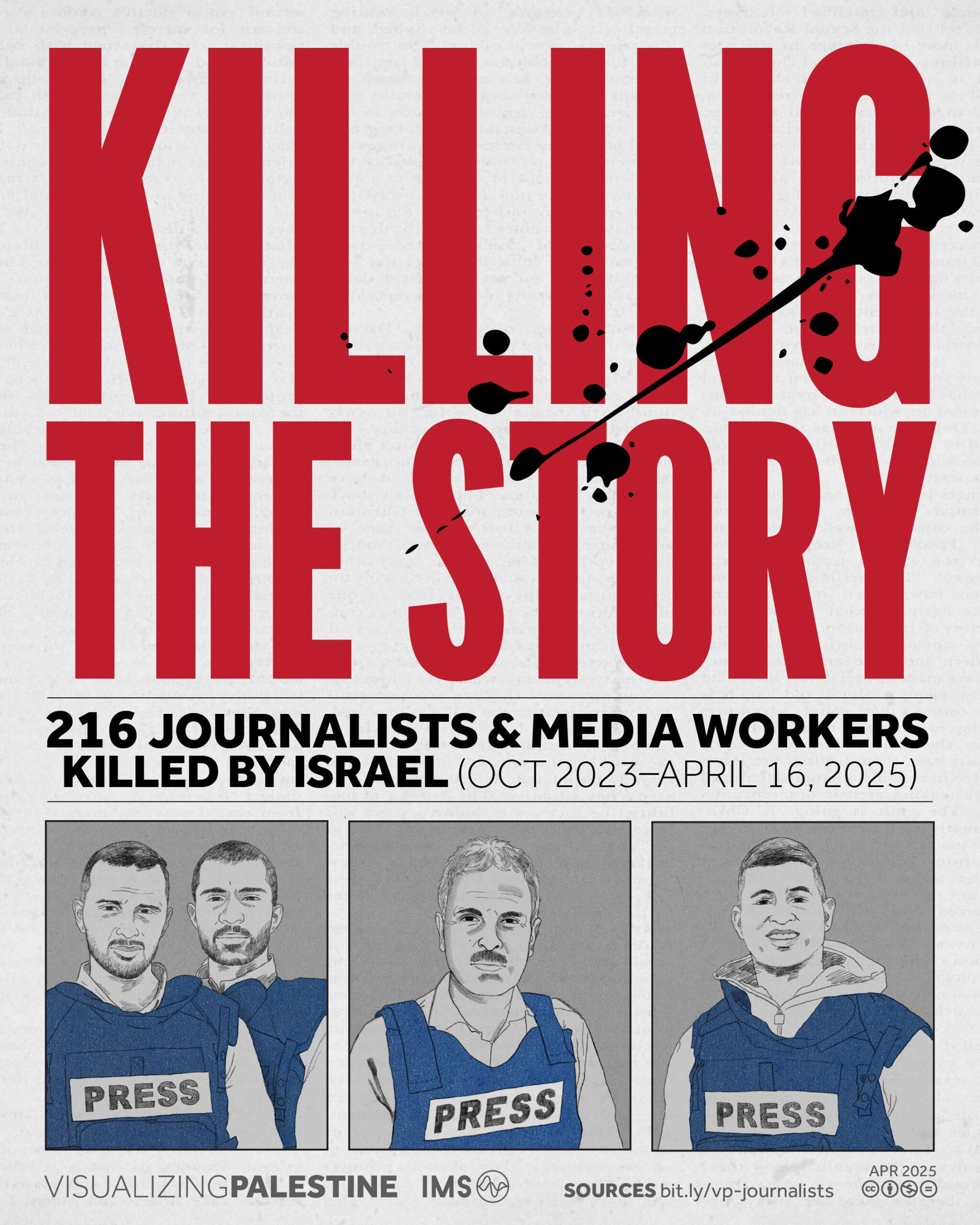
Image used in this post is from https://visualizingpalestine.org/visual/killing-the-story-april-2025/
There are reasons why the Kent County Prosecutor will not re-charge Schurr for murdering Patrick Lyoya
Late Thursday morning, Kent County Prosecutor Chris Becker made the announcement that he would not re-charge former GRPD cop Christopher Schurr for shooting Patrick Lyoya in the back of the head. Simply put, Becker said, “I just don’t see a place where we get 12 people to agree.”
We may never know the real reasons that Chris Becker decided to not re-charge Schurr, but there are certainly some factors that play into the Kent County Prosecutor’s decision.
First, the GRPD union contributed $1,000 to Becker’s campaign in 2016, according to the campaign finance records found online. However, the GRPD police union is not the only law enforcement entity to contribute to Becker’s campaign over the years. Former Kent Count Sheriff Larry Stelma and current Kent County Sheriff Michelle LaJoye-Young have both made contributions. In addition, there was a $1000 contribution in 2016 from the Kent County Sheriff Law Enforcement (How it was listed on the campaign finance document), which I can only conclude is the Sheriff’s Department union.
Equally important are the contributions that Kent County Prosecutor Chris Becker has received from the legal system. Looking at the records for the past two election cycles, Becker has received campaign contributions from at least 30 different lawyers, with several of them connected to the Kent County Prosecutor’s office, along with 6 current or retired judges. These are all people who are part of the punishment system, also known as the Criminal Justice System.
Second, there are the contributions from member of the Grand Rapids Power Structure over the past three election cycles.
2016 Election
- J.C. Huizenga $500
- Peter Secchia $2,500
- Steven Van Andel $500
- Cheri DeVos $1,000
- Dan DeVos $1,000
- Pam DeVos $1,000
- Dick DeVos $1,000
- Betsy DeVos $1,000
- Richard DeVos $1,000
- Helen DeVos $1,000
- Doug DeVos $1,000
- Maria DeVos $1,000
2020 Election
- Cheri DeVos $4,000
- Dick DeVos $2,000
- Dan DeVos $2,000
- Doug & Maria DeVos $4,000
- Pam DeVos $2,000
2024 Election
- TGIF Victory Fund – $20,000
- Cheri DeVos – $8,325
- Steve Ehmann – $8,325
- Doug DeVos – $8,325
- Maria DeVos – $8,325
- Dick DeVos – $8,325
- Betsy DeVos – $8,325
- Daniel DeVos – $8,325
- Pamela DeVos – $8,325
- Joan Secchia – $4,000
- Charlie Secchia – $2,000
- John Kennedy – $2,000
- Jim Williams – $2,000
- David Van Andel – $2,000
- Carol Van Andel – $2,000
- Mike Ellis – $1,000
- Mark Murray – $1,000
- Tom Bylenga – $1,000
- Mark Bissell – $1,000
The DeVos family alone contributed $89,600 to Chris Becker over the past 3 election cycles, which is small change for them, but it still makes their family the single largest contributor to Becker’s campaign. There is one point about the contributions in 2020 and 2024, which I believe to be relevant as well, as it speaks to the longterm interests of Billionaires like the DeVos family.
You can see that the amount of money given by each DeVos family member increased from 2016 to 2020 to 2024. In looking at the contributions from the DeVos family in 2020, all of those contributions were made on July 10th, 2020. Why is that important? Well, it was only six weeks after the riot/uprising in Grand Rapids because of the police murder of George Floyd. It is my contention that Becker received an increase in campaign funds from the most power family in Grand Rapids, just weeks after the riot/uprising, since the DeVos family knew that Becker would be prosecuting people arrested during the riot/uprising.
The DeVos family has all of their foundation offices, their financial investment firm, RDV Corp, Windquest and a slew of hotels they own, all of which are located in downtown Grand Rapids. The Capitalist Class has vested interests that must be protected by the state and Becker has not disappointed in the cases he presided over regarding property destruction during the riot/uprising of 2020.
It is deeply troubling that Chris Becker has relied on the DeVos family and other members of the Grand Rapids Power Structure to get elected to the Prosecutor’s Office, and that their contributions increased after their investments were threatened by protestors in 2020 and the continued resistance since then up until today.
I can’t help but believe that the DeVos family continues to have conversations with Grand Rapids and Kent County elected officials over the potential threat to their downtown interests in the aftermath of the GRPD murder of Patrick Lyoya. After all, this is how systems of power function and we need to come to terms with this. The legal system in Kent County is not broken, it is doing exactly what it was designed to do – protect property and the financial interests of those with power. Once we understand this, we can develop more effective strategies of resistance.
 Grand Rapids Institute for Information Democracy