This article by Nick Alexandrov is re-posted from CounterPunch. Editor’s Note: The information in this article is not only important, since he could expose the US role in supporting the genocidal policies of former Guatemalan President Rios Montt, it could result in setting a legal precedence that has significant ramifications for Guatemalans living in the US. There are currently an estimated 4,000 Guatemalans living in West Michigan.
Efraín Rios Montt, Guatemala’s former dictator, may yet face the consequences of his actions. Last Monday, Judge Miguel Angel Gálvez announced that both Montt, 86, and José Mauricio Rodríguez Sánchez, another former general, must “stand trial on charges of genocide and crimes against humanity,” Elisabeth Malkin wrote in the New York Times. Her article, in accordance with Times standards, left a few things out, among them the fact that Montt completed coursework at the School of the Americas (SOA) three decades before taking power. (The school is now known as the Western Hemisphere Institute for Security Cooperation, or WHINSEC, but “there are no substantive changes besides the name,” one of its former instructors testified shortly after the rebranding.) His 14 months in charge were brutal, even by the standards SOA grads have set: “an estimated 70,000 unarmed civilians were killed or ‘disappeared;’ hundreds of thousands were internally displaced,” according to Amnesty International. And his “Operation Sofia” was “aimed at massacring thousands of indigenous peasants,” the National Security Archive website explains—and was quite successful, given the 600 Mayan villages it destroyed.
The National Security Archive is housed at George Washington University, which is worth bearing in mind. That a prominent university could name itself after the man the Iroquois dubbed “Town Destroyer” in the 1770s reveals much about this country’s prevailing intellectual culture, and its sense of history. Seneca Chief Cornplanter explained that, whenever someone mentioned that Founding Father’s name, “our women look behind them and turn pale, and our children cling close to the necks of their mothers.” Washington was hardly an innovator in this regard, and similar to the man who, centuries earlier, “set forth across the countryside, tearing into assembled masses of sick and unarmed native people, slaughtering them by the thousands.” That was Columbus’ March 1495 rampage across Hispaniola, as described by historian David Stannard. Montt was a worthy heir to this Western barbarism.
And his policies were right in line with Washington’s goals for the region. As World War II drew to a close, U.S. State Department planners wrote of the “problem,” as they saw it, with “the other American republics,” which were “manifesting an increasingly strong spirit of independence and jealous insistence on complete sovereignty.” This nuisance presented difficulties in light of Washington’s efforts to secure “long-term rights for the use…of certain naval and air bases,” and its wish “to maintain the economies” of Latin American nations in accordance with its principles—“quite apart from equity, it is to the selfish interest of the United States” to do so, planners emphasized.
These statements appear in documents from 1943-44, indicating Washington’s ensuing support for dictatorships had little to do with a “Cold War climate” warping the otherwise good intentions of U.S. officials. From the perspective of these men, Guatemala entered a decade-long crisis as WWII drew to a close. In 1944, a popular revolt brought down Jorge Ubico, the dictator Washington supported. His successor, Juan José Arévalo, won overwhelmingly in the election held that December; he started democratizing the country while in office. In 1951, voters elected Jacobo Árbenz, whose Agrarian Reform Law was part of a broader strategy to limit the power of major corporations. Under Ubico, Susanne Jonas explains, the government was “active…in protecting and subsidizing (but never regulating or restricting) private enterprise;” it also repressed most of the population, keeping workers poor, terrified, and atomized—and profits high.
But ultimately it was Guatemala’s “increasingly strong spirit of independence” under Árbenz, more so than any specific policies limiting, say, United Fruit’s ability to operate, that led to his downfall in the 1954 CIA coup. That ouster was one of the CIA’s earliest, though not without its difficulties: one official, as former CIA staff historian Nick Cullather revealed, “rallied his dispirited troops with a reminder that ‘the morale of the Nazis in the winter of 1932, just before their seizure of power in Spring 1933, was at an all-time low ebb.’” Once Árbenz was out of the picture, the Guatemalan government acted on U.S. Embassy instructions, hunting down thousands of perceived subversives and torturing many of them in an effort to terrorize the population back into submission. Under these conditions, the public could do little to protest, say, the 1955 Petroleum Code, which Jonas notes was written in English and a “giveaway measure” for foreign companies.
Washington’s 1960s restructuring of the security forces followed, doubling the army’s size and creating the Mobile Military Police, which expanded the state’s reach into rural regions. These changes coincided with U.S. training for counterinsurgency units, both at the SOA and in-country, as when Colonel John D. Webber traveled to Guatemala in 1966 to monitor the new squadrons’ instruction. Despite official rhetoric to the contrary, government repression was “totally disproportionate to the military force of the insurgency,” according to authors of the 1999 UN-backed Historical Clarification Commission—it was state terror, in plain terms, due to which perhaps 8,000 paid the ultimate price between 1966 and 1968. But things weren’t all bad. In 1962, a Chase Manhattan Bank report noted “the more favorable business climate” of the post-Árbenz era, in which its authors were confident foreign investment would “begin to pick up.”
Efforts to crush even the slightest trace of progressive politics intensified in the following years, and were pursued with utter ferocity in the 1980s. The 1981-1983 period was the one in which “agents of the State of Guatemala, within the framework of counterinsurgency operations”—developed with Washington’s help, it cannot be overemphasized—“committed acts of genocide against groups of Mayan people,” according to the 1999 truth commission. Rios Montt was running the show by this point, with the help of his cabinet, two-thirds of which—like the dictator himself—had studied at the SOA. These were the men who unleashed “Operation Sofia” on the Mayan communities: documents on the National Security Archive’s website demonstrate that the highest levels of Guatemala’s government were involved in its planning and direction.
Another human rights report, compiled by the Guatemalan Archdiocese’s Human Rights Office, gives a sense of what this “more favorable business climate” was like. One testimony recalls “burned corpses, women impaled and buried as if they were animals ready for the spit, all doubled up, and children massacred and carved up with machetes.” A second described how soldiers tied up a family inside a house, and then torched it; a two-year-old was among those burned to death. Yet another tells how a pregnant woman “in her eighth month” came face-to-face with counterinsurgency forces: “they cut her belly, and they took out the little one, and they tossed it around like a ball.” And in 1980, after shooting a woman lame, a group of soldiers “left their packs and dragged her like a dog to the riverbank. They raped and killed her.”
These are just four examples of thousands, and part of the broader policy of brutalization for which, in particular, Defense Minister Héctor Gramajo Morales bore major responsibility. U.S. officials honored him for his efforts at the SOA’s December 1991 commencement exercises in Fort Benning, GA, after which Harvard’s John F. Kennedy School of Government awarded him a Mason fellowship. Samantha Power, whose Pulitzer Prize-winning “A Problem from Hell” never mentions Guatemala, taught at the Kennedy School before Obama tapped her for his National Security Council, confirming Harvard’s status as a safe haven for contributors to the cause of Guatemalan genocide denial. But in civilized arenas, it seems more difficult to get away with overseeing the slaughter of thousands—one of several reasons why close attention should be paid to Rios Montt’s trial as it unfolds.
MLive article on LGBT Equality report amplifies anti-gay voices
Yesterday, we posted a story about the new Michigan Department of Civil Rights (MDCR) report on LGBT equality in Michigan. We provided an overview of the report, which included current state policy, documented cases of discrimination, testimony from public hearings and recommendations.
This morning MLive also reported on the new report and focused exclusively on just one aspect of the report, which is that LGBT discrimination is bad for Michigan’s economy.
In addition, the MLive story sought out comments from several sources. Besides comments from spokespersons from the Michigan Department of Civil Rights, the reporter talked to three independent sources, two that are opposed to LGBT equality and one in support.
The two anti-LGBT equality were cited first, beginning with Brian Burch, one of the five Holland City Council members who voted against recommendations from the Holland Community Relations Commission to include the LGBT community in the City’s anti-discrimination ordinance. Burch avoids talking about his denial of equality in Holland and instead redirects the conversation around the “brain drain” in Michigan. Burch, who is the lead PR person for ArtPrize, has defended his decision to vote against LGBT equality on numerous occasions since the June 2011 Holland City Council vote.
The other anti-LGBT equality source cited in the MLive article was James Muffett, president of Citizens for Traditional Values (CTV), a group that MLive identifies as “a conservative organization based in Lansing.”
Muffet is cited as saying, “Civil rights protections should include immutable characteristics that can’t be changed.” This is just code to mean that civil rights apply only to what their group believes as immutable characteristics, which for the CTV are heterosexual characteristics.
Citizens for Traditional values also believes that the US was founded on Christian principles and are strong advocates against women’s reproductive rights. In addition, CTV is a political action committee and has donated to rightwing and reactionary politicians and candidates.
It is not until the end of the very end of the MLive article that we read the only pro-LGBT comments from someone other than the Michigan Department of Civil Rights, which was a spokesperson from Equality Michigan.
Besides providing limited information and no analysis of the MDCR report, MLive gives more prominence to anti-LGBT voices than those who support LGBT equality.
Yesterday, former Secretary of State Madeleine Albright spoke at the Ford Museum in Grand Rapids.
MLive sent a reporter who acted primarily as a stenographer. What the Clinton administration Secretary of State said, the MLive reporter wrote. No questions asked, no verification of what she said and no mention of any major foreign policy matters she omitted.
The Mlive article focuses on a story that Albright shared about the Cuban use of the word cajones (Spanish for balls), which MLive never translates for readers. However, the more important point about this story was that Albright justified a practice of US intimidation and harassment of Cuba, with regular US military fly-overs being one aspect of that policy.
The MLive article continues with Albright talking about other major foreign policy matters during her tenure in the Clinton administration. Albright “expressed pride over U.S. intervention in Kosovo and regret that the country did not try to stop genocide in Rwanda.”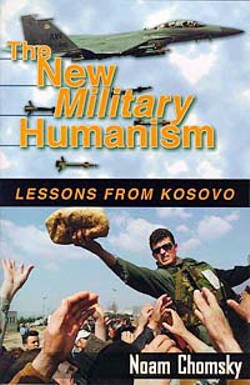
Again, the MLive reporter does not question Albright’s assertions about these policies, but accepts them as fact. Noam Chomsky refers to the US/NATO intervention in Kosovo as war crimes, a claim that was supported by an independent tribunal held in August of 1999.
On the matter of Rwanda, it is true that the US did not intervene militarily, but it doesn’t mean they were neutral. The fact is that the majority of weapons used in the Rwandan genocide were small arms, most of which came from the US and some European countries, as has been documented by Human Rights Watch and other independent foreign policy analysts. The trafficking of small arms was rampant during the Clinton years.
The MLive article continues with Albright commenting briefly on current US foreign policy, followed by a series of one-liner comments that were light hearted.
In addition to MLive’s failure to challenge or verify any of the major foreign policy claims by former Secretary of State Madeleine Albright, they also omitted one major foreign policy matter during her years in the Clinton administration. There is no mention of Iraq in the 1990s.
This is no minor omission, since the Clinton administration facilitated the harshest form of international sanctions ever imposed on a country. After the Gulf War in 1991, the US/UN imposed sanctions on Iraq, a policy which lead to two different UN diplomats resigning in protest because of the brutality of these sanctions. One official that resigned was Denis Halliday. Halliday resigned because the sanctions resulted in the deaths of thousands of Iraqi children, in a policy that Halliday referred to as genocide.
The United Nation’s estimated that roughly 500,000 Iraqi children died as a result of sanctions. This is a statistic that the US and particularly Madeleine Albright did not dispute. While being interviewed on CBS, Albright was asked if the death of 500,000 Iraqi children was worth it, to which Albright responded, “We think the price was worth it.” Here is the exchange between Albright and Leslie Stahl.
American Military Power: Interview with William Blum
This interview conducted by Paul Gottinger is re-posted from Dissident Voice.
William Blum’s work may not be as prominent as many other writers on the left, however that is not due to its lack of importance. This longtime critic of U.S. imperialism left the State Department in protest against the Vietnam War and founded the alternative paper ‘Washington Free Press’. His books Killing Hope and Rogue State meticulously document U.S. military and covert CIA interventions, as well as U.S. assassinations around the world. For over forty years he has been working to shatter the dominant narrative inside America that U.S. foreign policy is guided by humanitarian principles. In 1999 he received the Project Censored’s Award for writing the number five top-censored story of the year. The article was about how a 1994 U.S. Senate report showed that between 1985 and 1989, U.S companies provided microorganisms needed for Iraq’s chemical and biological warfare against Iran. In 2006 he was the subject of media attention when Osama Bin Laden recommended that all Americans read Rogue State. His upcoming book is entitled: America’s Deadliest Export: Democracy-The Truth about US Foreign Policy and Everything Else. My conversation focuses on recent events such as Obama’s increased military presence in Asia, the situation in Syria, and recent coups in Latin America.
Paul Gottinger: Given your extensive knowledge of US military and CIA interventions: How do you think US corporate and transnational corporate interests influence US foreign policy?
William Blum: The international corporations have a lot of feedback into the administration, much more than you or I do-that’s for sure. But, they also have more than feedback. They have money. They keep people like Obama in power. When you give millions of dollars in physical contributions you expect something in return. Obama is completely aware of it. This is common knowledge and common sense. So, there shouldn’t be any surprise that any president will cater to the needs of these international corporations. This is especially true of the ones that are in the military area. They reap huge benefits. Like one of the reasons the US has expanded NATO so much is because every new member of NATO has to spend something like 2 billion dollars on new military equipment to reach a certain standard of NATO. And the US companies, not surprisingly, sell more of this equipment to these new members than any other nation. That’s one example of the many ways in which US foreign policy benefits these multinationals.
PG: Jeremy Scahill writing in The Nation has stated that there has been a substantial transformation in the CIA since 9-11. He states that, “the agency has strayed from [collecting] intelligence to paramilitary-type activities” What are your thoughts?
WB: I would agree that is what happened. Although that’s not entirely new. The CIA was engaged in paramilitary activities a long way back. In China in the 1940s and early 1950s, the CIA was attempting to aid in the overthrow of the communist government. There are other examples I can give. It’s more open now than it ever was. In the example I just mentioned and others I could the CIA was very covert. It was only years later that the information came out. Now the CIA fears no publicity and it just goes in as the CIA and acts like it’s the defense department. That’s a change.
PG: In regard to Obama’s ‘Asian Pivot’ do you see any potential for a serious military confrontation with China or do you think that is unlikely?
WB: As much as the US intervenes it rarely picks on a country which can defend itself and China is one of those countries. I don’t think the US will actually intervene militarily against China. China can shoot down US planes and retaliate in many ways on the sea, on the land, and in the air. It’s easy to invade and bomb Iraq, Libya, Iran, and so on. But China is something quite different. Actually, Iran may be an exception. They certainly have been hinting at all kinds of new weapon developments and if its not hyperbole they may have protected themselves from a US invasion. We’ll see.
PG: What do you think is behind the movement of more US military personal to the Pacific if you don’t think a military attack on China is likely? Is it just posturing?
WB: The US has also made countless moves against Russia in the past ten years. The US is almost surrounding Russia. In the cold war it did many similar things. The US is constantly looking to surround its potential enemies. Russia and China are the only two nations in the world that pose a real threat to the US Empire and its unlimited expansion. So, the US, almost as a reflex, surrounds these countries with bases and allies. Whether they would use it is something else. It’s a form of intimidation. Just to let these countries know they can’t do anything they want. They have to take into account the power of the United States.
PG: How do you see what’s happening in Syria?
WB: I see the situation as very similar to Libya. This is a government that the US wants removed from power, as it does with almost any third world country that is not a good client and not a believer in the Holy Triumvirate (US, EU, and NATO). Any country that dares to stand up to the Triumvirate is marked for extinction. This was the case in Libya with Gaddafi. Assad is not a good client. Plus, the fact that Israel has wanted him out of power for a long time. Those are two sufficient reasons for the US and the nations in NATO to get involved. I think the only reason the US has not had soldiers on the ground or gotten involved more is that for once the US is a bit shy about being on the same side as terrorists. In Libya it really backfired. Their allies assassinated the American ambassador and a few CIA people. The US may have learned something, which is unusual. That is don’t get too close to Al Qaeda type terrorists. It is partly a civil war and partly a Jihad from outside the country. The so-called rebels in Syria have a large number of Jihadists from all over the Middle East and North Africa.
PG: Can you describe the current situation in Afghanistan?
WB: Well, I know it’s not a happy land for the people of Afghanistan or for the NATO forces. I mean there are more suicides amongst American soldiers than there are combat deaths. That is an amazing statistic. There may be no historical precedent for that. That by itself would be an overriding argument for the US to get the hell out of there. But, they don’t care. Such statistics bother the average citizen, but our leaders are not the same as you and I. They don’t really care about such things. This is really hard for American people to believe. Their leaders, including Obama, don’t care about the suffering of the GIs. No matter what they say. They can’t come out and say ‘we don’t care about the fate of the GIs’. They have to express their great sympathy and attachment for them and call them heroes and this and that, but this isn’t to be taken with any seriousness.
PG: The Obama administration officially ended the Iraq war at the end of 2011, but the US is still heavily involved in the country. Can you talk about the continued US military presence in the country?
WB: You have to keep in mind what they have next door in Kuwait and other places. They’re close enough to intervene if they have to. But it’s a good thing that they’re out because they were killing many people. In addition to what the Iraqis were doing and still are doing to each other. The US was doing even worse things. And of course, we’re not losing as many GIs there as before. But, nothing is final. The US military is close enough to come back into Iraq if they want in probably a days notice. The main reason they left was because of Wikileaks. The exposure of Wikileaks made it just impossible for the Iraqi government to give the US what it insisted it had to have. That is criminal immunity for its soldiers. The US insists upon this wherever they station their forces in the world. The US will not take the chance of their soldiers being arrested for murder or other crimes if they can help it. The revelations by Wikileaks exposed so much horror that even the very corrupt government of Iraq had no choice but to refuse to concede to the demand of Washington to make the American soldiers exempt from prosecution.
PG: Switching to Latin America. Ecuadorian president Rafael Correa has said the CIA may try to assassinate him before his upcoming election. Given the US history of assassinations in the region do you think his concern is reasonable?
WB: Its totally reasonable. I’m surprised they haven’t done it yet. I have a long list I’ve compiled of US assassination attempts of foreign leaders. There are more than 50 leaders on it. There’s no reason why Correa should be exempt or feel safe. There was a coup attempt against him in 2010, which threatened to culminate in his assassination, but somehow he escaped. The only reason why the US may not attempt to assassinate him is that it would be too obvious. Like with Chavez of Venezuela. If either Chavez or Correa were assassinated the whole world would not accept any alibi from Washington.
PG: The former president of Paraguay Fernando Lugo was ousted from power in June of 2012 in what has been called a ‘soft coup’. Do you think the US played any role in this?
WB: I’m not certain. The Paraguayan parliament has enough right-wingers in it, as they’ve had for decades, for them to do it on their own. But, I would guess given past experiences the coup plotters would not have gone ahead until they had the approval of Washington. In Honduras, the people who overthrew the progressive government in 2009 first met with Washington in Honduras and in the US to get the approval. That’s standard procedure. So, I would assume in Paraguay that is what happened.
PG: There seems to be a greater degree of general independence in South American countries from US dominance characterized by more left leaning leaders and policies aimed at improving the lives of the poor. A prime example is Evo Morales in Bolivia who has nationalized oil, mining, gas, and communications and has reduced extreme poverty in the country. Why are these leaders being allowed this independence from the US when in the past they may have just been assassinated?
WB: The US has already overthrown two of these governments in Honduras and Paraguay. The US is not sitting back and allowing this to happen. It caught them by surprise to some extent. But, I worry about all the others. I worry about Bolivia and Venezuela and so on. There’s other leftist governments besides the ones we mentioned who are not as outspoken. Like in Uruguay. The leader there is a leftist, but he has kept his comments to himself. He hasn’t attacked American imperialism like Chavez has, which may keep him in power a bit longer and may save his life. But I don’t know about the others. There are two down and about five or six more to go. The US is not going to sit back and rest on its laurels.
PG: What’s the legacy of the US funded death squads in El Salvador, Guatemala, and Honduras? How have the countries recovered and in what ways are the countries still impacted by the death squads?
WB: Of all the US interventions of the past 65 years probably the most horrible one was in Guatemala and maybe El Salvador was second. The carnage in those two places was just extraordinary. The US overthrew a leftist government in Guatemala and in El Salvador it suppressed a leftist movement. The results in both cases were very, very bloody civil wars. The people of those two nations are still suffering from that. They may never recover. The countries had a chance to achieve a certain level of development, maybe escape mass poverty, under Arbenz in Guatemala and under the leftists in El Salvador, but the US said no and that’s put an end to those movements. I can’t say how long it will take before there is recuperation in either place.
PG: Jimmy Carter stated that he wanted US foreign policy to be guided by human rights. Would you say you’ve seen any difference between any presidents (Republican or Democrats) in their use of covert military actions or foreign policy in general?
WB: Jimmy Carter has become much more of a progressive out of office than he ever was in office. In office they are all about the same. Carter was in office when the Sandinistas came to power and he did his best to sabotage their revolution in various ways. It’s only afterwards that he became a somewhat progressive person. Otherwise, there’s nothing to distinguish one Democrat or Republican from any other.
Michigan Department of Civil Rights releases report on LGBTQ policy and discrimination
Last year, the Michigan Department of Civil Rights hosted public hearings across the state in order to gather information about current forms of discrimination that the LGBTQ community was experiencing and to make some recommendations about the current anti-discrimination laws in Michigan.
We attended and reported on hearings that were held in both Holland and Grand Rapids.
The Michigan Department of Civil Rights released a statement yesterday about the new report, which was based on their research and information gathered from the various public hearings.
The statement read in part:
The Department also did not set out to determine whether it would, or would not, support amending the Elliott Larsen Civil Rights Act (ELCRA) to include protections based on sexual orientation or gender identity/expression. This Department and the Civil Rights Commission have long been on record as supporting this and other public policy changes that would ensure lesbian, gay, bisexual and transgender individuals are treated fairly and equally in the public sphere.
It went on to say:
We do not believe that this report mandates particular conclusions must be drawn on the merits of particular legislation; instead we assert that the report conclusively establishes that the economic implications of LGBT inclusion/exclusion are real, they are substantial, they are predictable and they must be a part of any informed policy discussion.
The report itself is 124 pages long and is divided in five major sections. The first section looks at the existing legal framework for federal law, state law, local ordinances and public opinion in Michigan.
Section two provides an assessment of the current state of sexual orientation, gender identity/expression discrimination in Michigan. This section has a great deal of data, as well as documented reporting of discrimination and evidence of discrimination provided at either the public hearings or online. There is plenty of evidence that there is significant discrimination against those who identify as LGBTQ in the form of employer discrimination, housing, public accommodations and education.
The third section outlines the effects that not prohibiting discrimination based on sexual orientation and gender identity/expression is having on Michigan citizens, families, communities, and the economy. Many people who identified as heterosexual delivered testimony on behalf of their LGBT children, parents, siblings, and friends. These testimonials provided a reminder that it is not only those who are discriminated against who are impacted.
The fourth section is a response to some of what was offered in testimonials provided at the public forums. This section is not a comprehensive response to those who oppose LGBT inclusive laws. Neither is this report intended to support or refute anyone’s views about “homosexuality.” The purpose of this project, this report is to add analytical and anecdotal evidence to the public policy debate about whether Michigan should adopt more inclusive legislation by asking whether the decision has economic implications.
The last section of this report, includes recommendations for the future. The emphasis here is on legislative action, which is far too limiting for what can actually be done and ignores the history of the LGBTQ movement, which has made numerous gains from direct action.
Despite the shortcomings of the report, it does provide further evidence of the level of current anti-LGBTQ discrimination in Michigan, evidence that can inform short-term and long-term strategies for change.
Filling Quotas or Setting Priorities? ICE Announcement to Increase Deportations Raises Concerns
This article by Michele Waslin is re-posted from Immigration Impact. Editor’s Note: This is a follow up story to the recent ICE arrests in West Michigan and how the local news media reported on it.

U.S. Immigration and Customs Enforcement (ICE) recently announced that it would pull 150 agents from desk jobs and add them to Fugitive Operations Teams—teams created to locate and detain “fugitive immigrants” who pose a threat to the nation or the community or who have a violent criminal history—in order to find and deport additional “criminal aliens.” According to the LA Times, ICE reported it was “experiencing a shortfall in criminal removals for the fiscal year” and need to increase the numbers. While it’s a good idea for ICE to use limited resources pursuing serious criminals, the reality is that ICE’s definition of “criminal alien” is very broad and the Fugitive Ops Team end up deporting unauthorized immigrants who pose no threat to the community.
“Fugitives immigrants” are defined as immigrants with outstanding orders of deportation who have not been deported. In some cases, these immigrants have fled, but in many others, they were unaware that they had a deportation order or the order was sent to an incorrect address. The Fugitive Ops Teams, however, frequently go beyond their mission of targeting dangerous fugitives.
According to a 2009 report by the Migration Policy Institute (MPI), while the number of immigrants apprehended by Fugitive Ops teams had increased, they have netted fewer violent criminals and arrested greater numbers of unauthorized immigrants with no criminal history. Many of those arrested were “ordinary status violators”—individuals whom the teams believe are unauthorized or in violation of immigration laws, but who have not been charged with anything.
MPI concluded that the Fugitive Operations Program “has failed to focus its resources on the priorities Congress intended when it authorized the program. In effect, [the program] has succeeded in apprehending the easiest targets, not the most dangerous fugitives.”
The LA Times also reported that each Fugitive Ops team has been given a new goal of arresting 50 suspects per month. ICE denied having set quotas, but this is not the first time the issue of quotas has arisen. In 2010, the Washington Post reported that an ICE official issued a memo stating that ICE had set a quota of 400,000 deportations for the year without regard to whether those individuals were criminals or not, and laid out strategies for doing so. Later that day, ICE issued a statement clarifying that the internal memo did not reflect their policies and was sent without proper authorization, and that ICE remained “strongly committed to carrying out [its] priorities to remove serious criminal offenders first and [they] definitely do not set quotas.”
The Obama administration has made many statements about focusing resources and prioritizing the deportation of serious criminals. However, we’ve seen again and again that many of those categorized as serious criminals have not been convicted of serious or violent crimes, and some have no criminal convictions.
Furthermore, it should raise eyebrows when ICE claims it’s falling behind on deportations and needs to deport more people. There’s an inherent inconsistency between focusing on serious criminals and trying to maintain large numbers of deportations. Increasing the number of deportations all too often means deporting immigrants who are not serious criminals.
New Video underscores the Keystone XL Tar Sands Climate Threat
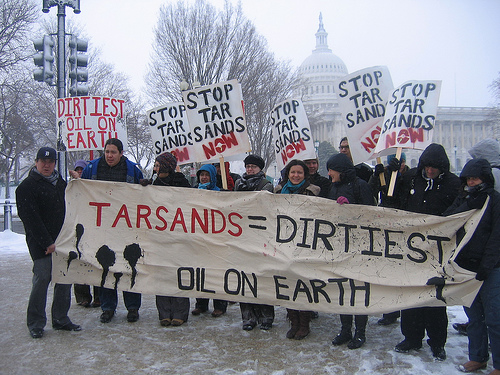
This article by Danielle Droitsch is re-posted from EcoWatch. Editor’s Note: The analysis in the following video on the climate impact of the tar sands pipeline is important and critical. However, we do not think that the action these groups are proposing, standing in front of the White House with signs, will be enough to actually stop the pipeline from being completed.
A new video released by Natural Resources Defense Council (NRDC) and 350.org explains how the Keystone XL tar sands pipeline is a lynchpin enabling the climate intensive tar sands industry to grow unimpeded. The video discusses cutting edge research from Oil Change International showing how tar sands oil causes more carbon pollution than originally estimated.
Recently, four energy experts and climate scientists from Canada and the U.S. traveled to Washington DC with an urgent message: if we are to truly respond to climate change which is causing extreme life-threatening weather, we must reject the Keystone XL tar sands pipeline. Watch the video and join tens of thousands of others on Feb. 17 for the Forward on Climate rally in Washington DC. Join us and send a message to the Obama administration that we need a comprehensive response to the threat of climate change. And one key ingredient of this plan will be for the U.S. to say No to the Keystone XL tar sands pipeline.
https://www.youtube.com/watch?v=TkgOmuIumjk&feature=player_embedded#!
New Report Analyzes Right’s Marriage Marketing
This article is re-posted from Political Research Associates. Editor’s Note: The report mentioned in this posting is important, because it not only documents the messages the anti-marriage equality movement has used, but provides some possibilities for counter-strategies.
“Mom, guess what I learned in school today! I learned how a prince married a prince, and I can marry a princess!”
Kids say the darndest things, don’t they? Over the past decade, the Right has drummed up fears that marriage equality will indoctrine children into a homosexual lifestyle. In the overwhelming majority of the state ballot initiatves on same-sex marriage up until 2012, the Right’s tactics in advertising and other areas have carried the day.
A new Political Research Associates briefing paper, “The Right’s Marriage Message: Talking Tolerance, Marketing Inequality,” (pdf) authored by researcher and activist David Dodge, provides an analysis of right-wing messaging–including insights into why they lost this year–to help LGBTQ organizers preparing for the next round.
This past November, equality organizers won in Minnesota, Washington, Maine, and Maryland, either passing same-sex marriage or defeating attempts to enshrine discrimination in the state constitution, in a surprising sweep. But, as Dodge warns, the Right will be back and better prepared, so we must remain vigilant.
2012 witnessed a significant shift in the Right’s messaging strategy. Advertisers largely abandoned their overtly homophobic messages, such as “Kids in Schools,” in favor of “Victims” religious liberty messaging, which details the “harm” done to churches, businesses, and individuals who oppose marriage equality. While other factors were in play, giving up the consistently successful “Kids in Schools” message took its toll, while the emerging religious liberty argument didn’t test as well in this field trial.
What, then, will the next campaign look like? In the new PRA report, Dodge analyzes the language in and data on dozens of ads over the years, outlining messaging strategies, how often they are used, and how effective they are in reaching voters. As the Right recovers from this election and does some soul searching, it’s likely they will revive faithful winning strategies. For this reason, Dodge’s historical context and analysis will be particularly helpful to advocates planning next steps.
As we enjoy the touching photos and stories coming out of Maine, Maryland, Minnesota, and Washington this month, we can also use this report to look to future campaigns and, hopefully, victories.
Econ Club GR speaker says Right to Work is just the beginning of greater “economic freedom”
The speaker at today’s Econ Club of Grand Rapids luncheon event was Dr. Robert Genetski, talking on the topic of Right to Work laws and economic freedom.
In some ways it seems a bit ridiculous to bring a speaker in to talk about Right to Work policies, not just because Michigan has made Right to Work a law, but because Genetski was addressing a predominantly business audience made up of the same circles of people who have been pushing for Right to Work policies for years.
The people who are active members of the Econ Club of Grand Rapids are also some of the same people who are involved in the West Michigan Policy Forum, which has made Right to Work a priority since its founding in 2008.
However, despite Michigan becoming the 24th State to adopt Right to Work Laws, the Econ Club and its members are not content and want to push even further to implement more business-friendly neoliberal economic policies.
This was evident even in the comments by Dick DeVos, who introduced the guest speaker today. DeVos said that it was an “Historic moment when Michigan enacted the Right to Work law and what Michigan did was more expansive than what Indiana and other recent Right to Work states have done.”
DeVos also made it a point to say that “union bosses” will be working hard to renew contracts in the state, since the Right to Work law made it so existing contracts will expire this year. DeVos showed his anti-union bias in the opening remarks and made it clear that the agenda of the Econ Club of Grand Rapids was to continue to work towards changing state policy that will be beneficial for the capitalist class.
Genetski’s presentation was very similar to the one he gave at the West Michigan Policy Forum in September in Grand Rapids. He chose to call Right to Work policies Freedom to Work, because his whole mantra was that the greater economic freedom individuals have, the more prosperous individuals and nations will be.
Genetski didn’t provide much evidence for his position and even stated early on that the kind of free market economy he advocated for is what God wanted for all of us, so we can all be prosperous. Such a statement no doubt played well to the West Michigan business community.
The speaker looked at Right to Work policies across the country and offered up comparisons between states with those policies and those without and where they were economically. Not surprising Genetski believes that those states with Right to Work laws and more business-friendly tax policies had better economies. Genetski also made it clear that the other factor, which determined economic prosperity, was states that had lower numbers of union members in their workforce.
Michigan, Genetski believes, will be able to turn things around economically when union power is weakened and tax policies will be redone. He blamed the economic problems in Michigan on bad tax policies and union control, but said that under Gov. Snyder things are changing.
Genetski also said he was disturbed by the proposed tax hike for road repair, which he says would raise the state tax rate 17% above the national average. “The state should take the money from other areas instead of new taxes,” which is code for cut spending on social programs and state worker salaries.
Genetski is nothing more than a pundit for the business class and even argues for the privatization of Social Security. None of this should be surprising, since Genetski is an “expert” with the Heartland Institute, a Right Wing Think Tank that is heavily funded by the Koch brothers and promotes the idea that global warming is a hoax.
It is paramount that people who care about economic justice and the future of Michigan, not only understand the deep commitment that the business class has to the acquisition of greater wealth, but factor this understanding into to their strategies for fighting back that go well beyond electoral politics.
Blockade at PA Fracking Site Highlights Risks to Farms and Food
This article by the Shadbush Environmental Justice Collective is re-posted from EcoWatch.
Residents of Western Pennsylvania and friends of Lawrence County farmer Maggie Henry locked themselves to a giant paper-mache pig today in the entrance to a Shell natural gas well site in order to protest the company’s threat to local agriculture and food safety. The newly-constructed gas well is located at 1545 PA Route 108, Bessemer, PA , 16102, less than 4,000 feet from Henry’s organic pig farm.
The farm has been in the Henry family for generations and has been maintained as a small business despite pressure from industry consolidation. The Henry’s made a switch from dairy to organic pork and poultry production several years ago as part of their commitment to keeping the operation safe and sustainable for generations to come. Joining Maggie Henry at the well site are residents from other Pennsylvania counties affected by natural gas drilling and Pittsburgh-area residents of all ages who support Henry’s fight. Many are customers who buy her food at farmers’ markets and grocery stores who do not want to see the integrity of their food source compromised.
The Henry farm is especially vulnerable to the risks associated with fracking because it is located in an area riddled with hundreds of abandoned oil wells from the turn of the 20th century. According to hydro-geologist Daniel Fisher who has studied the area, “Each of these abandoned wells is a potentially direct pathway or conduit to the surface should any gas or fluids migrate upward from the wells during or after fracking.”
Methane leaks from gas wells have been responsible for numerous explosions in or near residences in Pennsylvania in recent years. Migrating gas and fluids also threaten groundwater supplies, on which Henry and her animals depend for their drinking water. Last summer a major gas leak in Tioga County, PA caused by Shell’s own drilling operations, produced a 30 foot geyser of methane and water, which spewed from an unplugged well and forced several families to evacuate.
The nine foot tall pig is stationed in the driveway of the site with four protestors chained to its’ legs, obstructing traffic to and from the site. The protestors are wearing signs that read, “Fracking Threatens Food” and “Protect Farms for Our Future.” A couple dozen supporters are also on the scene.
Nick Lubecki, one of the protestors locked to the pig, recently started a farm of his own in Allegheny County. He worries about the future of agriculture in Pennsylvania, which is the state’s number one industry. “It is extremely disturbing as a young farmer to have to worry about the safety of the water supply in a chaotically changing climate while these out of state drillers have the red carpet rolled out for them. In a few years the drillers will all be gone when this boom turns to bust like these things always do. I don’t want to be stuck with their mess to clean up.”
Prior to this action, Henry exhausted all avenues to prevent or shut down the well through the legal system. Supporters of her farm have also held previous protests at the site. Despite the heightened risks posed by the abandoned wells in the area, Shell is moving forward with their operations, and Maggie’s supporters have turned to nonviolent civil disobedience.
The action comes on the heels of escalating nonviolent civil disobedience across the continent to stop extreme energy projects, like fracking, mountaintop removal coal mining and tar sands oil mining, which destroy communities and fuel the climate crisis. Last week a coalition of Appalachian and Navajo communities impacted by strip mining, blockaded Peabody Coal’s headquarters in St. Louis, MO. Earlier this month protestors in eastern Texas erected a tree sit blockade to halt construction of TransCanada’s Keystone XL pipeline, slated to transport crude oil from the devastating tar sands mining in Alberta, Canada to refineries in Texas.
 Grand Rapids Institute for Information Democracy